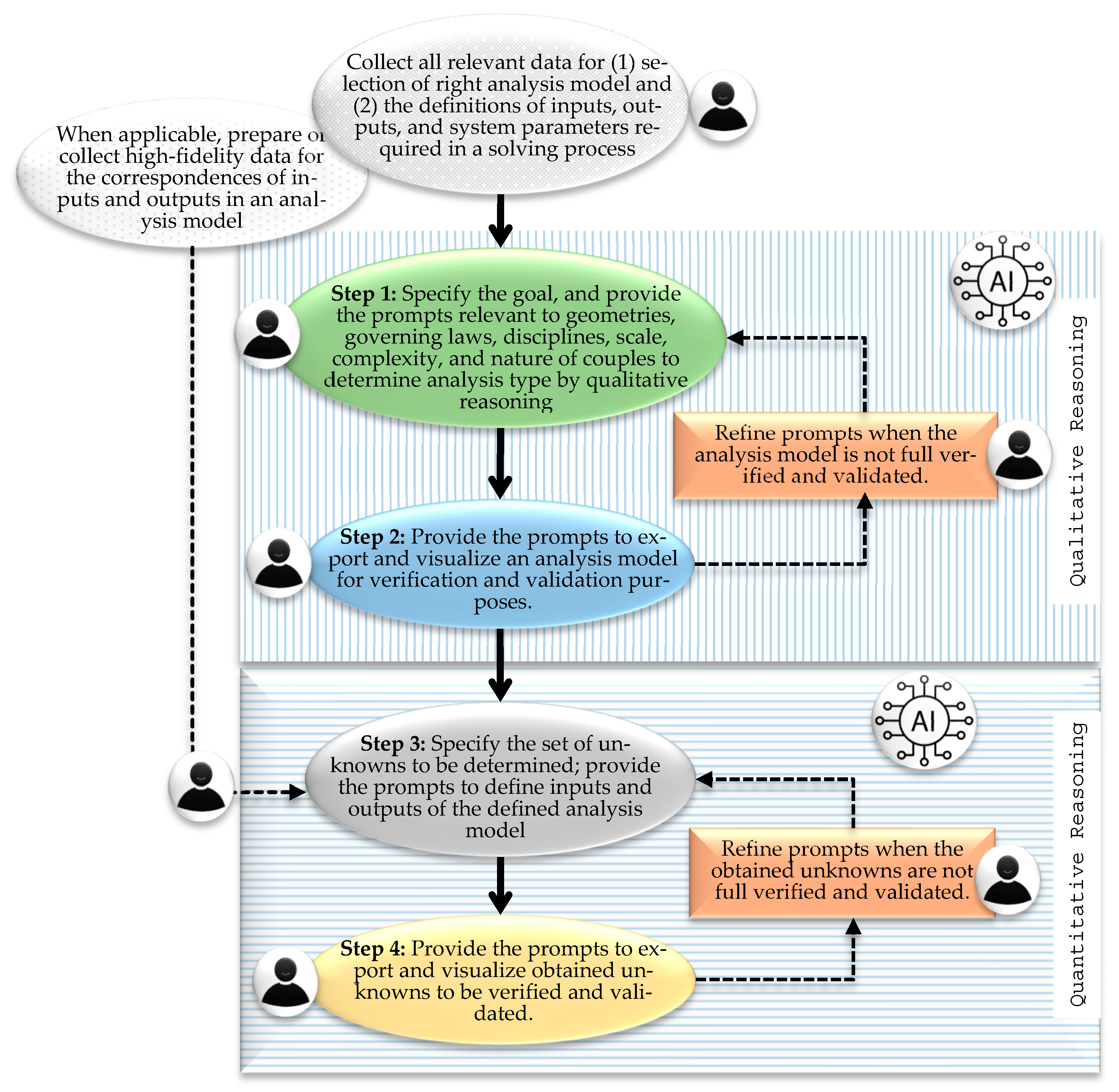
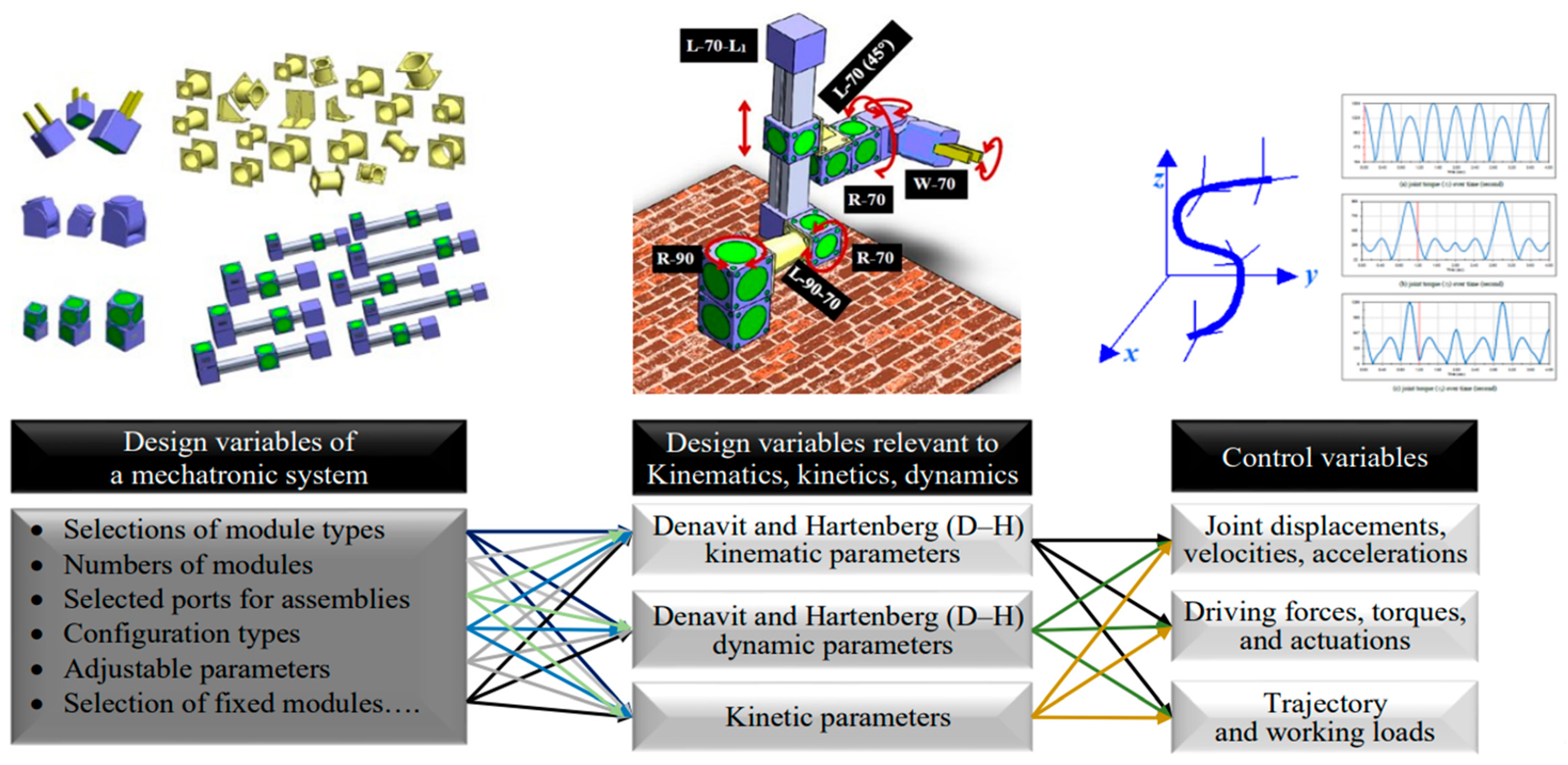
1. Introduction
Prosthesis is a branch of bio-mechatronics of developing an artifact that can replace a missing and injured part of a human body [
1,
2], and a
prosthetic leg is designed to replace the function(s) of an ankle and/or a knee of a human body [
3,
4]. The global market for prosthetic legs has been undergoing rapid transformation due to several main factors, especially the expectations of amputees for improved mobility, comfort, and quality of life. There are around 2 million
persons with limb loss (PWLL) and around 185,000 new amputations in the United States annually. Globally, there are 42 million PWLL [
5,
6]. The trend of the prosthetic market and the historical development of prosthetic technologies have been systematically discussed in many studies [
7,
8]. For example, Fagioli et al. (2024) [
9] conducted a literature survey and concluded that a total of 53 prosthetic designs were reported; these designs included 16 knee–ankle prostheses, 18 knee prostheses, and 19 ankle prostheses. They identified some open challenges from the mechatronic perspective in miniaturization, energy efficiency, cost reduction, adaptive controls, and verification and validation.
Research on prosthetic products has attracted significant attention in both academia and industry. Earlier works focused on the implementation of prosthetic functions. For example, Veneman et al. (2007) [
10] built a gait rehabilitation device consisting of a two-degrees-of-freedom (DOF) pelvis segment and a leg exoskeleton with a two-DOF hip joint and a one-DOF knee joint. Nandi et al. (2009) [
11] and Nandy et al. (2012) [
12] extended the bipedal robotics technology for an adaptive modular prosthetic leg. Hermini et al. (2011) [
13] modeled a biped locomotion system based on their understanding of anatomy, physiology, biomechanics, and robotics. Zelik et al. (2011) [
14] investigated the energy-storing system in a prototype prosthetic foot and found the importance of spring elements to gait mechanics and metabolic energy consumption. Kalyana (2015) [
15] and Halsne (2021) [
16] developed a simulation system to verify the concepts of various prosthetic legs qualitatively. Kaur (2016) [
17] and Salazar et al. (2025) [
18] studied how prosthetic products can be manufactured economically and suggested adopting additive manufacturing (AM) to reduce the development cycle and prompt customization. Lawson et al. (2014) [
19] designed a powered knee and ankle with integrated impedance controls, while Kondratenko et al. (2013) [
20] proposed a nonlinear impedance controller to deal with uncertainties and dynamics. Electromyography (EMG) signals or other neuro-signals were used by Sawake et al. (2014) [
21] and Valle et al. (2021) [
22] to control an above-knee prosthetic leg. Awad et al. (2016) [
23] developed a semi-active prosthetic knee that was able to operate in both active and active mode in a gait cycle for various activities of daily living. The passive model was featured as back-drivable. An open-source robotic leg was developed to alleviate the drawbacks of existing prosthetic legs in sustaining gait patterns, lacking net-positive mechanical energy, and implementing effective controls [
24]. Caputo (2015) [
25] developed an experimental platform to explore prosthesis designs to emulate their functions in a treadmill; however, it was found to be incredibly challenging in design or to prescribe effective lower-limb prostheses; moreover, technological adoption has been limited by an inability to justify an increase of 10–100 times in cost over existing solutions. Elery et al. (2020) [
26] designed an actuation scheme to control prosthetic legs with low-impedance actuation with the objectives to implement a free-swinging knee motion, reduce acoustic noise, and recycle power when making contact with the ground. Gabert et al. (2020) [
27] developed a compact robotic ankle–foot prosthesis with the purpose of weight and cost reduction. Yu et al. (2021) [
28] conducted a clinical evaluation of a modular prosthetic limb system and showed the potential of utilizing a pattern recognition paradigm for intuitive prosthetic controls. Xing et al. [
29] gave a comprehensive survey on admittance controls in operating a wheeled mobile manipulator with consideration of obstacles.
Existing prosthetic products have shown limited clinical adoption. In particular, no combined knee–ankle prosthetic leg is commercially available due to the absence of clinically viable controls [
30,
31,
32,
33,
34]. Developing a prosthetic system is not a trivial task. Traditional prosthetic systems implement their controls at the joint level. Li et al. (2024) [
35] and Kelly (2025) [
36] focused on task-level controls of a powered lower-limb prosthesis with the goal of regenerating realistic biological functions of the prosthetic system. Multi-muscle analyses were conducted to develop a customizable musculoskeletal model of an amputee with transtibial prostheses [
37]. Nipa et al. (2023) [
38] designed a robotic exo-leg to assist a patient with a transfemoral amputation in sitting, walking, and ascending stairs. Petelina (2025) [
39] developed an integrated framework called the
hip trajectory error (THE) to design a prosthetic leg for a user with an above-knee amputation. It incorporated the shock absorption function of early stance knee flexion in the design of a prosthetic foot. Pi (2025) [
40] utilizes noninvasive functional electrical stimulation for an amputation to sense the change in contact force, thus controlling a prosthetic leg adaptively. Rampeltshammer (2023) [
41] and Prieto (2024) [
42] proposed to balance torque-based and position-based controls of a
lower-limb exoskeleton (LLE) for a patient with complete spinal cord injury (cSCI) and without motor functionalities. To reduce weight and improve robustness and efficiency of robotic leg prosthesis, Tran et al. (2022) [
43] proposed a compliant underactuated mechanism as a single actuator to power both ankle and toe joints, and this allowed the biological toe to dissipate energy while the biological angle injected energy into the gait cycle. Other than cost analysis, a prosthetic solution should be validated rigorously to ensure its effectiveness, safety, and reliability. Etoundi et al. (2022) [
44] and Soliman (2024) [
45] developed a testing platform to evaluate the performance of prosthetic joints in performing comprehensive movements subjected to cyclic loading conditions.
Despite these technological advances, existing prosthetic solutions exhibit several notable limitations.
Cost is a primary concern. Most commercial products remain prohibitively expensive due to tightly coupled hardware–software architectures, limited modularity, and labor-intensive design and fitting processes. The average costs of available semi-active ankles, semi-active knees, and powered knees are
$22,000,
$32,000, and
$46,540, respectively. With a median household income of
$67.541, these prosthetic devices are out of most amputees’ reach (Davidson 2022) [
6].
Customization is a secondary concern. Customization is often restricted to parametric tuning rather than true functional reconfiguration, and design decisions may rely heavily on expert experience rather than systematic reasoning. In addition,
verification and validation of customized configurations are typically limited, making it difficult to guarantee long-term performance and safety across diverse use conditions. These limitations constrain scalability, impede innovation, and hinder broader adoption of advanced prosthetic technologies. Users increasingly demand prosthetic legs that not only restore basic locomotion but also support adaptive gait, energy efficiency, and personalized functionality for diverse daily activities and vocational needs. At the same time,
affordability,
accessibility, and
rapid customization have become critical market pressures, particularly in low- and middle-income regions and for aging populations. These demands necessitate prosthetic solutions that are scalable, modular, and adaptable to individual users while maintaining manageable lifecycle costs and training requirements.
Although recent studies have demonstrated the potential of large language models (LLMs) and generative AI in conceptual design, design ideation, engineering documentation, and generative design automation, most existing approaches treat AI as a stand-alone knowledge generation tool. Their primary objective is to generate candidate concepts, design alternatives, or descriptive knowledge from textual prompts. Consequently, these approaches often suffer from three limitations when applied to complex mechatronic systems such as prosthetic legs: (1) the generated solutions are not systematically linked to functional requirements and system architecture; (2) the reasoning process is largely opaque and difficult to verify against engineering constraints and physical laws; and (3) the generated concepts are rarely connected to lifecycle customization, validation, and evolution of physical products.
We propose to fill the above gaps by integrating Microsoft Copilot, axiomatic design theory (ADT), and digital triads (DT-II) into a unified knowledge-engineering methodology. Unlike conventional LLM-assisted design studies, the objective is not to autonomously generate a final design solution. Instead, AI is employed as a knowledge-discovery and synthesis engine within a structured engineering-design workflow. Most importantly, ADT decomposes complex system-level functional requirements into verifiable sub-requirements, thereby constraining the reasoning space of the LLM and enabling human validation at each decomposition level. DT-II further extends the framework beyond conceptual design by establishing continuous interactions among physical models, digital models, and life models throughout the product lifecycle.
The technical contributions of this work are threefold: (1) a human-verifiable AI-driven knowledge-engineering framework that combines structured prompting with ADT-based functional decomposition; (2) a DT-II-enabled architecture that links AI-assisted design reasoning to lifecycle customization, adaptation, and evolution of prosthetic systems; and (3) a methodology for identifying, reusing, and integrating existing engineering solutions and commercial off-the-shelf components into a modular prosthetic leg platform aimed at improving affordability, accessibility, and rapid customization. Rather than focusing on the generation of novel geometries, the proposed approach focuses on the systematic synthesis, validation, and lifecycle integration of knowledge for complex mechatronic systems.
3. Functional Requirements (FRs)
Low limb amputees can be first classified into
transfemoral (TF)
amputation and
transtibial amputation (TT) for an amputation level above or below the knee. Accordingly, transfemoral and transtibial levels are called above-knee (AK) and below-knee (BK) amputations, respectively. Additionally, from the perspective of the desired level of mobility by amputees, lower limb amputations are classified into five levels, i.e., K0, K1, K2, K3, and K4 [
23].
Unlike the design of dedicated prosthetic products by others, we develop a modular prosthetic leg DT-II [
58,
59] for any amputee to customize a prosthetic leg solution. In other words, DT-II accommodates all variants of physical prosthetic legs, desired levels of mobility, affordable cost levels, and types of residual legs.
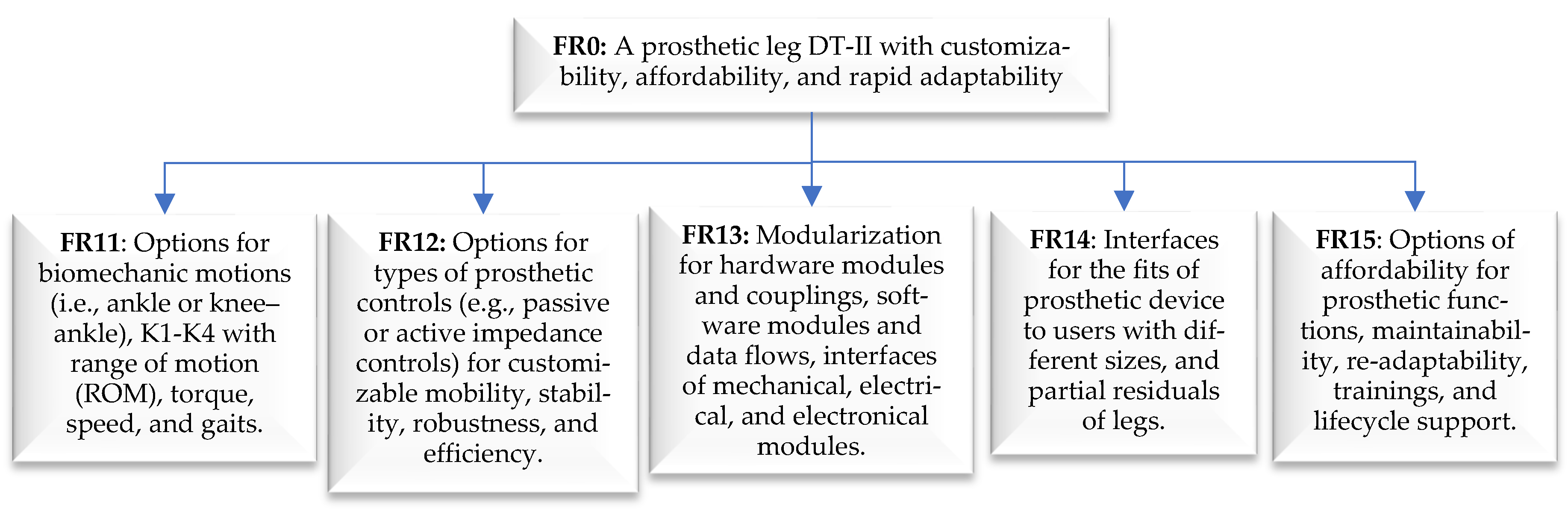
Figure 3 shows the decomposition of system-level FRs that consist of five sub-FRs. FR11 represents the options of biomechanic motions; FR12 represents the types of prosthetic controls; FR13 represents the need for hardware and software modularization; FR14 represents the setup of a prosthetic device with a user; and FR15 represents the requirements of affordability options for prosthetic functions, maintainability, re-adaptability, training, and lifecycle support.
3.1. FR11: Options for Biomechanic Motions
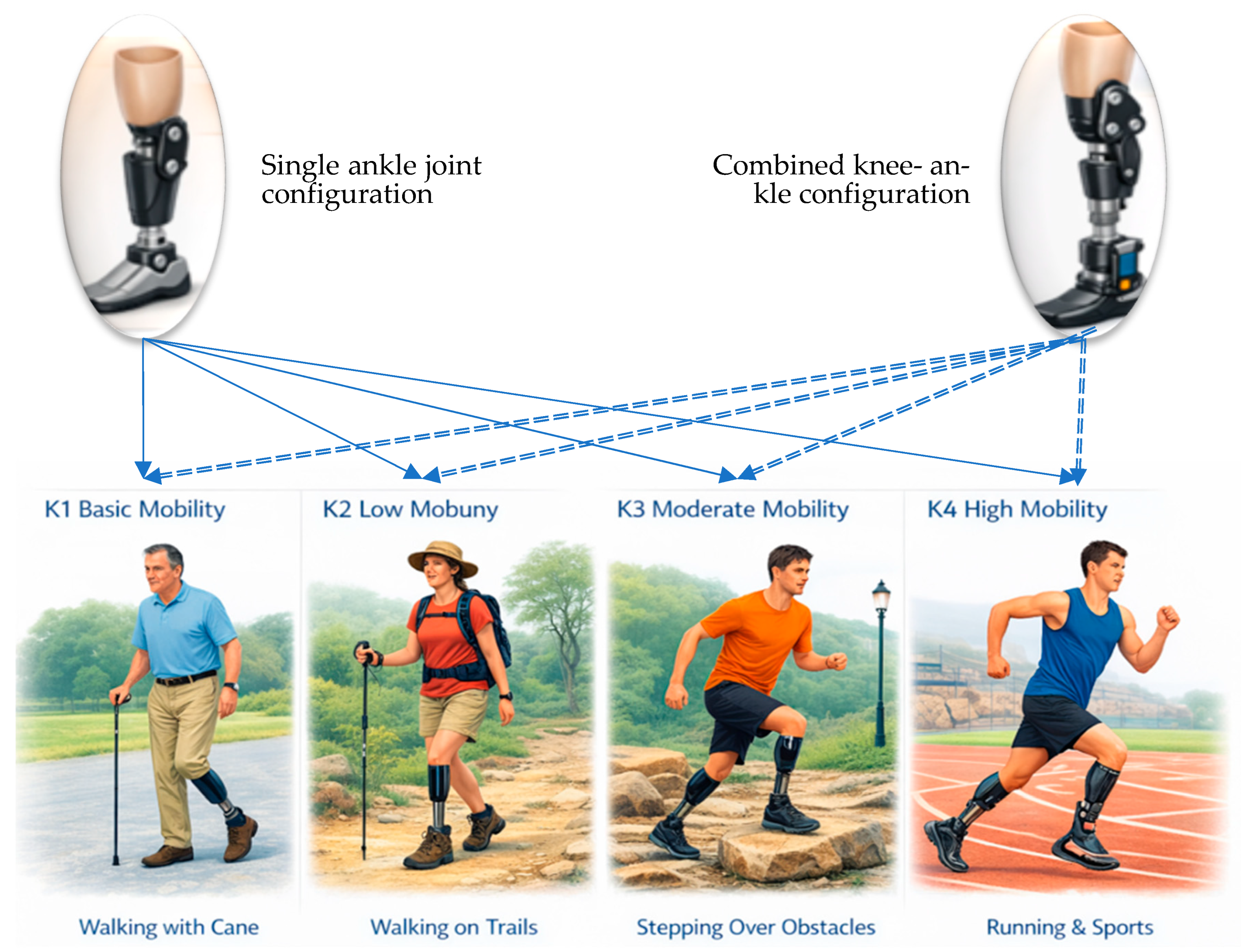
In a DT-II of prosthetic legs, the options of (1) an ankle joint only and (2) a combined ankle joint and knee joint should be available for amputees with BT and AT amputations, respectively. Therefore, to support individualized prosthetic prescription and scalable system design, a prosthetic leg should offer configurable joint architectures, specifically, (1) a single ankle joint configuration and (2) a combined ankle and knee joint configuration (See
Figure 4).
Moreover, Medicare functional classification levels (K-levels) provide a clinically established framework to categorize the desired lower-limb amputee mobility, ranging from limited household ambulation (K1) to high-impact athletic activity (K4). Either a single ankle joint configuration or a combined ankle and knee joint configuration impose distinct functional, actuator sizing, control bandwidth, and power requirements that must be aligned with the user’s K-level. Aligning prosthetic joint configurations with K-level classifications enables mobility-driven customization of actuation and control strategies. Single-ankle systems optimized for K1–K2 users emphasize simplicity, low power consumption, and robustness, while ankle–knee systems for K3–K4 users require progressively larger actuators, higher control bandwidth, and greater power availability. Defining these functional requirements within a modular framework allows prosthetic systems to scale across mobility levels and supports upgrades as a user’s functional capabilities evolve.
3.2. FR12: Options for Passive and Active Controls
Passive and active options should be available to make a trade-off between the cost, weight, functionalities, and recharging cycle, and this helps users to match their prosthetic needs to their financial budgets. Therefore, FR12 becomes a primary sub-FR of prosthetic leg DT-II for its ability to regulate impedances of prosthetic joints. The impedances of joints are regulated to ensure mobility, stability, comfort, and adaptability in various locomotion tasks. FR12 of DT-II provides the options of passive and active controls to enable scalable functionalities.
Passive impedance control relies on mechanical elements such as springs, elastomers, hydraulic dampers, and compliant linkages. These systems require minimal sensing and energy, offering robustness and low cost for amputees with stable gait patterns or limited mobility demands. DT-II must parameterize passive impedance elements so that AI-assisted customization can select appropriate stiffness and damping values based on user weight, activity level, and gait symmetry. Active impedance control employs sensors, actuators, and real-time controllers to modulate joint impedance dynamically. Sub-FRs include real-time sensing of joint position, velocity, and loading, as well as adaptive control laws that respond to terrain changes, walking speed, or transitions between level walking, stairs, and slopes. An active impedance control model continuously updates impedance parameters using data-driven learning, allowing the prosthesis to adapt over time while preserving stability and user trust. The left side shows the scenario of walking on a level surface by passive control that is illustrated by a spring–damper model with fixed stiffness and damping; a joint’s stiffness and damping are constant over a gait cycle. The right side shows a scenario of locomoting over stairs by active control. The control model involves sensors and a controller, and the joint’s stiffness and damping are varied over time. The table below shows the differences in FRs in adaptability, performance, energy efficiency, and complexity.
3.3. FR13: Hardware and Software Modularization
Modularization is critical to the success of product families [
60]. Modularization benefits cost reduction, customization, ease of maintenance, and technology upgradation. By decomposing the prosthesis into reusable modules, designers can utilize common components across product variants, thereby significantly reducing development and production costs. At the same time, modular design enables mass customization and allows designers to tailor a configuration to a specific user within the same DT-II. Furthermore, a modular system inherently supports rapid adaptability, where new sensing, AI control, or power technologies can be integrated through existing interfaces rather than redesigning DT-II. This capability is critical to embed rapidly developed AI and wearable sensing technologies, accommodate the amputee’s rehabilitation progression, and adapt to changing mobility needs.
FR13 of hardware modularization can be decomposed into sub-FRs that explicitly capture biomechanical and interface requirements of the ankle–knee system.
From the kinematic perspective, the corresponding sub-FR defines the required motion ranges of each joint, where the ankle must accommodate bidirectional rotation (e.g., dorsiflexion/plantarflexion typically on the order of ±20°) to replicate stance and push-off phases, while the knee must support near-full extension to flexion cycles consistent with gait subphases.
From the kinetic perspective, the corresponding sub-FR specifies torques and controllability required to support load transfer, propulsion, and backdrivability.
From the dynamic perspective, the corresponding sub-FRs define speeds and temporal characteristics of joints; for example, the bandwidth and response of a joint are required to match the cadence and phase duration in a gait. From the
task perspective, the corresponding sub-FR reflects activity-dependent durations and transitions, such as walking, ascending stairs, or going from sitting to standing.
Table 1 shows the main biomechanical characteristics that are used to define the FRs of joint modules [
19].
FR13 of software modularization specifies the requirements of user-centric operation and adaptability. Firstly, a functional module is required to tailor control parameters, gait profiles, and assistive behaviors to individual users with the consideration of body characteristics, activity preferences, and evolving rehabilitation states. Secondly, a functional model is required to support calibration, progressive gait training, and feedback-guided adaptation over time. Thirdly, a functional module is required to communicate and support the integration of high-level user commands with low-level joint control modules. Fourthly, intuitive and accessible interfaces are required to control and monitor the use of prosthetic legs.
3.4. FR14: User Interfaces
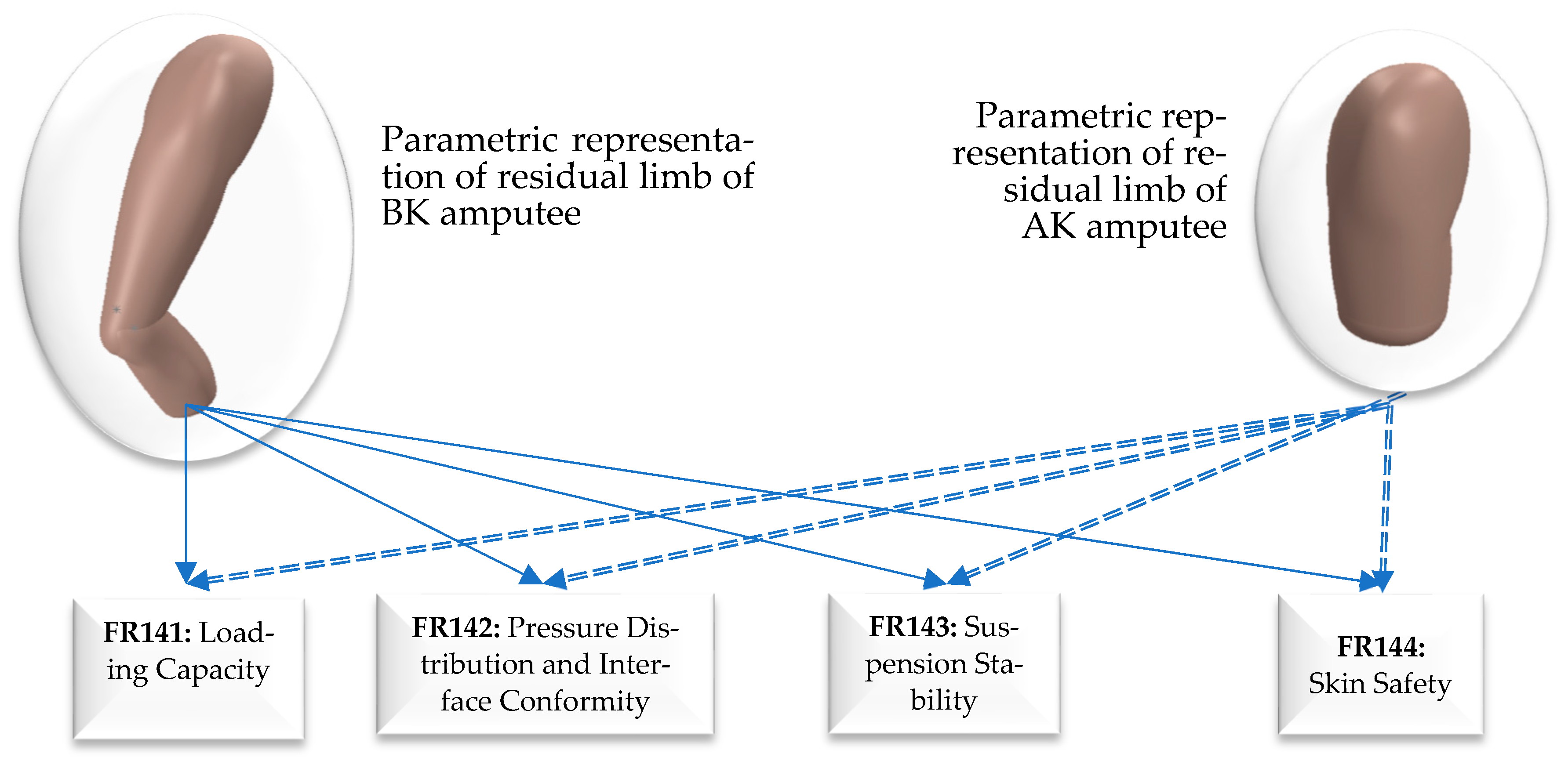
The FR14 user interface is critical to support the interactions of a user with a prosthetic system. FR14 firstly distinguishes application-specific interface configurations for
above-transfemoral (AT) and
below-transtibial (BT) amputees since there are anatomical differences in AT and BT users in terms of load paths, control strategies, and shapes and dimensions of residual limbs. Furthermore, FR14 is decomposed into a set of sub-FRs associated with residual limb–prosthesis couplings. As shown in
Figure 5, these sub-FRs include (1)
FR141 loading capacity to specify transmittable axial, shear, and torsional loads safely from the user’s body to the prosthetic structure during various activities; (2)
FR142 pressure distribution and
interface conformity to minimize discomfort and avoid tissue damage; (3)
F143 suspension stability to ensure minimal relative motion such as pitoning and rotation in dynamic activities; and (4)
F144 skin safety to prevent skin irritation, excessive perspiration, and tissue breakdown.
3.5. FR15: Option of Affordability
The FR15 option of affordability is decomposed to represent requirements on economic, operational, and sustainability dimensions. FR15 offers the options relevant to initial affordability, maintainability, re-adaptability, training accessibility, and lifecycle support services, since the consideration of all five of these aspects determines the total cost for an amputee. More specifically, affordability will be evaluated based on cost-effectiveness, standardization of modular components, and scalability. Maintainability cost is associated with ease of repair, replaceability, and downtime caused by malfunctioning modules. Re-adaptability cost is related to reconfigurability and upgradability when the prosthetic conditions change. Training-related costs are associated with user training, clinician support, and AI-enabled guidance systems. Lifecycle cost is associated with serviceability, monitoring, software updates, and end-of-life management in the long term.
4. Design Parameters (DPs)
According to ADT, mapping from FRs into design parameters (DPs) should follow two axioms, i.e.,
the independence axiom and
the information axiom. The independence axiom states that FRs must be independent from each other, and each FR should be satisfied by a corresponding DP without affecting other FRs. The information axiom states that DPs must be selected to minimize the information content, which further guides selection among feasible designs by requiring minimization of information content to decouple sub-DPs to a great extent [
61]. However, a prosthetic leg is a typical mechatronic system with a strongly coupled nature in fulfilling system-level FRs. In other words, ADT is not effective in determining the set of DPs of a strongly coupled multidisciplinary system due to the violence of two axioms [
62,
63]. It is worth noting that ADT is introduced to manage the complexity of prosthetic leg DT-II, so that the scope and level of an engineering solution generated by AI becomes manageable and verifiable by human designers.
Since a prosthetic leg DT-II consists of mechatronic functional modules (MFMs) with a strong multidisciplinary nature, instead of having one-to-one mapping to FRs, DPs are defined from a knowledge engineering (KE) perspective; DPs are decomposed into the sub-DPs of system architecture, hardware modules, software modules, hardware interfaces, and user interfaces for setup, training, and lifecycle support.
4.1. DP11: System Architecture
System architecture is a set of constitutive modules together with their interactions, rather than isolated components. Therefore, DP11 is concerned with how functional modules are organized and connected to form a coherent mechatronic system. For prosthetic leg DT-II, DPs for system architecture can be decomposed into the sub-DPs of hardware modules and software modules. DPs for hardware modules include these for structural modules (socket, pylon, and connector), actuation modules (ankle joints, knee joints, and impedance mechanisms), sensing modules (inertial measurement units (IMUs), positions, torques, electromyography (EMG)), power modules (battery, power suppliers), and communication modules (controller area network (CAN), ethernet/TCI/IP, Wi-Fi, Bluetooth, and Zigbee). DPs for software modules include these for information flows (sensor signals and control commands), energy flow (low and high voltage), and force flow (pressure, force, and torque in load transferring).
DP11 plays a foundational role in enabling FR11 to FR15 in the sense that (1) system architecture defines joints as self-enclosed modules, and a different number and type of module can be selected and assembled into a system configuration for specified bio-mechanic motions to meet FR11; (2) system architecture separates sensing, actuation, and control modules, different types of modules can be selected and assembled to enable passive or active control mechanisms to meet FR12; (3) FR13 for hardware and software modularization are directly met by adopting a modular system architecture; (4) system architecture defines the interface layers between users and functional modules and this provides integration pathway for customization required by FR14; and (5) system architecture contributes to FR15 by the standardization of modules, plug-and-play interface, reconfigurability, and scalability.
4.2. DP12: Hardware Modules
DP12 focuses on physical realizations of mechatronic functional modules (MFMs) and represents the tangible building blocks of the prosthetic system. In the proposed DT-II, types of hardware modules include (1) structural modules such as sockets for AT and BT configuration, load-bearing connectors, mechanical frames and housings, and adjustable alignments; (2) joint modules including ankle joints (passive, semi-active, or powered), knee joints (damping or powered), and impedance mechanisms (spring-damper, motor-driven, or statistical energy analysis (SEA)); (3) sensing modules such as IMU for position, velocity, and acceleration, loadcell, torque sensor, or bio-signals; (4) power modules including batteries or power suppliers; and (5) communication modules such as microcontrollers, FPGA, Wi-Fi, Bluetooth, and CAN.
DP12 contributes to the fulfillment of FR11 to FR15 in the sense that (1) selective joint and actuation modules can be used to achieve K1-K4 level of mobilities for AT and BT amputees to meet FR11; (2) both passive elements (springs, dampers, or compliant structures) and active elements (motors, sensors, control electronics) are embedded in corresponding hardware modules to enable passive or active controls of FR12; (3) FR13 for hardware and software modularization are directly met by using decoupled hardware modules and standardized interfaces; (4) socket modules are provided as hardware interfaces to meet FR14; and (5) modularized hardware allows to build an exact system configuration to fit a user’s budget to meet FR15.
4.3. DP13: Software Modules
DP13 provides computational and algorithmic infrastructure that orchestrates, coordinates, and adapts the behavior of hardware modules. Like hardware modules, software modules are organized as functionally cohesive and loosely coupled components that interact through data flows and communication interfaces. Four module types are (1) data acquisition and processing modules such as those for IMU and loadcells, and those for signal filtering, cleaning, and fusion; (2) control modules for impedance regulations, detection of gait phase, and motor-level controls; (3) AI and learning modules for implementation of adaptive controls, personalized models, and coordination at system-level; (4) middleware and communication modules to implement communication protocols; and (5) graphic user interfaces to interact with users.
DP13 contributes to the fulfillment of FR11 to FR15 in the sense that (1) control modules determine motion profiles and joint trajectories, coordinate ankle and knee motions, and adaptive user-specific gain characteristics to meet FR11; (2) software modules represent fixed impedance profiles for passive control and enable adaptive impedance and feedback control for active controls to meet FR12; (3) DP13 allows functional decomposition of the information system and standardizes the interfaces for data changes that meet FR13 from information system perspective naturally; (4) AI and learning modules allow software customization to meet FR14; and (5) modularized software allows to build an exact information system to fit a user’s budget to meet FR15.
4.4. DP14: Hardware Interfaces
DP14 focuses on how these modules are physically connected and interact through standardized interfaces. In a prosthetic leg DT-II, interfaces are critical to ensure the transfer of materials (loads), energy, and signals among modules. Therefore, DP14 consists of a set of interface specifications and mechanisms that govern compatibility, interchangeability, and system integration. Four hardware interface types are (1) mechanical interfaces including socket-residual interface for load transferring and fitting, joint-joint connectors, and adjustable connectors; (2) alignment interfaces such as pyramid adapters, telescopic connectors, and adjustable couplings; (3) electrical interfaces including power connections, wiring harnesses and electrical isolation and protection; and (4) attachment interfaces such as bolt patterns, standardized mounts, plug-and-play connectors, and quick-release mechanisms.
DP14 contributes to the fulfillment of FR11 to FR15 in the sense that (1) mechanical interfaces enable the integration of different functional modules to transmit force or torque across joints to meet FR11; (2) electrical interfaces enable power delivery to activate actuators and sensors, and signal interface enable data exchanges among functional modules to meet FR12; (3) standardized interfaces allow plug-to-play integration of modules and sustain independence of hardware components to meet FR13; (4) socket interfaces transmit pressure and load, and the interface mechanism ensures stability and comfort to meet FR14; and (5) modularized hardware interfaces allow for functional modules to fit a user’s budget to meet FR15.
4.5. DP15: Uses Interfaces for Setup, Training, and Lifecycle Support
DP15 defines software interfaces that support the prosthetic leg system across its entire lifecycle, including setup (ordering and configuration), training (adaptation and calibration), and operational lifecycle support (monitoring, maintenance, and updates). DP15 complements DP13 (software modules) by focusing specifically on interfaces and services that interact with users, clinicians, and support systems. Four types of DP15 are (1) setup and configuration interfaces for selection and assembly of modules and clinician dashboards in fitting and initialization; (2) calibration and personalization interfaces for the automation of calibration routines (alignment, sensor tuning, and impedance setting); (3) training and adaptation interfaces including gait training programs, guided feedback interfaces, and adaptative learning interfaces; (4) monitoring and diagnostic interfaces for real-time state monitoring, assessment, and diagnosis; and (5) maintenance and lifecycle support interfaces including predictive maintenance and alert system, software and upgrade interfaces, and lifecycle management tools. DP15 contributes to the fulfillment of FR11 to FR15 in the sense that (1) setup interfaces initialize, calibrate, and enable the communications after a system configuration is built to meet FR11 and FR12; (2) standardized interfaces allow plug-to-play integration of modules and sustain independence of software components to meet FR13 and FR14; and (3) modularized software interfaces allow for functional modules to fit a user’s budget to meet FR15.
5. Prosthetic Leg DT-II as Physical Solutions (PSs)
A
physical solution (PS) consists of determined DPs that can meet FRs satisfactorily. Based on our discussions of DPs and FRs, it is seen that the design of a prosthetic leg for an individual amputee is strongly coupled since the FRs-DPs are of the full rank.
It is found that the strongly coupled nature of the mapping matrix Equation (1) partially explains the reason why advancing a complex mechatronic product or system is so challenging and lagged by comparing rapidly developed enabling technologies. Every product development team can only specialize in certain subjects or technologies; there are no traditional ways to perform KE for the whole product and synthesize the strengths or expertise of enabling technologies by others effectively. From this perspective, LLM-based KE becomes a promising alternative to fill the above gap of traditional mechatronic design.
A physical solution (PS) for a mechatronic system must satisfy governing physical laws, boundary conditions, and temporal initial conditions. Within the framework of axiomatic design, PS is obtained through a mapping from functional requirements (FRs) to design parameters (DPs); therefore, the reasoning underlying this mapping must be explicit, traceable, and verifiable. In contrast, data-driven knowledge engineering approaches generate outputs through probabilistic transformations within hidden layers without establishing explicit causal relationships. As a result, large language models (LLMs) are generally unable to provide transparent and auditable cause–effect mappings from FRs to DPs. Consequently, a PS derived from data-driven, statistically correlated processes lacks interpretability, and its validity must be ensured through rigorous human-led verification and validation.
During the development of the prosthetic leg DT-II, Microsoft Copilot was repeatedly used to identify candidate hardware modules, control methods, interface technologies, customization approaches, and lifecycle-support strategies. A considerable portion of these recommendations was discarded during human verification because they did not satisfy affordability requirements, violated integration constraints, lacked sufficient technical evidence, or were inconsistent with biomechanical requirements. Only verified solutions were retained in the final DT-II architecture. This filtering process highlights that the proposed framework relies on human-guided knowledge synthesis rather than autonomous AI-based design generation.
5.1. Modular, Scalable, Decentralized Architecture
The concept of DT-II [
64,
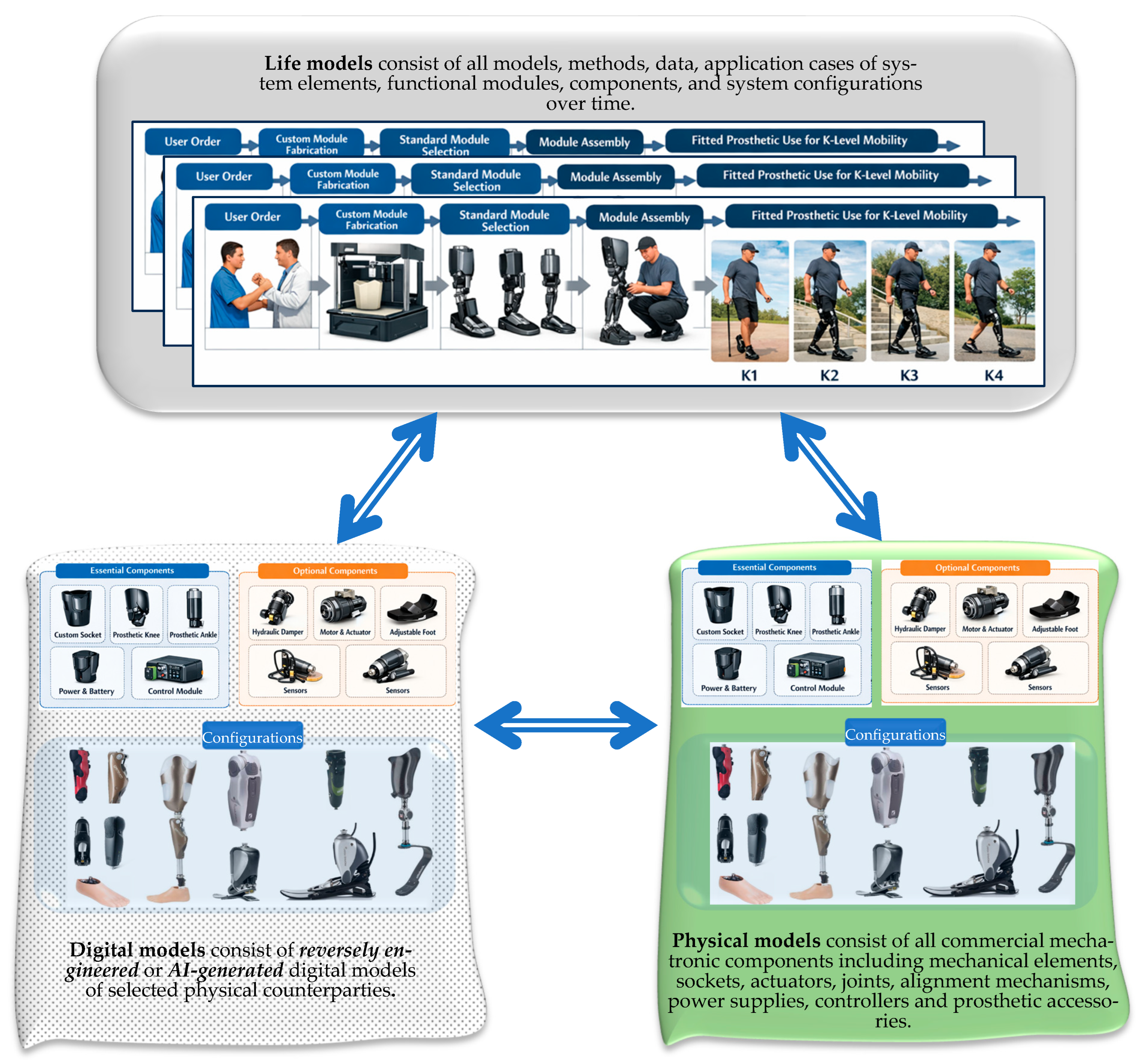
65] is adopted, and it is assisted by Microsoft Copilot to develop a modular, scalable, and decentralized architecture for a prosthetic leg DT-II, as shown in
Figure 6. Three models (i.e., physical models, digital models, and life models) are tightly interrelated and continuously evolved and empowered over their uses.
Physical models consist of all commercial mechatronic components, including mechanical elements, sockets, actuators, joints, alignment mechanisms, power supplies, controllers, and prosthetic accessories.
Digital models consist of reversely engineered or AI-generated digital models of selected physical counterparties.
Life models consist of all models, methods, data, application cases of system elements, functional modules, components, and system configurations over time. Bidirectional linkages among the three types of models ensure that operational data continuously updates these models for continuous improvement of the prosthetic leg DT-II over its system lifecycle.
The emphasis on modularization is central to fully utilizing available prosthetic technologies with minimized effort on re-invention. By decomposing the prosthetic system into essential and optional modules, the design isolates functional responsibilities and enables interchangeable physical realizations. Each module represents a physical embodiment of a design parameter or a group of closely related parameters, allowing targeted upgrades or substitutions for an FR to vary. The use of commercial off-the-shelf (COTS) components plays a crucial role in making this architecture both practical and economically viable. By leveraging readily available sensors, actuators, controllers, and power systems, the design avoids the need for extensive custom hardware development, thereby significantly reducing cost and development time. More importantly, the integration of COTS components minimizes repeated work across different designs and implementations.
Scalability emerges naturally from a modularized structure. From the system perspective, architecture provides all options to customize amputees’ needs, such as AT and BT amputations, mobility levels, shapes and geometries of residual limbs, and affordability levels. For example, as users transition from lower to higher mobility levels, the system can scale through the introduction of more advanced modules, such as microprocessor-controlled knees or powered actuators, without disrupting the overall architecture. Decentralization is another feature that implements the play-and-plug integration of functional modules. Instead of relying on centralized control in a conventional prosthetic leg, sensors and actuators within individual modules perform localized data acquisition and control actions, and a data-driven controller enables rapid response to real-time conditions such as changes in gait or terrain. This decentralized structure not only improves responsiveness and robustness but also enhances fault tolerance, as the failure or degradation of one module does not necessarily compromise the entire system.
5.2. AI-Driven Customization and Controls
Our study on the literature shows that the major portion of the cost of a prosthetic solution is associated with the following tasks: (1) customizing the interface of a prosthetic device with a residual limb and (2) providing training to operate or control a prosthetic device. Such a cost is reduced significantly when these tasks can be automated by open-source AI tools.
AI-driven customization transforms a traditionally labor-intensive and iterative prosthetic design process into a streamlined, data-driven workflow. A 3D limb scan captures precise geometric and anatomical information of the residual limb, eliminating the need for multiple manual casting and fitting sessions. This digital representation is processed by an AI-enabled design system that automatically generates an optimized socket geometry tailored to the user’s biomechanical requirements. By embedding cost models and historical design knowledge within the AI system, the framework simultaneously evaluates alternative configurations and selects cost-efficient solutions while maintaining performance constraints. This may reduce design time, minimize material waste, and avoid repeated trial-and-error adjustments that are common in conventional prosthetic fabrication. The integration of digital models with automated fabrication further reduces dependence on highly specialized manual craftsmanship, thereby lowering labor costs and enabling consistent quality across different production environments.
An AI-driven control reduces the lifecycle cost by improving operational efficiency and extending system longevity. Publicly accessible data and real-time data from distributed sensors can be fused and processed through AI models to extract predictive insights about gait patterns, component wear, and user adaptation. This allows the prosthetic system to perform adaptive adjustments in real time, improving comfort and functional performance without requiring repeated clinical visits for manual tuning. Additionally, the capability of predictive maintenance may reduce the likelihood of unexpected failures and costly repairs by identifying issues before they escalate. The use of learning-based models further enables the system to generalize across similar users and conditions, reducing the need to redesign control strategies from scratch for each individual case.
5.3. Customization of Prosthetic Legs
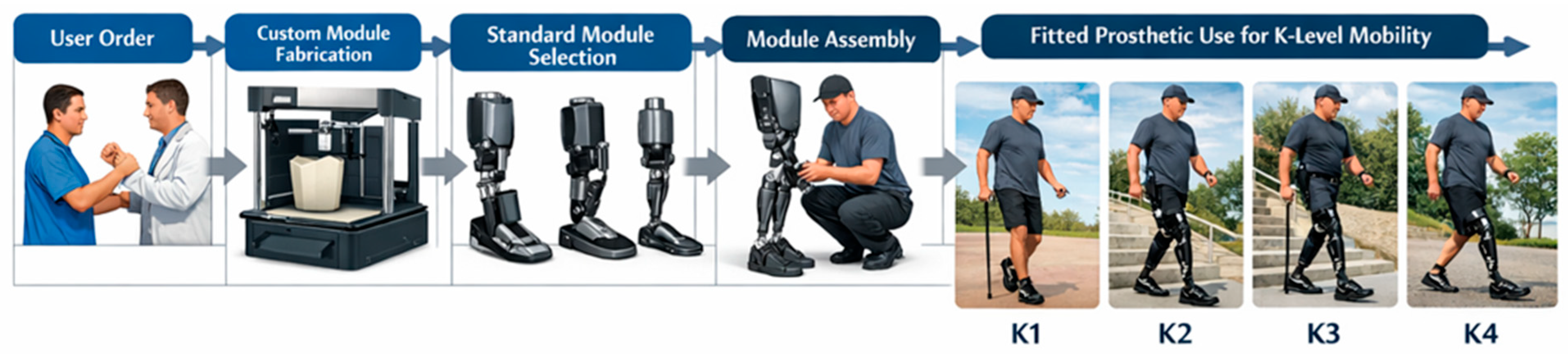
The proposed prosthetic leg DT-II serves as a universal platform for amputees to customize their prosthetic legs with optimized fulfillments of desired FRs, including expected costs. Every instance of life models in system architecture is a model of a customized prosthetic leg, and it is created by performing a series of tasks illustrated in
Figure 7.
The proposed DT-II enables the entire design cycle that is executed as an integrated, data-driven, and cost-efficient workflow. At the initial stage, user-specific requirements are captured and translated into digital representations, allowing AI-assisted customization to generate custom components, including sockets, while most of the system is constructed from standardized modules. This selective customization significantly reduces fabrication cost and time by avoiding repeated designs and testing efforts. During module assembly, the compatibility ensured by the modular architecture simplifies integration and reduces labor intensity, while also enabling rapid configuration changes without re-engineering the entire system. Throughout the lifecycle, the architecture supports scalable adaptation to different mobility levels (K1–K4) by reconfiguring modules rather than redesigning the prosthesis, which substantially lowers long-term ownership cost.
The tight coupling between digital models and physical implementation in the DT-II framework ensures that design decisions are validated before fabrication and continuously refined during usage, thereby reducing costly post-deployment corrections. Moreover, the reuse of common modules and the ability to upgrade only specific subsystems as user needs evolve prevent repeated work and extend the service life of the prosthetic system. As a result, architecture achieves cost reduction not only in initial design and manufacturing but also across maintenance, upgrade, and lifecycle management, while maintaining high performance and personalization.
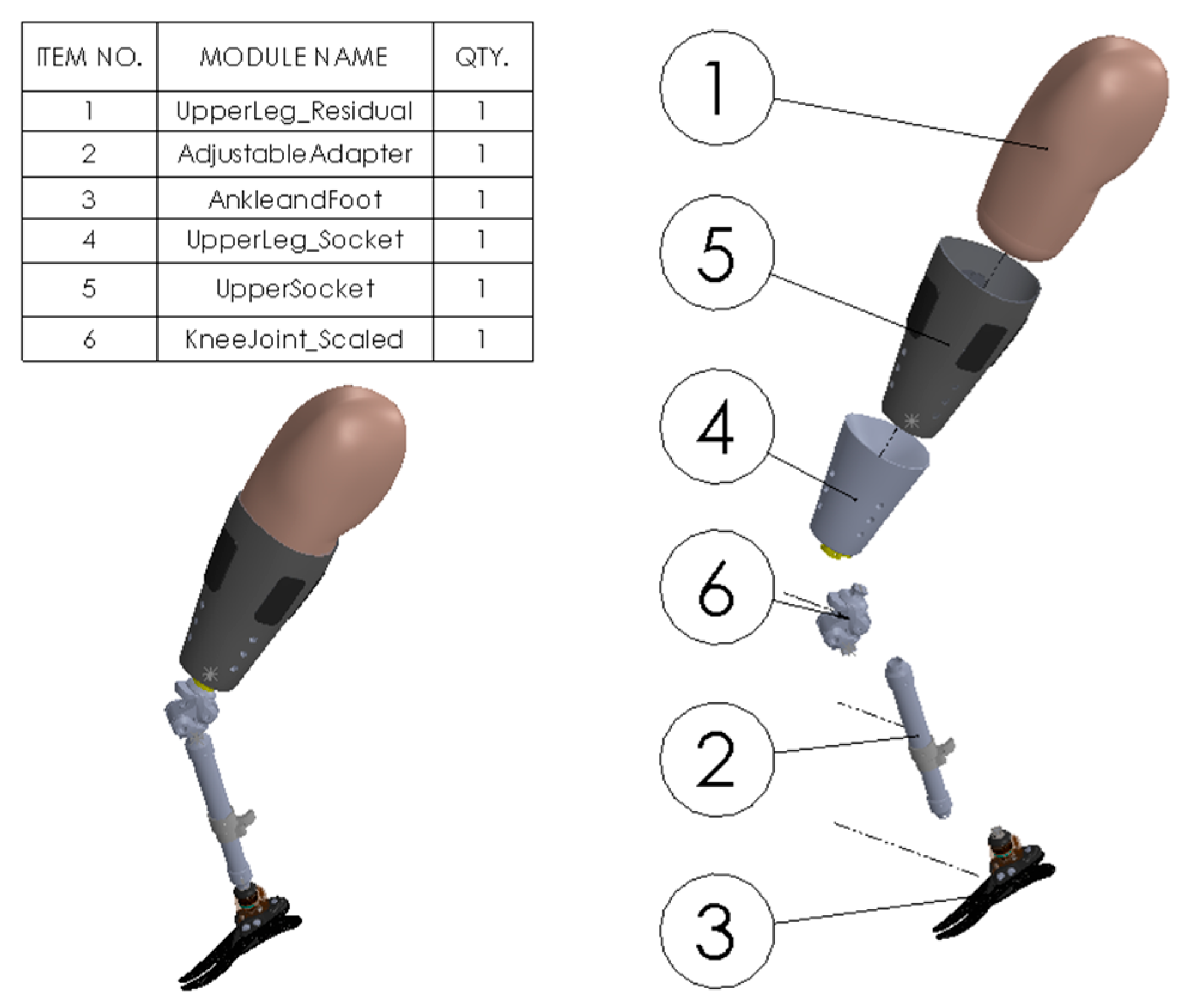
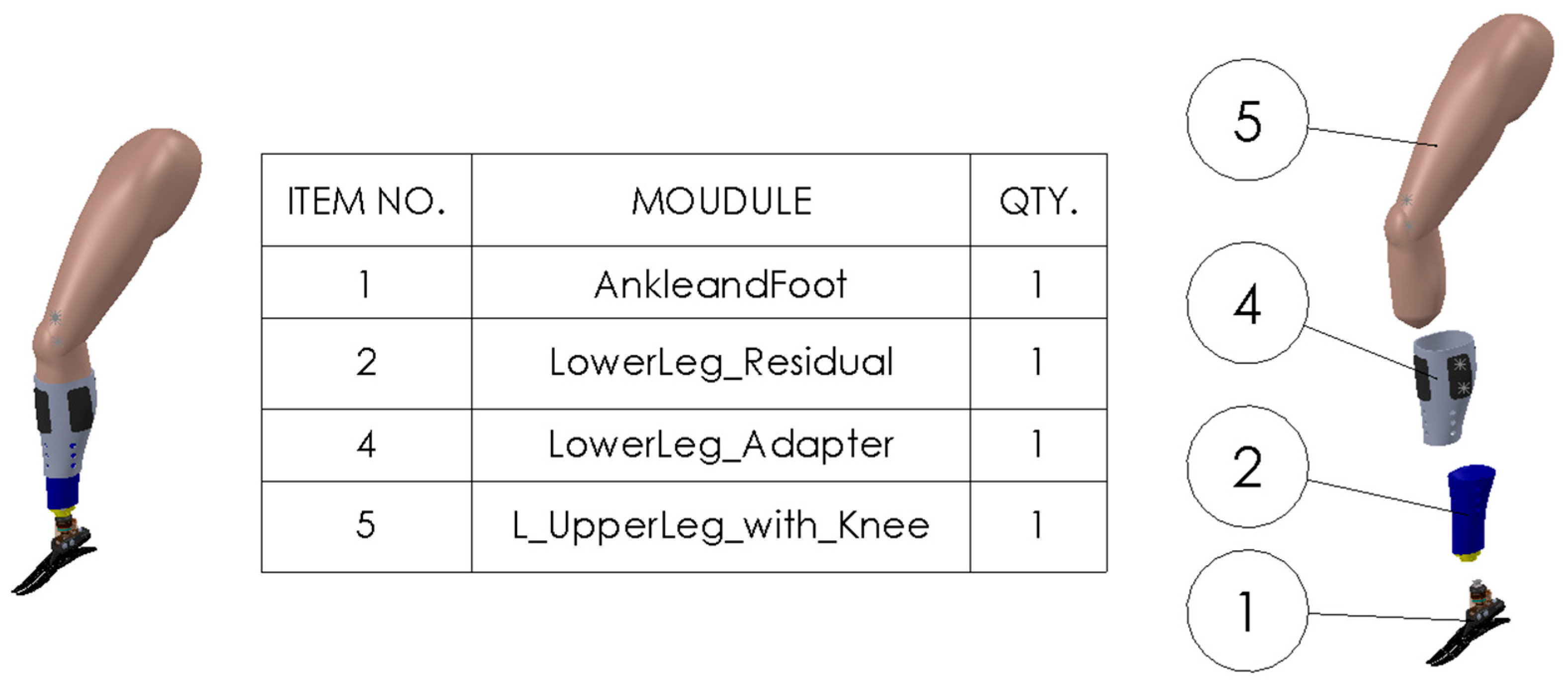
Figure 8 and
Figure 9 show examples of AT and BT configurations from the proposed prosthetic leg DT-II, respectively.
5.4. Cost Analysis by Comparison
It is our primary goal to improve the affordability of prosthetic products. The cost of available prosthetic legs spans a wide range depending on the level of amputation, advancement of embedded technology, and functionalities. The search by Microsoft Copilot shows that a basic prosthetic leg costs in the range of $5000–$15,000, while that of a high-end one, such as the Ottobock C-Leg, is in the range of $40,000 to $130,000.
By contrast, the proposed modular, scalable, and decentralized DT-II-based prosthetic architecture provides a structured pathway to reduce both initial and lifecycle costs by systematically addressing these cost drivers in the sense that (1) the use of AI-driven customization significantly reduces manual fabrication and fitting iterations, which are a major contributor to labor cost, suggesting a reduction of approximately 20–30% in customization-related expenses; (2) standardized modular components are utilized to the great extent to reduce design redundancy and this may lead to an estimated 15–25% cost reduction in system integration and assembly; (3) the integration of commercial off-the-shelf (COTS) components, combined with modular substitution, has the potential to dramatically reduce the cost of high-value subsystems such as microprocessor knees—experimental evidence suggests that functionally comparable smart knee systems can be implemented at a fraction of commercial prices using standardized sensors and controllers, indicating a possible 30–50% reduction in hardware cost for advanced configurations; and (4) AI-driven monitoring and predictive maintenance reduce long-term servicing and replacement costs by minimizing failure rates and unnecessary clinical visits, contributing an additional 10–20% lifecycle cost saving. Aggregating these contributions, the proposed DT-II architecture is expected to achieve an overall cost reduction on the order of 40% to 70% compared to current high-end commercial prosthetic systems, while maintaining or even enhancing system performance through optimized design, data-driven control, and efficient reuse of validated components. It is worth mentioning that while the prediction of 40% to 70% cost reduction is very promising, it is predicted by Microsoft Copilot, which cannot be verified or proven until we develop and experiment with our physical systems in the next stage.
In the prosthetic leg case study, human verification is performed whenever Microsoft Copilot recommends candidate modules, control strategies, interface configurations, or system architecture. The designer evaluates whether the generated recommendations satisfy the previously defined FRs, comply with biomechanical and engineering constraints, and remain consistent with affordability targets. Recommendations that cannot be justified using engineering evidence or established design principles are rejected and regenerated through refined prompting and additional decomposition.
6. Summary, Conclusions, and Future Work
This study has presented an AI-driven KE framework to develop a modular prosthetic leg DT-II. The proposed methodology integrates AI with ADT to systematically decompose complex FRs into DSs that can be managed and are verifiable to human designers. By combining structured qualitative and quantitative reasoning with human-in-the-loop verification, the proposed DT-II enables a transparent and traceable mapping from FRs to DPs, which is essential for addressing the inherent complexity of prosthetic systems. The proposed DT-II enables scalable customization across amputee types, mobility levels, and cost constraints, thereby addressing key limitations of existing prosthetic technologies such as high cost, limited adaptability, and lack of systematic design reasoning.
A distinguishing characteristic of the proposed framework is the incorporation of a formal human-in-the-loop verification and validation process. Unlike purely data-driven design approaches, each stage of AI reasoning is subjected to explicit evaluation against functional requirements, physical laws, engineering feasibility, safety considerations, and lifecycle objectives. This iterative verification mechanism improves transparency, traceability, and trustworthiness while enabling AI-generated knowledge to be integrated into engineering decision-making responsibly. AI-generated outputs are treated as candidate engineering knowledge rather than validated design solutions. The framework incorporates explicit prompting, human verification, rejection of unsuitable recommendations, and iterative refinement. By documenting representative prompts, outputs, acceptance criteria, and rejection decisions, the proposed approach improves transparency and reproducibility of LLM-assisted engineering design.
The conclusions of this work highlight several key innovations: (1) a novel AI-driven KE is introduced by integrating Microsoft Copilot with ADT, enabling structured and iterative design reasoning that bridges data-driven intelligence and physics-based engineering validation; (2) the system architecture in DT is modular, scalable, and decentralized, and it supports the plug-and-play integration of mechatronic modules and decentralized control, significantly enhancing system adaptability, robustness, and reconfigurability; (3) the emphasis on modularization and the use of commercial off-the-shelf components provide a practical pathway for reducing both initial and lifecycle costs while minimizing redundant engineering effort and accelerating system deployment; (4) the incorporation of AI-driven customization and control introduces a data-driven lifecycle approach that reduces design iteration, improves user-specific adaptation, and enables predictive maintenance, thereby enhancing both performance and affordability of prosthetic solutions. Future work will focus on validating and extending the proposed framework through both experimental and computational studies. A critical next step is the physical implementation and testing of prototype prosthetic systems derived from the DT-II framework to verify the predicted performance improvements and cost reductions, particularly the estimated 40–70% cost savings relative to current commercial systems, which remains to be experimentally validated. Future validation involving human participants will be conducted in compliance with institutional ethical guidelines and with prior IRB approval.




 ,
,