Article

A Reconfigurable Design Approach for Hybrid Tendon–Pneumatic Continuum Robots Enabled by Soft Multi-Lumen Backbones

School of Electronic and Electrical Engineering, University of Leeds, Leeds LS2 9JT, UK
*
Author to whom correspondence should be addressed.
Actuators 2026, 15(6), 339; https://doi.org/10.3390/act15060339 (registering DOI)
Submission received: 30 April 2026 / Revised: 4 June 2026 / Accepted: 10 June 2026 / Published: 13 June 2026
(This article belongs to the Special Issue Soft Pneumatic Actuators: Recent Advances and Emerging Applications)

Abstract

Continuum robots offer inherent compliance and dexterity for operation in confined and unstructured environments; however, achieving hybrid multi-segment functionality typically requires application-specific redesign and tightly coupled architectures. To address this limitation, this study proposes a reconfigurable hybrid continuum robot architecture based around a multi-lumen central integration backbone that supports multiple actuation modalities and robot configurations. The proposed design combines external tendon-driven disk modules for proximal actuation with a pneumatically actuated distal tip, while internal lumens allow routing of pneumatic lines and the insertion of optional stiffening elements without structural interference. The reconfigurability of the architecture is demonstrated through two configurations: Concept-1, a two-segment hybrid system, and Concept-2, a miniaturized three-segment configuration achieved by reducing the disk diameter and extending tendon actuation to the backbone. Experimental evaluations are conducted to characterize segment-wise actuation, coupled deformation behavior, and workspace capabilities, hysteresis response, tip contact force, and phantom-based target reachability. Results show that the integration of tendon-driven and pneumatic actuation significantly expands and reorients the reachable workspace. Additional functional tests showed repeatable loading–unloading behaviour of the tendon-driven segment, a maximum pneumatic tip contact force of approximately 0.45 N, and successful access to five representative targets within a stomach-like phantom using Concept-2. A kinematic model based on a constant-curvature formulation is validated against experimental data, yielding root-mean-square errors (RMSE) of 5.44 mm and 6.12 mm for Concept-1 and Concept-2, respectively. These results demonstrate consistent model accuracy across different configurations and scales. Overall, the proposed architecture enables modular, scalable, and reconfigurable hybrid continuum robots, providing a flexible framework for applications ranging from large-scale manipulation to gastroscopy-inspired minimally invasive procedures.

1. Introduction

Continuum robots (CRs) offer high dexterity and structural compliance, enabling adaptation to non-uniform objects and complex navigation within confined spaces [1,2]. Consequently, CRs are well-suited to applications where adaptability is essential, including industrial and agricultural tasks involving grasping or interaction with unstructured objects [3], medical applications such as endoscopy [4] and minimally invasive surgery [5], and inspection tasks in confined or cluttered environments [6]. To meet the broad range of requirements associated with these application areas, CRs have been developed using a variety of actuation strategies. These have included tendon-based [7,8], pneumatic [9], hydraulic [10], and magnetic mechanisms [11], with each presenting unique benefits and limitations. For example, tendon-driven systems enable compact proximal actuation, high force transmission, and relatively simple mechanical designs; however, they are prone to issues like frictional losses, backlash, and tensioning complexity, which can introduce nonlinear dynamics and hysteresis [12]. Pneumatic actuation can generate smooth, distributed deformation through pressurization and allows compliant motion with relatively simple input transmission. However, its nonlinear pressure-to-deformation relationship often limits the accuracy of control and repeatability [13]. Magnetic actuation enables wireless manipulation, removing the need for mechanical or fluid transmission elements; however, it requires dedicated external field-generation hardware and careful field control, which can increase overall system complexity and limit practical deployment [14].
To balance the strengths and limitations of different actuation approaches, hybrid CRs have been developed that combine different actuation modes and structural concepts [15]. Hybrid systems have combined different modes of actuation, including tendon-driven bending with fluidic growing [16,17], tendon and magnetic actuation [18], or mixed different structural paradigms involving hard components [19], soft components [20], and hard–soft combinations [21]. Hybrid approaches aim to improve dexterity, compliance, controllability, and task-specific adaptability [15]. In particular, architectures that merge tendon-driven and pneumatic sections have demonstrated enhanced operational flexibility and agility by improving the decoupling between proximal and distal bending segments [22,23,24]. Within such systems, tendon mechanisms generally provide accurate directional steering and proximal force transmission, whereas pneumatic components contribute compliant bending and supplementary degrees of freedom. Table 1 compares representative tendon–pneumatic hybrid continuum robots. These approaches have demonstrated important capabilities, including pneumatic deformation, tendon-driven steering, variable stiffness, length modulation, and application-specific functional integration. However, despite these advantages, existing systems are primarily based on fixed body architectures in which the actuation pathways, structural components, and segment definitions are tightly integrated for a specific robot configuration [25,26]. As a result, fabrication becomes more complex, modularity is reduced, and reconfiguration or adaptation of the robot’s design to suit different tasks is challenging [15].
Therefore, a major challenge exists for the design of hybrid CRs in creating a cohesive, modular framework that supports multiple actuation types within a space-efficient body and allows simple reconfiguration. Specifically, it remains difficult to house pneumatic tubes alongside tendon systems without increasing structural complexity or compromising the robot’s inherent flexibility. Therefore, there is a need for design strategies that allow different actuation pathways to coexist within a compact continuum body without reducing modularity, flexibility, or ease of assembly [27,28]. Motivated by this challenge, we propose a reconfigurable hybrid CR architecture enabled by a soft multi-lumen backbone (Figure 1). In contrast to existing designs (Table 1), the proposed architecture uses a soft multi-lumen backbone as a shared structural and routing platform. Specifically, the internal lumens can be reconfigured to act as pneumatic transmission lines, accommodate actuation tendons, or house structural stiffening inserts without increasing the external diameter of the robot (Figure 1A). Additionally, the compliant structure can be used to support mechanical self-anchoring of external tendon routing disks to further extend segment definition and degrees of freedom of the CR.
Table 1. Architectural comparison of representative tendon-pneumatic hybrid continuum robots. (NR: not reported.)
StudyRobot Diameter (mm)No. of SegmentsBody/Structural CompositionReconfigurability/ModularityApplication
[13]NRNRSoft urethane rubber modules + 3D-printed connectors; pneumatic inflation + tendon wiresFixed soft manipulator; pressure-based stiffness/length tuningSoft manipulation
[22]231Silicone segment; pneumatic chambers + embedded tendonsFixed body architecture; variable stiffness through tendon–pneumatic antagonistic actuationMinimally invasive surgery
[23]181Helical spring-like continuum structure + central NiTi backbone; cable-driven bending + pneumatic flat tubesFixed body architecture; variable stiffness via pneumatic pressure; integrated functional channelsFlexible gastrointestinal endoscopy
[24]151Ecoflex soft cylindrical body; 3 air chambers, 3 tendons, central working channelFixed body architecture; geometry-optimized design; hybrid air–tendon actuationIntra-bronchial intervention
[29]NR3Fabric-based origami pneumatic chamber + spacer disks; 3 tendons; no elastic backboneExtensible body; pressure-tunable stiffness; modular origami chamberGeneral continuum manipulation
[17]144TPE tubular body + 3D-printed disks; 3 tendons + single pneumatic chamber + central tool channelFixed extensible architecture; Pressure-driven length modulation; tendon steering; reversible tool-channel lockingGastroscopy/endoluminal intervention; soft gripping
Concept-1 (This Work)50:52Soft multi-lumen backbone, rigid external tendon-routing disks, and soft pneumatic distal tipReconfigurable hybrid architecture; modular disk system; decoupled tendon-–pneumatic segmentsLarge-scale manipulation/agricultural harvesting
Concept-2(This Work)10:6.6:53Soft multi-lumen backbone, miniaturized rigid disks, internal tendon-actuated backbone segment, and soft pneumatic distal tipReconfigurable hybrid architecture; miniaturized modular body; additional backbone-actuated segmentGastroscopy and minimally invasive endoscopic procedures
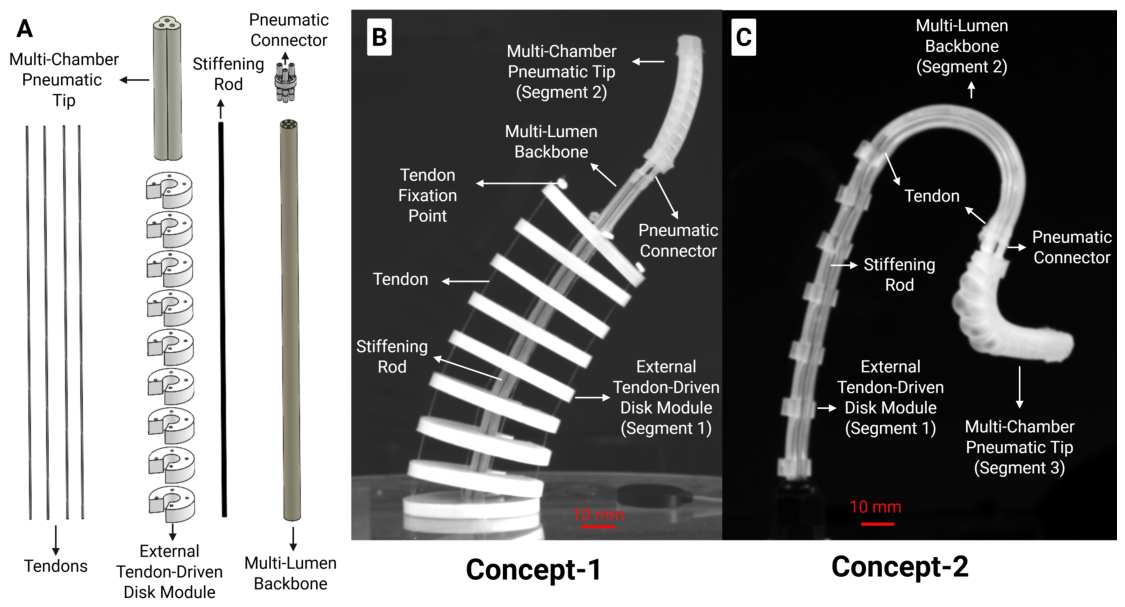
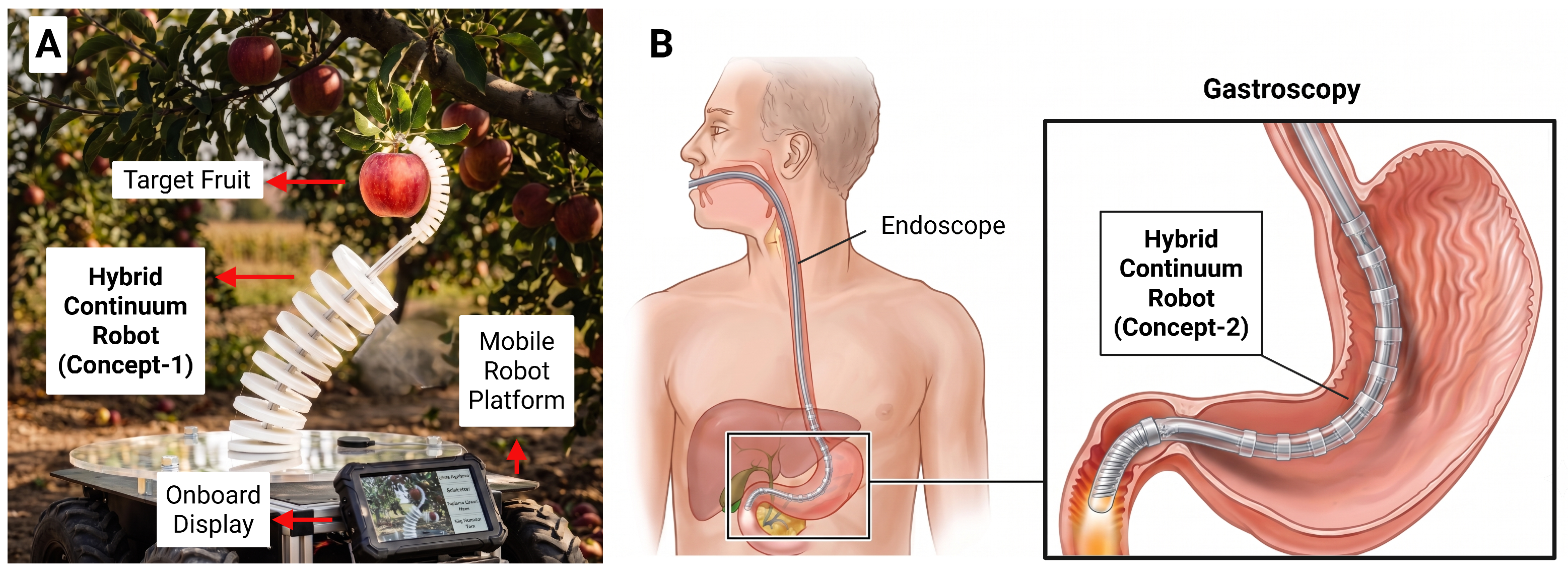
Therefore, the main contribution of this work lies not only in combining tendon-driven and pneumatic actuation, but also in demonstrating an architecture that can be reconfigured at the design level across robot scale, segment number, and actuation arrangement. To demonstrate the system’s reconfigurability, two designs are presented. Concept-1 (Figure 1B) represents a two-segment hybrid robot composed of a proximal external tendon-driven disk module and a distal pneumatically actuated tip. In this configuration, actuation modalities are spatially separated, enabling straightforward integration and controlled deformation behavior. Concept-2 (Figure 1C) reconfigures and extends this architecture into a miniaturized three-segment configuration by reducing the disk diameter and enabling tendon actuation of the backbone through internal lumen routing, resulting in an additional intermediate segment. In this way, these two configurations demonstrate how the proposed architecture can be adapted across different scales and segment arrangements while preserving a common design principle. Table 1 compares the main features of the two concepts with existing approaches and highlights the versatility of the proposed framework in suiting distinct representative application scenarios. Specifically, Concept-1 represents a larger-scale configuration that may be relevant to manipulation tasks in unstructured environments, such as agricultural harvesting (Figure 2A), whereas Concept-2 represents a compact configuration that may be relevant to confined-space applications, including gastroscopy and minimally invasive endoscopic procedures (Figure 2B). These examples are intended to contextualize the design motivation, while the present study focuses on the architectural design, modeling, and experimental characterization of the hybrid CR platform.
The main contributions of this work are summarized as follows:
  • A multi-lumen backbone design framework that serves as a unified structural and routing platform for integrating tendon-driven and pneumatically actuated segments within a compact hybrid CR that supports reversible assembly through self-anchoring disks.
  • Hybrid design implementations based on the framework, demonstrating two embodiments: Concept-1, a two-segment hybrid robot, and Concept-2, a miniaturized three-segment robot obtained by reducing the disk scale and activating the backbone as an additional tendon-driven segment.
  • A constant-curvature-based modeling approach for predicting the kinematic behavior of the tendon-driven and pneumatic segments and enabling comparison with experimental tip motion.
  • Experimental validation of the proposed architecture through segment-wise and combined actuation tests, including workspace analysis, tendon hysteresis characterization, pneumatic tip force measurement, and phantom-based target reachability.
The remainder of this article presents the proposed architecture through its design, modeling, fabrication and experimental validation. The design principles and two prototype embodiments are first introduced, followed by the kinematic modeling framework used to describe the tendon-driven and pneumatic segments. The fabrication process and the experimental setup are then detailed, followed by the experimental results. Finally, the paper concludes by discussing the main findings, current limitations and future directions for reconfigurable hybrid continuum robot architectures.

2. Design Principle

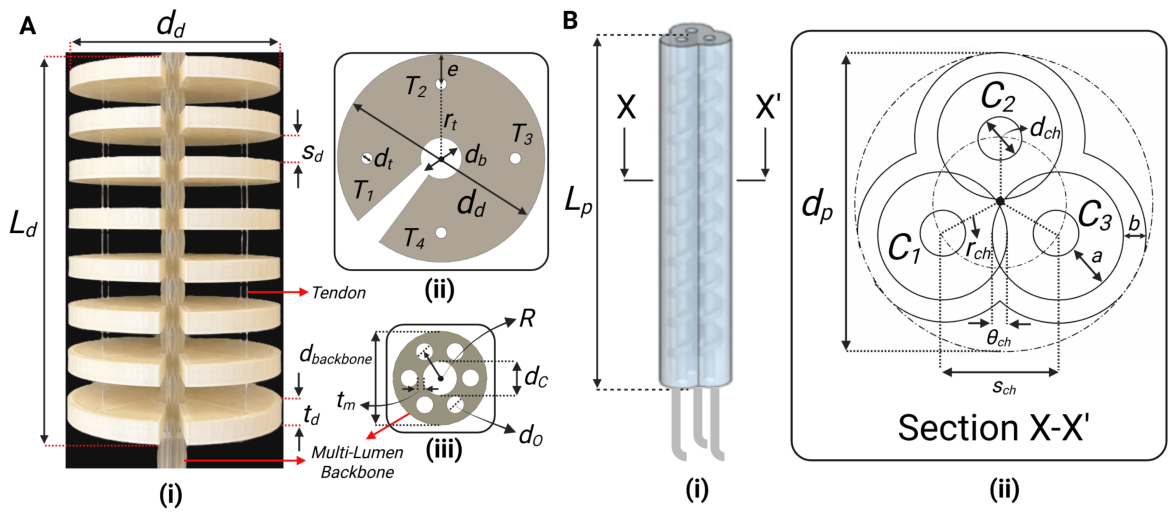
The proposed hybrid CR architecture is built upon a multi-lumen soft tube that serves as a central structural backbone and as a functional element for integrating tendon pathways, pneumatic transmission lines or tool channels. As illustrated in Figure 1A and Figure 3A(iii), the backbone consists of a central channel surrounded by multiple circumferentially distributed outer lumens. From a geometric perspective, the multi-lumen backbone can be described using a set of general parameters, including the central lumen diameter d c , the outer lumen diameter d o , and the minimum material thickness t m between adjacent channels. These parameters define the radial placement of the outer lumens and the overall outer diameter of the backbone.
Radial distance from backbone center to outer lumen center R can be approximated as:
R = d c + d o 2 + t m .
The overall outer diameter of the backbone d backbone can be expressed as:
d backbone = d c + 2 ( d o + 2 t m )
These relationships highlight the balance between lumen diameters and minimum wall thickness for an evenly distributed multi-lumen design. Parameters must be selected to maintain lumen independence and balance compactness with manufacturability. Alternative formulations may also be developed for non-symmetrical or concentric lumen layouts.
While the internal lumens provide routing capability, additional tendon routing disk modules (Figure 3A(ii)) can be introduced to enable additional reconfigurable actuation segments without modifying the backbone structure. The disks are designed to be mechanically self-anchored onto the soft backbone through a reversible interference fit, eliminating the need for adhesives or additional fastening mechanisms. To facilitate assembly, each disk incorporates a central slot with a tapered geometry. The slot opening is initially larger than the backbone diameter and gradually reduces to a dimension smaller than the backbone, requiring the soft material to be elastically compressed during insertion. Once assembled, the elastic deformation of the backbone maintains a secure interference fit within the disk, preventing axial travel of the disk during actuation.
The geometry of the tendon-driven disk system is governed by a set of parametric relationships that ensure compatibility with the backbone. The outer diameter of the disk is primarily determined by the tendon routing radius r t and the edge clearance e required to maintain structural integrity, given by:
d d = 2 ( r t + e )
This relationship directly determines the overall diameter of the tendon-driven module. Similarly, the central slot of the disk is designed to accommodate the multi-lumen backbone, leading to the constraint:
d b = d backbone + δ
where δ is a tolerance factor that governs the fit between the disk and the backbone. For compliant or soft backbone materials, δ is selected as a small negative value to achieve a tight interference fit, relying on elastic deformation of the backbone material. The value must also remain small enough to avoid occluding the internal lumen or distorting the backbone structure.
Finally, the total length of the tendon-driven segment is governed by the number of disks ( N d ) and their geometric arrangement:
L d = N d · t d + ( N d 1 ) . S d
where t d is the disk thickness and S d is the spacing between adjacent disks.

2.1. Concept-1: Hybrid Two-Segment Configuration

The first configuration, referred to as Concept-1 (see Figure 1B), consists of a wide proximal external tendon-driven disk segment and a distal pneumatically actuated segment. In this configuration, the tendon-driven module provides directional bending through antagonistic tendon actuation, while the pneumatic tip contributes decoupled positioning of the distal end.
The external tendon-driven disk system is constructed using a series of rigid disks with predefined tendon routing holes. Tendons are guided through these holes, terminated at the most distal disk, and actuated proximally to generate controlled bending under differential tension. The geometric parameters of this module define the bending characteristics, as detailed in Section 3. The distal segment is a soft pneumatic actuator based on the design in [30], where multi-chamber soft actuators are fabricated using parallel helical cores. The helical chamber geometry limits radial expansion and promotes axial elongation, resulting in efficient omnidirectional bending behavior and large achievable curvature using only a single elastomeric material.
In the presented implementation, the pneumatic channels of the distal tip are arranged in parallel and aligned with the internal lumens of the backbone, enabling direct routing of pneumatic inputs through the structure. Pneumatic transmission between the backbone and the distal tip was achieved via intermediate connectors, which provide a continuous interface between the corresponding backbone lumens and pneumatic tip channels (see Supplemental Video S1). This configuration enables clear functional separation between tendon-driven and pneumatic actuation.

2.2. Concept-2: Miniaturized Three-Segment Configuration

To demonstrate the reconfigurability of the proposed architecture, Concept-2 (see Figure 1C) adapts and extends the design into a three-segment CR configuration through geometric scaling and redistribution of actuation. Specifically, the external tendon-driven disk system is miniaturized by reducing the disk diameter and tendon routing radius, leading to a more compact proximal segment for operation in constrained environments. The scaling relationship in Equation (3) highlights that decreasing r t results in a proportional reduction in disk diameter d d , allowing the system to transition from a large-scale configuration (Concept-1) to a miniaturized form (Concept-2) without altering the fundamental design principles.
The second segment of Concept-2 is formed by routing a tendon through one of the internal lumens of the backbone and fixing it at the distal end of the backbone. Actuation of this tendon induces bending within the backbone structure, effectively transforming it into an active segment. This approach allows the backbone to transition from a purely structural component into a functional actuation element without requiring additional external modules.
The distal segment employs the same pneumatically actuated tip design as in Concept-1. As a result, Concept-2 achieves a three-segment hybrid configuration consisting of: (i) a proximal external tendon-driven disk segment, (ii) an intermediate backbone-actuated tendon-driven segment, and (iii) a distal pneumatic segment.

2.3. Design Synergy and Reconfigurability

The two presented concepts highlight how the proposed hybrid architecture can be configured at different scales while maintaining the same underlying integration principle. In both concepts, the multi-lumen backbone acts as the central structural and routing element, enabling the tendon-driven and pneumatic components to be combined within a compact body while reducing mechanical interference between actuation pathways.
Concept-1 provides a simplified two-segment configuration in which the external tendon-driven disk module and the pneumatically actuated distal tip are clearly separated. This arrangement offers a straightforward embodiment of the hybrid design, where the tendon-driven section provides larger-scale bending and workspace coverage, while the pneumatic tip contributes localized distal articulation.
Concept-2 extends the same integration strategy to a miniaturized three-segment configuration. In this case, the reduced-diameter disk module and the additional backbone-actuated tendon segment provide increased shape control and dexterity within a more compact structure. The use of the multi-lumen backbone further enables the routing of pneumatic lines and tendon pathways through the robot body, supporting segment-level decoupling and simplifying the integration of multiple actuation modes.
These two concepts illustrate the reconfigurability of the proposed architecture through changes in segment number, disk-module scale, and actuation arrangement. This provides a unified design framework for developing hybrid CRs with different workspace, dexterity and size requirements.

3. Modeling Approach

3.1. Modeling of the Tendon-Driven Segment

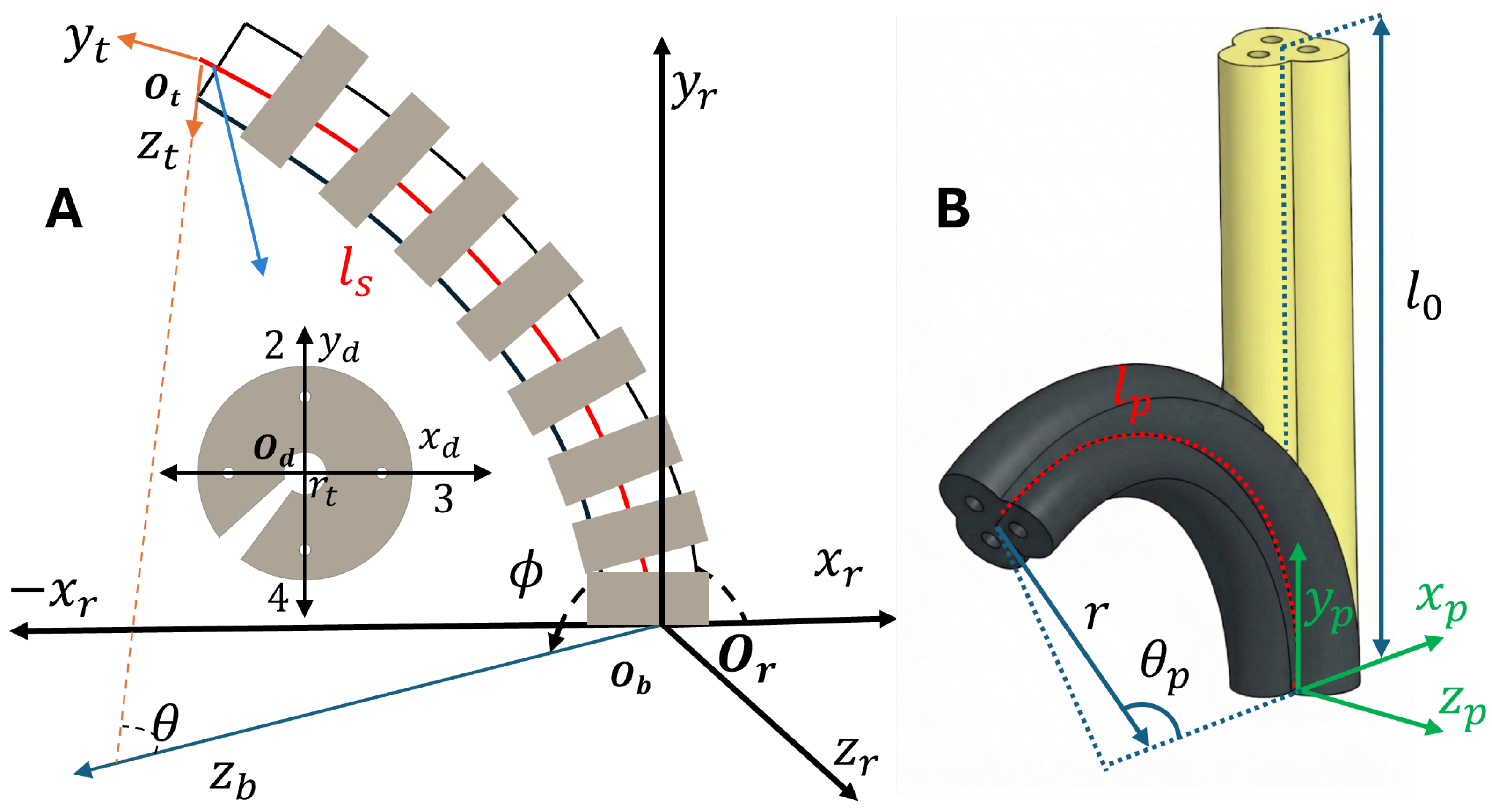
The kinematic behavior of the tendon-driven segment is modeled using the constant curvature (CC) assumption, which approximates the deformed backbone as a planar circular arc [31,32]. This assumption is commonly adopted in continuum robotics due to its simplicity and ability to provide a direct mapping between tendon actuation and robot configuration. Under the CC assumption, the configuration of the tendon-driven segment is described by three parameters: the arc length of the segment l s , the curvature k, and the bending plane angle ϕ , as illustrated in Figure 4A. The bending angle θ is related to the curvature by:
θ = k · l s
For the external tendon-driven disk segment, the tendons are routed through disk elements with an assumed constant radial offset r t from the backbone center, as defined in Figure 3A(ii). For the backbone-actuated tendon segment in Concept-2, the tendon is instead routed through one of the internal lumens of the multi-lumen backbone; therefore, the effective tendon offset is defined by the radial position of the selected lumen, denoted as R in Figure 3A(iii). In the following formulation, the tendon offset is expressed as r a (actuation radius), where r a = r t for the external disk segment and r a = R for the internal backbone-actuated segment.
For a tendon routed at angular position ϕ i , an applied tendon displacement Δ l i induces bending in the segment. Under the constant-curvature assumption, the bending angle can be expressed as:
θ = Δ l i r a cos ( ϕ i ϕ )
where ϕ is the bending plane orientation and ϕ i denotes the angular position of the i-th tendon around the segment cross-section.
For the external tendon-driven disk segment, actuation is performed using antagonistic tendon pairs (e.g., Tendon 1 and Tendon 3), which are positioned approximately opposite each other on the disk. In this case, bending occurs in a fixed plane and the bending plane angle ϕ remains constant. When the actuated tendon is aligned with the bending direction, the bending angle and curvature simplify to:
θ = Δ l r a
k = θ l s = Δ l l s r a
where Δ l represents the effective tendon displacement.
For the backbone-actuated tendon segment in Concept-2, the tendon is routed through one of the internal lumens of the multi-lumen backbone. Since the available lumen positions are not arranged as directly opposing tendon pairs, the bending direction is determined by the angular position of the selected lumen. Therefore, the general formulation in Equation (7) is retained to describe the relationship between tendon displacement and bending.
Based on the obtained curvature, the spatial position of the robot backbone and tip can be computed using standard constant-curvature kinematics [31]. The resulting formulation provides a direct geometric mapping between tendon actuation and robot configuration, which is used for comparison with experimental results.

3.2. Modeling of the Pneumatic Distal Segment

The distal pneumatic segment is also modeled under the CC assumption, whereby the deformed actuator centerline is approximated as a circular arc, as illustrated in Figure 4B. The configuration of the pneumatic segment is described by three parameters: the bending angle θ p , the bending plane angle ϕ p , and the arc length l p . The corresponding curvature is defined as
κ p = θ p l p
For a multi-chamber pneumatic actuator, bending is produced by differential elongation of the pressurized chambers. In the present design, the pneumatic tip consists of three chambers arranged around the actuator centerline. Since the segment is driven by volumetric actuation based on syringes, the effective elongation of the chamber is treated as a nonlinear function of the supplied input volume. Thus, for chamber i,
l i = f ( v i ) ,
where l i is the effective chamber length and v i is the input volume supplied. This formulation avoids assuming a direct linear relationship between input volume and chamber elongation, which is appropriate for elastomeric pneumatic actuators where material deformation and air compressibility influence the actuation response [30].
In the experiments reported in this work, the pneumatic segment was evaluated primarily under single-chamber actuation. Therefore, the bending plane was treated as fixed for each actuated chamber, and the input volume was mapped directly to the experimentally observed bending angle,
θ p = f ( v i ) .
The mapping was identified experimentally from the measured bending angle of the pneumatic tip at discrete input volumes. For each selected input volume, the pneumatic chamber was inflated quasi-statically, and the resulting bending angle was extracted from the recorded images. The resulting input–output data were then used as an empirical volume–bending relationship for the pneumatic segment. The bending angle for intermediate input volumes was obtained by interpolation between the experimentally measured data points. This approach captures the relationship between supplied volume and bending angle, which is nonlinear due to elastomeric deformation, chamber geometry, and air compressibility. In the present study, this experimentally identified mapping was used for kinematic comparison and shape prediction, rather than for closed-loop pneumatic control. This treatment is consistent with the parallel helix actuator characterization reported in [30], where volumetric input was used to model the nonlinear bending response of small-scale soft pneumatic actuators.
The distal tip pose was then obtained using the standard CC transformation with the parameters θ p , ϕ p , and l p . This provides a compact geometric representation of the pneumatic distal segment for comparison with the measured bending behavior and for integration with the tendon-driven proximal segment model.
If higher model accuracy is required, an effective chamber offset may be introduced during calibration to account for radial deformation and deviations from the ideal chamber geometry, as previously reported for volumetrically driven soft pneumatic actuators [30].

4. Fabrication

Hybrid CR concepts were fabricated in two configurations corresponding to Concept-1 and Concept-2 and based on the parameters in Table 2. Each concept employed a distinct tendon-driven disk design. For Concept-1, the larger rigid disks were fabricated using a polylactic acid (PLA) 3D printer (Ultimaker S7, Utrecht, The Netherlands). For Concept-2, the miniaturized rigid disks were manufactured using a stereolithography (SLA) 3D printer (Form 4, Formlabs, Somerville, MA, USA) with Clear V5 resin to achieve higher dimensional accuracy. A soft seven-lumen backbone was formed from a custom extrusion in a medical-grade elastomer (Nusil Med-4050, Della Medical, Brentwood, TN, USA) based on the desired cross-sectional geometry (Table 2). To assemble the disks with the backbone and ensure consistent alignment and spacing for the proximal segment, a custom disk jig was utilized during assembly. Disks were loaded into the jig and the multi-lumen backbone subsequently inserted laterally through the tapered slots of the disks (see Figure 3A(i) and Supplementary Video S1). Tendons were then routed through the predefined holes and terminated at the most distal disk. For Concept-1, large actuation tendons (2 mm diameter, Nylon filament) were used, while in Concept-2 0.2 mm diameter NiTi tendons (McMaster-Carr, Elmhurst, IL, USA) were employed to support miniaturization and improved flexibility. A total of nine disks were used in Concept-1, whereas seven disks were used in Concept-2, as summarized in Table 2.
For Concept-2, an additional tendon-driven segment was created within the multi-lumen backbone. Specifically, a 0.2 mm diameter NiTi tendon (McMaster-Carr, USA) was routed through one of the internal lumens aligned with the tendon-3 position defined in Figure 3A(ii). This tendon was fixed distally, enabling active bending of the backbone segment upon actuation. For both concepts, a flexible rod (1.15 mm diameter NiTi, McMaster Carr, USA) was inserted through the central channel of the multi-lumen backbone along the full length of the first proximal segment to increase stiffness. Overall, the proximal tendon-driven disk system for both concepts employed four tendons for actuation, while Concept-2 introduced an additional tendon within the backbone for definition and actuation of a second segment, resulting in a three-segment hybrid configuration.
The pneumatic distal segment was fabricated based on the multi-chamber soft actuator design reported in [30]. The monolithic elastomeric structure with embedded chambers was produced using a molding-based process in which a multi-part mold and internal cores defining the chamber geometry were first produced via high-resolution 3D printing (Clear Resin v5; Form 4 SLA, Formlabs, USA). A silicone elastomer (Dragon Skin series 10, Smooth-On) was then mixed, degassed, and injected into the assembled mold to form the monolithic structure. After curing at room temperature, the mold was disassembled, the internal cores were unscrewed and removed, and the top of the actuator was sealed with additional silicone. The fabricated pneumatic tip was then connected to the multi-lumen backbone using a dedicated pneumatic connector, aligning the internal pneumatic channels of the tip with the corresponding lumens of the backbone (see Figure 1A). At the proximal end, the backbone lumens were connected to syringes via flexible tubing, allowing controlled pneumatic actuation.
The complete fabrication and assembly process, including disk alignment, tendon routing, and pneumatic integration, is demonstrated in the Supplementary Video S1.

5. Experimental Setup

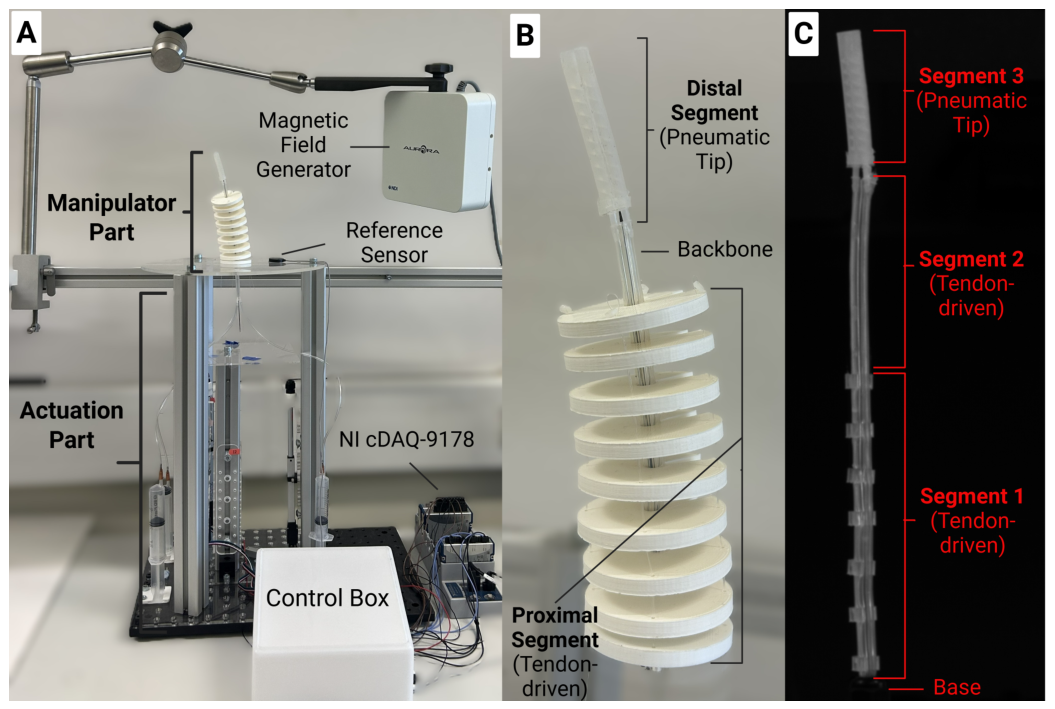
Experimental evaluation of the two proposed hybrid robot configurations was carried out using the setup shown in Figure 5A. The platform was designed to enable independent tendon actuation, pneumatic inputs, and synchronized measurement of both tip motion and overall robot deformation.
For tendon-driven actuation, each tendon was independently driven using a miniature linear actuator (L12-100-50-12-I, Actuonix, Victoria, BC, Canada) with 100 mm stroke and integrated positional feedback. The actuators were mounted within a custom actuation frame and interfaced with a data acquisition system (cDAQ, National Instruments, Austin, TX, USA), allowing precise control and monitoring of tendon displacement throughout the experiments. This arrangement enabled repeatable application of prescribed tendon inputs for both Concept-1 and Concept-2.
For the pneumatic distal segment, actuation was provided via manually operated 10 mL syringes connected to the corresponding lumens of the multi-lumen backbone through flexible tubing. Each syringe included graduated markings from 0 to 10 mL, with five intermediate divisions between each 1 mL interval, enabling the input volume to be manually adjusted in approximately 0.2 mL increments. During testing, the operator set the desired input volume by aligning the syringe plunger with the corresponding graduation mark, and the recorded volume values were taken directly from these syringe markings. The pneumatic lines were routed through the backbone and connected to the distal pneumatic tip using the interface described in the fabrication section. This allowed regulated pneumatic volume delivery to the pneumatic segment. This provided a simple, manually controlled volumetric actuation method for quasi-static characterization of the pneumatic segment. Although manual syringe operation may introduce variability in injection rate and final plunger positioning, the experiments were performed slowly and quasi-statically to reduce dynamic effects.
To characterize the three-dimensional workspace of the robot, an electromagnetic (EM) tracking system (AURORA, NDI) was employed. One EM sensor was placed at the base of the robot to define a reference frame, while a second sensor was attached at the distal tip to record the end-effector pose during actuation. The relative transformation between these two sensors was used to determine the robot tip position with respect to the base frame.
In addition to tip-position tracking, a vision-based measurement setup was used to capture full-shape in-plane bending of the robot. A high-resolution camera (Basler aCA2040-120um, Ahrensburg, Germany) with an image resolution of 2048 × 1536 pixels was positioned to record the deformation of the robot during tendon-driven tests. Following calibration, the system provided sub-millimeter measurement capability through pixel-to-length conversion with an estimated resolution better than 0.1 mm. The captured images were calibrated from pixel-to-length and used to extract the robot’s shape and compare experimental results with the proposed kinematic models.

6. Results

This section presents the experimental evaluation of the proposed hybrid CR configurations, focusing on actuation behavior, workspace characteristics, and model validation. Both Concept-1 and Concept-2 were systematically tested under individual and combined actuation conditions to assess their kinematic response, segment interaction, and overall performance. The experiments were designed to evaluate the consistency of segment behavior, the degree of coupling between actuation modalities, and the effectiveness of the proposed architecture in enabling reconfigurable multi-segment operation.

6.1. Segment-Wise Actuation Characterization

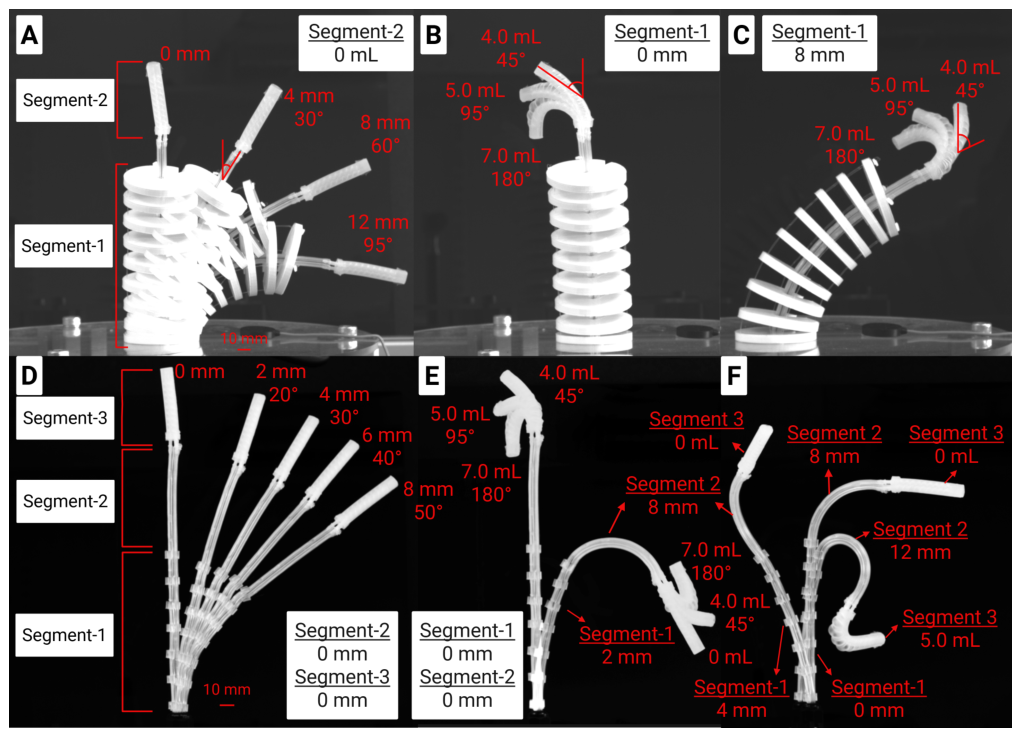
To characterize the physical response of each segment and to assess the level of interaction between tendon-driven and pneumatic actuation, the segment-wise actuation behavior of the proposed hybrid CR concepts was evaluated through independent and joint actuation of each segment, as shown in Figure 6.
For Concept-1, the proximal tendon-driven segment (Segment-1) and the distal pneumatic segment (Segment-2) were first actuated independently (see Figure 6A,B). When only the tendon-driven segment was actuated, smooth and predictable bending behavior was observed, exhibiting an approximately linear increase in bending angle with respect to tendon displacement. The segment achieved bending angles exceeding 90°, demonstrating sufficient flexibility for directional control. When only the distal pneumatic segment was actuated, the robot exhibited a large tip bending deformation, with angles exceeding 180°. This highlights the capability of the pneumatic segment to generate high curvature and compliant motion independently of the proximal structure.
To illustrate this effective decoupling, the tendon-driven segment was fixed at a constant actuation level, while the pneumatic segment was actuated over a range of input conditions (see Figure 6C). The resulting tip responses were found to be consistent with those obtained when the pneumatic segment was actuated independently, indicating that the distal pneumatic segment remains largely unaffected by the configuration of the proximal tendon-driven segment, suggesting partial decoupling between the two actuation modalities.
A similar evaluation was performed for Concept-2, as illustrated in Figure 6D,F. In this configuration, three segments were considered: the proximal tendon-driven disk segment (Segment-1), the intermediate backbone-actuated tendon segment (Segment-2), and the distal pneumatic segment (Segment-3). When only Segment-1 was actuated, the system again exhibited smooth bending behavior with minimal influence on the distal segments. Actuation of the pneumatic segment (Segment-3) independently resulted in deformation characteristics similar to those observed in Concept-1, confirming that the pneumatic response remains consistent despite the increased structural complexity.
Transitioning the backbone from a passive structural element into an actively actuated segment through internal tendon routing (specific to Concept-2) enables increased dexterity and improved CR shaping, as shown in Figure 6E,F. Finally, simultaneous actuation of all three segments (Figure 6F) demonstrated complex multi-curvature shapes, illustrating the capability of the proposed architecture to achieve highly dexterous configurations. These results highlight the potential of Concept-2 for operation in confined and complex environments where precise multi-segment control is required.
Overall, the results demonstrate that the proposed architecture enables consistent and predictable segment behavior, while maintaining a high degree of decoupling between actuation modalities. At the same time, controlled interaction between segments allows the generation of complex shapes, supporting the intended application scenarios.

6.2. Workspace Analysis

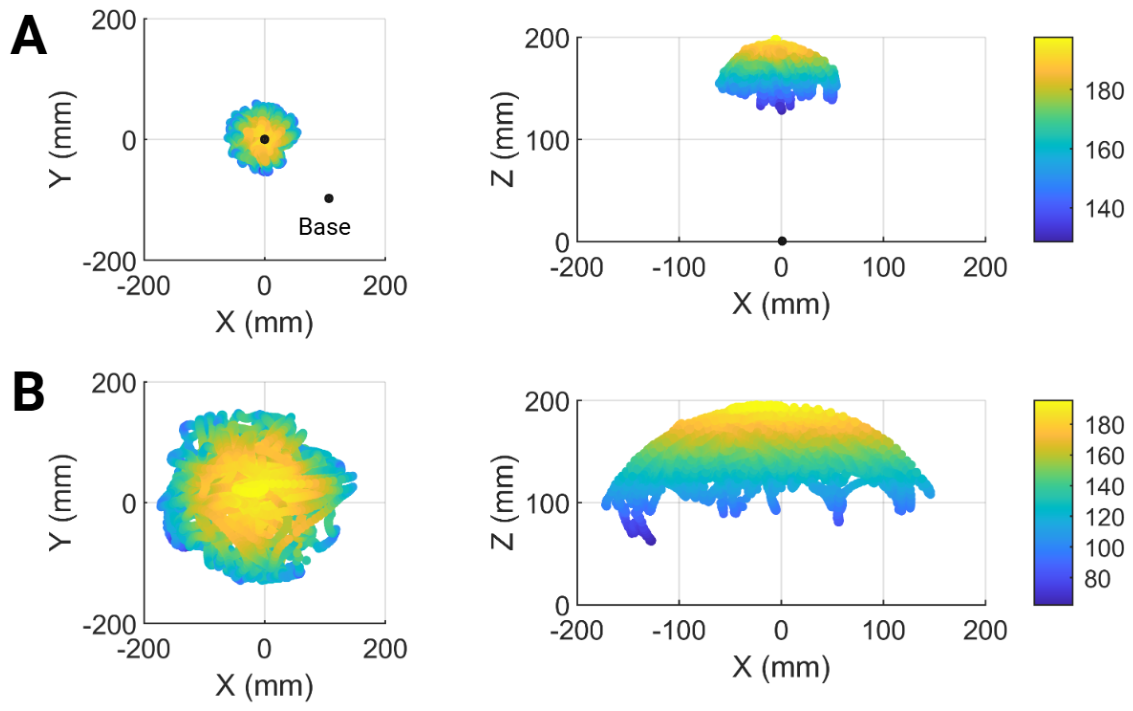
The reachable workspace of the proposed hybrid CR’s tip was characterized using Concept-1, with results presented in Figure 7. The primary objective of this analysis is to evaluate the contribution of the tendon-driven segment to the overall reachable space of the pneumatically actuated distal tip. To support this comparison quantitatively, the measured tip positions were further analysed using axis-wise reachable ranges, maximum lateral displacement, and convex-hull workspace volume, as summarized in Table 3.
Initially, the workspace of the pneumatic tip alone was evaluated, as shown in Figure 7A. In this case, the distal segment was actuated independently, and the reachable positions were recorded. The resulting workspace is relatively limited, reflecting the constrained bending capability of a single pneumatic segment.
Subsequently, the external tendon-driven segment was also actuated to allow repositioning of the pneumatic tip. The hybrid CR was actuated using all available inputs, including the four tendons of the proximal segment and the three pneumatic chambers of the distal segment. During testing, up to two tendons and two pneumatic chambers were activated simultaneously to ensure stable operation within the allowable actuation limits. As illustrated in Figure 7B, the hybrid system exhibits a wide and well-distributed lateral workspace, with near-continuous coverage around the base axis. This demonstrates the system’s ability to achieve effective omnidirectional bending without significant directional bias. Furthermore, the workspace boundary indicates that large curvature configurations can be achieved while maintaining structural integrity and stable actuation behavior. This represents a significant expansion of the reachable region with respect to pneumatic actuation alone (Figure 7A), demonstrating the contribution of the proximal tendon-driven segment in extending both the range and directional coverage of the distal tip. Quantitatively, the convex-hull workspace volume increased from 357 cm3 in the pneumatic-tip-only condition ( V p ) to 5040 cm3 under hybrid actuation ( V h ), corresponding to a 14.1-fold expansion ( V h / V p ; see Table 3). These quantitative results confirm that the tendon-driven proximal segment not only repositions the distal pneumatic segment, but also substantially expands and reorients its reachable workspace.

6.3. Kinematic Model Validation

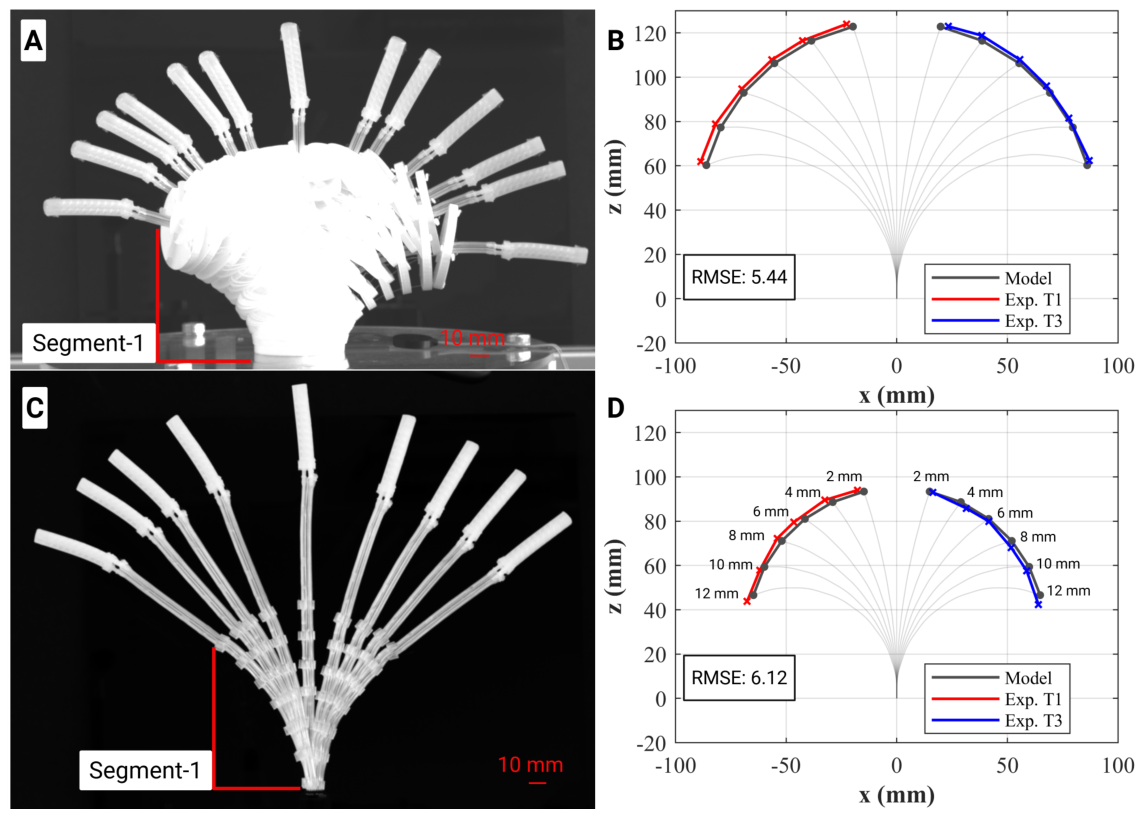
The accuracy of the proposed kinematic model was evaluated by comparing model predictions with experimentally measured tip positions for both Concept-1 and Concept-2, as shown in Figure 8. The validation focused on the tendon-driven segment (Segment-1) under controlled actuation conditions.
A symmetric single-segment bending scenario was adopted for both configurations to ensure a consistent evaluation framework. In this setup, antagonistic tendon pairs (Tendon 1 and Tendon 3) were actuated with displacement inputs ranging from 2 mm to 12 mm in increments of 2 mm. Representative images of the robot configurations during actuation are shown in Figure 8A,C for Concept-1 and Concept-2, respectively.
The corresponding quantitative results are presented in Figure 8B,D, where the measured Segment-1 tip positions are compared against the model predictions. In both configurations, the two opposing tendons exhibit highly consistent displacement–bending responses, indicating repeatable and stable actuation behavior. Minor deviations between experimental results and model predictions are observed, which can be attributed to factors such as tendon friction, actuator inaccuracies, and structural effects related to the backbone geometry.
The root-mean-square error (RMSE) between the predicted and measured Segment-1 tip positions was calculated as 5.44 mm for Concept-1 and 6.12 mm for Concept-2. In both cases, the error remains within the characteristic diameter of the tendon-driven segment, demonstrating that the proposed model provides a reliable approximation of the segment kinematics.
In particular, despite the increased structural complexity introduced in Concept-2 through the addition of an extra segment and internal tendon routing, the model maintains comparable prediction accuracy. This suggests that the proposed constant-curvature-based formulation is sufficiently robust to capture the dominant kinematic behavior of both configurations.
Overall, the results validate the effectiveness of the proposed modeling approach in predicting the kinematic response of the proximal tendon-driven segment, providing a practical tool for analysis and control of the hybrid continuum robot.

6.4. Functional Performance Characterization

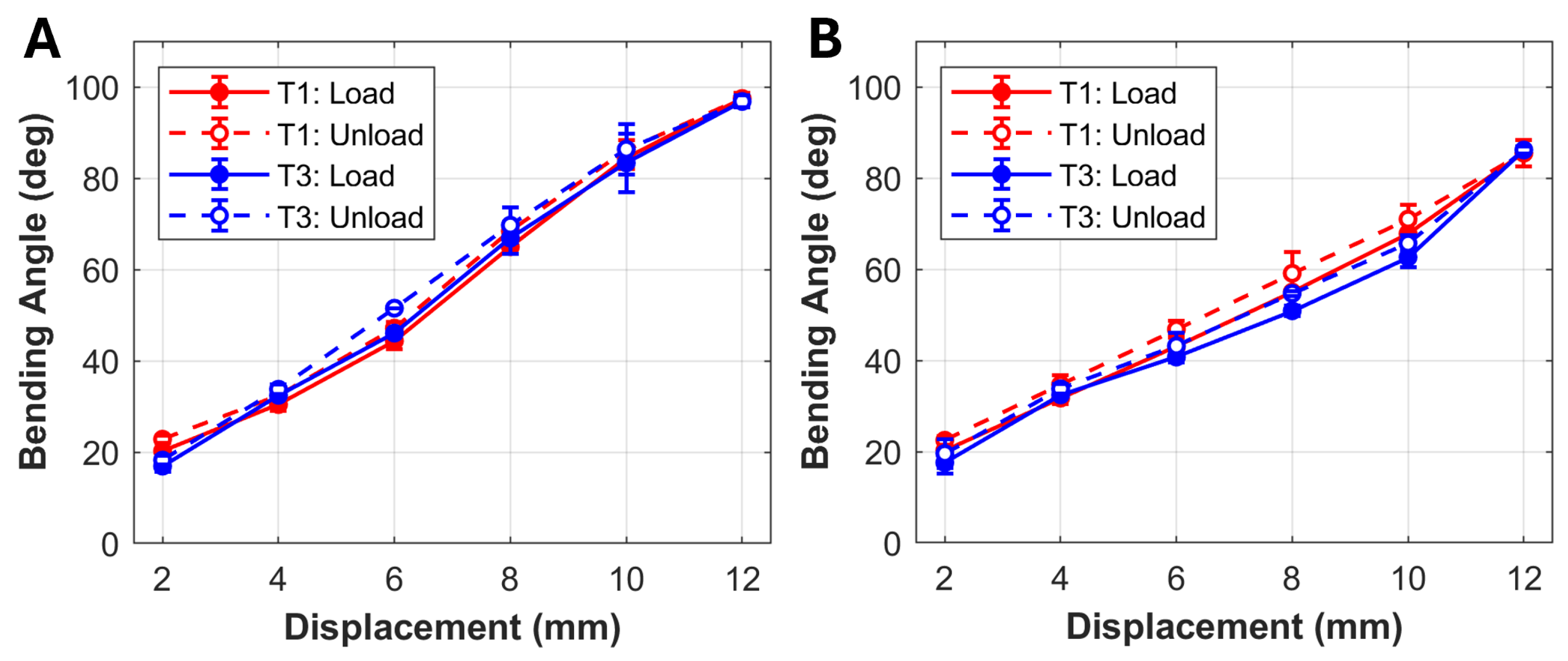
Following the kinematic validation, additional experiments were conducted to further evaluate the practical performance of the proposed concepts. First, the hysteresis behavior of Segment-1 was evaluated for both concepts by comparing the bending angle during tendon loading and unloading, as shown in Figure 9. In both Concept-1 and Concept-2, the bending angle increased progressively with tendon displacement from 2 to 12 mm, reaching approximately 97° for Concept-1 and 86° for Concept-2 at the maximum displacement. During unloading, the bending angle followed a slightly different path, indicating the presence of hysteresis, which can be attributed to tendon-guide friction, compliance of the soft structure, and residual deformation during cyclic actuation. However, the loading and unloading curves remained close to each other, and the error bars across the three repeated trials were relatively small, indicating repeatable actuation behavior. In addition, the responses of the two opposing tendons, Tendon-1 (T1) and Tendon-3 (T3), were closely matched for both concepts, indicating balanced bending performance of Segment-1 under tendon actuation.
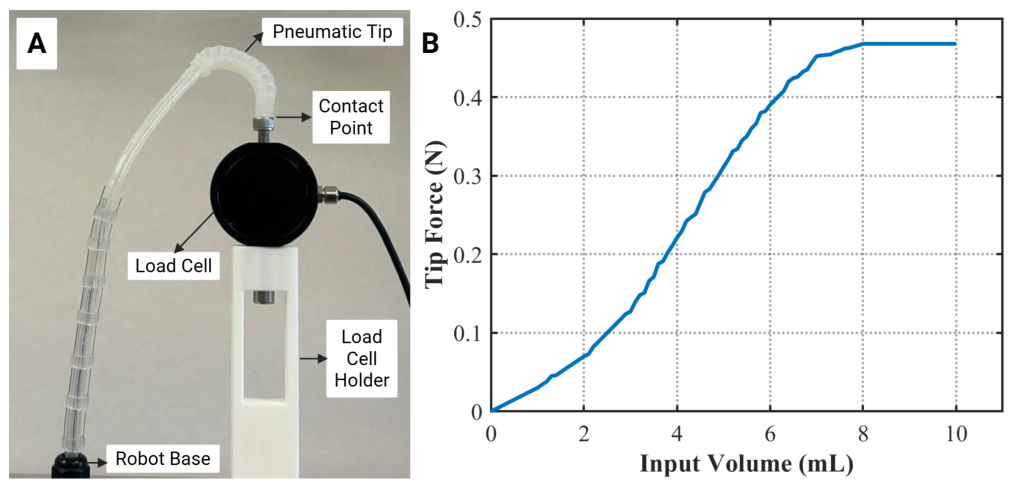
The contact force capability of the pneumatic distal section was characterized using the load cell setup shown in Figure 10A. As the pneumatic input volume increased, the measured tip force also increased, demonstrating a clear relationship between input volume and generated contact force. The force response increased nonlinearly at lower and intermediate input volumes and then reached a plateau after approximately 8.0 mL. The maximum measured force was approximately 0.45 N, indicating that the pneumatic tip can generate sub-Newton contact forces under constrained contact conditions. This result supports the suitability of the pneumatic distal section for compliant interaction tasks where low-force contact is required.
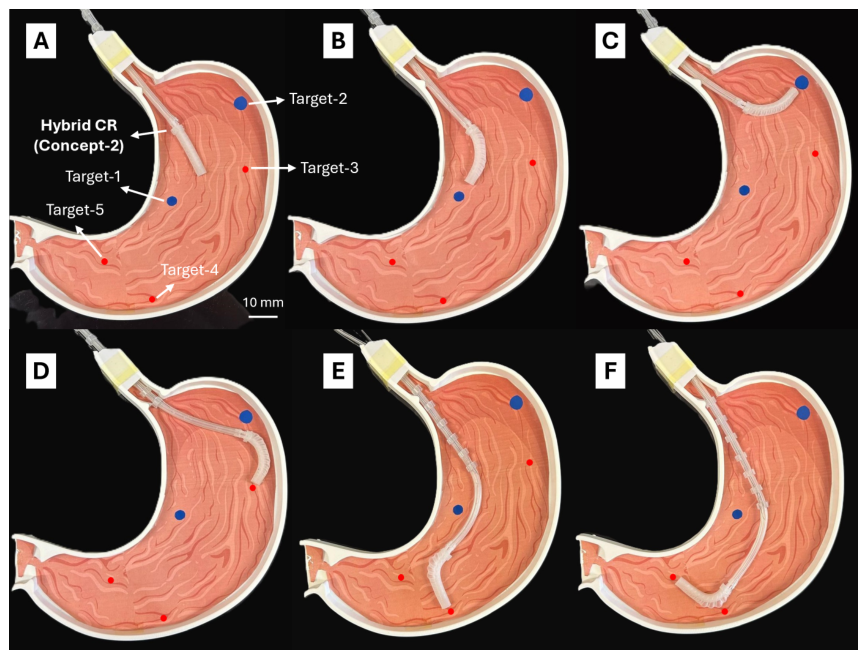
Finally, the application-oriented capability of Concept-2 was demonstrated in a stomach-like phantom environment, as shown in Figure 11. The robot was positioned inside the phantom and tested against five representative target locations. Concept-2 was able to reach Target-1, Target-2, Target-3, and the deeper targets Target-4 and Target-5, demonstrating qualitative reachability and orientation capability within a confined anatomical environment. The three-segment configuration was specifically used to access deeper targets within the phantom, which were successfully reached, highlighting the benefit of the multi-segment architecture for extended reach. In contrast to the free-space workspace analysis, this phantom demonstration provides an initial assessment of whole-body navigation feasibility, as the robot body was required to conform within the phantom boundary while accessing the target locations. This phantom demonstration further supports the potential of the compact hybrid continuum architecture for target access in gastroscopy-inspired minimally invasive applications.

7. Discussion and Conclusions

This study introduced a reconfigurable hybrid CR architecture enabled by a soft multi-lumen backbone, designed to integrate multiple actuation modalities within a unified and compact structure. The proposed approach addresses a key limitation of many existing hybrid CR designs, where different actuation strategies are often tightly integrated into application-specific architectures that are difficult to modify or scale. By separating structural support, actuation routing, and functional segmentation, the presented architecture provides a flexible platform that supports modularity, scalability, and design-level reconfiguration.
The experimental results demonstrate that the proposed system achieves consistent and predictable actuation behavior across both configurations. Segment-wise characterization confirmed that the tendon-driven and pneumatic segments exhibit partially decoupled behavior, where the distal pneumatic response remains largely unaffected by variations in proximal tendon actuation. This characteristic is particularly important for simplifying control strategies, as it allows individual segments to be modeled and actuated with reduced cross-dependency. At the same time, the combined actuation experiments showed that controlled interaction between segments enables the generation of complex multi-curvature shapes, enhancing the overall dexterity of the system.
The workspace analysis further highlighted the benefits of hybridization, demonstrating a significant expansion in reachable space when the pneumatic tip is integrated with the tendon-driven segment. The proximal tendon-driven module effectively acts as a positioning stage, extending the operational envelope of the distal pneumatic actuator. This capability enables the robot to access a wider range of orientations and positions, which is essential for tasks in confined and unstructured environments.
From a modeling perspective, the proposed constant-curvature-based formulation was shown to provide reliable predictions of the tendon-driven segment behavior. Despite the increased structural complexity in Concept-2, the model maintained comparable accuracy for Segment-1, with RMSE values remaining within the characteristic scale of the robot. This indicates that the dominant kinematic behavior of the system can be effectively captured using a simplified geometric model, providing a practical balance between modeling complexity and predictive capability.
Although the present study focuses on design, modeling, and experimental characterization rather than CR control, the proposed kinematic formulation provides a basis for future endpoint position control. A practical control strategy could be implemented using a hierarchical approach. At the outer level, the desired endpoint position could be converted into target segment configurations using the constant-curvature model and inverse kinematics. At the inner level, the tendon-driven segments could be controlled through the displacement-controlled linear actuators, while the pneumatic distal segment could be controlled through calibrated volume–bending relationships. In this framework, the kinematic controller could first solve for the desired endpoint position, while allowing flexibility in the endpoint orientation or distal segment configuration. This would enable the proximal tendon-driven segment to primarily reposition the distal section, while the pneumatic segment could be adjusted to refine local orientation or shape. Since the proposed architecture promotes partial decoupling between tendon-driven and pneumatic segments, each segment could initially be controlled independently and then coordinated to achieve the desired endpoint pose. For improved accuracy, especially in the presence of hysteresis, tendon friction, pneumatic nonlinearities, and environmental contact, the feedforward model could be combined with feedback from EM tracking, vision-based shape sensing, pressure sensors, and/or embedded soft sensors. Future work will therefore focus on developing closed-loop endpoint control using model-based feedforward compensation combined with sensor feedback to improve positioning accuracy, repeatability, and robustness during multi-segment actuation.
Another practical consideration is the detection of the robot endpoint during operation. In this study, EM tracking was used to measure the distal tip position for experimental validation, while vision-based measurements were used to assess in-plane deformation. Although this approach is suitable for laboratory characterization, EM tracking may not be appropriate for all application scenarios due to constraints related to sensor size, wiring, integration complexity, and magnetic interference. For practical deployment, endpoint estimation could instead be achieved using application-specific sensing strategies, such as camera-based visual tracking, image-guided localization, model-based estimation, pressure/volume feedback, tendon displacement sensing, fiber-optic shape sensing, or embedded soft strain sensors.
A key contribution of this work lies in the demonstration of design versatility, simplified assembly, and architectural reconfigurability. The transition from Concept-1 to Concept-2 illustrates how the same underlying design principles can be adapted to achieve different functional outcomes. In particular, the miniaturized configuration introduces an additional tendon-driven segment within the backbone, effectively transforming it from a passive structural element into an active component. This enables increased dexterity and control without requiring a complete redesign of the system. Furthermore, the use of internal lumens allows for flexible routing of actuation channels and supports the integration of additional elements such as stiffening rods, enabling further tuning of mechanical behavior and segment interaction.
Beyond the two presented embodiments, the proposed architecture also offers a broader design space for future hybrid CR development. For example, the tendon-driven disk designs and/or configurations could be modified to deliver tapered or helical tendon routing arrangements for more complex actuation behavior. Similarly, as the backbone component is defined by its cross-section and material, it can be readily modified to adjust scale, degrees of actuation, or augmented stiffness, deformation response, and load-bearing characteristics of the CR. Additionally, the attached pneumatic actuation unit may be readily replaced or interchanged to support additional degrees of actuation or end-effector designs (e.g., soft grippers). This adaptability is all enabled by the shared utilization of the soft multi-lumen backbone, which provides organized internal pathways for routing actuation lines, tools, or functional components without requiring a complete redesign of the robot body. In this way, the architecture provides a scalable platform that can be adapted to different application requirements, robot diameters, and operational environments.
Despite these promising results, several limitations remain. The current modeling approach does not explicitly account for nonlinear effects such as tendon friction, hysteresis, or material compliance in the pneumatic segment. Additionally, the pneumatic actuation was evaluated under simplified input conditions, and more advanced control strategies could further improve performance. Therefore, the pneumatic results should be interpreted as input-volume-based characterization rather than closed-loop pneumatic control performance. Future work will focus on extending the modeling framework to incorporate these nonlinearities, as well as exploring closed-loop control strategies for coordinated multi-segment actuation.
In addition, the current evaluation primarily considers tip reachability and qualitative phantom-based target access. Although the stomach-like phantom demonstration showed that Concept-2 could reach representative target locations within a confined environment, the study does not yet provide a full quantitative analysis of whole-body collision-free navigation. Future work should evaluate metrics such as swept volume, minimum clearance from environmental boundaries, passable curvature, collision-free reachable path range, and tip-position error with and without contact. These analyses will be important for assessing safe navigation in realistic anatomical or cluttered environments.
In conclusion, this work establishes a unified and reconfigurable design framework for hybrid CRs, in which a multi-lumen backbone enables the integration, redistribution, and coordination of multiple actuation modalities. The proposed approach not only simplifies system design and assembly but also expands the functional capabilities of CRs across different scales and application domains. These findings provide a foundation for the development of next-generation hybrid continuum robots capable of operating in complex, constrained, and dynamic environments.


Supplementary Materials

The following supporting information can be downloaded at: https://www.mdpi.com/article/10.3390/act15060339/s1, Video S1: Robot Assembly and Experimental Testing.

Author Contributions

Conceptualization, B.O., A.C. and J.H.C.; methodology, B.O. and J.H.C.; software, B.O.; validation, B.O. and J.H.C.; formal analysis, B.O. and J.H.C.; investigation, B.O. and J.H.C.; resources, B.O. and J.H.C.; data curation, B.O. and J.H.C.; writing—original draft preparation, B.O. and J.H.C.; writing—review and editing, B.O., A.C., P.V. and J.H.C.; visualization, B.O.; supervision, P.V. and J.H.C.; project administration, J.H.C.; funding acquisition, P.V. and J.H.C. All authors have read and agreed to the published version of the manuscript.

Funding

This work was supported in part by the Engineering and Physical Sciences Research Council (EPSRC) under grants EP/V047914/1, EP/Y037235/1 and EP/V009818/1; and the National Institute for Health and Care Research (NIHR) Leeds Biomedical Research Centre (BRC) under grant NIHR203331. B. Ozdemir was supported by a scholarship from the Turkish Ministry of National Education, Republic of Turkiye. J. Chandler was supported by the Leverhulme Trust and the Royal Academy of Engineering under a RAEng/Leverhulme Trust Research Fellowship under grant LTRF-2425-21-154.

Institutional Review Board Statement

Not Applicable.

Informed Consent Statement

Not Applicable.

Data Availability Statement

The data supporting the findings of this study are available from the corresponding author upon reasonable request (j.h.chandler@leeds.ac.uk).

Acknowledgments

During the preparation of this manuscript, the authors used BioRender.com, accessed on 12 June 2026, for the purpose of creating Figure 2. The authors have reviewed and edited the output and take full responsibility for the content of this publication.

Conflicts of Interest

The authors declare no conflicts of interest.

Abbreviations

The following abbreviations are used in this manuscript:
CRsContinuum robots
CCConstant-curvature
PLAPolylactic acid
SLAStereolithography
EMElectromagnetic
RMSERoot-mean-square error

References

  1. Burgner-Kahrs, J.; Rucker, D.C.; Choset, H. Continuum robots for medical applications: A survey. IEEE Trans. Robot. 2015, 31, 1261–1280. [Google Scholar] [CrossRef]
  2. Russo, M.; Sadati, S.M.H.; Dong, X.; Mohammad, A.; Walker, I.D.; Bergeles, C.; Xu, K.; Axinte, D.A. Continuum Robots: An Overview. Adv. Intell. Syst. 2023, 5, 2200367. [Google Scholar] [CrossRef]
  3. Niño, M.P.H.; Boutayeb, M.; Martinez, D. A hybrid tendon-driven continuum robot that avoids torsion under external load. Front. Robot. 2025, 12, 1576209. [Google Scholar]
  4. Zhang, J.; Fang, Q.; Liu, L.; Jin, R.; Xiang, P.; Xiong, R.; Wang, Y.; Lu, H. Design and Stiffness Control of a Variable-Length Continuum Robot for Endoscopic Surgery. IEEE Trans. Autom. Sci. Eng. 2025, 22, 5251–5261. [Google Scholar] [CrossRef]
  5. Yañez, L.Z.; Rogatinsky, J.; Recco, D.; Lee, S.Y.; Matthews, G.; Sabelhaus, A.P.; Hoganson, D.; Ranzani, T. Soft Robotic Delivery of Coiled Anchors for Cardiac Interventions. IEEE Robot. Autom. Lett. 2025, 10, 1–8. [Google Scholar] [CrossRef]
  6. Wang, M.; Dong, X.; Ba, W.; Mohammad, A.; Axinte, D.; Norton, A. Design, modelling and validation of a novel extra slender continuum robot for in-situ inspection and repair in aeroengine. Robot.-Comput.-Integr. Manuf. 2021, 67, 102054. [Google Scholar] [CrossRef]
  7. Kato, T.; Okumura, I.; Song, S.E.; Golby, A.J.; Hata, N. Tendon-driven continuum robot for endoscopic surgery: Preclinical development and validation of a tension propagation model. IEEE/ASME Trans. Mechatron. 2014, 20, 2252–2263. [Google Scholar] [CrossRef] [PubMed]
  8. Ozdemir, B.; Valdastri, P.; Chandler, J.H. Spring-Based Tendon-Driven Continuum Robots for Compact Modular Designs in Endoluminal Applications. IEEE/ASME Trans. Mechatron. 2026, 1–9. [Google Scholar] [CrossRef]
  9. Kang, R.; Branson, D.T.; Zheng, T.; Guglielmino, E.; Caldwell, D.G. Design, modeling and control of a pneumatically actuated manipulator inspired by biological continuum structures. Bioinspiration Biomim. 2013, 8, 036008. [Google Scholar] [CrossRef]
  10. Jia, Y.; Zhang, Z.; Sun, W.; Zhang, K.; Chen, Y.; Gong, Y. Study of bionic module driven by water hydraulic artificial muscles for underwater continuum robot. Mar. Syst. Ocean. Technol. 2025, 20, 25. [Google Scholar] [CrossRef]
  11. Lee, Y.; Koehler, F.; Dillon, T.; Loke, G.; Kim, Y.; Marion, J.; Antonini, M.J.; Garwood, I.C.; Sahasrabudhe, A.; Nagao, K.; et al. Magnetically Actuated Fiber-Based Soft Robots. Adv. Mater. 2023, 35, 2301916. [Google Scholar] [CrossRef] [PubMed]
  12. Hanley, D.; Alambeigi, F.; Khadem, M. On the Benefits of Hysteresis in Tendon Driven Continuum Robots. In Proceedings of the 2025 IEEE International Conference on Robotics and Automation (ICRA), Atlanta, GA, USA, 19–23 May 2025; pp. 14001–14007. [Google Scholar] [CrossRef]
  13. Lee, J.Y.; Go, E.Y.; Choi, W.Y.; Kim, W.B.; Cho, K.J. Development of soft continuum manipulator with pneumatic and tendon driven actuations. In Proceedings of the 2016 13th International Conference on Ubiquitous Robots and Ambient Intelligence (URAI), Xi’an, China, 19–22 August 2016; IEEE: New York, NY, USA, 2016; pp. 377–379. [Google Scholar]
  14. Ebrahimi, N.; Bi, C.; Cappelleri, D.J.; Ciuti, G.; Conn, A.T.; Faivre, D.; Habibi, N.; Hošovský, A.; Iacovacci, V.; Khalil, I.S.M.; et al. Magnetic Actuation Methods in Bio/Soft Robotics. Adv. Funct. Mater. 2021, 31, 2005137. [Google Scholar] [CrossRef]
  15. Ozdemir, B.; Khalid, M.A.; Chauhan, M.; Valdastri, P.; Chandler, J.H. Hybrid Continuum Robot Designs and Architectures for Healthcare Applications. Adv. Robot. Res. 2026, e202500177. [Google Scholar] [CrossRef]
  16. Mangan, A.; Kim, S.; Jones, N.; Brandel, M.G.; Heit, J.J.; Norbash, A.; Hwang, J.T.; Hawkes, E.; Morimoto, T.K. Serially-Connected Soft Continuum Robots for Endovascular Emergencies. IEEE Trans. Med. Robot. Bionics 2025, 7, 1029–1040. [Google Scholar] [CrossRef]
  17. Ozdemir, B.; Khalid, M.A.; Valdastri, P.; Chandler, J.H. A Hybrid Tendon-Pneumatic Continuum Robot with Pressure-Driven Length Modulation and Tool-Channel Locking. In Proceedings of the 2026 IEEE 9th International Conference on Soft Robotics (RoboSoft), Kanazawa, Japan, 7–12 April 2026; pp. 950–955. [Google Scholar] [CrossRef]
  18. Khalid, M.A.; Valdastri, P.; Chandler, J.H. 3D-Printed Variable-Length Magnetically Steered Catheter Tip for Enhanced Access in Aneurysm Interventions. In Proceedings of the 2025 IEEE 8th International Conference on Soft Robotics (RoboSoft), Lausanne, Switzerland, 22–26 April 2025; pp. 1–7. [Google Scholar] [CrossRef]
  19. Ma, X.; Wang, X.; Zhang, Z.; Zhu, P.; Cheng, S.S.; Samuel Au, K.W. Design and Experimental Validation of a Novel Hybrid Continuum Robot With Enhanced Dexterity and Manipulability in Confined Space. IEEE/ASME Trans. Mechatron. 2023, 28, 1826–1835. [Google Scholar] [CrossRef]
  20. Xiao, W.; Hu, D.; Zhou, H.; Du, X. A self-sensing intelligent soft pneumatic actuator with soft magnetic structures. Int. J. Mech. Sci. 2023, 250, 108279. [Google Scholar] [CrossRef]
  21. Wu, Z.; Reyzabal, M.D.I.; Sadati, S.; Liu, H.; Ourselin, S.; Leff, D.; Katzschmann, R.K.; Rhode, K.; Bergeles, C. Towards a Physics-Based Model for Steerable Eversion Growing Robots. IEEE Robot. Autom. Lett. 2023, 8, 1005–1012. [Google Scholar] [CrossRef]
  22. Shiva, A.; Stilli, A.; Noh, Y.; Faragasso, A.; De Falco, I.; Gerboni, G.; Cianchetti, M.; Menciassi, A.; Althoefer, K.; Wurdemann, H.A. Tendon-based stiffening for a pneumatically actuated soft manipulator. IEEE Robot. Autom. Lett. 2016, 1, 632–637. [Google Scholar] [CrossRef]
  23. Luo, X.; Song, D.; Zhang, Z.; Wang, S.; Shi, C. A Novel Distal Hybrid Pneumatic/Cable-Driven Continuum Joint with Variable Stiffness Capacity for Flexible Gastrointestinal Endoscopy. Adv. Intell. Syst. 2023, 5, 2200403. [Google Scholar] [CrossRef]
  24. Roshanfar, M.; Dargahi, J.; Hooshiar, A. Design Optimization of a Hybrid-Driven Soft Surgical Robot with Biomimetic Constraints. Biomimetics 2024, 9, 59. [Google Scholar] [CrossRef]
  25. Yang, H.D.; Asbeck, A.T. Design and characterization of a modular hybrid continuum robotic manipulator. IEEE/ASME Trans. Mechatron. 2020, 25, 2812–2823. [Google Scholar] [CrossRef]
  26. Yamamoto, K.K.; Zachem, T.J.; Kheradmand, P.; Zheng, P.; Abdelgadir, J.; Bailey, J.L.; Pieter, K.; Codd, P.J.; Chitalia, Y. Tendon-Actuated Concentric Tube Endonasal Robot (TACTER). J. Med. Robot. Res. 2025, 10, 2550002. [Google Scholar] [CrossRef]
  27. Tian, L.; Zhao, J.; Zheng, Q.; Seckin, E.; Temelkuran, B. Multimaterial Fiber-based Steerable Soft Robot for Minimally Invasive Surgery. In Proceedings of the 2025 IEEE 8th International Conference on Soft Robotics (RoboSoft), Lausanne, Switzerland, 22–26 April 2025; pp. 1–6. [Google Scholar] [CrossRef]
  28. Tian, L.; Zhao, J.; Yang, Z.; Chalau, V.; Temelkuran, B. Thermally Drawn Steerable Soft Robotic Fiber for Multi-Purpose Minimally Invasive Surgery. IEEE Robot. Autom. Lett. 2025, 10, 12389–12396. [Google Scholar] [CrossRef]
  29. Zhang, Z.; Tang, S.; Fan, W.; Xun, Y.; Wang, H.; Chen, G. Design and analysis of hybrid-driven origami continuum robots with extensible and stiffness-tunable sections. Mech. Mach. Theory 2022, 169, 104607. [Google Scholar] [CrossRef]
  30. Chandler, J.H.; Chauhan, M.; Garbin, N.; Obstein, K.L.; Valdastri, P. Parallel Helix Actuators for Soft Robotic Applications. Front. Robot. 2020, 7, 119. [Google Scholar] [CrossRef]
  31. Webster, R.J., III; Jones, B.A. Design and kinematic modeling of constant curvature continuum robots: A review. Int. J. Robot. Res. 2010, 29, 1661–1683. [Google Scholar] [CrossRef]
  32. Ozdemir, B.; Valdastri, P.; Chandler, J.H. Towards Accurate Shape Prediction for Compact Spring Backbone Tendon-Driven Continuum Robots. In Towards Autonomous Robotic Systems; Cavalcanti, A., Foster, S., Richardson, R., Eds.; Springer: Cham, Switzerland, 2026; pp. 210–222. [Google Scholar]
Figure 1. Overview of the reconfigurable hybrid continuum robot architecture. (A) General system design components, including the multi-lumen backbone, self-anchoring external tendon routing disks, multi-channel pneumatic tip, stiffening rod, and pneumatic interface. (B) Concept-1: a two-segment hybrid configuration combining a large diameter proximal tendon-driven disk module (Segment 1) with a pneumatically actuated distal segment (Segment 2). (C) Concept-2: a reconfigured three-segment architecture obtained using the same design components, where the multi-lumen backbone is also tendon-actuated (Segment 2) and a reduced-diameter disk module is employed, enabling a more compact structure with an additional intermediate segment and a distal pneumatic segment (Segment 3).
Actuators 15 00339 g001
Figure 2. Representative application scenarios of the proposed reconfigurable hybrid continuum robot architecture. (A) Concept-1 demonstrating its potential for large-scale manipulation tasks, such as agricultural harvesting, where the robot is mounted on a mobile platform and interacts with target objects in cluttered outdoor environments. (B) Concept-2 illustrating its potential for gastroscopy and minimally invasive endoscopic procedures, where the compact, miniaturized multi-segment design enables dexterous navigation within confined anatomical spaces, such as the stomach. Created in BioRender. Ozdemir, B. (2026) https://BioRender.com/oqil3gd (accessed on 8 June 2026).
Actuators 15 00339 g002
Figure 3. Geometric design and parameterization of the main components in the proposed reconfigurable hybrid continuum robot architecture. (A) External tendon-driven disk module: (i) side view illustrating the disk stack and overall dimensions, (ii) top view detailing tendon routing and disk geometry, and (iii) cross-sectional view of the multi-lumen backbone. (B) Pneumatic tip module: (i) side view of the multi-channel pneumatic segment, and (ii) cross-sectional view (Section X–X’) showing the internal channel arrangement and key geometric features.
Actuators 15 00339 g003
Figure 4. Kinematic modeling framework of the hybrid continuum robot. (A) Representation of the proximal tendon-driven disk segment based on a constant-curvature assumption, illustrating the disk coordinate frames, backbone configuration, and tendon length variation. (B) Representation of the pneumatically actuated distal segment, approximated as a constant-curvature section, showing the geometric parameters and local coordinate frame along the segment centerline.
Actuators 15 00339 g004
Figure 5. Experimental setup and robotic configurations used in this study. (A) Overview of the experimental platform, including the actuation system, control unit, and electromagnetic tracking system used for motion characterization. (B) Concept-1, showing the assembled two-segment hybrid CR composed of a proximal tendon-driven segment and a distal pneumatically actuated tip. (C) Concept-2, showing the assembled three-segment configuration composed of two tendon-driven segments and a distal pneumatically actuated tip.
Actuators 15 00339 g005
Figure 6. Representative actuation behaviors of the proposed hybrid CRs under different segment activation conditions. (AC) Concept-1 (two-segment configuration): (A) actuation of the proximal tendon-driven segment (Segment 1) with the distal pneumatic segment inactive, (B) actuation of the distal pneumatic segment (Segment 2) with the proximal segment inactive, and (C) combined actuation showing the influence of distal actuation under fixed proximal configurations. (DF) Concept-2 (three-segment configuration): (D) actuation of the proximal tendon-driven segment (Segment 1) with the intermediate (Segment 2) and distal segments (Segment 3) inactive, (E) actuation of the distal pneumatic segment (Segment 3) with tendon-driven segments (Segment 1 and 2) inactive and active, and (F) combined actuation of all three segments demonstrating the multi-segment deformation capability of the reconfigured architecture.
Actuators 15 00339 g006
Figure 7. Workspace characterization of the pneumatically actuated distal segment under different structural configurations. (A) Workspace obtained when only the standalone pneumatic tip is actuated. (B) Workspace of the pneumatic tip after integration with the proximal tendon-driven disk module (Concept-1), illustrating the expanded and reoriented reachable space enabled by the hybrid architecture. The color bar represents the Z-axis position of the tip.
Actuators 15 00339 g007
Figure 8. Experimental validation of the proposed kinematic model under Segment-1 tendon-driven actuation for both robot configurations. (A) Representative deformation of the proximal tendon-driven segment in Concept-1. (B) Comparison between model predictions and experimental tip trajectories for Concept-1 under antagonistic tendon actuation (Tendon-1 and Tendon-3), yielding an RMSE of 5.44 mm. (C) Representative deformation of the proximal tendon-driven segment in Concept-2. (D) Corresponding model–experiment comparison for Concept-2, showing an RMSE of 6.12 mm.
Actuators 15 00339 g008
Figure 9. Hysteresis response of Segment-1 for (A) Concept-1 and (B) Concept-2. The measured bending angle is plotted against tendon displacement for tendons T1 and T3 during loading and unloading cycles. Error bars indicate the variation across three repeated trials.
Actuators 15 00339 g009
Figure 10. Tip force characterization of the pneumatic distal section. (A) Experimental setup used to measure the contact force generated by the pneumatic tip against a load cell. (B) Measured tip force as a function of input volume, illustrating the force response of the pneumatic tip under constrained contact conditions.
Actuators 15 00339 g010
Figure 11. Phantom demonstration of Concept-2 in a stomach-like environment. (A) Overview of the hybrid continuum robot positioned inside the stomach phantom, showing the five target locations. The robot’s reachability is demonstrated toward (B) Target-1, (C) Target-2, (D) Target-3, (E) Target-4, and (F) Target-5, respectively, illustrating its ability to navigate and orient within the confined phantom environment.
Actuators 15 00339 g011
Table 2. Geometric parameters of the hybrid continuum robot design for Concept-1 and Concept-2.
VariableParameterConcept-1Concept-2
External Tendon-Driven Disk System
L d Total length of the tendon-driven disk system125 mm95 mm
d d Disk outer diameter50 mm10 mm
S d Distance between adjacent disks10 mm10 mm
t d Disk thickness5 mm5 mm
r t Radial distance from disk center to tendon hole center20 mm4 mm
d t Tendon hole diameter2 mm0.6 mm
N d Number of disks97
δ A tolerance factor−1.16 mm−1.16 mm
d b Central backbone clearance diameter5.5 mm5.5 mm
Multi-lumen Backbone
d backbone Backbone outer diameter6.66 mm
d c Central lumen diameter2.29 mm
d o Outer lumen diameter1.59 mm
n l Number of lumens7
RRadial distance from backbone center to outer lumen center2.24 mm
t m Minimum wall thickness between lumens0.3 mm
Pneumatic Tip
L p Total length of the pneumatic tip50 mm
d p Overall diameter5 mm
d c h Core shaft diameter1.5 mm
r c h Distance from tip center to core center2.02 mm
bWall thickness1 mm
aThread width1 mm
θ c h Thread overlap0 mm
S c h Distance between adjacent core centers3.5 mm
Table 3. Quantitative comparison of the pneumatic-tip-only and hybrid workspaces for Concept-1.
ConditionX RangeY RangeZ RangeMax Lateral DisplacementWorkspace VolumeExpansion Ratio
(mm)(mm)(mm)(mm)(cm3)(−)
Pneumatic tip only78.873.547.342.63571.0
Hybrid actuation317.9276.3143.2167.8504014.1 (Vh/Vp)
Disclaimer/Publisher’s Note: The statements, opinions and data contained in all publications are solely those of the individual author(s) and contributor(s) and not of MDPI and/or the editor(s). MDPI and/or the editor(s) disclaim responsibility for any injury to people or property resulting from any ideas, methods, instructions or products referred to in the content.