Article

Modeling, Comparative Investigation and Compensation for Hysteresis Response of Actuator Using Nonlinear Transformation


1
Ningbo Key Laboratory of Micro-Nano Motion and Intelligent Control, Ningbo University, Ningbo 315211, China
2
National Quality Inspection and Testing Center of Pneumatic Product, Ningbo 315500, China
3
Taizhou Customs Comprehensive Technical Service Center, Taizhou 318000, China
4
Centre for Infrastructure Engineering, Western Sydney University, Penrith, NSW 2751, Australia
*
Authors to whom correspondence should be addressed.
Actuators 2026, 15(6), 338; https://doi.org/10.3390/act15060338 (registering DOI)
Submission received: 9 May 2026 / Revised: 5 June 2026 / Accepted: 11 June 2026 / Published: 13 June 2026
(This article belongs to the Section Actuator Materials)

Abstract

Aiming at problems such as the reduced positioning accuracy and insufficient dynamic response caused by the inherent hysteresis nonlinearity of piezoelectric actuators, this paper proposes a hysteresis modeling and compensation method for piezoelectric actuators based on nonlinear transformation. The proposed NT hysteresis model utilizes the nonlinear characteristics of activation functions to describe the complex nonlinearity in the hysteresis response of piezoelectric actuators. On this basis, a feedforward compensation controller is further designed based on the proposed inverse NT hysteresis model. Moreover, a composite controller is constructed by combining it with PID feedback to improve the dynamic response speed and trajectory tracking accuracy of piezoelectric actuators. Based on experimental data, the fitting performance of the proposed model is compared with that of several common hysteresis models using evaluation indicators including RMSE, MAPE and SMAPE. Finally, the performance of the proposed control method is verified through step response and sinusoidal trajectory tracking experiments. Experimental results show that the proposed NT hysteresis model performs best in characterizing the hysteresis characteristics of piezoelectric actuators, and the feedforward compensation controller constructed based on its inverse model exhibits superior control performance.

1. Introduction

Piezoelectric actuators (PZTs) have been widely used due to their simple driving principle, compact structure, and high displacement resolution [1,2,3]. However, the inherent hysteresis between input voltage and displacement response of piezoelectric actuators can seriously affect positioning accuracy and further hinder engineering applications. Therefore, establishing a model that can accurately describe hysteresis behavior is of great engineering significance for improving system control accuracy, reducing system debugging costs, enhancing model generality, and supporting adaptive control design.
Generally, hysteresis modeling of piezoelectric actuators falls into two main categories: physical models and phenomenological models. Compared with physical models, phenomenological models do not consider natural physical properties and can directly use numerical formulations characterizing the hysteretic nonlinear input–output relationship, thus finding greater application. Therefore, phenomenological models such as the Dahl model [4,5], LuGre model [6,7], Prandtl–Ishlinskii (PI) model [8,9,10], Bouc–Wen (BW) model [11,12,13] and four-parameter viscoelastic (FP) model [14,15] have found broad application in the modeling of hysteresis nonlinearities, which are mainly especially time and rate dependent [16,17], of piezoelectric actuators. These models each have their own advantages and can describe different materials’ hysteresis effects and dynamic characteristics. For example, the Dahl model is simple to construct and easy to understand and implement; the LuGre model has high precision when simulating the hysteresis phenomenon of piezoelectric actuators; the PI model features high computational efficiency and easy inverse computation; the BW model enjoys broad popularity and application in simulating hysteresis phenomena in structural mechanics, magnetorheological, and seismic isolation devices; and the FP model ensures computational accuracy through avoiding the computation of nonlinear equations. However, these models also have some shortcomings, such as a large number of model parameters, difficulty in solving nonlinear differential equations, challenges in determining intermediate functions, and low modeling accuracy, which pose certain obstacles to practical applications. In addition, there is a lack of comprehensive comparative analysis of these models in terms of their ability to characterize the hysteresis properties of piezoelectric actuators, leaving a gap in the evaluation of their fitting performance. In all, an ideal hysteresis model should feature a small number of unknown parameters, the absence of highly nonlinear differential equations, no need to determine intermediate functions, and ease of solution, as well as maintaining high fitting accuracy.
Based on the modeling idea of nonlinear transformation, a novel nonlinear transformation (NT) model is proposed in this paper. Through using the nonlinearity of activation functions to replace and characterize the nonlinear hysteresis response of piezoelectric actuators, the proposed NT model is simple to construct, featuring fewer unknown parameters and the absence of highly nonlinear differential equations in its expression, which means no need to determine intermediate functions, thereby avoiding the shortcomings of existing common hysteresis models that involve nonlinear differential equations and low solution efficiency. Subsequently, based on the Particle Swarm Optimization (PSO) algorithm, the fitting performance of the proposed NT model and existing hysteresis models is comprehensively analyzed using experimental data under various loading conditions. All six hysteresis models above are compared using multiple indicators, including Root Mean Square Error (RMSE), Mean Absolute Percentage Error (MAPE), Symmetric Mean Absolute Percentage Error (SMAPE), and the Coefficient of Determination (R2). Quantitative analysis of the model’s fitting errors is also conducted. The results show that the proposed NT model outperforms the other five general models in all indicators. Additionally, it exhibits significant advantages over other existing models in terms of maximum fitting error, indicating that the proposed NT model performs best in characterizing the hysteresis properties of piezoelectric actuators. In addition, a discrete inverse NT model is derived to support feedforward compensation and motion-control applications.
The main contributions of this paper are threefold. First, a compact phenomenological hysteresis modeling framework based on nonlinear transformation is established for piezoelectric actuators, enriching the modeling methodology beyond conventional differential-equation-based or operator-based formulations. Second, the proposed NT model is systematically compared with five representative hysteresis models under the same experimental datasets and evaluation criteria, thereby filling a gap in comprehensive performance benchmarking. Finally, the control applicability of the model is further validated by deriving a discrete inverse model and conducting sinusoidal trajectory-tracking and step-response experiments with feedforward compensation.

2. Hysteresis Modeling

2.1. Modeling Idea

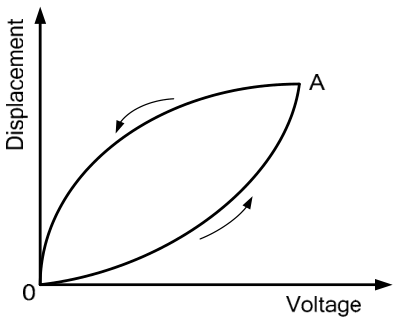
The nonlinear hysteresis effect of piezoelectric actuators can be characterized by a hysteresis loop with an upper convex and lower convex shape, as shown in Figure 1. It exhibits a lower convex characteristic during the displacement rising phase (as shown by the curve from point 0 to point A in Figure 1) and an upper convex characteristic during the displacement falling phase (as shown by the curve from point A back to point 0 in Figure 1). To describe nonlinear characteristics, nonlinear differential equations or intermediate variables are often introduced in existing research, which leads to complex model structures, difficulty in equation solving, and low computational accuracy.
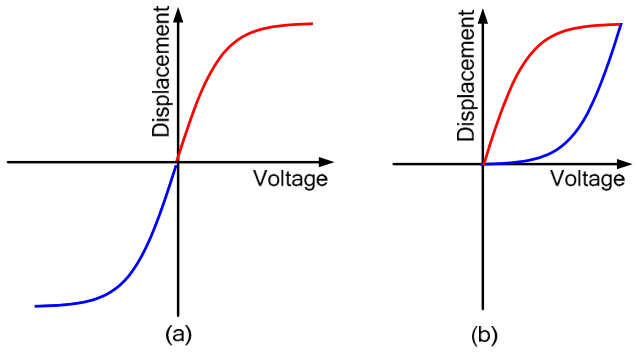
The activation function features an S-shaped curve, similar to the hysteresis loop. Based on the idea of nonlinear transformation, the activation function is introduced to describe the nonlinear hysteresis loop in this paper. The idea of nonlinear transformation is illustrated in Figure 2. The S-shaped curve of the activation function shows an upper convex characteristic in the first quadrant and a lower convex characteristic in the third quadrant (as shown in Figure 2a). By transforming the negative half of the activation function located in the third quadrant to the first quadrant, and introducing corresponding shape parameters to adjust the upper and lower convex curves, it is possible to approximate the upper and lower convex characteristics of the hysteresis loop (as shown in Figure 2b), making it feasible to describe the displacement-voltage nonlinearity of piezoelectric actuators.
As shown in Figure 2, after nonlinear transformation, the nonlinear hysteresis loop of the piezoelectric actuator can be converted into an S-shaped curve of the activation function. The lower convex characteristic during the displacement rising phase (blue curve) and the upper convex characteristic during the displacement falling phase (red curve) can be described by the curves of the activation function in the third and first quadrants, respectively.
Among various activation functions, the Softsign function has a smoother asymptote compared to the Tanh and Sigmoid functions, and it has higher computational efficiency than the Softplus function, while also possessing a smooth derivative. In this paper, the Softsign function is used as the nonlinear transformation function for the hysteresis characteristics of piezoelectric actuators, thereby avoiding the disadvantages of introducing nonlinear differential equations or intermediate variables. The Softsign function used in this study is shown as follows:
S o f t s i g n ( t ) = u ( t ) 1 + u ( t )
It is necessary to explicate how the Softsign function fundamentally represents hysteresis evolution and the memory effects of actuators. The Softsign function inherently encodes two critical physical constraints: (1) First, the approach to saturation. As u ⟶ ±∞ is input, Softsign asymptotically approaches ±1, naturally replicating the saturation hysteresis. More importantly, its polynomial saturation rate provides a better fit for certain materials. (2) Next, the reversible component at zero. Unlike piecewise linear models, Softsign is smooth at the origin with a non-zero, finite derivative. This mathematically guarantees a continuous transition from reversible to irreversible domain wall motion, a prerequisite for physically sound hysteresis representation.
Because Softsign is a strictly monotonic, bounded function with a Lipschitz constant of 1, it acts as a contraction map that stabilizes the state evolution. This stabilization is essential: it prevents the internal state from diverging and guarantees that the fading memory property is consistently maintained. The state reflects a weighted, bounded recollection of past extrema, which is the very essence of memory in hysteretic systems.

2.2. Hysteresis Modeling Based on Nonlinear Transformation

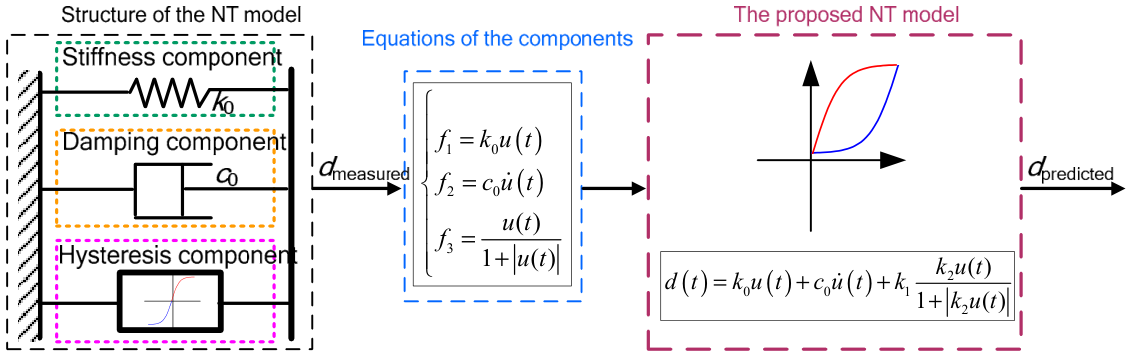
A piezoelectric actuator can be approximately seen as a spring-damper system. In addition to characterizing the nonlinear hysteresis loop, it is also necessary to consider the stiffness and damping of the system. Based on this, the stiffness component and damping component that vary with the driving voltage is further introduced, thereby leading to the proposed NT model, as shown in Equation (2).
d t = k 0 u t + c 0 u ˙ t + k 1 k 2 u ( t ) 1 + k 2 u ( t )
where u(s) denotes the driving voltage and d(s) represents the output displacement. To establish a rigid boundary between structural dynamics and material science, the parameters are categorized into two distinct classes based on their physical–mathematical roles.
The parameters k0 and c0 govern the fundamental structural dynamics of the actuator assembly. Specifically, k0 represents the baseline elastic structural stiffness of the piezoelectric stack, dictates the linear voltage-to-displacement conversion under quasi-static conditions, and remains highly stable across varied frequencies. The parameter c0 represents the linear viscous damping factor, capturing the physical energy dissipation within the mechanical joints and material interfaces during cyclic motions.
Conversely, k1 and k2 serve as phenomenological coefficients mapped directly to the microscopic ferroelectric dipole polarization kinetics. Under an alternating electrical excitation, the reorientation and switching behaviors of the internal micro-domains introduce a distinct nonlinear lag, resulting in an asymmetric upper and lower convex hysteresis loop. Within this context, k1 acts as an amplitude coefficient that scales the maximum bounds of the hysteretic trajectory, which is tied to the saturation polarization capacity of the material. The parameter k2 acts as a shape parameter regulating the voltage saturation threshold within the Softsign activation framework. As the operating frequency scales upward, the microscopic polarization reorientation lags further behind the external electric field. This physical polarization mismatch modifies the geometry of the hysteresis loop, which is successfully captured by the condition-specific evolution of the curve-fitting coefficients k1 and k2.
The construction process of the proposed NT hysteresis model is illustrated in Figure 3. First, the model employs the nonlinear characteristics of the activation function to directly characterize the inherent nonlinear components in the hysteresis loop of piezoelectric actuators, thereby effectively avoiding the problems of complex derivation, high-order coupling, and numerical solution difficulties encountered by traditional nonlinear differential equations. Furthermore, a stiffness and a damping factor that can reflect the dynamic characteristics of the system are introduced. The overall structure of the constructed NT model is concise and intuitive, with a small number of unknown parameters to be identified. It does not involve strongly nonlinear differential equations, nor does it require the introduction and determination of complex intermediate state variables, which significantly reduces model complexity and online computational burden. Compared with traditional hysteresis models such as Prandtl–Ishlinskii and Bouc–Wen, this model maintains high characterization accuracy while being more convenient for parameter identification, numerical solution, and practical engineering implementation, providing a sound foundation for subsequent inverse-model construction and real-time compensation control.

2.3. Inverse NT Model Derivation

To further demonstrate the applicability of the proposed NT model in precision positioning and feedforward control, a discrete inverse model is derived.
In control applications, the desired displacement d r ( t ) is typically given, and the corresponding driving voltage u ( t ) needs to be generated. Because the NT model contains both the derivative term u ˙ ( t ) and the nonlinear fractional term with an absolute value, direct continuous-time inversion is inconvenient for real-time implementation. Therefore, a discrete inverse formulation is adopted. Let the sampling period be T s and approximate the voltage derivative by backward difference:
u ˙ t u n u n 1 T s
Then, the model at the nth sampling instant becomes
d n = k 0 u n + c 0 u n u n 1 T s + k 1 k 2 u n 1 + k 2 u n
Further, we can obtain
d n + c 0 T s u n 1 = k 0 + c 0 T s u n + k 1 k 2 u n 1 + k 2 u n
Define
A = k 0 + c 0 T s , B n = d n + c 0 T s u n 1
Then, we can get
B n = A u n + k 1 k 2 u n 1 + k 2 u n
Because of the absolute-value term, Equation (7) is solved piecewise.
When u n 0 , | k 2 u n | = k 2 u n , and therefore
B n = A u n + k 1 k 2 u n 1 + k 2 u n
By multiplying both sides by ( 1 + k 2 u n ) and rearranging elements, we can obtain
A k 2 u n 2 + A + k 1 k 2 B n k 2 u n B n = 0
When u n < 0 , | k 2 u n | = k 2 u n , then
B n = A u n + k 1 k 2 u n 1 k 2 u n
Similarly, we can obtain
A k 2 u n 2 + A k 1 k 2 B n k 2 u n + B n = 0
Therefore, the inverse problem of the NT model in discrete form is converted into a piecewise quadratic equation with respect to un. At each sampling instant, candidate solutions from the positive and negative branches are calculated, and the physically admissible solution is selected according to the sign constraint and continuity with the previous input u n 1 . This inverse-model formulation avoids complex iterative computation and is convenient for real-time feedforward implementation.

3. Model Identification and Evaluation Metrics

3.1. Model Identification

In recent years, swarm intelligence algorithms have been widely applied in the parameter recognition of piezoelectric actuators, such as Genetic Algorithms (GAs) [18,19,20,21], the Artificial Bee Colony (ABC) algorithm [22,23,24], Ant Colony Optimization (ACO) [25,26,27], Cuckoo Search (CS) [28,29,30] and Particle Swarm Optimization (PSO) [31,32,33]. Each of these algorithms has its own advantages. For example, GA, ABC, and ACO possess global search capabilities, strong adaptability, multi-mode search, and ease of implementation. However, they suffer from slow convergence speed and a tendency to get trapped in local optima when searching for the optimal solution. The CS algorithm performs better than GA and ABC with regard to convergence behavior and optimization accuracy in high-dimensional nonlinear optimization, but it has higher computational complexity, lower computational efficiency, and is more sensitive to noise. Compared with GA, ABC, and ACO, the PSO algorithm has advantages of simplicity, high convergence efficiency, and ease of application. In contrast to the CS algorithm, the PSO algorithm has fewer parameters and can be combined with other algorithms. Many researchers [34,35,36,37,38] have demonstrated the effectiveness of the PSO algorithm in multiple fields, including piezoelectric systems. Thereby, the PSO algorithm is used for hysteresis nonlinearity fitting in this paper.
v i k + 1 = ω i v i k + c 1 r a n d 1 ( p b e s t i x i k ) + c 2 r a n d 2 ( g b e s t x i k ) x i k + 1 = x i k + v i k + 1
where ω is the inertia weight, which controls the degree to which the particle maintains its original direction; c1 and c2 are learning factors; r1 and r2 are random numbers within the interval [0, 1]; and xi(t) and vi(t) are the position and velocity of the ith particle at time t.
The parameter identification process for the hysteresis nonlinearity of the piezoelectric actuator is essentially a problem of finding a global minimum. Defining a proper objective function is essential for the optimization problem. Herein, the RMSE between the measured displacement and the model output over a sampling period is taken as the optimization target. During the iteration process, the model parameters are continuously updated to minimize the RMSE value, thereby determining the optimal solution. Its mathematical formula is as follows:
R M S E = 1 N i = 1 N d i model t d i exp t 2
where N is the number of samples in one sampling frequency, and the value varies for different frequencies, and d i exp s and d i model s represent the measured value and the model value, respectively.
To ensure the high-fidelity representation capability of the proposed NT model, separate parameter sets are identified independently for each distinct loading condition (voltage and frequency). This condition-specific tuning strategy is physically justified by the inherent rate-dependent and amplitude-dependent nature of piezoelectric actuators, where internal polarization dynamics and micro-domain switching lags shift under different excitation envelopes. By executing the PSO algorithm independently for every experimental dataset, we ensure a fair and rigorous structural benchmarking process, comparing the maximum mathematical capacity of each of the six competing model architectures under identical optimization conditions. In practical precision engineering implementations, these condition-specific optimal parameter sets are seamlessly integrated into real-time controllers via a multi-dimensional calibration look-up table or a gain-scheduling framework mapped to the operating frequency and voltage.

3.2. Evaluation Metrics

To perform a multi-dimensional performance comparison, several commonly used evaluation metrics are also chosen in order to conduct a comprehensive analysis. In addition to RMSE, the Mean Absolute Percentage Error (MAPE), the Symmetric Mean Absolute Percentage Error (SMAPE), and the Coefficient of Determination (R2) are introduced as evaluation metrics so as to provide a comprehensive evaluation of the six hysteresis models from multiple dimensions.
MAPE is an indicator used to measure the accuracy of a predictive model and has found wide application in areas such as time series forecasting and regression analysis. Its mathematical expression is as follows:
M A P E = 1 N i = 1 N d i model t d i exp t d i exp t
SMAPE is often chosen to evaluate predictive accuracy, especially suitable for time series forecasting or regression problems. Unlike MAPE, the relative size of the actual value and the predicted value during calculation is taken into consideration in SMAPE. Its mathematical expression is as follows:
S M A P E = 1 N i = 1 N d i model t d i e x p t ( d i model t + d i e x p t ) / 2
R2 is an indicator used in statistics to measure the goodness of fitting. It ranges from 0 to 1, where a value of 0 usually indicates poor fitting performance and a value of 1 indicates that the model perfectly fits the data. Its mathematical expression is as follows:
R 2 = 1 i 1 N ( d i exp t d i model t ) 2 i 1 N ( d i exp t d i exp t ¯ ) 2
These four evaluation metrics can cover different dimensions of assessment needs. RMSE measures the absolute error between the predicted value and the true value, with units consistent with the target variable; MAPE measures the relative error ratio between the predicted value and the true value, facilitating comparisons across different datasets; SMAPE avoids the division-by-zero issue that occurs in MAPE when the true value is zero; and R2 measures the ability of the model to explain the variability in the data, reflecting the overall fitting performance of the model. Generally speaking, for the first three indicators, the lower the value of the evaluation metric, the better the model performance. For R2, the higher the value of the evaluation metric, the better the model performance.
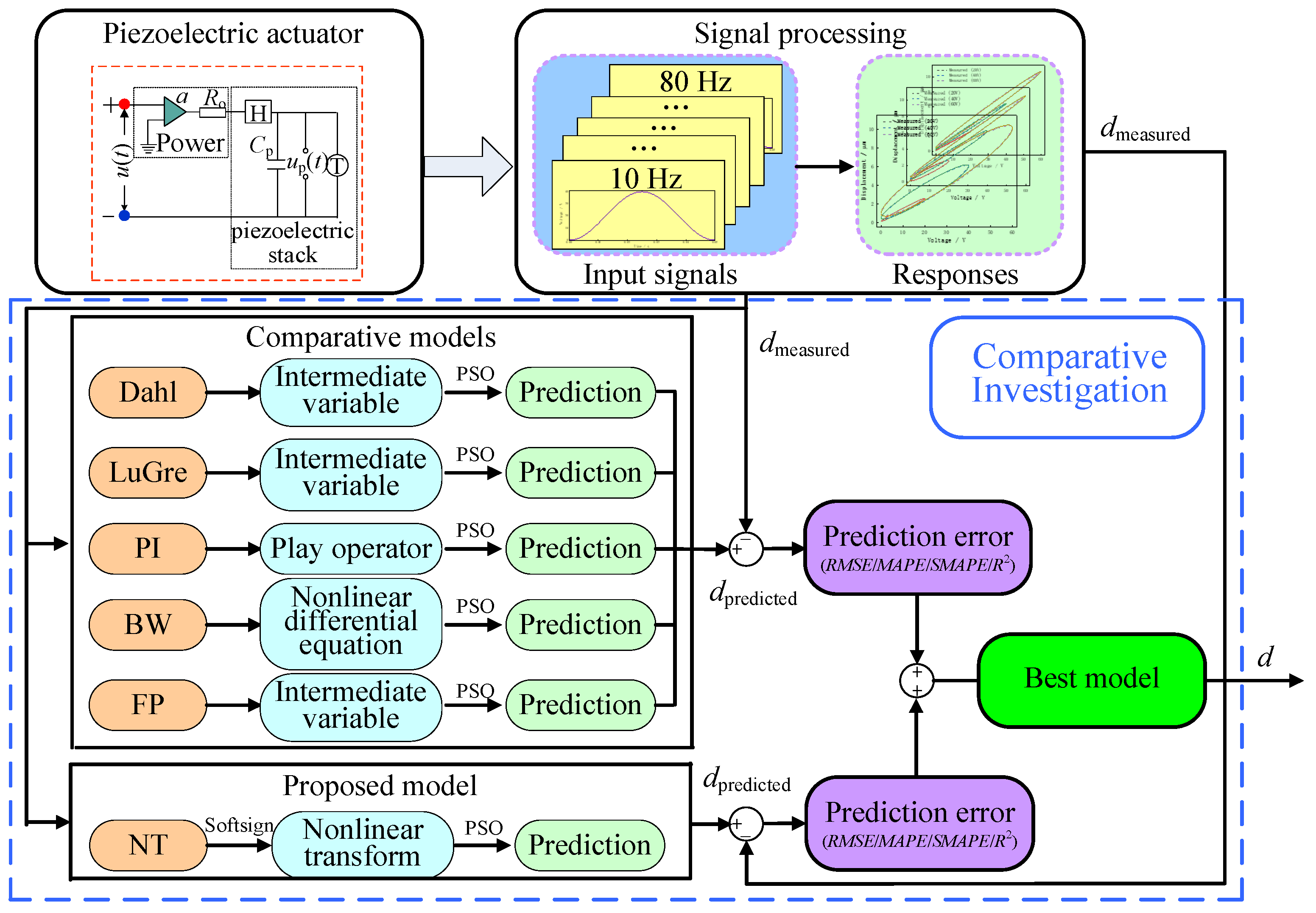
Furthermore, the comparative investigation strategy is illustrated in Figure 4, which is mainly composed of three components: the piezoelectric system, signal processing and comparative investigation. The individual prediction is performed by each hysteresis model, and thereby the prediction error compared with the measured experiment values can be obtained. Through comparison of prediction error, the advantage of the proposed NT model can be determined.

4. Results and Analysis

4.1. Experimental Setup

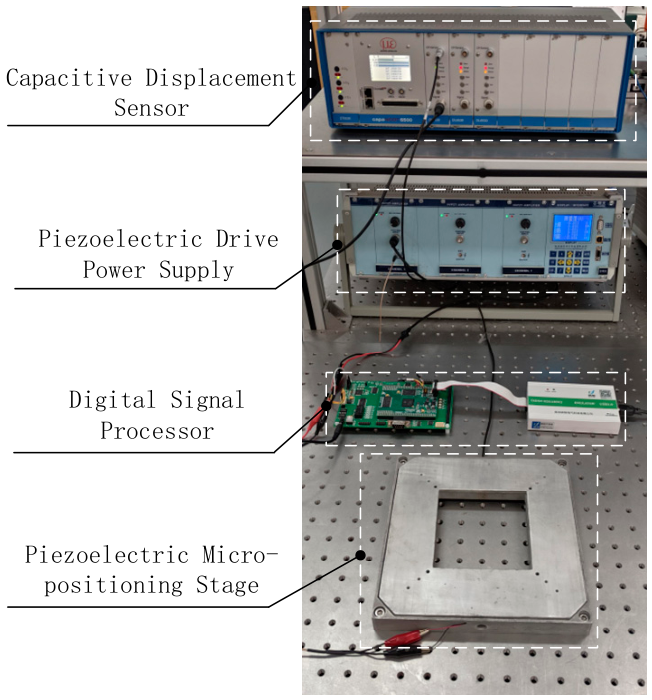
The experimental configuration for displacement and voltage measurement of the piezoelectric actuator (installed inside a micro-positioning stage) is shown in Figure 5. The resonant frequencies of the micro-positioning stage under no-load conditions are 104.4, 138.4 and 120 Hz in the x, y, and θz direction, respectively. The system includes a DSP card (Manufacture: Texas Instruments, Type: TMS320C6747, Frequency: 375 MHz), a piezoelectric actuator (Manufacture: PANT; Type: PTJ1501010601, shown in Table 1), a capacitive displacement sensor (Manufacture: Micro-Epsilon, Type: CSE1, Resolution: 0.02 µm, installed inside micro-positioning stage), a computer, a driver power supply, auxiliary measurement brackets, and a three-dimensional manual adjustment platform. The measurement procedure is described as follows. The multifunctional data acquisition (DAQ) card converts the digital signal generated by the computer into an analog signal, which is subsequently transmitted to the power drive module of the piezoelectric actuator. The output voltage from the drive module is applied to the piezoelectric actuator, thereby driving the device to generate micro-displacement, which further results in a displacement of the micro-positioning stage. Finally, the resulting displacement is collected by a non-contact capacitive displacement sensor and finally collected into the computer via a network port.
To further explore the hysteretic nonlinear behavior of piezoelectric actuators, three groups of sinusoidal excitation voltages (0-20 V-0, 0-40 V-0 and 0-60 V-0) are imposed on the actuator. The excitation frequency is set from 10 Hz to 80 Hz with an interval of 10 Hz, and repeated experiments are carried out to record the output responses. Accordingly, the corresponding hysteresis correlation between input voltage and output displacement is acquired. To guarantee experimental stability, the sampling duration for all tests is configured to five operating cycles. Both voltage and displacement responses can be directly acquired from sensor measurements, whereas the voltage change rate is calculated by taking the derivative of voltage with respect to time.

4.2. Fitting Analysis of Hysteresis Model

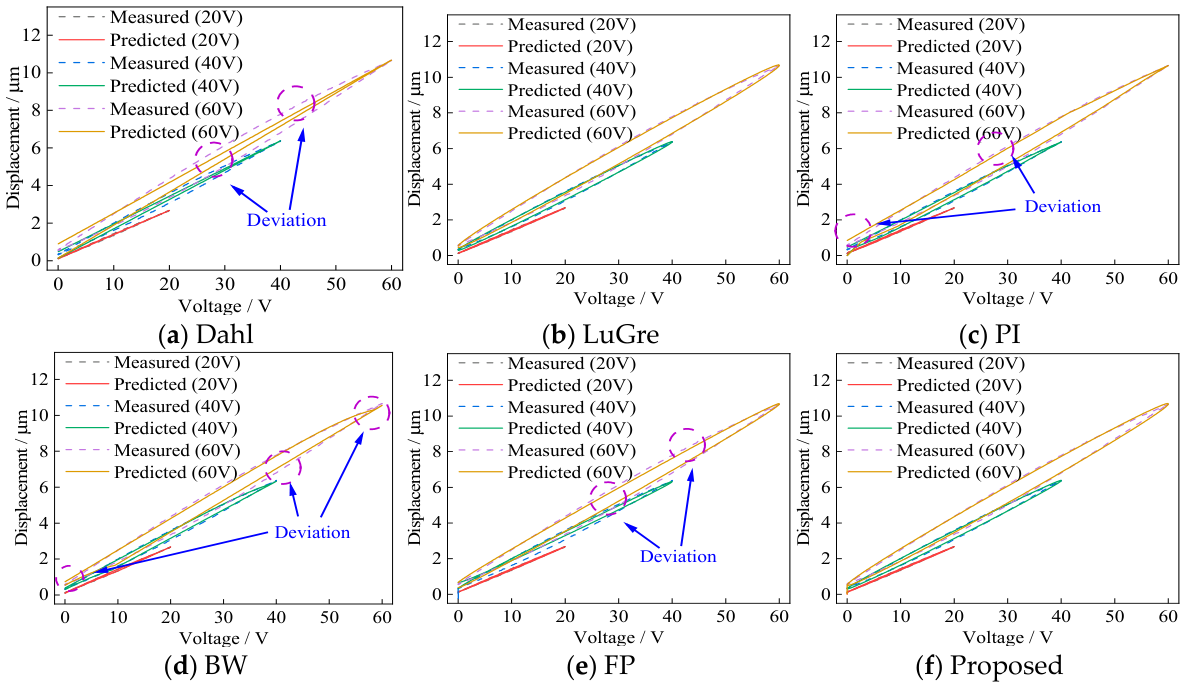
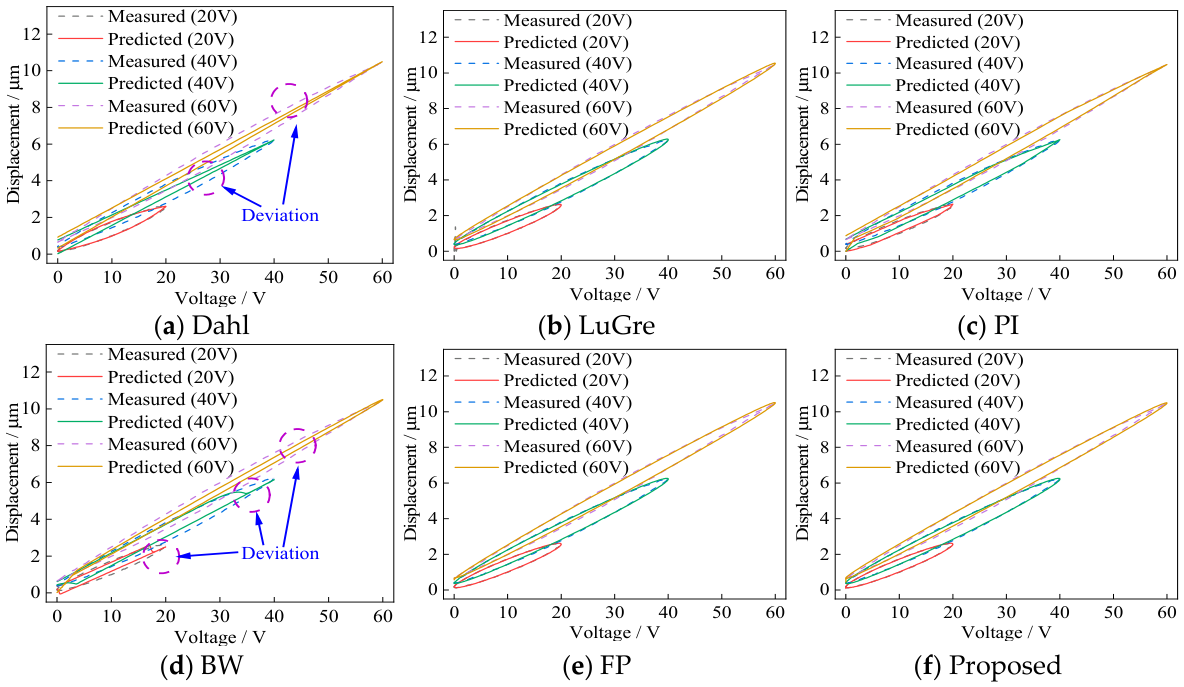
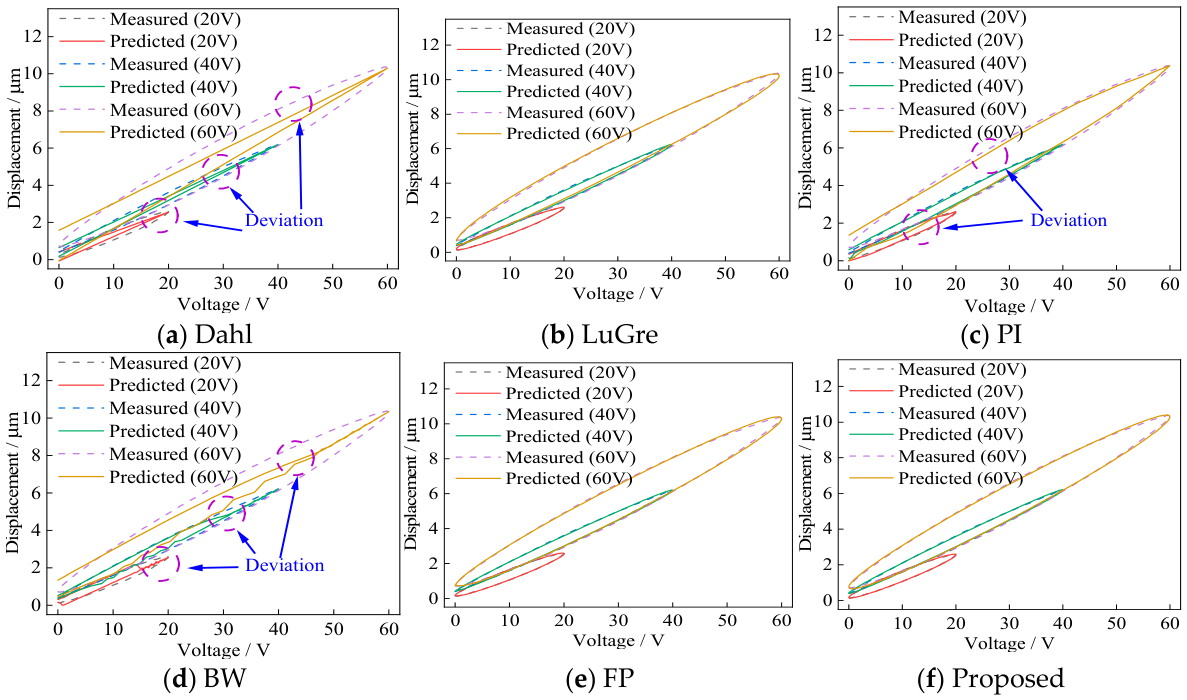
In Figure 6, Figure 7 and Figure 8, the hysteresis responses of six hysteresis models under different loading conditions at frequencies of 10 Hz, 40 Hz, and 80 Hz with voltages of 20 V, 40 V, and 60 V are compared, respectively. The results show that the proposed NT model, along with the LuGre and FP models, exhibits a relatively good match between the measured values and the model values, effectively characterizing the hysteresis characteristics of the piezoelectric actuator under different loading conditions. With regards to the PI model, some deviation can be observed in fitting the hysteresis curves under the loading conditions of 20 V and 10 Hz, 20 V and 80 Hz, and 60 V and 80 Hz. Meanwhile, significant deviations and distortions under most frequency and voltage conditions can also be found as in the Dahl and BW models, indicating clear shortcomings in their ability to characterize the hysteresis characteristics of the piezoelectric actuator.
In summary, compared to the proposed NT model, LuGre, and FP models, the PI, Dahl, and BW models show a certain problem of deviation in fitting performance, indicating their deficiencies in characterizing the hysteresis nonlinear characteristics. The proposed NT model, along with the LuGre and FP models, demonstrates better fitting performance under various loading conditions, indicating superior performance in describing the hysteresis nonlinear characteristics of the piezoelectric actuator.

4.3. Quantitative Analysis of Model Fitting Performance

4.3.1. RMSE Analysis

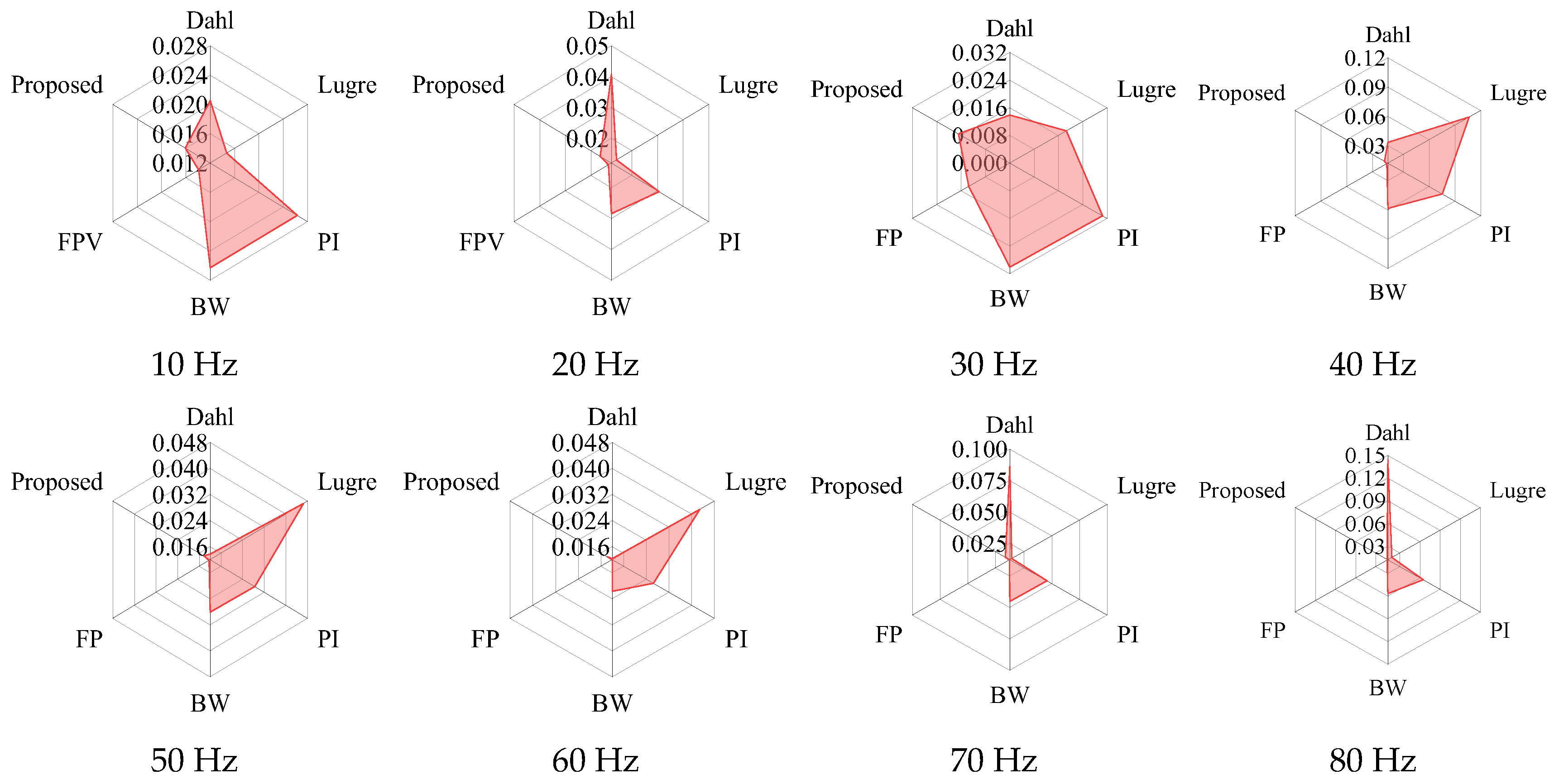
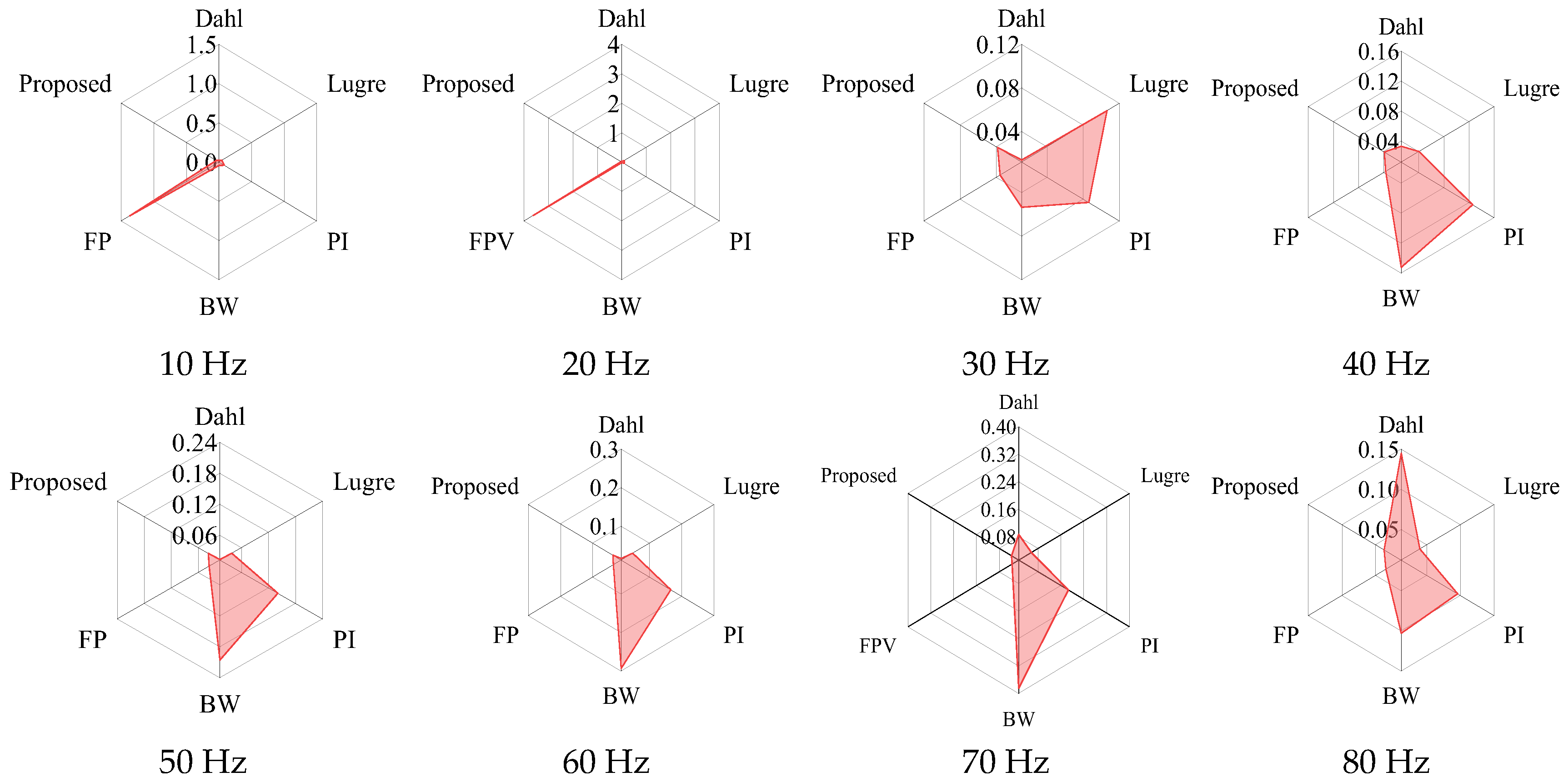
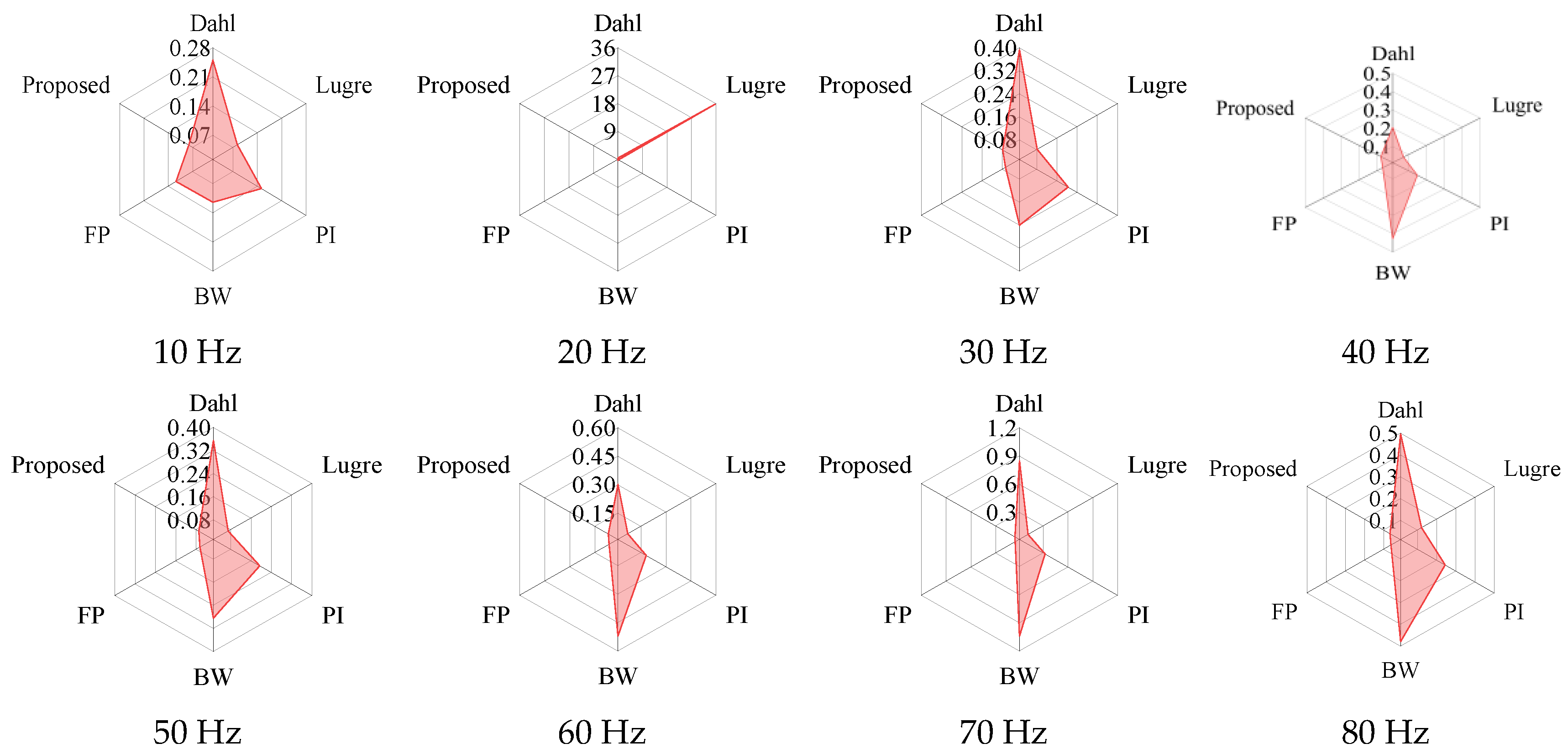
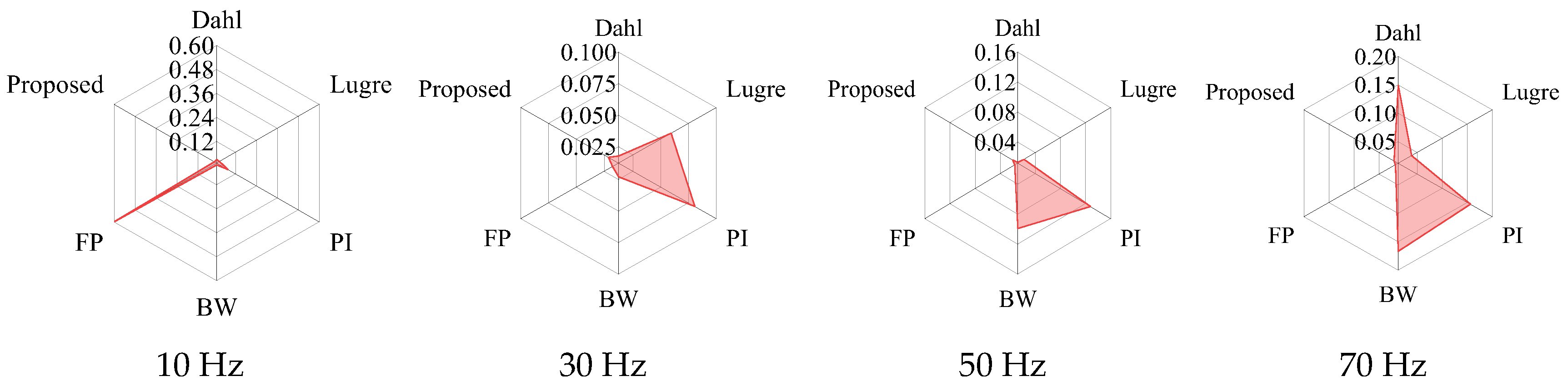
The RMSE performance of the six hysteresis models is compared, with driving voltages of 20, 40, and 60 V and working frequencies ranging from 10 to 80 Hz at intervals of 10 Hz. To intuitively display the numerical comparison of the RMSE of each model, satellite maps are used, as shown in Figure 9, Figure 10 and Figure 11.
From the figures, it can be seen that the RMSE values of the proposed NT model are within a small range under all loading conditions, and the fitting error is more stable and reliable compared to the other five existing hysteresis models. Although the FP model has smaller RMSE values than the proposed NT model under all working frequencies at 20 V, its RMSE performance is also superior to the proposed NT model under several working conditions such as 40 V and 30 Hz, 40 V and 50 Hz, 40 V and 60 Hz, 40 V and 80 Hz, 60 V and 30 Hz, 60 V and 40 Hz, and 60 V and 50 Hz. However, the FP model’s RMSE reaches 1.3708 at 40 V and 10 Hz, which is 6686.83%, 3195.34%, 1681.96%, and 3194.63% higher than the other four existing models and 3319.13% higher than the proposed NT model, making it the largest error among all six models and indicating that its performance is not as reliable as the proposed NT model. Similar extreme fitting errors also exist in other existing hysteresis models, such as the Dahl model reaching its maximum RMSE of 0.8485 (proposed model: 0.0668) at 60 V and 70 Hz, the LuGre model reaching its maximum RMSE of 35.69 (proposed model: 0.0789) at 60 V and 20 Hz, the PI model reaching its maximum RMSE of 0.1859 (proposed model: 0.0371) at 40 V and 70 Hz, and the BW model reaching its maximum RMSE of 1.0414 (proposed model: 0.0668) at 60 V and 70 Hz. In contrast, the proposed NT hysteresis model has a maximum RMSE of only 0.0812 at 60 V and 10 Hz.
In summary, the maximum RMSE of the proposed NT model under all loading conditions is only 0.0812, which is better than the other five hysteresis models. Thereby, it can be concluded that the proposed NT model has a clear advantage in fitting the hysteresis characteristics of the piezoelectric actuator.

4.3.2. MAPE Analysis

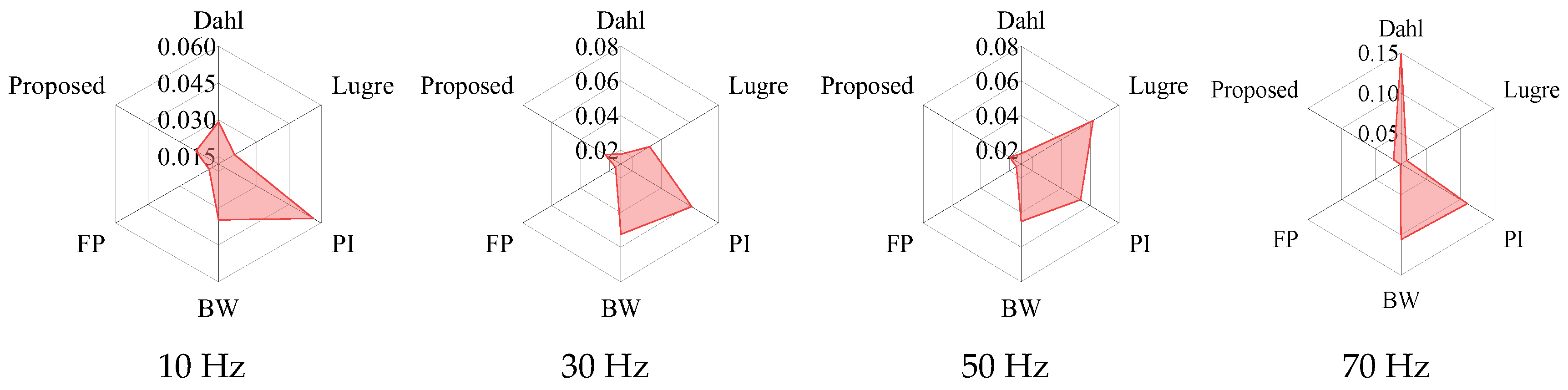
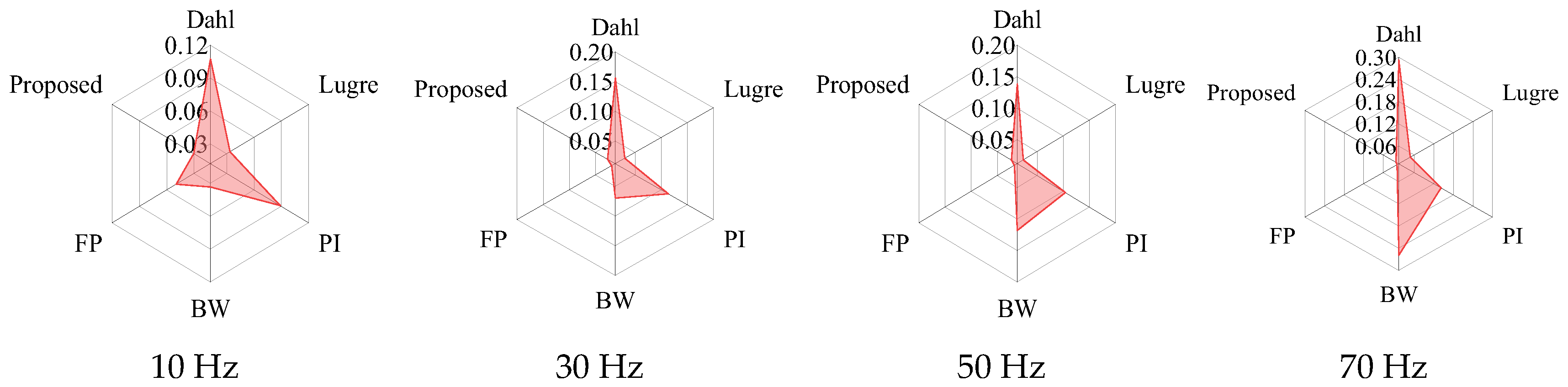
To further analyze and clarify the advantages and disadvantages of the six hysteresis models, the MAPE performance of all models is further analyzed. Considering the need to reduce the length of the text, only MAPE satellite maps for 20, 40, and 60 V driving voltages at 10, 30, 50, and 70 Hz are given, as shown in Figure 12, Figure 13 and Figure 14.
From the figures, it can be seen that the MAPE of the proposed NT model is within a small range under all loading conditions, and its fitting accuracy is more reliable compared to the other five hysteresis models. Although the FP model has smaller MAPE values than the proposed NT model under all working frequencies at 20 V and 60 V, under other working conditions such as 40 V and 20 Hz, 40 V and 40 Hz, 40 V and 60 Hz, and 40 V and 80 Hz, its MAPE reaches 0.6044 and 0.5919 at 40 V and 10 Hz and 40 V and 20 Hz, respectively, which is 2437.1% and 2518.72% higher than the proposed NT model. Similar extreme fitting errors also exist in other conventional hysteresis models, such as the Dahl model reaching its maximum MAPE of 0.2461 (proposed model: 0.0191) at 40 V and 80 Hz, the LuGre model reaching its maximum MAPE of 22.44 (proposed model: 0.0225) at 20 V and 40 Hz, the PI model reaching its maximum MAPE of 0.1694 (proposed model: 0.0225) at 20 V and 40 Hz, and the BW model reaching its maximum MAPE of 0.1841 (proposed model: 0.0224) at 60 V and 60 Hz. Overall, the proposed NT model and the FP model have an absolute advantage in fitting accuracy compared to other models. However, the proposed NT model performs more stably and reliably compared to the FP model, achieving satisfactory results in all loading conditions. The maximum MAPE of the proposed NT model under all loading conditions is only 0.045, demonstrating the reliability of the proposed model’s performance.

4.3.3. SMAPE Analysis

The six hysteresis models are further analyzed using SMAPE. To reduce the length of the text and to comprehensively analyze the model fitting performance under all loading conditions, as well as to complement the MAPE analysis above, only SMAPE satellite maps for 20, 40, and 60 V driving voltages at 20, 40, 60, and 80 Hz operating conditions are given in this paper.
The results show that although the FP model has lower SMAPE values than the proposed NT model in most conditions, its SMAPE value reaches an astonishing 1.2133 at 40 V and 20 Hz, which is 5055.42% higher than the proposed NT model. Overall, the maximum SMAPE values of the Dahl, LuGre, PI, BW, FP, and proposed hysteresis models are 0.539, 0.7143, 0.2195, 0.239, 1.2133, and 0.0456, respectively, occurring at 60 V and 70 Hz, 60 V and 20 Hz, 20 V and 40 Hz, 60 V and 60 Hz, 40 V and 20 Hz, and 20 V and 60 Hz, respectively, which are far higher than the maximum SMAPE value of the proposed NT model.

4.3.4. R2 Analysis

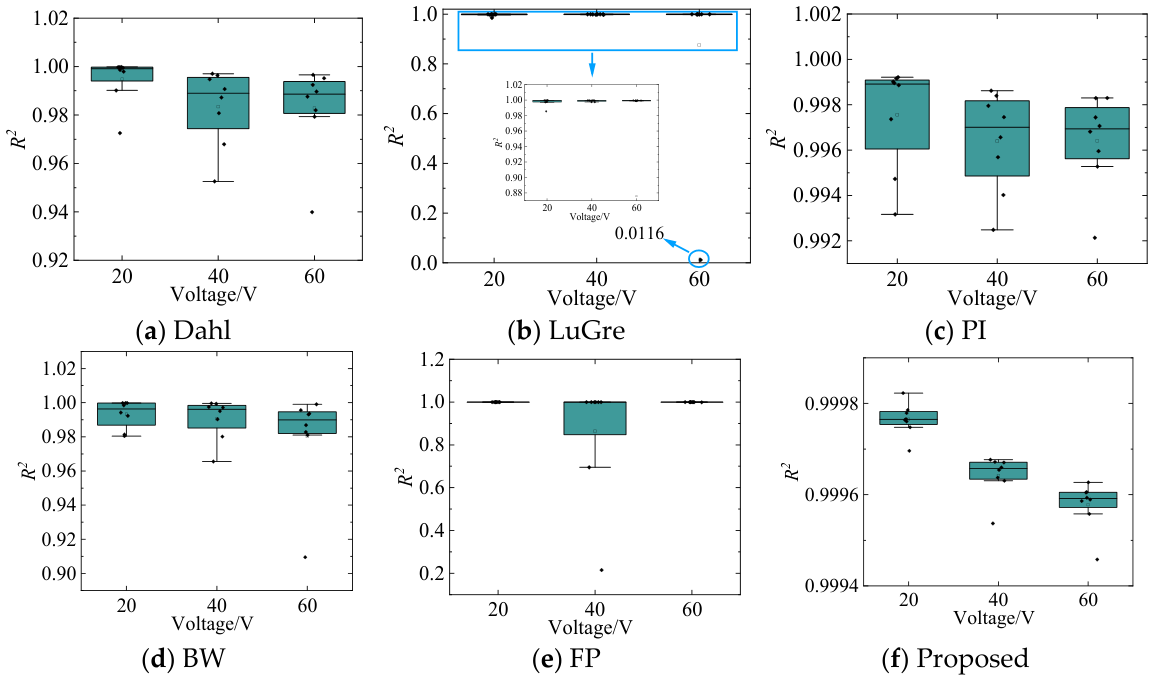
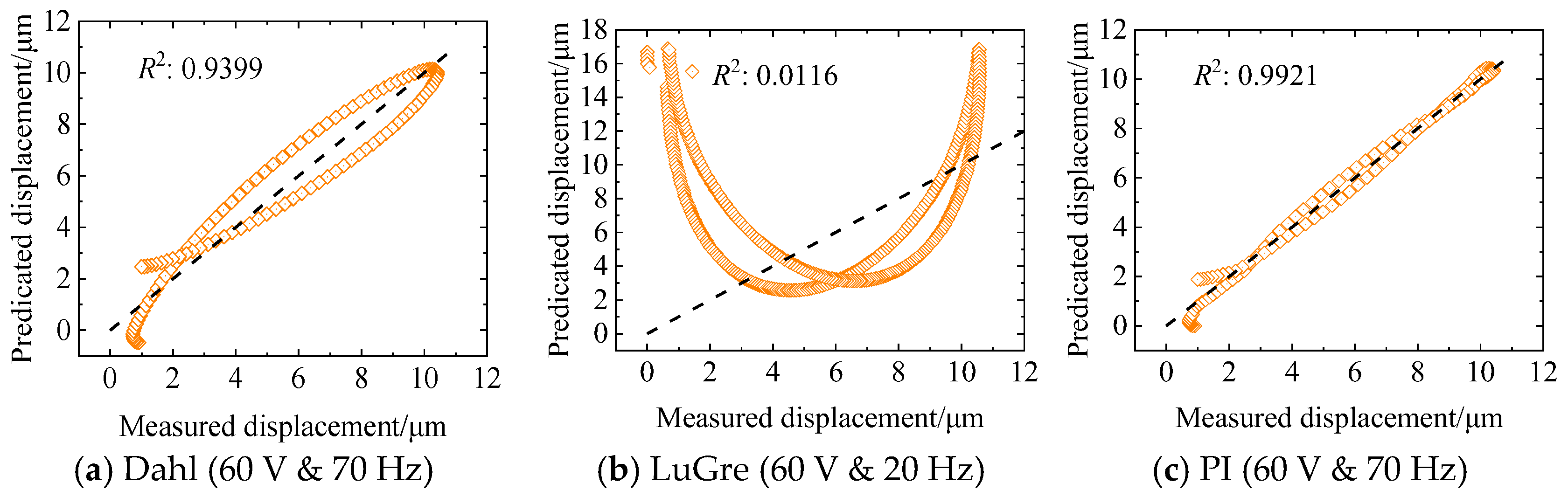
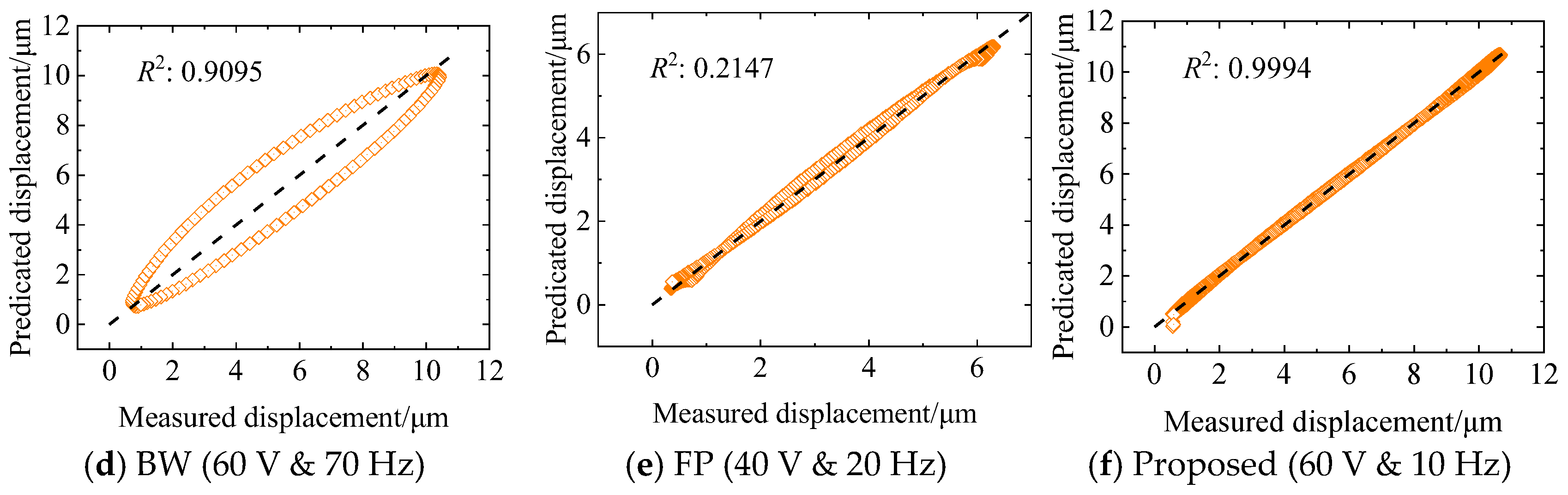
R2 results of the six hysteresis models are also analyzed under driving voltages of 20, 40, and 60 V, with frequencies ranging from 10 to 80 Hz at intervals of 10 Hz. It should be noted that the R2 values of the Dahl, LuGre, PI, BW, and FP models all have results below 0.94, with the lowest R2 values being 0.9399, 0.0116, 0.9921, 0.9095, and 0.2147, respectively (highlighted numbers in Table 2), occurring at 60 V and 70 Hz, 60 V and 20 Hz, 60 V and 70 Hz, 60 V and 70 Hz, and 60 V and 70 Hz. The lowest R2 value of the proposed NT model is 0.9994 at 60 V and 10 Hz, significantly higher than the R2 values of the other five hysteresis models.
The R2 distribution map of the six hysteresis models under all loading conditions is further given in Figure 15. It can be seen that the R2 distribution of the proposed NT model is the most concentrated, with the smallest errors.

4.3.5. Worst R2 Performance

The relationship between the measured value and the model value when the six hysteresis models reach their own lowest R2 values is further demonstrated in Figure 16. The dashed line represents the data fitting comparison line y = x. The closer the data is to the line y = x, the better the model fitting effect. The proposed NT model achieves perfect matching between the model value and the measured value when its lowest R2 is 0.9994, fully demonstrating the good fitting effect of the proposed NT model on the experimental data.

4.3.6. Running Time Performance

As can be seen from the Table 2, the overall computation time of the proposed NT hysteresis model is satisfactory and ranks at a good level among the six hysteresis models.

4.4. Fitting Error Analysis of the Proposed NT Model

After confirming the advantages of the proposed NT model in terms of fitting accuracy and stability, the analysis of fitting error is further conducted, as shown in Figure 17. The relative error between the fitted data and the experimental data is presented, with frequencies ranging from 10 to 80 Hz at driving voltages of 20 V, 40 V, and 60 V. As shown in Figure 17, the hysteresis fitting error generally increases with the increase in driving voltage. Under the driving voltages of 20 V, 40 V, and 60 V, the error is within the ranges of −0.02~0.02 µm, −0.06~0.06 µm, and −0.13~0.12 µm, respectively, indicating that the fitting error of the proposed NT model presents a satisfactory acceptable level. The maximum fitting error occurs under the loading condition of 60 V and 40 Hz, with a maximum fitting error of 0.13 µm. It can be seen that under the 20 V driving voltage, the maximum fitting error of the proposed NT model is only 0.02 µm, indicating that the fitting accuracy of the proposed NT model is very good. In summary, the proposed NT model has a small fitting error and a relatively stable distribution and can effectively reflect the nonlinear hysteretic features of the piezoelectric actuator.

4.5. Performance Comparison

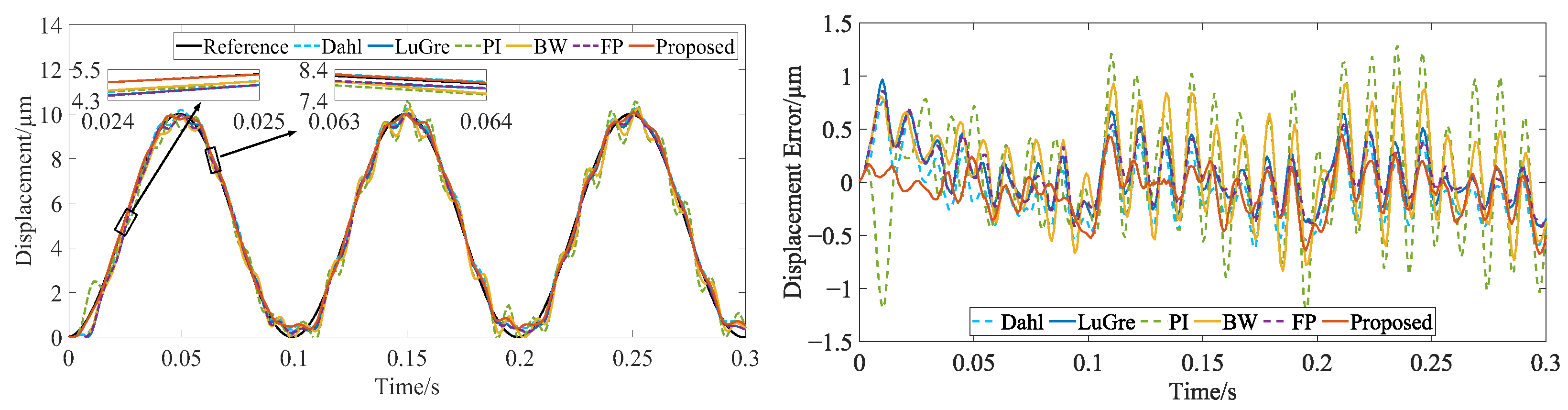
Based on the above analysis, a performance comparison of the six hysteresis models is provided and listed in Table 3. The comparison demonstrates that the proposed NT model has the advantages of simple structure, few parameters, convenient solving, and high fitting accuracy. It comprehensively outperforms the Dahl, LuGre, PI, BW, and FP models in terms of RMSE, MAPE, SMAPE, and R2.

5. Trajectory Tracking Control and Positioning Control Performance of the Inverse Model

To systematically evaluate the effectiveness of the proposed NT hysteresis inverse model in the motion control of piezoelectric actuators, feedforward control, sinusoidal trajectory tracking control and step positioning control experiments are carried out. Through comparative analyses with existing hysteresis models and conventional feedback control methods, the performance superiority of the proposed model in hysteresis compensation, dynamic trajectory tracking and fast positioning control is verified.
First, to investigate the feedforward compensation performance of different hysteresis inverse models, the corresponding inverse control voltages are calculated based on the proposed NT, Dahl, LuGre, PI, BW and FP models, respectively, which are applied to the piezoelectric actuator as feedforward inputs. The feedforward control performances under different models are presented in Figure 17 and Table 4. As indicated by the plotted data and tabulated results, the feedforward control based on the proposed NT hysteresis inverse model achieves the minimum trajectory tracking error, with a maximum tracking error emax of 0.675 μm and a Root Mean Square Error (RMSE) of 0.227 μm, which are lower than those obtained from the Dahl, LuGre, PI, BW and FP models. Compared with the PI model, the proposed model reduces emax and RMSE by 47.5% and 59.0%, respectively. In contrast to the BW model, the two indices drop by 27.3% and 46.2%; versus the FP model, the reductions reach 21.7% and 14.3%. In addition, the proposed model also yields smaller maximum error and RMSE than the Dahl and LuGre models. The above results demonstrate that the proposed NT model can not only accurately characterize the hysteresis nonlinearity of piezoelectric actuators, but its inverse version can generate more precise feedforward compensation voltage, thereby effectively suppressing the tracking error induced by hysteresis effects.
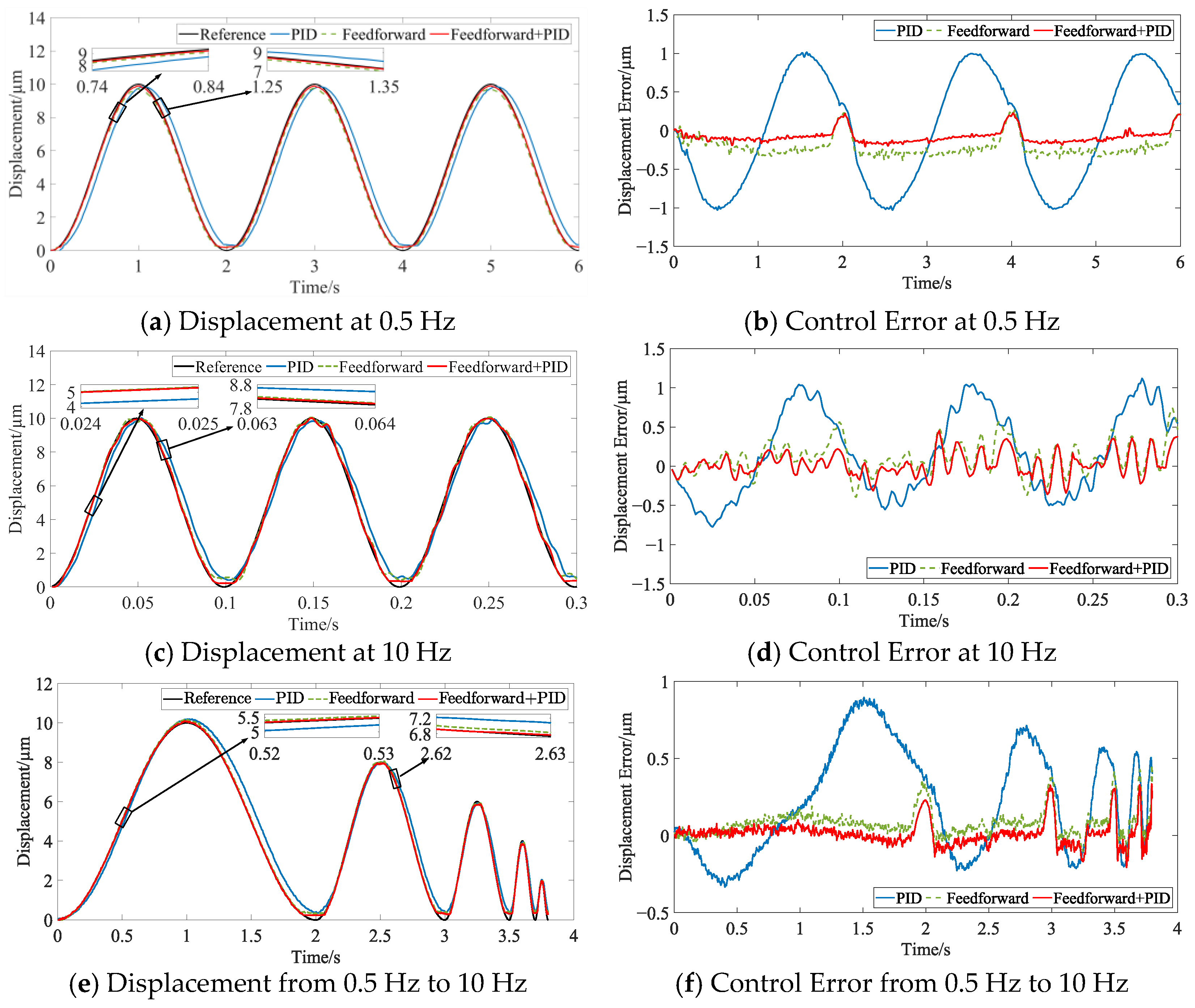
Further, sinusoidal trajectory tracking experiments under various operating conditions are implemented to verify the compensation capability of the proposed NT hysteresis inverse model in closed-loop trajectory tracking control. Three control strategies are compared in the experiments: pure PID feedback control, feedforward control based on the NT inverse model, and composite control combining NT inverse-model feedforward with PID feedback. To evaluate the adaptability of the proposed control scheme under varying frequencies and complicated trajectories, three reference trajectories are adopted: low-frequency sinusoidal trajectory at 0.5 Hz, high-frequency sinusoidal trajectory at 10 Hz, and variable-amplitude variable-frequency sinusoidal trajectory at frequencies ranging from 0.5 to 10 Hz. The mathematical expression of the sinusoidal reference trajectory is given as
d r ( t ) = A i 2 sin ( 2 π f i t π / 2 ) + A i 2
where Ai denotes the sinusoidal amplitude and fi stands for the trajectory frequency.
Experimental results are summarized in Figure 18 and Table 5.
For the low-frequency sinusoidal trajectory with an amplitude of 10 μm at 0.5 Hz, large tracking errors under standalone PID control were observed, with a maximum tracking error emax of 1.029 μm and an RMSE of 0.718 μm, accounting for 10.29% and 7.18% of the full stroke, respectively. After introducing feedforward compensation using the proposed NT hysteresis inverse model, the emax drops to 0.394 μm and RMSE decreases to 0.248 μm, corresponding to 3.94% and 2.48% of the total travel stroke. When the composite feedforward-plus-PID control is applied, the tracking precision is remarkably improved, with an emax of 0.270 μm and RMSE of 0.113 μm, which occupy merely 2.70% and 1.13% of the full stroke. Compared with conventional standalone PID control, the feedforward-only strategy reduces the emax and RMSE by 61.7% and 65.5%. If the composite feedforward and PID control is adopted, error reductions can be achieved to 73.7% and 84.3%. These results demonstrate that the proposed NT hysteresis inverse model can effectively compensate hysteresis nonlinearity during low-frequency motion, and the cooperation with feedback regulation can further boost trajectory tracking accuracy.
To evaluate the dynamic tracking performance of the proposed control method under high-frequency excitation, high-frequency sinusoidal trajectory tracking experiments with an amplitude of 10 μm at 10 Hz are carried out. The experimental results are presented in Figure 18c,d, and the corresponding 10 Hz data is shown in Table 5. Under the 10 Hz high-frequency sinusoidal excitation, standalone PID control yields a maximum tracking error emax of 1.121 μm and an RMSE of 0.567 μm. After adopting the NT inverse-model feedforward control, these two indices drop to 0.741 μm and 0.242 μm, representing reductions of 33.9% and 57.3% compared with pure PID control. When the composite feedforward-plus-PID control is further implemented, the emax and RMSE are reduced to 0.659 μm and 0.183 μm, decreasing by 41.2% and 67.7% relative to PID alone. Although high-frequency input aggravates the adverse effects of dynamic lag and modeling errors on tracking accuracy, the proposed NT inverse model still considerably suppresses tracking errors, verifying its favorable compensation capability for high-speed motion control. Moreover, the composite control further reduces tracking errors, which reveals excellent complementarity between feedforward compensation and feedback regulation.
To further verify the robustness of the developed control method under complicated operating conditions, variable-amplitude and variable-frequency sinusoidal tracking experiments are performed. The reference trajectory amplitude Ai is sequentially set to 10, 8, 6, 4 and 2 μm with corresponding frequencies of 0.5, 1, 2, 5 and 10 Hz. The experimental outcomes are plotted in Figure 18e,f and listed in the relevant 0.5~10 Hz columns of Table 5. For the variable-amplitude variable-frequency trajectory, pure PID control results in an emax of 0.897 μm and RMSE of 0.414 μm. Under NT inverse-model feedforward control, the emax and RMSE decline to 0.461 and 0.114 μm, which are reduced by 48.6% and 72.5% in contrast to PID control. The composite feedforward–PID control achieves further error reduction, with the emax and RMSE reaching 0.336 and 0.077 μm, corresponding to error reductions of 62.5% and 81.4% against the PID strategy. These results demonstrate that the proposed NT hysteresis inverse model maintains effective feedforward compensation even when the amplitude and frequency of reference trajectories vary, which confirms the satisfactory dynamic adaptability and control robustness of the proposed method.
In all, it can be concluded that the feedforward control of the NT inverse model can significantly decrease the tracking errors of pure PID control under low-frequency, high-frequency, and variable-amplitude variable-frequency trajectories. Further, the feedforward–PID composite control achieves the minimum emax and RMSE across all tested working conditions. It is concluded that the proposed NT hysteresis inverse model can not only improve open-loop hysteresis compensation for piezoelectric actuators but also further elevate the trajectory tracking precision of the system under complex dynamic motions when combined with feedback control.
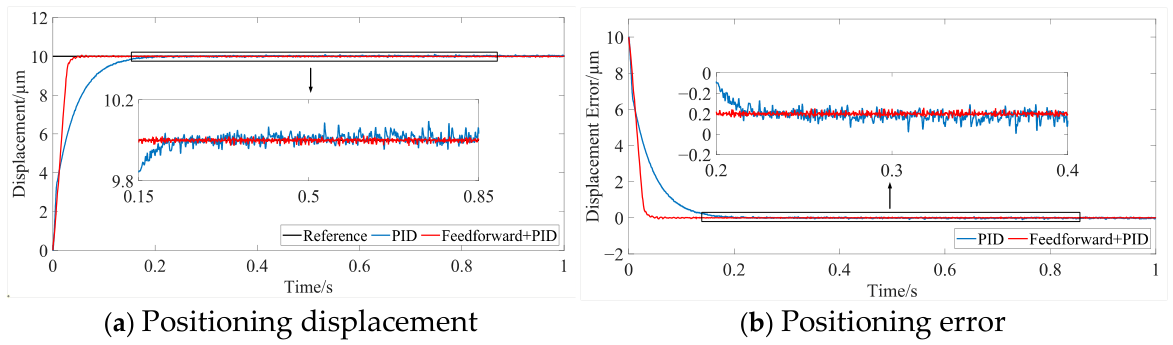
To further analyze the response performance of the proposed NT hysteresis inverse model under dynamic working conditions, a step signal with an amplitude of 10 μm was selected as the target displacement. The dynamic response characteristics of conventional PID control and the NT hysteresis inverse-model feedforward + PID compound control were compared, and the results can be observed in Figure 19.
As depicted in Figure 19a, upon adopting the compound control strategy, the displacement response can approach the target displacement faster and more accurately. Compared with PID control, the proposed method achieves both faster response speed and higher tracking accuracy, indicating that the established hysteresis inverse model can rapidly predict the required control voltage according to the target displacement. In addition, Figure 19b further shows that the compound control method maintains a lower positioning error during the entire response process, demonstrating that feedforward compensation based on the hysteresis inverse model can effectively suppress the nonlinear error caused by hysteresis.
Table 6 summarizes the key dynamic performance index under the two control strategies, including rise time Tr, settling time Ts, maximum tracking error emax, and Root Mean Square Error RMSE. Here, Tr is defined as the time required for the system response to reach 90% of the steady-state value, and Ts denotes the time required for the system response to enter and stabilize within a ±5% error band. The experimental results show that the Tr, Ts, emax and RMSE under the compound control strategy are 0.027 s, 0.076 s, 0.042 μm and 0.009 μm, respectively, which are reduced by 68.0%, 66.8%, 56.3% and 64.8% compared with PID control. Therefore, the proposed NT hysteresis inverse-model feedforward + PID feedback compound control method exhibits significant advantages in improving response speed and positioning accuracy, showing good application potential in high-precision motion control.

6. Conclusions

Based on the modeling idea of nonlinear transformation, a novel NT model is developed to describe the nonlinear hysteresis response of piezoelectric actuators. The model is simple in structure, has fewer unknown parameters, and does not include highly nonlinear differential equations in its expression. Moreover, it does not require determining intermediate functions, making it easier to solve.
The performance of common hysteresis models and the proposed NT model is comprehensively evaluated, using evaluation indicators such as RMSE, MAPE, SMAPE, and R2. The following conclusions can be drawn: (1) the proposed NT model can effectively describe the voltage-displacement response of piezoelectric actuators, achieving high precision in calculation and small predictive deviation; (2) the proposed NT model outperforms the Dahl, LuGre, PI, BW, and FP models with regard to the RMSE, MAPE, SMAPE, and R2; the maximum fitting errors of the proposed NT model under driving voltages of 20 V, 40 V, and 60 V are 0.02 µm, 0.08 µm, and 0.13 µm, respectively.
Hysteresis compensation is further performed. Through combining feedforward compensation with PID feedback, the system performance is significantly improved. The maximum error emax and RMSE are reduced to 0.270 μm and 0.113 μm, respectively, accounting for only 2.70% and 1.13% of the total stroke.

Author Contributions

Conceptualization, X.X.; Methodology, Y.Y.; Software, Z.R. and X.X.; Validation, P.C.; Formal analysis, Z.R. and Y.C.; Investigation, X.X. and P.C.; Data curation, Z.R.; Writing—original draft, Z.R.; Writing—review & editing, Y.C.; Visualization, X.X. and Y.Y.; Supervision, Y.C. and Y.Y.; Project administration, Y.C. All authors have read and agreed to the published version of the manuscript.

Funding

This research is supported by the National Natural Science Foundation of China (NO.U23A20618, NO.52075273, NO.52575125).

Institutional Review Board Statement

Not applicable.

Informed Consent Statement

Not applicable.

Data Availability Statement

The data presented in this study are available on request from the corresponding author.

Conflicts of Interest

The authors declare no conflicts of interest. The funders had no role in the design of the study; in the collection, analyses, or interpretation of data; in the writing of the manuscript; or in the decision to publish the results.

References

  1. Shi, B.; Wang, F.; Huo, Z.; Tian, Y.; Zhao, X.; Zhang, D. Design of a rhombus-type stick-slip actuator with two driving modes for micropositioning. Mech. Syst. Signal Process. 2022, 166, 108421. [Google Scholar] [CrossRef]
  2. Wang, J.; Huang, H.; Zhang, S.; Qin, F.; Wang, Z.; Liang, T.; Zhao, H. Development and analysis of a stick-slip rotary piezoelectric positioner achieving high velocity with compact structure. Mech. Syst. Signal Process. 2020, 145, 106895. [Google Scholar] [CrossRef]
  3. Jalalnezhad, M.; Kareem, A.K.; Chammam, A.; Al Attabi, K. Intelligent Vibration Control of Composite and FGM Plates Using Piezoelectric Actuators and Optimized Sliding Mode-Based Controllers. J. Vib. Eng. Technol. 2025, 13, 474. [Google Scholar] [CrossRef]
  4. Ni, L.; Wang, H.; Chen, G.; Zhang, L.; Yao, N.; Wang, G. An interpretable Dahl-LRN neural-network for accurately modelling the systems with rate-dependent asymmetric hysteresis. Appl. Soft Comput. 2025, 173, 112936. [Google Scholar] [CrossRef]
  5. Lim, B.; Choi, J.; Yoo, Y.; Choi, S. Perceived magnitude function of friction rendered by the dahl model. In Proceedings of the 2021 IEEE World Haptics Conference (WHC), Montreal, QC, Canada, 6–9 July 2021; pp. 13–18. [Google Scholar]
  6. Gan, J.; Zhang, X.; Xu, J.; Shan, Y.; Zhou, P.; Wu, C. Hysteresis modeling and analysis of piezoelectric actuators using a modified LuGre model at different preloads and frequencies. Smart Mater. Struct. 2024, 33, 055030. [Google Scholar] [CrossRef]
  7. Duan, Y.; Ling, J.; Zhu, Y. Modeling and Admittance Control of a Piezoactuated Needle Insertion Device for Safe Puncture of Spinal Membranes. J. Med. Devices 2024, 18, 034501. [Google Scholar] [CrossRef]
  8. Wu, T.; Hu, W.; Zhang, J.; Zhang, Z.; Cheng, C.; Wu, J.; Feng, Y. Research on Hysteresis Modeling and Nonlinear Compensation of Piezoelectric Actuators. J. Vib. Eng. Technol. 2025, 13, 52. [Google Scholar] [CrossRef]
  9. Yang, Y.; Kang, H.; Xu, Y.; Yang, X.; Zhang, Z. A Multi-conditional Prandtl–Ishlinskii model for nonlinearity compensation on the longi-tudinal-shear piezoelectric nanopositioning stage. Mech. Syst. Signal Process. 2025, 232, 112681. [Google Scholar] [CrossRef]
  10. Wang, X.; An, D.; Qin, Z.; Wang, C.; Liu, Y.; Yang, Y. Nonlinearity Characterization of Flexible Hinge Piezoelectric Stages Under Dynamic Preload via a Force-Dependent Prandtl–Ishlinskii Model with a Force-Analyzed Finite Element Method. Actuators 2025, 14, 411. [Google Scholar] [CrossRef]
  11. Zhou, M.; Dai, Z.; Zhou, Z.; Liu, X.; Cao, T.; Li, Z. Modeling, identification, and high-speed compensation study of dynamic hysteresis nonlinearity for piezoelectric actuator. J. Intell. Mater. Syst. Struct. 2024, 35, 822–844. [Google Scholar] [CrossRef]
  12. De la Morena, J.; Ramos, F.; Vázquez, A.S. Hysteresis Modeling of Soft Pneumatic Actuators: An Experimental Review. Actuators 2025, 14, 321. [Google Scholar] [CrossRef]
  13. Heredia-Pérez, M.; Alvarez, D.A.; Bedoya-Ruiz, D. A State-of-the-Art Review of the Bouc-Wen Class Model of Hysteresis: Origin, Evolution and Current State. Arch. Comput. Methods Eng. 2025, 33, 1–51. [Google Scholar] [CrossRef]
  14. Li, S.; Tian, T.; Wang, H.; Li, Y.; Li, J.; Zhou, Y.; Wu, J. Development of a four-parameter phenomenological model for the nonlinear viscoelastic behaviour of magnetorheological gels. Mater. Des. 2020, 194, 108935. [Google Scholar] [CrossRef]
  15. Li, W.H.; Zhou, Y.; Tian, T.F. Viscoelastic properties of MR elastomers under harmonic loading. Rheol. Acta 2010, 49, 733–740. [Google Scholar] [CrossRef]
  16. Gu, G.; Zhu, L. Modeling of rate-dependent hysteresis in piezoelectric actuators using a family of ellipses. Sens. Actuators A Phys. 2011, 165, 303–309. [Google Scholar] [CrossRef]
  17. Arockiarajan, A.; Menzel, A.; Delibas, B.; Seemann, W. Computational modeling of rate-dependent domain switching in piezoelectric materials. Eur. J. Mech.-A-Solids 2006, 25, 950–964. [Google Scholar] [CrossRef]
  18. Wu, Z.; Zhang, Z.; Wu, D.; Chen, Y.; Hu, F.; Guo, C.; Tang, L. Design and Implementation of Elliptical Ultrasonic Vibrational Piezoelectric Transducer. J. Vib. Eng. Technol. 2025, 13, 77. [Google Scholar] [CrossRef]
  19. Singh, S.; Nandan, A.S.; Malik, A.; Kumar, R.; Awasthi, L.K.; Kumar, N. A GA-Based Sustainable and Secure Green Data Communication Method Using IoT-Enabled WSN in Healthcare. IEEE Internet Things J. 2022, 9, 7481–7490. [Google Scholar] [CrossRef]
  20. Lin, Y.; Liu, B.; Zhang, T.; Zhang, H.; Zhang, Z. Energy management strategy for electrically-powered hydraulic vehicle based on driving mode recognition. Energy Sources Part A 2025, 47, 2480–2503. [Google Scholar] [CrossRef]
  21. Katoch, S.; Chauhan, S.S.; Kumar, V. A review on genetic algorithm: Past, present, and future. Multimed. Tools Appl. 2021, 80, 8091–8126. [Google Scholar] [CrossRef]
  22. Liu, H.; Ge, J.; Wang, Y.; Li, J.; Ding, K.; Zhang, Z.; Guo, Z.; Li, W.; Lan, J. Multi-UAV Optimal Mission Assignment and Path Planning for Disaster Rescue Using Adaptive Genetic Algorithm and Improved Artificial Bee Colony Method. Actuators 2022, 11, 4. [Google Scholar] [CrossRef]
  23. Khatir, A.; Capozucca, R.; Khatir, S.; Magagnini, E.; Cuong-Le, T. Enhancing Damage Detection Using Reptile Search Algorithm-Optimized Neural Network and Frequency Response Function. J. Vib. Eng. Technol. 2025, 13, 88. [Google Scholar] [CrossRef]
  24. Chellappan, D.; Rajaguru, H. Generalizability of machine learning models for diabetes detection a study with nordic islet transplant and PIMA datasets. Sci. Rep. 2025, 15, 4479. [Google Scholar] [CrossRef]
  25. Giglio, V.M.; Haach, V.G. Optimization of ultrasonic tomography in concrete using non-linear paths through bio-inspired algorithms. NDT E Int. 2025, 152, 103324. [Google Scholar] [CrossRef]
  26. Abdi, S.B.; Debilou, A.; Guettal, L.; Guergazi, A. Robust trajectory tracking control of a quadrotor under external disturbances and dynamic parameter uncertainties using a hybrid P-PID controller tuned with ant colony optimization. Aerosp. Sci. Technol. 2025, 160, 110053. [Google Scholar] [CrossRef]
  27. Sun, H.; Zhu, K.; Zhang, W.; Ke, Z.; Hu, H.; Wu, K.; Zhang, T. Emergency path planning based on improved ant colony algorithm. J. Build. Eng. 2025, 100, 111725. [Google Scholar] [CrossRef]
  28. Liu, Y.; Meng, J.; Cao, J. Rate-Dependent Hysteresis Model of a Giant Magnetostrictive Actuator Based on an Improved Cuckoo Algorithm. Actuators 2023, 12, 400. [Google Scholar] [CrossRef]
  29. Xiao, M.; Liao, Y.; Bartos, P.; Filip, M.; Geng, G.; Jiang, Z. Fault diagnosis of rolling bearing based on back propagation neural network optimized by cuckoo search algorithm. Multimed. Tools Appl. 2022, 81, 1567–1587. [Google Scholar] [CrossRef]
  30. Prasannakumar, T.J.; Sivajibabu, K.; Durgaprasad, B. Thermo-Elastic Vibration Analysis of Acoustic Liners Using Polymer-Metal Nanocomposites: Prediction and Optimization of Hybrid Deep Neural Network and Cuckoo Search Algorithm. J. Vib. Eng. Technol. 2025, 13, 49. [Google Scholar] [CrossRef]
  31. Huang, Y.; Yuan, Y.; Jia, Y.; Zhao, Y. Design of low-frequency vibration isolators with high-static-low-dynamic characteristic via functionally graded beam systems. Acta Mech. Sin. 2025, 41, 523501. [Google Scholar] [CrossRef]
  32. Zoremsanga, C.; Hussain, J. Particle Swarm Optimized Deep Learning Models for Rainfall Prediction: A Case Study in Aizawl, Mizoram. IEEE Access 2024, 12, 57172–57184. [Google Scholar] [CrossRef]
  33. Li, L.; Zhang, J.; Zhang, H.; Leus, R. A novel hyper-heuristic based on surrogate genetic programming for the three-dimensional spatial resource-constrained project scheduling problem under uncertain environments. Comput. Oper. Res. 2025, 179, 107013. [Google Scholar] [CrossRef]
  34. Silva, T.M.; Balasubramanian, P.; Franchini, G.; Buabdulla, A.; Amabili, M. Experiment-in-the-Loop system for fast and effective tuning of active vibration controllers. Int. J. Mech. Sci. 2024, 284, 109753. [Google Scholar] [CrossRef]
  35. Zhu, H.; Li, S.; Zhu, R.; Gao, F.; Yin, Z.; Liu, L.; Zheng, X. Residual Vibration Suppression of Piezoelectric Inkjet Printing Based on Particle Swarm Optimization Algorithm. Micromachines 2024, 15, 1192. [Google Scholar] [CrossRef] [PubMed]
  36. Hu, Y.; Chen, C.; Han, F.; Chen, X.; Guo, Y.; Liu, S. Improved method for acoustic emission source location based on DFB laser sensor and particle swarm optimization algorithm. IEEE Sens. J. 2024, 24, 19151–19158. [Google Scholar] [CrossRef]
  37. Hasheminejad, S.M.; Kasaeisani, A. A novel smart hybrid multimorph piezoelectric spherical shell cloak for broadband near-perfect underwater acoustic camouflage applications. Sci. Rep. 2024, 14, 13128. [Google Scholar] [CrossRef] [PubMed]
  38. Xie, X.; Cui, Y.; Yu, Y. Study of nonlinear hysteretic modelling and performance evaluation for piezoelectric actuators based on activation functions. Smart Struct. Syst. 2024, 33, 133–143. [Google Scholar] [CrossRef]
Figure 1. Schematic diagram of hysteresis effect.
Actuators 15 00338 g001
Figure 2. Schematic diagram of nonlinear transformation. (a) Original curve. (b) Transformed curve.
Actuators 15 00338 g002
Figure 3. Block diagram of the developed NT model.
Actuators 15 00338 g003
Figure 4. Comparative investigation strategy of evolution based on the developed model.
Actuators 15 00338 g004
Figure 5. Experiment setup for measuring hysteresis displacement.
Actuators 15 00338 g005
Figure 6. Comparison between measured value and model value of 10 Hz case.
Actuators 15 00338 g006
Figure 7. Comparison between measured value and model value of 40 Hz case.
Actuators 15 00338 g007
Figure 8. Comparison between measured value and model value of 80 Hz case.
Actuators 15 00338 g008
Figure 9. Evaluation of RMSE among the six models of the 20 V case.
Actuators 15 00338 g009
Figure 10. Evaluation of RMSE among the six models of the 40 V case.
Actuators 15 00338 g010
Figure 11. Evaluation of RMSE among the six models of the 60 V case.
Actuators 15 00338 g011
Figure 12. Evaluation of MAPE among the six models of the 20 V case.
Actuators 15 00338 g012
Figure 13. Evaluation of MAPE among the six models of the 40 V case.
Actuators 15 00338 g013
Figure 14. Evaluation of MAPE among the six models of the 60 V case.
Actuators 15 00338 g014
Figure 15. Statistical distributions of R2 among the six models.
Actuators 15 00338 g015
Figure 16. Worst R2 analysis among the six models.
Actuators 15 00338 g016aActuators 15 00338 g016b
Figure 17. Feedforward compensation performance of different models.
Actuators 15 00338 g017
Figure 18. Sinusoidal trajectory tracking under different control methods.
Actuators 15 00338 g018
Figure 19. Dynamic responses under different control methods.
Actuators 15 00338 g019
Table 1. Parameters of piezoelectric actuator.
Modeld33
(10−12 C/N)
Density
(g/cm3)
Quality FactorElasticity Tensor
(10−12 m2/N)
Stiffness
(N/µm)
PTJ1501010601≥6507.94514.366
Table 2. Comparison of running time.
Model10 Hz
(s)
20 Hz
(s)
30 Hz
(s)
40 Hz
(s)
50 Hz
(s)
60 Hz
(s)
70 Hz
(s)
80 Hz
(s)
Dahl0-20 V-07.28415.28413.58716.28716.94155.98156.287110.3987
0-40 V-08.51187.28198.284111.57197.58118.84186.99816.2871
0-60 V-06.21557.28747.28847.85124.99528.01755.52159.2871
LuGre0-20 V-09.587111.65878.28747.28716.58417.85019.581211.2841
0-40 V-08.58449.85189.995111.38949.52748.50526.841820.6813
0-60 V-08.02849.02847.84158.68419.84088.07685.90478.6512
PI0-20 V-00.38570.63840.61210.73550.63580.56850.60150.5325
0-40 V-00.59640.59810.68740.64280.69270.50270.59870.5027
0-60 V-00.42870.56250.58970.50240.72680.51540.66570.4685
BW0-20 V-00.55171.35511.36513.951717.25415.028711.28542.9418
0-40 V-012.55214.15874.35145.68419.254110.238412.89416.9514
0-60 V-05.96584.58714.95144.681123.518614.51879.967113.5417
FP0-20 V-015.82249.58129.55216.842118.64188.64188.25418.2841
0-40 V-011.55058.95877.513811.417911.38138.00177.288716.5712
0-60 V-08.51288.36817.992816.85419.85717.52987.98179.5518
Proposed 0-20 V-01.65171.36412.31713.35444.70253.18214.38742.9517
0-40 V-03.95171.69842.33513.48125.66515.24716.35144.7518
0-60 V-05.89411.41732.00171.32543.91174.25415.95777.5281
Table 3. Performance comparisons between the proposed model and other models.
PerformanceProposedDahlLuGrePIBWFP
None of nonlinear equation××××
None of intermediate variable××××
Parameters number456454
Maximum RMSE0.08120.848535.69330.32191.04143.6322
Maximum MAPE0.0450.29277218.60.16940.25910.6044
Maximum SMAPE0.04560.5390.71430.21950.2391.2133
Minimum R20.99940.93990.01160.99210.90950.2147
Maximum error (µm) (20 V)0.020.030.030.150.050.03
Maximum error (µm) (40 V)0.080.240.320.520.9467.11
Maximum error (µm) (60 V)0.131.47659.310.911.7367.11
Footnote: √ stands for conformity; × stands for non-conformity.
Table 4. Feedforward control performance comparisons between the proposed model and other models.
PerformanceProposedDahlLuGrePIBWFP
emax (µm)0.6750.7590.9661.2850.9290.862
RMSE (µm)0.2270.2980.2860.5540.4220.265
Table 5. Sinusoidal trajectory tracking performance under different control methods.
FrequencyPerformancePIDFeedforwardFeedforward + PID
0.5 Hzemax (µm)1.0290.3940.270
RMSE (µm)0.7180.2480.113
10 Hzemax (µm)1.1210.7410.659
RMSE (µm)0.5670.2420.183
0.5 to 10 Hzemax (µm)0.8970.4610.336
RMSE (µm)0.4140.1140.077
Table 6. Dynamic response performance under different control methods.
PerformancePIDFeedforward + PID
Tr (s)0.0840.027
Ts (s)0.2290.076
emax (µm)0.0950.042
RMSE (µm)0.0260.009
Disclaimer/Publisher’s Note: The statements, opinions and data contained in all publications are solely those of the individual author(s) and contributor(s) and not of MDPI and/or the editor(s). MDPI and/or the editor(s) disclaim responsibility for any injury to people or property resulting from any ideas, methods, instructions or products referred to in the content.