
TD3-Enhanced MPC for Safe Braking of Overhead Cranes with Safety-Critical Region Prediction

Abstract
1. Introduction
2. Model Predictive Braking Control Design
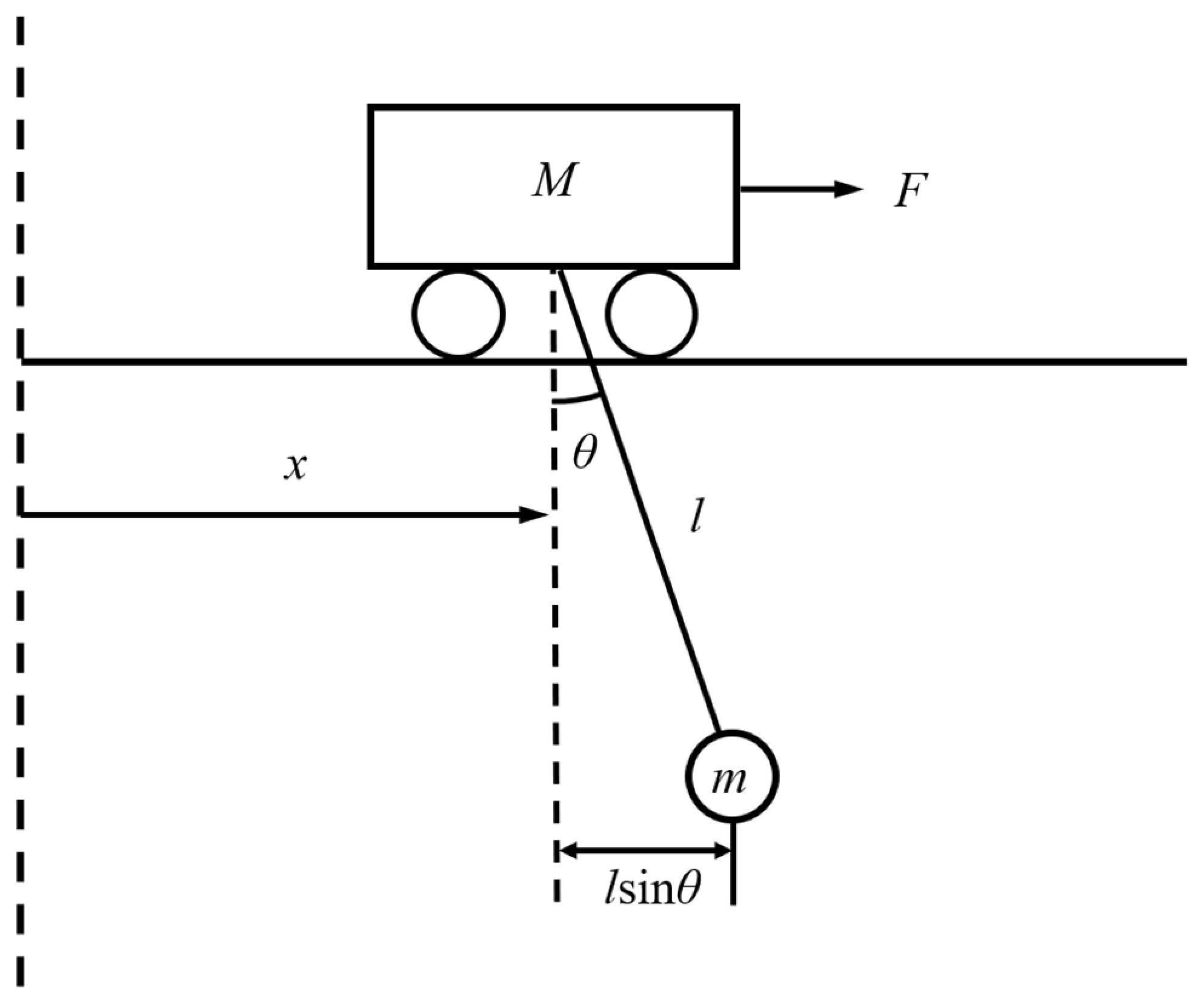
2.1. Dynamic System Model
2.2. Linearization and Discretization
2.3. Adaptive Braking Reference Trajectory
2.4. Objective Function and Constraint
3. TD3-Based Adaptive Control Framework
3.1. State and Action Space Design
3.2. Reward Function Construction
- State tracking reward
- 2.
- Control constraint reward
- 3.
- Parameter-optimization reward
- 4.
- Safety constraint penalty
3.3. TD3 Learning and Update Strategy
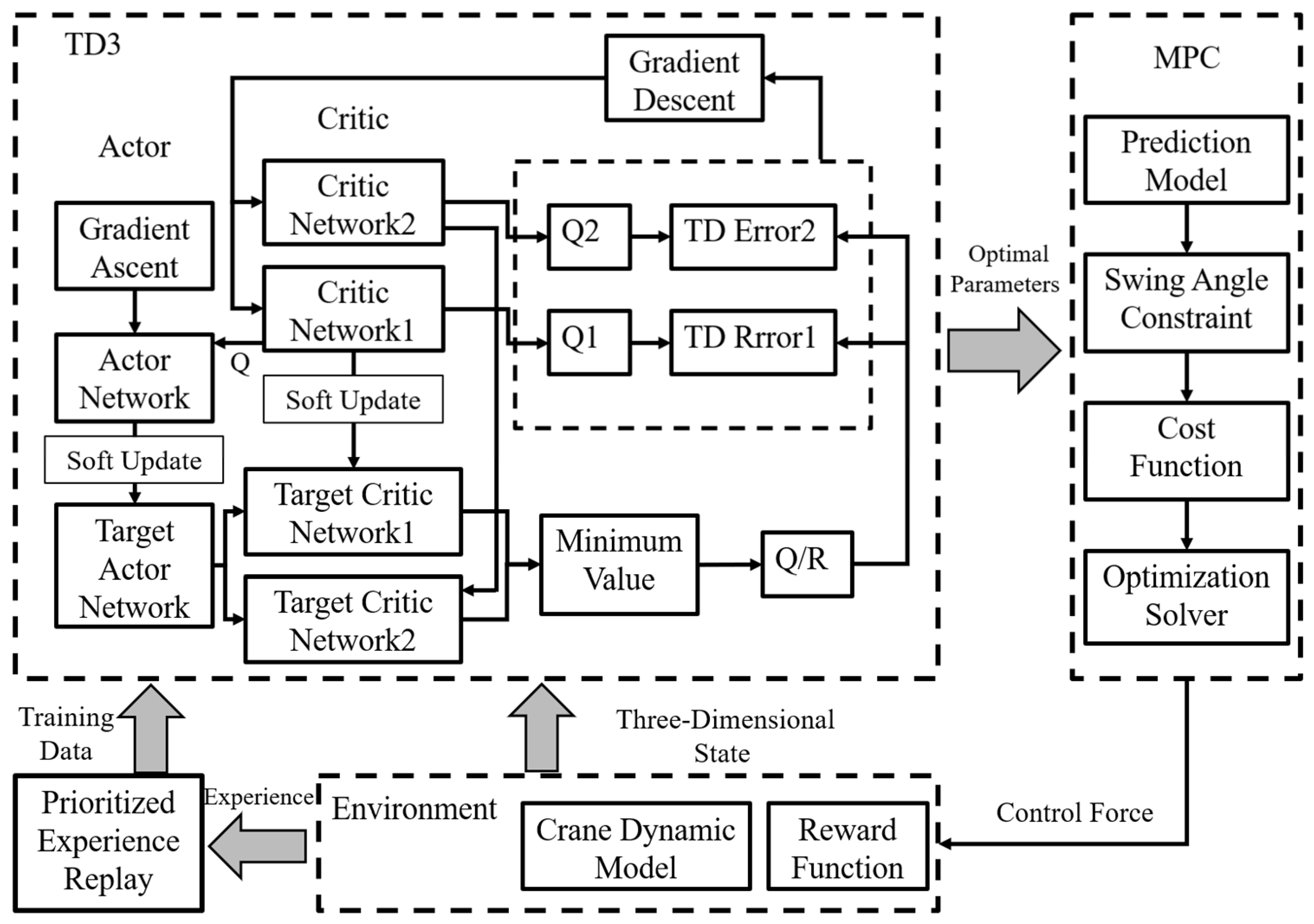
3.4. TD3-MPC Integrated Control Framework
- Time-domain parameter optimization
- 2.
- Weighting matrix optimization
- 3.
- Reference trajectory optimization
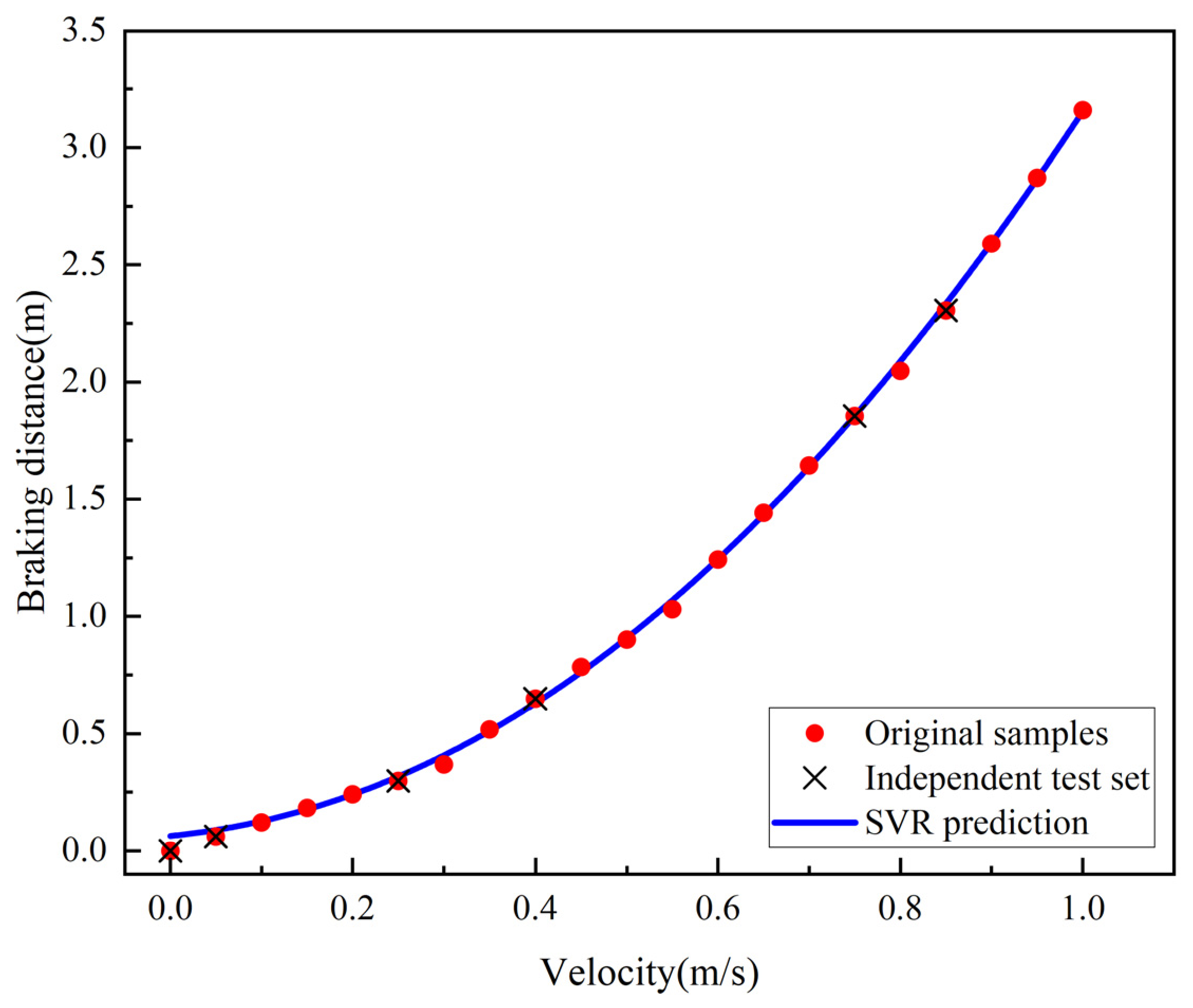
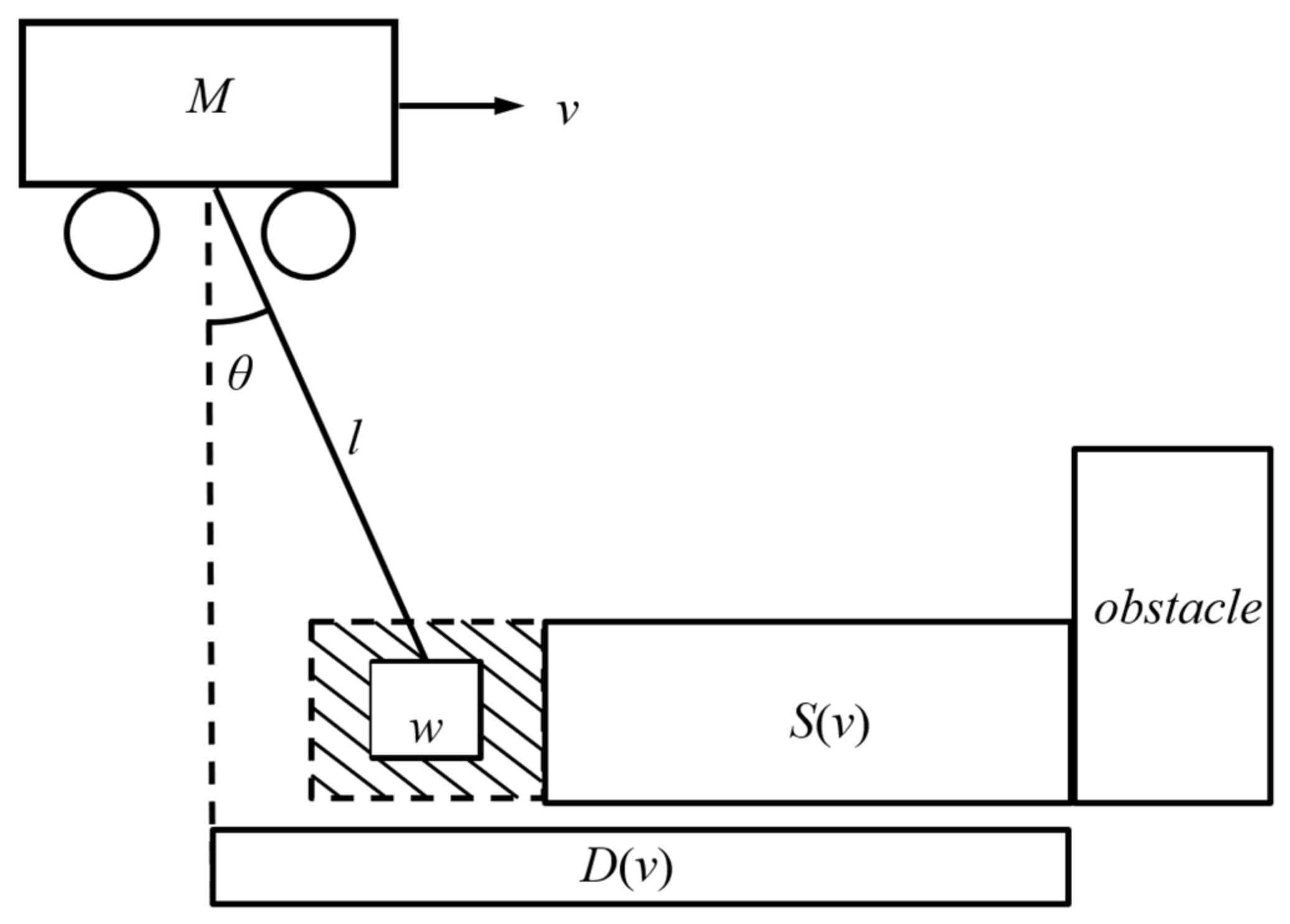
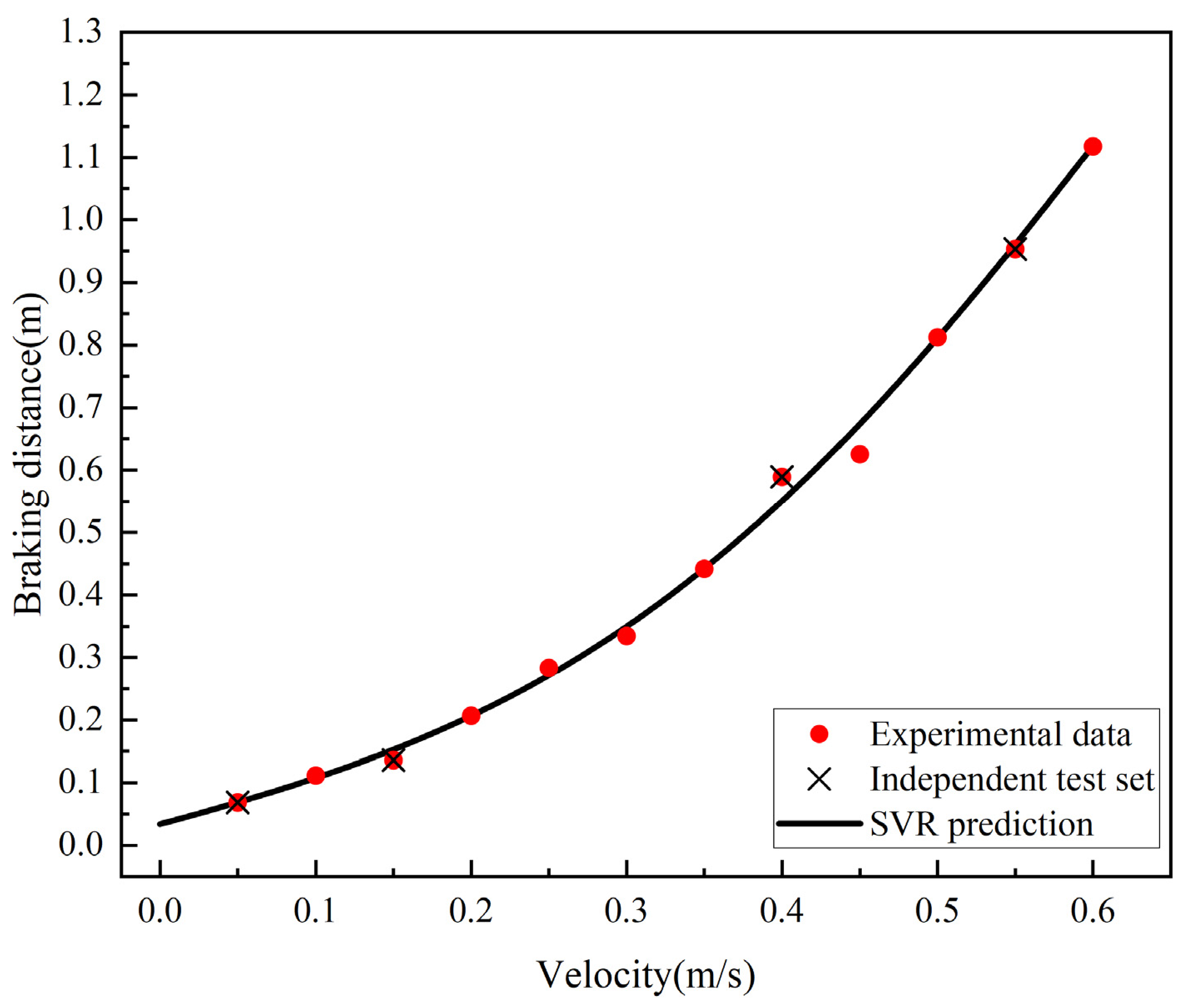
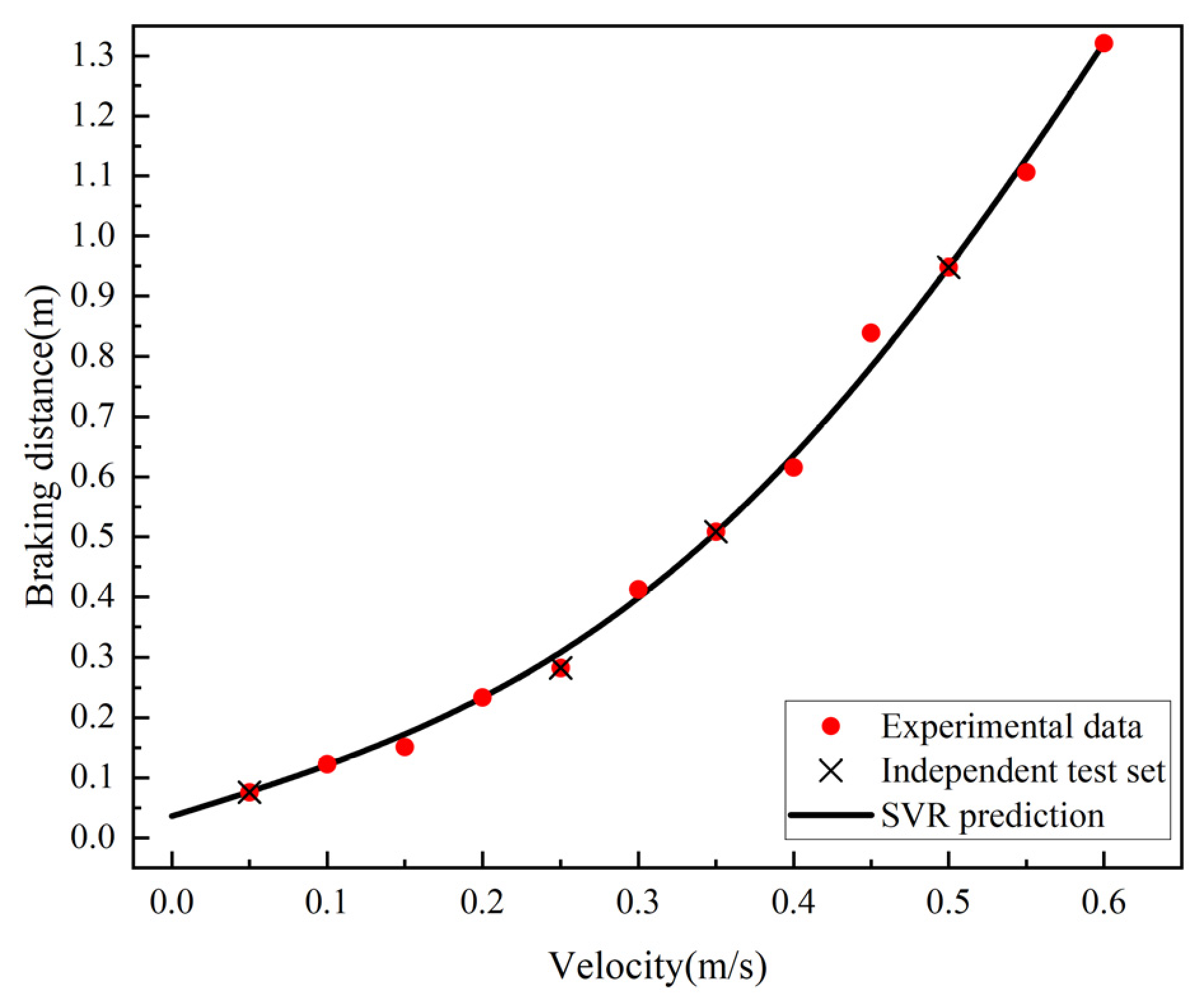
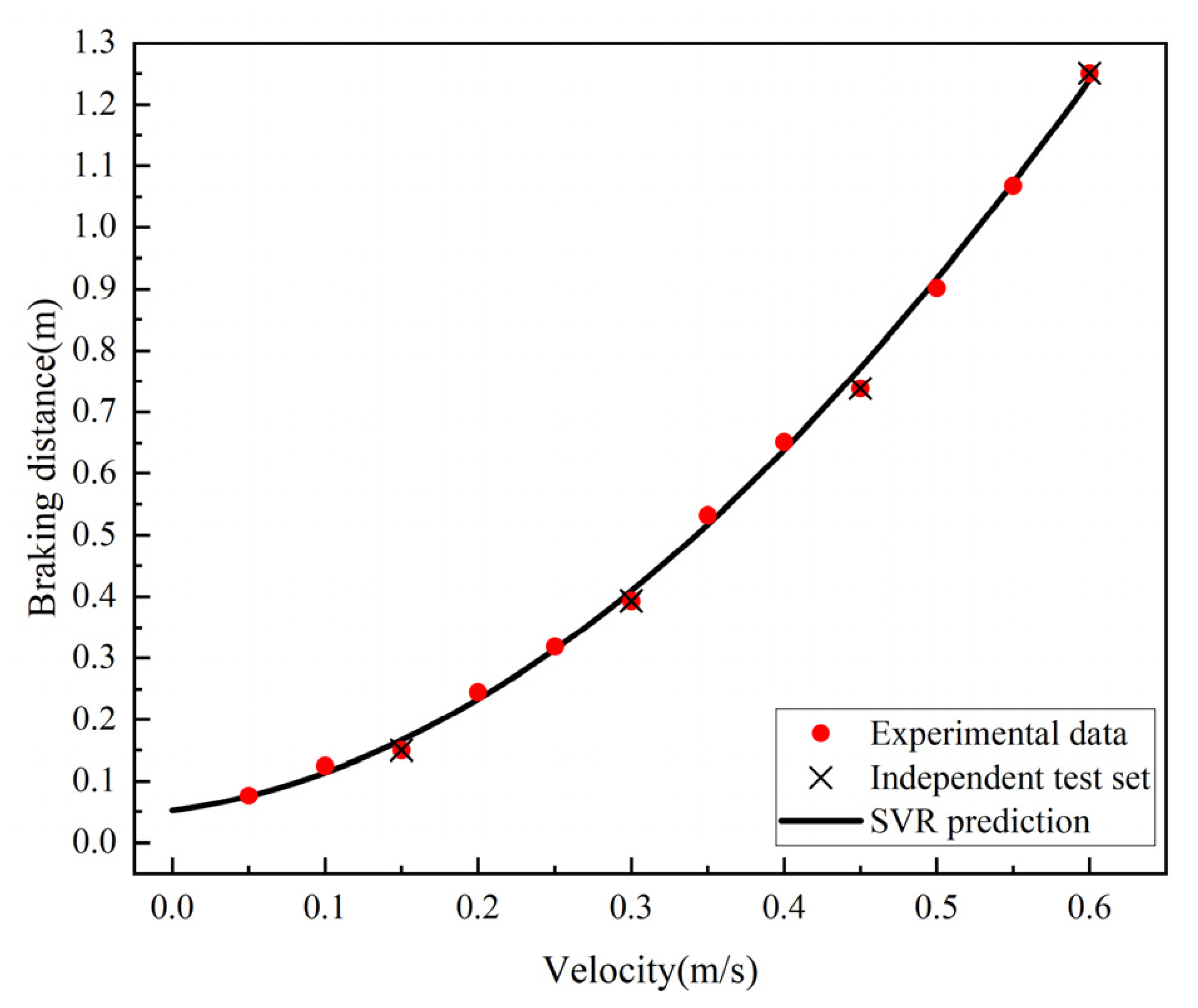
4. Safety-Critical Braking Distance Prediction Model
5. Examples and Results
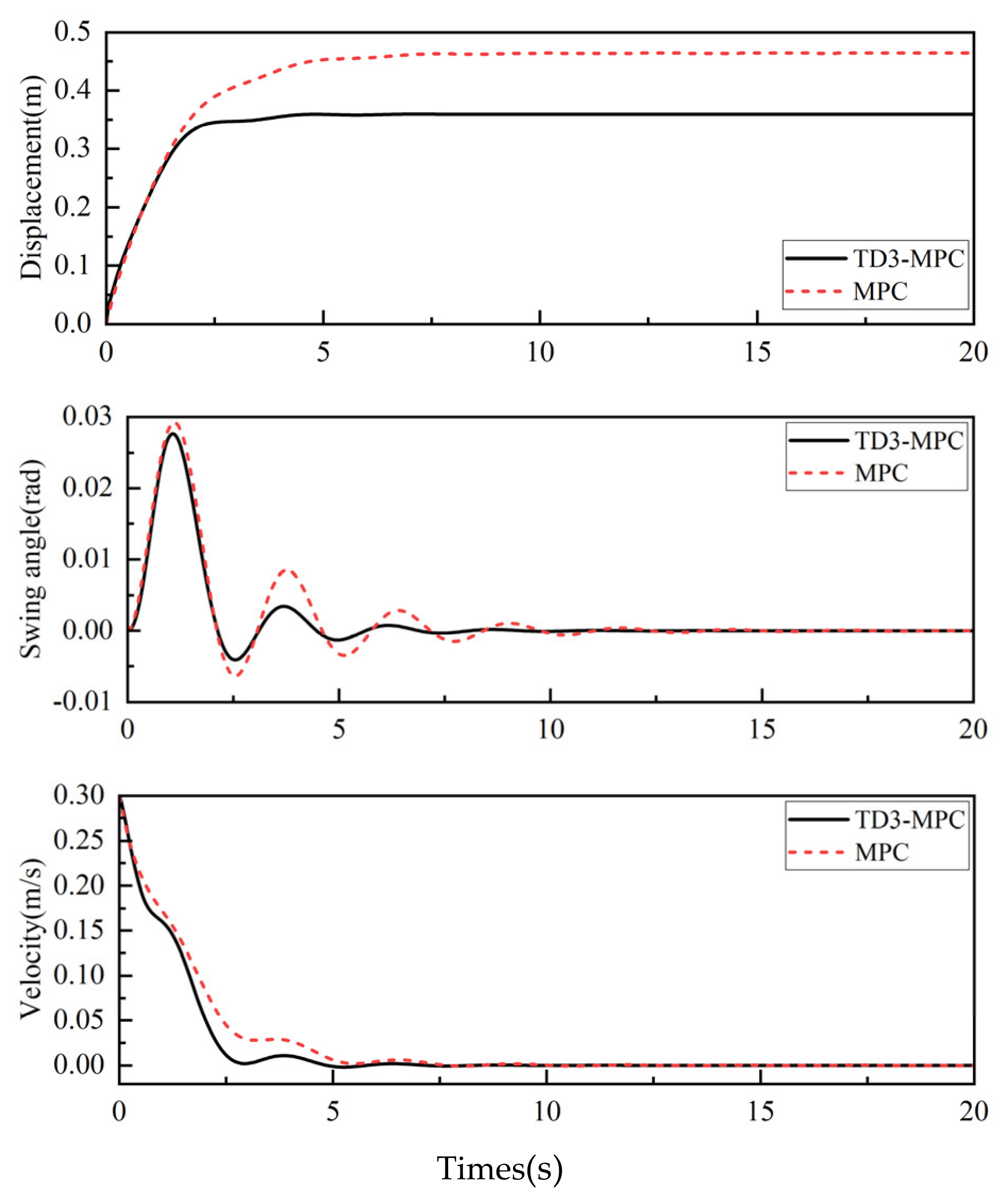
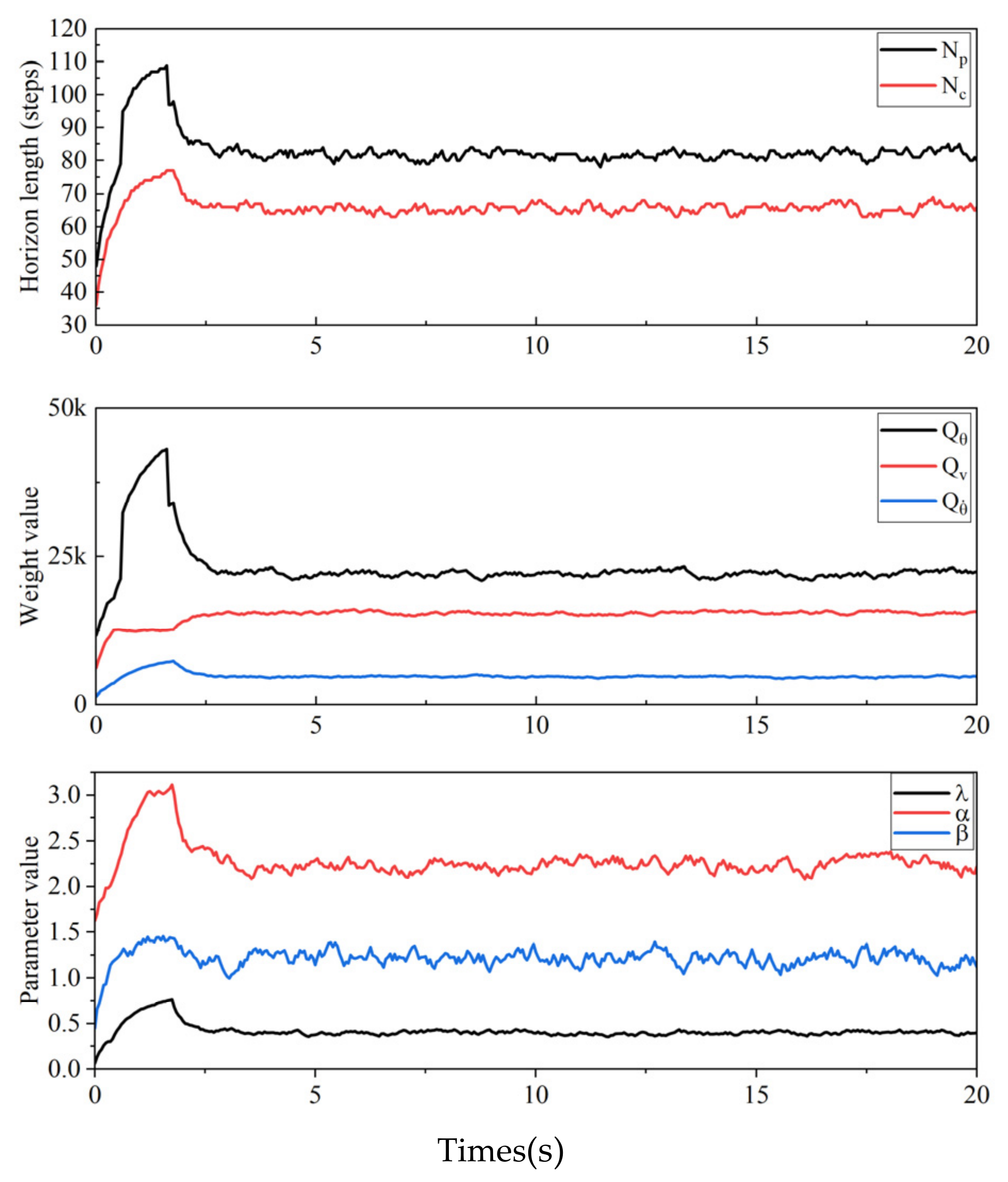
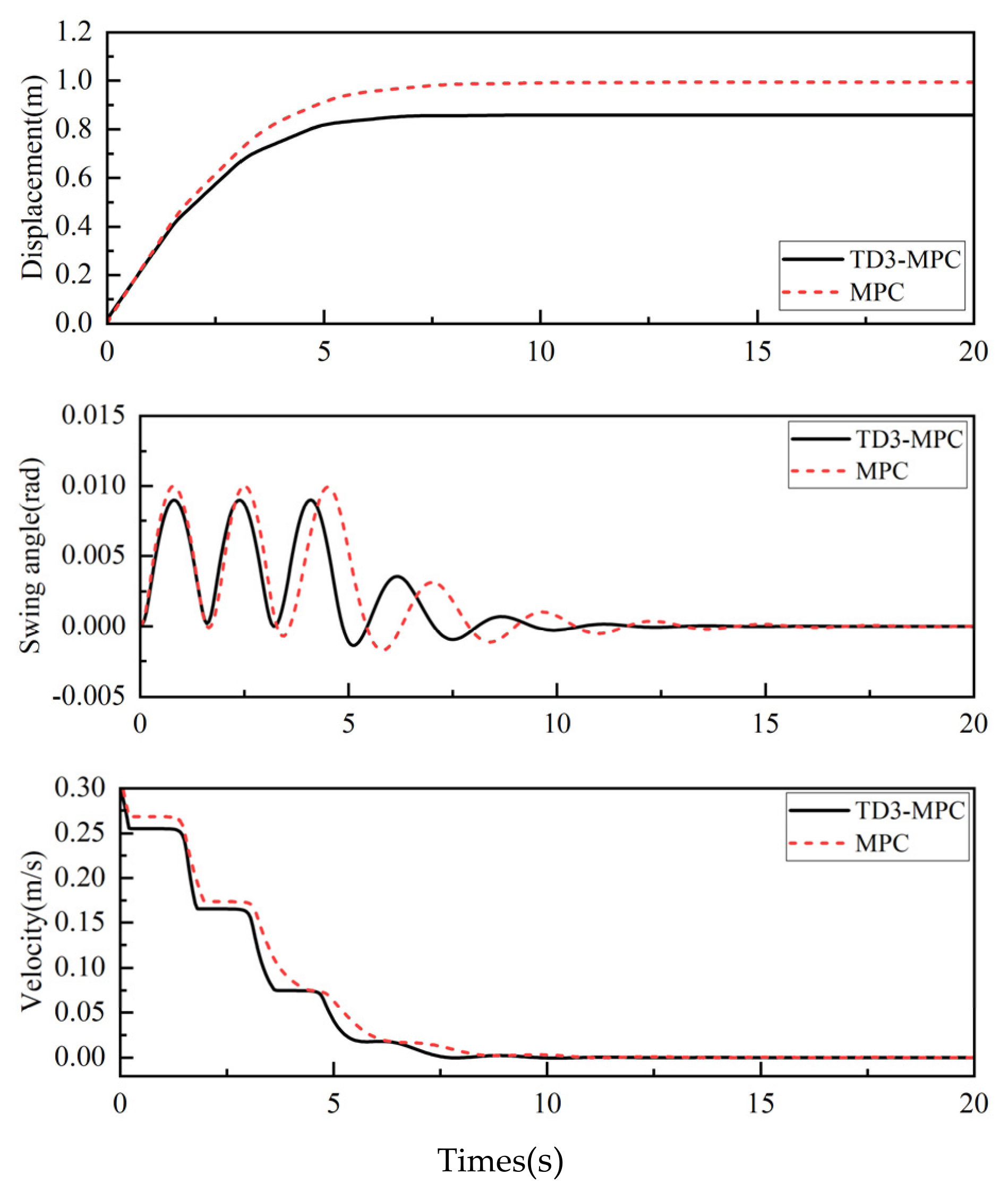
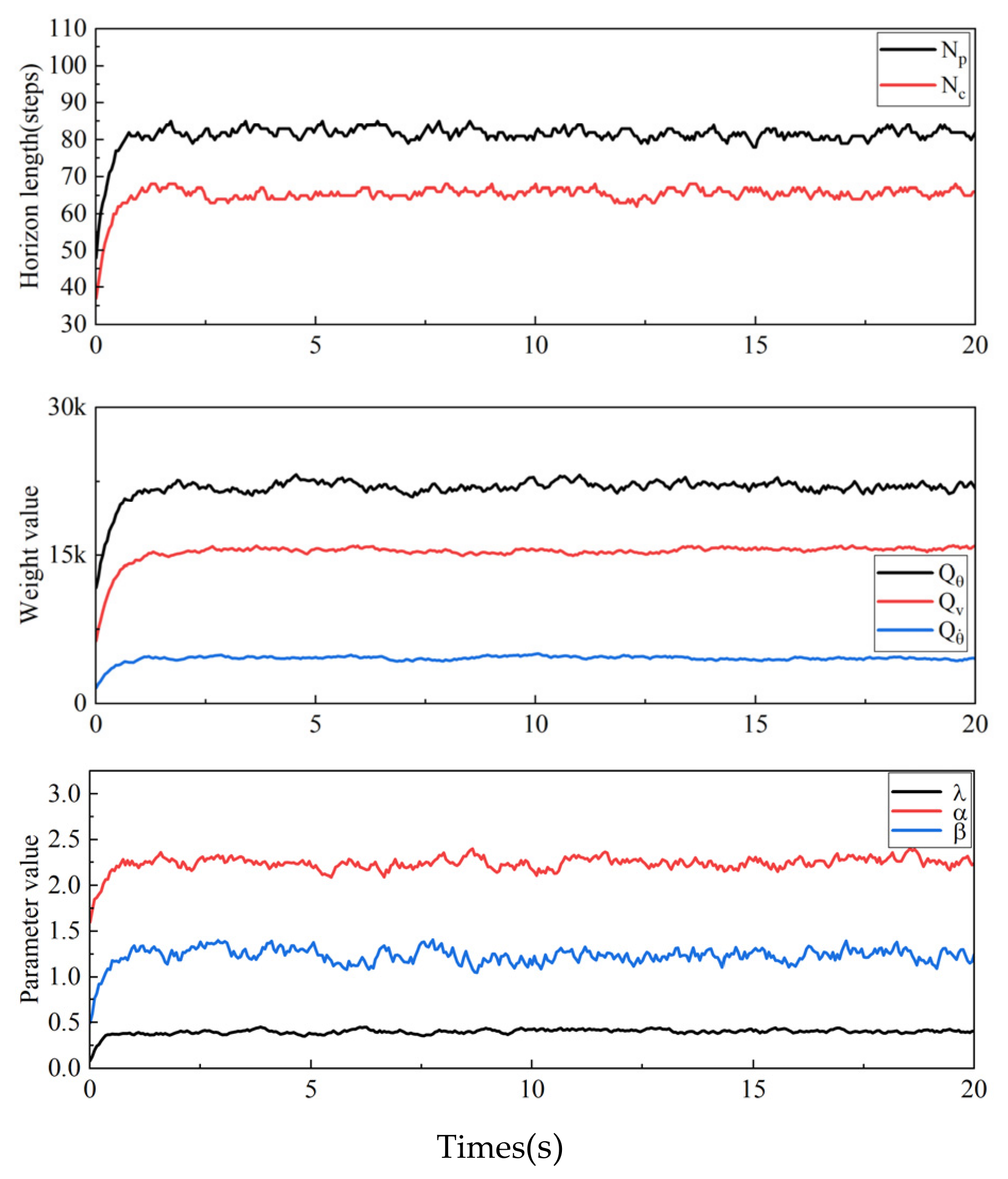
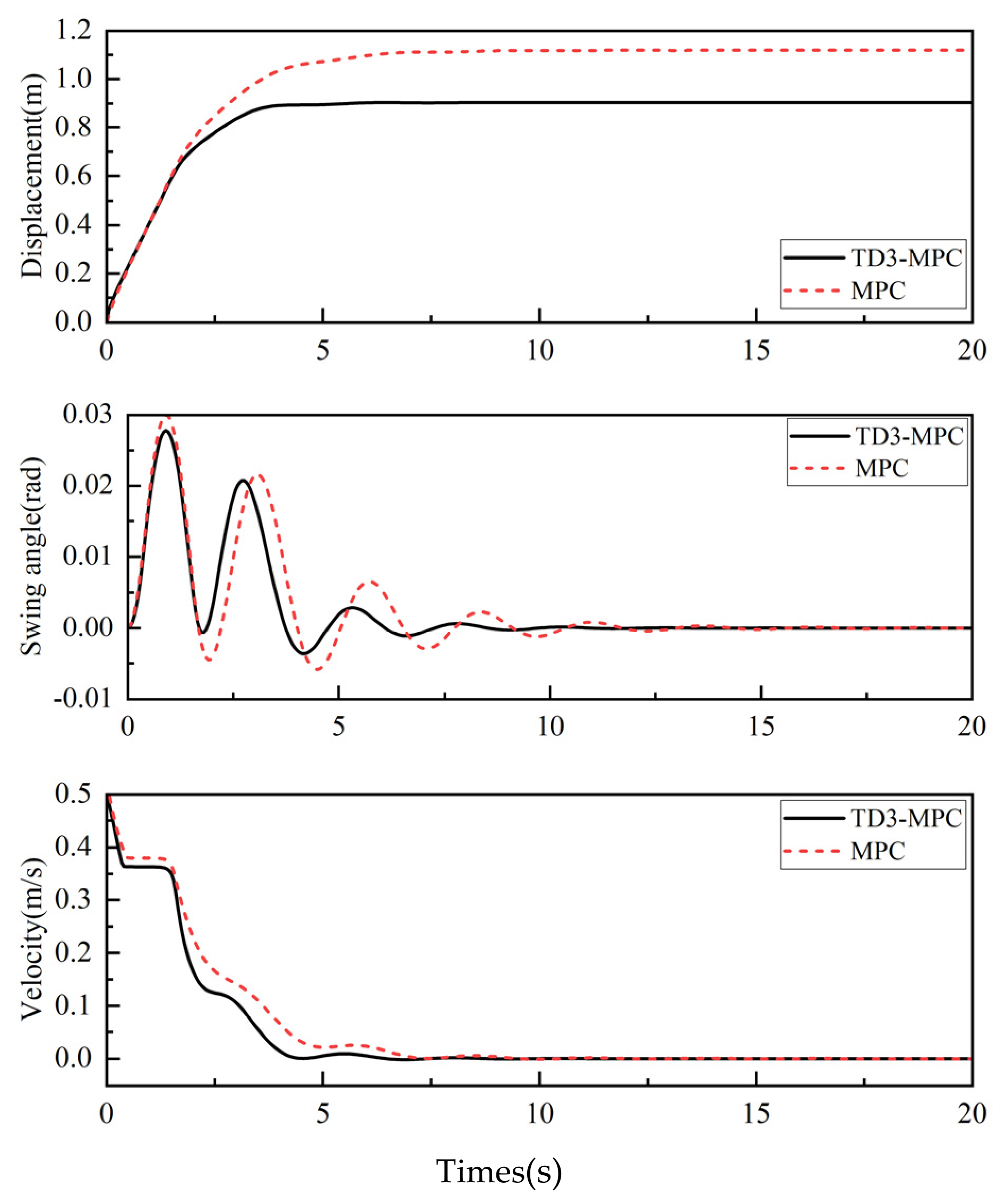
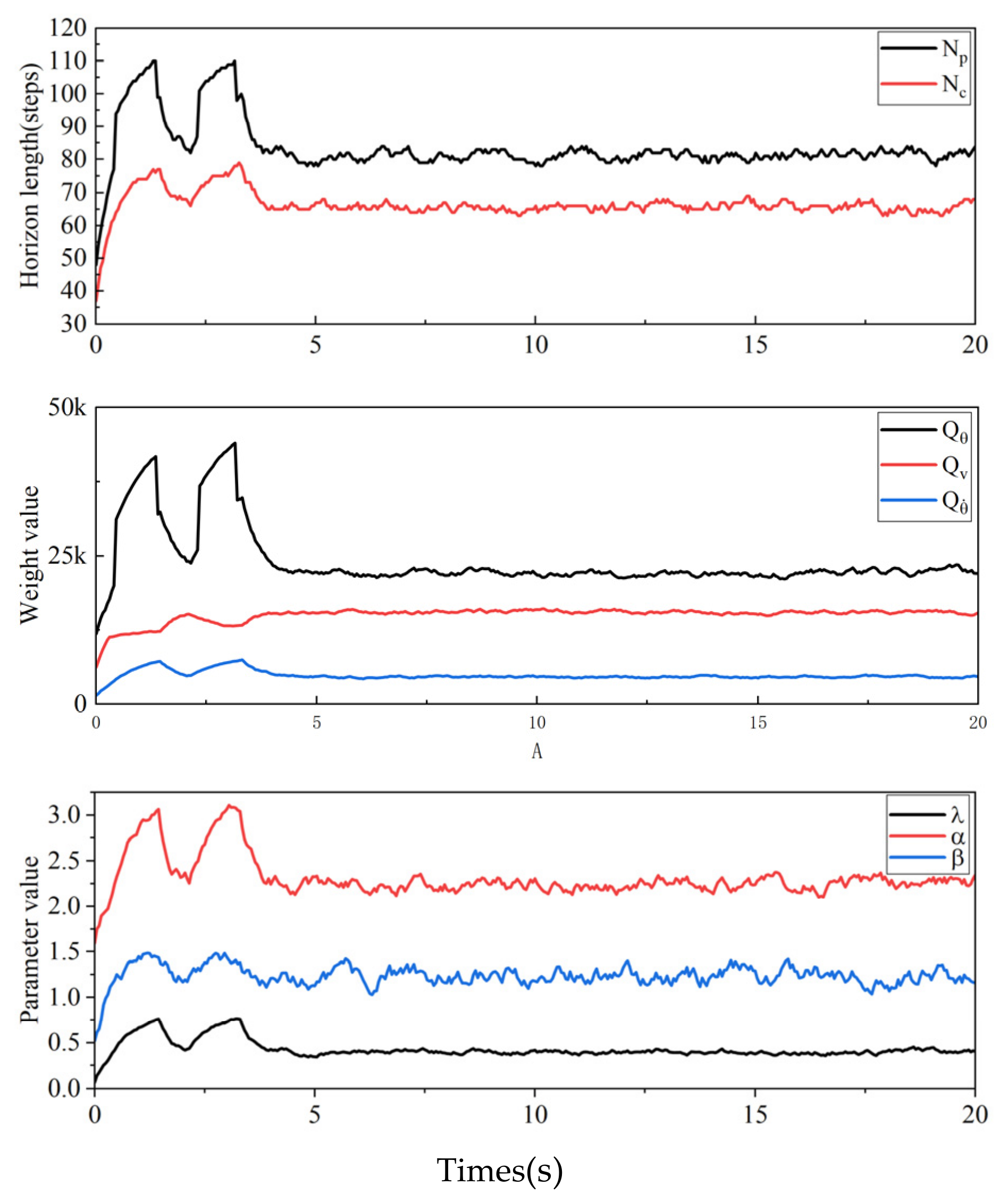
5.1. Simulation Analysis of TD3-MPC Braking Control
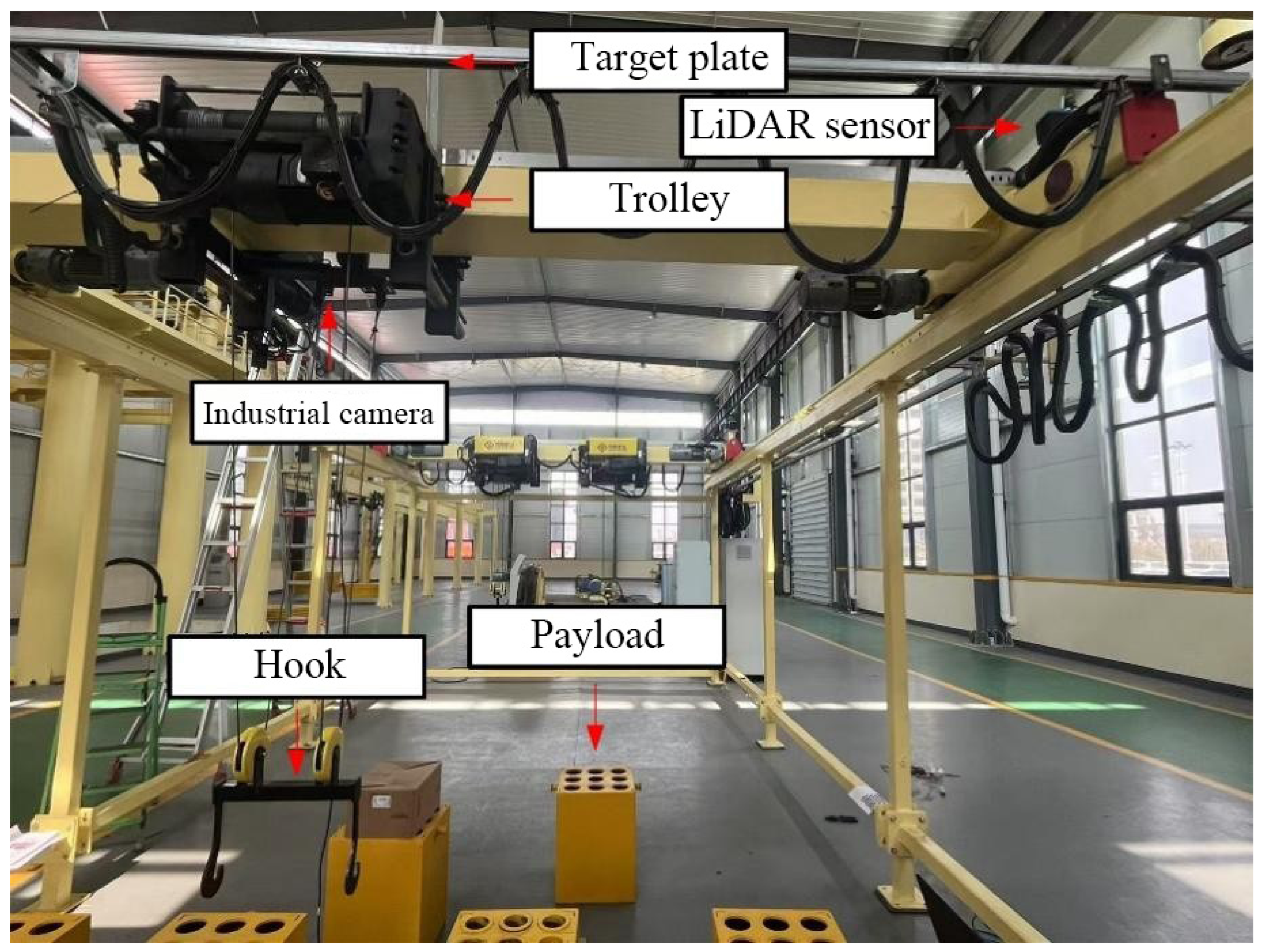
5.2. Real Crane Experiment
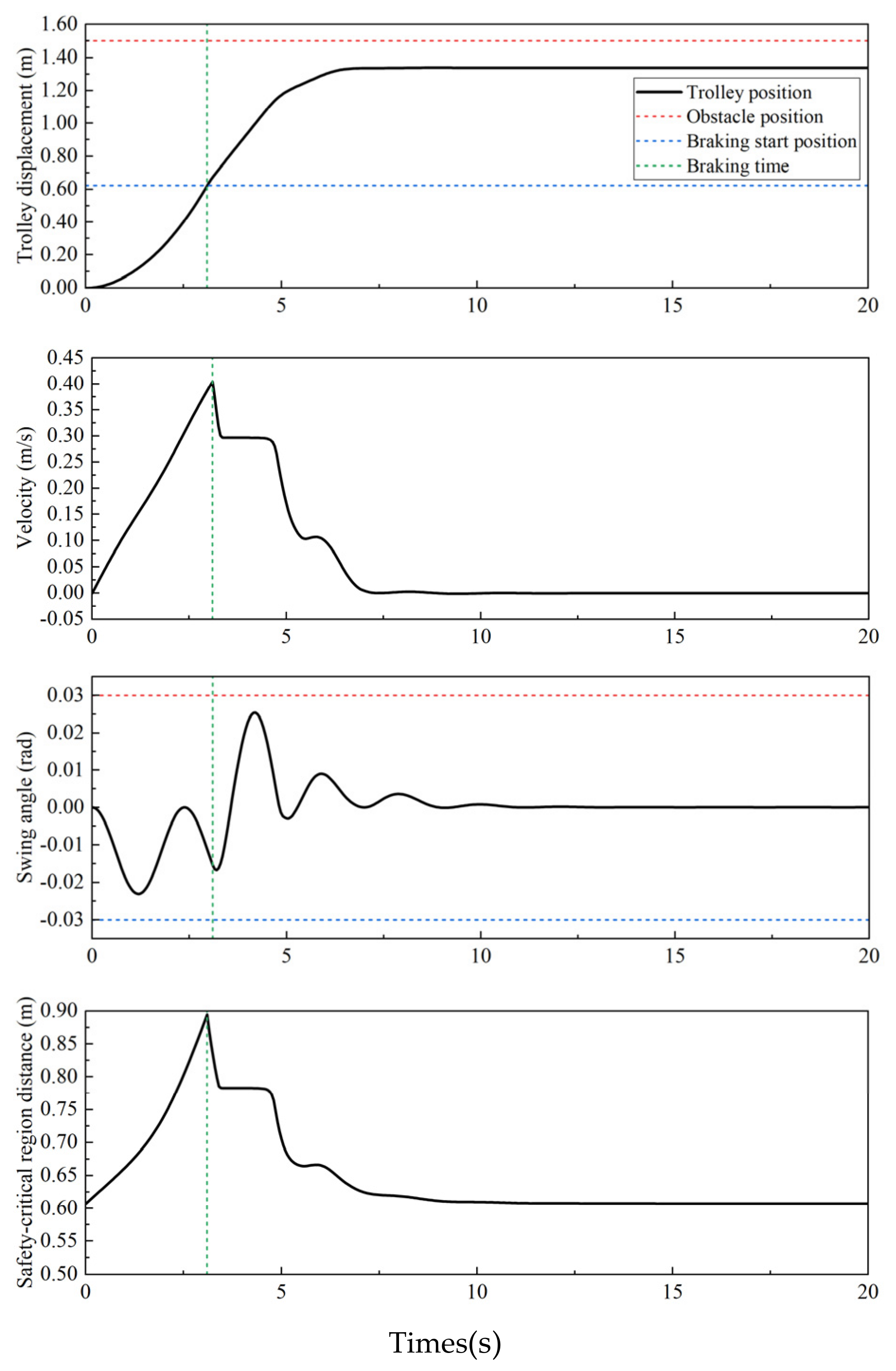
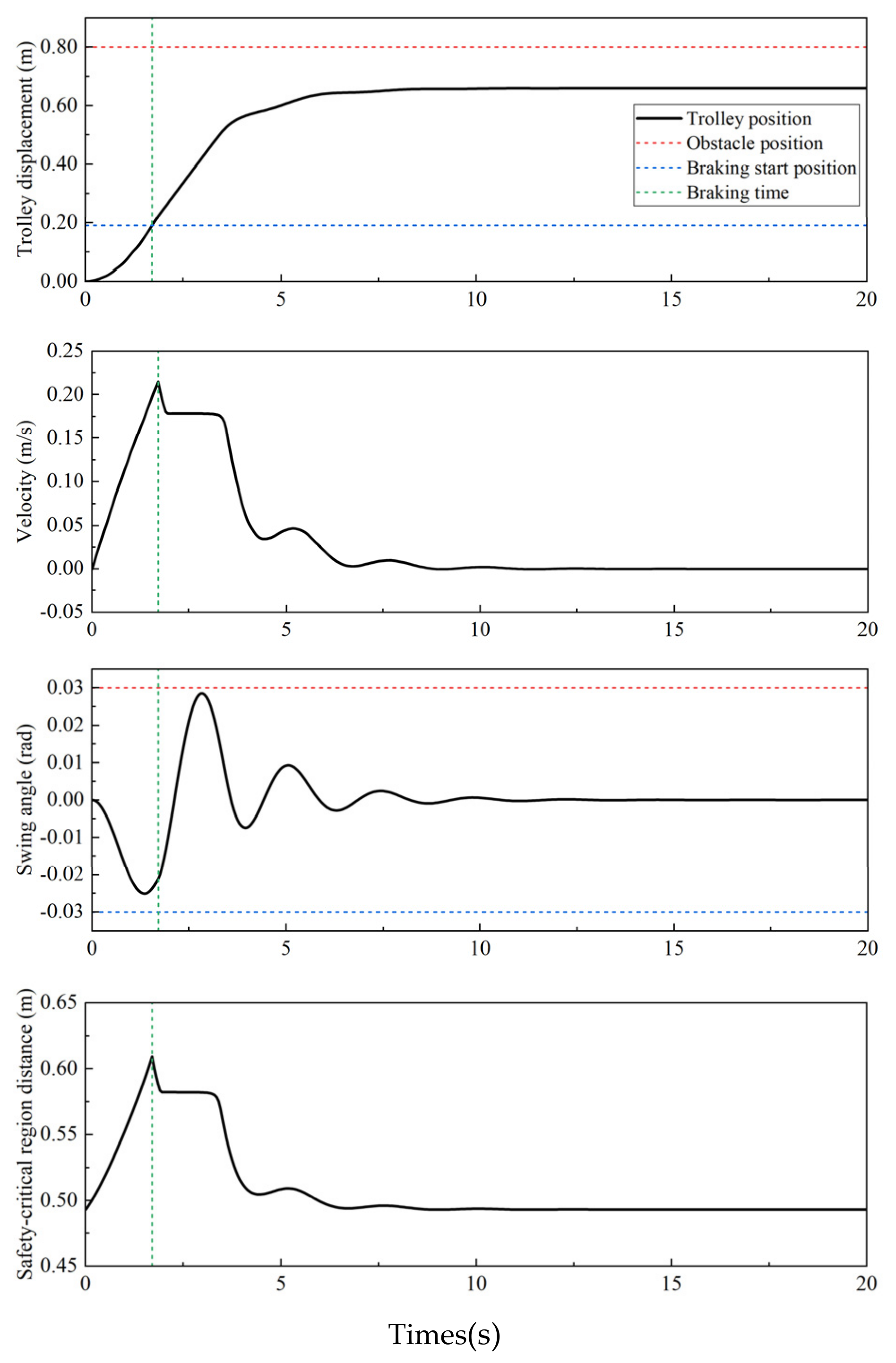
5.2.1. Experimental Group 1
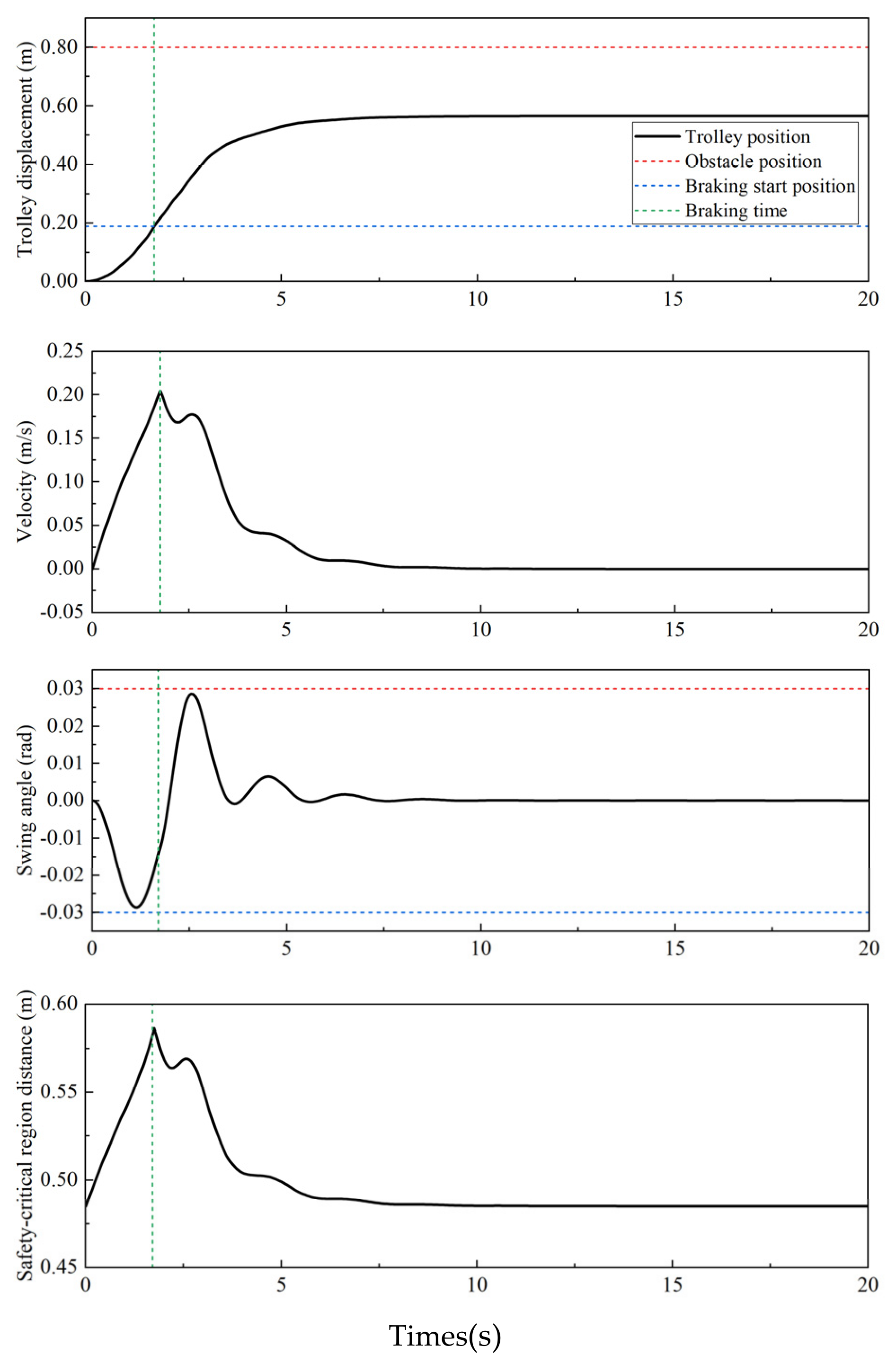
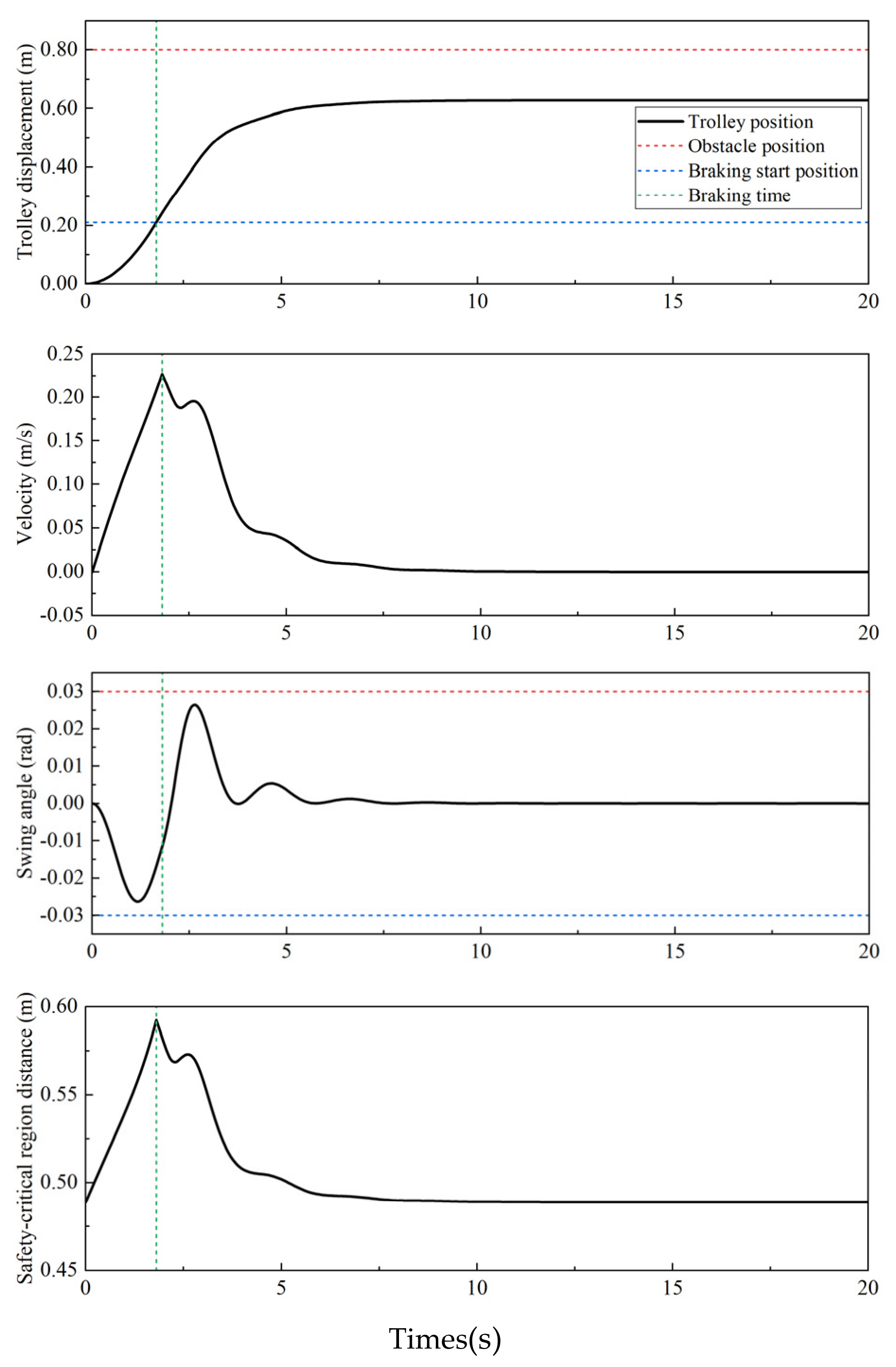
5.2.2. Experimental Group 2
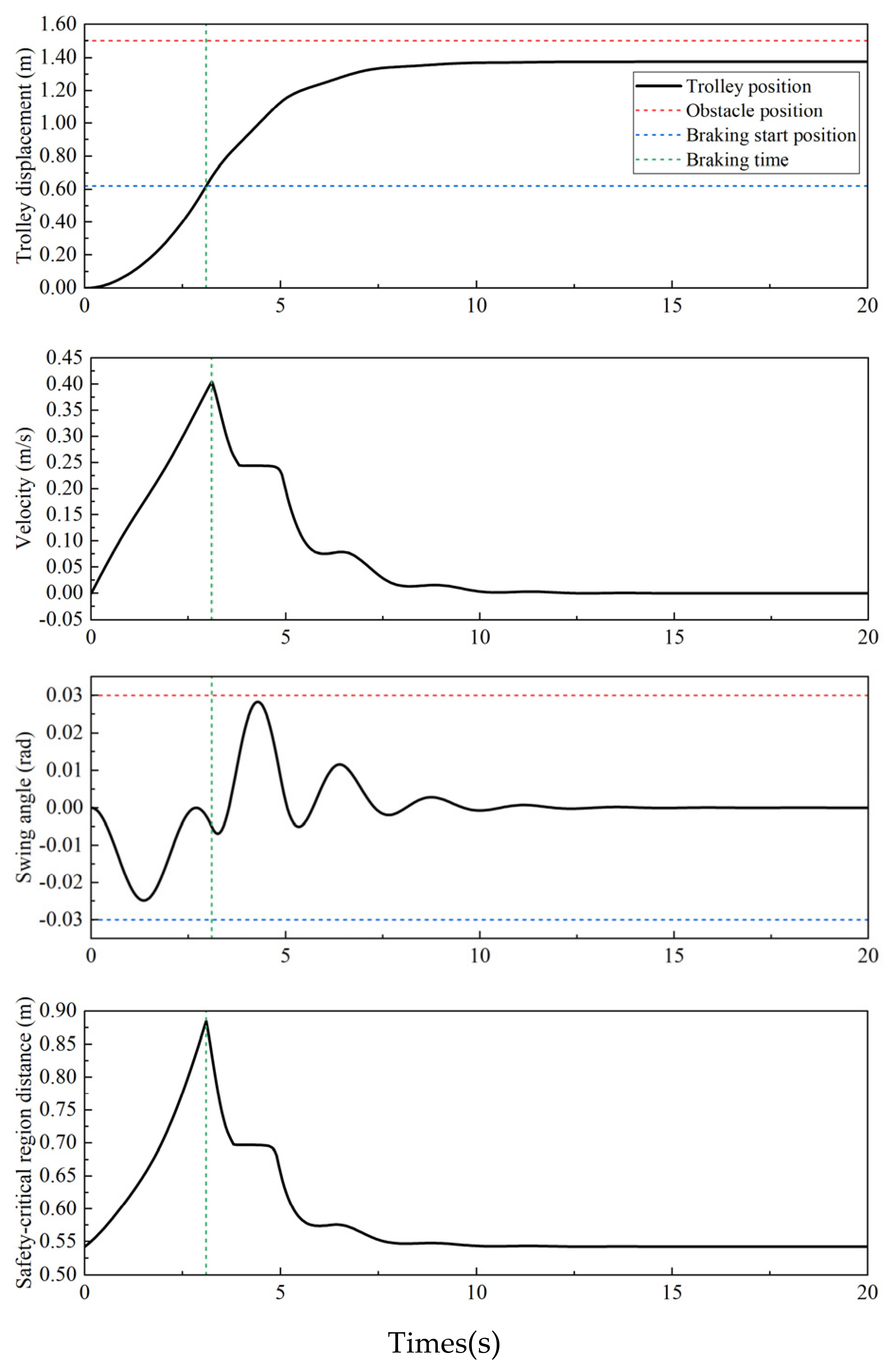
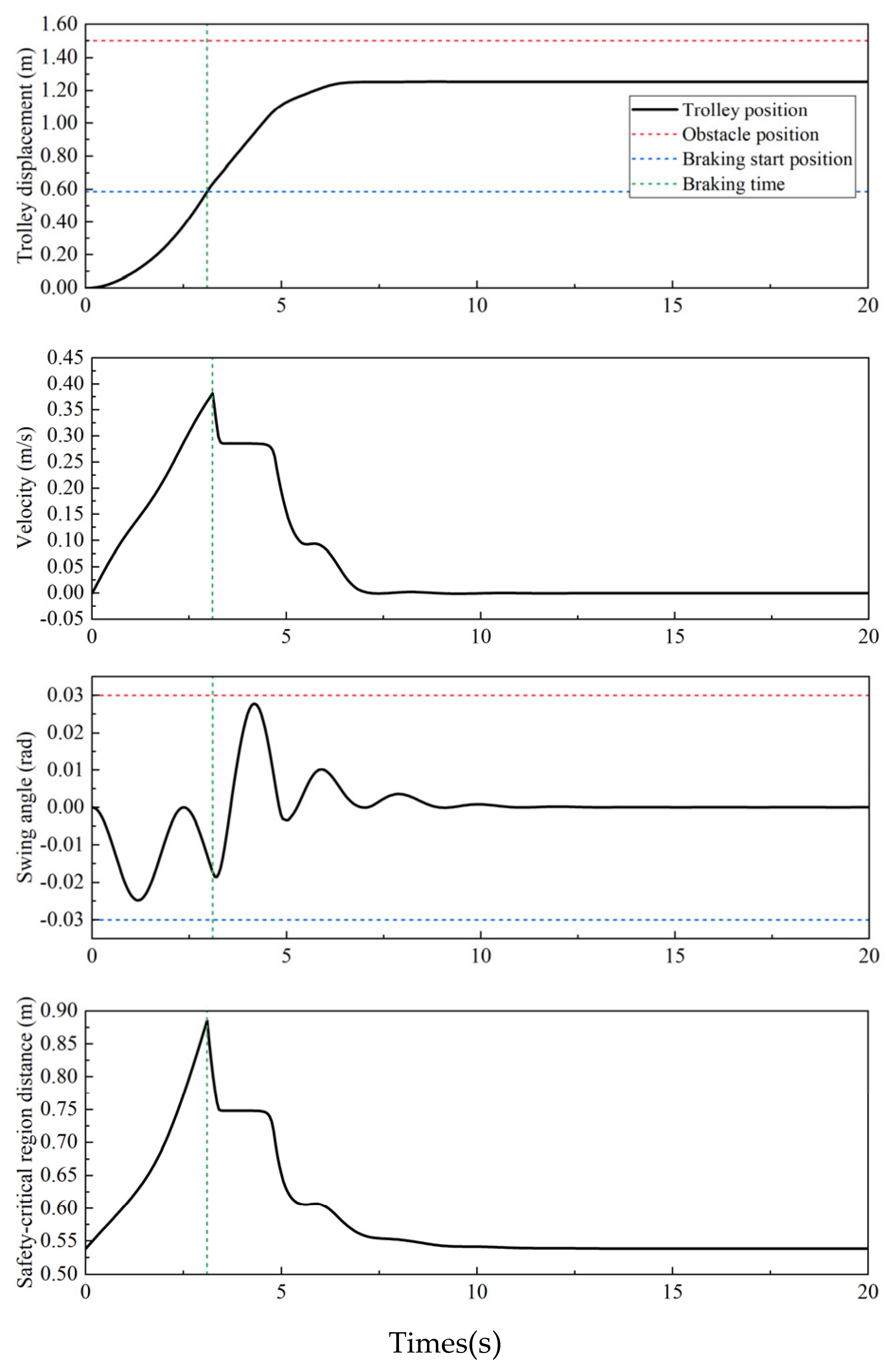
5.2.3. Experimental Group 3
6. Conclusions
Author Contributions
Funding
Institutional Review Board Statement
Informed Consent Statement
Data Availability Statement
Conflicts of Interest
Nomenclature
| Symbol | Description |
| M | Trolley mass |
| m | Payload mass |
| l | Rope length |
| x | Trolley position |
| θ | Payload swing angle |
| u | Control input force |
| Previous control input | |
| Np | Prediction horizon |
| Nc | Control horizon |
| Q | State weighting matrix |
| R | Control weighting matrix |
| λ | Reference trajectory parameter |
| α | Reference trajectory parameter |
| β | Reference trajectory parameter |
| ′ | Predicted value at the next time step |
| Maximum allowable payload swing angle | |
| Trolley velocity at the braking trigger instant | |
| Normalized form of a variable | |
| ρ | Safety factor |
| w | Payload width |
| K | Payload expansion coefficient |
Appendix A
Appendix A.1. Overview of Objective Function and Constrained Optimization Problem
Appendix A.2. Control Input Constraints
Appendix A.3. Swing Angle Constraints
Appendix A.4. Limitation of Direct State-Space Mapping
Appendix A.5. Bounded Swing Angle Analysis Based on the Kinematic Equation
Appendix A.6. Explicit Solution for Maximum Allowable Acceleration
Appendix A.7. Mapping from Acceleration Constraints to Control Input Constraints
Appendix A.8. Final Form of the Constrained Optimization Problem
References
- Li, D.; Xie, T.; Li, G.; Yao, J.; Hu, S. Adaptive coupling tracking control strategy for double-pendulum bridge crane with load hoisting/lowering. Nonlinear Dyn. 2024, 112, 8261–8280. [Google Scholar] [CrossRef]
- Zhang, M.; Zhang, Y.; Chen, H.; Cheng, X. Model-independent PD-SMC method with payload swing suppression for 3D overhead crane systems. Mech. Syst. Signal Process. 2019, 129, 381–393. [Google Scholar] [CrossRef]
- Li, S.H.; Li, K.D.; Gao, Y.S.; Wang, A.-H. Neural network adaptive robust control strategy for bridge crane based on partial state feedback of trolley. J. Mech. Sci. Technol. 2025, 39, 7065–7074. [Google Scholar] [CrossRef]
- Yang, T.; Sun, N.; Chen, H.; Fang, Y. Neural network-based adaptive anti-swing control of an underactuated ship-mounted crane with roll motions and input dead zones. IEEE Trans. Neural Netw. Learn. Syst. 2020, 31, 901–914. [Google Scholar] [CrossRef]
- Yang, T.; Sun, N.; Chen, H.; Fang, Y. Swing suppression and accurate positioning control for underactuated offshore crane systems suffering from disturbances. IEEE-CAA J. Autom. Sin. 2020, 7, 892–900. [Google Scholar]
- Reddy, B.S. Emergency Braking in an Overhead Crane using Sliding Mode Control under Unknown Uncertainties and Disturbances. In Proceedings of the International Conference on Control, Automation and Systems (ICCAS), Jeju, Republic of Korea, 29 October 2024–1 November 2024; pp. 1371–1376. [Google Scholar]
- Chen, H.; Liu, G.; Tian, G.; Zhang, J.; Ji, Z. Safe distance prediction for braking control of bridge cranes considering anti-swing. Int. J. Intell. Syst. 2022, 37, 4845–4863. [Google Scholar]
- He, W.; Zhang, S.; Ge, S.S. Adaptive Control of a Flexible Crane System with the Boundary Output Constraint. IEEE Trans. Ind. Electron. 2014, 61, 4126–4133. [Google Scholar] [CrossRef]
- Zhang, M.; Jing, X. Adaptive Neural Network Tracking Control for Double-Pendulum Tower Crane Systems with Nonideal Inputs. IEEE Trans. Syst. Man Cybern. Syst. 2022, 52, 2514–2530. [Google Scholar]
- Fang, Y.; Ma, B.; Wang, P.; Zhang, X. A Motion Planning-Based Adaptive Control Method for an Underactuated Crane System. IEEE Trans. Control Syst. Technol. 2012, 20, 241–248. [Google Scholar]
- Mei, Y.; Liu, Y.; Wang, H.; Cai, H. Adaptive Deformation Control of a Flexible Variable-Length Rotary Crane Arm with Asymmetric Input-Output Constraints. IEEE Trans. Cybern. 2022, 52, 13752–13761. [Google Scholar] [CrossRef]
- Yu, J.; Shi, P.; Dong, W.; Lin, C. Command filtering-based fuzzy control for nonlinear systems with saturation input. IEEE Trans. Cybern. 2017, 47, 2472–2479. [Google Scholar] [CrossRef] [PubMed]
- Sun, Z.; Bi, Y.; Zhao, X.; Sun, Z.; Ying, C.; Tan, S. Type-2 fuzzy sliding mode anti-swing controller design and optimization for overhead crane. IEEE Access 2018, 6, 51931–51938. [Google Scholar] [CrossRef]
- Ouyang, H.; Hu, J.; Zhang, G.; Mei, L.; Deng, X. Decoupled linear model and S-shaped curve motion trajectory for load sway reduction control in overhead cranes with double-pendulum effect. Proc. Inst. Mech. Eng. Part C J. Mech. Eng. Sci. 2019, 233, 3678–3689. [Google Scholar] [CrossRef]
- Sun, N.; Wu, Y.; Chen, H.; Fang, Y. Anti-swing cargo transportation of underactuated tower crane systems by a nonlinear controller embedded with an integral term. IEEE Trans. Autom. Sci. Eng. 2019, 16, 1387–1398. [Google Scholar] [CrossRef]
- Yamamoto, M.; Honda, E.; Mohri, A. Safe Automatic Emergency Stop Control of Gantry Crane Including Moving Obstacles in Its Workspace. In Proceedings of the Proceedings of the 2005 IEEE International Conference on Robotics and Automation, Barcelona, Spain, 18–22 April 2005; pp. 253–258. [Google Scholar]
- Hino, H.; Kobayashi, Y.; Higashi, T.; Ota, J. Control methodology of stacker cranes for collision avoidance considering dynamics in a warehouse. In Proceedings of the 2009 IEEE International Conference on Robotics and Biomimetics (ROBIO), Guilin, China, 19–23 December 2009; pp. 983–988. [Google Scholar]
- Ma, B.; Fang, Y.; Zhang, Y. Switching-based emergency braking control for an overhead crane system. IET Control Theory Appl. 2010, 4, 1739–1747. [Google Scholar] [CrossRef]
- Veciana, J.M.; Cardona, S.; Catala, P. Minimizing residual vibrations for non-zero initial states: Application to an emergency stop of a crane. Int. J. Precis. Eng. Manuf. 2013, 14, 1901–1908. [Google Scholar] [CrossRef]
- Chen, H.; Fang, Y.; Sun, N. A payload swing suppression guaranteed emergency braking method for overhead crane systems. J. Vib. Control 2018, 24, 4561–4660. [Google Scholar]
- Chen, H.; Xuan, B.; Yang, P.; Chen, H. A new overhead crane emergency braking method with theoretical analysis and experimental verification. Nonlinear Dyn. 2019, 98, 2211–2225. [Google Scholar] [CrossRef]
- Chen, H.; Li, M.; Wu, Y. An emergency braking method with swing suppression and safety limits consideration for double pendulum cranes. Control Eng. Pract. 2023, 139, 105638. [Google Scholar] [CrossRef]
- Deka, A.; Basireddy, S.R. A Fuzzy Controller for the Emergency Braking Problem in Overhead Cranes. In Proceedings of the 2022 IEEE Delhi Section Conference (DELCON), New Delhi, India, 11–13 February 2022; pp. 1–6. [Google Scholar]
- Deka, A.; Basireddy, S.R. Emergency Braking Control in 3D Overhead Cranes Using a Switching PD-Fuzzy Controller. In Proceedings of the 2023 9th International Conference on Control, Automation and Robotics (ICCAR), Bejing, China, 21–23 April 2023; pp. 285–290. [Google Scholar]
- Chen, H.; Liu, G.; Tian, G.; Zhang, J.; Ji, Z. Adaptive Safe Distance Prediction Using MPC for Bridge Cranes Considering Anti-Swing. In Proceedings of the 2020 Chinese Automation Congress (CAC), Shanghai, China, 6–8 November 2020; pp. 1914–1919. [Google Scholar]
- Nasti, S.M.; Najar, Z.A.; Chishti, M.A. Adaptive mapless mobile robot navigation using deep reinforcement learning based improved TD3 algorithm. Front. Robot. AI 2025, 12, 1625968. [Google Scholar] [CrossRef]
- Yuste, P.C.; Martínez, J.A.I.; de Miguel, M.A.S. Simulation-based evaluation of model-free reinforcement learning algorithms for quadcopter attitude control and trajectory tracking. Neurocomputing 2024, 608, 128362. [Google Scholar] [CrossRef]
- Wang, T.; Tan, N.; Qiu, J.; Zheng, Z.; Lin, C.; Wang, H. A novel model-free adaptive terminal sliding mode controller for bridge cranes. Meas. Control 2023, 56, 1217–1230. [Google Scholar] [CrossRef]
- Chen, Q.P.; Yu, B.H.; Min, S.L. Study on Intelligent Vehicle Trajectory Planning and Tracking Control Based on Improved APF and MPC. Int. J. Automot. Technol. 2025, 26, 715–728. [Google Scholar] [CrossRef]
- Lv, C.; Xue, B.; Chen, G.; Chen, J.; Yu, H. Event triggered disturbance observer based nonlinear MPC for agricultural machinery trajectory tracking control. Comput. Electron. Agric. 2026, 248, 111798. [Google Scholar] [CrossRef]
- Zhang, M.; Ma, X.; Song, R.; Rong, X.; Tian, G.; Tian, X.; Li, Y. Adaptive proportional-derivative sliding mode control law with improved transient performance for underactuated overhead crane systems. IEEE-CAA J. Autom. 2018, 5, 683–690. [Google Scholar] [CrossRef]
- Tripura, T.; Chakraborty, S. Learning to predict and control with sparse model discovery and deep temporal difference reinforcement learning. Mech. Syst. Signal Process. 2026, 251, 114226. [Google Scholar] [CrossRef]
- Brandner, D.; Sebastien, G.; Sergio, L. Computationally efficient Gauss-Newton reinforcement learning for model predictive control. Comput. Chem. Eng. 2026, 209, 109605. [Google Scholar] [CrossRef]
- Li, Z.; Guan, X.; Liu, C.; Li, D.; He, L.; Cao, Y.; Long, Y. Active disturbance rejection control based on Twin-Delayed Deep Deterministic Policy Gradient for an exoskeleton. J. Bionic Eng. 2025, 22, 1211–1230. [Google Scholar] [CrossRef]
- Pan, Y.; Wang, Y.; Ran, B. A Hierarchical Dynamic Path Planning Framework for Autonomous Vehicles Based on Physics-Informed Potential Field and TD3 Reinforcement Learning. Appl. Sci. 2026, 16, 3610. [Google Scholar] [CrossRef]
- Shi, J.Y.; Zhou, J.; Lyu, Y.Z. Parallel grid search-enhanced support vector regression for small unmanned helicopter modeling. Eng. Comput. 2026, 43, 349–362. [Google Scholar] [CrossRef]







| Item | Configuration |
|---|---|
| Actor network structure | 3 → 256 → 256 → 128 → 8 |
| Critic network structure | 11 → 256 → 256 → 1 |
| Learning rate | Actor: 3 × 10⁻⁴, Critic: 3 × 10⁻⁴ |
| Batch size | 256 |
| Replay buffer size | 50,000 |
| Discount factor | 0.99 |
| Target network update coefficient | 0.005 |
| Training episodes | 3 (pretraining stage) |
| Exploration noise | OU noise (σ = 0.15, θ = 0.2, clip = [−0.5, 0.5]) |
| Activation function and optimizer | ReLU (hidden), Sigmoid (output); AdamW |
| Scenario | θmax/rad | M/kg | m/kg | l/m | v/(m/s) |
|---|---|---|---|---|---|
| Scenario 1 | 0.03 | 280 | 30 | 2 | 0.3 |
| Scenario 2 | 0.01 | 280 | 30 | 2 | 0.3 |
| Scenario 3 | 0.03 | 280 | 30 | 2 | 0.5 |
| Reward Configuration | Braking Distance/m | Maximum Swing Angle/rad |
|---|---|---|
| Full Reward | 0.359 | 0.027 |
| w/o State tracking reward | 0.397 | 0.026 |
| w/o Control constraint reward | 0.379 | 0.027 |
| w/o Parameter optimization reward | 0.386 | 0.028 |
| w/o Safety constraint penalty | 0.363 | 0.031 |
| Scenario | Method | Braking Distance/m | Maximum Swing Angle/rad | Settling Time/s |
|---|---|---|---|---|
| Scenario 1 | MPC TD3–MPC | 0.464 0.359 | 0.029 0.027 | 6.95 5.10 |
| Scenario 2 | MPC TD3–MPC | 0.989 0.856 | 0.011 0.009 | 8.20 6.50 |
| Scenario 3 | MPC TD3–MPC | 1.118 0.901 | 0.030 0.027 | 6.85 5.20 |
| Component | Average Time/ms | Maximum Time/ms |
|---|---|---|
| TD3 inference | 0.72 | 1.02 |
| MPC optimization | 21.35 | 30.48 |
| Total control cycle | 25.12 | 35.67 |
| Experimental Group | θmax/rad | M/kg | m/kg | l/m |
|---|---|---|---|---|
| Group 1 | 0.03 | 280 | 30 | 1.5 |
| Group 2 | 0.03 | 280 | 50 | 1.5 |
| Group 3 | 0.03 | 280 | 30 | 2 |
Disclaimer/Publisher’s Note: The statements, opinions and data contained in all publications are solely those of the individual author(s) and contributor(s) and not of MDPI and/or the editor(s). MDPI and/or the editor(s) disclaim responsibility for any injury to people or property resulting from any ideas, methods, instructions or products referred to in the content. |
© 2026 by the authors. Licensee MDPI, Basel, Switzerland. This article is an open access article distributed under the terms and conditions of the Creative Commons Attribution (CC BY) license.
Share and Cite
Zhang, W.; Wang, Y.; Liu, M.; Lan, P. TD3-Enhanced MPC for Safe Braking of Overhead Cranes with Safety-Critical Region Prediction. Actuators 2026, 15, 334. https://doi.org/10.3390/act15060334
Zhang W, Wang Y, Liu M, Lan P. TD3-Enhanced MPC for Safe Braking of Overhead Cranes with Safety-Critical Region Prediction. Actuators. 2026; 15(6):334. https://doi.org/10.3390/act15060334
Chicago/Turabian StyleZhang, Wenshuai, Yifan Wang, Manlan Liu, and Peng Lan. 2026. "TD3-Enhanced MPC for Safe Braking of Overhead Cranes with Safety-Critical Region Prediction" Actuators 15, no. 6: 334. https://doi.org/10.3390/act15060334
APA StyleZhang, W., Wang, Y., Liu, M., & Lan, P. (2026). TD3-Enhanced MPC for Safe Braking of Overhead Cranes with Safety-Critical Region Prediction. Actuators, 15(6), 334. https://doi.org/10.3390/act15060334