Article

Research on Robotic Force Control for Infant Hip Ultrasound

Institute of Instrument Science and Engineering, Southeast University, Nanjing 210096, China
*
Author to whom correspondence should be addressed.
Actuators 2026, 15(6), 333; https://doi.org/10.3390/act15060333
Submission received: 6 May 2026 / Revised: 7 June 2026 / Accepted: 10 June 2026 / Published: 11 June 2026
(This article belongs to the Section Actuators for Robotics)

Abstract

The contact force between the ultrasound probe and human skin directly affects image quality, patient safety, and comfort. In infant developmental dysplasia of the hip (DDH) ultrasound examinations, higher force control precision is required, as infants have thin skin and soft cartilage that are easily deformed under excessive probe pressure. This paper proposes a comprehensive force control method for DDH ultrasound robots. Firstly, an online gravity calibration approach is employed to estimate the installation tilt, sensor zero offset, and probe center of gravity, thereby improving force measurement accuracy. Then, a torque-based pose control algorithm is adopted to achieve conformal probe–skin contact. Finally, a variable admittance control strategy based on fuzzy neural network (FNN) is proposed, which adaptively regulates the damping coefficient based on the force error and its rate, enabling stable force control without explicit soft-tissue modeling. Experiments on an infant phantom and human skin show that the proposed method achieves force fluctuation amplitudes of 0.0984 ± 0.0012 N and 0.0976 ± 0.0014 N, respectively, with absolute steady-state force errors below 0.01 N. Compared with conventional admittance control, it significantly reduces force oscillations and improves tracking accuracy. In infant experiments, the method enables smooth convergence to the desired force and maintains relatively stable probe–skin interaction, which contributes to consistent ultrasound image acquisition and reduces tissue deformation. These results suggest that the proposed method can provide a feasible force control basis for stable and gentle robotic DDH ultrasound scanning.

1. Introduction

Developmental dysplasia of the hip (DDH) is one of the most common musculoskeletal disorders in infants [1]. The optimal treatment window for DDH is within 6 months after birth. Failure to receive timely treatment may lead to long-term hip joint dysfunction, early-onset osteoarthritis, and even lifelong disability [2]. Ultrasound is the preferred imaging method for the early screening of DDH [3]. However, ultrasound screening for infant hip dysplasia requires the involvement of a large number of physicians, and diagnostic results are prone to significant variation due to differences in physicians’ experience and technical proficiency [4]. Given their potential for high precision, flexibility, and repeatability, robots are often highly suitable for integration with ultrasound technology [5,6]. Therefore, ultrasound diagnostic robots are key equipment for implementing a developmental dysplasia of the hip (DDH) screening.
The Graf method is currently the most widely used ultrasound-based technique for the diagnosis of DDH, in which the α and β angles are measured for diagnosis. Its accuracy depends on stable acquisition and high image quality of the standard plane [7,8]. As the infant hip joint is predominantly composed of cartilaginous tissue, excessive contact force or improper probe orientation can easily cause soft tissue deformation, leading to degraded image quality. This may not only compromise diagnostic reliability but also pose potential safety risks [9,10,11]. Therefore, achieving precise control of probe–skin contact force is essential for improving imaging quality, ensuring diagnostic reliability, and maintaining safety in robotic DDH ultrasound systems.
According to different control strategies, robotic contact force control methods can be divided into passive compliance control and active compliance control. Passive compliance is achieved by mounting compliance devices or dampers at the end of the robot [12,13,14]. Though simple in design and implementation, its fixed compliance center precludes dynamic adjustment, limiting applicability and resulting in generally low contact force control accuracy.
Active compliance control relies on more complex algorithms to achieve higher adaptability, mainly including dynamic model-based control, force–position hybrid control, and admittance control. Dynamics model-based control methods estimate or regulate the interaction force by combining robot dynamic models with joint torque measurements, motor-side feedback, or observer-based external force estimation methods [15,16,17]. Although this method is effective in modeling and optimizing complex systems, the high dependence on model accuracy limits its application in infant ultrasonography, especially the difficulty in modeling the mechanical properties of the infant skin, which increases the complexity of implementation. Force–position hybrid control is a strategy that simultaneously realizes contact force control and displacement control [18,19,20] and is suitable for tasks that require simultaneous regulation of force and displacement. This method offers a high degree of flexibility, but it is more complex to implement, and improper regulation may lead to performance degradation.
Admittance control is a flexible and widely used method for controlling contact forces in human–robot interaction [21,22]. It converts the measured interaction force into desired robot motion through a virtual mass–spring–damper model, allowing the robot to exhibit compliant behavior during physical interaction. However, traditional admittance control usually relies on fixed parameter settings, which limits its adaptability to force variations in compliant environments. To overcome this limitation, recent studies have introduced variable or adaptive admittance control, in which admittance parameters are adjusted online according to interaction force, human intention, or environment uncertainty. For example, Wang et al. [23] developed a variable admittance control method for physical human–robot interaction, where the admittance parameters were adjusted according to predicted human hand motion to reduce interaction force. Cao et al. [24] developed an adaptive admittance controller for a lower-limb rehabilitation exoskeleton, in which admittance parameters were adjusted according to human–robot interaction force to improve compliance and comfort. In robotic ultrasound, Jiang et al. [25] proposed an integral adaptive admittance control strategy, which improved force tracking by estimating environmental stiffness and position online and introducing an integral term. However, the method was mainly validated on phantom models with a desired force of 6 N, and the probe–tissue interaction was simplified as a first-order spring model. Moreover, the admittance parameters were still manually predefined, limiting their adaptability to real-time force variations in infant hip ultrasound. Xiao et al. [26] proposed an adaptive variable admittance control strategy for remote robotic ultrasound scanning, which improved force tracking by combining variable damping, variable stiffness, online environment estimation, and an energy tank mechanism. However, the method was validated mainly on a vascular phantom and adult upper limb with target forces of 6–10 N. In addition, its reliance on ultrasound-confidence-based environment estimation and a simplified linear contact model limits its direct applicability to low-force infant hip ultrasound.
Although existing variable and adaptive admittance control methods have improved force-tracking performance in physical human–robot interaction and robotic ultrasound, their direct application to infant DDH ultrasonography remains limited. Most existing studies are validated on phantoms or adult tissues, often with higher desired contact forces than those required for infant hip ultrasound. Moreover, some methods still depend on predefined admittance parameters, simplified linear contact models, or specific environment-estimation strategies. These assumptions may be insufficient for infant hip ultrasound, where the skin and periarticular soft tissues are highly compliant, nonlinear, and vary significantly among individuals. Therefore, a more adaptive force control strategy is required to reduce force fluctuation and maintain stable, low-force probe–skin contact. Motivated by this need, this paper conducts a comprehensive study on the force control method for the DDH ultrasound robot. The main contributions of this study are summarized as follows:
(1)
A comprehensive contact force control method for robotic DDH ultrasound screening is proposed, integrating gravity compensation, torque-based pose control, and fuzzy neural network (FNN)-based variable admittance control to achieve accurate and stable probe–skin interaction.
(2)
A variable admittance control strategy based on FNN is developed, which dynamically adjusts the damping coefficient according to force error and its variation, enabling stable force regulation without explicit soft-tissue modeling.
(3)
Extensive experiments under multiple conditions, including an infant phantom, human skin, and preliminary infant trials, demonstrate that the proposed method improves force stability and tracking accuracy, and shows the potential to support more consistent ultrasound image acquisition in infant hip scanning.
The structure of this paper is as follows: Section 2 describes the gravity compensation approach, the pose control algorithm of the ultrasonic probe, and the contact force control strategy at the end of the robot in detail. Section 3 introduces the architecture of the experimental platform and the design of the contact force buffer tool. Section 4 verifies the effectiveness of the proposed method through experiments and analyzes the experimental results. Section 5 summarizes the research of this paper and looks forward to future research directions.

2. Methodology

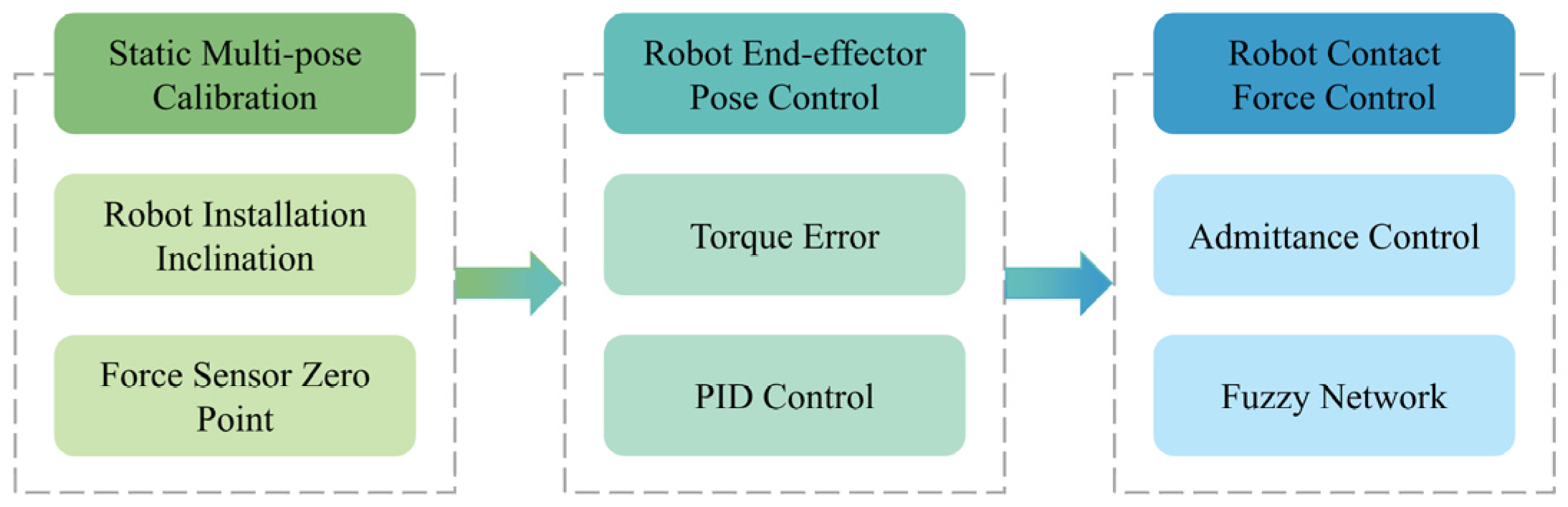
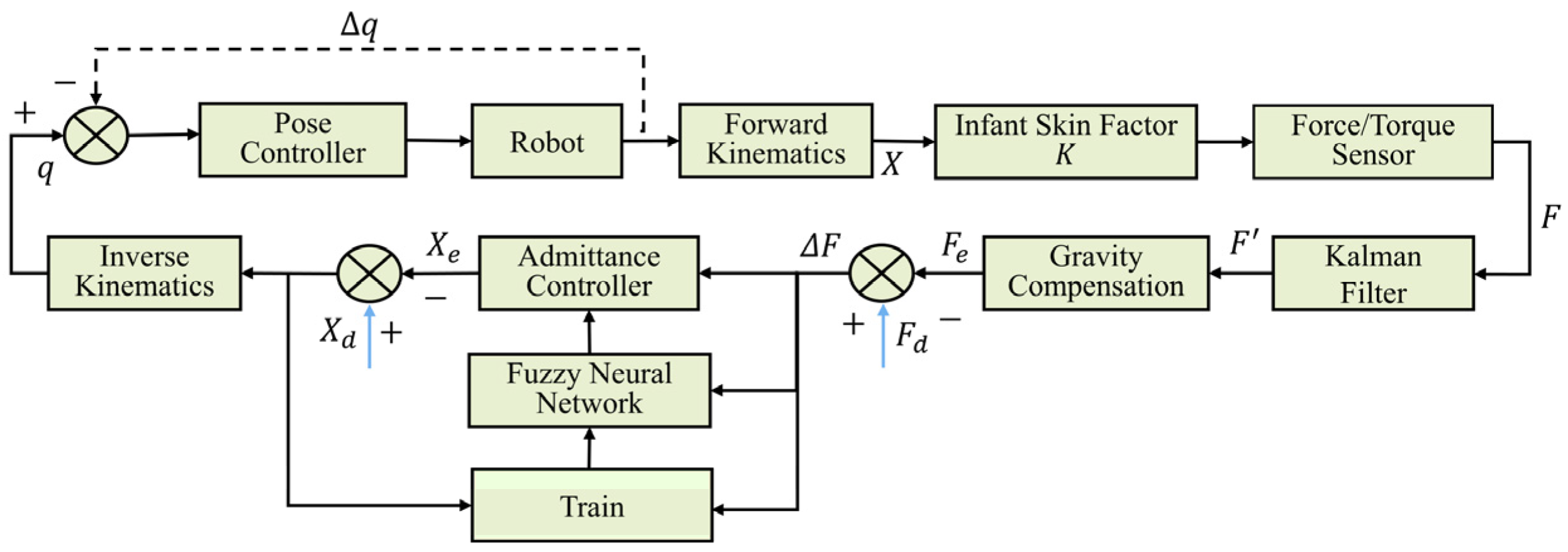
As shown in Figure 1, this chapter presents the overall methodology, which is structured into three main components. To address gravitational interference, a static multi-pose calibration approach is developed to estimate the robot’s mounting inclination angle, model and compensate for the end-effector gravitational force, and determine the zero offset of the multi-dimensional force/torque sensor. Following this calibration, torque data discrepancies between sensor measurements and reference values serve as inputs to a PID controller, which regulates the end-effector pose to ensure close conformity with the measured skin surface. Under the constraint of maintaining conformal contact, a contact force control strategy is proposed, which builds upon improved admittance control and a fuzzy neural network (FNN). By taking the contact force error and its rate of change as inputs, the network enables real-time adjustment of admittance parameters, thereby achieving adaptive tuning of contact characteristics in response to the external environment.
To quantitatively evaluate the effectiveness of the proposed method, corresponding performance metrics will be introduced and analyzed in the subsequent section.

2.1. Static Multi-Pose Calibration Approach

The robot executes high-speed movements for coarse positioning and automatically transitions to low-speed motion as it approaches and contacts the infant’s skin. A six-axis force/torque sensor mounted at the robot’s end-effector measures the contact force between the ultrasonic probe and the infant’s skin. During the low-speed phase, the inertial force from the probe’s movement is negligible; however, the probe’s weight introduces errors in the measured contact force. To address these weight-induced biases, a static multi-pose calibration approach is employed to determine both the sensor’s offset values and the instantaneous weight components. By subtracting these from the raw measurements, the approach computes the actual contact force between the probe and the skin, thus significantly enhancing the accuracy of force sensing and the stability of control systems.

2.1.1. Robot Mounting Inclination and End Tool Gravity Calculation
When the six-axis force/torque sensor at the end of the robot does not have external forces acting on the end, the measured data includes the gravitational load at the end of the robot and zero offset [27]. That is:
{ f x = f x 0 + g x f y = f y 0 + g y f z = f z 0 + g z m x = m x 0 + m g x m y = m y 0 + m g y m z = m z 0 + m g z
where, f x , f y , f z , m x , m y , m z are the measurement values of force and torque in the coordinate axis direction of a six-axis force/torque sensor, g x ,   g y ,   g z ,   m g x ,   m g y ,     m g z are the force components and torques of gravity G in three coordinate axes, f x 0 , f y 0 , f z 0 , m x 0 ,   m y 0 , m z 0 are the values of the zero offset.
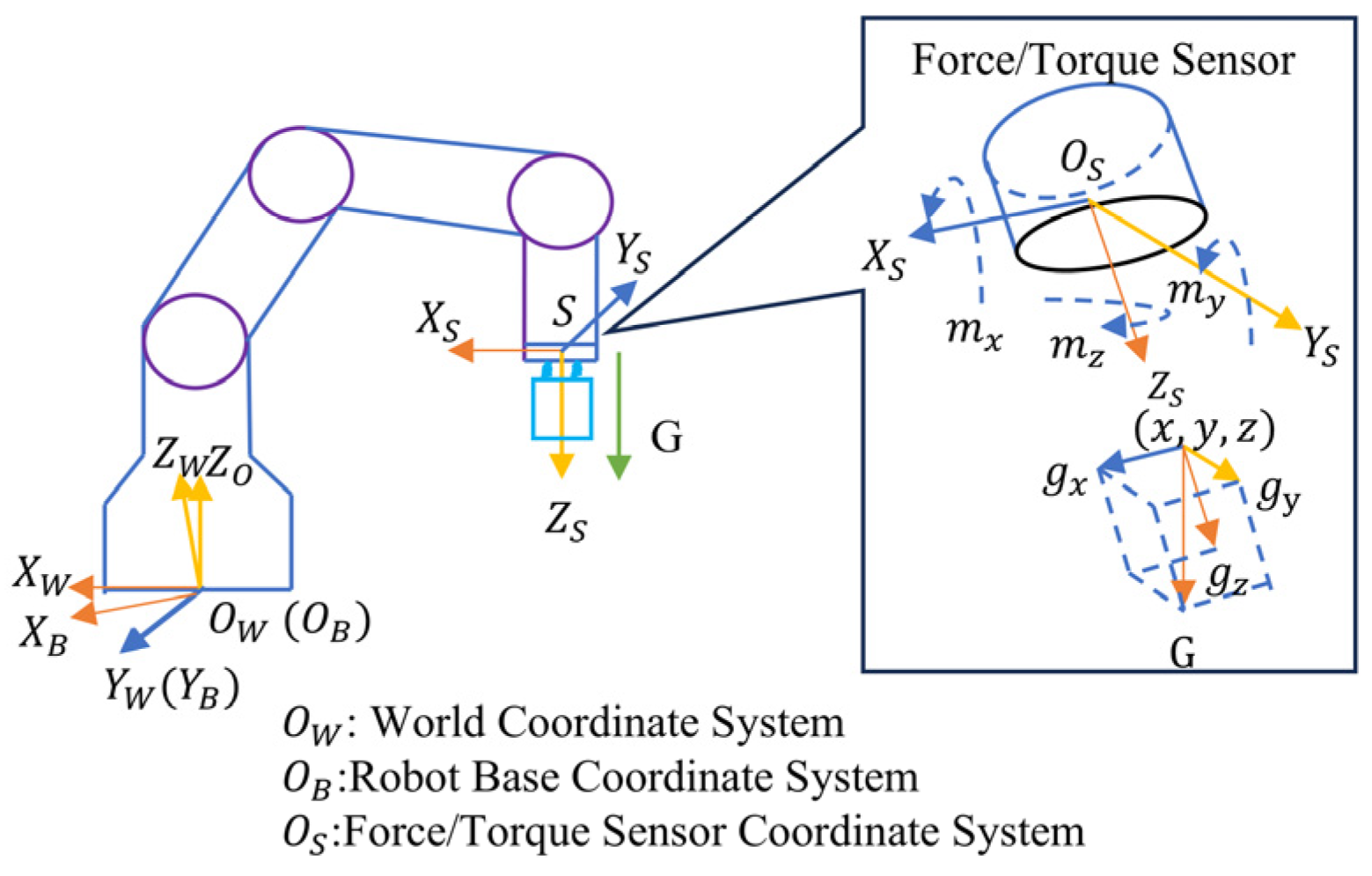
As shown in Figure 2, the coordinates of the load center at the end of the robot arm in the six-axis force/torque sensor coordinate system are ( x ,   y ,   z ) . According to the relationship between the force and the torque [28], the following expression can be obtained:
{ m g x = g z · y g y · z m g y = g x · z g z · x m g z = g y · x g x · y
By solving Equations (1) and (2) simultaneously, the following is obtained:
{ m x = f z · y f y · z + m x 0 + f y 0 · z f z 0 · y m y = f x · z f z · x + m y 0 + f z 0 · x f x 0 · z m z = f y · x f x · y + m z 0 + f x 0 · y f y 0 · x
Neglecting the fluctuation of force/torque sensor data, f x 0 , f y 0 , f z 0 , m x 0 , m y 0 , m z 0 , x , y , z are constants in the case of unchanged end-of-arm tooling. Define constants as:
{ k 1 = m x 0 + f y 0 · z f z 0 · y k 2 = m y 0 + f z 0 · x f x 0 · z k 3 = m z 0 + f x 0 · y f y 0 · x
By substituting this into the relationship between force and torque, the following can be obtained:
[ m x m y m z ] = [ 0 f z f y 1 0 0 f z 0 f x 0 1 0 f y f x 0 0 0 1 ] [ x y z k 1 k 2 k 3 ]
Figure 2. Schematic of coordinate definition and center of mass.
Actuators 15 00333 g002
To identify the load centroid and the zero-offset-related constants of the end tool, N 3 independent static calibration poses were selected. Here, N denotes the number of independent robot poses used for gravity compensation calibration. For the i -th calibration pose, the six-axis force/torque sensor reading is denoted as f x , i , f y , i , f z , i , m x , i ,   m y , i ¸ m z , i . In this study, three different static poses were used, namely N = 3 . To reduce random measurement noise, ten consecutive groups of force/torque data were collected at each pose and averaged before parameter identification:
s ¯ i = 1 M j = 1 M s i , j ,           M = 10
where s i , j represents the j -th six-axis force/torque measurement at the i -th pose, M is the number of repeated measurements at each pose, and s ˉ i is the averaged measurement used for calibration. The averaged force/torque data from the three poses were substituted into Equation (5), and the load centroid coordinates ( x ,   y ,   z ) and the constants k 1 , k 2 , and k 3   were identified using the least-squares method.

2.1.2. Force/Torque Sensor Zero Offset

During the mounting of the robot, due to an error in the mounting platform, a certain angle may exist between the robot base coordinate system and the world coordinate system, resulting in a deviation between the measured sensor value and the actual value. To obtain the measured value accurately, the mounting error needs to be corrected.
The coordinate systems defined in this paper are shown in Figure 2, the world coordinate system is set as O W X W Y W Z W , the robot base coordinate system is set as O B X B Y B Z B , and the coordinate system of the six-axis force/torque sensor is set as O S X S Y S Z S . Assuming that the origin of the world coordinate system and the origin of the robot base coordinate system are coincidence, the rotational transformation can be used to get the base coordinate system to world coordinate system transformation matrix [28]:
R B W = [ 1 0 0 0 c o s U s i n U 0 s i n U c o s U ] [ c o s V 0 s i n V 0 1 0 s i n V 0 c o s V ]
Meanwhile, the sensor coordinate system O S X S Y S Z S may be obtained by rotating the base coordinate system O B X B Y B Z B by α around the Z B axis, then by β around the current Y axis, and finally by γ around the current X axis. The transformation matrix R S B can be expressed as:
R S B = R Z ( α ) R y ( β ) R x ( γ )
where R z , R y , and R x denote the rotation matrices around the z -axis, y -axis, and x -axis, respectively. The component force of the end tool gravity G in the world coordinate system O is expressed as:
G W = [ 0 , 0 , g ] T
Through the rotation transformation matrix, the component force of G on the force/torque sensor coordinate system O S X S Y S Z S can be obtained, denoted as:
G S = [ g x g y g z ] = R B S R W B G W = R B S [ c o s U · s i n V · g s i n U · g c o s U · c o s V · g ]
Substituting Equation (10) into Equation (1) yields:
[ f x f y f z ] = R B S [ c o s U · s i n V · g s i n U · g c o s U · c o s V · g ] + [ f x 0 f y 0 f z 0 ]
Define constants as:
{ l x = c o s U s i n V · g l y = s i n U · g l z = c o s U c o s V · g
Equation (11) can be expressed as:
[ f x f y f z ] = [ R B S I ] [ l x l y l z f x 0 f y 0 f z 0 ]
where I is a 3 × 3-unit matrix.
Taking N ≥ 3 different poses, obtaining N sets of six-axis force/torque sensor data, substituting into Equation (13), and solving by the least squares method, the zero offset f x 0 , f y 0 , f z 0 and the constants l x , l y , l z of the six-axis force/torque sensors can be computed. From Equation (12), the gravity force of the end tool g as well as the robot’s mounting inclination angles U , V can be computed. Combined with the values of constants k 1 , k 2 , k 3 obtained from the calculations in Section 2.1.1, we can ultimately find the values of m x 0 , m y 0 , m z 0 . So far, the coordinates of the load center of mass ( x , y , z ) in the coordinate system of the six-axis force/torque sensor, the mounting inclination angles U and V of the robot base, the zero offset of the six-axis force/torque sensor F 0 = [ f x 0 , f y 0 , f z 0 ] T , M 0 = [ m x 0 , m y 0 , m z 0 ] T , and the end-gravity force G have been found out.

2.1.3. Calculation of the Real Contact Force at the End of the Robot

Based on Section 2.1.1 and Section 2.1.2, the zero offset of the six-axis force/torque sensor can be identified and combined with the current robot pose ( R S B ) to compensate for the gravity of the robot’s end-effector load in real time. By integrating Equations (10) and (12), the gravity component of the robot’s end-effector load in the six-axis force/torque sensor coordinate system O S X S Y S Z S   is derived as follows:
[ g x g y g z ] = R S B T · [ l x l y l z ]
Combined with Equation (2), the torque components m g x , m g y , m g z of the end-effector of the robot at O S X S Y S Z S can be obtained. After gravity compensation, the error-compensated contact forces f e x , f e y , f e z and torques m e x , m e y , m e z at the end-effector of the robot are:
{ f e x = f x f x 0 g x f e y = f y f y 0 g y f e z = f z f z 0 g z m e x = m x m x 0 m g x m e y = m y m y 0 m g y m e z = m z m z 0 m g z

2.2. Robot End-Effector Pose Control

This section presents the pose control algorithm for the ultrasonic probe. Based on the measured torque values ( m e x , m e y , m e z ) from the six-axis force/torque sensor at the robot end-effector, the angles ( α , β , γ ) of the end-effector are adjusted to ensure proper contact between the ultrasonic probe and the skin surface.
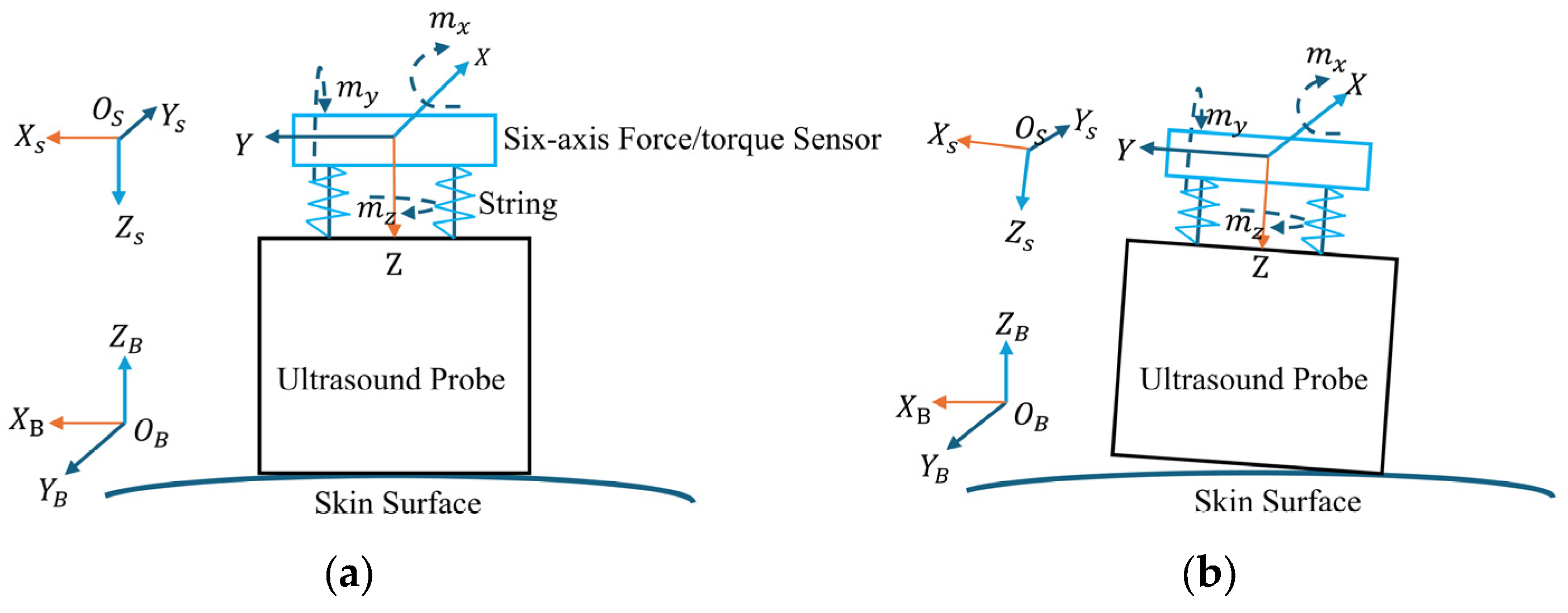
As illustrated in Figure 3, contact between the ultrasonic probe and the skin generates force and torque readings on the six-axis force/torque sensor. Three zero torque components indicate that the probe surface is fully aligned with the skin surface.
Conversely, non-zero torque components indicate non-conformal contact or misalignment between the probe and the skin surface. As described in Section 2.1, the sensor coordinate system O S X S Y S Z S is derived from the base coordinate system O B X B Y B Z B via a sequence of extrinsic rotations: first by α about the Z B -axis, then by β about the Y B -axis, and finally by γ about the X B -axis. As illustrated in Figure 3b, in the case of tilted or non-conformal contact, adjusting the rotation angle γ can restore conformal contact between the probe and the skin surface.
To ensure full contact between the probe and the surface during interaction, this study employs a PID controller [29] that uses torque error as the input and outputs the change in the end-effector orientation. The PID controller was selected because the pose regulation in this study mainly involves small-angle orientation adjustment of the ultrasound probe, and PID control provides a simple, computationally efficient, and reliable solution for real-time implementation. The controller is defined as:
θ ( t ) = K p e ( t ) + K i 0 t e ( τ ) d τ + K d d e ( t ) d t
e ( t ) = m t a r g e t m a c t u a l
where θ ( t ) denotes the change in end-effector orientation, K p , K i   and K d are the proportional, integral, and derivative gains, and e ( t ) is the torque error.
The selection of the initial PID parameters directly affects the transient response, steady-state accuracy, and safety of the probe–surface contact. Therefore, the initial parameters were determined using the Ziegler–Nichols ultimate gain method [30] as a reference, followed by empirical refinement in phantom experiments. During the initial tuning process, the integral and derivative gains were first set to zero, and the proportional gain was gradually increased until sustained torque oscillation occurred. The corresponding ultimate gain and oscillation period were identified as K c r = 22 and T c r = 0.8 s, respectively. According to the Ziegler–Nichols rule, the proportional gain was initially estimated as K p = 0.6 × K c r = 13.2 . Considering the compliant contact between the ultrasonic probe and the skin surface, K p was conservatively reduced to 12 to avoid excessive orientation adjustment and overshoot.
The integral and derivative gains were then refined experimentally. The integral gain was selected to reduce the steady-state torque error, but it was kept at a relatively small value to avoid excessive accumulated correction during continuous contact. The derivative gain was introduced to damp contact-induced oscillations and improve transient stability. Based on repeated phantom experiments under the constraint of stable and safe probe–surface contact, the final initial PID parameters were set as K p = 12 , K i = 5 and K d = 1.5 . These parameters were used as the initial values for the subsequent end-effector pose control experiments.
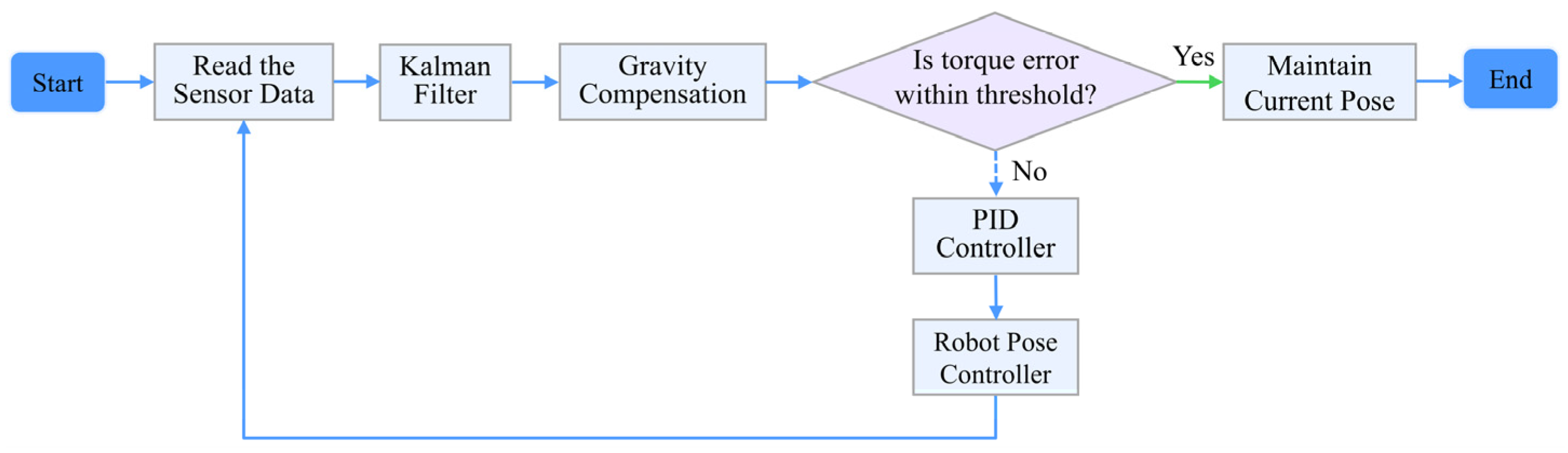
Figure 4 illustrates the flowchart of the ultrasonic probe pose control algorithm. First, the force/torque sensor data are acquired and processed using a Kalman filter to reduce random measurement noise [31]. Gravity compensation is then performed to eliminate the influence of the sensor and ultrasound probe weight on the measured torque. After compensation, the torque error is calculated by comparing the corrected torque with the desired torque. If the torque error is within the predefined threshold, the robot maintains the current probe pose. Otherwise, the torque error is sent to the PID controller, which calculates the corrective adjustment of the end-effector orientation. The robot pose controller then updates the probe pose accordingly, and the sensor data are acquired again to form a closed-loop pose adjustment process until stable probe–surface contact is achieved.

2.3. Robot End-Effector Contact Force Control

In robot–environment interaction, the admittance model converts the contact force error into a corresponding motion adjustment of the robot end-effector. In the proposed system, the raw force/torque signal F measured by the six-axis force/torque sensor is first processed using a Kalman filter to suppress random measurement noise. The filtered signal is then subjected to gravity compensation to remove the influence of the sensor and ultrasound probe weight, thereby obtaining the actual probe–skin contact force F e . For a single-degree-of-freedom system, the admittance relationship [32] can be written as:
M ( x ¨ c x ¨ r ) + B ( x c ˙ x r ˙ ) + K ( x c x r ) = F e F d
where x c , x c ˙ , x c ¨ are the current position, velocity, and acceleration of the robot end-effector in the Cartesian frame, respectively. x r , x r ˙ , x r ¨ are the reference (desired) position, velocity, and acceleration, respectively. K , B , and M   denote the target stiffness, damping, and inertia (scalars or matrices, depending on implementation) that characterize the rigid-body dynamics. F e denotes the actual probe–skin contact force after Kalman filtering and gravity compensation, and F d denotes the desired contact force.
The contact force error is defined as:
F = F e F d
This paper proposes a variable admittance control strategy based on a fuzzy neural network (FNN) to effectively stabilize the force interaction between the robot and infant skin. As illustrated in Figure 5, the FNN receives the contact force error F and its rate of change F ˙ as inputs, and outputs the damping coefficient B via fuzzy inference, thereby enabling real-time adaptation of the admittance model.

2.3.1. Fuzzy Set Definition

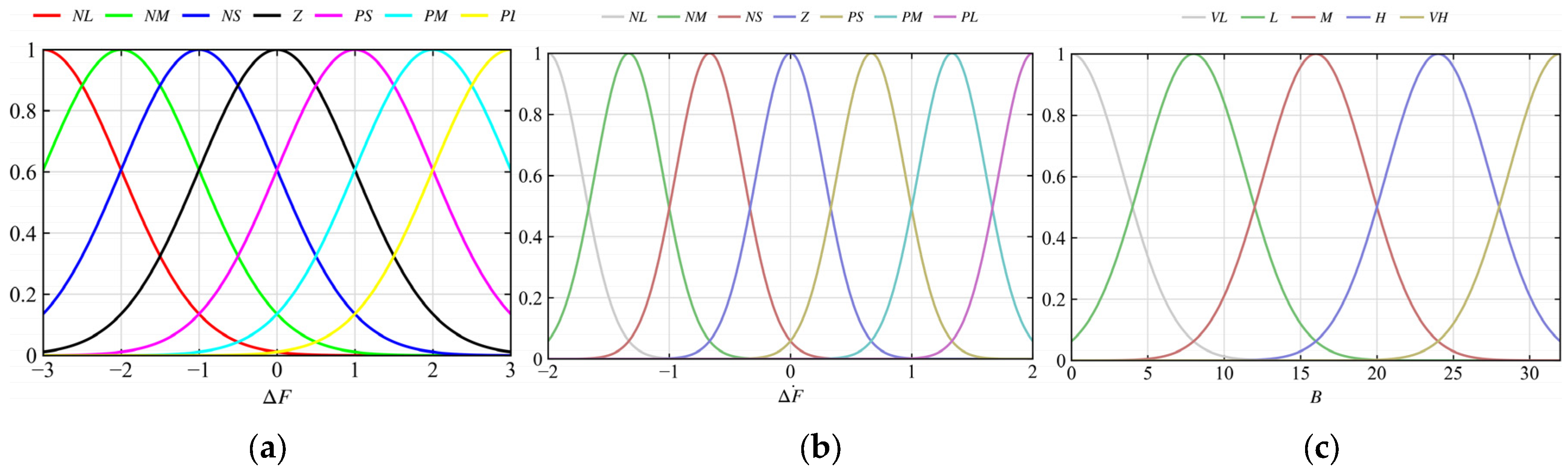
Based on fuzzy set theory and fuzzy control method [33], the input variables defined in this study are the contact force error F and its rate of change F ˙ and the output variable is the damping coefficient B . Fuzzy subsets for these variables are defined as:
F , F ˙ = { N L , N M , N S , Z , P S , P M , P L } , B = { V L , L , M , H , V H }
Among them, N L , N M , N S , Z , P S , P M , and P L denote Negative Large, Negative Medium, Negative Small, Zero, Positive Small, Positive Medium, and Positive Large, respectively. For the output variable, V L , L , M , H , and V H denote Very Low, Low, Medium, High, and Very High damping levels, respectively. Lower damping levels allow faster and more compliant position adjustment, whereas higher damping levels suppress abrupt motion and excessive position correction, thereby improving contact stability. Specifically, V L and L correspond to low damping levels with higher compliance, M represents a moderate damping level, and H and V H correspond to high damping levels with stronger suppression of oscillations.
To ensure the stability of the system, it is necessary to determine the applicable range of the damping coefficient B . In the admittance control model, B denotes the damping coefficient, while F represents the force error between the actual contact force and the target contact force. Defining e = x c x r as the position error between the current and reference end-effector positions, and using Δ F = F e F d as the contact force error, the admittance control model can be expressed in the following error form:
M e ¨ + B e ˙ + K e = F
The Laplace transform of Equation (21) (assuming zero initial conditions) yields:
( M s 2 + B s + K ) X ( s ) = F ( s )
Thus, the system transfer function is:
G ( s ) = X ( s ) F ( s ) = 1 M s 2 + B s + K
For the second-order admittance system M s 2 + B s + K = 0 , the root of its characteristic equation determines the stability of the system. According to Routh’s stability criterion [34], the necessary conditions for the stability of the second-order system are M > 0 , K > 0 and B > 0 . From the point of view of the roots of the characteristic equation, the roots of the equation M s 2 + B s + K = 0 are:
s = B ± B 2 4 M K 2 M
To ensure the stability of the system, the roots of the characteristic equation must have a negative fundamental part; that is, when B 2 4 M K 0 , combined with the necessary conditions of the Routh stability criterion, the range of the damping coefficient B can be obtained as 0 < B 2 M K . The input range is F [ 3 N , 3 N ] , F ˙ [ 2 N / s , + 2 N / s ] , and the output range is set to B [ 0 , 35.36 ] . The detailed basis for selecting these parameter ranges is further explained in Section 2.3.3. The normalized membership functions of each variable are shown in Figure 6.
Based on the current state of contact force changes during the ultrasound screening of infant hip joints, the following fuzzy rules have been formulated, with the specific rules detailed in Table 1.
(1) If Δ F = N L (large negative error) and Δ F ˙ = N L (large negative rate), then B = V H . In this case, the force error is large in the negative direction and continues to diverge rapidly. A very high damping coefficient is assigned to suppress abrupt position correction, reduce oscillatory behavior, and improve force tracking stability.
(2) If Δ F = Z and Δ F ˙ = Z , then B = M . In this case, the force error is negligible and stable. A medium damping coefficient is assigned to maintain smooth force regulation without inducing unnecessary oscillations.
(3) If Δ F = P L (large positive error) and Δ F ˙ = P L   (large positive rate), then B = V H . In this case, the force error is large in the positive direction and continues to increase. A very high damping coefficient is assigned to suppress further divergence of the force error and improve contact stability.
(4) If Δ F = N S (small negative error) and Δ F ˙ = P S   (small positive rate), then B = L . In this case, the force error is slightly negative but is moving toward the desired value. A low damping coefficient is selected to allow smooth adaptation while avoiding excessive resistance.
(5) If Δ F = P M (medium positive error) and Δ F ˙ = N M   (medium negative rate), then B = L . In this case, the force error is positive but decreasing toward the desired value. A low damping coefficient is selected because the error is already being corrected, which helps maintain compliance and avoid excessive rigidity during probe–skin interaction.

2.3.2. FNN Structure

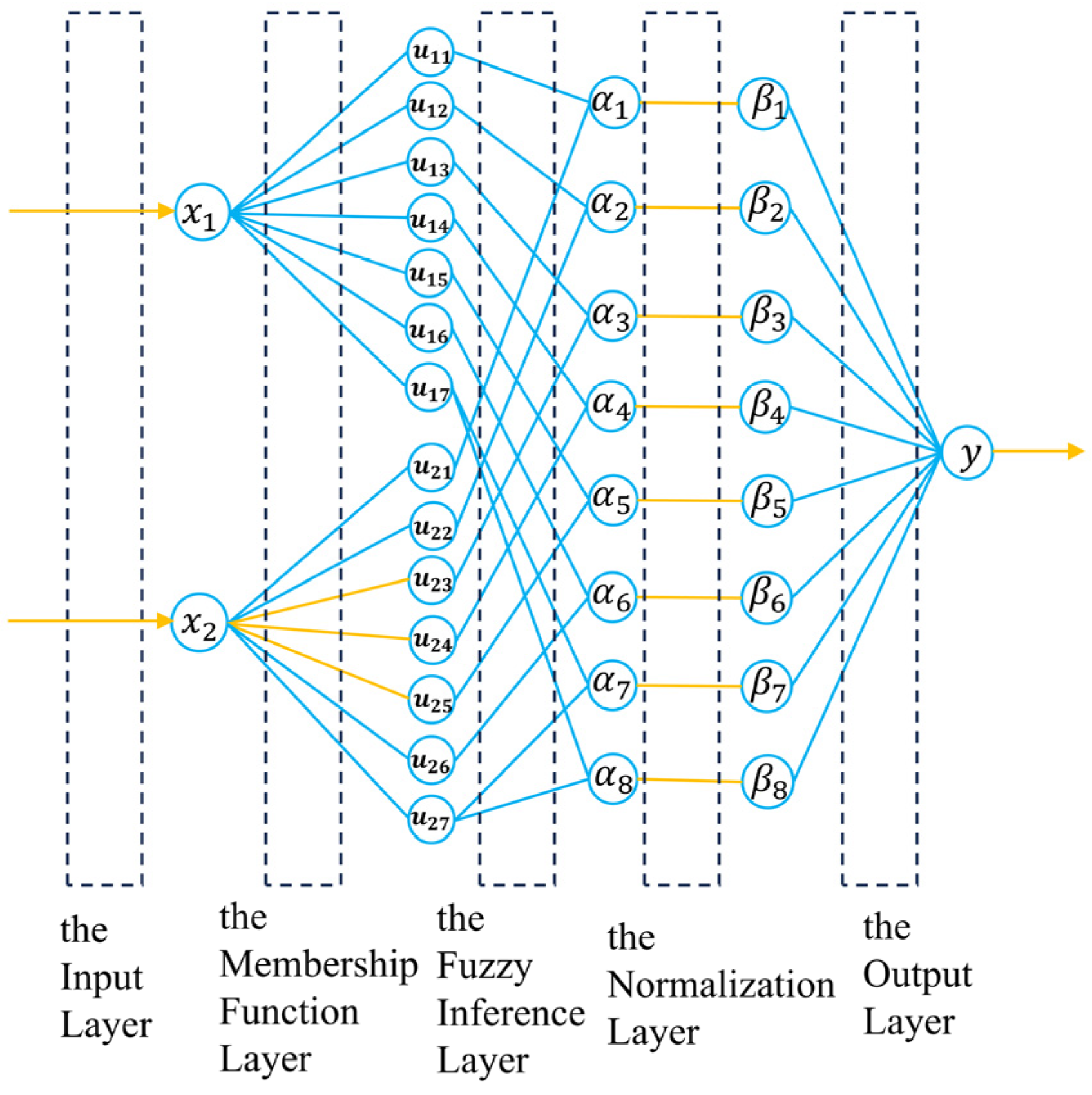
Following the adaptive neuro-fuzzy inference framework [35], a fuzzy BP neural network with two inputs and one output is designed in this study. The network comprises five layers: the input layer, the membership (fuzzification) layer, the fuzzy inference layer, the normalization layer, and the output layer. Its architecture is illustrated in Figure 7.
The first layer is the input layer. Each node in the input layer corresponds directly to one component x i ( i = 1,2 ) of the input vector. The input vector is defined as:
x = [ x 1 , x 2 ] T
Which represents the contact force error and its rate of change, respectively. These values are passed to the next layer. The number of nodes in this layer is N 1 = n . Where n is the input dimension.
The second layer is the membership function layer (fuzzification layer). Each input component x i is associated with m i nodes, where m i is the number of fuzzy sets (linguistic labels) for that component. Node j in layer 2 computes the degree of membership u i j of x i in the j -th fuzzy set:
u i j = exp [ ( x i c i j ) 2 σ i j 2 ] , i = 1,2 , j = 1 , , m i
where c i j and σ i j are the center and width parameters of the Gaussian membership function. The total number of nodes in this layer is:
N 2 = i = 1 n m i
The third layer is the fuzzy inference layer. Each node here corresponds to one fuzzy rule; its output is the rule’s firing strength. Each node in this layer corresponds to one fuzzy rule defined in the selected fuzzy rule base. Given that Gaussian membership values near the input are higher, a rule’s firing strength reflects the combined degrees of membership:
α j = i = 1 n u i j
where j indexes a particular rule.
The fourth layer is the normalization layer. The firing strengths from layer 3 are normalized so that they sum to 1. The normalization is performed as:
β j = α j i = 1 m α i , j = 1,2 m
where m is the total number of rules.
The fifth layer is the output layer. The network output (here, the damping coefficient B in the admittance model) is computed by defuzzification via a weighted average:
B = j = 1 m β j B j
where B j is the consequent parameter of rule j .

2.3.3. Parameter Setting of FNN

The performance of the FNN in dynamically adjusting contact forces dependent critically on three groups of parameters: membership function parameters, fuzzy rule sets, and network training hyperparameters. These parameters are meticulously designed to balance clinical relevance and mathematical robustness.
The input variables (contact force error Δ F and its rate of change F ˙ ) and the output variable (damping coefficient B ) are modeled using Gaussian-type membership functions, as defined in Equation (24), where c i j and σ i j   represent the center positions and widths of the corresponding fuzzy sets. These parameters are determined via a hybrid approach combining expert knowledge and empirical tuning. Specifically, the ranges of Δ F and Δ F ˙ were jointly determined by safety requirements and experimental observations.
The contact force error Δ F represents the deviation between the actual probe–skin contact force and the desired contact force. Based on preliminary tests conducted on infant phantoms and human forearm subjects, the maximum absolute value of the observed force error did not exceed 3 N. Therefore, the range of Δ F was set to [−3 N, +3 N], which covers the force error variations during the scanning process. In addition, the bounded input range helps avoid abnormal controller outputs caused by excessive transient force errors, thereby improving the safety and comfort of probe–skin interaction.
The rate of change Δ F ˙ reflects the dynamic variation in the contact force error during probe–skin interaction. A large Δ F ˙ may lead to probe vibration or transient overshoot, thereby affecting image stability, whereas an excessively narrow input range may reduce the responsiveness of the controller. To balance responsiveness and stability, the range of Δ F ˙ was determined based on the dynamic response characteristics of the robotic arm and preliminary manual and robotic scanning experiments. During contact transitions, the observed rapid force variations were typically within ± 2   N / s . When this range was exceeded, probe vibration and transient overshoot were more likely to occur. Therefore, the range of Δ F ˙   was set to [ 2   N / s , 2   N / s ] , which was used as the input range of the FNN to maintain smooth probe–skin interaction and reduce the risk of tissue impact.
For Δ F [−3 N, +3 N], the range is equally divided into seven fuzzy subsets (Negative Large [ N L ], Negative Medium [ N M ], Negative Small [ N S ], Zero [ Z ], Positive Small [ P S ], Positive Medium [ P M ], Positive Large [ P L ]) with centers at [−3, −2, −1, 0, 1, 2, 3] and uniform width σ = 0.8 , ensuring sufficient overlap between adjacent subsets for smooth fuzzy inference. Similarly, Δ F ˙ [−2 N/s, +2 N/s] is equally divided into seven subsets with centers at [−2, −1.3, −0.7, 0, 0.7, 1.3, 2] and σ = 0.5 , enhancing sensitivity to rapid error rate variations. The output variable B [ 0 ,   35.36 ] is discretized into five levels, namely Very Low ( V L ], Low ( L ], Medium ( M ], High ( H ], Very High ( V H ], with centers set as 3, 10, 18, 25, and 33, and σ = 4 . It is constrained within the stable range 0 < B 2 M K (where M   = 0.25  kg, K = 1250  N/m) to ensure system stability.
The fuzzy rule table (Table 1) is derived from clinical ultrasound force control expertise, encoding three primary logic principles. First, when both F and F ˙ exhibit large deviations, the damping coefficient B is increased to “Very High” ( V H ) to rapidly suppress errors. Second, as the system approaches equilibrium, B is maintained constant to preserve balance. Finally, initial rules are refined through cross-validation on 2000 clinically collected force samples, ensuring adaptability to typical infant skin contact scenarios.
The network is trained using the BP algorithm with the following architecture: Input layer (2 nodes) → Membership layer (14 nodes, 7 subsets × 2 inputs) → Inference layer (49 nodes, 7 × 7 rule combination) → Normalization layer (49 nodes) → Output layer (1 node). Training is conducted on 2000 clinical samples ( F , F ˙ , B o p t ), where B o p t represents expert-optimized damping coefficients. Hyperparameters include a mean squared error (MSE) loss function, a learning rate η = 0.01 , 1000 iterations, and a convergence threshold ϵ = 0.01 . The final model achieves an MSE of 0.008 with prediction errors below 3% for B , demonstrating high accuracy and generalization performance.

2.4. Performance Evaluation Metrics

To quantitatively evaluate the performance of the proposed contact force control strategy, three commonly used control indicators are adopted, including force fluctuation amplitude, settling time and steady-state error. These metrics reflect the accuracy, responsiveness, and stability of the force control system, respectively.
(1)
Force Fluctuation Amplitude
The force fluctuation amplitude characterizes the stability of the contact force during steady-state operation. It is defined as half of the peak-to-peak variation within the steady-state interval:
A f = F m a x s s F m i n s s 2
where F m a x s s and F m i n s s denote the maximum and minimum contact forces in the steady-state interval, respectively. A smaller A f indicates a more stable contact force.
(2)
Settling Time
The settling time characterizes the dynamic response of the system. It is defined as the time required for the contact force to enter and remain within a specified tolerance band around the desired force:
t s = m i n { t | | F ( t ) F d | δ , t t s
where F ( t ) is the contact force at time t , F d denotes the desired contact force, and δ represents the allowable tolerance band. In this study, δ is set to ±0.1 N, corresponding to 5% of the desired contact force magnitude, to define the settling region.
(3)
Steady-State Error
The steady-state error is used to evaluate the accuracy of force tracking. It is defined as the difference between the average contact force in the steady-state interval and the desired force:
e s s = F ¯ s s F d
where F ¯ s s denotes the mean value of the contact force in the steady-state interval, and F d is the desired contact force. This definition preserves the sign of the error to indicate whether the applied force is higher or lower than the target value.

3. Experimental Platforms

3.1. Experimental Platform Architecture

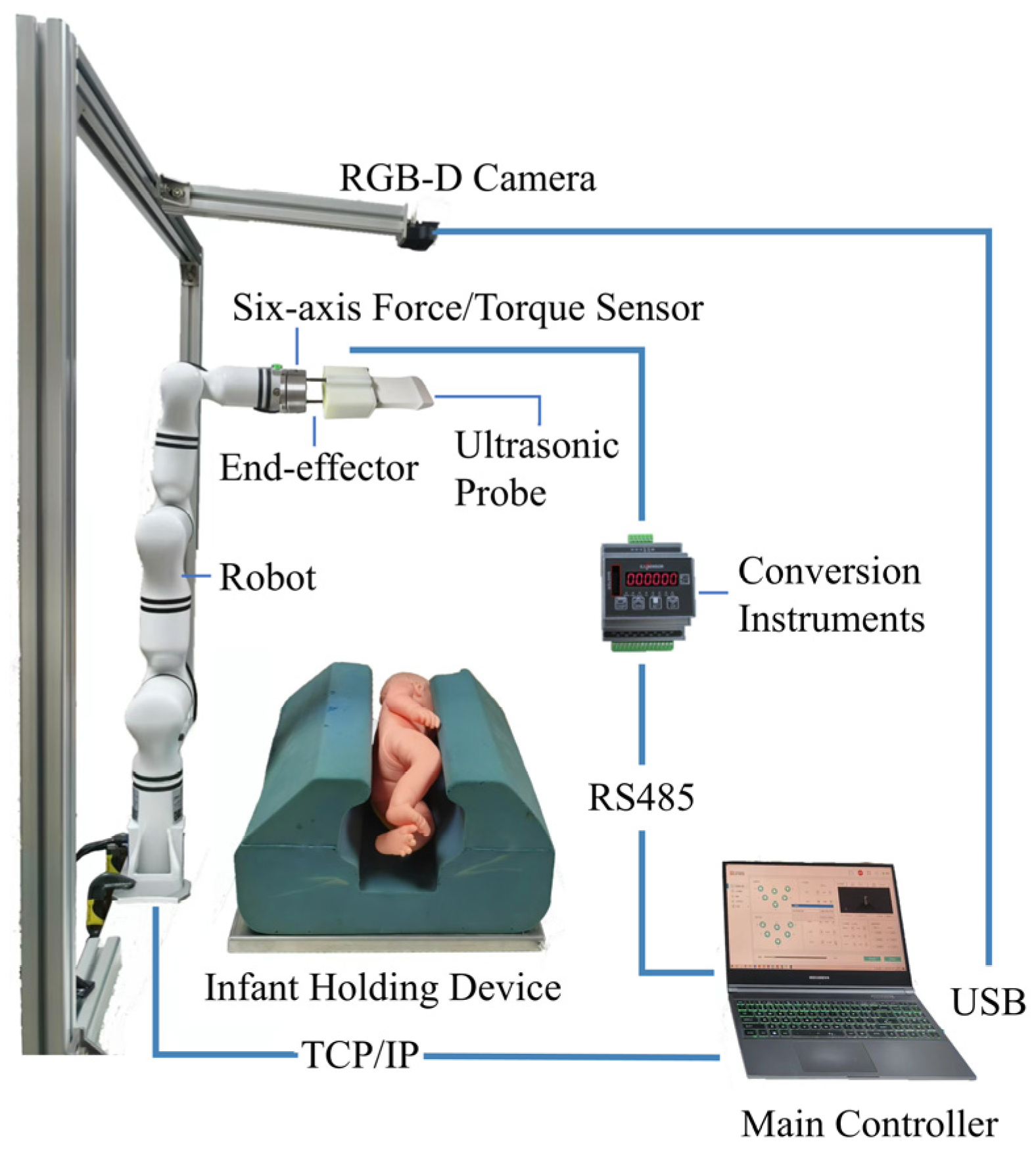
To verify the feasibility and effectiveness of the proposed control method, this study designed and built a comprehensive experimental platform for the infant hip robot, as shown in Figure 8. The experimental platform consists of a six-degree-of-freedom robot, a six-axis force/torque sensor, an RGB-D camera, a commercial handheld ultrasonic probe, an infant positioner, a main controller, and a contact force buffer tool, which provides a high-precision experimental environment for the ultrasound screening of infant hip joints.
The driving component of the experimental platform is the six-degree-of-freedom robot (model RM65-B), which has two modes of trajectory planning and CANFD transparent transmission control. The minimum control period of the transparent transmission control mode is 10 ms, which can realize high-precision real-time motion control. The robot is equipped with an emergency stop device, which can be manually cut off by the guardian or doctor in an emergency to ensure the safety of the inspection process.
The force/torque sensor used in this study is the XJC-6F-D40-H18-A-20N-1N·m six-axis force/torque sensor (Xinjingcheng Sensor Technology Co., Ltd., Shenzhen, China), which can measure the force and torque components along the X , Y , and Z   axes in real time. The measurement ranges are 20 N for F x , F y , and F z , and 1 N·m for M x , M y , and M z . The nonlinearity and hysteresis errors are both within ±0.5% F.S., and the repeatability is within ±0.05% F.S. The sensor has a safe overload capacity of 200% F.S. and a crosstalk error of 3% F.S. The sensor supports a maximum sampling frequency of 100 Hz for real-time force/torque data acquisition. The RGB-D camera adopts a Gemini Pro binocular RGB-D camera with a working range of 0.25 to 2.5 m and an accuracy of ± 5 mm in the range of 1 m. The camera can obtain color images and depth images at the same time, which are used to identify the detection site and calculate the distance between the camera and the detection center point. The commercial handheld ultrasonic probe (D8c, Qiyou Medical, Foshan, China) is mounted on the robot end-effector. The device connects to the main controller via WiFi. B-mode ultrasound images can be acquired through a dedicated ultrasound application during robotic scanning, with an ultrasonic frequency range of 6–11 MHz.
The infant restraint device is consistent with the hip ultrasound device commonly used in hospitals to stabilize the position of the infants. The infant model approximates the size of a typical infant and is fabricated from plastic materials, featuring a skin-mimicking surface with moderate elasticity. The self-made tool is connected to the six-axis force/torque sensor and the ultrasonic probe through a spring guide rod, which can effectively buffer the instantaneous impact that may occur during the movement of the robot and reduce the system instability caused by changes in contact force. The main controller is a computer equipped with Intel®Core™i7-10750H CPU, clocked at 2.60 GHz. The control algorithm is developed using the PyCharm Community Edition 2024.2.4 development platform (JetBrains, Prague, Czech Republic), and the Anaconda virtual environment is used for module management and code operation to ensure system stability and efficiency.
Figure 8 shows that communication between components uses multiple protocols to achieve efficient data transmission. The data exchange between the robot and the main controller is realized through the TCP/IP protocol to ensure the real-time and reliability of the control commands. The force/torque sensor communicates with the main controller via the RS485 protocol to ensure the stability of high-frequency data acquisition. Meanwhile, the RGB-D camera is connected to the main controller via a USB interface to realize real-time visual data transmission and provide auxiliary information support for contact force control.
Importantly, the proposed platform was further evaluated beyond laboratory experiments. In addition to tests on an infant phantom and human skin, preliminary ultrasound scanning experiments on infants were conducted to assess the feasibility of force control, contact safety, and imaging stability under DDH screening conditions.

3.2. The Contact Force Buffer Tool

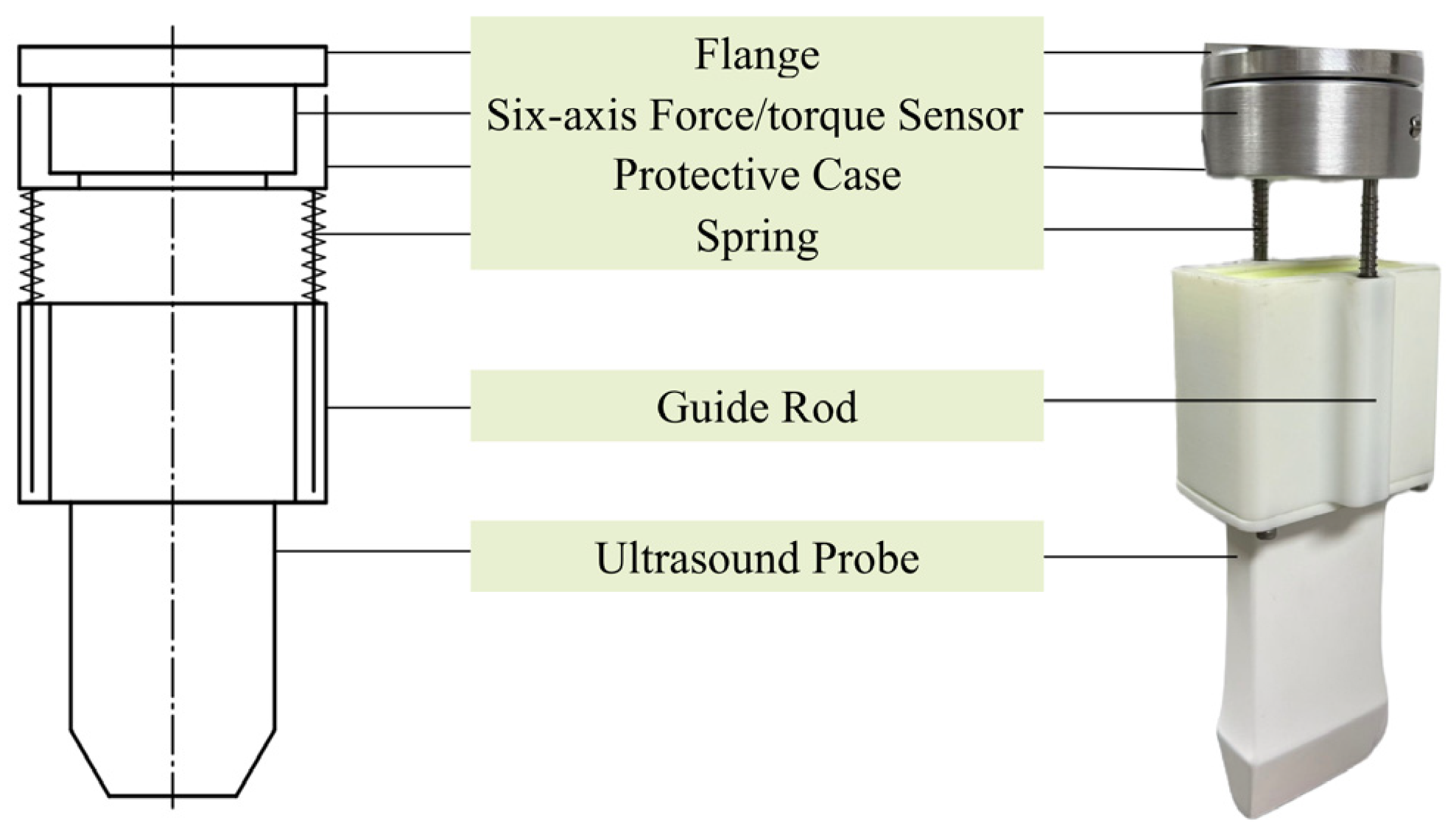
To address the force control requirements and enhance contact flexibility during ultrasound screening, a robotic end-effector was developed in this study, as depicted in Figure 9. The left panel of the figure presents a sectional view of the end-effector’s internal structure, while the right panel shows a photograph of the end-effector to illustrate its appearance.
The force/torque sensor is mounted at the robot end-effector through a flange. A cylindrical guide rail is installed on the protective shell of the sensor to constrain the motion of the ultrasound probe and ensure precise linear displacement during contact. A spring is integrated into the guide structure to buffer the contact force and attenuate instantaneous impacts between the probe and the skin. The main parameters of the spring used in the contact force buffer tool are listed in Table 2.

4. Experiments and Results

4.1. Gravity Compensation Experiment

To accurately obtain the tilt angle of the robot mounting base and the zero offset of the sensor, this experiment collected force/torque sensor data at the end of the robot in three different poses. At each pose, ten consecutive groups of force/torque data were collected and averaged to reduce random measurement noise. The averaged sensor data are shown in Table 3, where α ,   β ,   γ are the rotation angles of the end sensor relative to the robot base coordinate system around the Z ,   Y   and X axes, respectively, and f x , f y , f z ,   m x , m y , m z represent the original data collected by the six-axis force/torque sensor. Subsequently, the center of gravity coordinates ( x , y , z ) and the gravitational value G of the end tool, as well as the zero offset of the six-axis force/torque sensor, are calculated according to the derivation relationship in Section 2.1 and are shown in Table 4.

4.2. Pose Control Experiment

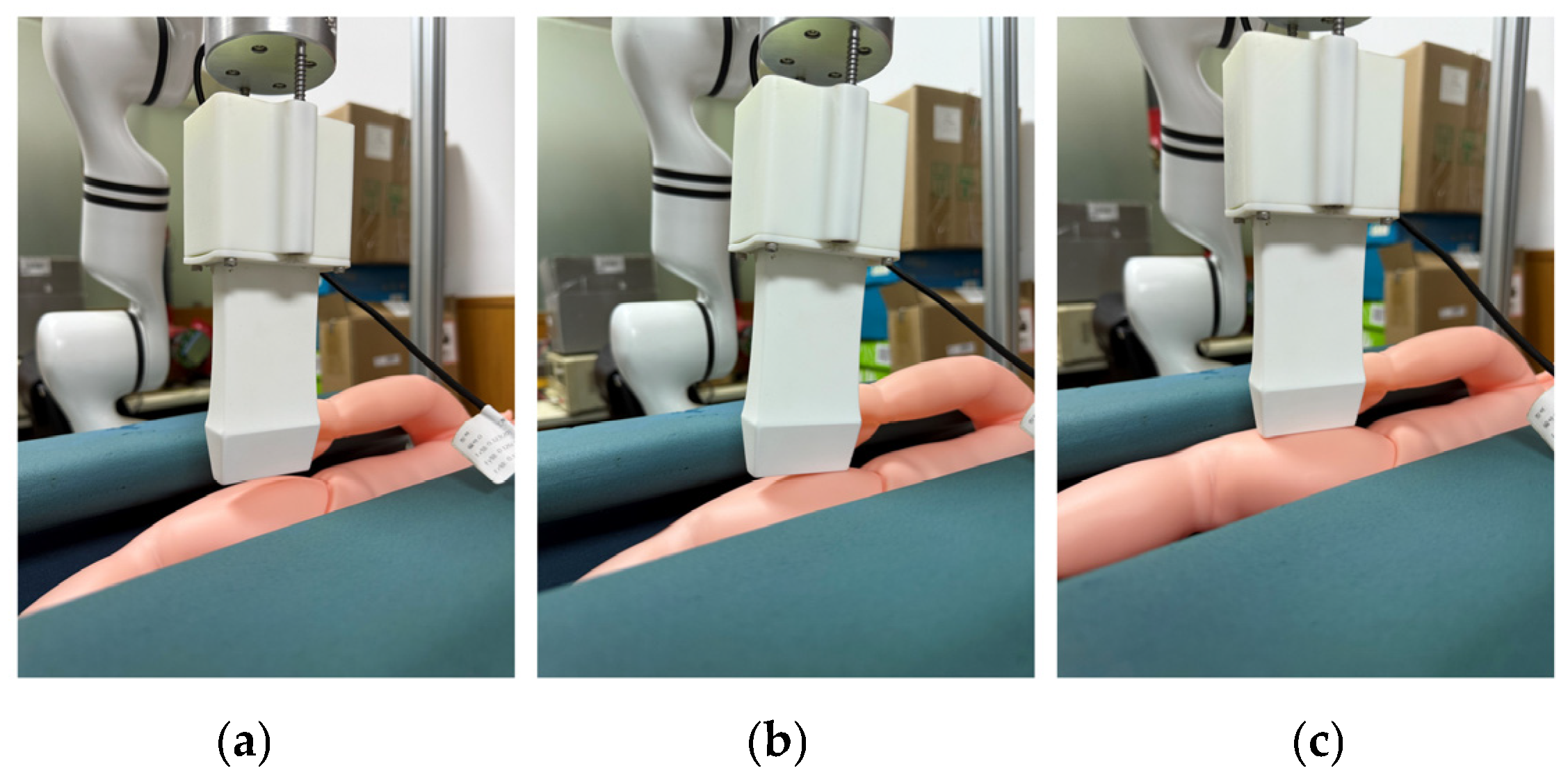
To verify the feasibility of the pose control algorithm, experiments were conducted by adjusting the relative position between the ultrasonic probe and the infant hip phantom. Figure 10a–c show three representative cases: no contact, one-side contact, and full contact. The corresponding torque components measured in these three cases are summarized in Table 5. The results show that the one-side contact generated obvious torque deviations, while the torque components were significantly reduced under the full-contact condition after pose adjustment, indicating that the proposed pose control algorithm can effectively improve the probe–phantom contact posture.
Experimental Procedure: The RGB-D camera is activated, and the hip detection position is recognized by its captured image and converted to the robot base coordinate system according to matrix operation. When the robot reaches the position above the hip detection point, it slowly descends and contacts the infant’s skin. The six-axis force/torque sensor measures the torque, and the pose control method estimates the adjustment required to output the angle between the robot’s end-effector and the skin surface. During the contact of the ultrasonic probe with the skin, the orientation angle of the robot changes in real-time based on the feedback from the sensors.
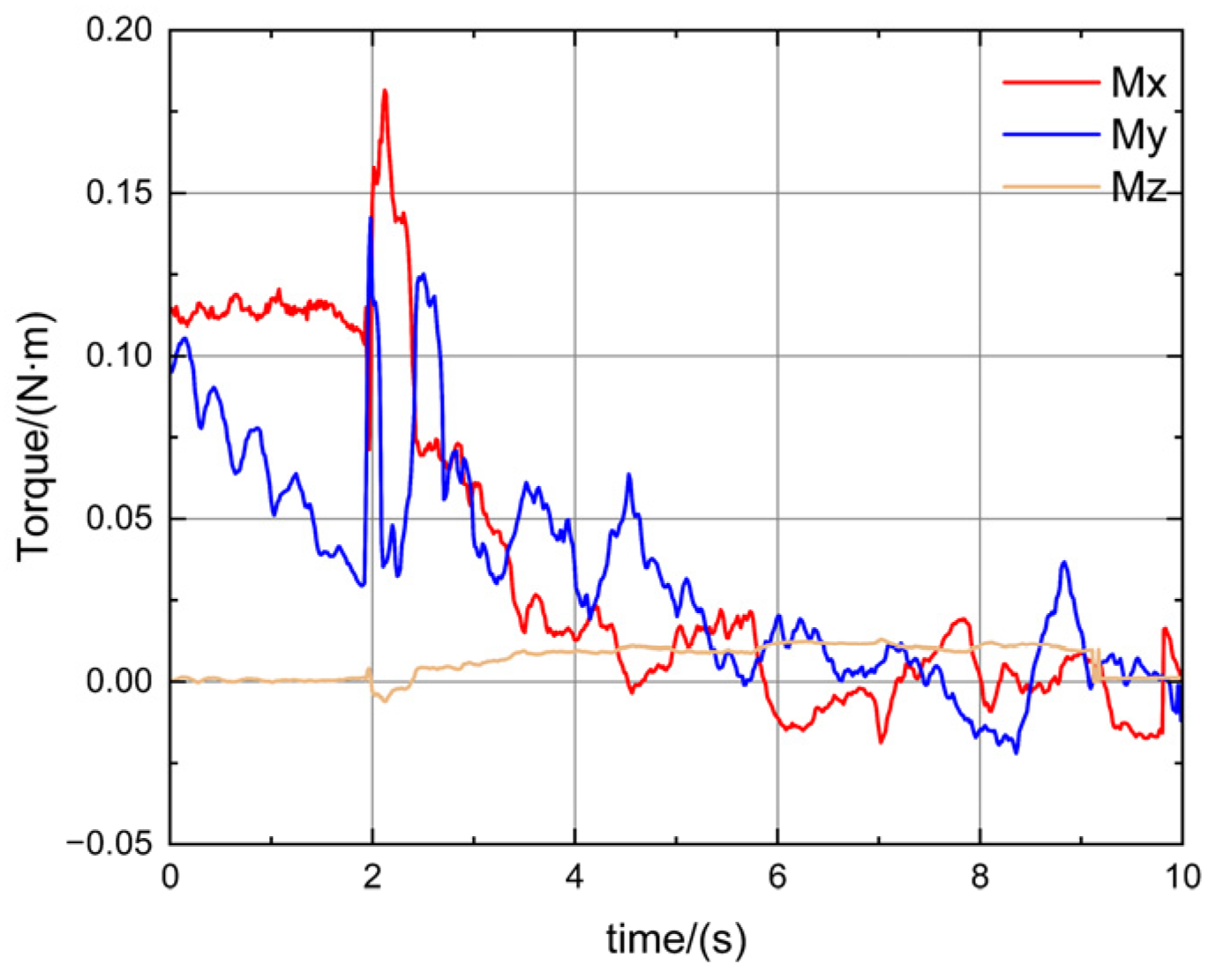
The torques of the process from uneven contact, pose adjustment to close contact are shown in Figure 11. Initially, the magnitude of the torques of M x , M y is around 0.1 N∙m, and after the pose adjustment, the ultrasonic probe is in full contact with the skin and the torques of M x , M y   and M z tended to be zero. The minimum and maximum difference between the M x value and the target torque value (0) are −0.0030 N∙m and 0.1816 N∙m. The minimum and maximum difference between the M y value and the target torque value (0) are 0.0007 N∙m and 0.1204 N∙m. The minimum and maximum difference between the M z value and the target torque value (0) are 0.0003 N∙m and 0.0130 N∙m, respectively.

4.3. Contact Force Control Experiment

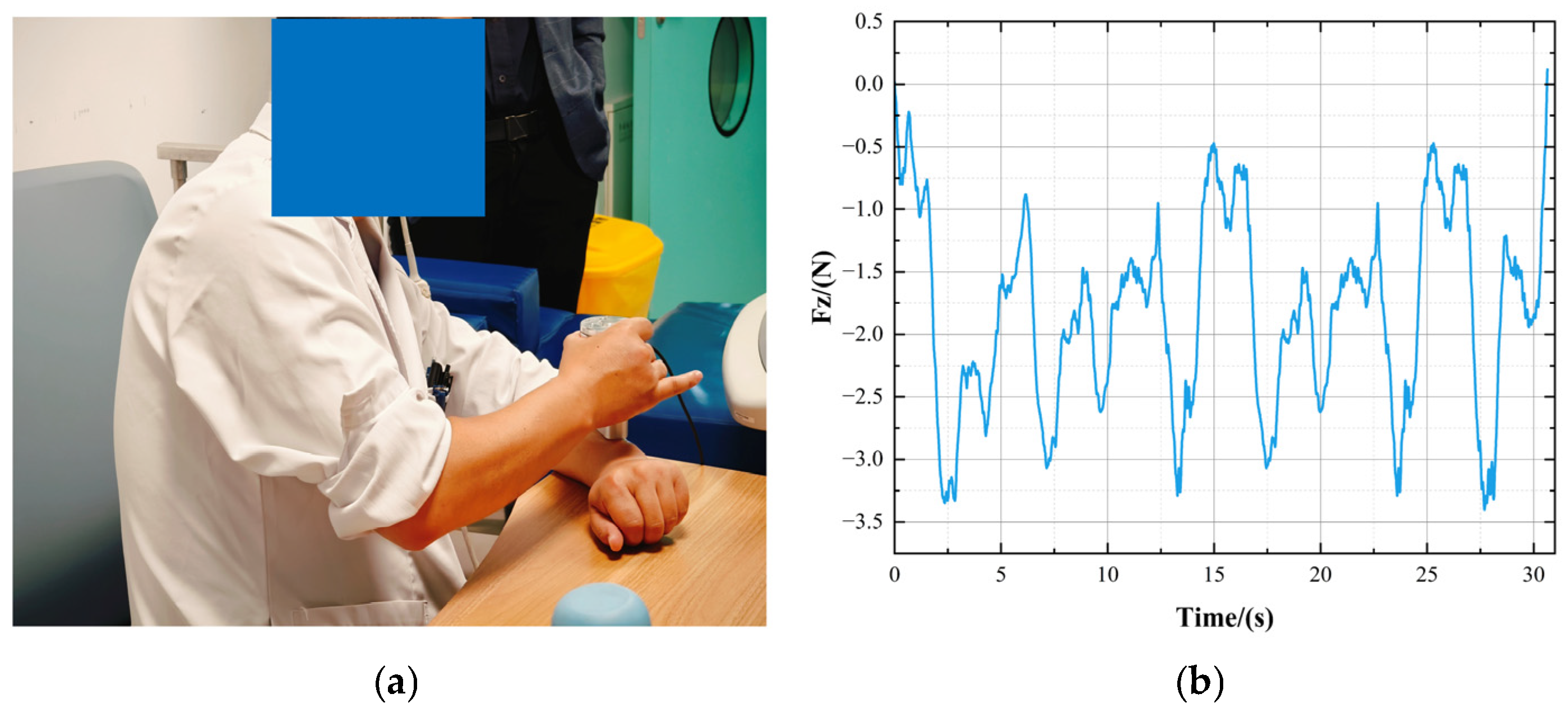
Experiments were first conducted during manual ultrasound scanning by experienced clinicians to investigate the characteristics of contact force in routine clinical practice. As shown in Figure 12a, a trained clinician manually manipulates the robotic end-effector to demonstrate routine hip ultrasound screening procedures. The ultrasound probe, equipped with a six-axis force/torque sensor, maintains continuous contact with the clinician’s skin, enabling real-time force measurement during scanning. Figure 12b shows the Z-axis contact force measured by the XJC-D40 sensor during 30 s of continuous manual scanning. The contact force varies substantially within the range of −0.5 N to −3.5 N, with only brief intervals of stabilization. This result highlights the inherent variability of manual operation, where the applied force is continuously adjusted based on subjective feedback rather than being quantitatively controlled. Such large fluctuations and inconsistent force levels may lead to variations in ultrasound image quality. To address this issue, the relationship between contact force and image quality is further analyzed to determine an optimal force level for stable and high-quality imaging.
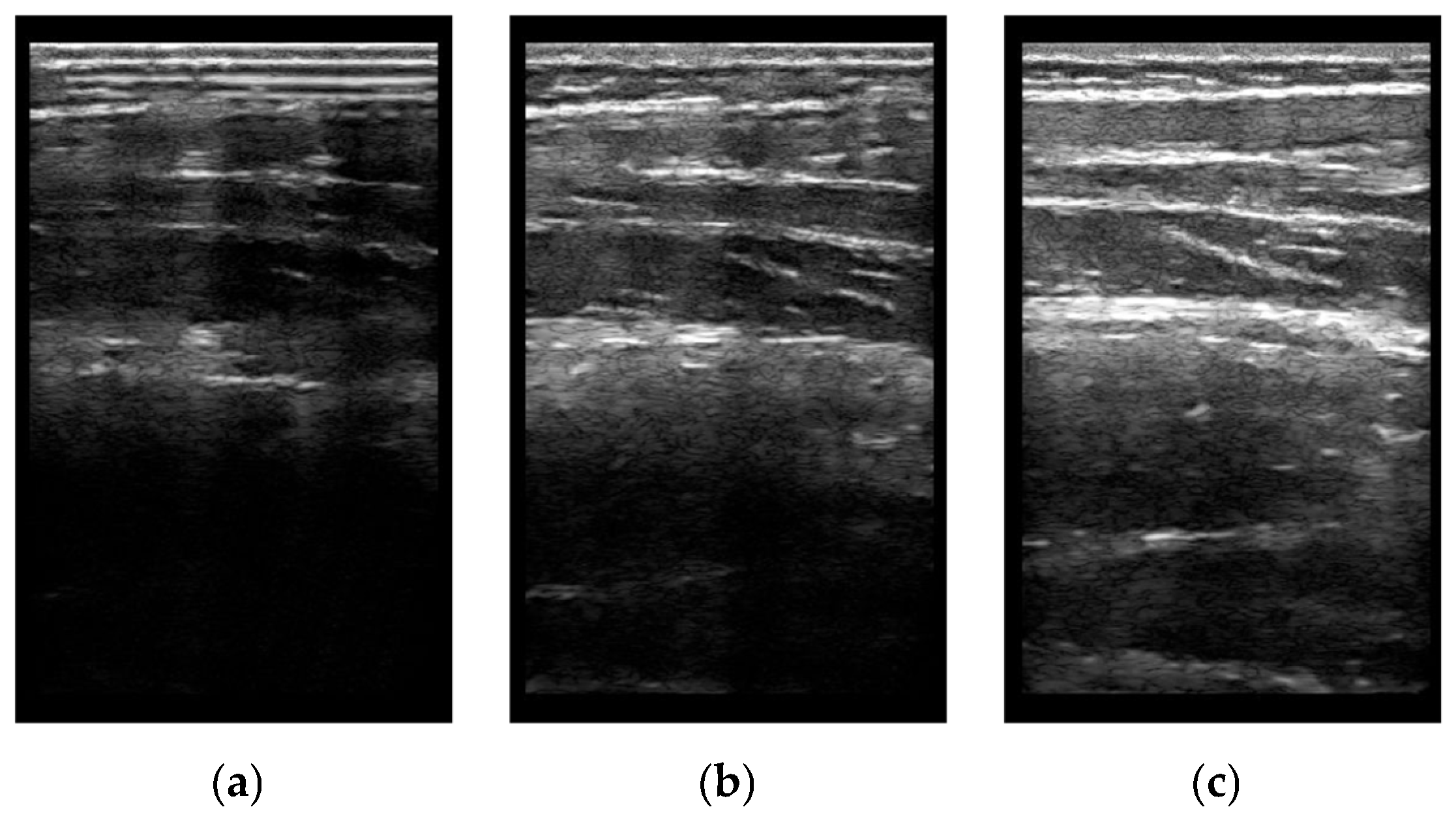
Ultrasound imaging experiments were conducted under different force levels. Figure 13 illustrates the corresponding imaging results. When the contact force was 0 N, the coupling between the probe and the skin was insufficient, resulting in poor image quality. At –1 N, the image clarity improved, but the coupling was still unstable due to incomplete contact. At –2 N, the image showed clear tissue boundaries and uniform brightness with minimal compression. Further increasing the contact force did not lead to noticeable improvement in image quality but instead increased the pressure on the infant’s skin, potentially causing discomfort. Therefore, –2 N was selected as the optimal target force, achieving a balance among acoustic coupling, image quality, and comfort. This force level is subsequently adopted as the reference value in the following force control experiments.
To validate the effectiveness of the proposed algorithm, experiments were conducted on both an infant phantom and human skin. The mechanical stiffness of the subjects was unknown and variable, mimicking real-world clinical scenarios. For the human skin experiments, healthy adult volunteers participated after providing written informed consent. The experiments were conducted in accordance with the approved ethical protocol and relevant ethical guidelines for medical research involving human participants. All experiments were conducted under operator supervision with predefined contact force limits. All experimental images and data were anonymized before publication to protect participant privacy.
The FNN was trained using a dataset of 2000 contact force samples collected from five clinicians during routine infant hip ultrasound screenings (sampling rate: 100 Hz). Each sample includes contact force error ( F ) and its rate of change ( F ˙ ) as inputs, paired with expert-optimized damping coefficients ( B o p t ) as target outputs. The FNN training employed the backpropagation algorithm with the following hyperparameters: learning rate = 0.01, batch size = 32, maximum iterations = 1000, and convergence threshold (MSE) = 0.01. Model convergence was evaluated using mean squared error (MSE) between predicted and target damping values. After 850 iterations, the network achieved an MSE of 0.008, with final weights and thresholds stored for real-time control. This training process ensures the FNN exhibits robust generalization to unseen contact scenarios.
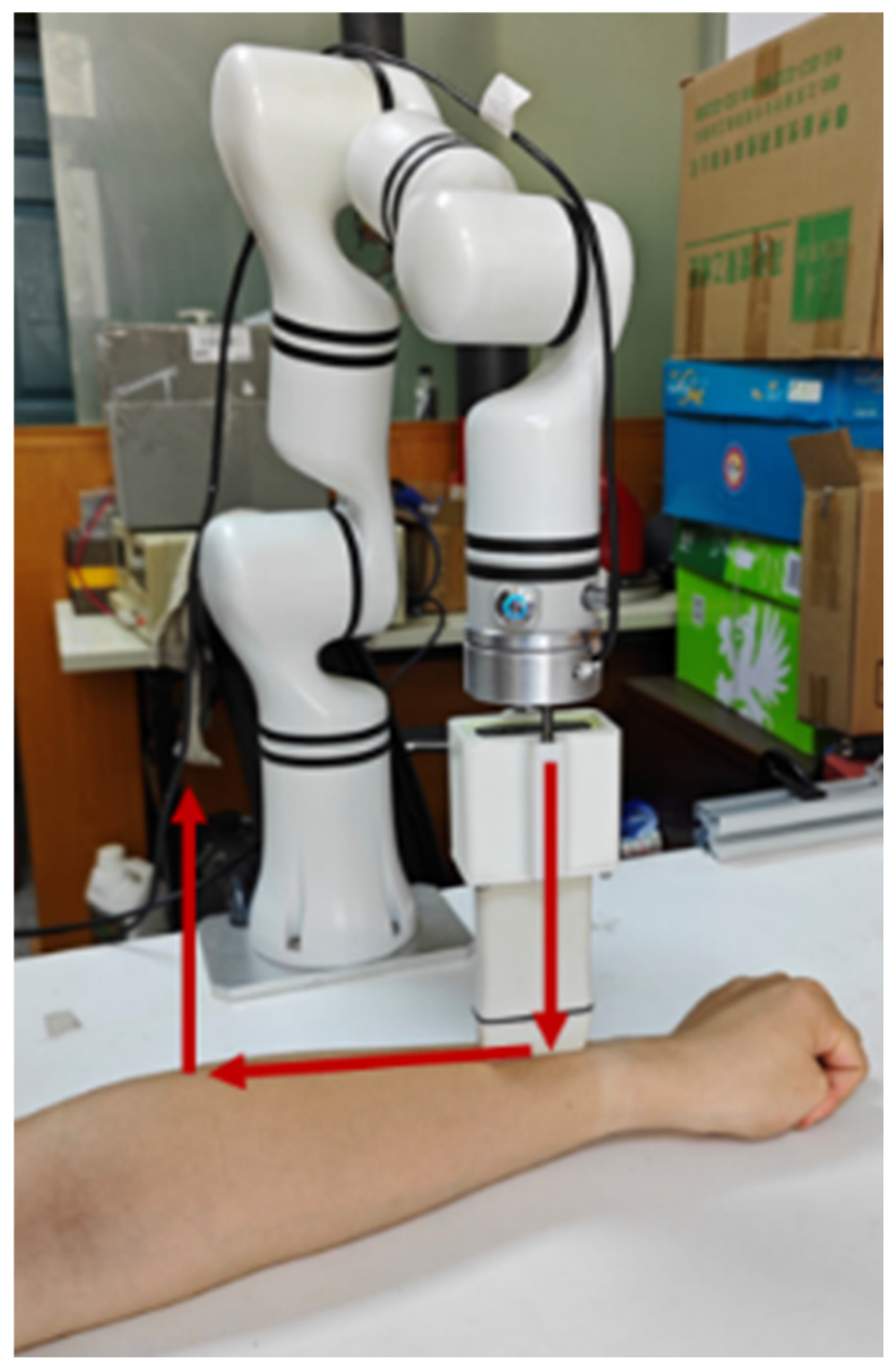
The evaluation process began with a traditional admittance control experiment on the infant phantom to establish baseline performance on a simulated skin surface. The parameters were configured as follows: mass M = 0.25 kg, spring stiffness K = 1250 N/m, and damping coefficient B = 25 N·s/m. The experimental procedure involved positioning the robot above the starting point of the infant hip joint screening, lowering it to establish contact with the skin surface, executing a constant-force scan using the ultrasonic probe, and automatically retracting the probe after completion.
Subsequently, a variable admittance control experiment was conducted on the same phantom, keeping M and K constant while dynamically adjusting B via an FNN. Finally, the same experimental protocols were applied to human skin under both traditional and variable admittance control to assess the robustness of the proposed method in biological tissues. The motion trajectory of the robotic end-effector throughout the experiments is presented in Figure 14.
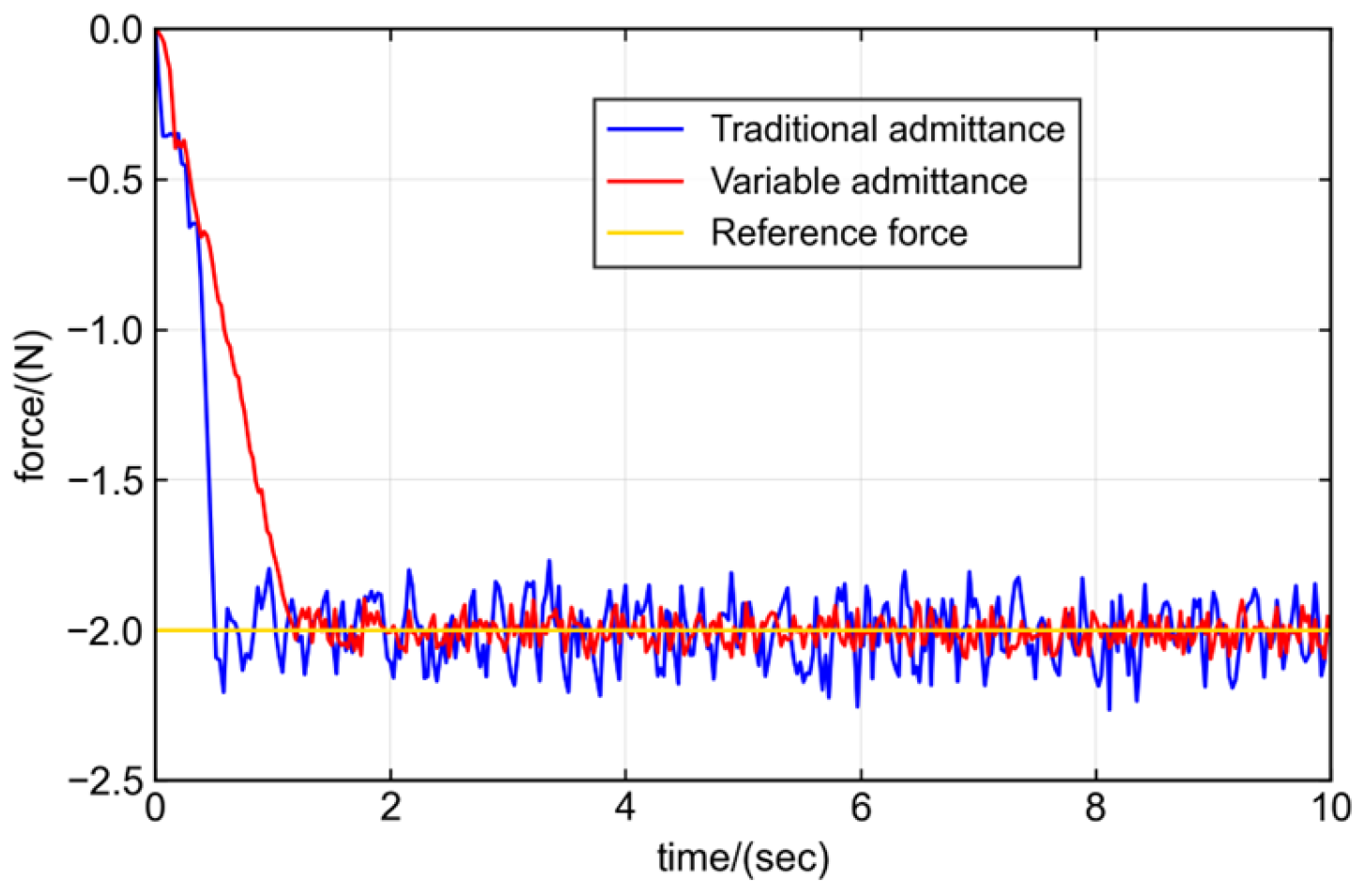
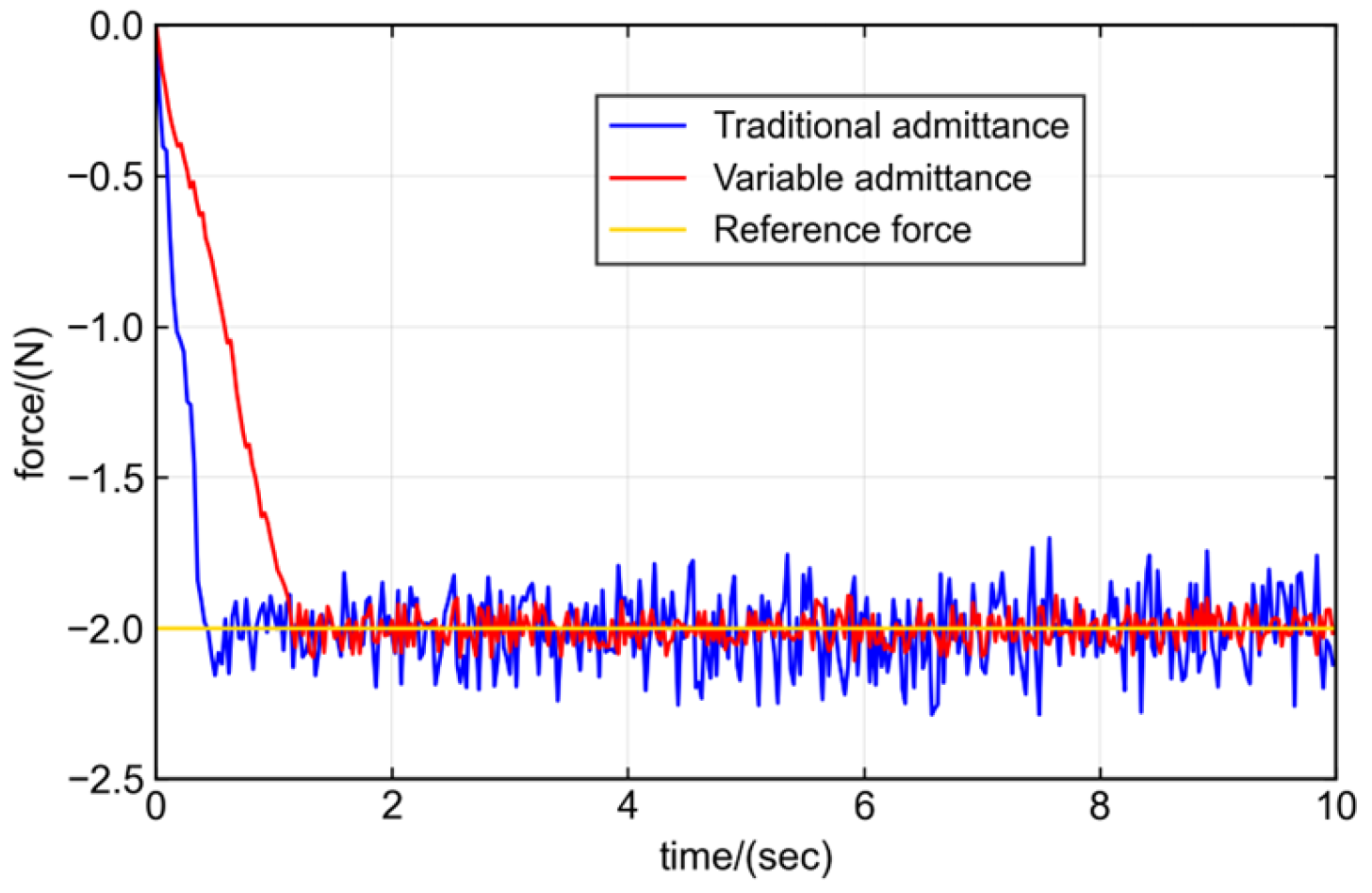
Representative Z-axis contact force tracking curves for the infant phantom and human skin experiments are shown in Figure 15 and Figure 16, respectively. One representative trial is shown in each figure for clarity, while the corresponding quantitative results calculated from all repeated trials are summarized in Table 6 and Table 7. The performance of traditional admittance control and the proposed FNN-based variable admittance control is evaluated in terms of force fluctuation amplitude, settling time, and steady-state force error. For each repeated trial, these metrics were calculated independently from the recorded force response.
In terms of force stability, Figure 15 and Figure 16 show that traditional admittance control exhibits noticeable oscillations around the reference force, whereas the proposed method produces a smoother and more stable response. This observation is consistent with the quantitative results in Table 6 and Table 7. The force fluctuation amplitude was reduced from 0.2880 ± 0.0252 N to 0.0984 ± 0.0012 N in the infant phantom experiment, and from 0.2966 ± 0.0274 N to 0.0976 ± 0.0014 N in the human skin experiment. This reduction indicates that the proposed method can effectively suppress contact force oscillations and maintain more stable probe–surface contact during scanning.
Regarding settling behavior, Figure 15 and Figure 16 show that traditional admittance control approaches the target force more rapidly during the initial transient phase but fails to remain within the specified tolerance band because of persistent oscillations. Therefore, its settling time was recorded as “Not settled” under the defined accuracy requirement. In contrast, the proposed method converges more gradually but maintains the contact force within the tolerance band, achieving settling times of 1.12 ± 0.09 s in the infant phantom experiment and 1.13 ± 0.08 s in the human skin experiment. This behavior can be attributed to the adaptive adjustment of the damping coefficient, which prioritizes stability and steady-state accuracy over transient response speed. Although this results in slower convergence, such a trade-off is acceptable in clinical scenarios where safety and precision are more critical than rapid response.
In terms of steady-state accuracy, the proposed method maintains the contact force closer to the reference value, as shown by the tighter distribution of the response curves around the reference line in Figure 15 and Figure 16. This is quantitatively reflected in Table 6 and Table 7, where the steady-state force error was reduced from 0.0141 ± 0.0021 N to 0.0065 ± 0.0008 N in the infant phantom experiment, and from −0.0185 ± 0.0027 N to −0.0083 ± 0.00011 N in the human skin experiment. This improvement reduces systematic bias and supports more accurate and consistent force regulation during scanning.
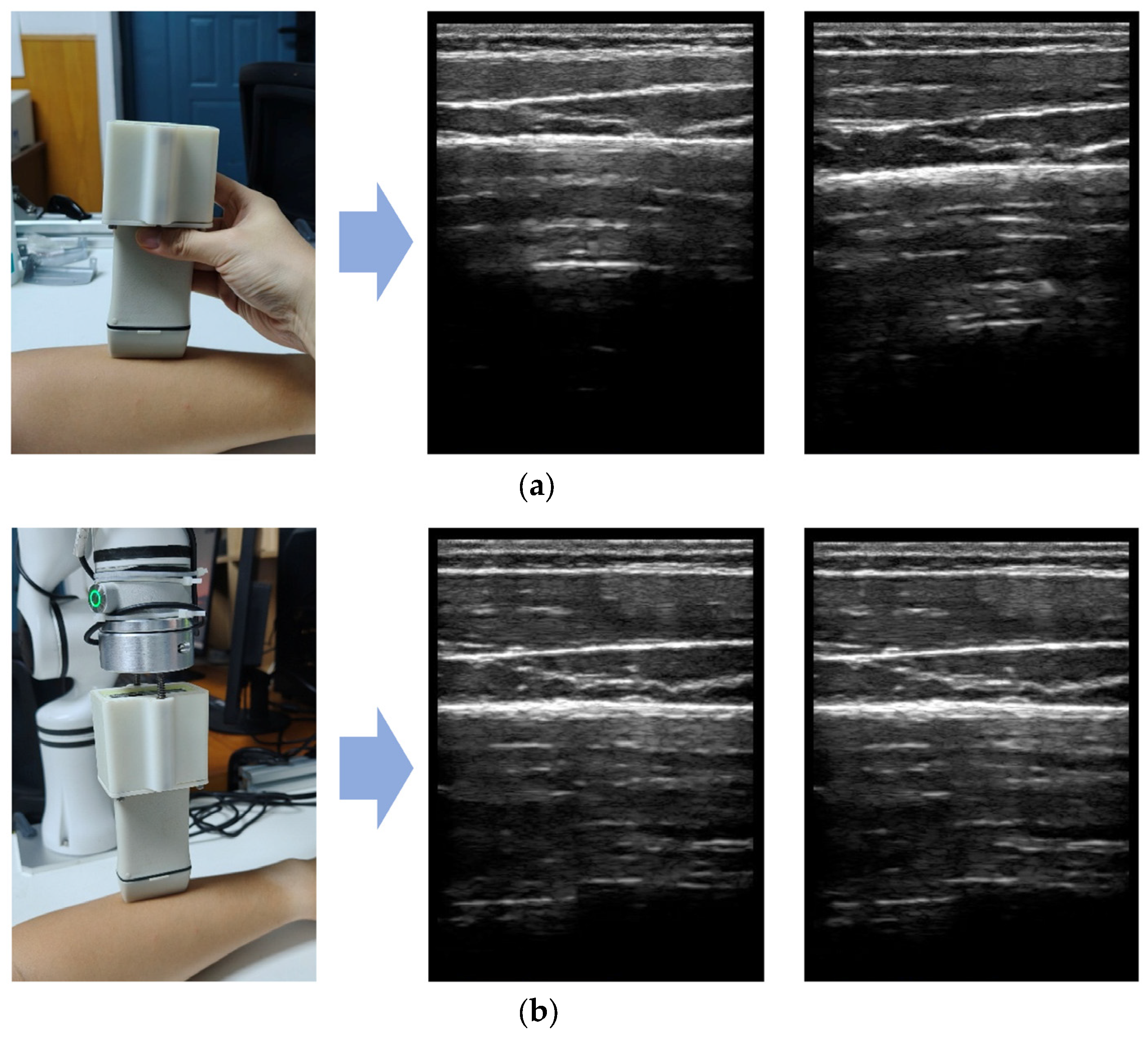
To further validate the practical effectiveness of the proposed method, ultrasound imaging experiments were conducted using an ultrasound probe mounted on the robot end-effector. Ultrasound imaging performed manually and automatically by the robotic system was compared under identical conditions, including ultrasound frequency, imaging depth, and scanning position on a human forearm. As shown in Figure 17, the manually acquired images show noticeable differences at the same location, whereas the robot-acquired images are highly consistent. In addition, the robot system applies very low pressure during scanning, causing almost no visible tissue deformation, whereas manual imaging produces obvious compression of the arm tissue. These results demonstrate that the proposed strategy can achieve reliable imaging performance with improved comfort and safety.

4.4. Infant DDH Ultrasound Experiment

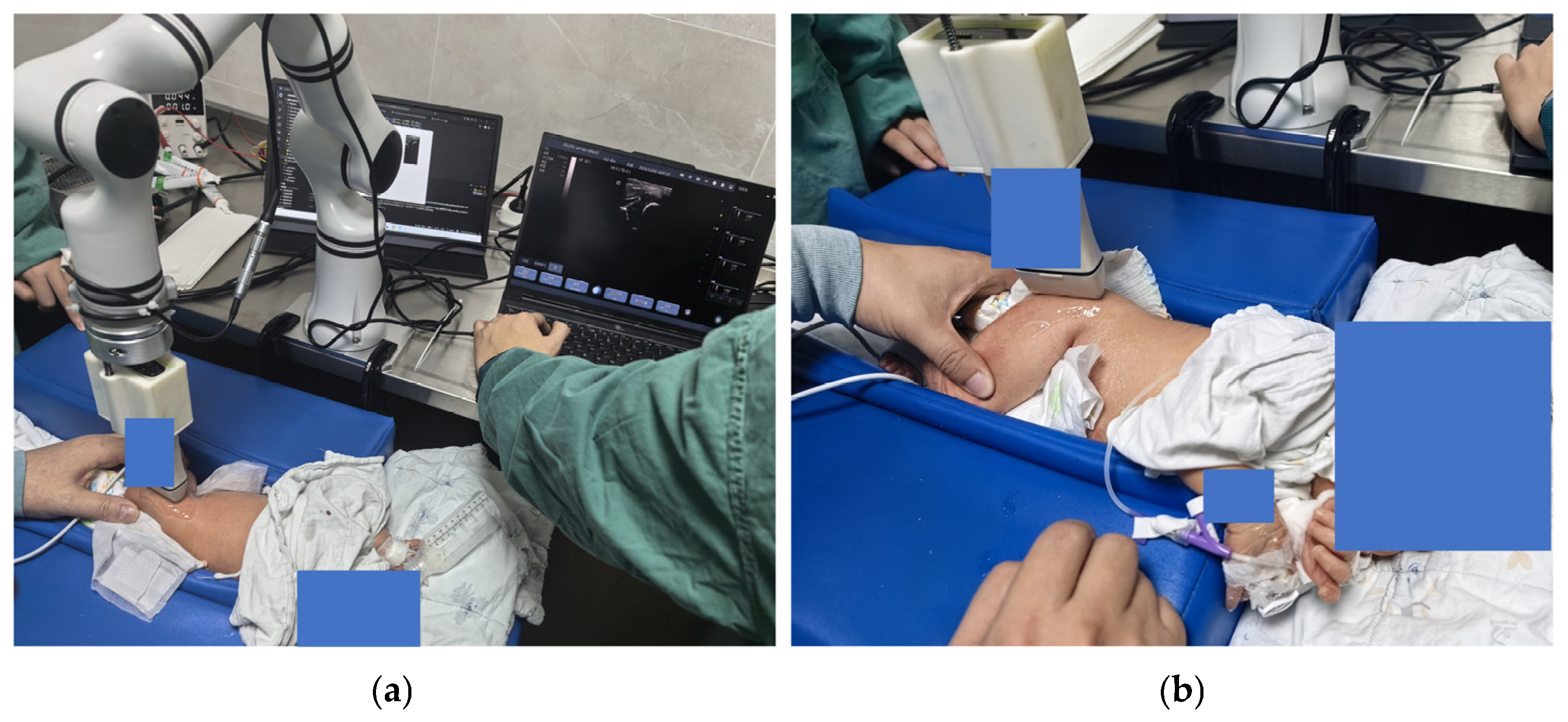
To preliminarily evaluate the feasibility of the proposed robotic force control method in clinical infant hip ultrasound scanning, robotic ultrasound experiments were conducted on four infants under 6 months of age for DDH screening. The experiments were performed under the supervision of experienced clinicians, as shown in Figure 18.
All infant experiments were approved by the Ethics Committee of Yangzhou Maternal and Child Health Care Hospital (Approval No. 2024-021; approval date: 24 May 2024) and were conducted in accordance with the Declaration of Helsinki and relevant ethical guidelines for medical research involving human participants. Written informed consent was obtained from the parents or legal guardians of all infant participants prior to participation. All experimental images and data were anonymized before publication, and identifiable facial features were obscured where necessary to protect participant privacy. The anonymized demographic and clinical information of the enrolled infants, including age, sex, clinical status, and Graf classification, is summarized in Table 8.
The experiments were conducted using the same robotic ultrasound platform described in Section 3. The scanning region was the infant hip joint, following the standard DDH ultrasound screening protocol based on the Graf method. During the experiments, the infants were attended by medical staff to ensure safety and reduce involuntary movements. Meanwhile, the infants were positioned using a clinical fixation device to maintain stability throughout the scanning process. In addition, the robot was operated under predefined contact force limits and emergency-stop protection to ensure safe probe–skin interaction.
After the robot moved to the target hip region, the probe gradually approached the skin under gravity compensation, torque-based pose adjustment, and FNN-based variable admittance control. Once stable probe–skin contact was established, the robot performed the scanning motion while maintaining the desired contact force. During the entire procedure, the contact force measured by the six-axis sensor and the corresponding ultrasound images were recorded synchronously. Data acquisition was performed at a fixed sampling rate of 40 Hz, ensuring continuous, stable, and temporally consistent data collection throughout the experiment.
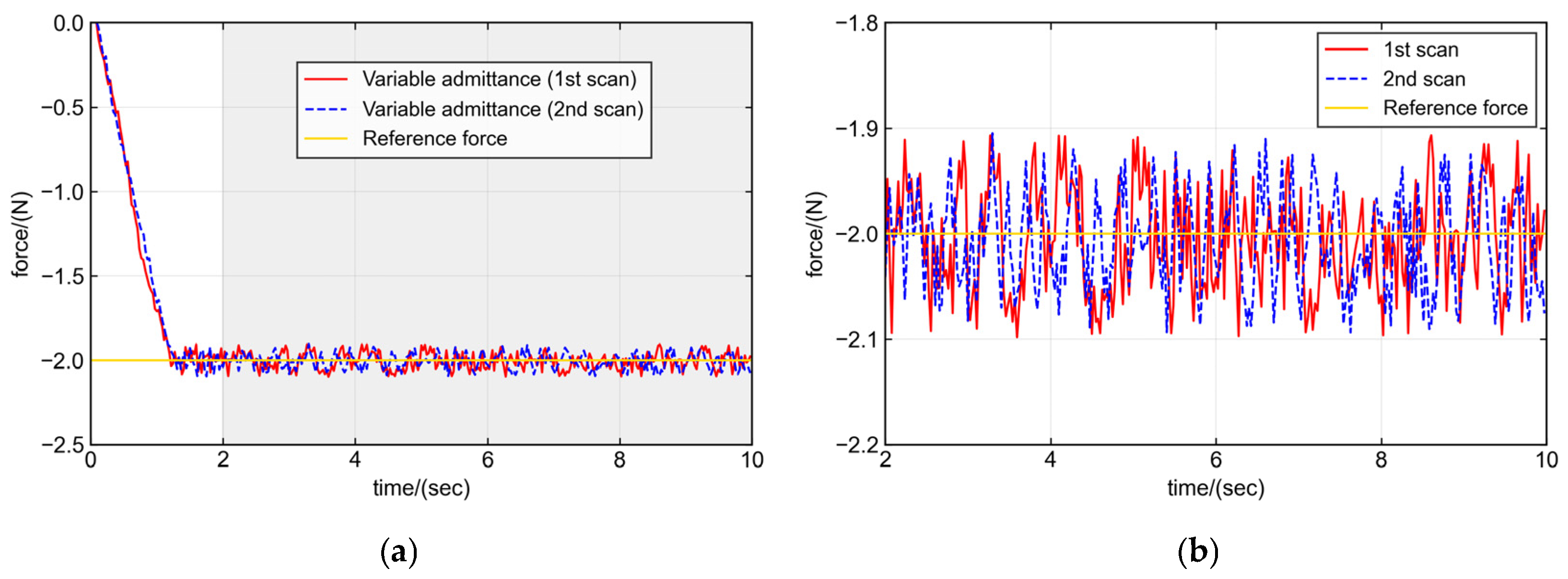
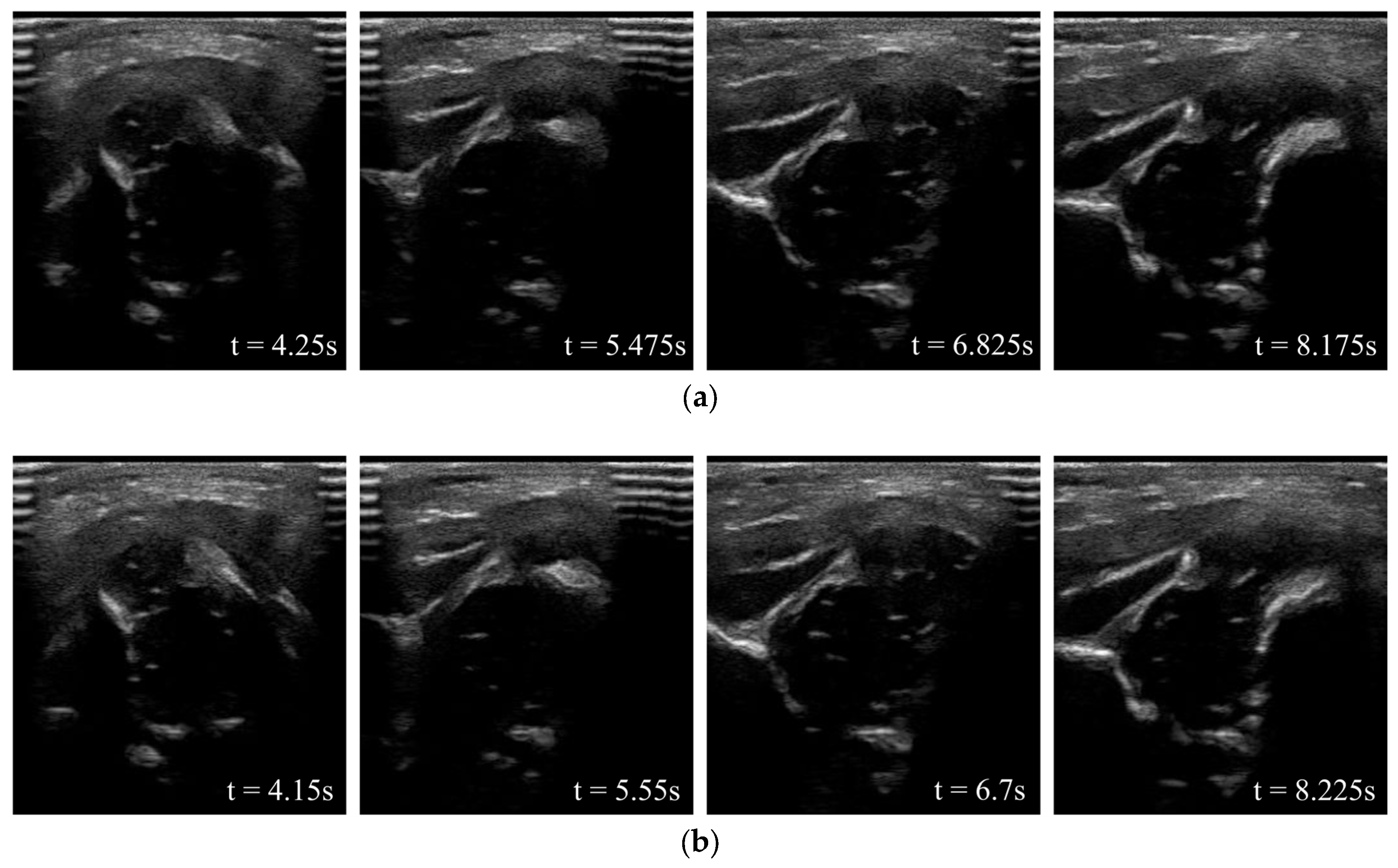
Representative Z-axis contact force tracking curves during the infant scanning process are shown in Figure 19. As illustrated in Figure 19a, both scans exhibit smooth convergence to the desired force level without abrupt variations. The settling time is approximately 1.1–1.2 s for both scans, after which the force enters a stable region around the reference value. The enlarged view of the steady-state region (2–10 s) is presented in Figure 19b. Although the two scans exhibit different fluctuation patterns, both maintain comparable force ranges around the reference value. Specifically, the steady-state force fluctuates within approximately ±0.08–0.10 N, indicating a low fluctuation amplitude and stable contact force regulation. Under such stable force conditions, representative ultrasound images acquired during robotic scanning are shown in Figure 20. All images were selected from the steady-state phase (2–10 s), and the acquisition time of each frame is indicated in the corresponding subfigure. Figure 20a and Figure 20b present the results of the first and repeated scans, respectively. The images clearly present the anatomical structures of the infant hip and exhibit consistent visual quality across repeated scans. Despite being acquired in separate scanning trials, the corresponding anatomical features remain well aligned and clearly delineated, demonstrating good repeatability of the imaging results.
Overall, the infant experiments provide preliminary evidence for the feasibility of the proposed robotic force control method in clinical infant hip ultrasound scanning. In the four enrolled infants, the system was able to establish stable probe–skin contact and maintain the contact force within a relatively small fluctuation range during scans. These results suggest that the proposed method has the potential to support stable robotic ultrasound scanning in infant DDH screening.

5. Discussion

5.1. Interpretation of Findings

This study proposed a contact force control method for a robotic DDH ultrasound system to achieve stable and gentle probe–skin contact during infant hip ultrasound scanning. The experimental results in Section 4 provide a stepwise validation of the proposed framework, including gravity compensation, torque-based pose regulation, phantom experiments, human skin experiments, and preliminary infant ultrasound tests.
The multi-pose gravity calibration reduced the static bias caused by the weight and installation deviation of the ultrasound probe and force/torque sensor. This is important because uncompensated gravitational components may be incorrectly regarded as contact force, thereby affecting the accuracy of the force control loop. The torque-based pose regulation further improved probe–surface contact by reducing one-sided contact and local pressure concentration, which helped maintain more stable contact conditions during scanning.
The phantom and human skin experiments demonstrate the main advantage of the proposed FNN-based variable admittance control over fixed-parameter admittance control. In traditional admittance control, the damping coefficient remains constant. However, probe–tissue contact is time-varying and nonlinear. A small damping value may cause excessive response and force fluctuation, whereas a large damping value may slow the response and increase settling time. Therefore, a fixed damping value cannot easily balance response speed and contact stability under different soft-tissue conditions. In contrast, the proposed FNN-based variable admittance controller adjusts the damping coefficient online according to the force error and its rate of change. When the force error changes rapidly, the controller increases damping to suppress excessive motion and reduce force fluctuation. When the force error changes rapidly, the controller increases damping to suppress excessive motion and reduce force fluctuation. As the contact state gradually approaches the desired force, the damping is adjusted to support stable low-force contact. This adaptive regulation improves the balance between response speed and contact stability, which is reflected in the reduced force fluctuation and improved steady-state accuracy observed in the phantom and human skin experiments.
The preliminary infant ultrasound experiments further evaluated the applicability of the proposed method in the target scenario. The results show that the robotic system maintained relatively stable low-force contact during infant hip scanning, and the ultrasound images acquired during the stable phase showed identifiable and relatively consistent anatomical structures. These findings suggest the feasibility of applying the proposed method to infant hip ultrasound scanning. Future studies will include more infant cases with different ages, body sizes, and Graf classifications to further evaluate the robustness and applicability of the system under broader clinical conditions.
Overall, the experimental findings indicate that the proposed framework can improve probe–skin contact stability by combining gravity compensation, torque-based pose regulation, and FNN-based variable admittance control. These results support the potential of the proposed method as a force control basis for future robotic infant hip ultrasound scanning systems.

5.2. Implications

To provide a clearer contextual comparison, representative robotic ultrasound force control studies are summarized in Table 9. The selected studies are closely related to robotic ultrasound scanning, hybrid force–position control, admittance control, or adaptive force regulation.
As shown in Table 9, previous studies have demonstrated the effectiveness of hybrid force control, impedance control, and adaptive admittance control in robotic ultrasound or tele-ultrasound applications. However, most of them were validated on phantoms, adult tissues, vascular models, or general soft-tissue scenarios, and the desired contact forces were generally higher than those required for infant hip ultrasound. In contrast, this study focuses on low-force probe–skin interaction in robotic infant DDH ultrasound scanning, where the desired contact force is 2 N and the contacted tissue is more compliant and sensitive.
Overall, the comparison suggests that the proposed method addresses a different but clinically relevant requirement: stable low-force probe–skin contact during infant hip ultrasound scanning. By adjusting the damping coefficient online, the FNN-based variable admittance controller maintained small force fluctuations under the tested phantom, human skin, and preliminary infant conditions. This capability may provide a useful basis for future robotic DDH ultrasound systems, especially for improving scanning consistency and reducing dependence on manual force adjustment.

5.3. Limitations

Although the proposed method showed stable contact force regulation in infant phantom experiments, human skin experiments, and preliminary infant hip scanning, further validation is still needed before broader clinical application. In this study, the infant experiments involved four enrolled infants and mainly served to evaluate the feasibility of applying the proposed control strategy in the target scenario. Future studies should include a larger and more diverse infant cohort to assess system performance across different ages, body sizes, and Graf classifications. In addition, small involuntary movements may occur during infant examinations, which can affect probe–skin contact and image consistency. Therefore, future work will incorporate motion compensation and prediction algorithms to reduce the influence of such motion and support continuous, gentle, and stable probe–skin coupling during scanning.
Another limitation lies in the structural complexity and platform dependence of the current system. The proposed framework integrates gravity compensation, PID-based pose regulation, and FNN-based variable admittance control, which increases implementation and maintenance difficulty in clinical settings. In addition, force measurements may still be affected by sensor noise, calibration errors, and platform-dependent mechanical characteristics, which could influence reproducibility across different robotic platforms. Future studies will focus on automating the gravity calibration process, modularizing system interfaces, and defining standardized external communication interfaces to improve interoperability with different robotic platforms and ultrasound systems.
Overall, these improvements are expected to simplify system operation, improve sensing and control robustness, and provide a more practical basis for future research on automatic DDH ultrasound scanning and related robotic ultrasound applications.

5.4. Future Work

Besides addressing the above limitations, future work will focus on extending this study toward autonomous robotic ultrasound applications. The contact force control method developed in this study serves as a preliminary step toward this goal. Subsequent research will mainly concentrate on path planning and scanning strategies, integrating multi-modal sensing information such as vision, ultrasound imaging, and contact force to achieve a more automated DDH diagnostic workflow.
For autonomous infant hip ultrasound scanning, the robot will need to operate under more complex constraints, including probe–pose constraints, patient motion, sensor noise, and uncertain soft-tissue deformation. Therefore, improving the robustness and constraint-handling capability of the control framework will be an important direction. Recent studies on adaptive finite-time visual servoing, constrained motion control, and anti-noise adaptive neural network control in medical robotics provide useful references for this purpose [36,37]. Although these methods have mainly been applied to flexible endoscopic robots rather than robotic ultrasound force control, they emphasize the importance of fast convergence, constraint handling, and noise robustness in clinical robotic systems. In future work, these ideas may be selectively incorporated into the proposed FNN-based variable admittance framework to further improve the stability and robustness of robotic infant hip ultrasound scanning under complex clinical conditions.
In addition, collaboration with hospitals is planned to conduct large-scale clinical studies under ethical approval. These studies will further evaluate the reliability, safety, and clinical applicability of the proposed system in real infant examinations, providing evidence for its potential integration into clinical practice.

Author Contributions

J.C. project managed. X.Z. and Y.D. designed the program and drafted the first version of the manuscript. X.Z., Y.D. and W.Z. designed the project and revised the manuscript. All authors have read and agreed to the published version of the manuscript.

Funding

This research was funded by the Research Foundation of Jiangsu Provincial Health Commission, China, grant number ZD2022049.

Institutional Review Board Statement

The study was conducted in accordance with the Declaration of Helsinki and approved by the Ethics Committee of Yangzhou Maternal and Child Health Care Hospital (Approval No. 2024-021; approval date: 24 May 2024).

Informed Consent Statement

Written informed consent was obtained from all adult volunteers and from the parents or legal guardians of all infant participants involved in the study. Written informed consent for publication of related experimental images was obtained where applicable. All experimental images and data were anonymized before publication, and identifiable facial features were obscured where necessary to protect participant privacy.

Data Availability Statement

The data supporting the findings of this study are available from the corresponding author upon reasonable request. Due to privacy and ethical restrictions associated with clinical ultrasound examinations involving infant participants, the raw data are not publicly available. The FNN training code and control algorithm implementation are available from the corresponding author upon reasonable request, subject to institutional approval and restrictions related to device-specific system integration and participant privacy protection.

Acknowledgments

The authors thank Jiakuan Wang from Yangzhou Maternal and Child Health Care Hospital for clinical coordination, ethical approval support, and supervision during the infant ultrasound experiments.

Conflicts of Interest

The authors declare no conflicts of interest.

Abbreviations

The following abbreviations are used in this manuscript:
DDHDevelopmental dysplasia of the hip
FNNFuzzy neural network
PIDProportional-Integral-Derivative

References

  1. Heneghan, M. Developmental dysplasia of the hip. JAAPA 2021, 34, 48–49. [Google Scholar] [CrossRef]
  2. Engesæter, I.Ø.; Lehmann, T.; Laborie, L.B.; Lie, S.A.; Rosendahl, K.; Engesæter, L.B. Total hip replacement in young adults with hip dysplasia: Age at diagnosis, previous treatment, quality of life, and validation of diagnoses reported to the Norwegian Arthroplasty Register between 1987 and 2007. Acta Orthop. 2011, 82, 149–154. [Google Scholar] [CrossRef]
  3. Riboni, G.; Bellini, A.; Serantoni, S.; Rognoni, E.; Bisanti, L. Ultrasound screening for developmental dysplasia of the hip. Pediatr. Radiol. 2003, 33, 475–481. [Google Scholar] [CrossRef]
  4. Ulziibat, M.; Munkhuu, B.; Schmid, R.; Wyder, C.; Baumann, T.; Essig, S. Comparison of Quality and Interpretation of Newborn Ultrasound Screening Examinations for Developmental Dysplasia of the Hip by Basically Trained Nurses and Junior Physicians with No Previous Ultrasound Experience. PLoS ONE 2024, 19, e0300753. [Google Scholar] [CrossRef] [PubMed]
  5. Priester, A.M.; Natarajan, S.; Culjat, M.O. Robotic Ultrasound Systems in Medicine. IEEE Trans. Ultrason. Ferroelectr. Freq. Control 2013, 60, 507–523. [Google Scholar] [CrossRef]
  6. Huang, Q.; Zhou, J.; Li, Z. Review of Robot-Assisted Medical Ultrasound Imaging Systems: Technology and Clinical Applications. Neurocomputing 2023, 559, 126790. [Google Scholar] [CrossRef]
  7. Ömeroğlu, H. Use of Ultrasonography in Developmental Dysplasia of the Hip. J. Child. Orthop. 2014, 8, 105–113. [Google Scholar] [CrossRef]
  8. Walter, S.G.; Ossendorff, R.; Yagdiran, A.; Hockmann, J.; Bornemann, R.; Placzek, S. Four Decades of Developmental Dysplastic Hip Screening According to Graf: What Have We Learned? Front. Pediatr. 2022, 10, 990806. [Google Scholar] [CrossRef]
  9. Graf, R. Hip Sonography: Diagnosis and Management of Infant Hip Dysplasia; Springer: Berlin/Heidelberg, Germany, 2006. [Google Scholar] [CrossRef]
  10. Clarke, N.M.P.; Taylor, C.C. Diagnosis and management of developmental hip dysplasia. Paediatr. Child Health 2012, 22, 235–238. [Google Scholar] [CrossRef]
  11. Jiang, Z.; Zhou, Y.; Bi, Y.; Zhou, M.; Wendler, T.; Navab, N. Deformation-aware robotic 3D ultrasound. IEEE Robot. Autom. Lett. 2021, 6, 7675–7682. [Google Scholar] [CrossRef]
  12. Bao, X.; Wang, S.; Housden, R.; Hajnal, J.; Rhode, K. A constant-force end-effector with online force adjustment for robotic ultrasonography. IEEE Robot. Autom. Lett. 2021, 6, 2547–2554. [Google Scholar] [CrossRef]
  13. Tsumura, R.; Iwata, H. Robotic fetal ultrasonography platform with a passive scan mechanism. Int. J. Comput. Assist. Radiol. Surg. 2020, 15, 1323–1333. [Google Scholar] [CrossRef]
  14. Tsumura, R.; Tomioka, T.; Koseki, Y.; Yoshinaka, K. Safe contact force generation for robotic thyroid ultrasound imaging. IEEE Robot. Autom. Lett. 2024, 9, 1700–1707. [Google Scholar] [CrossRef]
  15. Han, L.; Mao, J.; Cao, P.; Gan, Y.; Li, S. Toward sensorless interaction force estimation for industrial robots using high-order finite-time observers. IEEE Trans. Ind. Electron. 2022, 69, 7275–7284. [Google Scholar] [CrossRef]
  16. Liu, H.; Wang, X.; Li, M. External force estimation for robotic manipulator base on particle swarm optimization. Int. J. Adv. Robot. Syst. 2021, 18, 17298814211063744. [Google Scholar] [CrossRef]
  17. Liu, X.; Zhao, F.; Ge, S.S.; Wu, Y.; Mei, X. End-effector force estimation for flexible-joint robots with global friction approximation using neural networks. IEEE Trans. Ind. Inform. 2019, 15, 1730–1741. [Google Scholar] [CrossRef]
  18. Abbas, M.; Al Issa, S.; Dwivedy, S.K. Event-triggered adaptive hybrid position-force control for robot-assisted ultrasonic examination system. J. Intell. Robot. Syst. 2021, 102, 84. [Google Scholar] [CrossRef]
  19. Huang, D.; Yang, C.; Zhou, M.; Karlas, A.; Navab, N.; Jiang, Z. Robot-assisted deep venous thrombosis ultrasound examination using virtual fixture. IEEE Trans. Autom. Sci. Eng. 2025, 22, 381–392. [Google Scholar] [CrossRef]
  20. Goel, R.; Abhimanyu, F.; Patel, K.; Galeotti, J.; Choset, H. Autonomous ultrasound scanning using Bayesian optimization and hybrid force control. In Proceedings of the 2022 IEEE International Conference on Robotics and Automation (ICRA), Philadelphia, PA, USA, 23–27 May 2022; pp. 8396–8402. [Google Scholar] [CrossRef]
  21. Hogan, N. Impedance control: An approach to manipulation: Part II—Implementation. J. Dyn. Syst. Meas. Control 1985, 107, 8–16. [Google Scholar] [CrossRef]
  22. Keemink, A.Q.L.; van der Kooij, H.; Stienen, A.H.A. Admittance control for physical human–robot interaction. Int. J. Robot. Res. 2018, 37, 1421–1444. [Google Scholar] [CrossRef]
  23. Wang, Y.; Yang, Y.; Zhao, B.; Qi, X.; Hu, Y.; Li, B.; Sun, L.; Zhang, L.; Meng, M.Q.-H. Variable admittance control based on trajectory prediction of human hand motion for physical human–robot interaction. Appl. Sci. 2021, 11, 5651. [Google Scholar] [CrossRef]
  24. Cao, J.; Zhang, J.; Wang, C.; Li, K.; Zhang, J.; Wang, G.; Ren, H. Variable admittance control of high compatibility exoskeleton based on human–robotic interaction force. Chin. J. Mech. Eng. 2024, 37, 119. [Google Scholar] [CrossRef]
  25. Jiang, J.; Luo, J.; Wang, H.; Tang, X.; Nian, F.; Qi, L. Force tracking control method for robotic ultrasound scanning system under soft uncertain environment. Actuators 2024, 13, 62. [Google Scholar] [CrossRef]
  26. Xiao, S.; Wang, T.; Long, Y.; Yang, L. Optimizing variable admittance control for remote ultrasound scanning under uncertain environment. IEEE Access 2025, 13, 83274–83284. [Google Scholar] [CrossRef]
  27. Vougioukas, S. Bias estimation and gravity compensation for force-torque sensors. In Proceedings of the 3rd WSEAS Symposium on Mathematical Methods and Computational Techniques in Electrical Engineering, Athens, Greece, 17–23 December 2001; pp. 82–85. [Google Scholar]
  28. Craig, J.J. Introduction to Robotics: Mechanics and Control, 3rd ed.; Pearson Education: Upper Saddle River, NJ, USA, 2005. [Google Scholar]
  29. Åström, K.J.; Hägglund, T. PID Controllers: Theory, Design, and Tuning, 2nd ed.; Instrument Society of America: Research Triangle Park, NC, USA, 1995. [Google Scholar]
  30. Ziegler, J.G.; Nichols, N.B. Optimum settings for automatic controllers. J. Dyn. Syst. Meas. Control 1993, 115, 220–222. [Google Scholar] [CrossRef]
  31. Kalman, R.E. A new approach to linear filtering and prediction problems. J. Basic Eng. 1960, 82, 35–45. [Google Scholar] [CrossRef]
  32. Hogan, N. Impedance control: An approach to manipulation. In Proceedings of the 1984 American Control Conference, San Diego, CA, USA, 6–8 June 1984; pp. 304–313. [Google Scholar] [CrossRef]
  33. Zadeh, L.A. Fuzzy sets. Inf. Control 1965, 8, 338–353. [Google Scholar] [CrossRef]
  34. Ogata, K. Modern Control Engineering, 5th ed.; Prentice Hall: Upper Saddle River, NJ, USA, 2010. [Google Scholar]
  35. Jang, J.-S.R. ANFIS: Adaptive-network-based fuzzy inference system. IEEE Trans. Syst. Man Cybern. 1993, 23, 665–685. [Google Scholar] [CrossRef]
  36. Cui, Z.; Li, W.; Zhang, X.; Chiu, P.W.Y.; Li, Z. Accelerated dual neural network controller for visual servoing of flexible endoscopic robot with tracking error, joint motion, and RCM constraints. IEEE Trans. Ind. Electron. 2022, 69, 9246–9257. [Google Scholar] [CrossRef]
  37. Huang, Y.; Li, W.; Zhang, X.; Li, J.; Li, Y.; Sun, Y.; Chiu, P.W.Y.; Li, Z. 4-DOF visual servoing of a robotic flexible endoscope with a predefined-time convergent and noise-immune adaptive neural network. IEEE/ASME Trans. Mechatron. 2024, 29, 576–587. [Google Scholar] [CrossRef]
Figure 1. Methodology flow chart.
Actuators 15 00333 g001
Figure 3. Schematic diagram of ultrasonic probe–skin contact forces and torques. (a) Full contact. (b) One-sided contact.
Actuators 15 00333 g003
Figure 4. Block diagram of probe pose control algorithm. Sensor data are filtered and gravity-compensated before torque error evaluation. When the torque error exceeds the preset threshold, the PID controller generates pose corrections that are executed by the robot pose controller. Otherwise, the current pose is maintained.
Actuators 15 00333 g004
Figure 5. Block diagram of variable admittance control strategy with FNN. The measured interaction force F is processed by the Kalman filter and gravity compensation module to obtain the actual external contact force F e . The contact force error is defined as Δ F = F e F d , where F d is the desired contact force. The error Δ F is sent to the admittance controller, while Δ F and Δ F ˙   are used as the inputs of the FNN to adaptively adjust the damping coefficient B . The admittance controller generates the position correction X e , which is combined with the desired position X d to obtain the corrected command for inverse kinematics.
Actuators 15 00333 g005
Figure 6. Curve of normalized affiliation function of fuzzy controller. (a) Membership functions of the contact force error F , with the curves corresponding to N L , N M , N S , Z , P S ,   P M , and P L from left to right. (b) Membership functions of the rate of change of the contact force error F ˙ , with the curves corresponding to N L , N M , N S , Z , P S , P M , and P L from left to right. (c) Membership functions of the damping coefficient B , with the curves corresponding to V L , L , M , H , and V H from left to right.
Actuators 15 00333 g006
Figure 7. Structure of FNN. The yellow arrows indicate the direction of signal propagation, and the blue lines represent the connections between adjacent layers. The input layer receives two input variables, x 1   and x 2 , corresponding to the contact force error Δ F and its rate of change Δ F ˙ , respectively. The membership function layer maps each input into fuzzy membership values. Each node in the fuzzy inference layer corresponds to one predefined fuzzy rule and outputs the firing strength α j . The normalization layer calculates the normalized firing strength β j , and the output layer generates the network output y , which is used to adjust the damping coefficient B of the admittance controller.
Actuators 15 00333 g007
Figure 8. Experimental platform design.
Actuators 15 00333 g008
Figure 9. Robot end-effector.
Actuators 15 00333 g009
Figure 10. Pose control experiment on the infant phantom. (a) No contact. (b) One-side contact. (c) Full contact.
Actuators 15 00333 g010
Figure 11. Change in torque.
Actuators 15 00333 g011
Figure 12. Doctor’s ultrasound operation and contact force variation. (a) Clinician performing an ultrasound. (b) Contact force variation diagram.
Actuators 15 00333 g012
Figure 13. Ultrasonic imaging under different contact forces. (a) 0 N. (b) −1 N. (c) −2 N.
Actuators 15 00333 g013
Figure 14. Motion trajectory of the robotic end-effector during experiments on human skin. The red arrows indicate the direction of probe positioning and the relative movement direction of the robotic arm during ultrasound scanning.
Actuators 15 00333 g014
Figure 15. Representative Z-axis contact force tracking curves on the infant phantom. One representative trial is shown for clarity. The blue curve represents traditional admittance control, the yellow curve represents the proposed FNN-based variable admittance control, and the yellow line indicates the target contact force of −2 N. Quantitative results from three repeated trials are summarized in Table 6.
Actuators 15 00333 g015
Figure 16. Representative Z-axis contact force tracking curves on human skin. One representative trial is shown for clarity. The blue curve represents traditional admittance control, the red curve represents the proposed FNN-based variable admittance control, and the yellow line indicates the target contact force of −2 N. Quantitative results from three repeated trials are summarized in Table 7.
Actuators 15 00333 g016
Figure 17. Comparison of ultrasound imaging under the same conditions. (a) Manual ultrasound imaging. (b) Automated ultrasound imaging.
Actuators 15 00333 g017
Figure 18. Robotic ultrasound experiment on infants for DDH screening. (a) Overall experimental setup during infant DDH ultrasound examination. (b) Probe–skin contact during robotic ultrasound scanning on an infant.
Actuators 15 00333 g018
Figure 19. Representative Z-axis contact force tracking curves on infant hip joint. One representative trial is shown for clarity. The target contact force was −2 N. (a) Overall force response. (b) Enlarged steady-state region (2–10 s).
Actuators 15 00333 g019
Figure 20. Representative ultrasound images acquired during the steady-state phase of force control. (a) First scan. (b) Repeated scan.
Actuators 15 00333 g020
Table 1. Fuzzy control rules.
B F ˙
F N L N M N S Z P S P M P L
N L V H H H M M L V L
N M H H M M L L V L
N S H M M M L L V L
Z M M M M M M M
P S L L M M H H V H
P M L L L M H H V H
P L V L L L M H H V H
Table 2. Spring parameter table.
ParametersValue
Spring materialSUS304-WPB
Spring outer diameter4.0 mm
Spring wire diameter0.4 mm
Spring length20 mm
Number of effective coils12
Table 3. Averaged six-axis force/torque sensor readings under different static calibration poses.
No. α  (°) β  (°) γ  (°) f x  (N) f y  (N) f z  (N) m x  (N∙m) m y  (N∙m) m z  (N∙m)
1001804.8696.6544.023−0.050−0.013−0.129
2−9090905.8868.7680.4830.1630.007−0.143
3135004.5957.465−3.5550.0400.014−0.132
Table 4. Zero offset and mounting errors.
CategoryParameter 1Parameter 2Parameter 3Parameter 4Parameter 5Parameter 6
Zero-offset set f x 0 (N) f y 0 (N) f z 0 (N) m x 0 (N∙m) m y 0 (N∙m) m z 0 (N∙m)
3.7587.9600.1870.0740.094−0.140
Mounting errors G (N) U   ( ° ) V   ( ° ) x   (mm) y   ( m m ) z   ( m m )
3.415−17.3656.880−3.745−0.004−0.068
Table 5. Torque components measured under different probe–phantom contact conditions.
Contact Case M x (N∙m) M y (N∙m) M z (N∙m)
No contact0.00020.11450.0032
One-side contact0.00010.0952−0.0014
Full contact0.00010.00120.0012
Table 6. Comparison of quantified results on the infant phantom.
MetricTraditional Control (Mean ± SD)FNN-Based Control (Mean ± SD)
Force fluctuation amplitude (N)0.2880 ± 0.02520.0984 ± 0.0012
Settling time (s)Not settled1.12 ± 0.09
Steady-state force error (N)0.0141 ± 0.00210.0065 ± 0.0008
Values are reported as mean ± standard deviation across three repeated trials. The force fluctuation amplitude was calculated as the maximum absolute deviation from the target force during the steady-state period. “Not settled” indicates that the force response did not enter and remain within the predefined steady-state range during the observation period.
Table 7. Comparison of quantified results on human skin.
MetricTraditional Control (Mean ± SD)FNN-Based Control (Mean ± SD)
Force fluctuation amplitude (N)0.2966 ± 0.02740.0976 ± 0.0014
Settling time (s)Not settled1.13 ± 0.08
Steady-state force error (N)−0.0185 ± 0.0027−0.0083 ± 0.0011
Values are reported as mean ± standard deviation across three repeated trials. The force fluctuation amplitude was calculated as the maximum absolute deviation from the target force during the steady-state period. “Not settled” indicates that the force response did not enter and remain within the predefined steady-state range during the observation period.
Table 8. Demographic and clinical information of infant participants.
ParticipantAgeSexGraf TypeClinical StatusNumber of Scans
Infant 12.4 monthsMaleType INormal3
Infant 21.9 monthsFemaleType INormal2
Infant 33.5 monthsMaleType INormal3
Infant 42.1 monthsFemaleType IIaPhysiologically immature3
Age is reported in months at the time of examination. All participant information was anonymized. Graf classification was determined by experienced clinicians according to routine clinical ultrasound assessment.
Table 9. Comparison with representative robotic ultrasound force control studies.
StudyScenarioTarget ForceMethodMain ResultLimitation
Abbas et al. [18]Robot-assisted
abdominal
ultrasound
5 NEvent-triggered adaptive hybrid
position–force
control
RMSE: 0.21 N;
IAE: 0.54 N
Mainly simulation-based; model-
dependent
Goel et al. [20]Robotic ultrasound on vascular
phantoms
8 NBayesian
optimization with hybrid force–
position control
Mean force
deviation:
0.025–0.35 N
Validation limited to phantoms
Jiang et al. [25]Robotic ultrasound on flat skin, kidney, and heart models6 NIntegral adaptive
admittance control
Force fluctuation
reduced by 55.6%
Simplified first-
order soft-tissue model
Xiao et al. [26]Remote robotic
ultrasound on
vascular phantom and adult upper limb
6–10 NAdaptive variable admittance controlTracking error within 0.2 N on phantom and 0.4
N on human skin
Not designed for low-force infant scanning
This studyRobotic infant DDH ultrasound scanning2 NFNN-based variable
admittance control
Force fluctuation below 0.10 N; steady-state error below 0.01 NClinical sample size remains limited
Disclaimer/Publisher’s Note: The statements, opinions and data contained in all publications are solely those of the individual author(s) and contributor(s) and not of MDPI and/or the editor(s). MDPI and/or the editor(s) disclaim responsibility for any injury to people or property resulting from any ideas, methods, instructions or products referred to in the content.