Article

Model-Based Control of Antagonistic Pair of Pneumatically Actuated Pouch Motors

Mechanical Engineering Department, Imperial College London, Exhibition Road, London SW7 2AZ, UK
*
Author to whom correspondence should be addressed.
Actuators 2026, 15(6), 332; https://doi.org/10.3390/act15060332
Submission received: 23 April 2026 / Revised: 5 June 2026 / Accepted: 9 June 2026 / Published: 11 June 2026
(This article belongs to the Special Issue Advanced Mechanism Design and Sensing for Soft Robotics)

Abstract

Pneumatic pouch motors are soft actuators that contract when inflated. Their low cost and ease of fabrication make them ideal choices for disposable systems such as those used in robotic surgery. However, the dynamics of pouch motors are highly nonlinear, which complicates control. In this paper, we investigate the position control of an antagonistic pair of soft pneumatic pouch motors. An analytical model of system dynamics, including the pressure dynamics in the pouches, is proposed. To compensate for uncertainties and disturbances, a nonlinear observer is constructed based on the Immersion and Invariance methodology. A new model-based nonlinear controller, constructed using a nested sliding variable, is designed for tracking tasks. Stability conditions are discussed, and the effectiveness of the new controller is demonstrated in simulations and experiments. The new controller is compared with a reduced-order version that neglects pressure dynamics. The results indicate that both controllers are effective in tracking tasks, with the new controller showing improved accuracy by up to 33.3% in experiments.

1. Introduction

Soft robots are mechanical devices that use compliant and often deformable materials in their construction as opposed to rigid metals. Thus, they are lightweight, generally inexpensive to produce, and facilitate safer, compliance-matched interactions with the environment [1]. Consequently, they are well suited to surgical applications [2,3,4]. The deformable nature of these robots, however, makes the control problem more challenging. Control strategies for soft robotic manipulators have predominantly relied on either linear, model-free, or data-driven methods, primarily due to the challenges associated with modelling these systems and accounting for uncertainties and nonlinearities [5,6]. PID-based techniques remain strong contenders even for continuum robots [5,7], but exhibit limitations such as parameter sensitivity to setpoint changes and sub-optimal transient behaviour. Model-free approaches include Jacobian estimation strategies based on optimization. For example, in [8], a Frobenius norm minimization approach was used for Jacobian estimation and tracking of a continuum robot. In [9], an adaptive Kalman filter was used for Jacobian estimation with a pneumatic muscle actuator (PMA), while both approaches achieved good tracking performance with reported improvements over a constant-curvature (CC) inverse-kinematics (IK) controller [10]; their stability properties were not proved rigorously. Several data-driven approaches have recently gained attention, see [11]. Reinforcement learning (RL)-based approaches attempt to learn optimal control policies [12,13] but suffer from sim-to-real gaps and interpretability issues. Furthermore, they require large datasets and computational resources and generally lack stability guarantees. Physics-informed neural networks, such as Lagrangian and Hamiltonian Neural Networks [14,15], aim to incorporate structural knowledge, thereby addressing the interpretability gap, while other works [16] have attempted to address the stability gap. Koopman operator-based methods are data-efficient [17] and attempt to reduce the data and computational load. The sim-to-real gap has been reduced with additional neural layers [18,19]. Additionally, hybrid strategies have gained prominence with the incorporation of data-driven or learned models into physics-based approaches such as model-predictive control [20,21] and model-free predictive control [22]. Nevertheless, these approaches are still in the early stages of research and development.
In contrast, model-based control enables the construction of a physically interpretable control law with clear, analytically provable stability properties. Additionally, model-based controllers generally have a lower computational load than data-driven counterparts, which is desirable for real-time implementation, while analytical descriptions of nonlinear systems are challenging and often inaccurate; simplified yet representative system models are sufficient to significantly improve control performance over a model-free baseline [6]. Model-based control of soft robots is a relatively nascent field of research [23]. Common approaches include PD-plus computed torque control, feedback linearization [24,25,26], model-predictive control [27,28], and sliding mode control [29,30].
Disturbances and parametric uncertainties are among the most significant challenges for model-based control. Conventionally, these have been handled using large gains, which, in closed loop, have the adverse effect of increasing the stiffness of the soft robot, thus compromising the advantages they offer [31]. To overcome this, recent works have attempted to compensate for uncertainties by including nonlinear disturbance observers [32,33,34,35], integral actions [36,37,38,39], or neural networks [40]. All the above have demonstrated successful performance in estimating disturbances and uncertainties while avoiding large gains.
A further challenge with model-based control in the case of fluidic actuation arises from the incorporation of pressure dynamics in the model [23,41]. This results in a model that is not control-affine, because the flow rate through the control valves is treated as the control input and does not appear in the dynamics of the payload. In [42,43], energy-shaping controllers that account for pressure dynamics were proposed for a soft pneumatic manipulator. In [33], a modified sliding surface was adopted for tracking control of a soft pneumatic everting robot actuated by proportional pressure regulators.
A common fluidic actuator is the bellow actuator or pouch motor [44] that contracts when inflated. Pouch motors have several potential applications, including in the development of soft robotic manipulators, in the actuation of soft growing robots [45,46], and in force sensing [47]. However, there have only been a few attempts to design model-based controllers for position control of pouch motors. For example, in [32], the authors designed an energy-shaping controller for an antagonistic pair of hydraulic pouch motors; while effective, the controller was not intended for tracking tasks.
Few other works exist in the literature devoted to position control of an antagonistic pair of pneumatic actuators [48], but they do not consider the pressure dynamics of the compressed air. In this work, a nested sliding surface approach [49] is adopted for the design of a tracking controller intended for pneumatically actuated pouch motors arranged in an antagonistic pair. To the best of the authors’ knowledge, this is the first application of a model-based controller to this type of system. The main contributions of this article include the following:
  • A dynamic model of the antagonistic pair of soft pneumatic pouch motors, including the pressure dynamics of the working fluid, is presented. Differently from [32], the pressure dynamics here are those of a compressible fluid. A new tracking control law is constructed using a nested sliding surface approach.
  • The model uncertainties are modelled as a lumped disturbance, and a nonlinear observer is designed using the Immersion and Invariance methodology to compensate for its effects. Stability conditions are discussed using a classical Lyapunov approach.
  • For comparison, a reduced-order model that neglects the pressure dynamics is employed to design a baseline tracking controller. The performance of the controllers is quantified using numerical simulations and experiments on a prototype.
The rest of the paper is organized as follows. Section 2 presents the system model, while Section 3 details controller design and stability analysis. In Section 4, a reduced-order model is presented along with the corresponding controller. Section 5 presents and discusses the simulation and experimental results. Section 6 contains concluding remarks.

2. System Model

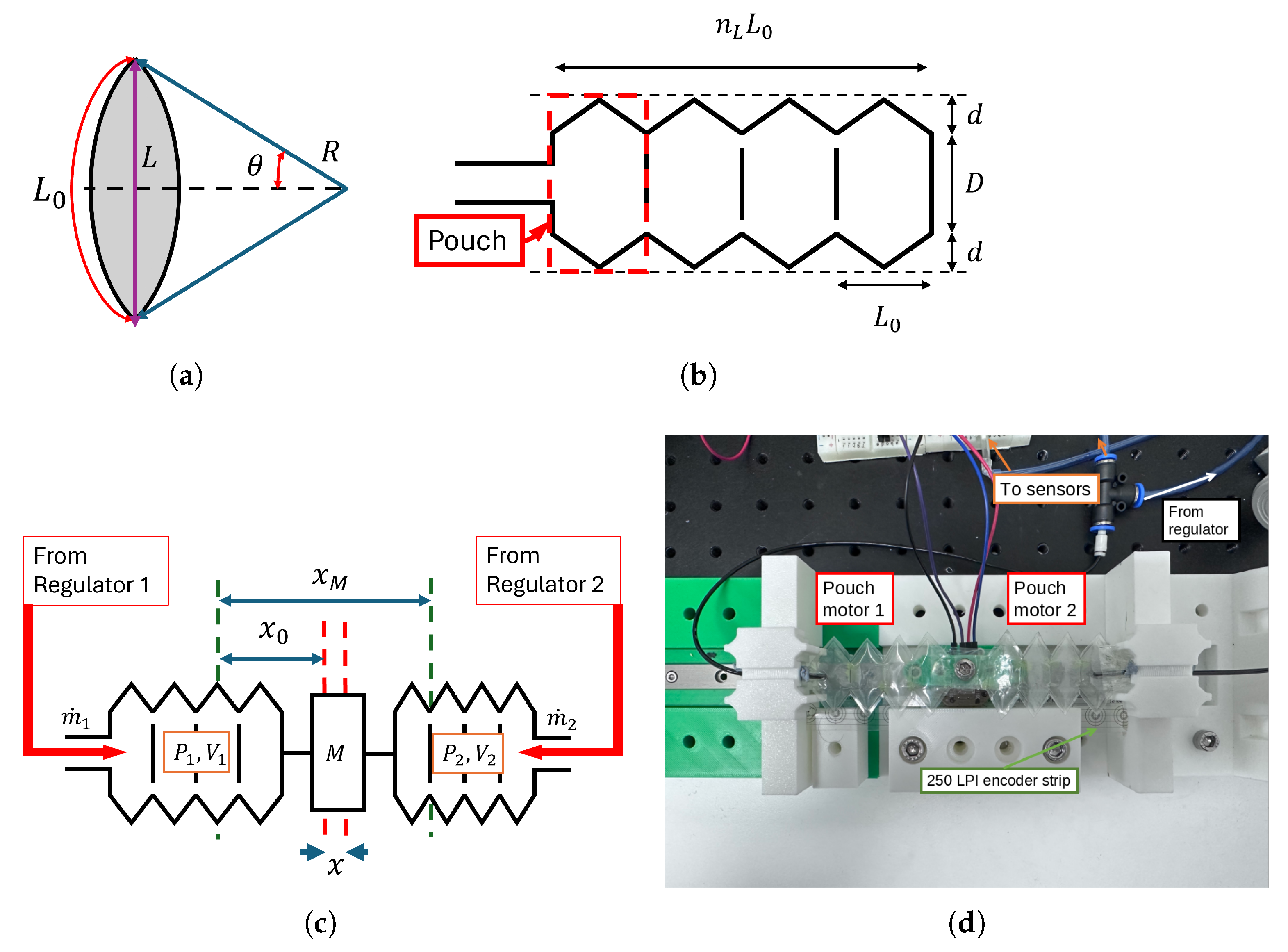
In this study, we consider a system consisting of two soft pneumatic pouch motors [44]. These were fabricated by joining two sheets of inextensible thermoplastic using a custom-built laser welding system [50] and are identical to those used in [32]. The pouch motors are supplied by proportional digital regulators (see details in Section 5.2) that accept a demanded pressure level as input. Since pouch motors contract when inflated, inflation of pouch motor 2 and deflation of pouch motor 1 result in motion of the block of mass M in the positive horizontal direction x (see Figure 1c). In this work, “pouch motor” is used to refer to the complete actuator, comprised a series of connected “pouches” (see Figure 1b). The following assumptions are introduced for the purposes of modelling and controller design.
Assumption 1. 
The working fluid is an ideal gas, and the process it undergoes (i.e., compression-expansion) is isentropic, described by the polytropic index γ.
This is a common assumption used in the design of pneumatic systems [41,43] and is representative of the negligible heat transfer across the boundaries of the system.
Assumption 2. 
The pouch motors used assume a cylindrical profile when inflated.
This assumption is commonly employed in pouch motor modelling [32,44] and holds for moderate inflations encountered during typical operating conditions. A correction factor ν is introduced in Section 2.1 to compensate for deviations from this profile. When combined with the inextensible nature of the material used for the pouch motors, this implies that at any instant the constant length of the pouch is L 0 = 2 θ R , where the radius R and the central angle θ vary with the extent to which the pouch is inflated and are defined in Figure 1a.
 Assumption 3. 
The system states that the position of the block x, its velocity x ˙ , and the pressures P 1 and P 2 inside the pouch motors are known at every instant. The position of the block is bounded, x 0 x x 0 , where x 0 represents half the maximum travel of the block. The pressures P 1 and P 2 are bounded, that is, 0 P 1 P * , 0 P 2 P * , where P * is a constant.
This assumption is similar to Assumption 3 in [32], where P * is chosen to avoid damage to the pouch motors.
 Assumption 4. 
The system uncertainties are lumped into a disturbance, F, which is unknown with a bounded, unknown rate of change that is, | F ˙ | ϵ , with ϵ 0 .
Disturbances may include modelling and truncation errors, friction, and parameter uncertainty. The bounded-rate assumption is reasonable because pneumatic systems typically have limited bandwidth [51] relative to the sampling rate used in this study (100 Hz). Additionally, the pouch motors are pre-inflated to a prescribed level at the start of each experiment, so there is negligible deadband. Note that the bound ϵ is not assumed known and can, theoretically, be arbitrarily high. The assumption only disqualifies such phenomena as deadbands, stiction, and sharp interactions with the environment. The system is designed to avoid or reduce the likelihood of their occurrence, thus justifying the assumption. Note that this assumption disqualifies robust controllers, such as SMC, where the disturbance bound is required to be known.

2.1. Antagonistic Pair Modelling

The modelling of the pouch motor in this work closely follows that in [44]. Since L 0 = 2 R θ and L = 2 R sin θ (see Figure 1a), it follows from Assumption 2 that
L = L 0 sin θ θ ,
where L is the contracted length of the pouch. The contraction of the pouch motor, δ L = n L ( L 0 L ) , can be expressed using a Taylor series expansion as
δ L = n L L 0 1 sin ( θ ) θ n L L 0 θ 2 6 ,
with n L the number of connected pouches in the pouch motor (see Figure 1b). In practice, pouch motor inflation does not exceed 45°. The truncation error for this angle is approximately 3 % , which is considered acceptable. Equation (2) yields the following expression relating θ and δ L
θ = 6 n L L 0 δ L .
The contractions of pouch motors 1 and 2 are δ L 1 = x M x 0 x and δ L 2 = x 0 + x , respectively; see Figure 1c. In practice, the inflation of the pouch is inhibited by several factors such as the elasticity of the material, the method used to bond the two plastic films, and the thickness of the weld joint. To compensate for these effects, a correction factor ν is introduced to modify the expressions for θ , which yields for the two pouch motors
θ 1 = 6 n L L 0 x M x 0 x ν ,
θ 2 = 6 n L L 0 x 0 + x ν .
The total volume of the pouch motor expressed as a function of θ is [32,52]
V ( θ ) = n L L 0 2 D 2 + d 3 θ sin θ cos θ θ 2 .
with D and d parameters defining the geometry of the pouch (see Figure 1b). Employing a Taylor series expansion for the trigonometric term, i.e., sin θ cos θ = 1 2 sin 2 θ θ 2 3 θ 3 , it follows from Equation (6) that
V ( θ ) = n L L 0 2 3 D + 2 3 d θ ,
with truncation error at θ = 45 being approximately 13 % . This error is bundled into the unknown disturbance F. Upon substituting Equations (4) and (5), Equation (7) yields
V 1 = V 0 + n L L 0 2 3 D + 2 3 d 6 n L L 0 κ 1 x M x 0 x ν ,
V 2 = V 0 + n L L 0 2 3 D + 2 3 d 6 n L L 0 κ 2 x 0 + x ν ,
where V 0 is a dead volume including the volume of pipes and fittings. From [44], the force exerted by the pouch motor can be expressed as a function of the pressure in the pouch motor P p o u c h and the partial derivative of the volume V with respect to the linear displacement x as
F p o u c h = P p o u c h V x .
Substituting Equations (8) and (9) in the above, the force exerted by each pouch motor is
F 1 = κ 1 P 1 1 2 ν x M x 0 x ν ,
F 2 = κ 2 P 2 1 2 ν x 0 + x ν .
The pressure rate in the pouch motors depends on the bulk modulus of the fluid, Γ , as [53]
P ˙ = Γ m ˙ V x x ˙ V ,
where Γ = γ P p o u c h for an ideal gas undergoing an isentropic process and m ˙ is the net mass flow rate into the volume V. Employing Equations (11) and (12), the inertial dynamics of the payload yield
M x ¨ + c x ˙ + κ 1 P 1 2 ν x M x 0 x ν κ 2 P 2 2 ν x 0 + x ν + F = 0 ,
where c represents the damping coefficient and F is defined by Assumption 4. Substituting Equations (8) and (9) in Equation (13) yields the pressure dynamics in the pouch motors
P ˙ 1 = R s T 0 γ m ˙ 1 V 0 + κ 1 x M x 0 x ν κ 1 P 1 γ x ˙ 2 ν V 0 + κ 1 x M x 0 x ν x M x 0 x ν ,
P ˙ 2 = R s T 0 γ m ˙ 2 V 0 + κ 2 x 0 + x ν + κ 2 P 2 γ x ˙ 2 ν V 0 + κ 2 x 0 + x ν x 0 + x ν .

2.2. Pressure Supply and Flow Rates

In the system defined by Equations (14)–(16), the mass flow rates of air m 1 ˙ and m 2 ˙ supplied to the two pouch motors serve as control inputs. However, in our system, the pouch motors are supplied by proportional regulators that accept a demanded pressure level as input. To relate the commanded pressure to the resulting flow, the ISO 6358 orifice model is employed, which is based on the flow of an ideal gas through a fixed sharp-edged orifice [41,54]. While this is not entirely descriptive of the nature of proportional valves, it serves as a representative approximation and has been successfully employed in previous work on modelling pressure dynamics with proportional pressure regulators [33]
Q = P u p C 1 P P u p b 1 b 2 b < P P u p < 1 ( subsonic inflow ) P u p b 0 < P P u p b ( choked inflow ) P C 1 P u p P b 1 b 2 b < P u p P < 1 ( subsonic outflow ) P C 0 < P u p P 1 ( choked outflow ) ,
where P u p is the upstream pressure, P the downstream pressure, b = 0.528 the critical pressure ratio for ideal di-atomic gases, and C the pneumatic conductance of an orifice of diameter D c and length L c given by [54]
C = 0.029 D c 2 L c D c 1.25 + 510 .
The upstream pressure set by the pressure regulators is obtained by inverting Equation (17), which yields
P u p = P b 1 1 2 1 b 1 + Q 2 ( C P ) 2 ( 1 b ) 2 2 b 1 b < P P u p < 1 , Q > 0 Q / C 0 P P u p < b , Q > 0 P b + ( 1 b ) 1 Q 2 ( C P ) 2 C P < Q < 0 P b Q < C P .

3. Controller Design

The control objective in this study is to track a given trajectory ( x d , x d ˙ ) for the payload. In order to compensate for the unknown disturbance F (see Assumption 4), a nonlinear observer is designed according to the Immersion and Invariance methodology [55]. A nested sliding surface is then employed to design the tracking controller.

3.1. Nonlinear Observer Design

Approximating the lumped disturbance F as the sum of a function of system states, η ( x ˙ ) , and an observer state, F ^ , the estimation error Δ is defined as
Δ = F ^ + η ( x ˙ ) F ,
where
η ( x ˙ ) = M α x ˙ .
The observer update law is
F ^ ˙ = α F ^ + c x ˙ M α x ˙ + κ 1 P 1 2 ν x M x 0 x ν κ 2 P 2 2 ν x 0 + x ν .
with α > 0 a positive tuning parameter.
 Proposition 1. 
Consider system (14) under Assumptions 1–4 and the observer update law defined in Equations (21) and (22). The estimation error Δ defined in Equation (20) is ultimately and uniformly bounded, provided the system trajectories are bounded under the control law.
The proof is given in Appendix A.1.

3.2. Tracking Control

A nested sliding surface approach [49] is adopted to handle the non-affine control input arising from the inclusion of pressure dynamics (see Equations (14)–(16)). The position error is defined as e = x d x , and the first sliding surface is defined as
ζ = e ˙ + K 1 e ,
with K 1 > 0 a constant parameter. The second sliding surface is defined as
τ = ζ ˙ + K 2 ζ ,
with K 2 > 0 a constant parameter. The control objective, in the presence of constant disturbances (i.e., F ˙ = 0 ), is to drive τ to zero, which in turn ensures convergence of ζ and e to zero. In the presence of a time-varying disturbance, however, the goal is to achieve bounded tracking errors. To this end, the following control law is proposed:
m 1 ˙ = σ 1 σ 2 x d x ˙ α σ 5 + 2 K 1 K 2 + K 2 2 c M σ 5 + σ 1 σ 2 x d ˙ ( K 2 2 + 2 K 1 K 2 ) + x d ¨ ( K 1 + 2 K 2 ) + F ^ M σ 5 K 1 K 2 2 ( x x d ) σ 1 σ 2 κ 2 P 2 ( γ + 1 ) σ 5 x ˙ ( V 0 κ 2 σ 3 ( γ 1 ) ) 2 ( κ 2 ( σ 3 2 ) + V 0 ν σ 3 ) σ 3 2 M ν σ 3 + σ 1 σ 2 κ 1 P 1 ( γ + 1 ) σ 5 x ˙ ( V 0 κ 1 ( γ 1 ) σ 4 ) 2 ( κ 1 ( σ 4 2 ) V 0 ν σ 4 ) σ 4 2 M ν σ 4 ,
where
σ 1 = 2 M ν 2 σ 3 σ 4 V 0 + κ 2 σ 3 V 0 + κ 1 σ 4 ,
σ 2 = R s T 0 γ κ 1 V 0 ν σ 3 + κ 2 V 0 ν σ 4 + κ 1 κ 2 ν x M ,
σ 3 = x 0 + x ν ,
σ 4 = x M x 0 x ν ,
σ 5 = K 1 + 2 K 2 c M .
The redundant actuation in the antagonistic pair may be resolved by enforcing complementary or opposing behaviours on the actuators so one actuator extends while the other contracts. To this end, the mass flow rates into the pouches are constrained as m ˙ 1 + m ˙ 2 = 0 .
Proposition 2. 
Consider the system defined by Equations (14)–(16) under Assumptions 1–4 in closed loop with the control law (25) and the observer update law (22). Then the tracking error remains ultimately and uniformly bounded, converging to a ball of radius
ρ = ϵ K 1 K 2 2 K 1 1 2 K 2 M 2 + K i 2 α ,
for any K i > 0 , K 2 > K 1 and
α > σ 5 2 M 2 ( K 2 K 1 ) K i .
The proof is given in Appendix A.2.
Corollary 1. 
Suppose the disturbance F is constant (i.e., F ˙ = 0 ) and Assumptions 1–3 hold, then the equilibrium ( x , x ˙ ) = ( x d , x d ˙ ) is exponentially stabilized by observer (22) and Controller (25) for any K 1 > 0 , K 2 > 0 and α > 0 .
The proof is given in Appendix A.3.

4. Simplified Model—Without Pressure Dynamics

Neglecting the pressure dynamics, the pressure set to the pouch motors becomes the control input. In order to resolve redundant actuation, the pouches are constrained to have complementary pressures P 1 and P 2 , i.e., P 2 = 2 P 0 + β P 1 , where P 0 is the atmospheric pressure and β is a constant. This ensures that one pouch is inflated as the other is deflated. As a result, the sum of the pressures in the pouches remains constant, thereby maintaining a roughly constant system stiffness, characterized by β . The control goal is to achieve bounded tracking error. To this end, consider the control law
P 1 = M κ 1 2 ν σ 4 + κ 2 2 ν σ 3 x d ¨ K 1 2 ( x x d ) 2 K 1 ( x ˙ x ˙ d ) + F ^ M + ( c M α ) x ˙ M κ 2 ( 2 P 0 + β ) 2 M ν σ 3 ,
where σ 3 and σ 4 are defined in Equations (28) and (29)
Proposition 3. 
Consider system (14) under Assumptions 2–4 in closed loop with the observer update law (22) and the control law (33). Then the tracking error e is ultimately and uniformly bounded, converging to a ball of radius
ρ = ϵ K j K 1 3 α ,
for any K 1 > 0 and
α > 1 M 2 K 1 K j .
The proof for this is presented in Appendix A.4
Remark 1. 
Both the proposed controller (25) and the simplified controller (33) rely on the same observer (22) and require a minimum value of the parameter α to ensure convergence. In particular, the bounds (32) and (35) are both inversely proportional to M 2 and to K i and K j , respectively. Thus, in theory, they can be minimized by choosing large K i and K j .
Additionally, both controllers only enable ultimate boundedness of the tracking error; see Proposition 2. In both cases, however, the tracking error can be made arbitrarily small by increasing the tuning parameters K 1 , K 2 , and α (see Equations (31) and (34)). In practice, however, the use of large gains can be problematic as it might excite high-frequency components in the unmodelled dynamics. As a consequence, employing large gains in the simplified controller (33) might result in oscillations due to the unmodelled pressure dynamics. In addition, with the controller (33), the uncertainties resulting from the unmodelled pressure dynamics may add to the disturbance F and could increase the bound ϵ. This is verified by the controller gain chosen in experiments and simulations (see Table 1 and Table 2). In particular, K 1 in both controllers represents the time constant of the first sliding surface (τ), and a higher value was viable with Controller (25). In addition, the controller (25) resulted in a smoother time-history for the pressure, see Section 5.2.

5. Results

5.1. Simulation

System (14) was simulated in MATLAB R2025b with the following model parameters: m = 60 g, c = 100 kg/s, L 0 = 13.5 mm, d = 14 mm, D = 9 mm, n L = 4 , x M = 11 mm, x 0 = x M 2 = 5.5 mm. The dead volume V 0 =   3 × 10 10   m 3 represents the volume of the pipes leading to the two pouch motors, with diameters of 2 mm and lengths of 10 and 15 cm, respectively. The pipe dimensions were also used to determine the pneumatic conductance of the sharp-edged orifice (see Equation (18)), with D c = 2 mm for both pouch motors, L c = 10 cm for pouch motor 1, and L c = 15 cm for pouch motor 2. The remaining parameters are the atmospheric temperature T = 298 K, the atmospheric pressure P 0 = 101325 Pa, the polytropic index γ = 1.4 , and the specific gas constant for dry air, R s = 287 J/kg K.
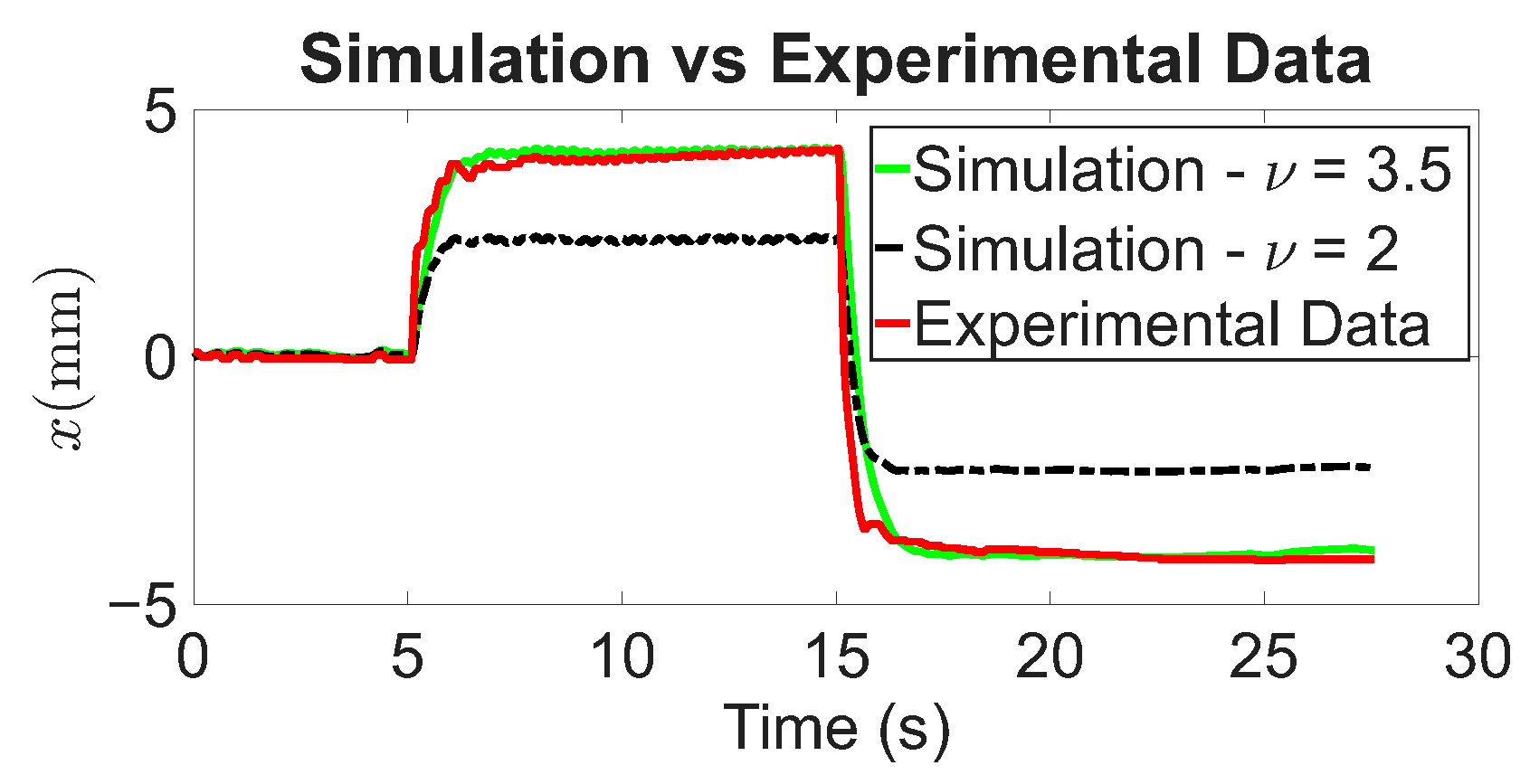
The open-loop response to a complementary step input in pressure ( P 1 = 30 mbar , P 2 = 350 mbar ) was recorded experimentally (see Section 5.2 for Experimental setup) to identify an appropriate correction factor ν . A grid search over ν [ 1 , 5 ] with a step of 0.1 identified ν = 3.5 as minimizing the RMSE between the simulated and experimental step responses. A sensitivity analysis showed that a ± 10 % variation in ν increased RMSE by approximately 20%. This indicates moderate sensitivity to the parameter. However, the absolute RMSE remains within 5 × 10⁻³ mm, which is acceptable for control purposes. The effect of this parameter is shown in Figure 2. The unknown external disturbance was set in simulations as F = 0.2 log ( 0.1 ( 1 + t ) ) N. This is a slowly varying disturbance with a bounded maximum rate F ˙ = 0.2 1 + t 0.2 . The following heuristic procedure was employed for gain selection: K 1 and K 2 were increased in accordance with the stability criteria until the overshoot exceeded 10% of the maximum displacement. α was increased until persistent oscillations were seen in the observer estimate. PID tuning parameters were selected to minimize overshoot and match the rise time achieved by the model-based controllers in the cubic tracking task. This process yielded the tuning parameters listed in Table 1 and Table 2.
Remark 2. 
α determines the trade-off between disturbance rejection, noise sensitivity, and convergence speed. A higher α yields faster convergence but amplifies noise in experiments. Note that α in experiments was chosen lower than in simulations. This was done to mitigate the noise caused by computing velocity through discrete differentiation and to compensate for the discrepancies caused by discrete implementation of the continuous-time controller. Employing finite differences to estimate velocity using position measurements can introduce high-frequency quantization noise and phase lag, while higher observer gains theoretically improve disturbance rejection and convergence speeds; they can reduce the closed-loop phase margin in a digital controller. Empirical testing showed that higher observer gains ( α > 10 ) caused the amplified noise to interact with the actuators latency, leading to persistent oscillations. Thus, α = 10 represents the maximum viable gain for this hardware configuration.
The values of the controller parameters verify the conditions on the controller and observer gains (Equations (32) and (35)) for K i =  3 × 10⁵ and K j =   0.5 , respectively. For these gains, the bounds on the tracking error with ϵ = 0.2 are ρ =  8.4 × 10⁻⁶ m and ρ =  9.2 × 10⁻⁶ m. The controllers are enabled in all simulations at t = 4 s. This is done to match experiments, where a settling time of 4 s is allowed for the position to stabilize at the mid-point of the stroke. The reference trajectories x d ( t ) used in this study are defined in Table 3. The cubic trajectories are used in simulations and have a first derivative equal to zero at the end points.
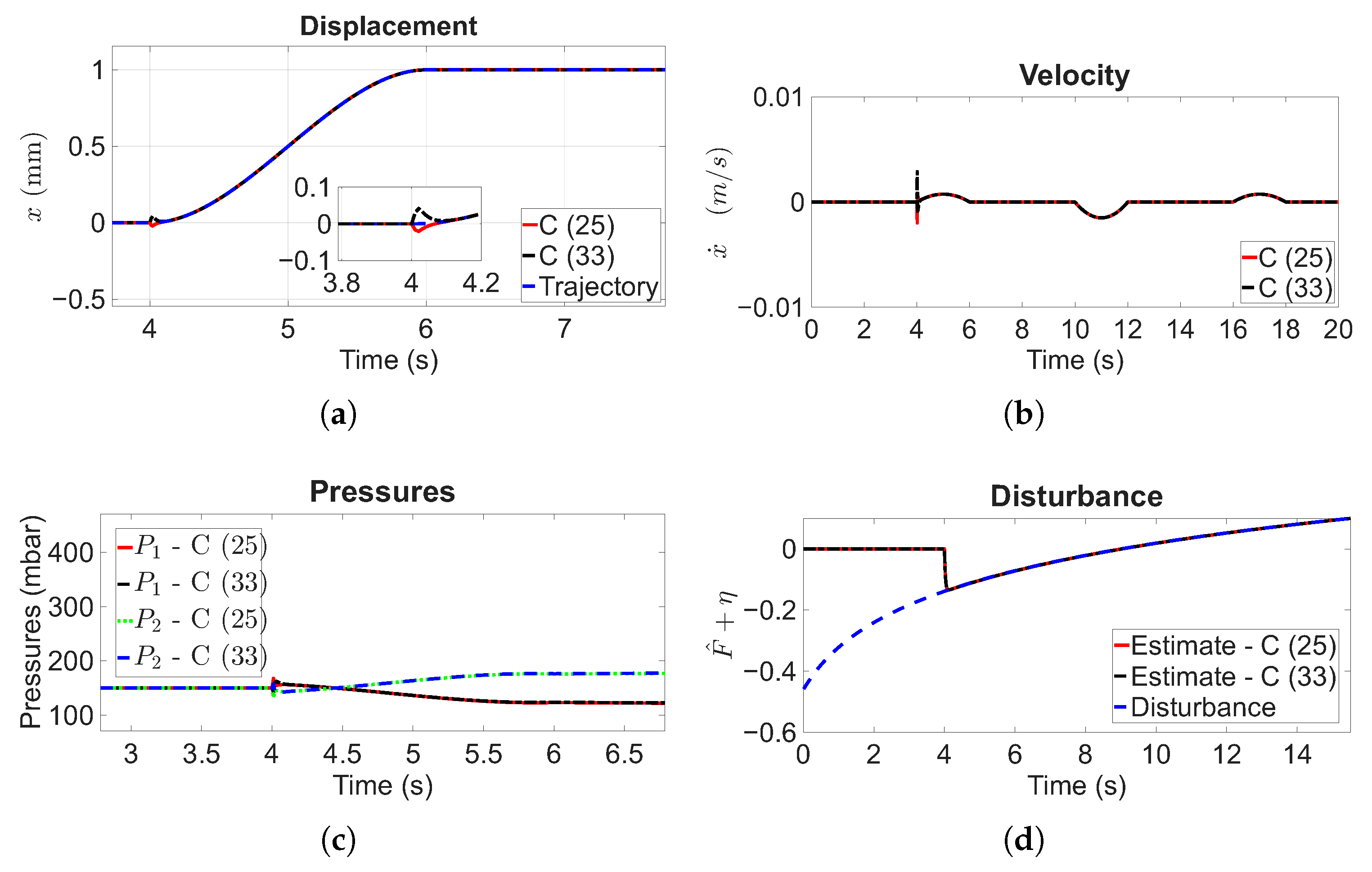
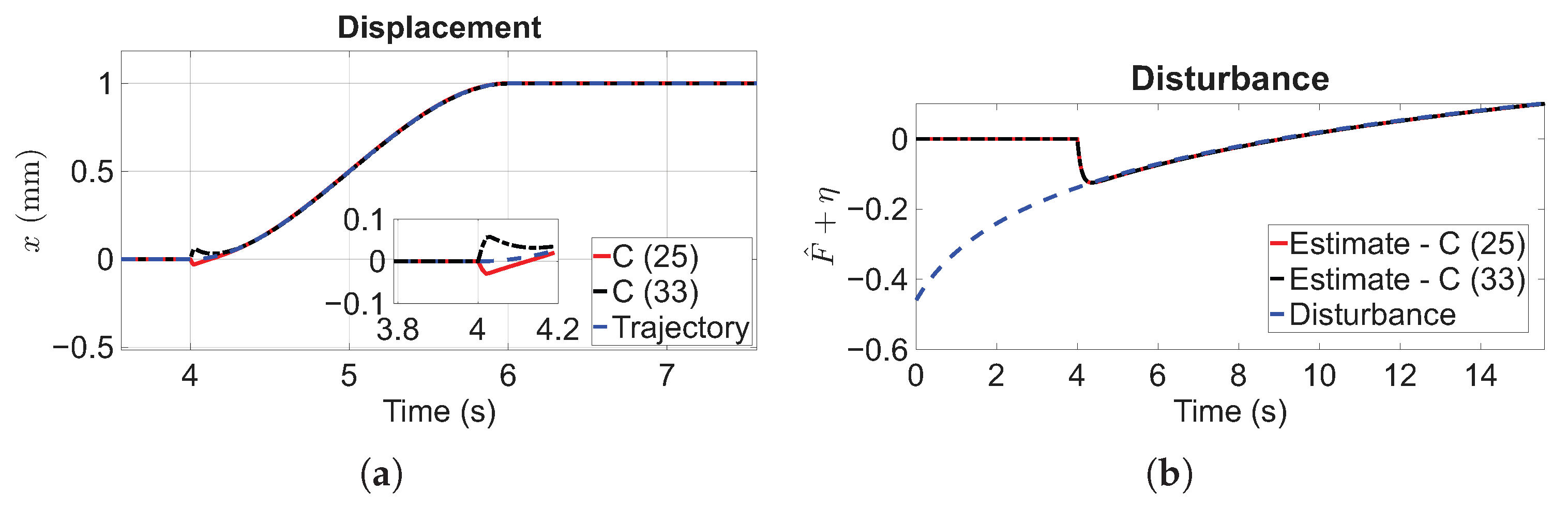
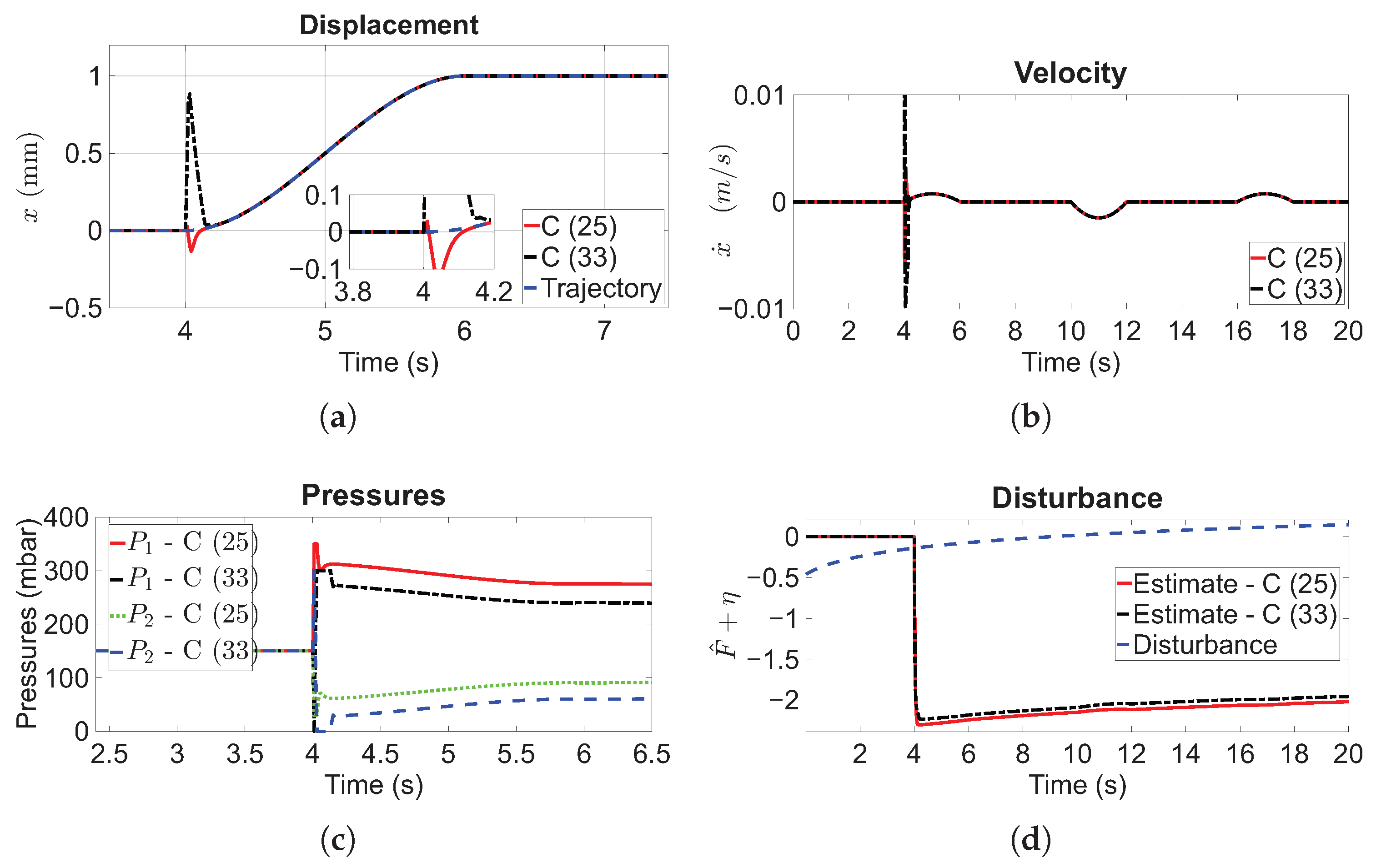
Simulation results with model and controller employing the same model parameters are shown in Figure 3 for the cubic trajectory. Simulation results for the nominal case with α = 10 are shown in Figure 4. The simulation study is extended further by testing the robustness of the observer in compensating for a rapidly varying parametric uncertainty. Figure 5 shows the performance of the controllers when a 10% uncertainty is imposed on the system parameters c, m, κ 1 , κ 2 (see Equations (14)–(16)), with 10% chosen for illustrative purposes. This is implemented by cycling the aforementioned parameters in the model between 110% and 90% of their nominal values at each simulation time step, while the controller uses the nominal values.
Both controllers (25) and (33) converge to the prescribed trajectory almost instantly after they are enabled (see Figure 3a). There is an initial rapid change in position with both controllers, due to the initial value of the observer state (see Figure 3d), which settles within 0.1 s. The pressures are also comparable, with a very small difference between the controllers (see Figure 3c). This suggests that, in this particular scenario, both controllers are equivalent.
Figure 3 and Figure 4 show the minimal improvement offered by a higher α . Employing α = 10 yields a larger error and a slower convergence to the reference trajectory (i.e., approximately 0.2 s compared to 0.1 s with α = 40 ). This is still acceptable for control purposes.
In the presence of a 10% uncertainty on the model parameters, both controllers eventually achieve perfect tracking. However, (25) outperforms (33) in handling the uncertainty, see Figure 5a. In particular, (25) exhibits a small deviation from the reference trajectory, while with (33), there is a rapid displacement of the payload at the beginning of the trajectories. This initial displacement causes (25) to settle within 0.1 mm of the reference trajectory slightly faster (by ≈ 0.1 s) than (33); see the inset in Figure 5a. This is a consequence of the parameter uncertainties increasing the disturbance F by approximately 2 N, see Figure 5d, and results in both cases in higher pressures. In particular, P 1 in both cases reaches the upper limit, while with (33), P 2 reaches the lower limit, leading to a slack pouch. In addition, P 1 > P 2 at steady state for both controllers, which is counter-intuitive, since, in the absence of disturbances, this condition corresponds to the block moving in the negative x direction. This anomaly is a consequence of the additional disturbance caused by parametric uncertainties. Nevertheless, the observer is able to compensate effectively for both parametric uncertainties and external disturbances, and the reference trajectory is successfully tracked.

5.2. Experiments

Figure 1d shows the experimental setup used in this work. The pouches are supplied individually by digital pressure regulators (i.e., SMC ITV1030, SMC Corporation, Tokyo, Japan), driven by a 12-bit DAC (i.e., MCP4922, Microchip Technology, Chandler, AZ, USA). The pressure in each pouch motor is measured using 14-bit digital pressure sensors (i.e., MS4525DO, TE Connectivity, Schaffhausen, Switzerland). A linear encoder (i.e., HEDS-9200, Broadcom Inc., Palo Alto, CA, USA) is used with a 250 LPI encoder strip, and a quadrature counter (i.e., LS7366R, LSI Computer Systems Inc., Melville, NY, USA) is employed to measure the position of the payload—a 60 g block constrained to move along a linear guide rail. The position and pressure sensors are digitally filtered, thereby minimizing sensor noise. An Arduino Uno R4 Wifi (Arduino, Turin, Italy) microcontroller is used to communicate with the electronic components via SPI and with a PC via serial link (baud rate 115,200) at a sampling frequency of 100 Hz.
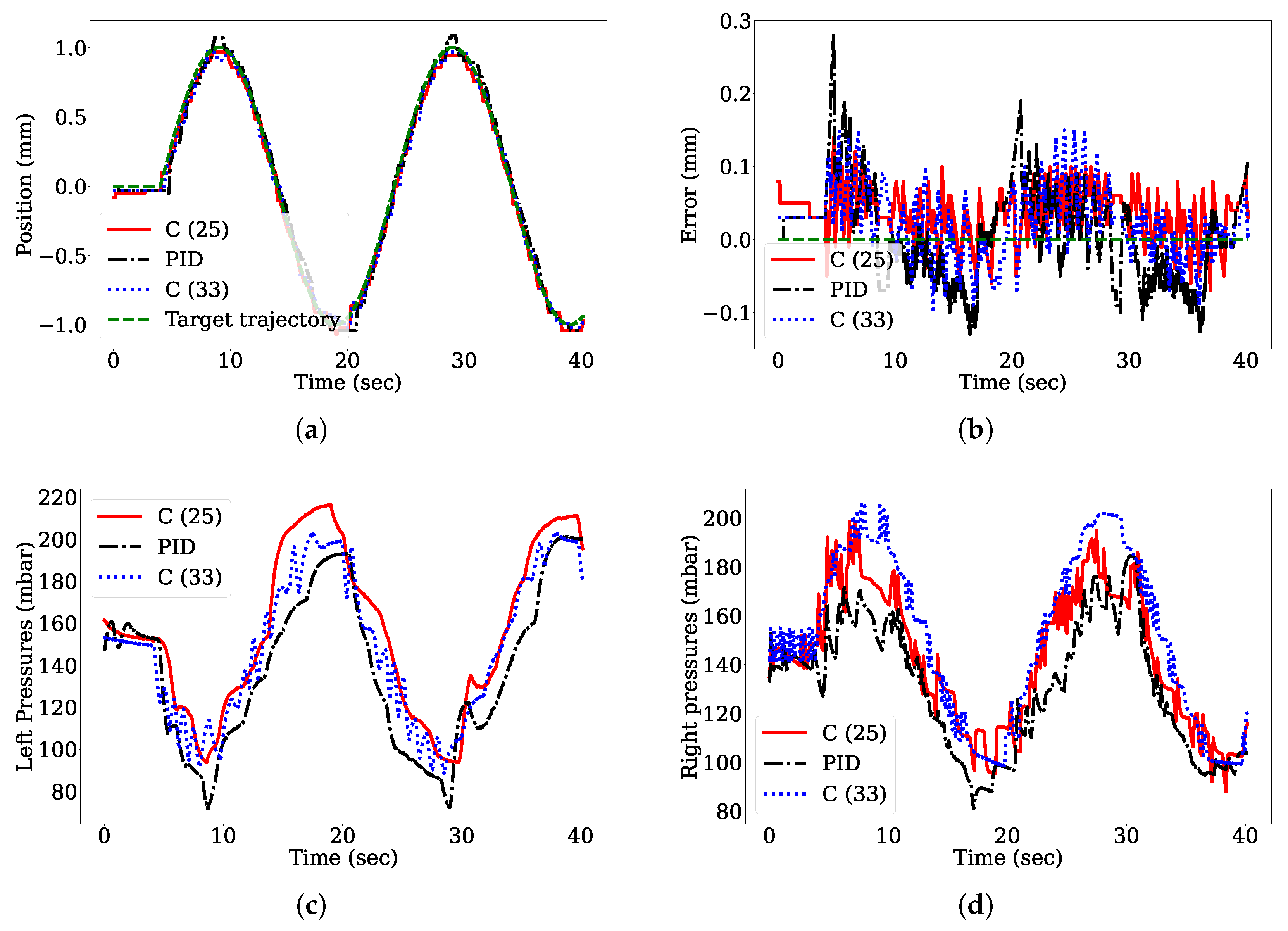
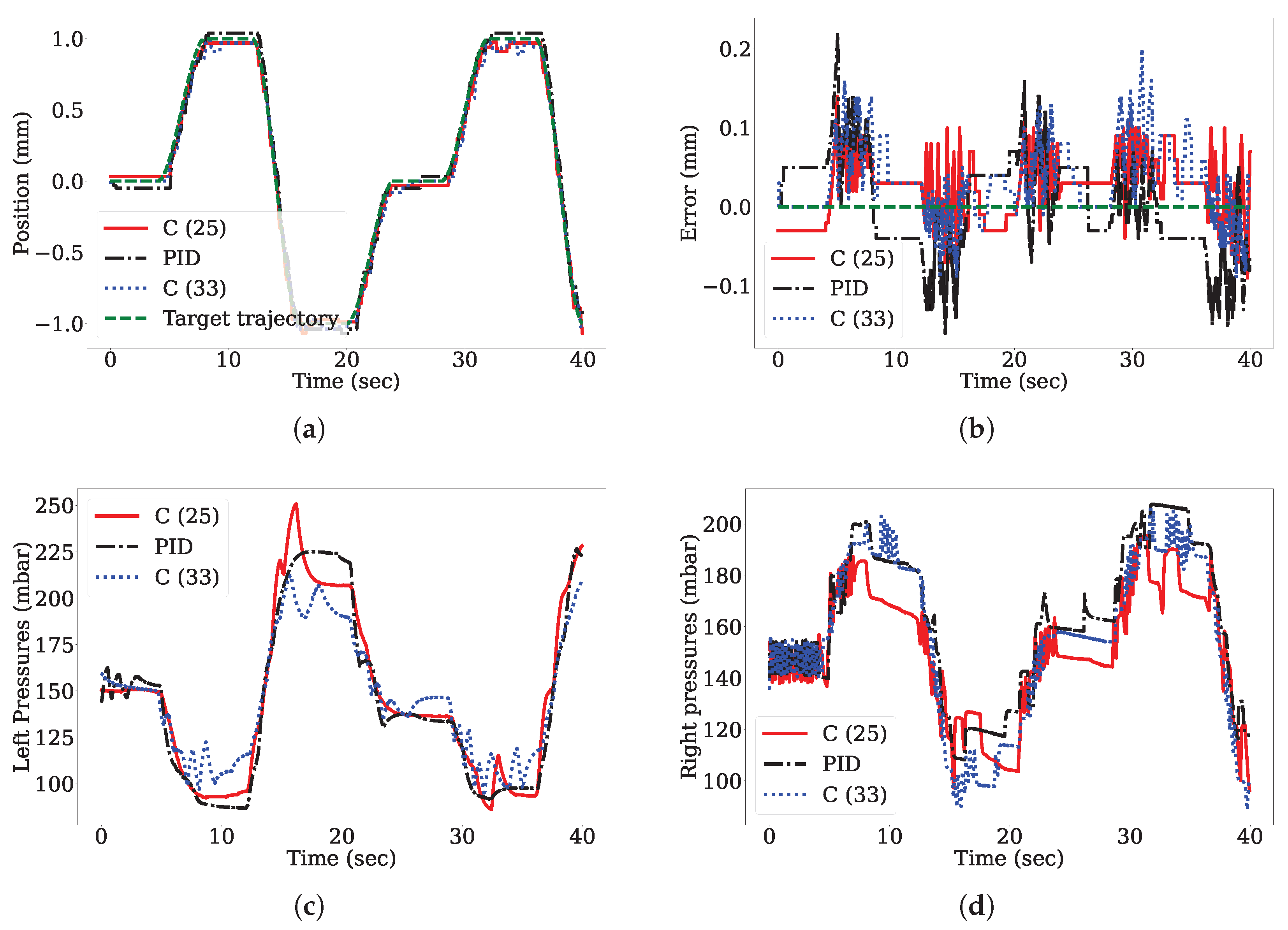
Two reference trajectories were employed in the experiments-sinusoidal and cubic (see Table 3). The controller parameters for experiments are listed in Table 2. The model parameters m, c, L 0 , d, D, n L , V 0 , T, P 0 , γ , R s , ν , L c , and D c were set identical to simulations (see Section 5.1). To avoid damaging the pouch motors, an upper limit of P m a x = 400 mbar was imposed on the pressures. Similarly, to prevent the actuators from slackening due to insufficient pressure, the minimum allowed pressure was set at P m i n = 30 mbar. The setup was calibrated at the beginning of every experiment to identify the maximum ( x M ) and initial ( x 0 ) positions of the block. x M was calculated as the difference between the positions of the block under the two extreme conditions ( P 1 = 400 mbar, P 2 = 30 mbar and P 1 = 30 mbar, P 2 = 400 mbar, respectively). x 0 was identified as the position of the block when P 1 = P 2 = 150 mbar. The controller was enabled at t = 4 s to allow the pressures and the position to settle before initiating the trajectory. Table 4 lists mean and standard deviation values for the maximum error, mean absolute error (MAE), and root mean squared error (RMSE) with 5 experiments each, calculated starting at t = 4 s. The best results for each task are shown in Figure 6 and Figure 7, comparing the performance of Controller (25) to the simplified controller without pressure dynamics (33) and a model-free PID controller serving as a baseline. PID was chosen as a baseline since it is arguably the most used controller in engineering practice for various classes of physical systems. While the theoretical bound on the tracking error depends on the unknown ϵ , the MAE (≈40 × 10−6 m) and the RMSE (≈50 × 10−6 m) are consistent with the order of magnitude presented in Section 5.1.
Figure 6a and Figure 7a show generally comparable performance between the controllers, with the model-based controllers achieving maximum absolute errors under 0.2 mm, or 10% of the maximum displacement. Both model-based controllers outperform the PID baseline, with lower maximum, mean absolute, and RMS errors. Among the model-based controllers, (25) outperforms (33). In tracking the sinusoidal trajectory, while the MAEs are similar, (25) achieves lower RMSE. This indicates the presence of larger spikes or outliers in the time history of the position error for (33). The improvement offered by the controller (25) is clearer in the tracking results of the cubic trajectory, resulting in a 33.3% improvement in RMSE and a 20% improvement in the MAE over Controller (33). This result confirms that a better system model yields a better-performing model-based controller.
Figure 6c,d and Figure 7c,d show the time history of the pressures in the pouch motors. The model-based controllers, in general, employ slightly higher pressures than PID. This is likely to be a consequence of the high controller gains required in order to achieve lower tracking bounds (see Propositions 2 and 3). In principle, this may be undesirable for actuator longevity and compliance with safety regulations in surgical applications. However, the difference at any time is below 50 mbar, which is considered acceptable for this system. Higher peaks and more rapid pressure variations are observed in pouch motor 2 (Figure 6d and Figure 7d). This is likely to be a consequence of a minor leakage, requiring more frequent filling from the pressure regulator.
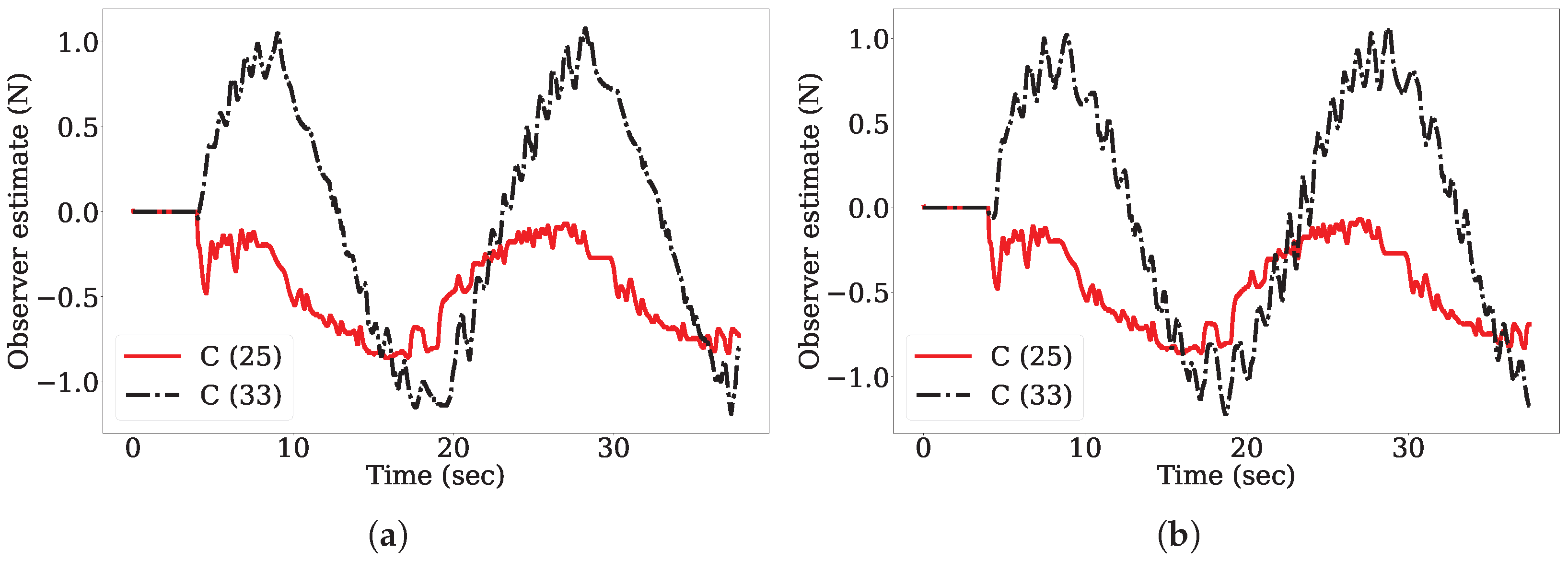
In summary, the results indicate that the inclusion of pressure dynamics in the model and the corresponding controller does lead to meaningful improvements in reducing tracking errors. In addition, Figure 8a,b show that the observer estimate with Controller (25) is lower and varies more slowly than the estimate with Controller (33), which has higher peaks and larger variations. This discrepancy is likely due to the simplified controller neglecting the pressure dynamics, further increasing the lumped disturbance, as postulated in Remark 1. While the controller (25) yields better performance, even the simplified controller (33) performs better than the PID baseline and represents a sensible alternative when a simpler controller is sought or pressure dynamics can be neglected. Further, the controller (25) is dependent on the jerk of the reference trajectory ( x d ), while the simplified controller is not. Thus, controller (33) may be more suitable where sudden changes in position are required. A further effect of incorporating the pressure dynamics in the model is a smoother pressure profile; see Figure 6c and Figure 7c. This finding is aligned with Remark 1 and indicates that neglecting the pressure dynamics in the controller design can excite unmodelled dynamics, leading to oscillations.
Despite these positive results, it must be noted that this work has some limitations. For instance, the orifice diameter D c and length L c are not known accurately and may even vary with the direction of the flow, resulting in uncertainty in the pneumatic conductance C. This might explain why the measured pressure in Figure 6d and Figure 7c,d has a non-smooth profile despite the trajectory being smooth. This aspect will be explored in future work.
Finally, while the observer does compensate for the unknown disturbance, state-dependent uncertainties such as velocity and pressure-dependent terms, leakages, and experimental validation of the system’s robustness to external disturbances and varying loads were not explicitly accounted for in this study. This is deemed acceptable due to the relatively slow reference trajectory being tracked and to the absence of deadbands, discontinuities, and nonlinearities in the experimental setup. Observer design in the presence of such classes of disturbances could be a possible avenue for future work. Further, while higher gains in theory enable better tracking, there are upper limits, not defined in this work, which are due to the discrete nature of the control implementation. While it was not observed in experiments with the gains employed in this work, the discrete implementation of the controller under high gains may further amplify noise from sensor measurements, particularly with the first-order discrete velocity estimation. Possible avenues for future work, therefore, include explorations of extended observers to handle state-dependent disturbances, and discrete controller implementations, allowing better quantification of controller gain limits and corresponding stability conditions.

6. Conclusions

In this paper, a new model-based tracking controller was presented for an antagonistic pair of soft pneumatic pouch motors. A dynamic model of the system that includes the pressure dynamics was formulated and used to design a nonlinear observer and a nonlinear controller, constructed using a nested sliding variable approach. A simplified representation of the system, without pressure dynamics, was employed to design a simplified controller for comparison, and performance was evaluated with simulations and experiments.
Experimental results demonstrated the effectiveness of the proposed controller, achieving RMS errors below 0.05 mm for both sinusoidal and cubic trajectories—under 2.5% of the maximum displacement. It was observed that while a simplified model-based controller demonstrated improvements over empirical PID, the inclusion of pressure dynamics in the model consistently improved accuracy, by up to 33.3% when RMSE figures are compared. Notably, the system was able to track a smoothed step trajectory corresponding to a displacement of 2 mm in under 2 s, demonstrating good responsiveness.
Future work will focus on extending the modelling framework to multi-degree-of-freedom configurations. We shall also investigate discrete-time control and extended observers capable of handling state-dependent disturbances and leakages.

Author Contributions

Conceptualization and Investigation, S.A.H. and E.F.; Methodology and Analysis, S.A.H. and E.F.; Software, S.A.H.; Writing, S.A.H.; Review, E.F.; Supervision, E.F. All authors have read and agreed to the published version of the manuscript.

Funding

This research received no external funding.

Institutional Review Board Statement

Not applicable.

Informed Consent Statement

Not applicable.

Data Availability Statement

Data is available from the authors upon reasonable request.

Acknowledgments

The authors would like to thank Mark Runciman of the Hamlyn Centre, Imperial College London, for providing the pouch motors used in the experimental part of this study.

Conflicts of Interest

The authors declare no conflicts of interest.

Appendix A. Stability Proofs

Appendix A.1. Proof for Observer Stability

Proof. 
Computing the time-derivatives of Equations (20) and (21) while substituting Equations (14) and (22) yields
Δ ˙ = α F F ^ + M α x ˙ F ˙ = α Δ F ˙ .
Defining a storage function Υ = 1 2 Δ 2 and computing its time-derivative while substituting (A1) yields
Υ ˙ = Δ Δ ˙ = α Δ 2 Δ F ˙ ,
and since | F ˙ | ϵ by Assumption 4,
Υ ˙ α Δ 2 + | Δ | ϵ .
Thus, Υ ˙ 0 in the set D = { Δ : | Δ | ϵ α } , and Δ converges to the bound ϵ α , which can be made arbitrarily small by increasing α , provided that the system trajectories remain bounded under the control law, see Lemma 9.2 in [56]. □

Appendix A.2. Controller (25) Stability Proof

Proof. 
Define a Lyapunov function candidate Λ = 1 2 τ 2 + K i 1 2 Δ 2 , with Δ the observer estimation error given in Equation (20), and K i a constant to be chosen. The time derivative of Λ yields
Λ ˙ = τ τ ˙ + K i Δ Δ ˙ .
Computing the time-derivative of τ while substituting Equations (14)–(16) yields
τ ˙ = x d + x ˙ κ 1 P 1 ( 1 + γ ) 4 M ν 2 σ 4 3 2 + κ 2 P 2 ( 1 + γ ) 4 M ν 2 σ 3 3 2 + x d ¨ K 1 + K 2 + K 1 + K 2 c M F + c x ˙ + κ 1 P 1 ( 1 + γ ) 2 ν σ 4 κ 2 P 2 ( 1 + γ ) 2 ν σ 3 M + F ˙ M + K 1 K 2 ( x d ˙ x ˙ ) + P 1 γ R s T 0 m 1 ˙ P 1 κ 1 x ˙ 2 ν σ 4 κ 1 ( 1 + γ ) 2 M ν σ 4 V 0 + κ 1 σ 4 P 2 γ R s T 0 m 2 ˙ P 2 + κ 2 x ˙ 2 ν σ 3 K 2 ( 1 + γ ) 2 M ν σ 3 V 0 + κ 2 σ 3 .
Then, substituting m 1 ˙ and m 2 ˙ = m 1 ˙ from Equation (25) yields
τ ˙ = σ 5 M Δ K 2 x d ¨ x ¨ ( K 1 + K 2 ) ( x ˙ x d ˙ ) K 1 K 2 ( x x d ) + F ˙ M ,
which, upon substituting Equation (24), gives
τ ˙ = K 2 τ σ 5 M Δ + F ˙ M .
Substituting Equations (A1) and (A7) into Equation (A4) gives
Λ ˙ = K 2 τ 2 σ 5 M Δ τ + τ F ˙ M α K i Δ 2 + K i Δ F ˙ .
Recalling that | F ˙ | ϵ by Assumption 4 yields
Λ ˙ K 2 τ 2 σ 5 M Δ τ α K i Δ 2 + | τ | ϵ M + K i | Δ | ϵ .
Applying Young’s inequality on the last two terms yields
| τ | ϵ M K 2 2 τ 2 + 1 2 K 2 ϵ 2 M 2 ,
K i | Δ | ϵ α K i Δ 2 2 + K i 2 α ϵ 2 ,
with the coefficients of τ 2 and Δ 2 chosen to ensure dimensional consistency and simplify subsequent analysis. Substituting these inequalities in Equation (A9) yields
Λ ˙ 1 2 K 2 τ 2 σ 5 M Δ τ α K i Δ 2 2 + 1 2 K 2 M 2 + K i 2 α ϵ 2 ,
which, after adding and subtracting K 1 2 τ 2 , can be re-written in matrix form as
Λ ˙ τ Δ K 2 2 K 1 2 σ 5 2 M σ 5 2 M α K i 2 Ψ τ Δ K 1 2 τ 2 + 1 2 K 2 M 2 + K i 2 α ϵ 2 .
Employing Sylvester’s criterion, the matrix Ψ is positive-definite if 1 2 K 2 K 1 > 0 , which is satisfied by any K 2 > K 1 , and if det ( Ψ ) > 0 , which yields
det ( Ψ ) = α K i 4 K 2 K 1 σ 5 2 4 M 2 > 0 .
Thus, det ( Ψ ) can be made positive by choosing α as in Equation (32). Now consider the following bound for | τ | ,
ρ = ϵ 2 K 1 1 2 K 2 M 2 + K i 2 α ,
which can be made arbitrarily small by increasing K 1 . It follows that Λ ˙ 0 in the set C = { ( τ , Δ ) : | τ | ρ } for any K 2 > K 1 and α satisfying Equation (32). Thus τ converges asymptotically to a ball of radius ρ , see Lemma 9.2 in [56], i.e.,
ζ ˙ + K 2 ζ = ρ ,
which admits the solution
ζ ( t ) = ρ K 2 + ζ ( 0 ) ρ K 2 exp ( K 2 t ) .
Consequently, ζ converges asymptotically to a ball of radius ρ K 2 , i.e.,
e ˙ + K 1 e = ρ K 2 ,
which admits the solution
e ( t ) = ρ K 1 K 2 + e ( 0 ) ρ K 1 K 2 exp ( K 1 t ) .
Consequently, e converges asymptotically to a ball of radius ρ = ρ K 1 K 2 , which can be made arbitrarily small by increasing K 1 and K 2 . □

Appendix A.3. Corollary 1 Proof

Substituting F ˙ = ϵ = 0 in Equation (A2) yields
Υ ˙ = 2 α Υ ,
which guarantees exponential convergence of the estimation error Δ to zero. Similarly, substituting F ˙ = 0 in Equation (A8) gives
Λ ˙ = K 2 τ 2 σ 5 M Δ τ α K i Δ 2 ,
where K i 1 , which can be re-written as
Λ ˙ = τ Δ K 2 1 2 σ 5 M 1 2 σ 5 M α K i Φ τ Δ .
Employing Sylvester’s criterion, the matrix Φ is positive definite if K 2 > 0 and det ( Φ ) = K 2 K i α 1 4 ( σ 5 M ) 2 > 0 , which can be ensured for any α > 0 by making K i arbitrarily large as it does not appear in the control law. This condition is less restrictive than that in Proposition 2 (i.e., where K 2 > K 1 and Equation (32) were required). Consequently, the closed-loop trajectories converge to the invariant set B = { ( τ , Δ ) : τ = 0 , Δ = 0 } , which ensures asymptotic stability of the equilibrium. Since Φ is positive definite, there exists a minimum eigenvalue of Φ , λ m i n ( Φ ) > 0 , such that v T Φ v λ m i n v 2 . With v = τ Δ , Equation (A22) yields
Λ ˙ λ m i n τ 2 + Δ 2 .
Since K i ( τ 2 + Δ 2 ) ( τ 2 + K i Δ 2 ) for all K i 1 , we have finally
Λ ˙ 2 λ m i n K i Λ .
Thus the equilibrium is exponentially stable and v converges to zero [56]. As a result, the tracking error, e, converges to zero exponentially.

Appendix A.4. Controller (33) Stability Proof

Proof. 
Define a Lyapunov candidate function Ω = 1 2 ζ 2 + K j 1 2 Δ 2 , with ζ and Δ given in Equations (20) and (23). Then the time-derivative of Ω is
Ω ˙ = ζ ζ ˙ + K j Δ Δ ˙ .
Computing the time-derivative of ζ and substituting the control law (33) yields
ζ ˙ = K 1 ( x ˙ x ˙ d ) + K 1 2 ( x x d ) + 1 M ( F F ^ + M α x ˙ ) ,
which is equivalent to
ζ ˙ = K 1 ζ 1 M Δ .
Substituting the above in Equation (A25) yields
Ω ˙ = K 1 ζ 2 1 M ζ Δ + K j Δ ( α Δ F ˙ ) .
Recalling that | F ˙ | ϵ by Assumption (4), Equation (A28) yields
Ω ˙ K 1 ζ 2 1 M ζ Δ K j α Δ 2 + K j | Δ | ϵ
Employing Young’s inequality on the last term yields
K j | Δ | ϵ K j α 2 Δ 2 + K j ϵ 2 2 α ,
and substituting it into Equation (A29) yields
Ω ˙ K 1 ζ 2 1 M ζ Δ K j α 2 Δ 2 + K j ϵ 2 2 α .
Adding and subtracting K 1 2 ζ 2 yields
Ω ˙ ζ Δ K 1 2 1 2 M 1 2 M K j α 2 Θ ζ Δ K 1 2 ζ 2 + K j ϵ 2 2 α .
Employing Sylvester’s criterion, Θ is positive-definite if K 1 > 0 and det ( Θ ) = K j K 1 4 α 1 4 M 2 > 0 . This can be ensured by choosing α according to Equation (35). Then, consider the following bound for | ζ |
Ξ = K j K 1 α ϵ ,
which can be made arbitrarily small by increasing K 1 and α . It follows that Ω ˙ 0 in the set E = { ( ζ , Δ ) : | ζ | Ξ } for all K 1 > 0 and for any α verifying Equation (35). Thus, ζ converges asymptotically to a ball of radius Ξ , see Lemma 9.2 in [56], i.e.,
e ˙ + K 1 e = Ξ ,
which admits the solution
e ( t ) = Ξ K 1 + e ( 0 ) Ξ K 1 exp ( K 1 t ) .
Consequently, e converges asymptotically to a ball of radius ρ = Ξ K 1 defined in Equation (34), which can be made arbitrarily small by increasing K 1 and α . □

References

  1. Ahmed, F.; Waqas, M.; Jawed, B.; Soomro, A.M.; Kumar, S.; Hina, A.; Khan, U.; Kim, K.H.; Choi, K.H. Decade of Bio-Inspired Soft Robots: A Review. Smart Mater. Struct. 2022, 31, 073002. [Google Scholar] [CrossRef]
  2. Cianchetti, M.; Laschi, C.; Menciassi, A.; Dario, P. Biomedical Applications of Soft Robotics. Nat. Rev. Mater. 2018, 3, 143–153. [Google Scholar] [CrossRef]
  3. Oyejide, A.; Stroppa, F.; Sarac, M. Miniaturized Soft Growing Robots for Minimally Invasive Surgeries: Challenges and Opportunities. Prog. Biomed. Eng. 2025, 7, 033001. [Google Scholar] [CrossRef] [PubMed]
  4. Iqbal, F.; Esfandiari, M.; Amirkhani, G.; Hoshyarmanesh, H.; Lama, S.; Tavakoli, M.; Sutherland, G.R. Continuum and Soft Robots in Minimally Invasive Surgery: A Systematic Review. IEEE Access 2025, 13, 24053–24079. [Google Scholar] [CrossRef]
  5. Aner, E.A.; Shehata, O.M.; Awad, M.I.; ElHady, N.E. A Decade of Soft Robotic Manipulators: Advances in Design, Modeling, Control, and Emerging Challenges. J. Bionic Eng. 2026, 23, 55–98. [Google Scholar] [CrossRef]
  6. Della Santina, C.; Duriez, C.; Rus, D. Model-Based Control of Soft Robots: A Survey of the State of the Art and Open Challenges. IEEE Control Syst. 2023, 43, 30–65. [Google Scholar] [CrossRef]
  7. Aner, E.A.; Awad, M.I.; Shehata, O.M. Modeling and Trajectory Tracking Control for a Multi-Section Continuum Manipulator. J. Intell. Robot. Syst. 2023, 108, 49. [Google Scholar] [CrossRef]
  8. Yip, M.C.; Camarillo, D.B. Model-Less Feedback Control of Continuum Manipulators in Constrained Environments. IEEE Trans. Robot. 2014, 30, 880–889. [Google Scholar] [CrossRef]
  9. Li, M.; Kang, R.; Branson, D.T.; Dai, J.S. Model-Free Control for Continuum Robots Based on an Adaptive Kalman Filter. IEEE/ASME Trans. Mechatron. 2018, 23, 286–297. [Google Scholar] [CrossRef]
  10. Penning, R.S.; Jung, J.; Ferrier, N.J.; Zinn, M.R. An Evaluation of Closed-Loop Control Options for Continuum Manipulators. In Proceedings of the 2012 IEEE International Conference on Robotics and Automation, Saint Paul, MN, USA, 14–18 May 2012; pp. 5392–5397. [Google Scholar] [CrossRef]
  11. Liu, J.; Duo, Y.; Chen, X.; Zuo, Z.; Liu, Y.; Wen, L. Data-Driven Methods for Sensing, Modeling and Control of Soft Continuum Robot: A Review. IEEE/ASME Trans. Mechatron. 2025, 30, 5520–5530. [Google Scholar] [CrossRef]
  12. Satheeshbabu, S.; Uppalapati, N.K.; Fu, T.; Krishnan, G. Continuous Control of a Soft Continuum Arm Using Deep Reinforcement Learning. In Proceedings of the 2020 3rd IEEE International Conference on Soft Robotics (RoboSoft), New Haven, CT, USA, 15 May–15 July 2020; pp. 497–503. [Google Scholar] [CrossRef]
  13. Liu, X.; Onal, C.D.; Fu, J. Reinforcement Learning of CPG-Regulated Locomotion Controller for a Soft Snake Robot. IEEE Trans. Robot. 2023, 39, 3382–3401. [Google Scholar] [CrossRef]
  14. Cranmer, M.; Greydanus, S.; Hoyer, S.; Battaglia, P.; Spergel, D.; Ho, S. Lagrangian Neural Networks. arXiv 2020, arXiv:2003.04630. [Google Scholar] [CrossRef]
  15. Greydanus, S.; Dzamba, M.; Yosinski, J. Hamiltonian Neural Networks. arXiv 2019, arXiv:1906.01563. [Google Scholar] [CrossRef]
  16. Kashima, K.; Yoshiuchi, R.; Kawano, Y. Learning Stabilizable Deep Dynamics Models. arXiv 2022, arXiv:2203.09710. [Google Scholar] [CrossRef]
  17. Shi, L.; Liu, Z.; Karydis, K. Koopman Operators for Modeling and Control of Soft Robotics. Curr. Robot. Rep. 2023, 4, 23–31. [Google Scholar] [CrossRef]
  18. Kriegman, S.; Nasab, A.M.; Shah, D.; Steele, H.; Branin, G.; Levin, M.; Bongard, J.; Kramer-Bottiglio, R. Scalable Sim-to-Real Transfer of Soft Robot Designs. In Proceedings of the 2020 3rd IEEE International Conference on Soft Robotics (RoboSoft), New Haven, CT, USA, 15 May–15 July 2020; pp. 359–366. [Google Scholar] [CrossRef]
  19. Yao, S.; Luo, P.; Yue, Y.; Chen, Y.; Yan, H.; Meng, M.Q.H. Adaptive Load-Dependent Sim2Real Framework for Path Tracking Toward Tendon-Driven Continuum Robots. IEEE/ASME Trans. Mechatron. 2025, 30, 5307–5318. [Google Scholar] [CrossRef]
  20. Wang, Q.; Jin, Y.; Hou, L.; Li, C.; Saeed, N.A.; Fouly, A.; Mahrous Awwad, E. Model Predictive Control of Nonlinear Dynamical Systems Based on Long Sequence Stable Koopman Network. ISA Trans. 2025, 166, 126–144. [Google Scholar] [CrossRef]
  21. Hyatt, P.; Wingate, D.; Killpack, M.D. Model-Based Control of Soft Actuators Using Learned Non-linear Discrete-Time Models. Front. Robot. AI 2019, 6, 22. [Google Scholar] [CrossRef] [PubMed]
  22. Nauman, M.; Shireen, W.; Hussain, A. Model-Free Predictive Control and Its Applications. Energies 2022, 15, 5131. [Google Scholar] [CrossRef]
  23. George Thuruthel, T.; Ansari, Y.; Falotico, E.; Laschi, C. Control Strategies for Soft Robotic Manipulators: A Survey. Soft Robot. 2018, 5, 149–163. [Google Scholar] [CrossRef] [PubMed]
  24. Kapadia, A.; Walker, I.D. Task-Space Control of Extensible Continuum Manipulators. In Proceedings of the 2011 IEEE/RSJ International Conference on Intelligent Robots and Systems, San Francisco, CA, USA, 25–30 September 2011; pp. 1087–1092. [Google Scholar] [CrossRef]
  25. Falkenhahn, V.; Hildebrandt, A.; Neumann, R.; Sawodny, O. Model-Based Feedforward Position Control of Constant Curvature Continuum Robots Using Feedback Linearization. In Proceedings of the 2015 IEEE International Conference on Robotics and Automation (ICRA), Seattle, WA, USA, 26–30 May 2015; pp. 762–767. [Google Scholar] [CrossRef]
  26. Falkenhahn, V.; Hildebrandt, A.; Neumann, R.; Sawodny, O. Dynamic Control of the Bionic Handling Assistant. IEEE/ASME Trans. Mechatron. 2017, 22, 6–17. [Google Scholar] [CrossRef]
  27. Best, C.M.; Gillespie, M.T.; Hyatt, P.; Rupert, L.; Sherrod, V.; Killpack, M.D. A New Soft Robot Control Method: Using Model Predictive Control for a Pneumatically Actuated Humanoid. IEEE Robot. Autom. Mag. 2016, 23, 75–84. [Google Scholar] [CrossRef]
  28. Bastos, G.; Franco, E. Dynamic Tube Model Predictive Control for a Class of Soft Manipulators with Fluidic Actuation. Int. J. Robust. Nonlinear Control 2025, 35, 2780–2799. [Google Scholar] [CrossRef]
  29. Kapadia, A.D.; Walker, I.D.; Dawson, D.M.; Tatlicioglu, E. A Model-Based Sliding Mode Controller for Extensible Continuum Robots. In Proceedings of the 9th WSEAS International Conference on Signal Processing, Robotics and Automation, Stevens Point, WI, USA, 20–22 February 2010; ISPRA’10. pp. 113–120. [Google Scholar]
  30. Sun, J.; Zhang, A.; Liang, X.; Pan, G.; Qiu, J. Tracking Control for 2-DOF Continuum Manipulator Based on Anti-Saturation Fixed-Time Sliding Mode Method. In Proceedings of the First International Conference on Advanced Robotics, Control, and Artificial Intelligence; Wang, H., Ed.; Springer: Singapore, 2025; pp. 955–964. [Google Scholar]
  31. Della Santina, C.; Bianchi, M.; Grioli, G.; Angelini, F.; Catalano, M.; Garabini, M.; Bicchi, A. Controlling Soft Robots: Balancing Feedback and Feedforward Elements. IEEE Robot. Autom. Mag. 2017, 24, 75–83. [Google Scholar] [CrossRef]
  32. Runciman, M.; Franco, E.; Avery, J.; Rodriguez y Baena, F.; Mylonas, G. Model Based Position Control of Soft Hydraulic Actuators. In Proceedings of the 2023 IEEE International Conference on Robotics and Automation (ICRA), London, UK, 29 May–2 June 2023; pp. 2676–2682. [Google Scholar] [CrossRef]
  33. Borvorntanajanya, K.; Treratanakulchai, S.; Rodriguez y Baena, F.; Franco, E. Model-Based Tracking Control of a Soft Growing Robot for Colonoscopy. IEEE Trans. Med. Robot. Bionics 2024, 6, 1354–1362. [Google Scholar] [CrossRef]
  34. Gao, X.; Shang, W.; Zhang, B. Disturbance Observer-Based Model Predictive Control for Cable-Driven Parallel Robots. IEEE Trans. Robot. 2025, 41, 6307–6326. [Google Scholar] [CrossRef]
  35. Salman, M.; Niu, Z.; Singh, R.; Kshetrimayum, L.; Hussain, I. Robust Control of a Compliant Manipulator with Reduced Dynamics and Sliding Perturbation Observer. Sci. Rep. 2025, 15, 8934. [Google Scholar] [CrossRef] [PubMed]
  36. Franco, E.; Garriga Casanovas, A.; Donaire, A. Energy Shaping Control with Integral Action for Soft Continuum Manipulators. Mech. Mach. Theory 2021, 158, 104250. [Google Scholar] [CrossRef]
  37. Arpenti, P.; Franco, E.; Donaire, A. Integral Passivity-Based Control of an Underactuated Hydraulic Soft Manipulator with Uncertain Nonlinear Stiffness. IFAC-PapersOnLine. 2024, 58, 13–18. [Google Scholar] [CrossRef]
  38. Franco, E.; Ryalat, M. Position-Feedback Integral IDA-PBC for Constant Matched and Unmatched Disturbances. Int. J. Robust. Nonlinear Control 2025, 35, 3623–3639. [Google Scholar] [CrossRef]
  39. Kassim, S.O.; San-Millan, A.; Vaziri, V.; Aphale, S.S. Fuzzy-Enhanced Integral Augmented Sliding Mode Control for a Dual-Cavity Soft Pneumatic Actuator: Design, Modelling, and Control. Int. J. Dynam. Control 2026, 14, 144. [Google Scholar] [CrossRef]
  40. Alqumsan, A.A.; Khoo, S.; Arogbonlo, A.; Nahavand, S. Adaptive Neural Network Based Sliding Mode Control of Continuum Robots with Mismatched Uncertainties. In Proceedings of the 2021 IEEE International Conference on Systems, Man, and Cybernetics (SMC), Melbourne, Australia, 17–20 October 2021; pp. 2602–2607. [Google Scholar] [CrossRef]
  41. Xavier, M.S.; Fleming, A.J.; Yong, Y.K. Design and Control of Pneumatic Systems for Soft Robotics: A Simulation Approach. IEEE Robot. Autom. Lett. 2021, 6, 5800–5807. [Google Scholar] [CrossRef]
  42. Franco, E.; Ayatullah, T.; Sugiharto, A.; Garriga-Casanovas, A.; Virdyawan, V. Nonlinear Energy-Based Control of Soft Continuum Pneumatic Manipulators. Nonlinear Dyn. 2021, 106, 229–253. [Google Scholar] [CrossRef]
  43. Franco, E. Model-Based Eversion Control of Soft Growing Robots With Pneumatic Actuation. IEEE Control Syst. Lett. 2022, 6, 2689–2694. [Google Scholar] [CrossRef]
  44. Niiyama, R.; Rus, D.; Kim, S. Pouch Motors: Printable/Inflatable Soft Actuators for Robotics. In Proceedings of the 2014 IEEE International Conference on Robotics and Automation (ICRA), Hong Kong, China, 31 May–7 June 2014; pp. 6332–6337. [Google Scholar] [CrossRef]
  45. Abrar, T.; Putzu, F.; Ataka, A.; Godaba, H.; Althoefer, K. Highly Manoeuvrable Eversion Robot Based on Fusion of Function with Structure. In Proceedings of the 2021 IEEE International Conference on Robotics and Automation (ICRA), Xi’an, China, 30 May–5 June 2021; pp. 12089–12096. [Google Scholar] [CrossRef]
  46. Coad, M.M.; Blumenschein, L.H.; Cutler, S.; Zepeda, J.A.R.; Naclerio, N.D.; El-Hussieny, H.; Mehmood, U.; Ryu, J.H.; Hawkes, E.W.; Okamura, A.M. Vine Robots: Design, Teleoperation, and Deployment for Navigation and Exploration. IEEE Robot. Autom. Mag. 2020, 27, 120–132. [Google Scholar] [CrossRef]
  47. Borvorntanajanya, K.; Shi, J.; Ahmed, J.F.; Franco, E.; y Baena, F.R. A Pneumatic Force Sensor for Enhanced Force Feedback in Robotic Colonoscopy. IEEE. Trans. Med. Robot. Bionics 2025, 7, 1377–1388. [Google Scholar] [CrossRef]
  48. Skorina, E.H.; Luo, M.; Ozel, S.; Chen, F.; Tao, W.; Onal, C.D. Feedforward Augmented Sliding Mode Motion Control of Antagonistic Soft Pneumatic Actuators. In Proceedings of the 2015 IEEE International Conference on Robotics and Automation (ICRA), Seattle, WA, USA, 26–30 May 2015; pp. 2544–2549. [Google Scholar] [CrossRef]
  49. Slotine, J.E.; Coetsee, J.A. Adaptive Sliding Controller Synthesis for Non-Linear Systems. Int. J. Control 1986, 43, 1631–1651. [Google Scholar] [CrossRef]
  50. Runciman, M.; Avery, J.; Zhao, M.; Darzi, A.; Mylonas, G.P. Deployable, Variable Stiffness, Cable Driven Robot for Minimally Invasive Surgery. Front. Robot. AI 2020, 6, 141. [Google Scholar] [CrossRef]
  51. Versluys, R.; Deckers, K.; Van Damme, M.; Van Ham, R.; Steenackers, G.; Guillaume, P.; Lefeber, D. A Study on the Bandwidth Characteristics of Pleated Pneumatic Artificial Muscles. Appl. Bionics Biomech. 2009, 6, 3–9. [Google Scholar] [CrossRef]
  52. Runciman, M.; Darzi, A.; Mylonas, G.P. Soft Robotics in Minimally Invasive Surgery. Soft Robot. 2019, 6, 423–443. [Google Scholar] [CrossRef]
  53. Franco, E.; Astolfi, A. Energy Shaping Control of Underactuated Mechanical Systems with Fluidic Actuation. Int. J. Robust. Nonlinear Control 2022, 32, 10011–10028. [Google Scholar] [CrossRef]
  54. Joshi, S.; Sonar, H.; Paik, J. Flow Path Optimization for Soft Pneumatic Actuators: Towards Optimal Performance and Portability. IEEE Robot. Autom. Lett. 2021, 6, 7949–7956. [Google Scholar] [CrossRef]
  55. Astolfi, A.; Karagiannis, D.; Ortega, R. Nonlinear and Adaptive Control with Applications; Springer: London, UK, 2007. [Google Scholar]
  56. Khalil, H. Nonlinear Systems: Pearson New International Edition; Pearson Education, Limited: Harlow, UK, 2013. [Google Scholar]
Figure 1. (a) Pouch profile when inflated. (b) Profile of the pouch motors used in the study. (c) Schematic showing antagonistic pair. (d) Experimental setup.
Actuators 15 00332 g001
Figure 2. Open loop comparison of simulation and experiment data illustrating the effect of ν .
Actuators 15 00332 g002
Figure 3. Simulation results comparing Controller (25) and Controller (33). (a) Displacement (b) Velocity (c) Pressures in the pouch motors (d) Disturbance estimate F ^ + η .
Actuators 15 00332 g003
Figure 4. Simulation results comparing Controller (25) and Controller (33) with α = 10 . (a) Displacement (b) Disturbance estimate F ^ + η .
Actuators 15 00332 g004
Figure 5. Simulation results comparing Controller (25) and Controller (33) in the presence of a 10% uncertainty in model parameters. (a) Displacement (b) Velocity (c) Pressures in the pouches (d) Disturbance estimate F ^ + η .
Actuators 15 00332 g005
Figure 6. Experimental results comparing controller performance in tracking a sinusoidal trajectory (a) Positions (b) Tracking errors (c) Measured pressure in pouch motor 1 (d) Measured pressure in pouch motor 2.
Actuators 15 00332 g006
Figure 7. Experimental results comparing controller performance in tracking a cubic trajectory (a) Positions (b) Tracking errors (c) Measured pressure in pouch motor 1 (d) Measured pressure in pouch motor 2.
Actuators 15 00332 g007
Figure 8. Observer estimate F ^ + η comparison (a) Sinusoidal trajectory (b) Cubic trajectory.
Actuators 15 00332 g008
Table 1. Controller tuning parameters for simulations.
ControllerParameters
Controller (25) K 1 = 320     K 2 = 360     α = 40
Controller (33) K 1 = 180     α = 40
Table 2. Controller tuning parameters in experiments.
ControllerParameters
Controller (25) K 1 = 320     K 2 = 360     α = 10
Controller (33) K 1 = 180     α = 10
PID K p = 0.1     K i = 0.05     K d = 0.01
Table 3. Reference trajectories. All positions are in mm.
Trajectory Type x d ( t )
Cubic 0 < t < 4 , x d ( t ) = 0 4 t < 6 , x d ( t ) = 1 4 ( t 4 ) 3 + 3 4 ( t 4 ) 2 6 t < 10 , x d ( t ) = 1 10 t < 12 , x d ( t ) = 1 2 ( t 10 ) 3 3 2 ( t 10 ) 2 + 1 12 t < 16 , x d ( t ) = 1 16 t < 18 , x d ( t ) = 1 4 ( t 16 ) 3 3 4 ( t 16 ) 2 1 18 t < 22 , x d ( t ) = 0
Sinusoidal 0 < t < 4 x d ( t ) = 0 t 4 x d ( t ) = sin ( 2 π · 0.05 )
Table 4. Maximum and RMS error comparison 1.
ControllerProfileMaximum Error (mm)Mean Absolute Error (mm)RMS Error (mm)
 (25)Sinusoidal0.19 ± 0.050.04 ± 0.000.05 ± 0.00
 (33)0.16 ± 0.010.04 ± 0.000.06 ± 0.00
PID0.25 ± 0.010.07 ± 0.000.09 ± 0.00
 (25)Cubic0.22 ± 0.060.04 ± 0.000.04 ± 0.00
 (33)0.21 ± 0.000.05 ± 0.010.06 ± 0.00
PID0.24 ± 0.020.05 ± 0.000.07 ± 0.01
1 All errors are rounded to the precision of the encoder used (0.01 mm).
Disclaimer/Publisher’s Note: The statements, opinions and data contained in all publications are solely those of the individual author(s) and contributor(s) and not of MDPI and/or the editor(s). MDPI and/or the editor(s) disclaim responsibility for any injury to people or property resulting from any ideas, methods, instructions or products referred to in the content.