Article

Predicted Adaptive Line-of-Sight Path Following Control for Underactuated USVs with Unknown Time-Varying Sideslip Angles

School of Naval Architecture and Maritime, Zhejiang Ocean University, Zhoushan 316022, China
*
Author to whom correspondence should be addressed.
Actuators 2026, 15(6), 331; https://doi.org/10.3390/act15060331
Submission received: 6 May 2026 / Revised: 28 May 2026 / Accepted: 5 June 2026 / Published: 11 June 2026
(This article belongs to the Special Issue Advanced Underwater Robotics)

Abstract

The problem of path following control for underactuated Unmanned Surface Vehicles (USVs) is tackled in this work, and a scheme based on Predicted Adaptive Line-of-Sight (PALOS) is put forward. At the guidance level, prediction techniques and adaptive mechanisms are incorporated to eliminate the inherent assumption of small sideslip angle in the conventional LOS methods, enabling online estimation and dynamic feedforward compensation of time-varying sideslip angles. On the control side, radial basis function neural networks are combined with virtual parameter learning techniques to achieve online approximation of the lumped uncertainties, which include modeling inaccuracies and external disturbances. An adaptive control scheme based on lifelong learning mechanisms is developed, wherein the historical knowledge is constructed and preserved through feedback terms to achieve knowledge retention and on-demand reuse, thereby enhancing control efficiency and mitigating catastrophic forgetting. Additionally, a self-triggered mechanism acts as a knowledge transfer instrument, reducing communication overhead, relaxing transmission conditions, and rigorously precluding Zeno behavior. Through theoretical derivations, one can prove that all closed-loop signals are uniformly ultimately bounded. Comprehensive numerical simulations based on the 1:70 CyberShip II scale-model ship dynamics under complex sea conditions verify the proposed approach to be both effective and practical.

1. Introduction

Marine resource exploitation and intelligent shipping are advancing rapidly, making the intelligence and automation of vessel motion control systems increasingly imperative. Serving as a vital waterborne transportation platform, vessels during navigation are greatly influenced by uncertain model parameters, strong dynamic nonlinearities, and complex, time-varying marine environments (for instance, random disturbances caused by wind, waves, and currents) [1]. An additional critical challenge arises because many vessels depend exclusively on propellers and rudders, which yields fewer independent control inputs relative to the system’s degrees of freedom—a characteristic underactuated configuration [2,3]. This characteristic greatly increases the difficulty of vessel motion control. In practical navigation operations, vessels are often required to strictly follow predefined geometric paths (such as shipping lanes, patrol boundaries, or survey routes). Among various navigation tasks, path following control has attracted substantial attention because it meets the operational demands for flexibility and economy. It now stands as a central research topic in the control of underactuated Unmanned Surface Vehicles (USVs) [4,5,6]. Therefore, under novel architectures with coexistence of internal and external composite uncertainties, designing a path following control scheme capable of estimating and compensating for unknown time-varying sideslip angles, dynamic uncertainties, and environmental disturbances constitutes a critical technical challenge for ensuring the safe and reliable operation of intelligent vessels, possessing significant theoretical value and urgent practical implications. In recent years, numerous domestic and international scholars have proposed diversified strategies for the tracking control of underactuated USVs from various theoretical perspectives. Among these, path following refers to USVs traveling along a predetermined, time-independent spatial path at a specified speed [7], representing one of the fundamental tasks in underactuated USV maneuvering control [8]. To achieve this objective, Line-of-Sight (LOS) guidance-based methods have become the mainstream choice. [9,10,11,12]. LOS guidance fundamentally transforms path following into a heading angle tracking task: by directing the vessel toward a virtual point situated a lookahead distance along the reference path, the cross-track error is driven to converge [13]. However, underactuated USVs lack independent transverse thrusters; lateral motion is generated through the coupling between longitudinal thrust and rudder forces. This particularity renders many advanced strategies difficult to apply directly. Furthermore, conventional LOS guidance suffers from the major drawback of ignoring sideslip angles. As a result, steady-state cross-track errors persist under environmental disturbances, and sideslip effects inevitably arise during path tracking [14,15], which further leads to inevitable sideslip phenomena when vessels track desired paths in complex navigation environments [16]. Therefore, accurate estimation and effective compensation of sideslip angles constitute the key to improving USV path following performance and enhancing tracking accuracy.
To address this issue, Borhaug E et al. [12] originally proposed Integral LOS guidance (ILOS), which introduces an integral action to cancel steady-state errors from constant unknown sideslip angles. This approach was later extended to curved paths. However, its effectiveness drops sharply when sideslip angles change rapidly with sea conditions. The Adaptive LOS (ALOS) method was subsequently introduced by Fossen [10,17] to estimate the sideslip angle online via adaptive laws and to deliver feedforward compensation. Despite being computationally more efficient than ILOS [13,18], the ALOS approach still suffers from limited estimation accuracy. Building upon this foundation, Sun et al. [19] proposed a time-varying sideslip angle compensation method based on the ALOS that estimates sideslip angles in real time to enhance adaptability to time-varying disturbances. Nevertheless, their guidance law is tailored to straight-line paths and cannot be directly applied to curved following tasks. In another development, Cheng [20] proposed a hybrid LOS guidance law that combines ILOS with hybrid LOS through a fuzzy system for small and large sideslip angle scenarios, respectively. However, the design of fuzzy switching rules relies on empirical parameter tuning, and frequent threshold crossings of sideslip angles can induce chattering issues. Furthermore, Dong et al. [21] conducted a systematic review and improvement of LOS guidance law design for sideslip angle compensation, proposing a unified guidance framework applicable to various sea states. Xu et al. [22] simultaneously considered sideslip angle reduction and input saturation in path following control, achieving active suppression of sideslip angles through nonlinear control methods.
The aforementioned methods essentially belong to indirect compensation. Researchers have further introduced observers for direct reconstruction of sideslip angles. An extended state observer based LOS (ESO-LOS) scheme was introduced by Yu et al. [23], achieving effective compensation for time-varying sideslip angles. In the work of Wu et al. [24], a reduced-order extended state observer is employed to perform real-time estimation of time-varying sideslip angles arising from environmental disturbances (e.g., wind, waves, and currents); consequently, an improved ESO-LOS is proposed that enables rapid and precise sideslip angle compensation, allowing underactuated vessels to follow desired paths with high accuracy even under challenging sea states. Building upon this, Martinović [25] developed an Adaptive State Observer (ASO) combined with LOS guidance (ASO-LOS) for online sideslip angle compensation, validating its effectiveness on underactuated USVs. Žečević et al. [26] proposed an ASO-based precise sideslip angle compensation method ensuring asymptotic convergence of sideslip angle compensation errors to zero. However, ASO-LOS and similar observer-based estimation methods are essentially passive and reactive, relying on feedback correction of real-time measurements, exhibiting certain lag in response to rapid dynamic changes of sideslip angles. Meanwhile, observer gains require careful tuning for specific operating conditions, and high-gain designs tend to introduce measurement noise sensitivity issues. To address these drawbacks, prediction techniques were introduced by Liu et al. [27], who put forward a Predicted LOS method which utilizes a predictor to perform online proactive estimation of unknown time-varying sideslip angles, thereby mitigating convergence oscillations that arise from large adaptive gains and producing more precise guidance control laws. Furthermore, to enhance convergence performance, the finite-time theory has been incorporated into LOS guidance [28]. A Finite-Time ESO-LOS guidance was developed by Yu et al. [29], demonstrating significant advantages in convergence speed, transient performance, and the precision of sideslip angle compensation. Ma, Y. et al. [30] proposed a finite-time sideslip observer-based model-free fast path-following control strategy for autonomous surface vehicles subject to large time-varying sideslip. Polyakov, A. and Fridman, L. [31] studied stability notions and Lyapunov functions for sliding mode control systems. Wang et al. [32] introduced fixed-time theory into the PLOS framework, designing a Predicted Fixed-time LOS guidance that achieves fixed-time convergence characteristics. Wang et al. [33,34] integrated finite-time observers with fixed-time convergence theory, which relaxes constraints on drift angles, allowing for time-varying drift with substantially larger magnitudes, and consequently enhances both the disturbance rejection capability and the accuracy of the path following system.
Motivated by the above discussion, this paper introduces adaptive mechanisms, virtual parameter learning, and prediction techniques, combined with lifelong learning mechanisms, to propose a Predicted Adaptive LOS (PALOS)-based path following control strategy. Through this strategy, online estimation and dynamic feedforward compensation are achieved for time-varying sideslip angles and environmental disturbances such as wind, waves, and currents. Only position information is required for compensation, without the need for direct velocity measurements or knowledge of environmental parameters. As a result, sensor configuration requirements are significantly lowered, while the robustness and reliability of ship motion control systems operating in complex environments are effectively enhanced. The primary contributions of this work are outlined as follows:
  • A novel PALOS guidance strategy is developed, breaking through the restrictive small sideslip angle constraint. Compared with the ILOS in [12], ALOS in [10], and ESO-LOS in [23], this paper introduces prediction techniques into the LOS guidance framework. Unlike the passive reactive estimation based on extended state observers in [21] or the direct sideslip angle suppression method in [22], the proposed predictor enables rapid and precise compensation for large time-varying sideslip angles without requiring high-gain observer tuning. Thereby, steady-state cross-track errors are eliminated, and robustness to complex sea states is enhanced.
  • An adaptive neural network control scheme with lifelong learning mechanisms is proposed. Adaptive neural networks and virtual parameter learning techniques are employed to approximate online the lumped uncertainties comprising model parameter uncertainties, external disturbances, and input saturation, requiring adaptive update of only two parameters without persistent excitation conditions or complex fuzzy rule design. Unlike the fuzzy-based hybrid LOS method in [20], which requires empirical rule tuning, the proposed approach substantially lowers computation. Moreover, distinct from the lifelong learning frameworks in [35,36], our scheme constructs and retains historical knowledge via feedback terms, enabling knowledge reuse and alleviating catastrophic forgetting.
  • A self-triggered knowledge retention protocol is developed to schedule the intermittent injection of historical knowledge. Unlike the distributed event-triggered mechanisms requiring continuous monitoring in [17,26], the proposed self-triggered scheduling function achieves adaptive scheduling of triggering instants through preset dynamic conditions, enabling on-demand reuse of historical virtual-parameter estimates, significantly reducing communication transmission load, while effectively precluding Zeno behavior.

2. Problem Formulation and Preliminary Analysis

2.1. Modeling of USV Kinematics and Kinetics

To support control design and force analysis within ship motion control, the USV motion model is often simplified into a 3-degree-of-freedom (3-DOF) form. With the assumptions that the USV hull exhibits port-starboard symmetry and that the origin of the body-fixed frame coincides with the USV’s center of gravity, the kinematic model of the USV in 3-DOF is given as follows [18]:
x ˙ = u cos ψ v sin ψ y ˙ = u sin ψ + v cos ψ ψ ˙ = r
The dynamic equations can be stated as:
u ˙ = 1 m 11 f u ( v ) + 1 m 11 ( τ u + τ w u ) v ˙ = 1 m 22 f v ( v ) + 1 m 22 τ w v r ˙ = 1 m 33 f r ( v ) + 1 m 33 ( τ r + τ w r )
where the nonlinear dynamic terms in each degree of freedom are written as:
f u ( v ) = m 22 v r d 11 u f v ( v ) = ( m 11 u d 23 ) r d 22 v f r ( v ) = ( m 11 m 22 ) u v d 32 v d 33 r
In the model, x, y and ψ denote the longitudinal displacement, lateral displacement, and heading angle of the USV in the inertial coordinate frame, respectively; v = [ u , v , r ] T is the velocity vector in the body-fixed coordinate frame, with u, v and r representing the USV’s longitudinal velocity, lateral velocity, and yaw rate, respectively; F = [ f u ( v ) , f v ( v ) , f r ( v ) ] T describes the nonlinear dynamic terms of the USV model in each degree of freedom. τ u and τ r are the longitudinal thrust and rudder torque control inputs acting on the USV, respectively; τ w u , τ w v and τ w r denote the unknown time-varying environmental disturbances in the longitudinal, lateral, and yaw directions, respectively. The inertia mass parameters of the USV along the longitudinal, lateral, and yaw axes are given by m 11 , m 22 and m 33 , respectively; d 11 , d 22 , d 23 , d 32 and d 33 denote the coupled damping coefficients in the nonlinear hydrodynamic damping matrix of the USV system.
Assumption 1
(Bounded disturbances). The external disturbance τ w is unknown and bounded, and there exists an unknown positive constant τ ¯ w such that τ w τ ¯ w .
Assumption 2
(Unknown nonlinear dynamics). The nonlinear dynamic terms f u , f v , f r are unknown functions.
Assumption 3
(Smooth desired path). The absolutely smooth desired path P ( θ ) = [ x ( θ ) , y ( θ ) ] described by the path parameter θ is differentiable, and both P ( θ ) and its first- and second-order derivatives with respect to θ are known and bounded.
Remark 1
(On the standard assumptions). The three assumptions imposed above are standard in the marine control literature and have been widely adopted without loss of generality. Specifically, bounded environmental disturbances induced by wind, waves and currents (Assumption 1) are physically justified by the finite energy of stochastic sea loads, and are routinely assumed in robust vessel tracking and path-following designs [1,5,31]. The treatment of hydrodynamic damping and Coriolis–centripetal terms as unknown nonlinearities (Assumption 2) is common practice when exact hydrodynamic coefficients are unavailable due to unmodeled effects and parameter perturbations; RBF neural networks or fuzzy systems are then employed to approximate these uncertain dynamics on compact sets, as done in adaptive neural/fuzzy control of surface vessels [6,29,37].Finally, the smoothness and bounded-derivative requirement on the desired path (Assumption 3) is a routine condition in trajectory tracking and path-following problems for underactuated marine vehicles, where reference trajectories are user-designed and can be chosen sufficiently smooth [7,9,10].
The control objective of this paper is to address the path following control problem for USVs under unknown time-varying sideslip angles with current disturbances, designing guidance and control laws such that the USV can accurately track the designed desired path P ( θ ) , ensuring that the tracking errors ( x x d ( θ ) , y y d ( θ ) ) converge to an arbitrarily small neighborhood of zero Ω y , i.e., lim y e ( t ) Ω y , where Ω y N + .

2.2. Preliminaries

Lemma 1
([38]). For any real variables a 1 , b 1 , arbitrary positive constants ς 1 , ω 1 , and any positive real-valued function ρ 1 ( a 1 , b 1 ) > 0 , the following inequality always holds:
| a 1 | ς 1 | b 1 | ω 1 ρ 1 ( a 1 , b 1 ) ς 1 ς 1 + ω 1 | a 1 | ς 1 + ω 1 + ρ 1 ς 1 ω 1 ( a 1 , b 1 ) ω 1 ς 1 + ω 1 | b 1 | ς 1 + ω 1
Lemma 2
([39]). For an arbitrary positive constant a 2 and any real number b 2 , the following inequality is universally valid:
0 | b 2 | b 2 2 a 2 2 + b 2 2 < a 2
Lemma 3
([1]). Let f 1 ( s ) be any nonlinear function defined on an arbitrary compact set Ω z R n ( R n R ) . Then there exists a Radial Basis Function (RBF) neural network W T H ( s ) such that:
f 1 ( s ) = W T H ( s ) + ε
where ε denotes the approximation error, whose upper bound ε ¯ is a positive constant satisfying | ε | ε ¯ . The vector W = [ w 1 , , w t ] T denotes the neural network weight coefficient vector, and H ( s ) = [ h 1 ( s ) , , h t ( s ) ] T is the neural network radial basis function vector, where t > 1 is the number of hidden layer nodes. The basis functions h i ( s ) , i = 1 , , t are typically selected as the following Gaussian error functions:
h i ( s ) = exp ( s ı i ) T ( s ı i ) γ i 2
in this expression, ı i = [ ı i , 1 , , ı i , p ] T and γ i are, respectively, the center and width of the Gaussian function’s receptive field.
Lemma 4
([37]). Consider a nonlinear system and suppose that its initial condition satisfies V 1 ( e 0 ) < ρ , where ρ is a positive constant. Provided that a continuous positive definite Lyapunov function V 1 ( e ) exists and its derivative along the system trajectories satisfies:
V ˙ 1 ( e ) λ 1 V 1 ( e ) + Ξ 1
where λ 1 > 0 represents the convergence rate and Ξ 1 > 0 denotes the disturbance magnitude, then the state trajectories of the nonlinear system are uniformly ultimately bounded.

3. PALOS Guidance for 3-DOF USVs

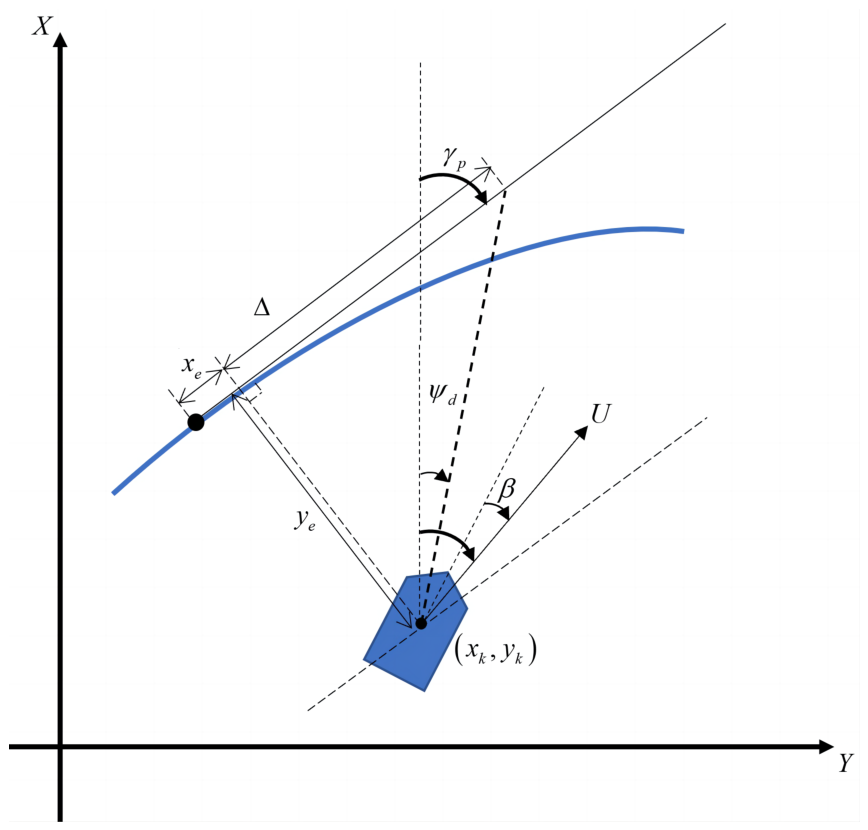
In this section, the design and analysis of PALOS guidance for 3-DOF USVs are presented. Prior to the guidance law design, the main variables involved in the PALOS-based path following are introduced, and the corresponding schematic diagram based on the conventional LOS is illustrated in Figure 1. Note that P ( θ ) is the reference path with θ being the path variable. In the control design, the path-tangential angle ψ p can be obtained as ψ p = arctan ( y p / x p ) with x p = x d / θ and y p = y d / θ , where ψ p and its first derivative ψ ˙ p are both known and bounded. The actual position of USVs is denoted by ( x , y ) . To facilitate the subsequent control scheme design, the position errors, including the longitudinal error and lateral error, are defined as follows:
x e y e = cos γ p sin γ p sin γ p cos γ p x x d ( θ ) y y d ( θ )
The sideslip angle β , as a bounded unknown time-varying variable, has its estimate β ^ maintaining an equivalently bounded property. Let β ˜ = β β ^ , x ˜ e = x e x ^ e , and y ˜ e = y e y ^ e .
By taking the derivative of x e and y e with respect to time, and incorporating the USV kinematic relations from (1) yields:
x ˙ e = U cos ( ψ γ p + β ) + y e γ ˙ p u p y ˙ e = U sin ( ψ γ p + β ) x e γ ˙ p
In these equations, U = u 2 + v 2 represents the resultant velocity of the USV, which is positive and bounded in practice; u p = θ ˙ x ˙ d 2 + y ˙ d 2 is the path parameter update speed.
In order to mitigate the influence of unknown time-varying sideslip angles on guidance performance, the predictor is formulated as follows:
x ^ ˙ e = U cos ( ψ γ p + β ^ ) + y e γ ˙ p u p + k 1 x ˜ e y ^ ˙ e = U sin ( ψ γ p + β ^ ) x e γ ˙ p + k 2 y ˜ e
where x ˜ e = x e x ^ e and y ˜ e = y e y ^ e denote the prediction errors; k x and k y are positive constants to be designed; β ^ 1 and β ^ 2 represent the estimates of β 1 and β 2 , respectively. This predictor achieves online estimation of the USV’s lateral error by introducing a position prediction error feedback mechanism, providing compensation basis for the subsequent guidance law design.
The update laws based on prediction errors are designed as:
β ^ = arctan ( β ^ 2 / β ^ 1 ) β ^ ˙ 1 = U cos ( ψ γ p ) x ˜ e + sin ( ψ γ p ) y ˜ e + k β 1 β ˜ 1 β ^ ˙ 2 = U sin ( ψ γ p ) x ˜ e cos ( ψ γ p ) y ˜ e + k β 2 β ˜ 2
where k β 1 and k β 2 are positive design constants.
From the above, the prediction error dynamics can be obtained as:
x ˜ ˙ e = U cos ( ψ γ p ) β ˜ 1 sin ( ψ γ p ) β ˜ 2 + γ ˙ p y ˜ e k x x ˜ e y ˜ ˙ e = U sin ( ψ γ p ) β ˜ 1 + cos ( ψ γ p ) β ˜ 2 γ ˙ p x ˜ e k y y ˜ e β ˜ ˙ 1 = U cos ( ψ γ p ) x ˜ e + sin ( ψ γ p ) y ˜ e k β 1 β ˜ 1 β ˜ ˙ 2 = U sin ( ψ γ p ) x ˜ e cos ( ψ γ p ) y ˜ e k β 2 β ˜ 2
The above error dynamics equations reflect the coupling relationship between prediction errors and estimation deviations, providing a mathematical foundation for stability analysis.
To address the path following problem of USVs in the presence of unknown time-varying sideslip angles, this subsection devises a predicted compensation mechanism for error dynamics. By introducing auxiliary variables, the predictor dynamic equations shown in (11)–(13) are constructed, aiming to achieve online estimation of prediction errors caused by time-varying sideslip angles, model uncertainties, and external environmental disturbances, thereby providing more precise compensation basis for the subsequent controller design. The key advantage of the predictor lies in its capability to indirectly estimate the sideslip angle using only position information without direct measurement, significantly reducing sensor configuration requirements. Proceeding from this foundation, this section proceeds to analyze the convergence performance of the predictor, and the theorem below is stated.
Theorem 1.
Consider the predictor system described by (11). With appropriately selected design parameters k x , k y , k β 1 and k β 2 , the prediction errors converge exponentially to a neighborhood of the origin, ensuring that all signals in the system are uniformly ultimately bounded.
Proof. 
Select the Lyapunov candidate function as V p = 1 2 x ˜ e 2 + 1 2 y ˜ e 2 + 1 2 β ˜ 2 + 1 2 θ ˜ 2 . Differentiating V p with respect to time and substituting (13) yields:
V ˙ p = x ˜ e γ ˙ P y ˜ e + U cos ( ψ γ P ) β ˜ 1 sin ( ψ γ P ) β ˜ 2 k x x ˜ e + y ˜ e γ ˙ P x ˜ e k y y ˜ e + U sin ( ψ γ P ) β ˜ 1 + cos ( ψ γ P ) β ˜ 2 β ˜ 1 U cos ( ψ γ P ) x ˜ e + U sin ( ψ γ P ) y ˜ e + k β 1 β ˜ 1 β ˜ 2 U cos ( ψ γ P ) y ˜ e U sin ( ψ γ P ) x ˜ e + k β 2 β ˜ 2
After rearrangement, one obtains:
V ˙ p k x x ˜ e 2 k y y ˜ e 2 k β 1 β ˜ 1 2 k β 2 β ˜ 2 2 ρ p V p
where ρ p is defined as:
ρ p = min k x , k y , k β 1 , k β 2
From the definition of ρ p , when the design parameters satisfy k x > 0 , k y > 0 , k β 1 > 0 and k β 2 > 0 , it follows that ρ p > 0 . Therefore, V ˙ p is negative definite. Invoking Lyapunov stability arguments, the prediction error dynamics are established to be uniformly ultimately bounded, featuring exponential convergence of all error trajectories to any arbitrarily small neighborhood of the equilibrium. This brings the proof of Theorem 1 to an end. □
Furthermore, the predicted adaptive LOS guidance law can be constructed as follows:
ψ d = γ P β ^ + arctan y ^ e Δ
where Δ is a parameter to be designed which denotes the lookahead distance, and its upper and lower bounds Δ max and Δ min are positive constants to be designed.
Furthermore, to achieve online updating of the path parameter, the update speed u p can be designed such that the USV accurately tracks the desired path:
u p = U cos ( ψ γ P + β ^ ) + k m x ^ e
where k m being a positive constant to be selected.
Accordingly, the update law for the path parameter θ is given as follows:
θ ˙ = U cos ( ψ γ P + β ^ ) + k m x ^ e ( x ˙ d 2 + y ˙ d 2 )
Based on the completed predictor design and convergence analysis, this subsection further investigates the stability of the guidance subsystem, and presents the following theorem regarding the convergence of the guidance subsystem.
Theorem 2.
Consider the guidance subsystem described by (17). With appropriately selected design parameters k m , k x and k y , based on the boundedness property of γ ˙ p , the system converges exponentially to a neighborhood of the origin.
Proof. 
Construct the Lyapunov candidate function V 2 = 1 2 x ^ e 2 + 1 2 y ^ e 2 . Taking the time derivative of V 2 and substituting the guidance error dynamic equations yields:
V ˙ 2 = x ^ e k m x ^ e + γ ˙ P y ^ e + k x x ˜ e + y ^ e γ ˙ P x ^ e U y ^ e Δ 2 + y ^ e 2 + k y y ˜ e = k m x ^ e 2 + k x x ^ e x ˜ e + k y y ^ e y ˜ e U y ^ e 2 Δ 2 + y ^ e 2
Combining with Lemma 1, one obtains:
x ^ e k x x ˜ e o 1 2 x ^ e 2 + k x 2 2 o 1 x ˜ e 2
y ^ e k y y ˜ e o 2 2 y ^ e 2 + k y 2 2 o 2 y ˜ e 2
Substituting (20) yields:
V ˙ 2 k m o 1 2 x ^ e 2 + o 2 2 y ^ e 2 U y ^ e 2 Δ 2 + y ^ e 2 + k x 2 2 o 1 x ˜ e 2 + k y 2 2 o 2 y ˜ e 2
From Lemma 2, it follows that:
U y ^ e 2 Δ 2 + y ^ e 2 U | y ^ e | + U Δ max
Furthermore, combining with Lemma 1, the above inequality can be written as:
U y ^ e 2 Δ 2 + y ^ e 2 U o 2 y ^ e 2 + U 2 o 3
Equation (24) can be rewritten as:
V ˙ 2 k m o 1 2 x ^ e 2 U o 2 o 2 2 y ^ e 2 + k x 2 2 o 1 x ˜ e 2 + k y 2 2 o 2 y ˜ e 2 + U 2 o 3 + U Δ max
By selecting appropriate design parameters such that k m o 1 2 > 0 and U o > o 2 , then
V ˙ 2 ρ 2 V 2 + Ξ 2 + ϖ x ˜ e 2 + y ˜ e 2
where ρ 2 = min k m o 1 2 , U o 2 o 2 2 , Ξ 2 = U 2 o 3 + U Δ max , and ϖ = max k x 2 2 o 1 , k y 2 2 o 2 .
Because Theorem 1 guarantees global uniform asymptotic stability for the prediction errors x ˜ e and y ˜ e , once the predictor reaches its steady state and the equalities x ˜ e = 0 and y ˜ e = 0 are assumed, the preceding inequality reduces to a simpler one:
V ˙ 2 ρ 2 V 2 + Ξ 2
Under the above conditions, the designed tuning parameters can ensure that ρ 2 > 0 holds, and therefore V ˙ 2 is negative definite. In line with Lyapunov stability theory, the error signals of the PALOS guidance subsystem are uniformly ultimately bounded; moreover, they converge exponentially to a small region around the origin. This behavior consequently guarantees the stability of the overall system. The above line of reasoning thus completes the proof of Theorem 2. □

4. Control Design and Stability Analysis

Once the feasible desired heading angle ψ d has been generated by applying the PALOS guidance law from the previous section, the current section proceeds to incorporate adaptive neural networks, virtual parameter learning, and lifelong learning mechanisms. By utilizing a self-triggered mechanism that drives the transmission of historical information, the lumped uncertainties (i.e., model uncertainties together with external disturbances) are approximated online and compensated in a dynamic manner.
In practical engineering, all actuators inevitably face physical limitations, meaning that the forces and torques delivered by the ship’s propulsion system cannot exceed certain upper bounds. Furthermore, taking Assumption 1 and the vessel’s maneuvering behavior into account, the ship velocity v remains bounded, i.e., v v m , with v m being a constant.

4.1. Surge Control

To achieve accurate and effective following of desired path, the desired surge velocity generated by surge velocity guidance as
u d = u max tanh k y e v e 2 + u min u max
where u max and u min are positive constants to be designed, which physically represent the upper and lower limits of the surge velocity of the USV, respectively. Meanwhile, k y e denotes another positive constant to be selected.
Subsequently, the error variable for the surge velocity is defined as follows:
u e = u u d
By differentiating (30) with respect to time and inserting the dynamic model (2), we arrive at:
u ˙ e = 1 m 11 f u ( v ) + τ u + τ w u u ˙ d
Combining with Assumption 2, we let H u ( s 1 ) = ( 1 / m 11 ) f u ( v ) u ˙ d be an unknown function, where the neural network input vector is described by s 1 = v T , u ˙ d T .
According to Lemma 3, introducing the neural network approximation mechanism yields:
H u ( s 1 ) = W 1 T H 1 ( s 1 ) + ε 1
where H 1 ( s 1 ) = h 1 , 1 ( s 1 ) , , h 1 , m ( s 1 ) T denotes the output from the hidden layer associated with the radial basis functions of the neural network. The quantity m indicates the total number of nodes in the network, while ε 1 represents its approximation error.
On this basis, we let G u ( s 1 ) = H u ( s 1 ) + ( 1 / m 11 ) τ w u . Substituting (32) into it, and according to Assumption 1, introducing the virtual parameter online learning mechanism, one obtains:
G u ( s 1 ) W 1 T H 1 ( s 1 ) + ε 1 + τ ¯ w u * ϑ u 1 ( s 1 )
where ϑ u = max W 1 T , ε 1 + τ ¯ w u * is an unknown virtual parameter greater than zero, and 1 ( s 1 ) = H 1 ( s 1 ) + 1 is a known scalar function. Meanwhile, τ ¯ w u * = ( 1 / m 11 ) τ ¯ w u is the unknown upper limit of the longitudinal external time-varying environmental disturbance, from which it can be inferred that τ ¯ w u * must be a positive unknown constant.
Therefore, to solve the path following control problem of underactuated USVs under the external time-varying disturbances and model dynamic uncertainties, the surge velocity control law τ u is designed as follows:
τ u = k u u e ϑ ^ u u e 1 2 ( s 1 )
where ϑ ^ u denotes the estimate of the adaptive virtual parameter ϑ u , and its adaptive law can be constructed as:
ϑ ^ ˙ u = c 1 u e 2 1 2 ( s 1 ) μ 1 ϑ ^ u c u L u ϑ ^ u ϑ ¯ u
We introduce the estimation error equation of the adaptive virtual parameter ϑ u , which can be written as ϑ ˜ u = ϑ u ( 1 / m 11 ) ϑ ^ u , with L u = e ϑ ^ u e ϑ ¯ u 1 , and k u , c 1 , c u and μ 1 are positive gain coefficients to be designed. ϑ ¯ u denotes the historical information obtained from the previous task. To circumvent the restrictive assumption of explicit task demarcation, an adaptive triggering schedule is synthesized that autonomously determines when to inject historical virtual-parameter trajectories into the current update law, enabling cross-scenario knowledge accumulation for USV operations without predefined phase boundaries [38]. The specific expression of the self-triggered mechanism is given subsequently.

4.2. Steering Control

After completing the surge velocity control design, this paper further designs the heading angle tracking control law to realize the turning motion of the USV. One may write the heading angle tracking error as follows:
ψ e = ψ ψ d
By differentiating the above expression with respect to time, we obtain:
ψ ˙ e = r ψ ˙ d
The virtual yaw velocity is designed as:
r d = ψ ˙ d k ψ ψ e
where k ψ is a positive design parameter.
Considering that the desired heading angular velocity r d contains the virtual control law ψ ˙ d to be designed, direct differentiation would inevitably lead to a sharp increase in control law complexity. To address this, dynamic surface control (DSC) technique is introduced, and a first-order filter is designed to filter r d :
σ r β ˙ r + β r = r d , β r ( 0 ) = r d ( 0 )
where σ r > 0 is a time constant; β r denotes the first-order filter.
We define the error variable y r = β r r d as the filtering error. Taking the time derivative of the first-order filter β r , one obtains β ˙ r = ( 1 / σ r ) y r , from which it can be further deduced that:
y ˙ r = β ˙ r r ˙ d = y r σ r + A r ( ψ e , ψ ˙ e , ψ ¨ d , ψ ¨ d )
Here, A r ( · ) constitutes a continuous function with a bounded range [1] and its supremum is denoted by A ¯ r . Therefore, the heading angular velocity error variable r e can be rewritten as follows:
r e = r β r + y r
By differentiating r e with respect to time and inserting (2), the following expression is derived:
r ˙ e = 1 m 33 f r ( v ) + τ ω r + τ r ( β ˙ r y ˙ r )
Similarly, we define the unknown function as H r ( s 2 ) = ( 1 / m 33 ) f r ( v ) ( β ˙ r y ˙ r ) , where the neural network input vector is described by s 2 = v T , y r T . According to Lemma 3, we employ a neural network to perform the approximation. This allows us to deduce:
H r ( s 2 ) = W 2 T H 2 ( s 2 ) + ε 2
where H 2 ( s 2 ) = h 2 , 1 ( s 2 ) , , h 2 , n ( s 2 ) T is the hidden layer output vector corresponding to the radial basis neural network functions; n and ε 2 denote the number of nodes and the approximation error of the neural network, respectively.
On this basis, we let G r ( s 2 ) = H r ( s 2 ) + ( 1 / m 33 ) τ ω r . Substituting (43) into it, and according to Assumption 1, introducing the single-parameter online learning mechanism, one obtains:
G r ( s 2 ) W 2 T H 2 ( s 2 ) + ε 2 + τ ¯ ω r * ϑ r 2 ( s 2 )
where ϑ r = max W 2 T , ε 2 + τ ¯ ω r * is a virtual parameter greater than zero, with τ ¯ ω r * = ( 1 / m 33 ) τ ¯ ω r being the unknown upper bound of the yaw external time-varying environmental disturbance, from which it can be inferred that τ ¯ ω r * must be a positive unknown constant. Therefore, the heading angular velocity control law τ r is designed as follows:
τ r = k r r e ϑ ^ r r e 2 2 ( s 2 )
where ϑ ^ r denotes the adaptive estimate of the virtual parameter ϑ r , and its adaptive law is designed as:
ϑ ^ ˙ r = c 2 r e 2 2 2 ( s 2 ) μ 2 ϑ ^ r c r L r ϑ ^ r ϑ ¯ r
Further, we define its estimation error as ϑ ˜ r = ϑ r ( 1 / m 33 ) ϑ ^ r , where L r = e ϑ ^ r / e ϑ ¯ r 1 , and k r , c 2 , c r and μ 2 are positive gain coefficients to be designed; ϑ ¯ r denotes the historical information obtained from the previous task [38].
To modulate the present adaptation law using accumulated parameter estimates from prior tasks ϑ ¯ , the following triggering protocol is designed:
ϑ ¯ ( t ) = ϑ ^ ( t j ) , t t , j , t , j + 1 t , j + 1 = t , j + t , s
where N . And the term ϑ ¯ ( t ) denotes the update rule for the critic network taken from the earlier learning stage, and takes the values of u or r. The interval scheduling t , s is then formulated as follows:
t , s = ˙ e ( t ) + Ξ max Θ , ˙ e ( t ) > 0 , = u , r
where 0 < < 1 , Ξ > 0 , and Θ > 0 are parameters to be designed; ˙ e ( t ) is the first-order derivative of the tracking error e ( t ) at t = t .
Remark 2.
In the designed adaptive law, the self-triggered mechanism is introduced as an information update and transmission scheduling means, avoiding the continuous real-time monitoring of triggering conditions required in event-triggered mechanisms, thereby reducing the computational burden. Meanwhile, through effective retention and transfer of historical information, it helps alleviate the catastrophic forgetting problem [39].
Remark 3.
According to (47), the time-scheduling function t , s functions as the inter-trigger interval, quantifying the temporal displacement between the historical knowledge epoch and the present instant. t , s is a function of e ( t ) and ˙ e ( t ) , through which the next migration length can be calculated based on e ( t ) , ˙ e ( t ) , and the parameters to be designed. According to (48), when the desired path changes relatively slowly and the external disturbance is small, appropriately increasing the triggering threshold parameters , Ξ and decreasing Θ can effectively reduce the triggering frequency. Conversely, should the operational environment undergo perturbation or exogenous disturbances escalate, reducing , Ξ and increasing Θ can enhance the response capability of the triggering mechanism to error variations.
Remark 4.
The triggering instants satisfy t , l R + , and when l = 0 , t , 0 is the initial triggering instant. According to the self-triggered protocol (47), the initial instant t , 0 cannot be calculated from the scheduling function; therefore, it must be predefined. The system then performs the first triggering operation upon reaching this known instant.

4.3. Stability Analysis

This subsection, within the design framework of the vector backstepping method, evaluates the stability of the entire guidance-control closed-loop system under the designed PALOS guidance scheme. In addition, it presents relevant proofs regarding the negative definiteness of the designed Lyapunov function.
Theorem 3.
Consider Equations (1) and (2) and further assume that all previously stated assumptions hold. If the predictor Formula (11), the PALOS guidance law (17), (29)–(38), the designed control laws (34), (45), the adaptive laws (35), (46), and the first-order filter (39) are adopted simultaneously, then by properly selecting the design parameters, the resulting closed-loop path following guidance-control system exhibits stable and convergent characteristics.
Proof. 
To investigate the stability of the closed-loop ship path-following control system, this section employs the Lyapunov direct method to construct a composite Lyapunov candidate function containing velocity errors, adaptive parameter errors, and dynamic surface errors as follows:
V c = 1 2 u e 2 + 1 2 ψ e 2 + 1 2 r e 2 + 1 2 y r 2 + m 11 2 c 1 ϑ ˜ u 2 + m 33 2 c 2 ϑ ˜ r 2
To facilitate subsequent derivation, we let ϑ ˜ u = ϑ u ϑ ^ u m 11 , ϑ ˜ r = ϑ r ϑ ^ r m 33 .
Differentiating (49) with respect to time gives:
V ˙ c = u e G u ( s 1 ) + 1 m 11 τ u + ψ e r ψ ˙ d + r e G r ( s 2 ) + 1 m 33 τ r + y r y ˙ r 1 c 1 ϑ ˜ u ϑ ^ ˙ u 1 c 2 ϑ ˜ r ϑ ^ ˙ r
Substituting (33), (44) and (40) into (50), the preceding equation can be further expressed as:
V ˙ c ϑ u 1 ( s 1 ) | u e | + τ u u e m 11 + ψ e r e + r d ψ ˙ d + ϑ r 2 ( s 2 ) | r e | + τ r r e m 33 y r 2 σ r + y r A ¯ r 1 c 1 ϑ ˜ u ϑ ^ ˙ u 1 c 2 ϑ ˜ r ϑ ^ ˙ r
Substituting the control laws (34) and (45), and the adaptive laws (35) and (46) sequentially into (51), the preceding relation can be reformulated as:
V ˙ c k u m 11 u e 2 k r m 33 1 r e 2 ( k ψ 1 ) ψ e 2 1 σ r 1 y r 2 μ 1 2 ϑ ˜ u 2 μ 2 2 ϑ ˜ r 2 + ϑ u + ϑ r 4 + μ u 2 ϑ u 2 + μ r 2 ϑ r 2 + A ¯ r 2 + c u L u 2 ϑ u 2 + c r L r 2 ϑ r 2 + c u L u 2 ϑ ¯ u 2 + c r L r 2 ϑ ¯ r 2 ρ c V c + Ξ c
where the specific expressions for ρ c and Ξ c are as follows:
ρ c = min k u m 11 , k r m 33 m 33 , k ψ 1 , 1 σ r σ r , μ 1 2 , μ 2 2
Ξ c = ϑ u + ϑ r 4 + μ 1 2 ϑ u 2 + μ 2 2 ϑ r 2 + A ¯ r 2 + c u L u 2 2 ϑ u 2 + c r L r 2 2 ϑ r 2 + c u L u 2 2 ϑ ¯ u 2 + c r L r 2 2 ϑ ¯ r 2
If appropriate design parameters are selected such that k u > 0 , k r > m 33 , k ψ > 1 , 0 < σ r < 1 , μ 1 > 0 , and μ 2 > 0 , it can be ensured that ρ c > 0 . Equation (49) can be further written as:
V c Ξ c ρ c + V c ( 0 ) Ξ c ρ c exp ( ρ c t )
where V c ( 0 ) is the initial value of V c ( t ) .
From (55), one may conclude that the proposed adaptive neural network path following control scheme can ensure the uniform ultimate boundedness stability of all signals in the closed-loop system under the combined effects of external time-varying disturbances and model dynamic uncertainties. Theorem 3 is thus proved. □
From (48), the minimum triggering interval is:
t , j + 1 t , j = t , s
Equation (47) implies the existence of a positive constant Θ k , satisfying the condition as: 0 < max Θ , ˙ e ( t ) Θ k , . Plugging this inequality into (56) then gives:
t , j + 1 t , j > Ξ Θ k ,
Therefore, there exists a lower bound for the interval between two consecutive triggers, which can avoid Zeno behavior. Furthermore, the differential term ˙ e ( t ) in the scheduling function exists and is bounded.

5. Simulation Results

To verify the effectiveness of the proposed PALOS-based 3-DOF USVs adaptive neural network path following control method, this section presents comprehensive numerical simulations using the 1:70 CyberShip II (CS2) vessel dynamics model, with relevant model parameters referred to in [40].

5.1. Validation of Assumptions in Numerical Simulation

The environmental disturbances τ w u , τ w v , τ w r in the simulation are generated as bounded time-varying signals:
τ w u = 2.0 sin ( 0.1 t ) + 1.0 sin ( 0.3 t ) , τ w v = 2.0 cos ( 0.15 t ) + 1.0 cos ( 0.25 t ) , τ w r = 1.0 sin ( 0.2 t ) ,
with amplitudes selected such that τ w 3 2 + 3 2 + 1 2 4.36 N < 5.0 N, satisfying the boundedness condition. The simulation resultes will show that the control inputs τ u and τ r remain uniformly bounded, confirming that the disturbances are compensable under the designed control law.
The nonlinear terms f u ( v ) , f v ( v ) , f r ( v ) in Equation (3) are computed using the nominal CyberShip II parameters from [40], but the controller does not use these explicit expressions. Instead, the RBF neural networks approximate the lumped uncertainties G u ( s 1 ) and G r ( s 2 ) online. The simulation resultes will show that the adaptive parameters ϑ ^ u and ϑ ^ r converge to bounded steady-state values, indicating successful approximation of the unknown nonlinearities. The boundedness of the approximation is further guaranteed by the velocity limiter u d = u max tanh ( · ) with u max = 1.0 m/s, which constrains the neural network input s 1 , s 2 to the compact set [ 2 , 2 ] × [ 2 , 2 ] × [ 2 , 2 ] as required by Lemma 3.
The desired path is chosen as a circular path P ( θ ) = [ 50 sin ( θ ) , 50 50 cos ( θ ) ] , whose first- and second-order derivatives are given by:
P ( θ ) = [ 50 cos ( θ ) , 50 sin ( θ ) ] , P ( θ ) = [ 50 sin ( θ ) , 50 cos ( θ ) ] ,
where P ( θ ) = 50 m and P ( θ ) = 50 m, both uniformly bounded. The path-tangential angle ψ p = arctan ( y p / x p ) = θ and its derivative ψ ˙ p = θ ˙ are bounded by the path parameter update speed u p U + k m | x ^ e | 1.5 m/s (from Equation (18)). Thus, all conditions of Assumptions 1–3 are satisfied.
To verify the effectiveness of the proposed PALOS-based 3-DOF USV adaptive neural network path following control method, this section presents comprehensive numerical simulations using the 1:70 CyberShip II (CS2) vessel dynamics model, with relevant model parameters referred to in [40]. The controller parameters are selected according to the following design guidelines: predictor gains ( k x = 12 , k y = 6 , k β 1 = k β 2 = 25 ) ensure exponential predictor convergence (Theorem 1); lookahead distance bounds ( Δ min = 2.5 , Δ max = 10.0 ) satisfy Δ [ 2 L , 8 L ] with vessel length L = 1.255 m [17]; surge control gain k u = 190 satisfies the stability condition k u > 0 established in Theorem 3; velocity limits ( u min = 0.5 , u max = 1.0 ) are employed to constrain the desired velocity command; yaw gains ( k ψ = 150 , k r = 70 ) achieve damping ratio ζ 0.7 ; adaptive rates ( c 1 = 1 , c 2 = 10 , μ 1 = 0.1 , μ 2 = 10 ) balance convergence speed against oscillation; triggering parameters ( u = 0.5 , r = 0.4 , Ξ u = Ξ r = 2.0 , Θ u = 0.2 , Θ r = 0.4 ) ensure minimum inter-trigger interval > 1.5 s (Theorem 3).
The initial state of the vessel is set as η ( 0 ) = [ 4 , 1 , 0 ] T and v ( 0 ) = [ 0.1 , 0 , 0.1 ] T , while all other initial conditions of the guidance-control system are set to zero. The parameterized desired path is set as x d ( θ ) , y d ( θ ) T = 50 sin ( θ ) , 50 50 cos ( θ ) T , where θ ( 0 , 2 π ) . The number of hidden layer nodes for the radial basis neural networks is both set to 20. In the surge velocity and heading angle control loop designs, the node centers are uniformly distributed in the input space [ 2 , 2 ] × [ 2 , 2 ] × [ 2 , 2 ] , and their function widths are both set to 1 [40].

5.2. Validation of the Superiority of the Proposed PALOS Control Method

To further demonstrate the superiority of the proposed PALOS guidance law, comparative simulations are conducted against the conventional pure line-of-sight (PLOS) guidance method. Both methods employ predictor-based sideslip angle estimation and compensation; however, the PLOS method utilizes a fixed lookahead distance Δ = 5.0 m and does not incorporate adaptive compensation mechanisms. Both methods share identical controller parameters and initial conditions to ensure a fair comparison.
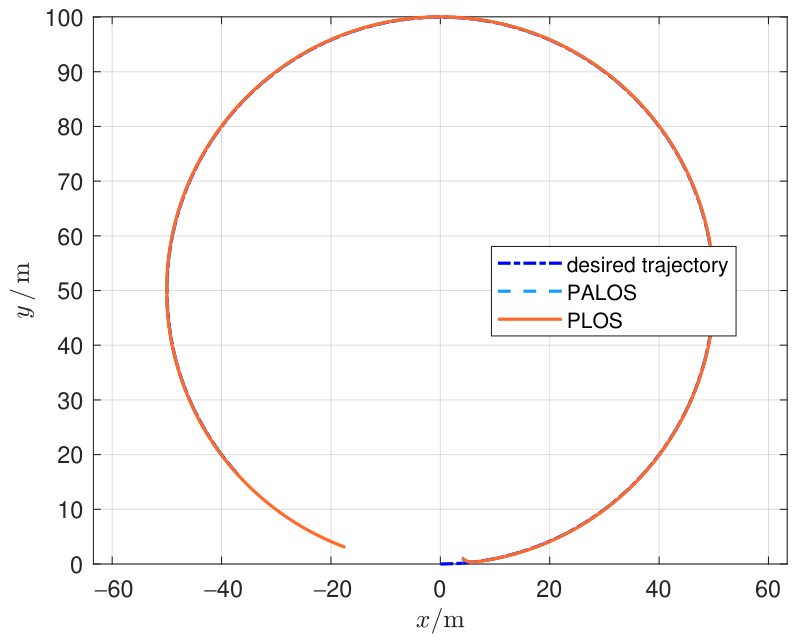
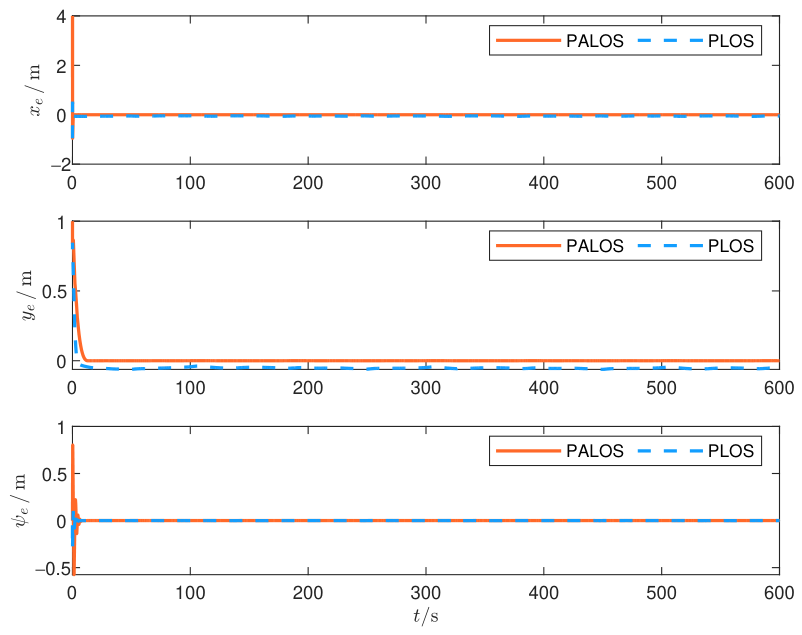
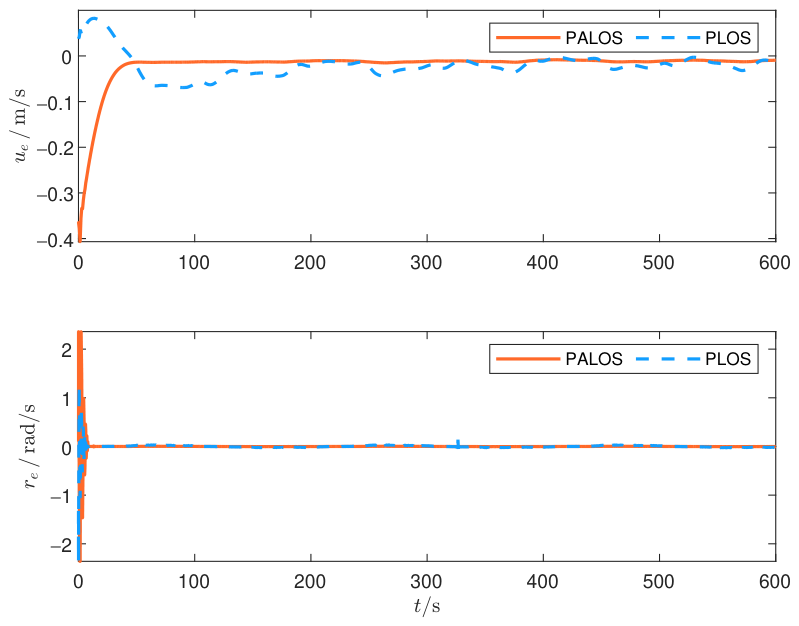
The simulation results are shown in Figure 2, Figure 3, Figure 4, Figure 5, Figure 6, Figure 7 and Figure 8.
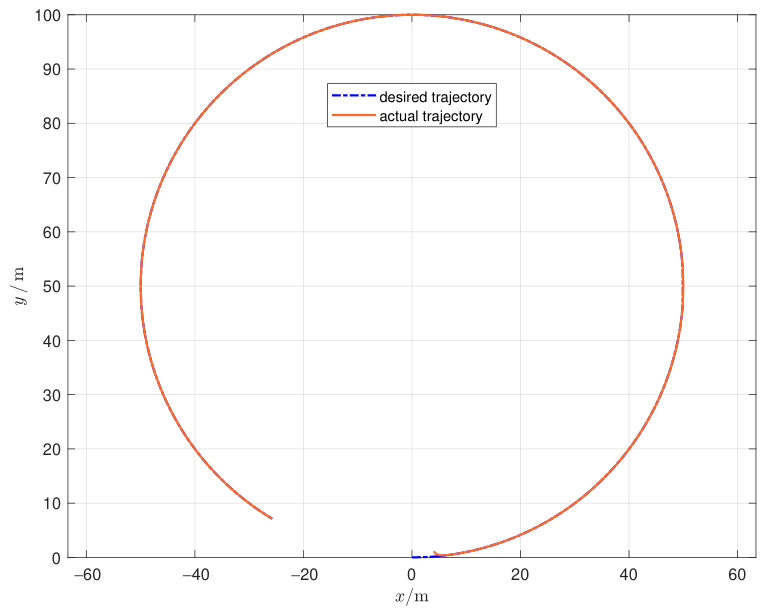
Figure 2 presents the path following trajectories in the x y -plane. The proposed PALOS method accurately tracks the desired path, whereas the PLOS method exhibits steady-state deviations due to its fixed lookahead distance and lack of adaptive compensation.
The position errors are shown in Figure 3. For PALOS, the along-track error x e converges to | x e | 0.05 m and the cross-track error y e converges to | y e |     0.1 m within t 20 s and t 30 s, respectively. In contrast, PLOS yields persistent errors of approximately 0.1 m for y e with oscillation amplitudes around 0.03 m.
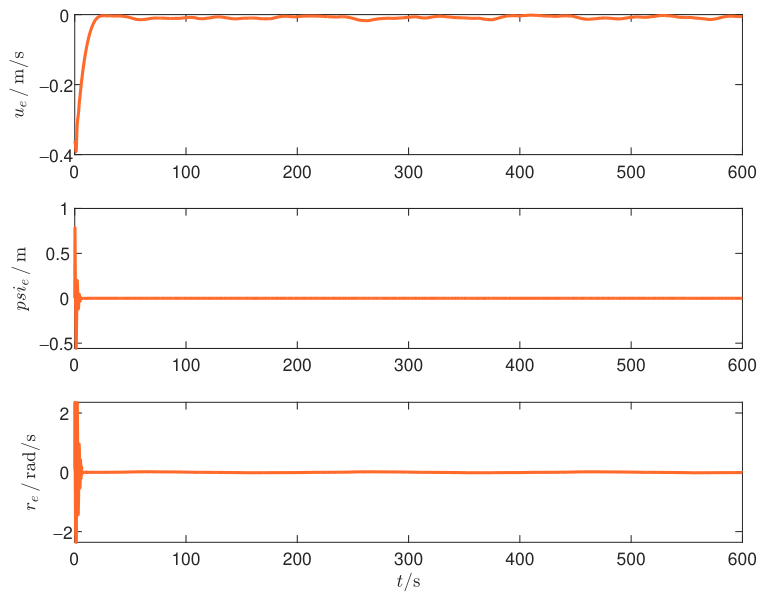
Figure 4 shows the surge velocity error u e and yaw rate error r e . The PALOS method achieves | u e |     0.05 m/s within t 40 s, whereas PLOS yields a steady-state error of u e 0.04 m/s. Both methods achieve similar yaw rate tracking performance.
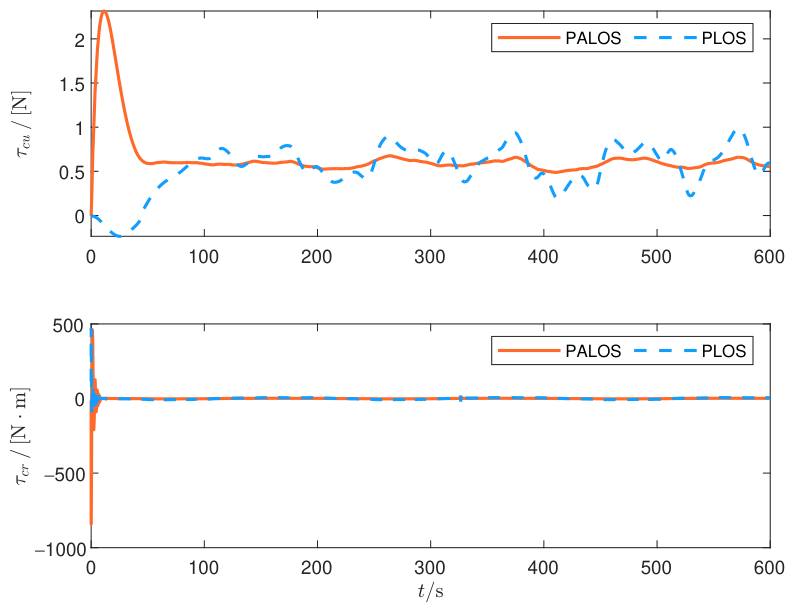
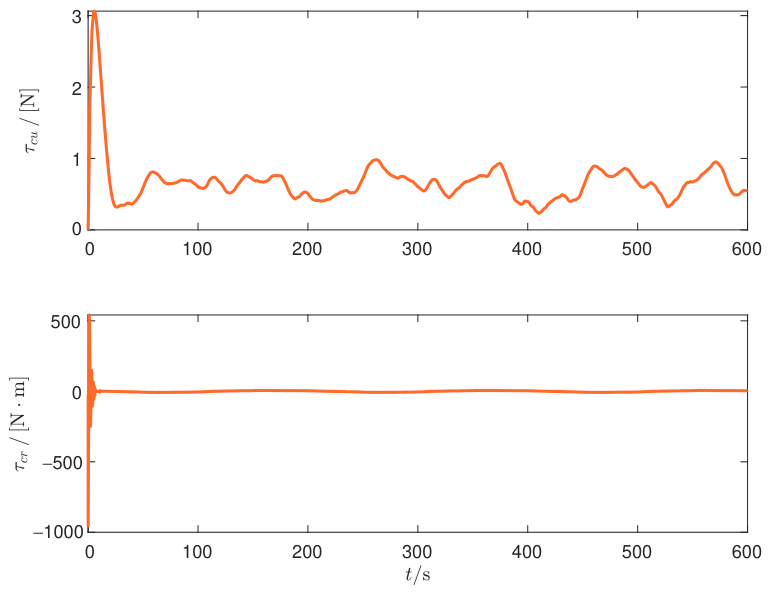
The control inputs are presented in Figure 5. For PALOS, the surge control τ c u exhibits an initial peak of 2.5 N and then converges to steady-state oscillations around 0.6 N, while the yaw control τ c r peaks at 500 N·m and rapidly decays to near zero.
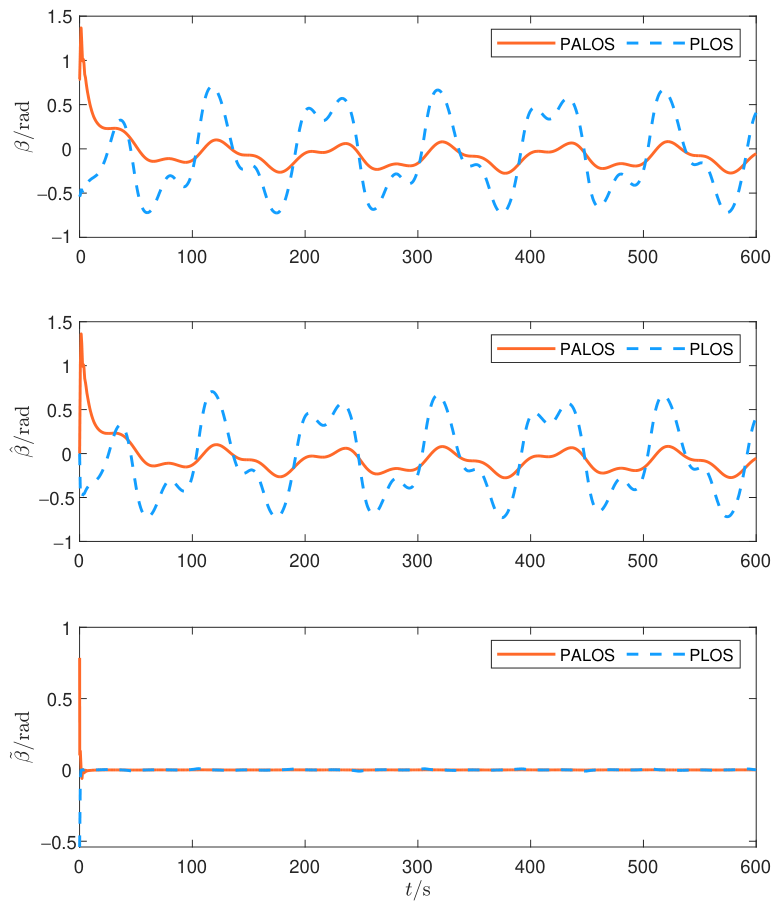
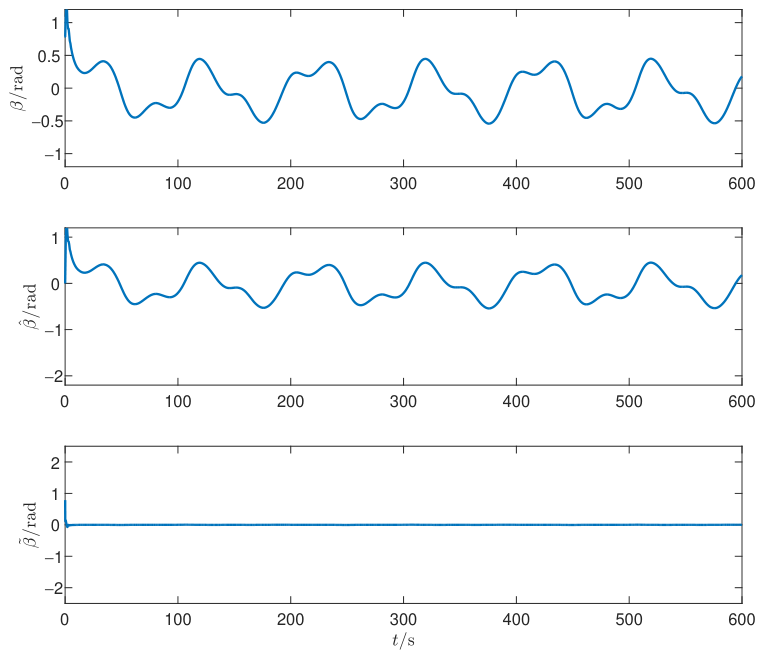
Figure 6 shows the sideslip angle estimation. For both PALOS and PLOS, the estimation error β ˜ converges to | β ˜ | 0.05 rad within t 10 s, validating the UUB stability in Theorem 1.
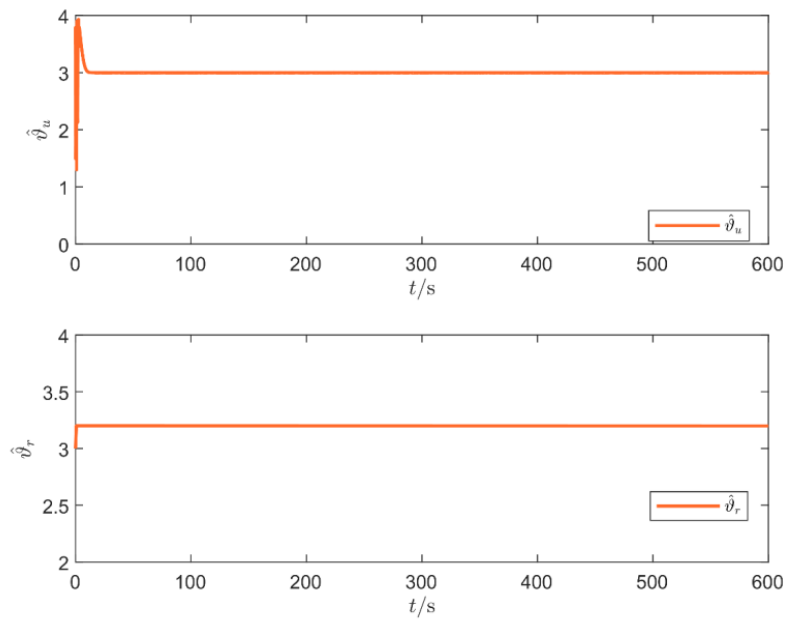
Figure 7 illustrates the adaptive parameters ϑ ^ u and ϑ ^ r , which converge to constant values (≈3.0 and ≈3.1) without unbounded growth, confirming the UUB stability in Theorem 3.
Figure 8 presents the self-triggered instant distribution. Both channels satisfy the Zeno-free condition with positive lower bounds. The average triggering intervals validate that the mechanism reduces communication load while guaranteeing control performance.
The simulations validate Theorems 1–3 and demonstrate the superiority of PALOS over PLOS. PALOS achieves accurate path following with small UUB errors, while PLOS suffers from persistent deviations due to its fixed lookahead distance and lack of adaptive compensation. The self-triggered mechanism ensures Zeno-free operation with reduced communication load.

5.3. Validation of Lifelong Learning Mechanism

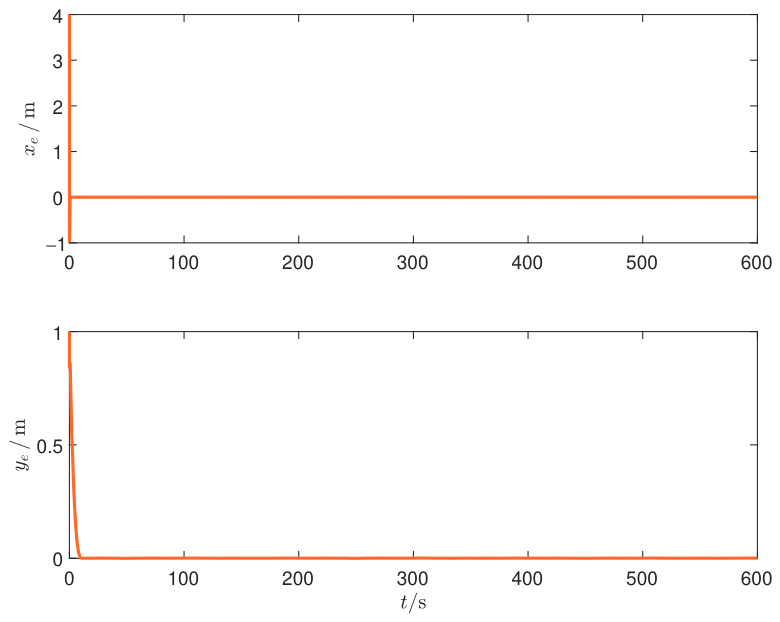
To validate the lifelong learning mechanism, supplementary simulations are conducted with reduced triggering frequency. The results are shown in Figure 9, Figure 10, Figure 11, Figure 12, Figure 13 and Figure 14. Note that the proposed mechanism is designed specifically for continuous USV path following tasks: it stores historical neural network parameter estimates and reactivates them during inter-trigger intervals to prevent loss of learned disturbance compensation knowledge within a single operational task. This differs from broader lifelong learning concepts involving multi-task transfer or long-term memory consolidation. The focus of this paper is on the PALOS-based control scheme, with the history-aware parameter retention serving as an enabling component for robust self-triggered control under intermittent communication.
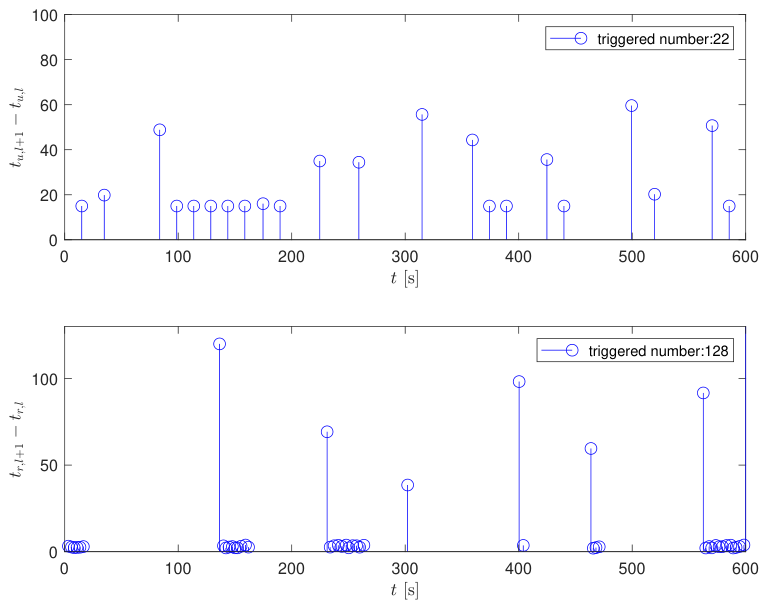
Figure 9 illustrates the self-triggered instant distribution under reduced communication. The triggered numbers decrease to 22 (surge) and 128 (yaw) over 600 s, and both channels satisfy the Zeno-free condition.
Figure 10 shows the path following trajectories under reduced triggering. The actual trajectory accurately follows the desired path, with only slight transient deviation increase.
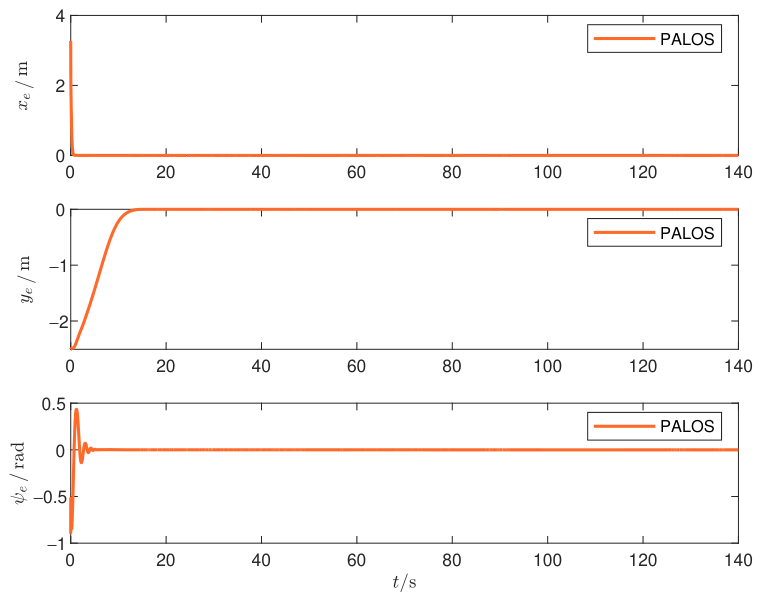
The position errors are shown in Figure 11. The along-track and cross-track errors converge to | x e |     0.08 m and | y e |     0.15 m, slightly larger than the original case. The heading error | ψ e |     0.03 rad exhibits a similar trend.
Figure 12 shows the control inputs under reduced triggering. The signals exhibit comparable magnitudes with slightly more pronounced transient oscillations. The steady-state efforts remain bounded.
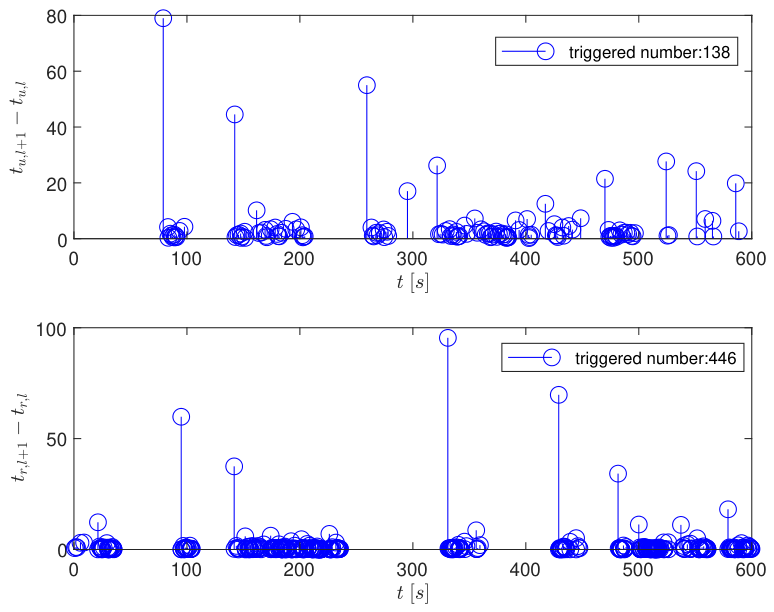
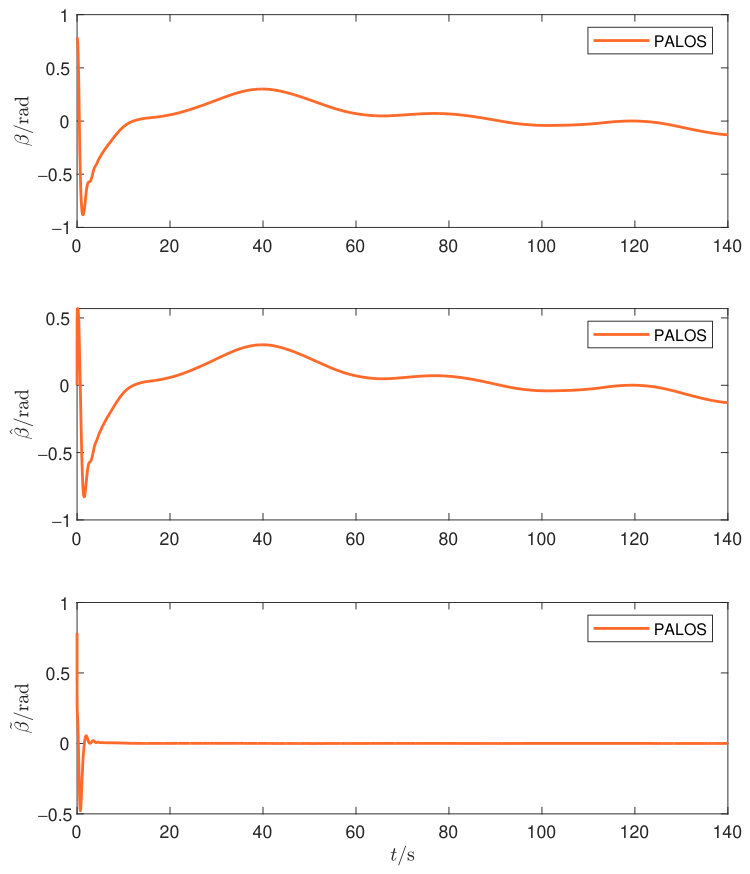
Figure 13 displays the sideslip angle estimation under reduced triggering. The predictor achieves effective tracking with | β ˜ |     0.08 rad, slightly larger than the original case ( 0.05 rad).
Figure 14 presents the velocity errors under reduced triggering. The surge error converges to | u e |     0.08 m/s, moderately larger than the original bound ( 0.05 m/s). The yaw rate error remains comparable ( | r e |     0.015 rad/s).
The supplementary simulations confirm that the lifelong learning mechanism enables stable path following under reduced triggering. Although tracking exhibits minor degradation in steady-state bounds and transient oscillations, all signals remain UUB and accuracy is preserved at an acceptable level. The triggered events are reduced by ≈ 84 % (surge, 138→22) and ≈ 71 % (yaw, 446→128), achieving substantial communication savings. This validates that history-aware parameter retention enhances the deploy ability of the self-triggered PALOS scheme in bandwidth-constrained marine applications.

5.4. Validation on Irregular Trajectory

To further demonstrate the adaptability of the proposed PALOS-based control scheme to paths with varying curvature, additional simulations are conducted on an S-shaped trajectory characterized by continuously changing curvature. The desired path is parameterized as
x d ( θ ) , y d ( θ ) T = L θ 2 π , W sin ( θ ) T ,
where L = 100 m and W = 40 m denote the path length and amplitude, respectively, with θ [ 0 , 2 π ] .
Notably, all controller parameters remain identical to those employed in the circular path scenario (Section 5.2), without any retuning. This validates the parameter robustness and generalization capability of the proposed method across different path geometries.
The simulation results are presented in Figure 15, Figure 16 and Figure 17.
Figure 15 illustrates the path following trajectory, demonstrating accurate tracking of the S-shaped path despite its varying curvature. The position errors (Figure 16) converge to | x e |     0.1 m and | y e |     0.2 m within t 20 s, while the heading error remains bounded by | ψ e |     0.05 rad. The sideslip angle estimation (Figure 17) achieves comparable accuracy to the circular path case, with | β ˜ |     0.08 rad. The control inputs still exhibits similar boundedness properties, with initial transient peaks attributable to the initial position offset and the path curvature variation.
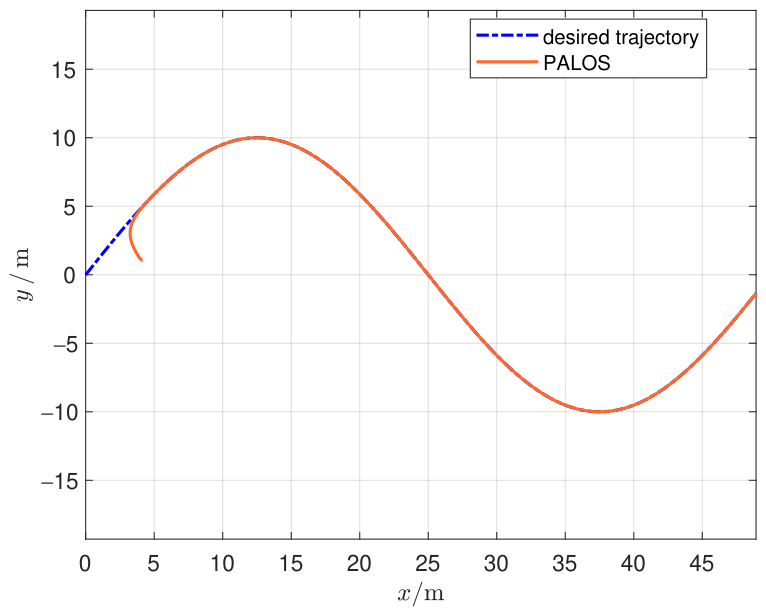
These results confirm that the proposed PALOS guidance law, coupled with the adaptive neural network compensator and predictor-based sideslip estimation, effectively handles paths with non-constant curvature without requiring path-specific parameter tuning.

6. Conclusions

This paper introduces predictor techniques, lifelong learning mechanisms, and self-triggered mechanisms to construct a parametric path following control framework for 3-DOF USVs under unknown time-varying sideslip angles. First, at the guidance level, prediction techniques and adaptive mechanisms are incorporated to overcome the limitation of the small sideslip angle assumption inherent to conventional LOS methods. Subsequently, a control-level design is presented: an adaptive neural network control law founded upon lifelong learning mechanisms is designed, wherein historical knowledge is constructed and preserved through feedback terms to achieve effective knowledge retention, improve control efficiency, and mitigate catastrophic forgetting problems. The self-triggered mechanism serves as a transfer tool, enabling the reuse of historical knowledge while relaxing the stringent assumptions on transfer conditions. Theoretical analysis proves the uniform ultimate boundedness stability of the closed-loop system and demonstrates that the self-triggered mechanism can avoid Zeno behavior. Comprehensive numerical simulations based on the 1:70 CyberShip II scale-model ship dynamics validate the effectiveness and feasibility of the proposed scheme.

Author Contributions

The idea for this research work was proposed by M.Y. and Y.W.; the MATLAB code was developed by M.Y.; the writing and data analysis were completed by M.Y.; proofreading and instance setting were performed by Y.W. All authors have read and agreed to the published version of the manuscript.

Funding

This research received no external funding.

Institutional Review Board Statement

Not applicable.

Informed Consent Statement

Not applicable.

Data Availability Statement

The original contributions presented in this study are included in the article. Further inquiries can be directed to the corresponding author.

Conflicts of Interest

The authors declare no conflicts of interest.

References

  1. Zhu, G.B.; Du, J.L. Global robust adaptive trajectory tracking control for surface ships under input saturation. IEEE J. Ocean. Eng. 2020, 45, 442–450. [Google Scholar] [CrossRef]
  2. Wang, W.; Huang, J.; Wen, C.; Fan, H. Distributed adaptive control for consensus tracking with application to formation control of nonholonomic mobile robots. Automatica 2014, 50, 1254–1263. [Google Scholar] [CrossRef]
  3. Zhu, G.B.; Li, J.H.; Ma, Y.; Hu, S. FT-ILOS-based Adaptive Fuzzy Path Following of USVs under Input Saturation via Parallel self-triggered Approach. IEEE J. Ocean. Eng. 2025, 50, 2744–2755. [Google Scholar] [CrossRef]
  4. Liu, Z.; Zhang, Y.; Yu, X.; Yuan, C. Unmanned surface vehicles: An overview of developments and challenges. Annu. Rev. Control 2016, 41, 71–93. [Google Scholar] [CrossRef]
  5. Liu, L.; Wang, D.; Peng, Z.H. State recovery and disturbance estimation of unmanned surface vehicles based on nonlinear extended state observers. Ocean Eng. 2019, 171, 625–632. [Google Scholar] [CrossRef]
  6. Huang, H.; Li, Y.; Zhuang, Y.; Gong, M.; Sharma, S.; Xu, D. A new guidance law for trajectory tracking of an underactuated unmanned surface vehicle with parameter perturbations. Ocean Eng. 2019, 175, 217–222. [Google Scholar] [CrossRef]
  7. Do, K.D.; Pan, J. Control of Ships and Underwater Vehicles; Springer: London, UK, 2009. [Google Scholar]
  8. Ashrafiuon, H.; Muske, K.R.; Menich, L. Review of nonlinear tracking and setpoint control approaches for autonomous underactuated marine vehicles. In Proceedings of the 2010 American Control Conference; IEEE: Baltimore, MD, USA, 2010. [Google Scholar]
  9. Fossen, T.I.; Breivik, M.; Skjetne, R. Line-of-sight path following for underactuated marine craft. In Proceedings of the IFAC Conference on Maneuvering and Control of Marine Craft, Girona, Spain, 17–19 September 2003. [Google Scholar]
  10. Lekkas, A.M.; Fossen, T.I. A time-varying lookahead distance guidance law for path following. In Proceedings of the 9th IFAC Conference on Maneuvering and Control of Marine Craft, Arenzano, Italy, 19–21 September 2012; pp. 398–403. [Google Scholar]
  11. Borhaug, E.; Pavlov, A.; Pettersen, K.Y. Integral LOS control for path following of underactuated marine surface vessels in the presence of constant ocean currents. In Proceedings of the 47th IEEE Conference on Decision Control, Cancun, Mexico, 9–11 December 2008; pp. 4984–4991. [Google Scholar]
  12. Fossen, T.I.; Pettersen, K.Y.; Galeazzi, R. Line-of-sight path following for Dubins paths with adaptive sideslip compensation of drift forces. IEEE Trans. Control Syst. Technol. 2015, 23, 820–827. [Google Scholar] [CrossRef]
  13. Peng, Z.; Wang, J.; Han, Q. Path-following control of autonomous underwater vehicles subject to velocity and input constraints via neurodynamic optimization. IEEE Trans. Ind. Electron. 2019, 66, 8724–8732. [Google Scholar] [CrossRef]
  14. Fossen, T.I.; Pettersen, K.Y. On uniform semiglobal exponential stability of proportional line of sight guidance laws. Automatica 2014, 50, 2912–2917. [Google Scholar] [CrossRef]
  15. Gu, N.; Wang, D.; Peng, Z.; Wang, J.; Han, Q.L. Advances in line-of-sight guidance for path following of autonomous marine vehicles: An overview. IEEE Trans. Syst. Man Cybern. Syst. 2023, 53, 12–28. [Google Scholar] [CrossRef]
  16. Zheng, Z.; Sun, L. Path following control for marine surface vessel with uncertainties and input saturation. Neurocomputing 2016, 177, 158–167. [Google Scholar] [CrossRef]
  17. Fossen, T.I. Handbook of Marine Craft Hydrodynamics and Motion Control; John Wiley & Sons: New York, NY, USA, 2011. [Google Scholar]
  18. Fossen, T.I. An adaptive line-of-sight guidance law for path following of aircraft and marine craft. IEEE Trans. Control Syst. Technol. 2023, 31, 2887–2894. [Google Scholar] [CrossRef]
  19. Sun, J.H.; Han, S.; Yan, L.X.; Liu, K.; Ding, S.F.; Zhou, L. Adaptive LOS guidance method for unmanned surface vehicle based on time-varying sideslip angle compensation. Chin. J. Ship Res. 2025, 20, 1–10. (In Chinese) [Google Scholar]
  20. Cheng, Y.X.; Han, B.; Shen, D.K.; Wang, C.Y. Hybrid LOS Guidance for Unmanned Surface Vehicle Complex Path Following. Comput. Simul. 2025, 42, 34–39. (In Chinese) [Google Scholar]
  21. Dong, W.; Zhu, Y.; Xing, J.; Wang, S.; Xin, Z. Line-of-sight guidance law design for path following of USVs with sideslip angle compensation. Ocean Eng. 2025, 342, 123015. [Google Scholar] [CrossRef]
  22. Xu, Z.; He, S.; Zhou, W.; Li, Y.; Xiang, J. Path following control with sideslip reduction for underactuated unmanned surface vehicles. IEEE Trans. Ind. Electron. 2023, 71, 11039–11047. [Google Scholar] [CrossRef]
  23. Yu, C.; Liu, C.; Lian, L.; Xiang, X.; Zeng, Z. ELOS-based path following control for underactuated surface vehicles with actuator dynamics. Ocean Eng. 2019, 187, 106139. [Google Scholar] [CrossRef]
  24. Wu, S.; Ye, H.; Liu, W.; Yang, X.; Liu, Z.; Zhang, H. An improved ELOS guidance law for path following of underactuated unmanned surface vehicles. Sensors 2024, 24, 5384. [Google Scholar] [CrossRef]
  25. Martinovic, L.; Zecevic, Z.; Bibuli, M.; Caccia, M.; Nađ, Ð. Adaptive observer-based line-of-sight guidance law for path following of underactuated unmanned surface vehicle with sideslip compensation. IEEE Access 2024, 12, 144992–145002. [Google Scholar] [CrossRef]
  26. Zecevic, Z.; Martinovic, L.; Asanin, L. Observer-based path following control of unmanned surface vehicle with exact compensation of sideslip angle. Ocean Eng. 2025, 342, 122947. [Google Scholar] [CrossRef]
  27. Liu, L.; Wang, D.; Peng, Z.; Wang, H. Predictor-based LOS guidance law for path-following of under-actuated marine surface vehicles with sideslip compensation. Ocean Eng. 2016, 124, 340–348. [Google Scholar] [CrossRef]
  28. Yu, Y.; Guo, C.; Li, T. Finite-time LOS path following of unmanned surface vessels with time-varying sideslip angles and input saturation. IEEE/ASME Trans. Mechatron. 2022, 27, 463–471. [Google Scholar] [CrossRef]
  29. Yu, Y.; Guo, C.; Yu, H. Finite-time PLOS-based integral sliding-mode adaptive neural path following for unmanned surface vessels with unknown dynamics and disturbances. IEEE Trans. Autom. Sci. Eng. 2019, 16, 1500–1511. [Google Scholar] [CrossRef]
  30. Ma, Y.; Weng, Y.; Wang, N. Finite-time sideslip observer-based model-free fast path-following control of disturbed autonomous surface vehicles with large time-varying sideslip. Ocean Eng. 2026, 344, 123600. [Google Scholar] [CrossRef]
  31. Polyakov, A.; Fridman, L. Stability notions and Lyapunov functions for sliding mode control systems. J. Frankl. Inst. 2014, 351, 1831–1865. [Google Scholar] [CrossRef]
  32. Wang, S.; Sun, M.; Xu, Y.; Liu, J.; Sun, C. Predictor-based fixed-time LOS path following control of underactuated USV with unknown disturbances. IEEE Trans. Intell. Veh. 2023, 8, 2088–2096. [Google Scholar] [CrossRef]
  33. Wang, N.; Sun, Z.; Zheng, Z.; Zhao, H. Finite-time sideslip observer-based adaptive fuzzy path-following control of underactuated marine vehicles with time-varying large sideslip. Int. J. Fuzzy Syst. 2018, 20, 1767–1778. [Google Scholar] [CrossRef]
  34. Wang, N.; Sun, Z.; Yin, J.; Su, S.F.; Sharma, S. Finite-time observer-based guidance and control of underactuated surface vehicles with unknown sideslip angles and disturbances. IEEE Access 2018, 99, 14059–14070. [Google Scholar] [CrossRef]
  35. Ganie, I.; Jagannathan, S. Lifelong learning-based optimal trajectory tracking control of constrained nonlinear affine systems using deep neural networks. IEEE Trans. Cybern. 2024, 54, 7133–7146. [Google Scholar] [CrossRef]
  36. Ganie, I.; Jagannathan, S. Lifelong reinforcement learning tracking control of nonlinear strict-feedback systems using multilayer neural networks with constraints. Neurocomputing 2024, 600, 128139. [Google Scholar] [CrossRef]
  37. Wang, C.; Lin, Y. Decentralized adaptive tracking control for a class of interconnected nonlinear time-varying systems. Automatica 2015, 54, 16–24. [Google Scholar] [CrossRef]
  38. Huang, X.; Lin, W.; Yang, B. Global finite-time stabilization of a class of uncertain nonlinear systems. Automatica 2005, 41, 881–888. [Google Scholar] [CrossRef]
  39. Khalil, H.K. Nonlinear Systems, 3rd ed.; Prentice Hall: New Jersey, NJ, USA, 2002. [Google Scholar]
  40. Skjetne, R.; Fossen, T.I.; Kokotović, P.V. Adaptive maneuvering, with experiments, for a model ship in a marine control laboratory. Automatica 2005, 41, 289–298. [Google Scholar] [CrossRef]
Figure 1. Geometric schematic of conventional LOS guidance under curved path conditions.
Actuators 15 00331 g001
Figure 2. Path following performance.
Actuators 15 00331 g002
Figure 3. Duration curve of following error.
Actuators 15 00331 g003
Figure 4. Duration curve of velocity tracking errors.
Actuators 15 00331 g004
Figure 5. Dactual control input τ c u and τ c r .
Actuators 15 00331 g005
Figure 6. Sideslip angle estimation performance.
Actuators 15 00331 g006
Figure 7. Duration curve of adaptive parameters.
Actuators 15 00331 g007
Figure 8. Self-triggered mechanism performance.
Actuators 15 00331 g008
Figure 9. Self-triggered instant distribution and triggering interval variation curves.
Actuators 15 00331 g009
Figure 10. Path following trajectories under reduced triggering frequency.
Actuators 15 00331 g010
Figure 11. Position errors under reduced triggering.
Actuators 15 00331 g011
Figure 12. Surge and yaw control inputs under reduced triggering.
Actuators 15 00331 g012
Figure 13. Sideslip angle estimation performance under reduced triggering.
Actuators 15 00331 g013
Figure 14. Surge velocity error and yaw rate error under reduced triggering.
Actuators 15 00331 g014
Figure 15. Path following trajectory on the S-shaped path.
Actuators 15 00331 g015
Figure 16. Position errors on the S-shaped path.
Actuators 15 00331 g016
Figure 17. Sideslip angle estimation performance on the S-shaped path.
Actuators 15 00331 g017
Disclaimer/Publisher’s Note: The statements, opinions and data contained in all publications are solely those of the individual author(s) and contributor(s) and not of MDPI and/or the editor(s). MDPI and/or the editor(s) disclaim responsibility for any injury to people or property resulting from any ideas, methods, instructions or products referred to in the content.