


Abstract
The AC rotary head, serving as a dual-axis direct-drive rotary actuation unit in five-axis CNC machine tools, integrates torque motors for A- and C-axis actuation, and its structural static and dynamic characteristics directly govern the actuation accuracy, dynamic response, and stability of the electromechanical system. Its complex spatial pose variations further complicate performance prediction. To overcome the difficulty of existing local optimization methods in balancing stiffness-mass matching for such complex actuation assemblies, this paper proposes a static and dynamic performance optimization method based on stiffness-mass matching. First, a pose-dependent semi-analytical dynamic model is established using dynamic condensation and component mode synthesis (CMS) to reveal performance distribution laws across the workspace and identify weak poses. Then, Sobol’ sensitivity analysis identifies key joints and structural components, and the NSGA-II algorithm optimizes their stiffness-mass matching. Finally, a surrogate model performs dimensional parameter optimization targeting the optimized matrices. Results show that the first-order natural frequency increases by 10.5%, translational static stiffness in the X and Y directions improves by over 20%, and other directions by 4.2–18.6%. The proposed method effectively enhances global static and dynamic performance, providing theoretical guidance for the structural design of direct-drive rotary actuators in electromechanical actuation systems.
1. Introduction
Five-axis CNC machine tools serve as the primary equipment for machining large and complex parts, and are widely used across the aviation, aerospace, nuclear power, and shipbuilding sectors. The AC rotary head, as a typical dual-axis direct-drive rotary actuation unit, is a core functional component of medium- and large-scale gantry-type five-axis machining centers, in which torque motors directly actuate the A- and C-axes without intermediate transmission, eliminating backlash and enabling high-bandwidth motion control. It is commonly used for machining large precision parts with complex curved surfaces. During machining, accuracy is affected by many factors, including kinematic errors, thermal errors, static and dynamic characteristics, and tool wear. Previous studies have primarily focused on geometric error compensation for five-axis machines [1,2,3,4,5,6] and on thermal analysis of milling heads [7,8,9,10], with the aim of improving machining accuracy. As direct-drive rotary actuators eliminate mechanical transmission and offer fast dynamic response, their performance is increasingly governed by structural rather than transmission factors [11,12]. Modern manufacturing, however, now demands higher speeds and tighter tolerances. Elastic deformation and chatter of the machine structure induced by cutting forces [13] have become the main bottleneck for machining accuracy and throughput. Understanding and refining the static and dynamic performance of the AC rotary head is therefore a key concern.
During five-axis machining, the AC rotary head must frequently shift its spatial pose to follow complex curved-surface toolpaths. As its structural topology and gravity distribution evolve continuously with motion, the rotary head exhibits markedly time-varying static and dynamic characteristics across different poses. Prior work has firmly established the strong influence of spatial pose variation on the static and dynamic characteristics of multi-axis machining equipment. Similar pose-dependent behavior has also been observed in direct-drive rotary actuators used in multi-axis precision equipment. Jiang et al. [14] constructed a dynamic prediction model incorporating the Nadam algorithm for a dual-rotary-table five-axis machine, uncovering how dynamic parameters evolve under the coupled effect of machining position and milling load. Huynh et al. [15], using multibody dynamics, built a pose-dependent reduced-DOF model of a five-axis machine that supports rapid prediction and dynamic simulation of the frequency response function (FRF) at arbitrary poses.
These studies indicate that such pose-varying dynamic behavior has a decisive effect on machining accuracy and cutting stability. A dynamic model that faithfully captures pose-dependent behavior is thus a prerequisite for any reliable performance prediction and optimization.
Existing dynamic modeling approaches primarily include the lumped parameter method, finite element analysis (FEA), transfer matrix method (TMM), and modal synthesis method. The lumped parameter method treats structural components as rigid bodies linked by equivalent spring and damping elements, yielding simple and efficient models [16,17,18,19,20], yet it struggles to capture the geometric features and local elastic deformation of complex components. FEA, through discretization, can resolve intricate structural details and is widely used for whole-machine dynamic performance prediction and structural optimization [21,22,23,24]; for pose-dependent time-varying components, however, repeated remeshing at each configuration is required, which is computationally expensive. TMM and its variants are algorithmically efficient [25,26,27,28], but still face difficulties in accurate reduced-order modeling of complex three-dimensional machine components. The modal synthesis method reduces the system DOF via dynamic condensation while retaining the dominant low-order modes. Recent work has coupled it with multi-point constraints, screw theory, or Jacobian formulations, overcoming the heavy computation of traditional models and delivering efficient, accurate prediction of pose-dependent dynamic performance throughout the entire workspace [29,30,31,32]. For components with complex rotary joints such as the AC rotary head, a pose-dependent semi-analytical dynamic model that balances accuracy with efficiency is therefore particularly attractive.
Improving the machining accuracy and stability of the AC rotary head ultimately depends on enhancing its static and dynamic performance, and structural optimization is a principal means to that end. Most existing studies rely on dimensional optimization, topology optimization, or bionic design to pursue lightweighting or a single stiffness metric [33,34,35]. More recent efforts have introduced multi-condition or multi-objective optimization to address static and dynamic performance jointly. For instance, Huang et al. [36] combined topology, bionic design, and neural networks for an integrated optimization of a gantry bed, while Ma et al. [37] optimized the dynamic performance of a whole machine using a reduced-order dynamic model coupled with a genetic algorithm. For complex assembled systems such as machine tools, however, the heavy computational cost undermines optimization efficiency and limits practical engineering use. Conventional local optimization tends to overlook the interactions among structural components and between components and joints. Optimizing a single component without regard to system-level matching readily produces an unbalanced mass distribution or local stiffness weakness, leading in turn to reduced low-order natural frequencies and degraded anti-vibration performance.
Most studies on stiffness and mass distribution target structural components with relatively fixed spatial poses, such as beds and columns. Lin et al. [38] carried out bionic lightweight and high-stiffness design for the worktable, bed, and column of a grinding machine. Core rotary functional components of multi-axis machines, such as the AC rotary head, instead display complex pose-dependent time-varying behavior during machining. Liu et al. [39] combined spatial coordinates with workspace analysis to topologically optimize a machining robot with spatial motion features, aiming to mitigate insufficient stiffness.
In summary, how to raise computational efficiency, pinpoint performance-sensitive poses under pose-dependent time-varying behavior across the global workspace, and deliver coordinated stiffness-mass matching of the whole assembly remains the central open problem in the structural optimization of complex moving components such as the AC rotary head. While individual techniques such as CMS, Kriging, Sobol analysis, and NSGA-II are well-established, their isolated or conventional application falls short in addressing these coupled challenges. Existing optimization approaches for machine tools typically focus on fixed poses or isolated component lightweighting, lacking a cohesive strategy for complex moving assemblies.
Therefore, the specific methodological contribution of this paper is the proposal of a novel, closed-loop structural optimization framework tailored for pose-dependent time-varying components. By systematically integrating these established methods, the proposed framework uniquely bridges the gap between global workspace weak-pose identification and system-level stiffness-mass matching. The main contributions of this work within this framework are as follows:
(1) A pose-dependent semi-analytical dynamic modeling method is proposed for the AC rotary head. Built upon dynamic condensation and component mode synthesis (CMS) and combined with uniform design of experiments and Kriging surrogate modeling, the method is validated against experiments and simulations.
(2) A weak-link identification method grounded in global-workspace weak poses is developed. Using Sobol’ sensitivity analysis, the influence of joint and structural-component parameters on the static and dynamic performance of the AC rotary head at weak poses is quantified, which pinpoints the key joints and key structural components.
(3) A structural optimization scheme driven by stiffness-mass matching is introduced. The NSGA-II multi-objective genetic algorithm first performs global matching of the key joints and components to yield the optimal stiffness and mass matrices; a dimensional-parameter surrogate model is then constructed with these matrices as the target, and size optimization is carried out on the key structural components, resolving local stiffness weakness and unbalanced mass distribution in complex assemblies.
The optimization framework for the static and dynamic performance of the AC rotary head based on stiffness-mass matching is presented in what follows, and the paper is organized as follows. Section 2 builds the pose-dependent semi-analytical dynamic model and identifies the weak poses for static and dynamic performance across the global workspace. Section 3 takes the identified weak pose as a benchmark to isolate the weak links, locating the key joints and key structural components. Section 4 performs stiffness-mass matching of these key joints and components on the basis of the semi-analytical dynamic model, and then carries out size optimization of the key components under the matching constraints, thereby enhancing the static and dynamic performance of the AC rotary head. Section 5 summarizes the work and draws conclusions.
2. Pose-Dependent Dynamic Modeling of the AC Rotary Head
2.1. Substructure Division
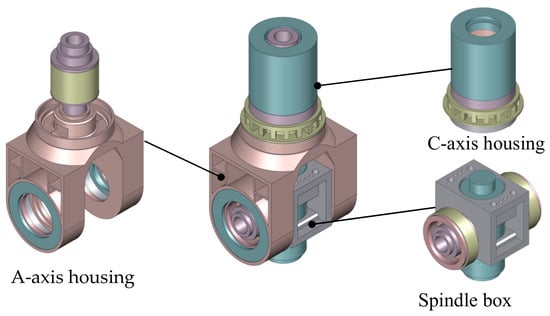
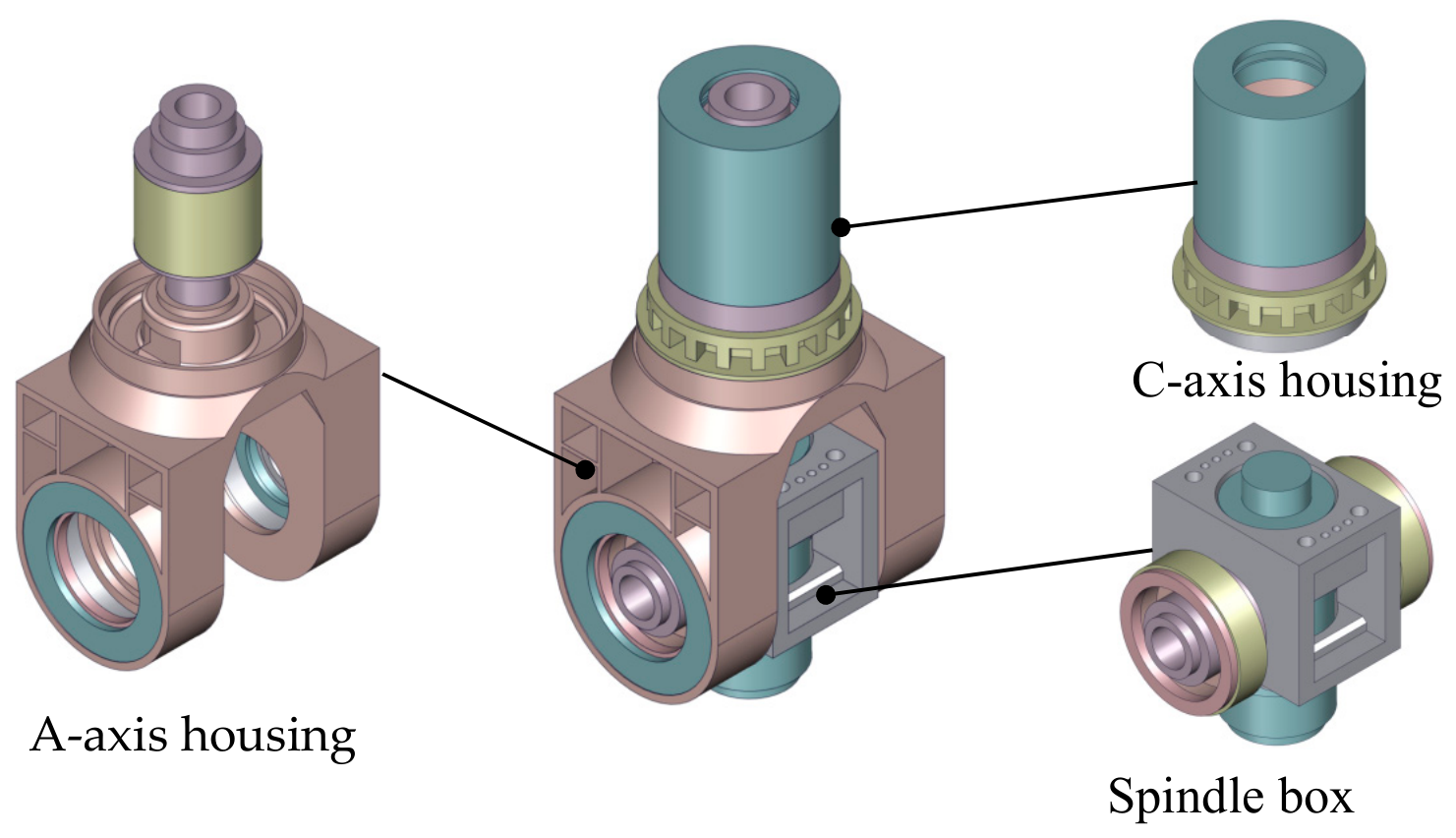
Substructure division is a prerequisite for CMS-based dynamic modeling of the AC rotary head. A sensible partition reduces the computational scale and improves the efficiency and accuracy of the model. Taking the AC rotary head, a representative dual-axis direct-drive rotary actuator, as the research object, and based on the function, dynamic behavior, and joint connections of each substructure, the head is partitioned into three parts: the A-axis housing, the C-axis housing, and the spindle box. The resulting division is shown in Figure 1.
Figure 1.
Substructure division of the AC rotary head.
2.2. Pose-Dependent Dynamic Modeling of Substructures
2.2.1. Reduced Dynamic Model of the Substructure
Building on the dynamic condensation method together with rigid multi-point constraints (RBE2), the component mode synthesis (CMS) scheme is adopted, and a condensation node is created at the center of each substructure joint. Modal reduction is then performed on this node, from which the stiffness and mass matrices of the substructure are extracted. By combining the analytical method with the finite element method, and applying dynamic condensation, the semi-analytical dynamic model of the substructure is formulated as follows:
where and denote, respectively, the nodal displacement vector and the nodal force vector of substructure i after FE meshing and dynamic condensation; and stand for the external nodal displacement vector and the internal modal vector of the condensed substructure; and and are the corresponding condensed mass and stiffness matrices, whose dimensions depend on the number of FE nodes retained at the joint after meshing and on the order of internal modes selected.
On the basis of rigid multi-point constraints (RBE2), a six-DOF condensation node is created at the equivalent center of the joint and denoted by . The displacement of any FE node on joint can then be expressed through that of this condensation node as follows [40]:
where and denote the three-dimensional translational and rotational displacement vectors of the condensation node , respectively; is the three-dimensional translational displacement vector of the k-th FE node on the joint; and is the position vector pointing from to .
Under the rigid multi-point assumption, the external nodal displacement vector of substructure i in Equation (2) can be rewritten as
where is the six-dimensional nodal displacement vector of the condensation node ; is the rigid multi-point constraint matrix; and stands for the skew-symmetric matrix of the vector .
Likewise, the external nodal displacement vector of substructure j can be written, under the same assumption, as
where denotes the six-dimensional nodal displacement vector of the condensation node .
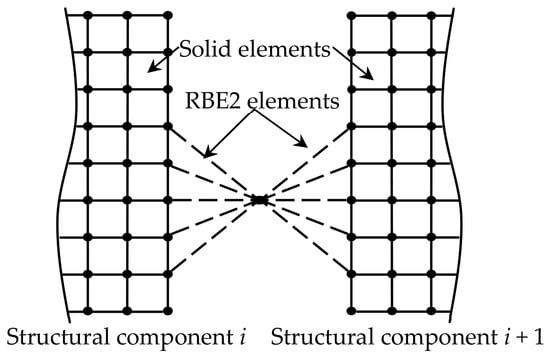
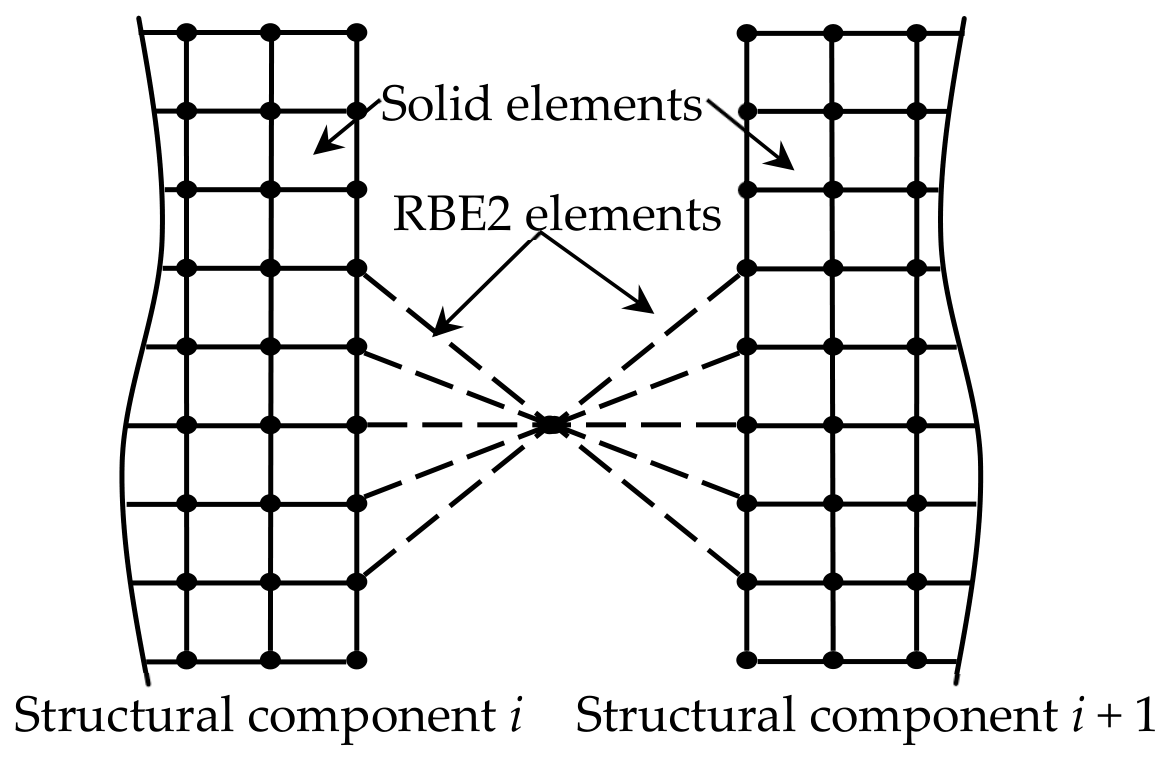
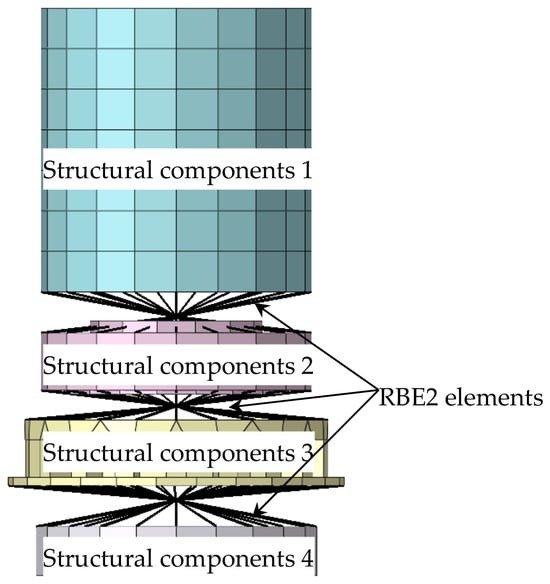
Within substructure i, rigid RBE2 elements are created between the joint surfaces of structural component i and structural component i + 1, enforcing rigid multi-point constraints across the joint, as shown in Figure 2.
Figure 2.
Rigid multi-point constraints on the joint surface.
Taking the C-axis housing substructure as an example, rigid RBE2 elements are inserted between the joint surfaces of its structural components to enforce rigid multi-point constraints across the joints, as shown in Figure 3.
Figure 3.
Rigid multi-point constraints in the C-axis housing substructure.
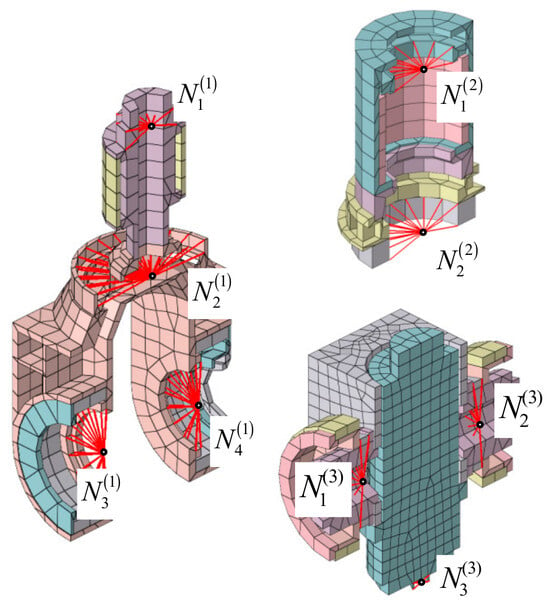
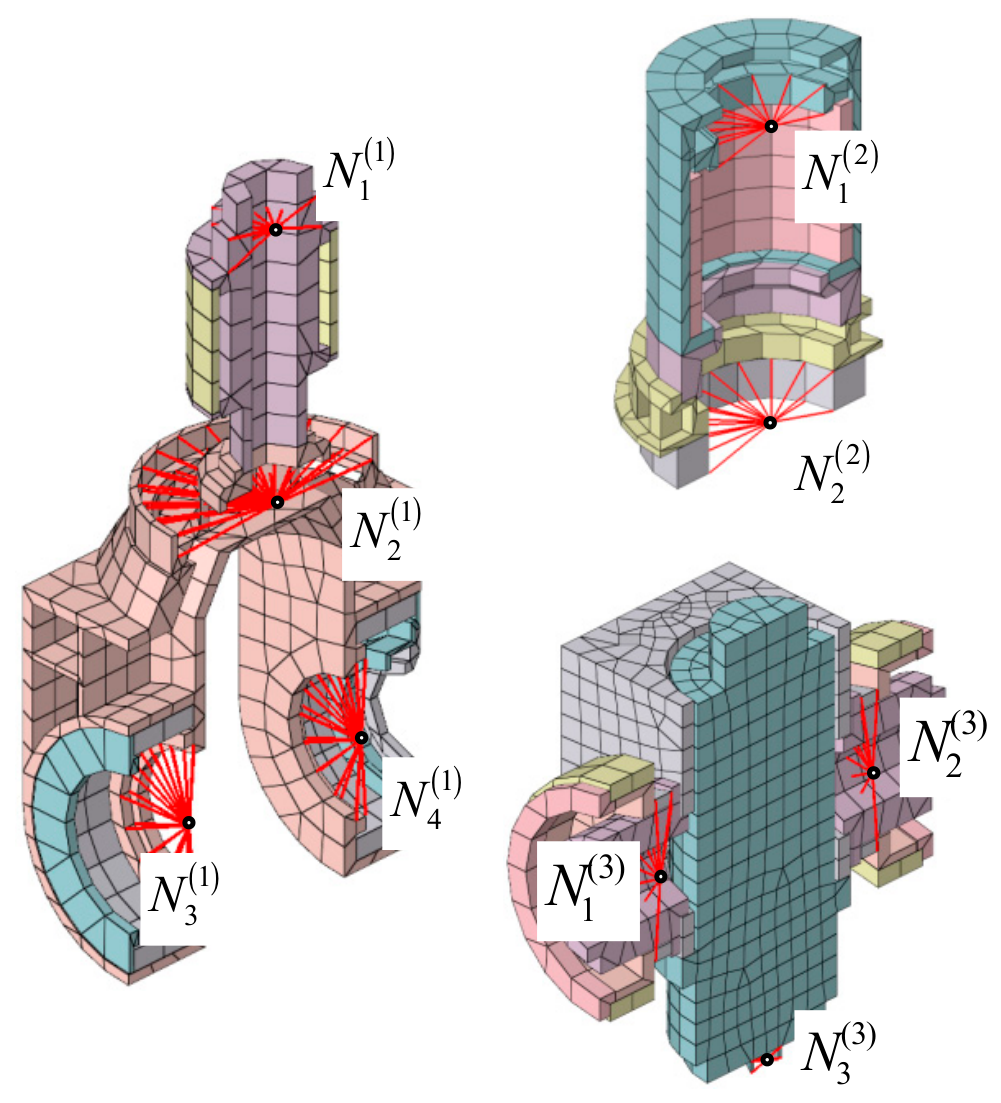
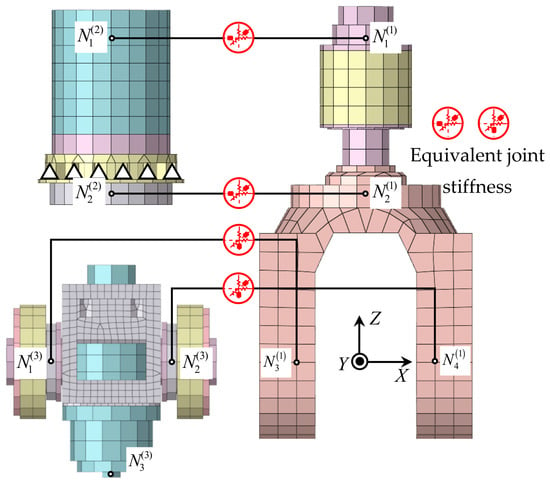
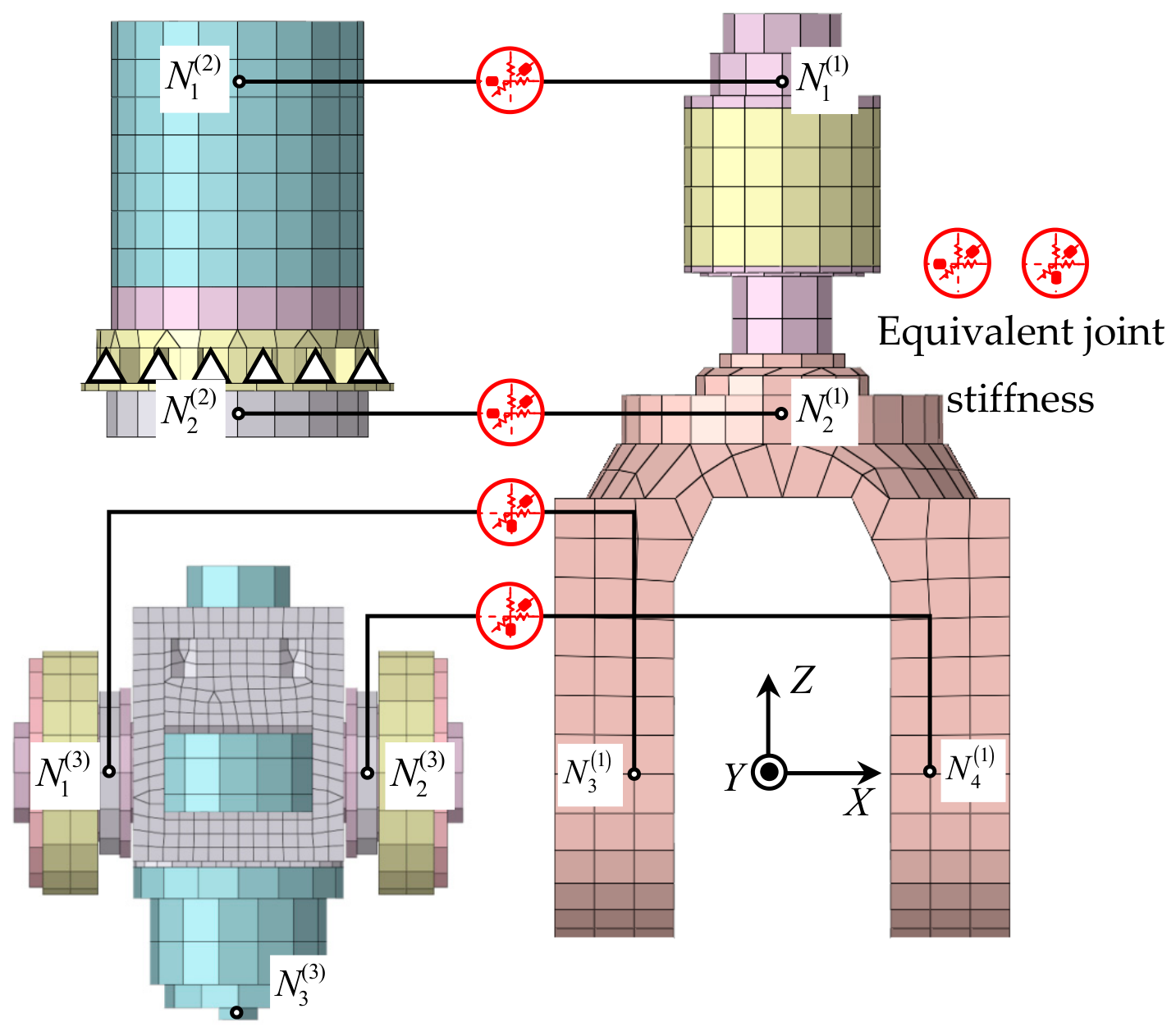
Based on these rigid multi-point constraints, condensation nodes are defined for the A-axis housing, C-axis housing, and spindle box substructures. Specifically, , , , and are placed at the centers of the four joints of the A-axis housing substructure; and at the centers of the two joints of the C-axis housing substructure; and and at the centers of the two joints of the spindle box substructure. An additional node is defined at the spindle tip, as illustrated in Figure 4.
Figure 4.
Schematic of condensation nodes for each substructure.
The modal reduction described above is performed in finite element software. The internal nodes of each substructure are condensed to reduce the number of degrees of freedom, while rigid multi-point constraints are imposed between the structural components within the substructure through rigid RBE2 or flexible RBE3 elements. Condensation nodes are then defined at the substructure joints via these constraints, yielding a reduced dynamic model of the substructure.
2.2.2. Pose-Dependent Dynamic Modeling of the AC Rotary Head
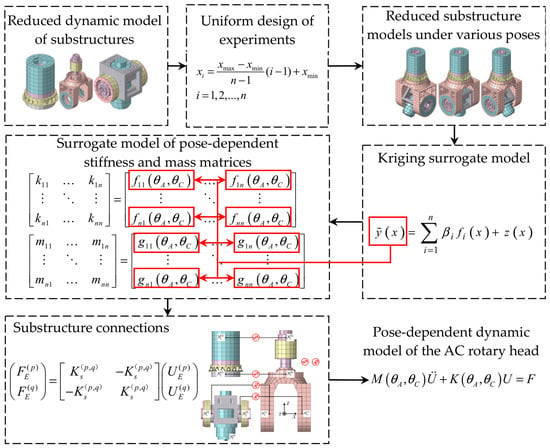
The workflow for pose-dependent dynamic modeling of the AC rotary head is shown in Figure 5.
Figure 5.
Workflow of pose-dependent dynamic modeling for the AC rotary head.
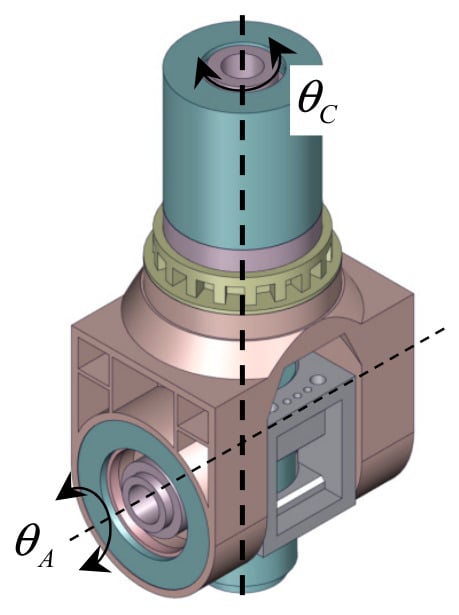
When the pose of the AC rotary head changes, the reduced finite element model of each substructure changes accordingly, which in turn alters its stiffness and mass matrices. Figure 6 shows a schematic of the AC rotary head rotation, where denotes the rotation angle about the A-axis shaft (ranging from −110° to 110°) and denotes the rotation angle about the C-axis shaft (ranging from 0° to 360°). The reduced model of each substructure therefore depends on these two pose parameters. Uniform design of experiments is adopted for pose sampling, and 3285 sample points are selected across the entire workspace to ensure reasonable coverage.
Figure 6.
Schematic of the rotational motion of the AC rotary head.
A Kriging surrogate model is employed in this work. It combines a regression model with a stochastic function, and the single-output response is written as
where is the number of regression terms, is the coefficient of the i-th regression term, is the i-th regression function, and z(x) is the stochastic function.
The reduced finite element model of each substructure is updated at every sample point, and dynamic condensation then yields the corresponding stiffness and mass matrices. A Kriging surrogate is subsequently built for every entry of these matrices, taking the pose parameters as inputs. This produces pose-dependent stiffness and mass matrices for each substructure, and a surrogate model covering the full pose space is obtained. The resulting model captures the nonlinear dependence of each matrix entry on the pose parameters, as expressed in Equation (6).
where through denote the entries of the substructure stiffness matrix, and through are the entries of the substructure mass matrix. and are the pose parameters of the substructure. The terms through describe the nonlinear mappings from the pose parameters to the individual entries of the stiffness matrix, while through are defined in the same way.
To ensure the reproducibility and accuracy of the Kriging surrogate models, specific modeling procedures were established. Specifically, a Gaussian kernel function was selected to capture the spatial correlation, and the hyperparameters were optimized using Maximum Likelihood Estimation (MLE). The pose-dependent dynamic models for the A-axis housing and the spindle box substructures were constructed separately. To validate the prediction accuracy, 10 sets of pose samples were randomly selected as a separate testing set, while the remaining samples were utilized to train the surrogate models. Excluding special matrix entries that are constant or negligibly small, the minimum coefficient of determination () among the remaining entries was used to evaluate the overall model performance. The calculated minimum values for the stiffness and mass matrices of the A-axis housing substructure are 0.9873 and 0.9886, respectively. Similarly, the minimum values for the stiffness and mass matrices of the spindle box substructure are 0.9901 and 0.9896, respectively. These results demonstrate that the constructed Kriging surrogate models possess high prediction accuracy and fully meet the modeling requirements.
The dynamic model of the AC rotary head is established using the component mode synthesis (CMS) method, by assembling the substructure stiffness and mass matrix models together with the joint contact stiffness matrices. Figure 7 shows the corresponding assembly process, in which the substructures are linked via joint contact stiffness matrices.
Figure 7.
Schematic of the substructure connection relationships.
The joint stiffness between substructures and is represented by an equivalent six-DOF spring. The deformation compatibility between the two temporary nodes connected by this spring then takes the form of Equation (7):
where is the six-DOF spring stiffness matrix of the joint between substructures and , denotes the six-dimensional force vector acting on the temporary node of the corresponding substructure, and denotes the six-dimensional displacement vector at that node.
Based on the deformation compatibility at the joint, the stiffness matrices of substructures and can be assembled with the joint stiffness matrix . Assuming that the joint connection occurs between the n-th node of substructure and the 1st node of substructure , the assembled global stiffness matrix takes the form:
The mass matrix is assembled in a simpler manner: the mass matrices of substructures and are concatenated along the block diagonal, yielding the global mass matrix:
Following the schematic of the substructure connections of the AC rotary head, the stiffness matrices of the individual substructures and their joints are assembled through the deformation compatibility conditions to form the stiffness matrix of the AC rotary head. The mass matrix is obtained in the same manner by applying the block-diagonal assembly scheme to the substructure mass matrices.
At different pose configurations, assembling the substructure and joint matrices yields the pose-dependent dynamic equation of the AC rotary head:
where and denote the stiffness and mass matrices of the AC rotary head, while and are the external force vector and nodal displacement vector at the retained (master) nodes after dynamic condensation.
2.2.3. Simulation and Experiment
Defining accurate boundary conditions is crucial for capturing the real dynamic characteristics of the structural system. To closely replicate actual working conditions, the AC rotary head was not analyzed in a free-free state. Instead, during the physical experiments, the AC rotary head was securely mounted to the machine tool’s ram. Correspondingly, in the finite element model, fixed boundary conditions were applied at the connection interface between the rotary head and the ram to simulate this actual assembly state.
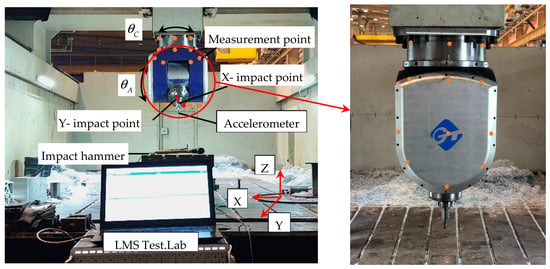
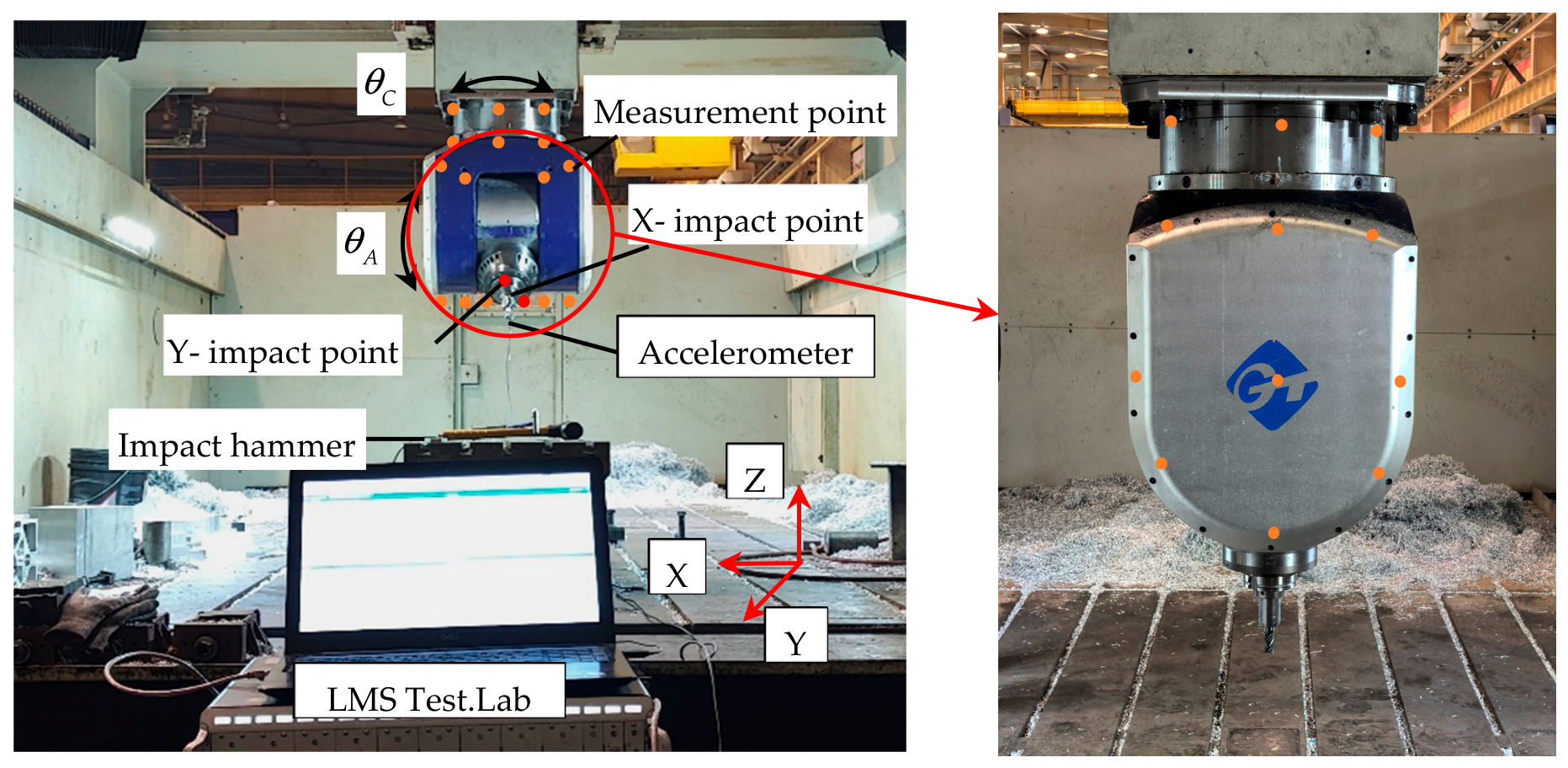
Based on these boundary conditions, impact hammer tests were conducted on the AC rotary head to measure its frequency response and to assess the accuracy of the pose-dependent formulation. The modal tests were performed using the LMS Test.Lab system equipped with an SCM2E05 data acquisition unit. To effectively excite the AC rotary head and ensure sufficient energy input, an LC2 impact hammer was used to apply excitations at the X and Y ends of the spindle. To comprehensively capture the mode shapes and avoid vibration nodes, measurement points were distributed across the AC rotary head, and the acceleration responses were collected using PCB 356A33 triaxial accelerometers.
To minimize random noise, the impact test was repeated three times at each position, and the frequency response functions (FRFs) were averaged. The natural frequencies and mode shapes were determined using the PolyMAX algorithm integrated into the LMS Test.Lab software. Stabilization diagrams were employed during the analysis to select the appropriate model order and accurately identify the stable physical poles. Although multiple higher-order frequencies were validly captured, the subsequent analysis primarily focuses on the first-order natural frequency. This is because the first-order mode corresponds to the lowest dynamic stiffness and is the most susceptible to excitation during actual machining operations, thereby playing a dominant role in the dynamic stability of the AC rotary head. During the tests, the C-axis angle was held fixed, while the A-axis was rotated to six positions: 0°, 20°, 40°, 60°, 80°, and 90°. The C-axis was kept constant because, as will be detailed through the global workspace simulation in Section 3.1, the C-axis rotation does not alter the relative position between the rotation and swing axes. Consequently, the system’s dynamic performance is highly sensitive to the A-axis but effectively decoupled from the C-axis. Focusing the experiments on the A-axis allows for the validation of the model under the most significant dynamic variations. The test setup is shown in Figure 8, and the instruments used are listed in Table 1.
Figure 8.
Experimental test system.
Table 1.
Instruments used in the experiment.
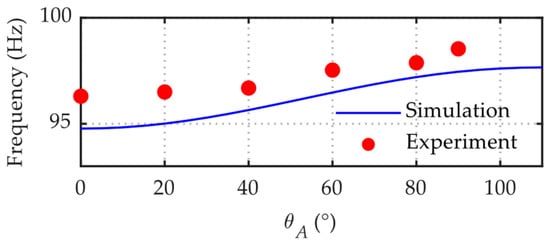
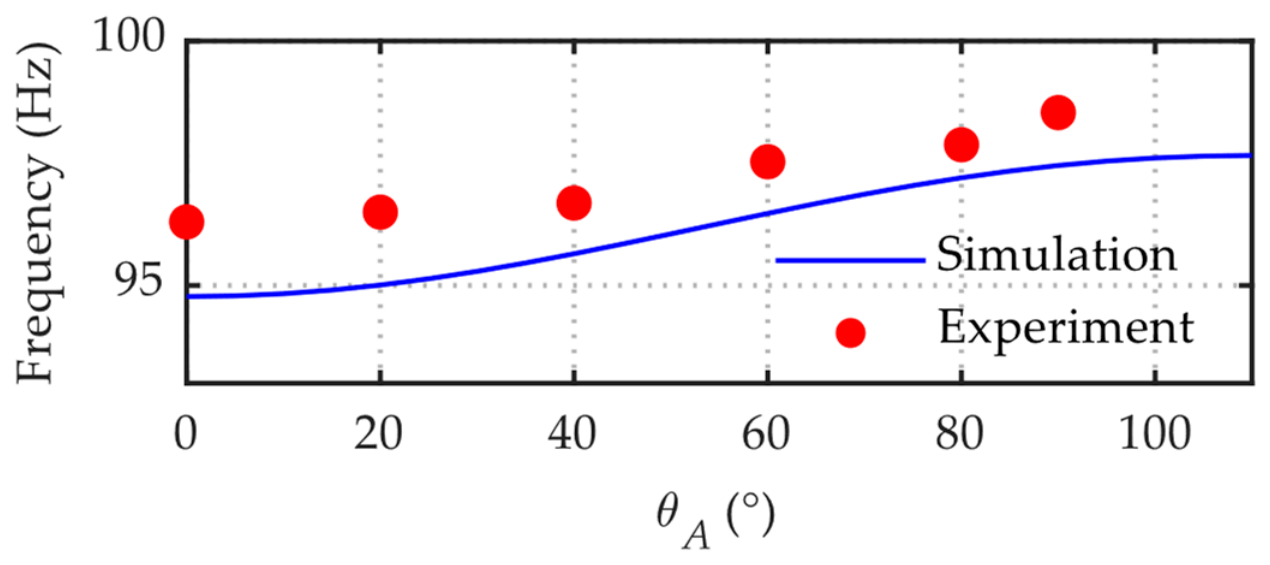
Figure 9 compares the first-order natural frequency of the AC rotary head predicted by the semi-analytical model with the measured values at different A-axis angles.
Figure 9.
Comparison between simulated and experimental first-order natural frequencies.
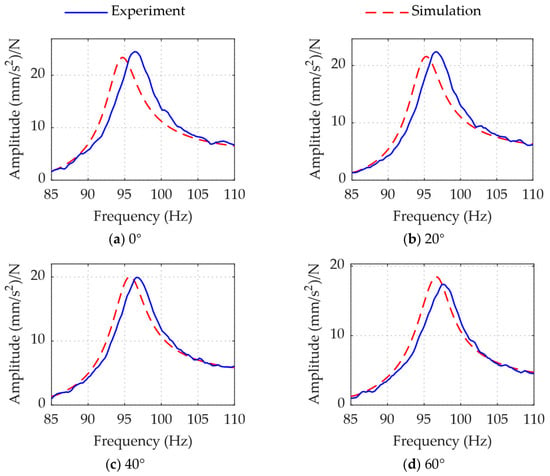
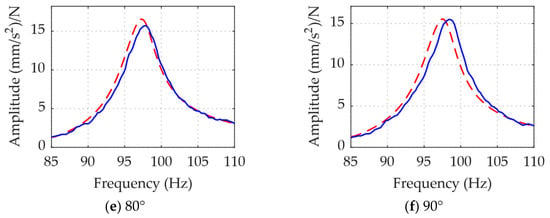
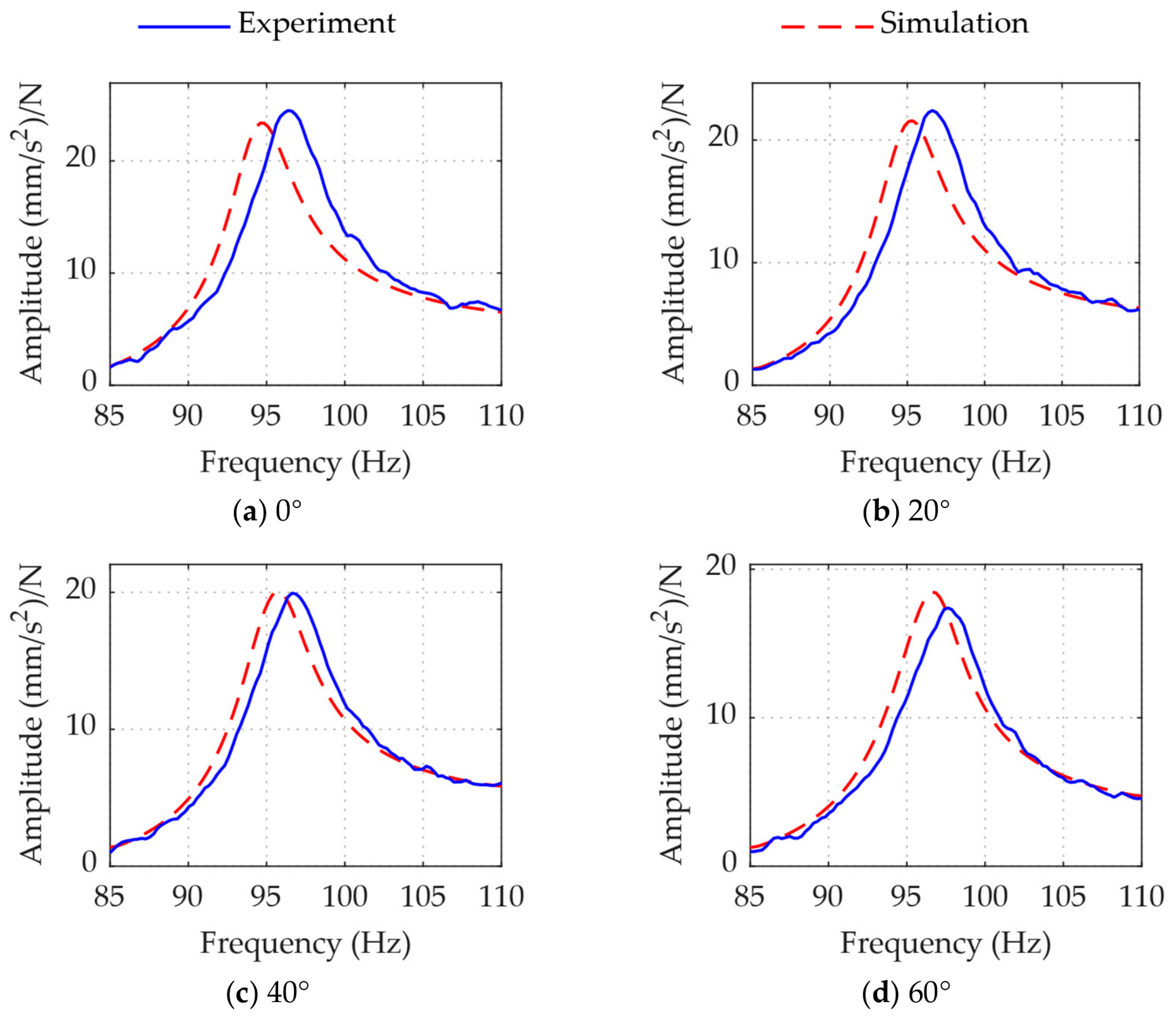
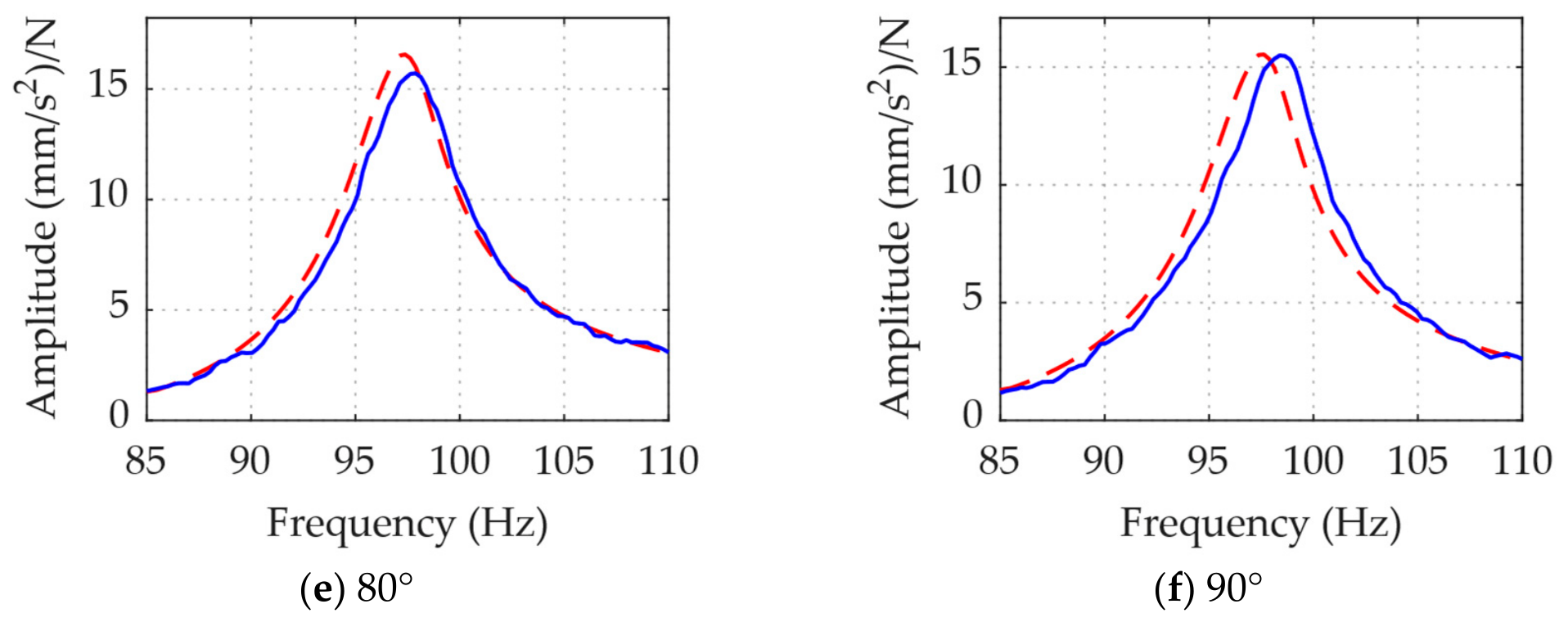
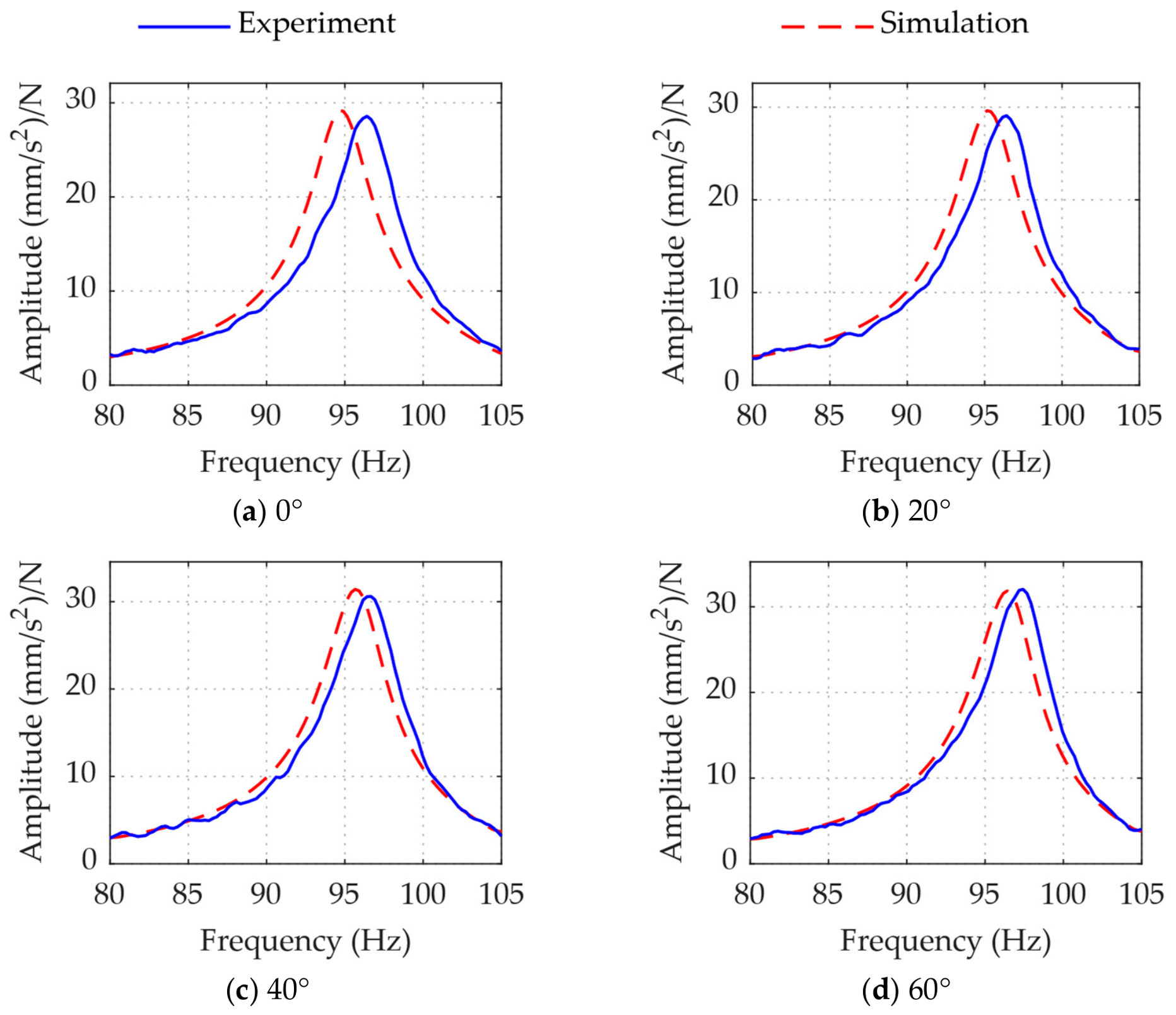
Figure 10 compares the semi-analytical and measured X-direction FRFs at the spindle nose of the AC rotary head under X-direction excitation, evaluated at different A-axis angles.
Figure 10.
Simulated and experimental FRFs of XX.
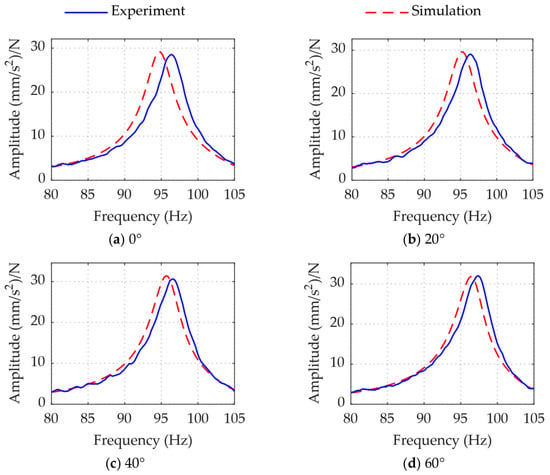
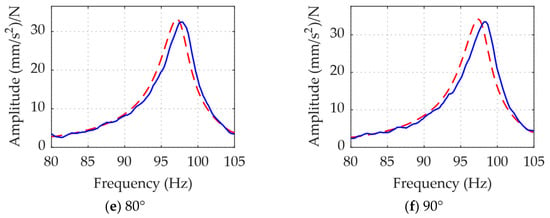
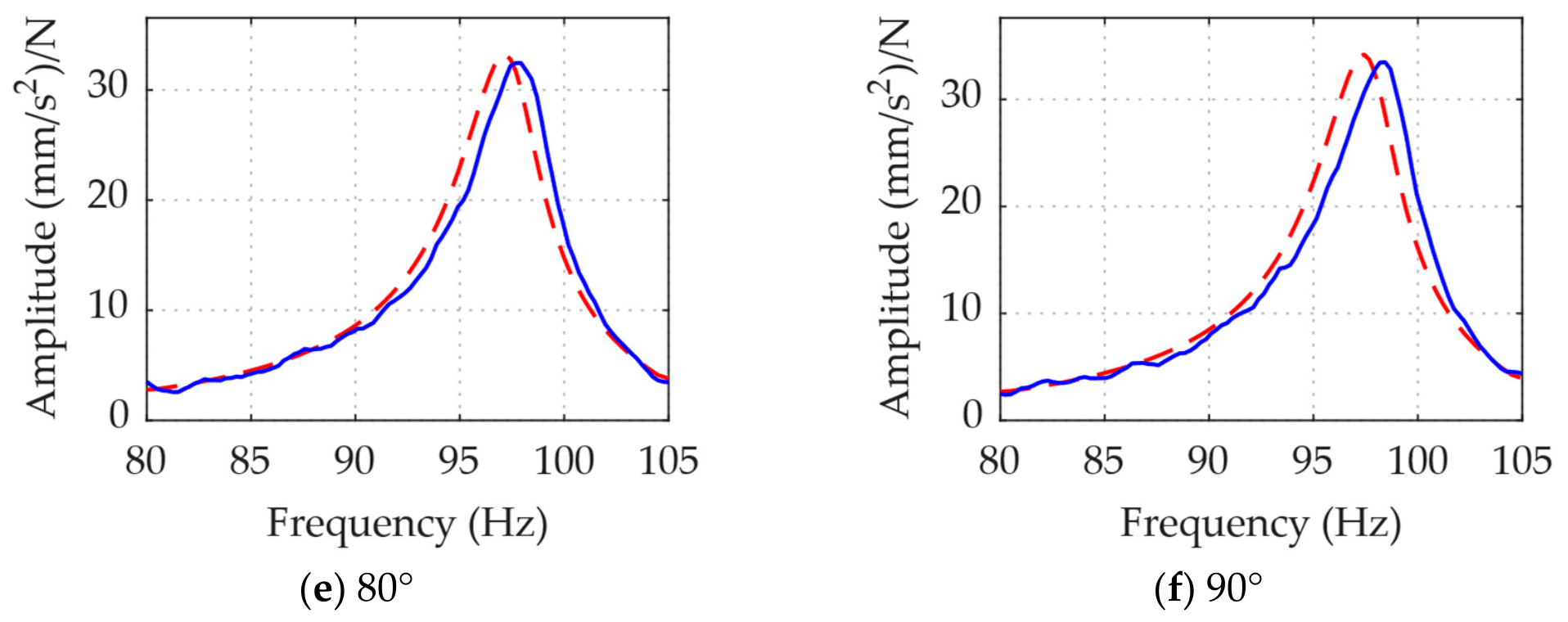
Figure 11 shows the Y-direction FRFs at the spindle nose of the AC rotary head under excitation along the same direction, where the semi-analytical predictions are compared with the experimental measurements at different A-axis angles.
Figure 11.
Simulated and experimental FRFs of YY.
As shown in Figure 9, the first-order natural frequency of the AC rotary head rises steadily with the A-axis rotation angle. When the angle increases from 0° to 90°, the measured frequency shifts from 95.5 Hz to 97.5 Hz, while the simulated value moves from 94.6 Hz to 97.0 Hz, giving a maximum deviation below 2 Hz. The FRF comparisons in Figure 10 and Figure 11 tell a similar story: the resonant peaks of the two curves lie within 2 Hz of each other, the relative error in peak amplitude stays below 10%, and the overall curve shapes match closely. Taken together, the simulated and measured responses are in close agreement in frequency, amplitude, and shape, which confirms the accuracy of the pose-dependent dynamic model established for the AC rotary head.
3. Static and Dynamic Performance Analysis and Weak-Link Identification of the AC Rotary Head
3.1. Global Distribution of the Static and Dynamic Performance
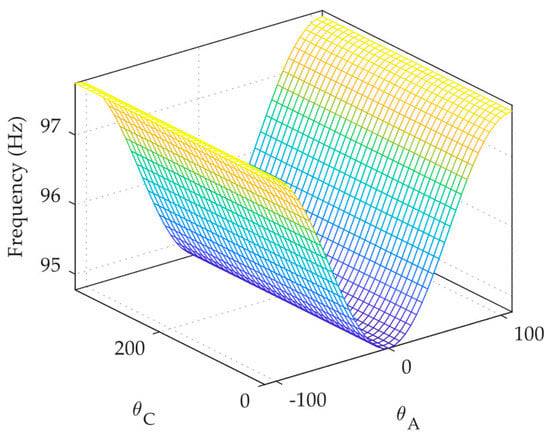
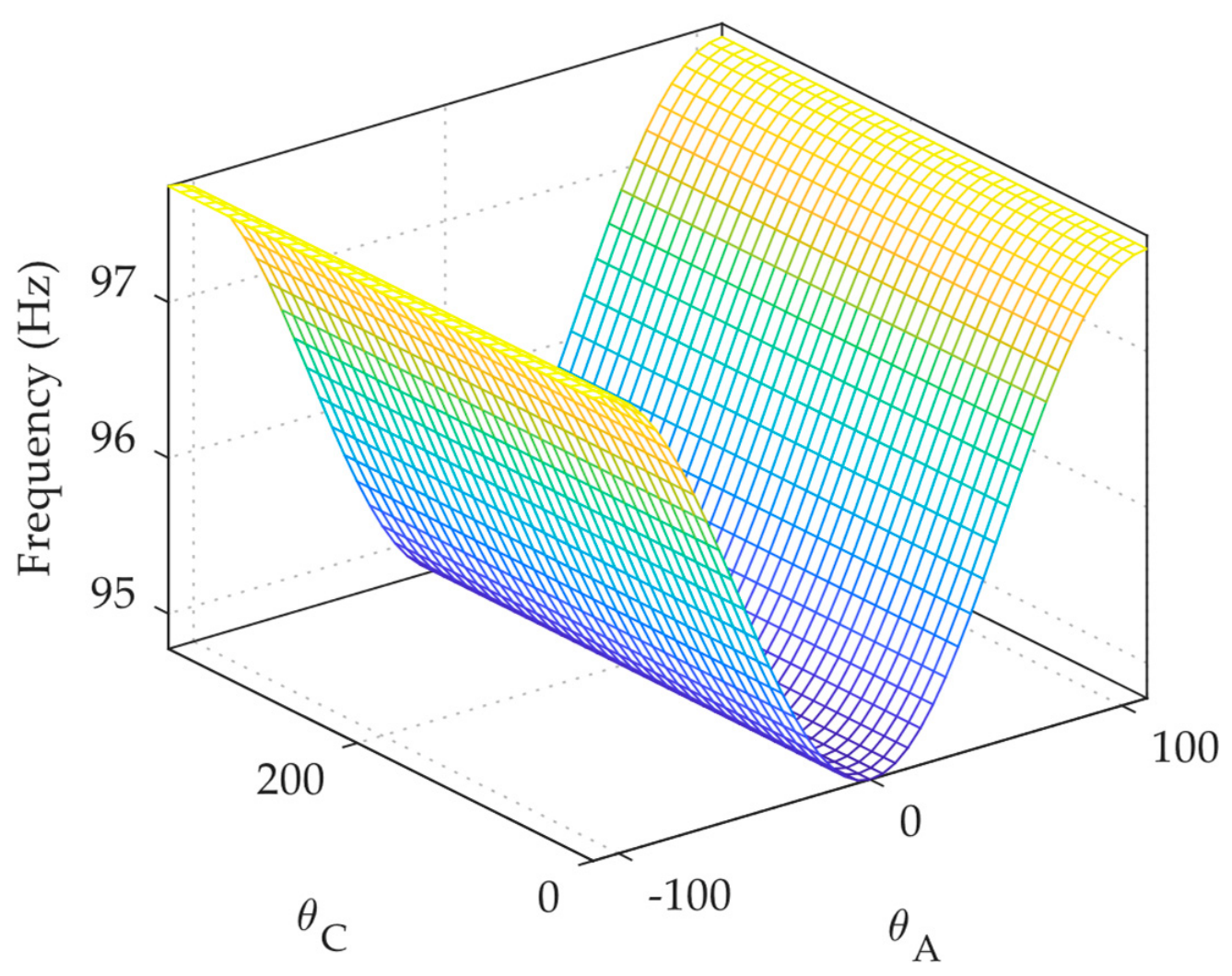
The dynamic performance of the AC rotary head is characterized by the first-order natural frequency distributed over the entire workspace. As shown in Figure 12, this frequency is highly sensitive to the A-axis rotation angle. On any fixed C-axis cross-section, it varies with in a symmetric nonlinear fashion, reaching a global minimum at = 0° and rising smoothly as increases. Along the C-axis, the gradient of the frequency surface is nearly zero, which indicates that the C-axis pose is effectively decoupled from the frequency distribution, since C-axis rotation does not alter the relative position between the rotation axis and the swing axis. = = 0° is therefore taken as the reference pose for identifying the dynamic weak link.
Figure 12.
Global distribution of the first-order natural frequency of the AC rotary head.
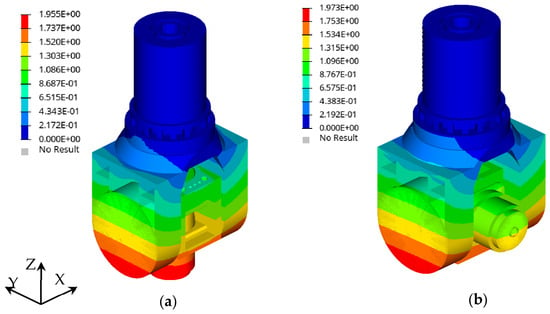
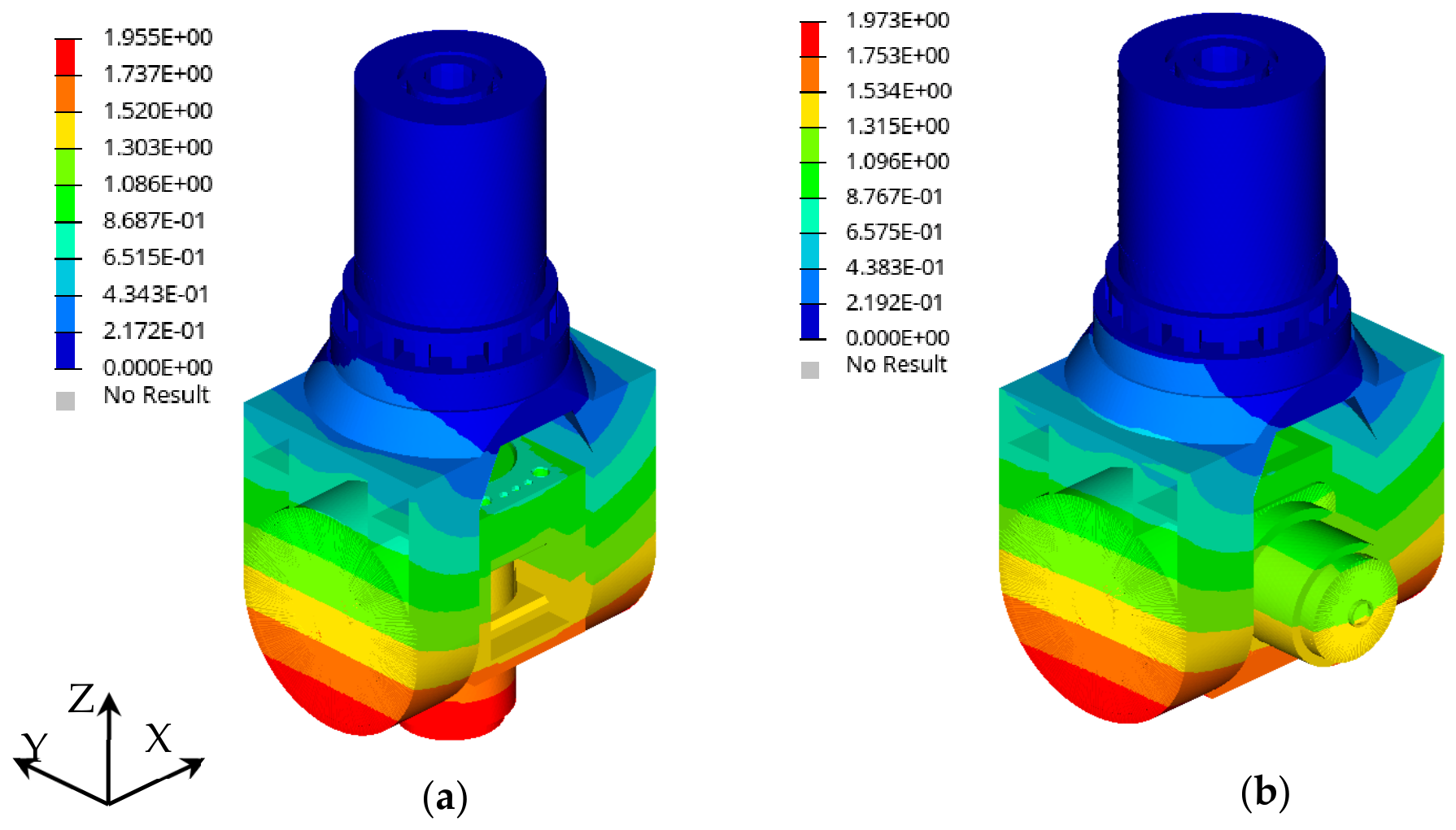
To further illustrate the dynamic characteristics, the mode shapes of the first natural frequency at two typical poses (the reference pose and the orthogonal pose ) are plotted in Figure 13. As depicted in Figure 13a, the mode shape at is mainly characterized by the bending vibration of the spindle end. Conversely, when the A-axis rotates to (Figure 13b), the dominant deformation pattern shifts to the bending deformation of the A-axis housing. This visual comparison intuitively reveals how the spatial configuration alters the structural dynamic behavior of the rotary head.
Figure 13.
Mode shapes of the first natural frequency at two typical poses.
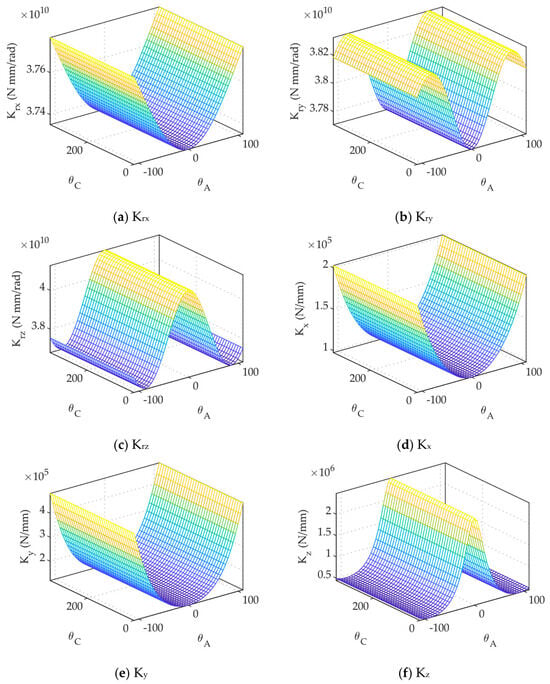
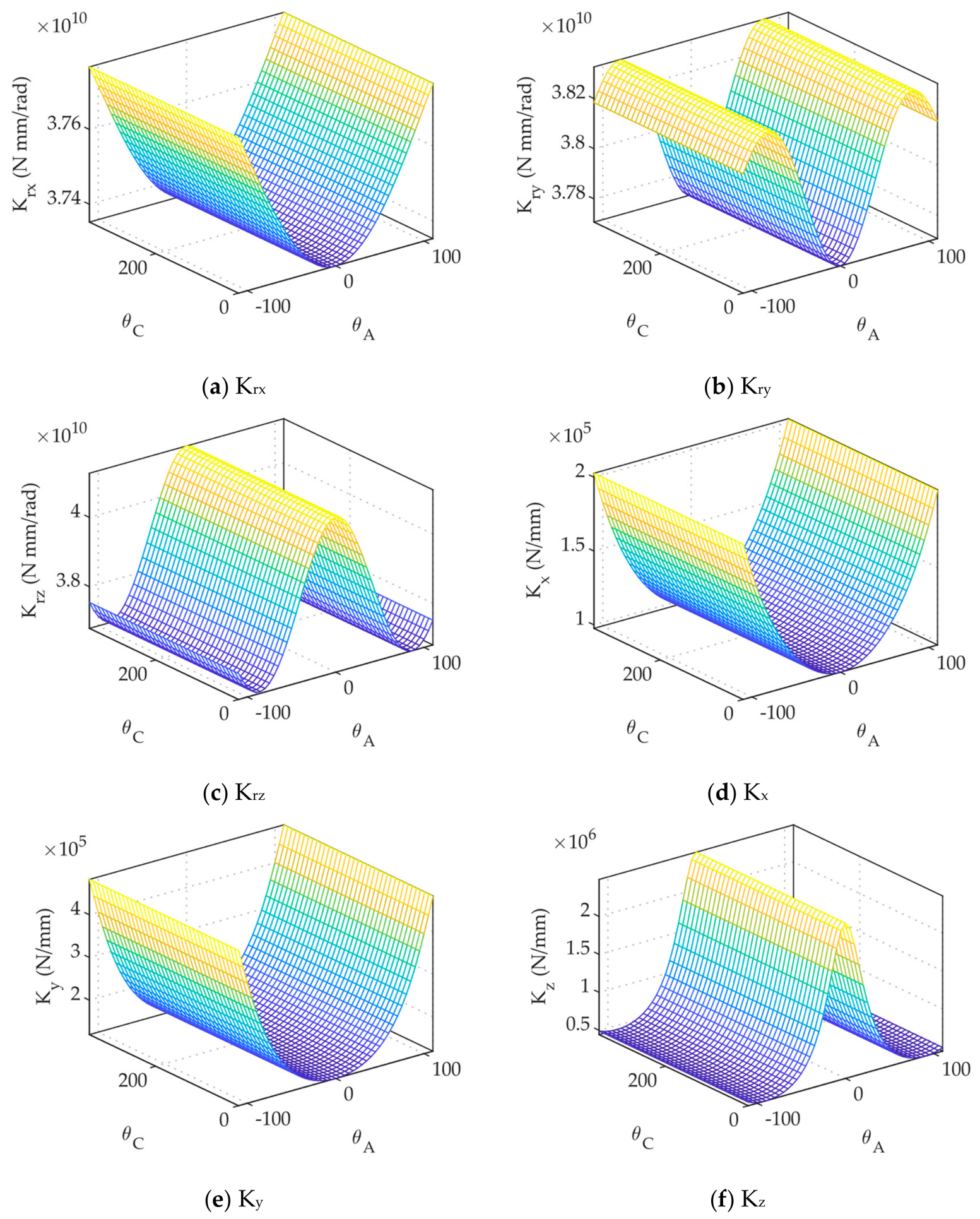
The static performance of the AC rotary head is evaluated through the directional stiffness distribution at the spindle nose. By solving the pose-dependent semi-analytical stiffness matrix, the spindle-nose stiffness along the three translational directions (X, Y, Z) and about the three corresponding axes is obtained across the entire workspace, as shown in Figure 14.
Figure 14.
Directional static stiffness distribution of the AC rotary head across the workspace.
Figure 14 shows that the stiffness in every direction is barely sensitive to , with acting as the dominant variable; the reason again lies in the fact that C-axis rotation does not change the relative position of the two axes. Figure 14a,b,d,e correspond to the X and Y translations and the rotations about these two axes. For all four, the minima coincide exactly with the zero pose at which the spindle is vertical ( = 0°, = 0°), and the stiffness rises monotonically in a pronounced nonlinear manner as moves away from zero. By contrast, Figure 14c,f, corresponding to the Z-translation and the rotation about the Z-axis, display non-monotonic behavior: the stiffness reaches its global maximum at the zero pose, drops sharply with increasing , and falls to the global minimum at the critical pose = 90°, = 0°. Beyond this point, it rebounds and rises again.
The resulting weak poses of the AC rotary head, together with their indices and pose parameters, are listed in Table 2.
Table 2.
Weak poses of the AC rotary head.
3.2. Weak-Link Identification of the AC Rotary Head
The static and dynamic performance of the AC rotary head is governed by the combined effects of joint stiffnesses together with the stiffnesses and masses of the structural components, whose individual contributions differ. Sensitivity analysis offers a means to evaluate the joint stiffness parameters and the structural component parameters at a given pose; the resulting indices then reveal the weak links of the AC rotary head and provide a theoretical basis for enhancing its static and dynamic performance.
Because the contribution of the joints and structural components varies with the pose, the pose parameters must be fixed before the weak links can be identified. The analysis in Section 3.1 shows that two weak poses exist for the AC rotary head, and both are considered jointly in the subsequent sensitivity analysis. At Weak Pose 1, the first-order natural frequency, the translational static stiffnesses along the X- and Y-axes, and the rotational static stiffnesses about the X- and Y-axes are denoted by , , , and , respectively; at Weak Pose 2, the translational static stiffness along the Z-axis and the rotational static stiffness about the Z-axis are denoted by and .
3.2.1. Identification of Key Joints
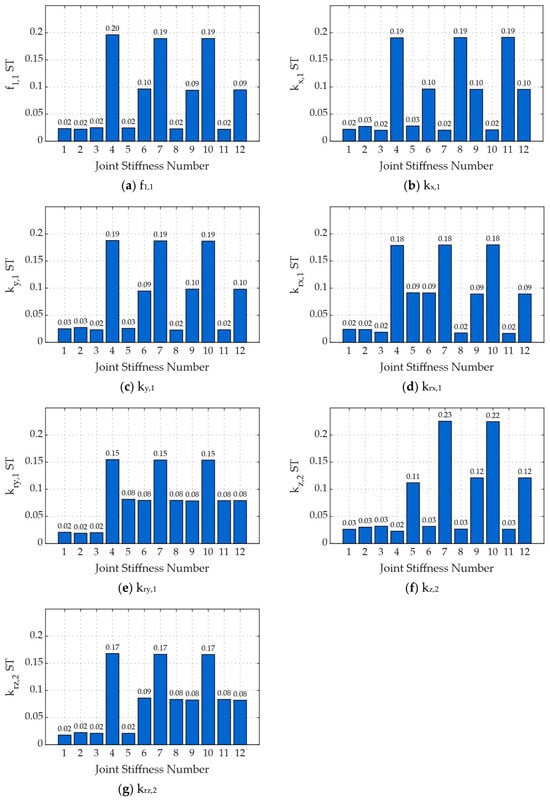
The static and dynamic performance of the AC rotary head is jointly influenced by the stiffness of the individual joints, and each factor contributes to a different extent. A Sobol’ sensitivity analysis is employed to examine how the joint stiffness parameters affect the static and dynamic performance of the AC rotary head at the two weak poses. For the bearing joints, the stiffness ranges are determined by directly consulting the manufacturer’s product manuals for the specific bearing models [41,42]. The resulting joint stiffness ranges are summarized in Table A1 of Appendix A.
Based on the Sobol’ sensitivity analysis [43,44], the effect of each joint stiffness parameter on the static and dynamic performance of the AC rotary head is examined at the two weak poses. To ensure the reliability of the results, a convergence analysis of the sample size was conducted prior to the evaluation. A base sample size of N = 1,048,576 was selected, at which point the calculated sensitivity indices stabilized and the fluctuations became negligible. The corresponding pose parameters are listed in Table 2, and the sensitivity results are plotted in Figure 15.
Figure 15.
Total-effect Sobol’ indices of the joint stiffnesses at the weak pose of the AC rotary head.
As shown in Figure 15, joint stiffnesses No. 4, 7, and 10 exhibit the highest sensitivities in Figure 15a,c and in the three rotational stiffness indices d, e, and g, and thus dominate the anti-vibration stability, the fundamental dynamic characteristics, and the resistance of the spindle nose to torsional deformation. Figure 15b follows a different pattern: the deformation along the X-axis is most sensitive to joint stiffnesses No. 4, 8, and 11. In Figure 15f, only No. 7 and 10 stand out and govern the translational static stiffness along the Z-axis. Joint stiffnesses No. 6, 9 and 12 show moderately high sensitivities across the seven indices and contribute to a non-negligible extent, whereas No. 1, 2, and 3 remain consistently low and have little influence on the static and dynamic performance of the AC rotary head. From a mechanical perspective, the varying sensitivities of these joints are directly linked to their physical roles in the structural force loop. Joints No. 4 to 6 correspond to the C-axis lower bearing, which acts as the critical interface connecting the A-axis housing to the C-axis structure. Joints No. 7 to 12 correspond to the A-axis left and right bearings, which directly support the spindle box. During machining, cutting forces at the tool tip generate significant overturning moments. These bending moments are vprimarily resisted by the axial deformations of the supporting bearings, which perfectly explains why the axial stiffnesses of the C-axis lower bearing (No. 4) and the A-axis left/right bearings (No. 7 and 10) exhibit the dominant sensitivities. In contrast, joints No. 1, 2, and 3 correspond to the C-axis upper bearing. Being located far from the cutting zone, it mainly provides auxiliary support and experiences substantially attenuated loads, thus having minimal influence on the overall compliance. The key joint stiffnesses of the AC rotary head are therefore identified as No. 4 to No. 12.
3.2.2. Identification of Key Structural Components
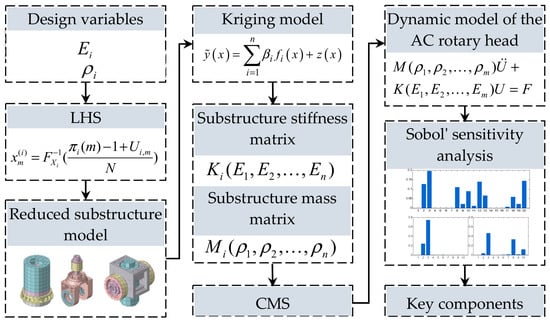
The contributions of different structural components to the static and dynamic performance of the AC rotary head differ markedly. By singling out the components that exert the largest influence on this performance, the optimization effort can be focused where it matters, improving both the efficiency and the relevance of subsequent design tuning. In this study, the stiffness and mass of each component are altered by varying its elastic modulus and density, and the resulting effect on the static and dynamic performance is then examined. The identification procedure is outlined in Figure 16.
Figure 16.
Flowchart of critical structural component identification.
Ten components of the AC rotary head are selected, and the variation ranges of their elastic moduli and densities are specified. Indices 1–10 denote the elastic moduli of the components, and indices 11–20 denote their densities; the corresponding ranges are listed in Table A3 of Appendix A.
One hundred samples are generated by Latin hypercube sampling. This sample size was determined through a preliminary convergence test, which confirmed that 100 samples are sufficient to construct a highly accurate Kriging surrogate model while maintaining computational efficiency. At the two weak poses considered, the elastic modulus and density of each component in the reduced substructure finite element model are updated according to the sampled values, and the resulting substructure stiffness and mass matrices are exported. With the Kriging method, the elastic moduli and densities of the ten selected components are taken as input variables, while the substructure stiffness and mass matrices at the two weak poses are treated as outputs, yielding a surrogate of the semi-analytical dynamic model of the AC rotary head parameterized by these moduli and densities. A Sobol’ sensitivity analysis is then performed to quantify the contribution of each component’s elastic modulus and density to the first-order natural frequency and directional static stiffness of the AC rotary head at the weak poses. Similar to the joint sensitivity analysis, a convergence check was performed, and a sample size of N = 2,097,152 was utilized to ensure the stable convergence of the sensitivity indices. The results are shown in Figure 17.
Figure 17.
Sobol’ total-effect indices of the structural component parameters at the weak pose of the AC rotary head.
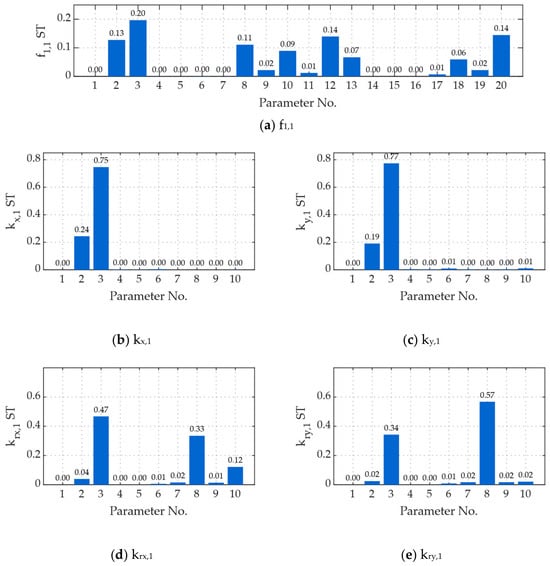
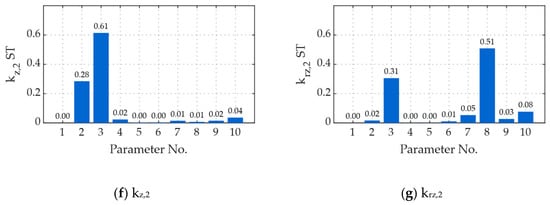
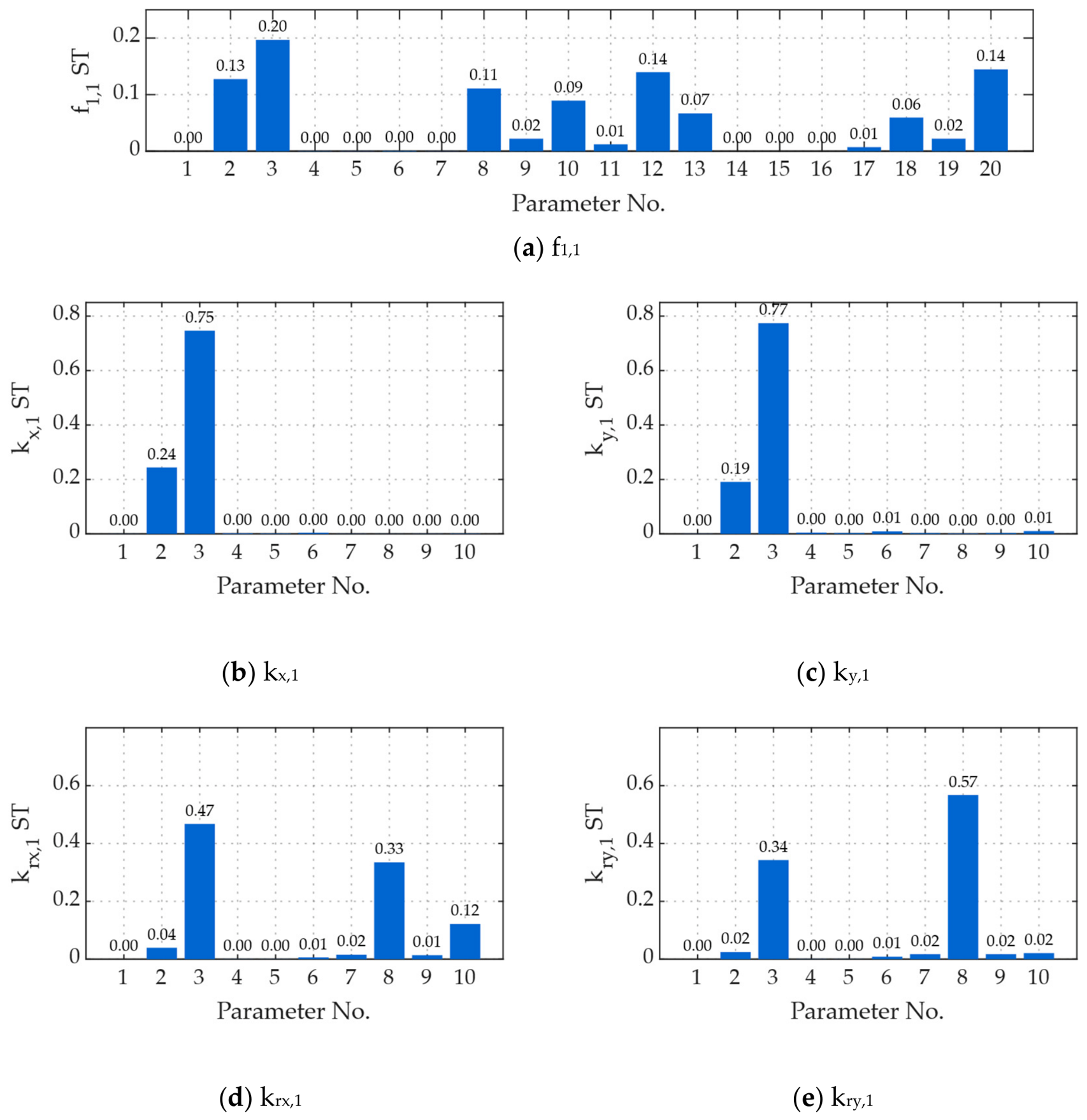
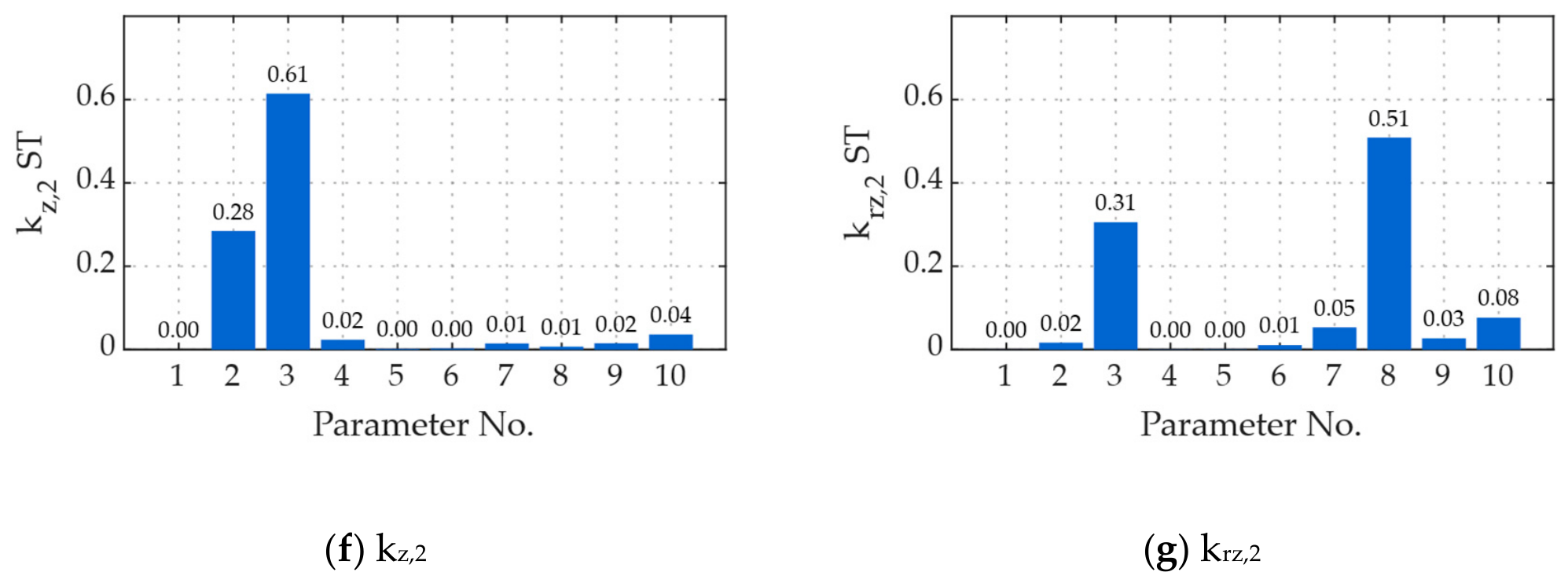
As shown in rotary, the key parameters are 2, 3, 8, 10, 12, 13, 18, and 20. Parameters 2 and 12 correspond to the elastic modulus and density of the C-axis shaft; parameters 3 and 13 to those of the A-axis housing; parameters 8 and 18 to those of the spindle box; and parameters 10 and 20 to those of the A-axis shaft. The underlying mechanical reasons for their dominant influence are highly consistent with their structural configurations in the AC rotary head. The spindle box and the fork-like A-axis housing are located at the terminal end of the kinematic chain. Their large mass inertia and overhanging structural characteristics make them highly susceptible to bending and torsional deformations under cutting loads. Any slight elastic deformation in these terminal components is directly amplified at the tool tip due to the cantilever effect. Furthermore, the C-axis and A-axis shafts serve as the primary rotational pivots supporting these heavy assemblies; their elastic moduli directly govern the overall rotational rigidity of the head, while their densities significantly dictate the mass distribution and fundamental natural frequencies. The key structural components are therefore the C-axis shaft, A-axis housing, spindle box, and A-axis shaft.
4. Structural Parameter Optimization of the AC Rotary Head
4.1. Optimization Procedure for the AC Rotary Head
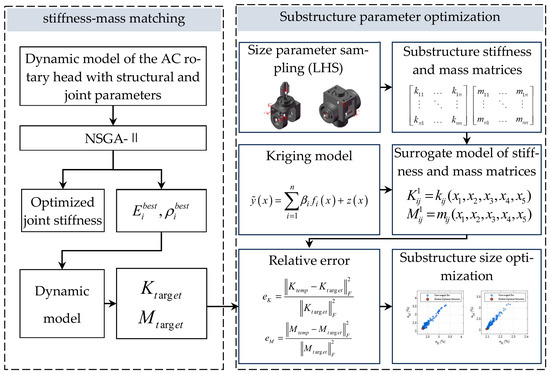
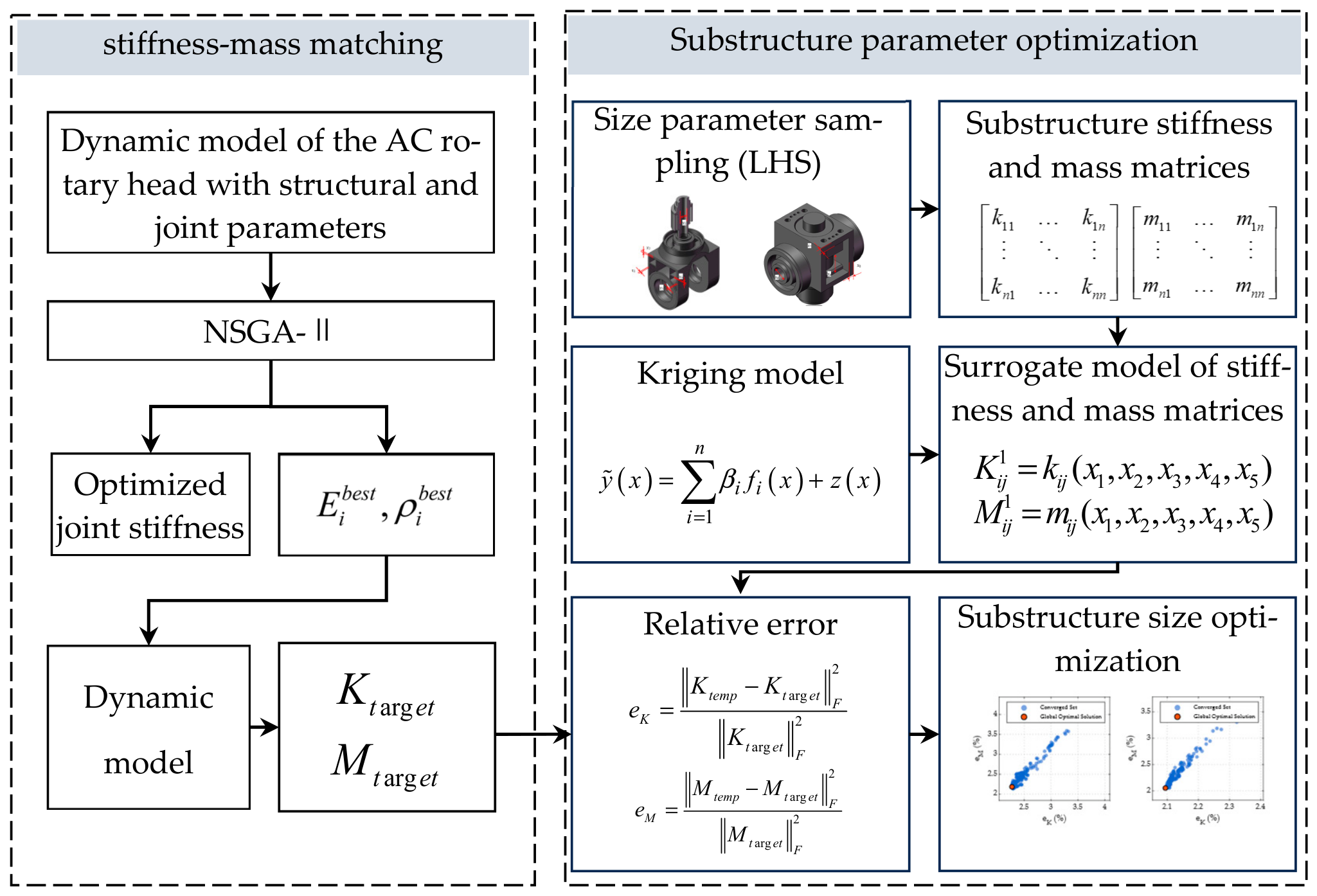
The proposed optimization scheme is organized into three stages. In the first stage, the first-order natural frequency at the weak pose of the AC rotary head and the translational static stiffness of the spindle nose along each direction are taken as the objectives to be maximized, and a multi-objective optimization model is formulated on this basis. Solving this model yields the optimized stiffness values of the key joints together with the elastic moduli and densities of the key structural components, from which the optimal stiffness and mass matrices of the substructures are obtained. The final stage focuses on dimensional parameter optimization: a Kriging surrogate model linking the substructure size parameters to the stiffness and mass matrices is built, and the substructure dimensions that best reproduce the target matrices are then identified. The overall workflow is shown in Figure 18.
Figure 18.
Flowchart of the structural parameter optimization of the AC rotary head.
4.2. Stiffness-Mass Matching of the AC Rotary Head
To improve the static and dynamic performance of the AC rotary head, a multi-objective optimization is carried out on the basis of the dynamic model parameterized by the elastic moduli and densities of the substructures, with the key joint parameters taken into account. The goal is to match the stiffness and mass of the key structural components against the stiffness of the key joints.
Step 1: Selection of design variables. Drawing on the key joints and key structural components identified in Section 3.2.1 and Section 3.2.2, and guided by the dynamic model parameterized by the elastic moduli and densities of the substructures, the stiffness of the key joints together with the elastic moduli and densities of the key structural components are taken as design variables. These seventeen variables are denoted by through , such that
Step 2: Formulation of objective functions. The first-order natural frequencies and the directional static stiffnesses at the spindle nose, evaluated at the two weak poses, serve as the objective functions. From an engineering perspective, these specific objectives are selected because the two weak poses represent the most vulnerable kinematic configurations during five-axis machining. Maximizing the directional static stiffnesses minimizes spindle nose deflection under cutting forces, thereby ensuring machining accuracy. Simultaneously, maximizing the natural frequency improves the dynamic stability margin, which is crucial for chatter avoidance. At weak pose 1, the first-order natural frequency, the translational static stiffnesses along the X- and Y-axes, and the rotational static stiffnesses about the X- and Y-axes are written as , , , , and . At weak pose 2, the translational static stiffness along the Z-axis and the rotational static stiffness about the Z-axis are written as and . The optimization is then formulated as
Step 3: Specification of constraints. The initial values of the objective functions are denoted by , , , , , , and , while the lower and upper bounds of each design variable are written as and . These constraints are established to guarantee strict engineering feasibility. The performance constraints ensure that the optimized design does not compromise any existing static or dynamic capabilities compared to the baseline design. Furthermore, the variable bounds are determined by physical and manufacturing limitations. The constraint set is expressed as
The optimization in this work is carried out with the NSGA-II multi-objective genetic algorithm. The population size is set to 200, with a crossover probability of 80%, a mutation probability of 10%, and 60 iterations. Applying the algorithm to the static and dynamic performance of the AC rotary head yields a Pareto optimal set that balances natural frequency against static stiffness. Since the Pareto front contains numerous non-dominated solutions with conflicting objectives, selecting a single optimum requires a rigorous multi-attribute decision-making approach. To avoid subjective bias in weight assignment, the Entropy-weight TOPSIS (Technique for Order of Preference by Similarity to Ideal Solution) method is employed in this study. First, the entropy weight method objectively determines the weight of each objective based on the information variance within the candidate set. Subsequently, TOPSIS calculates the Euclidean distances of each candidate solution to the positive ideal solution () and the negative ideal solution (). The relative closeness coefficient () is then calculated. The solution with the maximum value is selected as the final optimal compromise solution from the Pareto front. From an engineering standpoint, this selected solution represents the most practical trade-off, achieving significant improvements in overall rigidity and frequency. From this set, the best compromise solution is selected, and its key performance indicators are tabulated and compared with the baseline. The final results are reported in Table 3.
Table 3.
Optimization results for the static and dynamic performance of the AC rotary head based on stiffness-mass matching.
As shown in Table 3, the static and dynamic performance of the AC rotary head is markedly improved across all indices. The matched parameters of the key joints and structural components after stiffness-mass matching are summarized in Table 4.
Table 4.
Matched parameters of the key joints and structural components based on stiffness-mass matching.
As listed in Table 4, entries 1–8 correspond to the stiffness parameters of the key joints, and their optimized values all reach the upper bounds of the prescribed ranges. Each range was constructed by referring to the stiffness of a given bearing model under various preload levels, together with that of alternative bearing models sharing the same mounting dimensions. On this basis, the bearing model with the highest stiffness within the available dimensional envelope is adopted, paired with a heavier preload configuration.
4.3. Substructure Parameter Optimization
Building on the stiffness-mass matching results obtained for the key structural components of the AC rotary head, substructure parameter optimization is carried out. An objective function is formulated by introducing surrogate models that relate substructure dimensional parameters to the corresponding stiffness and mass matrices, driving the stiffness and mass matrices of the optimized substructure as close as possible to those obtained under the optimal elastic modulus and density configuration. Dimensional optimization of the key components is then achieved by minimizing the matrix discrepancy between the two. On this basis, a substructure parameter optimization model is established as follows.
Step 1: Selection of design variables:
where x denotes the set of dimensional parameter variables of the substructure, and m is the number of dimensional parameters contained in that substructure.
Step 2: Definition of the objective function:
where is the relative error between the substructure stiffness matrix after dimensional modification and the stiffness matrix under the optimal elastic modulus configuration; denotes the substructure stiffness matrix after dimensional modification, and the stiffness matrix under the optimal elastic modulus configuration. is the relative error between the substructure mass matrix after dimensional modification and the mass matrix under the optimal density configuration; denotes the substructure mass matrix after dimensional modification, and the mass matrix under the optimal configuration.
Step 3: Specification of constraints:
where and denote the lower and upper bounds of the corresponding design variable, respectively.
The substructure parameter optimization model is likewise solved using the NSGA-II multi-objective genetic algorithm, with the population size set to 150, the crossover probability to 80%, the mutation probability to 10%, and the number of iterations to 40.
4.3.1. Parameter Optimization of the A-Axis Housing Substructure
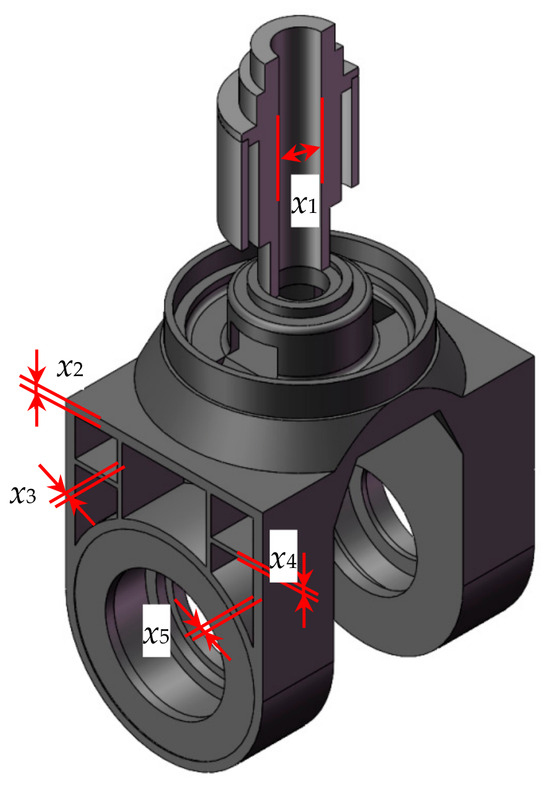
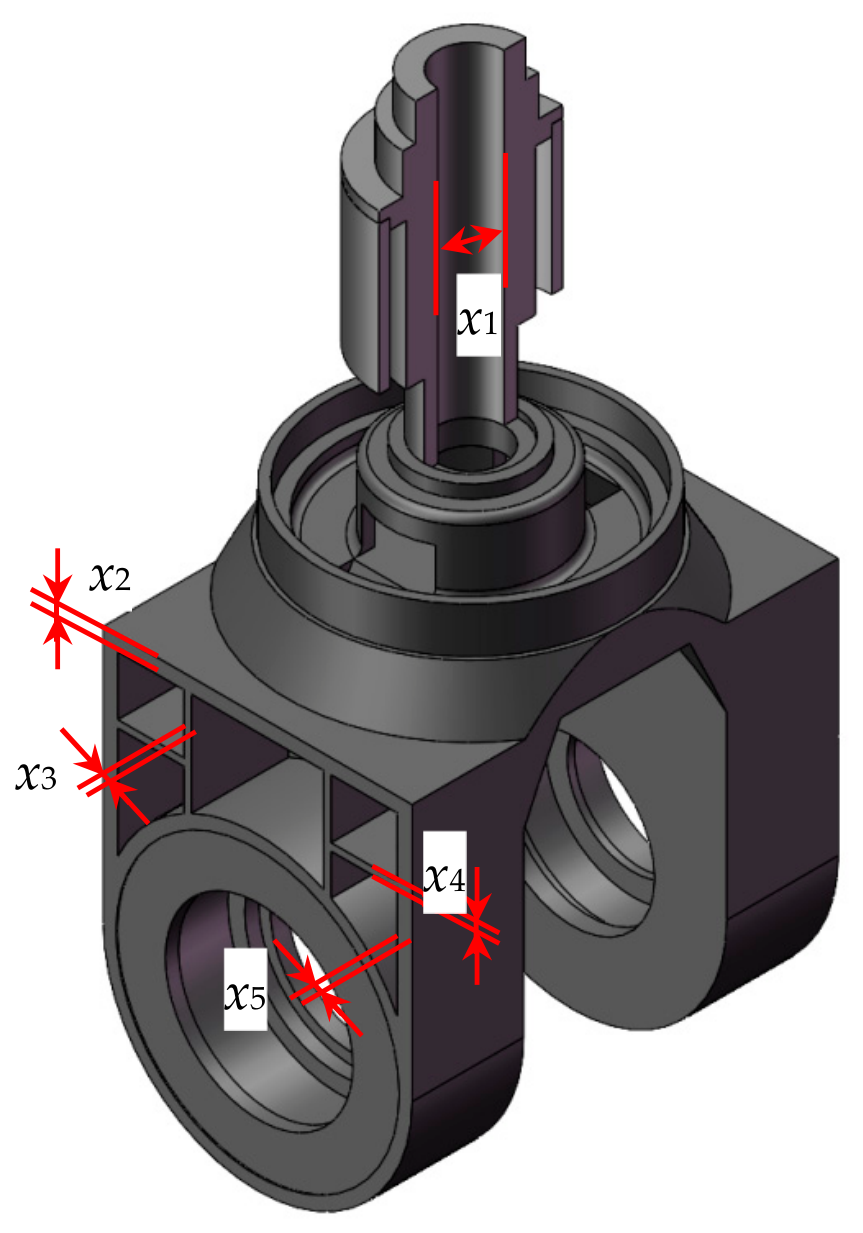
Since the key structural components C-axis shaft and A-axis housing both belong to the A-axis housing substructure, parameter optimization is carried out on this substructure. The dimensional parameters of the C-axis shaft and the A-axis housing within the substructure are selected, and a surrogate model linking these parameters to the corresponding stiffness and mass matrices is built. The selected dimensions are shown in Figure 19, and the initial values and variation ranges of each parameter are listed in Table 5.
Figure 19.
Dimensional parameters of the A-axis housing substructure.
Table 5.
Ranges of the dimensional parameters of the A-axis housing substructure.
The five-dimensional parameters listed in Table 5, x1, x2, x3, x4, and x5 are taken as input variables, and a surrogate model is constructed for the stiffness and mass matrices of the substructure. The construction procedure is as follows.
Step 1: Using the LHS method, 100 sample points are generated within the five-dimensional size-parameter space.
Step 2: For each sample, the corresponding stiffness and mass matrices of the substructure are extracted through finite element reduction.
Step 3: For every entry of the two matrices, a Kriging surrogate model is built so that the entry can be expressed as a function of the structural size parameters:
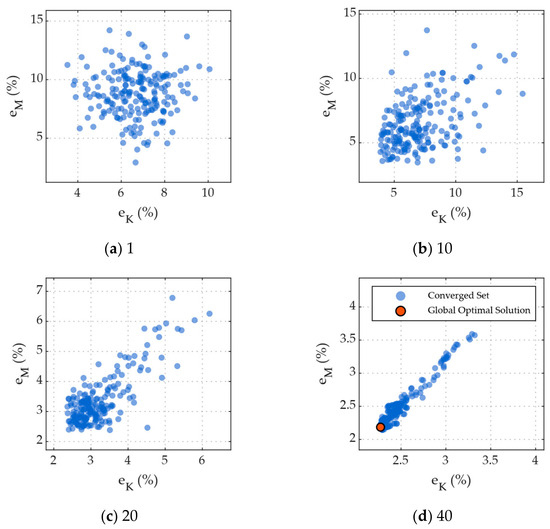
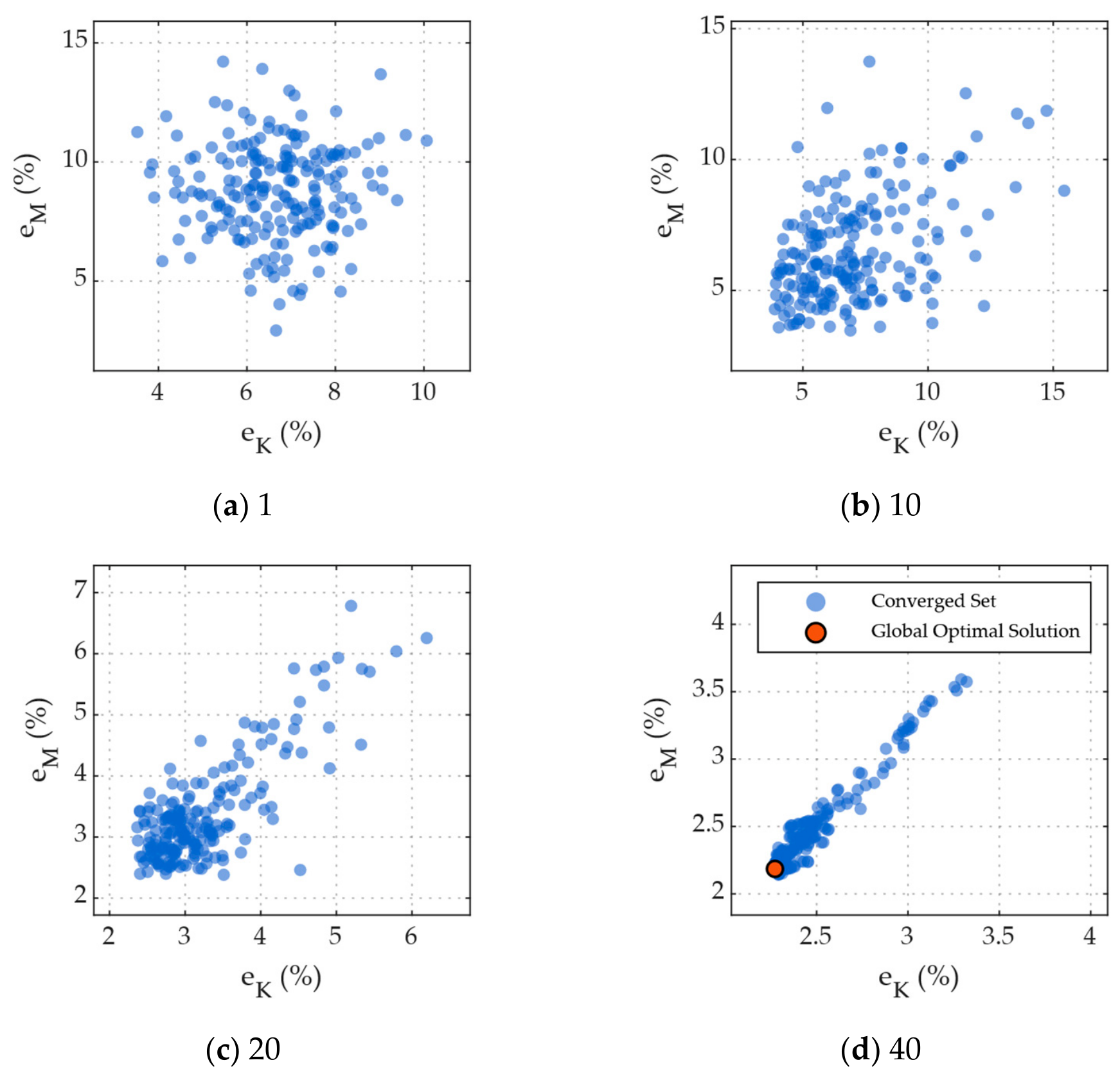
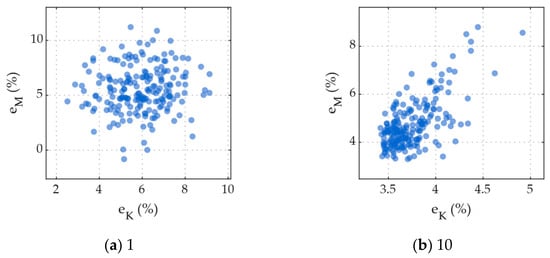
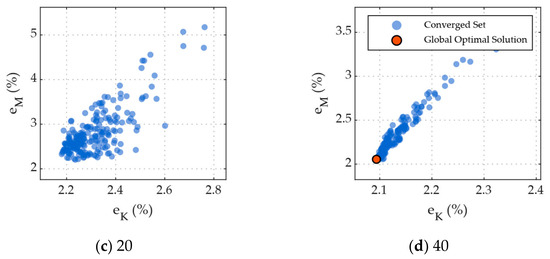
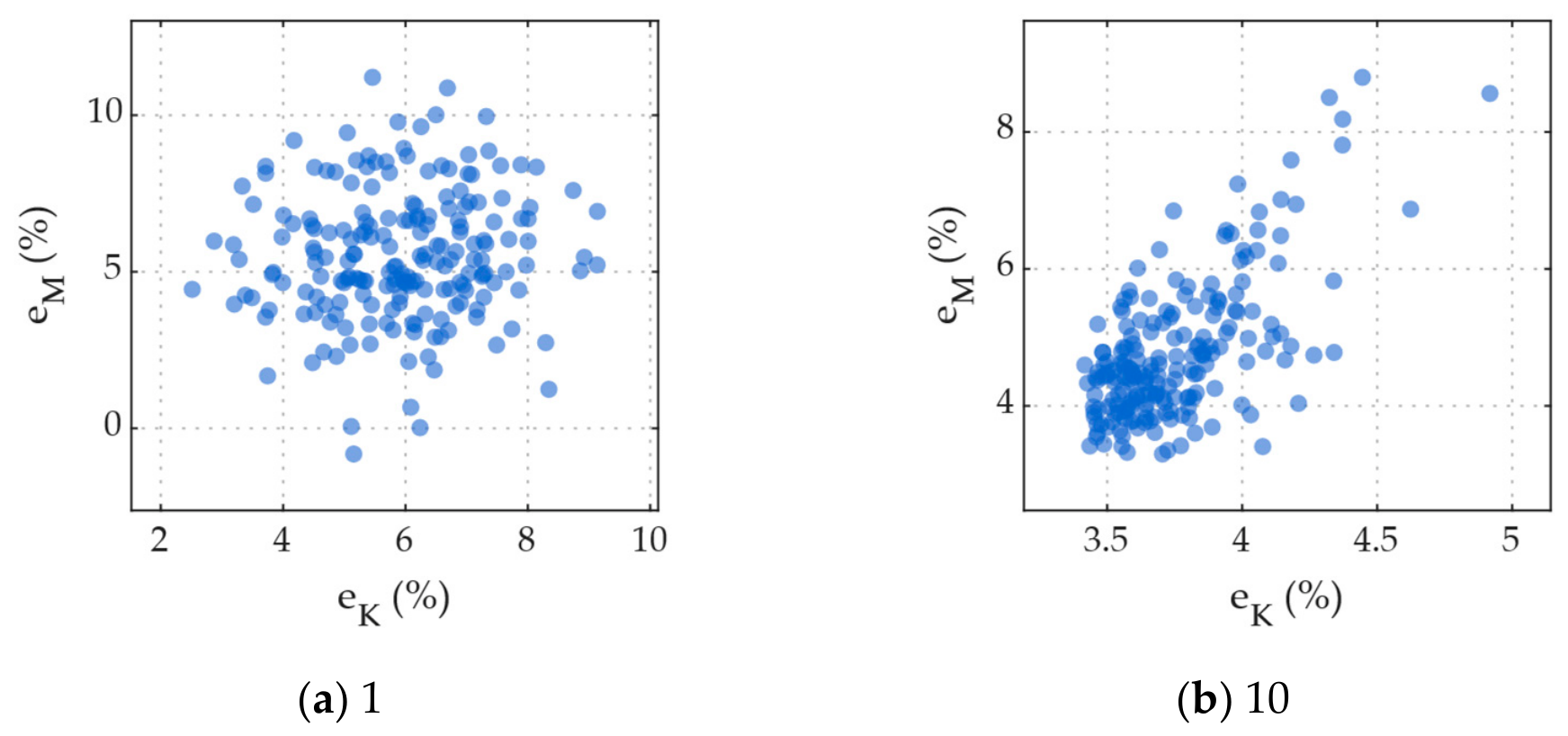
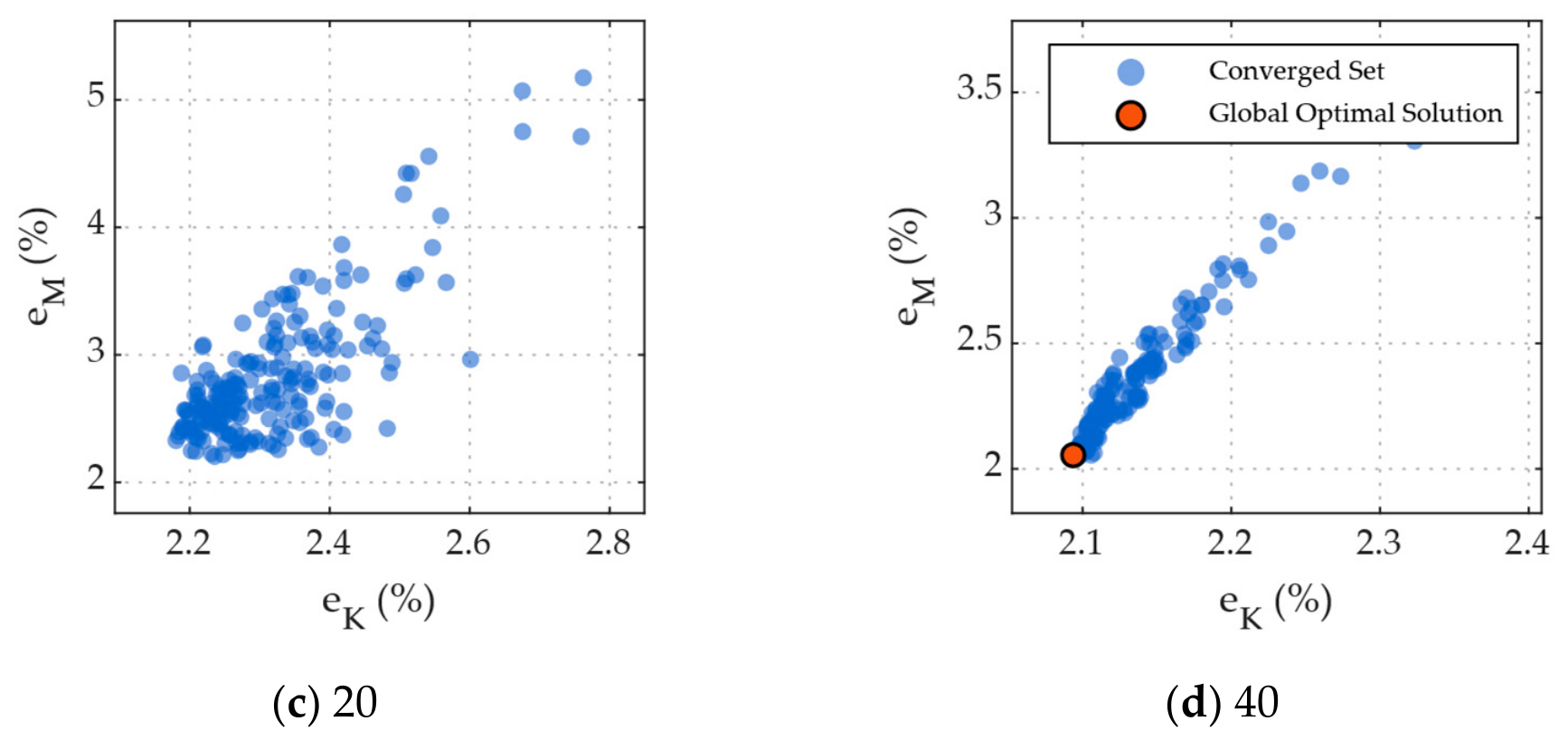
where and denote the mapping functions produced by the surrogate model, and and are the (i, j) entries of the stiffness and mass matrices of the A-axis housing substructure, respectively. Dimensional parameter optimization of the A-axis housing is then carried out based on the substructure parameter optimization model, with the Pareto optimal set obtained through NSGA-II. Figure 20 shows the iterative convergence behavior of this optimal set.
Figure 20.
Iterative convergence of the Pareto optimal set for the A-axis housing substructure.
As shown in Figure 20, the Pareto optimal set evolves into a band-shaped distribution that stretches from the lower-left to the upper-right of the objective space. This pattern indicates that, within the design space of the A-axis housing substructure, the accuracies of the stiffness and mass matrices are clearly in competition with each other. Since the optimization aims to minimize the relative errors of both matrices with respect to their target counterparts, the solution with the smallest Euclidean distance to the ideal point (i.e., the origin) is selected from the Pareto set as the final optimum. Located at the lower-left end of the front, this solution offers the best compromise between the equivalent accuracies of the stiffness and mass matrices under the current design space. Table 6 lists the dimensional parameters of the substructure before and after optimization.
Table 6.
Optimization results of the A-axis housing substructure parameters.
4.3.2. Parameter Optimization of the Spindle Box Substructure
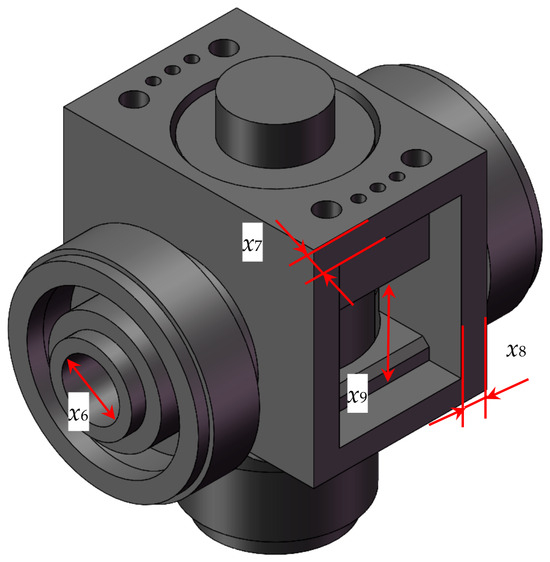
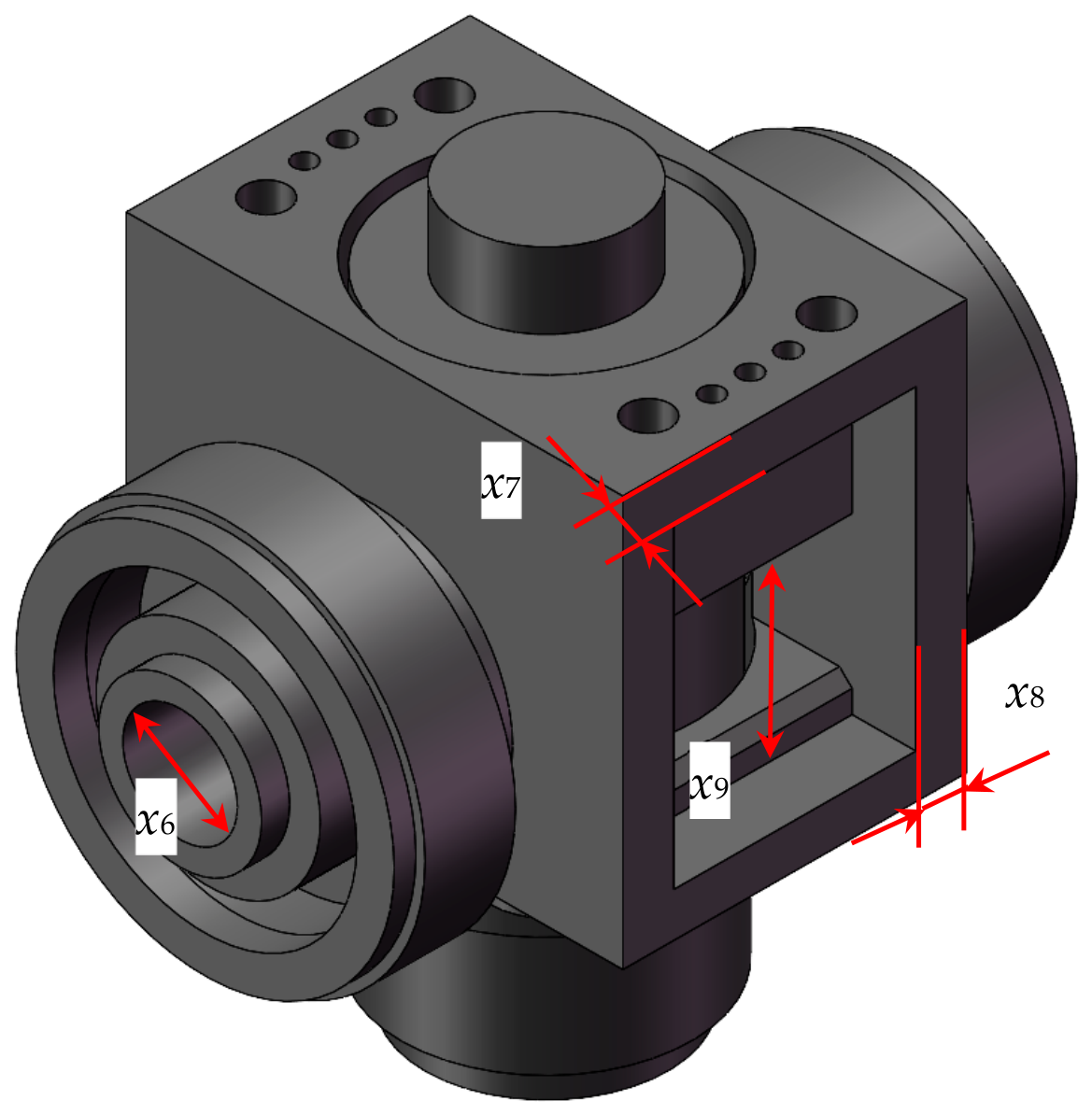
Given that the A-axis shaft and the spindle box, both identified as key structural components, belong to the spindle box substructure, dimensional parameter optimization is carried out on this substructure as a whole. Dimensional parameters are selected from the A-axis shaft and the spindle box, and a Kriging surrogate model is then built to map these parameters to the corresponding stiffness and mass matrices of the substructure. The selected dimensions are illustrated in Figure 21, while their initial values and variation ranges are listed in Table 7.
Figure 21.
Dimensional parameters of the spindle housing substructure.
Table 7.
Ranges of the dimensional parameters of the spindle housing substructure.
Based on the substructure parameter optimization model, dimensional parameter optimization is carried out for the spindle box substructure, and the Pareto optimal set is obtained using the NSGA-II algorithm. The iterative convergence process of the Pareto set is shown in Figure 22. Table 8 summarizes the dimensional parameters of the substructure before and after optimization, along with their comparison.
Figure 22.
Iterative convergence of the Pareto optimal set for the spindle housing substructure.
Table 8.
Optimization results of the spindle housing substructure.
4.4. Optimization Results of the AC Rotary Head
After the parameters of the key joints and key structural components have been optimized, the optimized joint and substructure models are incorporated into the AC rotary head in place of their unoptimized counterparts, and the static and dynamic performance of the updated assembly is re-evaluated. The comparison before and after optimization is summarized in Table 9. As shown in the table, both the static and dynamic performance of the AC rotary head are improved. The first-order natural frequency rises by 10.5%, which enhances the anti-vibration performance and dynamic stability of the rotary head. The multi-directional static stiffness also exhibits consistent gains across all directions, with the translational stiffness along the X and Y axes showing the largest improvements of 23.2% and 25.5%, respectively. The translational stiffness along Z and the rotational stiffness about each axis likewise increase by 4.2–18.6%.
Table 9.
Comparison of the AC rotary head parameters before and after optimization.
While the optimization yields ideal joint stiffness values that significantly enhance the static and dynamic performance of the AC rotary head, it is essential to discuss their engineering feasibility. In practice, the stiffness of bearing joints is primarily governed by the applied preload. Firstly, regarding the preload levels, the optimized stiffness values fall strictly within the allowable variation ranges defined in Table A1, which correspond to the medium-to-heavy preload classes specified in the manufacturer’s catalog. Therefore, these values are physically achievable through standard precision assembly procedures. Secondly, increased preload inevitably raises internal friction, potentially leading to adverse thermal effects. However, direct-drive rotary heads are typically equipped with built-in forced water-cooling systems around the torque motors and bearing housings, which can effectively dissipate the additional heat generated by the higher preload, thereby maintaining thermal stability. Finally, regarding the impact on bearing life, there is an inherent trade-off: higher preload improves structural rigidity but accelerates rolling contact fatigue, slightly reducing the theoretical rating life of the bearings. Nevertheless, in the context of high-end five-axis CNC machine tools, prioritizing static/dynamic stiffness and chatter suppression to ensure strict machining accuracy is generally preferred. The slight reduction in bearing life is considered an acceptable engineering compromise for achieving superior manufacturing productivity.
5. Conclusions
As a typical dual-axis direct-drive rotary actuation unit in five-axis CNC machine tools, the AC rotary head undergoes complex spatial pose variations during machining that reshape its static and dynamic characteristics, which in turn govern the actuation accuracy, dynamic response, and stability of the electromechanical system. Existing local optimization schemes struggle to coordinate stiffness and mass across the entire workspace of such complex actuation assemblies. To address this, we propose a stiffness-mass matching approach for the static and dynamic performance optimization of the AC rotary head. First, a pose-dependent semi-analytical dynamic model is built by coupling the dynamic condensation method with the component mode synthesis (CMS) method, enabling workspace-wide performance prediction and accurate identification of weak poses. Sobol’ sensitivity analysis is then performed at the identified weak poses to pinpoint the key joints and key structural components. NSGA-II is subsequently applied to these critical elements for stiffness-mass matching optimization. Finally, taking the resulting optimal stiffness and mass matrices as targets, dimensional parameter optimization is carried out on the weak substructures. The main conclusions are summarized below.
(1) Predicted and experimental results show that the static stiffness distribution, natural frequencies, and FRFs of the AC rotary head are strongly pose-dependent, showing high sensitivity to the A-axis swing angle and negligible sensitivity to the C-axis rotation angle; performance extrema occur at weak poses such as = 0°, = 0°.
(2) Using the weak poses as the benchmark, Sobol’ sensitivity analysis identifies the joint stiffnesses of the lower bearing of the C-axis shaft and of the bearings at both ends of the A-axis shaft, together with the stiffness and mass distributions of the C-axis shaft, A-axis housing, and spindle box, as the dominant weak links governing the static and dynamic performance of the AC rotary head.
(3) After NSGA-II-based stiffness-mass matching and subsequent dimensional optimization of these weak links, the first-order natural frequency rises by 10.5%, the translational static stiffness at the spindle nose along X and Y increases by more than 20%, and the stiffness along the remaining directions improves by 4.2–18.6%, delivering a marked gain in the global static and dynamic performance of the AC rotary head. From a practical industrial perspective, the enhanced directional static stiffnesses at the spindle nose directly minimize structural deflection under cutting forces, thereby ensuring strict geometric tolerances and high machining accuracy. Simultaneously, the increased natural frequency broadens the dynamic stability margin, which is crucial for chatter suppression. These combined improvements enable the machine tool to operate stably at higher material removal rates, ultimately leading to a substantial increase in manufacturing productivity for complex five-axis machining tasks.
The proposed parametric modeling and stiffness-mass matching framework is also applicable to other direct-drive rotary actuators and multi-axis actuation assemblies with complex structural and transmission layouts, providing a generalizable theoretical pathway for the structural design of high-performance electromechanical actuation systems. However, applying this method to other systems requires certain prerequisites, including the availability of accurate 3D geometric models, reliable identification of initial joint boundary conditions, and sufficient computational resources to generate training samples for surrogate modeling. Furthermore, potential challenges must be addressed in broader applications. For instance, if other actuators exhibit severe non-linear behaviors—such as heavy friction, clearance, or thermal deformation—the current semi-analytical modeling approach may require further non-linear enhancements. Additionally, for mechanisms with higher degrees of freedom, the computational cost of pose-dependent dynamic modeling and sensitivity analysis could increase significantly. Future work will extend the framework to a coupled tool–spindle–milling-head dynamic model, integrating servo control dynamics with the pose-dependent structural model, so as to examine how the pose-dependent dynamics of the rotary head affect cutting chatter stability and actuation bandwidth, thereby supporting further gains in the accuracy and productivity of five-axis CNC machining and offering insights for the design of next-generation precision rotary actuators.
Author Contributions
Conceptualization, J.L. and W.N.; methodology, J.L.; software, J.L.; validation, J.L.; formal analysis, J.L.; investigation, J.L.; resources, W.N.; data curation, J.L.; writing—original draft preparation, J.L.; writing—review and editing, J.L., Q.L. and H.Z.; visualization, J.L.; supervision, W.N.; project administration, W.N.; funding acquisition, W.N. All authors have read and agreed to the published version of the manuscript.
Funding
This research received no external funding.
Data Availability Statement
Datasets mentioned in the paper are available from the authors upon reasonable request.
Conflicts of Interest
Author Qing Liu was employed by the Shenyang China-Czech Aeronautics and Astronautics Machine Tool Co., Ltd. The remaining authors declare that the research was conducted in the absence of any commercial or financial relationships that could be construed as a potential conflict of interest.
Abbreviations
The following abbreviations are used in this manuscript:
| CNC | Computer Numerical Control |
| CMS | Component Mode Synthesis |
| FEA | Finite Element Analysis |
| FRF | Frequency Response Function |
| LHS | Latin Hypercube Sampling |
| NSGA-II | Non-dominated Sorting Genetic Algorithm II |
| RBE2 | Rigid Body Element Type 2 (Rigid Multi-Point Constraints) |
| TMM | Transfer Matrix Method |
Appendix A
The resulting joint stiffness ranges are summarized in Table A1.
Table A1.
Variation ranges of joint stiffnesses.
The designations of the joint stiffnesses are listed in Table A2.
Table A2.
Symbols and designations of the joint stiffness parameters.
The value ranges of Young’s modulus and density for the ten structural components are listed in Table A3.
Table A3.
Value ranges of Young’s modulus and density for the ten critical structural components.
The symbols and designations of Young’s modulus and density for each structural component are listed in Table A4.
Table A4.
Symbols and designations of the Young’s modulus and density of the structural components.
References
- Ding, S.; Zhang, X.; Chen, Z.W.; Wu, W.W. Position-independent geometric error compensation of a non-orthogonal five-axis machine tool using a simplified algebraic algorithm. Proc. Inst. Mech. Eng. Part B-J. Eng. Manuf. 2024, 238, 1634–1647. [Google Scholar] [CrossRef] [Scilit]
- Nguyen, V.H.; Le, T.T.; Truong, H.S.; Duong, H.T.; Le, M.V. Predicting volumetric error compensation for five-axis machine tool using machine learning. Int. J. Comput. Integr. Manuf. 2023, 36, 1191–1218. [Google Scholar] [CrossRef] [Scilit]
- Guo, S.J.; Jiang, G.D.; Mei, X.S. Investigation of sensitivity analysis and compensation parameter optimization of geometric error for five-axis machine tool. Int. J. Adv. Manuf. Technol. 2017, 93, 3229–3243. [Google Scholar] [CrossRef] [Scilit]
- Zhong, G.Y.; Wang, C.Q.; Yang, S.F.; Zheng, E.L.; Ge, Y.Y. Position geometric error modeling, identification and compensation for large 5-axis machining center prototype. Int. J. Mach. Tools Manuf. 2015, 89, 142–150. [Google Scholar] [CrossRef] [Scilit]
- Fu, G.Q.; Fu, J.Z.; Xu, Y.T.; Chen, Z.C.; Lai, J.T. Accuracy enhancement of five-axis machine tool based on differential motion matrix: Geometric error modeling, identification and compensation. Int. J. Mach. Tools Manuf. 2015, 89, 170–181. [Google Scholar] [CrossRef] [Scilit]
- Zhang, Y.; Yang, J.G.; Zhang, K. Geometric error measurement and compensation for the rotary table of five-axis machine tool with double ballbar. Int. J. Adv. Manuf. Technol. 2013, 65, 275–281. [Google Scholar] [CrossRef] [Scilit]
- Li, Z.L.; Wang, Q.H.; Zhu, B.; Wang, B.D.; Zhu, W.M.; Du, J.M.; Sun, B.C. Experimental study on thermal deformation suppression and cooling structure optimization of double pendulum angle milling head. Int. J. Adv. Manuf. Technol. 2023, 127, 279–293. [Google Scholar] [CrossRef] [Scilit]
- Dai, Y.; Li, Y.; Zhan, S.Q.; Li, Z.L.; Wang, X.; Li, W.W. Thermal error modeling of motorized spindle considering the effect of milling head heat source. Int. J. Adv. Manuf. Technol. 2023, 129, 855–870. [Google Scholar] [CrossRef] [Scilit]
- Cheng, Y.N.; Zhang, X.P.; Zhang, G.X.; Jiang, W.Q.; Li, B.W. Thermal deformation analysis and compensation of the direct-drive five-axis CNC milling head. J. Mech. Sci. Technol. 2022, 36, 4681–4694. [Google Scholar] [CrossRef] [Scilit]
- Li, T.M.; Li, F.C.; Jiang, Y.; Zhang, J.L.; Wang, H.T. Kinematic calibration of a 3-P(Pa)S parallel-type spindle head considering the thermal error. Mechatronics 2017, 43, 86–98. [Google Scholar] [CrossRef] [Scilit]
- Jia, Y.J.; Cao, J.Y.; Liao, Z.S.; Wu, W.; Tang, H.; Tian, Y.L.; Wei, Y.Z. The Design and Testing of a Cross-Scale Compliant Rotary Actuator with Minimum Actuation Redundancy and Sub-Microradian Resolution. Actuators 2025, 14, 284. [Google Scholar] [CrossRef] [Scilit]
- Zhang, J.; Liang, Q.S.; Sun, J.P.; Yan, B.S.; Hu, Z.D.; Sun, W. Multi-Objective Optimization of Torque Motor Structural Parameters in Direct-Drive Valves Based on Genetic Algorithm. Actuators 2025, 14, 527. [Google Scholar] [CrossRef] [Scilit]
- Gao, F.; Pi, D.C.; Chen, J.F. A Data-Driven and Physically Constrained Approach to Parameter Optimization for Milling Complex Surface. IEEE Trans. Autom. Sci. Eng. 2025, 22, 13236–13252. [Google Scholar] [CrossRef] [Scilit]
- Jiang, Y.C.; Huang, H.; Li, R.Y.; Liu, X.L.; Chen, X.R. Prediction of dynamic characteristics for load- and position-dependent 5-axis machine tools using Nadam algorithm. J. Mech. Sci. Technol. 2024, 38, 5241–5254. [Google Scholar] [CrossRef] [Scilit]
- Huynh, H.N.; Altintas, Y. Modeling the Dynamics of Five-Axis Machine Tool Using the Multibody Approach. J. Manuf. Sci. Eng.-Trans. ASME 2021, 143, 021012. [Google Scholar] [CrossRef] [Scilit]
- Zhang, X.M.; Ma, Z.M.; Jiang, Y.Y. Fault diagnosis of high-speed motorized spindles based on lumped parameter model and enhanced transfer learning. Struct. Health Monit. 2025, 24, 1841–1858. [Google Scholar] [CrossRef] [Scilit]
- Wu, S.; Yu, P.; Yu, T.; Li, M.Y.; Yang, Z.C. Research on the evaluation method of dynamic characteristics of the feed system of double-pendulum five-axis machine tool. J. Mech. Sci. Technol. 2025, 39, 2489–2505. [Google Scholar] [CrossRef] [Scilit]
- Shi, Z.F.; Liu, J.; Xiao, G.J. Planet needle roller bearing with waviness effect in the planetary gear system: Nonlinear dynamic modeling and simulation. Proc. Inst. Mech. Eng. Part C-J. Mech. Eng. Sci. 2025, 239, 2809–2822. [Google Scholar] [CrossRef] [Scilit]
- Gong, X.X.; Zhao, J.S.; Zhao, C.Y.; Li, C.Y.; Hao, J.; Xu, M.T. Dynamic modeling and nonlinear characteristic analysis of the cross-axis ball screw feed system considering thermal deformation. Nonlinear Dyn. 2025, 113, 14515–14560. [Google Scholar] [CrossRef] [Scilit]
- Chensheng, W.; Yuhai, F.; Fang, S. Static/Dynamic Stiffness Analysis of Ball Screw Feed Systems with Different Support Configurations Considering Workpiece Mass and Placement Position. Adv. Mech. Eng. 2025, 17, 14. [Google Scholar] [CrossRef] [Scilit]
- Chan, T.C.; Ullah, A.; Roy, B. Precision analysis and prediction of position-dependent structural natural frequencies in five-axis cradle machine tools. Int. J. Adv. Manuf. Technol. 2025, 138, 5413–5426. [Google Scholar] [CrossRef] [Scilit]
- Miao, H.H.; Wang, C.Y.; Li, C.Y.; Song, W.J.; Zhang, X.L.; Xu, M.T. Nonlinear dynamic modeling and vibration analysis of whole machine tool. Int. J. Mech. Sci. 2023, 245, 108122. [Google Scholar] [CrossRef] [Scilit]
- Sedlacek, F.; Bernardin, P.; Kozak, J.; Lasova, V.; Janda, P.; Kubicek, J. Hybrid Quill Shaft for a Multifunctional Portal Machine Tool Centre. Appl. Sci. 2026, 16, 1816. [Google Scholar] [CrossRef] [Scilit]
- Hung, J.P.; Lin, Y.C.; Lin, W.Z.; Xuan, X.J.; Lai, Y.S. Characterizing Spindle-Tool Holder Interfaces for Tool-Point FRF Prediction Using RCSA and Finite Element Modeling. Machines 2026, 14, 143. [Google Scholar] [CrossRef] [Scilit]
- Xu, B.; Tian, W.; Li, B. A complex extended transfer matrix method for computing the frequency response function of mechanical systems. J. Sound Vib. 2025, 609, 119091. [Google Scholar] [CrossRef] [Scilit]
- Lu, H.J.; Ma, Z.Y.; Chen, G.L.; Ding, Y.Y.; Chen, Y.H.; Chang, Y.; Rui, X.T. Dynamic simulation and active vibration control design of an ultra-precision fly-cutting machine tool. Int. J. Adv. Manuf. Technol. 2024, 133, 4663–4678. [Google Scholar] [CrossRef] [Scilit]
- Choudhary, R.; Rzig, I.; Fotsing, E.R.; Ross, A. A unified nonlinear model of piezoelectric cantilever beams with complex geometries for energy harvesting applications. Smart Mater. Struct. 2025, 34, 025010. [Google Scholar] [CrossRef] [Scilit]
- Gu, D.; Xie, Y.F.; Liu, S.L.; Wei, Y.; Shen, J.Y. Dynamic Modeling of Motorized Spindle System with Unbalanced Mass and Spindle Inclination. Appl. Sci. 2023, 13, 10053. [Google Scholar] [CrossRef] [Scilit]
- Ma, Y.W.; Tian, Y.L.; Liu, X.P. Rapid Predictions for Lower-Order Dynamics of Machine Tools Based on the Rigid Multipoint Constraints. Int. J. Precis. Eng. Manuf. 2023, 24, 485–500. [Google Scholar] [CrossRef] [Scilit]
- Duan, M.; Lu, H.; Zhang, X.B.; Li, Z.J.; Zhang, Y.Q.; Yang, M.H.; Liu, Q. Dynamic modeling and experimental research on position-dependent behavior of twin ball screw feed system. Int. J. Adv. Manuf. Technol. 2021, 117, 3693–3703. [Google Scholar] [CrossRef] [Scilit]
- Law, M.; Phani, A.S.; Altintas, Y. Position-Dependent Multibody Dynamic Modeling of Machine Tools Based on Improved Reduced Order Models. J. Manuf. Sci. Eng.-Trans. ASME 2013, 135, 021008. [Google Scholar] [CrossRef] [Scilit]
- Bilgili, D.; Budak, E.; Altintas, Y. Multibody dynamic modeling of five-axis machine tools with improved efficiency. Mech. Syst. Signal Process. 2022, 171, 108945. [Google Scholar] [CrossRef] [Scilit]
- Ullah, A.; Chan, T.C.; Chang, S.L. Enhancing Five-Axis Machine Tool Performance Through ESG-Based Design Optimization. Int. J. Precis. Eng. Manuf.-Green Technol. 2025, 12, 245–262. [Google Scholar] [CrossRef] [Scilit]
- Wang, J.W.; Yu, A.B.; Zhu, L.Z.; Wang, Z.L.; Liu, Y.R. Structural optimization design of working table of direct-drive machine tool based on a dragonfly wing structure. Proc. Inst. Mech. Eng. Part C-J. Mech. Eng. Sci. 2025, 239, 3921–3933. [Google Scholar] [CrossRef] [Scilit]
- Wu, S.Q.; Li, C.B.; Cao, H.J.; Li, X.Y.; Liu, H.S. A Novel Data-Driven Lightweight Optimization Method Based on Meta-Structure of CNC Machine Tool. IEEE Trans. Autom. Sci. Eng. 2025, 22, 24195–24208. [Google Scholar] [CrossRef] [Scilit]
- Huang, B.; Liu, J.; Yan, J.W.; Xiong, F.K.; Wu, J.Q.; Zhou, C.S. Multi-Objective Comprehensive Structural Optimization of the Bed for a GPC Fixed-Beam Gantry Machining Center. IEEE Access 2025, 13, 171721–171745. [Google Scholar] [CrossRef] [Scilit]
- Ma, Y.W.; Tian, Y.L.; Liu, X.P. Structural optimization design of machine tools based on parallel artificial neural networks and genetic algorithms. Neural Comput. Appl. 2023, 35, 25201–25221. [Google Scholar] [CrossRef] [Scilit]
- Lin, S.Y.; Lai, Y.T. Stiffness and Lightweight Enhancement in Biomimetic Design of a Grinding Machine-Tool Structure. Appl. Sci. 2025, 15, 9449. [Google Scholar] [CrossRef] [Scilit]
- Liu, S.H.; Su, J.B.; Lin, M. Structural Dynamic Analysis and Topology Optimization of a Propeller Polishing Machine Tool. J. Chin. Soc. Mech. Eng. 2025, 46, 153–162. [Google Scholar]
- Masson, G.; Brik, B.A.; Cogan, S.; Bouhaddi, N. Component mode synthesis (CMS) based on an enriched ritz approach for efficient structural optimization. J. Sound Vib. 2006, 296, 845–860. [Google Scholar] [CrossRef] [Scilit]
- Schaeffler Medias. YRTC260-XL Axial/Radial Roller Bearing. Available online: https://medias.schaeffler.us/en/product/rotary/rolling-and-plain-bearings/super-precision-bearings/combined-axial-%2c-radial-super-precision-bearings/bearings-for-rotary-tables/yrtc260-xl/p/397748 (accessed on 21 January 2026).
- Schaeffler Medias. YRTC180-XL Axial/Radial Roller Bearing. Available online: https://medias.schaeffler.us/en/product/rotary/rolling-and-plain-bearings/super-precision-bearings/combined-axial-%2c-radial-super-precision-bearings/bearings-for-rotary-tables/yrtc180-xl/p/397742 (accessed on 21 January 2026).
- Han, J.H.; Wang, L.P.; Ma, F.J.; Ge, Z.Y.; Wang, D.; Li, X.K. Sensitivity analysis of geometric error for a novel slide grinder based on improved Sobol method and its application. Int. J. Adv. Manuf. Technol. 2022, 121, 6661–6684. [Google Scholar] [CrossRef] [Scilit]
- Zhang, H.N.; Xiang, S.T.; Zhou, T.; Yang, J.G. Joint sensitivity analysis method of impeller aerodynamic performance to key geometric errors of five-axis machine tool. Eng. Sci. Technol. 2024, 57, 101814. [Google Scholar] [CrossRef] [Scilit]

Disclaimer/Publisher’s Note: The statements, opinions and data contained in all publications are solely those of the individual author(s) and contributor(s) and not of MDPI and/or the editor(s). MDPI and/or the editor(s) disclaim responsibility for any injury to people or property resulting from any ideas, methods, instructions or products referred to in the content. |
© 2026 by the authors. Licensee MDPI, Basel, Switzerland. This article is an open access article distributed under the terms and conditions of the Creative Commons Attribution (CC BY) license.