1. Introduction
As the automotive industry transitions toward software-defined vehicles (SDVs), the ability to algorithmically control key aspects of a vehicle’s motion is paramount. To this end, vehicles are increasingly adopting X-by-wire (XBW) architectures. XBW eliminates the mechanical connections between the driver and the vehicle, opting instead for sensors that measure driver input and actuators that respond to control the vehicle. A software layer exists between the sensors and actuators to interpret driver intent and command the actuator response based on the current scenario. This new architecture offers substantial benefits over traditional mechanical vehicle control systems, whose performance is heavily constrained by the reaction times and operational skill of humans.
The concept of replacing safety-critical mechanical control linkages with electronic systems is not new. Its origins lie in the aerospace industry, where “fly-by-wire” (FBW) technology revolutionized aircraft design and performance. The commercial turning point in aerospace occurred with the introduction of the Airbus A320 in the late 1980s [
1]. Before this, commercial aircraft relied on a complex and heavy network of steel cables, pulleys, and hydraulic lines to transmit the pilot’s inputs to the actuators. The A320 introduced a full-authority digital FBW system, where the pilot’s inputs were processed by computers and digitally transmitted to the actuators. Previously, a pilot’s inputs were direct commands for specific control surfaces; however, with FBW, they are used to determine the pilot’s objective, e.g., a request for a specific roll rate or vertical load factor. The computers then manipulate the actuators to achieve this objective while strictly enforcing flight envelope protections, preventing the aircraft from exceeding its limits regardless of pilot input. The automated protections made possible by FBW drastically improved aircraft safety and realized weight reductions by removing the old mechanical linkages. The automotive industry is undergoing a similar transition. Just as the A320 pilot commands a flight objective, the driver of an XBW vehicle commands a driving objective (e.g., yaw rate or trajectory), with the on-board systems managing the specific wheel steering angles, drive, and braking torques required to achieve it.
Drive-by-wire (DBW), also known as throttle-by-wire, was one of the first XBW systems implemented in vehicles, replacing the mechanical cable between the pedal and the engine with a sensor and microcontroller. The DBW systems improved fuel economy and emissions by maintaining optimal throttle conditions, and were a critical prerequisite for modern electronic stability control (ESC) systems. DBW was adopted early, as it primarily impacts vehicle performance rather than safety, allowing drivers to gain confidence in electronic vehicle systems [
2].
Following throttle-by-wire, brake-by-wire (BBW) systems evolved from traditional Electro-Hydraulic Brake (EHB) systems to fully Electro-Mechanical Brake (EMB) architectures [
3,
4]. EHB serves as a transitional technology by replacing the vacuum booster with an electric motor or high-pressure accumulator while retaining hydraulic actuation. EMB is further advanced by eliminating the hydraulic system in favor of motors mounted directly at the wheels. Both of these systems enable independent wheel braking, faster response times, and seamless integration with regenerative braking systems.
Similarly, steer-by-wire (SBW) eliminates the mechanical steering column with a purely electrical connection, enabling variable steering ratios and active stabilization interventions [
5,
6]. This decoupling improves handling performance and ultimately safety, but requires force feedback actuators to artificially recreate road feel to maintain a satisfying driving experience.
Concurrently integrating these three X-by-wire subsystems via holistic control methods maximizes the potential of SDVs, and is an active area of research. The benefits of over-actuated vehicle architectures are, for example, coordinating SBW with differential braking (BBW) or driving forces (DBW) at individual wheels. This allows the vehicle to maintain stability in extreme maneuvers where traditional mechanical systems would fail [
7]. Like any safety-critical control system, these XBW systems require comprehensive hardware validation. Due to the relatively recent emergence of this paradigm, there is little openly disseminated knowledge of XBW test platforms. An example is the Stanford X1 [
8], a student-designed steer-by-wire and drive-by-wire research vehicle that utilizes independent rear wheel electric drive and high-fidelity GPS/INS to validate control strategies near tire saturation limits. Similarly, the Toyota Research Institute (TRI) GRIP platform [
9] serves as a robust testbed via ‘dynamics emulation’, utilizing all-wheel steering (AWS), four-wheel independent drive (4WID), and four-wheel independent braking (4WIB) to replicate the behaviour of various vehicle configurations. A four-wheel independent steer (4WIS), 4WID, and 4WIB testbed is the KTH Research Concept Vehicle [
10]. This platform also includes active camber control, offering even more flexibility in terms of evaluating the vehicle behaviour and extending the type of advanced control strategies that can be implemented. RoboMObil (ROMO) from the German Aerospace Center (DLR) is an XBW test platform that takes a modular approach, consisting of four identical wheel robots, each consisting of electronically controllable drive motors, brakes, steering, and dampers [
11]. These powerful vehicle dynamics control test platforms are extremely important for final algorithm validation on hardware, but are prohibitively expensive for smaller research groups to build. Therefore, many promising vehicle dynamics control strategies remain untested on physical hardware.
Testing and validating control and estimation algorithms on full-scale hardware can be dangerous and costly, and simulation is still not sufficiently advanced for complete validation of safety-critical software. Scaled test platforms offer a compromise between these two extremes. They enable algorithm testing in a low-risk development environment, while still forcing consideration of practical hardware implementation, such as compute constraints, measurement fidelity, and actuation dynamics. To contextualize the design of a scaled XBW testbed, it is necessary to examine the existing landscape of scaled vehicle test platforms.
The most common scaled vehicle testbeds is the RoboRacer (F1TENTH) platform [
12]. Designed as a community benchmark for autonomous racing, it utilizes a standard 1:10 scale TRAXXAS RC car platform with a single drive motor and steering servo, and adds a LIDAR and cameras. Other notable platforms are the 1:10 scale RACECAR platform from MIT [
13], and the 1:10 scale Berkeley Autonomous Race Car (BARC) from the University of California Berkeley [
13]. These and other small-scale autonomous vehicle research platforms are reviewed in detail in [
14]. Such platforms have been excellent for democratizing access to autonomous vehicle research, but their size generally necessitates simplified drivetrains and suspension systems, and forces the brake subsystem to be omitted. These simplified mechanical architectures limit the utility of these vehicles for the validation and testing of advanced vehicle dynamics and control methods. One scaled test platform that offers some of the over-actuation necessary for XBW research is the Nigel platform [
15]. This vehicle includes independent all-wheel driving and independent all-wheel steering. However, the Nigel platform is a 1:14 scale vehicle, meaning its low mass, small tires, and lack of suspension can lead to erratic dynamics that are not representative of a full-scale vehicle. An interesting attempt to overcome these inherrant shortcomings of these smaller platforms is presented in [
16]. In this work, the authors use Buckingham’s
theorem to establish dynamic similitude between a 1:13 scale vehicle and a full-size HMMWV. The authors combined this dimensional analysis with a Hardware-in-the-Loop (HIL) setup, allowing them to physically match fundamental metrics like inertia while emulating other dynamics (e.g., drivetrain dynamics) in real-time. Larger scaled vehicle platforms also exist, such as the 1:5 scale AutoRally platform from Georgia Institute of Technology [
17]. This platform includes independent suspension systems and front brakes, and has enabled some vehicle dynamics control-related studies [
18,
19,
20]. However, the main intention of the AutoRally platform is autonomous driving research rather than pure vehicle dynamics, and therefore lacks several useful actuators such as rear brakes, independent front brakes, and independent wheel torque. In [
21], the authors constructed a similar 1:5 scale vehicle platform to conduct path-following control research for autonomous vehicles. The platform they used included only two actuators, a steering servo and a single electric drive motor. While effective for autonomous vehicle research, this platform does not include the over-actuation necessary to serve as a testbed for more advanced XBW vehicle control methods. A platform that offers a step towards this required actuation authority at the 1:5 scale is presented in [
22]. In this work, the researchers modified an off-the-shelf chassis to add an independent rear-wheel drive system. This powertrain enables independent wheel torque at the rear axle, providing sufficient over-actuation to successfully identify and control lateral vehicle dynamics during stable cornering regimes. However, because the platform still relies on a standard front Ackermann steering geometry and lacks a dedicated braking subsystem, it remains insufficiently actuated for comprehensive independent-wheel XBW research.
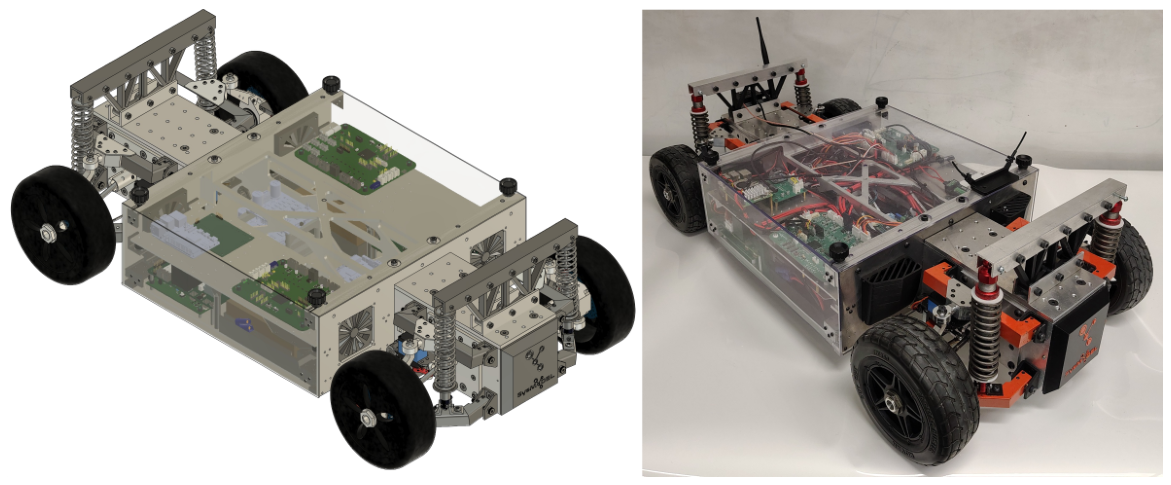
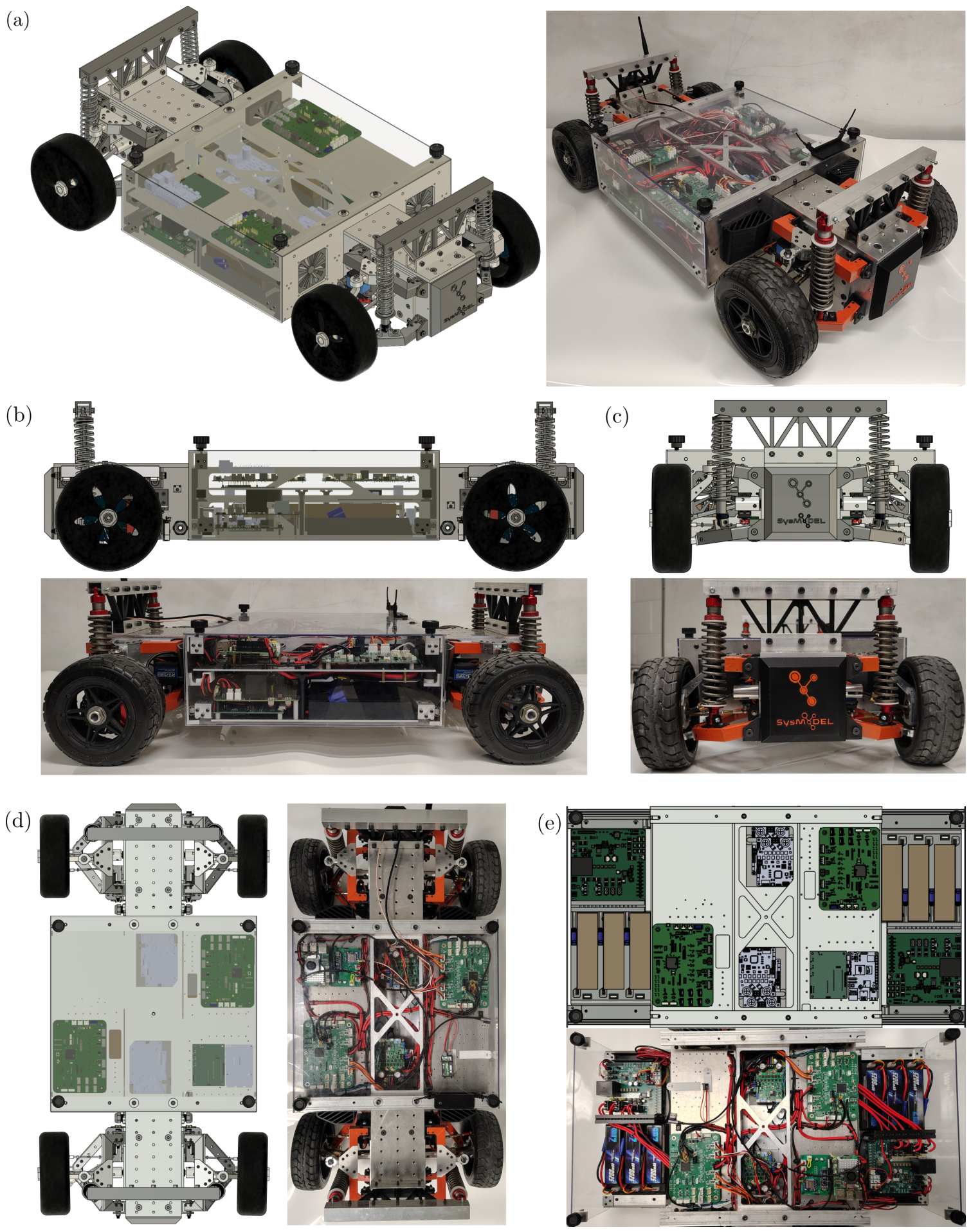
This article presents the Multi-Actuated Research Vehicle (MARV), to the best of the authors’ knowledge, the first scaled ground vehicle test platform with full XBW actuation authority. MARV is a 1:5 scale XBW ground vehicle test platform with independent wheel: (i) SBW, (ii) BBW, (iii) DBW, and (iv) suspension-by-wire (active suspension) capability. The MARV platform fills the gap between simulation and full-scale XBW vehicle validation, enabling a low-risk alternative for advanced vehicle dynamics and control system testing and validation. This article presents the design of the MARV platform as a blueprint for developing a scaled XBW research vehicle. It details the mechanical, electrical, software, and low-level control systems required to enable future researchers in the application and validation of novel advanced multi-actuated vehicle control architectures.
The platform design is presented as follows: First,
Section 2 provides an overview of the motivation and requirements for the vehicle, outlining system requirements and engineering specifications.
Section 3 outlines the vehicle’s mechanical design, followed by the electrical, embedded, and low-level control system design in
Section 4. The full vehicle assembly is presented in
Section 5, followed by system identification and experimental validation of key vehicle requirements in
Section 6 and
Section 7. Finally,
Section 8 concludes and presents avenues of future work.
3. Mechanical Design
The core objective of the mechanical design was to maximize modularity and adjustability (VSR4) in each of the vehicle’s subsystems. This led to the adoption of various off-the-shelf 1:5 scale vehicle components, specifically ball joints, wheels, tires, tie-rods, suspension struts, and driveshafts. The mechanical design targets robustness and incorporates design for manufacturing considerations. Throughout early iterations of the design, it became clear that the 1:5 scale vehicle can be designed within a maximum vehicle mass of 35 kg, encompassing the full mechanical design, batteries, and electrical components. Therefore, throughout the analysis of the vehicle’s systems design, an estimated vehicle mass of
kg will be used. The following five subsections detail the mechanical design of the chassis, driveline, braking, suspension, and steering subsystems to address the engineering specifications presented in
Section 2.2.1,
Section 2.2.2,
Section 2.2.3,
Section 2.2.4 and
Section 2.2.5.
3.1. Chassis Design
The selected body-on-frame chassis design is distributed into independent frame and body designs to fulfill the FES and BES specifications. The body and frame interact directly through FES2, incorporating standard mounting points on the frame and body for ease of assembly.
3.1.1. Frame Design
The frame facilitates the placement and structure required to mount the chassis’ body and each of the vehicle’s mechanical subsystems. The objective is to create a frame design that can be easily adapted for an increase in vehicle wheelbase. The vehicle specifications outline a wheelbase aspect ratio of (VSR3-d), representing a shorter vehicle. By designing the vehicle at a low wheelbase aspect ratio, the frame experiences its tightest spatial constraint, where larger aspect ratio vehicles can be realized by simply increasing the distance between the two axles.
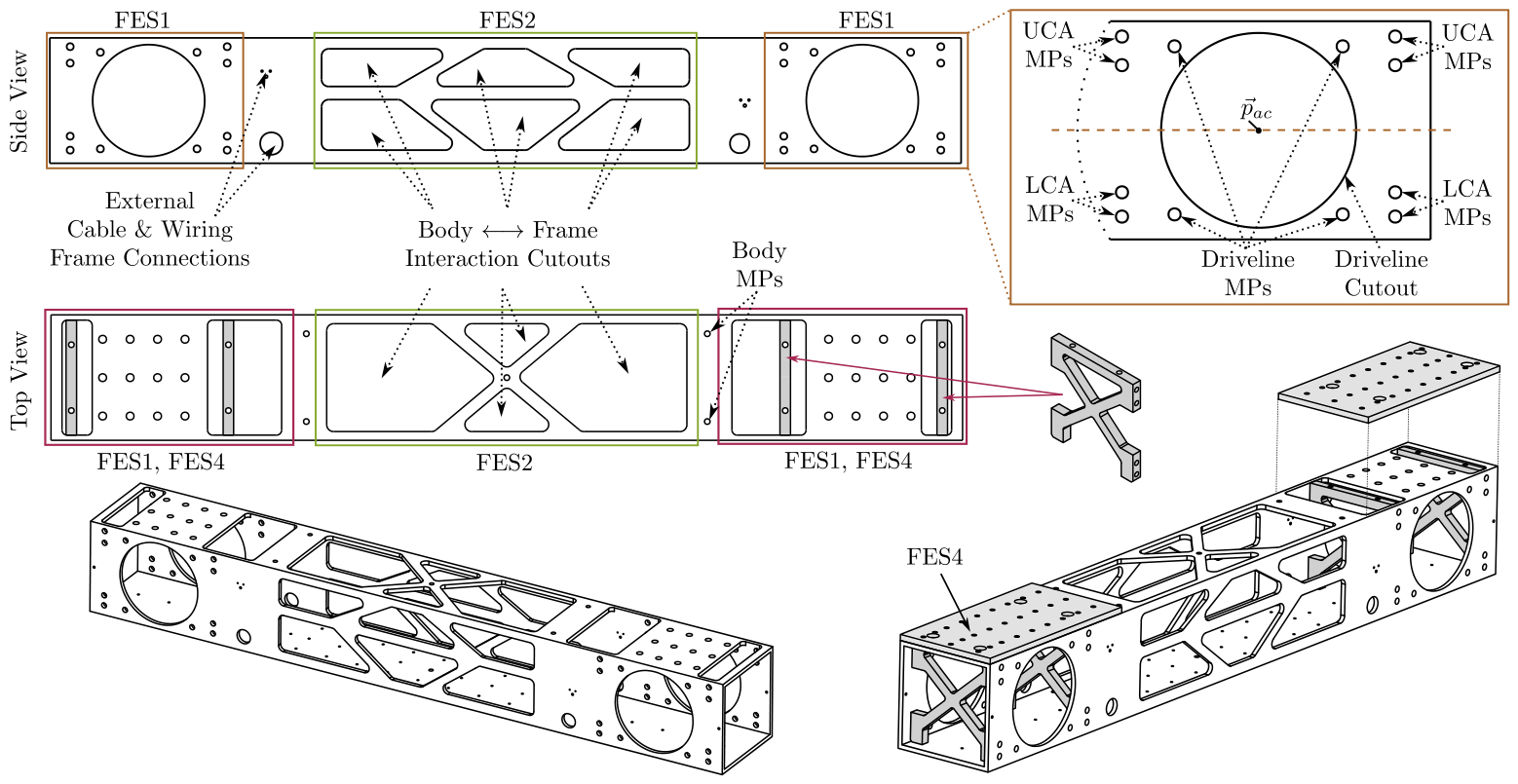
The frame design is separated into two sections: the axle section (FES1) and the body section (FES2); see
Figure 2. Inspired by the box frame design within mass-produced pickup trucks, the frame is designed from a single 4.5″ × 4.5″ extruded aluminum square tube. Aluminum was selected as the core frame material due to its high strength-to-weight ratio and extrusion properties. The strength-to-weight ratio allows the frame to withstand worst-case scenario impact forces (FES3) while remaining sufficiently light to aid in the vehicle’s dynamic performance criteria (VSR3).
The frame design, depicted in
Figure 2, has three core topologies: the side profile (mirror front to back and side to side), the top, and the bottom. The side profile is responsible for fulfilling FES1 and FES2. To address FES1, a generic motor mounting location and suspension mounting locations are defined in reference to the axle’s centre point (see
in
Figure 2), where
is selected based on the 1:5 scale tire (RV89002, RovanRC, New York, NY, USA) outer radius (
), and where a distance
from the edge of the frame ensures the wheel is longitudinally contained within the vehicle’s frame. The body design, discussed below, bounds the geometry of FES2, with large cutouts created within the frame’s tube to facilitate cable routing pathways between the frame and body.
The FES1 and FES2 requirements extend to the frame’s top, creating access points for installing and mounting the axle’s subsystems and facilitating the wiring of the vehicle. These access points are covered by a standardized mounting grid for vehicle hardware and sensors (FES4). To facilitate the mounting grid, three components are added to the frame. The first two components are structural cross members placed between the left and right control arm mounting points. The cross members extend to the top of the vehicle’s frame, facilitating a strong mounting point connection for the final component, a top plate with equidistantly placed holes. In addition, the frame’s bottom topology is equipped with equidistant threaded holes throughout the frame for FES4, facilitating the mounting of internal hardware and cable management within the frame.
3.1.2. Body Design
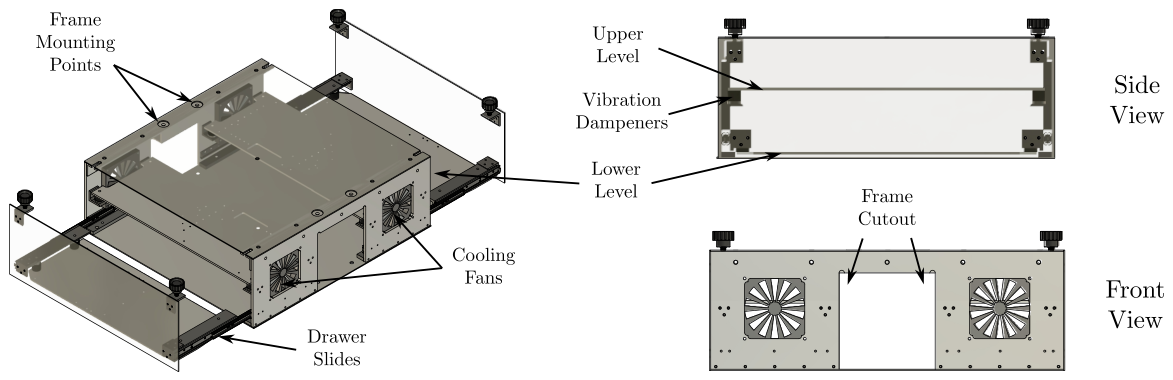
The vehicle’s body houses the batteries, electronics, and computing hardware (BES1). In full-scale EVs, the batteries are integrated into the base of the vehicle chassis and/or frame, leading to a lower centre of gravity. This method was directly implemented within the MARV design, separating the body into upper and lower levels. The lower level contains the batteries, battery monitoring systems, and power electronics. The upper level is dedicated to housing the embedded systems and compute modules, described in
Section 4. A key difference in scaled vehicles is the requirement to remove the batteries for recharging. This constraint led to the incorporation of a drawer system within the body design, enabling the lower level to slide out from under the upper level, providing direct access to the batteries for removal and recharging.
To enable easy mounting and removal from the vehicle’s frame (BES2), the body’s structure was designed to sit directly on top of the frame (see body mounting points in
Figure 2), with the bulk of the body wrapping around the sides of the frame. The body’s structure is manufactured from aluminum, with vibration dampeners placed between the body’s main structure and the upper and lower body plates. Stock drawer slides are employed to facilitate the motion of the lower tray assembly, with ball detents and screw knobs used to hold the tray closed during operation. The top, bottom, and sides of the body are manufactured from clear polycarbonate sheet, allowing the vehicle’s operator to visually inspect the batteries, embedded systems, and compute modules without opening the body.
To cool the electronic systems within the body (BES3), four computer fans are placed at the front and rear of the body to provide airflow over the batteries and electrical components. With all four fans operational (two input fans, two exhaust fans), the air within the body is cycled 45 times per minute. Additional blower fans are added throughout the vehicle body to ensure adequate passive cooling for all electronic devices.
Figure 3 displays the body design, highlighting the body’s two-level structure, mounting method, and main cooling fan locations.
3.2. Driveline Design
The vehicle’s driveline is responsible for providing the propulsive power required to obtain the top speed and acceleration rate defined in VSR3. An electric vehicle’s powertrain can be separated into the driveline (motors and gearboxes) and the power supply (batteries). The core trade-off when selecting the driveline motor is the compromise between the motor’s power and its geometry and weight.
The drive motor selection is constrained by the vehicle’s top speed (60 km/h—VSR3-b) and acceleration requirements (0 → 5.36 m/s in 5.3 s—VSR3-a). Assuming the motor applies constant torque throughout acceleration, the required longitudinal chassis force, neglecting mechanical losses, is defined as
where
is the desired constant acceleration defined by VSR3-a,
is the rolling resistance coefficient,
g is the gravitational constant, and
,
,
, and
are the air density, drag coefficient, frontal area, and longitudinal velocity. To achieve the required longitudinal chassis force with only the front or rear drivelines (DES1), the peak motor torque (
) for each driveline is determined by
Similarly, the peak vehicle speed (VSR3-b of 60 km/h) informs the peak driveline velocity (
) defined as
Evaluating the driveline’s peak torque with
m/s (VSR3-a) and conservative resistance parameters of
[
24],
,
,
,
, results in a peak torque of
Nm. Similarly, the peak driveline velocity is determined with the longitudinal velocity of
(VSR3-b), leading to an angular velocity of
Rad/s. To eliminate the need for an integrated gearbox, a large-diameter motor was selected to meet the torque and speed requirements. The selection of a gearless driveline minimizes the overall length and weight of the assembly, ensuring it remains within the vehicle frame design. The RI80 Brushless Direct Current (BLDC) frameless motor (CubeMars, Nanchang, China), was identified as a candidate drive motor. The RI80 motor exceeds the driveline torque requirement with a peak torque of 4.28 Nm (at 27.6 A), and achieves the peak motor speeds of
rad/s with a supply voltage of 24.96 V.
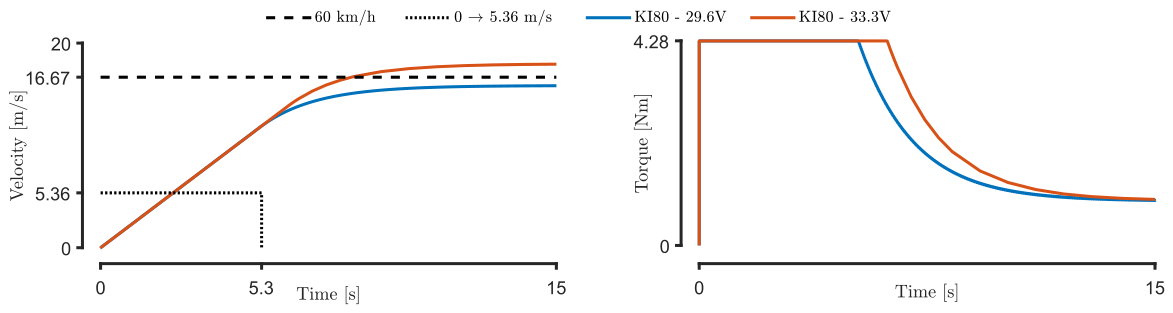
The second component of the vehicle’s powertrain is a portable power source. Lithium polymer (LiPo) batteries are implemented for their compact size, high current output, and wide adoption in scaled vehicles. To determine the minimum number of LiPo cells required to achieve the top-speed requirement, lumped parameter simulations were conducted in Matlab’s (2024b) Simscape toolbox for the RI80 motor with 29.6 V (8-LiPo cells) and 33.3 V (9-LiPo cells) supply voltage. The simulation considers the motor’s electrical and mechanical characteristics to accelerate the vehicle mass while considering aerodynamic drag and rolling resistance. The results are displayed in
Figure 4. The 33.3 V LiPo battery pack, comprised of 9-Lipo cells, represents the minimum supply voltage to achieve the top speed requirement. The result is a vehicle capable of achieving a 0 → 5.36 m/s acceleration in 1.98 s, while reaching the desired top speed within 8.32 s.
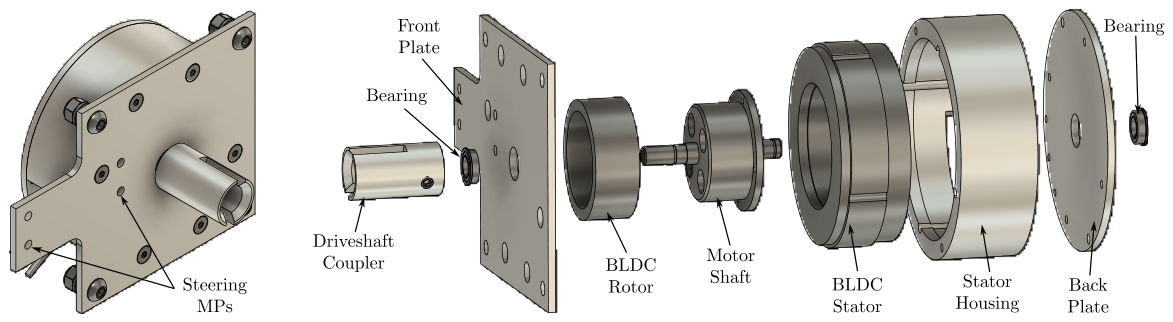
The driveline design is displayed in
Figure 5, targeting three main objectives: (1) implement a motor casing and rotor to interface with the KI80 frameless motor, (2) deliver the motor’s torque to the driveshaft, and (3) create mounting points for the future steer-by-wire motors. The stator housing was designed based on the motor cutout diameter in FES1 of
Figure 2, and the motor shaft was designed to have a press-fit interaction with the BLDC’s rotor. The motor’s front plate mounts the driveline assembly to the frame using the specified bolt pattern in FES1 and provides attachment points for the future steering system.
The proposed driveline design achieves the vehicle acceleration (VSR3-a) and top speed (VSR3-b) requirements. However, the electric powertrain requirement also boasts the capability to achieve the required vehicle stopping distance (VSR3-c), covered in the following section.
3.3. Brake System Design
The vehicle’s braking system is responsible for rapidly and accurately dissipating the vehicle’s kinetic energy. With EVs, a significant amount of the energy can be transferred back into the batteries, provided the batteries can accept the charge. The required energy dissipation by the braking system (
) to stop the vehicle is defined by
where
is the desired braking distance, and
is the required braking force applied to the chassis. Using (
4) in the context of BrES1, a constant dissipative chassis force of
N is required to achieve the
m stopping distance. With equal brake force engagement on either the front or rear wheels, the maximum required braking torque is determined by
The result is a constant braking torque of Nm to achieve the m stopping distance. The braking torque is within the peak torque of the RI80 motor, showing that regenerative braking alone is sufficient. However, a traditional mechanical braking system is required in two scenarios: First, if the vehicle’s battery is full, regenerative braking can not be used. Second, the mechanical brakes act independently of the motors, allowing increased energy dissipation in emergency scenarios.
In a previous work, the authors developed a mathematical model for a cable-based disk-brake system [
25]. The 1:5 scale system can achieve an accurate caliper clamping force of up to 250 N with a peak braking torque of
Nm using an aluminum pad and carbon-fiber rotor. In this application, the scaled brake caliper mounting location, pad, and rotor material are applied in direct alignment with the application in [
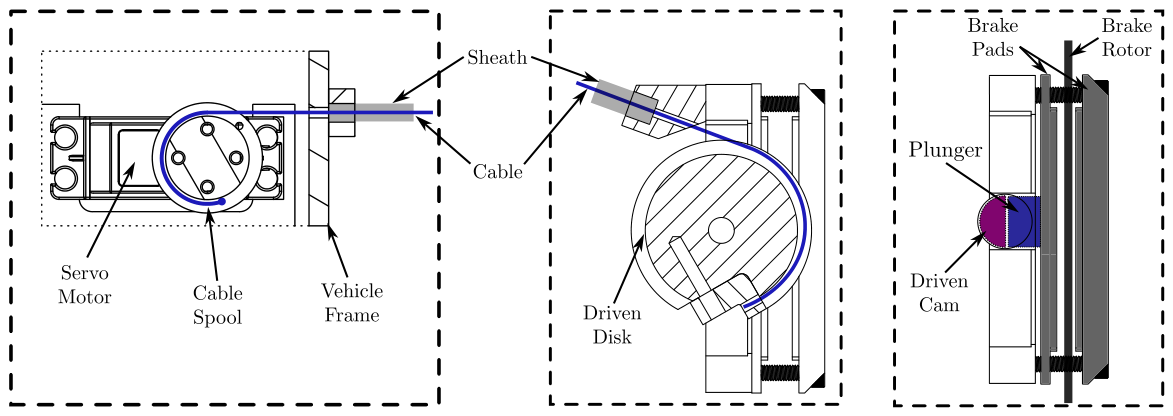
25]. However, the caliper’s driven disk (see
Figure 6) was modified to exhibit a constant mechanical advantage of 5:1, by replacing the traditional lever arm with a disk of a fixed radius. A servo motor is fitted with a cable spool to apply tension to the cable.
Figure 6 displays the design of the braking system, connecting the servo motor and driving spool located in the vehicle frame with the 1:5 scale caliper and drive disk on the wheel hub.
3.4. Suspension Design
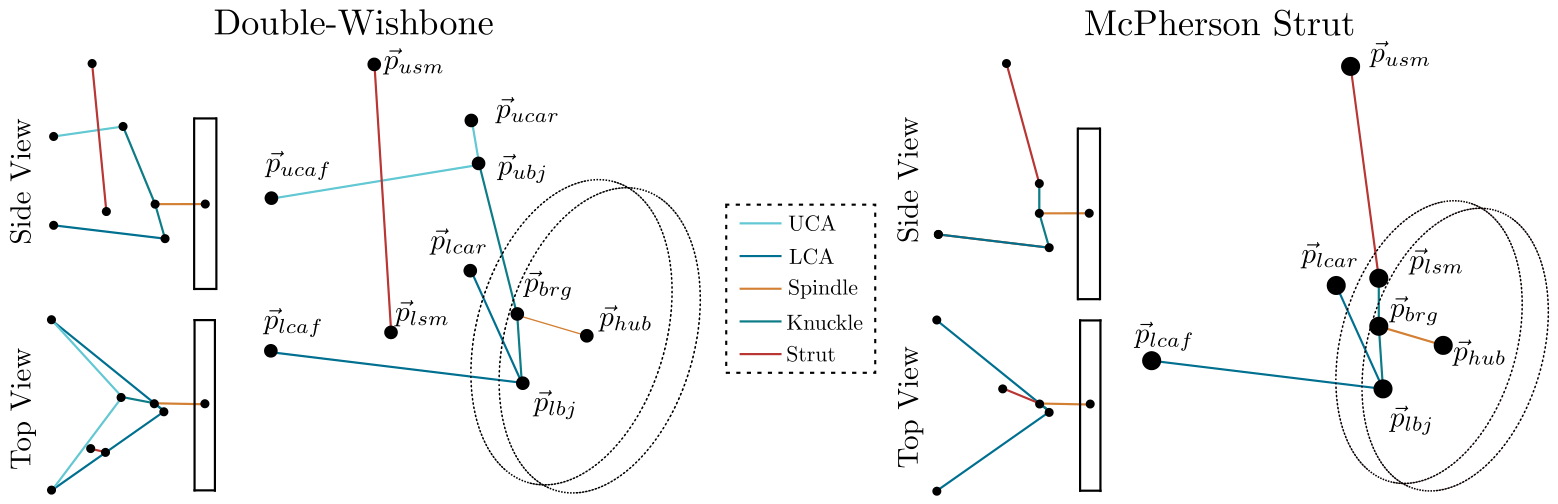
The suspension system elevates and isolates the vehicle from road disturbances, all while maintaining consistent tire contact with the road. In analyzing steerable suspension designs, both the McPherson strut and double-wishbone suspensions allow for tailoring of the suspension’s behaviour by changing the positions of key kinematic points (referred to as hardpoints) in the suspension (i.e., ball joints, wheel bearings). A local reference frame for the axle’s suspension system is created to simplify the design process. The local frame is placed on the bottom of the vehicle’s frame (Z), aligning with the axle’s centre point (
). All suspension hardpoints and designs are expressed relative to this local frame. The concept of suspension hardpoints and a local frame was inspired by the Project Chrono Vehicle open source library [
24], where the relevant hardpoints to fully define the double-wishbone and McPherson strut suspension designs are illustrated in
Figure 7. Ultimately, the double-wishbone suspension was selected for both the front and rear axles of the MARV design due to its high degree of tunability.
The suspension design begins by specifying the position of the wheel hub (
), the point where the wheel is mounted to the suspensions’ knuckle, fully defined by the 1G ground clearance (
) (SES1), vehicle wheel-base and track-width (
), and knowledge of the wheel and tire specifications, specifically, the outer radius (
), wheels’ inner radius (
), and hub offset (
). The fully defined wheel hub position is defined by
for the left side vehicle suspension, where
is the desired tire camber angle at the 1G position. Due to the inherent symmetry between the left and right suspension designs, the hardpoints for the vehicle’s left side are reflected to the right by flipping the sign of the
Y component. The second hardpoint defined is the position of the wheel bearing (
) determined by
where
is the spindle length, defined as the distance between the wheel hub and the end of the wheel bearing. This length incorporates the vehicle’s disk braking system and axle bearing systems. The alignment of the
and
X components ensures the wheel has zero steering angle. With the initial wheel position and orientation achieved, the focus can shift to achieving the desired suspension characteristics outlined in SES2 and SES3.
To position the lower ball joint, while ensuring sufficient design space for the wheel bearing and knuckle geometry, the lower ball joint position (
) is constrained based on the wheels’ inner diameter, such that the
Z component between
and
is
. The ball joints
X and
Y′ components inform the vehicle’s mechanical trail (SES2), scrub radius (SES2), and camber (SES3). These specifications are dependent on the suspension’s kingpin axis (
–a unit vector), and its change throughout suspension compression and extension. In the double-wishbone design,
is defined between
and the upper ball joint (
) as
The kingpin axis directly enables calculation of the mechanical trail and scrub radius. A simplified calculation of the mechanical trail (
) and scrub radius (
) is defined as
with
where
is the centre location of the tire print. The wheel camber (
) can be determined by the change in the
Y component of
due to the suspension’s motion, defined as
for the vehicle’s left side, where
is
at the suspensions’ 1G position. These simplified calculations in (
9)–(
11) are only valid in zero-steer conditions.
The SES2–SES3 suspension requirements outline a positive mechanical trail, near-zero scrub radius, while achieving negative camber during suspension compression and positive camber during suspension extension. Analyzing the camber characteristics in (
11) and the definition of
in (
8) outlines that to exhibit negative camber in compression, the
Y component of
must increase while the
Y component of the
decreases (double-wishbone) or remains constant (McPherson). The opposite is required to exhibit positive camber in extension. Simply put, the
Z component of
must be less than the lower control arm (LCA) mounting points (
) on the frame, creating a 1G LCA angle
. As the suspension is compressed (
), the
Y component of
increases, resulting in negative camber. Therefore, for bounded LCA rotation of
, the camber is inversely proportional to the
deviation from the 1G position. To amplify the camber characteristics from the LCA, the double-wishbone’s upper control arm (UCA) can incorporate a similar design methodology, but instead apply a positive 1G UCA angle
).
The LCA and UCA frame mounting points are defined based on the frame’s axle interface layout (FES1), outlined in SES4. For simplicity, the front and rear LCA ( and ) and UCA ( and ) mounting points are placed with identical Y components, leading to the UCA and LCA rotating about the vehicle’s X axis.
To achieve the characteristics in SES2–SES3, systematic iteration of the suspension hardpoints for the double-wishbone suspension (see
Figure 7) is applied. The resulting hardpoints for double-wishbone suspension designs implemented on the MARV platform are expressed in
Table 1. The suspension design boasts a mechanical trail of
mm, scrub radius of
mm, and camber range of
to
for LCA rotations of
(extension) and
(compression) from
.
With the suspension’s core positional characteristics achieved, focus can shift to the suspension’s response to road disturbances, defined by SES5. The suspension’s stiffness and damping are facilitated by the strut, a variable-length link with connection points on the vehicle frame (
) and LCA (
). The objective is to achieve a suspension natural frequency between 1 and 2 Hz, with lower natural frequencies leading to increased ride comfort and higher natural frequencies for increased dynamic performance [
26]. To determine the required stiffness and damping of the combination strut, a 1-DOF linear quarter-car suspension model is referenced, with the transfer function
where
and
are the vertical positions of the sprung mass and road, respectively, and
and
are the suspension’s stiffness and damping. The natural frequency of the second-order linear system is determined by
leading to a desired quarter-car stiffness of
Analyzing the stiffness for both comfort (1 Hz) and performance (2 Hz) natural frequencies yields quarter-car stiffnesses of 345 N/m and 1382 N/m, respectively. In the same way, the suspension’s damping coefficient is determined by
Applying damping ratios
(comfort)–
(performance) (values from Table 3 of [
23]) leads to damping coefficients of 138 Ns/m and 1105 Ns/m for comfort and performance designs, respectively.
The quarter-car suspension model is built on the assumption that the spring and damper are placed directly above the tire contact point. Therefore, scaling is required to determine the stiffness (
) and damping (
) of the physical strut from the quarter-car parameters. The coefficients are scaled based on the strut’s unit vector (
) and its connection to the unsprung mass—LCA for the double-wishbone. The coefficients are determined as
where
C denotes the chassis frame with
and
extracting the vectors
Y and
Z component, and
is defined as
The final consideration is the strut pre-load required to suspend the vehicle at its 1G position, defined as the 1G spring displacement of
The presented suspension design analysis covers the kinematic and dynamic requirements of a passive suspension system outlined in SES1–SES5. The final engineering specification outlines implementation of independent wheel active suspension (SES6).
3.4.1. Active Suspension
The MARV architecture was designed to enable the future integration of a fully active suspension system. The suspension-by-wire system, including the actuator and linkage, has not been fully defined. Based on past active suspension designs for scaled vehicles, it is assumed that the active suspension system will be electrically driven by a direct current (DC) motor. To properly scale the vehicle’s power distribution and battery capacity for a future active suspension system, a quarter-car simulation was conducted to establish power baselines.
A 2-DOF quarter-car simulation was conducted, implementing comfort-oriented quarter-car parameters:
kg,
kg,
N/m,
Ns/m, and
kN, representing the sprung mass, unsprung mass, suspension stiffness and damping, and tire stiffness, respectively. A Linear Quadratic Regulator (LQR) was designed to optimize the suspension’s ride comfort at a constant speed of 40 km/h over an ISO 8608 Class D road profile, representing a rough/damaged surface [
27]. Under these conditions, the simulation yielded a peak mechanical power requirement of
W, with an average of
W. Therefore, the electrical subsystem will be specified to include headroom for a peak electrical power requirement of 300 W per wheel for active suspension to account for efficiency and thermal losses.
3.4.2. Suspension CAD
The design of the suspension geometry was the result of iterative design, incorporating standard off-the-shelf 1:5 scale vehicle components. Suspension components in modern vehicles are topologically optimized; however, for the simplicity of manufacturing, the design focused on creating simple and robust components capable of being manufactured on a standard 3-axis milling machine and 2-axis lathe. The designed suspension hardpoints are displayed in
Table 1 for both the left front and rear suspension designs. Two stock 1:5 scale components were utilized in the design: a combination strut with a removable spring and stock ball joints (RV95145 and RV95108, RovanRC, New York, NY, USA). The lower and upper control arms and corresponding control arm mounts are manufactured from mild steel, with the remaining components manufactured from aluminum to reduce the unsprung mass. To measure the current position of the suspension, an absolute encoder is mounted to the LCA, directly measuring
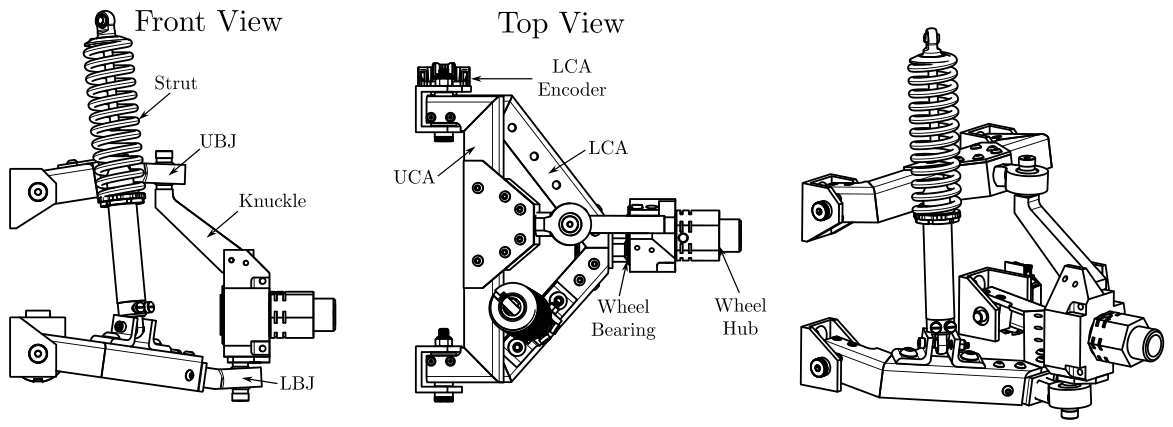
. The CAD model of the left front suspension design is presented in
Figure 8, resulting in a modelled quarter-car mass of
kg.
3.5. Steering System Design
The objective of a traditional linked steering system is to orient the left and right wheels according to the Ackermann steering condition, resulting in a yaw moment and a lateral force being applied to the vehicle. In independent SBW systems, the objective shifts to applying an effective steering angle, where traditional steering conditions, such as Ackermann steering, can be applied electronically by the control system designer.
A wheel’s effective steering angle is defined by the
x component of the spindle unit vector (
), defined as
where the effective steering angle is determined by
for the vehicle’s left side. The sign is flipped for the vehicle’s right side, ensuring that the wheels are referencing rotation about the positive
Z axis.
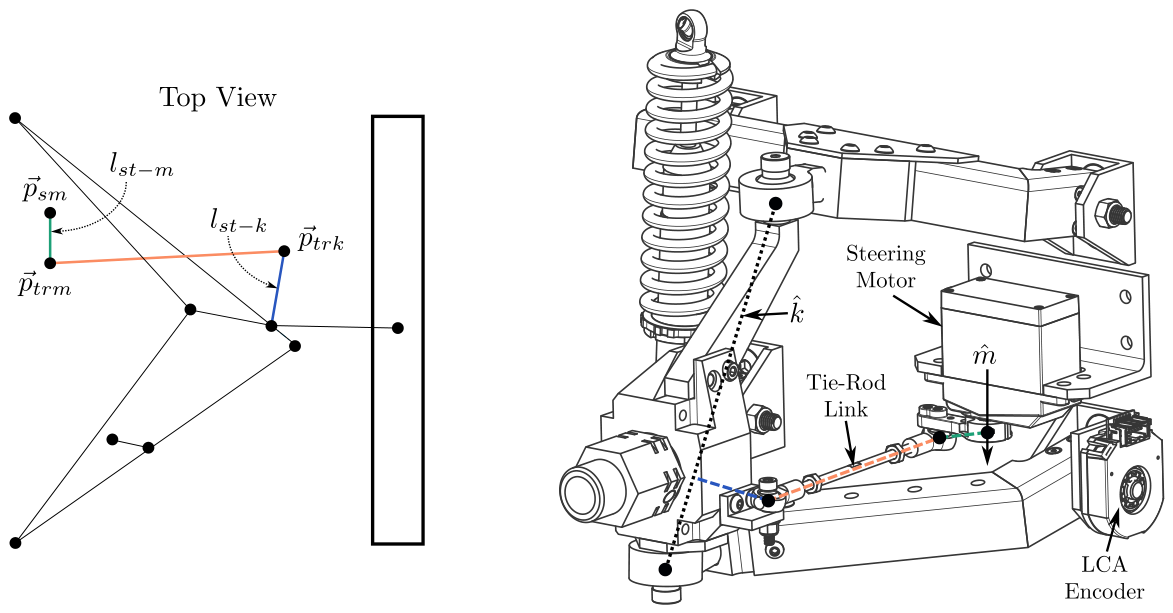
To implement independent SBW within the suspension design, three steering hardpoints and one actuation vector are defined: the tie-rod connection to the knuckle (
), the tie-rod connection to the steering motor linkage (
), the initial position of the rotational (i.e., pitman arm) or translation (i.e., rack and pinion) steering motor (
) and the motor’s rotational or translational unit vector (
); see
Figure 9. In linked steering systems, the steering linkage is designed to minimize bump steer by designing the tie-rod hardpoints to align with the UCA and LCA instantaneous centre (IC). However, the IC is dynamic with suspension extension and compression, making the design of linked steering systems complex. Independent wheel SBW significantly simplifies the steering system design, as the driving actuator can be controlled to actively compensate for bump steer, irrespective of steering hardpoint placement.
For the presented suspension design, an independent wheel pitman arm steering system was applied, driven by a servo motor. The required vehicle turning radius of
m defined in VSR3-e, determines the maximum required effective steering angle to achieve the turning radius. Using the Ackerman steering principle of an IC, the maximum effective front or rear wheel steering angle to achieve a turning radius (
) is determined by
where the vehicle’s centre of mass is assumed at the centre of the vehicle’s wheelbase. Using the platform’s wheel base (
m) and track width (
m), a turning radius of
m requires a maximum effective steering angle of
rad.
An iterative mechanical design process was conducted to place the steering hardpoints, analyzing resultant steering characteristics and mechanical interference. The selected hardpoints and actuation vectors for the left front and rear steering geometries are presented in
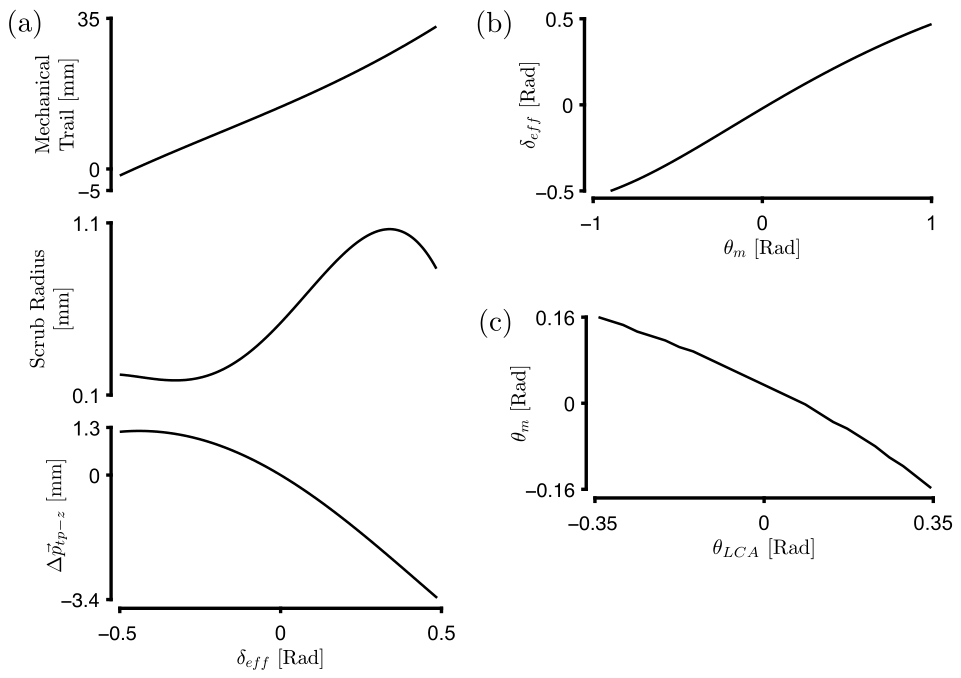
Table 2. Simulating the combined suspension and steering systems,
Figure 10a displays the resultant mechanical trail, scrub radius, and jacking distance for the front left wheel for an effective steering angle range of
rad. The figure clearly demonstrates that the suspension design has significant mechanical trail for the majority of effective steering angles (SES2) and has a consistently low scrub radius (SES2). The jacking distance is a key metric to consider for independent wheel drive systems, as a suspension with a non-zero caster angle will generate steering (jacking) torque based on the vertical tire load. In traditional linked steering systems, the magnitude of the jacking torque is significantly reduced by the mirrored suspension geometry and is not generally considered.
Figure 10b displays the required steering motor actuation to achieve the effective steering angle at the 1G position, and
Figure 10c displays the required motor actuation to maintain zero effective steering angle throughout suspension compression and extension.
The steering system mechanical design is presented in
Figure 9. The steering motor mount and knuckle tie-rod mount are manufactured from steel angle with the mounting holes aligning with the drive motor design and knuckle design, respectively. The tie-rod is made from standard ball joint rod ends and threaded rod, with the distance between the two rod ends defined by the length
The presented mechanical design and analysis initializes the XBW vehicle architecture (VSR1), implementing the mechanisms and systems required to enable independent wheel drive, steer, brake, and suspension-by-wire capabilities. Additionally, the vehicle’s dynamic performance (VSR3) and modularity (VSR4) are achieved in the mechanical design and analysis. However, the vehicle’s functional efficacy is only realized with integration of an advanced electrical and embedded system architecture to monitor and control the vehicle and its subsystems.
4. Electrical and Embedded System Design
The vehicle’s electrical and embedded systems bring each mechanical system to life. Upon analysis of the VSRs and EES’, five objectives for the electrical and embedded system were outlined: (1) monitor the vehicle’s power supply and ensure safe charge and discharge, (2) facilitate safe distribution and regulation of the power supply voltage to the vehicles subsystems, actuators, sensors, and logic boards, (3) enable low-level actuator control and sensing for each of the vehicle’s subsystems for VSR1 and VSR2, (4) achieve requirements VSR1, VSR5 and VSR6 by implementing actuator commands, receive vehicle feedback, enable remote monitoring, real-time data logging, and sub-module communication, and (5) create an isolated capability to stop vehicle operation in the case of emergencies.
The objectives led to the development of three embedded systems to address the first three objectives, a system-on-module to facilitate objective (4), and a custom wireless emergency stop (E-stop) system to enable (5).
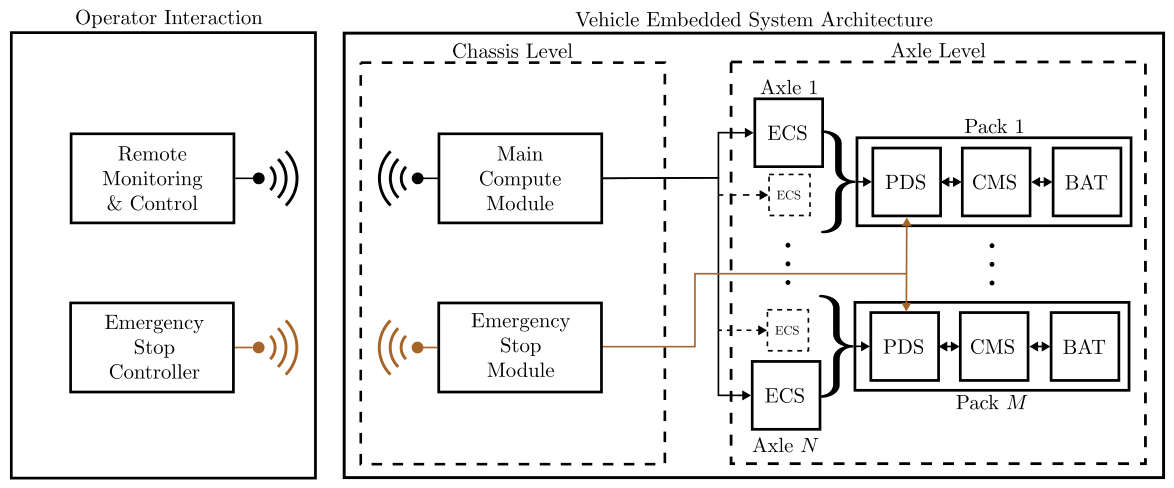
Figure 11 displays the vehicle’s embedded system architecture, separating the architecture into the axle and chassis levels.
The axle level contains the first three embedded systems, centralized in the vehicle’s axle or axle group. Each axle is equipped with an embedded control system (ECS) responsible for low-level control of the axle’s actuators and measuring feedback from each subsystem. The ECS, along with its actuators and sensors, is energized by a power pack capable of powering one or more axles based on the design specifications. Each power pack contains the LiPo batteries (BAT), a Cell Management System (CMS), and a Power Distribution System (PDS).
The chassis level contains two independent systems: the main compute module (MCM) and an E-stop module. The MCM has three core responsibilities: (1) directly interface with each axle’s ECS to command actuator outputs and receive feedback measurements, achieving objective 4, (2) provide a chassis-level control interface for the application of advanced vehicle controllers, and (3) provide remote monitoring data to the vehicle’s operator, as depicted in
Figure 11. In turn, the vehicle’s operator is equipped with an E-stop controller intended to safely and rapidly de-energize the vehicle upon activation.
The segmentation of the system architecture into chassis- and axle-level subsystems enables direct scalability for future multi-axle (>2) vehicles without modifying the core embedded systems (VSR4). A high-level overview of the axle- and chassis-level systems is described in the following subsections.
4.1. Axle Level
The axle-level system architecture core objective is to achieve the desired actuator output and provide the required state-feedback measurements for each subsystem in the axle. Within the axle level, the power pack provides the necessary voltage regulation and power supply to the actuators, sensors, and compute systems, where the ECS controls the actuators and measures the axle’s current state. The power pack’s embedded systems and the ECS are described as follows.
4.1.1. CMS
The CMS is responsible for the monitoring and management of the vehicle’s batteries, ensuring safe power dissipation and energy storage. In
Section 3.2, LiPo batteries were selected as the power source for the vehicle. LiPo batteries impose a significant safety hazard if improperly charged or discharged. Therefore, the sole objective of the CMS is to ensure the safe operation of the LiPo batteries.
Research into industry available battery and Cell Management Systems led to selecting the TIDA-00449 Texas Instruments reference design [
28]. The design was directly integrated into the CMS with the battery protection circuitry modified according to the combined peak current draw of the powered actuators. The managed power supply is then provided to the PDS module through a fused connection for voltage regulation and distribution.
4.1.2. PDS
The PDS has two main objectives: (1) regulate the input voltage from the CMS ( V) to power the cooling fans ( V), servo actuators ( V), and sensors and microcontrollers (5 V and V), and (2) safely disconnect power to the energy-inducing actuators (the drive motors and active suspension actuators) during emergency stop conditions.
To generate the regulated voltage from the provided CMS voltage, current-mode control buck converters were implemented to achieve the first objective. Objective (2) is facilitated by a normally open relay placed between the main drive motors and active suspension power outputs. For the relay to engage and provide power to the motors, the chassis-level E-stop module must provide a constant excitation voltage of
V to the PDS relay driving circuit (see
Figure 11). The driving circuit is engineered with safety in mind, ensuring the relay rapidly disengages in E-stop conditions (
V signal is not present). All power outputs from the PDS are fused using standard automotive AMT fuses, adding a layer of protection between the power pack, sensors, and actuators. The safe and regulated voltage supplied by the power pack enables the ECS to focus on the control and monitoring of the axle’s actuators and sensors.
4.1.3. ECS
The ECS brings each axle to life, communicating with the vehicle’s MCM and axle’s PDS, monitoring feedback from the sensors, and applying the desired actuator outputs. At its core, the ECS has seven main responsibilities:
- 1.
Control the main motor drives to control torque and receive feedback.
- 2.
Control the braking motors and provide torque feedback.
- 3.
Control the steering motors and provide position and torque feedback.
- 4.
Control active suspension motor drivers and measure force feedback.
- 5.
Measure the axle’s suspension pose.
- 6.
Communicate with the MCM to receive actuator commands and provide real-time feedback.
- 7.
Communicate with the axle’s PDS.
The first four responsibilities are directly linked to the drive, brake, steering, and suspension-by-wire subsystems designed above. Each subsystem has a desired method of actuation and specified feedback to maximize vehicle control.
In DBW systems, the motor torque is controlled, with feedback of the motor speed and applied torque. To achieve torque control, the SOLO UNO V2 (SOLO Motor Controllers, Saronno, Italy)—an off-the-shelf motor controller capable of motor torque or speed control with feedback—is implemented. Two SOLO UNO V2 motor controllers are employed for each axle, each controlling one of the axle’s drive motors. The ECS controls the motor torque using the analogue control mode, where feedback torque and speed feedback are obtained by UART communication with the motor driver at 500 Hz.
The brake-by-wire system (
Section 3.3) and steer-by-wire (
Section 3.5) systems employ a servo motor to apply the braking torque and control the steering angle of each wheel. Therefore, the servo’s position and torque must be measured. Position feedback is achieved by accessing the output of the servo motor’s internal rotational potentiometer, where torque feedback is estimated by measuring the current draw of the servo system (motor and controller), with the assumption that the internal servo controller has a constant current draw throughout operation. The unidirectional current can be translated to a torque magnitude and direction by referencing the servo’s torque constant and the error between the desired and measured servo position, respectively. The implemented control system to achieve the desired braking torque and effective steering angle is presented later in
Section 4.2.
The future active suspension system described in
Section 3.4.1 harnesses a 300 W direct current (DC) motor. The motors will be driven by an H-bridge motor driver with force feedback determined by directly measuring the motor’s current draw.
A core vehicle requirement is full-state feedback for each of the vehicle’s DOFs (VSR2). The ECS is responsible for measuring the state of the driveline, steering, and suspension DOFs. The driveline feedback is directly achieved using feedback from the SOLO UNO motor drives. However, to correctly measure the steering and suspension DOF, the axle’s suspension pose—current hardpoint positions of the double-wishbone and steering systems (
Table 1 and
Table 2)—must be identified. To calculate the suspension pose, the position of the LCA and steering motor must be known. In the suspension design, an absolute encoder is applied to the LCA position, with the steering servo motor capable of providing the position feedback as described above. The identification of the suspension pose is explained in detail in
Section 4.2 to follow.
The ECS’s remaining responsibilities are to enable inter-vehicle communication with the chassis’s MCM and power packs PDS. The ECS facilitates communication using standard UART communication, exhibiting a master–slave relationship, where the PDS only responds to an ECS command, and the ECS only responds to the MCM command. This method ensures that each message is properly received and processed, and ensures unnecessary data is not transmitted between devices. To directly achieve the required axle control outputs, low-level control systems are implemented within the axle’s ECS.
4.2. Low-Level Control System and Kinematics Implementations
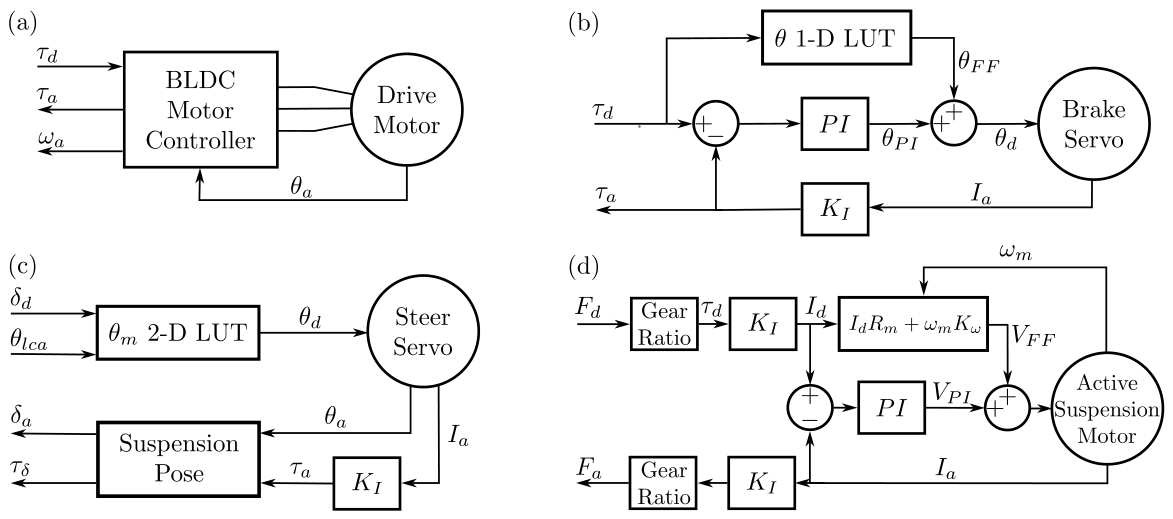
The main objective of the MARV platform from the lens of a control researcher is the ability to apply independent wheel drive torque (1), braking torque (2), effective steering angle (3), and active suspension vertical force (4), all while receiving full state-feedback for each of the vehicle’s subsystems (VSR1–VSR2). To enable direct dictation of these control inputs, the ECS incorporates low-level control systems coupled with suspension kinematics for each subsystem, displayed in
Figure 12. Only one control objective is directly realized with the selected hardware. Specifically, the SOLO UNO motor drivers enable the direct torque control and monitoring (
Figure 12a). The remaining three objectives require low-level controllers operating on the axle’s ECS to realize the desired control objectives.
4.2.1. Brake-by-Wire Control
The BBW control system achieves closed-loop torque control with a servo motor using a data-based feedforward-Proportional-Integral (FF-PI) controller (
Figure 12b). The control method can be implemented due to the following assumption: the brake pads will not wear significantly throughout a single instance of vehicle operation. The assumption implies that the relationship between the servo commanded position and applied torque will remain constant during regular operation intervals. On vehicle startup, the BBW system executes a calibration routine by sweeping driving servos until the maximum specified torque is reached. The calibration routine populates a lookup table of the servos’ commanded positions and measured currents (torque). The lookup table is used by the feedforward controller to set the servo’s initial position from the desired torque. The PI controller augments the FF position to account for errors between the desired and measured motor torque. The PI controller is implemented at 1 kHz, where the FF controller is computed once per change in the control input signal.
4.2.2. Steering Control
To apply an effective wheel steering angle, the steering motor position must be calculated based on the current suspension pose. The full suspension pose is calculated in two steps: First, the positions of the LBJ, UBJ, and resultant king-pin (
) axis are calculated using the LCA encoder measurement, axis of control arm rotation, and the geometries of the control arms and knuckle. Second, the steering hardpoint positions and rotation of the knuckle around the king-pin axis (
) can be determined based on the steering motor position. As described in
Section 3.5, the effective steering angle is defined by the spindle unit vector, which can only be defined in forward calculations with a fully defined suspension pose.
Therefore, to achieve an effective steering angle regardless of the suspension’s position, a data-based feedforward control (FF) control system is implemented. The controller employs a two-dimensional lookup table to retrieve the steering motor angle (
) required to achieve the desired effective steering angle (
) based on the current LCA angle (
). On startup, the suspension and steering hardpoints are calculated for the specified ranges of
and
and stored in the lookup table (
Figure 12c). The controller’s precision is defined by the discretization of
and
, where an increase in the size of the lookup table leads to increased precision with the trade-off of longer table population and lookup times. The control system operates at 100 Hz, based on the recent LCA measurement and the desired effective steering angle.
4.2.3. Active Suspension Control
The final low-level control system targets force control of the future active suspension system. The H-bridge motor driver allows the voltage to the DC motor to be directly controlled and the current monitored by the shunt-based current sensor. The proposed controller is a model-based FF-PI controller, where the model-based FF controller incorporates the motor’s speed, torque and speed constants, and lumped electrical properties to model the required input voltage to the motor to generate the desired motor current (force) (
Figure 12d). The additional PI controller augments the model-based FF controller to account for system uncertainties and ensure the desired setpoint is achieved. The controller is proposed to operate at 2 kHz to accommodate the high-speed current transients in DC motors.
The presented ECS and corresponding low-level control systems create the capability to realize the desired control inputs and capture the desired feedback for the application of future advanced XBW vehicle control algorithms implemented on the chassis level of the vehicle’s architecture.
4.3. Chassis Level
The chassis level of the system architecture is designed to coordinate the vehicle’s axles (VSR1), provide remote monitoring and feedback (VSR5), and enable the implementation of advanced vehicle control systems (VSR6). This capability is realized by the MCM, while the independent E-stop module provides the capability to stop the vehicle in case of an emergency.
4.3.1. MCM
The vehicle’s MCM is responsible for interfacing with each axle and the operator, while logging vehicle data and executing future implementations of advanced vehicle control algorithms in real-time. The axle-level embedded systems are designed to minimize the computational load on the MCM by ensuring its only interaction with the vehicle itself is with the ECS and a single chassis IMU and GNSS device. The combined IMU and GNSS device measures the chassis’ 6-DOF body translation and rotation, the only DOFs not measured by each axle’s ECS. The design allows for a computer-on-module to be implemented, in this case a Raspberry Pi 5 (8 GB Ram, A76 2.4 GHz processor). For the presented two-axle vehicle, the MCM communicates with the front and rear axles’ ECS with UART and powers and communicates with the IMU and GNSS via USB. A multi-threaded C++ API was developed for the vehicle, instantiating individual threads to communicate with each ECS, the IMU, and GNSS device, data logging, and to service an external wireless controller for manual vehicle control validation. The API allows a control system designer to directly apply the vehicle control inputs of: drive motor torque, braking torque, effective steering angle, and future active suspension force for each wheel. The API provides full-state feedback values of: standard IMU and GNSS reading, measured drive motor torque, wheel speeds, effective steering angle, rotation and rotational velocity of the knuckle around the kingpin axis (), applied steering torque to the kingpin axis, applied active suspension force, suspension displacement and velocity, and an estimate of tire vertical force and effective radius. In addition, the API also provides the battery pack voltage and average current draw, main motor controller temperatures, and the status of the ECS, PDS, and CMS embedded systems. The API can facilitate a control loop frequency of up to 100 Hz, limited by ECS communication bandwidth. Although the MCM control loop frequency is much lower than the low-level control loops, it surpasses the requirements for advanced high-level control algorithms, such as model predictive control, which implement lower control frequencies due to their high computational load.
4.3.2. E-Stop
A safety-critical component in research devices and industrial machinery is the capability to directly de-energize a system and ensure safe termination of its operation during an emergency condition. In the case of an emergency, an operator or bystander presses an E-stop button, which physically disconnects power to the main power relay for actuators and applies mechanical brakes. In remotely operated vehicles, a person is unable to press a physically wired E-stop. Therefore, a wireless E-stop system was designed, creating a wireless link between the operator’s E-stop controller and the vehicle’s E-stop module.
To create the wireless link, two dedicated microcontrollers are employed, one for the emergency stop controller (operator) and one for the emergency stop module (chassis). The wireless link is facilitated by a LoRa (915 MHz) transmitter and receiver module. To establish the wireless link, the transmitter (operator) continuously transmits a specified message every 125 ms. The receiver, within the vehicle’s emergency stop module, receives and parses the transmitted message. If the received message matches the expected message for a specified number of successive messages, the vehicle’s E-stop module enables the PDS relay (see
Section 4.1.2), allowing power to be supplied to the main drive and active suspension motors. Once active, the vehicle’s E-stop module must continue to receive the correct message from the transmitter within 300 ms of the last successful message. This time period allows two messages to be missed before triggering the E-stop, reducing the likelihood of false triggers due to wireless interruptions. Failure to receive a message results in the PDS relay disabling and disconnecting propulsive power from the vehicle. The E-stop controller (transmitter) power is directly fed through an industrial-grade E-stop button. With the presented design, the vehicle will transition into an E-stop condition under the following two conditions: (1) the E-stop button is pressed, directly de-energizing the E-stop LoRa transmitter, or (2) the vehicle operates out of range of the E-stop transmitter, leading to incomplete or no messages received by the vehicle.
The mechanical, electrical, embedded, and low-level control systems presented outline the multi-domain design aspects required to realize the full MARV XBW test platform. The process to converge upon the presented design was iterated over many configurations, eventually resulting in the operational experimental vehicle platform presented in this work.
7. Experimental Results
An experimental test campaign was performed to ensure the vehicle dynamic capabilities (VSR3) and safe operation are achieved. In total, four experiments were performed: (1) a front wheel drive acceleration test (VSR3-a), (2) a rear wheel braking stopping distance test (VSR3-c), (3) a turning radius test (VSR3-e), and (4) an E-stop activation time and reliability test. The front wheel driveline and rear wheel braking configuration was intentionally selected due to the presence of longitudinal load transfer during acceleration and braking, placing the vehicle in its worst-case configuration for the respective experiments. The top speed requirement in VSR3-b was not tested due to the testing environment’s spatial limits and safety considerations. To conduct the test, a simple vehicle controller is implemented on the vehicle’s MCM at 100 Hz, handling the drive motor torque, speed observation, and elapsed time measurements, with the vehicle’s data logger tracking the vehicle states at 50 Hz. The experiments were performed on an indoor test-track consisting of a polished and sealed concrete surface.
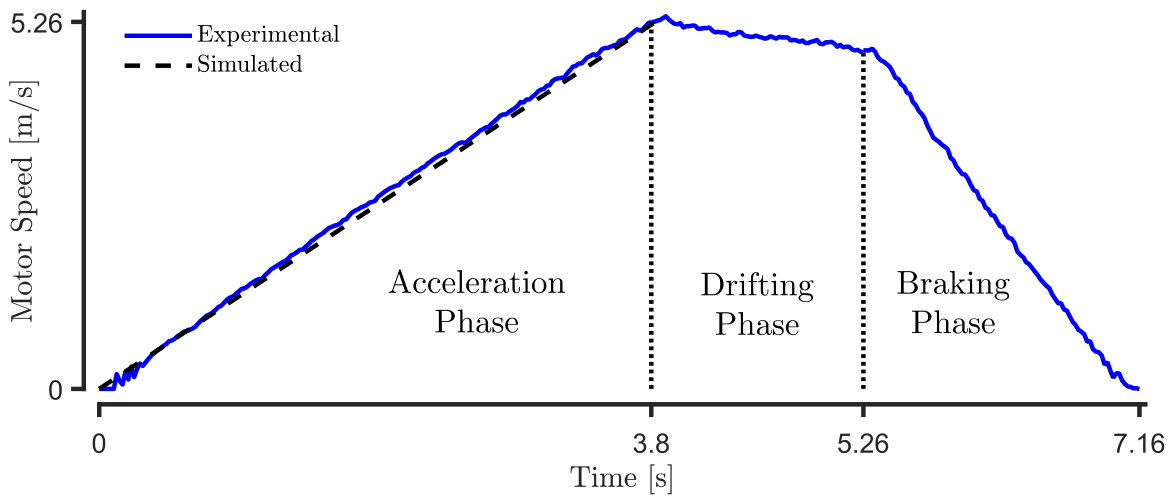
Experiments 1 and 2 are conducted within one test sequence containing three distinct phases. First, the vehicle is commanded to accelerate from rest with a step input drive torque of Nm at the two front wheels until a speed of m/s is achieved, completing experiment 1. Second, the vehicle enters a drifting phase for >1 s, creating separation between the two experiments. Third, the braking test is conducted by applying a step input braking torque of Nm to the two rear wheels, completing experiment 2 when the vehicle successfully stops.
Figure 14 displays the results of experiment 1 and 2. Experiment 1 led to a
m/s time of
s, within the
s requirement presented in VSR3-a. Additionally, the results directly align with the
s acceleration time of the simulated model. The large braking torque applied in experiment 2 results in the locking of the rear wheels and saturation of the rear tire forces. This scenario represents the vehicle’s maximum rate of deceleration within the test environment. The outcome is a stopping distance of
m from an initial speed of
m/s. Analyzing the deceleration of the vehicle in
Figure 14, the braking tests exhibit a linear trend. Therefore, using the measured deceleration rate, the adjusted stopping distance from
m/s is
m. A key element to discuss is the actuation time of the brake-by-wire system. The BBW servos exhibit a maximum speed of
rad/s, resulting in an actuation delay of up to 65 ms. The delay stems from the required rotation between the BBW systems’ rest position and the required braking position, a rotation of
rad. Incorporating the actuation delay into the adjusted stopping distance leads to a total distance of
m, within the VSR3-c requirement of
m.
To analyze the vehicle’s steer-by-wire capabilities, the suspension was loaded to its 1G condition. The maximum effective steering angle for the front and rear wheels was measured using the steering system feedback measurements. The result is a maximum effective steering angle of rad for the front axle and rad for the rear axle, respectively. The difference in steering angles is attributed to the LCA design differences to facilitate positive mechanical trail, leading to earlier spatial restrictions between the tire and LCA in the rear suspension system. Using the Ackerman steering principle with the maximum front and rear steering angles, the front, rear, and all-wheel turning radii are modelled as m, m, and m, respectively. An experimental test was conducted to verify the turning radius, resulting in measured front, rear, and all-wheel turning radii of m, m, and m. Each steering configuration is within the desired m steering radius presented in VSR3-e.
The final experiment tests two elements of the wireless E-stop system: the vehicle’s E-stop module’s reaction time to an E-stop event and the maximum stable operating distance. The E-stop module’s reaction time was characterized by measuring the time duration between the E-stop button activation and the deactivation of the PDS relay signal. In total, 30 events were captured, with the mean, standard deviation, and maximum time duration between button activation and PDS signal deactivation of 238 ms, 35 ms, and 296 ms, respectively. The E-stop operating distance was measured in an open-air environment, with a maximum operation distance of 170 m between the E-stop transmitter and receiver before message interruptions occurred.
8. Conclusions and Future Work
In conclusion, this work presented the design of a 1:5 scale Multi-Actuated Research Vehicle (MARV) platform. A systematic design process is applied, highlighting the key vehicle specifications and subsequent subsystem engineering requirements. A high-level overview of the platform’s mechanical, electrical, embedded, and software systems was presented, followed by the identification of critical systems and experimental validation of the assembled vehicle. The produced vehicle platform can achieve the outlined vehicle specification, speaking to the efficacy of a systematic and comprehensive design process.
The MARV platform opens the door for the future testing of novel over-actuated vehicle control systems. The SDV allows vehicle control researchers to compare and contrast different actuator configurations and control architectures on a palatable test platform. Specifically, MARV enables emulation of traditional vehicle driveline and steering configurations (e.g., front wheel drive with linked steering), facilitating the comparison of any vehicle actuator configuration. Furthermore, the independent wheel steer capability enables emulation of various vehicle wheel bases and track widths, extending the vehicle’s versatility. Overall, the MARV platform creates a vehicle-agnostic framework to test and validate unique actuator combinations within advanced control algorithms.
Future work related to the MARV platform will be focused on three main areas: (1) The integration of active suspension mechanisms as initially described in
Section 3.4.1. (2) The development of a digital twin of the MARV platform using the Project Chrono Vehicle library [
24], creating a sandbox environment to foster the development and preliminary testing of advanced control algorithms with multi-actuated vehicles. (3) Experimental validation of multi-actuated control algorithms using the MARV platform, capturing the improvements in safety and performance enabled by vehicle over-actuation.