Article

Command-Filtered Adaptive Prescribed-Time Tracking Control with Application to Output-Constrained Hydraulic Servo Systems


School of Mechanical Engineering, Nanjing University of Science and Technology, Nanjing 210094, China
*
Author to whom correspondence should be addressed.
Actuators 2026, 15(5), 238; https://doi.org/10.3390/act15050238
Submission received: 25 March 2026 / Revised: 12 April 2026 / Accepted: 20 April 2026 / Published: 28 April 2026

Abstract

In this paper, a command filter-based adaptive prescribed-time control method is proposed for hydraulic servo systems subject to time-varying parameters, external disturbances and output constraints. Firstly, a state-based nonlinear transformation function is introduced to convert the output-constrained problem into a boundedness problem. Then, an auxiliary system is constructed to compensate for command filtering errors. Subsequently, to handle the uncertainties from time-varying parameters and external disturbances, a smooth nonlinear term featuring an updated gain and incorporating a prescribed-time function is designed. Based on the transformed system, a novel control framework integrating command filtering, adaptive control, and the prescribed-time function is developed. Consequently, the complexity explosion is avoided, and the system output is guaranteed to converge to a small bounded interval near zero while strictly satisfying the output constraints. Moreover, this prescribed convergence time can be independently set by the designer. Furthermore, both the transient convergence performance within the prescribed time and the bounded convergence performance afterward are guaranteed by Lyapunov stability analysis. Finally, the effectiveness of the proposed method is verified by simulation results.

1. Introduction

Tracking control is one of the core problems in the field of nonlinear systems [1,2,3,4,5]. Consequently, how to rapidly and effectively eliminate the effects of various uncertainties has become a primary focus for researchers. In this context, finite-time control has gradually emerged as a mainstream strategy due to its guaranteed settling time and excellent tracking accuracy [6,7,8,9]. However, the design of finite-time controllers is highly dependent on the initial conditions of the system. Without precise knowledge of these initial states, an accurate convergence time cannot be guaranteed. To overcome this inherent limitation of finite-time control methods, fixed-time control strategies have been developed [10,11,12]. In these strategies, the estimation of the upper bound of the settling time is independent of the system’s initial conditions.
The upper bound of the settling time in fixed-time control can be determined a priori, which provides stronger robustness and disturbance rejection capabilities than finite-time control. However, its actual settling time still depends on the controller design parameters. Furthermore, the estimated upper bound is often overly conservative, leading to uncertainties in characterizing system performance. To overcome the limitations of both finite-time and fixed-time methods, this paper adopts a prescribed-time control framework. Initially proposed by Song et al. [13], this framework ensures that the convergence time of the tracking error can be preassigned arbitrarily by the user. Importantly, this time is completely independent of the system’s initial conditions and design parameters. Building upon this concept, several advanced control algorithms have been developed [14,15]. For instance, a disturbance observer-based prescribed-time controller was proposed in [14], which ensures the global prescribed-time stability of the system through targeted uncertainty compensation while guaranteeing an unambiguous prescribed convergence time. In [15], a practical prescribed-time controller integrating sliding mode control and a time-varying gain was proposed, further improving control precision compared to existing methods. These studies offer valuable insights into resolving the issue of uncertain convergence times in the tracking control of nonlinear systems. However, the aforementioned controllers neglect the state constraints that inherently exist in practical systems, which can severely degrade system stability and overall control performance.
In practical engineering, most systems are required to operate under specific constraints due to physical limitations, safety requirements, and performance metrics. For instance, robot manipulators are inherently subject to strict constraints involving state variables associated with hysteresis, dead zones, and output performance [16]. Similarly, uncertain unmanned surface ships also suffer from coupled input constraints [17]. During controller design, ignoring these constraints can severely compromise system stability, control performance, and operational safety. To address these issues, the barrier Lyapunov function (BLF) proposed in [18] provides an effective mechanism to prevent constraint violations. This mechanism has inspired the development of various nonlinear control strategies for state-constrained systems. Specifically, reference [19] proposed an adaptive neural network control method within an integrated framework to tackle time-delays and time-varying full-state constraints in nonlinear systems. Furthermore, to overcome the conservative constraint boundaries and excessive reliance on initial conditions inherent in traditional BLF methods, reference [20] introduced a state-dependent nonlinear transformation function. By employing nonlinear mapping, this approach transforms the state-constrained problem into a boundedness problem. Consequently, it significantly relaxes the requirements on initial conditions.
However, in the previous control framework combining the BLF method with backstepping, the differential computation of the virtual controller becomes increasingly complex as the system order increases. This phenomenon inevitably leads to the well-known “complexity explosion” issue [21,22,23]. To address this issue while ensuring system stability, reference [24] first developed the command filtering back-stepping technique. Reference [25] proposed a finite-time adaptive controller based on command filters to address the control problem of nonlinear systems with quantized inputs. However, in the design of the aforementioned controllers, the uncertain parameters of the nonlinear system are assumed to be unknown constants. In practical system operation, unknown time-varying parameters and external disturbances inevitably exist. Neglecting these factors significantly degrades the control performance.
Compared to the uncertain parameters of a nonlinear system being unknown constants [26,27], the handling of unknown time-varying parameters presents a more challenging problem. To address this dilemma, extensive research has been conducted [28,29,30]. These efforts have effectively solved the tracking problem for linear time-varying systems with slowly varying unknown parameters. Reference [28] proposed an indirect adaptive robust control method for tracking problems in nonlinear systems with unknown time-varying parameters, effectively solving the tracking control issue for lower-triangular systems. Reference [29] proposed a command filtering controller with smooth nonlinear terms. This design effectively compensates for the system’s time-varying parameters and external disturbances, thereby significantly improving control accuracy. Reference [30] addressed the control problem for strict-feedback nonlinear systems with unknown time-varying parameters using an indirect adaptive robust control (IARC) scheme. The primary advantage of their approach is that it obviates the need for prior knowledge of the parameter boundaries during the controller design process. These results offer a valuable approach for overcoming the issue of unknown time-varying parameters.
Building on the above discussion, designing an adaptive prescribed-time tracking controller for nonlinear systems subject to time-varying parameters and external disturbances remains a significant challenge. Furthermore, such a controller must ensure that the system output remains within a specified range while strictly maintaining tracking accuracy. To address this issue, this paper proposes a prescribed-time command filtering adaptive control method that ensures output constraints. Compared to existing results, the contributions of this paper are as follows:
  • A novel adaptive output-constrained prescribed-time command-filtered controller is designed. The primary objective of the proposed control strategy is to ensure that the tracking error of the system converges to an adjustable small bounded interval near zero within a user-defined prescribed time, with the settling time being entirely independent of the initial states. Furthermore, distinct from traditional prescribed-time control schemes [14,15], the proposed method not only preserves the advantageous prescribed-time convergence property but also incorporates an output constraint mechanism to ensure that the system output strictly remains within a pre-defined safe range. Consequently, the proposed approach further guarantees the safety and reliability of the system operation while maintaining a rigorous convergence time performance.
  • A novel auxiliary system is constructed by incorporating a given time-varying function. Unlike traditional auxiliary systems, it can effectively compensate for the transient filtering errors within a prescribed time and overcome the inherent “explosion of complexity” problem in the classical backstepping approach [21,22,23]. Moreover, different from the nonlinear systems that only consider constant parameters [26,27], the proposed controller introduces a smooth nonlinear term with adaptive gains to further account for and compensate time-varying parameters and external disturbances.
The rest of this article is organized in the following manner. Mathematical preliminaries and the formulation of the control problem are introduced in Section 2. Section 3 elaborates on the development of the command-filtered adaptive prescribed-time control scheme, followed by a rigorous stability analysis. Subsequently, Section 4 presents and discusses the numerical simulation results to verify the effectiveness of the proposed approach. Ultimately, Section 5 offers concluding remarks, summarizing the primary findings and contributions of this work.

2. Problem Statement and Preliminaries

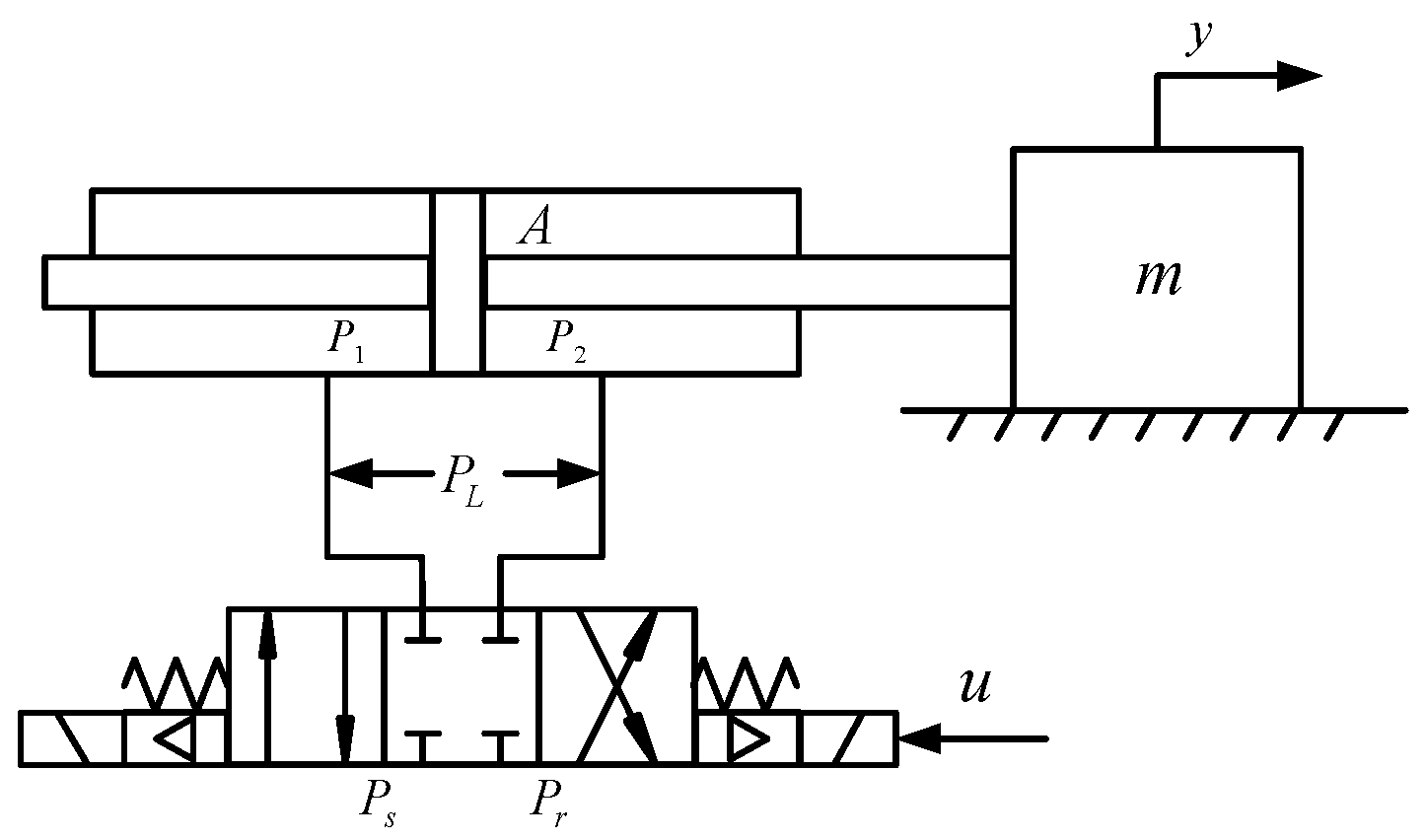
The simplified model of the hydraulic servo system under study is illustrated in Figure 1. Under normal operating conditions, the load is driven by the piston rod of a hydraulic cylinder, which is controlled by a valve.
According to Figure 1 and Newton’s second law, the force balance equation of the hydraulic system is given by
m y ¨ = A P 1 A P 2 B y ˙ + d 1 ( t )
where  m  denotes the load mass;  y y ˙ , and  y ¨  represent the displacement, velocity, and acceleration of the hydraulic cylinder piston rod, respectively;  A  is the effective acting area of the piston;  P 1  and  P 2  denote the oil pressures in the supply and return chambers of the cylinder, respectively;  B  is the viscous damping coefficient;  d 1 ( t )  represents the unmodeled mechanical disturbance; and  t  denotes time.
Neglecting the external leakage of the hydraulic cylinder, the pressure dynamic equations can be expressed as
P ˙ 1 = β e ( A y ˙ C t P L + Q 1 + q 1 ) / V 1 P ˙ 2 = β e ( A y ˙ + C t P L Q 2 q 2 ) / V 2
where  β e  denotes the effective bulk modulus of the hydraulic oil;  C t  is the internal leakage coefficient of the cylinder;  P L = P 1 P 2  represents the load pressure difference;  V 1 = V 01 + A y  and  V 2 = V 02 A y  are the control volumes of the supply and return chambers, respectively, with  V 01  and  V 02  being the corresponding initial volumes;  Q 1  and  Q 2  denote the flow rates of the supply and return chambers, respectively;  q 1  and  q 2  represent the unmodeled disturbances in the pressure dynamics;  P ˙ 1  and  P ˙ 2  denote the time derivatives of  P 1  and  P 2 .
Assuming that the control input  u  is proportional to the spool displacement  x v  of the electro-hydraulic proportional servo valve, the flow rates  Q 1  and  Q 2  can be expressed in terms of  x v  as follows
Q 1 = k q x v s ( x v ) P s P 1 + s ( x v ) P 1 P r Q 2 = k q x v s ( x v ) P 2 P r + s ( x v ) P s P 2
where  k q = C d w 0 2 / ρ  is the flow gain coefficient of the valve, with  C d w 0 , and  ρ  being the discharge coefficient, the area gradient of the valve spool, and the density of the hydraulic oil, respectively;  P s  and  P r  denote the supply pressure and the return pressure, respectively; and  s ( )  represents a function of the intermediate variable, defined as
s ( ) = 1     i f 0 0     i f < 0
Furthermore, given the relationship  x v = k i u , where  k i  denotes the voltage-to-spool displacement gain coefficient, Formula (3) can be rewritten as
Q 1 = k u R 1 u Q 2 = k u R 2 u
where the intermediate variables are defined as  k u = k q k i R 1 = s ( u ) P s P 1 + s ( u ) P 1 P r , and  R 2 = s ( u ) P 2 P r + s ( u ) P s P 2 .
Define the state vector as  ς = [ ς 1 , ς 2 , ς 3 ] T = [ y , y ˙ , ( A P 1 A P 2 ) / m ] T , where the state variables are chosen as  ς 1 = y ς 2 = y ˙ , and  ς 3 = ( A P 1 A P 2 ) / m . Consequently, Formula (1) can be transformed into the following state-space equation
ς ˙ 1 = g 1 ς 2 ς ˙ 2 = g 2 ς 3 ϑ 2 φ 2 + ϕ 2 ς ˙ 3 = g 3 u ξ 3 ϑ 3 φ 3 + ϕ 3
where  ς ˙ 1 ς ˙ 2 , and  ς ˙ 3  denote the first-order time derivatives of  ς 1 ς 2 , and  ς 3 .
In which
ϕ 2 = d 1 ( t ) / m , ϕ 3 = β e A q 1 / m V 1 + β e A q 2 / m V 2 g 1 = g 2 = 1 , g 3 = ( A R 1 / m V 1 + A R 2 / m V 2 ) β e k u ϑ 2 = ( A 2 / m V 1 + A 2 / m V 2 ) β e , φ 2 = x 2 ϑ 3 = ( 1 / V 1 + 1 / V 2 ) β e C t , φ 3 = x 3 , ξ 3 = ( A 2 / m V 1 + A 2 / m V 2 ) β e x 2
Our control objectives are as follows:
(1) The tracking error of the system is guaranteed to converge to a small bounded interval near zero in a prescribed time.
(2) The system output signal  ς 1  satisfies the following output constraints:
ς 1 R : F 1 ( t ) < ς 1 < F 2 ( t )
where  F 1 ( t )  and  F 2 ( t )  are positive time-varying constraint boundary functions.
In order to achieve the control objectives, the following assumption is made:
Assumption 1.
The system’s desired trajectory  ς d  and both its first and second time derivatives are bounded.
Assumption 2.
The external disturbances are also bounded by  ϕ i ( t ) ϕ ¯ i  , where  ϕ ¯ i  are the unknown positive constants for  i = 2 , 3 .
Remark 1.
This paper focuses on the theoretical control research of typical hydraulic servo systems, where Assumptions 1 and 2 serve as standard mathematical prerequisites in this field. However, when mapping these assumptions to practical engineering applications, certain limitations are inevitable. Regarding Assumption 1, the smoothness requirement for the reference trajectory aims to accommodate the inherent physical constraints of hydraulic actuators, which impose restrictions on the system’s direct response to step-like reference signals. As for Assumption 2, practical disturbances are inherently bounded by the hardware and mechanical limits of the equipment, thereby ensuring the existence of the upper bounds  ϕ ¯ i ( i = 2 , 3 ) . Nevertheless, it should be noted that in the event of catastrophic physical failures, these boundary conditions may be violated, potentially compromising the stability of the closed-loop system.
Remark 2.
The constraint boundaries should be selected based on the characteristics of the real system to ensure that its states remain within the desired range under the proposed control strategy.

3. Controller Construct

3.1. Nonlinear Conversion Function

Nonlinear transition function [31]: The output state nonlinear transition function is shown below:
ζ 1 ( ς 1 ) = ς 1 ( F 1 ( t ) + ς 1 ) ( F 2 ( t ) ς 1 )
According to the constructed nonlinear transformation function, it is obvious that while the initial value  ς 1 ( 0 )  satisfies  F 1 ( 0 ) < ς 1 ( 0 ) < F 2 ( 0 ) ζ 1 ( ς 1 )  tends to infinity as  ς 1 ( t ) F 1 ( t )  or  ς 1 ( t ) F 2 ( t ) .
Thus, for any initial state  ς 1 ( 0 )  satisfies  F 1 ( 0 ) < ς 1 ( 0 ) < F 2 ( 0 ) , if the controller design ensures that  ζ 1 ( ς 1 )  is bounded, then  F 1 ( t ) < ς 1 < F 2 ( t )  will naturally hold. Derivation of the nonlinear transformation function (9) yields
ζ ˙ 1 = μ 1 ς ˙ 1 + μ 2
μ 1 = ( F 1 ( t ) F 2 ( t ) + ς 1 2 ) ( F 1 ( t ) + ς 1 ) 2 ( F 2 ( t ) ς 1 ) 2 , μ 2 = [ F ˙ 1 ( t ) F 2 ( t ) + F 1 ( t ) F ˙ 2 ( t ) + ( F ˙ 2 ( t ) F ˙ 1 ( t ) ) ς 1 ] ς 1 ( F 1 ( t ) + ς 1 ) 2 ( F 2 ( t ) ς 1 ) 2
where  ζ ˙ 1 ς ˙ 1 F ˙ 1 ( t ) , and  F ˙ 2 ( t )  are the first derivatives of  ζ 1 ς 1 F 1 ( t ) , and  F 2 ( t ) .
The equivalent unconstrained nonlinear system is represented as follows:
ζ ˙ 1 = μ 1 g 1 ς 2 + μ 2 ς ˙ 2 = g 2 ς 3 ϑ 2 φ 2 + ϕ 2 ς ˙ 3 = g 3 μ ξ 3 ϑ 3 φ 3 + ϕ 3

3.2. Prescribed-Time Function

Prescribed-time function: a time-varying scaling function is introduced and defined as follows:
p ( t ) = η ( t P t ) 2 + b f ,   t 0 , t P η b f ,   t t P , p ˙ ( t ) = 2 ( t P t ) p 2 / η ,   t 0 , t P 0 ,   t t P ,
in which  t P  represents the prescribed time.  η > 0  represents the designable parameter,  b f > 0  is a designable constant value approaching zero.

3.3. Controller Design

Define the following error:
z 1 = ζ 1 α 0 , z j = ς j α j f , j = 2 , 3 v 1 = z 1 ι 1 , v j = z j ι j , j = 2 , 3
where  ζ 1  denotes the nonlinear transformation function given in (9), and  α 0  is defined as
α 0 = y d ( F 1 + y d ) ( F 2 y d )
where  y d  denotes the reference signal, and  α j f  represent the outputs of the improved command filters described below.
α ˙ j f = ω j p ε j
where  ε j = α j f α j 1  represent the filtering errors,  ω j  are the designable parameters.
An adaptive auxiliary filtering system [32] incorporating a prescribed-time function used to eliminate filtering errors is proposed:
ι ˙ 1 = κ 11 p ι 1 + μ 1 g 1 ( ι 2 + ε 2 ) μ 1 ν 1 ι ˙ 2 = κ 22 p ι 2 + g 2 ( ι 3 + ε 3 ) μ 1 g 1 ι 1 ν 2 ι ˙ 3 = κ 33 p ι 3 g 2 ι 2 ν 1 = g 1 ι 1 N ^ 1 2 ι 1 N ^ 1 tanh [ ι 1 / ( w 1 ( t ) / μ 1 ) ] + ( w 1 ( t ) / μ 1 )   ν 2 = g 2 ι 2 N ^ 2 2 ι 2 N ^ 2 tanh [ ι 2 / ( w 2 ( t ) ] + w 2 ( t )
in which  κ i i > 0   ( i = 1 , 2 , 3 )  are the constant gains, the positive functions  w i ( t ) ( i = 1 , 2 )  meet  lim t 0 t w i ( τ ) d τ w ¯ i < + t > 0 , with  w ¯ i > 0  being constants;  N i ( i = 1 , 2 )  are the positive constant parameters, whose estimated values are updated by
N ^ ˙ 1 = γ 11 p 2 μ 1 g 1 ι 1 σ 11 p N ^ 1   N ^ ˙ 2 = γ 21 p 2 g 2 ι 2 σ 21 p N ^ 2  
where  γ 11 > 0 γ 21 > 0 σ 11 > 0 , and  σ 21 > 0  are designable parameters.
According to (14), it can be obtained
ς j = z j + ε j + α j 1
Define the error-transformation functions  s i ( i = 1 , 2 , 3 )  using the introduced time-varying scaling function.
s i = p v i
Step 1: Differentiating the error variable, utilizing (14), (17), and (19) yields:
z ˙ 1 = ζ ˙ 1 α ˙ 0   = μ 1 g 1 ς 2 + μ 2 α ˙ 0   = μ 1 g 1 ( z 2 + ε 2 + α 1 ) + μ 2 α ˙ 0   = μ 1 g 1 ( v 2 + α 1 + ι 2 + ε 2 ) + μ 2 α ˙ 0
where  α ˙ 0  is the first derivative of  α 0 .
Differentiating  s 1  obtains
s ˙ 1 = p ˙ v 1 + p v ˙ 1   = p ˙ v 1 + p ( μ 1 g 1 ( v 2 + α 1 + ε 2 + ι 2 ) ι ˙ 1 + μ 2 α ˙ 0 )
The virtual control law  α 1  can be designed as
α 1 = 1 μ 1 g 1 ( k 1 s 1 + α ˙ 0 κ 11 p ι 1 μ 1 ν 1 μ 2 )
where  k 1 > 0  is the designable parameter.
Step 2: Differentiating  z 2  obtains
z ˙ 2 = ς ˙ 2 α ˙ 2 f = g 2 ς 3 ϑ 2 φ 2 + ϕ 2 α ˙ 2 f = g 2 ( v 3 + ι 3 + ε 3 + α 2 ) ϑ 2 φ 2 + ϕ 2 α ˙ 2 f
Differentiating  s 2  obtains
s ˙ 2 = p ˙ v 2 + p v ˙ 2   = p ˙ v 2 + p ( g 2 ( v 3 + α 2 + ε 3 + ι 3 ) ϑ 2 φ 2 + ϕ 2 ι ˙ 2 α ˙ 2 f )
Definition  M 2 = sup t 0 Ψ 2 ( t )  with
Ψ 2 ( t ) = ϑ 2 ( t ) , ϕ 2 ( t )
where  M 2  is unknown.
The virtual control law  α 2  can be designed as
α 2 = 1 g 2 ( k 2 s 2 + α ˙ 2 f μ 1 g 1 v 1 μ 1 g 1 ι 1 χ 2 κ 22 p ι 2 ν 2 ) χ 2 = s 2 ϖ 2 2 M ^ 2 2 s 2 ϖ 2 M ^ 2 tanh [ s 2 ϖ 2 / ( l 2 ) ] + l 2
where  ϖ 2 = s 2 ( f 2 Τ f 2 ) s 2 f 2 Τ f 2 tanh [ s 2 / l 2 ] + l 2 f 2 = [ φ 2 , 1 ] Τ k 2 > 0  is the designable parameter,  0 < l 2 l ¯ 2 < +  is the positive bounded function,  l ¯ 2  is a positive constant.
The estimation of  M 2  is updated
M ^ ˙ 2 = γ 2 p ϖ 2 s 2 σ 2 p M ^ 2
where  γ 2 > 0 σ 2 > 0  are the designable parameters.
Step 3: Differentiating  z 3  obtains
z ˙ 3 = ς ˙ 3 α ˙ 3 f = g 3 u ξ 3 θ 3 φ 3 + ϕ 3 α ˙ 3 f
Differentiating  s 3  obtains
s ˙ 3 = p ˙ v 3 + p v ˙ 3 = p ˙ v 3 + p ( g 3 u ξ 3 ϑ 3 φ 3 + ϕ 3 α ˙ 3 f ι ˙ 3 )
Definition  M 3 = sup t 0 Ψ 3 ( t )  with
Ψ 3 ( t ) = ϑ 3 ( t ) , ϕ 3 ( t )
where  M 3  is unknown.
The real control law  u  can be designed as
u = 1 g 3 ( k 3 s 3 + α ˙ 3 f + ξ 3 g 2 v 2 g 2 ι 2 χ 3 κ 33 p ι 3 ) χ 3 = s 3 ϖ 3 2 M ^ 3 2 s 3 ϖ 3 M ^ 3 tanh [ s 3 ϖ 3 / l 3 ] + l 3
where  ϖ 3 = s 3 ( f 3 Τ f 3 ) s 3 f 3 Τ f 3 tanh [ s 3 / l 3 ] + l 3 f 3 = [ φ 3 , 1 ] Τ k 3 > 0  is the designable parameter,  0 < l 3 l ¯ 3 < +  is the positive bounded function,  l ¯ 3  is a positive constant.
The estimation of  M 3  is updated
M ^ ˙ 3 = γ 3 p ϖ 3 s 3 σ 3 p M ^ 3
where  γ 3 > 0 σ 3 > 0  are the designable parameter.

3.4. Main Result and Stability Analysis

Theorem 1.
Provided that Assumptions 1 and 2 are satisfied for system (1), the developed prescribed-time control strategy ensures the following performance criteria: (1) All signals within the closed-loop framework are maintained bounded, while the system output is continuously confined to the predefined constraint boundaries. (2) The system output tracking error achieves convergence within the prescribed-time interval, being driven into a flexibly adjustable small bounded interval near zero.
Proof of Theorem 1.
Construct a brand new Lyapunov function:
V = 1 2 s 1 2 + 1 2 s 2 2 + 1 2 s 3 2 + 1 2 γ 2 1 M ˜ 2 2 + 1 2 γ 3 1 M ˜ 3 2
where  M ˜ 2 = M 2 M ^ 2 M ˜ 3 = M 3 M ^ 3 .
The derivative of  V  is expressed as
V ˙ = s 1 s ˙ 1 + s 2 s ˙ 2 + s 3 s ˙ 3 γ 2 1 M ˜ 2 M ^ ˙ 2 γ 3 1 M ˜ 3 M ^ ˙ 3   = i = 1 3 p p ˙ v i 2 i = 1 3 k i p 3 v i 2 + j = 2 3 ( p χ j s j + p Ψ j f j s j p M ˜ j ϖ j s j ) + j = 2 3 γ j 1 σ j p M ˜ j M ^ j
Using Proposition A1 in Appendix A obtains
Ψ j Τ f j s j M j f j Τ f s j = M j f j Τ f s j M j ς j s j + M j l j M ^ j ς j s j χ j s j l j
Next, deal with the items  γ j 1 σ j p M ˜ j M ^ j . Using Young’s inequality can obtain
γ j 1 p σ j M ˜ j M ^ j γ j 1 p σ j M j 2 / 2 γ j 1 p σ j M ˜ j 2 / 2
Combining Formulas (36) and (37), it is evident that
V ˙ i = 1 3 p p ˙ v i 2 i = 1 3 k i p 3 v i 2 + j = 2 3 p ( M j + 1 ) l ¯ j   j = 2 3 γ j 1 p σ j M ˜ j 2 / 2 + j = 2 3 γ j 1 p σ j M j 2 / 2
According to the Formula (13), it is evident to obtain
i = 1 3 p p ˙ v i 2 i = 1 3 2 t P p 3 v i 2 / η
Substituting Formula (39) into Formula (38) gives:
V ˙ i = 1 3 K i p 3 v i 2 + j = 2 3 p ( M j + 1 ) l ¯ j j = 2 3 γ j 1 p σ j M ˜ j 2 / 2 + j = 2 3 γ j 1 p σ j M j 2 / 2
where  K i = k i 2 t P / η > 0  are the feedback gain.
From the Formula (40), one has
V ˙ λ p V + p ( j = 2 3 ( ( M j + 1 ) l ¯ j + γ j 1 σ j M j 2 / 2 ) )
where  λ  is the minimum of the elements in the matrix  [ 2 K i , γ j 1 σ j ] M j = sup t 0 Ψ j ( t ) d j 0 < d i < +  are the bounded constants.
Therefore, Formula (41) can be simplified to
V ˙ λ p V + p C
where  C = j = 2 3 ( ( d j + 1 ) l ¯ j + γ j 1 σ j d j 2 / 2 )  are the positive constants.
Therefore, the full-state tracking errors  z i  converge to a small bounded interval near zero as  t t P . The range of this neighbourhood can be adjusted to be small by varying the values of parameters  b f  and  η  (for detailed proof, see Appendix B).
Redefining the new Lyapunov function based on the compensated signals  ι i ( i = 1 , 2 , 3 )
V f z = 1 2 i = 1 3 p 2 ι i 2 + 1 2 j = 1 2 γ j 1 1 N ˜ j 2
The derivative of  V f z  is expressed as
V ˙ f z = i = 1 3 p p ˙ ι i 2 + i = 1 3 p 2 ι i ι ˙ i j = 1 2 γ j 1 1 N ˜ j N ^ ˙ j   = i = 1 3 p p ˙ ι i 2 i = 1 3 p 3 κ i i ι i 2 + j = 1 2 p 2 μ j g j ι j ε j + 1 j = 1 2 p 2 μ j ι j υ j   j = 1 2 p 2 μ j g j N ˜ j ι j + j = 1 2 p γ j 1 1 σ j N ˜ j N ^ j
where  μ j = 1  while  j > 1 .
According to the Formula (13), it is evident that
i = 1 3 p p ˙ ι i 2 i = 1 3 2 t P p 3 ι i 2 / η
Substituting Formula (45) into Formula (44) gives
V ˙ f z j = 1 3 p 3 κ i ι i 2 + j = 1 2 p 2 μ j g j N j ι j j = 1 2 p 2 μ j ι j υ j   j = 1 2 p 2 μ j g j N ˜ j ι j + j = 1 2 p γ j 1 1 σ j N ˜ j N ^ j   i = 1 3 p 3 κ i ι i 2 + j = 1 2 p 2 μ j g j N ^ j ι j j = 1 2 p 2 μ j ι j υ j + j = 1 2 p γ j 1 1 σ j N ˜ j N ^ j
where  κ i = κ i i 2 t P / η > 0 . Further, applying Young’s inequality to  p γ j 1 1 σ j N ˜ j N ^ j  yields:
p γ j 1 1 σ j N ˜ j N ^ j p γ j 1 1 σ j N j 2 / 2 p γ j 1 1 σ j N ˜ j 2 / 2
Using Proposition A1 in Appendix A obtains
j = 1 2 p μ j g j N ^ j ι j j = 1 2 p μ j υ j ι j j = 1 2 p g j w j
Substituting Formulas (47) and (48) into Formula (46) gives
V ˙ f z i = 1 3 p 3 κ i ι i 2 + j = 1 2 p g j w j + j = 1 2 p γ j 1 1 σ j N j 2 / 2 j = 1 2 p γ j 1 1 σ j N ˜ j 2 / 2   λ 1 p V f z + p ( j = 1 2 g j w j + j = 1 2 γ j 1 1 σ j N j 2 / 2 )
where  λ 1  is the minimum of the elements in the matrix  [ 2 κ i , γ j 1 1 σ j ] N j  are the positive constant parameters.  w j  are the positive bounded functions.
Further, Formula (49) reduces to
V ˙ f z λ 1 p V f z + p D
where  D = j = 1 2 g j w j + j = 1 2 γ j 1 1 σ j N j 2 / 2  is the positive constant.
Therefore, the auxiliary signals  ι i  converge to a small bounded interval near zero as  t t P . The range of this neighbourhood can be adjusted to be small by varying the values of parameters  b f  and  η  (for detailed proof, see Appendix C).
For proof of stability after the prescribed time  t P , see Appendix D.
In conclusion, all signals in the control system are bounded (for detailed proof, see Appendix D). □

4. Simulation Results

Example 1.
In this section, simulation verification is performed using a practical hydraulic servo system model. The actual parameters of the model are listed in Table 1.
The desired reference signal is  y d   = 0.5 s i n π t 1 e t .
To fully illustrate the advantages of the control scheme proposed in this paper, the following five controllers are introduced for comparison.
C1: This paper presents a command-filtered adaptive prescribed-time controller with output-constrained, featuring a smooth nonlinear term and an improved first-order filter.
The control law is defined as follows:
z 1 = ζ 1 α 0 , z 2 = ς 2 α 2 f , z 3 = ς 3 α 3 f s 1 = p ( z 1 ι 1 ) , s 2 = p ( z 2 ι 2 ) , s 3 = p ( z 3 ι 3 ) α 1 = 1 μ 1 ( k 1 s 1 + α ˙ 0 μ 1 χ 1 κ 11 p ι 1 ν 1 ) α 2 = ( k 2 s 2 + α ˙ 2 f μ 1 v 1 ι 1 χ 2 κ 22 p ι 2 ν 2 ) u = 1 g 3 ( k 3 s 3 + α ˙ 3 f g 2 v 2 g 2 ι 2 χ 3 κ 33 p ι 3 )
with
α ˙ j f = ω j p 2 ε j , j = 2 , 3 M ^ ˙ i = γ i p ϖ i s i p σ i M ^ i , i = 2 , 3 N ^ ˙ i = γ i 1 p 2 g i ι i σ i 1 p N ^ i ,   i = 1 , 2
where  y d = 0.5 s i n π t 1 e t x 1 ( 0 ) = 1 t p = 1 η = 1 b f = 0.1 k 1 = 5 k 2 = 25 k 3 = 30 F 11 = 1 + 0.2 sin ( 0.5 π t ) F 12 = 0.9 + 0.2 cos ( π t ) γ 2 = 50 γ 3 = 200 σ 2 = 0.005 σ 3 = 0.05 γ 11 = 30 γ 12 = 30 γ 13 = 50 σ 11 = 1 σ 12 = 1 σ 13 = 1 ω 2 = 30 ω 3 = 20 M ^ 2 ( 0 ) = M ^ 3 ( 0 ) = N ^ 2 ( 0 ) = N ^ 3 ( 0 ) = 0 w i ( t ) = 80 / ( 1 + t ) l i ( t ) = 50 / ( 1 + t ) .
C2: A robust controller with output constraints is proposed in [33], defining where the control law is described as
z 1 = ς 1 y d , z 2 = ς 2 x 2 f , z 3 = ς 3 x 3 f p 1 = e β t , α ˙ 2 f = w 2 ε 2 , α ˙ 3 f = w 3 ε 3 s 1 = p 1 z 1 ( F _ 11 + z 1 ) ( F ¯ 12 z 1 ) , s 2 = p 1 z 2 , s 3 = p 1 z 3 α 1 = s 1 η 1 ( k 11 + β + b 1 τ 1 + c 1 χ 11 ) α 2 = s 2 ( k 12 + β + b 2 τ 2 + c 2 χ 12 + η 1 2 s 1 2 ) u = s 3 ( k 13 + β + b 3 τ 3 + c 3 χ 13 + z 2 2 )
with
η 1 = F _ 11 F ¯ 12 + z 1 2 ( ( F _ 11 + z 1 ) ( F ¯ 12 z 1 ) ) 2 γ ¯ 1 = [ F _ ˙ 11 F ¯ 12 + F _ 11 F ¯ ˙ 12 + ( F ¯ ˙ 12 F _ ˙ 11 ) z 1 ] z 1 ( ( F _ 11 + z 1 ) ( F ¯ 12 z 1 ) ) 2
where  τ 1 = γ ¯ 1 2 τ 2 = α ˙ 2 f 2 τ 3 = α ˙ 3 f 2 χ 11 = η 1 2 ( x ˙ 1 d 2 + 1 ) χ 12 = x 2 2 + 1 χ 13 = x 3 2 . To maintain the consistency of the parameter control, the parameter values of the system during the steady state response phase are  k 11 = 5 k 12 = 25 k 13 = 30 w 2 = 30 w 3 = 20 F 11 = 1 + 0.2 sin ( 0.5 π t ) y d F 12 = 0.9 + 0.2 cos ( π t ) y d β = 0.6 b 1 = 0.5 b 2 = 0.05 b 3 = 0.0001 c 1 = 0.05 c 2 = 0.2 c 3 = 0.005 .
Remark 3.
During the simulation, the feedback gain could grow unbounded as time approaches infinity, which would lead to instability in the closed-loop system. To prevent this issue and ensure fair comparisons, the saturation value of  p 1  is set to  p 1 max = 10  , where  p 1 max  is the saturation value of  p 1 .
C3: This controller is the same as C1 but without the time-varying scaling function, i.e.,  p = 1 . The corresponding control parameters are the same as C1.
C4: This controller is the same as C3 but without the smooth nonlinear term, i.e.,  γ 2 = γ 3 = σ 1 = σ 2 = 0 . The corresponding control parameters are the same as C3.
C5: This controller is the same as C4 but without the adaptive auxiliary filtering system, i.e.,  γ 11 = γ 12 = γ 13 = σ 11 = σ 12 = σ 13 = κ 11 = κ 22 = κ 33 = 0 . The corresponding control parameters are the same as C4.
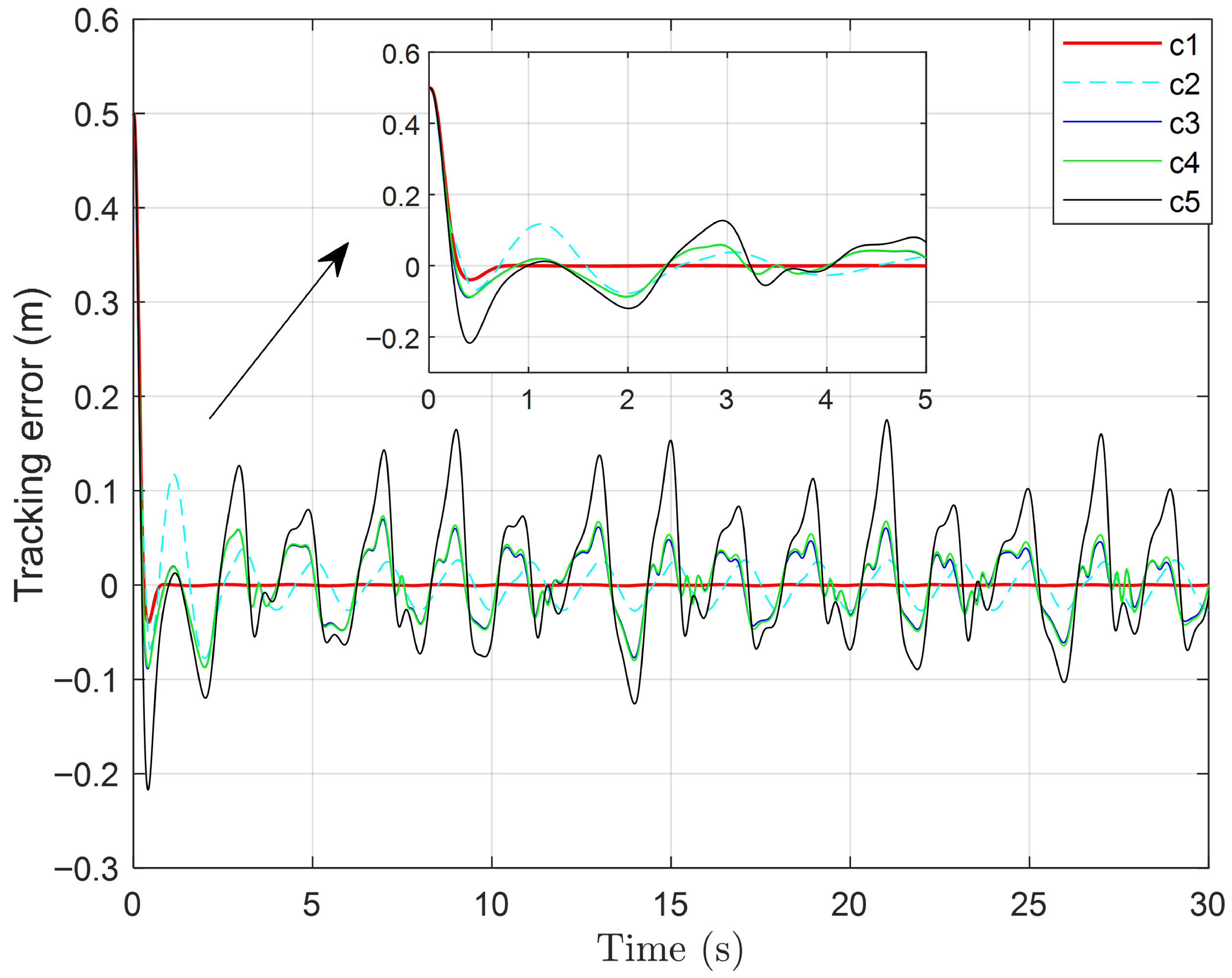
The tracking performance of the proposed controller within the prescribed boundaries is depicted in Figure 2. As observed from Figure 2, the controller exhibits excellent control performance; the system output is strictly maintained within the predefined boundaries and rapidly tracks the desired trajectory within the prescribed time. The tracking errors of the identical hydraulic system following the same trajectory under five different controllers are illustrated in Table 2 and Figure 3. The specific data for steady-state performance are shown in Table 2. Concretely, the index Mz of C1 is 0.0008 m, which reduces by about 96.7%, 99.1%, 99.1%, and 99.6% while comparing with those of C2–C5 severally. Combined with Figure 3, the superior control performance of the proposed controller is further demonstrated. Specifically, the comparison of tracking errors between the proposed controller (C1) and controllers C3–C5 highlights the advantages of the proposed control algorithm. This algorithm integrates a smooth nonlinear term to handle time-varying parameters and external disturbances, alongside an adaptive-gain auxiliary system to compensate for filtering errors. Furthermore, a prescribed time-varying function guarantees that the tracking error converges to an adjustable small bounded interval near zero within the prescribed time. Furthermore, we compare controller C1 with C2. Both controllers account for output constraints. The results reveal that C1 achieves further improved control performance. This is because C1 comprehensively addresses lumped uncertainties, which consist of time-varying parameters and external disturbances. Moreover, C1 successfully compensates for the interference caused by filtering errors. Moreover, the system achieves convergence within the prescribed time, which is entirely independent of the initial states.
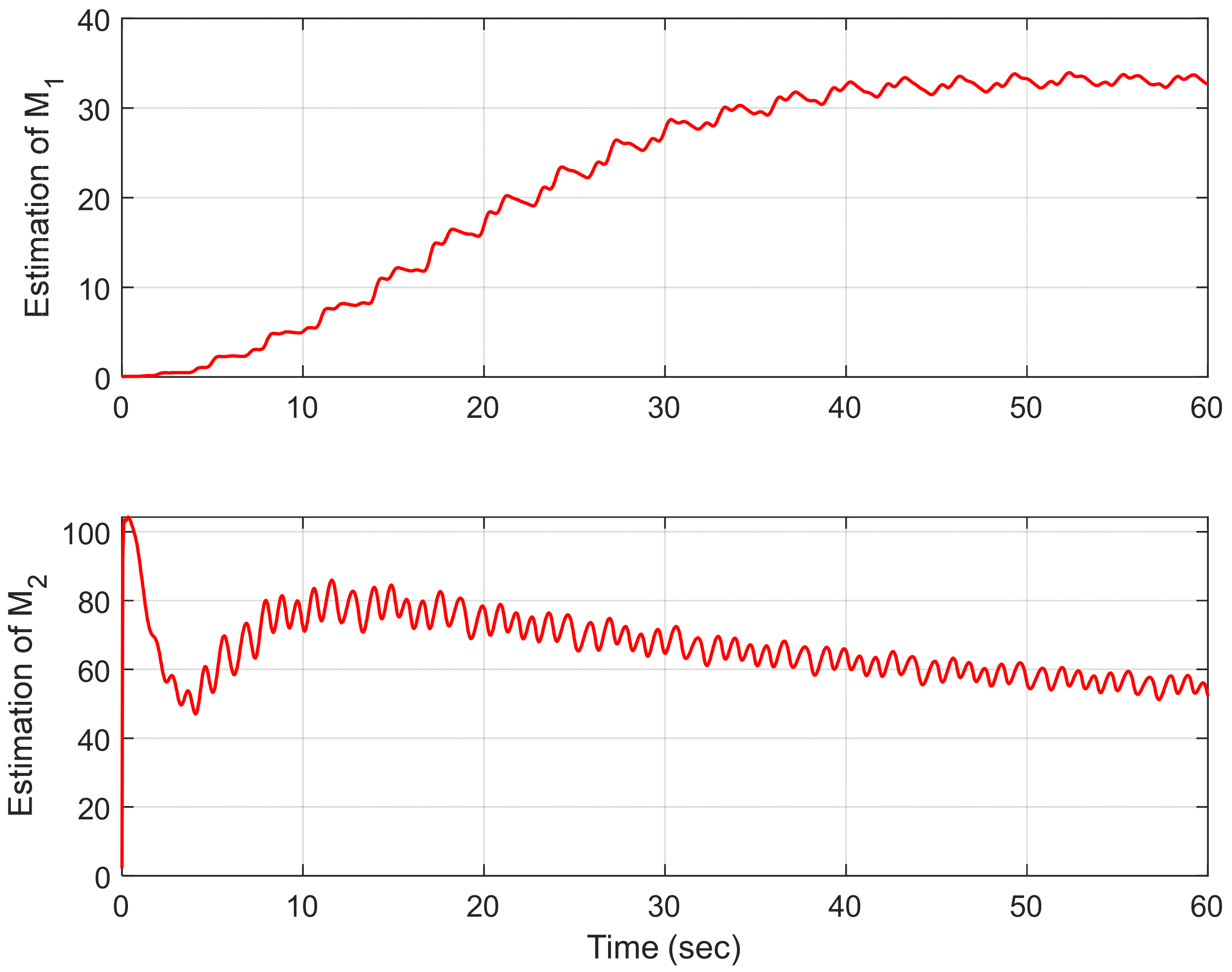
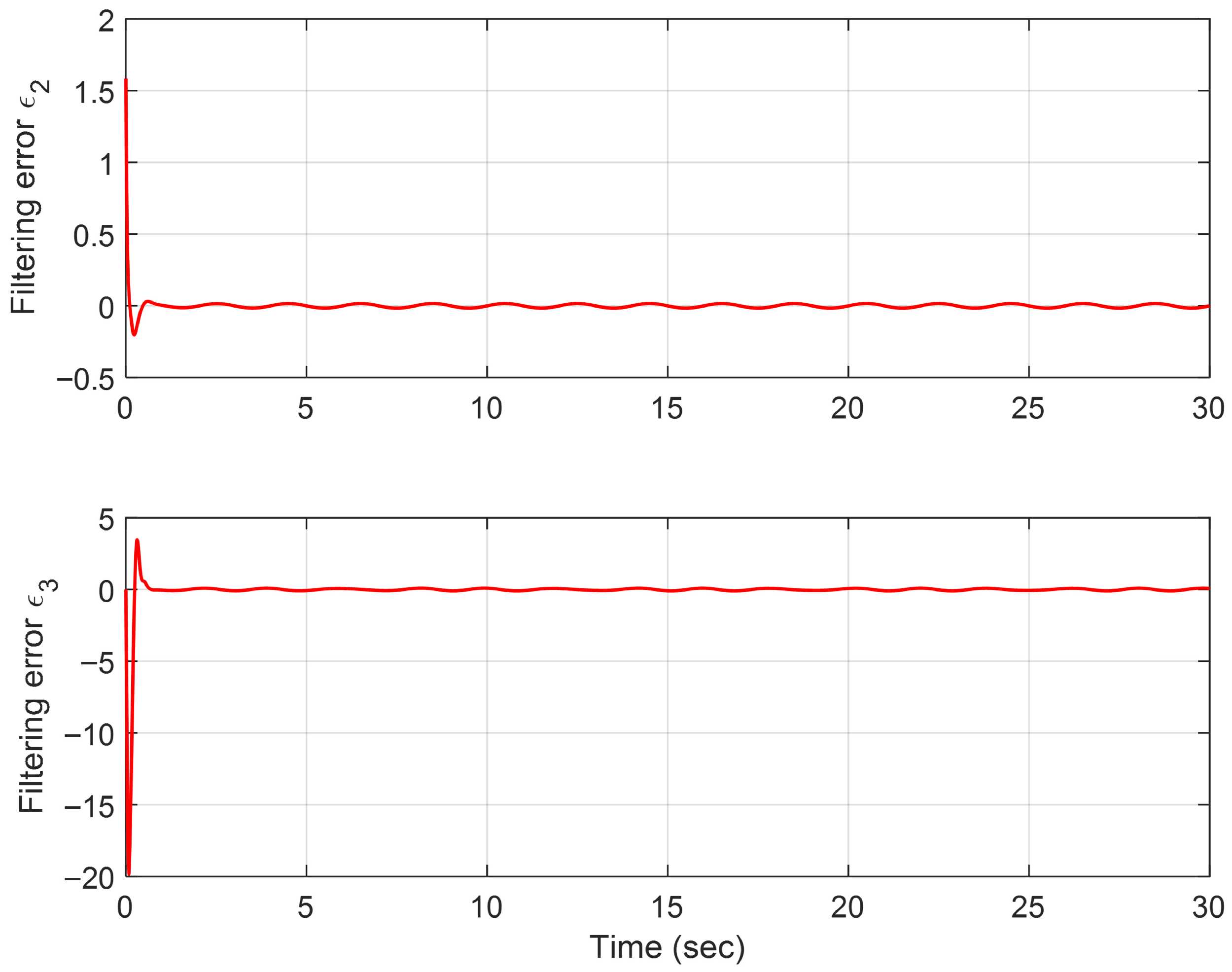
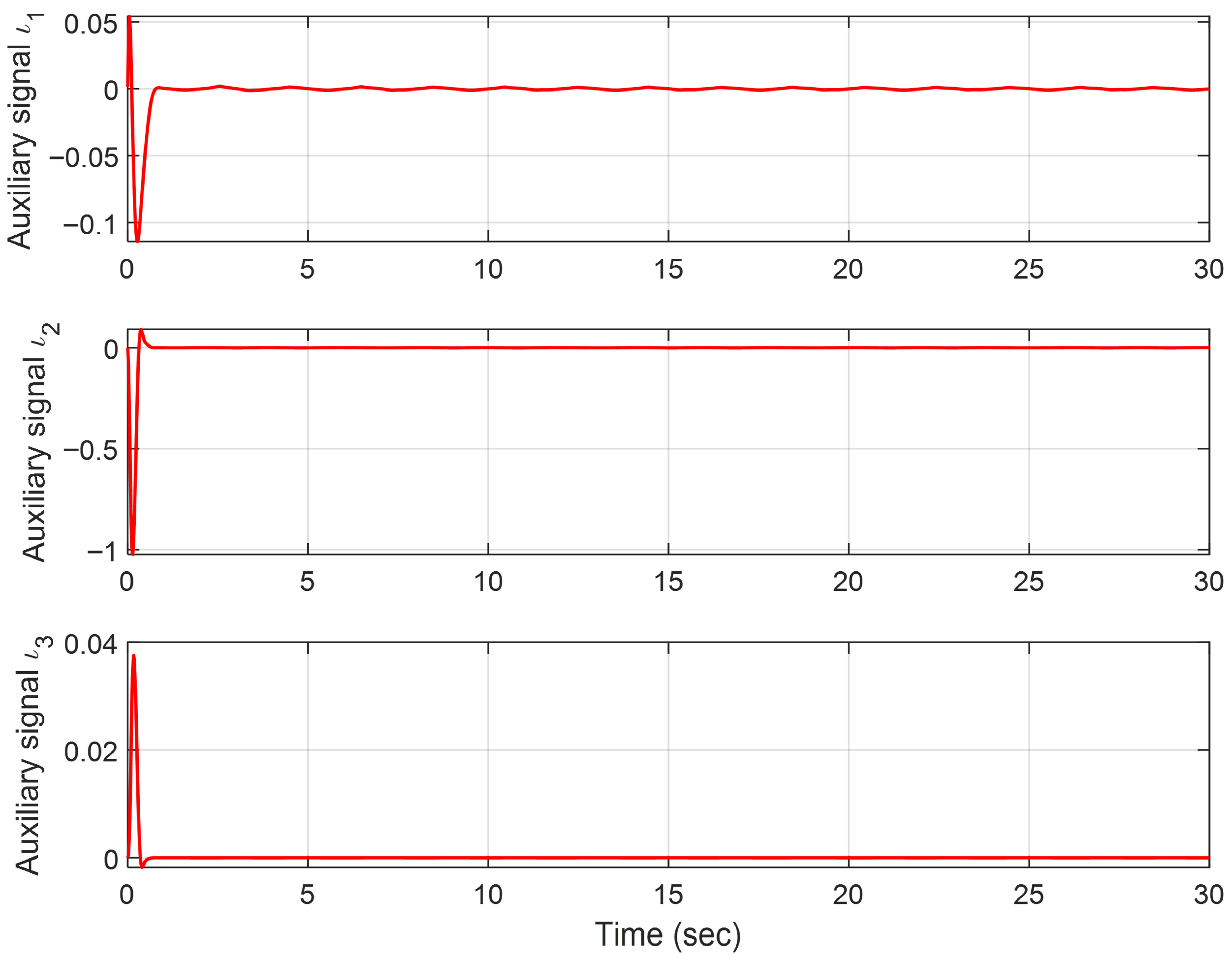
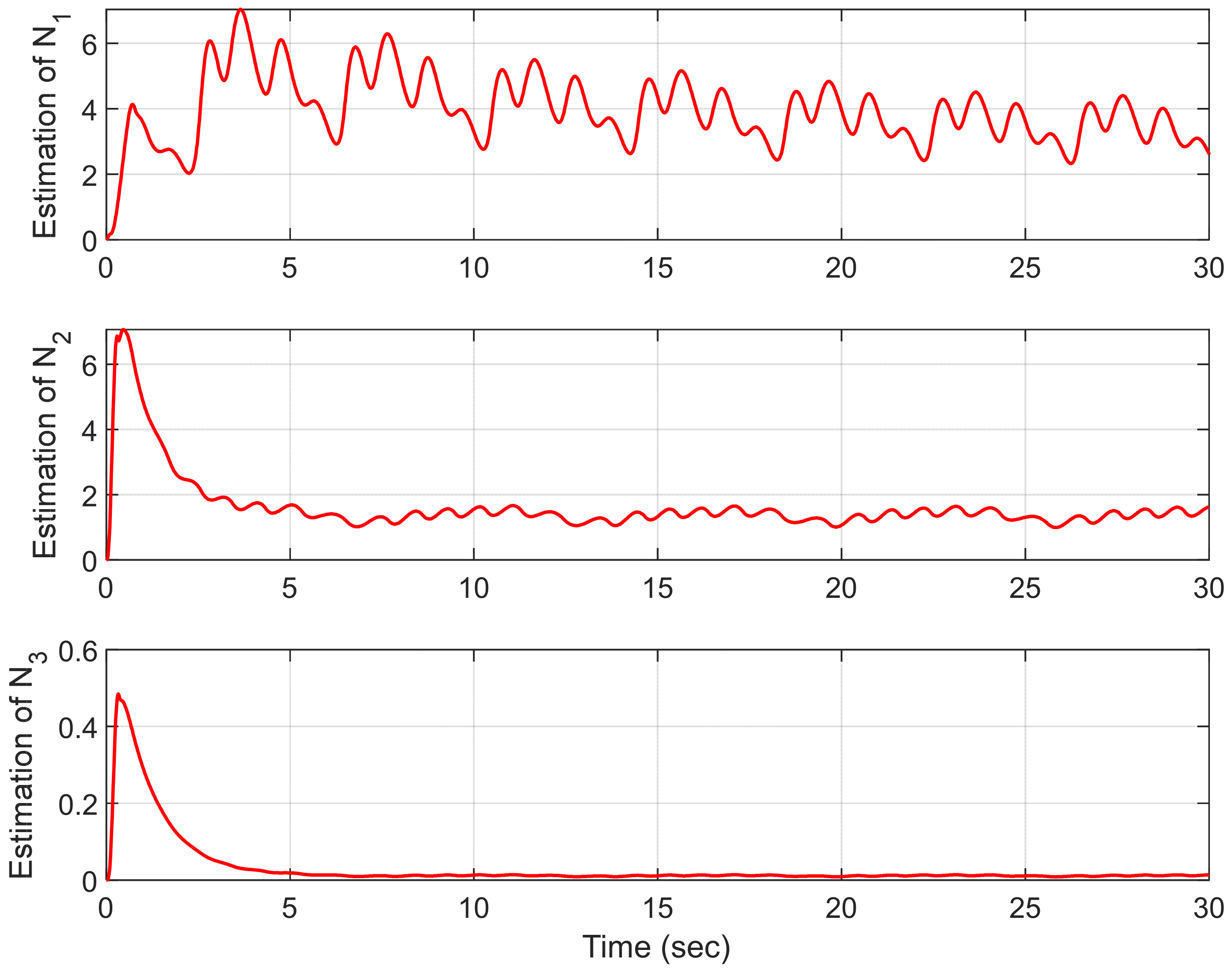
Figure 4 displays the filtering errors  ε 2  and  ε 3 , under controller C1. As observed, these filtering errors converge to a small bounded interval near zero within the prescribed time, verifying the effectiveness of the proposed control algorithm. Figure 5 concurrently illustrates that the auxiliary signals  ι 1 ι 2 , and  ι 3  all converge to steady-state values after the prescribed time. This result demonstrates the efficacy of the constructed auxiliary system in compensating for the filtering errors. Figure 6 and Figure 7 present the estimated trajectories of parameters  M 2 M 3   N 1 N 2 , and  N 3 , respectively. Ultimately, all parameter estimates converge to the vicinity of steady values, further corroborating the validity of the proposed algorithm. Finally, the control input of the system is depicted in Figure 8.
Example 2.
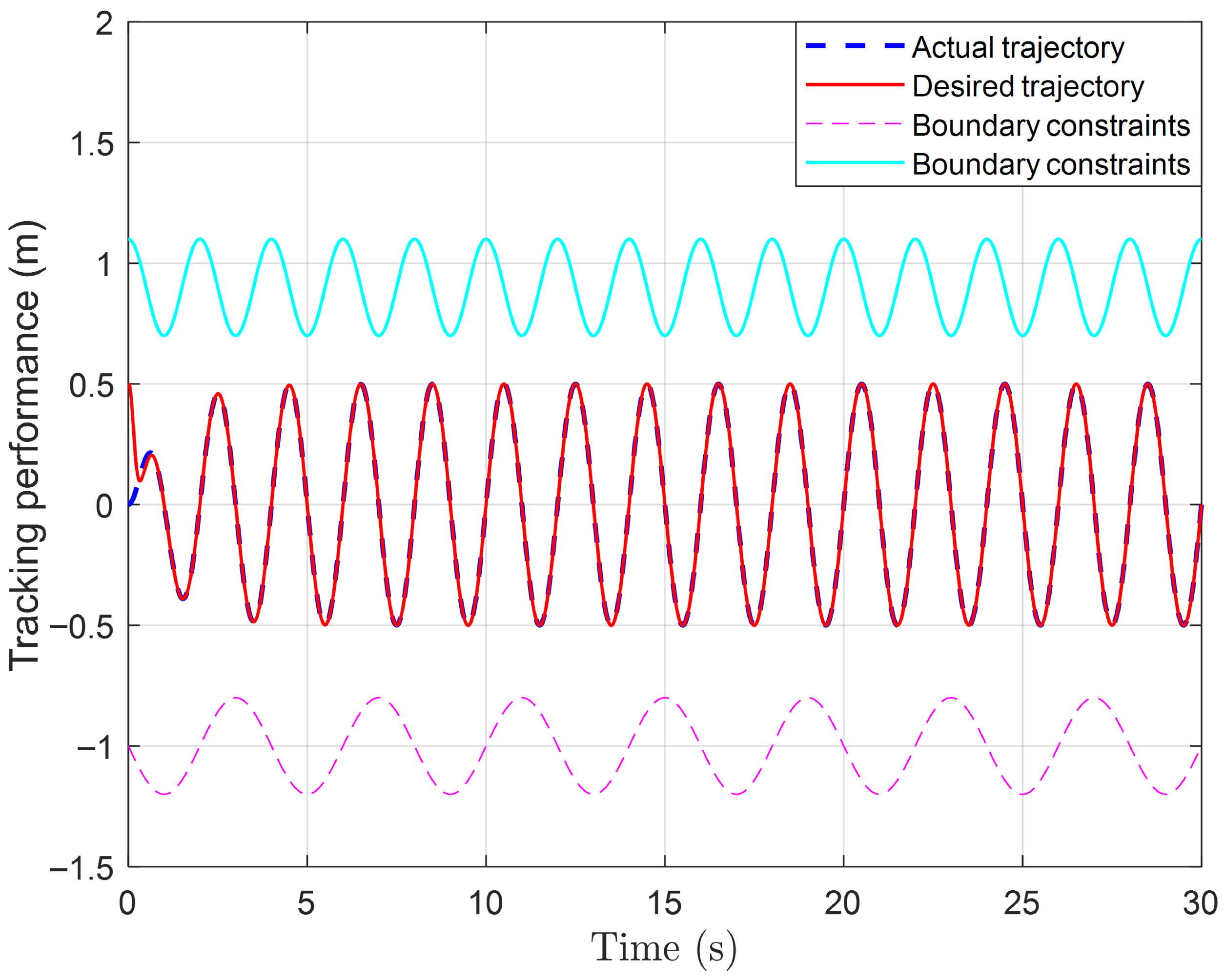
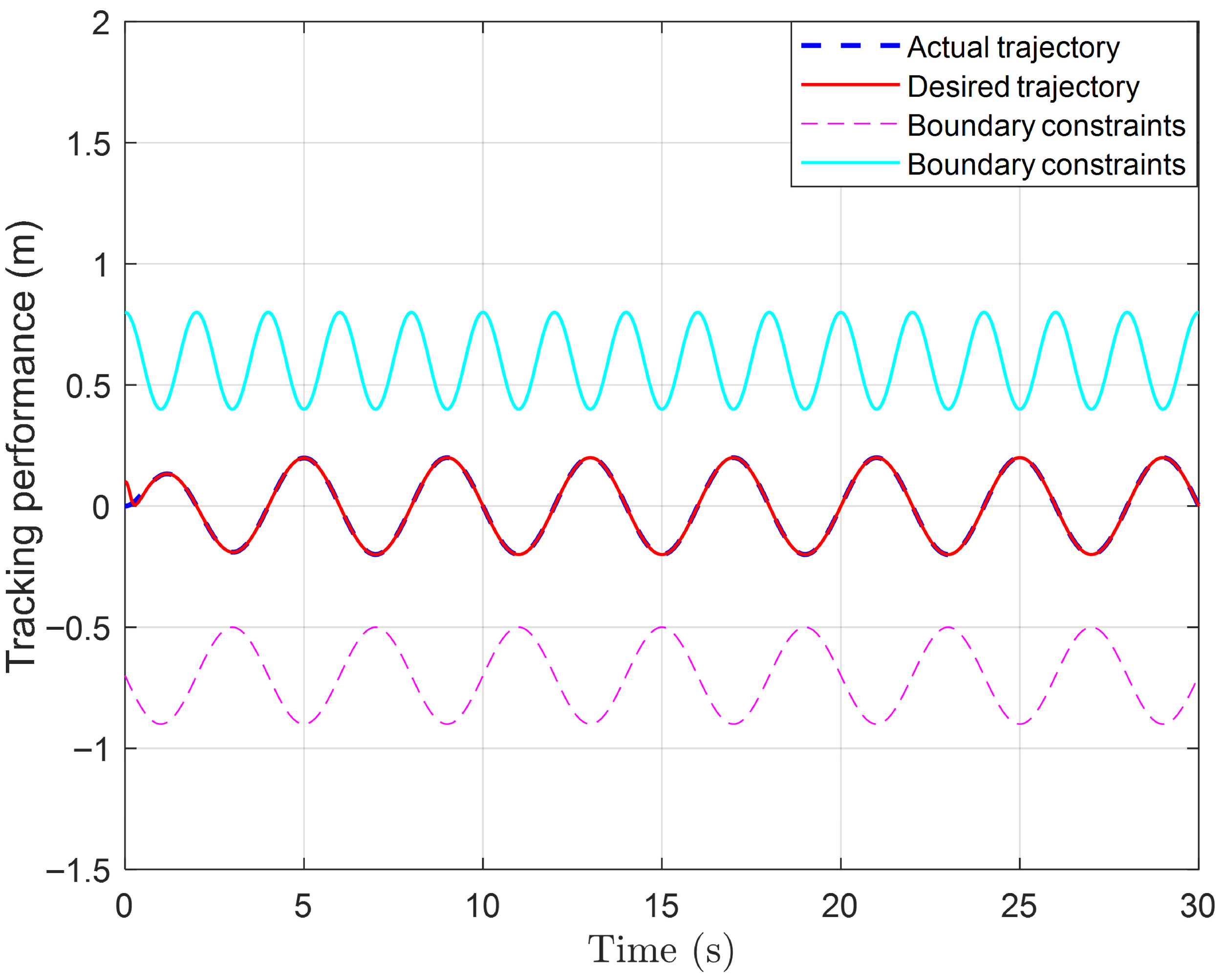
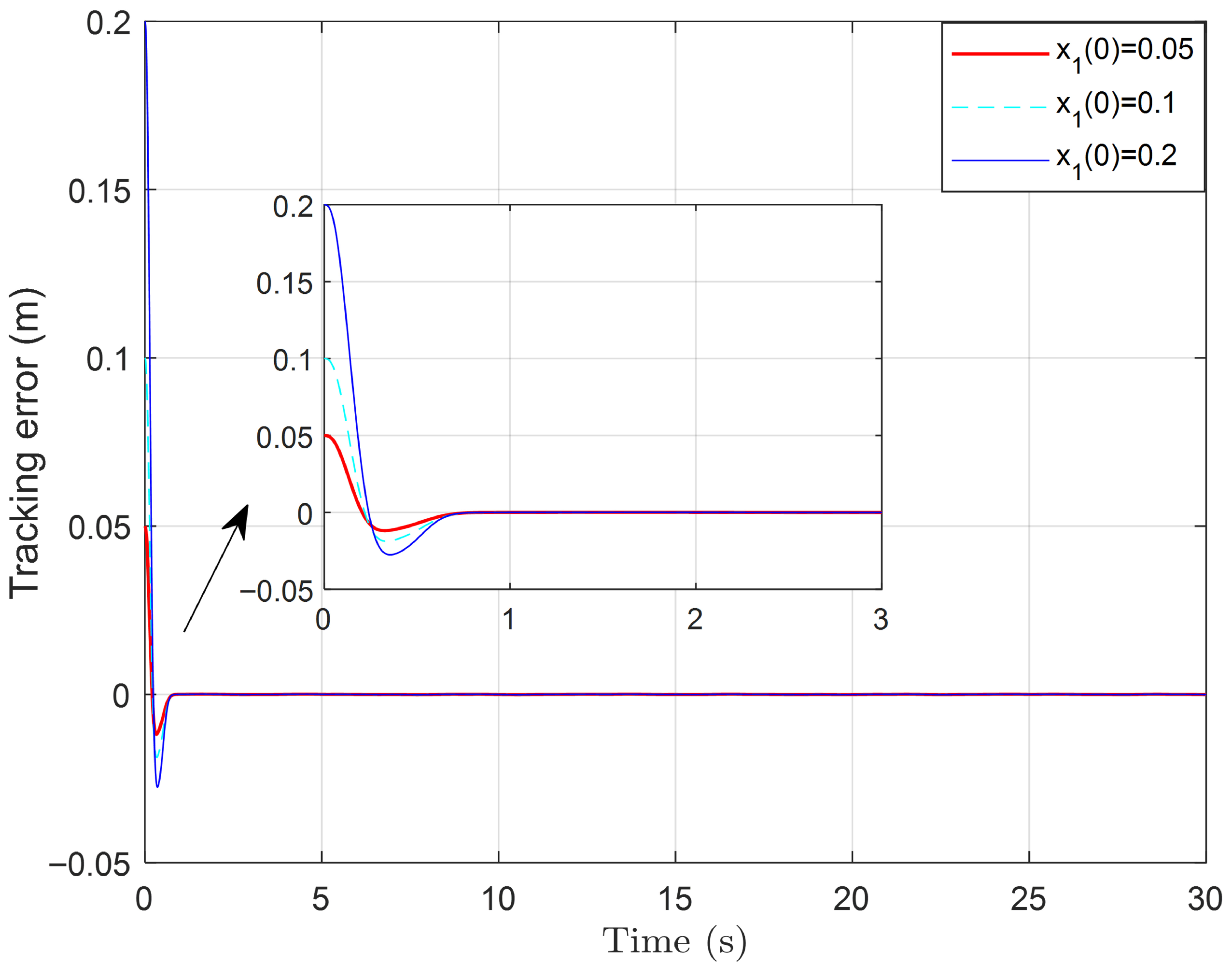
To further verify the effectiveness of the proposed algorithm, the reference trajectory is set to the command curve  y d = 0.2 sin ( 0.5 π t ) 1 e t  , the system’s initial state  x 1 ( 0 )  is changed and the constraint boundary  F 11 = 0.7 + 0.2 sin ( 0.5 π t )   F 12 = 0.6 + 0.2 cos ( π t )  while the corresponding control parameters are the same as Example 1. The corresponding simulation results are presented below.
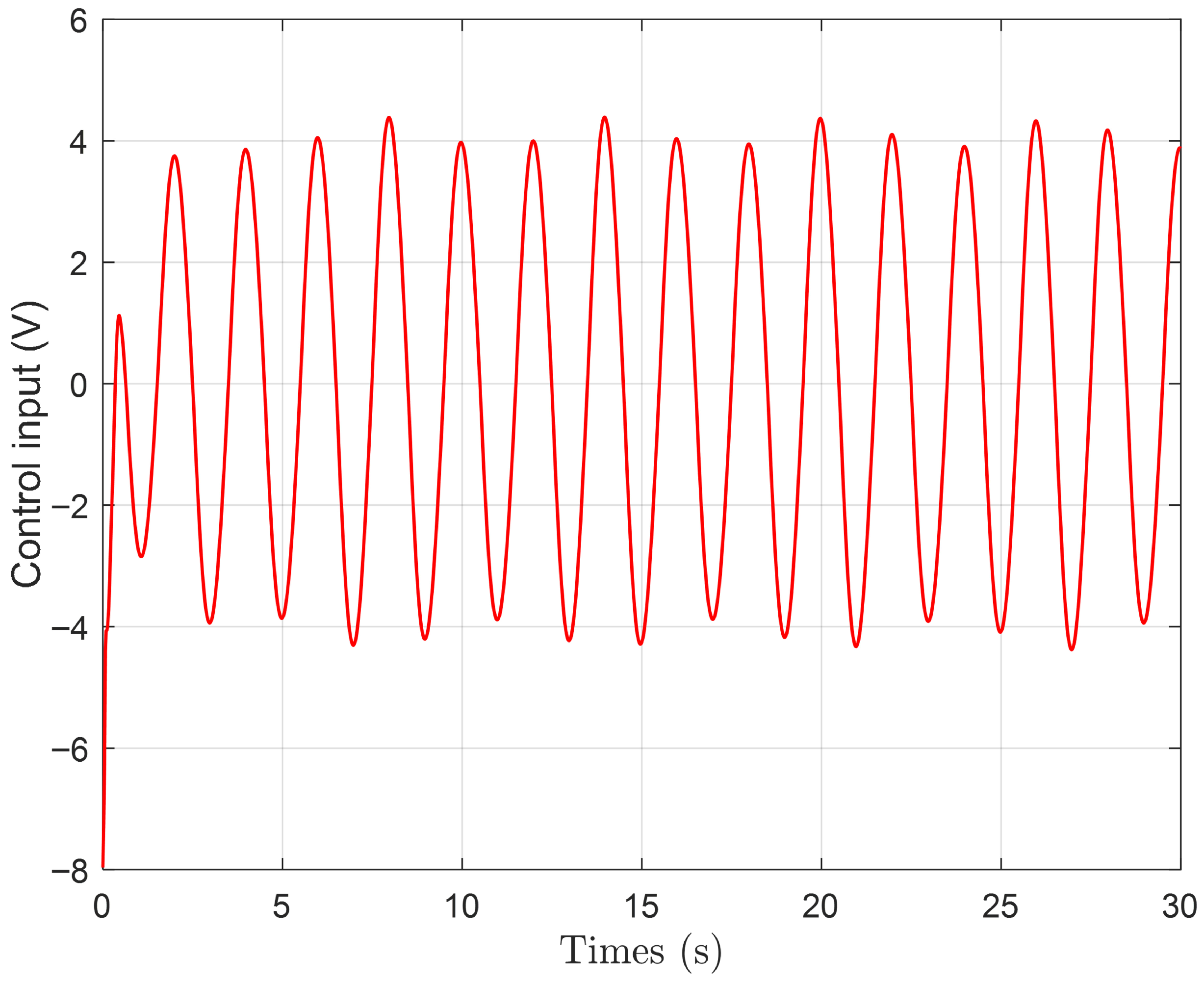
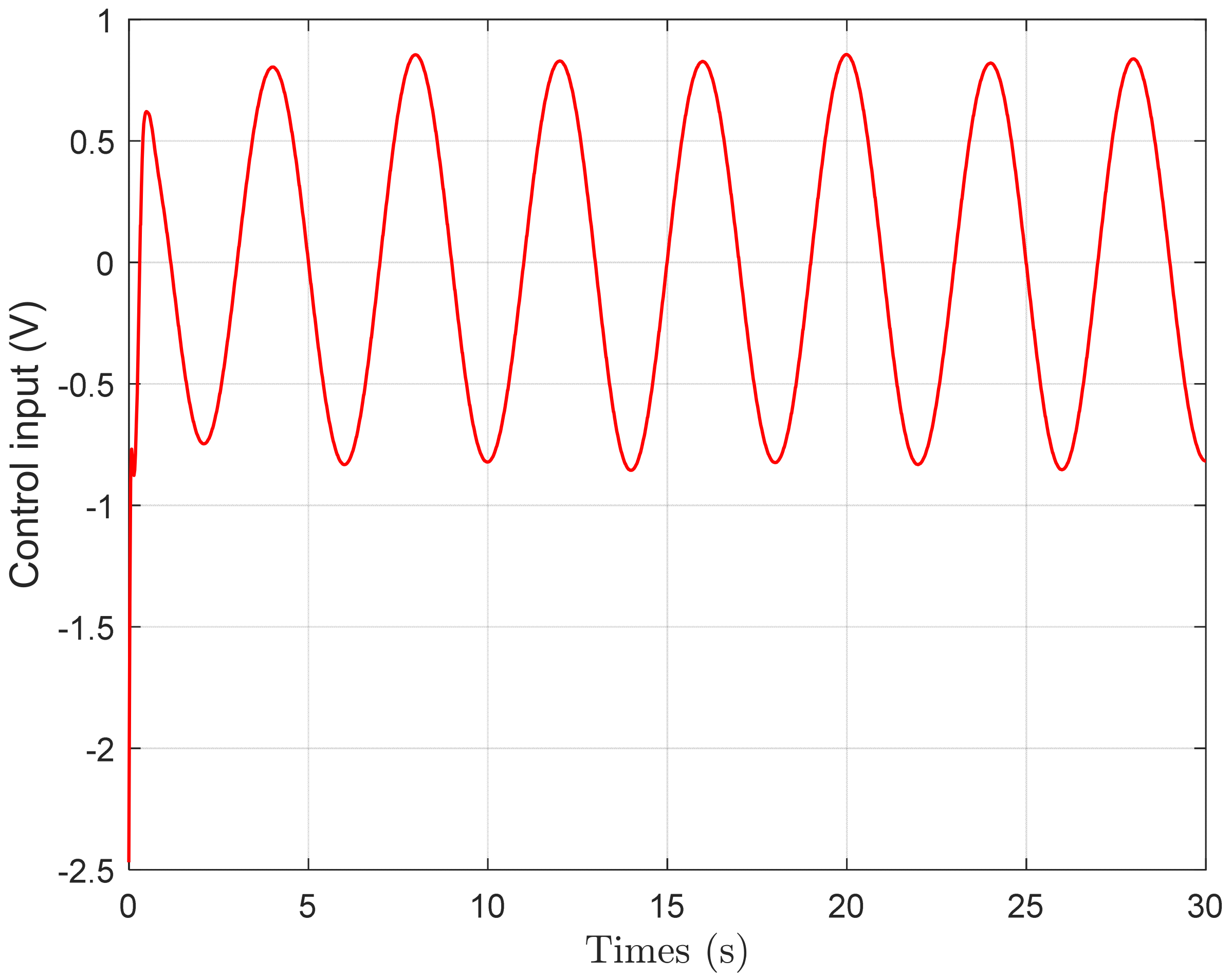
Figure 9 illustrates the tracking performance of the proposed controller. As observed, the controller exhibits excellent control performance. The tracking error depicted in Figure 10 further demonstrates that, under the proposed controller, the error converges to a small bounded interval near zero within the prescribed time, and this prescribed time is independent of the initial states. Finally, Figure 11 displays the control input of the proposed controller when the initial state  x 1 ( 0 ) = 0.1 .
Example 3.
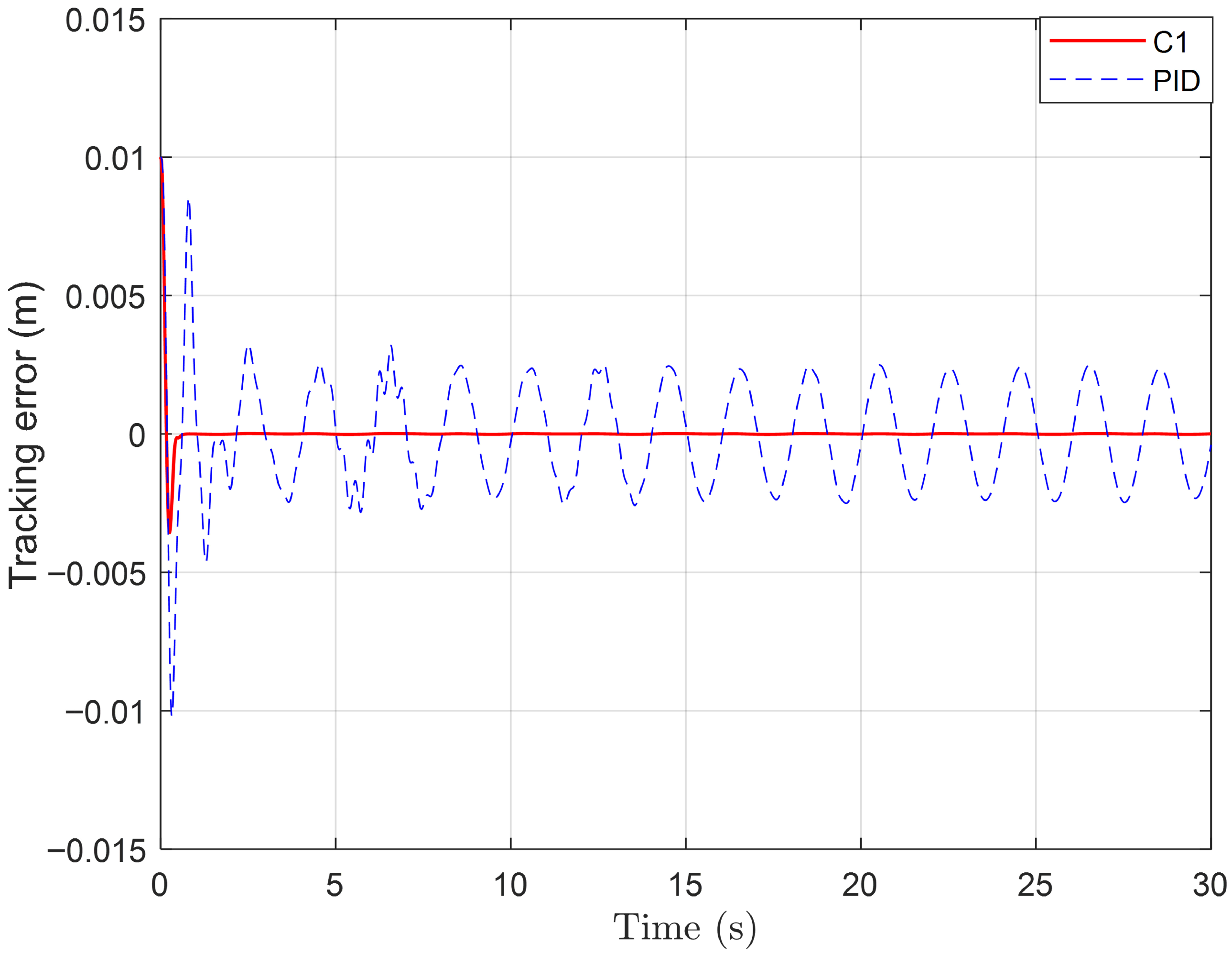
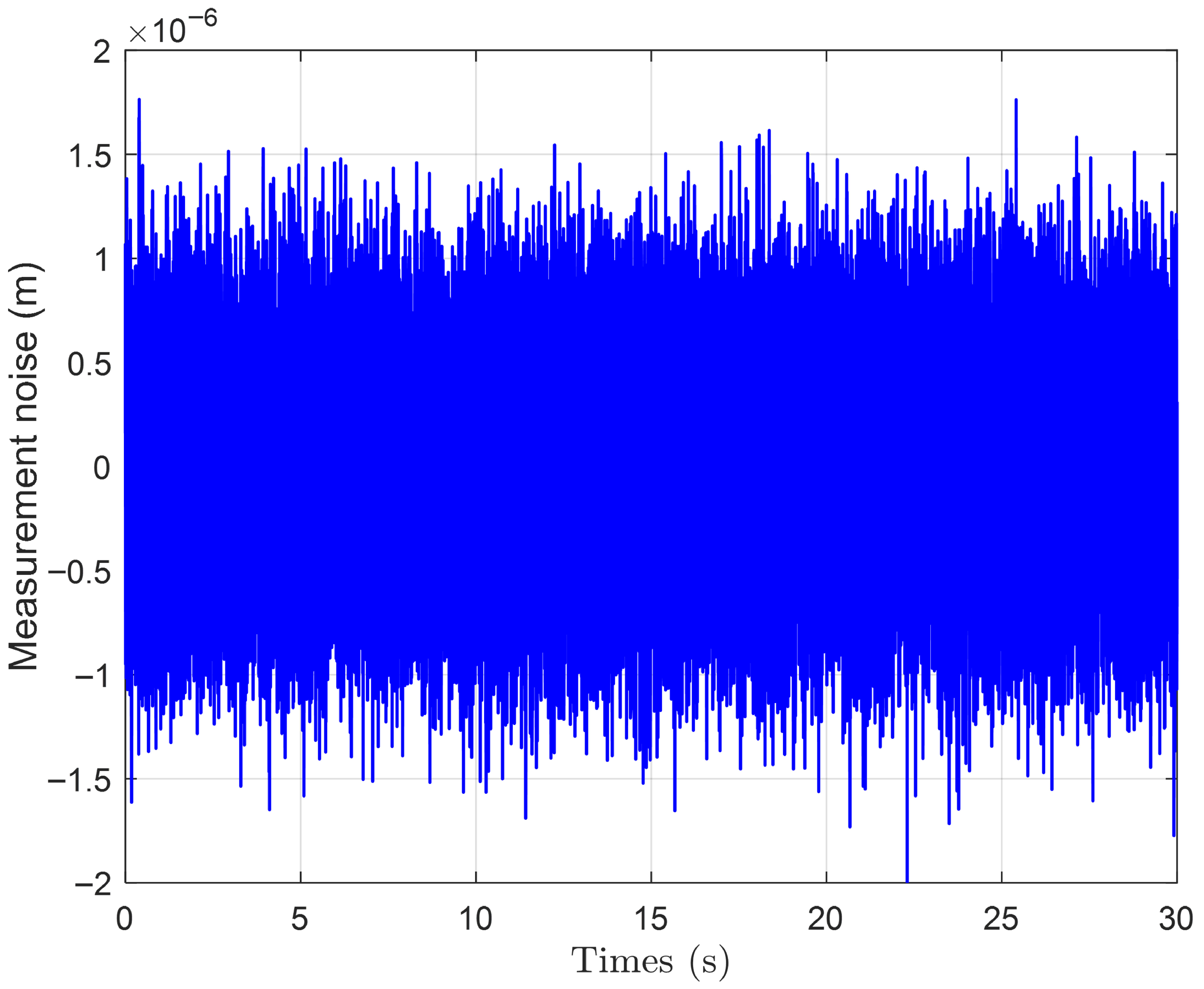
To further verify the effectiveness of the proposed method, measurement noise and actuator saturation are introduced into Example 1. Furthermore, the proposed method is compared with a traditional PID controller to make the simulation scenarios more representative of practical applications. The control parameters for the PID controller are chosen as  k p = 6 k i = 130 , and  k d = 1 . The actuator saturation limits are set to range from −10 V to +10 V. Taking into account the practical operating conditions, the reference trajectory is modified to  y d = 0.01 sin ( π t ) ( 1 e t ) , and the associated boundary functions are adjusted to  F 11 = 0.3 + 0.1 sin ( 0.5 π t )  and  F 12 = 0.4 + 0.1 cos ( π t ) , while the corresponding control parameters are the same as Example 1. The corresponding simulation results are presented below.
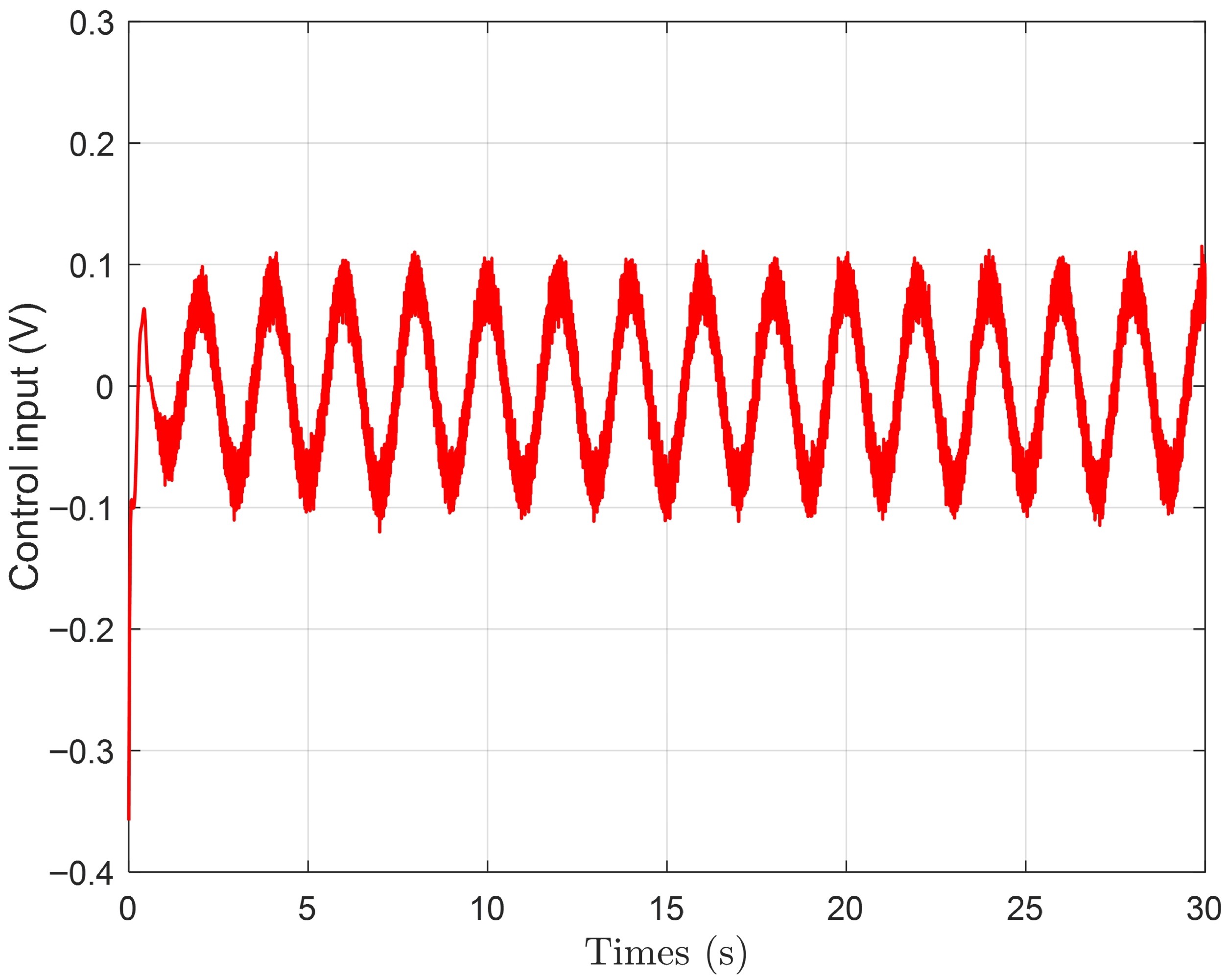
The introduced measurement noise is depicted in Figure 12. To further demonstrate its practical potential, Figure 13 compares the proposed control algorithm with a standard industrial PID controller. Finally, Figure 14 shows the generated control input of the proposed method.

5. Conclusions

In this paper, an innovative command filter-based adaptive prescribed-time control method is proposed for hydraulic servo systems. Based on the consideration of the system’s boundedness problem, a nonlinear transformation is applied to the state-space equations of the hydraulic servo system. Meanwhile, an auxiliary system is constructed to compensate for the command filtering errors. Furthermore, smooth nonlinear functions with updating gains are introduced to simultaneously compensate for time-varying parameters and external disturbances. By integrating command filtering, adaptive control, and the prescribed-time function, a novel control framework is developed. This framework guarantees that the tracking error of the system output converges to a small bounded interval near zero within the prescribed time, which is entirely independent of the initial states. Both Lyapunov stability analysis and simulation results demonstrate that the proposed method achieves superior tracking precision and convergence speed. However, this study also acknowledges certain limitations, as the proposed method only guarantees constraints on the output state. Therefore, future work will focus on achieving effective full-state constraints of the hydraulic system while further improving tracking precision, thereby comprehensively ensuring the safety and stability of the hydraulic control system.

Author Contributions

Conceptualization, P.L., X.Y. and J.Y.; methodology, P.L., X.Y. and J.Y.; software, P.L.; validation, P.L.; formal analysis, P.L.; investigation, P.L.; resources, X.Y. and J.Y.; data curation, P.L.; writing—original draft, P.L.; writing—review and editing, P.L.; visualization, P.L.; supervision, X.Y. and J.Y.; project administration, X.Y. and J.Y. All authors have read and agreed to the published version of the manuscript.

Funding

This work was supported in part by the National Science and Technology Major Project of China (No. 12124778012).

Institutional Review Board Statement

Not applicable.

Informed Consent Statement

Not applicable.

Data Availability Statement

The original contributions presented in this study are included in the article. Further inquiries can be directed to the corresponding author.

Conflicts of Interest

The authors declare no conflicts of interest.

Appendix A

This study employs the proposition presented below.
Proposition A1
([34]). For any positive function  δ ( t ) , there always exists  θ ( t )  and a non-negative function  υ ( t )  such as
υ θ θ 2 υ 2 θ υ tanh [ θ / δ ( t ) ] + δ ( t ) δ ( t )
Proof. 
There has
θ υ tanh [ θ / δ ( t ) ] υ θ
Thus, one has
υ θ θ 2 υ 2 θ υ tanh [ θ / δ ( t ) ] + δ ( t ) υ θ θ 2 υ 2 υ θ + δ ( t ) δ ( t )
Consequently, Proposition 1 holds. □

Appendix B

Solving the nonlinear differential Formula (42) gives
V ( t ) e λ 0 t p ( τ ) d τ V ( 0 ) + C 0 t e λ τ t p ( s ) d s p ( τ ) d τ
where the initial value of V ( t ) is V ( 0 ) as t = 0 . p ( τ ) and p ( s ) are intermediate functions, τ and s are intermediate variables.
Since p ( t ) monotonically increases over time t , there is
0 t e λ τ t p ( s ) d s p ( τ ) d τ 1 e λ 0 t p ( s ) d s λ 1 λ
Utilizing Formula (A5), Formula (A4) transforms to
V ( t ) e λ 0 t p ( τ ) d τ V ( 0 ) + C λ
Since V ( t ) = i = 1 3 1 2 p 2 z i 2 + i = 2 3 1 2 M ˜ i 2 and lim t T p p ( t ) = 1 b f , it is available
0 V ( t ) p 2 ( t ) e λ 0 t p ( τ ) d τ V ( 0 ) p 2 ( t ) + C λ p 2 ( t )   lim t T p z i b f η ( 2 e λ 0 t p p ( τ ) d τ V ( 0 ) + 2 C λ )

Appendix C

Solving the nonlinear differential Formula (50) gives
V f z e λ 1 0 t q ( τ 1 ) d τ 1 V f z ( 0 ) + D 0 t e λ 1 τ 1 t q ( s 1 ) d s 1 p ( τ 1 ) d τ 1
where the initial value of V f z ( t ) is V f z ( 0 ) as t = 0 . q ( τ 1 ) and q ( s 1 ) are intermediate functions, τ 1 and s 1 are intermediate variables.
Since p ( t ) monotonically increases over time t P , there is
0 t e λ 1 τ 1 t q ( s 1 ) d s 1 p ( τ 1 ) d τ 1 1 e λ 1 0 t q ( s 1 ) d s 1 λ 1 1 λ 1
Utilizing Formula (A9), Formula (A8) transforms to
V f z e λ 0 t q ( τ 1 ) d τ 1 V ( 0 ) + D λ 1
Since V f z = i = 1 3 1 2 p 2 ι i 2 + j = 1 2 1 2 N ˜ j 2 and lim t T p p ( t ) = 1 b f , it is available
0 V ( t ) p 2 ( t ) e λ 1 0 t q ( τ 1 ) d τ 1 V ( 0 ) p 2 ( t ) + D λ 1 p 2 ( t )   lim t T p ι i b f η ( 2 e λ 1 0 t p q ( τ 1 ) d τ 1 V ( 0 ) + 2 D λ 1 )

Appendix D

While t [ t P , + ) , combined Formulas (13), (42) and (50) can be modified as
V ˙ λ 2 V + Ψ , V ˙ f z λ 3 V f z + Ψ 1
in which λ 2 = η λ / b f , Ψ = η C / b f , λ 3 = η λ 1 / b f , Ψ 1 = η D / b f .
Thus it will yield
V ( t ) V ( t P ) e λ 2 ( t t P ) + Ψ λ 2 ( 1 e λ 2 ( t t P ) ) , V f z V f z ( t P ) e λ 3 ( t t P ) + Ψ 1 λ 3 ( 1 e λ 3 ( t t P ) )
Therefore, V ( t ) , V f z L , we can establish that s i ( i = 1 , 2 , 3 ) , ι i ( i = 1 , 2 , 3 ) , M ˜ i ( i = 2 , 3 ) , and N ˜ i ( i = 1 , 2 ) are bounded. Given that M ˜ i = M i M ^ i are bounded, it follows that M ^ i are also bounded. Consequently, ς i ( i = 1 , 2 , 3 ) and χ i ( i = 2 , 3 ) are bounded. Given that N ˜ i = N i N ^ i are bounded, it follows that N ^ i are also bounded. Consequently, ν i ( i = 1 , 2 ) are bounded. Since y d is bounded, α 0 and α ˙ 0 are also bounded. From z 1 = ζ 1 α 0 , v 1 = z 1 ι 1 , and s 1 = p v 1 , where p is a bounded function, the boundedness of s 1 implies that v 1 is a bounded function. This, in turn, ensures that z 1 and ζ 1 is bounded. According to nonlinear transition function [31], x 1 is also bounded. Thus, μ 1 is bounded, leading to the conclusion that the virtual controller α 1 is bounded.
Furthermore, because the α 1 is bounded. Hence, the α 2 f and α ˙ 2 f are bounded. From z 2 = ς 2 α 2 f , v 2 = z 2 ι 2 , and s 2 = p v 2 , where p is a bounded function, the boundedness of s 2 implies that v 2 is a bounded function. This, in turn, ensures that z 2 and ς 2 are bounded. Therefore, the virtual controller α 2 is also bounded.
Analogous to the preceding analysis, the actual controller u is also bounded.

References

  1. Liu, Y.; Zhu, Q. Adaptive Neural Network Asymptotic Tracking Control for Nonstrict Feedback Stochastic Nonlinear Systems. Neural Netw. 2021, 143, 283–290. [Google Scholar] [CrossRef]
  2. Yuan, X.; Chen, B.; Lin, C. Fuzzy Adaptive Output-Feedback Tracking Control for Nonlinear Strict-Feedback Systems in Prescribed Finite Time. J. Frankl. Inst. 2021, 358, 7309–7332. [Google Scholar] [CrossRef]
  3. Gao, L.; Song, Z.; Wang, Z. Adaptive Tracking Control of Uncertain Constrained Nonlinear Systems with Input Saturation. Commun. Nonlinear Sci. Numer. Simul. 2023, 127, 107553. [Google Scholar] [CrossRef]
  4. Yang, S.; Yuan, X.; Sun, Z.-Y. Practical Tracking Control for a Class of Uncertain MIMO Nonlinear Systems with Unmatched Disturbances. J. Frankl. Inst. 2024, 361, 107336. [Google Scholar] [CrossRef]
  5. Chen, F.; Chen, L.; Li, H.; Fang, J.-A. Adaptive Tracking Control of Fractional-Order Nonlinear Constrained Systems with Dead-Zone. J. Frankl. Inst. 2025, 362, 108035. [Google Scholar] [CrossRef]
  6. Huang, X.; Lin, W.; Yang, B. Global Finite-Time Stabilization of a Class of Uncertain Nonlinear Systems. Automatica 2005, 41, 881–888. [Google Scholar] [CrossRef]
  7. Amato, F.; Ariola, M.; Dorato, P. Finite-Time Control of Linear Systems Subject to Parametric Uncertainties and Disturbances. Automatica 2001, 37, 1459–1463. [Google Scholar] [CrossRef]
  8. Hong, Y.; Jiang, Z.-P. Finite-Time Stabilization of Nonlinear Systems with Parametric and Dynamic Uncertainties. IEEE Trans. Autom. Control 2006, 51, 1950–1956. [Google Scholar] [CrossRef]
  9. Yu, J.; Shi, P.; Zhao, L. Finite-Time Command Filtered Backstepping Control for a Class of Nonlinear Systems. Automatica 2018, 92, 173–180. [Google Scholar] [CrossRef]
  10. Zuo, Z.; Han, Q.-L.; Ning, B.; Ge, X.; Zhang, X.-M. An Overview of Recent Advances in Fixed-Time Cooperative Control of Multiagent Systems. IEEE Trans. Ind. Inform. 2018, 14, 2322–2334. [Google Scholar] [CrossRef]
  11. Chen, C.; Sun, Z. Fixed-time Stabilisation for a Class of High-order Non-linear Systems. IET Control Theory Appl. 2018, 12, 2578–2587. [Google Scholar] [CrossRef]
  12. Li, X.; Wen, C.; Wang, J. Lyapunov-Based Fixed-Time Stabilization Control of Quantum Systems. J. Autom. Intell. 2022, 1, 100005. [Google Scholar] [CrossRef]
  13. Song, Y.; Wang, Y.; Holloway, J.; Krstic, M. Time-Varying Feedback for Regulation of Normal-Form Nonlinear Systems in Prescribed Finite Time. Automatica 2017, 83, 243–251. [Google Scholar] [CrossRef]
  14. Que, N.; Deng, W.; Zhou, N.; Yao, J. Disturbance Observer-Based Prescribed-Time Tracking Control of Nonlinear Systems with Non-Vanishing Uncertainties. IEEE Trans. Circuits Syst. II Express Briefs 2024, 71, 3131–3135. [Google Scholar] [CrossRef]
  15. Li, Z.; Zhang, Y. Practical Prescribed-Time Control with Time Varying Gains for Nonlinear Systems. IFAC-PapersOnLine 2023, 56, 827–833. [Google Scholar] [CrossRef]
  16. Tran, D.T.; Truong, H.V.A.; Jin, M.; Ahn, K.K. Finite-Time Output Control for Uncertain Robotic Manipulators With Time-Varying Output Constraints. IEEE Access 2022, 10, 119119–119131. [Google Scholar] [CrossRef]
  17. Ouyang, Y.; Bai, Y.; Kong, L.; Wang, X. Adaptive Neural Output Constrained Control for an Unmanned Surface Vessel with Coupled Input Constraint. Ocean Eng. 2025, 335, 121654. [Google Scholar] [CrossRef]
  18. Tee, K.P.; Ge, S.S.; Tay, E.H. Barrier Lyapunov Functions for the Control of Output-Constrained Nonlinear Systems. Automatica 2009, 45, 918–927. [Google Scholar] [CrossRef]
  19. Li, D.; Chen, C.L.P.; Liu, Y.-J.; Tong, S. Neural Network Controller Design for a Class of Nonlinear Delayed Systems with Time-Varying Full-State Constraints. IEEE Trans. Neural Netw. Learn. Syst. 2019, 30, 2625–2636. [Google Scholar] [CrossRef]
  20. Zhao, K.; Song, Y.; Zhang, Z. Tracking Control of MIMO Nonlinear Systems under Full State Constraints: A Single-Parameter Adaptation Approach Free from Feasibility Conditions. Automatica 2019, 107, 52–60. [Google Scholar] [CrossRef]
  21. Tee, K.P.; Ge, S.S. Control of Nonlinear Systems with Partial State Constraints Using a Barrier Lyapunov Function. Int. J. Control 2011, 84, 2008–2023. [Google Scholar] [CrossRef]
  22. Min, H.; Shi, S. State-Feedback Control for Full-State Constrained Nonlinear Systems in a Prescribed Time. J. Frankl. Inst. 2024, 361, 107052. [Google Scholar] [CrossRef]
  23. Wan, Q.; Fan, T.; Li, Z.; Ding, Z. Event-Triggered Prescribed-Time Tracking for Uncertain Nonlinear Systems with Unknown Control Gain and Output Constraints. J. Frankl. Inst. 2024, 361, 106765. [Google Scholar] [CrossRef]
  24. Farrell, J.A.; Polycarpou, M.; Sharma, M.; Dong, W. Command Filtered Backstepping. IEEE Trans. Autom. Control 2009, 54, 1391–1395. [Google Scholar] [CrossRef]
  25. Ma, J.; Park, J.H.; Xu, S. Command-Filter-Based Finite-Time Adaptive Control for Nonlinear Systems with Quantized Input. IEEE Trans. Autom. Control 2021, 66, 2339–2344. [Google Scholar] [CrossRef]
  26. Chen, W.; Hu, J.; Yao, J.; Zhou, H.; Nie, W. Filter-Based Immersion and Invariance Adaptive Control of Nonlinear Systems. Int. J. Control Autom. Syst. 2024, 22, 196–204. [Google Scholar] [CrossRef]
  27. Yang, X. Adaptive Dynamic Surface Tracking Control for Uncertain Full-State Constrained Nonlinear Systems with Disturb-ance Compensation. J. Frankl. Inst. 2022, 359, 2424–2444. [Google Scholar] [CrossRef]
  28. Chen, K.; Astolfi, A. Adaptive Control for Systems with Time-Varying Parameters. IEEE Trans. Autom. Control 2021, 66, 1986–2001. [Google Scholar] [CrossRef]
  29. Wu, J.; Zhao, J.; Wu, D. Indirect Adaptive Robust Control of Nonlinear Systems with Time-varying Parameters in a Strict Feedback Form. Int. J. Robust Nonlinear Control 2018, 28, 3835–3851. [Google Scholar] [CrossRef]
  30. Zhang, Z.; Zhang, K.; Xie, X.; Stojanovic, V. ADP-Based Prescribed-Time Control for Nonlinear Time-Varying Delay Systems with Uncertain Parameters. IEEE Trans. Autom. Sci. Eng. 2025, 22, 3086–3096. [Google Scholar] [CrossRef]
  31. Cao, Y.; Song, Y.; Wen, C. Practical Tracking Control of Perturbed Uncertain Nonaffine Systems with Full State Constraints. Automatica 2019, 110, 108608. [Google Scholar] [CrossRef]
  32. Yang, X.; Ge, Y.; Deng, W.; Yao, J. Command Filtered Adaptive Tracking Control of Nonlinear Systems with Prescribed Performance under Time-variant Parameters and Input Delay. Int. J. Robust Nonlinear Control 2023, 33, 2840–2860. [Google Scholar] [CrossRef]
  33. Shi, T.; Xiang, Z. Asymptotic Tracking Control for a Class of Uncertain Nonlinear Systems with Output Constraint. Appl. Math. Comput. 2024, 478, 128845. [Google Scholar] [CrossRef]
  34. Yang, X.; Ge, Y.; Deng, W.; Yao, J. Precision Motion Control for Electro-Hydraulic Axis Systems under Unknown Time-Variant Parameters and Disturbances. Chin. J. Aeronaut. 2024, 37, 463–471. [Google Scholar] [CrossRef]
Figure 1. Simplified model of the hydraulic servo system.
Actuators 15 00238 g001
Figure 2. Tracking performance of C1 in Example 1.
Actuators 15 00238 g002
Figure 3. Tracking errors of five controllers in Example 1.
Actuators 15 00238 g003
Figure 4. Filtering errors  ε 2  and  ε 3  of C1 in Example 1.
Actuators 15 00238 g004
Figure 5. Auxiliary signals  ι 1 ι 2 , and  ι 3  of C1 in Example 1.
Actuators 15 00238 g005
Figure 6. Estimation of  M 1  and  M 2  of C1 in Example 1.
Actuators 15 00238 g006
Figure 7. Estimation of  N 1 N 2 , and  N 3  of C1 in Example 1.
Actuators 15 00238 g007
Figure 8. Control input of C1 in Example 1.
Actuators 15 00238 g008
Figure 9. Tracking performance of C1 in Example 2.
Actuators 15 00238 g009
Figure 10. Tracking errors with different initial states in Example 2.
Actuators 15 00238 g010
Figure 11. Control input of C1 in Example 2.
Actuators 15 00238 g011
Figure 12. Measurement noise in Example 3.
Actuators 15 00238 g012
Figure 13. Tracking errors with C1 and PID in Example 3.
Actuators 15 00238 g013
Figure 14. Control input of C1 in Example 3.
Actuators 15 00238 g014
Table 1. Parameters of hydraulic servo system.
Physical ParametersValuePhysical ParametersValue
A (m2)2 × 10⁻⁴βe (Pa)2 × 10⁸
m (kg)40B (N·s/m)80
Ct (m5/(N·s))7 × 10−12ku (m/V)4 × 10−8
V01 (m3)1 × 10⁻³V02 (m3)1 × 10⁻³
Ps (MPa)7Pr (MPa)0
Table 2. Performance Indices of C1–C5 in Example 1 (Steady-state performance).
IndicesMzAz
C10.00080.0003
C20.02370.0158
C30.08710.0275
C40.08740.0293
C50.17500.0575
Disclaimer/Publisher’s Note: The statements, opinions and data contained in all publications are solely those of the individual author(s) and contributor(s) and not of MDPI and/or the editor(s). MDPI and/or the editor(s) disclaim responsibility for any injury to people or property resulting from any ideas, methods, instructions or products referred to in the content.