


Abstract
Actuator placement optimization based on a reduced-order model is essential for controlling a high-dimensional system in real time. This paper discusses actuator placement in an unstable high-dimensional system based on a reduced-order model obtained by BPOD with input–output projection. Actuator locations in a linearized Ginzburg–Landau model are optimized with three objective functions based on a Riccati equation, a controllability Gramian, and an impulse response matrix. Further, the computation time for actuator selection and the resulting LQR performance are evaluated. The LQR performance is basically high when actuators are placed based on the Riccati equation or the impulse response matrix. The computation time of the method based on the impulse response matrix is much smaller than that of the other two methods. Thus, the method based on the impulse response matrix seems to have more advantages than the other two methods in terms of optimizing the actuator locations of the analyzed model. Moreover, it seems to be beneficial to place actuators with a low-dimensional model using this method.
1. Introduction
Fluid control is one of the vital topics in the fields of science and engineering, for example, from the perspective of improving the performance of fluid machinery [1,2,3]. However, the energy of input that can be applied to fluid is generally small compared to that of the fluid phenomena itself, as can be seen in control devices such as plasma actuators and flapping jets [4,5]. Thus, it is necessary to optimize the locations of input, in other words, actuator locations, to control fluid phenomena efficiently. In particular, it is effective to select actuator locations in real time depending on the state of the flow. However, fluid phenomena are often modeled as a high-dimensional system, since their degree of freedom is countless. Such systems are not favorable for selecting actuators in real time in terms of computation time. Hence, their order needs to be reduced before their actuator placement is optimized.
Proper orthogonal decomposition (POD) is a well-known method for reduced-order modeling [6,7]. It decomposes the complex behavior of high-dimensional systems in orthogonal bases as POD modes, and the order of the system can be reduced by projecting the original system onto dominant modes. Although POD is a powerful and useful tool in understanding the complicated behavior of high-dimensional systems, the transient motion of these systems may not be captured accurately, and the stability of the reduced-order model may be different from that of the full-order model, especially for systems with weak orthogonality, including fluid phenomena. On the other hand, frequency-based methods [8,9,10] and dynamical methods such as dynamic mode decomposition (DMD) [11,12,13], the POD-Galerkin method [14,15,16], the discrete empirical interpolation method (DEIM) [17,18,19], sparse identification of nonlinear dynamics (SINDy) [20,21,22], and echo state network reduced-order modeling [23,24] have been developed. In particular, ref. [25] introduced the idea of balanced truncation by focusing on the observability and controllability of an input–output system. The basic approach of this method is to transform the coordinates so that the most controllable states correspond to the most observable ones, and then truncate the least observable and controllable ones. This makes the reduced-order model reproduce the output accurately for an input, since only the states that have limited affect on the relation between input and output are omitted. However, it is not feasible to apply this method to a high-dimensional system in terms of computational cost, since the coordinates for the entire state needs to be transformed. Thus, balanced proper orthogonal decomposition (BPOD) was developed based on the idea of balanced truncation [26,27,28]. Although the core concept of these two methods is same in that they balance the observability and controllability Gramians, the computational cost of BPOD is smaller than that of balanced truncation, since the Gramians in BPOD are approximated with snapshots of impulse response, while those in balanced truncation are obtained by solving Lyapunov equations. However, BPOD requires p and q times of simulations with the original and adjoint system, respectively, where p and q are the number of input and output. This indicates that BPOD cannot be applied directly to a system with a large number of inputs or outputs. In such cases, the input and output are projected onto an appropriate subspace before BPOD is applied [27,29,30,31,32]. This procedure reduces the number of simulations to the amount of subspace used for projection. Hence, BPOD with input–output projection is a useful idea in controlling high-dimensional systems such as fluid phenomena. Nevertheless, BPOD has not been investigated enough with output and, especially, input projection. Therefore, it is important to explore the properties of reduced-order models obtained by BPOD with input–output projection.
Next, let us briefly review previous studies on sensor and actuator placement optimization. We refer to sensors as well as actuators, since sensor and actuator placement problems have a duality. For sensor placement, ref. [33,34] developed a global optimization technique called the branch-and-bound method. This method has the advantage that the exact solution of combinatorial problems can be obtained. However, it is not feasible to use to solve problems in a high-dimensional system, since its computational cost is high. Thus, ref. [35] relaxed the constraints of the problem and proposed an approximate convex relaxation method. This method could be applied to a relatively high-dimensional system with the recent modification [36]. Further, semidefinite programming (SDP) [37,38] and the alternating direction method of multipliers (ADMM) [39,40,41] were introduced, and the universality of the convex relaxation methods was enlarged. These methods offer the exact solution of the relaxed problems, but it is not ensured that the obtained solution performs well in the original problem. In contrast, the performance of the solution obtained by a greedy algorithm is guaranteed if the objective function is submodular and monotone [42,43,44,45,46,47,48,49] and is practically favorable even if not [50,51]. Moreover, its computational cost is less than the approximate convex relaxation methods.
As to studies on actuator placement, some focused on [40,52,53,54] and norm [55,56,57] and developed an actuator placement method for optimal control. These methods are useful for practical control such as that with linear quadratic regulator (LQR), but their computational costs are basically high. On the other hand, ref. [58,59] solved actuator placement problems from the viewpoint of maximizing the sensitivity of unstable modes to an input. In addition, ref. [60] proposed a method based on the idea of maximizing the sensitivity of the terminal output to an impulse input for various modes by using singular value decomposition. This method could be applied to high-dimensional systems, since the suboptimal solution of combinatorial problems is obtained by a determinant-based greedy algorithm. Controllability Gramian has also been focused on for actuator placement optimization [47,56,61,62,63]. In particular, ref. [56] investigated sensor and actuator placement problems in a balanced reduced model in the context of controlling active flexible structures. In addition, ref. [47] developed an algorithm to optimize sensor and actuator placement in a reduced-order model obtained by balanced truncation using greedy matrix QR pivoting. Further, ref. [64] discussed optimal actuator placement based on an extended balanced realization technique [65]. Although actuator placement methods have been proposed from various aspects, actuator placement problems in a reduced-order model for an unstable system have not been studied enough. In particular, further analysis regarding the effect of the dimension of the reduced-order model on actuator placement and control efficiency is required from the viewpoint of model construction.
In this paper, the order of a linearized Ginzburg–Landau model, which is known as a simple model for fluid phenomena, is reduced based on BPOD with input–output projection, and actuator locations are optimized with three objective functions based on the reduced-order model so that the system can be controlled efficiently with an LQR. Then, the computation time for actuator selection and the resulting LQR performance are evaluated. The three objective functions are based on a Riccati equation, a controllability Gramian, and an impulse response matrix. The main contribution of this paper is summarized as follows:
- Reduced-order models of an unstable system with different dimension are obtained by BPOD with input–output projection, and their dynamical properties are investigated from the perspective of impulse and frequency response.
- Actuator placement optimization for an unstable high-dimensional system based on a reduced order model is discussed from the perspective of computation time for actuator selection and the resulting LQR performance.
- An actuator selection method based on a Riccati equation is introduced, and two other methods based on a controllability Gramian and an impulse response matrix are modified.
- The three methods are compared, and their characteristics are clarified.
- It is analyzed how the dimension of the reduced-order model affects actuator locations, computation time for actuator selection, and LQR performance.
2. Problem Settings
First, let us describe the problem settings. Consider the following continuous-time linear time-invariant system:
where , and indicates the differentiation by t. Assume that A has a few eigenvalues on the right-half plane and that the system is unstable. In addition, suppose that , which indicates that the size of the system is large. The input is given by
where denotes the ith entry in . Equation (2) shows that actuators are placed at m points out of p points.
Let us briefly introduce the input for an LQR under the assumption that the system in Equation (1) can be controlled with an LQR by m actuators. Equation (1) can be transformed into
by recalling that . Here, and are defined as
where indicates the ith column vector of B. The feedback gain of LQR control is determined so that cost function
is minimized. Matrices and correspond to the weight for the state and input, respectively. The input is given by
where indicates the solution of a Riccati equation
and denotes an adjoint matrix. In this paper, we reduce the order of the system in Equation (1), and select from , in other words, we optimize actuator locations so that the system can be controlled efficiently with an LQR.
3. Reduced-Order Modeling by BPOD with Input–Output Projection
The order of the system in Equation (1) is reduced by BPOD. However, BPOD cannot be applied directly to an unstable system. Thus, the system is projected onto stable subspace, and BPOD is applied to the projected system [66]. Then, the reduced-order model of the projected system is integrated with the unstable part to obtain the reduced-order model of the original system. As is explained in Section 1, the naive application of BPOD to a system with a large number of inputs and outputs requires high computational cost. Thus, a so-called input–output projection technique is employed, and the number of simulations required for BPOD is reduced. Let us briefly introduce the procedures of the reduced-order modeling by following [16].
3.1. Projection onto Stable Subspace
The system in Equation (1) is projected onto the subspace of stable eigenvectors. Let and be matrices composed of unstable right and left eigenvectors, respectively. Note that they are normalized so that , where I is an identity matrix. Then, the matrix which projects the original system to the stable subspace is given by
and the projected stable system is obtained as
where
3.2. Approximation of Gramian by Input-Output Projection
Next, the order of the stable system in Equation (5) is reduced by BPOD. The input and output are projected onto the subspace of POD modes to reduce the computational cost. Consider the following system:
Here, and are orthogonal projection matrices for the subspace of POD modes, which are given by
where is a matrix composed of the first POD modes of the adjoint model of the system in Equation (5), and is a matrix composed of the first POD modes of the system in Equation (5).
The controllability Gramian and the observability Gramian of the system in Equation (6) are obtained as
respectively. Let us introduce the following two systems:
where and . The solution of Equation (8) with initial condition and an input (an impulse in the kth component) are written as
where denotes the kth column vector of . Similarly, the solution of Equation (9) with initial condition and an input (an impulse in the kth component) are obtained as
where denotes the kth column vector of . Thus, the Gramian in Equation (7) can be transformed into
Further, they can be approximated as
where
Here, are quadrature coefficients. As is shown in Equation (10), the number of times to compute impulse responses is decreased to and from p (≫1) and q (≫1) to obtain the controllability Gramian and the observability Gramian, respectively, which indicates that the computational cost is reduced by using the input–output projection.
3.3. Order Reduction by Balanced Proper Orthogonal Decomposition
It is not feasible to balance the controllability Gramain and the observability Gramian by directly computing them, since their size is , which is large. Thus, an economy singular value decomposition is applied to as follows:
where are matrices associated with left singular vectors, singular values, and right singular vectors. Further, and are defined as
The column vectors of and are bi-orthogonal and called direct and adjoint modes, respectively. Let us approximate in Equation (1) as
where denotes a matrix composed of the first direct modes of the stable system. Recall that indicates the matrix composed of unstable right eigenvectors of A. Further, , where is the number of unstable eigenvalues. Then, the reduced-order model of the system in Equation (1) is obtained as
where
Here, is a matrix composed of the first adjoint modes of the stable system. Hence, the original system with an n-dimensional state in Equation (1) is transformed into a system with an r-dimensional state in Equation (11) by using BPOD with input–output projection, where .
4. Actuator Selection
In this section we describe three methods to optimize actuator placement in the reduced-order model shown in Equation (11). Let us transform Equation (11) into
where is shown in Equation (3) and
Here, denotes the ith column vector of . The three methods are introduced by considering the system in Equation (12).
4.1. Selection Based on a Riccati Equation
An actuator selection method based on a Riccati equation is presented. Consider controlling the system in Equation (12) with an LQR. The input for LQR control is determined so that cost function
is minimized, where the minimum value is
Here, represents the solution of the Riccati equation for the system in Equation (12) and is defined as
Equation (13) implies that the cost function for LQR control may become small, in other words, the performance of the LQR may become high, when is small. Thus, the basic idea of selecting actuator locations is to minimize . This approach is mathematically equivalent to minimizing the determinant of an error covariance matrix in a sensor placement problem [48,51,67].
In this study, actuator locations are selected based on a greedy algorithm to obtain the suboptimal solution as follows:
where , and denotes the solution of the Riccati equation when k actuators are selected, which is given by
Here, is the submatrix of R formed by the entries corresponding to the selected actuators, and is defined as
4.2. Selection Based on a Controllability Gramian
An actuator selection method based on a controllability Gramian is shown by following [61], where the Gramian is defined in a frequency domain instead of a time domain in this study to analyze an unstable system. The basic idea of this method is to maximize the determinant of the controllability Gramian of the system in Equation (12) so that the controllability of the system is enlarged.
Actuator locations are selected based on the greedy method as follows:
where , the controllability Gramian when k actuators are selected, is theoretically defined as
In the numerical computation, is approximated as
where is a quadrature coefficient and
Note that if is not full rank, in other words, if , for all candidates, the index which maximizes the rank of is selected to increase the possibility of the Gramian to become full rank in the following steps. If such indices exist more than one, then the one that maximizes the product of the singular values of is chosen.
4.3. Selection Based on an Impulse Response Matrix
An actuator selection method based on an impulse response matrix is introduced by following [47,61]. The basic idea of this method is to maximize the norm of the system so that the energy of output for an impulse input is enlarged. The square of the norm for the system in Equation (12) is given by
where the transfer function of the system is denoted as
Equation (15) can be rewritten as
where the observability Gramian is defined in the frequency domain as
Here, the equivalence of the last two expressions in Equation (16) follows from the cyclic property of the trace. Equation (16) indicates that the energy of output for an impulse input is enlarged if the magnitude of or is large. Here, the magnitude of the matrices is quantified by the determinant rather than the trace, from the viewpoint of the volume spanned by the actuated subspace. The resulting optimization problem is to maximize either or . Two objective functions are considered, and the use of the determinant of a rank-deficient matrix is avoided. This formulation yields more robust actuator placement. The approach of maximizing the trace tends to favor the excitation of only the most amplified mode, similar to the previous study [60].
Hence, actuator locations are selected based on the greedy algorithm as
in the case of . On the other hand, they are optimized as
in the case of , since for , and
Here, the duality between sensor and actuator placement problems associated with the determinant-based greedy algorithm is utilized [44]. Note that the observability Gramian is approximated in the numerical computation as
where is a quadrature coefficient and
The method introduced in this paper is modified, and it is different from the one in [47] in that (1) the reduced-order model is obtained by BPOD with input–output projection instead of balanced truncation, and computational cost is reduced; (2) the observability Gramian of an unstable system is introduced by defining it in the frequency domain in the present study, while direct and adjoint modes themselves were adopted in [47] owing to the use of a stabilized system; and (3) the rigorous greedy algorithm is adopted and the method could be applied to a system with any number of actuators in the present study, while QR decomposition for the actuator system was used in [47].
5. Application to a Linearized Ginzburg–Landau Model
5.1. Linearized Ginzburg–Landau Model
Let us apply the methods for reduced-order modeling and actuator selection shown in Section 3 and Section 4 to a linearized Ginzburg–Landau model, which is known as a simple model of fluid phenomena [68,69]. Consider a linearized Ginzburg–Landau model with m actuators [70], given by
where , and
Here, are real numbers, and are complex numbers. Actuator locations are optimized based on the methods in Section 3 and Section 4 so that the system can be controlled efficiently with an LQR.
The partial differentiation equation in Equation (17) is rewritten as an ordinary differentiation equation
by discretizing z to and replacing with , where
Matrices and correspond to the first- and second-order differentiation matrices, respectively. Matrix is a diagonal matrix which corresponds to , and is a matrix with entries
Input satisfies Equation (2), and C is chosen so that
where . In this study, z is discretized by an algorithm introduced in [71], which is based on a spectral Hermite collocation method. The dimension is set to , which produces a computational domain around . Other parameters are set to . The matrix A has two unstable eigenvalues under this condition, and thus the system in Equation (18) is unstable.
5.2. Reduced-Order Model
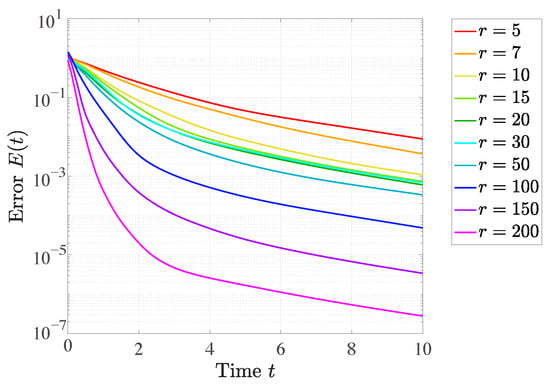
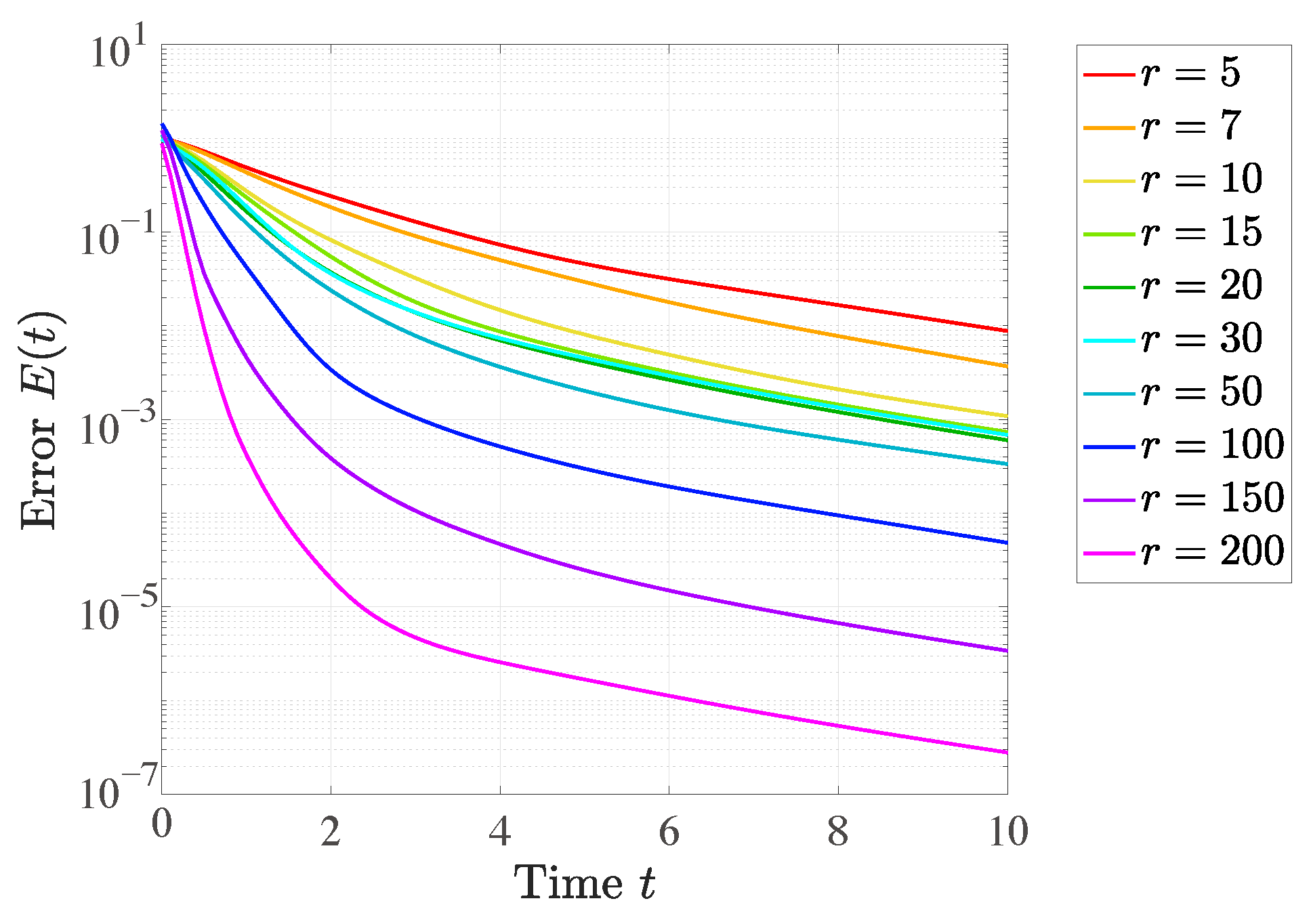
The dimension of the reduced-order model is set to in this study. Let us compare the impulse and frequency response of the reduced-order models with that of the full-order model to evaluate how accurately they approximate the original model. Figure 1 shows the error of the impulse response in the reduced-order models for one random initial condition, where the error is defined as
Here, and represent the output of the reduced-order and full-order model, respectively. The state at , when a random impulse input is applied to the full-order model at , is adopted as the initial condition. The POD modes for input–output projection are obtained by computing random impulse response N times, where the number of responses, time window, and time step are set to and , respectively. The random impulse input for the initial condition and POD modes is applied to each spatial point, and its magnitude is determined according to standard normal distribution. The POD modes depend on the random impulse response under this condition. This indicates that the obtained POD modes are not necessarily accurate. However, these settings are adopted and the robustness of the three actuator placement methods to the POD modes are compared. The number of POD modes used for input–output projection is . The initial time, terminal time, and time step to balance the observability and controllability Gramians are set to , respectively. This indicates that the number of computations of impulse response to balance the Gramians is decreased to 260 (=) times from 440 (=) times by using input–output projection.
Figure 1.
Error of impulse response in reduced-order models.
As is shown in Figure 1, reduced-order models cannot accurately reproduce the response of the full-order model just after the impulse input. However, error decreases with time t, and the response of the reduced-order models finally becomes similar to that of the full-order model. This is because direct modes with high decay rates have low energy and are truncated in the reduced-order models. Thus, models with higher dimensions can reproduce the response of the full-order model better than those with lower dimensions. Similar results are observed for other random impulse input or in other models obtained by different POD modes.
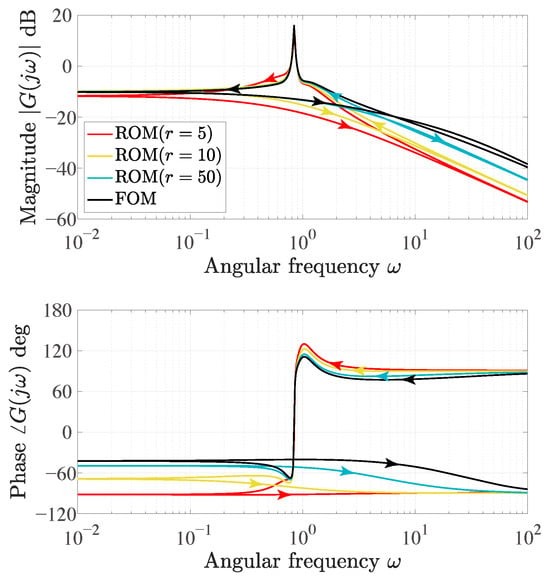
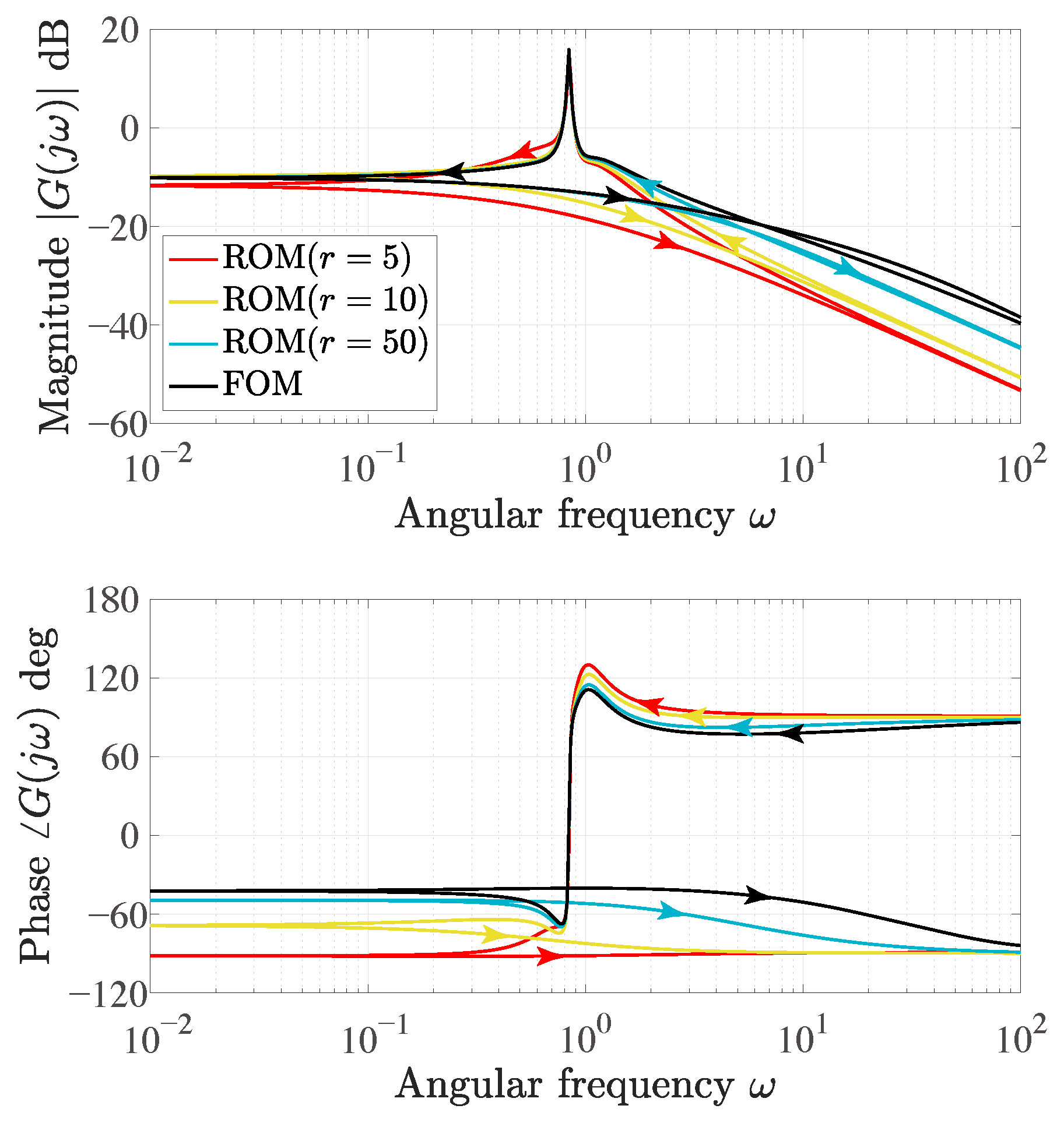
Figure 2 illustrates the bode plot of reduced-order and full-order models, where the location of input and output is set to , a node close to the origin. Lines with right and left arrows denote the bode plot for the positive and negative angular frequency, respectively. It is observed that the reduced-order models follow the full-order model relatively accurately in low-frequency regions in the perspective of magnitude, while they do not so much in high-frequency regions. This is because direct modes which represent high-frequency motion have low energy and are omitted in reduced-order models. Thus, the frequency response of reduced-order models with higher dimensions is more similar to that of the full-order model than those with lower dimensions, as is also the case for impulse response. Further, we can see that the behavior of reduced-order models differs from that of the full-order model even in the low-frequency region in the perspective of phase, when the dimension is low. We analyzed the frequency response for other input–output locations or other models obtained by different POD modes, and found a basic trend that the frequency response of the reduced-order models becomes similar to that of the full-order model when the dimension of the model is enlarged. However, some exceptions are observed. Further analysis and discussions are left as future works.
Figure 2.
Bode plot for reduced-order and full-order models.
5.3. Actuator Location
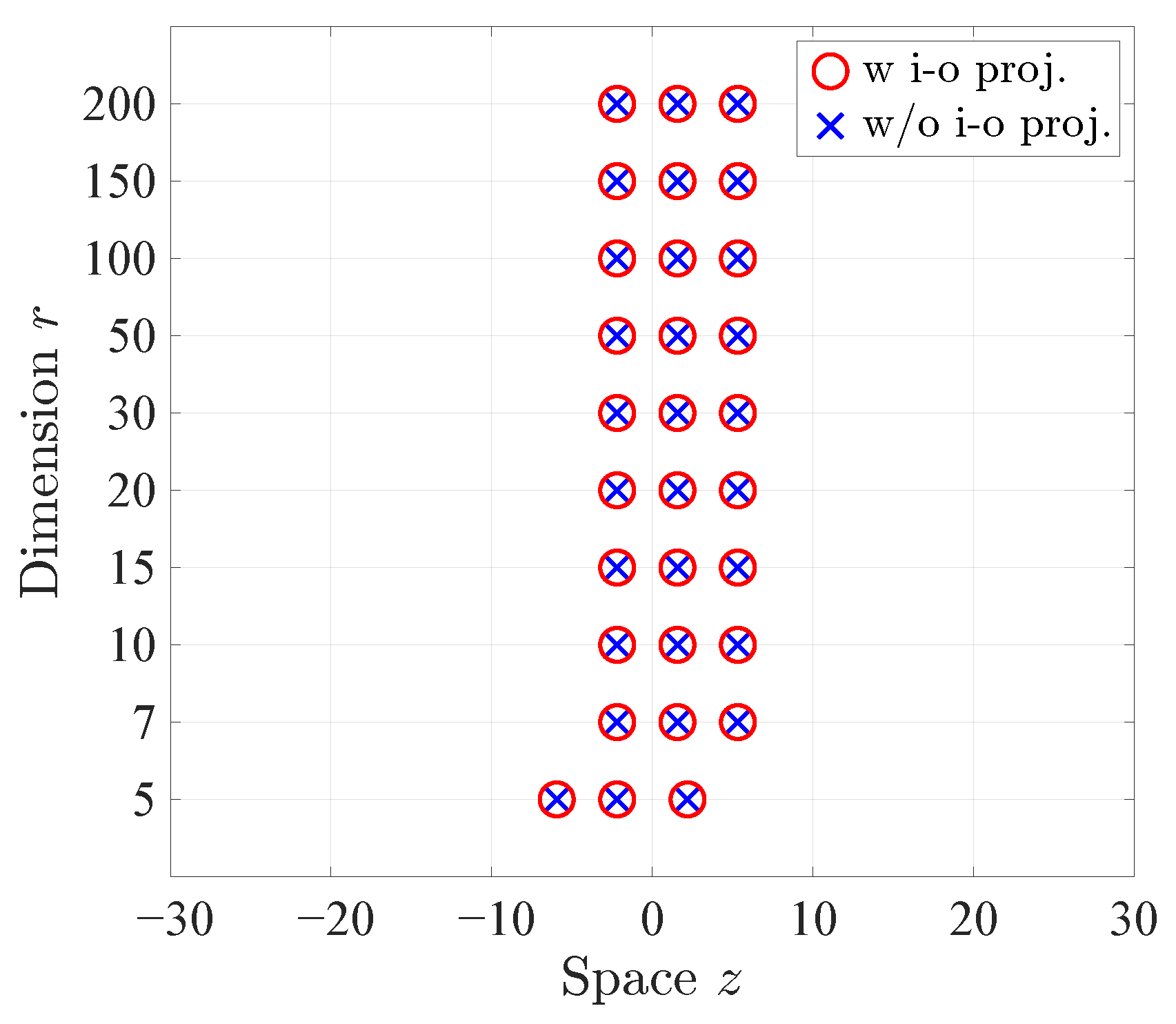
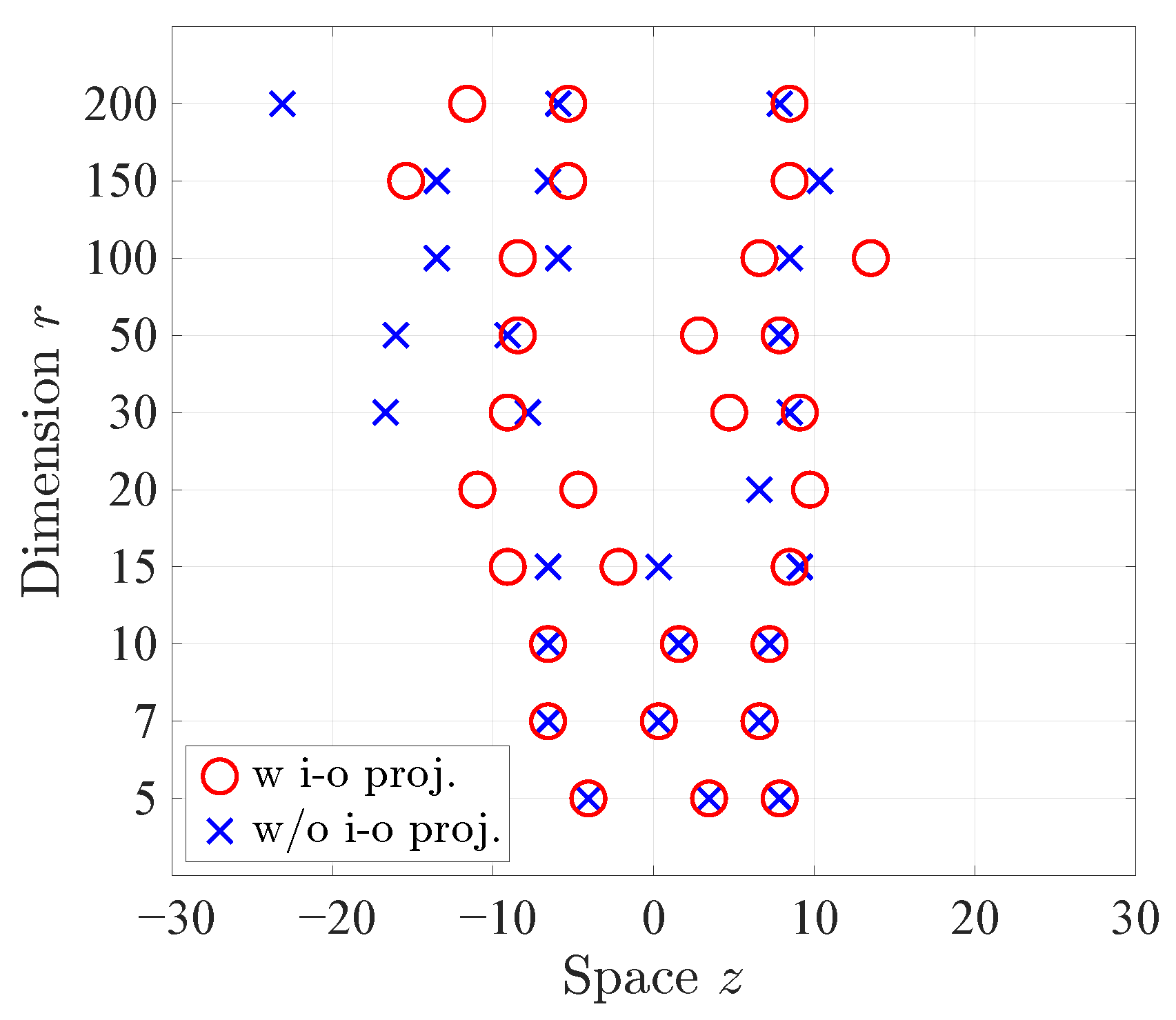
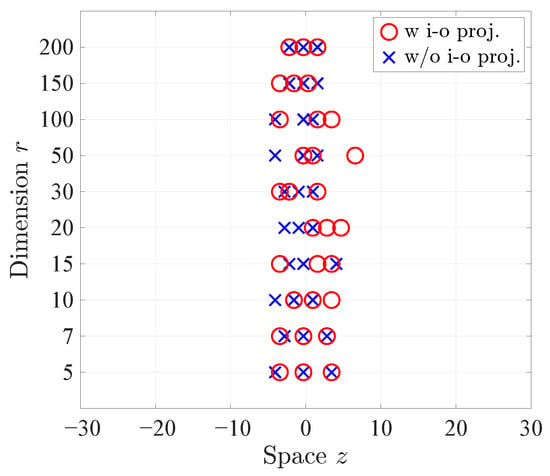
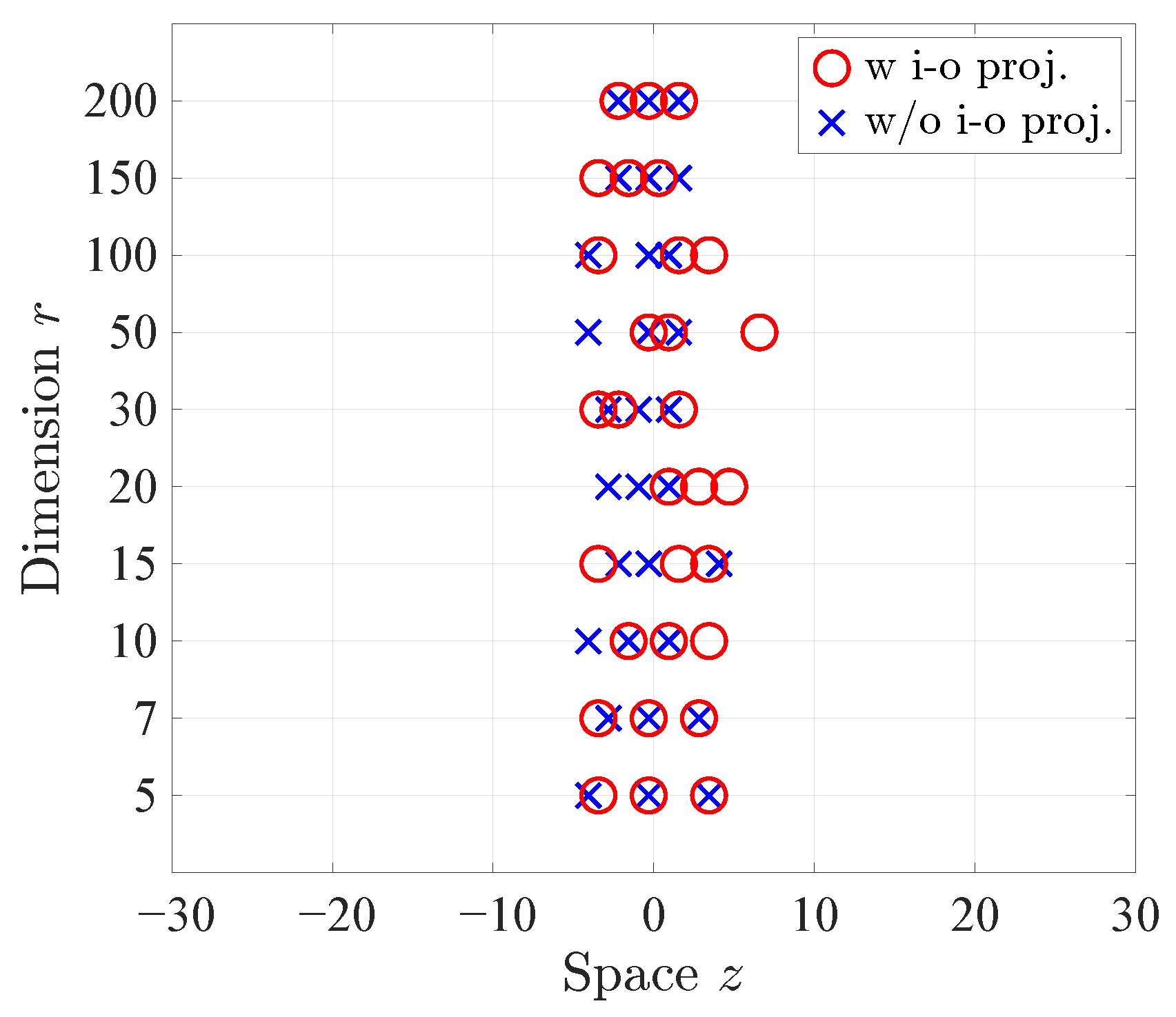
Figure 3, Figure 4 and Figure 5 depict actuator locations optimized by the three methods explained in Section 4.1, Section 4.2 and Section 4.3 based on a Riccati equation, a controllability Gramian, and an impulse response matrix, respectively. The horizontal and vertical axes are space z and the dimension r of the reduced-order model. Red circles and blue cross marks indicate actuator locations when input–output projection is used and not used in reducing the order of the system, respectively. The number of actuators is . The weight matrices for the method based on a Riccati equation are set to
so that the weight for input and output becomes the same in the cost function. The observability and controllability Gramians in the other two methods are numerically integrated under the configuration of . Note that actuator locations obtained based on the controllability Gramian and the impulse response matrix do not depend on Q and R.
Figure 3.
Actuator location optimized based on a Riccati equation.
Figure 4.
Actuator location optimized based on a controllability Gramian.
Figure 5.
Actuator location optimized based on an impulse response matrix.
Let us take a look at the results based on the Riccati equation shown in Figure 3. It is observed that actuators are placed around the origin regardless of the dimension r of the reduced-order model. In particular, their positions are exactly the same except for .
The results obtained by input–output projection are the same as those without using it, and the placement does not seem to depend on POD modes.
It is likely that the actuator placement is not sensitive to the weight matrices Q and R, since the results hardly change when either of them are multiplied by a low factor. For instance, the results for are exactly the same as those in Figure 3, and the results for are slightly different only in models with dimension . However, the placement may vary if the weight for each spatial point for state and input is altered in the cost function.
Figure 4 shows that actuators appear around the origin in models with small r but gradually spread out as r increases, when they are optimized based on the controllability Gramian. This can be explained by focusing on the rank of in Equation (14), which corresponds to the controllability Gramian when k actuators are selected. Table 1 shows whether is full rank or not for each model and selection. For , the Gramian is full rank for all three actuators. This indicates that the model is controllable in all three cases, and thus, the determinant of the Gramian is (suboptimally) maximized at each step to enlarge the volume of the reachable set. This can be understood from a dynamical perspective that reduced-order models with low dimension can be controlled with a limited number of actuators, since they only reproduce a few dominant modes in the original full-order model. In contrast, the Gramian is rank deficient for the first several steps for . Moreover, it cannot reach full rank within three steps for . If the Gramian is rank deficient, its rank or the product of its singular values is maximized instead of its determinant, as is explained in Section 4.2. This denotes that actuators are placed to increase the number of controllable modes. In other words, their positions are optimized to control not only the dominant modes but also the non-dominant modes, since the reduced-order models with large dimensions reproduce many modes of the original full-order model. For these reasons, actuators tend to be distributed widely for large r when they are optimized based on the controllability Gramian. Further, it is found that actuator locations tend to depend on POD modes when the dimensions of the reduced-order model are relatively large. However, the above discussion does not seem to be unique to the obtained POD modes, since the trends of the results obtained with and without using input–output projection are mostly similar. Note that the results for are an exception, where two actuators are placed outside the plot area when input–output projection is not used. Further analysis and discussions on this result are left as future works.
Table 1.
Rank of , the controllability Gramian when k actuators are selected. Symbols “full” and “deficient” indicate that is full rank and rank deficient, respectively.
Figure 5 illustrates that actuators are basically placed around the origin regardless of the dimension r of the reduced-order model when their locations are optimized based on the impulse response matrix.
As is the case with the method based on the impulse response matrix, it was found that the results depend on the POD modes.
However, it is probable that the above findings are not unique to the obtained POD modes, since the trend of the actuator placement obtained by input–output projection is similar to that without using it.
5.4. Computation Time for Actuator Selection and Performance of LQR
In this subsection we evaluate the computation time for actuator selection and the resulting LQR performance. The performance of the LQR is measured by averaged cost function under random initial conditions, given by
where P denotes the solution of the Riccati equation, shown in Equation (4), for the full-order model and indicates the initial condition. Thus, the feedback gain is determined based on the full-order model instead of each reduced-order model, and the input is directly applied to the full-order model, though the feedback gain does not need to be computed in the actual computation to obtain the averaged cost function. Note that the lower is, the higher the LQR performance. The weight matrices for the LQR control are set as in Equation (19).
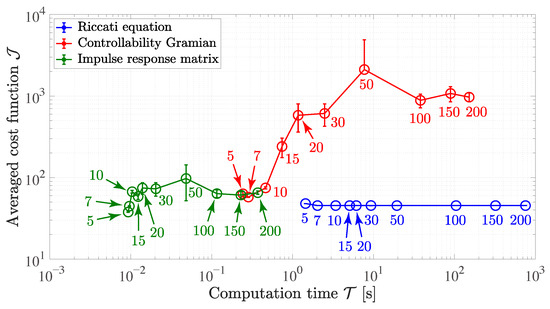
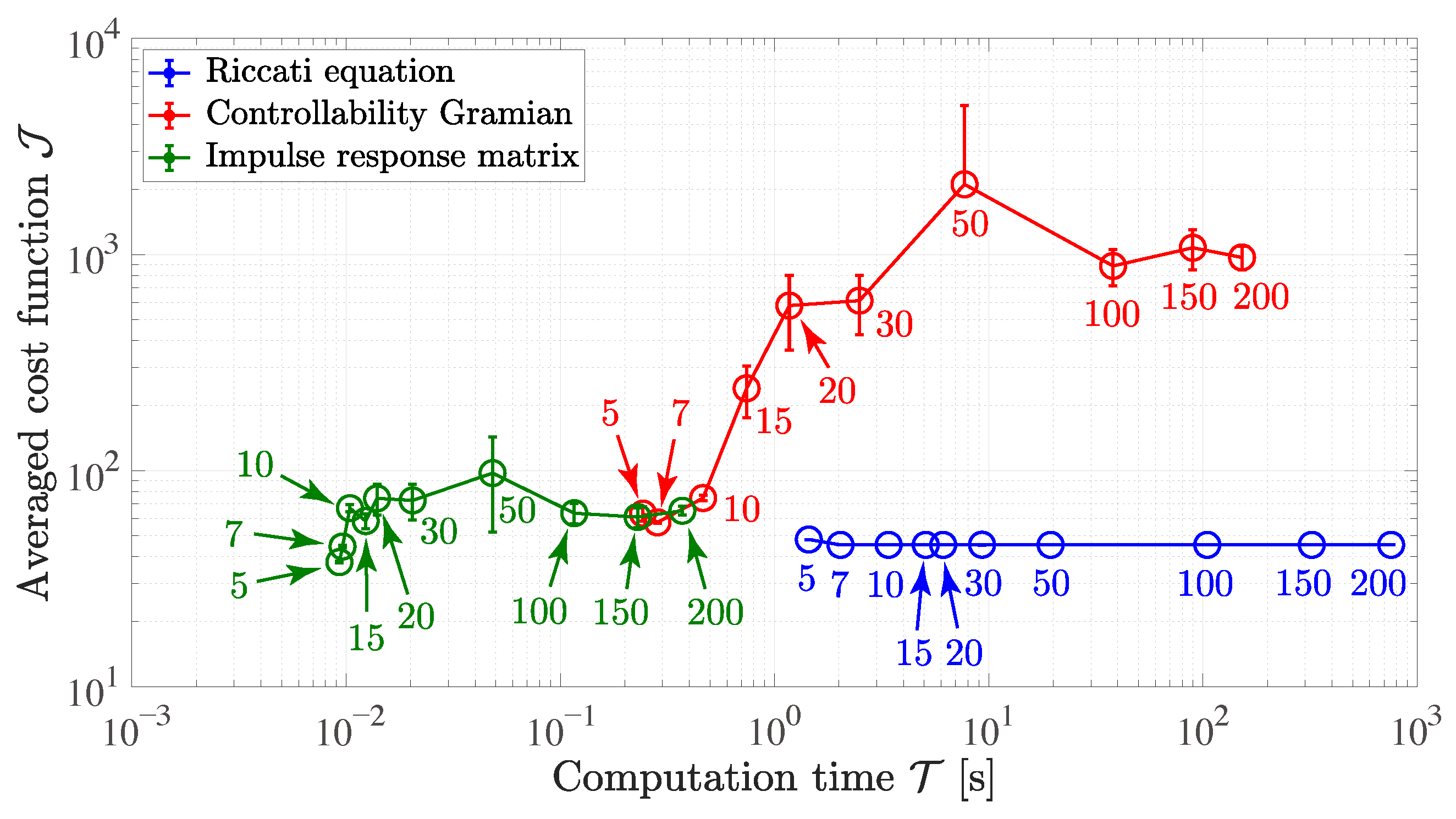
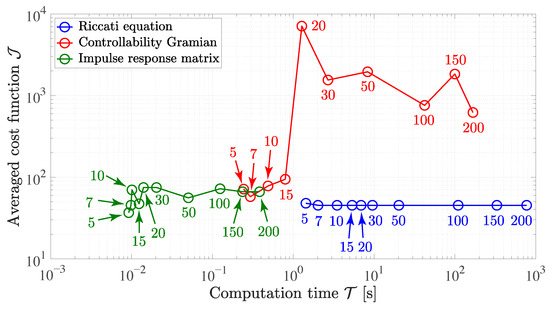
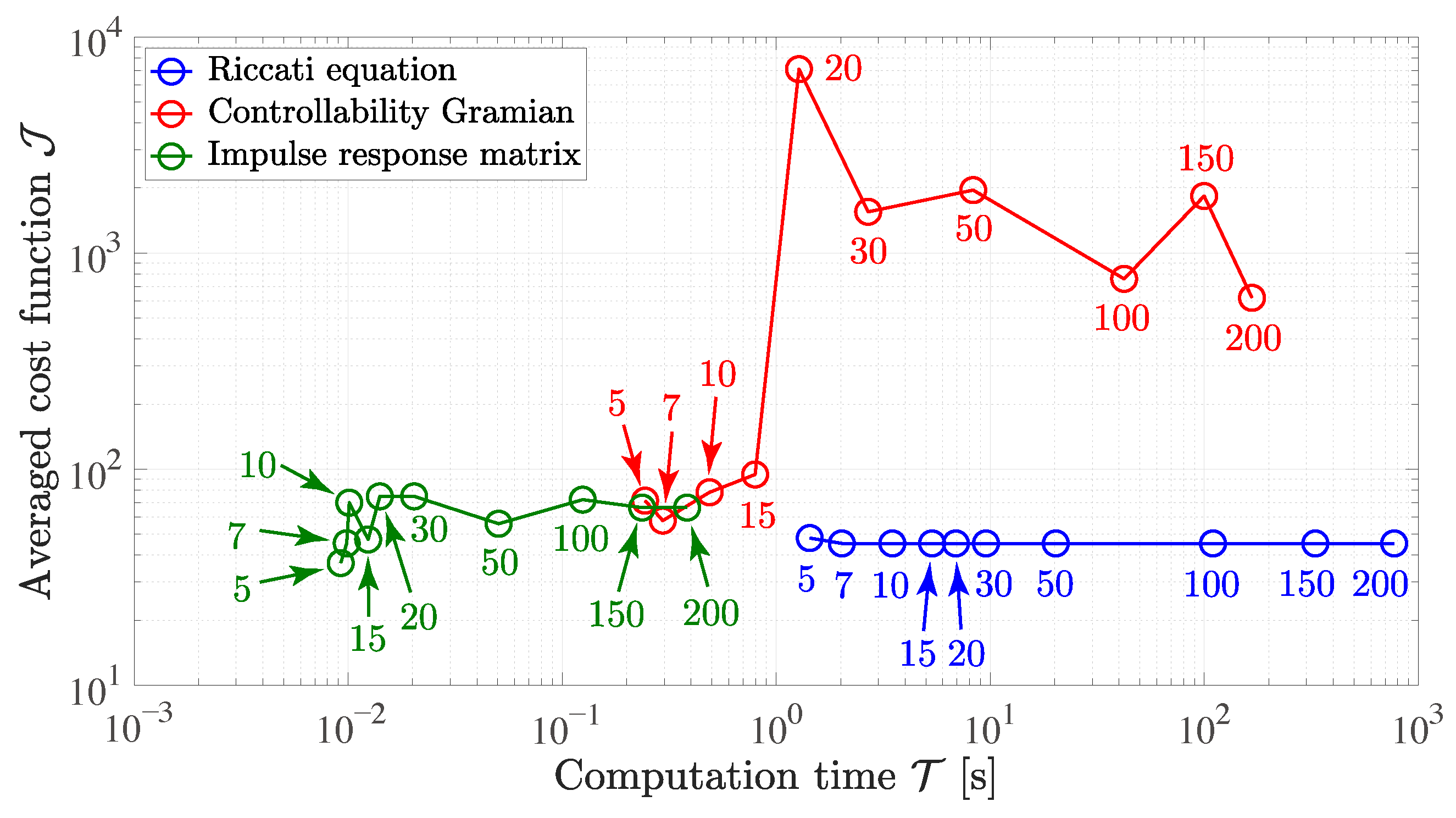
As is mentioned in Section 5.3, some actuator locations depend on the POD modes used for input–output projection. This implies that the performance of the LQR may also depend on the POD modes. Therefore, POD modes are computed 30 times in this subsection. Then, we reduce the order of the model, select actuators, and compute the averaged cost function for each set of POD modes. Finally, the mean value of the computation time for actuator selection and the averaged cost function is computed. Figure 6 illustrates the mean value of and for each reduced-order model. The number besides each plot denotes the dimension r of the model. The state at , when a random impulse input is applied to the full-order model at , is adopted as the initial condition . Here, the random impulse input is applied to each spatial point, and its magnitude is determined according to standard normal distribution. The number of the initial conditions is . The error bars indicate the 95% confidence interval of associated with the 30 sets of POD modes, where those that exceed the lower limit of the horizontal axis are omitted.
Figure 6.
Computation time for actuator selection and the resulting LQR performance when the order of the system is reduced using input–output projection.
Before taking a closer look at the results of each method, let us consider whether the LQR performance of the optimized actuators is higher than that of uniform and random configurations. The averaged cost function is when three actuators are placed almost uniformly at . Here, the discretized domain is divided into three equal sections and each actuator is placed almost in the middle of each section. Further, the mean value of for 1000 random placements of three actuators is , where the Riccati equation does not have a solution in 284 cases and such cases are excluded. The initial condition for the LQR control is the same as that for the optimized placement. Thus, Figure 6 indicates that the optimized actuators offer superior LQR performance to those placed uniformly or randomly.
Next, we focus on the results of the method based on the Riccati equation. It may not be theoretically guaranteed that the LQR performance of the full-order model is always improved by this method based on a reduced-order model. However, it is observed that the LQR performance is outstanding regardless of the dimension r of the model. This result may be obtained because all unstable modes are contained in the reduced-order model and the cost function for such a model is directly reduced by (suboptimally) minimizing . Note that only the stable modes are truncated when BPOD is applied to the system. We can also see that the performance hardly depends on the POD modes used for input–output projection. It is possible that the control performance of actuators placed based on the Riccati equation is robust to model uncertainty and measurement noise in practical control applications. On the other hand, the computation time is much longer than that of the other two methods. This is because it takes time to solve the Riccati equations multiple times. As is the case with the other two methods, the time grows as the dimension of the reduced-order model increases.
In contrast, when actuator locations are optimized based on the controllability Gramian, the LQR performance is high for , but suddenly decreases from as r increases, and becomes low for . This is because the reduced-order models with low dimensions tend to be controllable, while those with larger dimensions tend not to be, as we have discussed in Section 5.3. In addition, we can see that the LQR performance strongly depends on the POD modes, especially when the dimension of the model is large. Therefore, it is necessary to place actuators using a low-dimensional model when this method is used. Further, its computation time is shorter than that of the method based on the Riccati equation. However, it is much longer than that of the method based on the impulse response matrix, since the controllability Gramian needs to be computed multiple times in this method.
The performance of the LQR is basically high regardless of the dimension r of the reduced-order models when actuators are placed based on the impulse response matrix. This result may be obtained because the energy of output for an impulse input is enlarged in this method. In particular, it is observed that the LQR performance is outstanding for . This is because the reduced-order models with low dimensions reproduce only a few dominant modes of the original full-order model, and actuators are placed to control them efficiently. Although the performance of the LQR tends to depend on the POD modes when the dimensions of the model are large, the computation time of this method is much shorter than that of the other two methods, since the observability Gramian is computed only once in this method. For these reasons, the method based on the impulse response matrix seems to have more advantages than the other two methods in terms of optimizing the actuator locations of the system in Equation (18). Moreover, it seems to be beneficial to place actuators using a low-dimensional model by this method.
As we have seen in the above, the LQR performance of some actuators depends on the POD modes for input–output projection. Let us consider whether the above findings are unique or not to the obtained POD modes. Figure 7 depicts the computation time for actuator selection and the resulting LQR performance when input–output projection is not adopted in reducing the order of the system. The conditions are the same as in Figure 6 except that the cost function is not averaged, since actuator placement is unique for each model. The basic trends of the time for actuator selection and the LQR performance observed in Figure 6 are the same as those in Figure 7. Thus, it is likely that the above findings are not unique to the obtained POD modes.
Figure 7.
Computation time for actuator selection and the resulting LQR performance when the order of the system is reduced without using input–output projection.
Finally, we discuss the general applicability of the findings. The result that the computation time increases in the order of the method based on the impulse response matrix, the controllability Gramian, and the Riccati equation is highly likely to be a general fact, since the time basically increases in the order of obtaining the observability Gramian once, obtaining the controllability Gramian multiple times, and solving the Riccati equation multiple times. On the other hand, the results associated with the LQR performance may differ if we consider a system in which impulse or frequency response is different from that of the system in Equation (18). Thus, it is possible that the method based on the impulsive response matrix does not show advantages in other systems. The main point is that the LQR performance may differ depending on the actuator placement method. Therefore, it is necessary to choose an appropriate method for each system. Further investigation into other systems or controllers is left as future work.
6. Conclusions
This paper discusses actuator placement optimization for an unstable high-dimensional system based on a reduced-order model using BPOD with input–output projection. Actuator locations in the reduced-order model of a linearized Ginzburg–Landau model are optimized with three objective functions so that the system can be controlled efficiently with an LQR. Here, an actuator placement method based on a Riccati equation is introduced by focusing on the duality between sensor and actuator placement problems, and two other methods based on a controllability Gramian and an impulsive response matrix are modified for an unstable high-dimensional system by adopting BPOD with input–output projection and defining Gramians in the frequency domain. Then, the computation time for actuator selection and the resulting LQR performance are evaluated for each model. We have obtained the following results:
- Reduced-order models based on BPOD with input–output projection cannot accurately reproduce the response of the full-order model just after the impulse input, but their response becomes similar after a while. As for the frequency response, reduced-order models follow the full-order model relatively accurately in low-frequency regions, especially from the perspective of magnitude.
- The computation time for actuator selection grows in all three methods as the dimensions of the reduced-order model increase. On the other hand, the LQR performance varies differently in each method when the dimensions of the model are changed.
- The LQR performance is outstanding regardless of the dimensions of the model when actuators are placed based on the Riccati equation. In addition, it hardly depends on the POD modes used for input–output projection. However, the time for actuator selection is much longer than that of the other two methods.
- The LQR performance is high for low-dimensional models but is low for large-dimensional ones when actuators are placed based on the controllability Gramian. The computation time is much longer than that of the method based on the impulse response matrix, though it is shorter than that of the method based on the Riccati equation.
- The LQR performance is basically high regardless of the dimensions of the model when actuators are placed based on the impulse response matrix. In addition, the time for actuator selection is much shorter than that of the other two methods. Thus, the method based on the impulse response matrix seems to have more advantages than the other two methods in optimizing the actuator locations of the analyzed model. Moreover, it seems to be beneficial to place actuators with a low-dimensional model using this method.
Author Contributions
Conceptualization and methodology, M.W., K.H., and T.N. (Taku Nonomura); software, M.W. and K.H.; validation and investigation, M.W., K.H., Y.S., T.N. (Takayuki Nagata), and T.N. (Taku Nonomura); data curation, M.W. and K.H.; writing—original draft preparation, M.W. and K.H.; writing—review and editing, M.W., K.H., Y.S., T.N. (Takayuki Nagata), and T.N. (Taku Nonomura); supervision, T.N. (Taku Nonomura); funding acquisition, T.N. (Taku Nonomura) and M.W. All authors have read and agreed to the published version of the manuscript.
Funding
This research is partly funded by JST (Japan Science and Technology Agency) Moonshot Research and Development Program (JPMJMS2283), JST Fusion Oriented Research for Disruptive Science and Technology (JPMJFR202C), and JSPS (Japan Society for the Promotion of Science) Grant-in-Aid for Scientific Research (JP24K17200).
Institutional Review Board Statement
Not applicable.
Informed Consent Statement
Not applicable.
Data Availability Statement
All relevant data are included in this paper.
Conflicts of Interest
The authors declare no conflicts of interest.
Abbreviations
The following abbreviations are used in this manuscript:
| ADMM | Alternating direction method of multipliers |
| BPOD | Balanced proper orthogonal decomposition |
| DEIM | Discrete empirical interpolation method |
| DMD | Dynamic mode decomposition |
| LQR | Linear-quadratic regulator |
| POD | Proper orthogonal decomposition |
| SDP | Semidefinite programming |
| SINDy | Sparse identification of nonlinear dynamics |
References
- Zha, G.C.; Carroll, B.F.; Paxton, C.D.; Conley, C.A.; Wells, A. High-performance airfoil using coflow jet flow control. AIAA J. 2007, 45, 2087–2090. [Google Scholar] [CrossRef] [Scilit]
- Bénard, N.; Jolibois, J.; Moreau, E. Lift and drag performances of an axisymmetric airfoil controlled by plasma actuator. J. Electrost. 2009, 67, 133–139. [Google Scholar] [CrossRef] [Scilit]
- Feng, L.H.; Choi, K.S.; Wang, J.J. Flow control over an airfoil using virtual Gurney flaps. J. Fluid Mech. 2015, 767, 595–626. [Google Scholar] [CrossRef] [Scilit]
- Corke, T.C.; Enloe, C.L.; Wilkinson, S.P. Dielectric barrier discharge plasma actuators for flow control. Annu. Rev. Fluid Mech. 2010, 42, 505–529. [Google Scholar] [CrossRef] [Scilit]
- Gregory, J.; Tomac, M.N. A review of fluidic oscillator development and application for flow control. In Proceedings of the 43rd AIAA Fluid Dynamics Conference; American Institute of Aeronautics and Astronautics: Reston, VA, USA, 2013; p. 2474. [Google Scholar]
- Lumely, J.L. Stochastic Tools in Turbulence; Academic Press Inc.: Cambridge, MA, USA, 1970. [Google Scholar]
- Berkooz, G.; Holmes, P.; Lumley, J.L. The proper orthogonal decomposition in the analysis of turbulent flows. Annu. Rev. Fluid Mech. 1993, 25, 539–575. [Google Scholar] [CrossRef]
- Dickens, J.; Nakagawa, J.; Wittbrodt, M. A critique of mode acceleration and modal truncation augmentation methods for modal response analysis. Comput. Struct. 1997, 62, 985–998. [Google Scholar] [CrossRef] [Scilit]
- Liu, C.; Zhao, R.; Yu, K.; Lee, H.P.; Liao, B. A quasi-zero-stiffness device capable of vibration isolation and energy harvesting using piezoelectric buckled beams. Energy 2021, 233, 121146. [Google Scholar] [CrossRef] [Scilit]
- Zhao, R.; Yan, Y.; Yu, K.; Liu, Y. Nonlinear thermal vibration of variable stiffness composite laminated plates. Int. J. Mech. Sci. 2026, 318, 111527. [Google Scholar] [CrossRef] [Scilit]
- Schmid, P.J. Dynamic mode decomposition of numerical and experimental data. J. Fluid Mech. 2010, 656, 5–28. [Google Scholar] [CrossRef] [Scilit]
- Tu, J.H. Dynamic Mode Decomposition: Theory and Applications; Princeton University: Princeton, NJ, USA, 2013. [Google Scholar]
- Kutz, J.N.; Brunton, S.L.; Brunton, B.W.; Proctor, J.L. Dynamic Mode Decomposition: Data-Driven Modeling of Complex Systems; SIAM: Philadelphia, PA, USA, 2016; Volume 149. [Google Scholar]
- Iollo, A.; Lanteri, S.; Désidéri, J.A. Stability properties of POD–Galerkin approximations for the compressible Navier–Stokes equations. Theor. Comput. Fluid Dyn. 2000, 13, 377–396. [Google Scholar] [CrossRef] [Scilit]
- Rowley, C.W.; Colonius, T.; Murray, R.M. Model reduction for compressible flows using POD and Galerkin projection. Phys. D Nonlinear Phenom. 2004, 189, 115–129. [Google Scholar] [CrossRef] [Scilit]
- Holmes, P. Turbulence, Coherent Structures, Dynamical Systems and Symmetry; Cambridge University Press: Cambridge, UK, 2012. [Google Scholar]
- Chaturantabut, S.; Sorensen, D.C. Discrete empirical interpolation for nonlinear model reduction. In Proceedings of the 48th IEEE Conference on Decision and Control (CDC) Held Jointly with 2009 28th Chinese Control Conference; IEEE: Piscataway, NJ, USA, 2009; pp. 4316–4321. [Google Scholar]
- Chaturantabut, S.; Sorensen, D.C. Nonlinear model reduction via discrete empirical interpolation. SIAM J. Sci. Comput. 2010, 32, 2737–2764. [Google Scholar] [CrossRef] [Scilit]
- Peherstorfer, B.; Butnaru, D.; Willcox, K.; Bungartz, H.J. Localized discrete empirical interpolation method. SIAM J. Sci. Comput. 2014, 36, A168–A192. [Google Scholar] [CrossRef] [Scilit]
- Brunton, S.L.; Proctor, J.L.; Kutz, J.N. Discovering governing equations from data by sparse identification of nonlinear dynamical systems. Proc. Natl. Acad. Sci. USA 2016, 113, 3932–3937. [Google Scholar] [CrossRef] [Scilit]
- Kaiser, E.; Kutz, J.N.; Brunton, S.L. Sparse identification of nonlinear dynamics for model predictive control in the low-data limit. Proc. R. Soc. A Math. Phys. Eng. Sci. 2018, 474, 20180335. [Google Scholar] [CrossRef] [Scilit]
- Fukami, K.; Murata, T.; Zhang, K.; Fukagata, K. Sparse identification of nonlinear dynamics with low-dimensionalized flow representations. J. Fluid Mech. 2021, 926, A10. [Google Scholar] [CrossRef] [Scilit]
- Racca, A.; Doan, N.A.K.; Magri, L. Predicting turbulent dynamics with the convolutional autoencoder echo state network. J. Fluid Mech. 2023, 975, A2. [Google Scholar] [CrossRef] [Scilit]
- Jordanou, J.P.; Antonelo, E.A.; Camponogara, E.; Gildin, E. Investigation of proper orthogonal decomposition for echo state networks. Neurocomputing 2023, 548, 126395. [Google Scholar] [CrossRef] [Scilit]
- Moore, B. Principal component analysis in linear systems: Controllability, observability, and model reduction. IEEE Trans. Autom. Control 1981, 26, 17–32. [Google Scholar] [CrossRef] [Scilit]
- Willcox, K.; Peraire, J. Balanced model reduction via the proper orthogonal decomposition. AIAA J. 2002, 40, 2323–2330. [Google Scholar] [CrossRef] [Scilit]
- Rowley, C.W. Model reduction for fluids, using balanced proper orthogonal decomposition. Int. J. Bifurc. Chaos 2005, 15, 997–1013. [Google Scholar] [CrossRef] [Scilit]
- Ma, Z.; Ahuja, S.; Rowley, C.W. Reduced-order models for control of fluids using the eigensystem realization algorithm. Theor. Comput. Fluid Dyn. 2011, 25, 233–247. [Google Scholar] [CrossRef] [Scilit]
- Bui-Thanh, T.; Willcox, K. Model reduction for large-scale CFD applications using balanced proper orthogonal decomposition. In Proceedings of the 17th AIAA Computational Fluid Dynamics Conference; American Institute of Aeronautics and Astronautics: Reston, VA, USA, 2005; p. 4617. [Google Scholar]
- Ilak, M.; Rowley, C.W. Modeling of transitional channel flow using balanced proper orthogonal decomposition. Phys. Fluids 2008, 20, 034103. [Google Scholar] [CrossRef] [Scilit]
- Ilak, M.; Rowley, C. Feedback control of transitional channel flow using balanced proper orthogonal decomposition. In Proceedings of the 5th AIAA Theoretical Fluid Mechanics Conference; American Institute of Aeronautics and Astronautics: Reston, VA, USA, 2008; p. 4230. [Google Scholar]
- Herrmann, B.; Baddoo, P.J.; Dawson, S.T.; Semaan, R.; Brunton, S.L.; McKeon, B.J. Interpolatory input and output projections for flow control. J. Fluid Mech. 2023, 971, A27. [Google Scholar] [CrossRef] [Scilit]
- Lawler, E.L.; Wood, D.E. Branch-and-bound methods: A survey. Oper. Res. 1966, 14, 699–719. [Google Scholar] [CrossRef] [Scilit]
- Welch, W.J. Branch-and-bound search for experimental designs based on D optimality and other criteria. Technometrics 1982, 24, 41–48. [Google Scholar] [CrossRef] [Scilit]
- Joshi, S.; Boyd, S. Sensor selection via convex optimization. IEEE Trans. Signal Process. 2009, 57, 451–462. [Google Scholar] [CrossRef] [Scilit]
- Nonomura, T.; Ono, S.; Nakai, K.; Saito, Y. Randomized subspace Newton convex method applied to data-driven sensor selection problem. IEEE Signal Process. Lett. 2021, 28, 284–288. [Google Scholar] [CrossRef] [Scilit]
- Yang, C.; Wu, J.; Ren, X.; Yang, W.; Shi, H.; Shi, L. Deterministic sensor selection for centralized state estimation under limited communication resource. IEEE Trans. Signal Process. 2015, 63, 2336–2348. [Google Scholar] [CrossRef] [Scilit]
- Liu, S.; Chepuri, S.P.; Fardad, M.; Maşazade, E.; Leus, G.; Varshney, P.K. Sensor selection for estimation with correlated measurement noise. IEEE Trans. Signal Process. 2016, 64, 3509–3522. [Google Scholar] [CrossRef] [Scilit]
- Lin, F.; Fardad, M.; Jovanović, M.R. Design of optimal sparse feedback gains via the alternating direction method of multipliers. IEEE Trans. Autom. Control 2013, 58, 2426–2431. [Google Scholar] [CrossRef] [Scilit]
- Dhingra, N.K.; Jovanović, M.R.; Luo, Z.Q. An ADMM algorithm for optimal sensor and actuator selection. In Proceedings of the 53rd IEEE Conference on Decision and Control; IEEE: Piscataway, NJ, USA, 2014; pp. 4039–4044. [Google Scholar]
- Nagata, T.; Nonomura, T.; Nakai, K.; Yamada, K.; Saito, Y.; Ono, S. Data-driven sparse sensor selection based on A-optimal design of experiment with ADMM. IEEE Sens. J. 2021, 21, 15248–15257. [Google Scholar] [CrossRef] [Scilit]
- Manohar, K.; Brunton, B.W.; Kutz, J.N.; Brunton, S.L. Data-driven sparse sensor placement for reconstruction: Demonstrating the benefits of exploiting known patterns. IEEE Control Syst. Mag. 2018, 38, 63–86. [Google Scholar]
- Clark, E.; Askham, T.; Brunton, S.L.; Kutz, J.N. Greedy sensor placement with cost constraints. IEEE Sens. J. 2019, 19, 2642–2656. [Google Scholar] [CrossRef] [Scilit]
- Saito, Y.; Nonomura, T.; Yamada, K.; Nakai, K.; Nagata, T.; Asai, K.; Sasaki, Y.; Tsubakino, D. Determinant-based fast greedy sensor selection algorithm. IEEE Access 2021, 9, 68535–68551. [Google Scholar] [CrossRef] [Scilit]
- Nakai, K.; Yamada, K.; Nagata, T.; Saito, Y.; Nonomura, T. Effect of objective function on data-driven greedy sparse sensor optimization. IEEE Access 2021, 9, 46731–46743. [Google Scholar] [CrossRef] [Scilit]
- Yamada, K.; Saito, Y.; Nankai, K.; Nonomura, T.; Asai, K.; Tsubakino, D. Fast greedy optimization of sensor selection in measurement with correlated noise. Mech. Syst. Signal Process. 2021, 158, 107619. [Google Scholar] [CrossRef] [Scilit]
- Manohar, K.; Kutz, J.N.; Brunton, S.L. Optimal sensor and actuator selection using balanced model reduction. IEEE Trans. Autom. Control 2022, 67, 2108–2115. [Google Scholar] [CrossRef] [Scilit]
- Takahashi, S.; Sasaki, Y.; Nagata, T.; Yamada, K.; Nakai, K.; Saito, Y.; Nonomura, T. Sensor selection by greedy method for linear dynamical systems: Comparative study on Fisher-information-matrix, observability-Gramian and Kalman-Filter-Based indices. IEEE Access 2023, 11, 67850–67864. [Google Scholar] [CrossRef] [Scilit]
- Sasaki, Y.; Yamada, K.; Nagata, T.; Saito, Y.; Nonomura, T. Fast data-driven greedy sensor selection for ridge regression. IEEE Sens. J. 2025, 25, 10030–10045. [Google Scholar] [CrossRef] [Scilit]
- Yamada, K.; Sasaki, Y.; Nagata, T.; Nakai, K.; Tsubakino, D.; Nonomura, T. Efficient sensor node selection for observability Gramian optimization. Sensors 2023, 23, 5961. [Google Scholar] [CrossRef] [Scilit] [PubMed]
- Nagata, T.; Sasaki, Y.; Yamada, K.; Watanabe, M.; Tsubakino, D.; Nonomura, T. Assessment of sensor optimization methods toward state estimation in a high-dimensional system using Kalman filter. IEEE Sens. J. 2024, 24, 18012–18023. [Google Scholar] [CrossRef] [Scilit]
- Chen, K.K.; Rowley, C.W. H2 optimal actuator and sensor placement in the linearised complex Ginzburg-Landau system. J. Fluid Mech. 2011, 681, 241–260. [Google Scholar] [CrossRef] [Scilit]
- Polyak, B.; Khlebnikov, M.; Shcherbakov, P. An LMI approach to structured sparse feedback design in linear control systems. In Proceedings of the 2013 European Control Conference (ECC); IEEE: Piscataway, NJ, USA, 2013; pp. 833–838. [Google Scholar]
- Morris, K.; Demetriou, M.A.; Yang, S.D. Using -control performance metrics for the optimal actuator location of distributed parameter systems. IEEE Trans. Autom. Control 2014, 60, 450–462. [Google Scholar]
- Hale, J.; Daraji, A. Optimal placement of sensors and actuators for active vibration reduction of a flexible structure using a genetic algorithm based on modified H∞. In Proceedings of the Journal of Physics: Conference Series; IOP Publishing: Philadelphia, PA, USA, 2012; Volume 382, p. 012036. [Google Scholar]
- Nestorović, T.; Trajkov, M. Optimal actuator and sensor placement based on balanced reduced models. Mech. Syst. Signal Process. 2013, 36, 271–289. [Google Scholar] [CrossRef] [Scilit]
- Münz, U.; Pfister, M.; Wolfrum, P. Sensor and actuator placement for linear systems based on H2 and H∞ optimization. IEEE Trans. Autom. Control 2014, 59, 2984–2989. [Google Scholar]
- Park, D.; Ladd, D.; Hendricks, E. Feedback control of von Kármán vortex shedding behind a circular cylinder at low Reynolds numbers. Phys. Fluids 1994, 6, 2390–2405. [Google Scholar] [CrossRef] [Scilit]
- Natarajan, M.; Freund, J.B.; Bodony, D.J. Actuator selection and placement for localized feedback flow control. J. Fluid Mech. 2016, 809, 775–792. [Google Scholar] [CrossRef] [Scilit]
- Watanabe, M.; Sasaki, Y.; Nagata, T.; Yamada, K.; Tsubakino, D.; Ito, J.; Nonomura, T. Actuator placement optimization in a linear impulsive control system by determinant-based greedy algorithm. IEEE Access 2025, 13, 207581–207595. [Google Scholar] [CrossRef] [Scilit]
- Summers, T.H.; Cortesi, F.L.; Lygeros, J. On submodularity and controllability in complex dynamical networks. IEEE Trans. Control Netw. Syst. 2016, 3, 91–101. [Google Scholar]
- Bhattacharjee, D.; Klose, B.; Jacobs, G.B.; Hemati, M.S. Data-driven selection of actuators for optimal control of airfoil separation. Theor. Comput. Fluid Dyn. 2020, 34, 557–575. [Google Scholar] [CrossRef] [Scilit]
- Bhattacharjee, D.; Hemati, M.; Klose, B.; Jacobs, G. Optimal actuator selection for airfoil separation control. In Proceedings of the 2018 Flow Control Conference; American Institute of Aeronautics and Astronautics: Reston, VA, USA, 2018; p. 3692. [Google Scholar]
- Mattingly, M.; Roemer, R.; Devasia, S. Optimal actuator placement for large scale systems: A reduced-order modelling approach. Int. J. Hyperth. 1998, 14, 331–345. [Google Scholar] [CrossRef] [Scilit] [PubMed]
- Mattingly, M.; Bailey, E.A.; Dutton, A.W.; Roemer, R.B.; Devasia, S. Reduced-order modeling for hyperthermia: An extended balanced-realization-based approach. IEEE Trans. Biomed. Eng. 1998, 45, 1154–1162. [Google Scholar] [CrossRef] [Scilit] [PubMed]
- Ahuja, S.; Rowley, C.W. Feedback control of unstable steady states of flow past a flat plate using reduced-order estimators. J. Fluid Mech. 2010, 645, 447–478. [Google Scholar] [CrossRef] [Scilit]
- Tzoumas, V.; Jadbabaie, A.; Pappas, G.J. Sensor placement for optimal Kalman filtering: Fundamental limits, submodularity, and algorithms. In Proceedings of the 2016 American Control Conference (ACC); IEEE: Piscataway, NJ, USA, 2016; pp. 191–196. [Google Scholar]
- Fiedler, B. Handbook of Dynamical Systems; Gulf Professional Publishing: Waltham, MA, USA, 2002; Volume 2. [Google Scholar]
- Ginzburg, V.L.; Landau, L.D. On the theory of superconductivity. In On Superconductivity and Superfluidity: A Scientific Autobiography; Springer: Berlin/Heidelberg, Germany, 2009; pp. 113–137. [Google Scholar]
- Bagheri, S.; Henningson, D.S.; Hœpffner, J.; Schmid, P.J. Input-output analysis and control design applied to a linear model of spatially developing flows. Appl. Mech. Rev. 2009, 62, 020803. [Google Scholar] [CrossRef] [Scilit]
- Weideman, J.A.; Reddy, S.C. A MATLAB differentiation matrix suite. ACM Trans. Math. Softw. (TOMS) 2000, 26, 465–519. [Google Scholar] [CrossRef] [Scilit]

Disclaimer/Publisher’s Note: The statements, opinions and data contained in all publications are solely those of the individual author(s) and contributor(s) and not of MDPI and/or the editor(s). MDPI and/or the editor(s) disclaim responsibility for any injury to people or property resulting from any ideas, methods, instructions or products referred to in the content. |
© 2026 by the authors. Licensee MDPI, Basel, Switzerland. This article is an open access article distributed under the terms and conditions of the Creative Commons Attribution (CC BY) license.