
Article

Synergistic Guaranteed Cost and Integral Sliding Mode Fault-Tolerant Control for Steer-by-Wire Systems Subject to Multiple Uncertainties

by
Jinwen Yang
1,
Yiming Hu
1,2,*,
Dequan Zeng
1,
Lingang Yang
1 and
Giuseppe Carbone
1,3
1
School of Mechatronics and Vehicle Engineering, East China Jiaotong University, Nanchang 330013, China
2
Nanchang Automotive Institute of Intelligence & New Energy, Nanchang 330200, China
3
Department of Mechanical, Energy, and Management Engineering, University of Calabria, I-87036 Rende, Italy
*
Author to whom correspondence should be addressed.
Actuators 2026, 15(4), 199; https://doi.org/10.3390/act15040199
Submission received: 4 March 2026 / Revised: 29 March 2026 / Accepted: 31 March 2026 / Published: 2 April 2026
(This article belongs to the Section Control Systems)

Abstract

The actuator reliability of Steer-by-Wire (SBW) systems is critical to the functional safety of autonomous vehicles. However, existing control methods struggle to simultaneously enhance both response speed and fault-tolerant performance when facing multiple uncertainties such as parameter perturbations, external disturbances, and actuator faults. To address these issues, this paper proposes a synergistic fault-tolerant control (FTC) strategy combining guaranteed cost control (GCC) and integral sliding mode control (ISMC). First, a dynamic model of the SBW system incorporating the multiple uncertainties is established. Second, a GCC law is derived based on linear matrix inequalities (LMIs) to impose strict constraints on the system’s tracking accuracy and robustness. Building upon this, an ISMC is integrated to significantly accelerate the system’s dynamic response without sacrificing steady-state accuracy, thereby forming a synergistic fault-tolerant architecture characterized by both high precision and rapid response. The results indicate that, under typical fault modes and steering conditions, the response speed of GCC+ISMC is significantly improved compared with GCC alone, and the GCC+ISMC reduces tracking errors by approximately 35% compared to adaptive integral sliding mode control (AISMC). These findings demonstrate that the proposed approach effectively mitigates multiple system uncertainties, offering comprehensive advantages in tracking accuracy, response speed, and robustness.

1. Introduction

With the rapid advancement of automotive intelligence, traditional steering mechanisms are accelerating their evolution towards electrification and integration. As a core node of future chassis domain control, the SBW system not only breaks the physical constraints of mechanical linkages—thereby significantly enhancing vehicle layout freedom and handling response—but also serves as a critical enabler for the implementation of high-level autonomous driving. However, constrained by the intrinsic physical attributes of electronic components, the sensors, controllers, and actuators in SBW systems are highly susceptible to electromagnetic interference, thermal aging, and sudden load transients. Consequently, it is difficult to completely avoid the risks of performance drift or even system failure. In complex and dynamic driving environments, any minor anomaly in electronic components can be amplified, directly degrading the transient response and steady-state accuracy of the steering system, and in severe cases, jeopardizing vehicle safety. Therefore, researching and developing effective FTC strategies is of paramount importance for improving the functional safety and operational reliability of SBW systems.
Currently, mainstream FTC technologies can be broadly categorized into two types: Fault Detection and Isolation (FDI)-based strategies [1] and Fault Compensation (FC)-based strategies [2]. FDI-based strategies focus on accurately identifying and isolating the fault source to prevent fault propagation [3]. However, this technique relies heavily on the accuracy and real-time performance of fault diagnosis, and any delay or error in the diagnostic process will compromise fault-tolerance precision and control efficacy. In contrast, FC-based strategies maintain system functionality without interrupting operation by dynamically reallocating resources to compensate for faults in real time. Common compensation control methods, such as sliding mode control (SMC) [4], Model Predictive Control (MPC) [5], and Reinforcement Learning (RL) [6], have found certain applications across various industrial scenarios. Nevertheless, considering the highly complex operating conditions of vehicles, the strong uncertainty of external environments, and the inevitable parameter perturbations and partial failures after long-term service, the design of SBW controllers must rigorously account for both system robustness and stability.
To achieve robust and stable control under uncertainties and partial failures, various control strategies have emerged in recent years. For example, advanced sliding mode control techniques such as delay-resilient super-twisting strategies [7] and event-triggered integral sliding mode approaches [8] have been developed for uncertain dynamic systems, while fault-tolerant h-infinity stabilization methods with adaptive event-triggered mechanisms [9] have been proposed for networked control systems subject to actuator faults. Among the various fault-tolerant and robust control strategies, Prescribed Performance Control (PPC) and GCC are particularly prominent. PPC strategies constrain tracking errors within predefined boundaries by constructing time-varying performance bounds, thereby ensuring the system meets specific transient and steady-state requirements [10]. For instance, Zhou S. [11] and Zhao X. [12,13] applied PPC to address actuator faults, sensor faults, and external disturbances in steering systems, Lu L. [14] utilized PPC for actuator faults in multi-agent systems, and Wang H. [15] and Wang Z. [16] designed PPC for actuator faults in strict-feedback systems. While PPC can improve control accuracy and stability under fault conditions, the parameter selection for its performance functions often relies heavily on empirical tuning. Furthermore, PPC can be overly conservative or insufficient when handling the impact of severe uncertainties on performance boundaries, making it difficult to achieve desired outcomes in systems subject to multiple uncertainties.
In comparison, the GCC strategy exhibits distinct advantages when dealing with systems subject to multiple uncertainties. Its fundamental principle relies on constructing a control law via Lyapunov and LMIs within the allowable range of uncertain disturbances, ensuring that the closed-loop system is not only stable but also provides a provable upper bound for a specified performance index [17]. Since its inception, this method has garnered continuous attention for its ability to balance stability and measurable performance in uncertain systems [18,19,20,21], with successful extensions into applications such as spacecraft attitude control [22,23,24], multi-agent systems [25], and networked control systems [26]. In the field of vehicle control, GCC has been applied to path tracking [27] and handling stability control [28]. For example, Zhang Z. [29] proposed an intelligent vehicle trajectory tracking control strategy based on robust GCC for unreliable vehicular transmission environments, successfully attenuating the adverse effects of external disturbances and unmodeled errors. Liang Y. [30] addressed the path tracking problem of autonomous vehicles by performing multi-objective optimization on performance indices using robust GCC and Particle Swarm Optimization (PSO), yielding superior controller performance under different priority objectives. Regarding SBW fault-tolerant control, Zhou J. [31] designed a hierarchical GCC for motor open-circuit faults, enhancing torque output capability while reducing copper losses; Liu W. [32] proposed a GCC and adaptive FTC for actuator faults, maintaining certain tracking performance even when severe faults exceed the GCC limits. However, the latter study neglected the effects of parameter perturbations and external disturbances, and suffered from a relatively slow response speed.
In summary, research on GCC in the SBW domain remains relatively limited. On one hand, some existing works insufficiently consider multi-source uncertainties such as parameter perturbations and external disturbances. On the other hand, to obtain high steady-state accuracy, the controller design often introduces considerable conservatism, which can lead to sluggish steering responses. It must be emphasized that in critical scenarios such as emergency obstacle avoidance and high-speed lane changing, the dynamic response speed of the steering system is equally as crucial as steady-state accuracy, as it directly impacts the rapid execution of driving intentions and the vehicle’s maneuverability in unexpected situations. Therefore, enhancing the response speed while ensuring ultra-high steady-state accuracy of the SBW system, along with fully accounting for multiple uncertainties in actual operations, remains an urgent and challenging issue in current research.
Motivated by the above discussions, targeting the multiple uncertainties in SBW systems including parameter perturbations, external disturbances, and actuator faults, this paper establishes a comprehensive system dynamic model. Building upon this, a synergistic fault-tolerant strategy integrating GCC and ISMC is proposed. By defining a quadratic performance index and solving LMIs, the performance upper bound and the GCC law are obtained, thereby achieving strict constraints on tracking accuracy and robustness. To further enhance the system’s dynamic response capability to command signals, an ISMC mechanism is introduced, significantly reducing the time to reach the desired state while maintaining excellent steady-state performance. Simulation validations under typical vehicle steering conditions, including step, sinusoidal, and double lane change maneuvers, show that the proposed method outperforms existing schemes across various fault scenarios. The main contributions of this paper are summarized as follows:
(1)
An application-oriented GCC–ISMC fault-tolerant control framework is developed for SBW systems subject to parameter perturbations, external disturbances, and actuator faults, where the contribution lies in the integrated design for this practical engineering scenario.
(2)
A coordinated mechanism between GCC and ISMC is established, in which GCC provides performance guarantees and robustness constraints, while ISMC enhances transient response and accelerates convergence to the desired state.
The remainder of this paper is organized as follows: Section 2 presents the dynamic modeling of the SBW system. Section 3 details the design of the controller. Section 4 provides the example illustration. Section 5 concludes the paper.

2. Dynamic Modeling of the SBW System

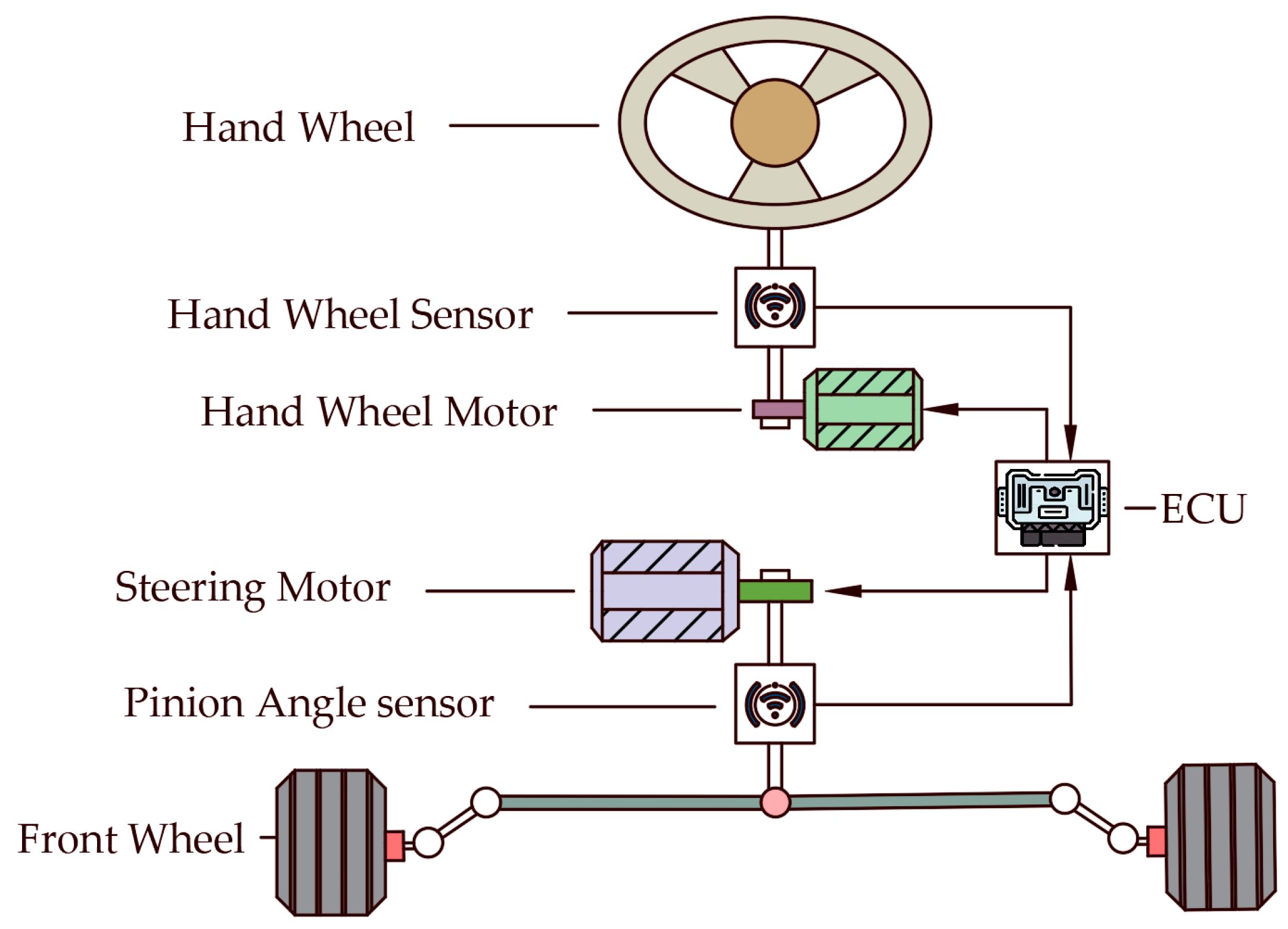
The structure of the SBW system is shown in Figure 1.
A three-phase surface-mounted permanent magnet synchronous motor (SPMSM) serves as the steering actuator. Its dynamic equation is expressed as
J m θ ¨ m + B m θ ˙ m + τ mf = τ m
where θm is the steering motor angle, Jm is the steering motor moment of inertia, Bm is the steering motor viscous damping, τmf is the torque applied to the motor steering shaft from the front wheels via the rack-and-pinion steering gear, and τm is the steering motor electromagnetic torque. Considering the torque ripple disturbance during actual motor operation, we have
τ m = τ mr + τ md
where τmr is the ideal electromagnetic torque of the steering motor, and τmd is the torque ripple disturbance of the steering motor.
The dynamic equation of the front steering wheel is expressed as
J f δ ¨ f + B f δ ˙ f + τ f + τ e = τ fm
where δf is the front wheel steering angle, Jf is the moment of inertia of the front wheel, Bf is the viscous damping of the front wheel, τf is the front wheel rotational resistance torque, τe is the self-aligning torque, and τfm is the torque applied to the front wheel by the steering motor through the rack-and-pinion steering gear.
Assuming no transmission backlash between the rack and pinion, the relationship between the front wheel angle and the steering motor angle is as follows:
δ f θ m = 1 r = τ mf τ fm
where r is the transmission ratio between the steering motor and the front steering wheel. Differentiating Equation (4) yields the following relationship:
δ f θ m = δ ˙ f θ ˙ m = δ ¨ f θ ¨ m = 1 r = τ mf τ fm
Based on Equations (1)–(5), the equivalent model of the steering actuator assembly of the SBW system is obtained as
J eq δ ¨ f + B eq δ ˙ f r τ md + τ f + τ e = τ eq J eq = J f + r 2 J m B eq = B f + r 2 B m τ eq = r τ mr
where Jeq is the equivalent moment of inertia, Beq is the equivalent viscous damping, and τeq is the equivalent torque.
Considering the sixth and twelfth harmonic components in the magnetic flux and the current bias at the electronic terminals, the torque disturbance of the motor can be expressed as [33]
τ md = τ md 6 cos ( 6 θ e ) + τ md 12 cos ( 12 θ e ) + 3 2 p n ψ f 0 i dis
where τmd6 and τmd12 are the sixth and twelfth harmonic torques, respectively; θe is the motor electrical angle; Pn is the number of pole pairs; ψf0 is the DC average amplitude of the d-axis flux linkage; and idis is the current bias, which can be expressed as
i dis = 2 3 sin ( θ e + 2 3 π ) ( Δ i a 2 ) + Δ i a Δ i b + ( Δ i b 2 )
where Δia and Δib are the current biases of phase a and phase b, respectively.
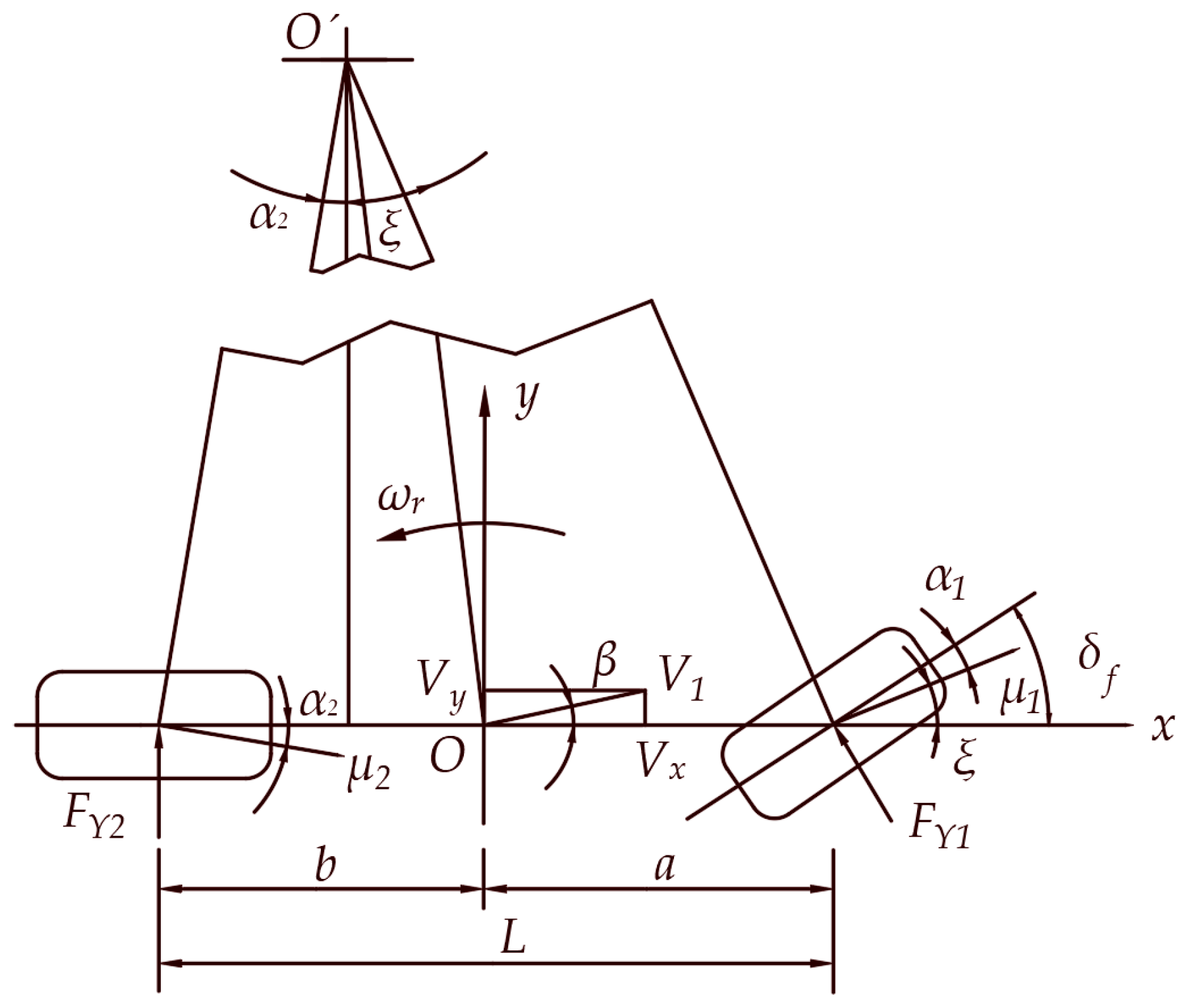
The vehicle is simplified into a two-degree-of-freedom (2-DOF) model, as shown in Figure 2. The vehicle’s center of mass (CG) is taken as the origin of the vehicle coordinate system, where Ox and Oy are the longitudinal and lateral axes, respectively, and the components of the CG velocity V1 along the Ox and Oy axes are Vx and Vy, respectively [34].
Assuming the vehicle’s longitudinal speed remains constant; neglecting its vertical, pitch, and roll motions; and assuming identical slip angles for the left and right wheels, when the side-slip angle is small, the lateral tire forces FY1 and FY2 acting on the front and rear wheels from the ground can be expressed as
F Y 1 = k 1 α 1 F Y 2 = k 2 α 2
where k1 and k2 are the cornering stiffness of the front and rear wheels, respectively, and α1 and α2 are the side-slip angles of the front and rear wheels, respectively, which are expressed as follows:
α 1 = β + a ω r V x δ f α 2 = β b ω r V x
where β is the sideslip angle of the center of mass, ωr is the yaw rate, and a and b are the distances from the center of mass to the front and rear axles, respectively.
Based on Equations (9) and (10), combined with the equilibrium equations and kinematic relationships, the following vehicle dynamic equations are obtained:
k 1 ( β + a ω r V x δ f ) k 2 ( β b ω r V x ) = m ( V ˙ y + V x ω r ) a k 1 ( β + a ω r V x δ f ) + b k 2 ( β b ω r V x ) = I Z ω ˙ r
where m is the vehicle mass and IZ is the moment of inertia of the vehicle about the z-axis.
When the tire experiences cornering, it generates a self-aligning torque about the z-axis:
τ e = l F Y 1
where l is the tire pneumatic trail.
Substituting Equations (9) and (10) into (12) yields
τ e = l k 1 ( β + ω r a V x δ f )
The front wheel rotational resistance torque can be expressed as
τ f = τ fs sign ( δ ˙ f )
where τfs is the resistance torque coefficient and sign() is the switching function.
Substituting Equations (7), (13) and (14) into Equation (6), and combining with Equation (11), the system dynamic equation is arranged as follows:
δ ¨ f = r J eq u B eq J eq δ ˙ f + l k 1 J eq β + l k 1 a J eq V x ω r l k 1 J eq δ f + 1 J eq r τ md τ f β ˙ = k 1 + k 2 m V x β + b k 2 a k 1 m V x 2 1 ω r + k 1 m V x δ f ω ˙ r = b k 2 a k 1 I z β + ( a 2 k 1 + b 2 k 2 ) I z V x ω r + a k 1 I z δ f
where u = τmr is the control input.
The tracking error of the front wheel steering angle is defined as
e = δ fr δ f
The state vector is constructed as
x ( t ) = 0 t e ( t )   d t δ f ( t ) δ ˙ f ( t ) β ω r T
Combined with Equation (15), the state-space equation of the system is obtained as
x ˙ ( t ) = A 0 x ( t ) + B 0 u ( t ) + C 0
where A 0 = 0 1 0 0 0 0 0 1 0 0 0 k 1 l J eq B eq J eq k 1 l J eq a k 1 l J eq V x 0 k 1 m V x 0 k 1 + k 2 m V x b k 2 a k 1 m V x 2 1 0 a k 1 I 0 b k 2 a k 1 I a 2 k 1 + b 2 k 2 I V x , B 0 = 0 0 r J eq 0 0 T , C 0 = δ fr 0 1 J eq ( r τ md τ f ) 0 0 T .
The main parameters of the above SBW system model are shown in Table 1.

3. Design of the Controller

3.1. GCC

The state equation of the system with linear uncertainties can be expressed in the following form [35]:
x ˙ ( t ) = ( A + Δ A ) x ( t ) + ( B + Δ B ) u g ( t ) + ω , x ( 0 ) = x 0
where ΔA and ΔB represent the uncertainties of the system state matrix and the control input matrix, respectively; ug is the guaranteed performance control input; and ω denotes the system disturbance, including the nonlinear torque ripple disturbance of the steering motor and the front wheel rotational resistance torque.
ΔA, ΔB and ω are norm-bounded and have the following form:
Δ A Δ B = D F ( t ) E 1 E 2
where D, E1 and E2 are known constant matrices of appropriate dimensions, which reflect the structural information of the uncertainties. F(t) ∈ Ri×j is an unknown matrix, which can be time-varying and satisfies:
F T ( t ) F ( t ) I
In an actual SBW system, the nominal model parameters are subject to time-varying perturbations due to various physical factors. Since a linear model cannot fully capture the nonlinear friction components within the reducer, and the viscosity of the lubricating oil is significantly affected by temperature variations, the equivalent viscous damping exhibits considerable uncertainty. Additionally, the tire cornering stiffness is highly sensitive to environmental conditions, including tire inflation pressure fluctuations, progressive tread wear, and temperature, all leading to significant variations. These parameter uncertainties have a substantial impact on system performance. Considering the uncertainty perturbations of the equivalent viscous damping and tire cornering stiffness, as well as the torque fault of the actuator motor, assume that the uncertainty component of the equivalent viscous damping is ΔBeq, the uncertainty component of the front wheel cornering stiffness is Δk1, the uncertainty component of the rear wheel cornering stiffness is Δk2, and the torque fault factor is ρ defined in the range ρ ∈ (0, 1). Then, Jeq0, Beq0 and ug can be expressed as
B eq = B eq 0 + Δ B eq k 1 = k 10 + Δ k 1 k 2 = k 20 + Δ k 2 u g = ( 1 ρ ) u c
where Beq0 is the ideal viscous damping, k10 is the ideal front wheel cornering stiffness, k20 is the ideal rear wheel cornering stiffness, and uc is the ideal input torque.
Substituting Equation (22) into (18), the matrices in Equations (19) and (20) can be obtained as follows:
A = 0 1 0 0 0 0 0 1 0 0 0 k 10 l J eq B eq 0 J eq k 10 l J eq a k 10 l J eq V x 0 k 10 m V x 0 k 10 + k 20 m V x b k 20 a k 10 m V x 2 1 0 a k 10 I 0 b k 20 a k 10 I a 2 k 10 + b 2 k 20 I V x ,   B = 0 0 r J eq 0 0 T ,
E 1 = 0 Δ k 1 l J eq Δ B e q J eq Δ k 1 l J eq a Δ k 1 l J eq V x 0 Δ k 1 m V x 0 Δ k 1 + Δ k 2 m V x b Δ k 2 a Δ k 1 m V x 2 0 a Δ k 1 I 0 b Δ k 2 a Δ k 1 I a 2 Δ k 1 + b 2 Δ k 2 I V x ,   E 2 = r ρ J eq 0 0 T ,
ω = δ fr 0 1 J eq ( r τ md τ f ) 0 0 T .
For system (19), the quadratic performance index is defined as
J = 0 x T ( t ) Q x ( t ) + u g T ( t ) R u g ( t )   d t
where Q and R are given symmetric positive definite weighting matrices.
Lemma 1 [35].
For any matrices Z and Y with appropriate dimensions, and for any positive scalar τ, the following inequality holds:
Z T Y + Y T Z τ Z T Z + 1 τ Y T Y
Theorem 1.
For the uncertain system (19) and the performance index (23), if there exists a matrix K and symmetric positive definite matrices P, along with positive scalars εg, ϑg, τg and γg, such that for all admissible uncertainties, the following holds:
Q + K T R K + P A + B K + A + B K T P + τ g P 2 + ε g τ g I + ϑ g P D D T P + 1 ϑ g E 1 + E 2 K T E 1 + E 2 K < 0
γ g γ g x 0 T P γ x 0 > 0
then ug(t) = Kx(t) is an optimal GCC law for system (19), and the corresponding upper bound of the system performance index is J ≤ 1/γg.
Stability Proof: Based on the optimal guaranteed performance control law and combining Equations (19) and (20), the corresponding closed-loop system is obtained as
x ˙ ( t ) = [ A + B K + D F ( E 1 + E 2 K ) ] x ( t ) + ω
The Lyapunov function is chosen as V(t) = xTPx. The positive definiteness of the matrix P implies that the Lyapunov function V(t) > 0 is positive definite. Differentiating V(t) yields
V ˙ ( t ) = x T P [ A + B K + D F ( E 1 + E 2 K ) ] + [ A + B K + D F ( E 1 + E 2 K ) ] T P x + x T P ω + ω T P x
According to Lemma 1, it follows that
V ˙ ( t ) x T P ( A + B K ) + ( A + B K ) T P + τ g P 2 + ϑ g P D D T P + 1 ϑ g ( E 1 + E 2 K ) T ( E 1 + E 2 K ) x + 1 τ g ω T ω
Assuming that the system disturbance ω satisfies ωTω < εgxTx and ε > 0, it can be obtained that
V ˙ ( t ) < x T P ( A + B K ) + ( A + B K ) T P + τ g P 2 + ε g τ g I + ϑ g P D D T P + 1 ϑ g ( E 1 + E 2 K ) T ( E 1 + E 2 K ) x
From Equations (25) and (30), it can be obtained that for all admissible uncertainties,
V ˙ ( t ) < x T ( Q + K T R K ) x < 0
According to the Lyapunov stability theory, the closed-loop system shown in Equation (27) is robustly asymptotically stable.
Integrating Equation (31) and utilizing the asymptotic stability of the system, it can be obtained that
J = 0 x T ( t ) Q x ( t ) + u g T ( t ) R u g ( t )   d t V ( 0 ) = x 0 T P x 0
Letting V(0) < 1/γg yields
V ( 0 ) = x 0 T P x 0 < 1 γ g
From Equations (30), (31) and (33), we can obtain Equations (25) and (26), thus proving Theorem 1.
Lemma 2 [35].
Schur Complement Property:
For a given symmetric matrix  S = S 11 S 12 S 21 S 22 , where S11 is a square matrix, the following three conditions are equivalent:
S < 0 S 11 < 0 , S 22 S 12 T S 11 1 S 12 < 0 S 22 < 0 , S 11 S 12 S 22 1 S 12 T < 0
According to the Lemma 2, Equations (25) and (26) transform into
P A + B K + A + B K T P + τ g P 2 + ϑ g P D D T P ( E 1 + E 2 K ) T I K T I E 1 + E 2 K ϑ g I 0 0 0 I 0 Q 1 0 0 K 0 0 R 1 0 I 0 0 0 τ g ε g I < 0
γ g γ g x 0 T γ g x 0 P 1 > 0
Pre-multiplying and post-multiplying inequality (35) by the matrix diag{P−1, I, I, I}, and letting X = P−1 and W = KP−1, we obtain
A X + B W + ( A X + B W ) T + τ g I + ϑ g D D T ( E 1 X + E 2 W ) T X W T X E 1 X + E 2 W ϑ g I 0 0 0 X 0 Q 1 0 0 W 0 0 R 1 0 X 0 0 0 τ g ε g I < 0
γ g γ g x 0 T γ g x 0 X > 0
Given the system matrices A, B, D, F, E1 and E2, the control matrices Q and R, and the torque peak value umax, with εg, ϑg, τg and γg set to be greater than zero, the matrices X and K are solved such that the index 1/γg is minimized while satisfying the constraints of inequalities (37) and (38). Finally, the optimal state-feedback GCC law is obtained.

3.2. ISMC

Within the GCC framework, the system achieves high control accuracy. To further improve the response speed, an ISMC is incorporated on the basis of guaranteed performance control to regulate the response speed.
To improve the convergence speed, an integral sliding mode surface is introduced, which eliminates the reaching phase from the initial moment, and the integral sliding surface is designed as
s = e ˙ + c e + μ e   d t   c > 0 , μ > 0
According to Equations (15) and (16), let d1 = τfmd. Assuming that the upper bound of d1 is D1, it can be obtained that
s ˙ = e ¨ + c e ˙ + μ e = ( δ ¨ fr δ ¨ f ) + c e ˙ + μ e = δ ¨ fr 1 J eq r u B eq δ ˙ f τ e + d 1 + c e ˙ + μ e
where c and μ are sliding surface parameters, both greater than zero.
The following reaching law is adopted:
s ˙ = ksat ( s )
where k is the control parameter, which is greater than zero, and sat() is the saturation function.
To verify the system stability, the Lyapunov function is designed as follows:
V 1 = 1 2 s 2
Differentiating Equation (42) yields
V ˙ 1 = s s ˙ = s δ ¨ fr 1 J eq r u s B eq δ ˙ f τ e d 1 + c e ˙ + μ e
The control law is designed as follows:
u s = J eq r [ B eq J eq δ ˙ ^ f + 1 J eq τ e + δ ¨ fr + c e ˙ + μ e ] + k s a t ( s )
Substituting Equation (44) into (43) yields
V ˙ 1 = 1 J eq s ( d 1 k s a t ( s ) ) 1 J eq s D 1 k s   1 J eq s ( D 1 k )
Taking D1 < k, it can be obtained that when V ˙ < 0 , the system satisfies the Lyapunov stability condition.
Therefore, the cooperative fault-tolerant control law of GCC+ISMC is given by
u = u g + u s
Under the cooperative framework of GCC and ISMC, the system can fully leverage the fast response capability of the ISMC during the initial response phase to rapidly track the desired angle, and subsequently rely on the inherent characteristics of GCC to achieve stable fault tolerance against controller failures. This cooperative mechanism enables the system to prioritize the fast response of ISMC during the transient phase while exploiting the robust guaranteed cost advantage of GCC during the steady-state phase, thereby achieving a unification of fast response and stable fault tolerance throughout the entire process.

4. Example Illustration

The designed control strategy was simulated and verified in MATLAB/SIMULINK R2022a, with the controller parameters shown in Table 2.
The simulation setup is as follows:
(1)
The simulation time interval is set to 0.001 s.
(2)
The uncertainty perturbation of the viscous damping Beq is set to ±5%, reflecting the equivalent modeling error introduced by unmodeled nonlinear friction components under normal operating temperatures and lubrication conditions.
(3)
The uncertainty perturbations of the front and rear wheel cornering stiffness k1 and k2 are set to ±10%, reflecting moderate variations arising from normal tread wear, mild tire inflation pressure fluctuations, and minor changes in road surface friction coefficient during regular highway driving.
(4)
A 50% torque failure fault of the steering motor is considered, representing a severe 50% loss of torque, which is injected from the eighth second of the simulation; that is, ρ = 0 (0 < t < 8) and ρ = 0.5 (t ≥ 8), and the corresponding effective torque of the faulty motor is τmr (1 − ρ). This value is deliberately chosen to evaluate the fault tolerance capability of the proposed controller under demanding conditions.
It is worth noting that the parameter perturbation bounds are intentionally kept at moderate, physically realistic levels. This ensures that the control performance improvements can be unambiguously attributed to the fault-tolerant mechanism of the proposed GCC+ISMC scheme, rather than being confounded by the effects of simultaneous large-scale parameter variations.
By employing the Mincx solver in the LMI toolbox, the guaranteed cost feedback gain matrix is obtained as K= [1.0685 −0.5024 −0.0743 0.0014 −0.0080] × 103. Based on this offline fixed gain K, the real-time GCC law ug is obtained by multiplying K with the system state vector x(t). Simultaneously, the ISMC law us is computed online, and the cooperative fault-tolerant control law u is finally derived.
To demonstrate the superiority of the proposed GCC+ISMC, comparative analyses are conducted against a standalone GCC and an AISMC. The control law of AISMC is as follows:
u s = J eq r [ B eq J eq δ ˙ ^ f + 1 J eq τ e + δ ¨ fr + c a e ˙ + μ a e ] + k a s a t ( s ) k a = α s + β
where ca and μa are sliding surface parameters, both greater than zero, ka is the adaptive gain, and α and β are the gain control parameters, both of which are greater than zero.
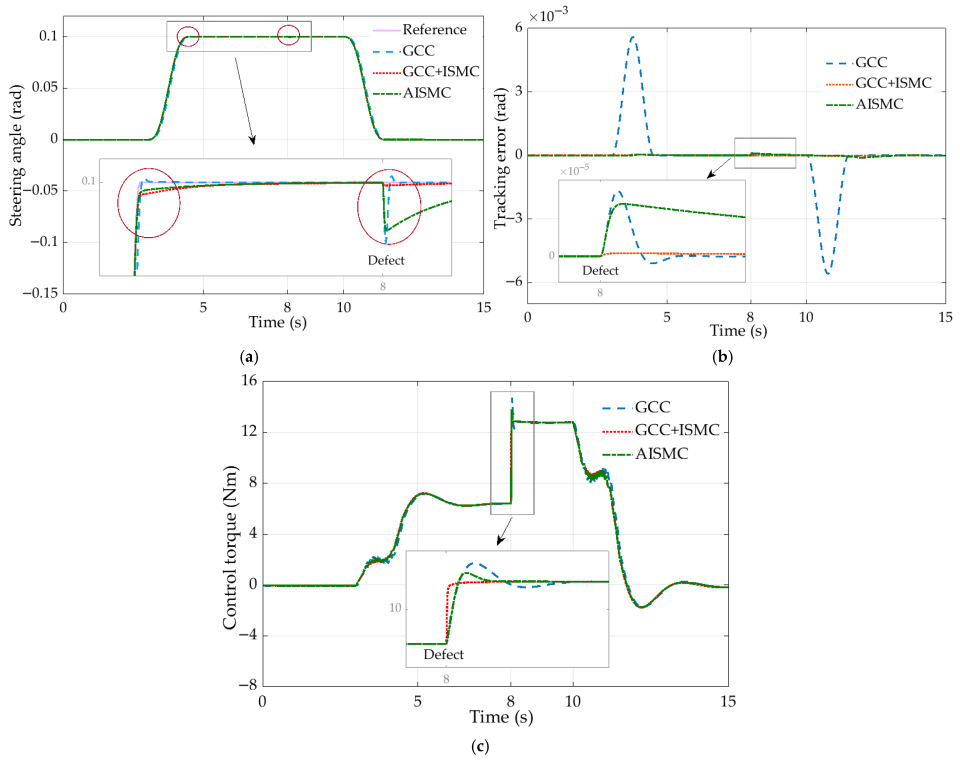
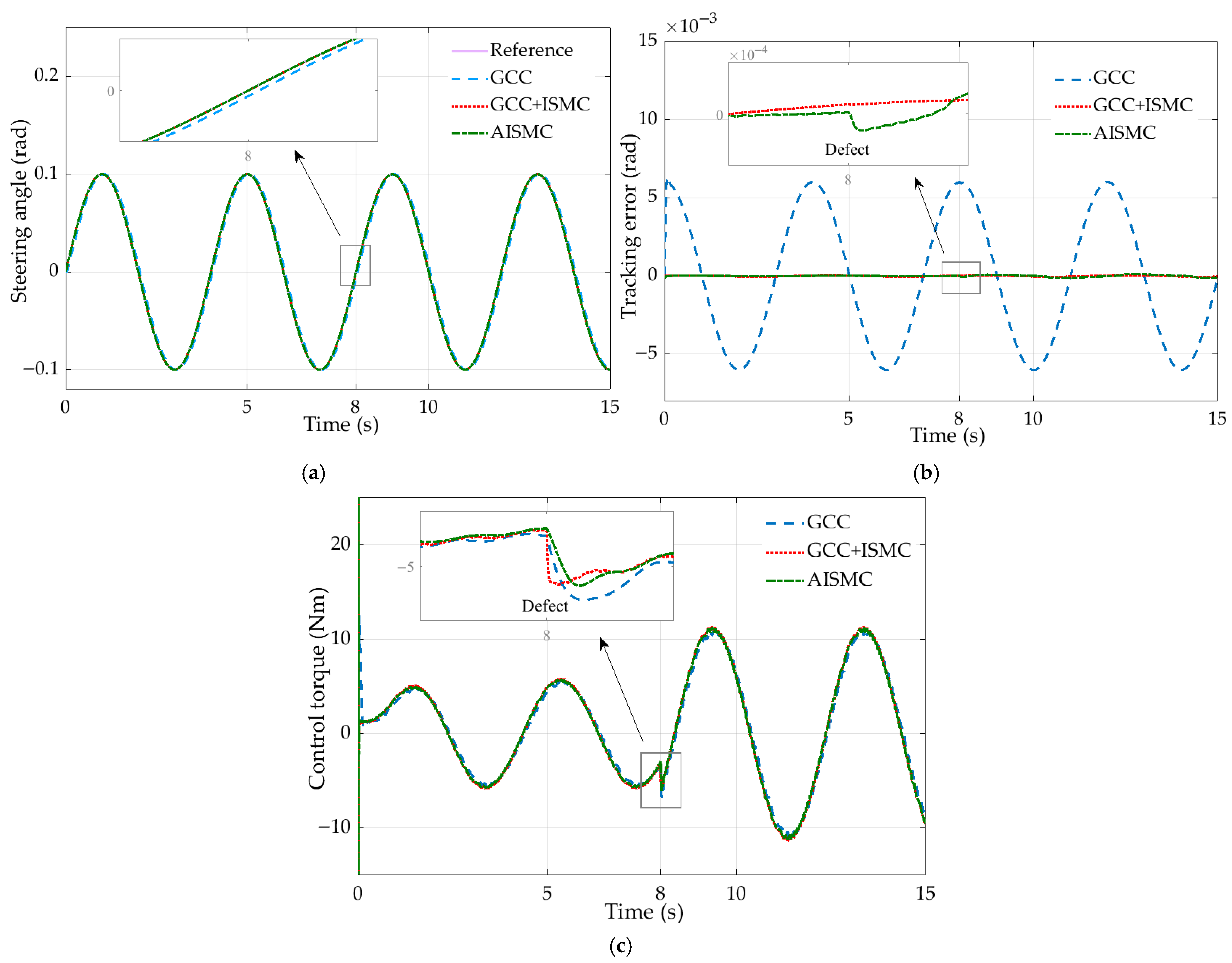
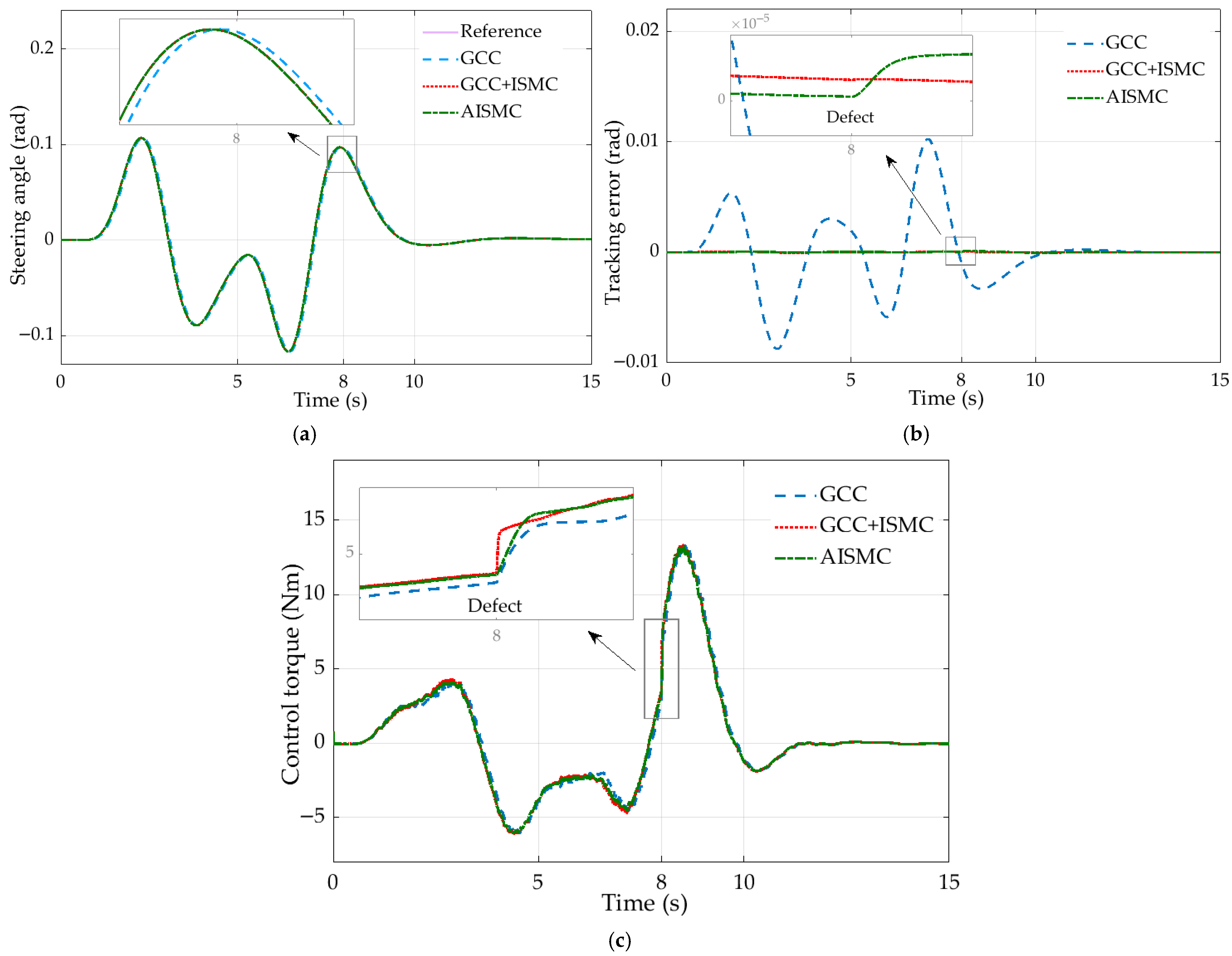
The control performance of the SBW system is evaluated under three typical steering maneuvers, step steering, sinusoidal steering, and double lane change steering, and illustrated in Figure 3, Figure 4 and Figure 5, respectively.
As depicted in Figure 3a,b, all three control strategies can effectively track the step steering reference signal. The response speed of the proposed synergistic GCC+ISMC is comparable to that of the AISMC, both outperforming the standalone GCC. At the instant of fault occurrence, the tracking accuracy of the synergistic GCC+ISMC remains virtually unaffected, whereas the tracking errors for both standalone GCC and AISMC increase significantly. However, while the GCC can rapidly recover to its nominal tracking level, the error convergence process of the AISMC is relatively slow. Furthermore, Figure 3c illustrates that to cope with the torque failure fault, all three strategies actively regulate the control torque at the moment of the fault. Notably, the synergistic GCC+ISMC strategy achieves a significantly shorter adjustment time and a smoother transition compared to the other two strategies.
For the sinusoidal steering maneuver, Figure 4a demonstrates that all three strategies successfully track the reference signal. Here, the synergistic GCC+ISMC exhibits superior dynamic response characteristics compared to the standalone GCC. As shown in Figure 4b, the tracking errors of both GCC+ISMC and AISMC are substantially smaller than that of the GCC. Upon fault injection, the tracking precision of GCC+ISMC and GCC sustains minimal impact, whereas the AISMC presents more pronounced error fluctuations, underscoring the stronger robustness of the former two under fault conditions. It can be observed from Figure 4c that the GCC+ISMC achieves the fastest torque adjustment speed in response to faults, followed by the GCC, with the AISM being the slowest. This further corroborates the superiority of the proposed strategy in fault response.
Under the double lane change maneuver, the performance of the three control strategies are consistent with those observed in the sinusoidal maneuver. In terms of response speed, Figure 5a indicates a marked improvement for the synergistic GCC+ISMC over the standalone GCC. Regarding tracking accuracy, Figure 5b reveals that the errors associated with GCC+ISMC and AISMC are smaller than those of the GCC. Crucially, at the moment of fault injection, the error of the GCC+ISMC remains remarkably stable, whereas the error of the AISM notably increases. Moreover, regarding torque allocation, Figure 5c demonstrates that the GCC+ISMC executes the fastest adjustment speed when responding to faults.
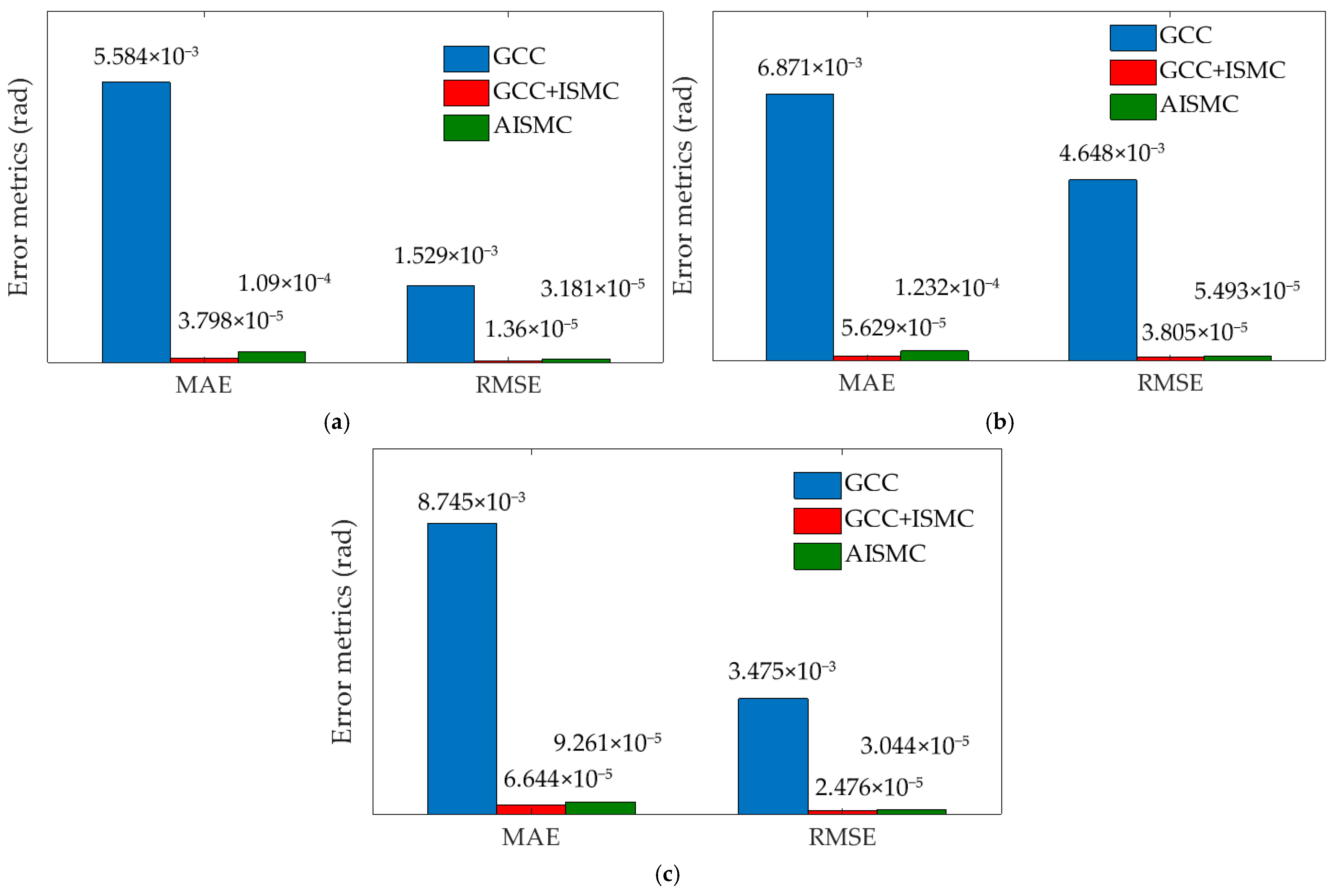
To further quantify the control performance, the Maximum Absolute Error (MAE) and the Root-Mean-Square Error (RMSE) of the tracking errors under the step, sinusoidal, and double lane change maneuvers are calculated as quantitative evaluation metrics, with the results presented in Figure 6.
As clearly evidenced by Figure 6, the proposed synergistic GCC+ISMC strategy yields the smallest values for both error metrics. Specifically, the RMSE is reduced by an average of approximately 35% compared to the AISMC. This solidly verifies that the synergistic GCC-ISM control possesses the highest tracking accuracy.
In summary, the proposed synergistic GCC+ISMC strategy seamlessly combines rapid dynamic response, high-precision tracking, and robust fault-tolerance, effectively satisfying the stringent control demands across varied steering conditions.

5. Conclusions

Aiming at the challenge of synergistically enhancing the control performance of SBW systems subject to multiple uncertainties, this paper proposes a synergistic fault-tolerant control strategy integrating GCC+ISMC. The main contributions and results are summarized as follows:
(1)
A dynamic model of the SBW system incorporating multiple uncertain factors was formulated, providing an accurate mathematical description of the controlled plant for subsequent controller design;
(2)
By deriving the GCC law based on LMI solutions, strict constraints were imposed on the system’s tracking accuracy and robustness, ensuring that the theoretical upper bound of the steady-state performance remains controllable under the influence of uncertainties.
(3)
By integrating an ISMC mechanism, the system’s dynamic response speed was significantly accelerated without sacrificing steady-state accuracy. This resolves the intrinsic trade-off between precision and rapidity common in existing methods, formulating a synergistic fault-tolerant architecture characterized by both high accuracy and fast response.
(4)
Simulations conducted under typical steering maneuvers demonstrated that the proposed strategy effectively suppresses the adverse effects of multiple uncertainties across various fault scenarios. Quantitative analysis reveals that the tracking RMSE of GCC+ISMC is reduced by approximately 35% compared to AISMC. This thoroughly corroborates the comprehensive advantages of the proposed method in tracking accuracy, response speed, and robustness.
In conclusion, the synergistic GCC+ISMC proposed in this paper effectively addresses the challenges posed by multiple uncertainties in SBW systems. It successfully achieves a synergistic enhancement of control performance while guaranteeing functional safety, thereby providing robust theoretical support and technical reference for the reliable operation of intelligent vehicles under complex environments. Future work will focus on Hardware-in-the-Loop experimental validation and the coordinated control of multiple chassis actuators.

Author Contributions

Conceptualization, J.Y. and Y.H.; methodology, J.Y.; software, J.Y.; validation, J.Y. and Y.H.; formal analysis, D.Z.; data curation, L.Y.; writing—original draft preparation, J.Y.; writing—review and editing, Y.H.; funding acquisition, Y.H., D.Z. and G.C. All authors have read and agreed to the published version of the manuscript.

Funding

This research was supported by the Young Scientists Fund of the National Natural Science Foundation of China [Grant number 52302470], the National Natural Science Foundation of China [Grant Number 52462053], the Research Fund for International Senior Scientists of the National Natural Science Found of China [Grant number W2531045], the Key R & D Program of Jiangxi Province [Grant number 20243BBG71011], the 03 Special Program and 5G Project of Jiangxi Province [Grant Number 20232ABC03A30], and the Jiangxi Province Government Special Fund for Graduate Innovation [Grant number YC2023-B207].

Institutional Review Board Statement

Not applicable.

Informed Consent Statement

Not applicable.

Data Availability Statement

Data will be made available on request.

Conflicts of Interest

The authors declare no conflicts of interest.

References

  1. Yang, C.; Wang, Q.; Wang, W.; Gao, Y.; Zhang, Y.; Zhang, R. A fault estimation and fault-tolerant operation scheme design under simultaneous actuator and sensor faults for steer-by-wire system. Veh. Syst. Dyn. 2025, 1–28. [Google Scholar] [CrossRef]
  2. Jiang, H.; Yang, N.; Liu, T.; Wang, J.; Mizuno, K.; Chen, M.; Zheng, J. Fault-tolerant control of steer-by-wire system based on Gaussian process regression. Trans. Inst. Meas. Control. 2025, 1–13. [Google Scholar] [CrossRef]
  3. Wang, X. Active fault tolerant control for unmanned underwater vehicle with actuator fault and guaranteed transient performance. IEEE Trans. Intell. Veh. 2020, 6, 470–479. [Google Scholar] [CrossRef]
  4. Wang, X.; Pan, L.; Tian, Y.; Liu, Y.; Li, L. Adaptive Fault-Tolerant Fixed-Time Sliding Mode Tracking Control for Steer-By-Wire System with Dual-Three-Phase PMSM. IEEE Trans. Veh. Technol. 2025, 74, 7554–7564. [Google Scholar] [CrossRef]
  5. Huang, C.; Naghdy, F.; Du, H. Fault tolerant sliding mode predictive control for uncertain steer-by-wire system. IEEE Trans. Cybern. 2017, 49, 261–272. [Google Scholar] [CrossRef] [PubMed]
  6. Chen, H.; Tu, Y.; Wang, H.; Shi, K.; He, S. Fault-tolerant tracking control based on reinforcement learning with application to a steer-by-wire system. J. Frankl. Inst. 2022, 359, 1152–1171. [Google Scholar] [CrossRef]
  7. Tran, A.T.; Van Huynh, V.; Tran, D.T.; Shim, J.W.; Lim, C.P. Delay-resilient super-twisting sliding mode control for frequency regulation in multi-area power systems under time-varying delays. Int. J. Electr. Power Energy Syst. 2026, 176, 111695. [Google Scholar] [CrossRef]
  8. Du, Z.; Wang, H.; Li, J.; Yang, X.; Ye, H. Event-Triggered Integral Sliding Mode Control for Nonlinear Networked Cascade Control Systems with Uncertain Delay. Int. J. Robust Nonlinear Control. 2025, 35, 3071–3082. [Google Scholar] [CrossRef]
  9. Du, Z.; Chen, C.; Li, C.; Yang, X.; Li, J. Fault-tolerant H-infinity stabilization for networked cascade control systems with novel adaptive event-triggered mechanism. IEEE Trans. Autom. Sci. Eng. 2025, 22, 22597–22608. [Google Scholar] [CrossRef]
  10. Guo, Z.; Henry, D.; Guo, J.; Wang, Z.; Cieslak, J.; Chang, J. Control for systems with prescribed performance guarantees: An alternative interval theory-based approach. Automatica 2022, 146, 110642. [Google Scholar] [CrossRef]
  11. Zhou, S.; Li, Y.; Tong, S. Prescribed performance adaptive fuzzy output feedback control for steer-by-wire vehicle system with intermittent actuator faults. Neural Comput. Appl. 2024, 36, 16057–16070. [Google Scholar] [CrossRef]
  12. Zhao, X.; Zhao, L. Steering angle tracking control of steer-by-wire system with prescribed performance under primary sensor failure. Control. Eng. Pract. 2025, 161, 106354. [Google Scholar] [CrossRef]
  13. Zhao, X.; Zhao, L. Performance-guaranteed adaptive switching tracking control for steer-by-wire system with disturbance observer. Nonlinear Dyn. 2025, 113, 35107–35123. [Google Scholar] [CrossRef]
  14. Lu, L.; Zhu, S.; Wang, D.M.; Han, Y.-Q. Distributed adaptive fault-tolerant control with prescribed performance for nonlinear multiagent systems. Commun. Nonlinear Sci. Numer. Simul. 2024, 138, 108222. [Google Scholar] [CrossRef]
  15. Wang, H.; Bai, W.; Zhao, X.; Liu, P.X. Finite-time-prescribed performance-based adaptive fuzzy control for strict-feedback nonlinear systems with dynamic uncertainty and actuator faults. IEEE Trans. Cybern. 2021, 52, 6959–6971. [Google Scholar] [CrossRef] [PubMed]
  16. Wang, Z.; Hashimoto, S.; Kurita, N.; Nie, P.; Xu, S.; Kawaguchi, T. Prescribed Performance Adaptive Fault-Tolerant Control for Nonlinear System with Actuator Faults and Dead Zones. Symmetry 2025, 17, 1915. [Google Scholar] [CrossRef]
  17. Chang, S.; Peng, T. Adaptive guaranteed cost control of systems with uncertain parameters. IEEE Trans. Autom. Control. 1972, 17, 474–483. [Google Scholar] [CrossRef]
  18. Yu, L.; Chu, J. An LMI approach to guaranteed cost control of linear uncertain time-delay systems. Automatica 1999, 35, 1155–1159. [Google Scholar] [CrossRef]
  19. Yu, L. An LMI approach to reliable guaranteed cost control of discrete-time systems with actuator failure. Appl. Math. Comput. 2005, 162, 1325–1331. [Google Scholar] [CrossRef]
  20. Zong, G.; Ren, H. Guaranteed cost finite-time control for semi-Markov jump systems with event-triggered scheme and quantization input. Int. J. Robust Nonlinear Control. 2019, 29, 5251–5273. [Google Scholar] [CrossRef]
  21. Qiao, M.; Chang, X. Quantified Guaranteed Cost Fault-Tolerant Control for Continuous-Time Fuzzy Singular Systems with Sensor and Actuator Faults. IEEE Trans. Fuzzy Syst. 2023, 32, 660–670. [Google Scholar] [CrossRef]
  22. Cai, H.; Shi, P. Attitude guaranteed cost control method for flexible spacecraft based on LPV model. J. Beijing Univ. Aeronaut. Astronaut. 2024, 50, 3921–3929. (In Chinese) [Google Scholar] [CrossRef]
  23. Wang, Z.; Li, Y. Guaranteed cost spacecraft attitude stabilization under actuator misalignments using linear partial differential equations. J. Frankl. Inst. 2020, 357, 6018–6040. [Google Scholar] [CrossRef]
  24. Xu, J.; Zhang, J.; Liu, C.; Yue, X. RBF Neural Network-based Guaranteed Cost Nonfragile Control for Spacecraft Electromagnetic Docking. Adv. Astronaut. 2026, 1–12. [Google Scholar] [CrossRef]
  25. Yu, Z.; Jiang, H.; Mei, X.; Hu, C. Guaranteed cost consensus for second-order multi-agent systems with heterogeneous inertias. Appl. Math. Comput. 2018, 338, 739–757. [Google Scholar] [CrossRef]
  26. Li, J.; Zhang, Q.; Yu, H.; Cai, M. Real-time guaranteed cost control of MIMO networked control systems with packet disordering. J. Process Control 2011, 21, 967–975. [Google Scholar] [CrossRef]
  27. Huai, H.; Wu, H.; Xu, J. Robust Lateral Shared Control of Autonomous Vehicle Considering Driver NMS Characteristics. J. Mech. Eng. 2024, 60, 280–290. (In Chinese) [Google Scholar] [CrossRef]
  28. Jin, X.J.; Yin, G.; Chen, J.; Chen, N. Robust guaranteed cost state-delayed control of yaw stability for four-wheel-independent-drive electric vehicles with active front steering system. Int. J. Veh. Des. 2015, 69, 304–323. [Google Scholar] [CrossRef]
  29. Zhang, Z.; Zheng, L.; Li, Y.; Zhang, Z.; Zheng, H. Trajectory Tracking Control of Intelligent Vehicle in Unreliable Onboard Data Transmission Environment. China J. Highw. Transp. 2023, 36, 284–297. (In Chinese) [Google Scholar] [CrossRef]
  30. Liang, Y.; Li, Y.; Khajepour, A.; Zheng, L. Optimised robust path following control of autonomous vehicle with pole constraints. Int. J. Veh. Des. 2021, 87, 5–28. [Google Scholar] [CrossRef]
  31. Zhou, J.; Ni, M.; Zhao, W.; Wang, C. Performance-guaranteed open-circuit fault-tolerant strategy for dual-winding steer-by-wire system. Proc. Inst. Mech. Eng. Part D J. Automob. Eng. 2025, 09544070251380918. [Google Scholar] [CrossRef]
  32. Liu, W.; Jiang, Z. Adaptive fault-tolerant control based on linear matrix inequalities for actuator failures in steer-by-wire system. Proc. Inst. Mech. Eng. Part D J. Automob. Eng. 2024, 238, 4379–4393. [Google Scholar] [CrossRef]
  33. Wang, H.; Kong, H.; Man, Z.; Tuan, D.M.; Cao, Z.; Shen, W. Sliding mode control for steer-by-wire systems with AC motors in road vehicles. IEEE Trans. Ind. Electron. 2013, 61, 1596–1611. [Google Scholar] [CrossRef]
  34. Yu, Z. Automobile Theory; China Machine Press: Beijing, China, 2023. (In Chinese) [Google Scholar]
  35. Yu, F. Robust Control-Linear Matrix Inequality (LMI) Approach; Tsinghua University Press: Beijing, China, 2002. (In Chinese) [Google Scholar]
Figure 1. The structure of the SBW system.
Actuators 15 00199 g001
Figure 2. The 2-DOF vehicle model.
Actuators 15 00199 g002
Figure 3. Control performance under step steering condition: (a) front wheel steering angle, (b) tracking error, and (c) control torque.
Actuators 15 00199 g003
Figure 4. Control performance under sinusoidal steering condition: (a) front wheel steering angle, (b) tracking error, and (c) control torque.
Actuators 15 00199 g004
Figure 5. Control performance under double lane change steering condition: (a) front wheel steering angle, (b) tracking error, and (c) control torque.
Actuators 15 00199 g005
Figure 6. Quantitative evaluation metrics of tracking errors: (a) step steering, (b) sinusoidal steering, and (c) double lane change steering.
Actuators 15 00199 g006
Table 1. Model parameters of SBW system.
ParametersValuesParametersValues
Jf (kg·m2)2.6Pn4
Bf (Nms/rad)12Ψf0 (Wb)0.0275
Jm (kg·m2)0.02129Δia (A)−0.08
Bm (Nms/rad)0.038Δib (A)0.06
τfs (Nm)2.68Iz (kg·m2)1300
r200m (kg)2000
N12Vx (m/s)35
l (m)0.039k1, k2 (N/rad)45,000
a (m)1.2τmd60.022
b (m)1.05τmd120.005
Table 2. Control parameters.
ParametersValues
D[0, 0, 0; 0, 0, 0; 1, 0, 0; 0, 1, 0; 0, 0, 1]
F[1, 0, 0; 0, 1, 0; 0, 0, 1]
Q[106, 0, 0, 0, 0; 0, 10−2, 0, 0, 0; 0, 0, 10, 0, 0; 0, 0, 0, 0, 10]
R10−6
ρ0.5
c100
μ100
k10,000
ca100
μa100
α10,000
β5
Disclaimer/Publisher’s Note: The statements, opinions and data contained in all publications are solely those of the individual author(s) and contributor(s) and not of MDPI and/or the editor(s). MDPI and/or the editor(s) disclaim responsibility for any injury to people or property resulting from any ideas, methods, instructions or products referred to in the content.