1. Introduction
Redundant robots can take various joint postures for a given spatial trajectory. To avoid singular configurations and improve motion performance, trajectory planning is commonly performed by searching based on evaluation functions such as manipulability [
1]. For example, the authors of [
2,
3] optimized the end-effector trajectory and the corresponding posture of an electrically actuated redundant manipulator by incorporating manipulability into the evaluation function.
In hydraulic systems, similar optimization problems are further complicated due to nonlinearities and physical constraints. In commonly used open circuits with flow control valves, a single pressure supply is shared across joints; thus, the supply pressure must be set to the actuator with the highest load. In addition, throttle loss is a major source of energy dissipation.
Therefore, exploiting redundancy to reduce energy consumption is an important challenge. For example, the authors of [
4] optimized joint trajectories of a redundant manipulator using dynamic programming (DP). In their formulation, they accounted for pressure and flow constraints and incorporated a servo-valve controlled cylinder model. In addition, the authors of [
5] optimized the posture of a redundant manipulator by solving a quadratic programming problem that considers velocity and acceleration constraints of hydraulic actuators. The authors of [
6,
7] computed joint trajectories of a hydraulic excavator by linearizing the hydraulic model and applying model predictive control. Moreover, the authors of [
8] formulated a manipulability polytope under flow constraints (Flow manipulability polytope) as a linear constraint problem and presented a method for determining the optimal posture of a hydraulically redundant manipulator.
Hydraulic energy savings can also be achieved by circuit innovations. To mitigate throttling loss, the concept of an independent metering valve (IMV) was proposed [
9] and later applied to robot manipulators [
10]. Another example is the electrohydraulic actuator (EHA) [
11], which uses a one-to-one connection between the pump and actuator, thereby eliminating valves. These approaches have also been studied to address the power imbalance among axes in multi-axis robots. For example, the authors of [
12] proposed a new EHA drive method for hydraulic excavator control and improved the speed by transferring flow from the bucket and arm cylinders to the boom cylinder. The authors of [
13,
14] proposed a method for appropriately distributing flow from multiple pumps to the actuators of an excavator using ON–OFF valves.
Circuits with multiple valves and multiple operating modes make energy-optimal operation more complex. Earlier studies of such systems are based primarily on optimization methods. The authors of [
15] combined an IMV with a load-sensing system and employed DP to optimize joint trajectories for a redundant robot. The authors of [
13] described the use of DP for controlling an excavator to determine the connection sequence between the pumps and actuators in a hydraulic system, in which the flow from each pump can be allocated to any actuator. However, these studies do not include motion trajectory planning for the robot.
These studies developed circuits and control methods that use flow summing to improve power management for multiple actuators. However, in hydraulic multi-axis robots, imbalances arise not only in flow but also in the supply pressure required by each actuator. Therefore, we developed a new hydraulic circuit that provides on-demand power to each joint [
16,
17]. This circuit uses the pressure boosting effect of two or more pumps connected in series to meet the different pressure requirements of individual actuators. For example, the Modular Hydraulic Servo Booster (MHSB) [
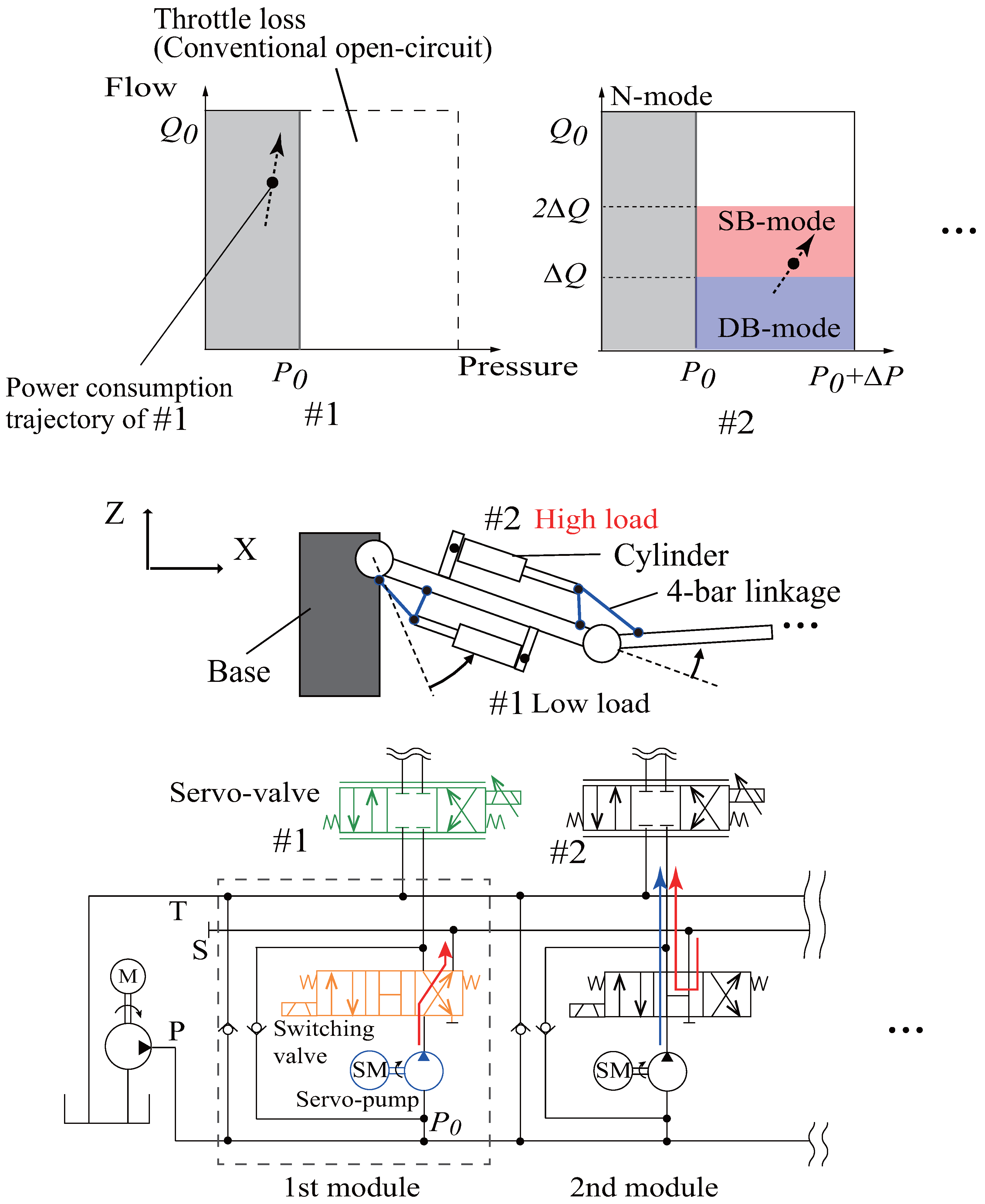
17] consists of servo-pumps (SPs), check valves, and switching valves, and can be retrofitted to a conventional open-circuit system to improve performance. This circuit has three operating modes with different power ranges. By selecting an appropriate mode depending on the load condition, throttling loss is reduced. The three modes and their characteristics are described below.
- 1.
Normal Mode (N-mode)
When the SP is stopped, each actuator can operate at high speed within the maximum flow of the main pump (MP).
- 2.
Decoupled Boost Mode (DB-mode)
When the SP is driven, a pressure higher than the supply pressure of the MP can be delivered to each actuator. However, the supplied flow is limited by the discharge flow of the SP.
- 3.
Shared Boost Mode (SB-mode)
With multiple SPs connected, the total flow can be sent to any set of actuators (flow summing), enabling higher-speed joint motion than in DB-mode (corresponding to #2 in
Figure 1).
The upper right of
Figure 1 shows the operation range of the pressure and flow for actuator #2. The colored regions indicate the operating range of a single actuator in each operating mode.
Figure 1.
The system equipped with Modular Hydraulic Servo Booster (MHSB). Efficiency is improved by selecting the operating modes (switching valves) and control inputs (servo valves and servo pumps). Here, we consider a multi-joint manipulator whose revolute joints are driven by hydraulic cylinders through four-bar linkages that convert the linear motion of the cylinders into joint rotation. The manipulator configuration is shown in the center of the figure, while the upper figure illustrates the operating regions of the two actuators.
is the maximum output flow of the SP, and
is the pressure boosted by the servo-pump (see [
17,
18] for details).
Figure 1.
The system equipped with Modular Hydraulic Servo Booster (MHSB). Efficiency is improved by selecting the operating modes (switching valves) and control inputs (servo valves and servo pumps). Here, we consider a multi-joint manipulator whose revolute joints are driven by hydraulic cylinders through four-bar linkages that convert the linear motion of the cylinders into joint rotation. The manipulator configuration is shown in the center of the figure, while the upper figure illustrates the operating regions of the two actuators.
is the maximum output flow of the SP, and
is the pressure boosted by the servo-pump (see [
17,
18] for details).
Our earlier work investigated energy-optimal operation using MHSB [
18]. Because the maximum available pressure and flow depend on the operating mode, these limits must be considered during planning. Although a boost mode can follow an arbitrary trajectory, its limited flow can increase the motion duration, thereby underutilizing the circuit versatility. In our earlier work, we proposed a control strategy that optimally drives multiple pumps and valves to execute point-to-point (PTP) tasks. This strategy evaluates the cost of each operating mode based on the required pressure and flow. It then simultaneously optimizes trajectory planning and mode switching using a graph search algorithm. Numerical simulations and experimental results on various PTP tasks with a two-link manipulator validated the effectiveness of the proposed method. However, the method did not address redundancy, which remained as future work. In addition, its real-time capability was not discussed.
This paper extends the previous method to redundant robots and implements the method in real time. Specifically, we propose a graph-search-based path planning framework in which the operating mode and joint posture are decision variables. To handle mode selection and redundancy simultaneously, we use a manipulability polytope under flow constraints (Flow manipulability polytope) [
8] as an evaluation function. This allows the characteristics of each operating mode to be reflected in the evaluation function. Furthermore, the optimal Flow manipulability polytope for each operating mode and end-effector position is computed in advance and stored in a lookup table. The proposed real-time search refers to this table.
Methods for computing real-time optimal motion for redundant robots in open-circuit systems have been reported [
6,
7,
8]. However, to the authors’ knowledge, no framework has been reported that simultaneously handles trajectory planning and mode switching in real time for redundant hydraulic manipulators.
Section 2 provides an overview of the trajectory planning framework.
Section 3 presents an example of trajectory planning when the proposed method is applied to a three-link serial manipulator.
Section 4 describes an online simulation in which the robot operates while planning the trajectory.
2. Optimal Trajectory Planning and Mode Switching
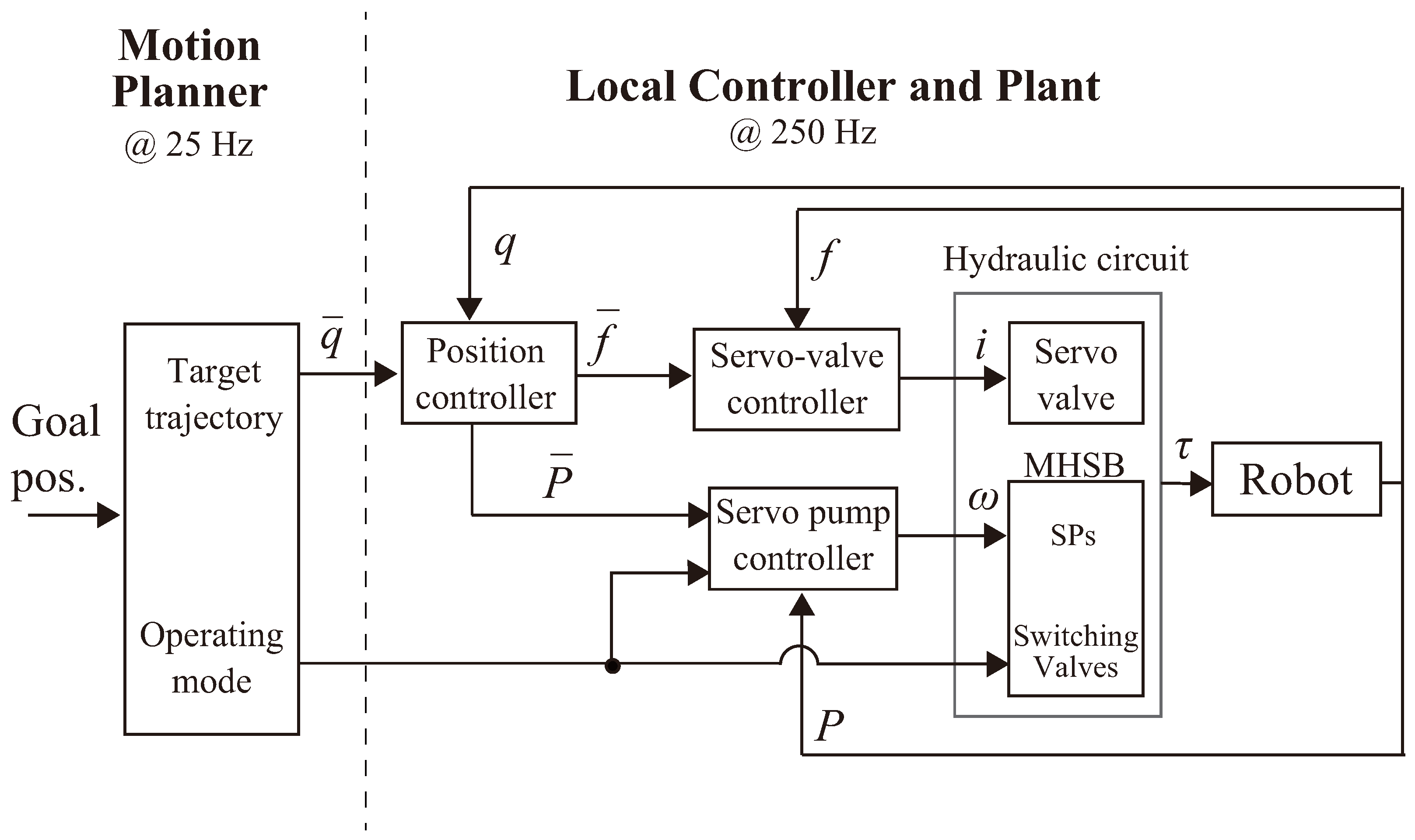
This section describes optimal trajectory planning and mode switching to minimize energy consumption in multi-axis robots. This method assumes a two-stage configuration consisting of a higher-level planner and a lower-level local control system. First, the higher-level planner performs path planning under constraints on the force (pressure), velocity (flow), and range of motion of each actuator for each mode. We employ the
algorithm [
19] as the planner, and will extend this approach to faster methods in future work. Tracking of the planned target posture is achieved by a cascade control system based on pressure feedback. In this framework, robot dynamics are not considered in the planning stage and are instead handled by the local servo system. The actuators are driven by highly responsive servo valves, and transient pressure and flow changes near the mode switching point are handled within this control system.
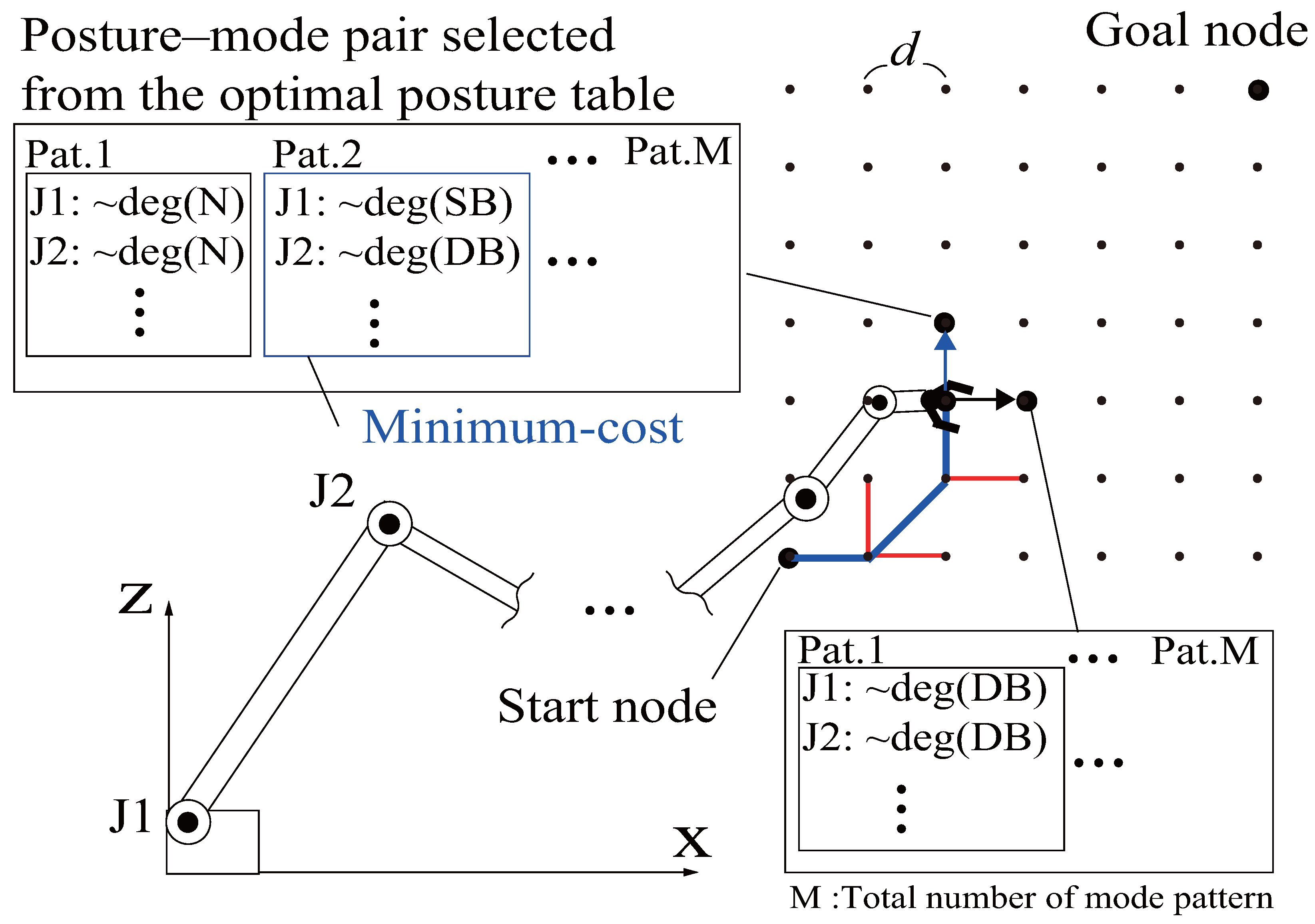
An overview of the proposed planning method is shown in
Figure 2. Nodes are evaluated based on cost, and the node with the lowest total cost is prioritized toward the goal. To simplify the calculation, we adopt the following assumptions.
- 1.
The robot motion is quasi-static.
- 2.
During transitions between nodes, the actuator velocity (V) is constant and is subject to the velocity limit (maximum value ).
- 3.
Mode switching is done only at nodes.
From Assumption 1, one can ascertain whether pressure boosting is necessary to drive the actuator. In this paper, quasi-static motion is defined as the condition in which the actuator velocity is not greater than . The validity of this method is limited to the range in which the quasi-static assumption holds. Under conditions exceeding the quasi-static limit, the mode switching timing may deviate from the planned value due to increased pressure peaks and tracking errors. As a result, the actual pressure distribution and joint behavior may deviate from the planned results.
Figure 2.
Overview of path search: The end-effector coordinates are set as the search space. When expanding each node, the optimal posture table is used to evaluate the cost. Then, the node with the lowest total cost is prioritized, and the search proceeds toward the goal. The blue line represents the shortest path to the current node, whereas the red line represents an alternative trajectory under exploration.
Figure 2.
Overview of path search: The end-effector coordinates are set as the search space. When expanding each node, the optimal posture table is used to evaluate the cost. Then, the node with the lowest total cost is prioritized, and the search proceeds toward the goal. The blue line represents the shortest path to the current node, whereas the red line represents an alternative trajectory under exploration.
The optimal path is obtained as follows.
- S1
For each end-effector position and operating mode, compute a posture that improves the evaluation metric and construct a lookup table (optimal posture table).
- S2
Using the optimal posture table, simultaneously perform discrete path planning and determine the mode switching timings. Movement between nodes is allowed in eight directions: straight or diagonal.
- S3
Generate a time trajectory by interpolating the discrete path with a sixth-degree polynomial.
- S4
Recalculate the mode switching timings for each actuator based on the obtained time trajectory and its required force.
S1 is performed offline. The optimal posture table is an array that stores the optimal posture for each mode pattern over the entire workspace.
Section 2.1 describes
S1, and
Section 2.2 describes the detailed procedure for
S2. In
S3, the time trajectory is generated so that the joint angles and joint velocities remain as close as possible to those obtained in
S2, while satisfying the boundary conditions at the start and end points. Therefore, a slight deviation from
may occur as an approximation error in the time-trajectory generation, although the generated trajectory is adjusted to remain within the quasi-static range.
2.1. S1: Optimal Posture Table Based on the Manipulability Polytope
In
S1, we optimize the posture for each end-effector position and operating mode, thereby resolving posture redundancy in the graph search. The evaluation function can be chosen arbitrarily. In this paper, we use the area of a Flow manipulability polytope [
8] as the evaluation metric.
The procedure for deriving the manipulability polytope of a robot with
joint degrees of freedom is described below. Here, we consider a robot whose revolute joints are driven by hydraulic cylinders. The constraint on the joint angular velocity
imposed by the servo-valve can be expressed for each joint
as follows.
Here,
denotes the moment arm that converts the force of the
jth cylinder into torque at the revolute joint, and
and
denote the effective areas of the cylinder.
and
denote the flows during the extension and retraction of the
jth cylinder, respectively, and can be expressed for each joint as follows. For notational simplicity, the subscript
j is omitted, and the following equations are written in representative form.
Here, is the rated flow of the servo-valve, is the pressure at the rated flow, and are the supply and tank pressures, respectively, and F is the cylinder force.
Next, the constraint on
, considering the maximum flow of the main pump
, can be expressed for each joint
as follows:
Finally, we derive the constraint on
that accounts for the maximum flow of the sub-pump,
. This constraint is imposed only on the joints in DB-mode or SB-mode. Let
be the set of joints that require the high-pressure mode. For each joint
, the constraint on
imposed by the maximum sub-pump flow
is expressed as follows:
Let
denote the vertices of the admissible joint-velocity region defined by (
1), (
3) and (
4). Here,
is the total number of vertices. Mapping this admissible set to the end-effector velocity space through the Jacobian
yields the following vertex set:
Here,
denote the vertices in the end-effector velocity space,
is the joint-angle vector, and
u is the vertex index.
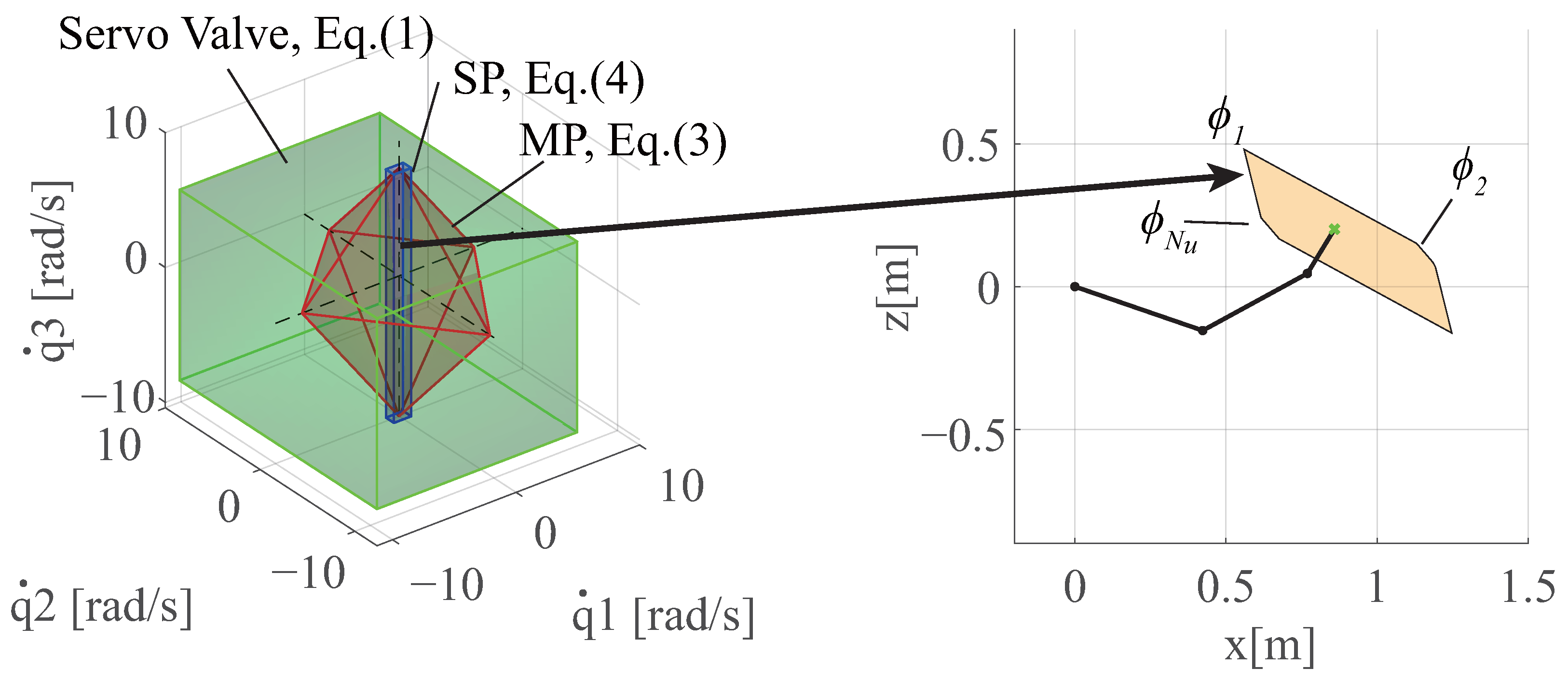
Figure 3 shows an example of a serial three-link manipulator operating in the x–z plane. The left panel of
Figure 3 shows the flow constraints in the joint-velocity space. The right panel shows the corresponding manipulability polytope mapped to the end-effector velocity space via the Jacobian
(J1–J3 correspond to SB, DB, and N-mode, respectively).
By optimizing the area of this polytope, we obtain the optimal posture for a given end-effector position and operating mode. Let the polygon vertices along the boundary be ordered as
, and let
. The area of the orange region in the right panel of
Figure 3 is computed using the shoelace formula. The polytope area
is defined as the area of the convex hull obtained from the vertex set of the manipulability polytope in the end-effector space and is given by
To find the posture that maximizes the polytope area, the following optimization problem is solved.
The objective function represents the polytope area for a given mode and posture . is the end-effector position vector computed by forward kinematics, and is the target end-effector position. and denote the lower and upper joint limits, respectively. This computation is performed for each end-effector position and operating mode, and the results are stored in the optimal posture table. The area maximization is solved using sequential quadratic programming.
2.2. S2: Definition of the Evaluation Function
S2 selects the optimal discrete path and determines the operating mode simultaneously using a graph search algorithm. When evaluating node transitions, the effect of the operating mode must be considered in addition to the movement direction. Therefore, for each node transition, we compute the joint motion direction and required torque, and then determine candidate operating modes based on the resulting load conditions. Specifically, N-mode is selected when pressure boosting is unnecessary or for a negative load. By contrast, when pressure boosting is required under a positive load, DB-mode and SB-mode are considered as candidates. We apply this procedure to all actuators and enumerate all combinations of the candidate modes. For each enumerated mode combination, we compute its cost, and the minimum cost is used as the evaluation value of the corresponding node transition. The cost at step
n (the number of nodes from the start to the current node) is given as:
Here, , , and are weighting coefficients, and denotes the energy consumption for the transition from node to node i. denotes the transition time between nodes. H is a heuristic function that gives the Euclidean distance from node n to the goal as the expected cost. The switching cost increases by 1 for each joint whose operating mode changes between nodes and i.
For this study,
is expressed as follows:
denotes the pressure calculated from the load on the
jth actuator (or
in N-mode), and
denotes the flow. In addition,
denotes the SP efficiency of the
jth actuator during the pressure boosting mode (set to 1 in N-mode), and
denotes the leakage flow of the servo-valve. Here,
is set to the longest time it takes for all joints to reach the next posture.
is calculated from the actuator velocity
V (
) and the actuator’s effective area. Further details are available in [
18].
3. Application to Three-Link Manipulator
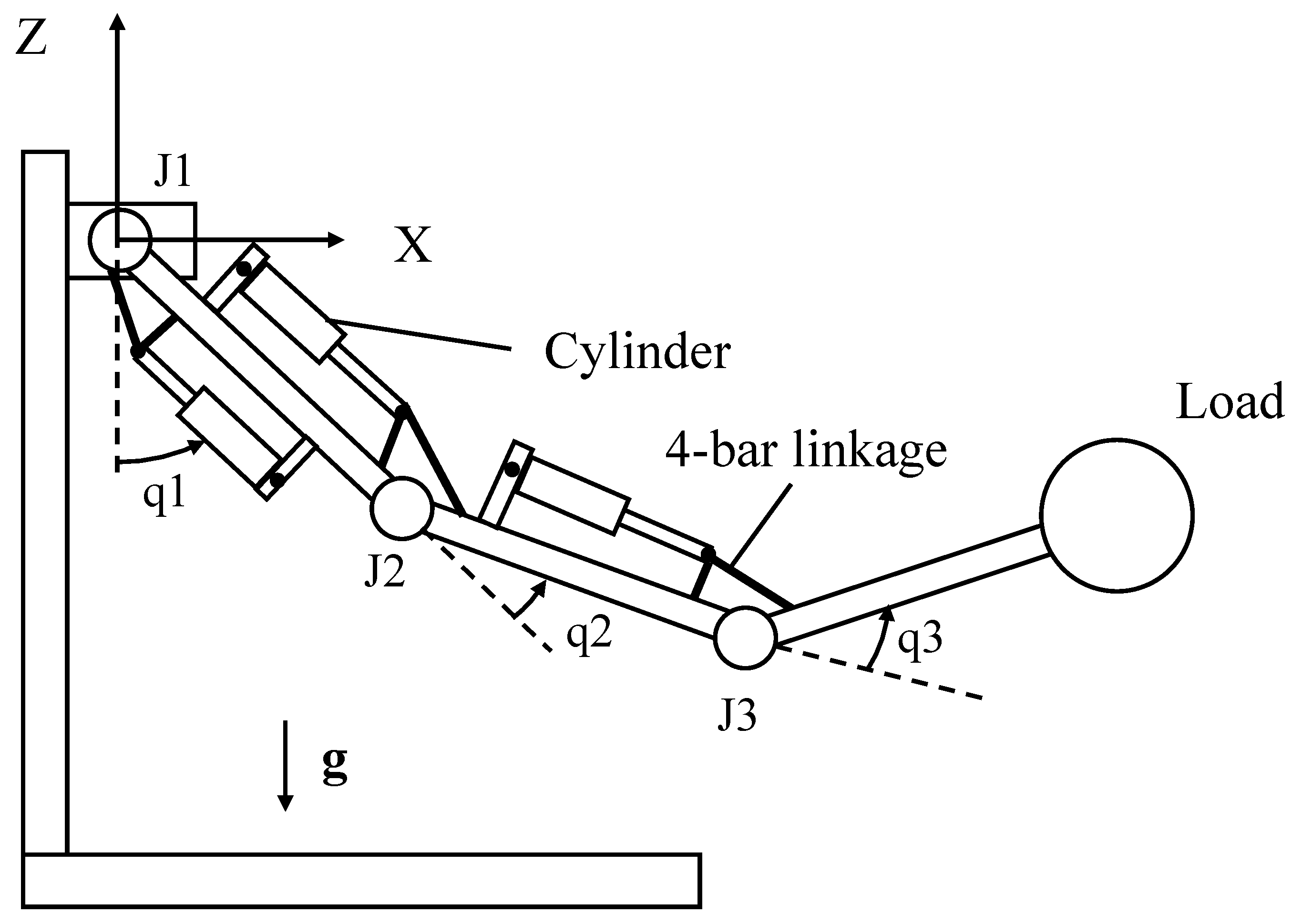
In this section, we evaluated the motion planning and mode selection methods using a three-link manipulator. Since only the end-effector position is specified for the task in space and the end-effector posture is determined through optimization, the simulation example considered in this paper can be regarded as a kinematically redundant planar manipulator. Although the proposed method is also applicable to tasks in three-dimensional space, this paper focuses on a planar manipulator example. The definitions of the robot coordinates and parameters are shown in
Figure 4 and
Table 1, respectively. Evaluations were conducted across the following five conditions.
- Case 1:
Vertical lifting
- Case 2:
Unloading
- Case 3:
Full-range lifting
- Case 4:
Comparison with the conventional method
- Case 5:
Effect of parameter variations
Table 1.
Parameters of a Three-Link Manipulator.
Table 1.
Parameters of a Three-Link Manipulator.
| Parameter | Value | Unit |
|---|
| Link length | L1: 450 | L2: 400 | L3: 179 | [mm] |
| Link weight | J1: 5.0 | J2: 3.5 | J3: 2.5 | [kg] |
| Load weight | 10 | [kg] |
| Cylinder size | Inner diameter: 25 | [mm] |
| Rod diameter: 12 | [mm] |
| Pressure of MP () | 4.0 | [MPa] |
Figure 4.
Coordinate definition of a three-link manipulator.
Figure 4.
Coordinate definition of a three-link manipulator.
The results of Case 1 are presented in
Section 3.1, whereas the results of Cases 2 and 3 are discussed in
Section 3.2. Case 4 and Case 5 are presented in
Section 3.3 and
Section 3.4, respectively. The parameters set for each case are summarized in
Table 2.
The offline computation for Step S1 is summarized as follows. Calculations were performed for all 23 possible operating mode patterns with four modules attached, over 642 nodes obtained by discretizing the workspace at 5 cm intervals. The total number of calculations was 14,766. The offline computation was performed on a PC equipped with an Intel Core(TM) Ultra 7 265 K (3.90 GHz) and 32 GB of memory, and the computation time was approximately 1.5 h. In this configuration, there were no infeasible regions.
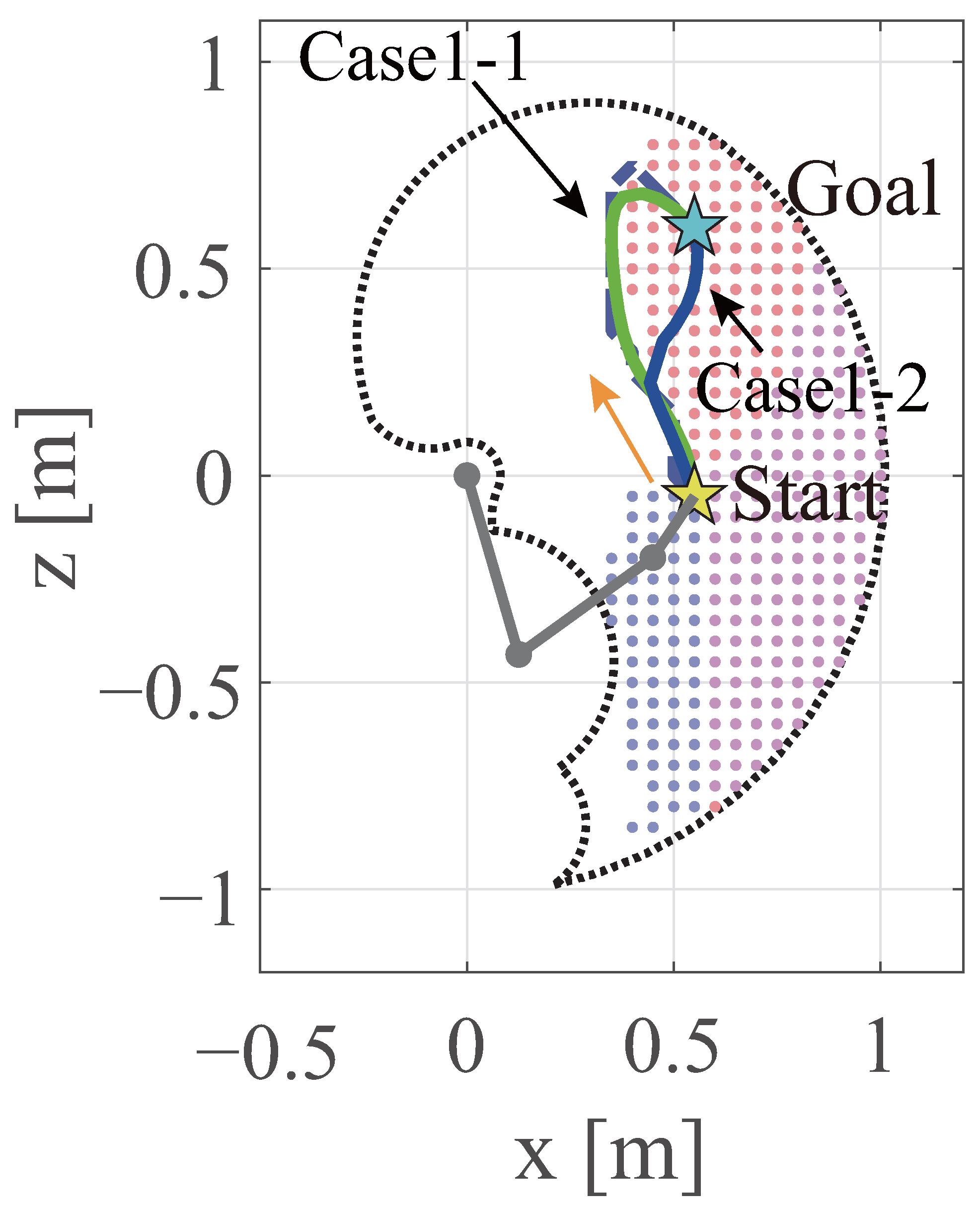
Figure 5 portrays the robot lifting a
load in the vertical plane. The area inside the black dotted line indicates the operating range of the manipulator. In this figure, the regions where the high-pressure mode is required when using the N-mode posture stored in the optimal posture table are highlighted. The orange region shows where it is required for J1, whereas the blue region shows where it is required for J2; the purple region shows where it is required for both joints. These regions vary as the robot moves along the planned path.
Table 2.
Parameters for Case Studies.
Table 2.
Parameters for Case Studies.
| | Start | Goal | w | | d | |
|---|
| | [m] | [m] | [-] | ext/ret | | |
|---|
| Case | X | Z | X | Z | 1 | 2 | 3 | [mm/s] | [mm] | [-] |
|---|
| 1-1 | 0.55 | −0.05 | 0.55 | 0.6 | 0.5 | 0 | 2 | N,SB:
12/12
DB:
8.2/10.7 | 50 | N: 1.0
DB,SB:
0.56 |
| 1-2 | | | | | 0 | 15 | 2 |
| 2-1 | 0.55 | 0.6 | 0.55 | −0.05 | 0.5 | 0 | 2 |
| 2-2 | | | 0.55 | −0.6 | | | |
| 3-1 | 0.55 | −0.7 | 0.55 | 0.75 | 0.5 | 0 | 2 |
| 3-2 | | | 0.75 | 0.55 | | | |
| 4-1 | | | | | | | |
| 4-2 | 0.5 | −0.15 | 0.65 | 0.45 | 0.5 | 0 | 2 |
| 4-3 | | | | | | | |
3.1. Evaluation of Energy Efficiency in Vertical Lifting Tasks (Case 1)
In
Figure 5, Case 1-1 and Case 1-2 correspond to the energy-optimal and shortest-time trajectories, respectively. The task durations were
and
. The energy consumption was
for the shortest-time trajectory and
for the energy-optimal trajectory, which corresponds to a
reduction. The blue dotted line behind the Case 1-1 trajectory indicates the discrete path obtained in
S2. Its energy consumption was
, and the discrepancy from the final time trajectory was
.
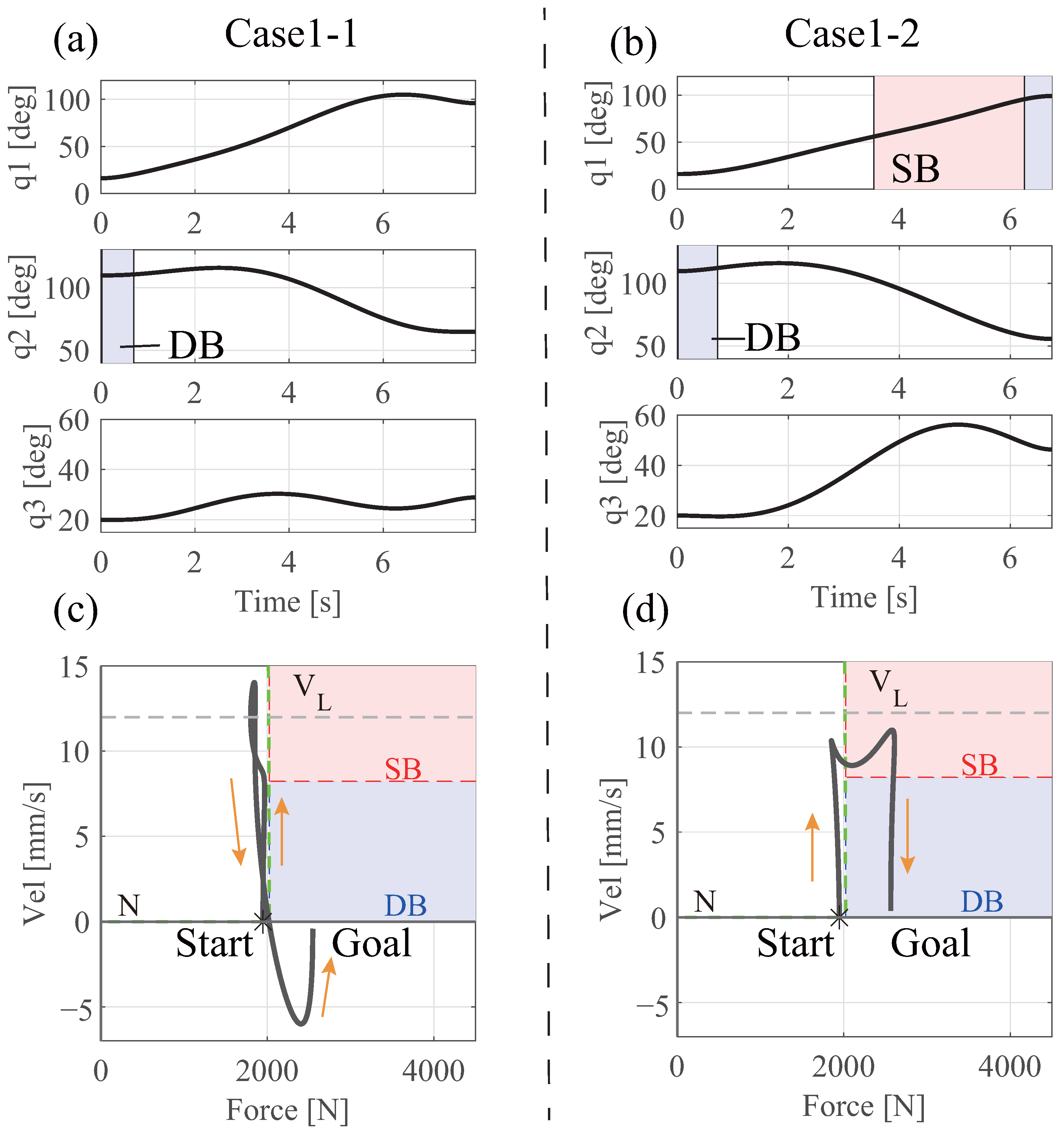
Figure 6a shows the time histories of the operating modes and joint angles for Case 1-1, and
Figure 6c shows the trajectory of J1 in the power space. Here, the abscissa shows the cylinder force, and the ordinate shows the cylinder velocity.
is the velocity limit imposed during the graph search in
S2. Therefore, this limit can be slightly exceeded during
S3.
Figure 6b,d show the joint-angle trajectories and load lines for Case 1-2. In the shortest-time trajectory, the same route as Case 1-1 is selected in the early phase because N-mode yields a more efficient motion. From the middle of the motion, SB-mode is selected to approach the goal more directly.
3.2. Influence of Goal Position on Trajectory Planning (Case 2, 3)
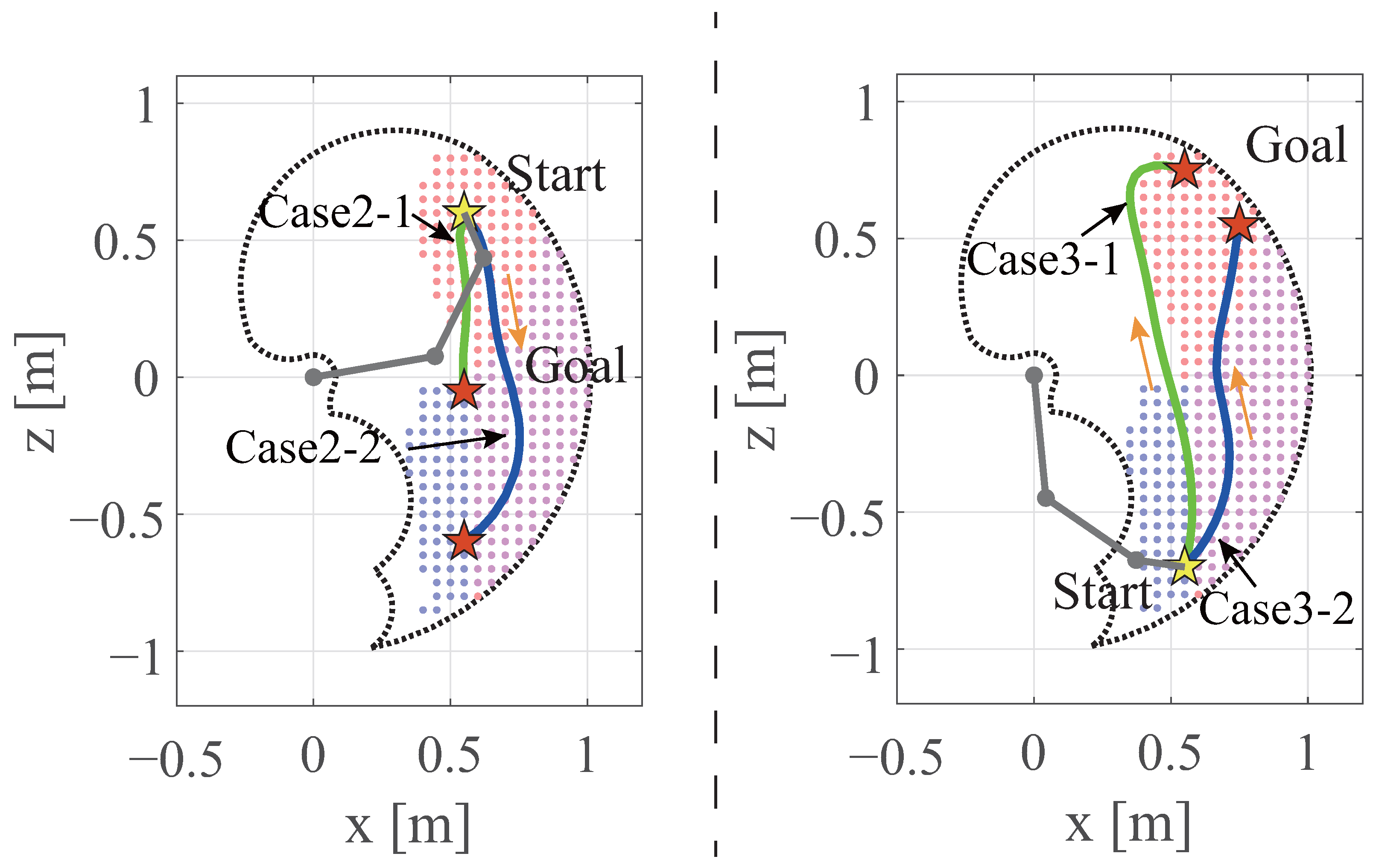
Cases 2 and 3 used the energy-optimal trajectory, and the results are shown in
Figure 7 and
Figure 8. In Case 2, N-mode was used in almost all regions. This is because, under a negative load, the cylinder can be controlled by throttling the valve, even when a high braking force is required. In Case 2-1, a trajectory was obtained in which the arm swings down vertically along the shortest path. The J2 joint was always under a positive load. It is inferred that the arm swung down while folding J2 to reduce the load as much as possible.
Figure 6.
Comparison of Case 1-1 (a,c) and Case 1-2 (b,d). The upper panel shows the joint trajectory. The lower panel shows the joint load trajectory on the operation region.
Figure 6.
Comparison of Case 1-1 (a,c) and Case 1-2 (b,d). The upper panel shows the joint trajectory. The lower panel shows the joint load trajectory on the operation region.
Figure 7.
Optimal trajectories for several PTP tasks in Cases 2–3.
Figure 7.
Optimal trajectories for several PTP tasks in Cases 2–3.
Figure 8.
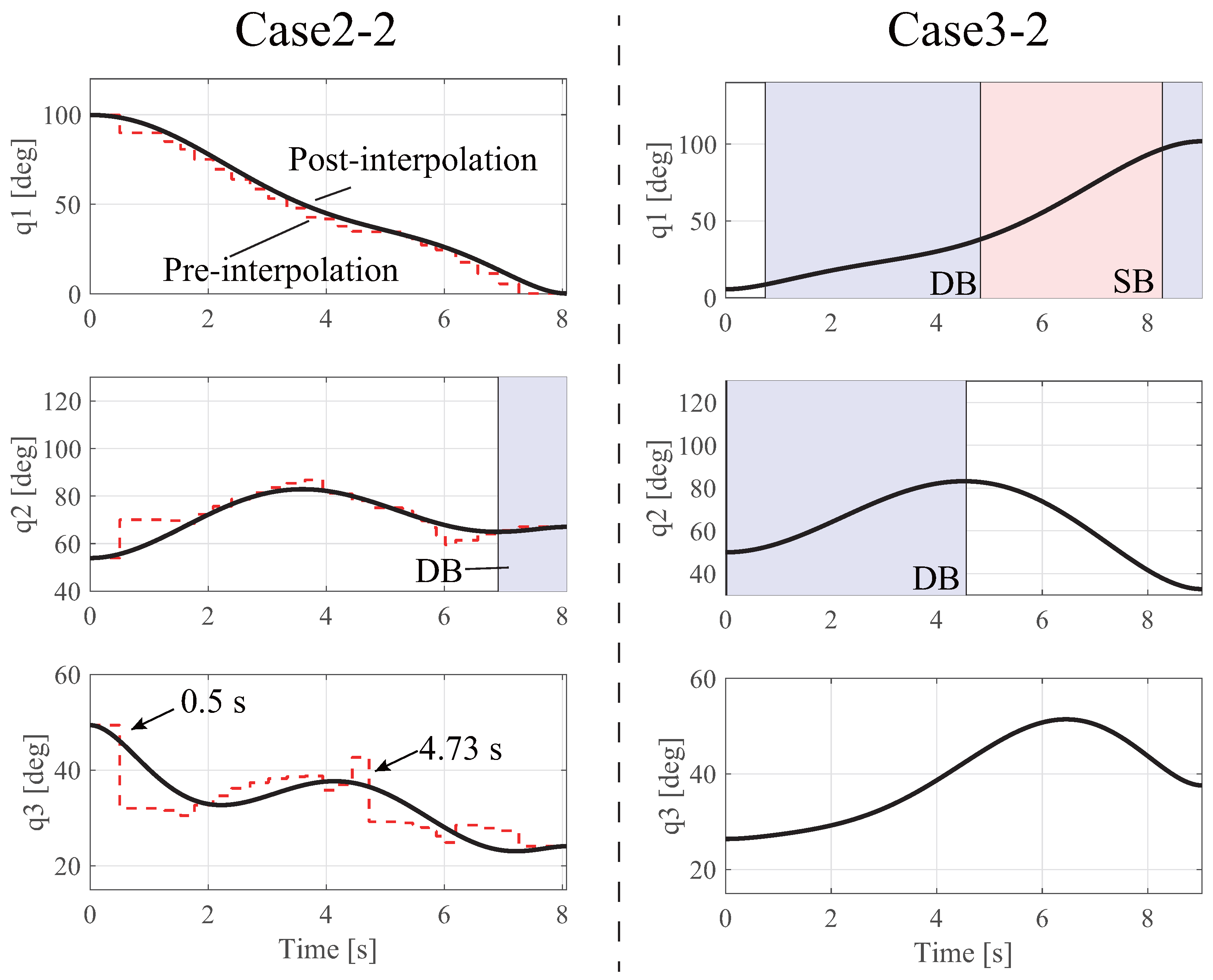
Joint trajectories for PTP tasks in Cases 2-2 and 3-2. The red line in the left indicates the discrete path obtained in Step S2.
Figure 8.
Joint trajectories for PTP tasks in Cases 2-2 and 3-2. The red line in the left indicates the discrete path obtained in Step S2.
In contrast, in Case 2-2, the end-effector trajectory slightly expanded outward. However, the most energy-efficient trajectory is expected to minimize the angle changes of J2 and J3 and approach the goal along an arc centered at the base joint. The joint trajectories for Case 2-2 are shown on the left of
Figure 8. In the proposed method, the posture is determined by the optimal posture table; therefore, the J2 and J3 joints also remain in motion throughout. Moreover, in the discrete path obtained in
S2 (red line on the left of
Figure 8), J3 exhibits large excursions at
and
. This is undesirable because it significantly increases the node transition time. The task time was
and the energy consumption was
(
before fitting); the discrepancy in energy consumption after fitting was small.
In Case 3, the goal coordinates were set to fully utilize the manipulator workspace. In Case 3-1, a detour trajectory was selected that folded the arm as much as possible and used N-mode frequently. In contrast, in Case 3-2, the robot reaches the goal along the shortest path by actively using the high-pressure mode, as shown on the right of
Figure 8. The task times of Case 3-1 and Case 3-2 were
and
, respectively. Their energy consumptions were
and
.
3.3. Comparison with the Conventional Method (Case 4)
This section compares our method with a previous method [
18]. The previous method does not include the processing in Step S1 and assumes that redundancy has been resolved beforehand. Here, to determine the posture corresponding to the end-effector coordinates, an initial angle is given first. If the postures of J1 and J2 can be calculated while keeping J3 fixed during path planning, those postures are adopted. If this is not possible, J3 is changed by 1 degree at a time until an inverse kinematic solution is obtained.
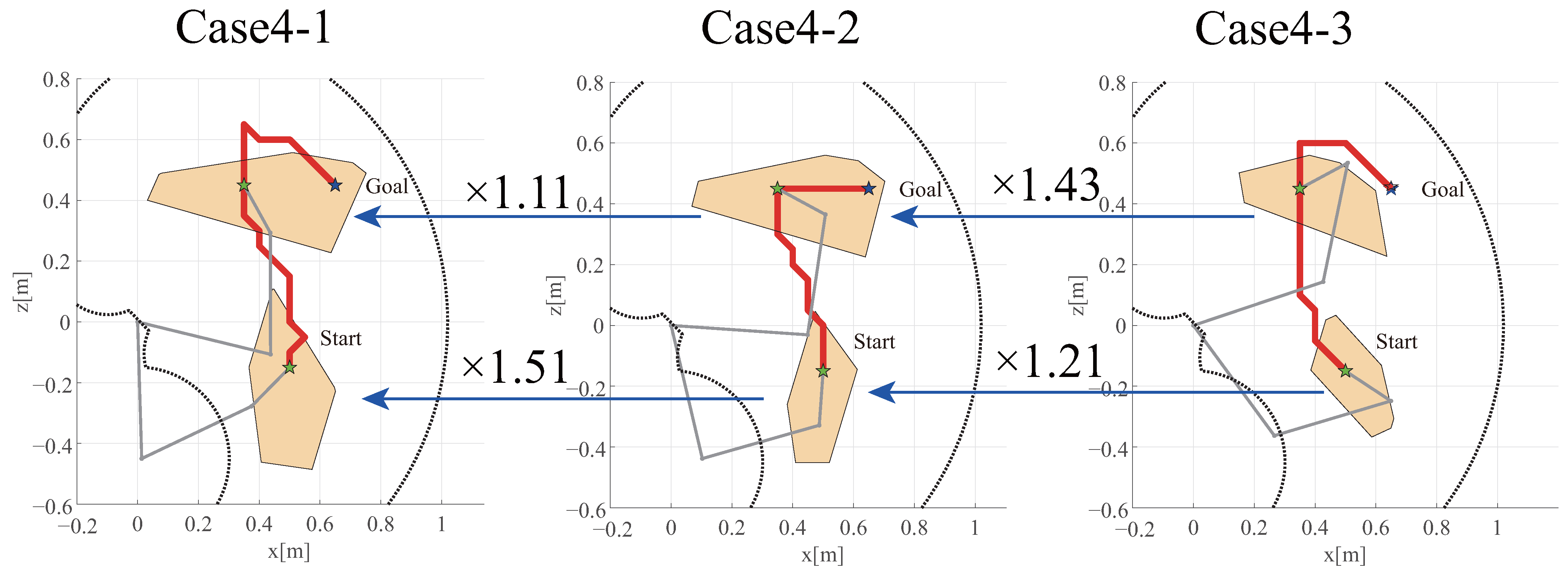
Figure 9 shows, for Cases 4-1 to 4-3, the discrete trajectories obtained by the proposed method and the method in [
18], together with the manipulability polytope at the same point along the trajectory. Compared to Cases 4-2 and 4-3, Case 4-1 yields a larger manipulability polytope because the size of the manipulability polytope is optimized by Step S1. On the other hand, the energy consumption was 593 J, 501 J, and 742 J, respectively. In particular, Case 4-2 shows the lowest energy consumption because the trajectory minimizes the motion of J3, thus reducing the energy consumption associated with joint motion. In contrast, in Case 4-1, each joint operates to maximize the manipulability polytope at each node, resulting in higher energy consumption than in Case 4-2. Furthermore, Case 4-3 required significant joint changes from the initial pose, resulting in the highest energy consumption.
The proposed method allows trajectory selection while satisfying the given performance index (in this study, maximization of the manipulability polytope). However, because polytope optimization and energy optimization are performed as separate processes, the present framework cannot directly handle trajectories that balance both objectives, which remains a challenge for future work.
3.4. Effect of Parameter Variations (Case 5)
How does the trajectory planning result change when the weight parameters are varied?
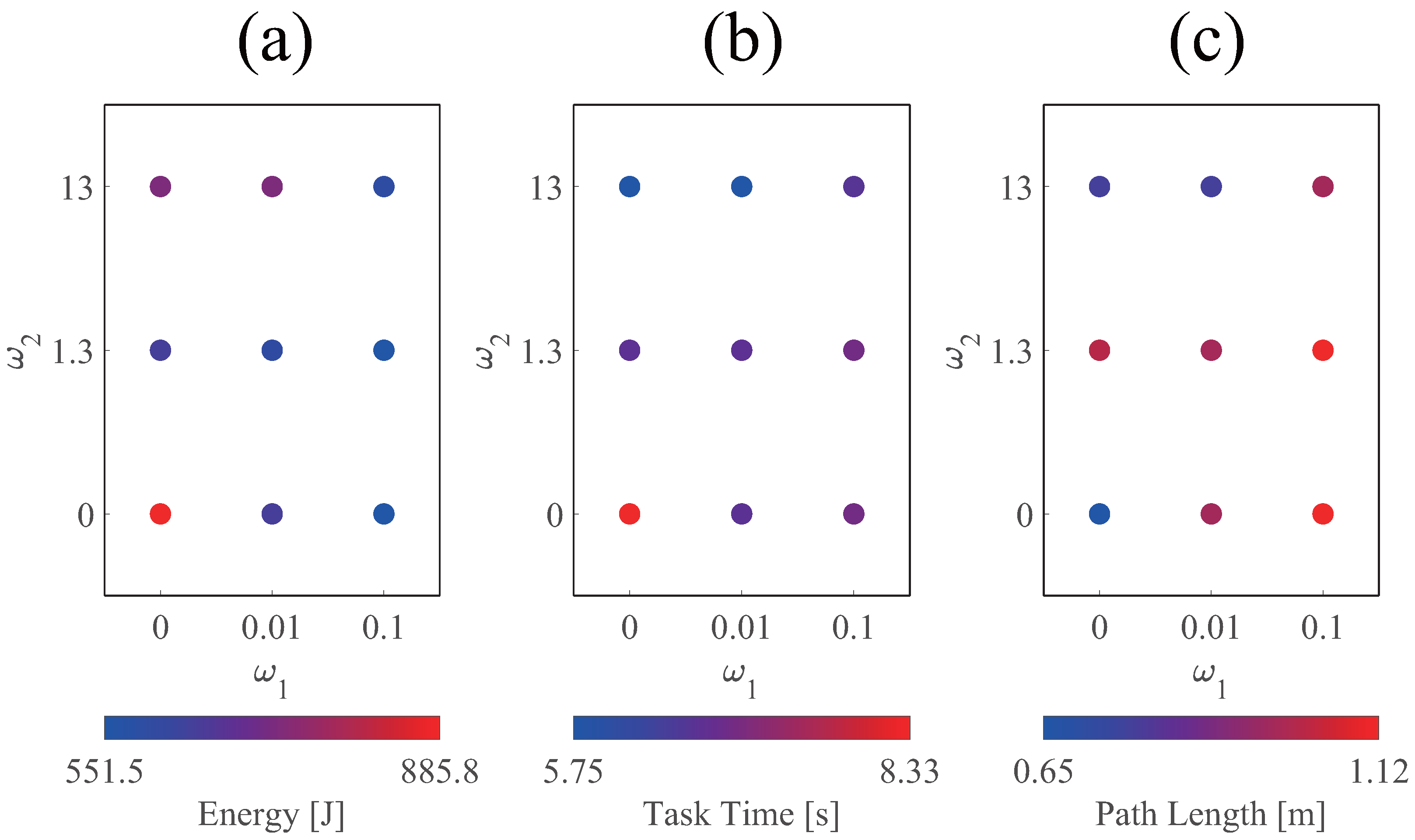
Figure 10 shows the energy consumption, task time, and path length for each combination of
on the horizontal axis and
on the vertical axis. Note that, under this condition,
, and the other parameters are the same as those in Case 1-1. When
is increased, as shown in
Figure 10a,c, the planner tends to select a detour route that reduces energy consumption at the expense of a longer path length. On the other hand, when
is increased, as shown in
Figure 10b, a trajectory that minimizes task time tends to be selected. In addition, when (
,
) = (0, 0), the cost function consists only of the heuristic cost, and the resulting trajectory is almost a straight line. However, this route requires relatively large joint displacements at each node, so both the energy consumption and task time become the largest. In this example, the shorter route with pressure boosting is more efficient in terms of task time, whereas the detour route is more energy-efficient. Therefore, by adjusting these weights, the planner can select a trajectory according to the desired performance priority.
Next, we examined the effects of
and
. Using the parameters from Case 1-2 as a baseline, we varied each parameter independently. First, we show the results for
varied in the range of 6 to 30. When
is 25 or less, the shortest path similar to that in Case 1-2, shown in
Figure 5, is selected. On the other hand, when
exceeds 25, detour paths similar to Case 1-1 appear. When
is small, node travel time increases, leading to increased servo loss and a tendency for higher energy consumption. Therefore, solutions that suppress joint motion, even with some pressure boosting, are more likely to be selected. Conversely, when
is large, node travel time decreases, making detour paths without pressure boosting more likely to be selected. However, if
is excessively large, dynamic effects become significant, potentially deviating from the assumptions of this method. Next, we varied
in the range of 0 to 20. The weighting coefficient
contributes to suppressing the number of mode switches. As a result, when
is 16 or greater,
becomes dominant, and a path similar to Case 1-1 is selected. This is because selecting a detour route allows most of the motion to remain in N-mode, thereby minimizing the number of mode switches.
Finally, the effects of changing the MP pressure are described as follows. Under the conditions of Case 1-1, when the MP pressure was set to 2.5 MPa and 10 MPa, only the boosting mode and N-mode were selected, respectively, and the robot reached the goal along the shortest path. The energy consumption was 1054 J and 1011 J, respectively. In both cases, the energy efficiency was lower than that in Case 1-1. This is due to the effect of SP efficiency degradation in the case of 2.5 MPa and the effect of throttling loss in the case of 10 MPa. These results indicate that and the MP set pressure also affects trajectory planning. Therefore, methods that can optimize the trajectory while including these parameters should be considered in future work.
3.5. Discussion
In Case 1, energy consumption was considerably reduced by selecting a detour trajectory that stays in N-mode. Moreover, as Case 2 shows, when negative loads can be exploited, the N-mode is actively selected. In Case 3, even in the energy-optimal trajectory, a detour is not always chosen; instead, depending on the goal position (Case 3-2), the robot reaches the goal along a near-shortest path while using the high-pressure mode. In Case 4, a comparison was made with the previous method [
18]. While the proposed method can maximize the size of the manipulability polytope, energy consumption may increase because joint motion also increases. In Case 5, it was confirmed that changes in the weight parameters of Equation (
8),
, and the MP set pressure result in trade-offs among energy efficiency, task efficiency, and the number of mode switches. On the other hand, the proposed method has several limitations.
A drawback of the proposed method is that posture selection relies strongly on the optimal posture table. For example, in Case 2-2, J2 and J3 move more than necessary during the swinging-down motion. Furthermore, a sudden change in J3 within a single node transition makes the node transition time unnecessarily long. Future work will be undertaken to explore methods that do not rely solely on the optimal posture table. In addition, because the proposed method performs manipulability-polytope optimization and energy optimization as separate processes, it cannot directly derive a trajectory that balances both objectives. In other words, while the method can select a trajectory while satisfying the given performance index (in this study, maximization of the manipulability polytope), it does not provide an optimization framework that simultaneously considers manipulability and energy. Moreover, the results of Case5 show that the trajectory planning results also depend on and the MP set pressure. Therefore, an integrated optimization method that also includes these parameters should be considered in future work.
Finally, we discuss the runtime of the proposed trajectory planning. All computations were performed on a PC equipped with an Intel Core Ultra 7 265K CPU and 32 GB of memory. For S2–S4, we measured the runtime using code generation. For all Cases 1–3, the computation time for S2–S4 was within . This computation time is sufficiently fast for quasi-static motions, indicating feasibility for real-time implementation.
5. Conclusions
In this paper, we presented examples of applying MHSB to PTP tasks for a redundant manipulator. These examples show that real-time trajectory planning is possible while considering the operating mode and posture.
In
Section 3, we used a three-link manipulator as a case study to examine various PTP tasks. The results demonstrate that the energy-optimal trajectory was chosen to reduce power consumption by reducing joint loads and exploiting negative loads, and the N-mode was selected whenever possible. We also confirmed that the shortest-time trajectory was selected using pressure boosting with the SPs, depending on the load conditions. The computation time for Cases 1–3 was within
. Furthermore, comparison with the conventional method demonstrated that the proposed method can perform path planning while considering manipulability. It was also shown that, by appropriately changing the parameters, the proposed method can select trajectories that reflect the trade-offs among energy efficiency, task time, and the number of mode switches.
As described in
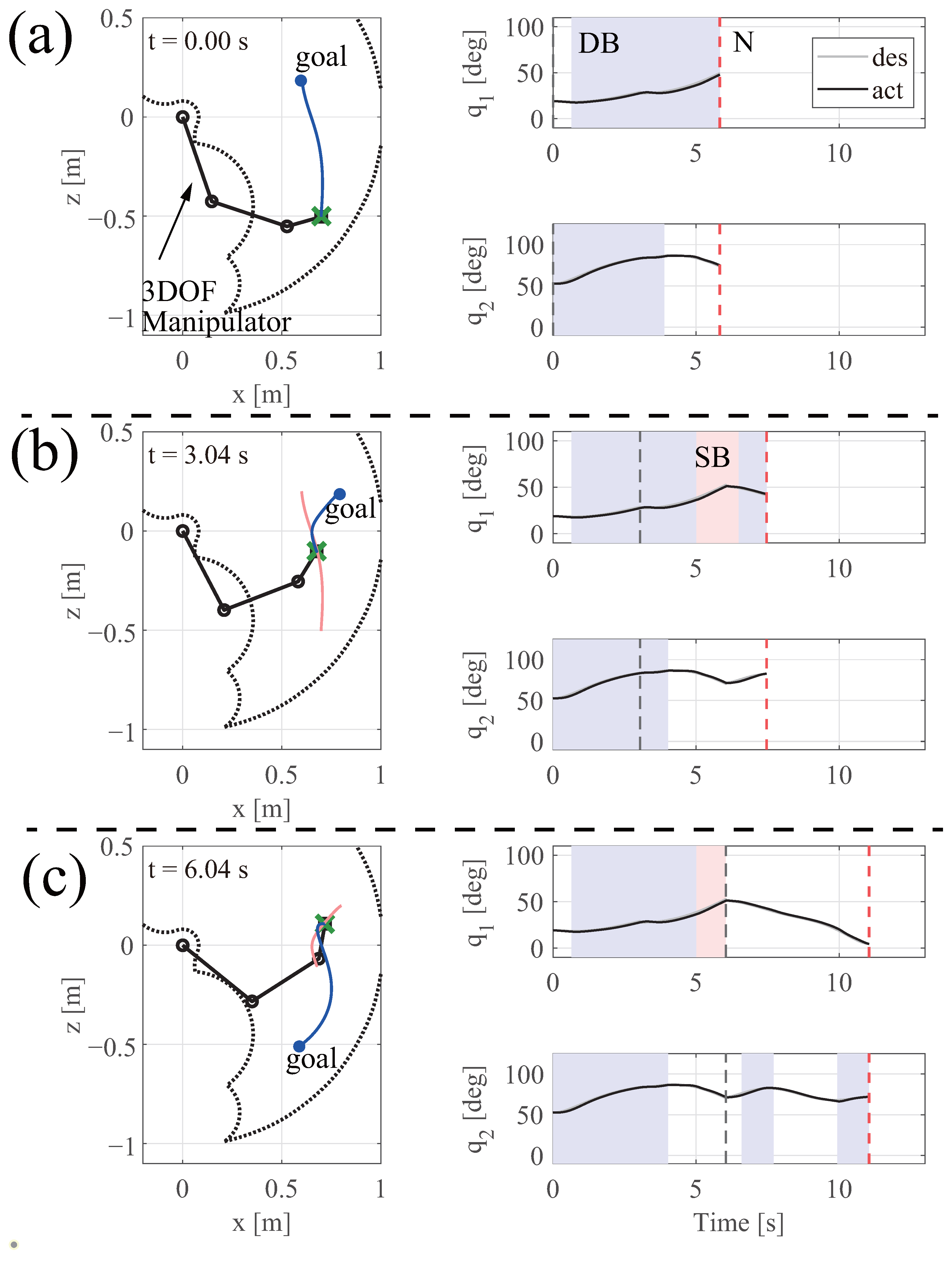
Section 4, we used a dynamic simulator for a three-link manipulator. We examined the behavior when the goal position was switched every
. The results show that the operating mode and trajectory can be recalculated quickly when the goal position changes. They also show that the joint trajectory can be tracked while using pressure boosting with the SPs as needed. However, because the coordinated control of the servo-valve and SP was insufficient, excessive internal pressure was observed immediately after trajectory replanning. This issue is attributable to the independent control of the servo-valve and SP. In future studies, we plan to improve the local control system.
A limitation of the proposed planning method is its strong dependence on the optimal posture table. Because postures corresponding to each operating mode and task-space target are predetermined, the method can yield unnecessary joint motions and unnecessarily long task durations in some cases. In addition, manipulability-polytope optimization and energy optimization are performed separately, and the present framework cannot directly derive trajectories that balance both objectives. Furthermore, the trajectory planning results also depend on and the MP set pressure. Therefore, constructing an integrated optimization method that includes these factors remains a challenge. In future studies, we will refine the method to reduce these limitations. We will also validate the proposed method through hardware experiments. Furthermore, we plan to extend the method to real-time trajectory planning while considering robot dynamics.