Article

Intelligent Multi-Objective Optimization of Structural Parameters for High-Frequency Ultrasonic Transducers


1
School of Physics and Electronic Science, Changsha University of Science and Technology, Changsha 410114, China
2
Hunan Provincial Key Laboratory of Grids Operation and Control on Multi-Power Sources Area, Shaoyang University, Shaoyang 422000, China
3
Hunan Province Higher Education Key Laboratory of Modeling and Monitoring on the Near-Earth Electromagnetic Environments, Changsha University of Science and Technology, Changsha 410114, China
*
Author to whom correspondence should be addressed.
Actuators 2026, 15(4), 191; https://doi.org/10.3390/act15040191
Submission received: 7 February 2026 / Revised: 24 March 2026 / Accepted: 28 March 2026 / Published: 31 March 2026

Abstract

The detection of micro-defects within cemented carbides necessitates a high-frequency, high-sensitivity ultrasonic non-destructive testing transducer (UNDTT), whose performance is highly sensitive to geometric structural parameters. Conventional design approaches rely heavily on empirical trial-and-error, resulting in low efficiency and difficulty in achieving globally optimal solutions. To address this limitation, an intelligent multi-objective optimization method is proposed for transducer structural parameters—namely, radius, matching layer thickness, and backing layer thickness—to simultaneously maximize sensitivity ( V p p ), center frequency ( f c ), and bandwidth (BW). By investigating the relationship between structural parameters and performance metrics, a dataset was constructed and used to develop a convolutional neural network (CNN) surrogate model that captures their nonlinear mapping. The CNN was integrated with the NSGA-III multi-objective optimization algorithm to iteratively generate a Pareto-optimal solution set, from which the best design was selected using the entropy-weighted Technique for Order Preference by Similarity to an Ideal Solution (TOPSIS). Finite element analysis (FEA) validation confirmed prediction errors below 7.0%. Compared to conventional designs, the proposed approach delivers a 46.1% higher sensitivity and a 7.7% broader bandwidth while maintaining a thinner matching layer. These results confirm the effectiveness and practical advantage of the proposed framework. This data-driven approach offers an efficient alternative for designing a high-performance UNDTT.

1. Introduction

Cemented carbides are widely used in cutting tools and wear-resistant components, where internal micro-defects pose serious threats to structural reliability [1,2,3,4]. Ultrasonic testing for such materials must fully consider their unique acoustic response characteristics: fine WC grains constitute strong scattering sources, causing severe attenuation of high-frequency acoustic energy and enhanced structural noise, which can easily mask signals from dangerous defects such as micro-cracks; the longitudinal wave velocity reaches as high as 6800 m/s, requiring frequencies around 10 MHz for detecting sub-millimeter defects, while higher frequencies introduce greater attenuation; furthermore, the primary failure mode is sudden brittle fracture, demanding the inspection system to possess high resolution and wide bandwidth (short pulse) for precise localization of internal defects [5,6,7]. Conventional commercial transducers cannot simultaneously achieve high frequency, high sensitivity, and wide bandwidth, necessitating specialized transducer design and optimization targeting the acoustic characteristics of cemented carbides. Transducer geometric parameters (radius, matching layer, and backing layer thicknesses) directly determine the efficiency of acoustic wave generation, propagation, and reception. Therefore, establishing an efficient transducer design method oriented toward the load characteristics of cemented carbides and systematically searching for optimal structural parameters holds significant theoretical importance and engineering application value.
Currently, transducer design relies heavily on classical physical models and empirical expertise. Equivalent circuit models, such as the Mason model and Krimholtz–Leedom–Mattaei (KLM) model [8,9,10], serve as classical analytical tools for characterizing electromechanical behavior. These models effectively reveal the mapping between design parameters and performance metrics. For instance, extended Mason-based studies have been applied to optimize matching layer designs and synergistically tune layer thickness, impedance, and bandwidth in high-frequency transducers [11,12,13]. Similarly, KLM-based approaches have enabled bandwidth expansion, pulse response optimization, and enhanced electroacoustic conversion efficiency [14,15,16].
FEA, leveraging its capacity to handle complex geometries and boundary conditions, has emerged as a powerful tool for transducer refinement. Commercial software platforms—COMSOL Multiphysics, PZFlex, ABAQUS, and ANSYS—are widely employed to simulate multi-physics behaviors of transducers [7,17,18,19,20,21,22]. Researchers have utilized these tools for multi-objective optimization of structural configurations (e.g., tonpilz-type transducers, PMUT array backing layers), composite material parameters (e.g., kerf width and depth), and overall designs, significantly enhancing bandwidth, sensitivity, and transmit-receive responses.
Despite these advancements, traditional design methodologies—relying on analytical models and iterative experimental validation—struggle to rapidly and accurately capture complex nonlinear relationships between design variables and performance metrics. This process demands extensive prior knowledge, repeated trials, and parameter adjustments, resulting in prolonged development cycles. Moreover, limited experimental iterations hinder comprehensive exploration of expansive design spaces, often precluding globally optimal solutions. Recently, artificial intelligence (AI) has demonstrated remarkable potential in addressing complex nonlinear mappings across industrial applications [23,24,25,26,27,28]. Integrating data-driven intelligent optimization algorithms into transducer design offers a promising avenue to establish an efficient, automated geometric optimization framework, significantly improving performance and reducing development time.
This study proposes a multi-objective optimization framework for a UNDTT based on intelligent algorithms, aiming to achieve high-performance designs efficiently. The methodology integrates FEA, CNN, multi-objective evolutionary algorithms, and decision-making evaluation models. Finally, the feasibility and efficacy of the proposed framework were validated through finite element simulations, comparing optimized designs against baseline models.

2. FEA of UNDTT

COMSOL Multiphysics, renowned for its exceptional multi-physics coupling capabilities and robust post-processing tools, has been widely applied in transducer design [29,30,31,32]. In this study, FEA was conducted on a UNDTT. A pulse-echo analysis model was established to investigate the effects of varying design parameters on transducer performance metrics, including sensitivity (Vpp), center frequency (fc), and bandwidth (BW).
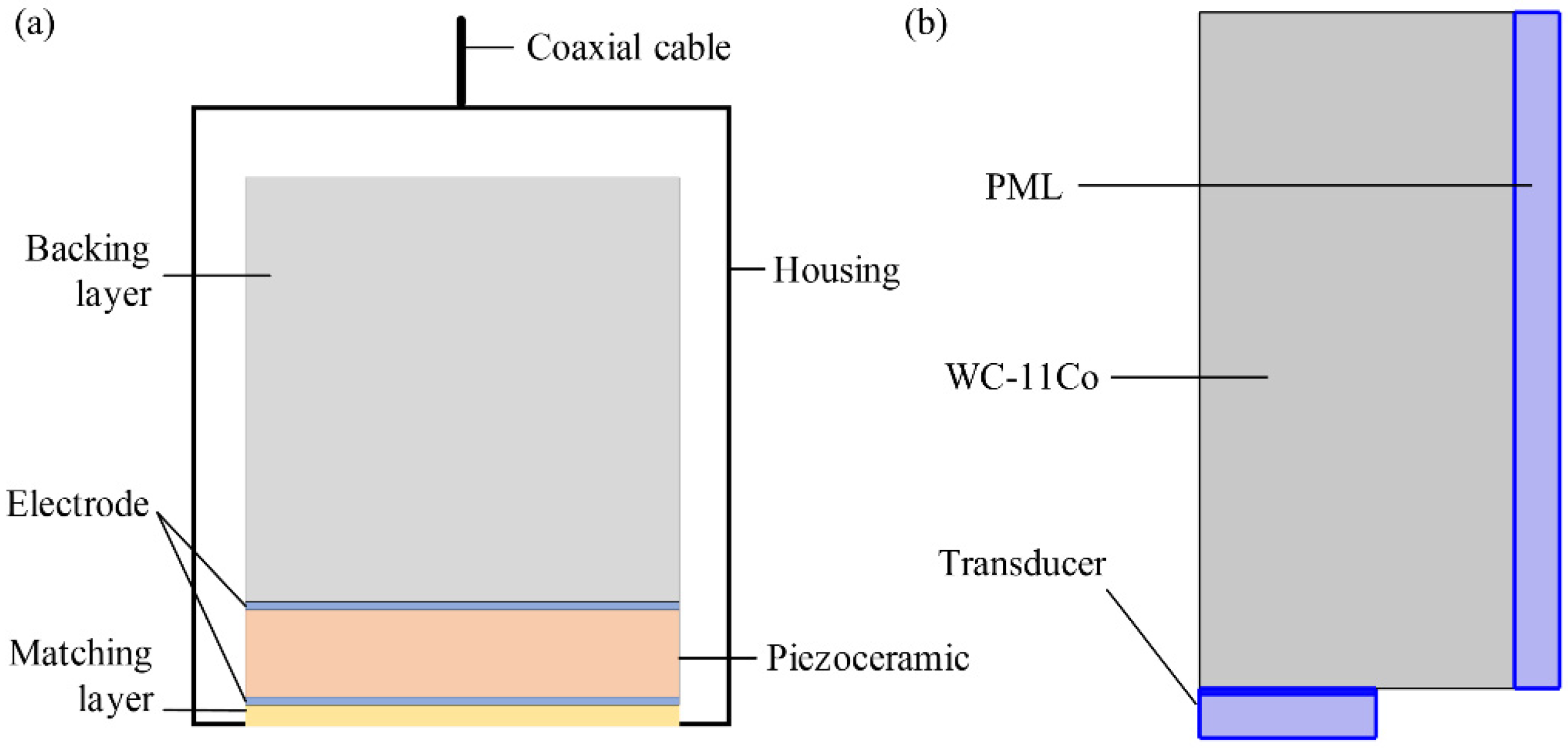
The transducer comprises a piezoelectric element, an acoustic matching layer, a backing layer, electrodes, lead wires, and an outer casing. In preliminary research, collaborative optimization of multi-component materials for the transducer was conducted, wherein the PMN-29PT/gold/epoxy configuration demonstrated the best comprehensive performance. Therefore, the materials for the three components of the transducer in this paper adopt this scheme. Figure 1a shows its longitudinal cross-section schematic, where PMN-29PT [33] is selected for the piezoelectric material, gold is used for the matching layer, and epoxy [34] is employed for the backing layer. The material properties are detailed in Table 1 (piezoelectric parameters) and Table 2 (passive material parameters).
The finite element model for pulse-echo analysis, as shown in Figure 1b, adopts a 2D axisymmetric configuration to reduce computational complexity. The bottom blue region represents the transducer, while the upper region represents the load material WC-11Co [35]. A Perfectly Matched Layer (PML) is set on the right boundary to simulate an infinite domain in the time domain. By combining transient analysis of solid mechanics, electrostatics, and circuit physics, sensitivity, bandwidth, and center frequency are quantified. In the finite element model of this study, the effects of transducer electrodes and housing are neglected. All components are assumed to behave as linear isotropic materials with ideal electrical contact and perfectly bonded interfaces, while thermal effects and nonlinear effects are also ignored. Regarding meshing, a mapped mesh is adopted for the piezoelectric layer and matching layer, while a triangular mesh is used for the load material and backing layer. To achieve optimal simulation efficiency, a trade-off between numerical accuracy and computational complexity was made. Through verification by refining mesh size and reducing time step, the maximum mesh size was set to no more than 1/5 of the wavelength, and the transient time step was adopted as T/40.
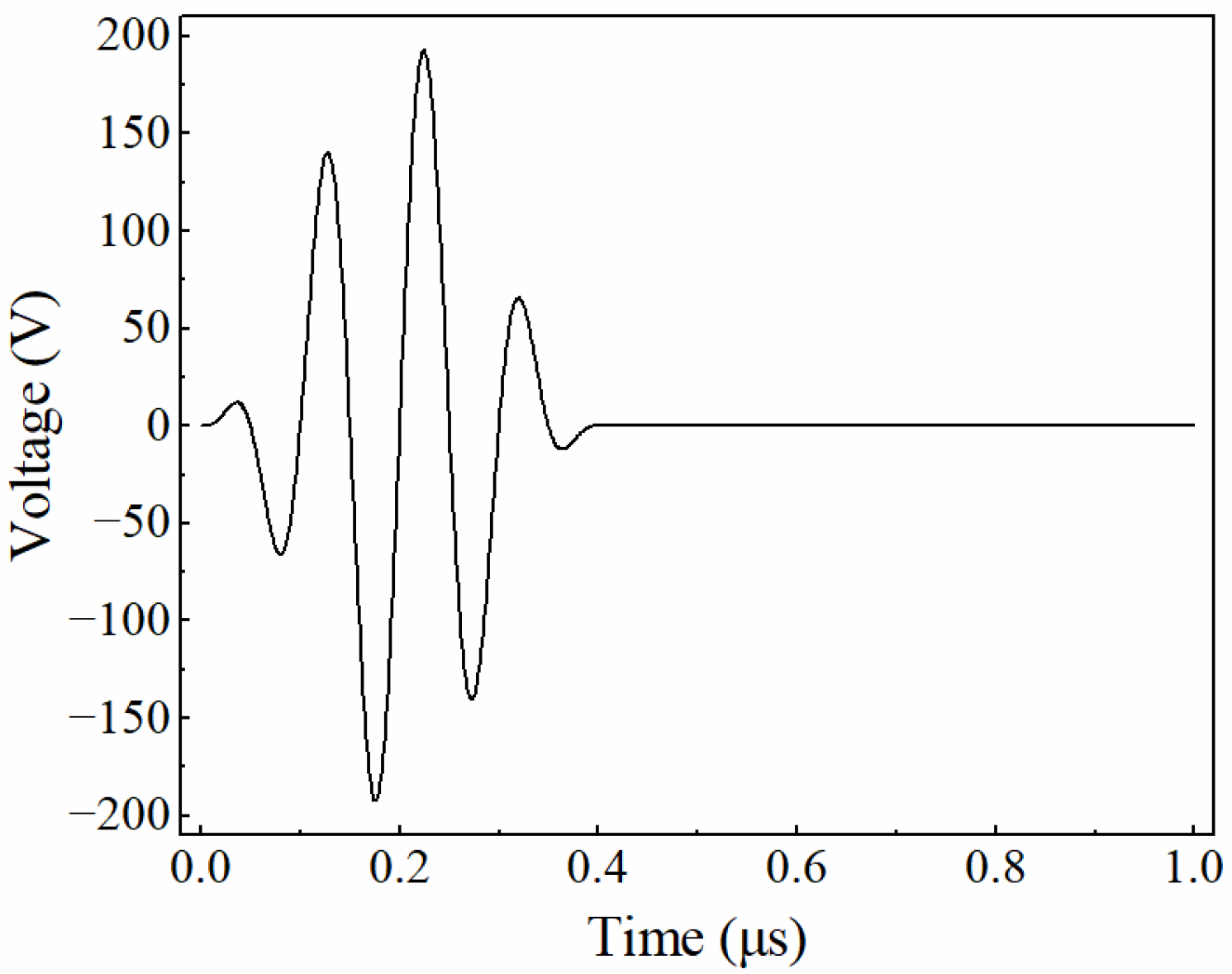
The pulse-echo simulation required an excitation signal defined by Equation (1):
A ( t ) = 100 sin ( 2 π f t ) 1 cos π f t 2 V ( 0 t 4 T )
where f is the operating frequency, and T is the sine wave period (Figure 2).
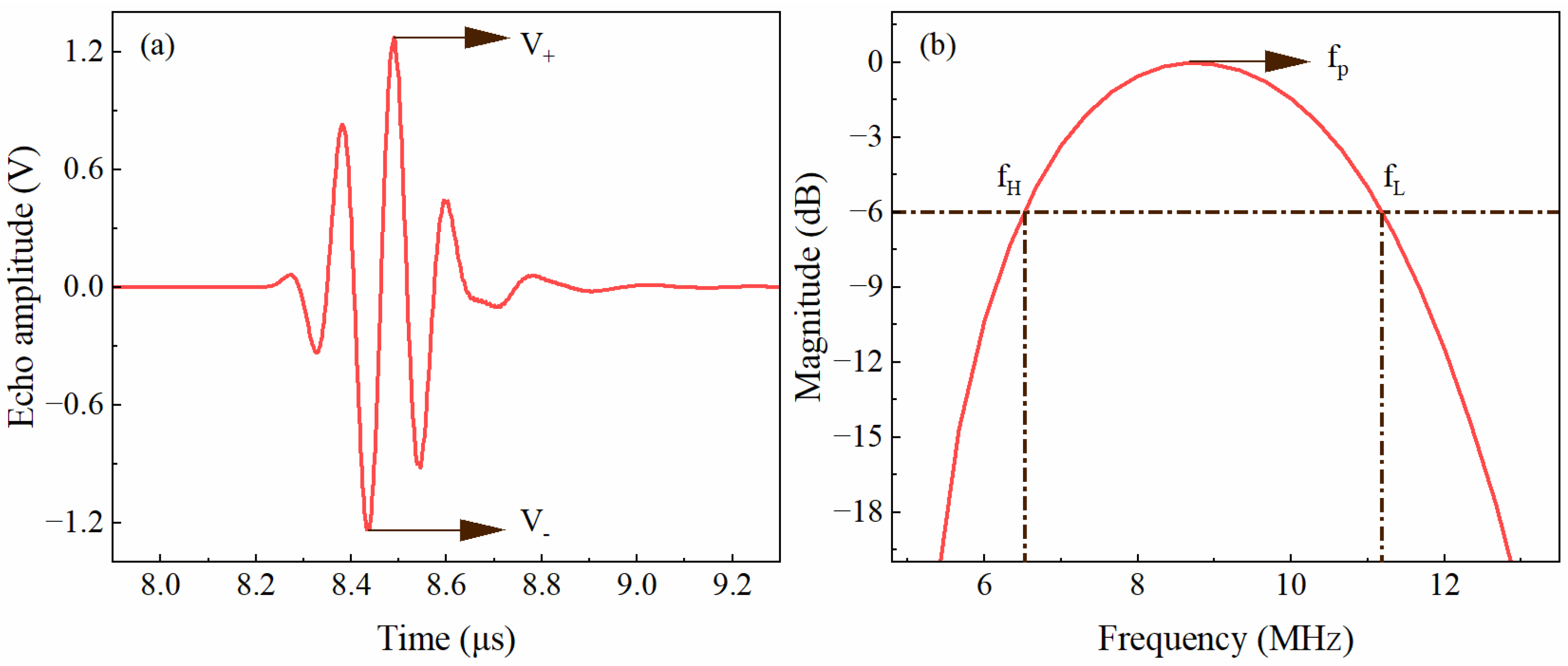
In the pulse-echo finite element model, the transducer is excited by applying a pulse signal, causing it to radiate ultrasonic pulses into the load medium. The first echo signal received by the same transducer constitutes the pulse-echo response, with its time-domain waveform and corresponding frequency-domain response shown in Figure 3a,b, respectively. Based on the time-domain waveform and frequency-domain response, the three performance indicators studied in this paper can be obtained, namely, sensitivity (Vpp), center frequency (fc), and bandwidth (BW).
In the time-domain response shown in Figure 3a, the peak-to-peak voltage of the echo signal is defined as the sensitivity Vpp = V+ − V−. This parameter directly characterizes the detection capability of the transducer: higher sensitivity means the transducer can achieve greater detection depth, wider coverage, and help improve imaging contrast and clarity.
Fast Fourier Transform (FFT) is applied to the time-domain signal to obtain its frequency-domain response, as shown in Figure 3b. The frequency with the maximum echo response is denoted as fp. Based on the frequencies f1 and f2 corresponding to the echo response dropping to half of the maximum value (i.e., −6 dB), the center frequency fc and relative bandwidth BW of the transducer are defined as follows:
f c = f H + f L 2 , B W 6 dB = f H f L f c × 100 %
The detectability of defects is closely related to the operating frequency of the transducer. According to diffraction theory, when the defect size is less than half of the wavelength in the medium (λ/2), ultrasonic waves will primarily undergo diffraction and bypass the defect, resulting in missing echo signals that cannot be identified. From λ = C/f (where C is the sound velocity in the medium), it can be seen that increasing the operating frequency can effectively enhance the detection capability for small-sized defects. On the other hand, the bandwidth of the transducer determines the range of effective frequency components it can receive. The axial resolution d can be approximately expressed as d = λ/(2 × BW), meaning that at a certain center frequency, the larger the bandwidth, the smaller the axial resolution value, which indicates higher imaging quality.
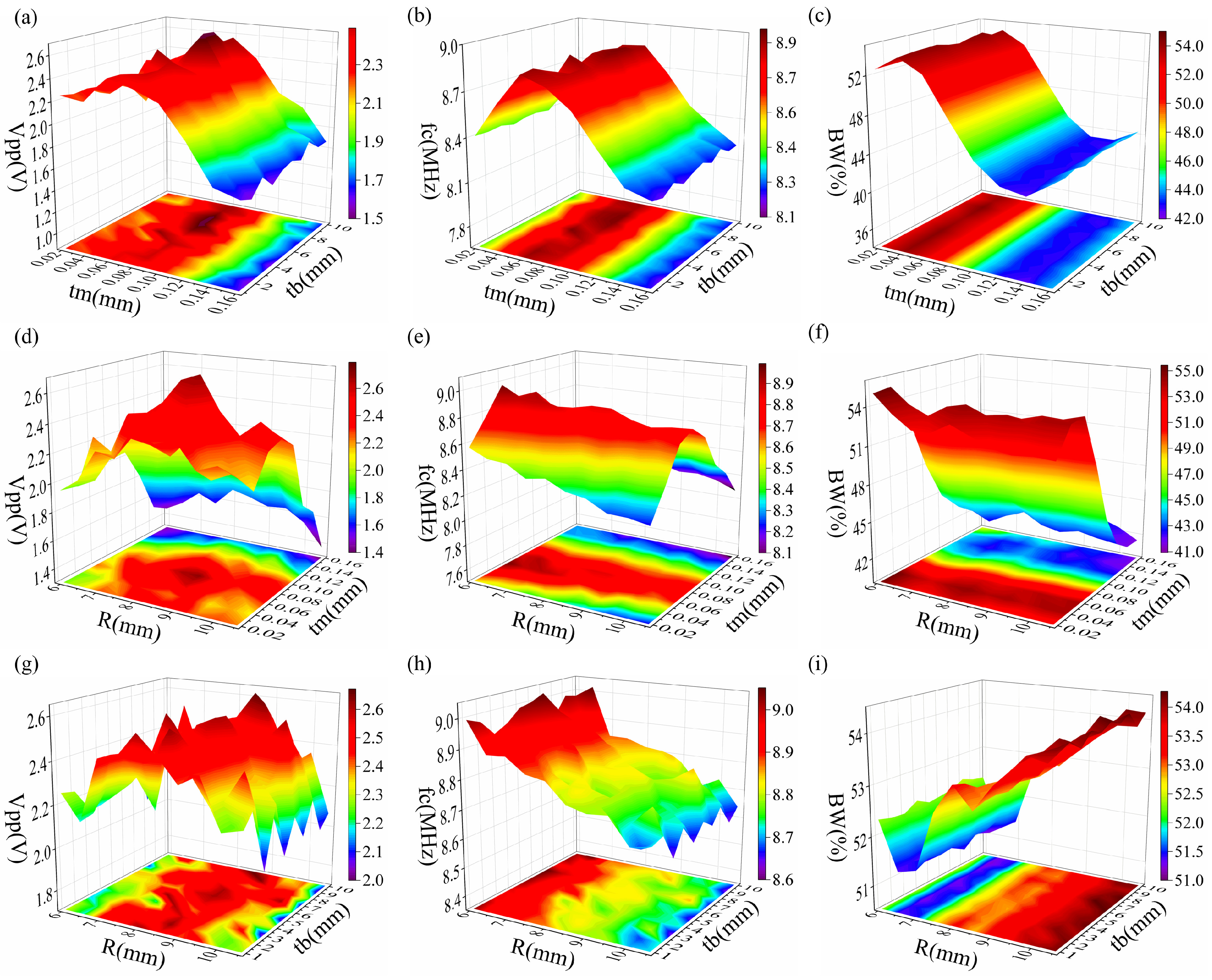
The performance indicators of the transducer can be directly acquired from the pulse-echo simulation model when the structural parameters are provided as inputs. Figure 4 illustrates the influence of transducer structural parameters on performance indicators. Specifically, Figure 4a–c show the effects of matching layer and backing layer thickness on sensitivity Vpp, center frequency fc, and bandwidth BW when the transducer radius is fixed at 7.5 mm; Figure 4d–f depict the effects of transducer radius and matching layer thickness on the aforementioned performance indicators when the backing layer thickness is fixed at 2 mm; Figure 4g–i present the effects of transducer radius and backing layer thickness on each performance indicator when the matching layer thickness is fixed at 0.06 mm. In all figures, redder colors indicate larger values of the relevant performance indicators, bluer colors indicate smaller values, and yellow-green colors represent medium values. As observed, each performance indicator exhibits significant nonlinearity and multi-peak characteristics with changes in design parameters, with multiple local optima existing. It is particularly noteworthy that the variation of sensitivity Vpp with structural parameters (Figure 4a,d,g) is more complex compared to center frequency fc (Figure 4b,e,h) and bandwidth BW (Figure 4c,f,i), demonstrating stronger nonlinearity and parameter coupling. This complex mapping relationship makes it difficult for traditional trial-and-error methods or single-variable parameter scanning to efficiently locate the global optimal solution. The aforementioned complexity highlights the critical need for establishing an intelligent optimization framework to achieve a global optimal transducer design.

3. Intelligent Optimization Method for UNDTT

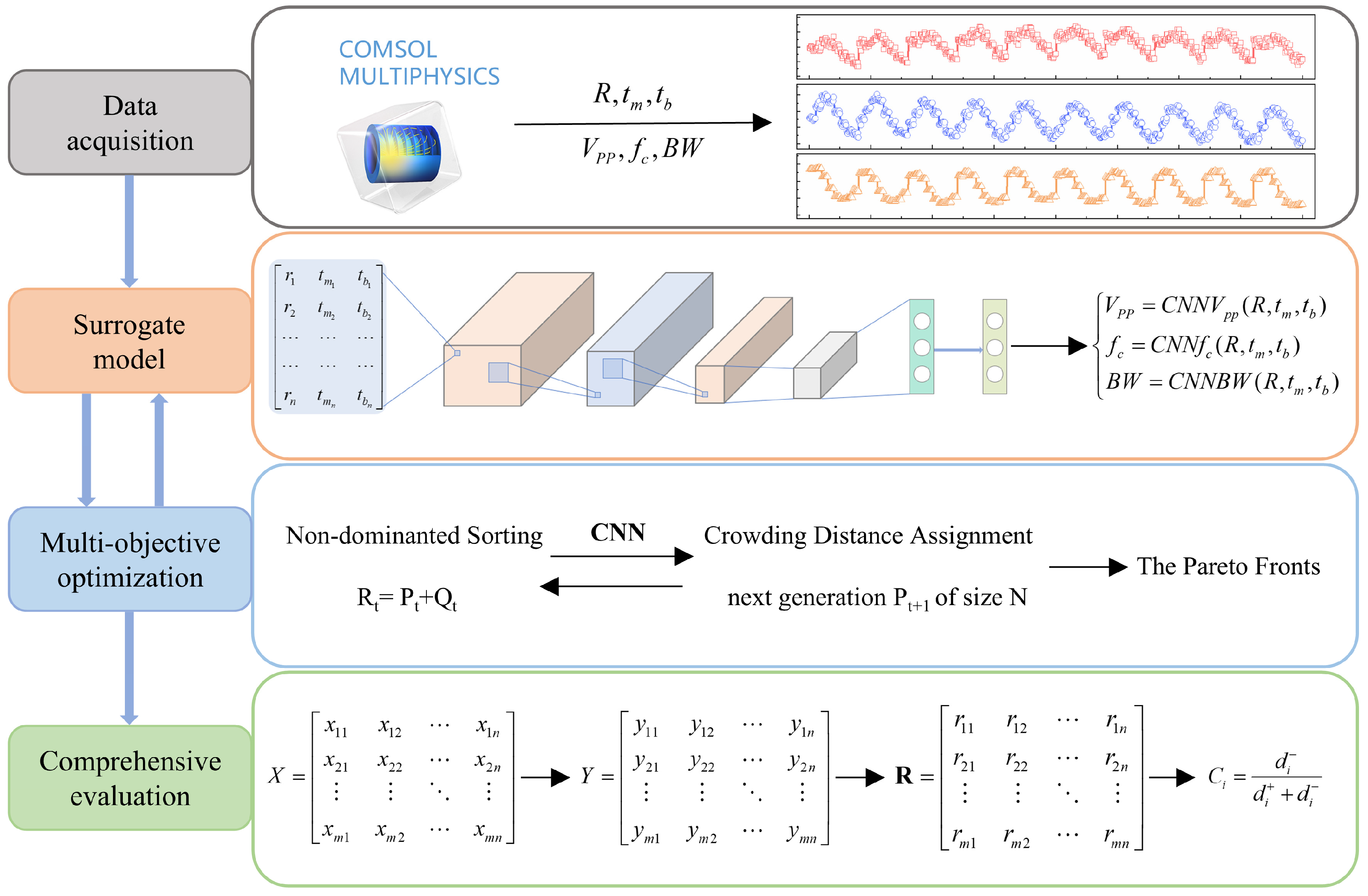
Given the nonlinear and complex relationships between geometric parameters and transducer performance, an intelligent optimization framework combining FEA and artificial intelligence (AI) was developed for a cemented carbide UNDTT. In this study, the transducer radius, matching layer thickness, and backing layer thickness were selected as design parameters, while sensitivity (Vpp), center frequency (fc), and bandwidth (BW) were defined as performance metrics. The flowchart of the proposed intelligent optimization method for cemented carbide transducers is illustrated in Figure 5. The optimization process consists of four sequential stages:
Step 1: Data Acquisition. Raw data were generated via COMSOL simulations. During this phase, the design parameters included the piezoelectric element radius, matching layer thickness, and backing layer thickness. The corresponding performance metrics extracted from the simulations comprised sensitivity, center frequency, and bandwidth.
Step 2: Surrogate Model Construction. To establish the nonlinear mapping between design parameters and performance metrics, a CNN-based surrogate model was constructed. The transducer design parameters (e.g., radius, matching/backing layer thicknesses) were assigned as inputs, while the performance metrics (sensitivity, bandwidth, and center frequency) served as outputs of the surrogate model.
Step 3: Multi-Objective Optimization. To identify transducer designs achieving optimal trade-offs among multiple performance criteria, the Non-Dominated Sorting Genetic Algorithm III (NSGA-III) was employed. Within the specified design parameter ranges, NSGA-III iteratively evaluated the surrogate model to compute and rank the three performance metrics. After multiple iterations, the Pareto front—a set of non-dominated optimal solutions—was obtained.
Step 4: Comprehensive Performance Evaluation. To select the transducer with the best overall performance from the Pareto front, the entropy-weighted TOPSIS method was applied. This decision-making model ranked the Pareto-optimal solutions by quantifying their relative closeness to an ideal reference point, ultimately identifying the design with superior comprehensive performance.

3.1. CNN Surrogate Model

FEA of the transducer model is inherently limited in scope as it is computationally prohibitive to simulate all possible geometric configurations within the design parameter space. Instead of relying solely on resource-intensive simulations, a surrogate model trained on a relatively small dataset can efficiently establish the nonlinear mapping between transducer geometry and performance metrics, significantly reducing computational costs and accelerating the design process.
Given the complex nonlinear interactions between transducer performance and geometric parameters, the CNN’s convolutional operations can capture interaction effects between parameters across different dimensions, whereas the Fully Connected Neural Network (MLP) requires large amounts of data to learn implicitly, Gaussian Process Regression (GPR) cannot leverage shared physical features among indicators, and Response Surface Methodology (RSM) can only preset specific forms of interaction terms. For future research, if extended to more design parameters (such as piezoelectric material thickness, electrode dimensions, and multiple matching layers), the input dimensionality will increase significantly, and the CNN architecture naturally supports high-dimensional input expansion. Therefore, we selected the CNN as the surrogate model.
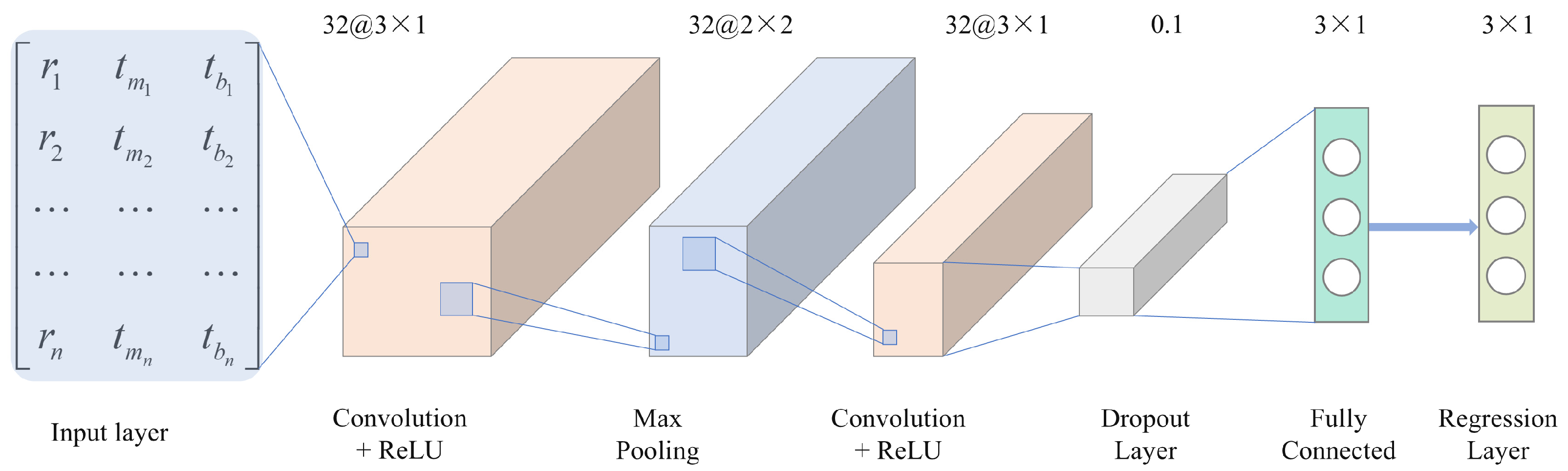
In this study, a CNN-based surrogate model was implemented. The network architecture, illustrated in Figure 6, comprises nine layers:
Input Layer: Accepts the design parameter dataset (transducer radius, matching/backing layer thicknesses).
Convolutional and ReLU Layers (Layers 2–3): Two sequential layers with 32 filters using 3 × 1 convolution kernels followed by ReLU activation functions.
Pooling Layer (Layer 4): A max-pooling layer with a 2 × 1 window to reduce spatial dimensionality.
Convolutional and ReLU Layers (Layers 5–6): Additional convolutional layers with 32 filters (3 × 1 kernels) and ReLU activation.
Dropout Layer (Layer 7): A 1 × 1 × 32 dropout layer with a 50% retention rate to mitigate overfitting.
Fully Connected Layer (Layer 8): A 3 × 1 × 1 dense layer for high-level feature integration.
Output Layer (Layer 9): A regression layer predicting the performance metrics (sensitivity, bandwidth, and center frequency).
The CNN surrogate model was trained using the stochastic gradient descent with momentum (SGDM) optimizer, with a batch size of 32, a maximum training epoch count of 1000, and an initial learning rate of 0.1 (decaying to 0.001 after 800 iterations). The training data were randomly shuffled to enhance generalization. The prediction accuracy of the surrogate model was quantified using the root mean square error (RMSE) between simulated and predicted performance metrics.

3.2. NSGA-III Multi-Objective Optimization

While the CNN surrogate model can predict performance metrics for transducers of arbitrary dimensions, identifying optimal solutions through trial-and-error remains inefficient. To address this challenge, multi-objective optimization enables automated exploration of the solution space, generating a Pareto front that represents non-dominated trade-off solutions. The Non-Dominated Sorting Genetic Algorithm III (NSGA-III) leverages a reference-point mechanism to filter Pareto-optimal non-dominated solutions, offering distinct advantages in high-dimensional multi-objective optimization problems.
In this study, the geometric parameters of the transducer—radius (R), matching layer thickness (tm), and backing layer thickness (tb)—were optimized simultaneously. The objective functions included sensitivity (Vpp), center frequency (fc), and bandwidth (BW), as formulated in Equation (3):
M i n i m i z e   F ( R , t m , t b ) = V P P = C N N V p p ( R , t m , t b ) f c = C N N f c ( R , t m , t b ) B W = C N N B W ( R , t m , t b ) S . t . 6 R 10.5 , 0.02 t m 0.16 , 1 t b 10
In Equation (3), Vpp represents sensitivity; a higher value indicates better electro-acoustic conversion efficiency of the transducer. fc is defined as the center frequency; a higher frequency enables the resolution of smaller internal defects in cemented carbide. BW denotes the −6 dB relative bandwidth; a wider bandwidth implies higher resolution. The terms CNNVpp, CNNfc, and CNNBW in the equation represent the trained CNN surrogate models. Their inputs are the geometric parameters of the transducer (radius R, matching layer thickness tm, and backing layer thickness tb), and their outputs are the predicted values of the corresponding performance indicators. In the optimization process, minimizing −CNNVpp, −CNNfc, and −CNNBW achieves the maximization of the three performance parameters.
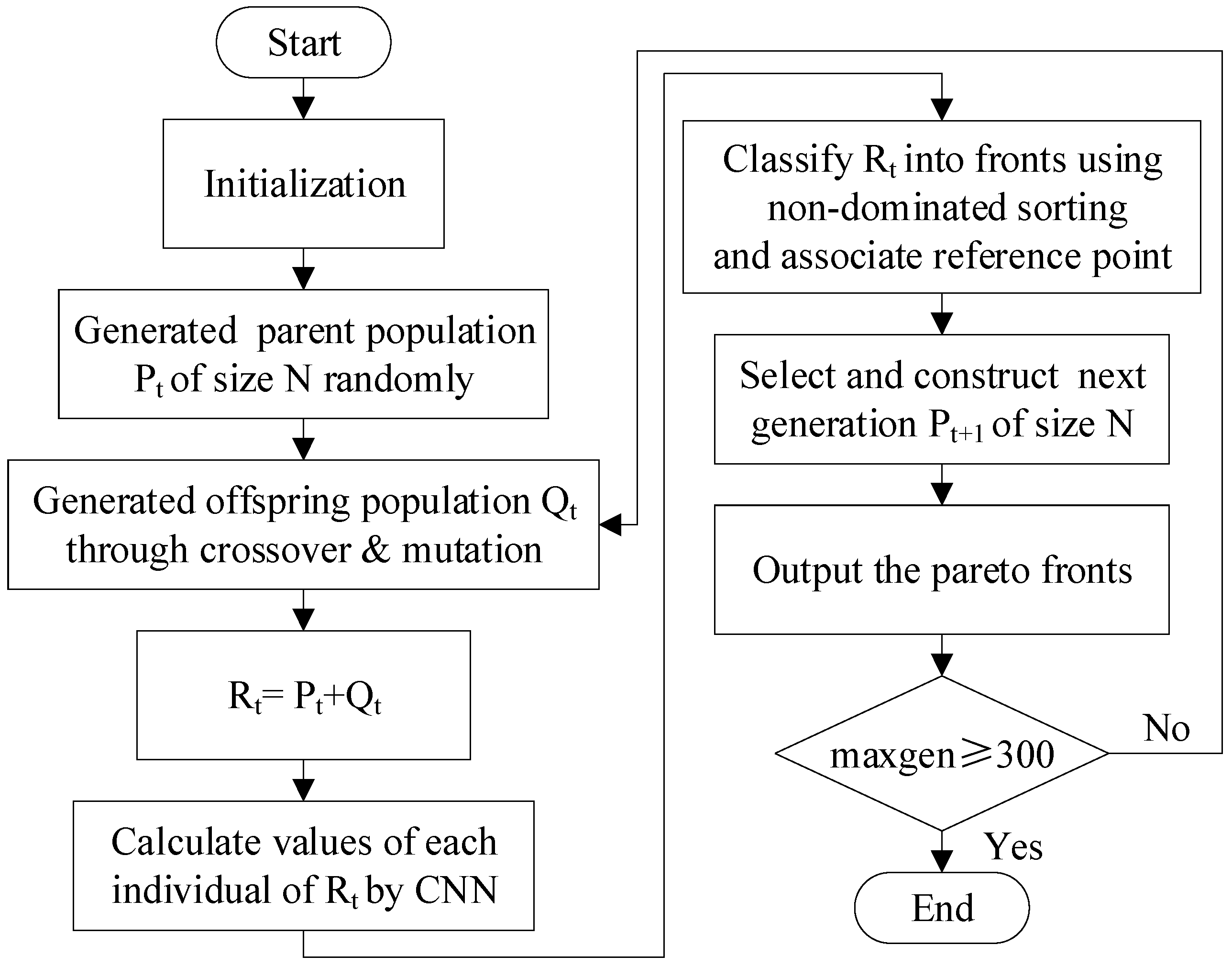
In this study, the NSGA-III algorithm was employed to search for Pareto-optimal solutions within the transducer geometric parameter space (R, tm, tb). NSGA-III is a multi-objective evolutionary algorithm developed based on the NSGA-II framework. Its core innovation lies in replacing the crowding distance mechanism with a reference-point-based selection strategy, thereby effectively maintaining population diversity in high-dimensional objective spaces. The main algorithm parameters were configured as follows: population size of 300, maximum number of generations of 300, distribution index of 20 for simulated binary crossover (SBX) with crossover probability of 0.7, and distribution index of 20 for polynomial mutation (PM) with mutation probability of 0.05. Reference points were generated using the Das and Dennis method, with each objective direction divided into 10 equal segments, yielding 66 reference points uniformly distributed across the three-dimensional objective space. The optimization workflow of NSGA-III is illustrated in Figure 7, with the detailed procedures described as follows:
Step 1: Population Initialization. An initial parent population is generated via random functions.
Step 2: Offspring Generation. New offspring populations are created through crossover and mutation operations.
Step 3: Population Merging. Parent and offspring populations are combined for evaluation.
Step 4: Objective Evaluation. The CNN surrogate model computes objective function values (Vpp, BW, and fc) for the merged population.
Step 5: Non-Dominated Sorting. Solutions are ranked based on dominance levels and associated with reference points to identify superior individuals.
Step 6: Iterative Refinement. A new population is constructed from non-dominated solutions. If the iteration count has not reached 300, the process returns to Step 2; otherwise, the algorithm terminates.
Throughout the optimization process, the CNN surrogate model is embedded into the main loop of NSGA-III as a fast performance evaluator. For each newly generated individual in every generation, the trained CNN model is directly invoked to predict its performance metrics, enabling efficient multi-objective design space exploration. This systematic approach ensures efficient convergence towards the Pareto front, thereby providing data-driven decision support for transducer design optimization.

3.3. Entropy-Weighted TOPSIS for Comprehensive Evaluation

The entropy-weighted TOPSIS method is a multi-attribute decision-making approach that combines the entropy weight method with the TOPSIS method [36]. It is primarily used to rank or select optimal alternatives with multiple evaluation criteria. The core idea of this method is to objectively determine the weights of each criterion using the entropy weight method based on the dispersion degree of the indicator data and then apply the TOPSIS method to rank the alternatives by calculating their distances to the positive and negative ideal solutions, thereby achieving a scientific evaluation of multiple candidate alternatives [37]. The complete evaluation procedure of the entropy-weighted TOPSIS method proceeds from constructing the original data matrix, through data normalization, entropy weight calculation, construction of the weighted normalized matrix, determination of the positive and negative ideal solutions, calculation of Euclidean distances, and finally computation of the relative closeness for ranking [38]. The detailed implementation steps in this study are as follows:
Step 1: Normalization of Performance Metrics. Suppose there are m alternatives for transducer performance evaluation (i = 1, 2, …, m), and each alternative has n evaluation parameters (j = 1, 2, …, n). Since the NSGA-III multi-objective algorithm is configured with 300 individuals, each alternative has three evaluation parameters; thus, m = 300 and n = 3. Based on the actual data, the characteristic matrix X can be constructed as
X = x 11 x 12 x 1 n x 21 x 22 x 2 n x m 1 x m 2 x m n
To eliminate discrepancies caused by differing units and scales across criteria, data normalization is essential [39]. Since all three performance indicators are benefit-type (i.e., higher values indicate better performance), the normalized value y i j is computed using Equation (5):
y i j = x i j x i j min x i j max x i j min
This yields the standardized decision matrix Y = [ y i j ] m × n , as shown in Equation (6):
Y = y 11 y 12 y 1 n y 21 y 22 y 2 n y m 1 y m 2 y m n
Step 2: Determination of Objective Weights and Weighted Normalized Matrix [40]. The information entropy E j for the j -th criterion is calculated as
E j = ln 1 m i = 1 m ( Y i j / i = 1 m Y i j ) ln ( Y i j / i = 1 m Y i j )
The corresponding entropy weight w j is then obtained by
W j = ( 1 E j ) / j = 1 n ( 1 E j )
Using these weights, the weighted normalized decision matrix R = [ r i j ] m × n is constructed as
R = r 11 r 12 r 1 n r 21 r 22 r 2 n r m 1 r m 2 r m n
where r i j = W j × Y i j .
Step 3: Calculation of Relative Closeness to the Ideal Solution. The positive ideal solution Q j + and negative ideal solution Q j are defined as
Q j + = ( max r i 1 , max r i 2 , , max r i n ) Q j = ( min r i 1 , min r i 2 , , min r i n )
The Euclidean distances from each alternative i to Q j + and Q j are computed as
d i + = j = 1 ( Q j + r i j ) 2 d i = j = 1 ( Q j r i j ) 2
Finally, the relative closeness coefficient C i is given by
C i = d i d i + + d i
The relative closeness Ci ranges between 0 and 1. A larger Ci value indicates better overall performance of transducer i, whereas a smaller value indicates poorer overall performance. Therefore, the optimal transducer design can be selected based on the relative closeness values of the alternatives.

4. Results and Discussion

The finite element analysis (FEA), neural network surrogate model, and NSGA-III multi-objective optimization algorithm in this study were all performed on a workstation with the following configuration: Windows 10 Pro (64-bit) operating system, manufactured by Microsoft Corporation (Redmond, WA, USA). Intel® Core™ i7-12,700 processor (base frequency 2.1 GHz), manufactured by Intel Corporation (Santa Clara, CA, USA). NVIDIA GeForce RTX 3060 graphics card, manufactured by NVIDIA Corporation (Santa Clara, CA, USA). 32.0 GB RAM (31.7 GB available), manufactured by Kingston Technology Company, Inc. (Fountain Valley, CA, USA). During the experiments, the CNN construction scripts, NSGA-III optimization main program, data preprocessing functions, and visualization scripts were all implemented through self-programming in the interactive development environment of the Octave-9.1.0 platform.

4.1. Optimization Results

4.1.1. Dataset of Design Parameters and Performance Metrics

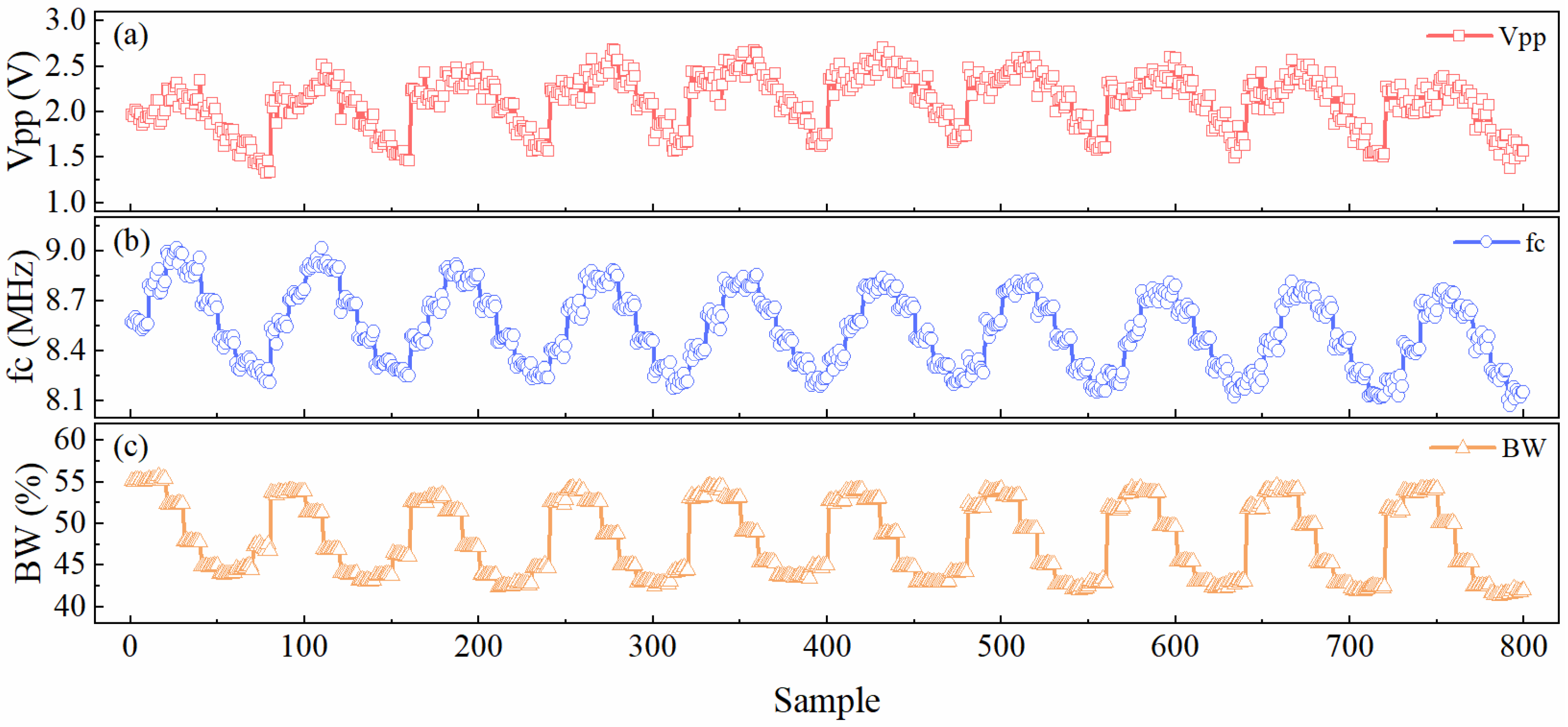
To construct the dataset for the CNN surrogate model and to investigate the influence of transducer structural parameters on performance metrics, full factorial sampling was performed within the defined ranges of the structural parameters: transducer radius ( R ): 6–10.5 mm (step size: 0.5 mm); matching layer thickness ( t m ): 0.02–0.16 mm (step size: 0.02 mm); backing layer thickness ( t b ): 1–10 mm (step size: 1 mm). A total of 800 transducer design schemes were obtained. For each design, finite element transient simulations were conducted to compute three performance metrics: sensitivity ( V p p ), center frequency ( f c ), and bandwidth ( B W ). Thus, a dataset consisting of the structural parameters and the corresponding three performance metrics for 800 transducer designs was established, as illustrated in Figure 8.
The dataset contains a one-to-one mapping between structural parameter schemes and performance metrics, which was subsequently used for training the CNN surrogate model. As shown in Figure 8, the sensitivity V p p ranges from approximately 1.4 V to 2.7 V, the center frequency f c varies between 8.1 MHz and 9.2 MHz, and the −6 dB fractional bandwidth ( B W ) ranges from 40% to 60%. Among these metrics, f c and B W exhibit relatively smooth and monotonic trends with respect to the geometric parameters, whereas V p p displays significantly more complex and nonlinear behavior, reflecting the intricate interactions among the design variables. This complexity underscores the necessity of employing a data-driven surrogate model to accurately capture the underlying input–output relationships.

4.1.2. Prediction Results of the Surrogate Model

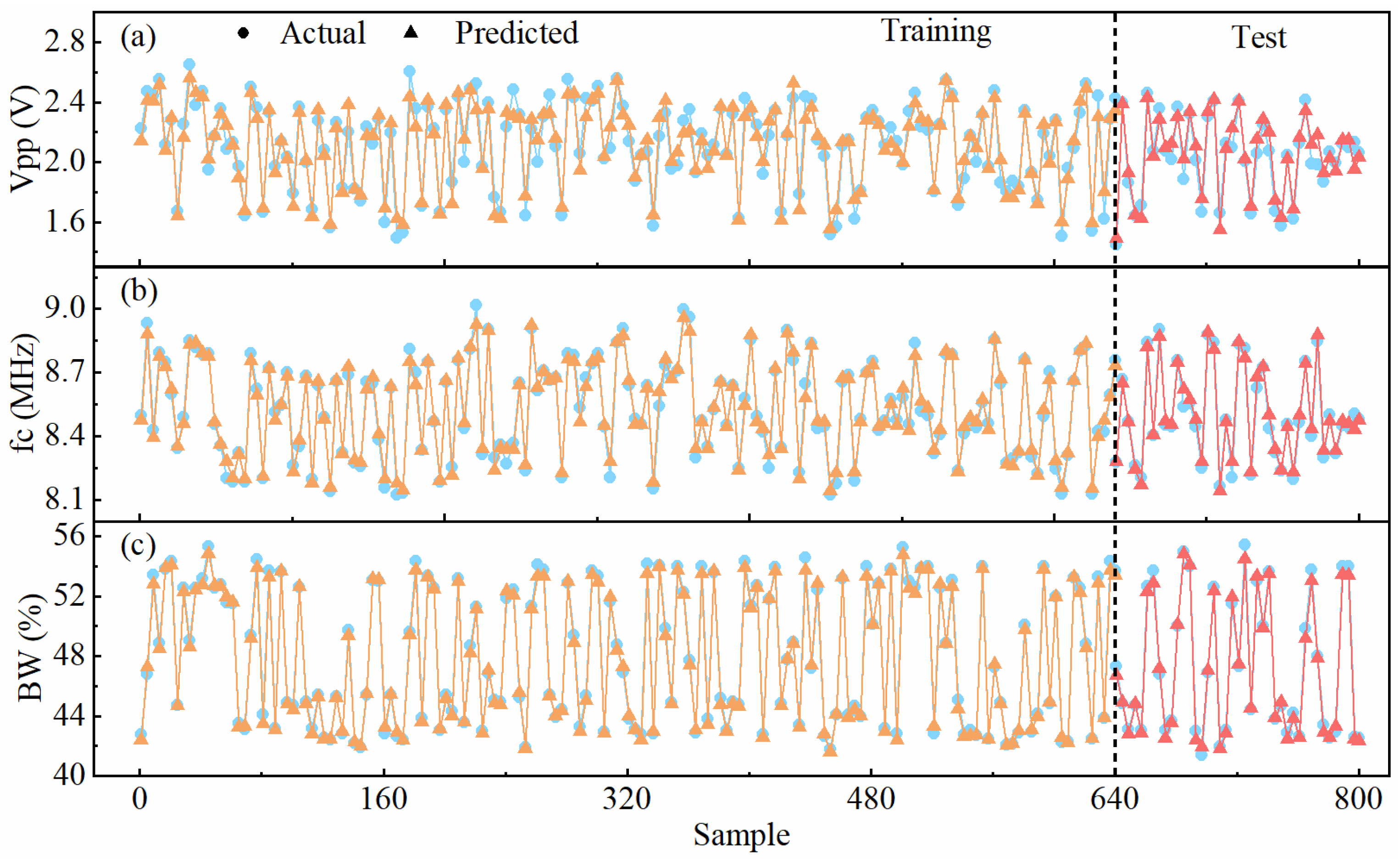
Based on the dataset obtained from FEA model simulations, 640 out of the 800 data samples were randomly selected for training the CNN surrogate model, while the remaining 160 samples served as the test set. The input parameters for the CNN surrogate model included the radius of the UNDTT, the thickness of the backing layer, and the thickness of the matching layer. The output parameters consisted of sensitivity ( V p p ), center frequency ( f c ), and bandwidth (BW). The comparison of the CNN surrogate model, namely, the comparison between actual and predicted values in both the training and test sets, after 1000 epochs of training is illustrated in Figure 9. The left side of the figure shows comparisons for the training set, whereas the right side depicts those for the test set. Solid circular markers connected by solid lines represent actual values, while triangular markers connected by solid lines indicate predicted values.
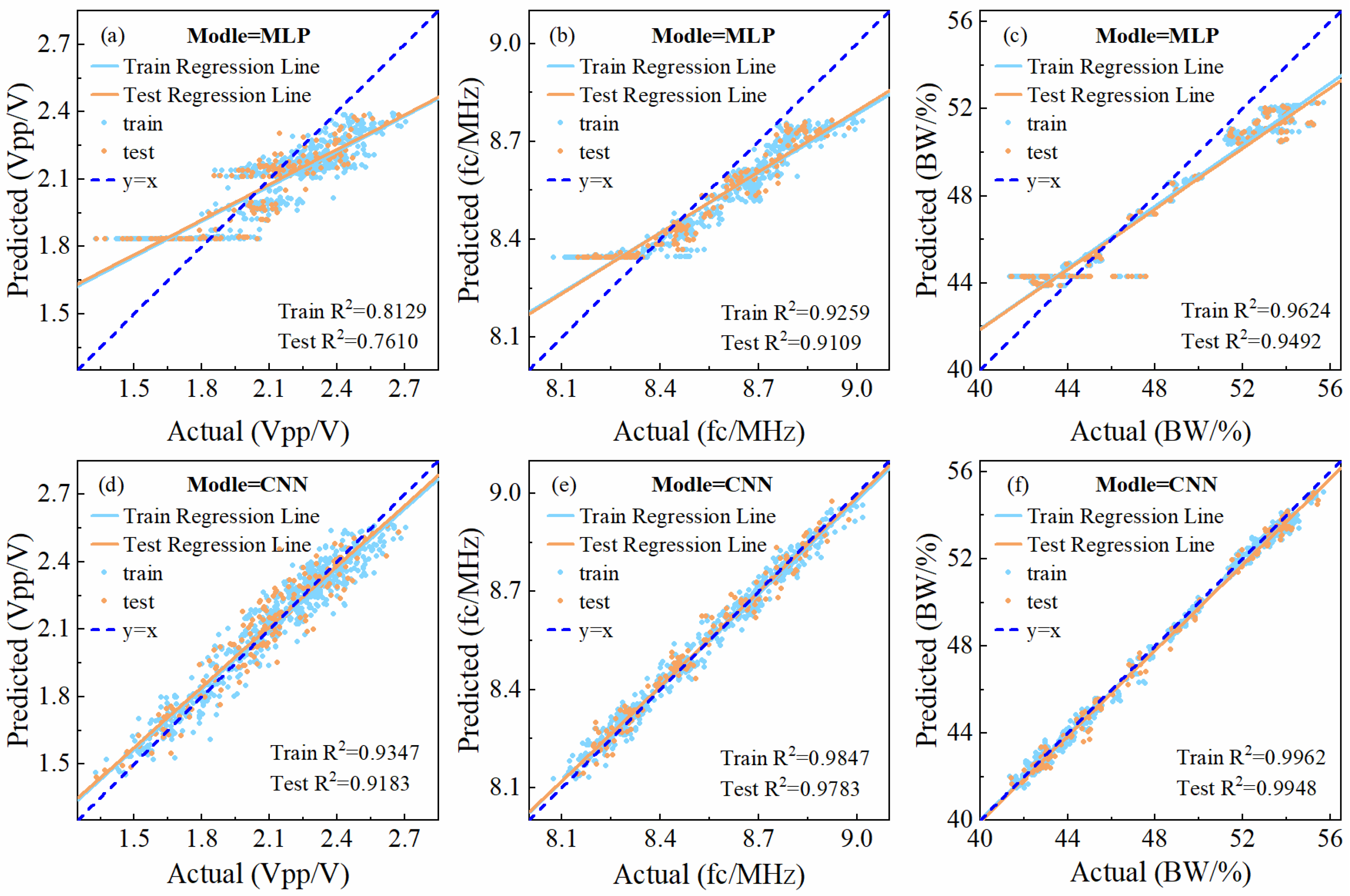
To evaluate the predictive capability of the surrogate models, both the MLP and CNN surrogate models were trained in the same training environment. The prediction results were used to generate linear regression plots to compare predicted values with actual values in the dataset. Based on the training and test sets, scatter plots of actual versus predicted values were generated with regression lines and R2 values annotated, thereby intuitively assessing model prediction accuracy, as shown in Figure 10. In these plots, the horizontal axis represents the true values obtained from finite element analysis (FEA), and the vertical axis represents the approximate predicted values given by the surrogate models. From these plots, it is evident that for the surrogate models, data points from the CNN surrogate model’s training and test sets closely follow the diagonal line y = x, while MLP surrogate model data points are more scattered and exhibit a horizontal point cluster at minimum values. In terms of performance parameters, the BW model shows the highest fitting degree, while Vpp has the lowest fitting accuracy. Regarding R2 values, the CNN surrogate model achieved R2 above 0.91 for all three performance indicators, while the MLP surrogate model performed significantly worse than the CNN, particularly on the sensitivity indicator with the strongest nonlinearity, where MLP’s R2 was only 0.761. This demonstrates that even with low-dimensional input, the CNN’s unique local receptive field and weight sharing mechanisms can more effectively resolve coupling relationships between parameters compared to the MLP’s global connection approach.
In addition, the model was evaluated for robustness through 5-fold cross-validation. The average R2 values for the three indicators were 0.9061, 0.9738, and 0.9919, respectively. The extremely low standard deviations further verify the generalization robustness of this surrogate model in full-domain prediction.

4.1.3. Performance Metrics from Multi-Objective Optimization

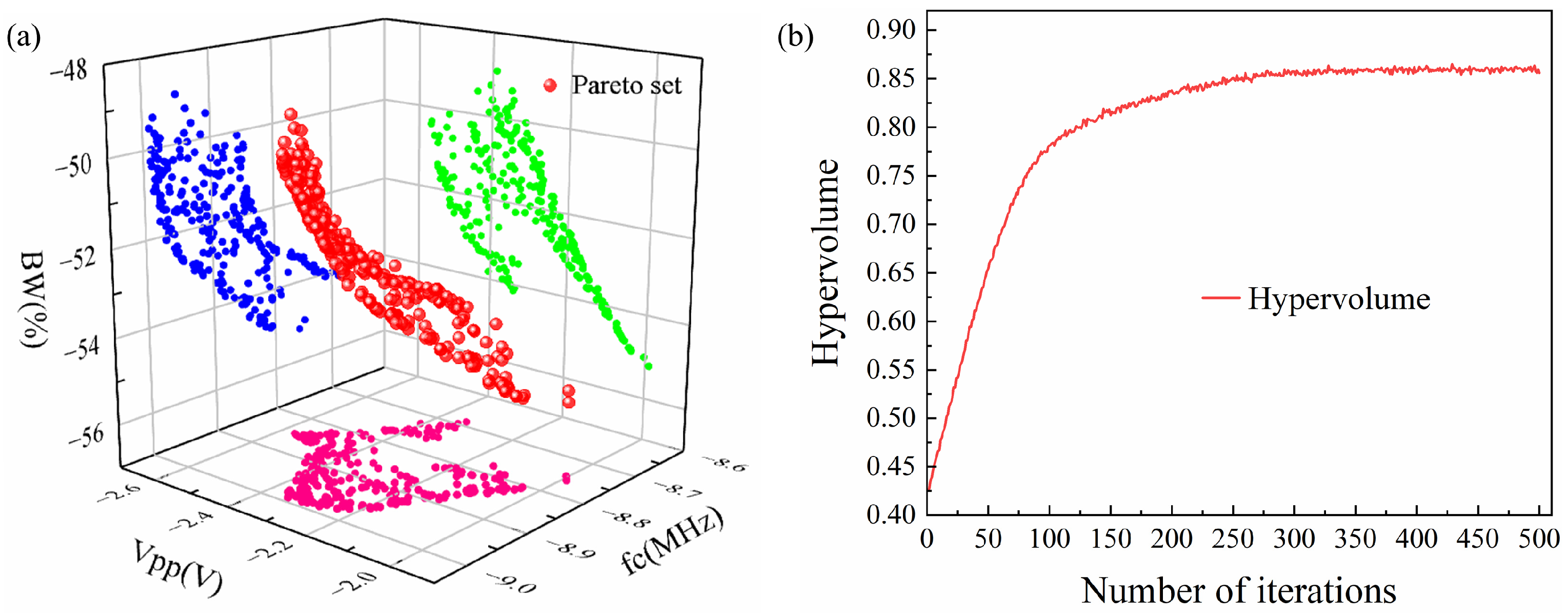
The optimization results obtained using the NSGA-III algorithm are presented in Figure 11a. The central red spheres represent the Pareto front consisting of 300 non-dominated solutions in the three-dimensional objective space defined by sensitivity ( V p p ), center frequency ( f c ), and bandwidth (BW).
To better interpret the trade-offs among objectives, projections of the Pareto front onto the coordinate planes are shown:
Pink circles depict the projection onto the V p p f c plane (X–Y plane), illustrating the relationship between sensitivity and center frequency. The solution with maximum sensitivity corresponds to a moderate f c , while the solution with the highest f c exhibits only moderate sensitivity, indicating a weak trade-off between these two metrics.
Green circles show the projection onto the V p p BW plane (X–Z plane), revealing the relationship between sensitivity and bandwidth. Here, the solution achieving the highest sensitivity tends toward the minimum bandwidth, whereas the solution with maximum bandwidth corresponds to the lowest sensitivity—demonstrating a strong inverse correlation.
Blue circles represent the projection onto the f c BW plane (Y–Z plane), highlighting the interplay between center frequency and bandwidth. The solution with the highest f c is associated with near-minimum bandwidth, and conversely, the solution with maximum bandwidth exhibits the lowest f c , indicating a pronounced trade-off.
These observations confirm that significant trade-offs exist—particularly between bandwidth and the other two performance metrics. Consequently, no single solution on the Pareto front simultaneously optimizes all three objectives. Instead, an optimal compromise must be identified based on a balanced evaluation of overall performance, which is addressed in the subsequent decision-making stage.
For the NSGA-III algorithm, it is necessary to discuss the convergence issue, its sensitivity to population size, mutation probability, and the number of iterations, as well as the issue of computational budget reduction, in order to validate the robustness and rationality of the algorithmic settings.
A.
Convergence Study
To verify the convergence of the NSGA-III algorithm, we selected the hypervolume (HV) indicator as the convergence metric. The HV measures the volume of the space dominated by the Pareto front relative to a reference point, comprehensively reflecting both the convergence and diversity of the solution set (a larger value indicates higher solution quality).
During the algorithm’s execution, we recorded the HV of the current population every generation and plotted the convergence curve, as shown in Figure 11b. As can be seen from the figure, in generations 0–100, the HV increased rapidly, indicating that the population was quickly approaching the true Pareto front; and in generations 100–250, the growth rate of the HV slowed down, entering a phase of fine-tuning and local search; in generations 250–500, the HV stabilized, and the relative change in the HV between generation 250 and generation 300 was less than 0.5%. This result confirms that 300 generations are sufficient to ensure full convergence of the algorithm. Further increasing the number of iterations would yield negligible improvements in result quality while incurring unnecessary computational costs.
B.
Parameter Sensitivity Analysis
To evaluate the sensitivity of the Pareto front results to variations in population size, mutation probability, and iteration count, we performed a systematic sensitivity analysis using the control variable method. Each parameter setting was run independently 5 times, and we calculated the mean and standard deviation of the HV for the resulting Pareto fronts.
When investigating the sensitivity to population size, all other parameters were held constant (300 generations, mutation probability of 0.05), and the population size was set to 100, 200, 300, 400, and 500, respectively. The results, as presented in Table 3, show that the performance improved significantly as the population size increased from 100 to 300. Beyond 300, however, the improvement became marginal. This indicates that a population size of 300 represents a well-balanced choice between solution quality and computational efficiency.
With the other parameters fixed (population size: 300, mutation probability: 0.05), the number of iterations was tested at 100, 200, 300, 400, and 500. The computational results, shown in Table 3, demonstrate that near-optimal performance (with only about a 2.5% performance loss) could be achieved by 200 generations. Further increasing the iterations beyond 300 yielded only limited gains. This validates that the setting of 300 generations is both sufficient and efficient.
While keeping the population size and number of iterations constant at 300, the mutation probability was varied as 0.01, 0.03, 0.05, 0.07, and 0.09. According to the results in Table 3, the hypervolume metric remained stable when the mutation probability fell within the range of 0.03 to 0.07. A probability lower than 0.03 tended to cause the algorithm to converge to local optima, whereas a probability higher than 0.07 excessively disrupted high-quality solutions, leading to a slower convergence rate. Therefore, the original setting of 0.05 lies within a robust and effective interval.
These results demonstrate that our chosen parameters are not only effective but also reside in a stable region where minor fluctuations do not significantly degrade performance.
C.
Performance With Reduced Computational Budgets
To investigate whether similar Pareto structures could emerge with reduced computational resources, we designed three resource-reduction scenarios: Scenario A: population 150 (halved), iterations 300; Scenario B: population 300, iterations 150 (halved); and Scenario C: population 150, iterations 150 (quarter of original total evaluations). Each configuration was independently run five times, and the mean value of the hypervolume metric was calculated. The results are presented in Table 4. The average HV results are summarized below: Reducing either the population size or the iteration count by half individually (Scenarios A and B) results in limited performance loss (<2.5%). However, reducing both simultaneously (Scenario C) leads to significant degradation (7.5% loss), indicating that maintaining a minimum threshold for both dimensions is crucial.

4.1.4. Selection of the Optimal Transducer via Comprehensive Evaluation

To comprehensively evaluate the Pareto-optimal solutions and identify the best compromise design, the entropy-weighted TOPSIS method was employed. Based on Equations (4)–(8), the objective weights for the three performance criteria—sensitivity ( V p p ), center frequency ( f c ), and bandwidth (BW)—were calculated as 0.48, 0.30, and 0.22, respectively. These weights reflect the relative importance of each metric derived solely from the intrinsic information entropy of the data, without subjective bias.
Subsequently, the relative closeness coefficients C i were computed using Equations (9)–(12). The solutions were then ranked in descending order of C i , and the top 10 candidates are listed in Table 5.
As shown in Table 5, the optimal design corresponds to the following geometric parameters: Transducer radius: 7.567 mm; matching layer thickness: 0.060 mm; and backing layer thickness: 2.270 mm. Notably, the optimized geometric parameters exhibit consistent trends across the top-ranked solutions: The transducer radius falls within a narrow range of 7.5–8.1 mm; the backing layer thickness is consistently between 2 and 3 mm; and all matching layer thicknesses cluster tightly around 0.06 mm.
This last observation is particularly significant: the optimal matching layer thickness deviates from the conventional quarter-wavelength ( λ / 4 ) design rule, suggesting that for the high-frequency UNDTT operating in highly attenuative media like cemented carbides, empirical design guidelines may be suboptimal, and data-driven optimization can uncover more effective configurations.

4.2. Finite Element Validation

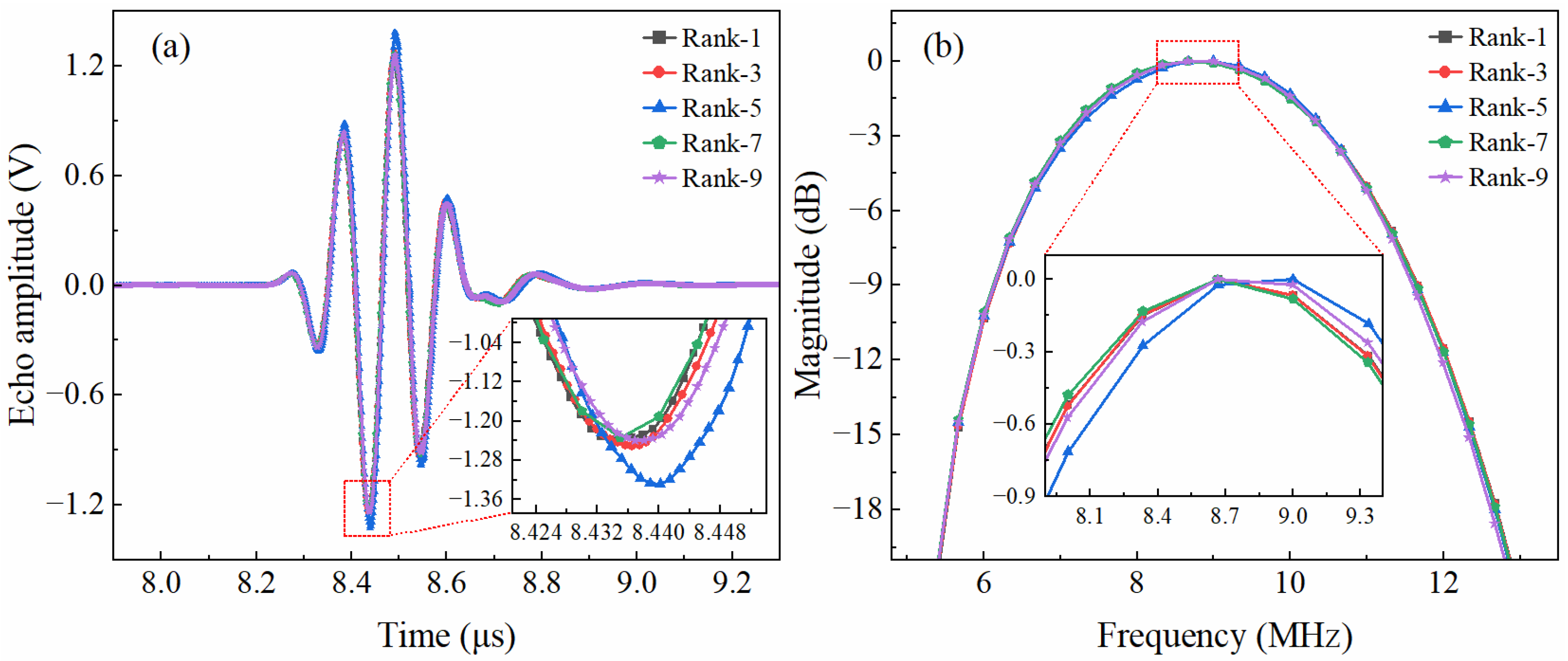
To validate the effectiveness of the proposed multi-objective intelligent optimization framework, a finite element pulse-echo simulation was performed using the optimal geometric parameters identified in Table 5. The time-domain and frequency-domain responses of the optimized transducer are presented in Figure 12. As illustrated, the sensitivity ( V p p ) and bandwidth (BW) curves across the optimized transducer candidates are highly consistent, exhibiting only minor variations. This close convergence indicates that, through iterative optimization via the NSGA-III algorithm and subsequent comprehensive ranking by the entropy-weighted TOPSIS method, all selected design parameters effectively converged toward a region that maximizes overall transducer performance.
The quantitative validation results are summarized in Table 6, which compares the predicted and simulated values of the key performance indicators. The relative errors between the optimized (predicted) and finite element (validated) results are as follows: sensitivity ( V p p ) ≤ 7.0%; center frequency ( f c ) ≤ 0.8%; bandwidth (BW) ≤ 0.7%.
These low error margins confirm that the optimized design accurately reflects the actual transducer behavior, thereby validating the fidelity of the CNN surrogate model and the robustness of the overall optimization framework.

4.3. Performance Comparison of Optimized Designs

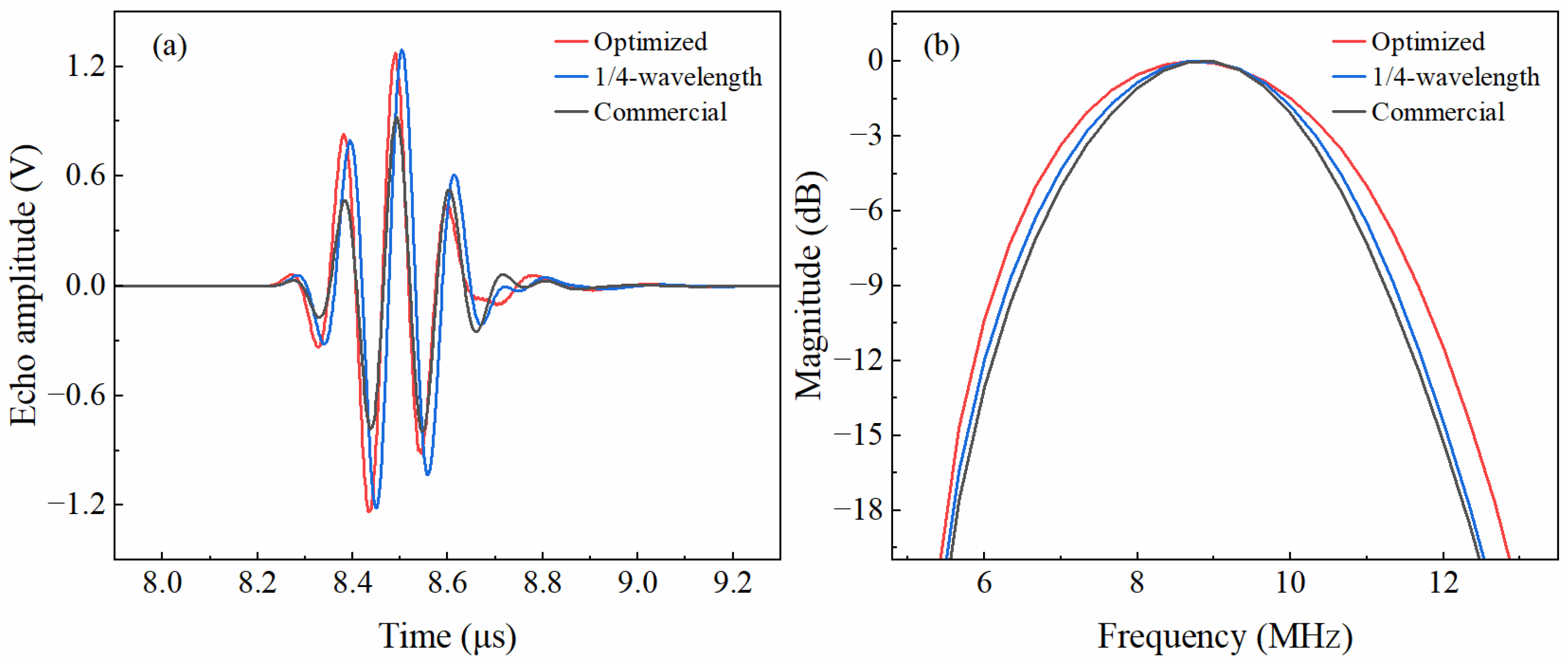
To validate the effectiveness of the multi-objective intelligent optimization method in enhancing performance, we compared the top-ranked optimized design from Table 5 (7.567, 0.060, 2.270) with the quarter-wavelength theoretical design [41] (7.567, 0.081, 2.270) and a commercial design (5.000, 0.081, 2.270). The pulse-echo simulation results for the transducers of these three designs are shown in Figure 13.
It is evident that the optimized design exhibits a wider bandwidth compared to the quarter-wavelength design and significantly higher sensitivity and wider bandwidth compared to the commercial design. Table 7 provides detailed performance metrics. Compared to the quarter-wavelength design, the optimized design achieves a 4.7% increase in bandwidth. Compared to the commercial design, the optimized design shows a 46.1% improvement in sensitivity and a 7.7% increase in bandwidth. These results further validate the effectiveness of the proposed optimization method.
In Figure 13, the optimized design shows an increase in pulse duration, which may expand the dead zone and reduce defect resolution. Furthermore, the increased transducer radius in the optimized solution alters its acoustic field characteristics, such as narrowing the main lobe of the directivity pattern and lengthening the near-field zone. This could introduce disadvantages for inspecting thin-walled workpieces or near-surface defects. Nonetheless, the improvements in both sensitivity and bandwidth endow the transducer with greater penetration depth and higher imaging resolution. These characteristics are advantageous for detecting internal micro-defects in highly attenuating materials like cemented carbide.

4.4. Manufacturing Tolerance and Robustness Analysis

In actual fabrication, transducer components inevitably entail slight manufacturing tolerances, which influence transducer performance. Therefore, an assessment of the impact of fabrication variations on performance is necessary. The analysis proceeds as follows: for each geometric parameter of the finally selected optimal design (7.567, 0.060, 2.270), a relative deviation of ±5% and ±10% is applied individually while keeping the other parameters unchanged, generating a series of parameter sets. Finite element simulations are performed to evaluate variations in key performance metrics (sensitivity, center frequency, and bandwidth). The absolute relative change percentage between the perturbed performance value and the original optimal value is computed.
The results are listed in Table 8. The data indicate that among the three performance metrics, the bandwidth is more sensitive to deviations in the matching layer thickness (±10% deviation causes approximately 6–7% variation in bandwidth), whereas changes in sensitivity and center frequency remain within 5%. Deviations in the radius and the backing layer thickness have a smaller effect on performance (most variations < 3%), suggesting the optimized parameters possess favorable robustness. Within common manufacturing tolerance ranges (e.g., ±5%), variations in all performance metrics are below 5% and thus do not significantly affect overall transducer performance. The analysis demonstrates that the optimized transducer design obtained in this study is largely insensitive to parameter deviations in practical manufacturing, with only the matching layer thickness requiring slightly tighter fabrication control. These findings further confirm the engineering feasibility of the optimized solution.

5. Conclusions

This study presents a multi-objective geometric optimization framework for a UNDTT, aimed at simultaneously enhancing their overall acoustic performance. The key design variables—transducer radius, matching layer thickness, and backing layer thickness—were optimized with respect to three core performance metrics: sensitivity ( V p p ), center frequency ( f c ), and bandwidth (BW).
A pulse-echo FEA model was established to generate a dataset comprising 800 design–performance pairs. This dataset was used to train a CNN as a high-fidelity surrogate model, which accurately captures the nonlinear mapping between geometric parameters and performance indicators. The trained CNN demonstrated excellent predictive accuracy on the test set, achieving coefficients of determination ( R 2 ) of 0.9183, 0.9783, and 0.9948 for V p p , f c , and BW, respectively.
Leveraging this surrogate model, the NSGA-III algorithm was employed to perform multi-objective optimization, yielding a Pareto-optimal solution set. Subsequently, the entropy-weighted TOPSIS method was applied to rank these non-dominated solutions comprehensively. The final optimal design was identified as: radius: 7.567 mm; matching layer thickness: 0.060 mm; backing layer thickness: 2.270 mm.
Finite element validation confirmed the reliability of the proposed approach: the relative errors between predicted and simulated values for three performance metrics were within 7.0%, demonstrating strong agreement between the surrogate model and physical simulation. Compared to a conventional design (radius = 5.0 mm, matching layer = λ / 4 ≈ 0.081 mm, same backing thickness), the optimized transducer exhibits a 46.07% increase in sensitivity, a 7.65% improvement in bandwidth, and a 35% reduction in matching layer thickness. These results highlight the dual advantages of the proposed method—enhanced performance and material efficiency.
In summary, the data-driven optimization framework developed in this work effectively enables multi-objective performance enhancement of a UNDTT. It offers a novel and robust pathway for the precise design of high-frequency transducers, particularly for demanding applications such as micro-defect detection in cemented carbides. It should be noted that the transducer performance indicators studied in this paper are all calculated based on finite element simulation models. In the next step, we will collaborate with manufacturing enterprises to conduct experimental research on transducers and further expand the evaluation and optimization of engineering application-related performance indicators (such as directivity and pulse width), thereby promoting the practical application process of this transducer design.

Author Contributions

Writing—original draft, D.W.; software, W.C.; investigation, Z.W.; resources, H.L.; conceptualization, L.T. All authors have read and agreed to the published version of the manuscript.

Funding

This work was supported by the Postgraduate Scientific Research Innovation Project of Hunan Province (Grant No. CX20230847), the Scientific Research Project of Hunan Provincial Department of Education (Grant No. 24C0413), the Open Research Fund of the Hunan Province Higher Education Key Laboratory of Modeling and Monitoring on the Near-Earth Electromagnetic Environments (Grant No. N202103), and the Key Scientific Research Project of the Hunan Provincial Department of Education (Grant No. 2025A0557).

Institutional Review Board Statement

Not applicable.

Data Availability Statement

Data are contained within the article. Further inquiries can be directed to the corresponding authors.

Conflicts of Interest

The authors declare that they have no known competing financial interests or personal relationships that could have appeared to influence the work reported in this paper.

References

  1. Klünsner, T.; Mitterhuber-Gressl, L.; Maier, K.; Beckstein, F.; Czettl, C. Thermal conductivity loss in WC-Co hard metal due to high-temperature cyclic loading damage as a function of microstructure and temperature. Int. J. Refract. Met. Hard Mater. 2024, 123, 106797. [Google Scholar] [CrossRef]
  2. Serra, M.; García-Marro, F.; Cinca, N.; Tarrés, E.; Jiménez-Piqué, E.; Llanes, L. Finite fatigue life behavior and fatigue crack-growth resistance of a fine-grained WC-Co cemented carbide. Int. J. Refract. Met. Hard Mater. 2025, 128, 107022. [Google Scholar] [CrossRef]
  3. Mahani, S.F.; Liu, C.; Lin, L.; Ramírez, G.; Wen, X.; Llanes, L. Damage tolerance and residual fatigue strength/life of WC-Co cemented carbides. Int. J. Refract. Met. Hard Mater. 2025, 129, 107117. [Google Scholar] [CrossRef]
  4. Gao, S.Y.; Xin, T.X.; Li, Q.L.; Zheng, M.L.; Chen, J.Y. Micro-hardness analysis of cemented carbide with cavity defects: An EBSD-based FEM perspective. Int. J. Refract. Met. Hard Mater. 2026, 134, 107484. [Google Scholar] [CrossRef]
  5. Zhou, Q.; Lau, S.; Wu, D.; Kirk Shung, K. Piezoelectric films for high frequency ultrasonic transducers in biomedical applications. Prog. Mater. Sci. 2011, 56, 139–174. [Google Scholar] [CrossRef]
  6. Zhou, Q.; Lam, K.H.; Zheng, H.; Qiu, W.; Shung, K.K. Piezoelectric single crystal ultrasonic transducers for biomedical applications. Prog. Mater. Sci. 2014, 66, 87–111. [Google Scholar] [CrossRef]
  7. Wang, F.W.; Cao, L.L.; Jin, M.L. Structural Optimization and Simulation of Dual-Frequency Piezoelectric Micromachined Ultrasonic Transducers. Micromachines 2025, 16, 1296. [Google Scholar] [CrossRef]
  8. Sherrit, S.; Leary, S.P.; Dolgin, B.P.; Bar-Cohen, Y. Comparison of the Mason and KLM equivalent circuits for piezoelectric resonators in the thickness mode. In 1999 IEEE Ultrasonics Symposium. Proceedings. International Symposium (Cat. No.99CH37027); IEEE: New York, NY, USA, 1999; pp. 921–926. [Google Scholar]
  9. Jamneala, T.; Bradley, P.; Koelle, U.B.; Chien, A. Modified Mason model for bulk acoustic wave resonators. IEEE Trans. Ultrason. Ferroelectr. Freq. Control 2008, 55, 2025–2029. [Google Scholar] [CrossRef]
  10. Castillo, M.; Acevedo, P.; Moreno, E. KLM model for lossy piezoelectric transducers. Ultrasonics 2003, 41, 671–679. [Google Scholar] [CrossRef]
  11. Boujenoui, A.; Bybi, A.; Reskal, H.; Khalfi, H.; Elmaimouni, L.; Hladky-Hennion, A.C. Development and validation of a 2D Mason model for ultrasonic transducer arrays: A simplified approach simulating crosstalk and dissipation mechanisms. Appl. Acoust. 2026, 241, 110991. [Google Scholar] [CrossRef]
  12. Yang, X.; Fei, C.; Li, D.; Sun, X.; Hou, S.; Chen, J.; Yang, Y. Multi-layer polymer-metal structures for acoustic impedance matching in high-frequency broadband ultrasonic transducers design. Appl. Acoust. 2020, 160, 107123. [Google Scholar] [CrossRef]
  13. Hou, C.; Fei, C.; Li, Z.; Zhang, S.; Man, J.; Chen, D.; Wu, R.; Li, D.; Yang, Y.; Feng, W. Optimized Backing Layers Design for High Frequency Broad Bandwidth Ultrasonic Transducer. IEEE Trans. Biomed. Eng. 2022, 69, 475–481. [Google Scholar] [CrossRef] [PubMed]
  14. Feuillard, G.; Hue, L.; Saadaoui, N.; Nguyen, V.T.; Lethiecq, M.; Saillant, J.F. Symmetric Reflector Ultrasonic Transducer Modeling and Characterization: Role of the Matching Layer on Electroacoustic Performance. IEEE Trans. Ultrason. Ferroelectr. Freq. Control 2021, 68, 3608–3615. [Google Scholar] [CrossRef] [PubMed]
  15. Zawada, T.; Bove, T. Analytical modeling of harmonically driven focused acoustic sources with experimental verification. Appl. Acoust. 2024, 221, 109989. [Google Scholar] [CrossRef]
  16. Wampo, F.L.H.; Ntenga, R.; Effa, J.Y.; Lapusta, Y.; Ntamack, G.E.; Maréchal, P. Generalized homogenization model of piezoelectric materials for ultrasonic transducer applications. J. Compos. Mater. 2022, 56, 713–726. [Google Scholar] [CrossRef]
  17. Abdullah, Z.; Naz, S.; Raja, M.A.Z.; Zameer, A. Design of wideband tonpilz transducers for underwater SONAR applications with finite element model. Appl. Acoust. 2021, 183, 108293. [Google Scholar] [CrossRef]
  18. Nie, Y.; Wang, Y.B. Design and Performance Optimization of a High-Frequency Broadband Transducer Based on P(VDF-TrFE). IEEE Access 2025, 13, 67856–67866. [Google Scholar] [CrossRef]
  19. Cheng, D.X.; Li, J.A.; Yue, Q.W.; Liang, R.H.; Dong, X.L. Crosstalk optimization of 5 MHz linear array transducer based on PZT/epoxy piezoelectric composite. Sens. Actuator A-Phys. 2022, 341, 113500. [Google Scholar] [CrossRef]
  20. Hou, C.X.; Wei, X.W.; Li, Z.X.; Yang, Y.H.; Peng, S.Q.; Quan, Y.; Fei, C.L.; Yang, Y.T. Broadband ultrasonic transducer based on nested composite structure with gradient acoustic impedance. Ceram. Int. 2024, 50, 51928–51934. [Google Scholar] [CrossRef]
  21. Mostafa, R.-M.; Honarvar, F. Investigation of the Performance of a Piezoelectric Ultrasonic Transducer by Finite Element Modeling. Russ. J. Nondestruct. Test. 2021, 57, 269–280. [Google Scholar] [CrossRef]
  22. Chen, J.S.; Gong, C.X.; Yue, G.L.; Zhang, L.L.; Wang, X.L.; Huo, Z.H.; Dong, Z.Y. Structural Optimization and Performance of a Low-Frequency Double-Shell Type-IV Flexural Hydroacoustic Transducer. Sensors 2024, 24, 4746. [Google Scholar] [CrossRef] [PubMed]
  23. Nath, P.C.; Mishra, A.K.; Sharma, R.; Bhunia, B.; Mishra, B.; Tiwari, A.; Nayak, P.K.; Sharma, M.; Bhuyan, T.; Kaushal, S.; et al. Recent advances in artificial intelligence towards the sustainable future of agri-food industry. Food Chem. 2024, 447, 138945. [Google Scholar] [CrossRef] [PubMed]
  24. Leng, J.W.; Zhu, X.F.; Huang, Z.Q.; Li, X.Y.; Zheng, P.; Zhou, X.L.; Mourtzis, D.; Wang, B.C.; Qi, Q.L.; Shao, H.D.; et al. Unlocking the power of industrial artificial intelligence towards Industry 5.0: Insights, pathways, and challenges. J. Manuf. Syst. 2024, 73, 349–363. [Google Scholar] [CrossRef]
  25. Serrano, D.R.; Luciano, F.C.; Anaya, B.J.; Ongoren, B.; Kara, A.; Molina, G.; Ramirez, B.I.; Sánchez-Guirales, S.A.; Simon, J.A.; Tomietto, G.; et al. Artificial Intelligence (AI) Applications in Drug Discovery and Drug Delivery: Revolutionizing Personalized Medicine. Pharmaceutics 2024, 16, 1328. [Google Scholar] [CrossRef]
  26. David-Olawade, A.C.; Olawade, D.B.; Vanderbloemen, L.; Rotifa, O.B.; Fidelis, S.C.; Egbon, E.; Akpan, A.O.; Adeleke, S.; Ghose, A.; Boussios, S. AI-Driven Advances in Low-Dose Imaging and Enhancement-A Review. Diagnostics 2025, 15, 689. [Google Scholar] [CrossRef]
  27. Bozyel, S.; Simsek, E.; Koçyigit, D.; Güler, A.; Korkmaz, Y.; Seker, M.; Ertürk, M.; Keser, N. Artificial Intelligence-Based Clinical Decision Support Systems in Cardiovascular Diseases. Anatol. J. Cardiol. 2024, 28, 74–86. [Google Scholar] [CrossRef]
  28. Xu, W.Q.; Ouyang, F. The application of AI technologies in STEM education: A systematic review from 2011 to 2021. Int. J. STEM Educ. 2022, 9, 59. [Google Scholar] [CrossRef]
  29. Su, X.; Ren, X.; Wan, H.; Jiang, X.; Liu, X. Simulation and Optimization of Piezoelectric Micromachined Ultrasonic Transducer Unit Based on AlN. Electronics 2022, 11, 2915. [Google Scholar] [CrossRef]
  30. Abdalla, O.M.O.; Massimino, G.; Savoia, A.S.; Quaglia, F.; Corigliano, A. Efficient Modeling and Simulation of PMUT Arrays in Various Ambients. Micromachines 2022, 13, 962. [Google Scholar] [CrossRef]
  31. Sun, Y.; Tao, J.; Guo, F.; Wang, F.; Dong, J.; Jin, L.; Li, S.; Huang, X. AZ31B magnesium alloy matching layer for Lens-focused piezoelectric transducer application. Ultrasonics 2023, 127, 106844. [Google Scholar] [CrossRef]
  32. Shao, W.W.; Han, X.; Li, P.Y.; Li, Z.J.; Lv, J.B.; Zhu, X.L.; Li, X.X.; Shen, J.; Cui, Y.Y. Analysis and experimental verification of dual frequency ultrasonic transducer with contour and thickness vibration modes. Appl. Acoust. 2022, 190, 108633. [Google Scholar] [CrossRef]
  33. Liu, S.; Zhang, Z.; Xu, J.; Xiao, J.; Wang, X.a.; Luo, H. Optimizing dual-piezoelectric-layer ultrasonic transducer via systematic analysis. Sens. Actuators A Phys. 2020, 315, 112336. [Google Scholar] [CrossRef]
  34. Ji, H.-w.; Qi, A.-q.; Yang, F.; Wu, X.; Lv, B.; Ni, J. Design of acoustic impedance gradient matching layers. Appl. Acoust. 2023, 211, 109549. [Google Scholar] [CrossRef]
  35. Wu, Q.; Xie, D.-J.; Si, Y.; Zhang, Y.-D.; Li, L.; Zhao, Y.-X. Simulation analysis and experimental study of milling surface residual stress of Ti-10V-2Fe-3Al. J. Manuf. Process. 2018, 32, 530–537. [Google Scholar] [CrossRef]
  36. Chen, H.; Lu, C.H.; Feng, L.; Liu, Z.; Sun, Y.; Chen, W. Structural optimization design of BIW using NSGA-III and entropy weighted TOPSIS methods. Adv. Mech. Eng. 2023, 15, 16878132231220351. [Google Scholar] [CrossRef]
  37. Chen, P. Effects of normalization on the entropy-based TOPSIS method. Expert Syst. Appl. 2019, 136, 33–41. [Google Scholar] [CrossRef]
  38. Li, P.; Wu, J.; Qian, H. Groundwater quality assessment based on rough sets attribute reduction and TOPSIS method in a semi-arid area, China. Environ. Monit. Assess. 2012, 184, 4841–4854. [Google Scholar] [CrossRef]
  39. Shi-fei, D.; Zhong-zhi, S. Studies on incidence pattern recognition based on information entropy. J. Inf. Sci. 2005, 31, 497–502. [Google Scholar] [CrossRef]
  40. Pei-Yue, L.; Hui, Q.; Jian-Hua, W. Application of Set Pair Analysis Method Based on Entropy Weight in Groundwater Quality Assessment-A Case Study in Dongsheng City, Northwest China. J. Chem. 2011, 8, 851–858. [Google Scholar] [CrossRef]
  41. Desilets, C.S.; Fraser, J.D.; Kino, G.S. The design of efficient broad-band piezoelectric transducers. IEEE Trans. Sonics Ultrason. 1978, 25, 115–125. [Google Scholar] [CrossRef]
Figure 1. UNDTT: (a) Schematic diagram of the transducer structure; (b) FEA model.
Actuators 15 00191 g001
Figure 2. Excitation waveform of the transducer.
Actuators 15 00191 g002
Figure 3. Ultrasonic transducer pulse-echo response: (a) time-domain response, (b) frequency-domain response.
Actuators 15 00191 g003
Figure 4. The effects of structural parameters on Vpp, fc, and BW: (ac) matching layer and backing thicknesses; (df) radius and matching layer thickness; (gi) radius and backing thickness.
Actuators 15 00191 g004
Figure 5. Flowchart of the intelligent optimization framework for a cemented carbide UNDTT.
Actuators 15 00191 g005
Figure 6. Network architecture of the surrogate model.
Actuators 15 00191 g006
Figure 7. NSGA-3 optimization flowchart.
Actuators 15 00191 g007
Figure 8. Performance metric dataset for transducers with varying design parameters: (a) Vpp, (b) fc, (c) BW.
Actuators 15 00191 g008
Figure 9. Comparison of actual and predicted values for the surrogate model: (a) V p p , (b) f c , (c) BW.
Actuators 15 00191 g009
Figure 10. Scatter plots of the actual and predicted values of Vpp, fc, and BW in different surrogate models: (ac) MLP, (df) CNN.
Actuators 15 00191 g010
Figure 11. Multi-objective optimization results: (a) Pareto front set, (b) hypervolume convergence curve.
Actuators 15 00191 g011
Figure 12. Finite element validation results: (a) time-domain response showing V p p , (b) frequency spectrum obtained via FFT.
Actuators 15 00191 g012
Figure 13. Comparison results: (a) time-domain response showing V p p , (b) frequency spectrum obtained via FFT.
Actuators 15 00191 g013
Table 1. Piezoelectric parameters of PMN-29PT.
PropertyVariableValuePropertyVariableValue
Elasticity matrix
(1010 N/m2)
C 11 E 11.7Coupling matrix
(C/m2)
e 13 −3.4
C 12 E 10.1 e 33 22.9
C 13 E 10.1 e 15 7.14
C 33 E 11.5Relative permittivity ε 11 S 1370
C 44 E 7.0 ε 33 S 926
C 66 E 5.6Mechanical quality factor Q m 135
Density (KG/m3)ρ8146Damping ratio ζ 0.37 × 10⁻²
Table 2. Material properties of passive components.
Materialρ (kg/m3)E (N/m2)σZ (Mrayl)
Gold19,2767.95 × 10100.4262.5
Epoxy10633.50 × 1090.382.6
Wc-11Co14,4406.50 × 10110.25102.9
Table 3. Sensitivity analysis of NSGA-III parameters on hypervolume performance.
ParameterLevelHypervolume (Mean)Std. Dev.Relative Change (%)
Population Size1000.7620.021−11.0
2000.8230.015−3.9
3000.8560.008Baseline
4000.8610.007+0.6
5000.8630.007+0.8
Generations1000.7810.025−8.8
2000.8350.014−2.5
3000.8560.008Baseline
4000.8590.008+0.4
5000.8600.007+0.5
Mutation Probability0.010.8120.023−5.1
0.030.8450.012−1.3
0.050.8560.008Baseline
0.070.8510.010−0.6
0.090.8280.018−3.3
All relative changes are calculated with respect to the baseline configuration (bolded) within each parameter group.
Table 4. Performance and computational cost comparison of NSGA-III configurations with resource reduction.
ConfigurationPopulation SizeGenerationsHypervolume (Mean)Gap vs. Baseline (%)Time Ratio (%)
Original3003000.8560.0100
Scenario A1503000.841−1.855
Scenario B3001500.838−2.152
Scenario C1501500.792−7.528
Baseline configuration (original) is bolded. Relative gap = [(HVconfig − HVbascline)/HVbascline] × 100%, Computational time ratio normalized to baseline.
Table 5. Top 10 Pareto-optimal solutions ranked by entropy-weighted TOPSIS.
Geometric ParameterVPP-Predict (V)fc-Predict (MHz)BW-Predict (%)CiRank
(7.567, 0.060, 2.270)2.469 8.842 52.525 0.650 1
(7.614, 0.061, 2.138) 2.477 8.840 52.457 0.648 2
(7.524, 0.060, 2.521) 2.466 8.846 52.420 0.645 3
(7.698, 0.062, 2.138) 2.489 8.835 52.363 0.644 4
(8.070, 0.063, 2.269) 2.501 8.817 52.524 0.643 5
(7.410, 0.059, 3.364) 2.462 8.856 52.238 0.641 6
(7.624, 0.059, 2.433)2.456 8.825 52.774 0.641 7
(7.846, 0.060, 1.948) 2.474 8.809 52.863 0.640 8
(7.800, 0.063, 2.377) 2.497 8.827 52.355 0.640 9
(8.060, 0.064, 2.199)2.511 8.822 52.321 0.640 10
Table 6. Relative errors between optimized predictions and finite element validation results.
RankGeometric ParameterVPP-Actual
(V)
Error
(%)
fc-Actual
(MHz)
Error
(%)
BW-Actual
(%)
Error
(%)
1(7.567, 0.060, 2.270)2.511 1.653 8.806 0.412 52.402 0.236
2(7.614, 0.061, 2.138) 2.542 2.572 8.852 0.139 52.650 0.367
3(7.524, 0.060, 2.521) 2.543 3.047 8.853 0.079 52.504 0.160
4(7.698, 0.062, 2.138) 2.388 4.197 8.768 0.761 52.536 0.329
5(8.070, 0.063, 2.269) 2.665 6.138 8.846 0.318 52.390 0.256
6(7.410, 0.059, 3.364) 2.500 1.529 8.858 0.032 52.525 0.546
7(7.624, 0.059, 2.433)2.500 1.773 8.828 0.036 52.86 0.171
8(7.846, 0.060, 1.948) 2.508 1.353 8.821 0.140 53.222 0.674
9(7.800, 0.063, 2.377) 2.503 0.232 8.821 0.074 52.420 0.125
10(8.060, 0.064, 2.199)2.698 6.921 8.854 0.363 52.099 0.425
Table 7. Comparison of performance parameters with other designs.
VariationVPP-Ture (V)fc-Ture (MHz)BW-Ture (%)
(7.567, 0.060, 2.270)2.511 8.806 52.402
(7.567, 0.081, 2.270)2.506 8.813 47.665
(5.000, 0.060, 2.270)1.719 8.814 44.752
Table 8. Sensitivity of transducer performance to manufacturing tolerances.
ParameterTolerance (%)ΔVpp (%)Δfc (%)ΔBW (%)
R±51.2–1.50.3–0.40.8–1.0
±102.8–3.10.7–0.91.9–2.2
tm±52.1–2.31.6–1.83.2–3.5
±104.4–4.73.2–3.56.3–6.8
tb±50.5–0.60.20.4–0.5
±101.1–1.30.4–0.50.9–1.1
Performance variations (Δ) are relative to the nominal design. ΔVpp, Δfc, and ΔBW denote percentage changes in peak-to-peak voltage, center frequency, and bandwidth, respectively.
Disclaimer/Publisher’s Note: The statements, opinions and data contained in all publications are solely those of the individual author(s) and contributor(s) and not of MDPI and/or the editor(s). MDPI and/or the editor(s) disclaim responsibility for any injury to people or property resulting from any ideas, methods, instructions or products referred to in the content.