Article

Position and Force Synchronization Control of Master–Slave Bilateral Teleoperation Manipulators Based on Adaptive Super-Twisting Sliding Mode

1
School of Mechanical Engineering, Zhejiang Sci-Tech University, Hangzhou 310018, China
2
Key Laboratory of Advanced Manufacturing and Intelligent Technology (Ministry of Education), Harbin University of Science and Technology, Harbin 150080, China
3
Hangzhou Boomy Intelligent Technology Co., Ltd., Hangzhou 310018, China
*
Author to whom correspondence should be addressed.
Actuators 2026, 15(4), 186; https://doi.org/10.3390/act15040186
Submission received: 11 February 2026 / Revised: 6 March 2026 / Accepted: 26 March 2026 / Published: 27 March 2026
(This article belongs to the Section Control Systems)

Abstract

Master–slave bilateral teleoperation systems face several practical challenges, including model uncertainties, time-varying communication delays, and environment-induced force disturbances. To address these issues, this paper proposes an adaptive super-twisting sliding-mode control scheme to achieve high-precision position tracking and real-time force-feedback synchronization. First, joint-space dynamic models are established for both the master and the slave manipulators, and a passive impedance model is adopted to characterize the interaction dynamics at the operator–master and environment–slave interfaces. Second, to attenuate measurement noise in the environment interaction force, a first-order low-pass filter is used to preprocess the raw force measurements, and a radial basis function neural network (RBFNN) is employed to approximate the environment torque online. Furthermore, a super-twisting sliding-mode controller is developed and combined with an adaptive law to compensate online for system uncertainties, including dynamic parameter variations and environment-induced force disturbances. The stability of the resulting closed-loop system is rigorously analyzed using Lyapunov stability theory. Finally, the effectiveness of the proposed method is validated through numerical simulations, virtual experiments conducted in the MuJoCo physics engine, and real-world hardware experiments. The results show that the proposed strategy achieves accurate position synchronization and force tracking while maintaining stable haptic interaction in the presence of bounded time-varying delays, parameter uncertainties, and external disturbances.

1. Introduction

Teleoperation enables a human operator to control a remote slave manipulator via a local master device, allowing the robotic system to perform tasks in hazardous or inaccessible environments. The core of such systems lies in establishing a high-fidelity bidirectional channel: the master transmits motion commands (e.g., position/velocity), while the slave returns interaction forces or tactile signals, thereby seamlessly integrating human cognition with robotic execution. This technology has been widely applied in nuclear maintenance, space and deep-sea exploration, and telesurgery. From an engineering perspective, the mechanical design of teleoperation systems varies substantially across applications. In on-orbit servicing, redundant manipulators with high degrees of freedom are typically used for satellite capture and maintenance [1]. In deep-sea exploration, underwater vehicle–manipulator systems (UVMSs) must be pressure-resistant and watertight, while also compensating for hydrodynamic disturbances [2]. In high-risk settings such as nuclear facilities, heterogeneous master–slave configurations are common: the slave prioritizes payload capacity and durability, whereas the master emphasizes ergonomics and realistic force feedback. In advanced manufacturing and medical rehabilitation [3], extremely high tracking accuracy and force transparency are required to support precision tasks such as micro-assembly, polishing, and tele-rehabilitation training. Regarding the evolution of bilateral teleoperation control structures and performance metrics, Hokayem and Spong provided a relatively comprehensive historical review, offering a reference for subsequent method comparisons and problem definition [4]. For haptic interaction devices, Xiong et al. proposed an object-grasping strategy based on an improved stiffness-display device, enhancing the operator’s perception of contact states and improving operational stability [5].
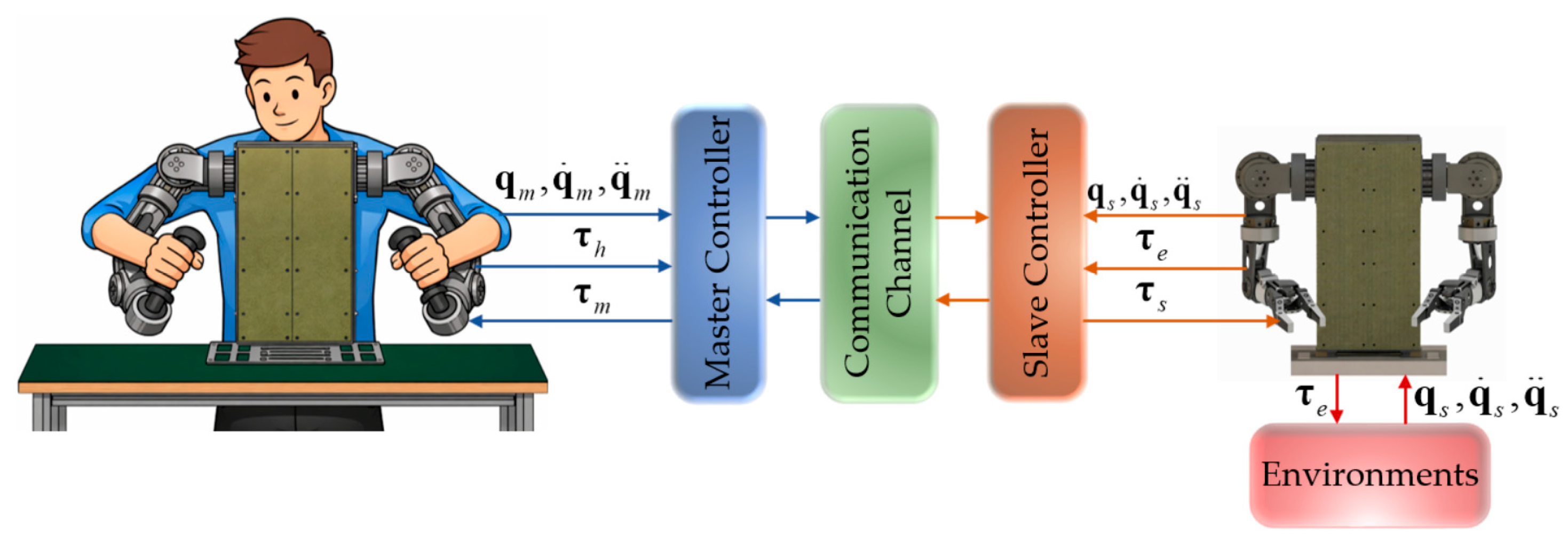
Realizing these diverse applications hinges on effective bilateral control. A primary objective of high-performance bilateral teleoperation is to ensure both stability and transparency [6,7]. While maintaining closed-loop stability, the system must accurately synchronize the slave position with the master motion and faithfully transmit the interaction forces between the slave and the environment to the operator in real time [8,9]. Achieving these dual objectives in practice is challenged by several key factors. Time-varying delays inherent in long-distance communication can break passivity, causing phase lag and energy accumulation that may severely compromise stability [10]. Furthermore, robotic systems exhibit intrinsic nonlinear dynamics, including friction, gravity, and Coriolis/centrifugal force coupling. Payload variations and uncertainties in dynamic parameters can significantly degrade tracking accuracy and controller robustness [11,12,13]. In unstructured, dynamic environments, contact force signals are often contaminated with high-frequency noise and transients. Moreover, environmental dynamics (e.g., stiffness and damping) are typically unknown and time-varying, which persistently degrades force-feedback fidelity and overall transparency. Figure 1 illustrates a typical master–slave teleoperation architecture and highlights the fundamental interactions among the master, the slave, the communication channel, and the environment.
Significant research efforts have been devoted to addressing the aforementioned challenges. Early studies primarily examined how communication delays affect system stability. Based on passivity theory, Reference [14] systematically established stability conditions for teleoperation systems with time delays, providing a theoretical foundation for subsequent controller design. Building upon this work, Anderson and Spong [15] proposed the scattering transformation to preserve passivity and stability under delayed communication. Subsequently, Niemeyer and Slotine [16] further developed the wave-variable control technique, which maintains passivity in the presence of communication delays by transmitting wave variables rather than direct power signals. Reference [17] investigated teleoperation systems with heterogeneous master–slave configurations and proposed a coordinated impedance-matching strategy that improves performance under asymmetric structures. Reference [18] introduced a state-prediction mechanism for synchronization control of multi-degree-of-freedom manipulators under time-varying delays, thereby reducing tracking lag. However, passivity-based and wave-variable approaches often sacrifice transparency in practice, potentially causing position drift, force distortion, and wave reflection [19,20]. In this context, Reference [21] investigated robust control under the combined effects of time-varying delays and model uncertainties. By constructing an adaptive observer to jointly estimate system states and disturbances, it improved stability maintenance under parameter perturbations. To improve tracking performance while ensuring stability, proportional–derivative (PD)-type controllers have been widely adopted in teleoperation systems. Nuño et al. [22,23,24] showed that simple structures such as P + d or PD + d can ensure stability under certain conditions, offering a practical baseline for engineering implementation. To cope with parametric uncertainties in manipulator dynamics, adaptive control schemes have also been developed. For instance, Chen et al. [25] proposed an adaptive controller integrated with environment force estimation, while Huang et al. [26] employed a radial basis function neural network (RBFNN) to approximate unknown dynamics. A common limitation of these methods is that they typically guarantee only asymptotic stability, which may lead to insufficient convergence speed in teleoperation tasks requiring rapid response and high dynamic performance. Consequently, finite-time control has attracted attention for its potential to deliver faster convergence and higher precision. Representative works include the adaptive fuzzy finite-time controller by Yang et al. [27] and the use of nonsingular terminal sliding-mode control by Li et al. [28] and Zhang et al. [29] in teleoperation systems. Although these methods provide theoretically improved convergence, many involve complex structures and require tuning multiple parameters, which complicates practical implementation. Hashemzadeh et al. [30] proposed a nonlinear tracking controller that estimates uncertainties online to enhance robustness against time-varying delays. Nevertheless, like other PD-based and asymptotically convergent designs, this approach may still exhibit limited transient response and disturbance rejection when facing abrupt force changes or significant parameter variations, and it may fail to drive tracking errors into a desired bound within a finite time.
To address these issues, this paper proposes a high-performance control framework for position synchronization and force feedback in complex master–slave teleoperation systems. The main contributions are summarized as follows:
(a)
An integrated dynamic estimation and communication strategy is proposed. A radial basis function neural network (RBFNN) is employed to estimate online the unknown nonlinear dynamics associated with the manipulators, the operator, and the environment [25,31]. Specifically, environment interaction parameters are identified online by a slave-side RBFNN. Instead of transmitting raw force/torque signals (power variables) through the delayed channel, only the learned network weights are communicated to the master, where the environment torque is reconstructed locally using the current master states [25,26]. By avoiding direct transmission of power signals over the time-delay channel, the proposed strategy mitigates passivity degradation caused by delayed force feedback and provides a delay-independent basis for stability analysis.
(b)
A comprehensive super-twisting sliding-mode control (STSMC) scheme is developed. By incorporating STSMC theory [32,33], the proposed controller achieves fast convergence, high tracking accuracy, and strong robustness against uncertainties and disturbances in the position-tracking loop, thereby overcoming the asymptotic convergence and slow transient response of conventional proportional–derivative (PD)-based and adaptive methods.
(c)
A practical force-signal conditioning method is implemented. A first-order low-pass filter is introduced to denoise and parameterize the measured environment interaction force signals [26]. This preprocessing step suppresses the adverse effects of high-frequency measurement noise and force transients on feedback quality and closed-loop stability.
The remainder of this paper is organized as follows. Section 2 presents the dynamic modeling of the master–slave teleoperation system and outlines the required theoretical preliminaries. Section 3 details the controller design and provides a rigorous Lyapunov-based stability analysis. Section 4 validates the proposed approach through numerical simulations of a two-link manipulator, physics-based simulations of a seven-degree-of-freedom manipulator, and real-world experiments on a seven-degree-of-freedom robotic platform. Finally, Section 5 concludes the paper and discusses potential directions for future research.

2. Preliminaries

2.1. Dynamic Description of Teleoperation System

A bilateral teleoperation system comprising a pair of n-degree-of-freedom (DOF) master and slave manipulators can be uniformly modeled in the joint space as follows [34]:
M m q m q ¨ m + C m q m , q ˙ m q ˙ m + D m q m , q ˙ m + G m q m = τ m + τ h M s q s q ¨ s + C s q s , q ˙ s q ˙ s + D s q s , q ˙ s + G s q s = τ s + τ e
where q i n , q ˙ i n , and q ¨ i n i m , s denote the generalized joint coordinates and their first and second-order time derivatives, respectively. τ m n and τ s n are the control input torques of the master and slave manipulators, respectively. τ h n represents the operator-applied joint torque on the master side, and τ e n denotes the interaction joint torque exerted on the slave side by the environment. M i q i n × n i = m , s is the symmetric positive-definite inertia matrix, C i q i , q ˙ i n × n i = m , s is the Coriolis and centrifugal matrix, and G i q i n i = m , s is the gravity vector. The term D i q i , q ˙ i n i = m , s collects joint friction and other unmodeled nonlinear dynamics/disturbances [34,35].
The teleoperation system (1) satisfies the following fundamental properties.
Property 1. 
The matrix M ˙ i ( q i ) 2 C i q i , q ˙ i is skew-symmetric; i.e., for any vector x n , x T M ˙ i ( q i ) / 2 C i q i , q ˙ i x = 0 holds. Note that this property stems from the passivity of the bilateral teleoperation system.
Property 2. 
The bilateral teleoperation system (1) is linearly parameterizable; i.e., there exists a constant parameter vector θ i ( i = m , s ) composed of uncertain parameters, and a regression matrix Y i q i , q ˙ i , q ¨ i formed by the system states, such that:
M i q i q ¨ i + C i q i , q ˙ i q ˙ i + D i q i , q ˙ i + G i q i = Y i ( q i , q ˙ i , q ¨ i ) θ i i = m , s
To characterize the dynamic interaction at both the operator–master and the environment–slave interfaces, a passive impedance model [30] is adopted to simplify (1). Under this representation, the interaction can be effectively modeled as a spring–damper structure, which yields:
τ h = f h + P h q m + Q h q ˙ m τ e = f e + P e q s + Q e q ˙ s
where f h and f e denote the external force components at the operator and environment ends, respectively. Q h n × n , P h n × n , Q e n × n , and P e n × n denote the equivalent damping and stiffness matrices, which are positive definite diagonal ones, for the operator and environment, respectively. It is assumed that f h and f e are time-varying external forces with known finite upper bounds f h f ¯ h and f e f ¯ e . Notably, this modeling approach captures the input characteristics of force variation during operator–environment interaction, thereby establishing a theoretical foundation for the subsequent controller design.

2.2. RBF Neural Network

In practical teleoperation scenarios, acquiring precise mathematical models for environmental interactions and inherent dynamic uncertainties is fundamentally difficult. To bypass the reliance on exact analytical modeling, Radial Basis Function Neural Networks (RBFNNs) serve as a powerful alternative owing to their universal approximation capabilities [28].
Consider an unknown continuous nonlinear mapping F ( x ) : Ω a b , where Ω is a compact set. An RBFNN can approximate F ( x ) as follows:
F ( x ) = W * T Φ x + ε x
where W * N × b is the ideal (constant) weight matrix, N is the number of hidden nodes, Φ x = ϕ 1 x , ϕ 2 x , , ϕ N x T N is the Gaussian basis function vector, and ε x b denotes the bounded approximation residual. Each basis function is given by:
Φ x = e x c j T x c j 2 σ j 2 , j = 1 , 2 , , N
where c i a is the center vector and σ j > 0 is the width parameter. Since Ω is compact and F ( ) is continuous, there exists a constant ε ¯ > 0 such that ε x ε ¯ for all x Ω . In the subsequent stability analysis, this residual bound will be explicitly retained in the Lyapunov derivative to derive an ultimate boundedness result (rather than assuming perfect cancellation.

3. Adaptive Super-Twisting Controller Design

3.1. Slave-Side Environmental Torque Model

In practical teleoperation systems, the interaction between the slave manipulator and the environment is subject to significant uncertainties and measurement noise. In particular, the raw force measurements used to estimate the environmental interaction torque are often contaminated by sensor noise and external disturbances. Directly incorporating such signals into the control loop may degrade system robustness and stability.
To mitigate the influence of measurement noise, a first-order discrete-time low-pass filter is introduced to preprocess the measured environmental force signal f e . Let k   denote the discrete sampling instant. The filtered force signal f ^ e k is generated according to:
f ^ e k = 1 α f ^ e k 1 + α f e k
where α 0 , 1 is the filter coefficient determining the trade-off between noise attenuation and signal responsiveness.
The filtered signal f ^ e is then incorporated into the environmental impedance model to obtain a smoothed estimate of the environmental interaction torque:
τ e = f ^ e + P e q s + Q e q ˙ s
where P e and Q e denote the environment stiffness and damping matrices, respectively.
To further improve the estimation accuracy of the environmental torque under modeling uncertainties, a Radial Basis Function Neural Network (RBFNN) is employed to approximate the nonlinear environmental dynamics online. The environmental torque can therefore be represented as follows:
τ e = θ e T Φ e q s , q ˙ s
where θ e = w e 1 , w e 2 , , w e n T l × n denotes the desired weight coefficient matrix of the neural network. Φ e q s , q ˙ s l × 1 denotes the basis function vector. To minimize the estimation error between the network output and the true environmental torque τ e , the weight matrix θ ^ e is adjusted online according to a designed adaptive update law. The adaptive update law is formulated as follows:
θ ^ e = k e Γ e Φ e q s , q ˙ s θ e T Φ e q s , q ˙ s θ ^ e T Φ e q s , q ˙ s
where Γ e = Γ e T > 0 l × l denotes a bounded, positive-definite adaptive gain matrix and k e is a positive constant.
Using the current weight estimate θ ^ e , the slave-side environmental torque is reconstructed in the form:
τ ^ e = θ ^ e T Φ e q s , q ˙ s
To fundamentally mitigate the instability risks associated with time-varying communication delays, a strategy based on Model-Mediated Teleoperation (MMT) is adopted. Instead of transmitting the raw environmental torque τ e , which inherently carries power conjugate variables and closes a delayed energetic loop, we transmit the estimated environmental parameters θ ^ e .
The transmission of the weight matrix θ ^ e represents a flow of information rather than energy. In traditional bilateral control (e.g., position-force architecture), the delayed force signal acts as an active energy source, potentially violating passivity. In contrast, by reconstructing the torque locally at the master side using local states q m , q ˙ m and delayed parameters θ ^ e t Δ T s t , the communication channel is effectively decoupled from the power exchange ports because only model parameters (RBF weights) are transmitted. Consequently, the communication delay does not appear as a delayed power-conjugate feedback path; instead, it manifests as a parametric lag in the received weight vector, which produces a reconstruction mismatch in the rendered environmental torque. Under bounded time-varying delays and bounded parameter update rates, this mismatch is bounded and can be lumped into the matched perturbation term in the sliding dynamics. Therefore, the delay primarily influences rendering fidelity (transparency) while the closed-loop interaction stability is ensured by the subsequent robust super-twisting design.
To mitigate the instability introduced by communication delays, the environmental torque τ ^ e is not transmitted directly back to the master. Instead, the learned environmental characteristic parameters—namely, the weight matrix θ ^ e T are communicated through the channel. This strategy offers two key advantages. First, since environmental characteristics generally evolve at a lower frequency than the force signal itself, transmitting the weight matrix places a lower demand on communication bandwidth. Second, the delayed channel no longer carries the raw force/torque signal (a power variable); hence, the classical passivity degradation caused by delayed force feedback is mitigated. The residual mismatch introduced by using delayed parameters in the reconstruction is treated as a bounded modeling error and will be accounted for in the subsequent stability analysis.

3.2. Slave-Side Controller Design

To ensure position synchronization under uncertain communication delays, a trajectory planner is deployed on the slave side. This module takes the delayed master joint position q m t Δ T m t as its input, where Δ T m t denotes the time-varying forward delay in the communication channel. The planner then generates a smooth reference trajectory, comprising the desired position q s d and corresponding first and second derivatives q ˙ s d and q ¨ s d , for the slave manipulator to track. A stable second-order low-pass filter is adopted to transform the intermittent master-position commands into a continuously differentiable slave trajectory. The transfer function of the filter is selected as follows:
V f s = 1 1 + τ f s 2
where τ f denotes the positive time constant of the filter. Taking the master position q m t Δ T m t as the input to the filter, define the delayed master joint position as follows:
q m d t q m t Δ T m t
The output can be expressed as follows:
Q s d s = V f s Q m d s
The corresponding expression in the time domain is given by the following differential equation:
τ f 2 q ¨ s d t + 2 τ f q ˙ s d t + q s d t = q m d t
Substitute the delayed definition q m d t q m t Δ T m t :
τ f 2 q ¨ s d t + 2 τ f q ˙ s d t + q s d t = q m t Δ T m t
The generated signals q s d t , q ˙ s d t , and q ¨ s d t are used as the reference trajectory for the slave manipulator to track. Accordingly, the position tracking error e s , and its first derivative with respect to the time e ˙ s are defined as follows:
e s = q s q s d e ˙ s = q ˙ s q ˙ s d
Then, the slave-side sliding surface s s is designed as follows:
s s = e ˙ s + Λ s e s
where Λ s n × n is a positive-definite diagonal matrix determining the slope of the sliding surface and Λ s n × n is a user-designed diagonal (or symmetric) positive definite matrix, i.e., Λ s = d i a g λ s 1 , , λ s n with λ s i > 0 , which shapes the convergence rate of the tracking-error dynamics on the sliding manifold. A larger Λ s accelerates error convergence but may increase control effort and sensitivity to measurement noise.
Differentiating (17) yields the expression for M s s ˙ s :
M s s ˙ s = τ s C s 0 q ˙ s d G s 0 M s 0 q ¨ s d + Λ s M s 0 e ˙ s τ ^ e + N s
where the model uncertainty term, denoted as N s , is defined as follows:
N s = M s M s 0 q ¨ s + C s C s 0 q ˙ s G s G s 0 D s
To compensate for model uncertainties, a Radial basis function neural network (RBFNN) is utilized for online approximation, and we have:
N s = θ s T Φ s Z s + ε s
where θ s l × n denotes the desired approximation parameter matrix of the neural network. Z s denotes the neural network input vector, which is defined as q s d T , q ˙ s d T , q ¨ s d T , e s T , e ˙ s T . ε s 1 × 5 n denotes the neural network approximation error vector. Φ Z s denotes the Gaussian basis function vector, which is defined as φ s 1 Z s , φ s 2 Z s , , φ s l Z s l × 1 , and φ s i ( Z s ) is defined as follows:
φ s i ( Z s ) = e z s c i T z s c i 2 b s 2 i = 1 , 2 , , l
where c i 1 × 5 n denote the center vector of the i th hidden-layer neuron, and b s is the Gaussian basis function width. Note that the model uncertainty term N s encompasses unmodeled dynamics and parametric perturbations in the dynamic model of the slave manipulator.
Based on the above design, the slave controller is constructed as follows:
τ s = C s 0 q ˙ s d + g s 0 + M s 0 q ¨ s d Λ s M s 0 e ˙ s K s 1 s s K s 2 s s 1 / 2 sgn s s 0 t K β s sgn s s d t θ s T Φ s ( Z s ) + τ ^ e
where K s 1 denotes the linear gain matrix, K s 2 denotes the gain matrix of the super-twisting algorithm, and K β s denotes the integral gain matrix. To ensure closed-loop stability and convergence of the RBF neural network weight estimates, the adaptive update law for the slave system is formulated, and we obtain:
θ ˙ s = Γ s Φ s Z s s s T
where Γ s is a positive-definite diagonal gain matrix.

3.3. Master-Side Controller Design

In a teleoperation system, the master-side controller must achieve two primary objectives: (a) to provide the operator with high-fidelity, transparent force feedback, and (b) to ensure precise tracking of the desired motion trajectory. To this end, this paper develops an impedance-model-based controller that simultaneously renders realistic environmental interaction forces and guarantees stable human–robot interaction.
To cope with the time-varying communication delay, the master receives the environment model parameters (i.e., the neural-network weights) estimated at the slave side with a backward delay Δ T s t . It is emphasized that the physical interaction takes place at the slave–environment interface; therefore, the master does not directly measure the true environmental torque. Instead, the received parameters are used to render an equivalent environment-emulated torque locally for haptic display, which mitigates the phase lag typically introduced by directly transmitting delayed force/torque signals.
Specifically, the slave approximates the interaction torque via a multi-output RBF network, and only the corresponding weight matrix is transmitted to the master. Let Φ e q m , q ˙ m l × 1 denote the Gaussian basis-function vector evaluated at the current master state, and let θ ^ e t l × n be the estimated weight matrix. Using the delayed weights θ ^ e t Δ T s t , the master computes the rendered torque candidate as follows:
τ ^ e m = θ ^ e T t Δ T s t Φ e q m , q ˙ m
For the special case n = 1 , (24) reduces to the conventional scalar dot-product form. For general n -DOF manipulators, the matrix form in (24) is required to ensure dimensional consistency of the reconstructed joint-torque vector. This reconstruction utilizes the current master motion state to generate Φ e m , while the learned interaction characteristics are carried by the transmitted weights; consequently, the feedback loop avoids directly introducing delayed force signals and thereby alleviates phase lag in the rendered haptic feedback. Based on the desired impedance model of the master manipulator and using τ ^ e m as the input, the desired trajectory planner for the master is derived as follows:
M d q ¨ m d + B d q ˙ m d + K d q m d = τ h τ ^ e m
where M d , B d , and K d denote the inertia, damping, and stiffness matrices, respectively. These matrices are adjustable and can be tuned according to the operator’s preferences, perceptual requirements, and the actual dynamics of the master device to optimize haptic rendering performance. Consequently, the design of the master controller is essentially reduced to ensuring that the actual master trajectory q m accurately tracks the desired trajectory q m d generated by the impedance model. For the master manipulator, the tracking error e m and its first-order derivative e ˙ m can be obtained as follows:
e m = q m q m d e ˙ m = q ˙ m q ˙ m d
Similarly, Λ m n × n is a positive-definite diagonal sliding-surface gain matrix for the master side. Then, the master-side sliding surface s m is designed as follows:
s m = e ˙ m + Λ m e m
Differentiating (23) with respect to the time yields:
M m s ˙ m = τ m C m 0 q ˙ m d G m 0 M m 0 q ¨ m d + Λ m M m 0 e ˙ m + N m
Consistent with the derivation of the slave-side controller, the uncertainties, frictional effects, and unmodeled dynamics present in the master-side dynamic model are aggregated into a lumped model uncertainty term N m , which is expressed as follows:
N m = M m M m 0 q ¨ m + C m C m 0 q ˙ m G m G m 0 D m
To compensate for model uncertainties, a Radial basis function neural network (RBFNN) is also employed for online approximation and compensation, and we have:
N m = θ m T Φ m Z m + ε m
where θ m l × n denotes the desired weight matrix, and l corresponds to the number of neurons in the hidden layer. ε m n × 1 denotes the approximation error vector. Φ ( Z m ) = φ m 1 ( Z m ) , φ m 2 ( Z m ) , , φ m l ( Z m ) l × 1 denotes the Gaussian basis function vector. The center vector of the ith hidden layer node is expressed as c i 1 × 5 n , and the width parameter is denoted as b m . Then, φ m i ( Z m ) can be determined by:
φ m i ( Z m ) = e z m c i T z m c i 2 b m 2 , i = 1 , 2 , , l
Since the model uncertainty term incorporates both the dynamic uncertainties of the master manipulator and those from the environmental interaction. Accordingly, the input vector for the neural network is chosen as follows: Z m = q m d T , q ˙ m d T , q ¨ m d T , e m T , e ˙ m T .
Following the design framework established above, the master manipulator controller is formulated as follows:
τ m = C m 0 q ˙ m d + G m 0 + M m 0 q ¨ m d Λ m M m 0 e ˙ m K m 1 s m K m 2 s m 1 / 2 sgn s m 0 t K β m sgn s m d t θ m T Φ m ( Z m )
where K m 1 denotes the linear gain matrix, K m 2 denotes the gain matrix of the super-twisting algorithm, and K β m denotes the integral gain matrix.
To ensure the stability of the closed-loop system and the convergence of the neural network weights, the corresponding adaptive update law for the master side is designed as follows:
θ ˙ m = Γ m Φ m Z m s m T
where Γ m is a positive-definite diagonal gain matrix.
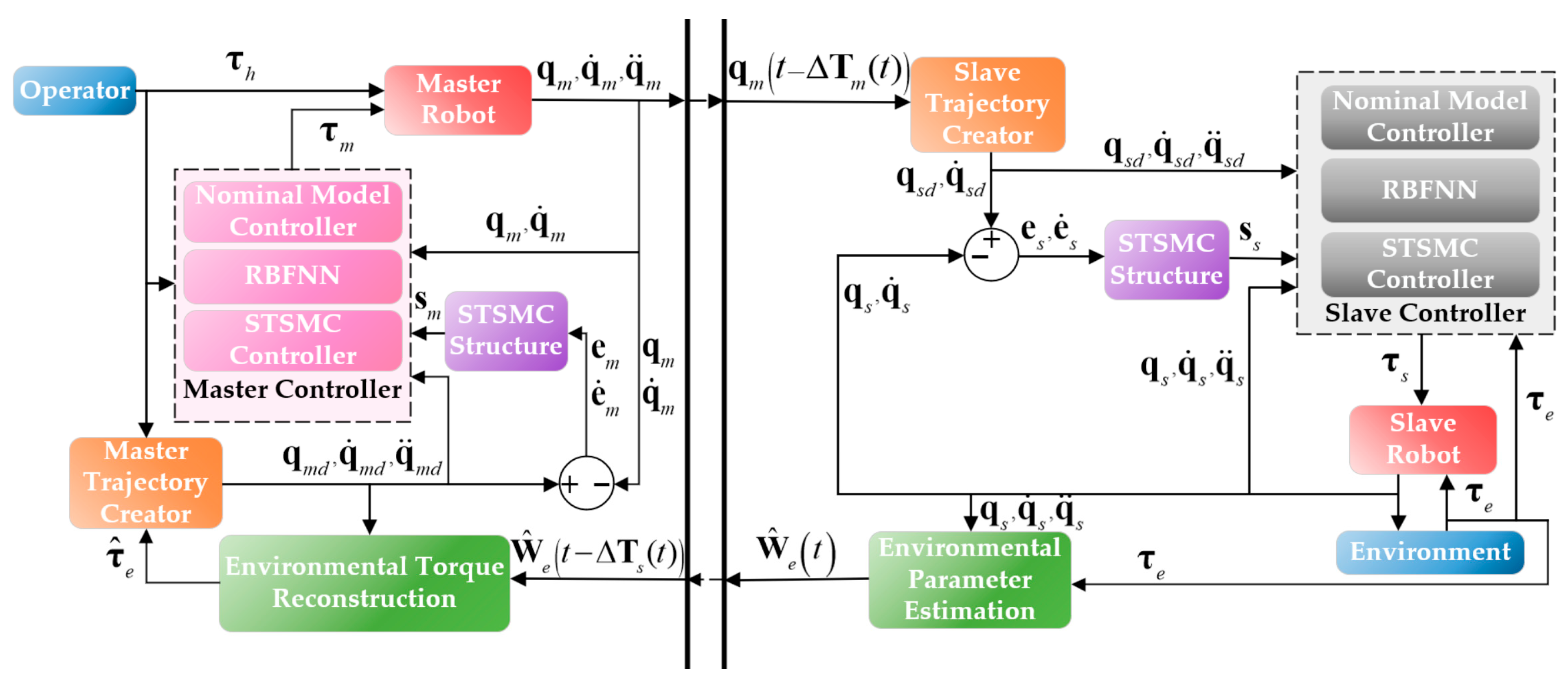
Integrating the master and slave controller designs presented in Section 3.1 and Section 3.3, the complete architecture of the bilateral teleoperation control system is illustrated in Figure 2. The left and right blocks depict the master-side and slave-side controllers, respectively.

3.4. Stability Analysis

This subsection establishes the stability properties of the slave-side and master-side controllers developed in Section 3.2 and Section 3.3. It should be emphasized that, due to the presence of the super-twisting integral action, the RBFNN-based adaptive compensation, and the delay-induced reconstruction mismatch on the master side, the resulting closed-loop system is not directly identical to the simplest scalar canonical super-twisting form. Therefore, the analysis proceeds by first rewriting the closed-loop sliding dynamics into an augmented form consisting of a mechanical-energy subsystem and an internal super-twisting state and then invoking the strict Lyapunov framework of [32,33] for the corresponding augmented super-twisting dynamics.
Before presenting the main results, the following assumptions are introduced.
Assumption 1 
([34,35]). For each i { m , s } , the inertia matrix M i ( q i ) is symmetric, positive definite, and uniformly bounded. That is, there exist positive constants m _ i and m ¯ i such that:
m _ i x 2 x T M i ( q i ) x m ¯ i x 2 , x n
Moreover, the matrix M ˙ i ( q i ) 2 C i ( q i , q ˙ i ) is skew-symmetric.
Assumption 2 
([28]). The RBFNN approximation residual is bounded on the compact operating set, namely:
ε i ( Z i ) ε ¯ i
where ε ¯ i > 0 are unknown but finite constants.
Assumption 3 
([36,37]). The lumped matched disturbance is bounded, i.e.,
d i ( t ) d ¯ i
where d ¯ i are unknown but finite constants.
Assumption 4. 
The forward and backward communication delays are bounded:
0 Δ T m ( t ) Δ T m ,   0 Δ T s ( t ) Δ T s
In addition, the transmitted environmental weight estimate has a bounded update rate:
θ ^ e ( t ) F ϑ ¯ e
and the Gaussian basis vector used in environmental torque reconstruction is bounded:
Φ ^ e ( q m , q m ) Φ ¯ e
Hence, the delay-induced reconstruction mismatch:
δ m t θ ^ e T Φ e q m , q ˙ m θ ^ e T t Δ T s t Φ e q m , q ˙ m
satisfies:
δ m t θ ¯ e Δ T ¯ s Φ ¯ e
Therefore, δ m t can be absorbed into the matched perturbation term of the master-side sliding dynamics.
Assumption 5 
([32,33]).  The lumped matched uncertainty entering the sliding dynamics is locally absolutely continuous and has a bounded derivative. Specifically, define:
Δ s ( t ) ε s ( Z s ) + d s ( t ) ,   Δ m ( t ) ε m ( Z m ) + d m ( t ) + δ m ( t )
and assume that:
Δ ˙ i ( t ) L i
where L i > 0 are unknown but finite constants.
Assumption 5 is the regularity condition required for invoking the strict Lyapunov theory of the super-twisting algorithm in [32,33]. It does not, by itself, imply boundedness of the internal integral state; rather, after the closed-loop sliding dynamics are rewritten in the corresponding augmented form, it allows one to rigorously establish boundedness of the internal super-twisting state and the resulting finite-time or ultimate boundedness properties of the sliding variables.
For compactness, define the element-wise nonlinear vector:
φ ( s i ) | s i 1 | 1 / 2 sgn ( s i 1 ) | s i n | 1 / 2 sgn ( s i n )
Next, introduce the internal integral states associated with the super-twisting terms:
z i ( t ) 0 t K β i sgn ( s i ( τ ) ) d τ
whose dynamics satisfy:
z ˙ i = K β i sgn ( s i )
By substituting the slave-side control law and adaptive law into the slave-side sliding dynamics, and similarly substituting the master-side control law and adaptive law into the master-side sliding dynamics, the two closed-loop subsystems can be written in the unified form:
M i ( q i ) s ˙ i + C i ( q i , q ˙ i ) s i = K i 1 s i K i 2 φ ( s i ) z i + θ ˜ i T Φ i ( Z i ) + Δ i ( t )
where:
θ ˜ i θ i θ ^ i
denotes the neural-network weight estimation error.
To explicitly handle the integral component, define the augmented variable
r i ( t ) z i ( t ) Δ i ( t )
Then, (47) becomes:
M i ( q i ) s ˙ i + C i ( q i , q ˙ i ) s i = K i 1 s i K i 2 φ ( s i ) r i + θ ˜ i T Φ i ( Z i )
and
r ˙ i = K β i sgn ( s i ) Δ i ( t )
Equations (50) and (51) show that both the slave-side and master-side closed-loop sliding dynamics admit the same augmented super-twisting structure. Therefore, a unified proof can be carried out for i { m , s } .
Theorem 1. 
Under Assumptions 1–5, consider the proposed bilateral teleoperation controller. Suppose that, for each i { m , s } , the matrices Λ i , Γ i , K i 1 , K i 2 , and K β i  are positive definite, and the gains K i 2  and   K β i  satisfy the standard gain conditions of the super-twisting algorithm in [32,33]. Then the following statements hold simultaneously for both the slave side and the master side: all closed-loop signals are bounded; the sliding variables s i t  are uniformly ultimately bounded; in the ideal case Δ i ( t ) 0 , the sliding variables s i t converge to zero in finite time; once the sliding motion is established, the tracking errors e i t converge to zero exponentially.
Proof. 
Consider the composite Lyapunov candidate:
V = i m , s V i
where:
V i = V i 1 + V i 2
with:
V i 1 = 1 2 s i T M i q i s i , V i 2 = 1 2 tr θ ˜ i T Γ i 1 θ ˜ i
We first compute the derivative of V i 1 . Differentiating V i 1 yields:
V ˙ i 1 = s i T M i s ˙ i + 1 2 s i T M ˙ i s i
By Assumption 1, M i 2 C i is skew-symmetric, and therefore:
1 2 s i T M ˙ i s i = s i T C i s ˙ i
Hence:
V ˙ i 1 = s i T M i s ˙ i + C i s i
Substituting the unified closed-loop sliding dynamics (50) into (57), one obtains:
V ˙ i 1 = s i T K i 1 s i s i T K i 2 φ s i s i T r i + s i T θ ˜ i T Φ i Z i
Differentiating V i 2 with respect to the time yields:
V ˙ i 2 = t r θ ˜ i T Γ i 1 θ ˜ ˙ i = t r θ ˜ i T Γ i 1 θ ^ ˙ i
By the trace identity:
t r θ ˜ i T Φ i Z i s i T = s i T θ ˜ i T Φ i Z i
It follows that:
V ˙ i 2 = s i T θ ˜ i T Φ i Z i
Combining (58) and (61), the neural-network parameter estimation term is exactly canceled, and thus:
V ˙ i = s i T K i 1 s i s i T K i 2 φ s i s i T r i
Summing over i { m , s } , we obtain:
V ˙ = i m , s s i T K i 1 s i i m , s s i T K i 2 φ s i i m , s s i T r i
At this stage, the term s i T r i cannot be discarded directly. Unlike informal arguments in which the integral term is simply viewed as an additional dissipative component, the present proof explicitly incorporates the integral action into the augmented variable r i = z i Δ i t . The boundedness of r i     must therefore be established rigorously.
From (51), for each i { m , s } :
r ˙ i = K β i sgn s i Δ ˙ i t
Since Assumption 5 ensures that Δ ˙ i t is bounded, and since the gains  K i 2 and K β i  satisfy the standard gain conditions of the super-twisting algorithm, the strict Lyapunov theory in [32,33] guarantees that, for each subsystem i { m , s } , there exists a positive definite function:
W i = W i s i , r i
and class- K functions α _ i , α ¯ i , and α i such that:
α _ i s i , r i W i s i , r i α ¯ i s i , r i
and
W ˙ i α i s i , r i
Define the total augmented Lyapunov function:
W = i m , s W i s i , r i
Then:
W ˙ = i m , s W ˙ i i m , s α i s i , r i
Therefore, under general bounded perturbations, each augmented pair s i , r i is uniformly ultimately bounded; in the ideal case Δ i t 0 , each pair s i , r i converges to the origin in finite time. In particular, for each i { m , s } , there exists a finite constant r ¯ i > 0 such that:
r i t r ¯ i , t 0
Using (70) in (62), and noting that K i 1 > 0 and K i 2 > 0 , there exist constants
λ i 1 = λ min K i 1 > 0
and c i 2 > 0 such that:
s i T K i 1 s i λ i 1 s i 2
and
s i T K i 2 φ s i = j = 1 n k i 2 , j | s i j | 3 / 2 c i 2 s i 3 / 2
Thus:
V ˙ i λ i 1 s i 2 c i 2 s i 3 / 2 + r ¯ i s i
Define:
Δ i * r ¯ i c i 2
Whenever s i Δ i * , one has:
c i 2 s i 3 / 2 + r ¯ i s i 0
which implies:
V ˙ i λ i 1 s i 2 0
Hence, each V i t is nonincreasing outside the compact set:
Ω i s i n : s i Δ i *
and, therefore, each sliding variable s i t is uniformly ultimately bounded.
Since V i contains quadratic terms in both s i and θ ˜ i , the boundedness of V i implies boundedness of s i and θ ˜ i . Moreover, since r i is bounded by (70), Δ i t is bounded by Assumptions 2–5, and:
z i = r i + Δ i
It follows that the internal integral state z i is also bounded. Consequently, all closed-loop signals on both the slave side and the master side are bounded.
Next, by the definition of the sliding surface:
s i = e ˙ i + Λ i e i
The tracking error dynamics satisfy:
e ˙ i = Λ i e i + s i
Since Λ i is positive definite and s i t is uniformly ultimately bounded, (81) represents an exponentially stable linear system driven by a bounded input. Therefore, e i t is uniformly ultimately bounded for both i = s and i = m .
Finally, consider the ideal case Δ i ( t ) 0 . Then, by the strict Lyapunov theory of the super-twisting algorithm in [32,33], each augmented pair s i , r i converges to the origin in finite time. Hence, for each i { m , s } , there exists a finite time T i > 0 such that:
s i t = 0 , r i t = 0 , t T i
Let:
T * max T s , T m
Then, for all t T * :
s i t = 0
Accordingly, the tracking error dynamics reduce to:
e ˙ i = Λ i e i
from which the exponential convergence of both e s ( t ) and e m ( t ) to zero follows immediately.
This completes the proof.

3.5. Controller Parameter Selection

The proposed adaptive super-twisting sliding-mode control scheme contains several design parameters that affect the convergence speed, robustness, and steady-state performance of the teleoperation system. In practice, these parameters can be selected according to the following guidelines.
First, the sliding-surface gain matrices Λ m and Λ s determine the convergence rate of the tracking error dynamics on the sliding manifold. Larger gains accelerate error convergence but may increase control effort and sensitivity to measurement noise.
Second, the super-twisting gains K i 1 , K i 1 , and K β i i = m , s mainly influence the reaching phase of the sliding motion. Increasing these gains enhances disturbance rejection and speeds up convergence to the sliding surface. However, excessively large gains may introduce control chattering or actuator saturation.
Furthermore, the adaptive gains in the neural-network weight update laws regulate the learning speed of the RBFNN approximation. Larger adaptive gains enable faster compensation of model uncertainties but may amplify oscillations caused by measurement noise.
Finally, the filter coefficient α in the environmental force preprocessing module determines the trade-off between noise attenuation and signal responsiveness. A smaller α provides stronger noise suppression but introduces additional lag, whereas a larger α improves responsiveness at the expense of noise sensitivity.
In this study, the controller parameters are selected empirically to balance tracking performance, robustness, and implementation feasibility. The specific parameter values used in simulations and experiments are provided in Section 4.

4. Simulation and Experimental Verification

4.1. Simulation I

In this section, a numerical simulation will be performed on a pair of two-degree-of-freedom (2-DOF) master–slave manipulators to validate the effectiveness of the method proposed in this paper.

Simulation Parameter Settings

For the 2-DOF master–slave teleoperation manipulators, the dynamics of the manipulators are the same as (1), where M i q i n × n , C i q i , q ˙ i n × n , D i q i , q ˙ i n , and G i q i n can be expressed as follows [30]:
M j q j = m j 1 l 1 2 + m j 2 l j 1 2 + l j 2 2 + 2 l j 1 l j 2 cos q j 2 m j 2 l j 2 2 + l j 1 l j 2 cos q 2 m j 2 l j 2 2 + l j 1 l j 2 cos q j 2 m j 2 l j 2 2
C j q j , q ˙ j = 2 m j 2 l j 1 l j 2 q ˙ j 2 sin q j 2 m j 2 l j 1 l j 2 q ˙ j 2 sin q j 2 m j 2 l j 1 l j 2 q ˙ j 2 sin q j 2 0
D j = b j 1 q ˙ j 1 + b j 2 sgn q ˙ j 1 , b j 3 q ˙ j 2 + b j 4 sgn q ˙ j 2 T
G j q j = m j 1 l j 1 + m j 2 l j 1 g cos q j 1 + m j 2 l j 1 l j 2 g cos q j 1 + q j 2 m j 2 l j 1 l j 2 g cos q j 1 + q j 2
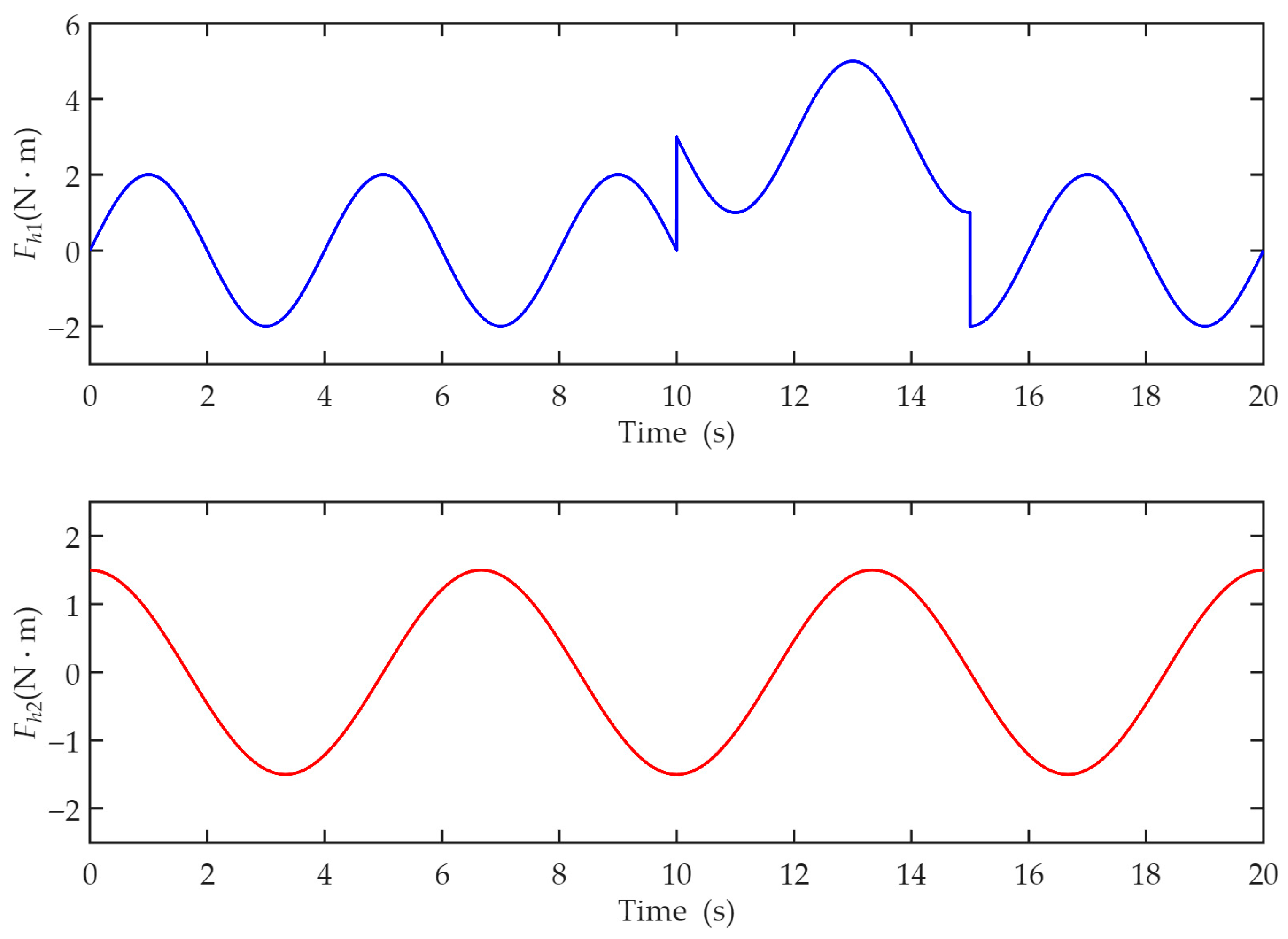
where the parameters used for this simulation are chosen as mj1 = 3.5 kg, mj2 = 2.5 kg, lj1 = 0.3 m, lj2 = 0.35 m, bm1 = 0.5, bm2 = 0.2, bm3 = 0.5, bm4 = 0.2, bs1 = 0.3, bs2 = 0.3, bs3 = 0.3, bs4 = 0.3, and g = 9.8 m/s2. The equivalent damping and stiffness matrices for the operator and environment are Qh = diag(0.1,0.1), Ph = diag(10,10), Qe = diag(0.5,0.5), and Pe = diag(10,10). To simulate the dynamic operator–master interaction, the external torques fh1 and fh2 shown in Figure 3, applied to master joint 1 and joint 2, respectively, are modeled as follows:
f h 1 t = 2 sin π t / 2 0 t 10 2 sin π t / 2 + 3 10 t 15 2 sin π t / 2 15 t 20
f h 2 t = 1.5 cos 3 π t / 10 0 t 20
To evaluate the effectiveness of the proposed control strategy, a comparative study is conducted under identical simulation conditions and parameter settings. The proposed adaptive super-twisting sliding-mode control method is compared with a representative PD-based bilateral teleoperation controller reported in [30], which is widely adopted as a benchmark baseline in teleoperation systems due to its simplicity and practical applicability.
Both controllers are tested while the master manipulator follows the same reference trajectory. The comparison focuses on key performance aspects, including position-tracking accuracy, force synchronization performance, dynamic response characteristics, and disturbance rejection capability.
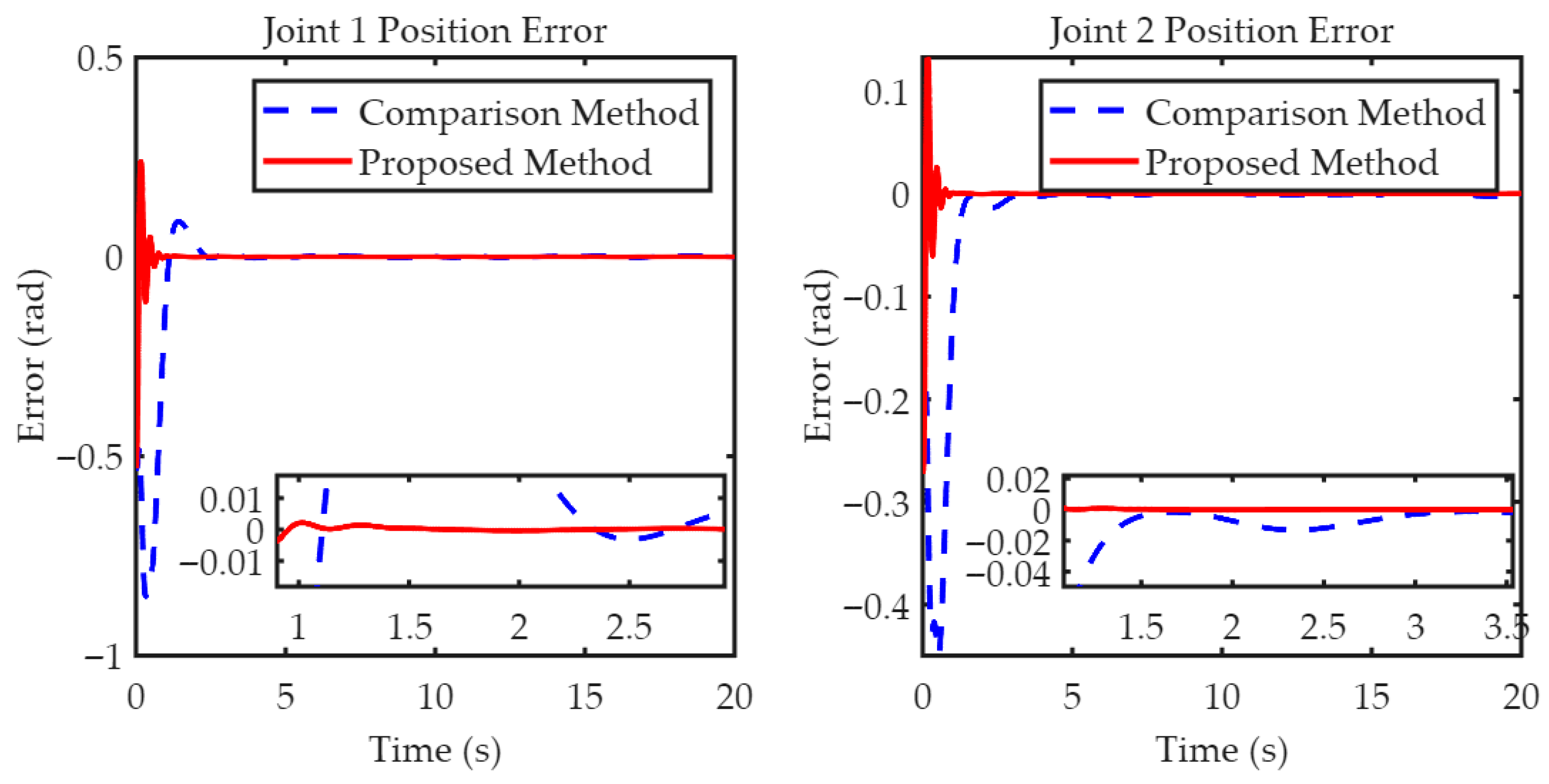
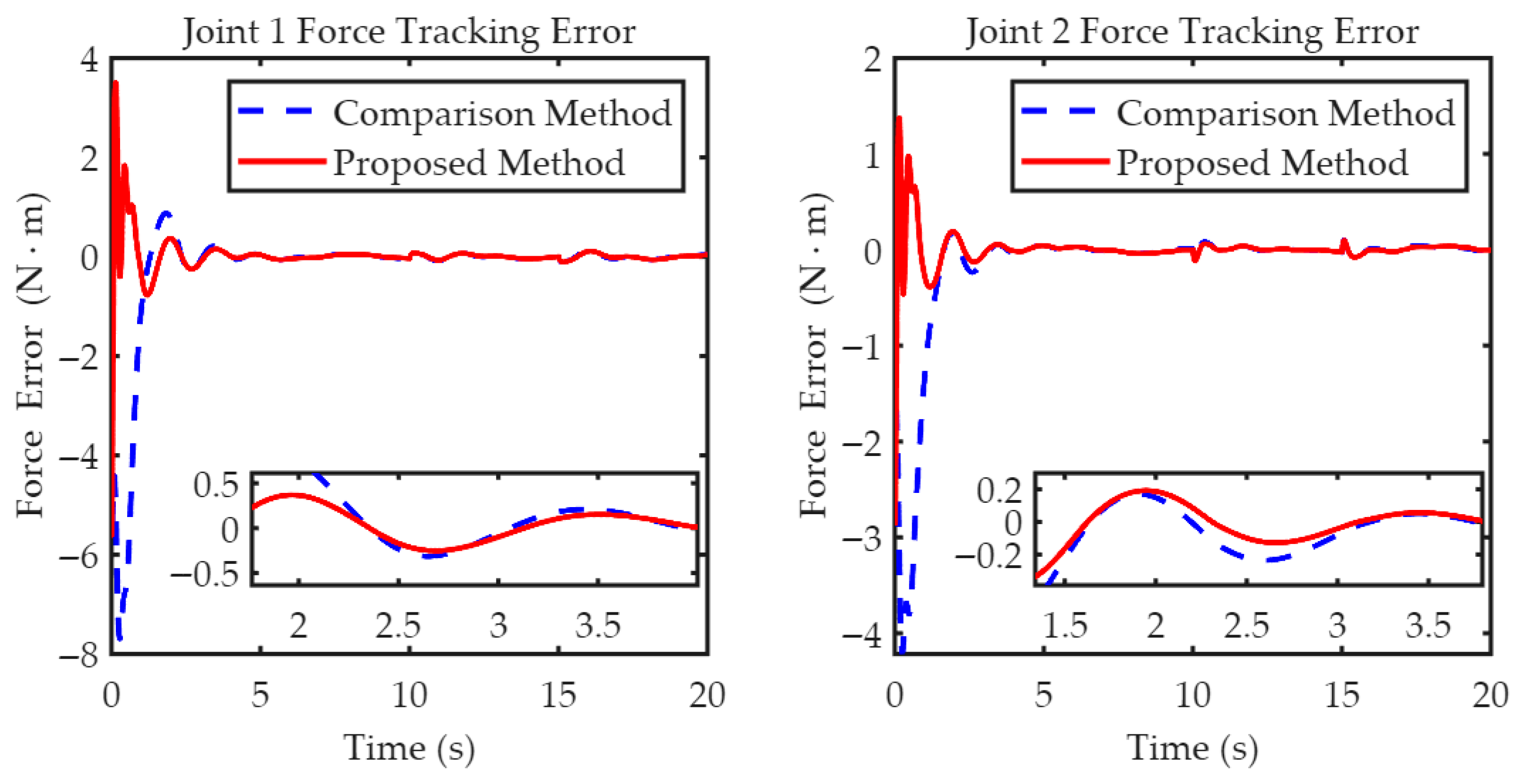
Figure 4 and Figure 5 present the position and force tracking errors obtained using the two control strategies. As observed in Figure 4, the proposed method drives the master–slave position errors to converge rapidly toward zero, demonstrating a significantly faster transient response. Specifically, the position errors converge to near zero within approximately 1.04 s, whereas the comparison controller requires about 3.51 s and 3.53 s for joints 1 and 2, respectively, to reach a comparable error level.
In terms of force-tracking performance, Figure 5 shows that although both methods eventually achieve stable force tracking, the proposed approach exhibits smaller error fluctuations, smoother transient responses, and stronger disturbance-attenuation capability.
To further quantify the steady-state and transient tracking performance, two commonly used evaluation indices—Root Mean Square Error (RMSE) and Integral of Time multiplied by Absolute Error (ITAE)—are adopted. For each joint i , given the discrete tracking error sequence e i k sampled with period Δ t , the performance metrics are defined as follows:
R M S E i = 1 N k = 1 N e i 2 k , I T A E i = k = 1 N t k e i k Δ t
where t k = k Δ t . In the simulations, the sampling period is set to Δ t = 2 ms (corresponding to a control frequency of 500 Hz), and the performance indices are evaluated over the time interval t [ 0,20 ] s.
The quantitative comparison results are summarized in Table 1. It can be clearly observed that the proposed method consistently achieves significantly lower RMSE and ITAE values for both position and force tracking compared with the PD-based controller. These results indicate that the proposed control strategy improves both steady-state tracking accuracy and transient response characteristics.
More specifically, the position RMSE is reduced by 27.98% and 41.44% for joints 1 and 2, respectively, while the corresponding ITAE values are decreased by 96.12% and 95.43%. For force tracking, the RMSE is reduced by 21.88–31.41%, and the ITAE is reduced by 39.64–43.62% across the four force channels.
Overall, these results demonstrate that the integration of super-twisting sliding-mode control with adaptive RBF neural network compensation significantly enhances convergence speed, steady-state tracking precision, and disturbance rejection capability compared with the conventional PD-based teleoperation controller.

4.2. Simulation II

To further validate the effectiveness and robustness of the proposed control strategy, a high-fidelity teleoperation simulation platform is developed based on the MuJoCo physics engine for a seven-degree-of-freedom (7-DOF) master–slave manipulator system. First, a detailed three-dimensional (3D) rigid-body model of the dual-arm manipulator is constructed using standard robotic modeling tools. The resulting URDF model is then imported into the MuJoCo simulator to ensure that the geometric configuration, inertial properties, and joint constraints accurately represent the dynamic characteristics of the physical manipulator. This modeling procedure guarantees that the simulated system faithfully captures the dynamics of the real robotic platform.
The simulation environment runs on Ubuntu 22.04 LTS, with Visual Studio Code 2023 used as the integrated development environment. Real-time bidirectional communication between the master and slave manipulators is implemented through a TCP socket-based network interface, enabling realistic data exchange in teleoperation scenarios. To ensure reproducibility of the simulation experiments, the key simulation parameters are explicitly specified. The control loop operates with a fixed sampling period of 2 ms, corresponding to a control frequency of 500 Hz. The numerical integration step of the MuJoCo physics engine is set to 0.002 s, which matches the controller update period and ensures synchronous updates between the control algorithm and the dynamic simulation.
The communication delay between the master and slave subsystems is modeled as time-varying transport delays to emulate realistic network latency in teleoperation systems. Specifically, the forward and backward communication delays are defined as follows:
Δ T m t = 0.15 + 0.008 sin 14 t + 0.003 sin 17 t + 0.003 sin 13 t + 0.008 sin 19 t
Δ T s t = 0.13 + 0.008 sin 16 t + 0.002 sin 11 t + 0.004 sin 19 t + 0.006 sin 7 t
where t   denotes the simulation time in seconds (s). The resulting forward and backward communication delays Δ T m t and Δ T s t are therefore evaluated in seconds and represent realistic time-varying network delays in the teleoperation system. Under this delay model, the forward delay varies approximately within [0.13 s, 0.17 s], while the backward delay varies within [0.11 s, 0.16 s], providing a realistic and challenging network condition for evaluating the proposed control strategy.
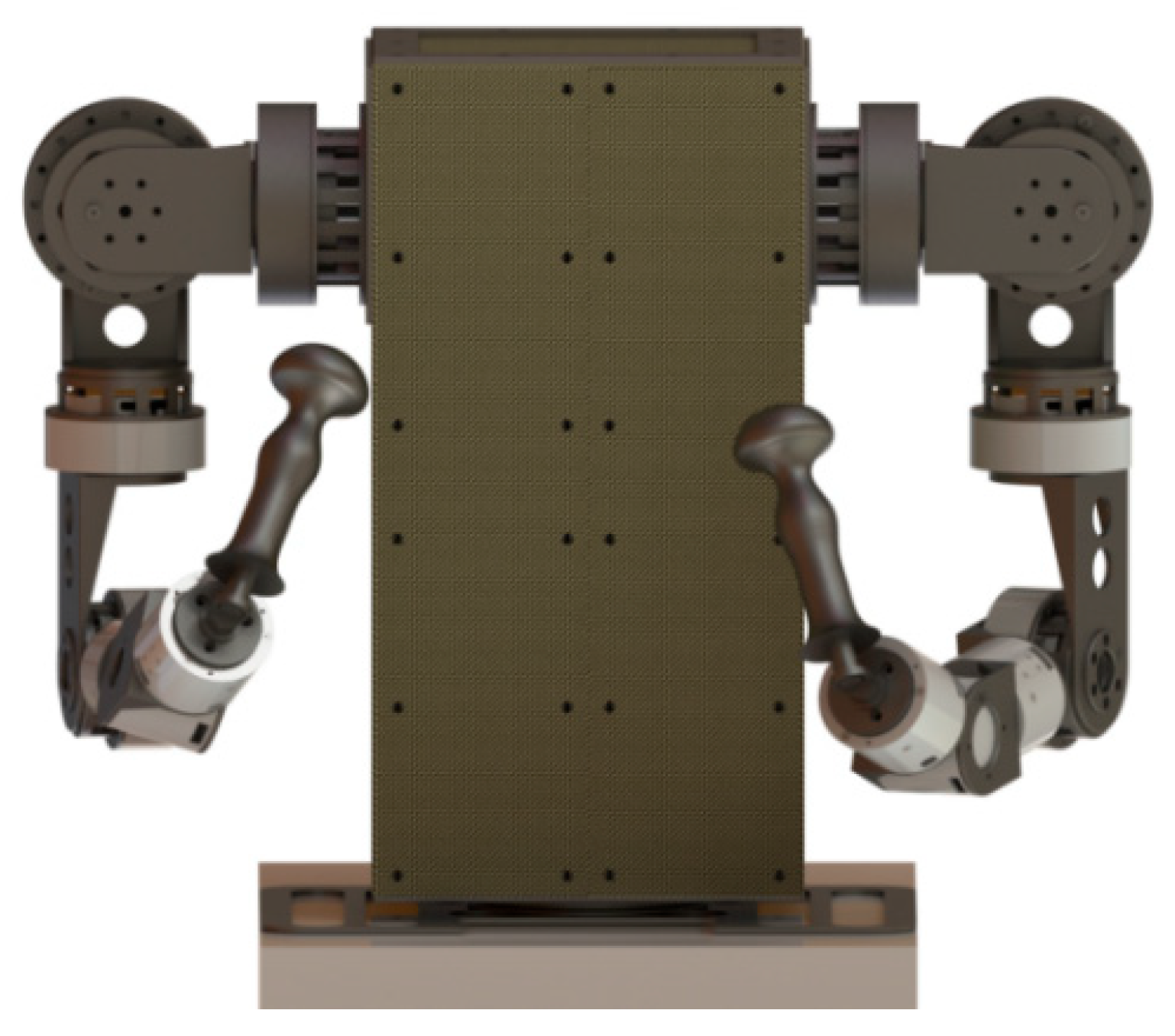
All simulations are conducted on a 7-DOF manipulator configuration, as shown in Figure 6. Joint position, velocity, and acceleration constraints are enforced according to the system configuration parameters to ensure that the simulated motion remains within physically feasible limits.

4.2.1. Simulation Parameter Settings

The sliding surface parameter matrix, linear gain matrix, super-twisting gain matrix, and integral gain matrix for the position tracking error are set as follows: Λ j = d i a g 3.5 , 3.5 , 3.5 , 3.5 , 3.5 , 3.5 , 3.5 , K j 1 = d i a g 0.90 , 0.65 , 0.68 , 0.55 , 0.66 , 0.67 , 0.68 , K j 2 = d i a g 0.80 , 0.55 , 0.59 , 0.52 , 0.59 , 0.67 , 0.59 , and K β j = d i a g 0.90 , 0.80 , 0.82 , 0.62 , 0.75 , 0.69 , 0.80 , respectively. The desired trajectory for the master manipulator is generated based on the impedance model (21). The corresponding behavioral matrix parameters are set as follows: M d = d i a g 7.8 , 7.8 , 7.8 , 7.8 , 7.8 , 7.8 , 7.8 , B d = 0 , and K d = d i a g 19.6 , 19.6 , 19.6 , 19.6 , 19.6 , 19.6 , 19.6 . Parameter settings for the environmental torque estimation and reconstruction module (8) are crucial for system transparency. The update parameters are set as follows: k e = 0.5 and Γ e = 5.0 Ι 50 . To achieve effective mapping of the Gaussian functions in the RBF neural network, the number of hidden layer nodes is chosen as N = 50 , with a basis width of σ e = 0.05 . The center vectors of the RBF network are set as follows: c j 3.0 , 3.0 .

4.2.2. Simulation Tracking Performance Analysis

Under consistent simulation parameters and operating conditions, the proposed method is compared with the PD-based control approach reported in [30]. Both controllers are tested while the master manipulator follows the same sinusoidal periodic trajectory. The resulting slave position tracking profiles and corresponding error variations are shown in Figure 7, Figure 8, Figure 9 and Figure 10. To further examine robustness under external perturbations, a step disturbance torque of 10 N·m is applied to each joint of the slave manipulator between 20 s and 21 s. This setup simulates abrupt disturbances such as rigid collisions or sudden load changes that may occur during teleoperation. The dynamic responses and tracking errors of the first six joints are recorded for analysis.
The results demonstrate a clear performance distinction between the two control strategies. During both the application and removal of the disturbance, the comparative PD-based method exhibits significantly larger error fluctuations, with peak error magnitudes approximately double those of the proposed method. This is accompanied by notable trajectory deviation and a prolonged recovery lag. In contrast, the proposed controller maintains close trajectory alignment with the master reference throughout the disturbance period, exhibiting only transient minor deviations. Following disturbance removal at approximately 21.2 s, the proposed method rapidly converges to a stable tracking state without appreciable overshoot or persistent oscillation. The comparison method, however, requires around 21.8 s to regain steady tracking. This comparative analysis confirms that integrating online RBF neural network compensation with a super-twisting sliding-mode robust design endows the proposed method with superior disturbance suppression and faster convergence in the presence of sudden external perturbations, outperforming the conventional PD-based scheme.

4.2.3. Quantitative Error Evaluation

To quantitatively evaluate the performance of the proposed adaptive super-twisting sliding-mode control method, two performance indices—Root Mean Square Error (RMSE) and Integral of Time multiplied by Absolute Error (ITAE)—are utilized to characterize the steady-state accuracy and dynamic response quality, respectively. As illustrated by the quantitative results in Table 2, the proposed method achieves superior tracking accuracy across all joints. The RMSE values are consistently lower than those of the comparison method, demonstrating its efficacy in suppressing steady-state errors. The performance enhancement is particularly pronounced for joints 1, 2, 5, and 6. For instance, the RMSE for joint 1 is reduced from 0.1631 rad to 0.0686 rad, marking a significant reduction of 57.9%, while joints 5 and 6 exhibit decreases of 54.5% and 55.6%, respectively. In terms of dynamic performance, the ITAE metrics for most joints are substantially reduced (e.g., joint 1 ITAE drops from 38.69 to 22.15), implying a more rapid transient response and attenuated oscillations under initial deviations or external disturbances. Although a marginal increase in ITAE is observed for Joint 4 (from 19.71 to 23.55), its overall tracking performance remains high due to the concurrent reduction in RMSE. It is demonstrated that, by leveraging the synergistic effects of super-twisting sliding-mode control and the adaptive compensation of the RBF neural network, the method proposed in this paper exhibits enhanced trajectory tracking precision, faster dynamic convergence, and robust disturbance rejection.

4.2.4. Simulation Torque Reconstruction Analysis

In the simulation, the environmental force τ e exerted on each joint of the slave manipulator is modeled as a combination of sinusoidal functions with different amplitudes, frequencies, and initial phases, which is expressed as follows:
τ e , i t = Ω t · A i · sin k i t + φ i + P i t
where A i denotes the amplitude, k i π denotes the angular frequency, and φ i denotes the initial phase. Ω t represents a time-varying amplitude modulation term used to test robustness. P i t denotes the instantaneous step disturbance, which is used to simulate sudden collisions or load changes during the operation. The specific parameters for each joint are listed in Table 3.
The time delay profile defined in (93) and (94) is implemented in the simulation. Figure 11 presents the torque responses of the first six slave joints, comparing the actual environmental torque (red solid line) with the neural network (NN)-estimated torque (blue dashed line) and the master-side reconstructed torque (green dash-dotted line). As illustrated, the NN-estimated torque exhibits high fidelity to the actual environmental torque, validating the estimation accuracy of the neural network. Furthermore, the reconstructed torque at the master side closely tracks the ground-truth variations, maintaining a high degree of consistency. These results verify that the weight transmission strategy effectively mitigates the impact of time-varying communication delays, thereby enhancing system robustness while ensuring high-force feedback transparency.

4.3. Experimental Verification

4.3.1. Experimental Platform Setup

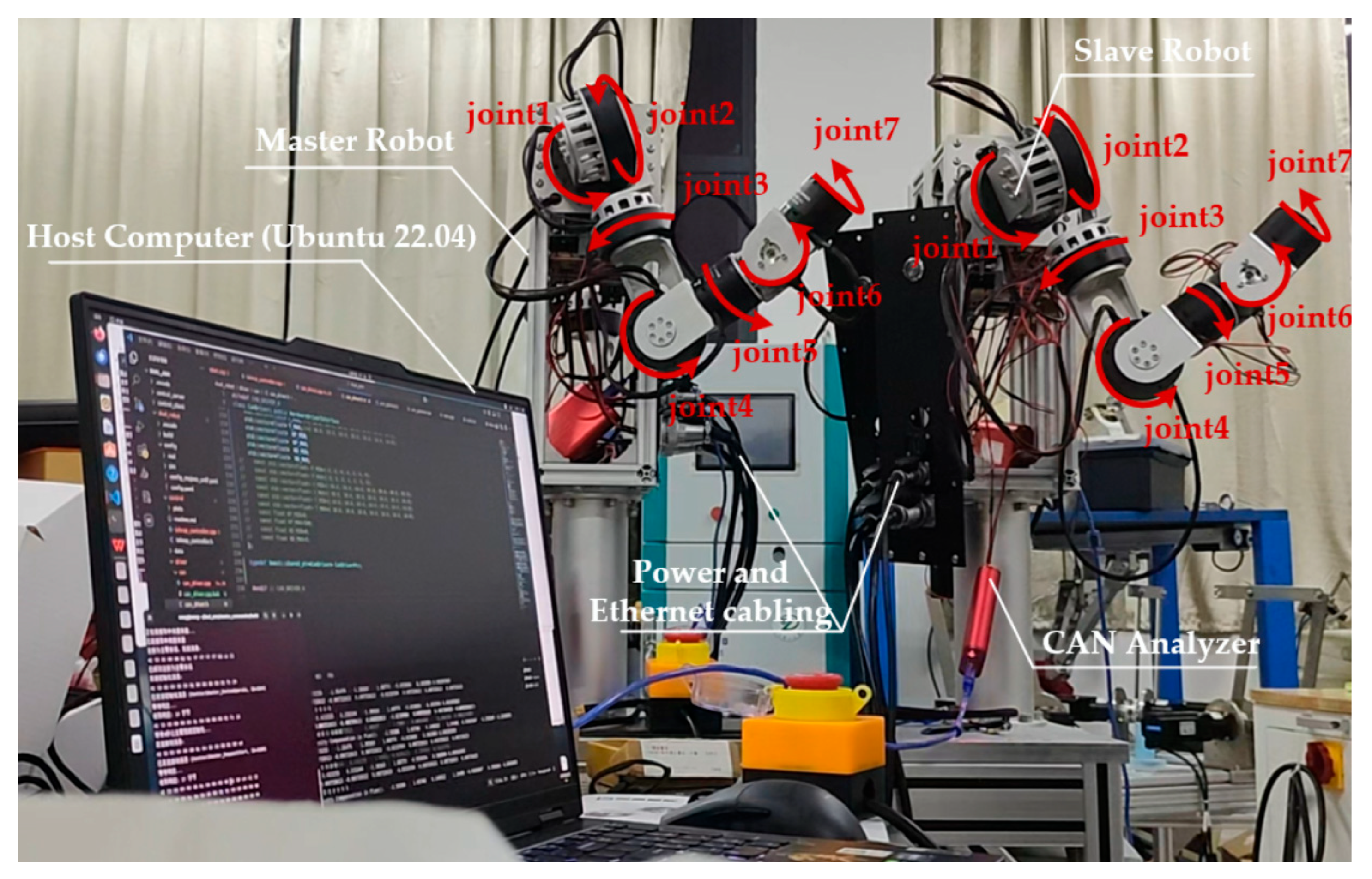
To ensure a fair and reproducible hardware validation of the proposed method, we built a 7-DOF master–slave teleoperation platform (Figure 12) and kept the controller architecture and tuning parameters identical to those used in simulation. The only practical difference is that the simulated actuation/sensing layer is replaced by physically integrated joint modules and their corresponding communication interfaces. Specifically, joints 1–2 are actuated by DM-J8006P-2EC modules, joints 3–4 by DM-J6006-2EC modules, and joints 5–7 by DM-J4310-2EC modules. Key actuator specifications (e.g., rated/peak torque, rated speed, reduction ratio, encoder configuration, and communication interface) are summarized in Table 4.
A host PC running Ubuntu 22.04 performs real-time control computation, command dispatch, and synchronized data logging. Joint-level commands and feedback (e.g., joint position and drive status) are exchanged via CAN/CAN-FD, whereas the inter-arm variables required by the proposed architecture are transmitted through a bidirectional Ethernet socket link. To enable controlled and repeatable evaluation under network effects, the communication channel is configured to emulate time-varying latency and jitter. In particular, the forward and backward communication delays follow the same delay profiles defined in Equations (93) and (94), i.e., Δ T m t and Δ T s t , respectively. During experiments, the control loop and the data logger operate synchronously at a fixed rate of 500 Hz. All transmitted and received packets are time-stamped and recorded on the host PC.
Torque-related signals are obtained from drive feedback (motor-side current or equivalent torque estimate) and converted to the output-side joint torque using the manufacturer-calibrated torque constant together with the built-in reduction ratio. To standardize the reported torque and improve cross-trial comparability, the output-side joint torque is filtered using a second-order Butterworth low-pass filter with a 30 Hz cutoff frequency; the filtered signal is used consistently for plotting and metric computation.

4.3.2. Tracking Performance Analysis

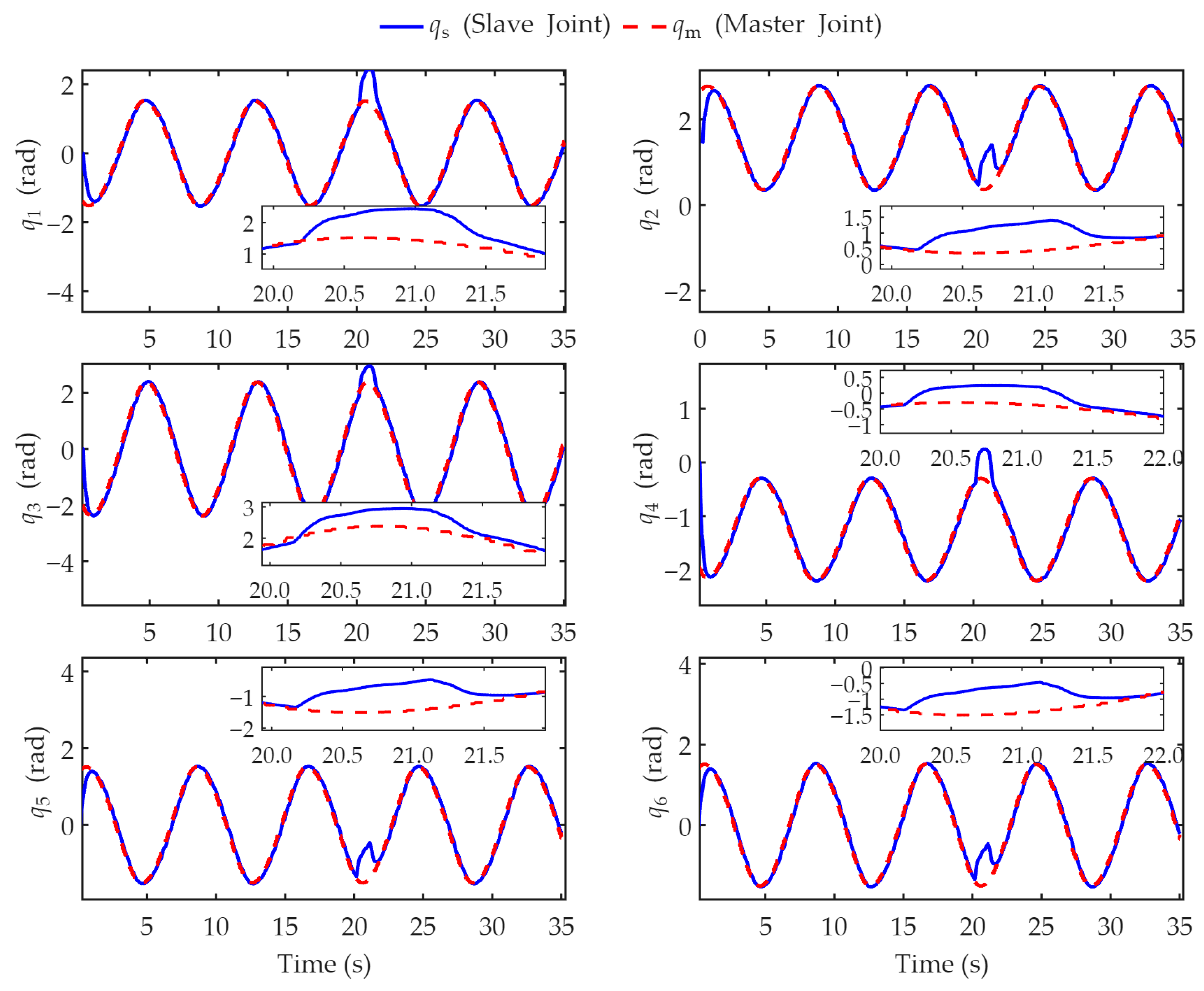
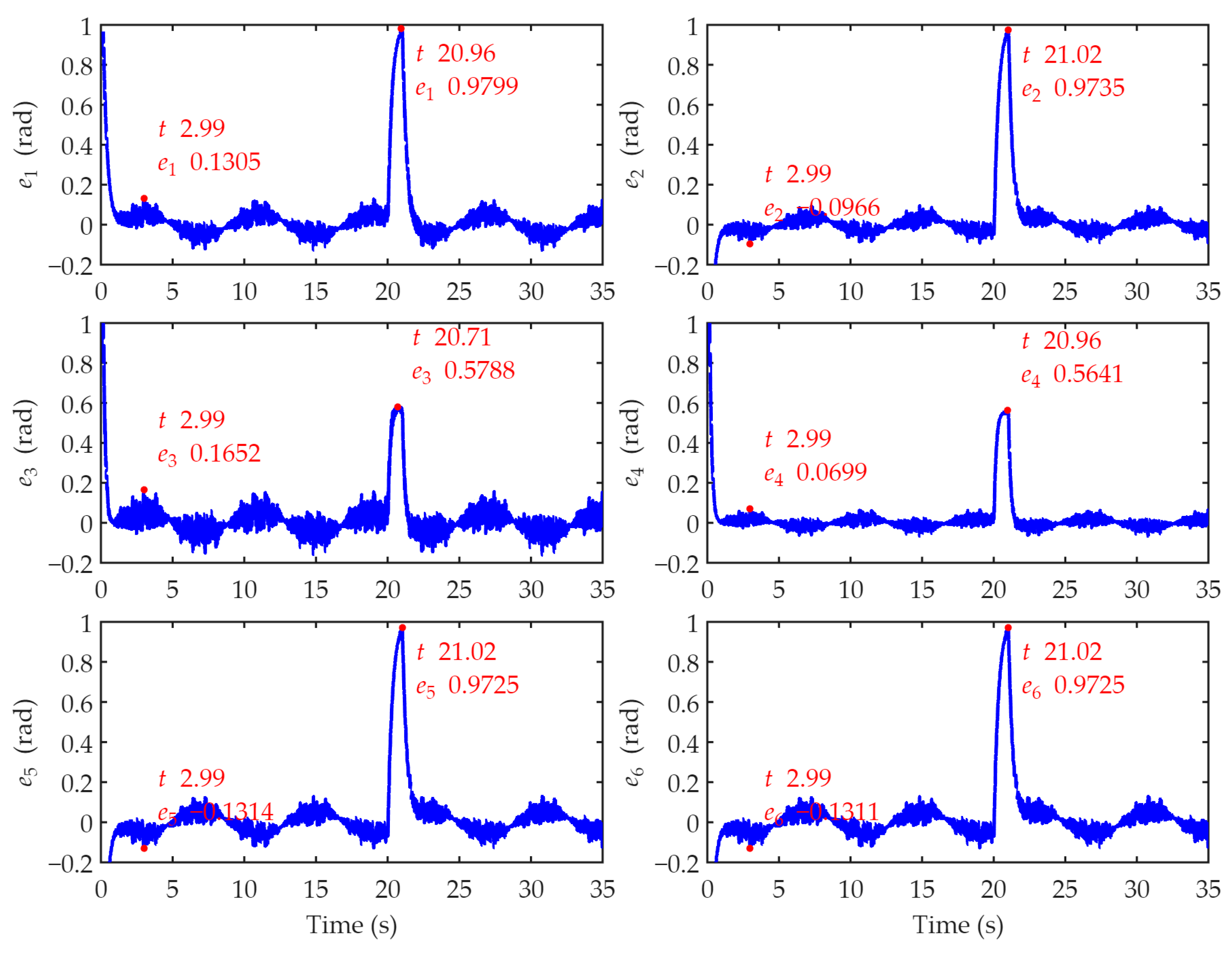
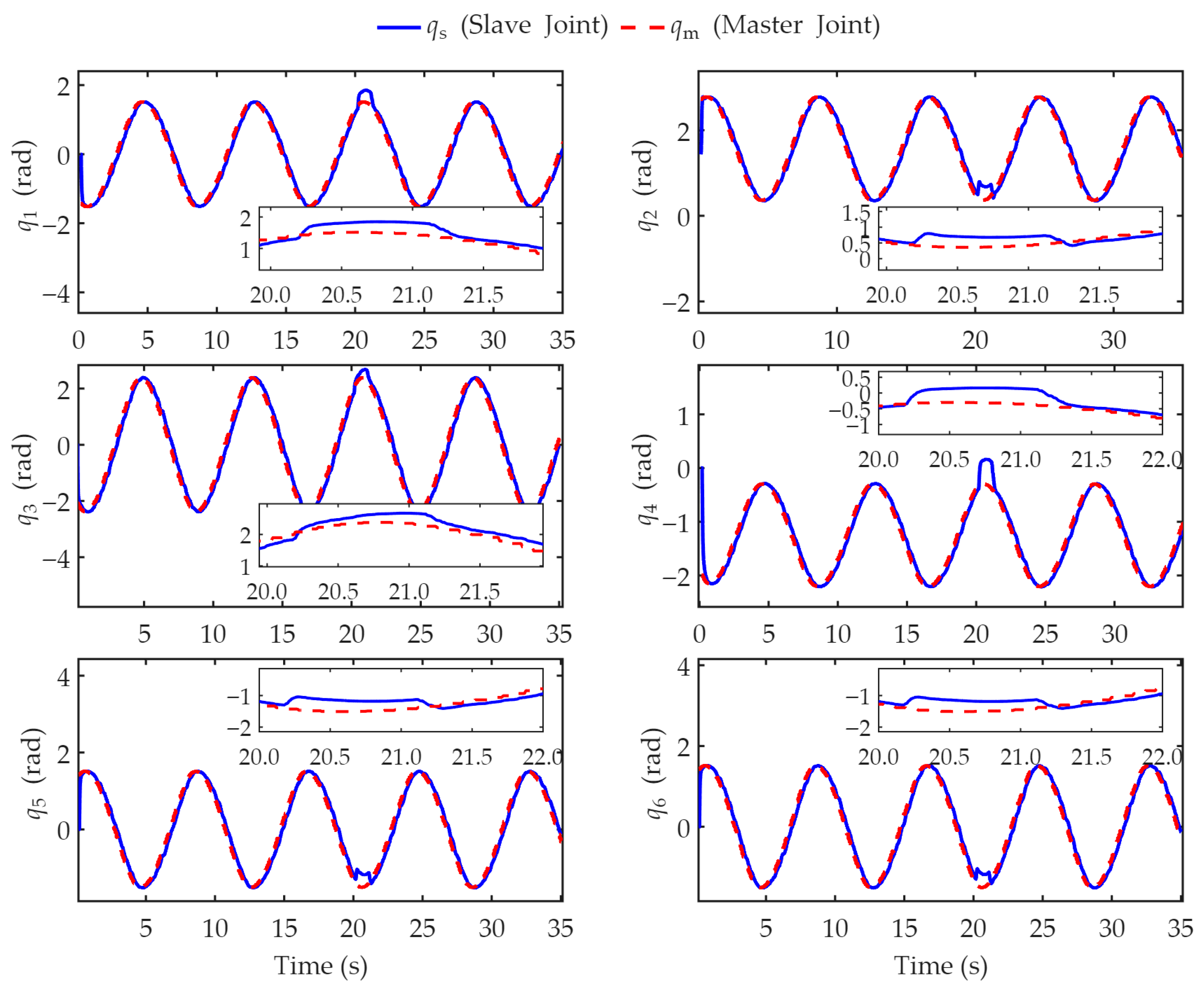
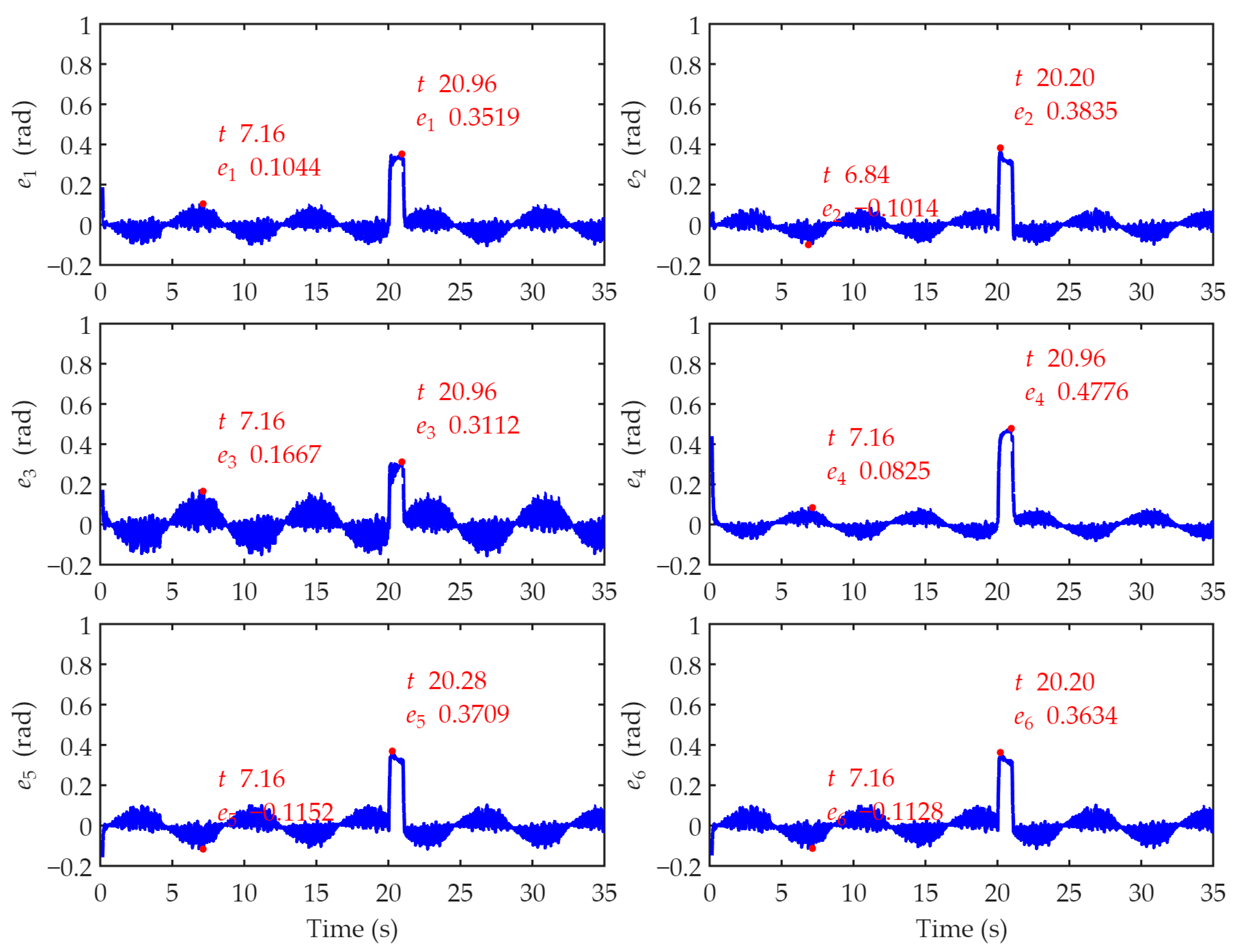
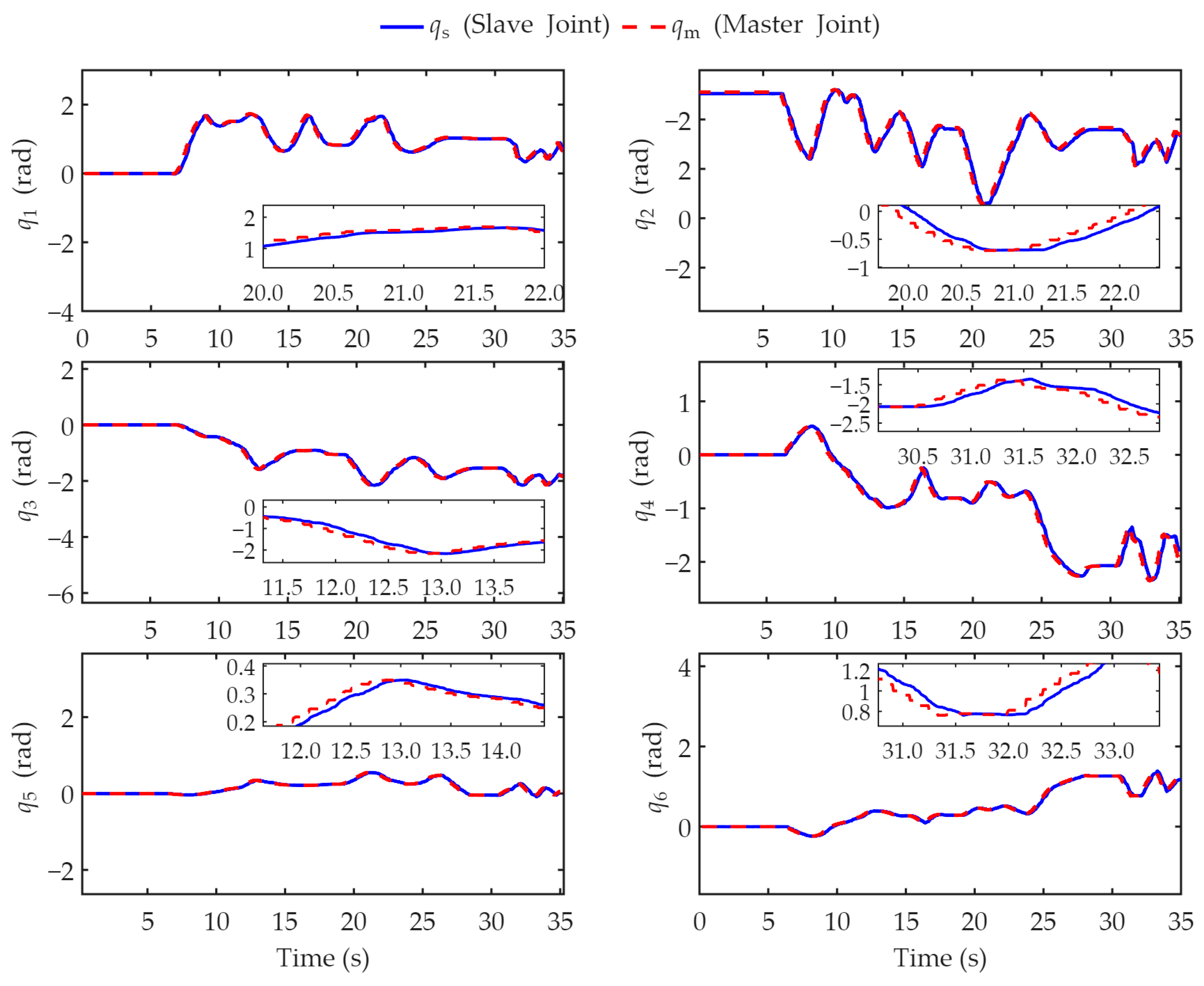
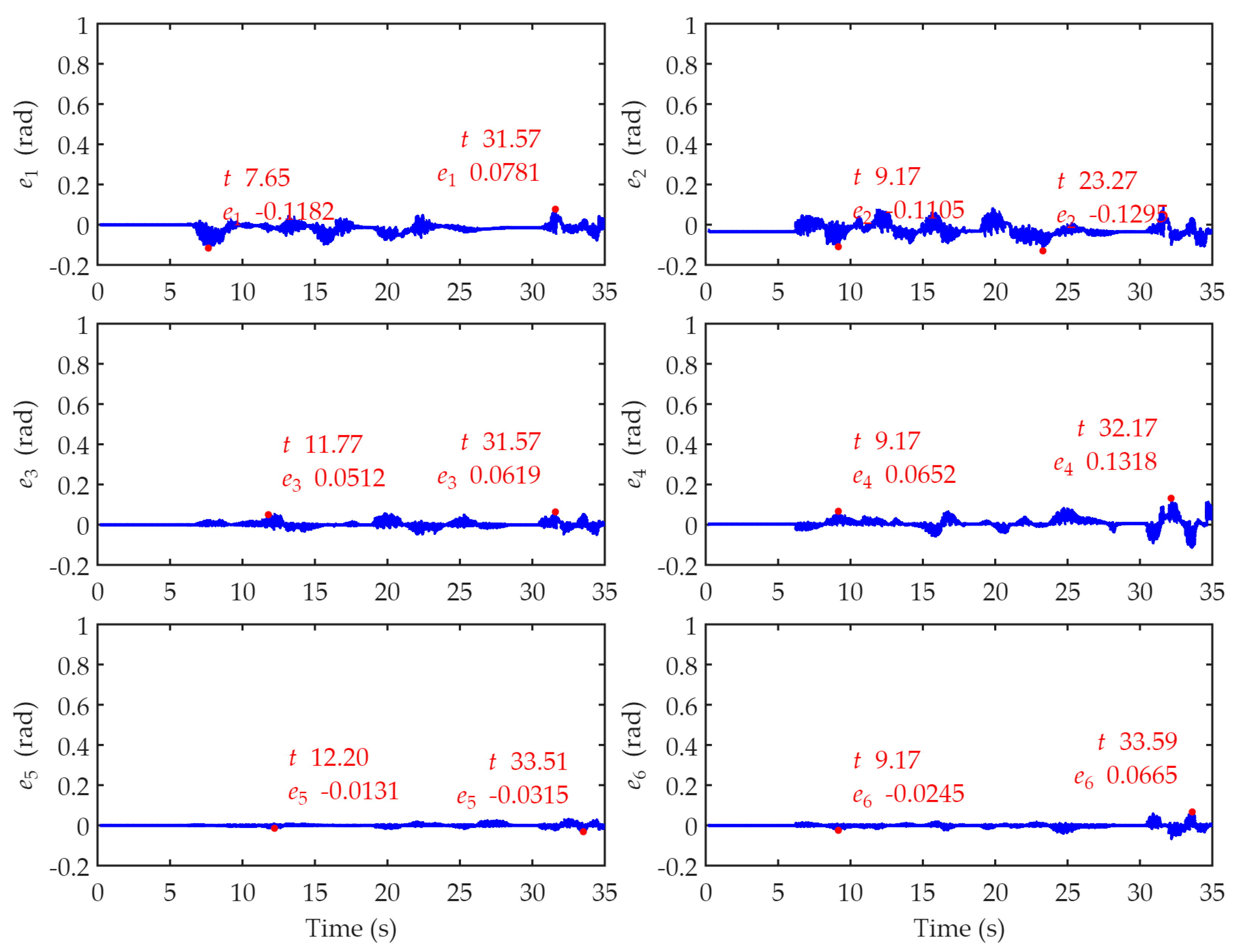
For performance evaluation, a 35 s motion segment is selected, with communication delays implemented according to (93) and (94). The position tracking performance for the first six joints is analyzed, with results presented in Figure 13 and Figure 14. It can be seen that the slave response curves (blue solid line) exhibit high fidelity to the master reference trajectories (red dashed line) across all joints, with negligible phase lag or amplitude attenuation. No significant overshoot or sustained oscillations are observed during the experiment, confirming that the slave manipulator can accurately and stably follow the master-side movements in a real physical environment. This validates the efficacy of the proposed control strategy and the RBF-based compensation in mitigating model uncertainties. Furthermore, Figure 14 illustrates the tracking error profiles; the errors for all joints converge and remain within a narrow band near zero. While transient peaks occur during rapid dragging maneuvers (e.g., at 7.65 s, 23.27 s, and 31.57 s), the errors decay rapidly, demonstrating the system’s robust error recovery and superior transient characteristics.

4.3.3. Torque Reconstruction Analysis

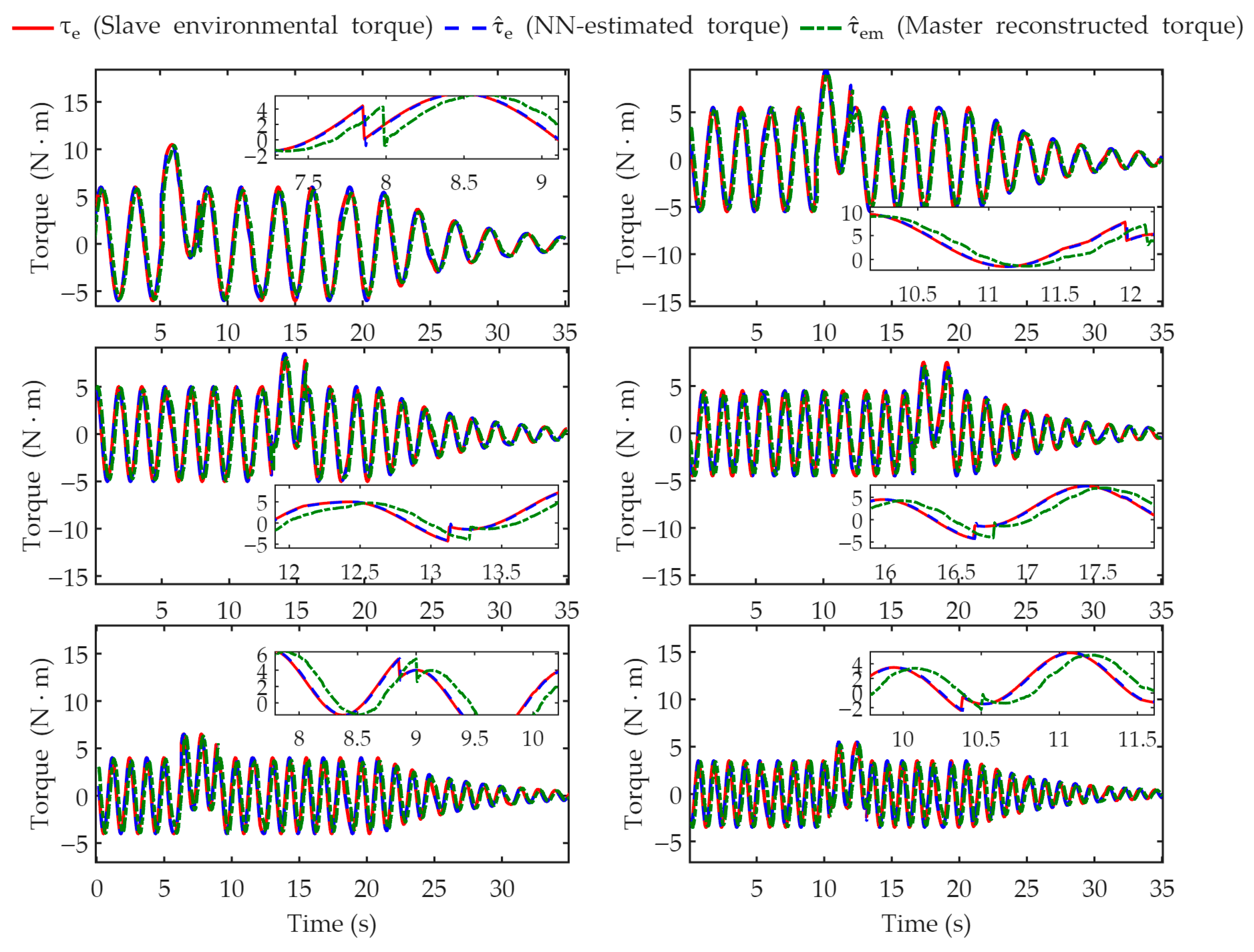
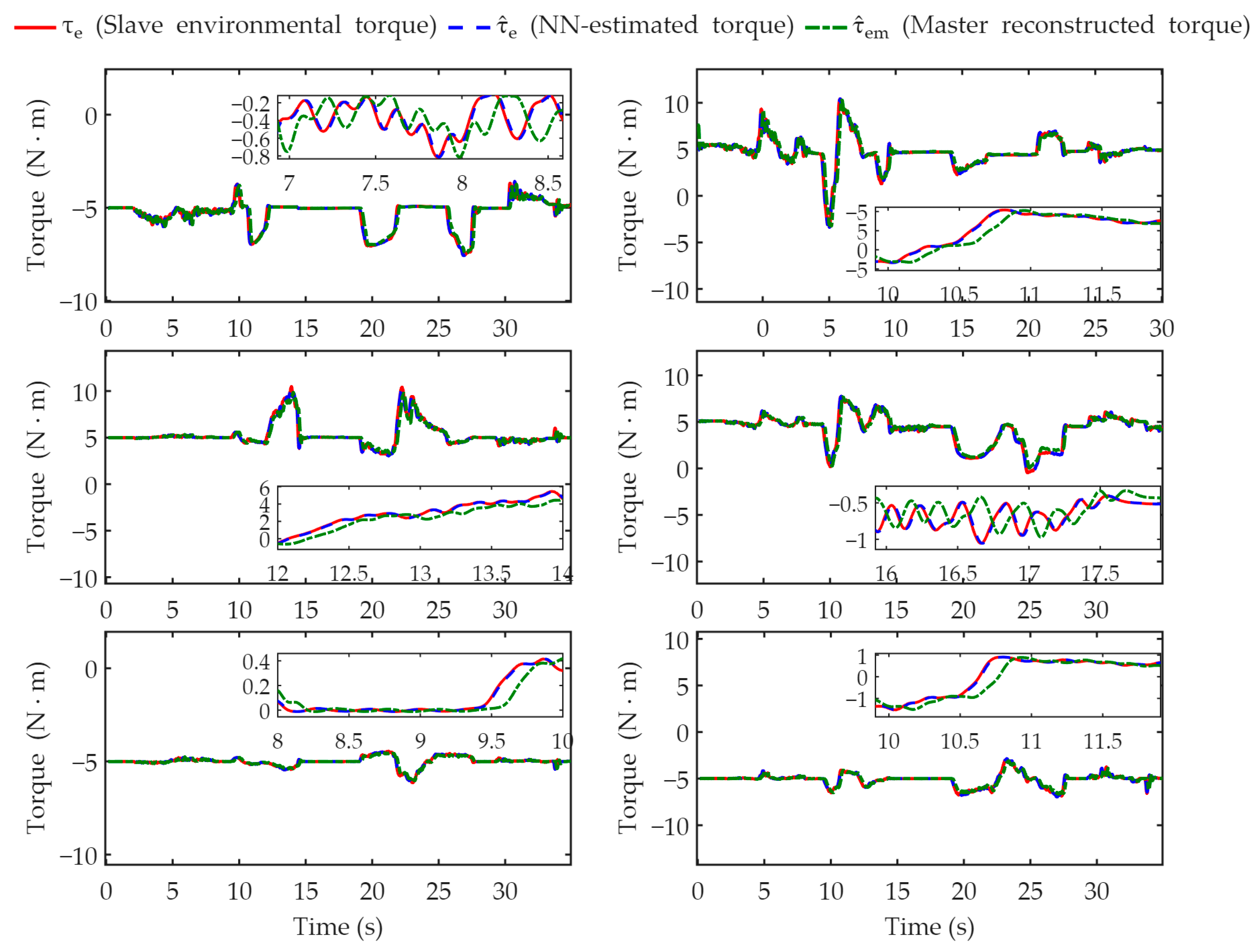
In this section, to evaluate the feasibility and robustness of the proposed RBF neural network (NN)-based force estimation and weight transmission strategy, torque feedback experiments are performed on the 7-DOF physical teleoperation platform. Contact interaction data are acquired by manually guiding the slave manipulator joints. Under the time-varying communication delays defined by (93) and (94), the environmental torque responses for the first six joints are analyzed. Figure 15 illustrates the measured environmental torque (red solid line), the online NN-estimated torque at the slave side (blue dashed line), and the reconstructed torque at the master side (green dash-dotted line). The results indicate that the estimated profiles exhibit high fidelity to the measured data in both magnitude and transient trends, effectively capturing the dynamic characteristics of the contact forces despite unmodeled friction and measurement noise. Concurrently, the master-side reconstructed torque maintains stable synchronization with the slave-side estimations, even during significant fluctuations (e.g., joint 2 at 10.8 s, joint 4 at 15.5 s, and joint 5 at 19.5 s). These observations confirm that, compared to the direct transmission of force signals, the proposed weight transmission scheme is significantly less sensitive to latencies. This approach effectively mitigates the adverse effects of delays on force feedback transparency, thereby enhancing the haptic fidelity and real-time perception for the operator.

5. Conclusions

Bilateral teleoperation systems are primarily challenged by model uncertainties, environmental disturbances, and transparency degradation. To address these issues, this paper develops an adaptive super-twisting sliding-mode control framework to achieve high-performance position synchronization and force feedback. The proposed scheme incorporates a first-order low-pass filter to preprocess environmental force signals and utilizes an RBF neural network for online torque estimation, effectively mitigating noise and improving estimation fidelity. Furthermore, an adaptive compensation mechanism is integrated into the sliding-mode controller to handle system uncertainties in real time. The closed-loop stability is established via Lyapunov stability theory. Both simulation and experimental results demonstrate that the proposed method maintains high-precision position tracking and ensures accurate environmental force reflection, even under dynamic uncertainties and external disturbances. Compared with conventional PD-based control strategies, the new framework exhibits superior convergence rates, higher steady-state accuracy, and enhanced robustness.
Future research will focus on extending this framework to multi-manipulator cooperative teleoperation and coordinated control under task-level constraints. Additionally, we aim to develop advanced modeling techniques for unstructured environments—accounting for nonlinearities such as friction and backlash—and integrate data-driven learning methods for intent prediction and autonomous parameter tuning.


Author Contributions

Conceptualization, X.D.; methodology, X.D. and Z.W.; software, S.L.; validation, Z.W. and S.L.; formal analysis, Z.W.; investigation, X.D. and P.R.; resources, Z.W.; data curation, Z.W.; writing—original draft preparation, Z.W.; writing—review and editing, X.D. and Z.W.; visualization, P.R.; supervision, X.D.; project administration, X.D.; funding acquisition, X.D. All authors have read and agreed to the published version of the manuscript.

Funding

This work was supported by the National Natural Science Foundation of China (Grant Number [52275469]); the Opening Project of the Key Laboratory of Advanced Manufacturing and Intelligent Technology (Ministry of Education), Harbin University of Science and Technology (Grant Number [KFKT202302]); and the Fundamental Research Funds of Zhejiang Sci-Tech University (Grant Number [24242121-Y]).

Institutional Review Board Statement

Not applicable.

Informed Consent Statement

Not applicable.

Data Availability Statement

The original contributions presented in this study are included in the article. Further inquiries can be directed to the corresponding author.

Conflicts of Interest

Author Pengfei Ren was employed by the company Hangzhou Boomy Intelligent Technology Co., Ltd. The remaining authors declare that the research was conducted in the absence of any commercial or financial relationships that could be construed as a potential conflict of interest.

References

  1. Imaida, T.; Yokokohji, Y.; Doi, T.; Oda, M.; Yoshikawa, T. Ground-space bilateral teleoperation of ETS-VII robot arm by direct bilateral coupling under 7-s time delay condition. IEEE Trans. Robot. Autom. 2004, 20, 499–511. [Google Scholar] [CrossRef]
  2. Soylu, S.; Firmani, F.; Buckham, B.J.; Podhorodeski, R.P. Comprehensive underwater vehicle-manipulator system teleoperation. In Proceedings of the Oceans 2010 MTS/IEEE Seattle, Seattle, WA, USA, 20–23 September 2010; pp. 1–8. [Google Scholar] [CrossRef]
  3. Guo, X.; Song, A.; Zhang, Y. Neural network control for tele-rehabilitation robot based on variable gain. In Proceedings of the 2008 International Conference on BioMedical Engineering and Informatics, Sanya, China, 27–30 May 2008; pp. 778–782. [Google Scholar] [CrossRef]
  4. Hokayem, P.F.; Spong, M.W. Bilateral teleoperation: An historical survey. Automatica 2006, 42, 2035–2057. [Google Scholar] [CrossRef]
  5. Xiong, P.; Zhu, X.; Song, A.; Hu, L.; Liu, X.P.; Feng, L. A target grabbing strategy for telerobot based on improved stiffness display device. IEEE/CAA J. Autom. Sin. 2017, 4, 661–667. [Google Scholar] [CrossRef]
  6. Hace, A.; Franc, M. FPGA implementation of sliding-mode-control algorithm for scaled bilateral teleoperation. IEEE Trans. Ind. Inform. 2013, 9, 1291–1300. [Google Scholar] [CrossRef]
  7. Chen, Z.; Pan, Y.J.; Gu, J. Integrated adaptive robust control for multilateral teleoperation systems under arbitrary time delays. Int. J. Robust Nonlinear Control 2016, 26, 2708–2728. [Google Scholar] [CrossRef]
  8. Ghavifekr, A.A.; Ghiasi, A.R. Discrete-time control of bilateral teleoperation systems: A review. Robotica 2017, 36, 552–569. [Google Scholar] [CrossRef]
  9. Beerens, R.; Heck, D.; Saccon, A.; Nijmeijer, H. The effect of controller design on delayed bilateral teleoperation performance: An experimental comparison. IEEE Trans. Control Syst. Technol. 2020, 28, 1727–1740. [Google Scholar] [CrossRef]
  10. Chen, Z.; Huang, F.; Song, W.; Zhu, S. A novel wave-variable based time-delay compensated four-channel control design for multilateral teleoperation system. IEEE Access 2018, 6, 25506–25516. [Google Scholar] [CrossRef]
  11. Bavili, R.E.; Akbari, A.; Esfanjani, R.M. Control of teleoperation systems in the presence of varying transmission delay, non-passive interaction forces, and model uncertainty. Robotica 2021, 39, 1451–1467. [Google Scholar] [CrossRef]
  12. Islam, S.; Liu, P.X.; El Saddik, A.; Yang, Y.B. Bilateral control of teleoperation systems with time delay. IEEE/ASME Trans. Mechatron. 2015, 20, 1–12. [Google Scholar] [CrossRef]
  13. Chen, Z.; Huang, F.; Yang, C.; Yao, B. Adaptive fuzzy backstepping control for stable nonlinear bilateral teleoperation manipulators with enhanced transparency performance. IEEE Trans. Ind. Electron. 2020, 67, 746–756. [Google Scholar] [CrossRef]
  14. Ortega, R.; Jiang, Z.P.; Hill, D.J. Passivity-based control of nonlinear systems: A tutorial. In Proceedings of the 1997 American Control Conference, Albuquerque, NM, USA, 6 June 1997; pp. 2633–2637. [Google Scholar] [CrossRef]
  15. Anderson, R.J.; Spong, M.W. Bilateral control of teleoperators with time delay. In Proceedings of the 1988 IEEE International Conference on Systems, Man, and Cybernetics, Beijing, China, 8–12 August 1988; pp. 131–138. [Google Scholar] [CrossRef]
  16. Niemeyer, G.; Slotine, J.J.E. Stable adaptive teleoperation. IEEE J. Ocean. Eng. 1991, 16, 152–162. [Google Scholar] [CrossRef]
  17. Munir, S.; Book, W.J. Internet-based teleoperation using wave variables with prediction. In Proceedings of the 2001 IEEE/ASME International Conference on Advanced Intelligent Mechatronics, Como, Italy, 8–12 July 2001; pp. 43–50. [Google Scholar] [CrossRef]
  18. Sun, D.; Naghdy, F.; Du, H. Wave-variable-based passivity control of four-channel nonlinear bilateral teleoperation system under time delays. IEEE/ASME Trans. Mechatron. 2016, 21, 238–253. [Google Scholar] [CrossRef]
  19. Yang, C.; Wang, X.; Li, Z.; Li, Y.; Su, C.-Y. Teleoperation control based on combination of wave variable and neural networks. IEEE Trans. Syst. Man Cybern. Syst. 2017, 47, 2125–2136. [Google Scholar] [CrossRef]
  20. Li, Y.; Li, K.; Tong, S. Finite-time adaptive fuzzy output feedback dynamic surface control for MIMO nonstrict feedback systems. IEEE Trans. Fuzzy Syst. 2019, 27, 96–110. [Google Scholar] [CrossRef]
  21. Wang, H.; Liu, P.X.; Zhao, X.; Liu, X. Adaptive fuzzy finite-time control of nonlinear systems with actuator faults. IEEE Trans. Cybern. 2020, 50, 1786–1797. [Google Scholar] [CrossRef]
  22. Nuño, E.; Ortega, R.; Barabanov, N.; Basañez, L. A globally stable PD controller for bilateral teleoperators. IEEE Trans. Robot. 2008, 24, 753–758. [Google Scholar] [CrossRef]
  23. Nuño, E.; Basañez, L.; López-Franco, C.; Arana-Daniel, N. Stability of nonlinear teleoperators using PD controllers without velocity measurements. J. Frankl. Inst. 2014, 351, 241–258. [Google Scholar] [CrossRef]
  24. Islam, S.; Liu, X.P.; El Saddik, A. Teleoperation systems with symmetric and unsymmetric time varying communication delay. IEEE Trans. Instrum. Meas. 2013, 62, 2943–2953. [Google Scholar] [CrossRef]
  25. Chen, Z.; Huang, F.; Sun, W.; Gu, J.; Yao, B. RBF-neural-network-based adaptive robust control for nonlinear bilateral teleoperation manipulators with uncertainty and time delay. IEEE/ASME Trans. Mechatron. 2020, 25, 906–918. [Google Scholar] [CrossRef]
  26. Huang, F.; Zhang, W.; Chen, Z.; Tang, J.; Song, W.; Zhu, S. RBFNN-based adaptive sliding mode control design for nonlinear bilateral teleoperation system under time-varying delays. IEEE Access 2019, 7, 11905–11912. [Google Scholar] [CrossRef]
  27. Yang, Y.; Constantinescu, D.; Shi, Y. Robust four-channel teleoperation through hybrid damping-stiffness adjustment. IEEE Trans. Control Syst. Technol. 2020, 28, 920–935. [Google Scholar] [CrossRef]
  28. Li, L.; Liu, Z.; Ma, Z.; Liu, X.; Yu, J.; Huang, P. Adaptive neural learning finite-time control for uncertain teleoperation system with output constraints. J. Intell. Robot. Syst. 2022, 105, 76. [Google Scholar] [CrossRef]
  29. Zhang, H.; Song, A.; Li, H.; Shen, S. Novel adaptive finite-time control of teleoperation system with time-varying delays and input saturation. IEEE Trans. Cybern. 2021, 51, 3724–3737. [Google Scholar] [CrossRef] [PubMed]
  30. Hashemzadeh, F.; Tavakoli, M. Position and force tracking in nonlinear teleoperation systems under varying delays. Robotica 2015, 33, 1003–1016. [Google Scholar] [CrossRef]
  31. Yang, Y.; Hua, C.; Guan, X. Adaptive fuzzy finite-time coordination control for networked nonlinear bilateral teleoperation system. IEEE Trans. Fuzzy Syst. 2014, 22, 631–641. [Google Scholar] [CrossRef]
  32. Son, H.U.; Jeong, Y.W.; Chung, C.C. Position estimation of stepping motor using adaptive gain super twisting algorithm sliding mode observer. In Proceedings of the 2021 21st International Conference on Control, Automation and Systems, Jeju, Republic of Korea, 12–15 October 2021; pp. 566–570. [Google Scholar] [CrossRef]
  33. Moreno, J.A.; Osorio, M. Strict Lyapunov functions for the super-twisting algorithm. IEEE Trans. Autom. Control 2012, 57, 1035–1040. [Google Scholar] [CrossRef]
  34. Spong, M.W.; Hutchinson, S.; Vidyasagar, M. Robot modeling and control. Ind. Robot Int. J. 2006, 33, 403–404. [Google Scholar] [CrossRef]
  35. Patel, B.V.; Shadpey, F. Control of Redundant Robot Manipulators; Springer: Berlin/Heidelberg, Germany, 2005. [Google Scholar]
  36. Ge, S.; Lee, T.; Harris, C. Adaptive Neural Network Control of Robotic Manipulators; World Scientific: Singapore, 1998. [Google Scholar]
  37. Guo, Q.; Li, X.; Zuo, Z.; Shi, Y.; Jiang, D. Quasi-synchronization control of multiple electro-hydraulic actuators with load disturbance and uncertain parameters. IEEE/ASME Trans. Mechatron. 2021, 26, 2048–2058. [Google Scholar] [CrossRef]
Figure 1. Typical architecture schematic of a master–slave teleoperation system.
Actuators 15 00186 g001
Figure 2. The complete architecture of master–slave bilateral teleoperation manipulators based on adaptive super-twisting sliding-mode control.
Actuators 15 00186 g002
Figure 3. The dynamic interaction between the operator and the master manipulator in the virtual environment.
Actuators 15 00186 g003
Figure 4. Comparison of position tracking errors between the comparison method and the proposed method for the 2-DOF teleoperation manipulators in the simulation.
Actuators 15 00186 g004
Figure 5. Comparison of force tracking errors between the comparison method and the proposed method for the 2-DOF teleoperation manipulators in the simulation.
Actuators 15 00186 g005
Figure 6. The solid 3D model of the 7-DOF manipulator mechanical system.
Actuators 15 00186 g006
Figure 7. Master–slave position tracking curves of the manipulator using the comparative method.
Actuators 15 00186 g007
Figure 8. Master–slave position tracking errors of the manipulator using the comparative method.
Actuators 15 00186 g008
Figure 9. Master–slave joint position tracking curves of the manipulator using the proposed method.
Actuators 15 00186 g009
Figure 10. Master–slave position tracking error curves of the manipulator using the proposed method.
Actuators 15 00186 g010
Figure 11. Performance comparison of online estimation and reconstruction for the slave manipulator environmental torque.
Actuators 15 00186 g011
Figure 12. The experimental platform of the 7-DOF teleoperation manipulators.
Actuators 15 00186 g012
Figure 13. Master–slave position tracking of the manipulator based on the proposed method in the physical experiment.
Actuators 15 00186 g013
Figure 14. Master–slave position error curves based on the proposed method in the physical experiment.
Actuators 15 00186 g014
Figure 15. Performance comparison of slave manipulator environmental torque estimation and master-side reconstruction in the physical experiment.
Actuators 15 00186 g015
Table 1. Quantitative comparison of position and force tracking RMSE and ITAE for the 2-DOF master–slave manipulators in the simulation.
Tracking ErrorMethodRMSEITAE
e 1 Comparison method
Proposed method
0.1406 rad
0.0302 rad
0.5829 rad s2
0.0226 rad s2
e 2 Comparison method
Proposed method
0.0769 rad
0.0167 rad
0.4245 rad s2
0.0148 rad s2
Δ F 1 Comparison method1.2156 N·m10.8315 N·m s2
Proposed method0.3703 N·m8.1338 N·m s2
Δ F 2 Comparison method0.6995 N·m6.5214 N·m s2
Proposed method0.1846 N·m4.7159 N·m s2
Table 2. Quantitative comparison of position tracking RMSE and ITAE for the 7-DOF master–slave manipulators in the simulation.
Tracking ErrorMethodRMSE (Rad) ITAE   ( Rad s2)
e 1 Comparison method
Proposed method
0.1631
0.0686
38.6886
22.1476
e 2 Comparison method
Proposed method
0.1573
0.0661
33.6893
21.0342
e 3 Comparison method
Proposed method
0.1075
0.0762
32.6914
31.3692
e 4 Comparison method
Proposed method
0.0958
0.0867
19.7138
23.5471
e 5 Comparison method
Proposed method
0.1583
0.0719
39.4749
24.7988
e 6 Comparison method
Proposed method
0.1583
0.0702
39.4056
23.9674
Table 3. Parameter configuration of the slave-side environmental torque functions in the 7-DOF master–slave manipulators in the simulation.
Joint Num.Base Function A i N · m φ i Rad k i Rad / s
#1sin6.000.4π
#2cos5.5π/40.5π
#3sin5.0π/30.6π
#4cos4.5π/20.7π
#5sin4.02π/30.8π
#6cos3.53π/40.9π
Table 4. Detailed specifications of the integrated joint actuators used in the 7-DOF teleoperation platform.
ParameterDM-J4310-2ECDM-J6006-2ECDM-J8006-2EC
Assigned jointsjoint 5, 6, 7joint 3, 4joint 1, 2
Rated torque (Nm)348
Peak torque (Nm)71120
Rated speed (rpm)120150120
Mass (g)300335559
Reduction ratio10:16:16:1
Dimensions (diameter × height, mm)57 × 4676 × 36.596 × 40
Rated power (W)3762100
Communication interfaceCAN/CAN-FDCAN/CAN-FDCAN/CAN-FD
Disclaimer/Publisher’s Note: The statements, opinions and data contained in all publications are solely those of the individual author(s) and contributor(s) and not of MDPI and/or the editor(s). MDPI and/or the editor(s) disclaim responsibility for any injury to people or property resulting from any ideas, methods, instructions or products referred to in the content.