
Article

Optimization Controller Design of Full-Vehicle Suspension System Based on Bicubic Positive-Real Impedances Realizable with Five Passive Elements


Key Laboratory of Advanced Process Control for Light Industry (Ministry of Education), School of Internet of Things Engineering, Jiangnan University, 1800 Lihu Road, Wuxi 214122, China
*
Author to whom correspondence should be addressed.
Actuators 2026, 15(4), 177; https://doi.org/10.3390/act15040177
Submission received: 27 February 2026 / Revised: 15 March 2026 / Accepted: 17 March 2026 / Published: 24 March 2026
(This article belongs to the Section Control Systems)

Abstract

This article investigates the passive controller design problem for a full-vehicle suspension system, where the passive controller consists of four positive-real bicubic impedances realizable as two-terminal five-element damper–spring–inerter networks. The state-space model for the full-vehicle suspension control system is formulated, and the corresponding comprehensive performance index is defined. Then, combined with the recent passive network synthesis results for a bicubic function to be realizable with five elements, the passive optimization problems are investigated. The results show that the passive controller corresponding to the optimal bicubic positive-real impedances realizable with five elements can significantly improve the individual system performance and the comprehensive performance, compared with the conventional structure case and the general biquadratic positive-real case. The findings of this article can simultaneously enhance system performance and reduce the complexity of the physical mechanical network realizations.

1. Introduction

Suspension is a significant component that has large effects on vehicle system performances [1]. Compared with active suspension systems, passive suspension systems have the advantages of low cost, high reliability, etc., despite providing limited system performances. Traditional passive suspension struts consist of dampers and springs, which can only physically realize a specific class of passive systems. The invention of inerters [2] has solved the physical realization problem of passive mechanical systems, by completing the analogy between passive mechanical and electrical networks. As a consequence, any two-terminal passive mechanical (resp. electrical) systems can be implemented with a finite number of dampers (resp. resistors), springs (resp. inductors), and inerters (resp. capacitors), by utilizing the theory of passive network synthesis [3]. The passive mechanical networks containing inerters have been widely applied to various mechanical vibration systems including vehicle suspension vibration systems [4,5,6,7,8].
Optimization designs of passive suspension systems generally adopt the fixed-structure approach, network synthesis approach (or called black-box approach), and structure-immittance approach [9]. The optimal design of suspension systems based on the fixed-structure approach is to list several fixed passive networks consisting of inerters, springs and dampers. By optimizing the desired system performance with the constraints of positive element values, the optimal network and the corresponding element values are determined. Smith and Wang investigated the optimization designs of a quarter-car system suspension by listing eight low-complexity passive network structures, where the optimization process depends on numerical approach [10]. The analytical approach has been utilized for the optimization design of the quarter-car suspension system for six low-complexity mechanical networks [11]. Chen et al. investigated the parameter optimization design of low-order positive-real admittances for a quarter-car suspension system by utilizing the network synthesis method, presenting the physical implementations and element values for the optimal admittances [12]. By employing the structure-immittance approach, He et al. investigated a range of inerter-based passive networks for an active-passive-combined vehicle suspensions, and demonstrates that the optimal configuration can significantly enhance the Pareto front between ride comfort and power consumption [13]. In [14], a vibration control framework, which integrates network synthesis with a fractional-order skyhook–groundhook hybrid strategy, was proposed to enhance the performances of vehicle suspensions. Network synthesis-based positive-real network optimization and skyhook inertial control were integrated to suppress low-frequency vibrations in heavy truck seat suspensions in [15]. He et al. proposed a graph theory-based structure-immittance approach to identify optimal three-terminal network configurations for hydraulic shock absorbers, achieving substantial improvements in vehicle suspension performances [16].
The impedance (resp. admittance) of any two-terminal passive network is a positive-real function, and any positive-real impedance (resp. admittance) function can be realized by the interconnection of passive elements [17,18,19]. Therefore, in order to obtain the passive realization of the impedance (resp. admittance), it is required that the designed impedance (resp. admittance) is a positive-real function. In the process of vehicle suspension controller optimization design, the implementation complexity needs to be considered, in addition to improving system performances. The implementation of any positive-real function can be given by the Bott–Duffin synthesis procedure [20,21], which is an important method in passive network synthesis but appears highly nonminimal. In recent years, the minimal complexity passive network realization problems for low-order positive-real functions have been widely investigated and partly solved [17,22,23,24,25,26], although further investigations are still needed. The realization results for bicubic positive-real impedances as five-element damper–spring–inerter networks have been presented, including the necessary and sufficient conditions for the realizability and the corresponding realization networks [17]. The five-element realizations contain the least possible number of elements to realize any bicubic (third-degree) strictly positive-real impedance, whose realizability conditions constitute a specific subset of the positive-real condition for bicubic impedances.
This article is to investigate the optimization design problem of bicubic positive-real impedances realizable with five passive elements for a full-vehicle suspension system, where the network synthesis results [17] have been utilized for the parameter optimizations and physical realizations. By formulating the state-space model for a class of full-vehicle suspension systems and defining the comprehensive system performance [27], the optimization problem is established. The optimization results can guarantee the optimal impedances to be consequently realizable by five-element passive mechanical networks. Different from the previous studies that only consider individual performance [12], this article gives the research of individual performance index and comprehensive performance index. The system performance can be enhanced with the increase of the McMillan degree of the controller function, but at the same time, the complexity of the networks will increase. Therefore the investigations in this article consider the complexity of the networks to realize the optimal impedances, in addition to the system performance affected by the McMillan degree of the controller function. The bicubic controllers designed in this article can simultaneously improve the system performance and simplify the implementation complexity.
Notations: In this article, denote M T , M , and Trace ( M ) as the transpose, conjugate transpose, and trace of any matrix M, respectively. I and 0 denote the identity matrix and zero matrix. Re ( ξ ) (resp. Im ( ξ ) ) denotes the real part (resp. imaginary part) of a complex value ξ . R [ s ] (resp. R ( s ) ) denotes the set of real-coefficient polynomials (resp. real-rational functions), deg ( f ) denotes the degree of a polynomial f R [ s ] , and δ ( H ) denotes the McMillan degree of any H R ( s ) . H x y denotes the transfer (matrix) function from x to y, and H x y 2 denotes the H 2 norm of H x y .

2. Preliminaries of Passive Network Synthesis

For a real-rational function expressed as Z ( s ) = a ( s ) / d ( s ) R ( s ) with a ( s ) , d ( s ) R [ s ] , Z ( s ) is called positive-real function provided that Z ( s ) is analytic and Re ( Z ( s ) ) > 0 for all Re ( s ) > 0 [28,29]. Based on the analogy between mechanical and electrical systems, the impedance (resp. admittance) of any two-terminal linear time-invariant mechanical network is defined to be the ratio of the relative velocity to the force of two external terminals. The Bott–Duffin synthesis procedure can be applied to realize any positive-real impedance (resp. admittance) by a one-port damper–spring–inerter network [20,29].
When deg ( a ( s ) ) = deg ( d ( s ) ) = 3 , Z ( s ) = a ( s ) / d ( s ) is called a bicubic impedance as
Z ( s ) = a 3 s 3 + a 2 s 2 + a 1 s + a 0 d 3 s 3 + d 2 s 2 + d 1 s + d 0 ,
where a i , d j > 0 for i , j = 0 , 1 , 2 , 3 . The McMillan degree of Z ( s ) in Equation (1) is three provided that a ( s ) and d ( s ) are coprime. The positive-real condition of bicubic impedance has been presented [29], which is set of inequalities concerned with the coefficients a i and d j . Considering the practical problems such as implementation cost and space, in addition to improving system performances, the problem of using the least components to realize the required impedance (admittance) network has been studied. The realization results of any bicubic impedance as five-element damper–spring–inerter networks are given [17], and the realizability conditions are also summarized in Appendix A.
When deg ( a ( s ) ) = deg ( d ( s ) ) = 2 , Z ( s ) = a ( s ) / d ( s ) is called a biquadratic impedance as
Z ( s ) = a 2 s 2 + a 1 s + a 0 d 2 s 2 + d 1 s + d 0 ,
where a i , d j > 0 for i , j = 0 , 1 , 2 . Z ( s ) is positive-real if and only if ( a 2 d 0 a 0 d 2 ) 2 a 1 d 1 [17]. Although a series of new circuit synthesis results for biquadratic functions have been derived during these years [21,22,26], the minimal realization problem of biquadratic functions has not been completely solved, and the Bott–Duffin synthesis procedure has to be utilized in the general case to realize the total class of positive-real biquadratic functions. The Bott–Duffin implementation of biquadratic impedance and the corresponding component values are given in Appendix B.

3. Full-Vehicle System Model

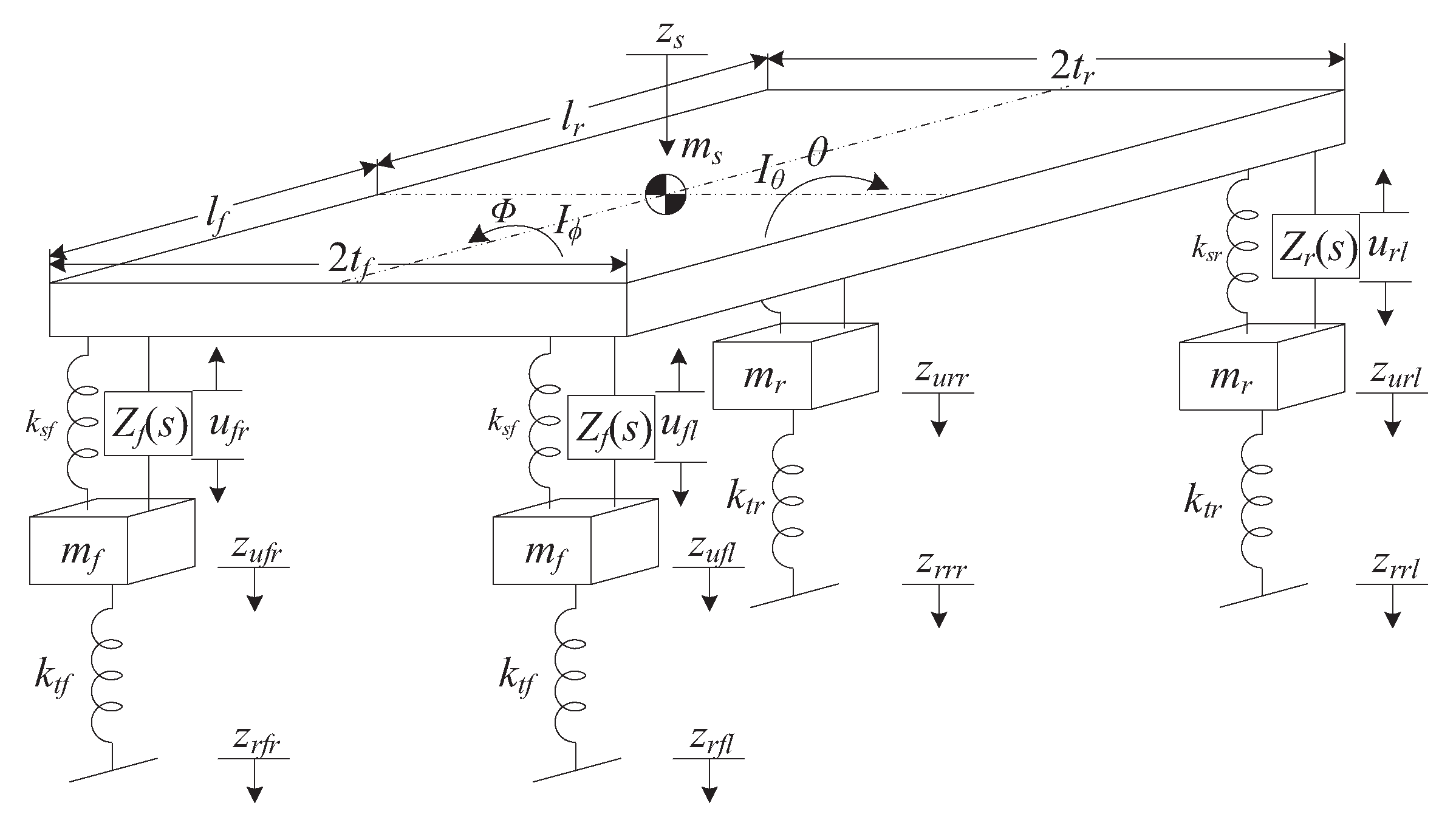
The full-vehicle model which contains seven degrees of freedom [27] is shown in Figure 1, where z s , Φ , and θ are the vertical displacement, roll angle, and pitch angle of the vehicle body m s , respectively, z u f r and z u f l are the vertical displacements of the two front unsprung masses m f , z u r r and z u r l are the vertical displacements of the two rear unsprung masses m r , k t f and k t r are the front and rear tire stiffnesses, k s f and k s r are the front and rear static stiffnesses, l f and l r are the distances from front and rear axles to the center of gravity, 2 t f and 2 t r are the widths of front and rear axles, u f r and u f l are the terminal forces of the two-terminal passive mechanical networks whose impedances are Z f ( s ) in the front vehicle part, u r r and u r l are the terminal forces of the two-terminal passive mechanical networks whose impedances are Z r ( s ) in the rear vehicle part, and z r f r , z r f l , z r r r , and z r r l are road input displacements.
We can formulate the dynamic equation of the full-vehicle suspension system in Figure 1 as
M g x ¨ g r + K g x g r = K g r z r + E g u ,
where x g r = [ x s T , x u T ] T , x s = [ z s , θ , Φ ] T , x u = [ z u f r , z u f l , z u r r , z u r l ] T , z r = [ z r f r , z r f l , z r r r , z r r l ] T , u = [ u f r , u f l , u r r , u r l ] T , and
E = 1 1 1 1 l f l f l r l r t f t f t r t r , M g = M s 0 0 M u , K g = E K s E T E K s K s E T K t + K s , K g r = 0 K t , E g = E I ,
with K s = diag ( k s f , k s f , k s r , k s r ) , M s = diag ( m s , I θ , I Φ ) , M u = diag ( m f , m f , m r , m r ) , and K t = diag ( k t f , k t f , k t r , k t r ) . Denoting the state vector x n as x n = [ x g r T , x ˙ g r T ] T , the state-space model can be further derived as
x ˙ n = A n x n + B n u + B n r z r ,
where
A n = 0 I M g 1 K g 0 , B n = 0 M g 1 E g , B n r = 0 M g 1 K g t .
Based on the power spectral density (PSD) function of the external input, pavement excitation can be denoted as Class A to Class E [30]. It is assumed in this article that the pavement excitation is obtained by two independent unit white noises [27,31,32] w r ( t ) and w l ( t ) (that is, the power spectral density is 1 and the mean value is 0) through the filter whose transfer function is
T ( s ) = 2 α V σ 2 s + α V ,
where α describes the road surface type, σ 2 is the road roughness variance, and V is the vehicle speed.
For different road profiles, α = 0.127 is the same, but the value of σ is different, such as σ = 2 × 10 3   m corresponding to Class A, σ = 4 × 10 3   m corresponding to Class B, σ = 8 × 10 3   m corresponding to Class C, σ = 16 × 10 3   m corresponding to Class D and σ = 32 × 10 3   m corresponding to Class E [30].
Then, taking the front right wheel road input as an example, the relationship between road input displacement and external road excitation can be expressed as
z ˙ r f r = α V z r f r + 2 α V σ 2 w r .
Considering the time delay, the correlation between the rear right (resp. left) wheel road excitation and the front right (resp. left) wheel road excitation of the vehicle can be obtained as z r r r ( t ) = z r f r ( t ( l f + l r ) / V ) (resp. z r r l ( t ) = z r f l ( t ( l f + l r ) / V ) ). Letting w = [ w r , w l ] T , together with the fourth-order Padé approximation [27], the state equation of the full-vehicle road input can be obtained as
x ˙ r = A r x r + B r w , z r = C r x r .
where x r is a state vector.
Combining Equations (3) and (4), and letting the measured output as y = E T x ˙ s x ˙ u , the following augmented representation can be obtained as
x ˙ g = A g x g + B g u + B g w w , y = C y g x g ,
where x g = [ x n T , x r T ] T , and
A g = A n B n r C r 0 A r , B g = B n 0 , B g w = 0 B r , C y g = 0 E T I 0 .
Then, the four passive mechanical networks of the full-vehicle system in Figure 1 constitute the passive controller, whose transfer matrix (from y to u) is
K ( s ) = diag ( Z f 1 ( s ) , Z f 1 ( s ) , Z r 1 ( s ) , Z r 1 ( s ) ) ,
where the impedances of two front mechanical networks are Z f ( s ) , and the impedances of two rear mechanical networks are Z r ( s ) . In this article, we assume that Z f ( s ) and Z r ( s ) are both positive-real bicubic impedances as in
Z f ( s ) = a f 3 s 3 + a f 2 s 2 + a f 1 s + a f 0 d f 3 s 3 + d f 2 s 2 + d f 1 s + d f 0 ,
Z r ( s ) = a r 3 s 3 + a r 2 s 2 + a r 1 s + a r 0 d r 3 s 3 + d r 2 s 2 + d r 1 s + d r 0 ,
where a f i , d f j > 0 and a r i , d r j > 0 for i , j = 0 , 1 , 2 , 3 . By assuming that the McMillan degrees of Z f ( s ) and Z r ( s ) in Equations (7) and (8) are three, we can obtain the minimal realizations of Z f ( s ) and Z r ( s ) as ( A k f , B k f , C k f , D k f ) and ( A k r , B k r , C k r , D k r ) , respectively. Then, the minimal state-space realization ( A k , B k , C k , D k ) of the controller K ( s ) in Equation (6) can be obtained as
x ˙ k = A k x k + B k y , u = C k x k + D k y ,
where A k = diag ( A k f , A k f , A k r , A k r ) , B k = diag ( B k f , B k f , B k r , B k r ) , C k = diag ( C k f , C k f , C k r , C k r ) , D k = diag ( D k f , D k f , D k r , D k r ) .
The system output vector z including body acceleration, suspension displacement and tire grip is defined as
z = ρ 1 x ¨ s T , ρ 2 ( E T x s x u ) T , ρ 3 ( x u z r ) T T = C z g x g + D z u u ,
where
C z g = C z g ( 1 , : ) C z g ( 2 , : ) C z g ( 3 , : ) , D z u = ρ 1 M s 1 E 0 ,
with C z g ( 1 , : ) = [ ρ 1 M s 1 E K s E T , ρ 1 M s 1 E K s , 0 ] , C z g ( 2 , : ) = [ ρ 2 E T , ρ 2 I , 0 ] , C z g ( 3 , : ) = [ 0 , ρ 3 I , 0 , ρ 3 C r ] .
Then, combining Equations (5), (9) and (10), the closed-loop state-space equation can be formulated as
x ˙ = A c l x + B c l w , z = C c l x ,
where x = [ x g T , x k T ] T , and
A c l = A g + B g D k C y g B g C k B k C y g A k , B c l = B g 0 , C c l = C z g + D z u D k C y g D z u C k .
Then, for the closed-loop system Equation (11), the transfer function from w to z can be calculated as H w z ( s ) = C c l ( s I A c l ) 1 B c l .

4. Optimization Design of Passive Controller

4.1. Performance Index and Optimization Procedure

Performance indices J 1 , J 2 and J 3 represent ride comfort determined by body acceleration (including vertical acceleration, roll angle acceleration and pitch angle acceleration), suspension deflection determined by the relative displacement of sprung mass and unsprung mass, and road holding determined by tire grip, which, respectively, are defined as
J 1 = lim T 1 T 0 T | | x ¨ s | | 2 d t , J 2 = lim T 1 T 0 T | | E T x s x u | | 2 d t , J 3 = lim T 1 T 0 T | | x u z r | | 2 d t .
As a consequence, we can formulate the comprehensive performance index as
J = ρ 1 J 1 + ρ 2 J 2 + ρ 3 J 3 = lim T s 1 T s 0 T s z T z d t = 1 2 π Trace ( S z ( j ω ) ) d ω = 1 2 π Trace ( H w z ( j ω ) S w ( j ω ) H w z ( j ω ) ) d ω = 1 2 π Trace ( H w z ( j ω ) H w z ( j ω ) ) d ω = H w z 2 2 ,
where ρ 1 , ρ 2 , and ρ 3 represent the weighting factors of J 1 , J 2 , and J 3 , which are non-negative constants.
If A c l is stable and ( A c l , B c l ) is completely controllable [33,34], then the performance index J can be equivalent to
J = Trace ( C c l P C c l T ) .
where the positive definite matrix P is the unique solution of the Lyapunov equation
A c l P + P A c l T = B c l B c l T .
Procedure 1.
For the augmented state-space model of the full-vehicle suspension system formulated in Equation (5), the optimization and physical design procedure of the passive controller K ( s ) in Equation (6) is stated as follows.
1.
Formulate the general form of the positive-real bicubic impedances Z f ( s ) and Z r ( s ) in Equations (7) and (8), and the transfer function of the passive controller K ( s ) to be designed can be formulated based on Equation (6), where a f i , d f j > 0 and a r i , d r j > 0 for i , j = 0 , 1 , 2 , 3 are optimization variables.
2.
Determine the minimal state-space realization of K ( s ) in Equation (9).
3.
Formulate the state-space model of the closed-loop system Equation (11), where A c l , B c l , and C c l are calculated by Equation (12).
4.
According to Equation (14), solve the following optimization problem:
min J = Trace ( C c l P C c l T ) ,
s . t .   A c l is stable, P > 0 is the unique solution of Equation (15), Z f ( s ) and Z r ( s ) satisfy the conditions in Appendix A.
5.
For the bicubic impedances Z f ( s ) and Z r ( s ) corresponding to the optimal performance obtained in Step 4, realize both Z f ( s ) and Z r ( s ) as five-element damper–spring–inerter networks by the circuit synthesis results in Appendix A.
For the case when Z f ( s ) and Z r ( s ) are other positive-real impedances, a similar procedure can be applied.

4.2. Numerical Optimization Designs and Network Realizations

In this article, we set the parameters of the full-vehicle model as m s = 1600   kg , I θ = 1000   kg / m 2 , I Φ = 450   kg / m 2 , α = 0.127   rad / m , m f = m r = 50   kg , l f = 1.15   m , l r = 1.35   m , σ = 8 × 10 3   m , t f = t r = 0.75   m , and k t f = k t r = 250   kN / m to illustrate the proposed optimization procedure. It is assumed that the static stiffness k s f of the front suspension is the same as the static stiffness k s r of the rear suspension due to the geometry of the full-vehicle model, which is chosen as a fixed value and is equal to one of 25 kN / m , 35 kN / m , 45 kN / m , 55 kN / m , and 65 kN / m [10]. Similarly, we assume that Z f ( s ) = Z r ( s ) . This assumption effectively reduces the complexity of the analysis. It is worth noting that, if Z f ( s ) Z r ( s ) , the theoretically obtained optimal bicubic controller can achieve at least equal system performances.
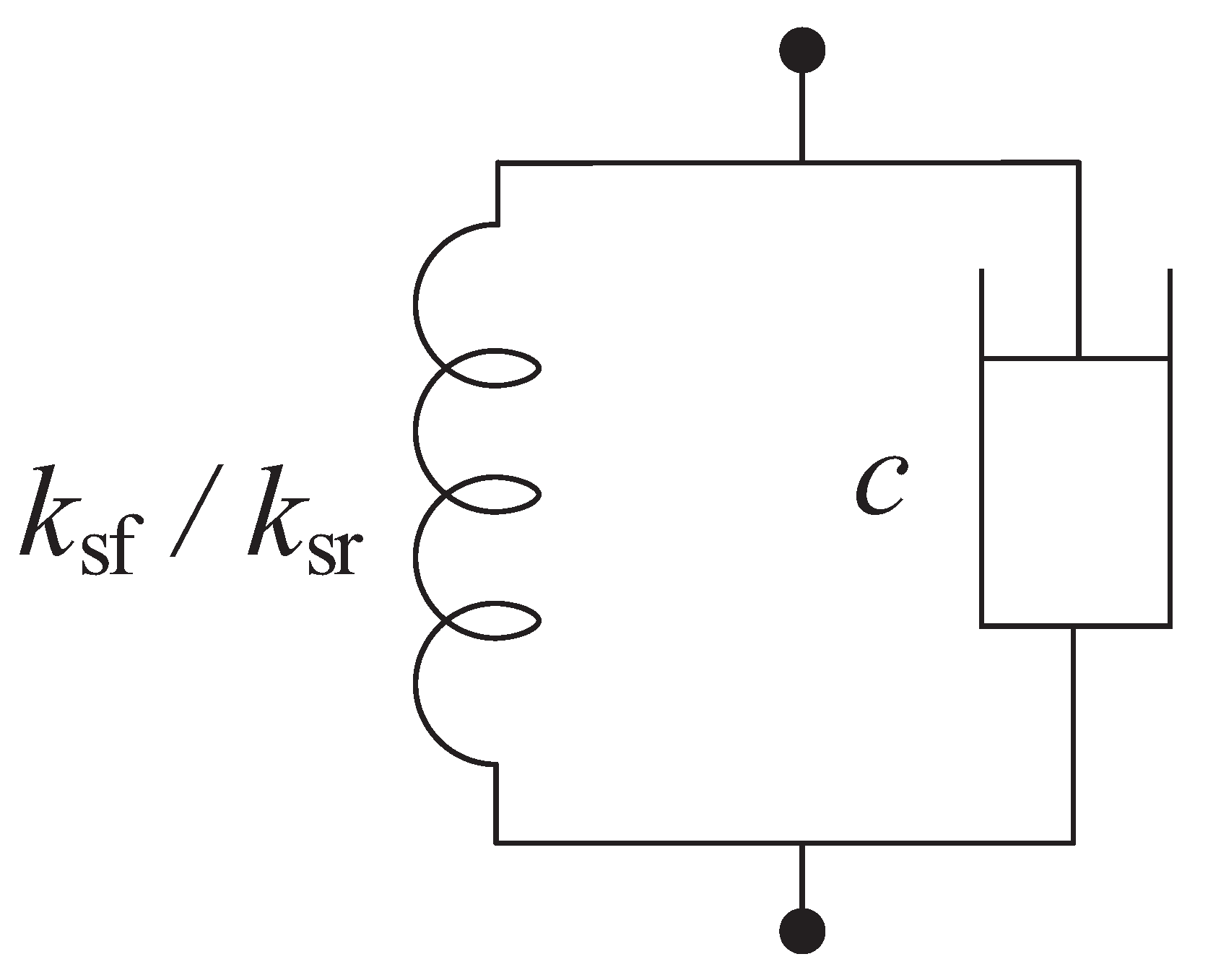
For the optimization design of the passive controller K ( s ) in Equation (6), we assume that the vehicle is on the Class C road and the speed is V = 30   m / s . Following Procedure 1, the optimization results and the physical network realizations can be obtained, where the numerical optimization technique based on the MATLAB (2019a) optimization solver patternsearch is utilized with multiple cycles of random initial values satisfying the constraint conditions to solve the optimization problem in Step 4. The optimization options of patternsearch in MATLAB are set as MaxIter = 25,000, MaxFunEvals = 200,000, TolFun = 1 × 10 10 , and TolX = 1 × 10 5 . The number of evaluations of the objective function is at least 100 times for each optimization run. In addition, the conventional passive structure C1 in Figure 2 and the biquadratic positive-real impedances in the form of Equation (2) are also optimized according to the similar steps, which are utilized as the benchmark for comparison.
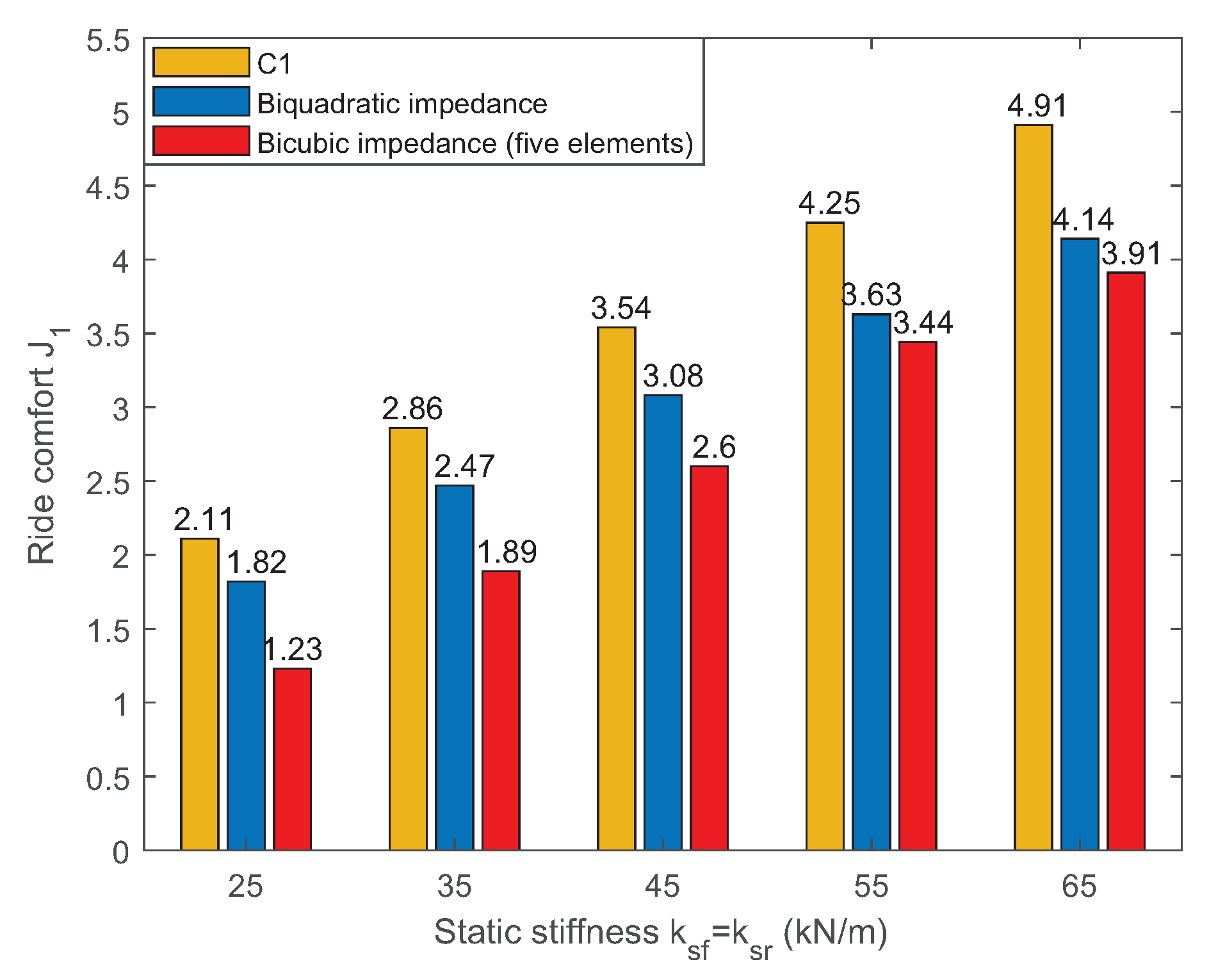
First, we will consider the optimal designs for individual performances. By choosing ρ 1 = 1 , ρ 2 = 0 and ρ 3 = 0 , we can obtain the ride comfort J 1 and the optimization results are shown in Figure 3. It is obvious that the use of bicubic positive-real impedances for passive controller K ( s ) (red histogram) can improve J 1 compared with the biquadratic positive-real impedances (blue histogram) and the conventional passive structure C1 (yellow histogram), where around 32.42 % and 41.71 % can be enhanced respectively. Obviously, when the parameters are the same, the ride comfort J 1 corresponding to bicubic controller are better than that corresponding to traditional passive structure and biquadratic controller. Similarly, by selecting ρ 1 = 0 , ρ 2 = 1 and ρ 3 = 0 (resp. ρ 1 = 0 , ρ 2 = 0 and ρ 3 = 1 ), we can individually optimize the suspension deflection J 2 and road holding J 3 , and for brevity the results of J 2 and J 3 are not presented in this article.
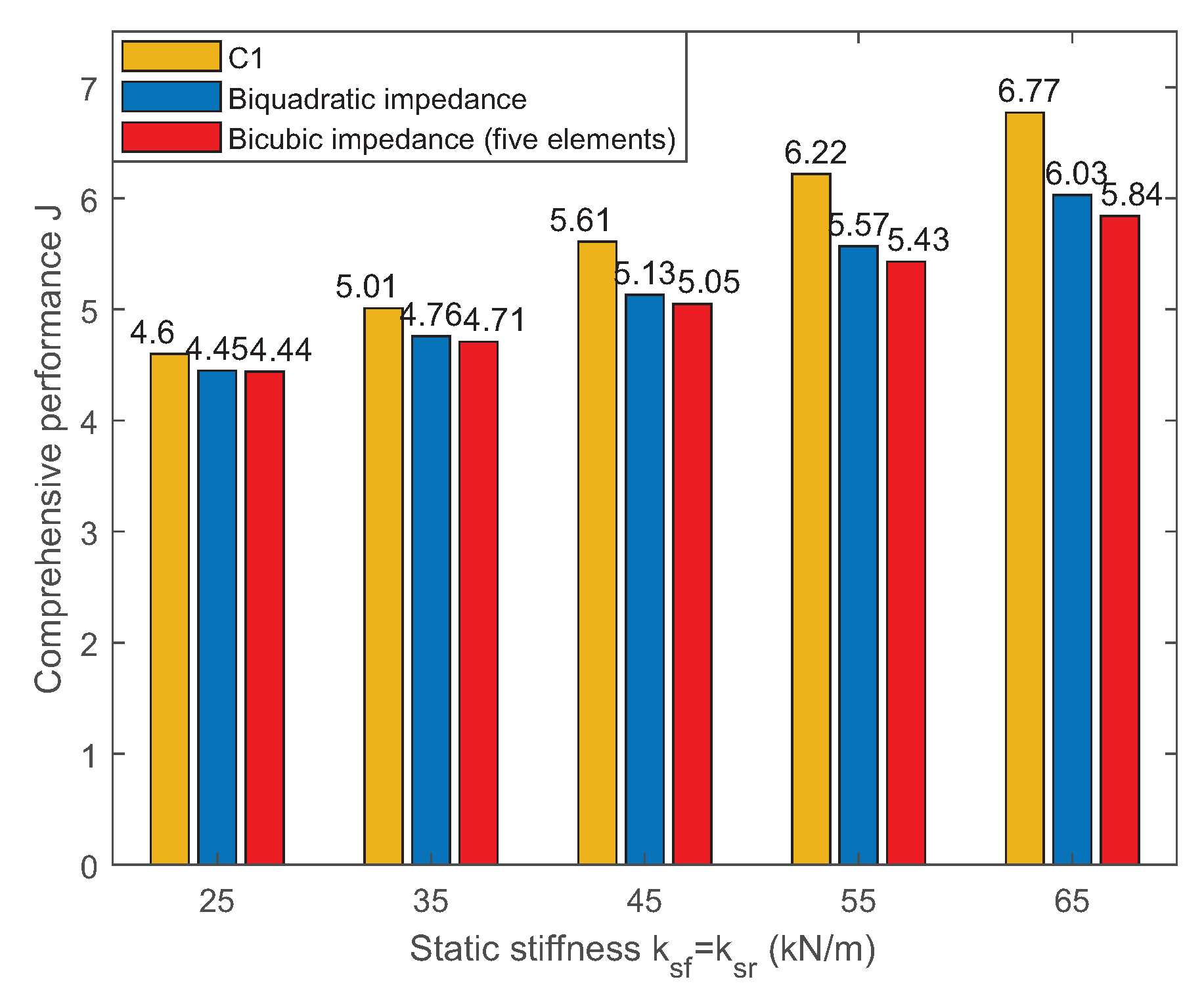
In practice, the suspension design usually involves the trade-off between different performances. To simultaneously consider these three performances J 1 , J 2 , and J 3 , we choose the weighting factors as ρ 1 = 1 , ρ 2 = 2500 , ρ 3 = 5 × 10 4 to formulate a comprehensive performance J in Equation (13). By letting k s f = k s r be equal to 25 kN / m , 35 kN / m , 45 kN / m , 55 kN / m and 65 kN / m , respectively, the optimization results of the comprehensive performance J for these fixed static stiffness values are shown in Figure 4, and the results show that the optimal comprehensive performance J can be improved by utilizing the passive controller K ( s ) corresponding to bicubic positive-real impedances (about 13.74 % improvement compared to C1 and 3.15 % improvement compared to biquadratic controller). It is obvious that different weighting coefficients directly affect the optimization results. For instance, employing a larger value of ρ 1 will make the optimization tend to reduce the ride comfort performance J 1 , while the suspension deflection J 2 and road holding J 3 may be sacrificed accordingly. If some other weighting factors such as ρ 1 = 1 , ρ 2 = 1 × 10 4 and ρ 3 = 1 × 10 6 are selected, then the road holding J 3 can be improved with the ride comfort J 1 being sacrificed. In this paper, we focus on the control performance of the bicubic impedance with a five-element realization, and thus the discussion on the influence of different weighting factors is simplified.
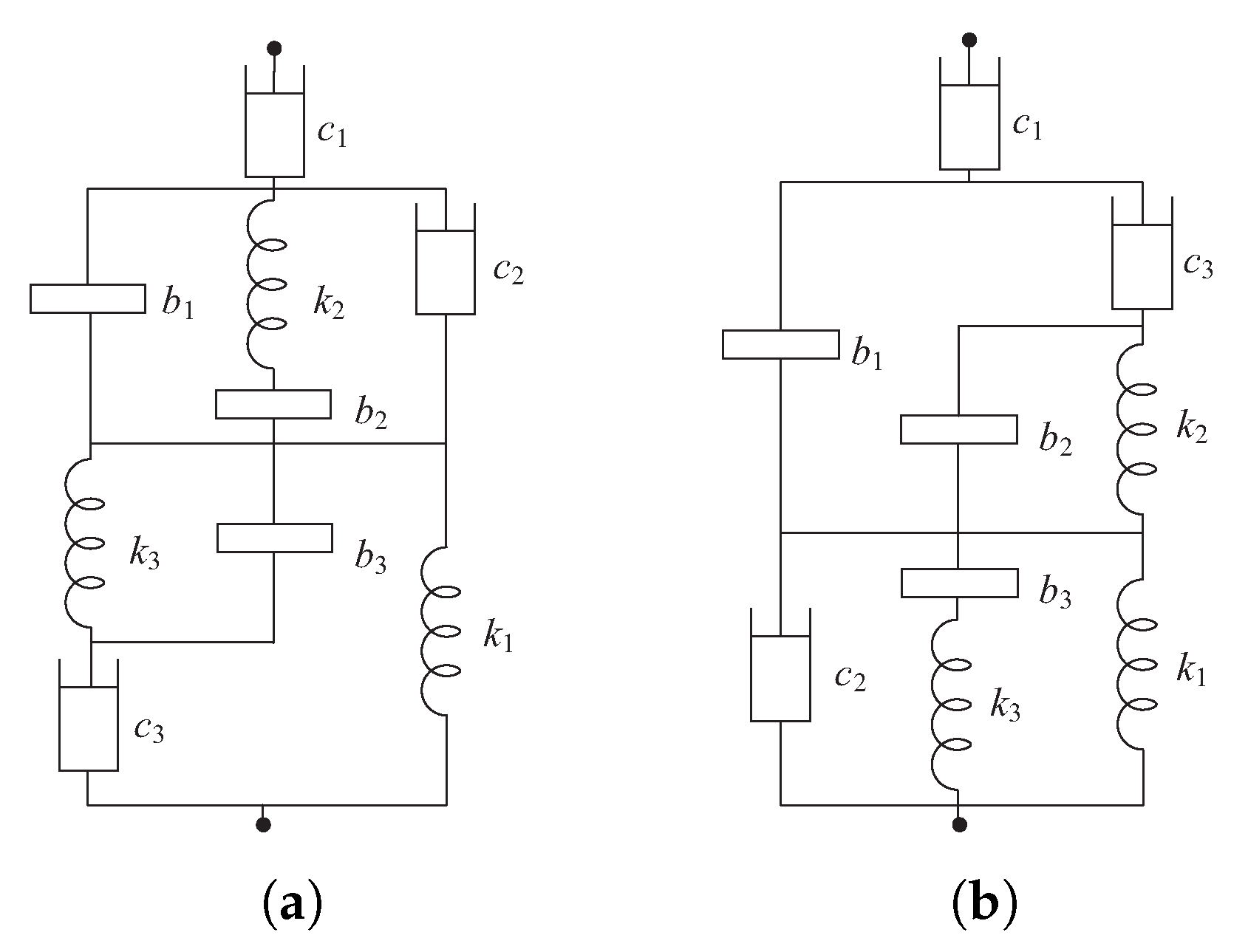
Then, according to Step 5 of Procedure 1, the bicubic positive-real impedances corresponding to the optimal comprehensive performance J can be realized by five-element networks by the passive network synthesis results summarized in Appendix A. The network realizing the optimal bicubic impedance is shown in Figure 5, where the static stiffness k s f = k s r satisfies 25 kN / m , 35 kN / m , 45 kN / m , 55 kN / m , and 65 kN / m respectively. In comparison, the biquadratic positive-real impedances with respect to the optimal comprehensive performance J are realized as nine-element series-parallel networks by utilizing the Bott–Duffin synthesis procedure (see Appendix B), and the network realization is shown in Figure A1a, where the static stiffnesses k s f = k s r are 25 kN / m , 35 kN / m , 45 kN / m , 55 kN / m , and 65 kN / m , respectively.
The case of k s f = k s r = 45   kN / m is utilized to illustrate the implementation of the impedances, and the optimal bicubic and biquadratic positive-real impedances are obtained as
Z 1 f ( s ) = Z 1 r ( s ) = 2 × 10 7 s 3 + 3 × 10 7 s 2 + 3 × 10 7 s + 7 × 10 7 9495 s 3 + 7 × 10 4 s 2 + 3.5 × 10 5 s + 1.5 × 10 6 ,
Z 2 f ( s ) = Z 2 r ( s ) = 1909.3 s 2 + 13645.3 s + 489.8 0.99 s 2 + 8.97 s + 64.93 ,
and the network function corresponding to C1 is
Z 3 f ( s ) = Z 3 r ( s ) = 5.787 × 10 4 .
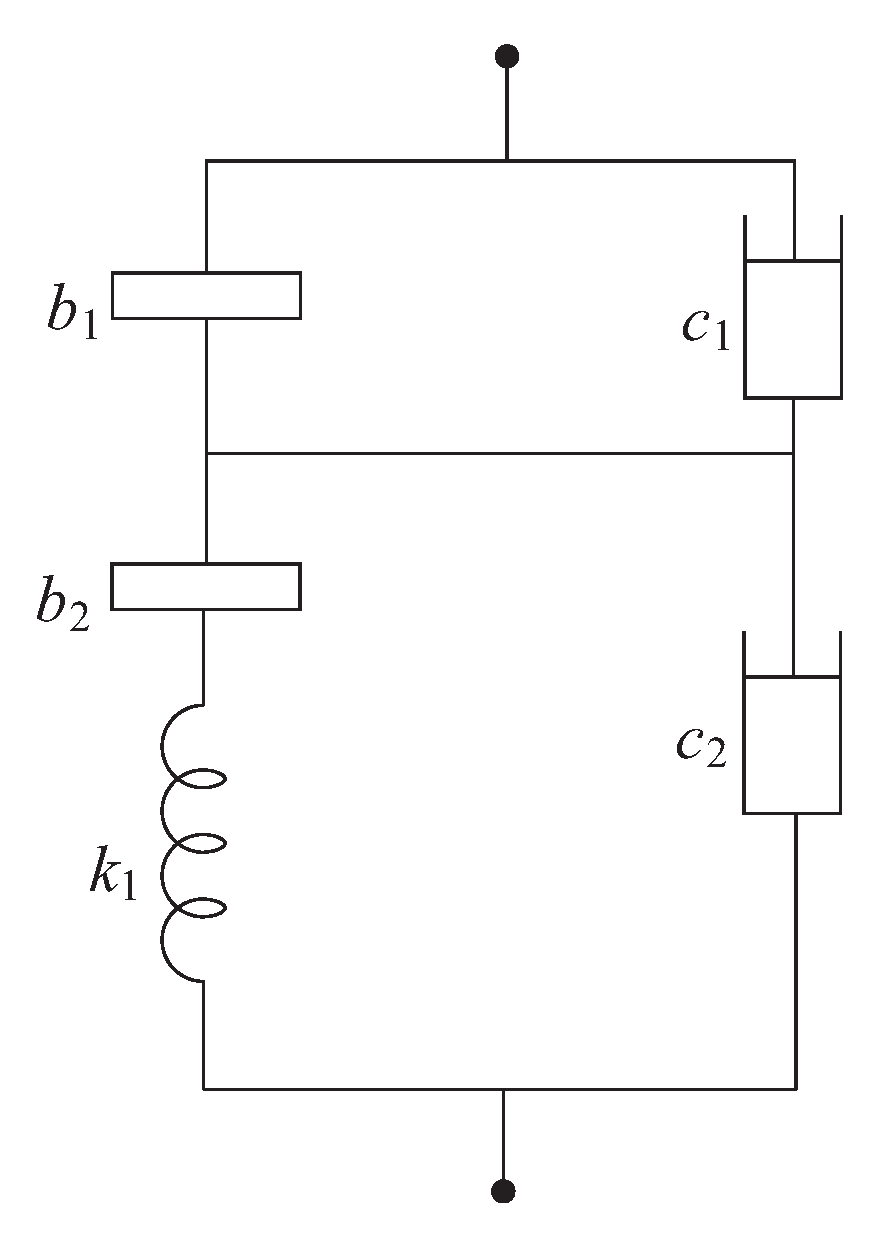
It should be noted that the optimal bicubic positive-real impedance in Equation (16) satisfies Condition V.2 of Proposition A1 in Appendix A. This condition ensures that it can be realized as a five-element damper–spring–inerter series-parallel network. The five-element network realizing Z 1 f ( s ) = Z 1 r ( s ) is shown in Figure 5, where c 1 = 1942.468   Ns / m , c 2 = 48.542   Ns / m , k 1 = 754.731   N / m , b 1 = 337.317   kg , and b 2 = 28.148   kg , and the nine-element network realizing Z 2 f ( s ) = Z 2 r ( s ) is shown in Figure A1a, where c 1 = 7.458   Ns / m , c 2 = 11.605   Ns / m , c 3 = 0.000520   Ns / m , k 1 = 0.00475   N / m , k 2 = 83.557   N / m , k 3 = 0.0000317   N / m , b 1 = 1.269   kg , b 2 = 190.052   kg , and b 3 = 0.0000723   kg . According to Z 3 f ( s ) = Z 3 r ( s ) , the element value of damper in C1 is c = 1728.031   Ns / m . It is noted that the realization of the bicubic case contains much fewer elements and without adding additional parameter range constraints, the corresponding component values of biquadratic optimal network may not be easy to built, such as c 3 . According to [35,36,37,38], the element values of inerters b 1 and b 2 fall within the parameter range of industrial products, showing the great potential for industrial applications. In addition, the elements with extremely small values can be approximately removed with zero element values in practice.
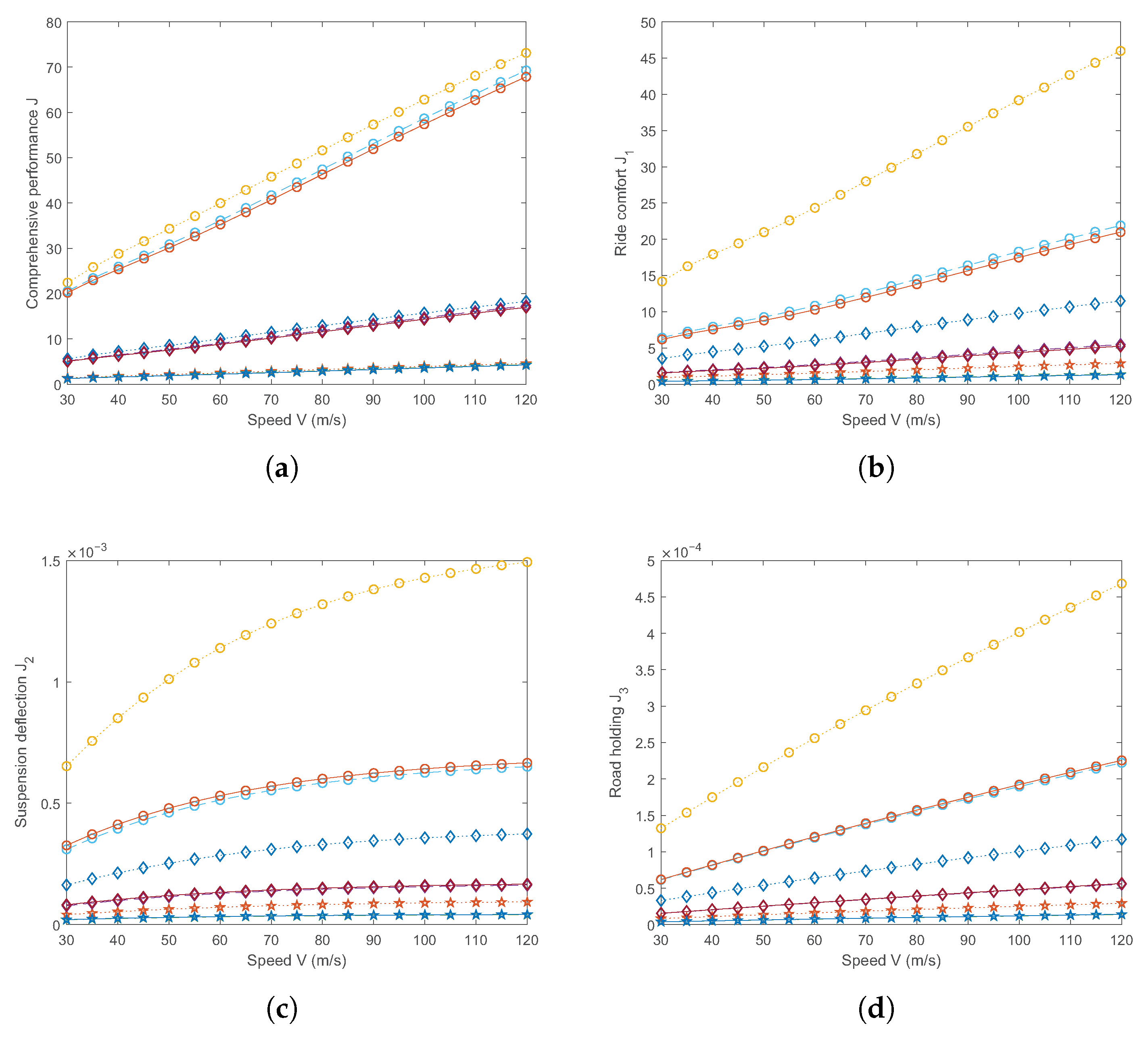
Considering that the passive suspension structures and the parameter values cannot be modified online, we further investigate the system performances with respect to different road profiles and speeds after designing the optimal passive controllers for Class C road and V = 30 m/s. Let the bicubic positive-real impedance Z 1 f ( s ) = Z 1 r ( s ) be realizable with five elements and the biquadratic positive-real impedance Z 2 f ( s ) = Z 2 r ( s ) be the optimal results in Equations (16) and (17), respectively, which correspond to the case of k s f = k s r = 45 kN/m, V = 30 m/s, and Class C road. The results of the comprehensive performance J for k s f = k s r = 45 kN/m and various values of vehicle speeds and different road classes are shown in Figure 6a, where the comprehensive performance of the bicubic positive-real impedance is always better than that of the biquadratic positive-real impedance and the conventional passive structure C1 for the same road class and speed. The results of the ride comfort J 1 , suspension deflection J 2 , and road holding J 3 are shown in Figure 6b, Figure 6c, and Figure 6d, respectively. The results show that the conventional passive structure C1 is the worst for these three performance indexes. For the same road class and speed, it is noted that the ride comfort J 1 of the bicubic positive-real impedance is always better than that of the biquadratic case, the road holding J 3 is almost the same as that of the biquadratic case, and the suspension deflection J 2 of the bicubic positive-real impedance is only slightly worse than that of the biquadratic case due to the trade-off of different performances. The results show that without changing the controller parameters the system performances of the bicubic impedance realizable with five elements can be almost maintained to be slightly better than those of the biquadratic case for different values of system parameters (V and σ ). Based on the results in Figure 3, Figure 4, Figure 5 and Figure 6, we can observe that the optimal positive-real impedances with higher McMillan degrees consistently achieve better system performances than those with lower degrees, and the optimal bicubic impedances realizable with five passive elements can achieve better system performances than the optimal positive-real biquadratic impedances realizable with nine passive elements. The results demonstrate that the McMillan degree of the impedance has stronger influences on system performances than the number of passive elements, and the optimization designs of this paper can improve system performances and decrease system complexity simultaneously. Therefore, the results highlight the practical advantages and significance of passive mechanical control designs based on passive network synthesis compared with those based on conventional fixed-structure approaches.

4.3. Time-Domain Simulation Results

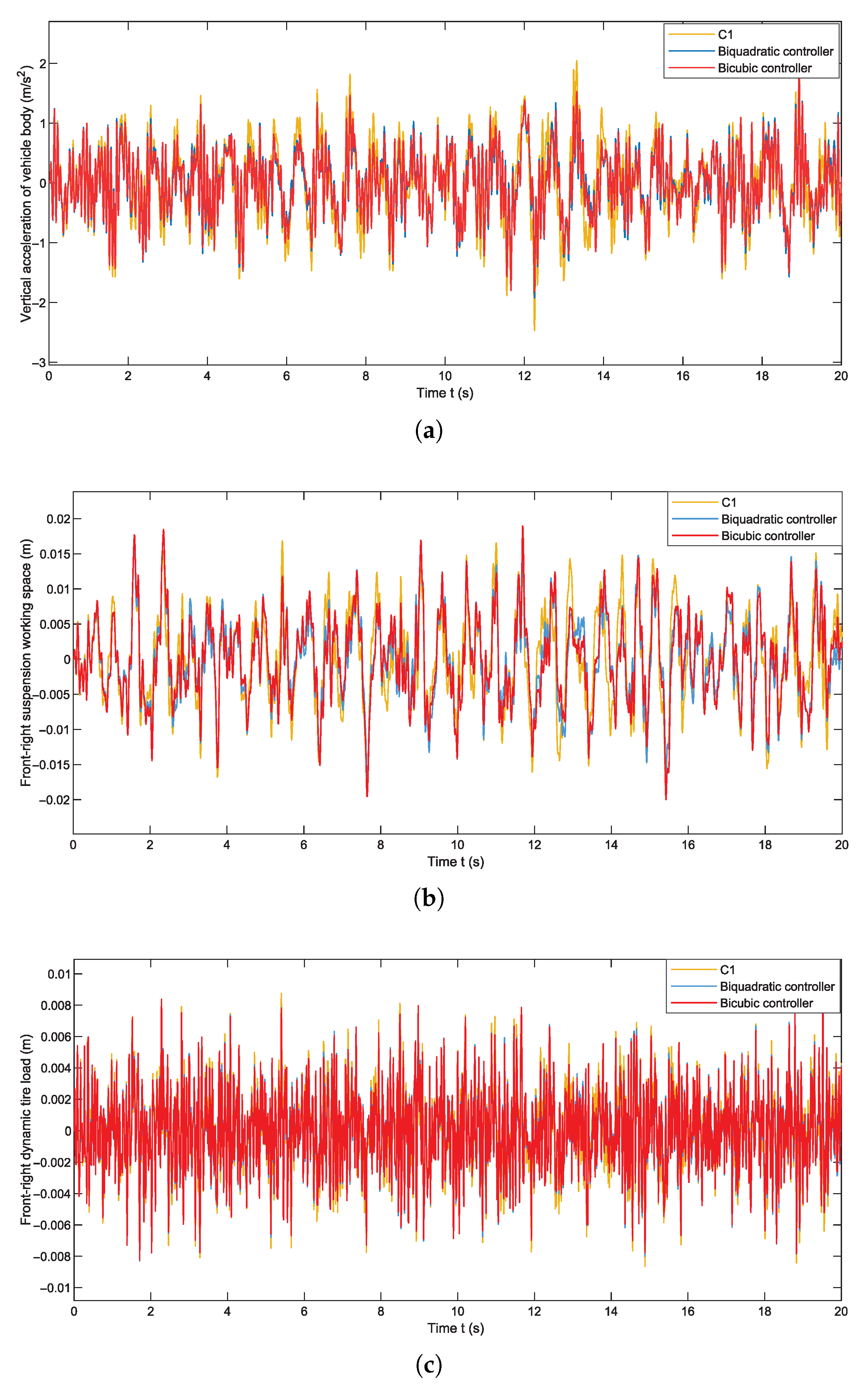
Letting Z 1 f ( s ) = Z 1 r ( s ) , Z 2 f ( s ) = Z 2 r ( s ) and Z 3 f ( s ) = Z 3 r ( s ) satisfy Equations (16), (17) and (18), respectively, the time-domain simulation is established. The detailed time-domain simulation results are listed in Figure 7, where k s f = k s r = 45   kN / m , V = 30   m / s , and Class C road is chosen. For the simulation, the actual time delay t τ is utilized instead of using Padé approximation, which is closer to the actual situation. The actual time delay t τ is calculated as t τ = ( l f + l r ) / V in the time-domain simulation. For clarity, select vertical acceleration of vehicle body z ¨ s , front-right suspension working space z s f r z u f r and front-right dynamic tire load z u f r z r f r as representatives, as shown in Figure 7a, Figure 7b and Figure 7c respectively. As shown in Figure 7, the average amplitude of z ¨ s , z s f r z u f r and z u f r z r f r for C1 is obviously the worst, and the average amplitude of z ¨ s for the bicubic impedance realizable with five elements is less than that for the biquadratic case, with the average amplitudes of z s f r z u f r and z u f r z r f r being almost maintained, which can illustrate the results shown in Figure 6.
Moreover, the mean square values (MSVs) of the system output z in Equation (10) can be calculated, where the simulation time is set to 100 s and the simulation time step is set to 0.01   s , which are presented in Table 1 and Table 2. The results illustrate that the bicubic positive-real controllers realizable with five elements can improve the comprehensive performance of the full-vehicle suspension system. For instance, as shown in Table 1, the improvement of MSV for the bicubic positive-real controllers realizable with five elements is + 12.38 % (resp. + 2.44 % ) compared with the conventional structure C1 (resp. biquadratic controller) under Class C road and V = 60   m / s . Moreover, the numerical results in Table 2 show that, under Class B road and V = 30   m / s , the improvement of MSV for the optimal bicubic positive-real controllers is + 10.93 % (resp. + 1.63 % ) compared with the conventional structure C1 (resp. biquadratic controller). Such improvements are consistently observed across various vehicle speeds and road classes, further validating the effectiveness of the optimal bicubic positive-real controllers realizable with five elements.

4.4. Simulation Results Considering Nonlinear Springs

In this section, we replace the static stiffness k s f and k s r in the original model with the nonlinear spring k n o n l . Referring to [39], the force generated by the nonlinear spring f n o n l is expressed as f n o n l = k 1 u i n + k 2 u i n 2 + k 3 u i n 3 , where k 1 , k 2 , and k 3 are the three stiffness coefficients, respectively, and u i n denotes the corresponding input variable. In the simulation study, we set the parameters of the nonlinear spring as k 1 = 45,000 kN / m , k 2 = −202,500 kN / m , k 3 = 1,113,750 kN / m , and the configurations of the optimal passive controller remain consistent with those in Section 4.3. The numerical results of the MSV of the system output z are summarized in Table 3 and Table 4. These numerical results demonstrate that the optimal bicubic controller obtained from the previous optimization still achieves the best control performance when nonlinear springs are employed in the suspension. Moreover, the numerical results reveal that the influence of using nonlinear springs on system performance is negligible and close to that of the original linear case, which validates the feasibility of optimizing the bicubic impedance based on linear systems.

5. Conclusions

In this article, the passive controller optimization design for a full-vehicle suspension system has been investigated, where four positive-real bicubic impedances realizable as two-terminal five-element damper–spring–inerter networks constitute the controller. First, the closed-loop state-space model for the full-vehicle suspension system was formulated, and the comprehensive performance index including ride comfort, suspension deflection, and road holding was defined. Then, the optimization controller design procedure was summarized. Following the procedure and utilizing the existing passive network synthesis results for a bicubic impedance to be realizable with five passive elements, the numerical optimization results were obtained. Compared with the conventional structure C1 case and the general biquadratic positive-real case, the results show that the passive controller corresponding to the optimal bicubic positive-real impedances realizable with five passive elements can significantly enhance individual system performance and the comprehensive system performance. The bicubic controllers designed in this article consider the complexity of the networks to realize the optimal impedances, in addition to the system performance affected by the McMillan degree of the controller function, which can simultaneously improve the system performance and simplify the implementation complexity. Finally, time-domain simulations were given to verify the results.

Author Contributions

Conceptualization, K.W.; methodology, K.W., Y.L., and J.P.; software, K.W., Y.L., and J.P.; validation, K.W., Y.L., and J.P.; formal analysis, K.W., Y.L., and J.P.; investigation, K.W., Y.L., and J.P.; resources, K.W.; data curation, K.W., Y.L., and J.P.; writing—original draft, K.W., and J.P.; writing—review & editing, K.W., Y.L., and J.P.; visualization, K.W., Y.L., and J.P.; supervision, K.W.; project administration, K.W.; funding acquisition, K.W. All authors have read and agreed to the published version of the manuscript.

Funding

This work was supported by the National Natural Science Foundation of China (62373166).

Institutional Review Board Statement

Not applicable.

Informed Consent Statement

Not applicable.

Data Availability Statement

The data that support the findings of this study are available from the corresponding author upon reasonable request.

Conflicts of Interest

The authors declare no conflicts of interest.

Appendix A. Five-Element Realization Conditions of Bicubic Positive-Real Function

The realizability results of any bicubic impedance Z ( s ) in Equation (1) with a i , d j > 0 for i , j = 0 , 1 , 2 , 3 as a five-element damper–spring–inerter network have been derived [17], which are utilized for the optimization design of the passive controller K ( s ) in Equation (6). The realizability results for the series-parallel case and the non-series-parallel case are summarized in the following Propositions A1 and A2, respectively.
Proposition A1
([17]). Any bicubic impedance Z ( s ) in Equation (1) with a i , d j > 0 for i , j = 0 , 1 , 2 , 3 can be realized by a five-element damper–spring–inerter series-parallel network, if and only if Z ( s ) satisfies one of the following conditions:
I 
B 13 0 , B 12 = 0 , B 23 = 0 , and Δ 1 > 0 ;
II.1 
B 13 = 0 , Δ 1 > 0 , and either a 0 B 33 = a 1 B 23 > 0 or a 3 B 11 = a 2 B 12 < 0 holds;
II.2 
B 13 = 0 , Δ 2 > 0 , and either d 0 B 33 = d 1 B 23 < 0 or d 3 B 11 = d 2 B 12 > 0 holds;
III.1 
B 33 Δ 1 = a 2 a 3 B 13 > 0 , and a 2 B 33 = a 3 B 23 > 0 ;
III.2 
B 33 Δ 2 = d 2 d 3 B 13 < 0 , and d 2 B 33 = d 3 B 23 < 0 ;
III.3 
B 11 Δ 1 = a 0 a 1 B 13 < 0 , and a 1 B 11 = a 0 B 12 < 0 ;
III.4 
B 11 Δ 2 = d 0 d 1 B 13 > 0 , and d 1 B 11 = d 0 B 12 > 0 ;
IV.1 
B 13 Δ 1 = a 1 2 B 23 > 0 , and a 1 B 33 = a 3 B 13 > 0 ;
IV.2 
B 13 Δ 2 = d 1 2 B 23 < 0 , and d 1 B 33 = d 3 B 13 < 0 ;
IV.3 
B 13 Δ 1 = a 2 2 B 12 < 0 , and a 2 B 11 = a 0 B 13 < 0 ;
IV.4 
B 13 Δ 2 = d 2 2 B 12 > 0 , and d 2 B 11 = d 0 B 13 > 0 ;
V.1 
a 3 2 d 0 2 Δ 2 = d 2 2 B 12 B 13 > 0 , and a 0 d 2 2 B 12 = a 3 d 0 2 ( a 1 d 2 a 3 d 0 ) > 0 ;
V.2 
a 0 2 d 3 2 Δ 1 = a 2 2 B 12 B 13 > 0 , and a 2 2 d 0 B 12 = a 0 2 d 3 ( a 0 d 3 a 2 d 1 ) < 0 ;
V.3 
a 0 2 d 3 2 Δ 2 = d 1 2 B 23 B 13 > 0 , and a 3 d 1 2 B 23 = a 0 d 3 2 ( a 0 d 3 a 2 d 1 ) < 0 ;
V.4 
a 3 2 d 0 2 Δ 1 = a 1 2 B 23 B 13 > 0 , and a 1 2 d 3 B 23 = a 3 2 d 0 ( a 1 d 2 a 3 d 0 ) > 0 ;
VI.1 
There exists at least one common root satisfying 0 < x < min { a 1 d 0 , a 0 d 1 } between a 3 x 2 a 0 B 23 x a 0 2 d 3 ( a 1 d 1 a 0 d 2 ) = 0 , M 13 x 2 a 0 d 0 M 23 x + a 0 2 a 2 d 0 2 d 3 = 0 , and x 3 M 11 x 2 + a 0 a 1 d 0 d 1 x a 0 3 d 0 2 d 3 = 0 ;
VI.2 
There exists at least one common root satisfying 0 < x < min { a 1 d 0 , a 0 d 1 } between d 3 x 2 + d 0 B 23 x a 3 d 0 2 ( a 1 d 1 a 2 d 0 ) = 0 , M 13 x 2 a 0 d 0 M 23 x + a 0 2 a 3 d 0 2 d 2 = 0 , and x 3 M 11 x 2 + a 0 a 1 d 0 d 1 x a 0 2 a 3 d 0 3 = 0 ;
VI.3 
There exists at least one common root satisfying 0 < x < min { a 2 d 3 , a 3 d 2 } between a 0 x 2 + a 3 B 12 x a 3 2 d 0 ( a 2 d 2 a 3 d 1 ) = 0 , M 13 x 2 a 3 d 3 M 12 x + a 3 2 a 1 d 3 2 d 0 = 0 , and x 3 M 33 x 2 + a 3 a 2 d 3 d 2 x a 3 3 d 3 2 d 0 = 0 ;
VI.4 
There exists at least one common root satisfying 0 < x < min { a 2 d 3 , a 3 d 2 } between d 0 x 2 d 3 B 12 x a 0 d 3 2 ( a 2 d 2 a 1 d 3 ) = 0 , M 13 x 2 a 3 d 3 M 12 x + a 3 2 a 0 d 3 2 d 1 = 0 , and x 3 M 33 x 2 + a 3 a 2 d 3 d 2 x a 3 2 a 0 d 3 3 = 0 ,
where B 11 : = a 1 d 0 a 0 d 1 , B 12 : = a 1 d 0 a 0 d 2 , B 13 : = a 3 d 0 a 0 d 3 , B 22 : = B 13 + a 2 d 1 a 1 d 2 , B 23 : = a 3 d 1 a 1 d 3 , B 33 : = a 3 d 2 a 2 d 3 , Δ 1 : = a 1 a 2 a 0 a 3 , Δ 2 : = d 1 d 2 d 0 d 3 , M 11 : = a 1 d 0 a 0 d 1 , M 33 : = a 3 d 2 a 2 d 3 , M 12 : = a 2 d 0 a 0 d 2 , M 23 : = a 3 d 1 a 1 d 3 , and M 13 : = a 3 d 0 a 0 d 3 . Moreover, Condition I–VI correspond to six groups of realization networks.
Proposition A2
([17]). Any bicubic impedance Z ( s ) in Equation (1) with a i , d j > 0 for i , j = 0 , 1 , 2 , 3 not satisfying any condition in Proposition A1 is realizable as a five-element damper–spring–inerter non-series-parallel network, and the necessary and sufficient conditions and five groups of realizability configurations have been proved by Wang and Chen.

Appendix B. Bott–Duffin Synthesis Results for Biquadratic Positive-Real Impedances

A real-rational function H 1 ( s ) R ( s ) is called a minimum function if (1) H 1 ( s ) is positive-real, (2) H 1 ( s ) contains no zero or pole on j R , and (3) ω 1 > 0 such that Re ( H 1 ( j ω 1 ) ) = 0 with Im ( H 1 ( j ω 1 ) ) 0 [3]. By applying the Foster preamble, any positive-real impedance H ( s ) can be converted into a minimum impedance H 1 ( s ) with δ ( H 1 ( s ) ) < δ ( H ( s ) ) through extracting a finite number of resistors, inductors, and capacitors [3]. For a biquadratic positive-real impedance Z ( s ) in Equation (2), a biquadratic minimum impedance Z 1 ( s ) can be directly obtained by Z 1 ( s ) = Z ( s ) β , where β = Re ( Z ( j ω 1 ) ) 0 , with ω 1 = arg min Re ( Z ( j ω ) ) , which corresponds to the series extraction of a damper c 1 = 1 / β .
Figure A1. Bott–Duffin synthesis procedure results: (a) f 2 g 0 > f 0 g 2 . (b) f 2 g 0 < f 0 g 2 .
Actuators 15 00177 g0a1
Then, the biquadratic minimum function Z 1 ( s ) can be written as
Z 1 ( s ) = f 2 s 2 + f 1 s + f 0 g 2 s 2 + g 1 s + g 0 ,
where f i , g j > 0 for i , j = 0 , 1 , 2 . Then, ( f 2 g 0 f 0 g 2 ) 2 = f 1 g 1 , and Z 1 ( j ω 1 ) = j X 1 with X 1 0 .
If f 2 g 0 > f 0 g 2 , then X 1 > 0 . Together with the series damper c 1 , the Bott–Duffin network realizing Z ( s ) is shown in Figure A1a, where
c 1 = 1 β , c 2 = g 0 f 0 , c 3 = g 2 f 2 , k 1 = g 0 g 1 f 1 f 2 , b 1 = g 2 f 1 g 0 f 0 f 2 g 1 , k 2 = g 1 g 0 f 0 f 2 g 2 + g 0 f 1 f 0 f 2 , k 3 = g 0 g 2 f 0 g 1 f 2 f 0 + f 1 g 0 g 2 f 2 , b 2 = f 1 g 0 g 2 f 0 f 0 f 2 + g 1 f 0 , b 3 = g 2 g 0 g 2 g 1 f 0 f 2 + f 1 g 0 g 2 .
If f 2 g 0 < f 0 g 2 , then X 1 < 0 . Together with the series damper c 1 , the Bott–Duffin network realizing Z ( s ) is shown in Figure A1b, where
c 1 = 1 β , c 2 = g 0 f 0 , c 3 = g 2 f 2 , k 1 = g 0 f 1 g 2 f 2 f 0 g 1 , b 1 = g 1 g 2 f 0 f 1 , k 2 = g 0 g 0 g 2 g 1 f 0 f 2 + f 1 g 0 g 2 , k 3 = g 1 f 2 + f 1 g 0 g 2 f 2 f 0 f 2 , b 2 = g 0 g 2 f 2 g 1 f 0 f 2 + f 1 f 0 g 0 g 2 , b 3 = g 1 g 2 g 0 f 0 f 2 + g 2 f 1 f 0 f 2 .

References

  1. Li, Y.; Han, S.; Xiong, J.; Wang, W. Comfort-oriented semi-active suspension configuration with inerter-based network synthesis. Actuators 2023, 12, 290. [Google Scholar] [CrossRef]
  2. Smith, M.C. Synthesis of mechanical networks: The inerter. IEEE Trans. Autom. Control 2002, 47, 1648–1662. [Google Scholar] [CrossRef]
  3. Chen, M.Z.Q.; Wang, K.; Chen, G. Passive Network Synthesis: Advances with Inerter; World Scientific: Singapore, 2019. [Google Scholar]
  4. Chen, H.-J.; Su, W.-J.; Wang, F.-C. Modeling and analyses of a connected multi-car train system employing the inerter. Adv. Mech. Eng. 2017, 9, 1–13. [Google Scholar] [CrossRef]
  5. Liu, C.; Chen, L.; Lee, H.P.; Yang, Y.; Zhang, X. A review of the inerter and inerter-based vibration isolation: Theory, devices, and applications. J. Frankl. Inst. 2022, 359, 7677–7707. [Google Scholar] [CrossRef]
  6. Chen, Q.; Zhang, L.; Zhang, R.; Pan, C. Seismic performance of an underground structure with an inerter-based isolation system. Struct. Control. Health Monit. 2023, 2023, 1349363. [Google Scholar] [CrossRef]
  7. Jiang, Z.; Tang, J.; Dai, K.; Fang, C.; Luo, Y. A tuned cable-inerter system for wind turbine blades vibration suppression. Int. J. Mech. Sci. 2024, 269, 109030. [Google Scholar] [CrossRef]
  8. Gai, P.-P.; Dai, J.; Yang, Y.; Bi, Q.-S.; Guan, Q.-S.; Zhang, G.-Y. Performance enhancement of seismically protected buildings using viscoelastic tuned inerter damper. Actuators 2025, 14, 360. [Google Scholar] [CrossRef]
  9. Zhang, S.Y.; Jiang, J.Z.; Neild, S.A. Passive vibration control: A structure–immittance approach. Proc. R. Soc. A Math. Phys. Eng. Sci. 2017, 473, 20170011. [Google Scholar]
  10. Smith, M.C.; Wang, F.-C. Performance benefits in passive vehicle suspensions employing inerters. Veh. Syst. Dyn. 2004, 42, 235–257. [Google Scholar] [CrossRef]
  11. Hu, Y.; Chen, M.Z.Q.; Shu, Z. Passive vehicle suspensions employing inerters with multiple performance requirements. J. Sound Vib. 2014, 333, 2212–2225. [Google Scholar] [CrossRef]
  12. Chen, L.; Liu, C.; Liu, W.; Nie, J.; Shen, Y.; Chen, G. Network synthesis and parameter optimization for vehicle suspension with inerter. Adv. Mech. Eng. 2017, 9, 1–7. [Google Scholar] [CrossRef]
  13. He, H.; Li, Y.; Jiang, J.Z.; Burrow, S.G.; Neild, S.A.; Conn, A.T. Using an inerter to enhance an active-passive-combined vehicle suspension system. Int. J. Mech. Sci. 2021, 204, 106535. [Google Scholar] [CrossRef]
  14. Shen, Y.; Li, J.; Huang, R.; Yang, X.; Chen, J.; Chen, L.; Li, M. Vibration control of vehicle ISD suspension based on the fractional-order SH-GH stragety. Mech. Syst. Signal Process. 2025, 234, 112880. [Google Scholar] [CrossRef]
  15. Yang, X.; Sun, R.; Yang, Y.; Liu, Y.; Hong, J.; Liu, C. Enhanced seat suspension performance through positive real network optimization and skyhook inertial control. Machines 2025, 13, 222. [Google Scholar] [CrossRef]
  16. He, H.; Li, Y.; Wang, Z.; Jiang, J.Z.; Burrow, S.G.; Neild, S.A.; Conn, A.T. Three-terminal configuration optimisation for enhancing hydraulic shock absorber performance with graph theory. Struct. Control. Health Monit. 2026, 2026, 7294621. [Google Scholar] [CrossRef]
  17. Wang, K.; Chen, M.Z.Q. Passive mechanical realizations of bicubic impedances with no more than five elements for inerter-based control design. J. Frankl. Inst. 2021, 358, 5353–5385. [Google Scholar] [CrossRef]
  18. Anderson, B.; Vongpanitlerd, S. Network Analysis and Synthesis: A Modern Systems Theory Approach; Prentice-Hall: Upper Saddle River, NJ, USA, 1973. [Google Scholar]
  19. Hughes, T.H. On the optimal control of passive or nonexpansive systems. IEEE Trans. Autom. Control 2018, 63, 4079–4093. [Google Scholar] [CrossRef]
  20. Bott, R.; Duffin, R.J. Impedance synthesis without use of transformers. J. Appl. Physics 1949, 20, 816. [Google Scholar] [CrossRef]
  21. Hughes, T.H.; Smith, M.C. On the minimality and uniqueness of the Bott–Duffin realization procedure. IEEE Trans. Autom. Control 2014, 59, 1858–1873. [Google Scholar] [CrossRef]
  22. Jiang, J.Z.; Smith, M.C. Regular positive-real functions and five-element network synthesis for electrical and mechanical networks. IEEE Trans. Autom. Control 2011, 56, 1275–1290. [Google Scholar] [CrossRef]
  23. Zhang, S.Y.; Jiang, J.Z.; Wang, H.L.; Neild, S.A. Synthesis of essential-regular bicubic impedances. Int. J. Circuit Theory Appl. 2017, 45, 1482–1496. [Google Scholar] [CrossRef]
  24. Hughes, T.H. Why RLC realizations of certain impedances need many more energy storage elements than expected. IEEE Trans. Autom. Control 2017, 62, 4333–4346. [Google Scholar] [CrossRef]
  25. Hughes, T.H. Minimal series–parallel network realizations of bicubic impedances. IEEE Trans. Autom. Control 2020, 65, 4997–5011. [Google Scholar] [CrossRef]
  26. Wang, K.; Chen, M.Z.Q. On realizability of specific biquadratic impedances as three-reactive seven-element seriesparallel networks for inerter-based mechanical control. IEEE Trans. Autom. Control 2021, 66, 340–345. [Google Scholar] [CrossRef]
  27. Chen, M.Z.Q.; Hu, Y.; Wang, F.-C. Passive mechanical control with a special class of positive real controllers: Application to passive vehicle suspensions. J. Dyn. Syst. Meas. Control 2015, 137, 121013. [Google Scholar] [CrossRef]
  28. Youla, D.C. Theory and Synthesis of Linear Passive Time-Invariant Networks; Cambridge University Press: Cambridge, UK, 2015. [Google Scholar]
  29. Chen, M.Z.Q.; Smith, M.C. A note on tests for positive-real functions. IEEE Trans. Autom. Control 2009, 54, 390–393. [Google Scholar] [CrossRef]
  30. Tyan, F.; Hong, Y.-F.; Tu, S.-H.; Jeng, W.S. Generation of random road profiles. J. Adv. Eng. 2009, 4, 151–156. [Google Scholar]
  31. Sharp, R.S.; Crolla, D.A. Road vehicle suspension system design-a review. Veh. Syst. Dyn. 1987, 16, 167–192. [Google Scholar] [CrossRef]
  32. Zuo, L.; Nayfeh, S.A. Structured H2 optimization of vehicle suspensions based on multi-wheel models. Veh. Syst. Dyn. 2003, 40, 351–371. [Google Scholar] [CrossRef]
  33. Doyle, J.C.; Francis, B.A.; Tannenbaum, A.R. Feedback Control Theory; Courier Corporation: North Chelmsford, MA, USA, 2013. [Google Scholar]
  34. Scheibe, F.; Smith, M.C. Analytical solutions for optimal ride comfort and tyre grip for passive vehicle suspensions. Veh. Syst. Dyn. 2009, 47, 1229–1252. [Google Scholar] [CrossRef]
  35. Ma, R.; Bi, K.; Hao, H. A novel rotational inertia damper for amplifying fluid resistance: Experiment and mechanical model. Mech. Syst. Signal Process. 2021, 149, 107313. [Google Scholar] [CrossRef]
  36. Du, F.; Wang, C.; Nie, W. Modeling and experimental study of the dual cylinder fluid inerter. Appl. Sci. 2022, 12, 10849. [Google Scholar] [CrossRef]
  37. Zhang, X.; Zhu, W.; Nie, J. Modelling and experiment of an adjustable device combining an inerter and a damper. Machines 2022, 10, 807. [Google Scholar] [CrossRef]
  38. Liao, Y.; Tang, H.; Guo, T.; Li, R.; Xie, L. An investigation on seismic performance of the separated fluid inerter base on model experiment and shaking table test. Structures 2024, 69, 107379. [Google Scholar] [CrossRef]
  39. Wang, T.; Li, Y. Neural-network adaptive output-feedback saturation control for uncertain active suspension systems. IEEE Trans. Cybern. 2022, 52, 1881–1890. [Google Scholar] [CrossRef] [PubMed]
Figure 1. Full-vehicle suspension system model [27].
Actuators 15 00177 g001
Figure 2. The conventional passive structure, denoted as C1. It is equivalent to the case of Z f ( s ) = Z r ( s ) = 1 / c .
Actuators 15 00177 g002
Figure 3. The optimal ride comfort J 1 comparison among C1, biquadratic positive-real controller and bicubic positive-real controller.
Actuators 15 00177 g003
Figure 4. The optimal comprehensive performance J comparison among C1, biquadratic positive-real controller and bicubic positive-real controller.
Actuators 15 00177 g004
Figure 5. The five-element network that can realize the bicubic positive-real impedance Z 1 f ( s ) = Z 1 r ( s ) corresponding to the optimal design when the specific static stiffness is 25 kN / m , 35 kN / m , 45 kN / m , 55 kN / m , and 65 kN / m .
Actuators 15 00177 g005
Figure 6. Performance results for different road profiles and different vehicle speeds with k s f = k s r = 45   kN / m , where the point line represents the case of C1, the dotted line represents the case of biquadratic positive-real controller, the solid line represents the case of bicubic positive-real controller, the line marked with five-pointed stars represents Class B road, the line marked with diamonds represents Class C road, and the line marked with circles represents Class D road: (a) Comprehensive performance J. (b) Ride comfort J 1 . (c) Suspension deflection J 2 . (d) Road holding J 3 .
Actuators 15 00177 g006
Figure 7. Time-domain simulation results under Class C road and V = 30   m / s , where the optimal controller parameters are determined by Z 1 f ( s ) , Z 1 r ( s ) , Z 2 f ( s ) , Z 2 r ( s ) and Z 3 f ( s ) , Z 3 r ( s ) when k s f = k s r = 45   kN / m : (a) Vertical acceleration of vehicle body. (b) Front-right suspension working space. (c) Front-right dynamic tire load.
Actuators 15 00177 g007
Table 1. MSVs of system output z with the Class C road for different speeds and improvement percentage.
Speed (m/s)MSV for C1MSV for Biquadratic Controller
(Improvement Compare to C1)
MSV for Bicubic Controller
(Improvement Compare to C1)
(Improvement Compare to Biquadratic Controller)
30 5.350 4.836
( + 9.61 % )
4.757
( + 11.09 % )
( + 1.63 % )
60 9.585 8.608
( + 10.19 % )
8.398
( + 12.38 % )
( + 2.44 % )
80 12.419 11.357
( + 8.55 % )
11.089
( + 10.71 % )
( + 2.36 % )
120 17.640 16.646
( + 5.63 % )
16.314
( + 7.52 % )
( + 2.00 % )
Table 2. MSVs of system output z with the Class C road for different speeds and improvement percentage.
Road ClassMSV for C1MSV for Biquadratic Controller
(Improvement Compare to C1)
MSV for Bicubic Controller
(Improvement Compare to C1)
(Improvement Compare to Biquadratic Controller)
Class A 0.334 0.303
( + 9.45 % )
0.297
( + 11.09 % )
( + 1.81 % )
Class B 1.336 1.210
( + 9.45 % )
1.190
( + 10.93 % )
( + 1.63 % )
Class C 5.350 4.836
( + 9.61 % )
4.757
( + 11.09 % )
( + 1.63 % )
Class D 21.400 19.342
( + 9.61 % )
19.027
( + 11.09 % )
( + 1.63 % )
Class E 85.600 77.370
( + 9.61 % )
76.126
( + 11.07 % )
( + 1.61 % )
Table 3. MSVs of system output z with the Class C road for different speeds and improvement percentage when considering nonlinear springs.
Speed (m/s)MSV for C1MSV for Biquadratic Controller
(Improvement Compare to C1)
MSV for Bicubic Controller
(Improvement Compare to C1)
(Improvement Compare to Biquadratic Controller)
30 5.350 4.866
( + 9.95 % )
4.790
( + 11.69 % )
( + 1.58 % )
60 9.88 8.95
( + 10.47 % )
8.74
( + 13.04 % )
( + 2.32 % )
80 12.76 11.73
( + 8.76 % )
11.48
( + 11.19 % )
( + 2.23 % )
120 17.94 17.00
( + 5.53 % )
16.68
( + 7.56 % )
( + 1.92 % )
Table 4. MSVs of system output z with the Class C road for different speeds and improvement percentage when considering nonlinear springs.
Road ClassMSV for C1MSV for Biquadratic Controller
(Improvement Compare to C1)
MSV for Bicubic Controller
(Improvement Compare to C1)
(Improvement Compare to Biquadratic Controller)
Class A 0.335 0.304
( + 10.12 % )
0.299
( + 12.00 % )
( + 1.70 % )
Class B 1.340 1.217
( + 10.08 % )
1.197
( + 11.91 % )
( + 1.67 % )
Class C 5.350 4.866
( + 9.95 % )
4.790
( + 11.69 % )
( + 1.58 % )
Class D 21.311 19.452
( + 9.56 % )
19.200
( + 10.99 % )
( + 1.31 % )
Class E 85.449 79.247
( + 7.83 % )
78.917
( + 8.28 % )
( + 0.42 % )
Disclaimer/Publisher’s Note: The statements, opinions and data contained in all publications are solely those of the individual author(s) and contributor(s) and not of MDPI and/or the editor(s). MDPI and/or the editor(s) disclaim responsibility for any injury to people or property resulting from any ideas, methods, instructions or products referred to in the content.