
1. Introduction
Autonomous multi-UAV systems have attracted increasing attention due to their potential in surveillance, environmental monitoring, disaster response, and cooperative transportation [
1,
2,
3,
4,
5,
6,
7,
8]. Compared with single vehicle systems [
9,
10], UAV formations offer enhanced robustness, scalability, and task efficiency by exploiting spatial cooperation and information sharing among multiple agents [
11,
12]. However, in practical applications, UAV formations [
13,
14] are often required to operate in obstacle-rich environments, where collision avoidance, trajectory feasibility, and formation maintenance must be simultaneously ensured. Moreover, realistic communication networks are subject to limited bandwidth, time-varying connectivity, and non-negligible delays, which significantly complicate the design and analysis of distributed formation control strategies [
15,
16]. These considerations motivate the development of formation control frameworks that explicitly account for environmental constraints and communication imperfections, while maintaining rigorous performance and safety guarantees.
Formation control under switching communication topologies and communication delays has been extensively studied in recent years [
12,
17,
18,
19,
20,
21]. Existing research has extensively studied consensus and formation maintenance under directed or undirected switching graphs. Convergence and robustness results have been established under various connectivity conditions [
22,
23], such as joint connectivity or uniformly quasi-strong connectivity [
24,
25]. In parallel, obstacle avoidance and safe navigation for multi-UAV systems have been addressed using potential fields, artificial constraints, and optimization-based trajectory planning methods [
26,
27,
28]. Nevertheless, most existing formation control approaches [
29] treat obstacle avoidance and formation maintenance as loosely coupled problems, often assuming either static formations or centralized planning. When communication topologies switch and delays are present, these approaches may suffer from degraded performance, loss of feasibility, or even safety violations, especially in narrow passages where the geometric footprint of the formation becomes critical.
Several techniques have been proposed to handle switching topologies and delays in distributed control problem of multi-agent systems. Lyapunov-based methods and common quadratic Lyapunov functions have been widely used to establish stability under switching graphs, but they typically impose restrictive assumptions on the switching signals or require conservative dwell-time conditions [
30,
31,
32]. Alternatively, delay-tolerant consensus and estimation schemes have been developed using predictor-based designs or augmented-state formulations [
33], which often lead to increased computational complexity and limited scalability. More recently, nonlinear agreement and contraction-based approaches have been explored to relax the need for fixed topologies and common Lyapunov functions [
34]. Despite these advances, integrating such communication-aware online control mechanisms, obstacle-aware trajectory planning, and formation feasibility guarantees remains challenging. In particular, few existing works provide a unified framework that simultaneously addresses switching directed graphs, bounded delays, and formation-level safety constraints induced by obstacle-rich environments.
In obstacle-dense environments, the formation control problem becomes significantly more challenging due to geometric feasibility constraints imposed by limited free space [
35,
36]. Unlike open environments where a fixed formation geometry can be maintained throughout the mission, narrow passages and irregular obstacle distributions may render a rigid formation configuration infeasible. In such cases, the effective footprint of the formation, determined by inter-agent spacing, directly affects whether the entire team can remain within collision-free regions. Moreover, obstacle avoidance and formation maintenance are intrinsically coupled [
37,
38]. A leader trajectory that is safe for a single UAV may not guarantee safety for the entire formation unless formation size is explicitly incorporated into the planning stage. When communication topologies are switching and subject to delays, this coupling becomes even more critical, as followers rely on distributed and potentially outdated information to reconstruct the leader reference. Consequently, ensuring corridor feasibility, formation coherence, and distributed stability simultaneously in cluttered environments remains a nontrivial and underexplored problem. These considerations motivate the development of a unified framework that integrates Safe Flight Corridor-based trajectory planning with adaptive formation scaling and delay-robust distributed estimation under directed switching communication graphs.
The considered problem introduces several intertwined technical difficulties. First, in obstacle-dense environments, a fixed-geometry formation may become geometrically infeasible when traversing narrow passages, as the formation footprint may exceed the available free space. Second, obstacle avoidance and formation maintenance are strongly coupled: a trajectory that is collision-free for a single UAV does not necessarily guarantee safety for the entire formation unless formation size is explicitly incorporated into the planning stage. Third, under directed switching communication topologies with bounded delays, followers may only have intermittent and outdated access to leader information, making distributed reference reconstruction nontrivial. Finally, the overall closed-loop system forms a cascade interconnection between distributed estimation dynamics and nonlinear tracking control, requiring careful stability analysis to guarantee practical convergence.
In this paper, we develop a distributed formation planning and control framework that explicitly accounts for switching directed communication topologies, bounded delays, and obstacle-induced environmental constraints. A leader–follower architecture is adopted in which the leader performs online trajectory planning based on Safe Flight Corridors (SFCs), while followers reconstruct the leader reference through a nonlinear agreement mechanism under intermittent and delayed information exchange. Unlike conventional formation control frameworks that assume fixed formation geometry or treat obstacle avoidance and formation maintenance as loosely coupled modules, the proposed method embeds the formation footprint directly into corridor tightening and incorporates formation size as a planning variable. As a result, the geometric feasibility of the entire formation is preserved when traversing narrow passages under switching communication and delayed leader information. Furthermore, the nonlinear agreement protocol is not introduced as an isolated delay consensus scheme, but as an estimator layer tightly coupled with adaptive formation resizing. The theoretical analysis establishes a cascade structure that quantitatively links estimator contraction rate to ultimate formation tracking accuracy, thereby providing a unified safety–communication–tracking guarantee. The effectiveness and robustness of the framework are demonstrated through simulations of multi-UAV formations navigating obstacle-rich environments under time-varying communication conditions. Our main contributions are as follows:
- (1)
We propose a formation control framework that systematically addresses directed switching communication topologies and bounded transmission delays. By reformulating leader state dissemination as a nonlinear agreement process, the scheme achieves practical leader tracking and inter-follower consensus under uniformly quasi-strongly connected (UQSC) switching conditions, without requiring fixed topologies or global synchronization.
- (2)
We develop a planning--control co-design methodology that couples SFC-constrained Bézier trajectory planning with online optimization of time-varying formation size. The formation size is adaptively adjusted according to corridor feasibility, allowing the entire formation to safely contract or expand when navigating narrow passages. This integration bridges the gap between single-agent motion planning and multi-agent formation constraints in cluttered environments.
- (3)
Using nonlinear agreement theory and a window-based max-min contraction analysis, we establish formal proofs of follower agreement and practical leader tracking under directed switching graphs with bounded delays. The analysis avoids restrictive quadratic Lyapunov assumptions and naturally accommodates the hybrid dynamics arising from replanning and communication switching, providing explicit bounds on estimation and tracking errors.
The rest of this article is organized as follows.
Section 2 presents the model of the UAV, followed by the problem formulation that explicitly states the control objectives and the assumptions.
Section 3 explains the proposed trajectory planning and distributed formation control framework and main results.
Section 4 demonstrates the effectiveness of the proposed algorithm through the simulation study. Finally,
Section 5 concludes the paper.
Appendix A provides the key lemmas and main proof, deriving the sufficient condition for constraint satisfaction and closed-loop stability under bounded disturbances.
Notation: In this paper, denotes the set of real numbers and denotes the Euclidean Space. We use and to represent the n-dimensional identity matrix, and -dimensional zero matrix, respectively. Let be the Euclidean norm. For a signal , define and for a given delay bound . For a locally Lipschitz function , denote its upper right Dini derivative. For a directed graph , let be the in-neighborhood of node i. We use to denote the all-one vector of length n. denotes the rotation matrix from the body-fixed frame to the inertial frame. The operator × denotes the vector cross product in .
3. Trajectory Planning and Adaptive Formation Control
3.1. Safe Flight Corridor
Let denote the w-th waypoint of the guidance path. The endpoints and are fixed, while the intermediate waypoints are decision variables to be optimized for smoothness and obstacle clearance.
At each replanning iteration
k, the leader generates an initial waypoint list
, then optimizes waypoints to improve smoothness and safety:
where
denotes the surround environment,
is the distance from waypoint
to the closest obstacle,
is a barrier/penalty enforcing a safe distance, and
and
are two positive constants.
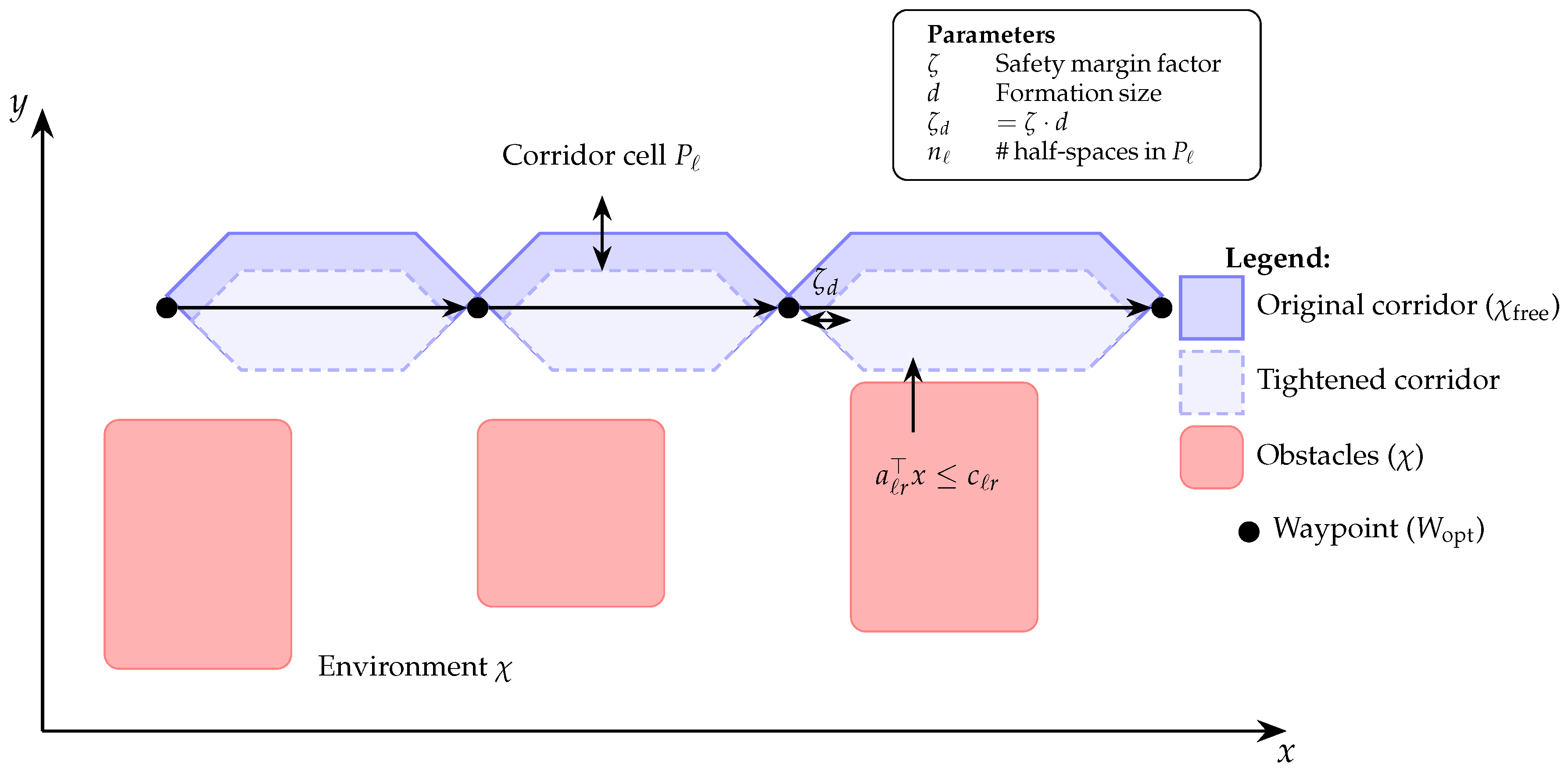
As shown in
Figure 1, the Safe Flight Corridor is represented as a sequence of adjacent convex polyhedra
where
is the number of corridor cells. For each cell
ℓ, the matrix
and vector
collect
half-space inequalities
(
), with
being the
r-th row of
.
To guarantee collision-free motion for a formation with size
, we tighten each corridor cell by shrinking every supporting half-space inward. Assuming the half-space normals are normalized, i.e.,
, the tightened corridor is
where
is a safety margin. If
is not normalized, the shrinkage can be written as
, so that each face is offset inward by the geometric distance
. The step of this method is concluded as Algorithm 1.
| Algorithm 1 Safe Flight Corridor Construction |
Require: Initial waypoint list , obstacle set , formation diameter d Ensure: Corridor cells 1: Generate initial piecewise linear path 2: for each segment do 3: Compute separating hyperplanes 4: Construct polyhedral cell 5: end for 6: Tighten constraints |
3.2. Trajectory and Formation Size Generation
Within replanning iteration
k, the leader trajectory is represented by an
M-segment
n-th order Bézier curve
where
are control points and
are Bernstein polynomials. Using the convex hull property, containment in the Safe Flight Corridor can be enforced by requiring all control points in the corresponding polyhedron.
We choose the formation size
as an optimization variable jointly with control points and polyhedron assignment binaries
:
A smooth transition
between
and
is generated by a high-order polynomial, satisfying boundary derivative matching up to order 4.
Remark 2. The trajectory smoothness term is chosen as the integral of the squared jerk, i.e., , for the following reasons. First, the jerk directly reflects the rate of change of acceleration and is closely related to the smoothness of thrust and attitude commands of quadrotor UAVs, making it more suitable than acceleration-based costs for execution on real platforms. Second, when the trajectory is parameterized by Bézier curves, the jerk remains a low order polynomial, which leads to a quadratic cost in the control points and enables efficient MIQP formulation. Finally, higher-order smoothness is enforced through explicit bounds on snap, guaranteeing continuity and compatibility with geometric tracking controllers. This choice provides a favorable trade-off between trajectory smoothness, tracking feasibility, and computational efficiency.
3.3. Distributed Time-Varying Formation Control Under Switching Topologies
To enable followers to compute and its derivatives, the leader publishes a parameter vector , which contains the current segment Bézier control points and timing information and the current formation-size polynomial parameters. Given and time t, any agent can compute , and analytically. Since replanning occurs at discrete instants, is piecewise constant with bounded jumps and bounded update frequency.
For each coordinate
, define the scalar estimate
and the leader signal
. We propose the nonlinear agreement protocol with delays:
where
and the nonlinearity
satisfies the strict dissipativity condition.
Assumption 3. For each coordinate ℓ, , and for all , . Moreover, is locally Lipschitz and there exists a class- function such that for all r in the semi-global domain of interest.
Define the leader oscillation over the delay window:
Equations (
17) and (
18) are a direct leader-following extension of the agreement model in [
39]: each follower is driven toward a time-varying convex combination of delayed neighbor estimates and delayed leader signal. The core advantage is that its convergence can be established via max–min contraction arguments under Assumption 1, without requiring a common quadratic Lyapunov function for switching directed graphs.
Define the estimation error for coordinate
ℓ:
. Let
Note that due to the leader time-variation, the asymptotic tracking generally requires additional internal model structure. Here we establish agreement among followers and practical tracking to the leader with a bound proportional to
.
Theorem 1. Suppose Assumptions 1 and 3 and bounded delays (7) hold, then for each coordinate ℓ: - 1.
The follower disagreement width converges to a neighborhood of zero:for some class- functions, is determined by and the joint leader reachability window . In particular, if is piecewise constant, then on each constant interval. - 2.
Each follower error satisfies the practical boundwhere is explicitly constructible via the window-based contraction recursion as in [39].
Proof. We prove the result for a single scalar coordinate of the leader parameter vector . The vector case follows by applying the same argument componentwise and taking the maximum bounds.
Define the follower envelope over the delay window
and the width
. By Lemma A3, for all
i and all
t
Applying Lemma A2 to each estimator
implies that
cannot exit the convex hull generated by
,
and the leader window. Hence
is well-defined and uniformly bounded for all
.
By Assumption 1, for any t there exists a time window whose union graph contains a directed spanning tree rooted at some follower r that receives leader information (i.e., on a subinterval of length at least ). Applying Lemma A4 on this subinterval shows that moves away from the envelope extremes by a margin proportional to , up to the leader window oscillation .
Along each directed edge of the spanning tree, Assumption 1 guarantees persistence for at least and a uniform weight lower bound . By Lemma A5, the contraction margin at the root propagates to each downstream node with at least a factor per edge. Since the depth of the spanning tree is at most , after the window , every follower contracts toward the interior of the envelope.
Then there exist explicit constants
such that for all
Iterating this recursion proves that (i) if is constant on , then strictly contracts and as ; and (ii) for time-varying , is ultimately bounded by .
The proof is complete. □
Each follower
i reconstructs the leader reference and its derivatives from
:
where
and
are analytic maps induced by Bézier/polynomial parameterization. Then the follower’s desired trajectory and derivatives are
Finally, each follower applies a geometric tracking controller using
,
,
, etc.
Given the implemented reference
and yaw
with bounded derivatives up to order four, we adopt a standard geometric tracking controller on
. Define the position/velocity errors
A commanded acceleration is chosen as
and the thrust is set to
The desired attitude
is constructed from the commanded acceleration and yaw. Its corresponding reference angular velocity is defined by
where
denotes the vee map from
to
.
The desired attitude
is constructed such that
aligns with
and the yaw matches
. Then the moment input
is designed by a standard attitude error feedback controller
which guarantees exponential tracking of
to
for sufficiently smooth references. This yields the ISS-type bound in Lemma A7. For a detailed ISS definition, see [
40].
Assumption 4. For each coordinate ℓ, the function is continuous, locally Lipschitz, , and there exists a constant such that Remark 3. Assumption 4 is a standard strong dissipativity/sector condition. It implies the sign condition for used in the switching agreement literature, while additionally providing a quantitative contraction rate that yields explicit recursion constants. A canonical choice is or .
Proposition 1 (Corridor tightening implies formation safety under time-varying radius)
. Fix a replanning interval and a corridor cell . Assume each row of is normalized, i.e., . Let the leader reference satisfy the tightened constraintsfor some tightening radius and safety factor . Suppose the executed formation radius after smoothing, , satisfiesand each follower remains within distance of the leader reference, i.e.,Then all agents remain inside the original corridor cell: Proof. For any face inequality
, by (
24)
For any follower
i, write
. Using
and Cauchy–Schwarz
By (
26) and (
25),
; hence,
. Since this holds for all faces,
. □
Theorem 2. Under Assumptions 1–3, and bounded delays (7), the closed-loop system consisting of the online planner (12)–(16), the nonlinear estimators (17) and (18), and the tracking controllers, satisfies: - 1.
All estimation signals are uniformly bounded for all .
- 2.
The reconstructed references , are uniformly bounded and satisfy the practical tracking bounds implied by Theorem 1.
- 3.
The formation tracking error is ultimately bounded:where can be made arbitrarily small by increasing the estimator contraction gain.
Proof. The closed-loop system can be interpreted as a cascade interconnection of three subsystems:
- (i)
The nonlinear distributed estimator layer (
17) and (
18).
- (ii)
The reference reconstruction layer induced by the Bézier and formation-size parameterization.
- (iii)
The geometric tracking control layer for each UAV.
We analyze these subsystems sequentially.
By Theorem 1, for each follower
i
where
and
are positive constants defined in (
19). Moreover, on any interval where
is constant (i.e., between replanning instants), the estimation error converges exponentially to zero. Hence, all estimator states remain uniformly bounded for all
.
By Lemma A6, the mappings
are locally Lipschitz with respect to the parameter vector
s on the compact set ensured by the planner.
Therefore, for each follower
i and
, there exist constants
such that
Thus the reference mismatch is uniformly bounded and inherits the practical convergence property of the estimator layer.
From Lemma A7, the geometric tracking controller satisfies the input-to-state stability (ISS) type bound
where
.
Taking the limit superior of (
30) yields
Combining (
31) with the reconstruction bound (
29) gives
for some constant
.
Substituting the estimator bound (
28) yields
where
Since the contraction factor increases with the estimator gain (Assumption 4), the ultimate formation tracking bound can be made arbitrarily small by increasing the estimator contraction gain.
This completes the strengthened proof. □
Remark 4. Compared with existing formation control methods under obstacle environments, the proposed framework offers several advantages. First, rather than treating obstacle avoidance and formation maintenance as loosely coupled problems, the formation footprint is explicitly embedded into the Safe Flight Corridor construction through corridor tightening. This guarantees the geometric feasibility of the entire formation in constrained spaces. Second, unlike approaches that rely on fixed or persistently connected communication graphs, the proposed nonlinear agreement protocol only requires joint leader reachability under switching directed topologies with bounded delays. Third, the analysis establishes an explicit cascade relationship between the estimator contraction rate and ultimate formation tracking accuracy, providing quantitative performance guarantees instead of purely qualitative convergence claims.
3.4. Computational Complexity Discussion
The Safe Flight Corridor construction consists of two main steps: (i) obstacle separation and half-space generation, and (ii) mixed-integer trajectory optimization.
For corridor construction, suppose each path segment interacts with at most nearby obstacles. Computing separating hyperplanes requires operations per segment. If the path contains L segments, the overall complexity of corridor generation is .
For trajectory optimization, let M denote the number of Bézier segments and n the polynomial order. The number of continuous decision variables is , while the number of binary variables equals the number of possible cell assignments per segment. The resulting optimization is a mixed-integer quadratic program (MIQP), whose worst-case complexity is exponential in the number of binary variables. However, since the corridor decomposition restricts feasible assignments locally, the practical computation remains tractable for moderate environment complexity.
Overall, the dominant computational cost arises from the MIQP solver, whereas corridor construction scales linearly with the number of obstacles and path segments.
4. Simulation Results
In this section, we employ a numerical example to verify the effectiveness of the proposed algorithm.
To further evaluate robustness, we consider stochastic packet delays and intermittent leader communication. Specifically, communication delays are randomly generated within following a uniform distribution, and leader access is temporarily disabled with a fixed probability to emulate packet loss. Simulation results indicate that although transient estimator errors increase during temporary connectivity violations, all states remain bounded due to the dissipative agreement structure. Once joint leader reachability is restored, the window-based contraction mechanism drives the estimator errors back to their nominal bounds. These results support the robustness of the proposed framework under more realistic communication conditions.
We consider a planar multi-UAV formation navigation task in an obstacle environment. The team consists of five UAVs, including one leader indexed by 0 and
followers indexed by
. The leader starts from
and aims to reach the goal
. The environment contains six static circular obstacles, specified by their centers and radius:
where each triple denotes
.
Followers are required to maintain a time-varying circular formation around the leader reference trajectory
. Let
be the desired angular offsets equally spaced on a circle. Define
. The ideal formation reference for follower
i is
where
is the time-varying formation size.
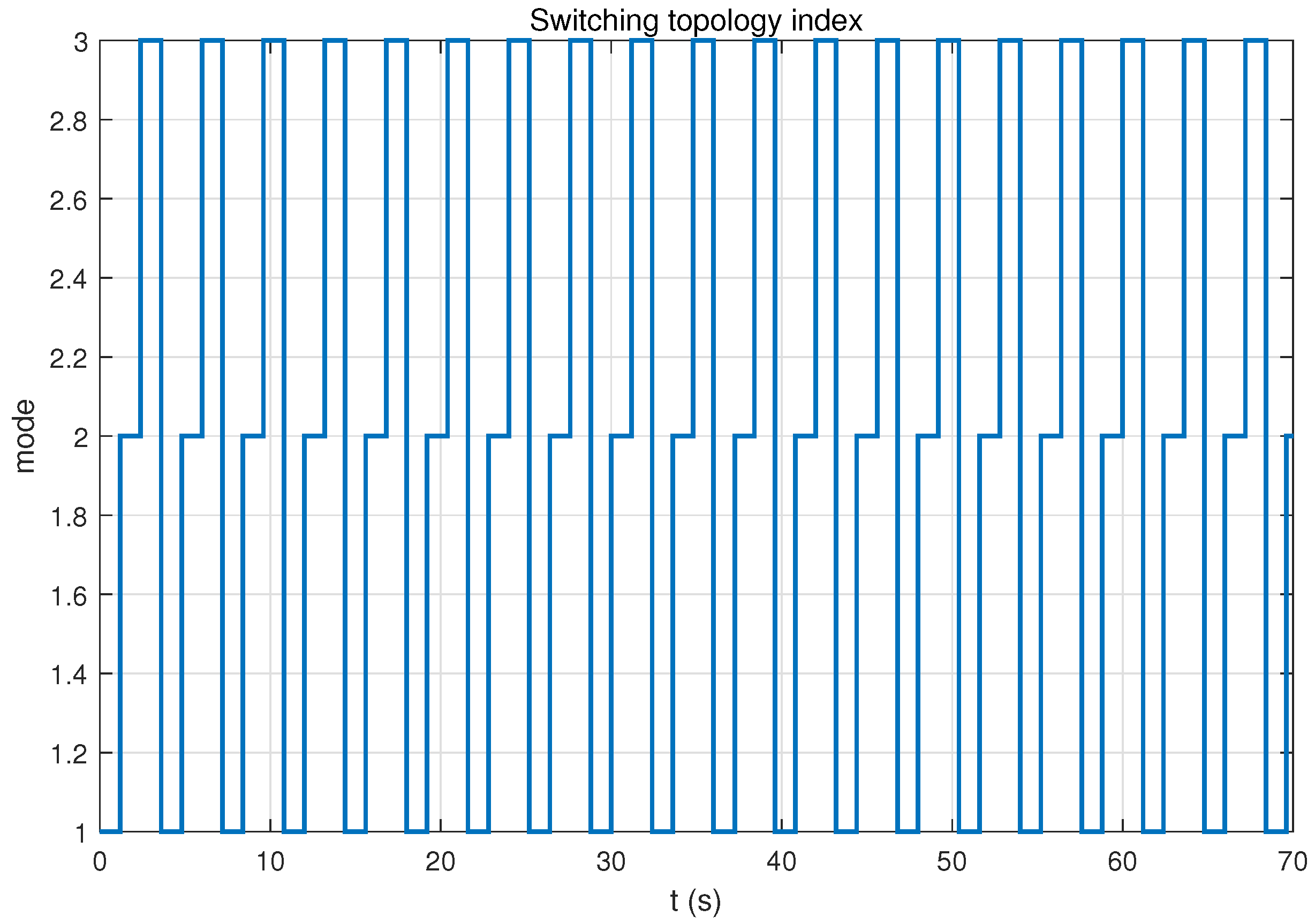
Communication among followers is described by a directed switching graph with three modes. We use the adjacency matrix
, where
indicates a directed edge
(i.e., follower
j receives information from follower
i) under mode
m. The three modes are:
The topology switches periodically every
. In addition, the leader information is directly available to exactly one follower per mode, encoded by
:
Communication delays are time-varying but bounded by
.
This subsection lists the simulation parameters and briefly verifies that the theoretical assumptions are satisfied. The simulation runs with sampling time
over
. The leader replans every
. The input of UAVs are sped with saturation
for the leader and
for followers. The leader tracks the planned reference point
by a proportional law
with
. Followers track their formation references using
with
, where
is a light obstacle repulsion term for safety.
The leader generates a waypoint list
(with
and
) and constructs a Safe Flight Corridor as a sequence of convex polyhedra
In implementation, each
is initialized as an axis-aligned corridor box inflated by
and then tightened by obstacle separating half-planes. The leader trajectory over each corridor segment is parameterized by a quintic Bézier curve (
). The control points are obtained by solving a quadratic program that minimizes a discrete proxy of the integrated squared jerk (third differences of control points), with weight
.
The nominal formation size is and the minimum radius is . The corridor tightening uses the safety factor , so that the corridor constraints are reduced by approximately at each replanning iteration (consistent with the formation footprint). The planned radius is smoothed into using a first-order filter with time constant .
Each follower maintains an estimate
of the leader reference point
using the nonlinear agreement protocol with delays:
where
is a convex combination of delayed neighbor estimates and (when available) the leader reference:
with normalized weights
and
defined as in (
6). Delays satisfy
and are simulated by random discrete delays up to
steps.
The directed switching graphs (
35) together with leader access vectors (
36) ensure that within each switching window, the leader information can reach all followers through directed paths, satisfying the joint leader reachability condition. The delay bound
is enforced by construction. The nonlinearity
satisfies
and
for all
, fulfilling the strict dissipativity requirement. Therefore, Assumptions 1–4 of the theoretical analysis are satisfied in the simulation.
The leader starts at
. Each follower starts near the leader with small random perturbations around the desired circular formation positions. The initial estimator states
are also perturbed, resulting in nonzero initial estimation errors. The simulation results are shown as in
Figure 2,
Figure 3,
Figure 4,
Figure 5,
Figure 6 and
Figure 7.
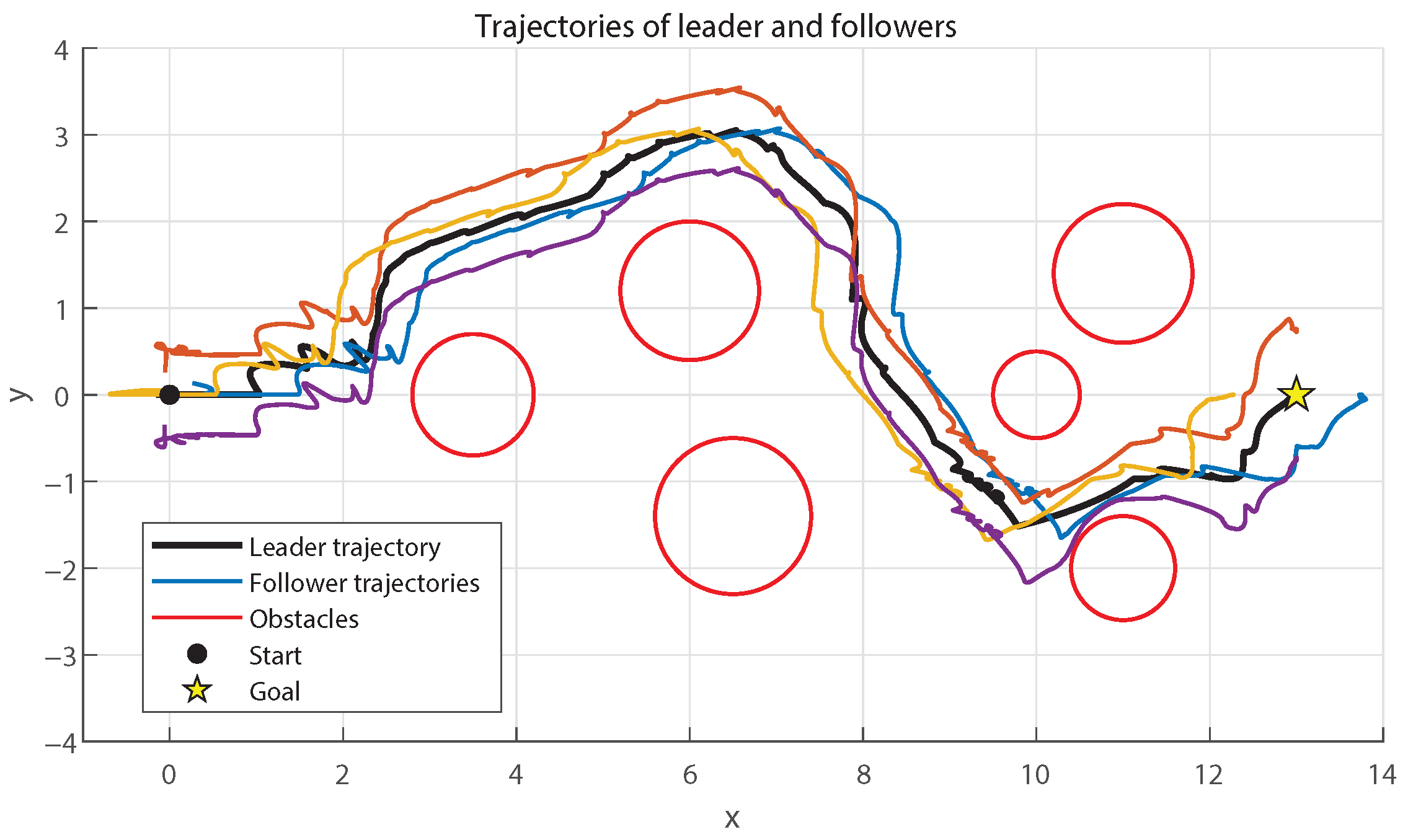
Figure 2 shows the trajectories of the leader and followers. The leader successfully navigates through the cluttered environment and reaches the goal, while followers maintain the desired circular formation. As the team approaches narrow passages, the formation size
decreases, enabling the entire formation to remain within the safe corridor, and then increases again in open regions.
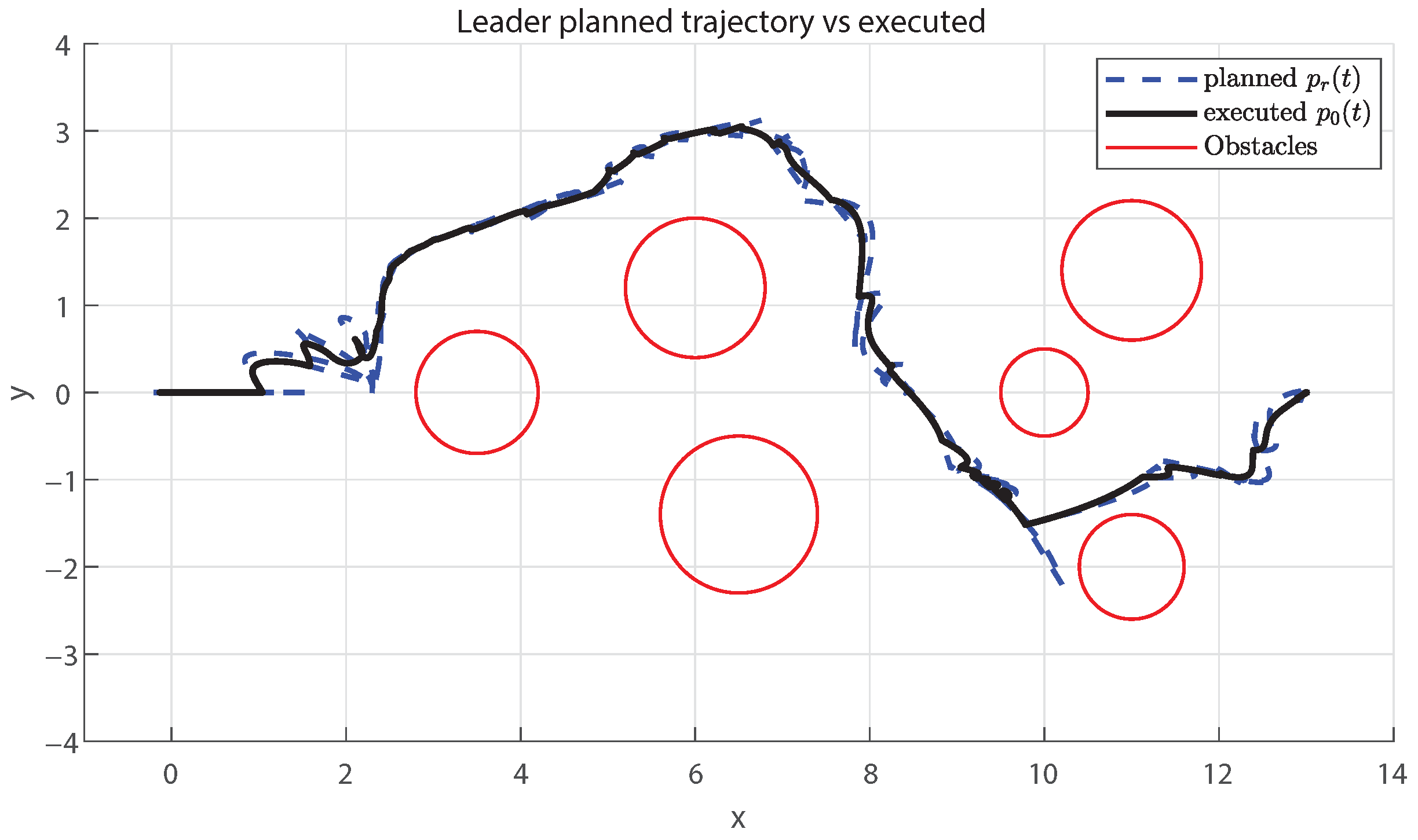
Figure 3 compares the planned leader reference trajectory
and the executed leader trajectory
. The executed trajectory closely tracks the planned reference, demonstrating that the planned trajectory is sufficiently smooth for tracking.
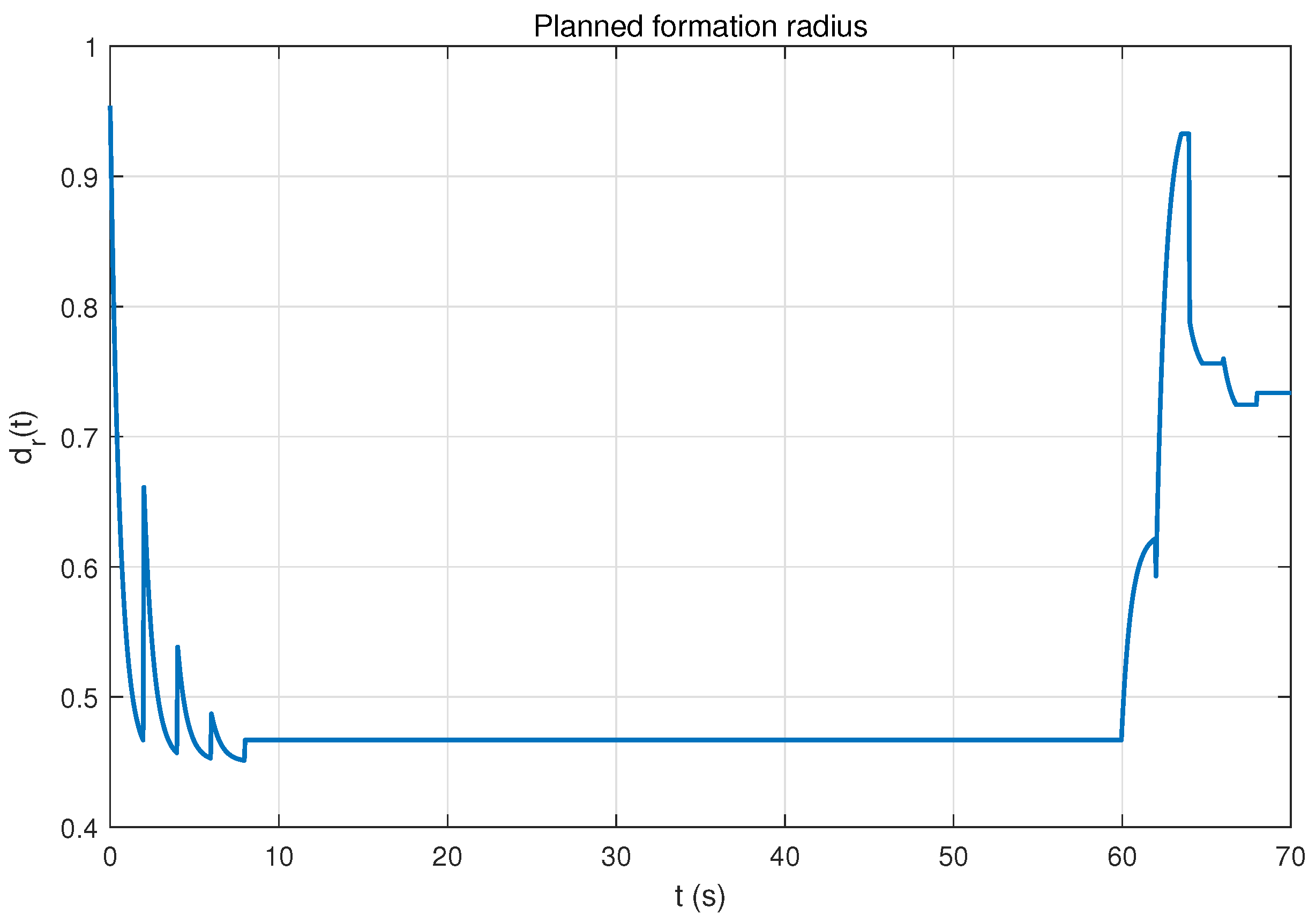
Figure 4 plots the time evolution of the formation size
, showing adaptive shrink behavior consistent with obstacle proximity.
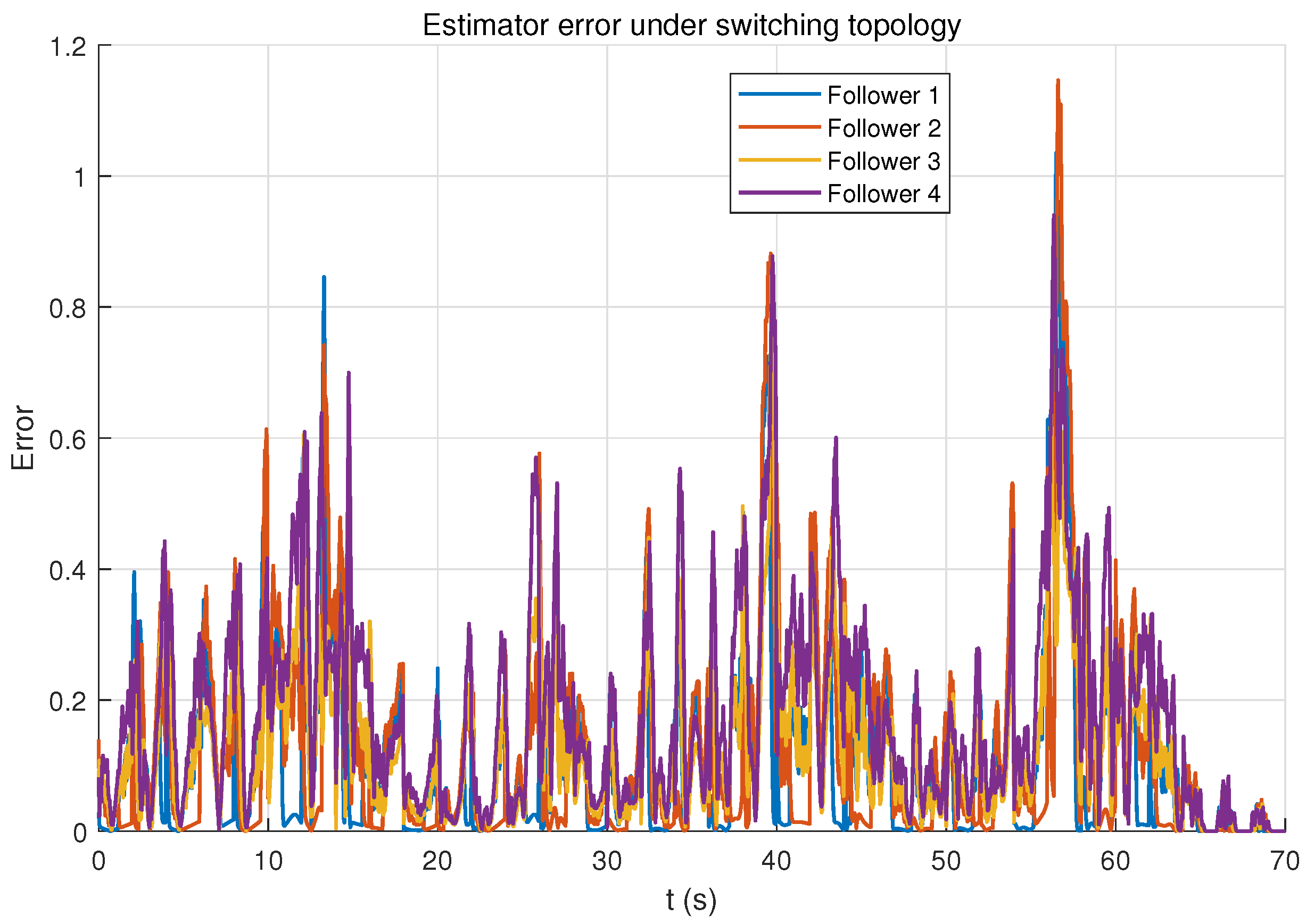
Figure 5 reports the distributed estimator errors
for all followers.
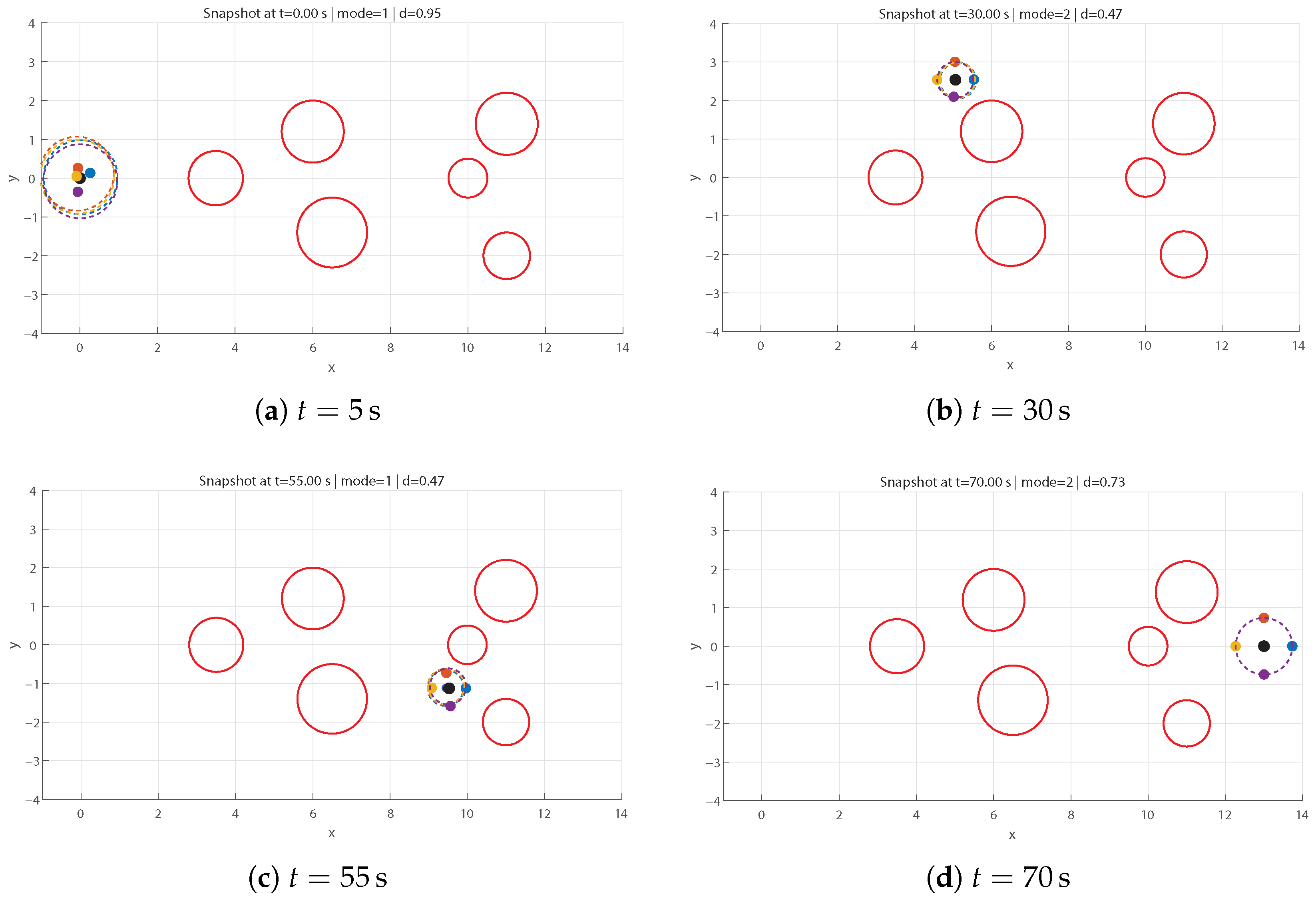
Figure 6 illustrates the mode switching process of the topology, while
Figure 7 shows a screenshot of the animation depicting the collective motion of the moving bodies in formation. Despite switching directed communication topologies and bounded delays, the estimator errors remain bounded and converge to small neighborhoods of zero, which corroborates the practical agreement guarantee.
The simulation results validate the proposed framework in a cluttered environment: (i) online planning generates smooth safe trajectories; (ii) adaptive formation sizing enables obstacle avoidance for the entire team; and (iii) the distributed nonlinear estimator achieves robust leader reference tracking under directed switching graphs with delays, leading to successful distributed formation control.
In practical UAV systems, the proposed framework can be implemented in a distributed manner. The leader computes the Safe Flight Corridor and formation size optimization at each replanning step, while followers run lightweight nonlinear agreement dynamics and geometric tracking controllers. Communication overhead is limited to parameter vector exchange rather than full trajectory broadcasting. The dissipative structure naturally tolerates moderate delay variations and packet loss, provided that joint connectivity is periodically restored. Computationally, corridor construction scales linearly with nearby obstacles, and the MIQP problem remains tractable for moderate environment complexity.
5. Conclusions
This paper presented a distributed formation planning and control framework for multi-UAV systems operating under directed switching communication topologies and environmental constraints. By integrating SFC-based trajectory planning with adaptive formation sizing, the proposed method enables the entire formation to safely navigate obstacle-rich environments. A nonlinear agreement protocol was introduced to handle delayed and intermittent leader information, and rigorous analysis established practical tracking and agreement guarantees under switching graphs. Simulation results validated the theoretical findings and demonstrated robust performance in challenging scenarios. Future work will focus on extending the framework to fully three-dimensional environments, incorporating more complex vehicle dynamics, and investigating experimental validation on real UAV platforms.
The present study considers a single-leader formation architecture. Extending the framework to multiple leaders introduces additional challenges, including potential inconsistency among leader references, multi-source information fusion in the distributed estimator, and more complex cascade stability analysis. In multi-leader scenarios, additional coordination mechanisms among leaders or consensus-based aggregation strategies would be required to ensure coherent formation behavior. Although the proposed nonlinear agreement protocol can serve as a foundation for such extensions under suitable connectivity assumptions, rigorous analysis for multi-leader formations is left for future investigation.
Despite the demonstrated effectiveness of the proposed framework, several limitations remain. First, the theoretical guarantees rely on bounded communication delays and a joint leader reachability condition; performance under severe packet loss or prolonged disconnections is not addressed. Second, the Safe Flight Corridor construction assumes accurate obstacle representation and convex decomposition, which may become conservative in highly complex 3D environments. Third, the formation control strategy focuses on practical convergence rather than strict asymptotic consensus under time-varying leader signals. Finally, the current validation is limited to numerical simulations, and experimental implementation on real UAV platforms remains as future work.