1. Introduction
Cerebrovascular accidents (CVAs), commonly known as strokes, are the leading cause of long-term physical disability [
1]. Neurological damage resulting from CVAs can result in hemiparesis—a partial paralysis affecting one side of the body—often manifesting as spasticity in specific muscle groups. Spasticity, characterized by an involuntary increase in muscle tone, hinders patients’ ability to perform activities of daily living (ADLs) [
2,
3]. In severe cases, muscle spasms may further impair voluntary control of the remaining functional muscles.
Various therapeutic interventions are employed to manage spasticity, including physical rehabilitation [
4,
5], electrostimulation [
6,
7,
8], and botulinum toxin injections [
9,
10]. Among these, physical rehabilitation remains the most effective and widely adopted approach [
11]. It typically involves repetitive muscle training guided by healthcare professionals. The physical rehabilitation is followed daily by clinicians who manually stretch the spastic muscles to promote motor recovery [
12]. However, there is a well-known growing shortage of trained clinicians. This shortfall limits access to therapy, leading to fewer treated patients and shorter sessions, which may negatively impact patient motivation and recovery outcomes [
13,
14].
A promising avenue to mitigate this issue is the use of robotized orthoses for post-stroke rehabilitation [
15,
16]. These devices can assist clinicians by automating elbow rehabilitation exercises with minimal human intervention. Mechatronic orthoses are capable of delivering consistent, repetitive motion, thereby improving the therapeutic process. However, current systems often fall short in terms of the force output required to manage spasticity effectively [
17,
18,
19,
20]. Notable examples include NEUROExos, University of Houston, USA [
21], ArmAssist, Tecnalia, Elexalde Derio, Spain [
22], and other portable or wearable systems designed for home or clinical settings [
23,
24]. These strongest devices deliver torques of 12 N⋅m, whereas it is suggested that at least 20 N⋅m is required for effective elbow flexion and extension rehabilitation.
Additionally, muscle spasms, referred to as clonus, may occur at frequencies ranging from 5 to 8 Hz, corresponding to a period of 160–200 ms [
25,
26]. Therefore, actuators used in such orthoses must not only generate sufficient torque but also be controllable at frequencies surpassing clonus to ensure compliance with collaborative robotics safety standards [
27,
28].
Incidentally, there is a need for the development of an elbow rehabilitation orthosis capable of generating sufficient torque to treat patients with spasticity, while also offering force control with adequate bandwidth to respond to disturbances caused by muscle spasms. Such a device must ensure patient comfort throughout therapy sessions by providing smooth and adaptive motion. Ideally, the orthosis should demonstrate reactivity faster than the average human reflex time—approximately 300 ms or 3–4 Hz [
29]—to replicate the responsiveness typically provided by a clinician.
Magnetorheological (MR) actuators are a recent high-performance actuator technology that combines high output torque with high control bandwidth and low backdriving forces, thereby offering transparent physical interactions with humans. In these actuators, an MR clutch located upstream of the electric motor decouples the motor’s inertia from the output, thereby enhancing responsiveness [
30,
31,
32,
33]. According to Véronneau et al. [
34], MR actuators achieve a torque-to-inertia ratio approximately 150 times higher than conventional actuators of equivalent torque and mass. This translates to a force control bandwidth nearly 10 times greater, exceeding 70 Hz for both position and force control. As a result, MR actuators are expected to offer reactivity that significantly surpasses human musculature.
In response to the limitations of current rehabilitation devices using poorly backdriveable gearmotors, this paper presents a feasibility study of a novel elbow orthosis designed using an MR actuator(Exonetik Inc., Sherbrooke, QC, Canada). The objective is to evaluate the actuator’s potential to provide the torque and responsiveness necessary for effective spasticity management in post-stroke rehabilitation. The MR rehabilitation Orthosis (MRO) is designed to replicate clinician-like movement through high-bandwidth force control and rapid responsiveness, addressing both therapeutic effectiveness and patient comfort.
The structure of this paper is as follows.
Section 2 details the mechanical design of the MRO.
Section 3 describes the electrical architecture of the MRO.
Section 4 outlines the embedded system and control implementation.
Section 5 presents the experimental validation conducted using a custom test bench, and
Section 6 provides the conclusion and discusses future works.
The work presented in this paper follows the advancement completed recently toward the amelioration of rehabilitation of upper-limb patients with spasticity [
35,
36].
2. Mechanical Design
As shown in
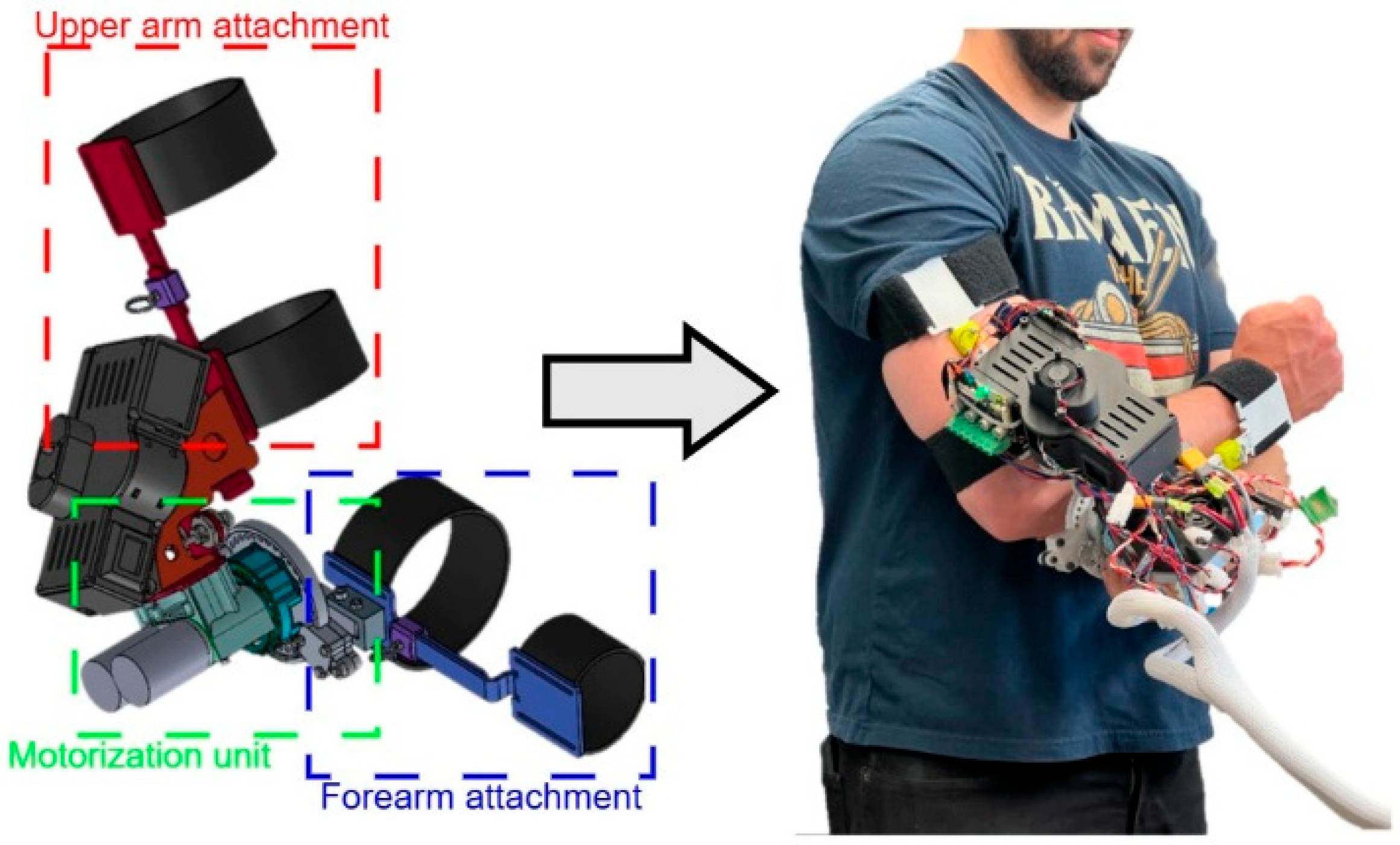
Figure 1, the MRO is segmented into three primary components: the upper arm attachment, the forearm attachment, and the motorization unit. The motorization unit is centrally located at the elbow joint, linking the two limb attachments.
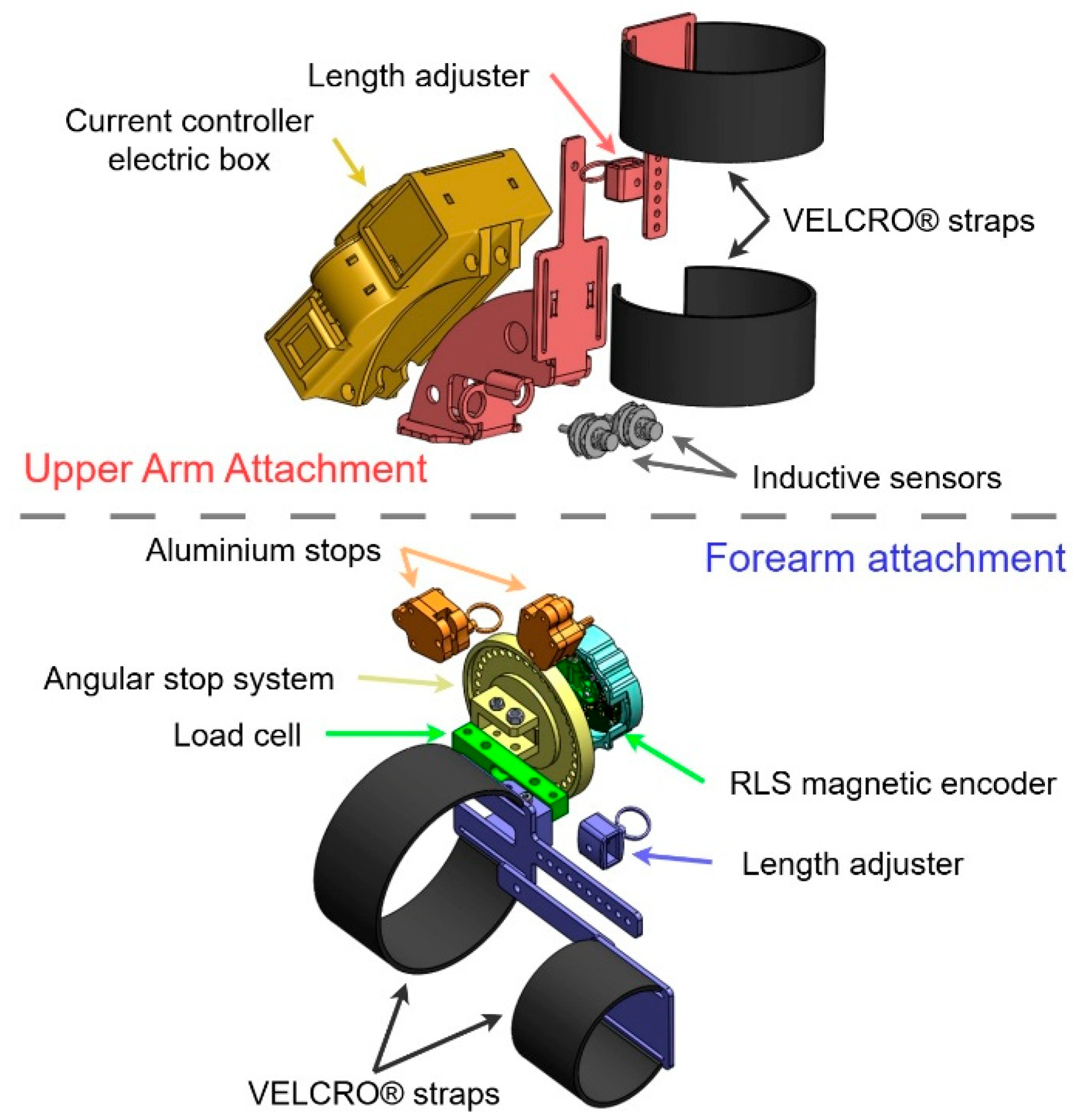
Figure 2 presents the mechanical parts of the MRO upper arm attachment and the forearm attachment. To secure the device to the patient’s limb, each segment uses two self-adhesive hook-and-loop (VELCRO
®, Ram International, Richmond, BC, Canada) straps with a width of 50.8 mm (2 in), distributing pressure over a larger surface area for improved comfort and safety.
Table 1 summarizes the design specifications, which outlines key performance criteria including weight, range of motion, and required torque output.
Based on male anthropometric data [
37], the distribution of force on the arm (
Fₑ) is calculated using the equation
, assuming a maximum applied torque of 20 N⋅m and the average distances of the straps at 5 cm and 20 cm from the elbow. There is then a maximum load of 133 N (~13.5 kg) on each strap. Based on the selected straps, the area of pressure should be ~0.0025 m
2. The pressure known as
is evaluated at 53.2 kPa. The resulting pressure is within acceptable limits for continuous contact, even under peak torque conditions [
38]. The spacing between the straps is manually adjustable with the length adjuster, allowing for proper fit across a wide range of arm lengths and morphologies.
The motorization unit comprises electric motors, an MR actuator, and an angular stop system. The MR actuator used for the orthosis prototype is a 30 N⋅m commercial robotic actuator from Exonetik Inc., chosen for its compatibility with the required torque, angular velocity, and mass specifications [
34]. To protect the patient’s joint, a manual angular stop system is integrated into the design. The system uses a mechanical dial with two aluminum stops and styrene–butadiene rubber (SBR) pads for added safety. Each stop limits the range of the MRO to prevent over-travel injuries. There are 36 discrete positions available for the angular stops that can be adjusted by the clinicians to customize the device’s range of motion to the patient’s needs. The system is also ambidextrous, enabling use on either arm.
Structurally, the MRO is adapted from an early version of the orthosis designed by the CIC1429 and modified here to integrate the MR actuator. The limb attachments are constructed from laser-cut and machined aluminum 5052, as well as 3D-printed polylactic acid (PLA) components. These materials are chosen for their strength-to-weight ratio. Engineering analyses were conducted on critical load-bearing regions using both theoretical calculations and finite element method (FEM) simulations, confirming that the structure stays within the yield strength capabilities of aluminum 5052. The straps (Ram International FS7PSS) are medical grade and skin safe. Their tensile strength and resistance to cyclic loading are sufficient to ensure durability. Foam padding can optionally be inserted under the straps to improve patient comfort during extended use.
3. Electrical Design
3.1. Power Components
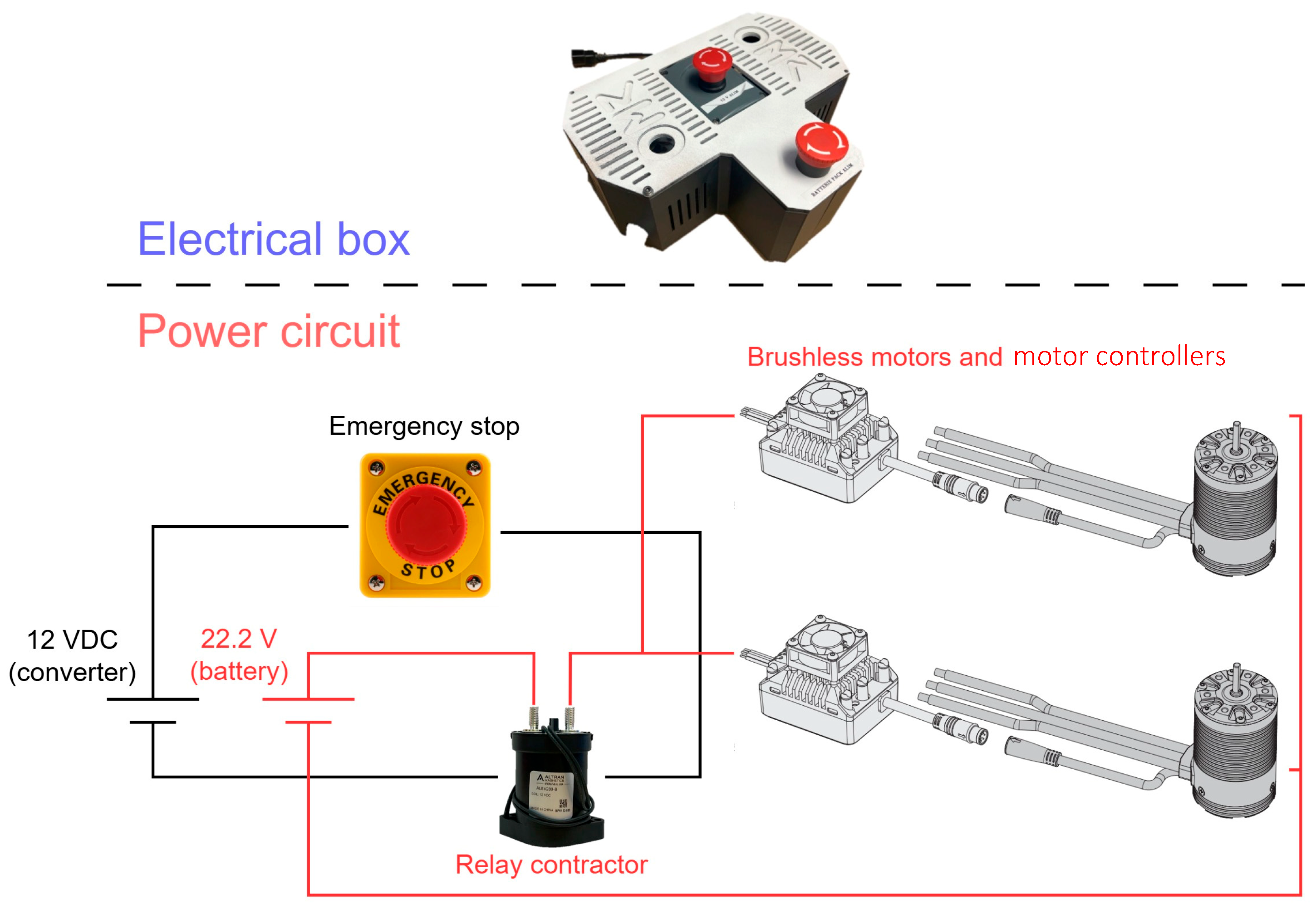
The power components enable the movement of the MRO, which consists of two motors and two current controllers. The motors selected for this application are Maxon brushless motors (maxon ECXFL32S KL A HTQ 24V, Sarnen, Switzerland). These brushless motors were chosen for their efficiency and suitability for precise control required in rehabilitation devices. The output torque can reach 1550 mN⋅m per motor continuously when assembled with the MR actuator. This high torque capacity is crucial for effectively managing patient spasticity, because at least 20 N⋅m of torque for elbow rehabilitation is suggested. The motors are controlled with motor drives ODrive (ODrive S1) which can be parameterized to the brushless motors via a web graphical user interface (GUI). The power circuit is simplified in
Figure 3.
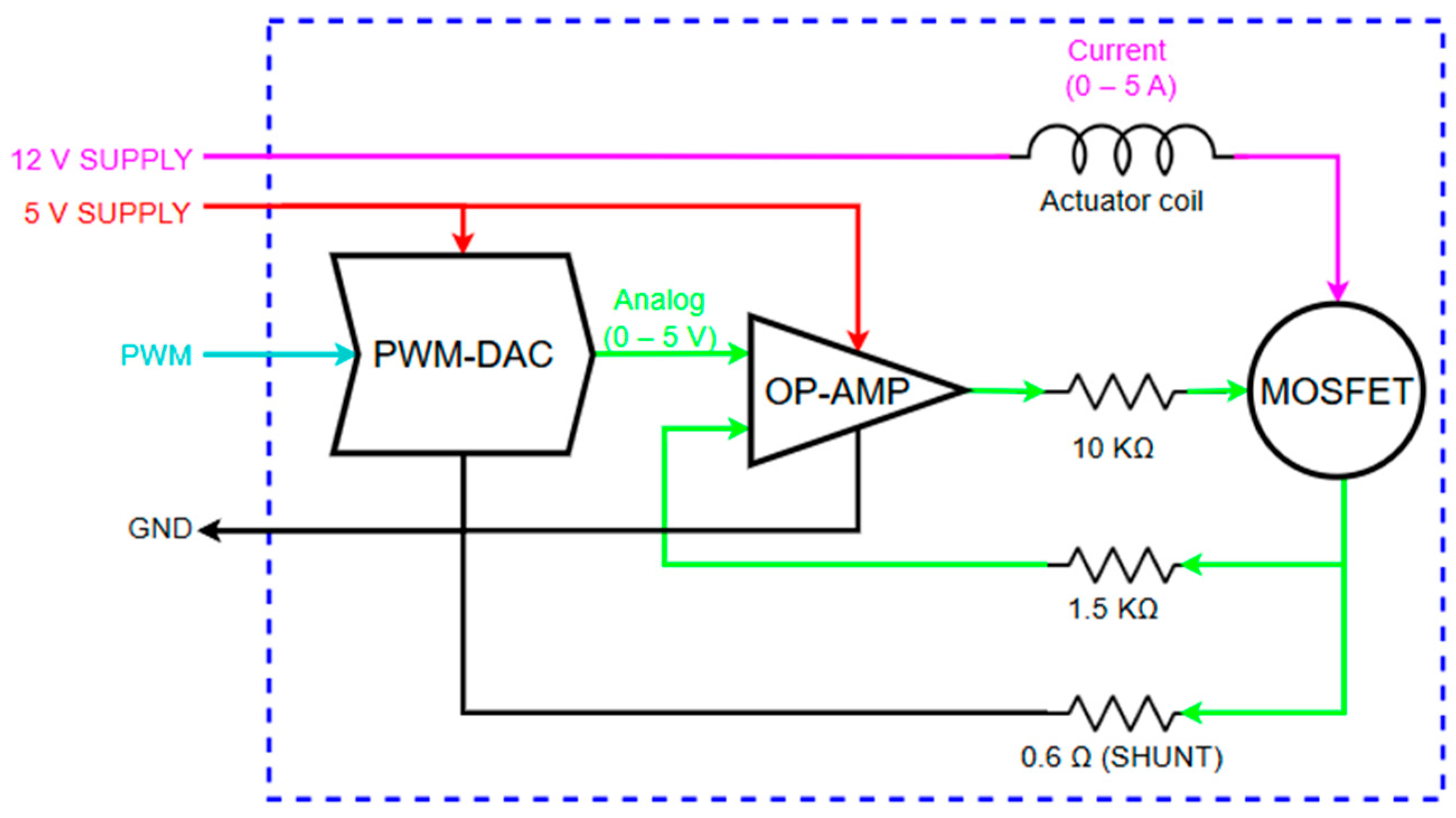
The motors are powered by a 6S LiPo 22.2 V battery with a capacity of 10,000 mAh. The LiPo battery is lightweight, increasing the portability of the MRO. The current controller for each coil has been designed to send variable current commands between 0 and 5 A from a pulse-width modulation (PWM) signal sent from the selected microcontroller. Following the schematic in
Figure 4, the current controller is mounted on a wire-wrapping PCB. It is placed as close as possible to the coils, in the current controller electric box on the orthosis. The current controller is powered by a 12 V power supply. The power components can be interrupted by emergency stops, with one stop to cut the power to the motors and another to cut the 12 V power supply. A relay contractor connected to an emergency stop allows power to be cut from the LiPo battery. This multi-layered emergency stop system emphasizes safety for the user.
3.2. Control Components
The microcontroller selected is an Arduino UNO R4 Minima. It offers 14 digital I/O pins, 6 analog inputs, and 6 PWM outputs, which are deemed sufficient for this research project. The microcontroller is single-threaded and operates at 48 kHz, which should provide an adequate processing speed for controlling the MRO and responding to sensor data in real time, a requirement highlighted due to the speed of clonus.
The sensors provide the resulting values of the motorization’s movement (position, speed, acceleration and force) at the MRO output. These feedback mechanisms are crucial for implementing open-loop control. Position, speed, and acceleration are obtained from a magnetic encoder (RLS MRA039B020DSE00). The sensor’s precision (19 bits) allows for high resolution (<0.001°), which is important for precise control of the MRO’s movement. The load cell measures the torque output of the MRO. It must be able to measure a torque of at least 20 N⋅m to meet the specifications. The relation between the maximum mass the load cell can accept (m) to the maximum torque of the MRO (T) is . It uses the average length of a human arm (L) and the gravitational constant (g). Considering a maximum torque of 20 N⋅m and the length of the desired load cell format of 0.045 m, a maximum capacity of 45.3 kg for the load cell is estimated. The selected load cell is a standard 50 kg load cell (RB-Phi-119).
To ensure patient safety, an extra-short DC proximity switch (Mc Master 2235N2) is placed at each end of the angular limiter to identify via an I/O signal when the MRO reaches a lower or upper angular limit of elbow flexion and extension. This mechanical safety is further reinforced by these sensors for security.
An electrical box houses power and control electronics for the MRO. All power-related components are enclosed in plastic casings, and the box is mounted on a wooden structure to ensure electrical isolation and protect the users from any electrical hazards.
4. Low-Level Computer Design
The low-level controller (LLC) of the MRO is programmed in C++ on the Arduino UNO R4 Minima microcontroller. This microcontroller communicates with the MRO by receiving torque commands from the main computer, which can be either a Linux-based Raspberry Pi or a Windows system, connected via a USB Serial communication link. The main computer sends a torque command, which the microcontroller converts into motor and coil commands for the MR actuator.
The microcontroller operates using an open-loop control architecture, enabling torque regulation without real-time feedback. The control process is executed in four main steps: sensor acquisition, command reception, command execution, and feedback transmission to the main computer. During the sensor acquisition phase, the system continuously monitors dynamic parameters of the MRO, including the position and velocity of both the motors and the MRO output, the output torque, and the status of inductive sensors used to detect mechanical limits.
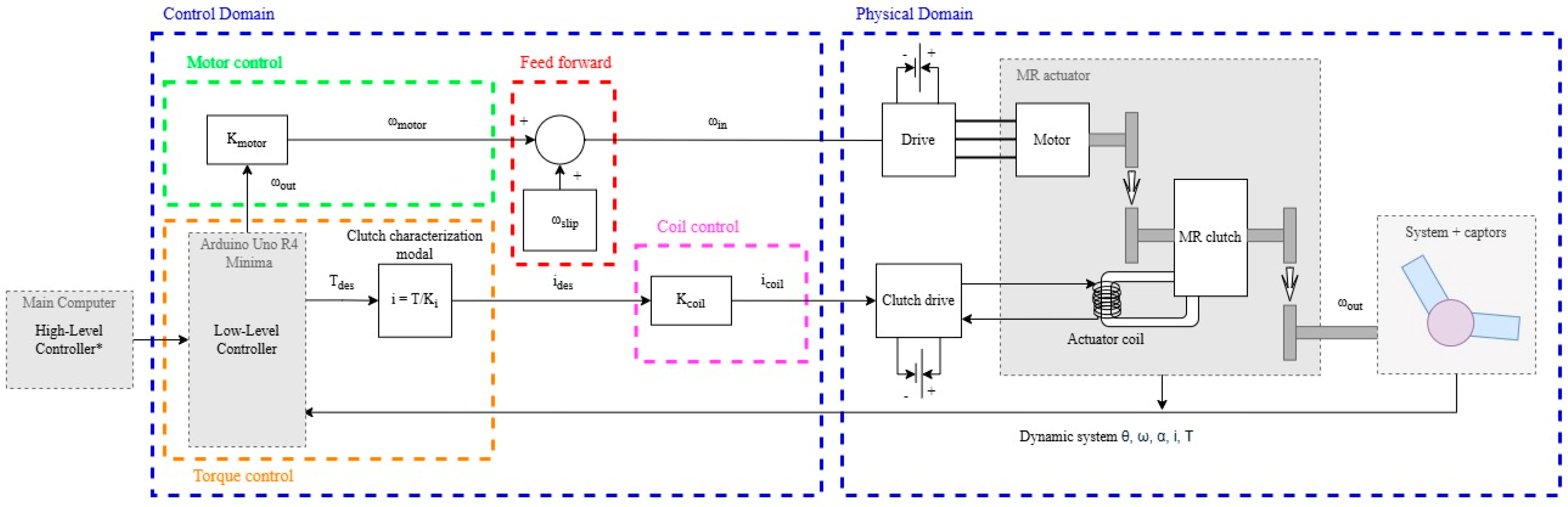
Command reception occurs through a Protobuf communication protocol between the main computer and the Arduino microcontroller. As shown in
Figure 5, the low-level open-loop architecture is separated into two domains, the Control Domain (CD) and the Physical Domain (PD). The CD receives a torque request
from the High-Level Controller (HLC), and it computes two control signals for each MR clutch, a motor command
and a coil current command
. These signals are computed twice, independently for each actuator, as the clutches operate in parallel but are not mechanically linked.
The motor command is computed from the motor control unit (MCU) and the feed forward unit (FFU). The motor command
is converted to a PWM signal communicating with UART to the motor controllers. The motors are velocity-controlled, with an internal loop modulating their speed to the MRO’s output speed. This feedback ensures a consistent velocity differential, typically around 300 RPM, across the MR fluid [
34]. This difference, referred to as the slip speed
, is a key parameter in torque generation. In detail, the MCU takes the output speed measurements
and multiplies it with a motor gain
computed with the gear ratio of the MR clutch. The motor speed
is then added to the slip speed
from the FFU. The output, the motor command
, is sent to motor drive ODrive via a serial communication protocol.
The torque output T of the MRO is controlled by adjusting the current delivered to the actuator coils. This current is calculated with the torque control unit (TCU) and the coil control unit (CCU). The TCU uses a first-order model specific to each clutch, as it depends on the physical characteristics of the coils. As a result, a calibration process is required to establish the clutch characterization model (CCM). The TCU takes the desired torque from the HLC and computes the desired current through the CCM. It is then sent to the CCU, which correctly adjusts the desired current with the coil gain to the hardware. This current command is forwarded through a PWM to the current controller.
Once the control commands have been executed in the PD with their respective equipment, the final step is to read sensor data and command outcomes with the LLC.
5. Experimental Validation
Experimental validation of the MRO prototype involves a series of tests focusing on torque control accuracy, temporal response, backdrivability, and response to user-induced disturbances. These validation phases demonstrate the system’s performance in conditions representative of intended use.
5.1. Torque Control and Temporal Response
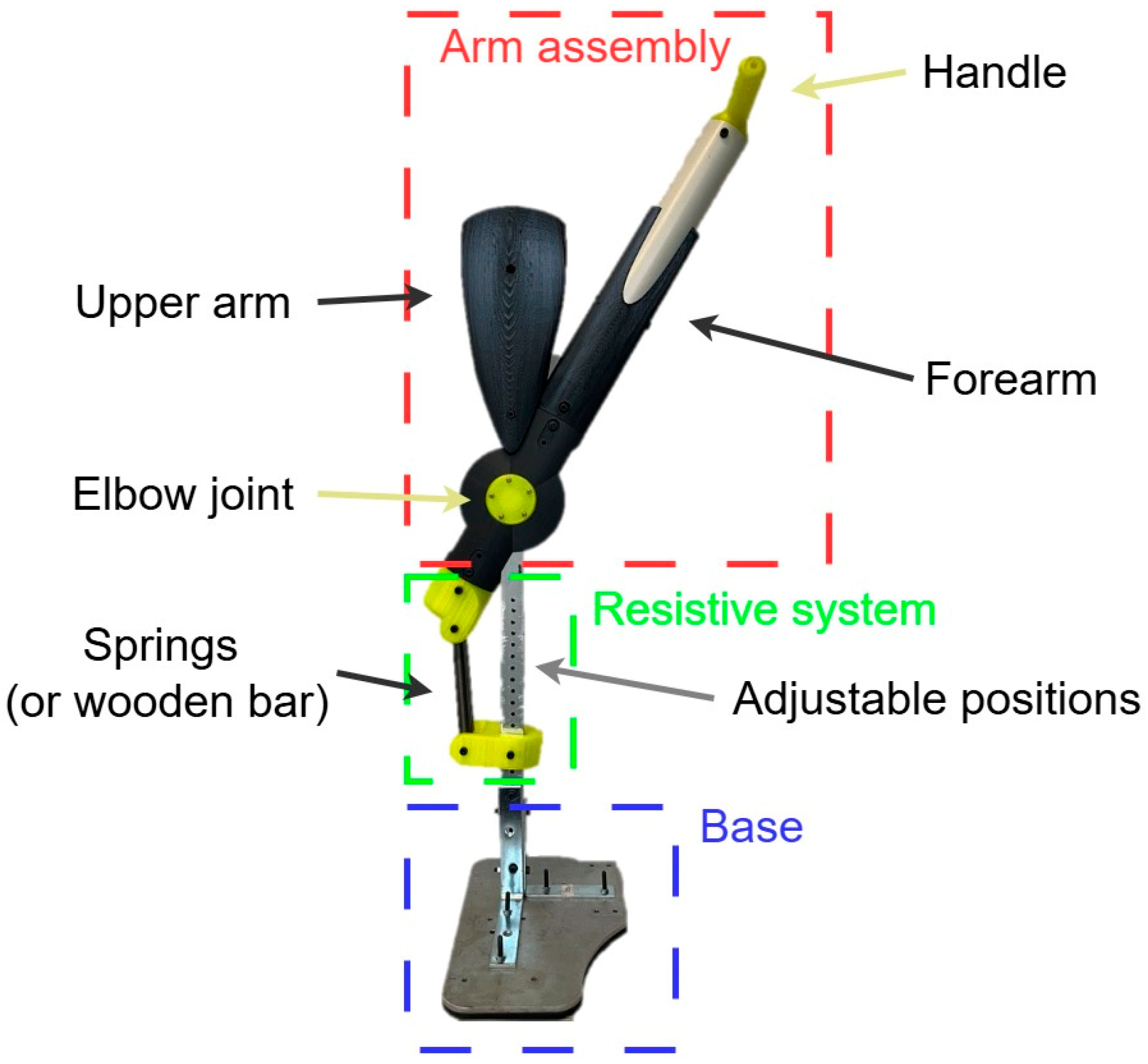
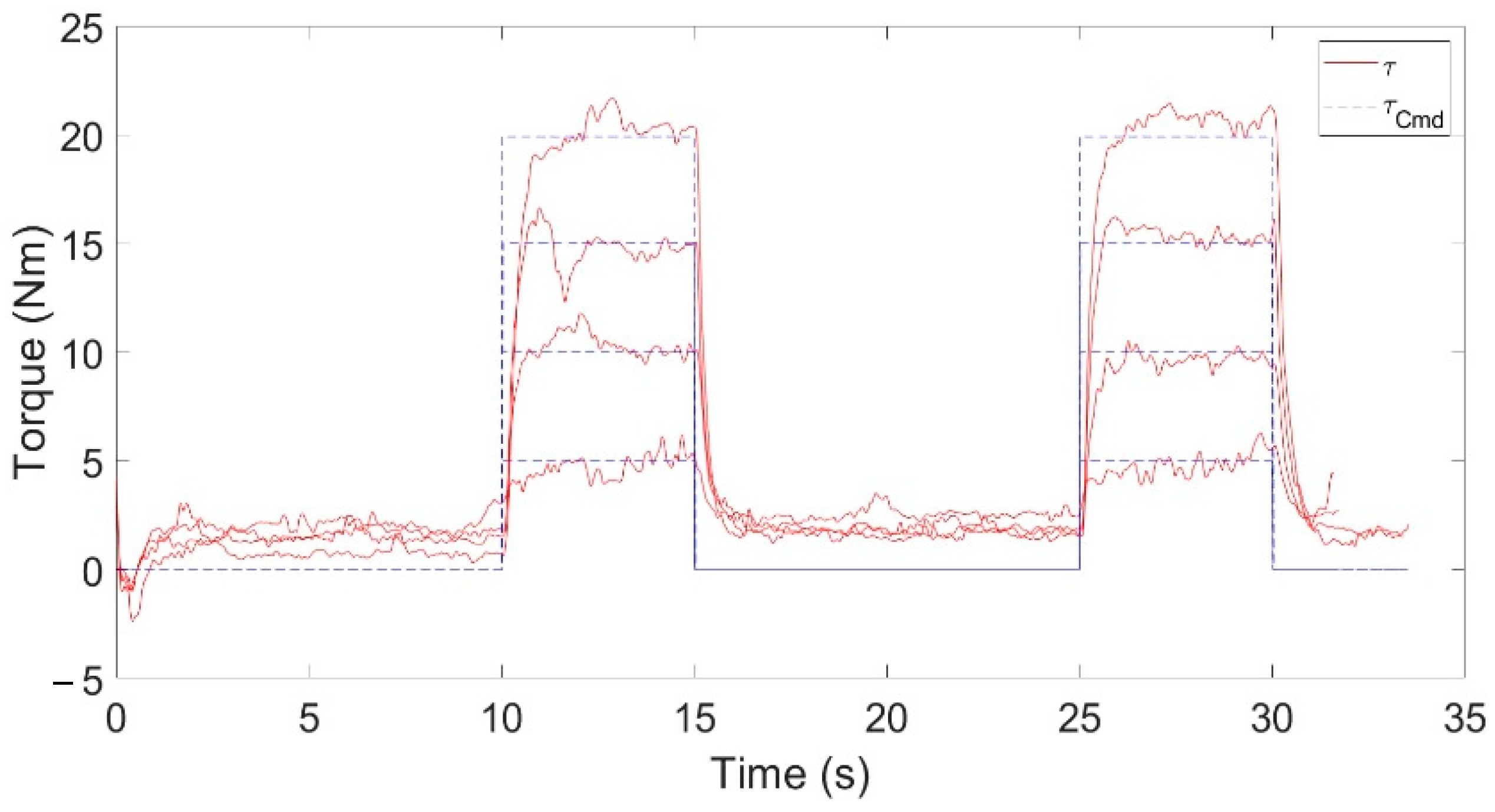
The first validation phase evaluated the open-loop torque control accuracy and the temporal response of the MRO. A range of step commands (5–20 N⋅m) was sent from the main computer, and the resulting torque was measured using the load cell. Two test benches were used for testing: one with the mock arm fixed to a wooden bar and another with mechanical resistance provided by springs. The mock arm replicates the human elbow joint and is composed of three main sections: the base, the arm assembly, and the resistive system.
Figure 6 presents the test bench. The base provides a stable connection to the test bench and is made from aluminum 5052 and secured using C-clamps to prevent tipping during testing. The arm assembly includes the shoulder, elbow, and forearm components. The shoulder and forearm are 3D-printed using PLA plastic, designed to match average human dimensions in length and width. The elbow joint is fitted with a pivot and bearings to reduce friction, while the forearm is equipped with a handle to apply voluntary perturbations. The resistive system controls the extension resistance of the test bench arm and offers two possible configurations: a rigid wooden bar and a set of adjustable springs. The wooden bar provides fixed resistance, allowing the MRO to demonstrate its maximum torque output in a static position. The spring-based test bench provides variable resistance, ranging from 0 to ~20 N⋅m with three springs total. Each spring provides a resistance of 5 kg at 10 cm of extension, resulting in a maximum torque of 12 N⋅m. Although the test bench cannot provide true dynamic load testing, the variable resistance allows for a progressive evaluation of the MRO’s performance throughout its range of motion.
The MRO responds to these step inputs with an average rising and falling time of 0.013 s, defined as the time required for the output torque to reach 90% of its steady-state value following a step input. This corresponds to a system bandwidth of approximately 78.17 ± 22.74 Hz assuming a first-order approximation. This evaluation is consistent with bandwidth measurements performed by Exonetik Inc. with 74 Hz [
34] when the output is blocked and a slip speed of 400 RPM. The variability of the bandwidth is attributed to the computational load of reading sensor values, processing commands, and generating motor and coil PWM signals on the Arduino UNO. The system demonstrates consistent torque tracking, with no overshoot or ringing observed in the response, indicating smooth and stable system dynamics. Some high-frequency noise is present in the torque signal, primarily caused by mechanical vibrations and minor sensor limitations.
As shown in
Figure 7, the average steady-state error across the tested torque range is 0.16 N·m above the commanded value, with a standard deviation of 0.596 N·m. This small positive offset reflects a slight systematic bias, which remains acceptable for a proof of concept system operating without feedback correction. The mean absolute error (MAE) obtained is 0.3175 N·m, while the normalized torque tracking error was found to be 0.9471% relative to the full 20 N·m torque span. These results suggest that the MRO maintains a high level of accuracy under open-loop control. The small deviation between commanded and actual torque is primarily attributed to the static characterization model used to convert coil current to torque. Overall, these results demonstrate the capability of the MR actuator and its current control strategy to reliably produce the desired output torque required for upper-limb rehabilitation tasks, even in the absence of closed-loop feedback.
5.2. Backdrivability and Passive Response
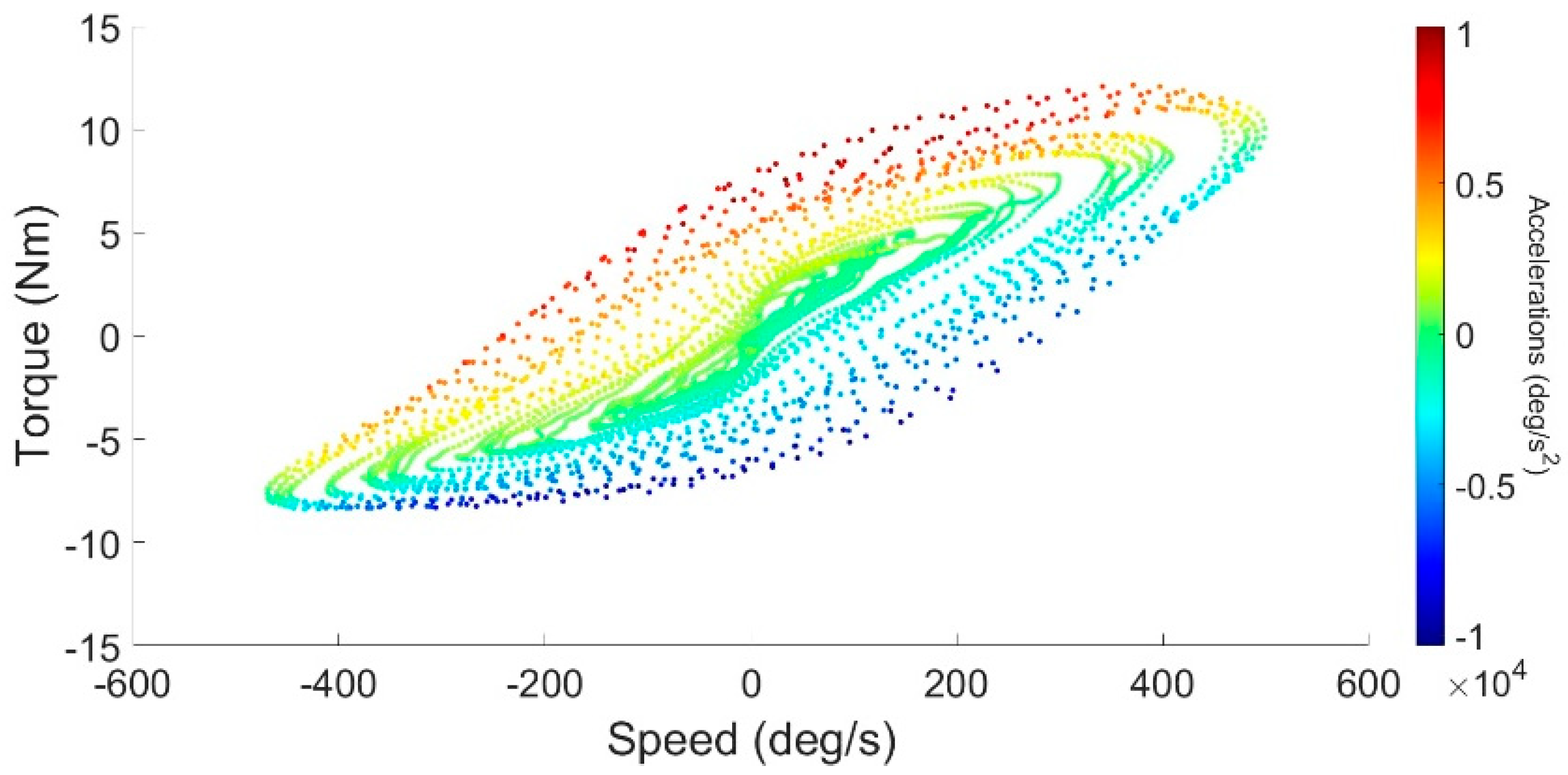
To ensure user safety in the event of actuator shutdown, MRO backdrivability, i.e., its resistance to external motion when unpowered, was characterized. High backdrivability allows free motion of the limb without constraints, ensuring safe interactions during unexpected power loss. This experimentation was done by manually rotating the MRO at various speeds up to ±500 degrees per second and measuring the resulting output torque. Equation (1) presents the results of a non-linear friction–velocity relationship [
39]:
The parameters of this model were estimated using custom fitting routines implemented in MATLAB (R2024b) with 95% confidence bounds. The estimation was possible with experimental values presented in
Figure 8.
Table 2 presents the values of each parameter, computed from the collected experimental data. This model captures both nonlinear frictional effects and viscous damping, enabling an accurate description of the actuator’s passive dynamics. The relatively low torque observed across the tested speeds suggests that the MRO has low mechanical resistance when unpowered, which is primarily attributed to its high torque-to-inertia ratio. This property is essential for ensuring safe, passive movement during rehabilitation and minimizing the risk of user injury.
5.3. Disturbance Tolerance with Human Interaction
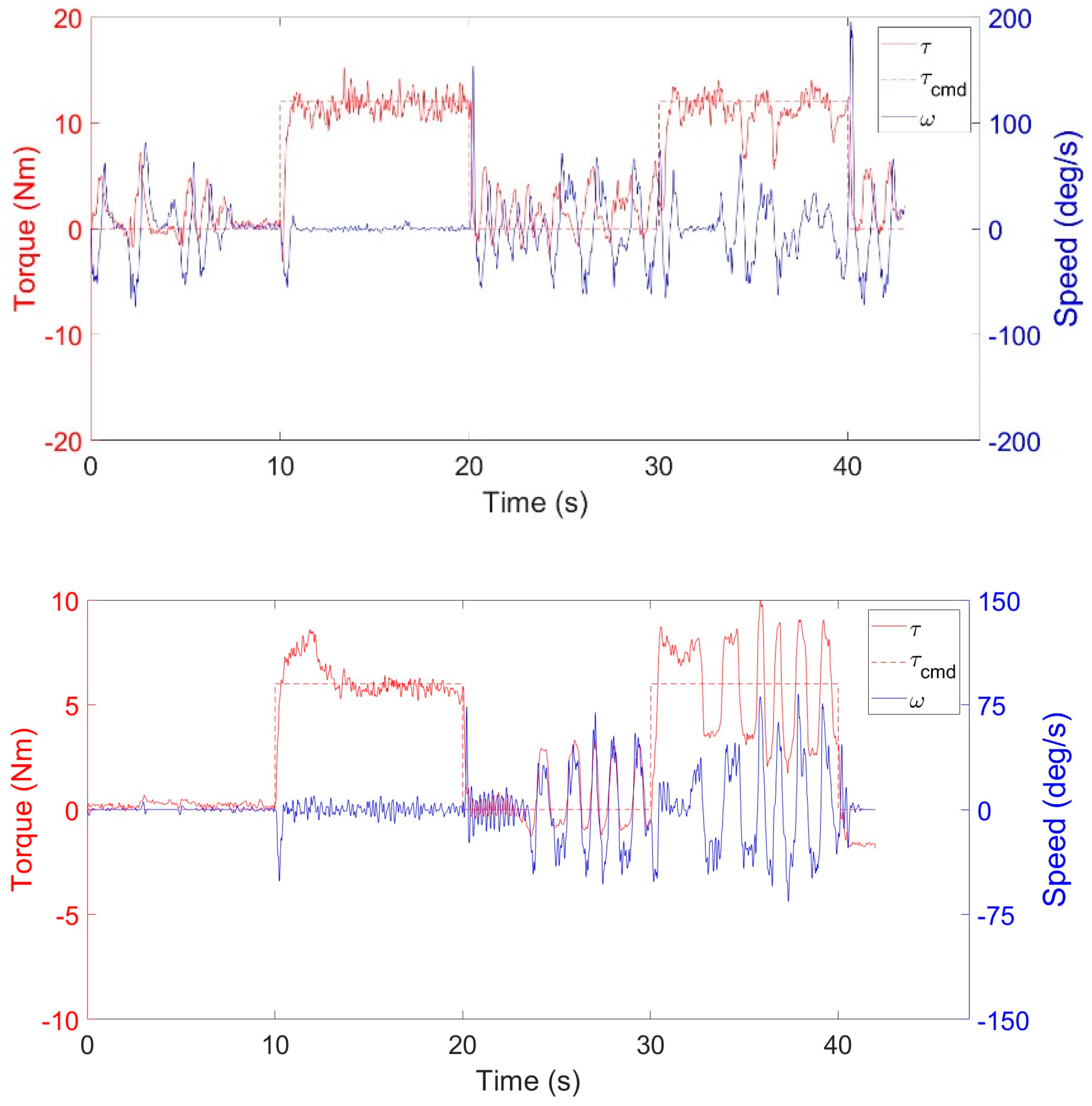
This validation step involved testing the MRO on a healthy human subject to evaluate its responsiveness to perturbations. During this test, the actuator was fitted on a user’s arm and commanded to maintain a constant torque output, while the subject voluntarily perturbed the MRO by moving their limb.
Figure 9 presents two representative trials conducted at 6 N⋅m and 12 N⋅m command torques, showing both the measured torque and the output angular velocity. Peaks in angular velocity—reaching up to ±100°/s—correspond to the user’s disturbances.
Despite the absence of active feedback control, the MRO maintained torque output with reasonable consistency, exhibiting a maximum deviation of ~6.2 N⋅m from the target. A linear regression analysis of the torque response as a function of angular velocity yielded the following relationship (2):
where
τ is the output torque in N⋅m, and ω is the angular velocity in degrees per second. The model produced a coefficient of determination
, indicating a moderate correlation between output speed and torque variation. These deviations are attributed not to MR clutch dynamics, but primarily to the friction compensation algorithm, which could not be executed at sufficient speed due to processing limitations of the LLC.
In all, these results illustrate the MRO’s potential to resist user-induced disturbances and maintain a relatively stable torque output, even in the absence of closed-loop correction. However, some overshoots and delays in response are observed in the current controller, demonstrating a limitation for this clinical-use case. Future improvements in control performance such as more efficient hardware and the integration of closed-loop feedback strategies could enhance robustness and adaptability during active use.
6. Conclusions
This paper presents the development and experimental validation of a torque-controlled orthosis powered by a magnetorheological (MR) actuator, designed specifically for upper-limb rehabilitation. The MRO is intended to operate an elbow orthosis, providing targeted support for the joint. With an emphasis on responsiveness, and user safety, the design employs an open-loop control strategy implemented on a lightweight and portable low-level hardware platform.
Mechanical and electrical validation was carried out through a series of experiments, including temporal response evaluation, backdrivability assessment, and real-world testing with a human subject. Results demonstrated a torque response time of 0.013 s, corresponding to a high frequency control bandwidth for the current system. It confirmed the system’s ability to deliver accurate torque control without overshoot or instability. The actuator also exhibited good backdrivability, with a fitted friction-torque model confirming low passive resistance during unpowered motion. During interaction testing with a healthy human subject, the MRO maintained, with limitations, torque control despite voluntary. The results reinforce the responsiveness and robustness of the MRO under real-life perturbations, even without feedback control. Limitations were observed in the response delays of the hardware. The open-loop architecture implemented on an Arduino UNO R4 Minima proved effective for this proof of concept, enabling reliable torque control without the computational overhead of feedback control. However, this approach requires careful and time-consuming calibration of the command-to-output relationship for each actuator. Because it lacks automatic feedback correction, any variation in component behavior over time or between units must be manually accounted for, limiting long-term consistency and ease of scaling.
Looking forward, future development will focus on refining the MR actuator itself, optimizing its size, weight, and thermal behavior, to better meet the ergonomic and functional requirements of wearable rehabilitation devices. While integrating a closed-loop architecture represents a promising direction for improving the MRO, its performance would be constrained by the present low-level controller’s bandwidth limitations of the hardware. Future versions will require more powerful, portable embedded hardware capable of processing multiple high-rate signals concurrently. With future works, the MRO would become a strong candidate for practical, patient-ready use in both elbow and hand rehabilitation contexts.
Author Contributions
Conceptualization, H.P., G.P. and J.-S.P.; Methodology, H.P., F.M. and J.-S.P.; Software, H.P., C.G.-T. and F.M.; Validation, H.P. and J.-S.P.; Formal analysis, H.P., C.G.-T., F.M., D.L., D.O. and G.P.; Investigation, H.P.; Resources, D.L. and S.C.; Writing—original draft, H.P.; Writing—review & editing, H.P., C.G.-T., F.M., D.O., G.P., S.C. and J.-S.P.; Visualization, J.-S.P.; Supervision, F.M., D.L., D.O., G.P., S.C. and J.-S.P.; Project administration, H.P., F.M. and J.-S.P.; Funding acquisition, F.M., D.O., G.P. and J.-S.P. All authors have read and agreed to the published version of the manuscript.
Funding
This research was funded by [INTER] grant number [40000] and [Mitacs] grant number [6000].
Institutional Review Board Statement
Not applicable.
Informed Consent Statement
Informed consent was obtained from all subjects involved in the study.
Data Availability Statement
The original contributions presented in this study are included in the article. Further inquiries can be directed to the corresponding author(s).
Acknowledgments
This work is funded by the Fonds de recherche du Québec—Nature et Technologie through the strategic network INTER (Engineering Interactive Technologies for Rehabilitation), and Mitacs. The authors also want to thank the kinesiotherapists at Hospital Poincaré, Garches, France, for their involvement in this project. During the preparation of this work, the author(s) used ChatGPT-5.2 for translation purposes. After using this tool, the author(s) reviewed and edited the content as needed and take full responsibility for the publication’s content.
Conflicts of Interest
The authors declare no conflicts of interest.
Abbreviations
The following abbreviations are used in this manuscript:
| CVA | Cerebrovascular Accident |
| ADLs | Activities of Daily Living |
| MR | Magnetorheological |
| MRO | Magnetorheological Orthosis |
| MAE | Mean Absolute Error |
| FEM | Finite Element Method |
| PLA | Polylactic Acid |
| SBR | Styrene–Butadiene Rubber |
| GUI | Graphical User Interface |
| PWM | Pulse-Width Modulation |
| LLC | Low-Level Control |
| HLC | High-Level Control |
| CD | Control Domain |
| PD | Physical Domain |
| MCU | Motor Control Unit |
| FFU | Feed Forward Unit |
| TCU | Torque Control Unit |
| CCU | Coil Control Unit |
References
- Feigin, V.L.; Nichols, E.; Alam, T.; Bannick, M.S.; Beghi, E.; Blake, N.; Culpepper, W.J.; Dorsey, E.R.; Elbaz, A.; Ellenbogen, R.G.; et al. Global, regional, and national burden of neurological disorders, 1990–2016: A systematic analysis for the Global Burden of Disease Study 2016. Lancet Neurol. 2019, 18, 459–480. [Google Scholar] [CrossRef]
- Stroke. Available online: https://www.ninds.nih.gov/health-information/disorders/stroke (accessed on 29 June 2023).
- Sveen, U.; Bautz-Holter, E.; Margrethe Sodring, K.; Bruun Wyller, T.; Laake, K. Association between impairments, self-care ability and social activities 1 year after stroke. Disabil. Rehabil. 1999, 21, 372–377. [Google Scholar] [CrossRef]
- French, B.; Thomas, L.H.; Leathley, M.J.; Sutton, C.J.; McAdam, J.; Forster, A.; Langhorne, P.; Price, C.I.; Walker, A.; Watkins, C.L.; et al. Repetitive task training for improving functional ability after stroke. In Cochrane Database of Systematic Reviews; The Cochrane Collaboration; John Wiley & Sons, Ltd.: Chichester, UK, 2007; p. CD006073.pub2. [Google Scholar]
- Wang, H.; Camicia, M.; Terdiman, J.; Mannava, M.K.; Sidney, S.; Sandel, M.E. Daily Treatment Time and Functional Gains of Stroke Patients During Inpatient Rehabilitation. PMR 2013, 5, 122–128. [Google Scholar] [CrossRef]
- Montoya, D.; Barria, P.; Cifuentes, C.A.; Aycardi, L.F.; Morís, A.; Aguilar, R.; Azorín, J.M.; Múnera, M. Biomechanical assessment of post-stroke patients’ upper limb before and after rehabilitation therapy based on FES and VR. Sensors 2022, 22, 2693. [Google Scholar] [CrossRef]
- Ren, Y.; Mo, L.; Lu, J.; Zhu, P.; Yin, M.; Jia, W.; Liang, F.; Han, X.; Zhao, J. Epidural Electrical Stimulation for Functional Recovery in Incomplete Spinal Cord Injury. Cyborg Bionic Syst. 2025, 6, 0314. [Google Scholar] [CrossRef] [PubMed]
- Lin, L.; Huang, Y.; Qing, W.; Kuet, M.-T.; Zhao, H.; Ye, F.; Rong, W.; Li, W.; Hu, X. Sensorimotor Integration by Targeted Priming in Muscles with Electromyography-Driven Electro-vibro-feedback in Robot-Assisted Wrist/Hand Rehabilitation after Stroke. Cyborg Bionic Syst. 2026, 7, 0507. [Google Scholar] [CrossRef] [PubMed]
- Elia, A.E.; Filippini, G.; Calandrella, D.; Albanese, A. Botulinum neurotoxins for post-stroke spasticity in adults: A systematic review. Mov. Disord. 2009, 24, 801–812. [Google Scholar] [CrossRef] [PubMed]
- Aspireault-Massé, J.; Higgins, J. La réadaptation en ergothérapie à la suite de l’injection de toxine botulique chez les personnes présentant de la spasticité à un membre supérieur: Revue de portée. Rev. Francoph. Rech. Ergothér. 2018, 4, 31–56. [Google Scholar] [CrossRef]
- Huang, J.; Ji, J.-R.; Liang, C.; Zhang, Y.-Z.; Sun, H.-C.; Yan, Y.-H.; Xing, X.-B. Effects of physical therapy-based rehabilitation on recovery of upper limb motor function after stroke in adults: A systematic review and meta-analysis of randomized controlled trials. Ann. Palliat. Med. 2022, 11, 521–531. [Google Scholar] [CrossRef]
- Kerr, L.; Jewell, V.D.; Jensen, L. Stretching and Splinting Interventions for Poststroke Spasticity, Hand Function, and Functional Tasks: A Systematic Review. Am. J. Occup. Ther. 2020, 74, 7405205050p1–7405205050p15. [Google Scholar] [CrossRef]
- Zimberlman, J.L.; Juraschek, S.P.; Zhang, X.; Lin, V.W.-H. Physical Therapy Workforce in the United States: Forecasting Nationwide Shortages. PMR 2010, 2, 1021–1029. [Google Scholar] [CrossRef] [PubMed]
- Lau, B.; Skinner, E.H.; Lo, K.; Bearman, M. Experiences of Physical Therapists Working in the Acute Hospital Setting: Systematic Review. Phys. Ther. 2016, 96, 1317–1332. [Google Scholar] [CrossRef] [PubMed]
- Babaiasl, M.; Mahdioun, S.H.; Jaryani, P.; Yazdani, M. A review of technological and clinical aspects of robot-aided rehabilitation of upper-extremity after stroke. Disabil. Rehabil. Assist. Technol. 2015, 11, 263–280. [Google Scholar] [CrossRef] [PubMed]
- Brackenridge, J.; Bradnam, L.V.; Lennon, S.; Costi, J.J.; Hobbs, D.A. A Review of Rehabilitation Devices to Promote Upper Limb Function Following Stroke. NBE 2016, 4, 25–42. [Google Scholar] [CrossRef]
- Said, R.R.; Yong, W.Q.; Bin Heyat, M.B.; Ali, L.; Qiang, S.; Ali, A.; Rauf, H.T.; Wu, Z. Design of a Smart Elbow Brace as a Home-Based Rehabilitation Device. Comput. Intell. Neurosci. 2022, 2022, 3754931. [Google Scholar] [CrossRef]
- Arcos Rosero, J.D.; Bolaños Rosero, D.C.; Alape Realpe, L.F.; Solis Pino, A.F.; Roldán González, E. Mechatronic Design of a Prototype Orthosis to Support Elbow Joint Rehabilitation. Bioengineering 2022, 9, 287. [Google Scholar] [CrossRef]
- Hmaied, H.; Sami, H.; Faouzi, B. Real time control of an upper limb orthosis robot for a passive rehabilitation. In Proceedings of the 2022 IEEE International Conference on Electrical Sciences and Technologies in Maghreb (CISTEM), Tunis, Tunisia, 26–28 October 2022; IEEE: Tunis, Tunisia, 2022; pp. 1–6. [Google Scholar]
- Pundik, S.; McCabe, J.; Kesner, S.; Skelly, M.; Fatone, S. Use of a myoelectric upper limb orthosis for rehabilitation of the upper limb in traumatic brain injury: A case report. J. Rehabil. Assist. Technol. Eng. 2020, 7, 2055668320921067. [Google Scholar] [CrossRef]
- Cempini, M.; Giovacchini, F.; Vitiello, N.; Cortese, M.; Moise, M.; Posteraro, F.; Carrozza, M.C. NEUROExos: A powered elbow orthosis for post-stroke early neurorehabilitation. In Proceedings of the 2013 35th Annual International Conference of the IEEE Engineering in Medicine and Biology Society (EMBC), Osaka, Japan, 3–7 July 2013; IEEE: Osaka, Japan, 2013; pp. 342–345. [Google Scholar]
- Garzo, A.; Jung, J.H.; Arcas-Ruiz-Ruano, J.; Perry, J.C.; Keller, T. ArmAssist: A telerehabilitation solution for upper-limb rehabilitation at home. IEEE Robot. Automat. Mag. 2023, 30, 62–71. [Google Scholar] [CrossRef]
- Bancud, K.; Kutilek, P.; Krivanek, V. Design of Powered Wearable Elbow Brace for Rehabilitation Applications at Clinic and Home. In Proceedings of the 2019 European Conference on Mobile Robots (ECMR), Prague, Czech Republic, 4–6 September 2019; IEEE: Prague, Czech Republic, 2019; pp. 1–6. [Google Scholar]
- Ferreira, F.M.R.M.; de Paula Rúbio, G.; Dutra, R.M.A.; Van Petten, A.M.V.N.; Vimieiro, C.B.S. Development of portable robotic orthosis and biomechanical validation in people with limited upper limb function after stroke. Robotica 2022, 40, 4238–4256. [Google Scholar] [CrossRef]
- Uysal, H.; Boyraz, İ.; Yağcıoğlu, S.; Oktay, F.; Kafalı, P.; Tönük, E. Ankle clonus and its relationship with the medium-latency reflex response of the soleus by peroneal nerve stimulation. J. Electromyogr. Kinesiol. 2011, 21, 438–444. [Google Scholar] [CrossRef]
- Boyraz, I.; Uysal, H.; Koc, B.; Sarman, H. Clonus: Definition, mechanism, treatment. Med. Glas. 2015, 12, 19–26. [Google Scholar]
- ISO/TS 15066; 2016: Robots and Robotic Devices-Collaborative Robots. ISO: Geneva, Switzerland, 2016.
- Merckaert, K.; Convens, B.; Wu, C.; Roncone, A.; Nicotra, M.M.; Vanderborght, B. Real-time motion control of robotic manipulators for safe human–robot coexistence. Robot. Comput.-Integr. Manuf. 2022, 73, 102223. [Google Scholar] [CrossRef]
- Kosarov, D. The reaction time of single motor units in the human muscle. Agressologie 1979, 20, 279–285. [Google Scholar] [PubMed]
- St-Jean, A.; Dorval, F.; Plante, J.-S.; Lussier-Desbiens, A. Magnetorheological-Actuators: An Enabling Technology for Fast, Safe, and Practical Collaborative Robots. IEEE Trans. Robot. 2024, 40, 1261–1272. [Google Scholar] [CrossRef]
- Gervais, M.; Lebel, L.-P.; Plante, J.-S. Design Exploration and Experimental Characterization of a 6 Degrees-of-Freedom Robotic Manipulator Powered by Cable-Driven Semi-Delocalized Magnetorheological Actuators. In Proceedings of the 2022 International Conference on Robotics and Automation (ICRA), Philadelphia, PA, USA, 23–27 May 2022; IEEE: Philadelphia, PA, USA, 2022; pp. 11416–11423. [Google Scholar]
- Turcotte, J.; East, W.; Plante, J.-S. Experimental Assessment of a Controlled Slippage Magnetorheological Automotive Active Suspension for Ride Comfort. SAE Int. J. Veh. Dyn. Stab. NVH 2022, 6, 357–370. [Google Scholar] [CrossRef]
- Denis, J.; Plante, J.-S.; Girard, A. Low-Level Force-Control of MR-Hydrostatic Actuators. IEEE Robot. Autom. Lett. 2021, 6, 3849–3856. [Google Scholar] [CrossRef]
- Veronneau, C.; Denis, J.; Lhommeau, P.; St-Jean, A.; Girard, A.; Plante, J.-S.; Bigue, J.-P.L. Modular Magnetorheological Actuator With High Torque Density and Transparency for the Collaborative Robot Industry. IEEE Robot. Autom. Lett. 2023, 8, 896–903. [Google Scholar] [CrossRef]
- Guay-Tanguay, C.; Létourneau, D.; Pagé, H.; Plante, J.S.; Pradel, G.; Orlikowski, D.; Michaud, F. Design of a Telerehabilitation Software Platform for a Compliant Upper-Limb Rehabilitation Orthosis. In Proceedings of the 2025 47th Annual International Conference of the IEEE Engineering in Medicine and Biology Society (EMBC), Copenhagen, Denmark, 14–17 July 2025; pp. 1–7. [Google Scholar]
- Guay-Tanguay, C.; Pagé, H.; Plante, J.S.; Pradel, G.; Charles, S.; Orlikowski, D.; Létourneau, D.; Michaud, F. Assist-as-Needed Impedance and Admittance Switching Control for an Upper-Limb Compliant Rehabilitation Orthosis. In Proceedings of the 2025 47th Annual International Conference of the IEEE Engineering in Medicine and Biology Society (EMBC), Copenhagen, Denmark, 14–17 July 2025; pp. 1–7. [Google Scholar]
- Gordon, C.C.; Blackwell, C.L.; Bradtmiller, B.; Parham, J.L.; Barrientos, P.; Paquette, S.P.; Corner, B.D.; Carson, J.M.; Venezia, J.C.; Rockwell, B.M.; et al. 2012 Anthropometric Survey of U.S. Army Personnel: Methods and Summary Statistics; Technical Report Natick/TR-15/007; U.S. Army Natick Soldier Research and Engineering Center: Natick, MA, USA, 2014; Available online: https://www.openlab.psu.edu/ansur2 (accessed on 31 January 2026).
- Rocon, E.; Ruiz, A.F.; Pons, J.L.; Belda-Lois, J.M.; Sanchez-Lacuesta, J.J. Rehabilitation Robotics: A Wearable Exo-Skeleton for Tremor Assessment and Suppression. In Proceedings of the 2005 IEEE International Conference on Robotics and Automation, Barcelona, Spain, 18–22 April 2005; IEEE: Barcelona, Spain, 2005; pp. 2271–2276. [Google Scholar]
- Makkar, C.; Dixon, W.E.; Sawyer, W.G.; Hu, G. A new continuously differentiable friction model for control systems design. In Proceedings of the 2005 IEEE/ASME International Conference on Advanced Intelligent Mechatronics, Monterey, CA, USA, 24–28 July 2005; pp. 600–605. [Google Scholar]
| Disclaimer/Publisher’s Note: The statements, opinions and data contained in all publications are solely those of the individual author(s) and contributor(s) and not of MDPI and/or the editor(s). MDPI and/or the editor(s) disclaim responsibility for any injury to people or property resulting from any ideas, methods, instructions or products referred to in the content. |




 ,
,