Article

Design Characteristics of Continuum Robots Based on TSA Variable Stiffness Method

1
School of Mechanical Engineering, Jiaxing University, Jiaxing 314000, China
2
Jiaxing Soy Intelligent Technology Co., Ltd., Jiaxing 314000, China
3
College of Mechanical and Electrical Engineering, Xi’an University of Architecture and Technology, Xi’an 710000, China
4
Institute of Automation, Chinese Academy of Sciences, Beijing 100080, China
*
Author to whom correspondence should be addressed.
Actuators 2026, 15(3), 154; https://doi.org/10.3390/act15030154
Submission received: 29 January 2026 / Revised: 26 February 2026 / Accepted: 2 March 2026 / Published: 4 March 2026
(This article belongs to the Section Actuators for Robotics)

Abstract

To address the contradiction between high flexibility and low stiffness in continuum robots, as well as the problems of complex structure, slow response, and narrow stiffness adjustment range in existing variable stiffness methods, this paper proposes a variable stiffness approach based on Twisted Multi-String Actuators (hereinafter referred to as TSA) for bionic spine-like continuum robots. Firstly, a bionic spine-like configuration was designed to support the force-locking variable stiffness mechanism. Secondly, the proposed TSA-based variable stiffness method was analyzed theoretically from the perspectives of geometric relationships and stiffness characteristics, laying a foundation for establishing other mathematical models such as that of string-twisting behavior. Finally, an experimental prototype was fabricated and subjected to flexibility tests. Furthermore, TSA variable stiffness experiments were conducted under two-strand, three-strand, and four-strand configurations to investigate the retraction and stiffness performance under different torsion turns and external loads. The results demonstrate that the stiffness of the robot is effectively enhanced by the TSA method, and increasing the number of string strands raises the failure load of the robot. Characteristic curves confirm that the proposed design and model exhibit superior performance to the traditional single-cable force-locking scheme. The design features a simple structure, fast response, and wide stiffness adjustment range, which provides a valuable reference for the stiffness modulation research of continuum robots.

1. Introduction

Continuum robots have demonstrated enormous potential in fields such as medical treatment [1,2,3,4] and aerospace inspection [5,6,7] due to their high flexibility and excellent adaptability in confined spaces [8,9]. However, their inherent low stiffness, especially under high aspect ratio conditions, severely limits their applications in scenarios demanding high load capacity and precise manipulation [10,11]. Consequently, achieving real-time, adjustable variable stiffness has become a key research focus, enabling these robots to dynamically adapt to various tasks ranging from highly flexible motion to high-stiffness operation [12]. Existing variable stiffness methods can be broadly categorized into four groups according to their working principles. However, each category has notable drawbacks that impede their practical implementation [13,14]. Among these methods, the force-locking method is considered a promising candidate due to its simple principle, but it still has limitations in stiffness adjustment range.
Material phase change methods modulate stiffness by altering the material state. Their main limitations include slow response times, and the fact that some phase-change media are not fully biocompatible or environmentally benign [15,16]. Jamming methods enhance stiffness by solidifying media via negative pressure. Their systems are usually structurally complex, requiring additional fluid control units, and the continuity and response speed of stiffness switching still need to be improved [17,18]. Wire jamming, as a specific form of jamming, achieves stiffness modulation through friction and geometric constraints among multiple wires arranged within a flexible sheath [19]. Structural locking methods achieve shape locking through mechanical interference [20,21], but their stiffness typically only has two states (“on-off”), failing to realize continuous and gradual stiffness adjustment with insufficient flexibility.
In contrast, the force-locking method varies stiffness by modulating the friction between a robot’s internal components [22]. This approach offers a simple principle and the potential for fast response [23]. Traditional force-locking designs mostly rely on the axial tension of a single cable. In our previous research [24], we proposed a continuum robot based on a spine-like configuration, which realized rapid stiffness adjustment through axial single-cable force-locking, which verifies the advantages of this configuration in enhancing friction and motion flexibility. However, the stiffness adjustment range of this method (hereinafter referred to as “traditional force locking”) is essentially limited by the tension upper limit of a single cable, which poses a bottleneck for applications requiring ultra-high stiffness output or a wider continuous adjustment range.
To break this bottleneck, the Twisted Multi-String Actuators (TSA), as a novel actuation and variable stiffness modulation principle, has attracted researchers’ attention [25,26,27]. By twisting multiple strands of cables, TSA can generate retraction force and tension far exceeding those of traditional linear stretching, offering revolutionary potential for improving the force-locking method [28,29,30]. The existing research on TSA mainly focuses on its actuation characteristics, such as force output and contraction modeling, but there is little research on integrating it into continuum robots for stiffness adjustment. In addition, integrating TSA into continuum robots introduces a unique challenge: cable twisting causes significant axial retraction, which is incompatible with the inherently fixed structural length of the robot body [28,31,32].
To clearly demonstrate the comprehensive advantages of the TSA method over existing mainstream technologies, Table 1 presents a systematic comparison from key performance dimensions.
Two innovative variable stiffness design strategies have emerged in recent research: one is the on-demand variable stiffness strain limiting layer in zigzag actuators [33], which achieves active control of bending stiffness by embedding phase change materials; the other is the active/adaptive tip trajectory generation of serrated actuators [34,35], which uses geometrically asymmetric structures to realize adaptive control of the end trajectory. These two methods respectively approach variable stiffness design from the material and structural levels, but their thermal management or structural design is relatively complex and not universal.
The remainder of this paper is organized as follows: Section 2 presents the structural design of the spine-like robot, including the passive retraction mechanism, followed by the theoretical modeling of TSA contraction, variable stiffness mechanics, and joint angle analysis. Section 3 describes the experimental setup and results, validating motion feasibility, cable retraction characteristics, and stiffness performance. Section 4 concludes the paper and outlines future research directions.

2. Materials and Methods

2.1. Spine-like Structure Design

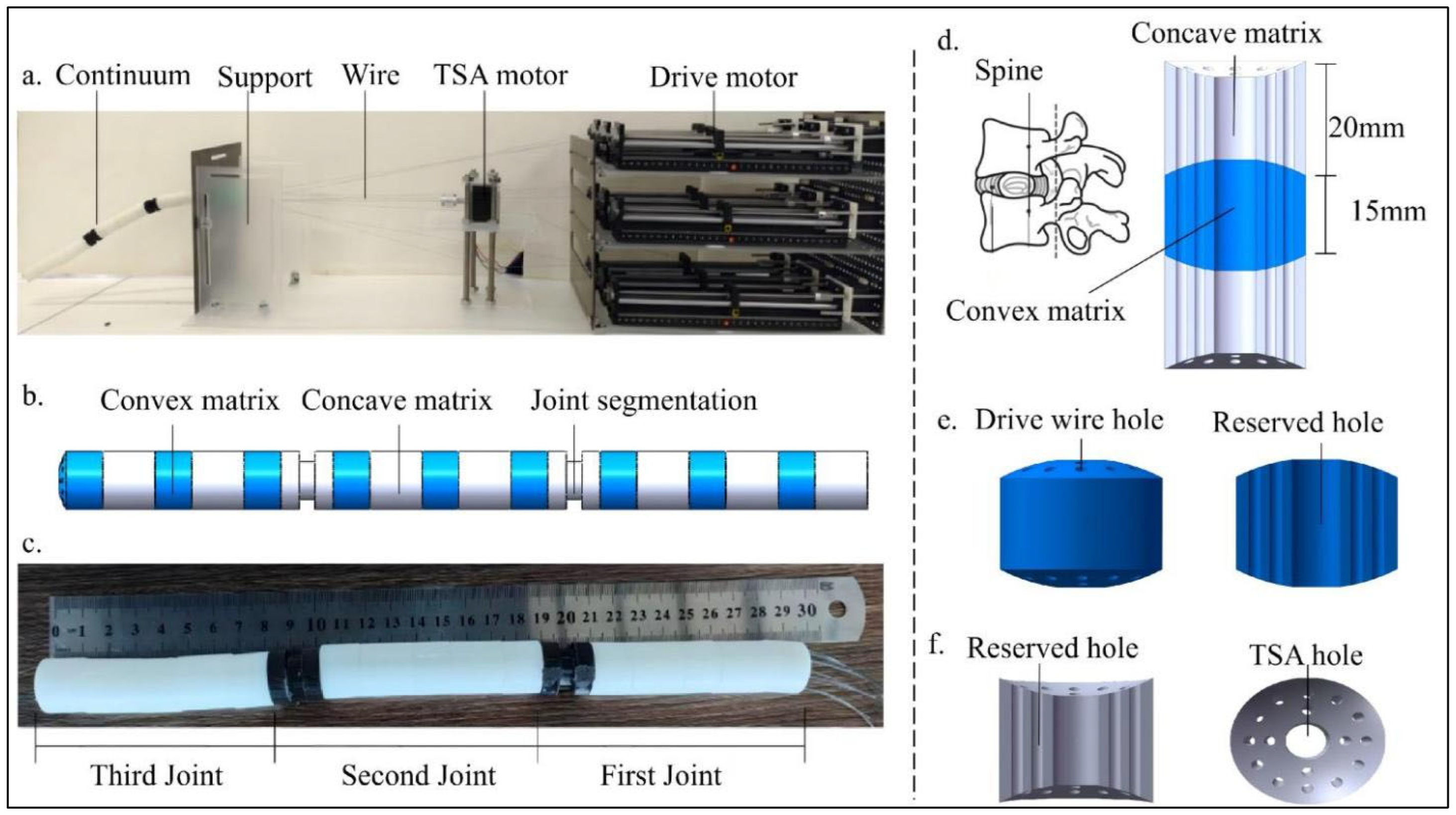
Although continuum robots have better flexibility than traditional rigid robots for adapting to complex environments, they often fail to meet the requirements of load capacity and manipulation precision. This limitation drives the development of variable stiffness control. To address this, this paper presents improvements in the structure and driving method of the previously proposed spinal-like continuous robot based on the force-locking variable stiffness method. It integrates Twisted Multi-String Actuators (TSA) to realize stiffness modulation. By integrating both TSA cable holes and drive cable holes into the same substrate, stiffness regulation and motion control can operate simultaneously without mutual interference. However, multi-strand cables exhibit significant contraction after torsional stiffening [36], and the fixed length of the continuum leads to motion conflicts with cable retraction [37]. Consequently, a retraction mechanism integrated with the spine-mimicking configuration was designed [38] to accommodate length changes in the robot caused by TSA operation. The structure of the spine-like continuum robot based on the TSA variable stiffness method is shown in Figure 1.
Inspired by bionic principles [39,40,41,42,43,44], the robot adopts a spine-mimetic structure that mimics the vertebrae-intervertebral disk arrangement of the human spine as shown in Figure 1d. It incorporates a concave–convex–concave contact substrate with a spherical contact interface, which optimizes friction generation by converting traditional line contact into spherical contact, distinguishing it from conventional force-locking configurations.
The arrangement of three adjacent bases (concave–convex–concave) of the robot is shown in Figure 1d. The robot employs two substrate types: ‘concave’ and ‘convex’ (see Figure 1e,f, with the following working principle: external circumferential cable holes accommodate drive wires to control substrate motion and overall robot movement, while inner circumferential holes route sensor signal wires. The central hollow cable holes serve as the core of the force-locking mechanism—multi-stranded cables for stiffness regulation pass through these central holes and are twisted by variable stiffness motors, generating adjustable tension to modulate the robot’s stiffness. For ease of identification, the “concave” matrix is labeled in gray and the “convex” matrix in blue.
Each substrate has twelve cable holes distributed evenly around the external circumference. Three holes at 120° intervals are responsible for controlling a continuum joint with two degrees of freedom, “pitch” and “yaw” and the remaining three holes are reserved for the subsequent addition of a fourth joint.
Due to the multi-substrate mechanism, the TSA variable stiffness design principle of the continuum robot is to change the pressure between the substrates through the tightening and loosening of the multi-stranded cables in the intermediate cable holes, thus changing the friction between the substrates, and using this friction to resist external loads and deformations, thus changing the flexibility and stiffness of the robot. At the same time, the substrate structure also implies the need to fix the robot arm through the end of the drive cable and the front end of the drive box link, so that the substrates are closely fitted to each other and can only rotate along the contact sphere. Therefore, the length of a single substrate will also affect the number of substrates, and thus the joint angles, pressure transfer and other parameters of a continuum robot, for a certain overall length design index. In this paper, the length of the individual substrate is 15 mm for the “convex” type and 20 mm for the “concave” type, with a radius of 5 mm and a total length of 295 mm.
The joints of the spine-like continuum prepared using resin material are shown in Figure 1c. The continuum’s joints are composed of substrates: six form the first joint (from the right), six form the second joint, and five form the third joint, and the “convex” substrate for the third joint is chosen for the convenience of the subsequent end-equipment retrofitting. The black matrix at the joint division is a “concave” matrix with an outer circle removed from the middle part, which was used to fix the driving cable and better distinguished the joints.

2.2. Passive Retraction Mechanism

Force-locking mechanisms that take a single cable tend to stiffen the continuum by adjusting the cable tension. In the case of only a single cable, due to the low tension, there is no situation where the variable stiffness cable length decreases due to the tension, thus driving the continuum back. However, in a TSA, the multi-strand cable undergoes substantial contraction during twisting, providing a wider stiffness adjustment range but also potentially causing the continuum section to retract undesirably. Furthermore, when a retraction situation exists, the variable stiffness operation cannot be realized because the continuum is usually fixed to the box, which leads to motion conflicts. Therefore, there is a need to design a retraction mechanism that can be used for TSA variable stiffness based on the spine-like continuum robot proposed in this paper.
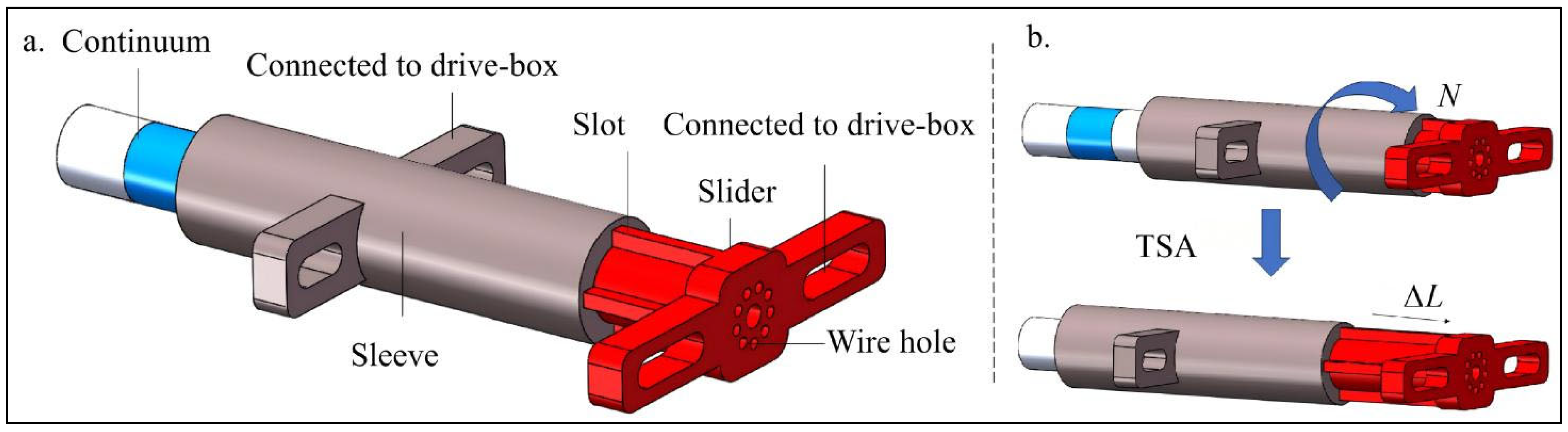
The structure of the passive retraction mechanism is shown in Figure 2a, which mainly consists of a sleeve and a slider. A section of the sleeve is embedded in the continuum structure, and the other end cooperates with the slider and slides through the four grooves arranged in the circumference of the sleeve. The sleeve is linked to the drive box. The motion principle of the retraction mechanism is shown in Figure 2b. When the multi-stranded cable is twisted to provide a certain stiffness for the continuum, the multi-stranded cable through the middle cable hole will contract, thus driving the continuum back. At this time, the bolts at both ends of the slider linked to the drive box will be relaxed so that it can obtain the freedom of sliding along the sleeve; the retracted continuum will drive the slider to move, realizing the retraction of the continuum with the variable stiffness multi-stranded cable after the twisting of the multi-stranded cable. After the retraction is completed, the bolts linked to the drive box body are re-fixed to ensure its positioning.
As described in the design section, the spine-like structure is proposed to provide resistance to displacement for the robot variable stiffness from the perspective of friction; the retraction mechanism is proposed to ensure that the cable-driven retraction displacement does not conflict with the structure when the robot performs the variable stiffness operation. The combination of the two ensures that the variable stiffness operation described in this paper is carried out smoothly.

2.3. Geometric Model Research

2.3.1. Geometric Model of String Twisting

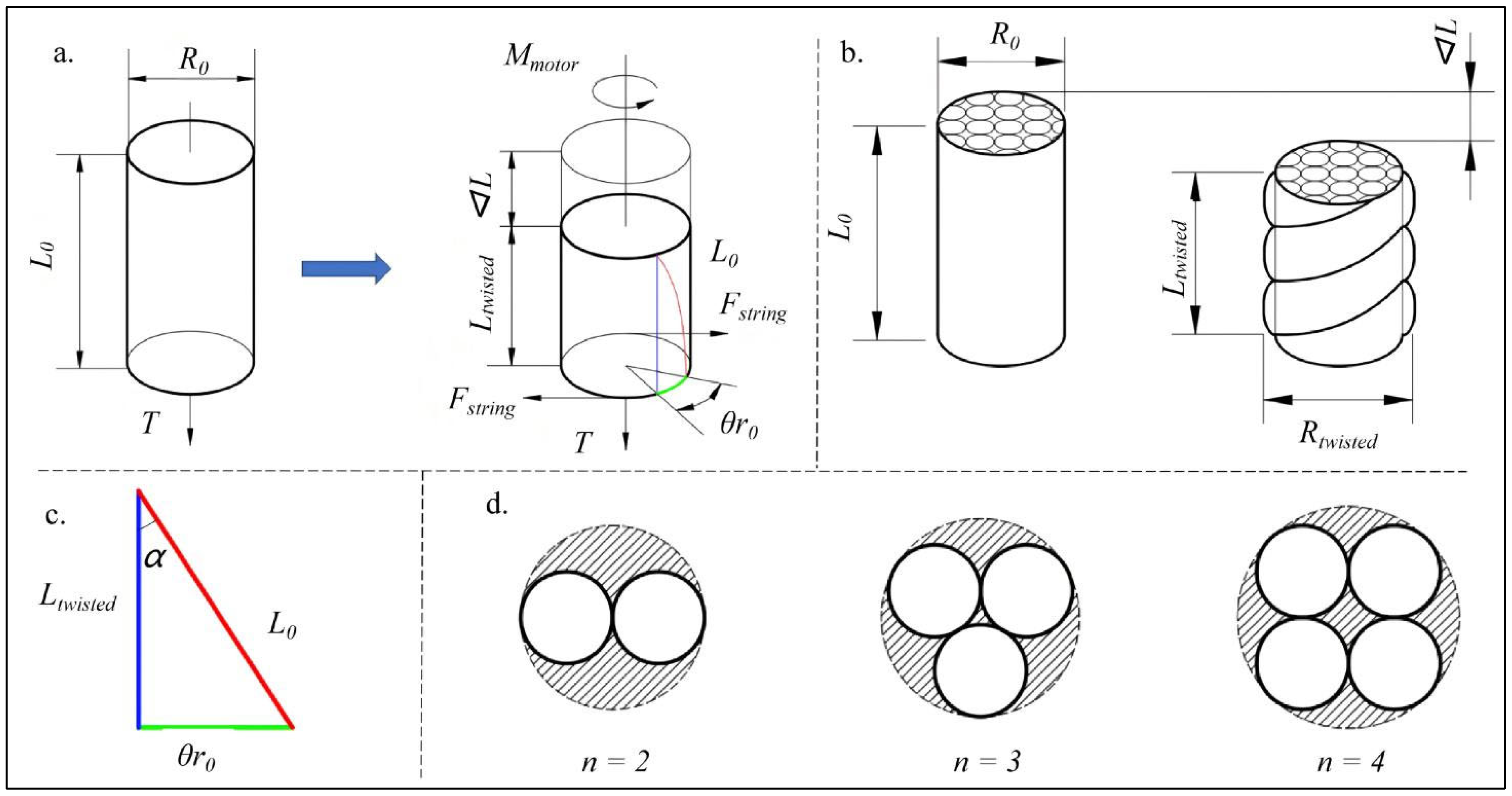
For TSA, due to the existence of torsional motion, its modeling requires constructing mathematical models starting from the untwisted cylinder to analyze the geometric changes in the relationship between its length and other quantities; the specific structure is shown in Figure 3. Where L0 is the original length of the cable, R0 is the original diameter of the cable, r0 is the original radius of the cable, T is the tension on the cable, Mmotor is the tension provided by the motor, ΔL is the amount of change in the length of the cable after torsion, Ltwisted is the new length of the cable after torsion, and Fstring is the force that resists deformation after the deformation of the cable.
When the cable is twisted by θ °, its cylindrical expansion is shown in Figure 3a,c, and the colors of the sides of the right triangle constructed in the geometric relationship diagram correspond to the sides in the diagram. The length of the cable after twisting can be derived as follows:
L t w i s t e d = L 0 2 θ 2 r 0 2 = L 0 cos α
However, in the force-locked twisting of a multi-stranded cable, after twisting at a certain angle, its radius cannot be the same as the traditional cylindrical model with the default radius unchanged. Rather, after twisting and shortening a certain length, the diameter will increase to Rtwisted, and its post-twisting schematic is shown in Figure 3b for the post-twisting diameter. It can be assumed that the volume of the cable remains constant during twisting [30]:
V 0 = V t w i s t e d
It is not difficult to derive the mathematical relationship between the radius rtwisted after twisting and the initial radius r0 from the cylinder formula:
r t w i s t e d = r 0 L 0 L t w i s t e d
Therefore, the conventional unfolding model of Figure 3a can be modified after taking into account the nonlinear increase in the cable radius produced by torsion. After torsion θ, the change in cable length ΔL can be calculated by the following equation:
L = L 0 L 0 2 θ 2 r t w i s t e d 2
Furthermore, it can be derived that after twisting, the helix angle α produced on the cable is:
α = arcsin θ r t w i s t e d L 0
However, in our experimental investigation, it was found that based on the equal volume assumption of Equation (2), in the case of multi-stranded cables—due to the large gap in the multi-stranded cables as shown in Figure 3d—and in the process of torsion, the behavior of the TSA is to fill in the gap first in the uniform torsion; this means that the higher the number of cable strands, the greater the error in the calculation of Equation (4) is calculated [30,44]. This is not applicable to the method of multi-stranded cables with continuous body locking as described in this paper. In this paper, the expression applicable to this robot is established from the point of view of the energy.
Deriving the contraction formula from an energy perspective requires following two premises: 1. All the torque input by the motor is converted into the elastic potential energy of the cable, with no energy loss; 2. The mechanical response of the twisted cable follows Hooke’s law, with an elastic coefficient of k.
The energy input Win of the system comes from the motor torque doing work, that is:
W i n = M m o t o r · θ
After twisting multiple strands of cable, axial contraction occurs, and the tension T and elastic potential energy of the cable Ep follow Hooke’s law:
T = k · Δ L
E p = 1 2 · k · Δ L 2
where k is the elastic coefficient of the TSA cable. According to the principle of energy balance, all the mechanical work input by the motor is converted into the elastic potential energy of the cable:
W i n = E p
The motor torque Mmotor needs to be balanced with the torque generated by the tension T of the cable:
M m o t o r = T · r t w i s t e d
After sorting, obtain a contraction formula based on energy balance:
k · Δ L = M m o t o r r t w i s t e d

2.3.2. Analyses of Variable-Stiffness

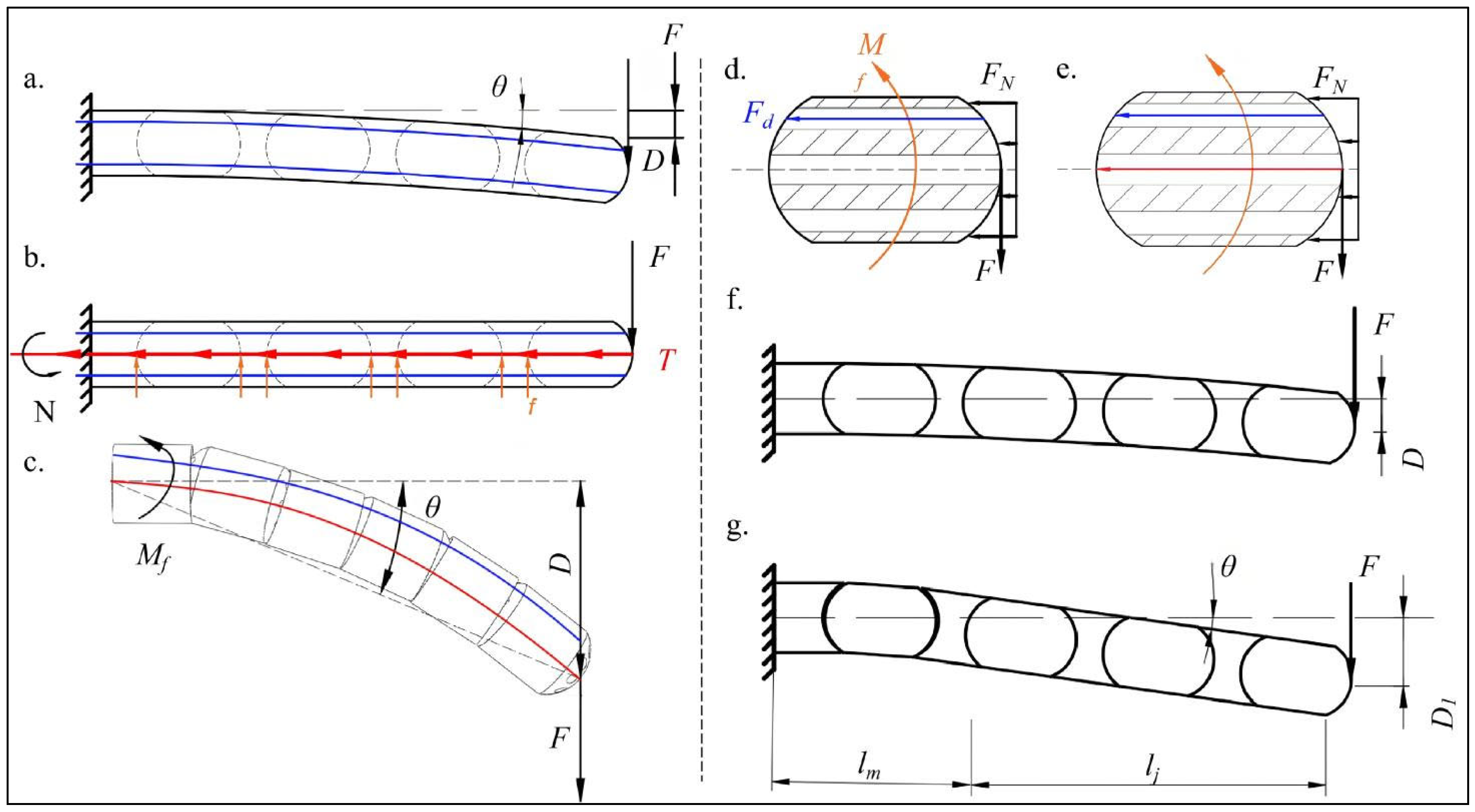
The variable stiffness structure of the robot is a core component and one of the design goals of this robot. The variable stiffness design proposed in this article, as mentioned earlier, uses TSA to control the motor and twist the multi-cable connected to it, causing axial tension T to be generated on the multi-strand cable passing through the central axis of the robot, thereby increasing the pressure N between the substrates and changing the frictional force used to resist external loads, ultimately causing a change in the stiffness of the robot. The principle is shown in Figure 4.
The black solid line represents the entire continuum, the black dashed line represents the continuum matrix, and the blue solid line represents the driving cable. From the figure, it can be seen that the end of the robot is a continuous free end, used to perform continuous motion and medical functions. The front end is fixed at the connection on the support plate. Therefore, when conducting mechanical or stiffness analysis, the continuous part of the robot can be regarded as a cantilever beam structure.
As shown in Figure 4a, the robot is not performing variable stiffness operation at this time. After being subjected to the end radial load F, the flexible joints of the robot are composed of discrete matrix cascades. When the joint itself is not subjected to axial tension, it does not have radial stiffness and cannot resist the end load. Therefore, under the action of the load, there will be a displacement D in the radial direction and a rotation angle θ will be generated. When the robot performs TSA variable stiffness operation, as shown in Figure 4b, the discrete joints of the robot are squeezed against each other, becoming rigid joints as a whole to resist deformation. In more detail, the TSA motor of the variable stiffness section rotates N turns, driving the connected multi strand cables to twist and generate axial tension force T, completing the TSA process. At this time, under the action of tension force T, the substrates are squeezed against each other, generating axial pressure N. Under the action of external radial load, the robot will have a radial movement trend. Therefore, under the action of the pressure N between the substrates, friction force between the substrates will be generated in the radial direction, which is opposite to the direction of the external load F, and stiffness will be obtained to resist the external radial load F, thus completing the variable stiffness process.
Furthermore, when the external load F exceeds the maximum frictional force fmax obtained by the TSA process, static friction between the substrates will be converted into dynamic friction, and slip will begin to occur. At this point, the robot cannot be considered to have failed. When the substrate slips completely, the robot’s motion can no longer be controlled, and the robot is considered to have failed. The external load at this point is referred to as the failure point of the robot. In actual use, it should be kept within the maximum static friction force fmax range, and should be avoided as much as possible from being used within the maximum static friction force and failure point, rather than continuing to be used after the failure point.
The stiffness of the continuum consists of two parts: radial stiffness and axial stiffness. However, in the axial direction, the horizontal displacement of the continuum is limited by the support plate and the variable stiffness retraction mechanism. The stiffness is determined by the strength of the base material and support plate. In practical operation, medical devices mainly cause loads in the radial direction, so discussing axial stiffness is meaningless. The continuous matrix itself does not have radial stiffness due to its discrete structure, and its stiffness is provided by the frictional force generated by the pressure between the matrices. Furthermore, the two main sources of tension on the robot substrate are the tension generated on the drive cable located on the circumference and the tension generated on the multi strand cable located on the axis used by TSA. Therefore, the stiffness K of the robot mainly comes from two sources: one is generated by the driving cable and cannot be adjusted. The second is the variable stiffness of the robot generated by TSA, which is provided by tension and serves as the main stiffness for the robot’s load tasks.
The cantilever beam model of the robot is shown in Figure 4c. Under the radial action of external force F, the robot generates displacement D and rotation angle θ. The blue solid line represents the driving cable and the red cable represents the TSA cable, which bring tension forces in two axial directions, thereby generating pressure between the substrates to obtain the friction force between the substrates. The friction force is converted into a friction torque Mf fixed on the continuous cantilever beam. At this point, the steel wire cable being stretched can be equivalent to a spring. According to the formula for calculating the stiffness of a cantilever beam, the stiffness of a continuous body can be calculated using Equation (12).
K = 3 E b a s e I b a s e L 3
where Ebase is the equivalent modulus of elasticity of the base, and Ibase is the equivalent base moment of inertia around the axis. The stiffness of the continuum is derived from the driving force Fd when the tension force T of the multi-cable is 0 without TSA operation, which generates the original stiffness K0 of the robot and the variable stiffness Kt of the continuum when T ≠ 0. Therefore, Hooke’s law was used first to calculate the driving force Fdrive of robots as shown in Equation (13). For the safe operation of medical robots, it should be assumed that the robot bends to the most extreme situation, where only one driving cable is subjected to force Fdrive. At this point, the original stiffness K of the robot is the lowest.
F d r i v e = E d r i v e A d r i v e θ R c o n t a c t 2 l d r i v e
where Rcontract is the diameter of the substrate arc portion, Adrive is the effective cross-sectional area of the substrate circumference, and ld is the length of the drive cable. According to geometric relationships, the relationship between joint angle θ and end displacement D can be derived as follows:
D = L θ ( 1 cos θ )
Under the condition that the whole is regarded as a cylindrical cantilever beam, the holes of the driving cable and the holes of the tensioning cable are symmetrical around the axis. The cross-section area of the base is Abase; the area occupied by the drive cable on the circumference is Adrive; the area occupied by the tension cable hole on the axis is Atension; the area occupied by the cable hole reserved for the sensor on the circumference is Asensor, then the actual cross-section area A is:
A = A b a s e A d r i v e A t e n s i o n A s e n s o r
Ibase can be deduced as the following equation:
I base = A ( x 2 + y 2 ) d A = A base A drive A tension A sensor ( x 2 + y 2 ) d A
For the assumed state at this time, the force distribution between the substrates is shown in Figure 4d. “Convex” type matrix as an example (“concave” configuration of the same force), its equilibrium by the radial load F, by the fixed tension on the drive cable Fdrive and the tension cable on the adjustable tension Ttension under the action of reaction Pressure N, and then the friction torque Mf produced by N under the joint action to maintain balance can be obtained as follows.
F drive R drive 2 + M f = F ( l + 2 l contact )
where according to the principle of tribology, under the condition of no failure of the substrate—i.e., the condition of maximum static friction—Mf is maximized as in the following equation, with the direction being upwards.
M f = μ N R contact
Thus the stiffness K0 of the robot at this point can be obtained as Equation (19). In the formula, l s is the total distance from the end of each section of the substrate to the point of static friction force
K 0 = ( r c i r c l e + l s · μ N ) E A r c i r c l e θ 3 D 2 ( 1 c o s θ ) s i n θ l d r i v e
According to the assumption, the robot does not adjust its stiffness at this time, resulting in the minimum stiffness.
After the robot performs TSA variable stiffness operation, the tension force T on the axis of the continuum is not 0. The principle of variable stiffness should be discussed in two situations, that is, the robot only has a motion trend, and there is only static friction between the substrates at this time. When the static friction force exceeds the maximum value, slip has occurred between the robot substrates, but the overall failure has not yet occurred. Both of the above situations will ultimately maintain force balance; therefore, the matrix force diagram at this time is shown in Figure 4e.
From the figure, it can be seen that the difference between the stress state of the substrate at this time and the stress state at T = 0 is that the inter substrate pressure N is jointly provided by the force Fdrive on the driving cable and the force T on the TSA wire.
In the first situation, the external load does not exceed the maximum static friction force, where static friction is still maintained between the substrates and there is only a relative motion trend without any relative motion, the schematic diagram is shown in Figure 4f.
The robot as a whole is regarded as a cantilever beam with a length of l, and the free end is subjected to a concentrated force F, resulting in a deflection D. The deflection formula of the cantilever beam is:
D = F l 3 3 E I
The stiffness foundation formula of the cantilever beam can be obtained by deformation:
K = F D = 3 E I l 3
However, as the robot is composed of a discrete matrix, its equivalent stiffness is slightly different from that of a continuous beam. Therefore, the stiffness formula of the cantilever beam model is modified (the coefficient is changed from 3 to 2), that is:
K r o b o t = 2 E b a s e I b a s e l 3
where Ebase is the equivalent elastic modulus of the matrix, Ibase is the equivalent sectional moment of inertia of the matrix and l is the total length of the robot. The cross-sectional moment of inertia of the substrate is calculated using Formula (11):
I b a s e = π 16 ( 2 R 4 36 R d r i v e 4 2 R t e n s i o n 4 R c i r c l e 2 R d r i v e 2 )
Thus the stiffness Krobot of the robot at this point can be obtained as:
K robot = F D robot = 2 E base I base l 3 = π E base ( 2 R 4 36 R drive 4 2 R tension 4 R circle 2 R drive 2 ) 8 l 3
where R is the radius of the matrix cross-section, Rdrive is the radius of the drive cable hole, Rtension is the radius of the central hole, and Rcircle is the radius of the circle where the center of all drive cable holes is located.
In the second situation, where the external load exceeds the maximum static friction force but has not reached the failure point, and a part of the continuum rotates, it is assumed that the robot only has one joint l 1 . In this joint, under the action of an external load F, the base of the lm joint rotates while the base of the lj joint remains unchanged. The continuum rotates a total of θ angles and undergoes a displacement of Dtension1, as shown in Figure 4g.
For the variable stiffness Ktension, the following two systems of equations can be listed according to their mechanical equilibrium:
μ ( T tension + F drive ) R contact 2 + F drive R circle 2 = F l stable cos θ + l 1 l stable θ sin θ
F l stable = μ T tension F contact
For its geometrical relations, the following relation can be obtained:
D tension 1 = l 1 l stable θ ( 1 cos θ ) + l sin θ
At this time, the force on the driving cable and TSA cable are jointly provided. Therefore, force can be calculated by Hooke’s law:
F drive + T = E drive A drive θ R contact 2 l drive
By combining Equations (24)–(28), the expression for the external load F can be obtained. And the load F on the second, third, and first joints, the driving cable force Fdrive, and the tension cable force T are the same, the joint length is different from l 1 , and the other mechanical states are similar. The load F on them can be deduced by the above method, and the corresponding Dtension2 and Dtension3 can be calculated. Therefore, the overall stiffness Ktension of the robot is given by Equation (20):
K tension = F D tension 1 + D tension 2 + D tension 3
For a section of the matrix, the point of action of the matrix friction torque Mf is at the end of the matrix, while for the entire continuum, the point of action of the friction torque is at the fixed end. Therefore, the total friction torque on a joint is expressed by Equation (30).
M f = l s μ F N
Among them, l s is the total distance from the end of each base to the point of static friction force. There are two configurations of the matrix described in this article; therefore, two situations need to be discussed for ls Equation (31):
l s = l + 2 l c o n t a c t ( W h e n   l s   i s   c o n v e x ) l s = l 2 l c o n t a c t ( W h e n   l s   i s   c o n c a v e )
Based on the above two friction conditions and calculation formulas, the stiffness of the robot should be calculated using the following two scenarios Equation (32):
K r o b o t = π E b a s e ( 2 R 3 36 R 4 2 R 4 R 2 R d r i v e 2 ) 8 l 3 ( F s m a x μ N R c o n t a c t / l s ) K t e n s i o n = F D t e n s i o n 1 + D t e n s i o n 2 + D t e n s i o n 3 ( F s m a x > μ N R c o n t a c t / l s )
It is not difficult to find from the above calculation process that the stiffness K of the robot is small without considering the tension between the substrates, while when considering the static friction force formula, the stiffness calculation formula is greatly affected by the tension force and the driving cable force. It is worth noting that although the driving cable force theoretically contributes to the overall stiffness, its value is relatively fixed and much smaller than the TSA cable force. Therefore, in this design, it mainly serves as the foundation stiffness support, rather than the core variable for stiffness adjustment. Therefore, this article focuses on studying the influence of TSA cable force on stiffness in the analysis of variable stiffness, in order to highlight the main adjustment ability of the variable stiffness mechanism. Further research can explore the dynamic effects of driving cable force under different operating conditions.

2.3.3. Geometric Model of Turning Angle

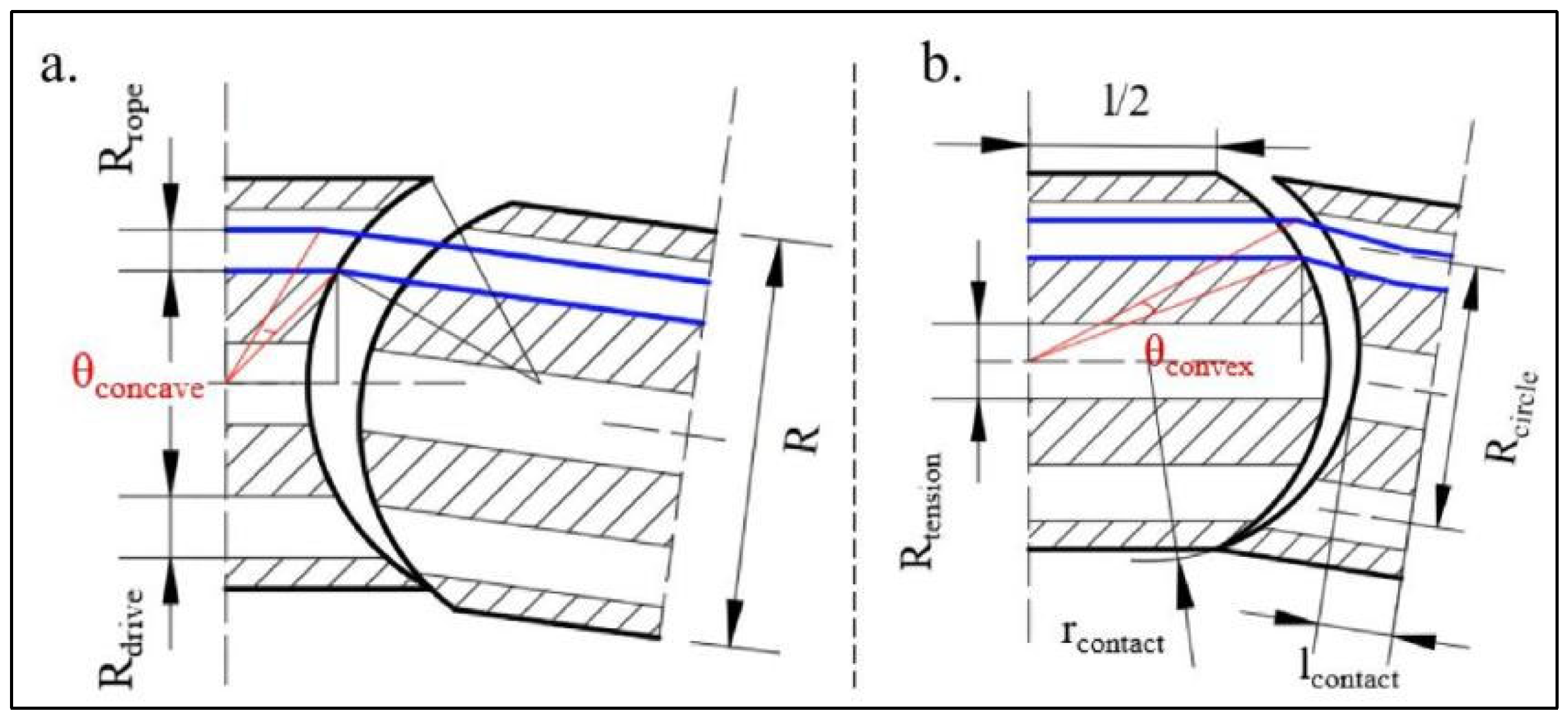
After the study of the variable stiffness principle of the robot, to ensure that the motion of the matrix of the continuum robot does not fail, it is necessary to analyze the motion angle of the matrix of the continuum. From the above robot’s matrix configuration, it can be seen that the motion limitation of the robot described in this paper will occur after the two sections of the matrix are rotated to a certain angle, the aperture wall of the drive cable or tension cable will be extruded with the drive cable or tension cable, and the matrix can no longer be rotated in the direction of the extrusion once one of the aperture walls has been extruded with the steel wire cable in that channel. Because the aperture diameter of the aperture of the tension cable is larger compared to the aperture diameter of the aperture of the drive cable and the angular change on the center line is small [45], only the angular limitation of the movement of the drive cable needs to be considered, and the above limit cases are shown in Figure 5.
Where Rcable denotes the diameter of the cable; Rdrive denotes the diameter of the hole of the drive cable; Rtension denotes the diameter of the hole of the tension cable; rcontact denotes the radius of the circular arc of the contact surface; R denotes the diameter of the substrate; l denotes the length of the substrate (excluding the circular arc portion); lcontact denotes the length of the circular arc portion of the substrate; θconcave denotes the limiting angle of the “concave–convex” contact; θconvex denotes the limiting angle of the “convex–concave” contact. Therefore, from the geometrical relationship, the expressions for the two limiting angles can be deduced as follows:
θ c o n c a v e = arctan R c i r c l e R d r i v e 2 + R r o p e l 2 l c o n t a c t arctan R c i r c l e R d r i v e 2 l 2 + l c o n t a c t R c o n t a c t 2 ( R c i r c l e R d r i v e 2 ) 2
θ c o n v e x = arctan R c i r c l e R d r i v e 2 + R r o p e l 2 l c o n t a c t arcsin R c i r c l e R d r i v e 2 R c o n t a c t
From the above calculations, the robot described in this paper has a turning angle of θ c o n c a v e 13 ° , θ c o n v e x 11 ° . The turn angle range of each joint is about 70°, which ensures that its flexibility can meet the basic task needs.

3. Results and Discussion

3.1. Prototype Assembly and Feasibility Experiment of Motion

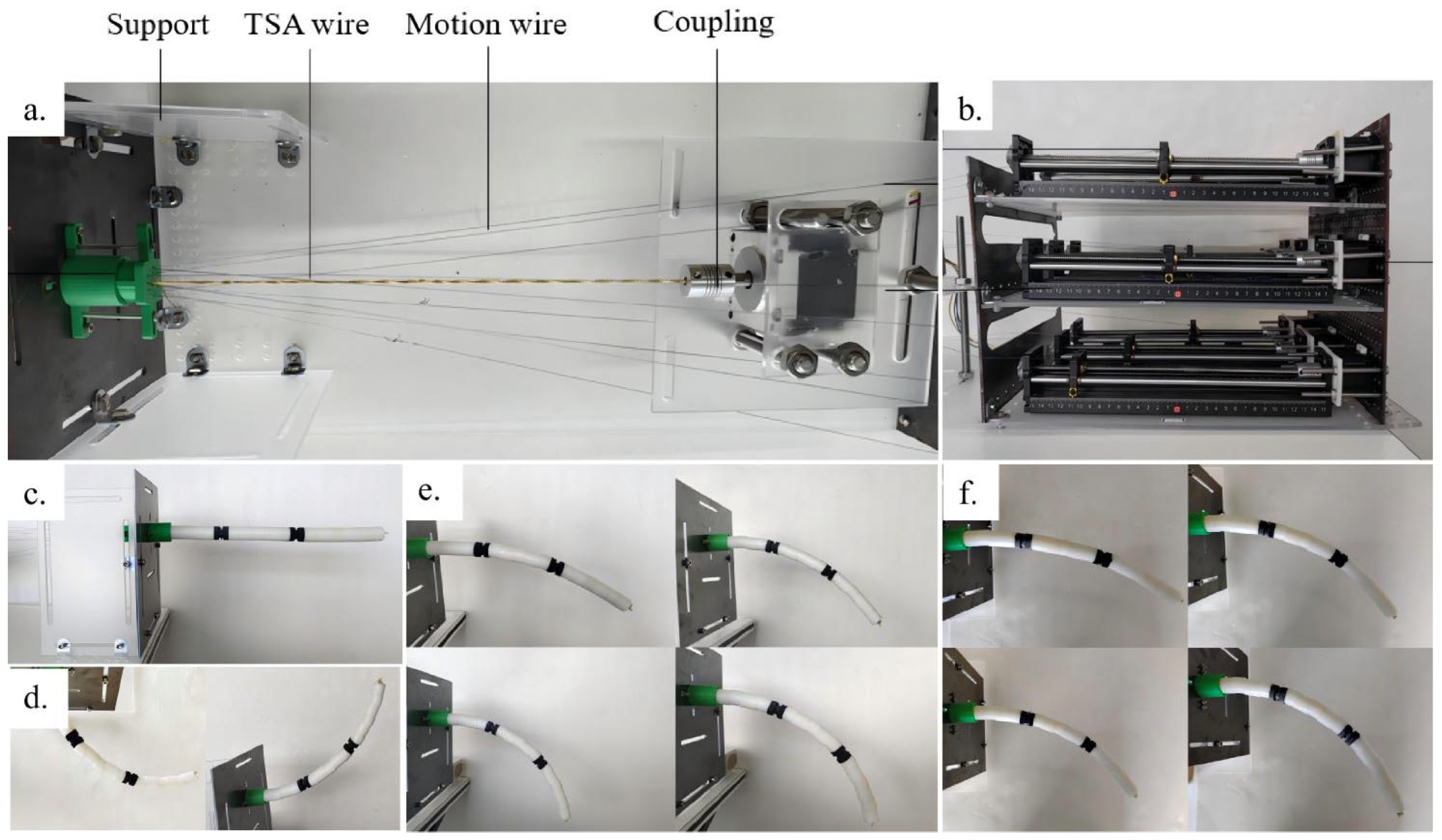
After theoretical modeling, the type of cable used in the TSA should be selected for the TSA variable stiffness continuum robot proposed in this paper. There are many different types of cables available, mostly made of many different materials or combinations of materials (Vectran, Kevlar, Dyneema, etc.), with a wide range of radii, as well as braided and non-braided constructions, etc. In particular, Vectran cables have a higher stiffness coefficient, which makes them more rigid for the TSA. Among these, Vectran cables have a higher stiffness coefficient, which allows the cable to respond faster to torsion and thus better meet the experimental demands. Considering that the Vectran cable may rupture under a load greater than 20 N, a load of 0–10 N is chosen in this paper. The experimental platform for the robot is shown in Figure 6a. It primarily consists of the robotic arm assembly, the drive unit, an upper-computer for control, and a sensor module.
The multi-strand cable TSA control motor described in this paper is the basis of variable stiffness, and its specific structure is shown in Figure 6a; its working principle is as follows: An n-strand cable (yellow in the physical image, where n denotes the number of strands) has one end fixed to a coupling and the other end fixed to the tip of the continuum. The coupling is connected to the motor shaft. When the motor rotates, the fixed ends cause the n-strand cable to twist and shorten. At this point, the locking bolts are loosened to allow the slider to retract. Subsequently, the bolts are tightened again, utilizing the self-locking of the motor and bolts to maintain the twisted state of the cable, thereby completing the TSA-based variable stiffness control process.
The motion control of the continuum robot operates as follows: Commands from the host computer are sent to a control board, which drives the motors via motor drivers. These motors then actuate the drive cables, thereby controlling the robot’s movement. The drive part of the motor is shown in Figure 6b. Subsequently, the motion control of the proposed continuum robot was validated based on the aforementioned principles. The results, shown in Figure 6c–f, successfully demonstrate the robot’s omnidirectional mobility.
The maximum joint movement angle of the robot’s convex–concave matrix can reach 13°, and the maximum joint movement angle of the convex–concave matrix can reach 11°. In the experiment, the robot can achieve 90° bending in all directions, verifying its omnidirectional bending ability.

3.2. Experiment on the Relationship Between Motor Rotation and Wire Retraction in TSA

Following the verification of the robot’s motion feasibility and flexibility, we characterized the cable retraction behavior. More specifically, during the TSA process, as the number of motor torsion turns N increases, the cable used for actuation is “tightened” and there are two physical changes: a shortening of the cable length by ΔL and an increase in its diameter. This results in a significant increase in the stiffness and load capacity of the TSA [27]. The robot described in this paper will be affected by its ΔL, but the radius change will not be affected because the pre-drilled holes in the TSA located at the center of the shaft reserve enough radius. The above characteristics of the TSA actuator, on the other hand, are highly variable due to the influence of the cable material and so on. Therefore, experimental verification of Equations (4) and (6) described in the previous section is needed to determine the robot’s length retraction ΔL after motor rotation N to ensure the robot’s maneuverability. This experiment and subsequent experiments were repeated five times under the same conditions, and the average of the five experimental data was taken for analysis.
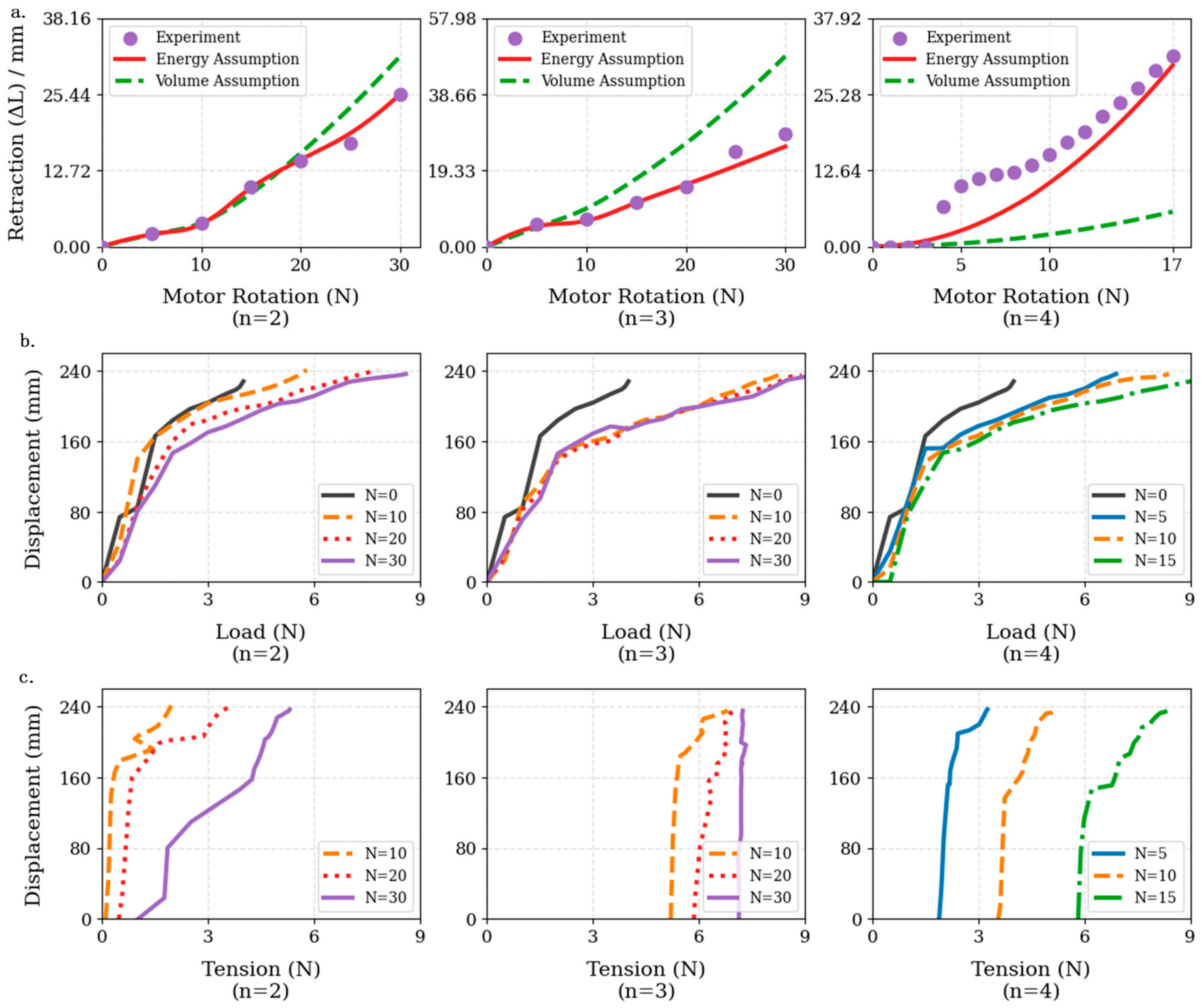
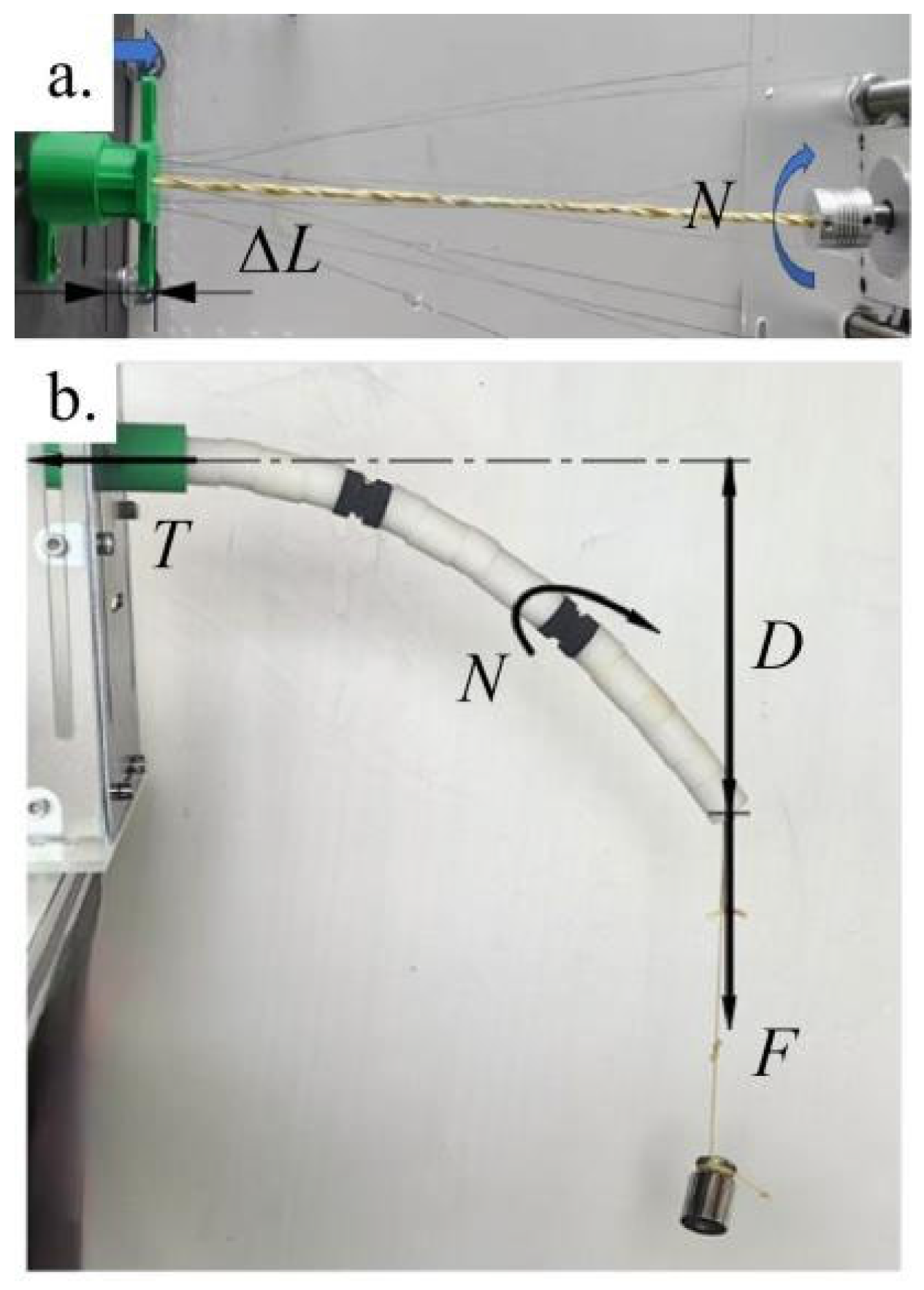
Using the experimental setup depicted in Figure 7a, tests were conducted for cable strand counts of n = 2 and n = 3. Starting from zero motor revolutions (N = 0), the retraction ΔL was measured. The motor rotation was then incremented in steps of five revolutions up to N = 30, with the cable under motor torque. For n = 4, the rotation was increased in steps of one revolution up to N = 17. A graphical comparison of the experimental data and the theoretical data is shown in the following Figure 8a.
In Figure 8a, the solid dots are the actual experimental data, the dashed line is the theoretical curve based on the volume assumption, while the solid line is the theoretical curve based on the energy assumption. From the figure, it can be seen that the expression for the amount of backlash of multi-stranded cable TSA proposed in this paper, which is based on Vectran from the principle of virtual work, is generally fitted to the actual situation when the number of motor rotating turns is small and is basically similar to that fitted to the traditional assumption based on the assumption of volume equivalence, but when the number of torsional turns is larger, it is fitted to the actual situation in a much closer way and is significantly superior to that based on the relational equation of the assumption of volume. The reason for this difference is that when the number of rotations of the motor is low, the torque output by the motor is not fully converted into effective retraction drive for the cable body, but there is a large amount of torque loss used to fill the gaps between multiple cables, resulting in significant errors at low speeds. During the high-speed phase, the gaps between multiple cables have been completely filled, and the torque output by the motor is entirely used for twisting and retracting the cables. Therefore, it can be concluded that the retraction equation proposed in this paper can better fit the retraction of the TSA under multi-stranded cables, which can make the robot that is described in this paper obtain better operability.

3.3. Variable Stiffness Experiment Based on TSA

Evaluating the stiffness characteristics is crucial for this study. Therefore, stiffness experiments were conducted on the continuum robot. The stiffness cannot be measured directly due to the limitation of conditions. However, by the cantilever beam stiffness formula, the displacement is inversely proportional to the stiffness, i.e., the end of the robot under a certain load, the smaller the displacement, the greater the stiffness, so it can be used to replace the robot stiffness by the robot end displacement D. The experimental setup is shown in Figure 7b, where weights are tied at the end as the external load F, and the number of weights at the end is changed to change the load F. The increase in tension T is realized by the number of rotations of the motor n (i.e., the TSA achieves different degrees of torsion under the control of the motor) and is measured by the dynamometer, and the number of strands of the multi-stranded cable is taken as n = 2, n = 3 and n = 4 for the three types of multi-stranded cables of the same material but with different strands. At the end, an increasing load F is taken and the displacement is recorded to respond to the displacement-angle-load characteristics and to verify that the stiffness becomes higher as the number of strands increases and the tension increases.
Following the experimental procedure, the experiment was first carried out at n = 2 and n = 3, with the number of motor rotations N = 10, N = 20 and N = 30, respectively, by loading the end of the motor at intervals of 0.5 N starting from F = 0 N and measuring the displacement D and the tension T of the cable, until the robot fails. After that, the above experimental procedure was repeated for n = 4 for the number of motor rotations N = 5, N = 10 and N = 15 respectively; the experimental results are shown in Figure 8b.
It is important to note that the terminal point of each curve does not represent an intentionally stopped measurement. Instead, it corresponds to robot failure under the applied load. The definition of failure is when the displacement of the end effector under constant load exceeds 250 mm, or when the motor torque limit is reached, the robot is considered to have malfunctioned, resulting in loss of motion. That is, at this point, the substrate slips significantly and the torque of the drive motors is too low to control the robot any longer, so loading measurements after the point of failure has no value. In all three graphs above, i.e., n = 2, n = 3 and n = 4, the point of failure occurs at a displacement D of approximately 250 mm, which is due to the characteristics of the robot substrate. A curve with N = 0 exists in each of the plots, when the centrally located TSA cable is not twisted to provide tension T, as the original control group without variable stiffness operation. It is easy to observe in the graphs that in the same set of experiments with the number of cable strands n, with the increase in the number of torsion turns N, the maximum tolerable load Fmax or the failure point is significantly shifted back; for example, in the case of n = 3, the maximum load at the number of motor turns N = 30 is 9.4 N, which is 235% higher than the maximum load of 4 N when the stiffness is unchanged—i.e., the stiffness is increased by a factor of 2.35. And between the experiments with different groups of cable strands n, the maximum load after TSA is also improving as n increases; for example, the maximum load at n = 4 is 9.9 N, while the maximum load at n = 2 is 8.6 N, which is an improvement of 115%. However, it is easy to see that the degree of torsion cannot be described by the same use of the number of motor rotations N, even when all other conditions are the same, due to the limitation of the change in the number of motor and cable strands. This is because the number of motor rotations N is only an intuitive independent variable, but what causes the change in stiffness is actually the cable tension T. Therefore, with the help of a dynamometer, the intuitive relationship between the cable tension T and the end displacement in this paper is shown in Figure 8c.
As can be seen in the figure, the tension T provided by the TSA increases after the number of motor revolutions N is increased or the number of cable strands n is increased. Furthermore, T is essentially the friction force between the substrates to resist the displacement after the external load is increased; therefore, the larger T is, also represents the better robot stiffness K. Since then, the feasibility of the TSA method has been verified to be the same as that of the continuum machine with human-locked variable stiffness, and the reasonableness of the proposed substrate in this paper.
In the experiment, under an external load of 2 N, the average original stiffness of the robot was 13.47 N/m, and the maximum load was 4.2 N. After performing variable stiffness operation, when the number of cable strands was n = 4 and the motor speed was N = 15, the average stiffness of the robot reached 31.5 N/m, the maximum load reached 13.9 N, the stiffness increased by 127%, and the maximum load capacity increased by 231%. The overall stiffness experiment proves that the theory of variable stiffness of the continuum robot TSA designed in this paper for the spine-like configuration is valid and the method is effective. In addition, it has been proven that TSA plays a major role in stiffness adjustment, while the drive rope only provides the original stiffness. The variable range of this part of stiffness is narrow, and it has little impact on the stiffness adjustment of the robot.
For the experimental data in Figure 8c, it can be seen from the comparison between different numbers of strands that the higher the number of cable strands, the better the stiffness provided. A noticeable change in response (e.g., a change in slope) occurs at a displacement of approximately 150 mm across all datasets. This corresponds to the onset of partial slippage between vertebrae before complete structural failure.
Specifically, the tension pattern presented in the data of n = 3 is significantly different from that presented in the data of n = 2 and n = 4. The data with n = 3 is relatively concentrated, the data with n = 2 is sparse, and the data with n = 4 is sparser. This is because the double stranded cable (n = 2) is a parallel torsion structure, which is prone to overloading on one side of the cable, resulting in uneven torque transmission. The gap between the four strands of cable (n = 4 strands) is uneven, and the torque is easily concentrated locally, so the uniformity of torque transmission is the worst. And the three strands of cable are symmetrically distributed within an equilateral triangle, with a compact structure and uniform force points. Therefore, the uniformity of torsional transmission is optimal.

4. Conclusions and Future Work

This study presents a novel variable stiffness solution for continuum robots, with its core innovation lying in the integration of Twisted String Actuators (TSA) into a spine-like structure. To address the inherent issue of cable retraction in TSA, a passive retraction mechanism was designed, thereby enabling independent operation of motion and stiffness adjustment. The combination of the high-tension output from TSA and the adaptive retraction mechanism effectively overcomes the narrow stiffness range inherent to traditional single-cable force-locking methods. The main contributions of this work are threefold:
Mechanism Design and Integration: A spine-like continuum robot was designed, incorporating a central TSA channel. Most critically, a novel passive retraction mechanism was developed. This mechanism autonomously compensates for the axial contraction of multi-strand cables during the twisting process, reducing the mutual influence between motion and stiffness adjustment and ensuring stable operational compatibility. It should be noted that the currently designed passive retraction mechanism has not yet achieved complete automation. However, the design can verify the effectiveness of the passive retraction mechanism. In order to achieve automated real-time and dynamic stiffness adjustment, new retraction mechanisms will be designed based on the mechanism proposed in this paper in future research.
Methodological Innovation: Multi-strand Twisted String Actuators replaced traditional single-cable linear stretching as the core actuation mechanism for variable stiffness. This method leverages the significant contraction force and ultra-high tension generated during cable twisting to directly and efficiently enhance the frictional locking effect within the joints, breaking through the inherent upper limit of tension output in traditional force-locking methods.
Theoretical Modeling and Experimental Validation: A complete theoretical framework, including a mechanical model for system stiffness, was established. Experimental results demonstrate that: the prototype exhibits excellent omnidirectional flexibility; compared to the constant-volume assumption, the retraction model based on the energy assumption shows a better fit with the experimental data; stiffness tests confirm that TSA provides a significant performance enhancement in the robot’s stiffness adjustability. For instance, using a 3-strand cable at 30 motor revolutions, the maximum load capacity increased by 135% (from 4 N to 9.4 N) compared to the non-stiffened state, and further performance improvement was observed with a 4-strand configuration.
The TSA variable stiffness method proposed in this article has significant advantages in stiffness range and response speed, but its performance depends on the arrangement of the cables. In the current design, TSA cables are arranged along the central axis of the robot to ensure axial force transmission and reduce friction. Although this arrangement to some extent limits the maximum bending angle of the joint ( 11 13 ), it is sufficient to cover the operational requirements of the target medical and detection tasks. Compared with other variable stiffness methods, TSA outperforms phase change materials that require thermal management and particle blocking methods that require fluid systems in terms of packaging simplicity, but its routing flexibility is lower than traditional single cable force locking. In future work, new TSA deployment methods will be explored to expand the workspace and curvature range of robots.
In summary, this research provides an effective new paradigm for achieving high-performance variable stiffness in continuum robots, characterized by a simple structure, purely mechanical design, fast response, and a wide adjustable range. Future work will focus on integrating pose and tension sensors based on the existing models to achieve more precise stiffness regulation and exploring the robot’s performance in dynamic interaction tasks. Furthermore, the adoption of higher-torque actuators will be pursued to expand the system’s load capacity and application scope.

Author Contributions

Conceptualization, G.C. and Y.W.; methodology, G.C. and Y.W.; validation, Y.W., Z.Z., J.Y. and S.L.; supervision, G.C., J.Z., E.L. and M.L.; writing—original draft preparation, Y.W. All authors have read and agreed to the published version of the manuscript.

Funding

This work supported by the Project (2024C04052) Zhejiang Province’s “Vanguard Leading Geese+X” R&D Key Project; Fund Project: Zhejiang Provincial Natural Science Foundation Joint Fund (LBMHY25F030001); Project (2023-JC-YB-313) supported by the Natural Science Basic Research Plan-General Project of Shaanxi Province; Project (2023-JC-YB-294) supported by the Natural Science Basic Research Plan-General Project of Shaanxi Province.

Institutional Review Board Statement

Not applicable.

Informed Consent Statement

Not applicable.

Data Availability Statement

The original contributions presented in this study are included in the article. Further inquiries can be directed to the corresponding author.

Acknowledgments

The authors gratefully acknowledge the technical and equipment support provided by Jiaxing University and Xi’an University of Architecture and Technology. During the preparation of this manuscript, the authors used DeepSeek AI (version released in July 2024) for reference summarization and English language polishing. The authors have reviewed and take full responsibility for the final content.

Conflicts of Interest

Author Gang Chen was employed by the company Jiaxing Soy Intelligent Technology Co., Ltd. The remaining authors declare that the research was conducted in the absence of any commercial or financial relationships that could be construed as a potential conflict of interest.

Nomenclature

SymbolPhysical MeaningUnit
L0Original length of the cablemm (millimeter)
ΔLContraction amount of the cable after twistingmm (millimeter)
R0Original diameter of the cablemm (millimeter)
rtwistedRadius of the cable after twistingmm (millimeter)
RRadius of the substrate cross-sectionmm (millimeter)
RdriveDiameter of the drive cable holemm (millimeter)
lLength of the substrate (excluding the arc portion)mm (millimeter)
LtotalTotal length of the robotmm (millimeter)
TCable tensionN (Newton)
FExternal radial loadN (Newton)
FmaxMaximum tolerable load (failure load) of the robotN (Newton)
FNAxial pressure between substratesN (Newton)
MmotorOutput torque of the motorN·m (Newton·meter)
IbaseEquivalent section moment of inertia of the substratemm4 (millimeter4)
KStiffness of the robotN/m (Newton/meter)
K0Original stiffness of the robot (without TSA action)N/m (Newton/meter)
KtensionVariable stiffness of the robot with TSA actionN/m (Newton/meter)
EbaseEquivalent elastic modulus of the substratePa (Pascal)
θCable torsion angle/Joint rotation angle° (degree)
θconcaveLimit angle of “concave–convex” contact° (degree)
θconvexLimit angle of “convex–concave” contact° (degree)
NNumber of motor torsion turnsturn (turn)
nNumber of TSA cable strandsstrand (strand)

References

  1. Iqbal, F.; Esfandiari, M.; Amirkhani, G.; Hoshyarmanesh, H.; Lama, S.; Tavakoli, M.; Sutherland, G.R. Continuum and soft robots in minimally invasive surgery: A systematic review. IEEE Access 2025, 13, 24053–24079. [Google Scholar] [CrossRef]
  2. Yang, G.-Z.; Bellingham, J.; Dupont, P.E.; Fischer, P.; Floridi, L.; Full, R.; Jacobstein, N.; Kumar, V.; McNutt, M.; Merrifield, R.; et al. The Grand Challenges of Science Robotics. Sci. Robot. 2018, 3, eaar7650. [Google Scholar] [CrossRef] [PubMed]
  3. Laschi, C.; Cianchetti, M.; Mazzolai, B.; Margheri, L.; Follador, M.; Dario, P. Soft robotics: What’s next in bioinspired design and applications of soft robots? Bioinspir. Biomim. 2025, 20, 051001. [Google Scholar] [CrossRef] [PubMed]
  4. Deng, Z.; Wei, X.; Pan, C.; Li, G.; Hu, Y. Shared Control of Tendon-Driven Continuum Robots Using Visibility-Guaranteed Optimization for Endoscopic Surgery. IEEE Trans. Med. Robot. Bionics 2024, 6, 487–497. [Google Scholar] [CrossRef]
  5. Yang, L.; Sun, Y.; Yang, Z.; Du, Z.; Peng, Y.; Zheng, Y.; Nan, C.; Yang, M.; Wang, Q.; Liu, Y.; et al. Industrial Minimally Invasive Surgery: Continuum Robotics Technologies and Applications for In-Situ Aero-Engine Inspection and Repair. J. Basic Sci. Eng. 2026, 34, 1–23. [Google Scholar] [CrossRef]
  6. Qi, F.; Ge, Y.; Sun, L.; Liu, X.; Zheng, H.; Xu, W. Kinematics and validation of an adsorbable continuum robot for aeroengine blades in situ inspection. Ind. Robot. 2025, 53, 211–225. [Google Scholar] [CrossRef]
  7. Ricárdez Ortigosa, A.; Bestmann, M.; Heilemann, F.; Halbe, J.; Christiansen, L.; Rodeck, R.; Wende, G. Foundations for Teleoperation and Motion Planning Towards Robot-Assisted Aircraft Fuel Tank Inspection. Aerospace 2025, 12, 156. [Google Scholar] [CrossRef]
  8. Chang, J.-C.; Dai, H.; Wang, X.; Axinte, D.; Dong, X. Development of a continuum robot with inflatable stiffness-adjustable elements for in-situ repair of aeroengines. Robot. Comput.-Integr. Manuf. 2025, 95, 103018. [Google Scholar] [CrossRef]
  9. Troncoso, D.A.; Robles-Linares, J.A.; Russo, M.; Dong, X.; Axinte, D.; Kell, J. A continuum robot for remote applications: From industrial to medical surgery with slender continuum robots. IEEE Robot. Autom. Mag. 2023, 30, 94–105. [Google Scholar] [CrossRef]
  10. Dupont, P.E.; Simaan, N.; Choset, H.; Rucker, D.C. Continuum robots for medical interventions. Proc. IEEE 2022, 110, 847–870. [Google Scholar] [CrossRef]
  11. Dou, W.; Zhong, G.; Cao, J.; Shi, Z.; Peng, B.; Tan, R. Soft robotic manipulators: Designs, actuation, stiffness tuning, and sensing. Adv. Mater. Technol. 2021, 6, 2100018. [Google Scholar] [CrossRef]
  12. Russo, M.; Sadati, S.M.H.; Dong, X.; Mohammad, A.; Walker, I.D.; Bergeles, C.; Xu, K.; Axinte, D.A. Continuum robots: An overview. Adv. Intell. Syst. 2023, 5, 2200367. [Google Scholar] [CrossRef]
  13. Walker, K.L.; Partridge, A.J.; Chen, H.-Y.; Webster, R.J., III. A modular, tendon driven variable stiffness manipulator with internal routing for improved stability and increased payload capacity. In Proceedings of the 2024 IEEE International Conference on Robotics and Automation (ICRA), Yokohama, Japan, 13–17 May 2024. [Google Scholar]
  14. Sozer, C.; Sahu, S.K.; Paternò, L.; Menciassi, A. Robotic modules for a continuum manipulator with variable stiffness joints. IEEE Robot. Autom. Lett. 2023, 8, 4745–4752. [Google Scholar] [CrossRef]
  15. Fitzgerald, S.G.; Delaney, G.W.; Howard, D. A review of jamming actuation in soft robotics. Actuators 2020, 9, 104. [Google Scholar] [CrossRef]
  16. Brancadoro, M.; Manti, M.; Tognarelli, S.; Cianchetti, M. Fiber jamming transition as a stiffening mechanism for soft robotics. Soft Robot. 2020, 7, 663–674. [Google Scholar] [CrossRef]
  17. Arleo, L.; Lorenzon, L.; Cianchetti, M. Variable stiffness linear actuator based on differential drive fiber jamming. IEEE Trans. Robot. 2023, 39, 4429–4442. [Google Scholar] [CrossRef]
  18. Zhang, S.; Yao, J.; Li, S.; Chen, X. Continuum modeling for layer jamming structures. Theor. Appl. Mech. Lett. 2025, 15, 100633. [Google Scholar] [CrossRef]
  19. Tadakuma, K.; Fujimoto, T.; Watanabe, M.; Shimizu, T.; Takane, E.; Konyo, M.; Tadokoro, S. Fire-Resistant Deformable Soft Gripper Based on Wire Jamming Mechanism. In Proceedings of the 3rd IEEE International Conference on Soft Robotics (RoboSoft); IEEE: Piscataway, NJ, USA, 2020; pp. 740–747. [Google Scholar] [CrossRef]
  20. Zhou, J.; Liang, B.; Wang, Z.; Wang, Z. Programmable Locking Cells (PLC) for Modular Robots with High Stiffness Tunability and Morphological Adaptability. arXiv 2025, arXiv:2509.07916. [Google Scholar] [CrossRef]
  21. Shen, D.; Zhang, Q.; Han, Y.; Tu, C.; Wang, X. Design and Development of a Continuum Robot with Switching-Stiffness. Soft Robot. 2023, 10, 1015–1027. [Google Scholar] [CrossRef]
  22. Yu, W.; Liu, J.; Li, X.; Yu, Z.; Yuan, H. A Novel Hybrid Variable Stiffness Mechanism: Synergistic Integration of Layer Jamming and Shape Memory Polymer. IEEE Robot. Autom. Lett. 2024, 9, 2345–2352. [Google Scholar] [CrossRef]
  23. Popov, D.; Gaponov, I.; Ryu, J.-H. Towards variable stiffness control of antagonistic twisted string actuators. In Proceedings of the 2014 IEEE/RSJ International Conference on Intelligent Robots and Systems (IROS), Chicago, IL, USA, 14–18 September 2014. [Google Scholar] [CrossRef]
  24. Chen, G.; Wu, Y.; Zheng, J.; Shi, H.; Li, F.; Qin, C. Research on the method of force-locking and variable stiffness for continuum robot with the spinal-like configuration. J. Braz. Soc. Mech. Sci. Eng. 2024, 46, 627. [Google Scholar] [CrossRef]
  25. Konda, R.; Bombara, D.; Chow, E.; Zhang, J. Kinematic Modeling and Open-Loop Control of a Twisted String Actuator-Driven Soft Robotic Manipulator. J. Mech. Robot. 2023, 15, 041009. [Google Scholar] [CrossRef]
  26. Bicchi, A.; Palli, G.; Berselli, G. Twisted string actuators: Comprehensive review on modeling, design innovations, application advances, and future challenges. Measurement 2026, 257, 118824. [Google Scholar] [CrossRef]
  27. Tsabedze, T.; Hartman, E.; Brennan, C.; Zhang, J. A compliant robotic wrist orthosis driven by twisted string actuators. In Proceedings of the 2021 International Symposium on Medical Robotics (ISMR), Atlanta, GA, USA, 17–19 November 2021. [Google Scholar] [CrossRef]
  28. Hasanen, B.; Suthar, B.; Zweiri, Y.; Seneviratne, L.; Hussain, I. Design of Twisted String Actuated Flexure Joint for Supernumerary Robotic Arm for Bimanual Tasks. IEEE Sens. J. 2025, 25, 7848–7857. [Google Scholar] [CrossRef]
  29. Bombara, D.; Konda, R.; Zhang, J. Experimental Characterization and Modeling of the Self-Sensing Property in Compliant Twisted String Actuators. IEEE Robot. Autom. Lett. 2021, 6, 974–981. [Google Scholar] [CrossRef]
  30. Baek, S.; Ryu, J.-H. Tension Control of Twisted String Actuators in Variation of Stiffness and Original Length of Strings. IEEE/ASME Trans. Mechatron. 2023, 28, 2483–2494. [Google Scholar] [CrossRef]
  31. Herneth, C.; Cheng, Y.; Ganguly, A.; Haddadin, S. Tension Dependent Twisted String Actuator Modelling and Efficacy Benchmarking in Force and Impedance Control. In Proceedings of the 2025 IEEE International Conference on Robotics and Automation (ICRA), Atlanta, GA, USA, 19–23 May 2025; pp. 5075–5081. [Google Scholar] [CrossRef]
  32. Xu, C.; Dong, S.; Ma, Y.; Zhan, J.; Wang, Y.; Wang, X. A Self-Sensing Anthropomorphic Robot Hand Driven by Twisted String Actuators. J. Bionic Eng. 2024, 21, 1174–1190. [Google Scholar] [CrossRef]
  33. Gunawardane, P.D.S.H.; Lee, D.; Cheung, P.; Zhou, H.; Alici, G.; Chiao, M. Configuration Identification of On-Demand Variable Stiffness Strain-Limiting Layers in Zig-Zag Soft Pneumatic Actuators Using Deep Learning Methods. Int. J. Robot. Res. 2025, 02783649251364287. [Google Scholar] [CrossRef]
  34. Hakamata, R.; Endo, M.; Sugahara, Y. Trajectory Shaping to Reproduce Rod Tip Vibration Suppression in the Rebound Phenomenon of Fly-Casting. Robotics 2026, 15, 42. [Google Scholar] [CrossRef]
  35. Gunawardane, P.D.S.H.; Cheung, P.; Zhou, H.; Alici, G.; de Silva, C.W.; Chiao, M. A Versatile 3D-Printable Soft Pneumatic Actuator Design for Multi-Functional Applications in Soft Robotics. Soft Robot. 2024, 11, 709–723. [Google Scholar] [CrossRef]
  36. Suthar, B.; Ryu, J.H. Twisted string actuation through a conduit: Undesirable behaviors and pre-twist effects. Mechatronics 2023, 96, 103084. [Google Scholar] [CrossRef]
  37. Suzuki, M.; Mayahara, T.; Ishizaka, A. Redundant muscle coordination of a multi-DOF robot joint by online optimization. In Proceedings of the 2007 IEEE/ASME International Conference on Advanced Intelligent Mechatronics, Zurich, Switzerland, 4–7 September 2007. [Google Scholar] [CrossRef]
  38. Bilancia, P.; Berselli, G. Conceptual design and virtual prototyping of a wearable upper limb exoskeleton for assisted operations. Int. J. Interact. Des. Manuf. 2021, 15, 525–539. [Google Scholar] [CrossRef]
  39. Runciman, M.; Darzi, A.; Mylonas, G.P. Soft robotics in minimally invasive surgery. Soft Robot. 2019, 6, 423–443. [Google Scholar] [CrossRef]
  40. Georgilas, I.; Tourassis, V. From the Human Spine to Hyperredundant Robots: The ERMIS Mechanism. J. Robot. 2013, 2013, 890609. [Google Scholar] [CrossRef]
  41. Huang, X.; Guo, Z.; Zhai, Y. Design analysis of a multi-jointed passive bionic spinal exoskeleton. Phys. Scr. 2025, 100, 125001. [Google Scholar] [CrossRef]
  42. Dong, J.; Liu, Q.; Li, P.; Wang, C.; Zhao, X.; Hu, X. Design, Modeling, and Experimental Validation of a Bio-Inspired Rigid–Flexible Continuum Robot Driven by Flexible Shaft Tension–Torsion Synergy. Biomimetics 2025, 10, 301. [Google Scholar] [CrossRef]
  43. Reinecke, J.; Deutschmann, B.; Fehrenbach, D. A structurally flexible humanoid spine based on a tendon-driven elastic continuum. In Proceedings of the 2016 IEEE International Conference on Robotics and Automation (ICRA), Stockholm, Sweden, 16–21 May 2016. [Google Scholar] [CrossRef]
  44. Kakehashi, Y.; Okada, K.; Inaba, M. Development of Continuum Spine Mechanism for Humanoid Robot: Biomimetic Supple and Curvilinear Spine Driven by Tendon. In Proceedings of the 2020 3rd IEEE International Conference on Soft Robotics (RoboSoft), New Haven, CT, USA, 30 May–3 June 2020. [Google Scholar] [CrossRef]
  45. Kim, Y.J.; Cheng, S.; Kim, S.; Iagnemma, K. A Stiffness-Adjustable Hyperredundant Manipulator Using a Variable Neutral-Line Mechanism for Minimally Invasive Surgery. IEEE Trans. Robot. 2014, 30, 382–395. [Google Scholar] [CrossRef]
Figure 1. Bionic spine-like continuum robots based on TSA variable stiffness method: (a) TSA variable stiffness continuum robot system; (b) model of three-joint continuum; (c) image of continuum joint; (d) the spinal-like configuration; (e) concave matrix; (f) convex matrix.
Actuators 15 00154 g001
Figure 2. (a) The structure of the passive retraction mechanism; (b) motion principle of the passive retraction mechanism.
Actuators 15 00154 g002
Figure 3. Geometric model of string twisting: (a) The mathematical model established assuming that the radius of the cable remains unchanged after twisting; (b) the mathematical model established based on the equal volume assumption; (c) the geometric relationship diagram of the original length and the length after twisting by θ° of the cable; (d) under the assumption of equal volume, there is a large gap between multiple strands of cable and the more strands there are, the larger the gap.
Actuators 15 00154 g003
Figure 4. Schematic diagram of variable stiffness: (a) When no TSA operation is performed, the robot generates a certain displacement and rotation angle under the action of radial load; (b) after undergoing TSA operations, the robot has acquired a certain degree of rigidity to resist external loads; (c) the cantilever beam model of the robot; (d) the force diagram of the convex matrix when T = 0 and only one drive cable is under stress; (e) schematic diagram of matrix stress when T ≠ 0; (f) the external load does not exceed the maximum static friction force, and the substrates remain relatively stationary; (g) the external load exceeds the maximum static friction force, but the robot has not failed, resulting in relative slippage between the substrates.
Actuators 15 00154 g004
Figure 5. Schematic diagram of robot turning angle: (a) “Concave–convex” configuration corner; (b) “Convex–concave” configuration corner.
Actuators 15 00154 g005
Figure 6. Feasibility experiment of motion: (a) Picture of TSA control part; (b) picture of the drive motor part; (c) horizontal state of continuum robot; (d) the turning angle of the robot in other directions; (e) bent down; (f) bent to the left.
Actuators 15 00154 g006
Figure 7. Experimental setup of the wire retraction experiment and the stiffness test: (a) experimental setup of Experiment on the relationship between N and ΔL; (b) experimental setup for the experiment on the relationship between load and displacement.
Actuators 15 00154 g007
Figure 8. Results of the wire retraction experiment and the stiffness test: (a) Comparison of experimental data from retraction experiments with theoretical values based on the equal volume hypothesis and energy hypothesis, under different numbers of strands (n = 2, n = 3, n = 4); (b) Displacement-rotation-load curves under different numbers of strands (n = 2, n = 3, n = 4). (c) Displacement-rotation-tension curves under different numbers of strands (n = 2, n = 3, n = 4).
Actuators 15 00154 g008
Table 1. Performance comparison of several variable stiffness methods.
Variable Stiffness MethodLimitationsAdvantages
Material Phase Change
(e.g., SMA)
Slow responseContinuous, reversible tuning
Jamming
(e.g., granular/layer/Wire)
Complex systemStable stiffness locking
Structural LockingPoor flexibility;
Discrete stiffness
Simple
Traditional Force Locking (single-cable)Limited stiffness rangeSimple; fast
TSA (Existing)Cable contraction requires compensationUltra-wide, continuous stiffness range
Disclaimer/Publisher’s Note: The statements, opinions and data contained in all publications are solely those of the individual author(s) and contributor(s) and not of MDPI and/or the editor(s). MDPI and/or the editor(s) disclaim responsibility for any injury to people or property resulting from any ideas, methods, instructions or products referred to in the content.