Article

Data-Driven Modeling and Simulation of Angle–Torque in a Sensorless Pneumatic Soft Bending Actuator Using the Ideal Gas Law


by
Wenyuan Shi
1 and
M. B. J. Wijesundara
2,*
1
Electronic and Electrical Engineering, SWJTU-Leeds Joint School, Southwest Jiaotong University (SWJTU), Chengdu 610097, China
2
Biomedical Technologies Division, University of Texas at Arlington Research Institute (UTARI), Arlington, TX 76118, USA
*
Author to whom correspondence should be addressed.
Actuators 2026, 15(3), 146; https://doi.org/10.3390/act15030146
Submission received: 22 January 2026 / Revised: 25 February 2026 / Accepted: 25 February 2026 / Published: 3 March 2026
(This article belongs to the Special Issue Design and Control of Soft Assistive Wearable Robots)

Abstract

This paper presents a data-driven modeling and sensorless angle–torque prediction method for a pneumatic soft bending actuator. The actuator contains no embedded angle or torque sensors; instead, only airflow and pressure sensors located in the external control box (standard components in pneumatic systems) are used during operation. The proposed method, and therefore eliminates the need for onboard sensing and detailed valve hysteresis modeling. Based on the ideal gas law, four continuous, monotonic, and single-valued pneumatic state equations were derived and experimentally validated. As a case study, a pneumatic soft actuator was designed to generate high torque for assisting knee and ankle extension. An experimental setup with multiple sensors collected key data on air mass, internal pressure, actuator torque, and bending angle. These additional sensors were used only during dataset generation. A data-driven modeling approach was developed with training neural networks to generate four fitting functions to predict actuator behavior, including equations for angle and torque prediction. An angle-sensorless closed-loop control simulation study, incorporating a PID controller, a proportional valve delay block, and torque prediction, demonstrated the controllability and computational feasibility of the proposed model as well as the actuator’s effectiveness in supporting additional weight during squat-to-stand motion.

1. Introduction

Wearable exoskeletons are transforming human capabilities and can effectively boost performance, improving load-carrying capacity, but they often require complex structures [1,2]. Consequently, they tend to have increased weight and size, reduced force output, and an increased risk of mechanical and electronic failure in harsh conditions, such as outdoor, wet, or underwater conditions. These challenges underscore the limitations of traditional exoskeleton designs and the need for alternative approaches.
Pneumatic soft actuators fabricated from TPU-coated nylon fabric are designed to generate high-torque output to assist the extension of the human knee and ankle joints. The use of textiles like TPU-coated nylon fabric enhances the actuator’s elasticity and strength, allowing for significant deformation and high torque output, which are essential for effective assistance in exoskeleton applications, such as supplementing bicep lifting capacity [3] and assisting knee or ankle flexions [4,5].
Soft pneumatic actuators are essential to soft exoskeletons but operate under more complex physical principles than rigid actuators due to the scalability, elastic deformation, and infinite degrees of freedom of soft materials [1,6]. Modeling these actuators is challenging and an active area of research [7,8,9,10,11,12,13].
The modeling of pneumatic soft exoskeletons can be broadly divided into two approaches: mathematical (physics-based) modeling and non-mathematical (model-free/data-driven) modeling. A). Mathematical modeling approaches: In previous studies, methods such as the piecewise constant curvature (PCC) approach, the Euler–Bernoulli beam equation, Cosserat rod theory, and hyperelastic models have been developed. These have been used to establish analytical models for bending-type soft exoskeletons [14]. Empirical methods have also been employed to derive lumped-parameter models, approximated as second-order dynamic equations, with model parameters identified through curve fitting [15]. For nonlinear systems, a mathematical model can be linearized by constructing a linear state-space equation using the Jacobian matrix [16]. The Jacobian matrix has also been used to represent the continuum mechanics of soft exoskeletons [14] and to formulate quasi-static models of them [17]. Overall, the mathematical modeling of soft exoskeletons mainly relies on engineering mechanics, including structural parameters, geometric relationships, torque, and rotational inertia. In contrast, modeling based on the ideal gas law has rarely been reported. B). Non-mathematical (model-free) modeling approaches: Due to the diversity of exoskeleton geometries and the frequent updates in structural design details, system identification has become a practical option. System identification uses experimentally measured input–output data and identification techniques to estimate a state-space model of a soft exoskeleton robot [18].
The ideal gas law is widely used to analyze the state of pneumatic devices, including actuators, by considering pressure, volume, mass, and temperature. The law indicates that the air mass within a pneumatic actuator is an independent variable. Based on valve models [19,20], prior studies have investigated pneumatic soft silicone finger actuators capable of estimating and controlling mass flow using input and output pressures [21]. However, due to the complexity of valve modeling and its dependence on product-specific parameters, this approach has not seen widespread adoption. To date, the dominant control strategy remains pressure-based actuation [7,8,9,10,11,12,22].
With growing interest in angle–torque-sensorless control strategies for pneumatic soft actuators [23,24], there is a pressing need to establish equations that relate actuator torque and bending angle to the thermodynamic state of the enclosed air. Such an approach requires modeling the complete internal air state and air mass to enable effective angle–torque-sensorless control.
Data-driven modeling, which builds real-world system representations using experimentally measured input–output data [25], has emerged as a promising technique, primarily through the use of neural networks [26]. Unlike traditional analytical and numerical models, neural networks can quickly approximate complex nonlinear systems and have gained significant traction in dynamic system modeling [27,28,29], opening new possibilities for the more effective control of soft exoskeletons [23]. In this work, experimentally acquired input–output data trained using neural networks are developed to implement data-driven modeling and the simulation of a pneumatic soft bending actuator. The proposed framework enables accurate prediction of both bending angle and output torque under varying operating conditions, capturing the actuator’s nonlinear behavior without relying on complex analytical formulations. Simulation studies are validated against experimental measurements, demonstrating the effectiveness of the data-driven approach. By establishing a reliable modeling and simulation framework, this work provides a foundation for future control design and the system-level integration of soft actuators in wearable exoskeletons.

2. Pneumatic Equations of the Soft Actuator

To establish the physical basis of the pneumatic soft bending actuator and to motivate the subsequent data-driven modeling approach, this section first reviews the fundamental thermodynamic relationships governing the pneumatic system. Although soft actuators exhibit a nonlinear behavior that is difficult to capture using analytical models alone, classical pneumatic equations provide insight into the coupling between air mass, pressure, and volume. These relationships serve as a reference framework for understanding actuator behavior and inform the structure and validation of the data-driven models developed in this work. The relationship among air volume, air pressure, and air mass within a pneumatic actuator is expressed using the ideal gas law.
V = M μ P a R T
where the absolute air pressure Pa is the sum of the relative pressure P and the atmospheric pressure Patm; V (dm3) and T (K) are the volume and temperature of air inside the actuator chamber, respectively; μ (29 g/mol) is the molar mass of air; R is the ideal gas constant for air (8.314 J/(mol∙K)); and M (g) is the mass of the air.

2.1. Absolute Pressure and Air Mass Injected into the Soft Actuator

This section is intended to relate the injected (inflow) air mass increment ΔM to the injected volumetric increment ΔV, where Δ V = σ Δ t is directly measured by the flow sensor. Using the ideal-gas density relation ρ avg = μ P a / ( R T ) , we compute Δ M = ρ avg Δ V .
During the experiments, the air flow rate σ (dm3/second) is measured using an air flow sensor at a sampling interval of Δt (0.05 s). A pressure sensor records the relative pressure P, and an atmospheric pressure sensor measures Patm, allowing for the calculation of the absolute air pressure Pa = P + Patm. In the experiment, the average air pressure in a sampling period is calculated as follows:
P a ¯ = P a t + P a t t 2
the discrete-time form as
P a ¯ ( n ) = P a n + P a n 1 2
In a sampling period, the average temperature is calculated as
T ¯ = T t + T t t 2
the discrete-time form as
T ¯ ( n ) = T n + T n 1 2
The average air pressure P a ¯ , average temperature T ¯ , R, and μ are constant, during a sampling period Δt = 0.05 s. Substituting (2) and (3) into (1), the injecting air mass ΔM during Δt is then determined by time-discrete equation as follows:
M = μ R ( T n + T ( n 1 ) ) P a n + P a n 1 V
where Pa (n) is discrete-time pressure and T (n) is discrete-time temperature.
A gas flow sensor is used to measure the air volumetric flow rate σ (dm3/second). The volume of air ΔV injected into the actuator during this period is calculated as ΔV = σ × Δt. Substituting ΔV = σ × Δt into Equation (4a),
M = μ R ( T n + T ( n 1 ) ) P a n + P a n 1 σ t
the difference equation of mass prediction is expressed as
M n + 1 = M n + μ σ n R ( T n + T ( n 1 ) ) P a n + P a n 1 t
where Pa (n) is the discrete-time pressure, T (n) is the discrete-time temperature, and the volume of air ΔV injected into the actuator during this interval is calculated as ΔV = σ × Δt. A gas flow sensor is used to measure the air volumetric flow rate σ (dm3/second) during this period.

2.2. Pneumatic Equations of Soft Actuator

As the actuator is filled with air, the cavity volume V of the actuator expands, causing the bending angle θ to change accordingly. Therefore, θ is a function of V [30,31,32,33].
θ = f θ V
Substituting (1) into (6) to obtain a function of the angle θ,
θ = f θ M R T μ P a
Equation (8) expresses θ as a function of the variables M, P, and T,
θ = f 1 M , P , T
Equation (9) expresses P as a function of the variables M, θ, and T,
P = f 2 M , θ , T
The output torque τ of a soft pneumatic actuator can be related to the internal pressure P and bending angle θ through the principle of virtual work [30], where the pressure-induced work is converted into mechanical deformation. In existing analytical formulations, the resulting torque is commonly expressed as a function of pressure, deformation, and actuator geometry [33,34].
Rather than deriving an explicit analytical expression, the actuator torque is modeled here as a general nonlinear function of pressure and bending angle as follows:
τ = f τ P , θ
which serves as the basis for the subsequent data-driven modeling approach.
By substituting (8) into (10) and simplifying, a function for τ is obtained.
τ = f 3 M , P , T
Combining (8) and (11) obtains the equation
τ , θ = f 4 M , P , T
Equation (8) will be used for angle prediction, while (9) and (11) will be used for the pneumatic modeling of the actuator. The derived equations are implicit functions that can be fitted by experimental data, and they are expected to be continuous, monotonic, and single-valued and are validated in Section 3 using neural network fitting and experimental data of a TPU-coated nylon fabric actuator.

3. Data-Driven Modeling of the Actuator

3.1. Modeling of the Actuator

The actuator model consists of a pneumatic model and a mechanical model. The pneumatic model can be expressed by implicit functions based on ideal gas law.

3.1.1. Pneumatic Model of the Actuator

For an angle–torque-sensorless control scheme, using (8), the angle can be predicted by a first-order backward difference equation [35],
θ n + 1 = 2 f 1 M n , P n , T n f 1 M n 1 , P n 1 , T n 1
Using (9), pressure can be predicted by a first-order backward difference equation as follows:
P n + 1 = 2 f 2 M n , θ n , T n f 2 M n 1 , θ n 1 , T n 1
Using (11), torque can be predicted by a first-order backward difference equation as follows:
τ n + 1 = 2 f 3 M n , P n , T n 1 f 3 M n 1 , P n 1 , T n 1
Using the air mass Formula (5), torque prediction Formula (15), and pressure Formula (14), a state-space difference equation can be constructed with air flow rate σ as the input and air mass M, air pressure P, and torque τ as the states and the outputs. The general nonlinear state-space model [36] can be represented in the time-discrete form as follows:
x n + 1 = f x n , u n y n = C x n
The state variables of the model are
x n = M n P n τ n
The state transition matrix in the first-order backward difference form of (16) is expressed as
f x n , u n = M n + μ u n t R ( T n + T ( n 1 ) ) P a n + P a n 1 2 f 2 M n , θ n , T n f 2 M n 1 , θ n 1 , T n 1         2 f 3 M n , P n , T n f 3 M n 1 , P n 1 , T n 1    
where θn and T are the real-time updated angle and temperature measurements.
The system input is
u n = σ n
where σn is the air volume flow rate.
System output is
y n = M n P n τ n
The output matrix is
C = 1       0       0 0       1       0 0       0       1
The implicit functions (9) and (11) are implemented by neural networks, which were trained by experimental data. The state transition matrix (18) is expressed by the neural network functions as follows:
M n + μ u n t R ( T n + T ( n 1 ) ) P a n + P a n 1 2 N e t _ A M n , θ n , T n N e t _ A M n 1 , θ n 1 , T n 1 2 N e t _ B M n , P n , T n 1 N e t _ B M n 1 , P n 1 , T n 1
If any state variable of this pneumatic nonlinear model can be driven by the control input un to any desired value, the nonlinear system is controllable. In Section 4, simulation results show the controllability of the system. Output yn contains all state variables, so that the system is observable.

3.1.2. Mechanical Model of the Actuator

The mechanical model is described by the Euler–Lagrange as follows [17]:
J θ ¨ + c θ ˙ + k θ = τ L o a d
where τ is the torque, J is inertia contribution, c is damping, and k is stiffness.
The Laplace transform of (23) is as follows:
θ = τ L o a d J s 2 + c s + k
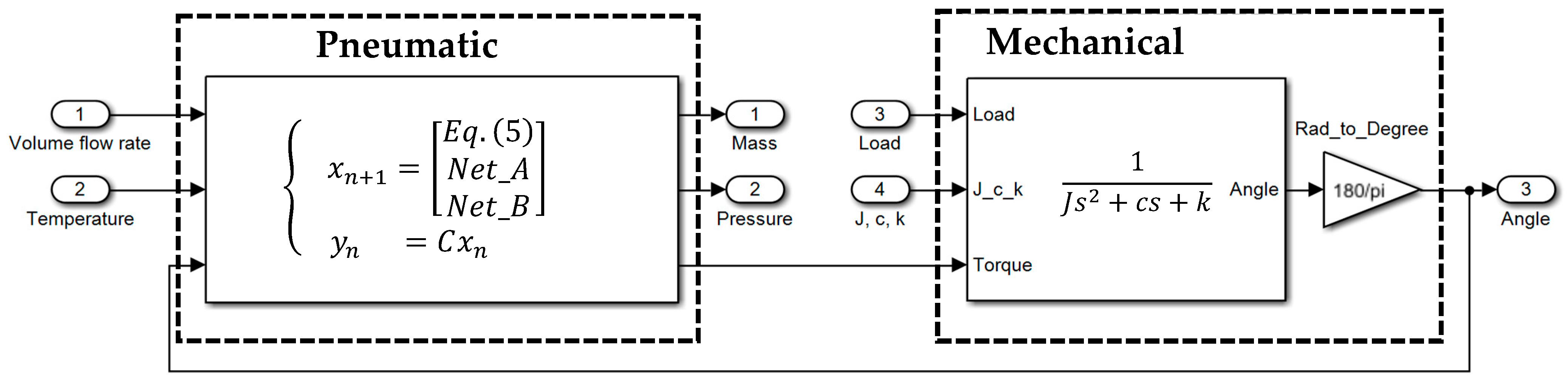
The pneumatic state-space model expressed in (24)–(27) and the mechanical model from (24) may constitute a dynamic model of the actuator that can be used to analyze the dynamic behavior of the actuator, as shown in Figure 1.

3.1.3. Angle-Sensorless Control Schemes of the Actuator

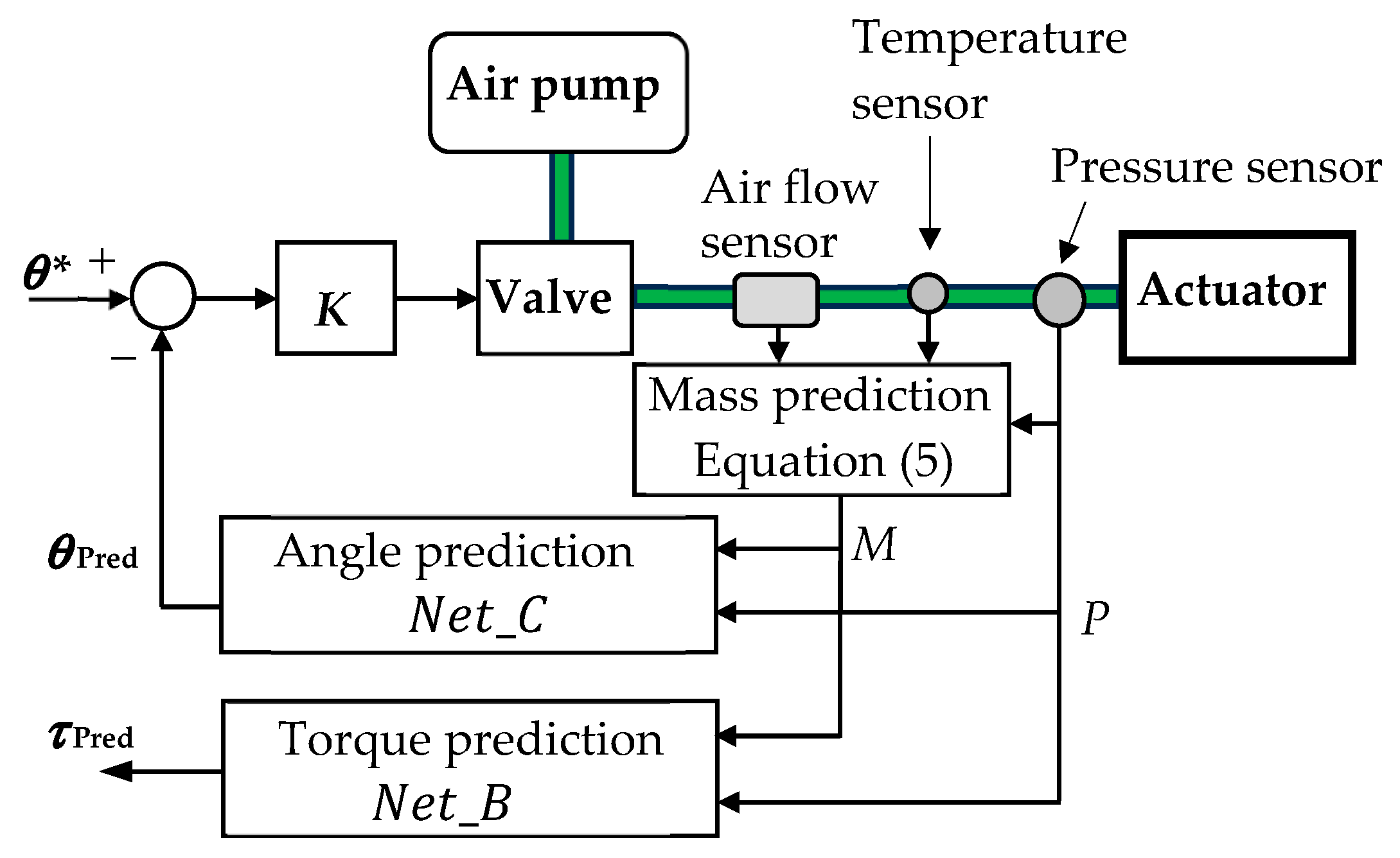
Using measured mass, pressure, and the angle prediction equation expressed by (13), a real actuator’s angle can be controlled without an angle sensor, as shown in Figure 2. The signals from an air flow sensor and a pressure sensor are fed into Equation (5) for predicting the mass. The angle prediction Equation (13) may be implemented by a neural network NetC, which was trained by experimental data. Then, mass and pressure are fed into Net_C for predicting the angle. The estimated bending angle is then fed back to the controller for comparison with the control command, enabling control of the actuator. Additionally, Net_B can be used to predict the contact torque between the actuator and the target object or for enabling a torque-sensorless control scheme.
As a case study, an actuator using TPU-coated nylon fabric and its experimental evaluation will be used to validate that these equations are continuous, monotonic, and single-valued functions.

3.2. Experimental Setup and Data Acquisition

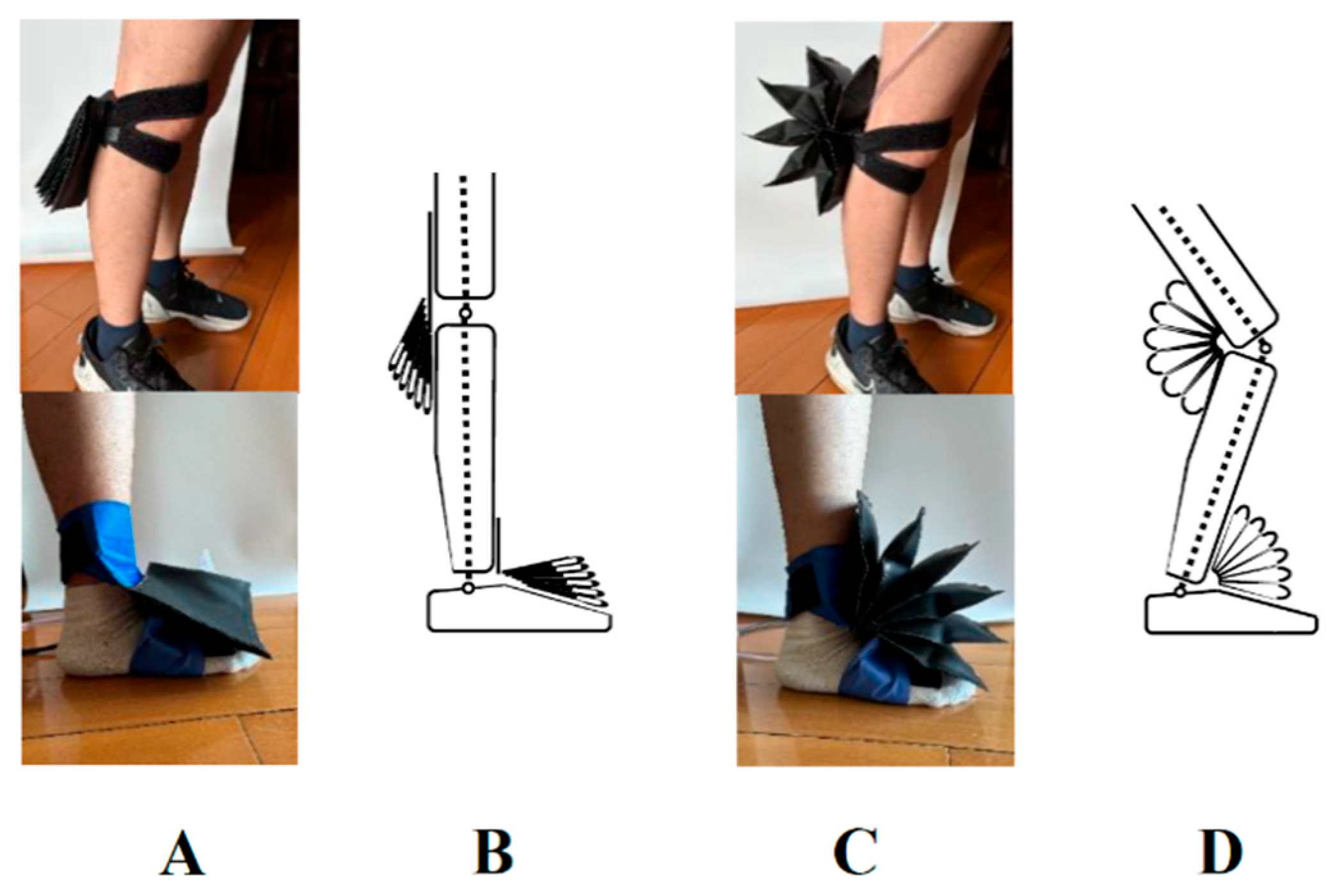
The soft actuator consists of six airbags, each airbag measuring 140 mm × 130 mm, to achieve the required bending angles (0–180°) for the knee and ankle. When inflated, the six airbags press against each other and generate an outward thrust. This provides the necessary torque for the actuators to assist with joint extension. Figure 3A–D shows the different geometries and volumes of the pneumatic soft actuators for the knee and ankle joints in both deflated and inflated states. These actuators are not only easy to wear but also occupy minimal space when not in use (deflated).
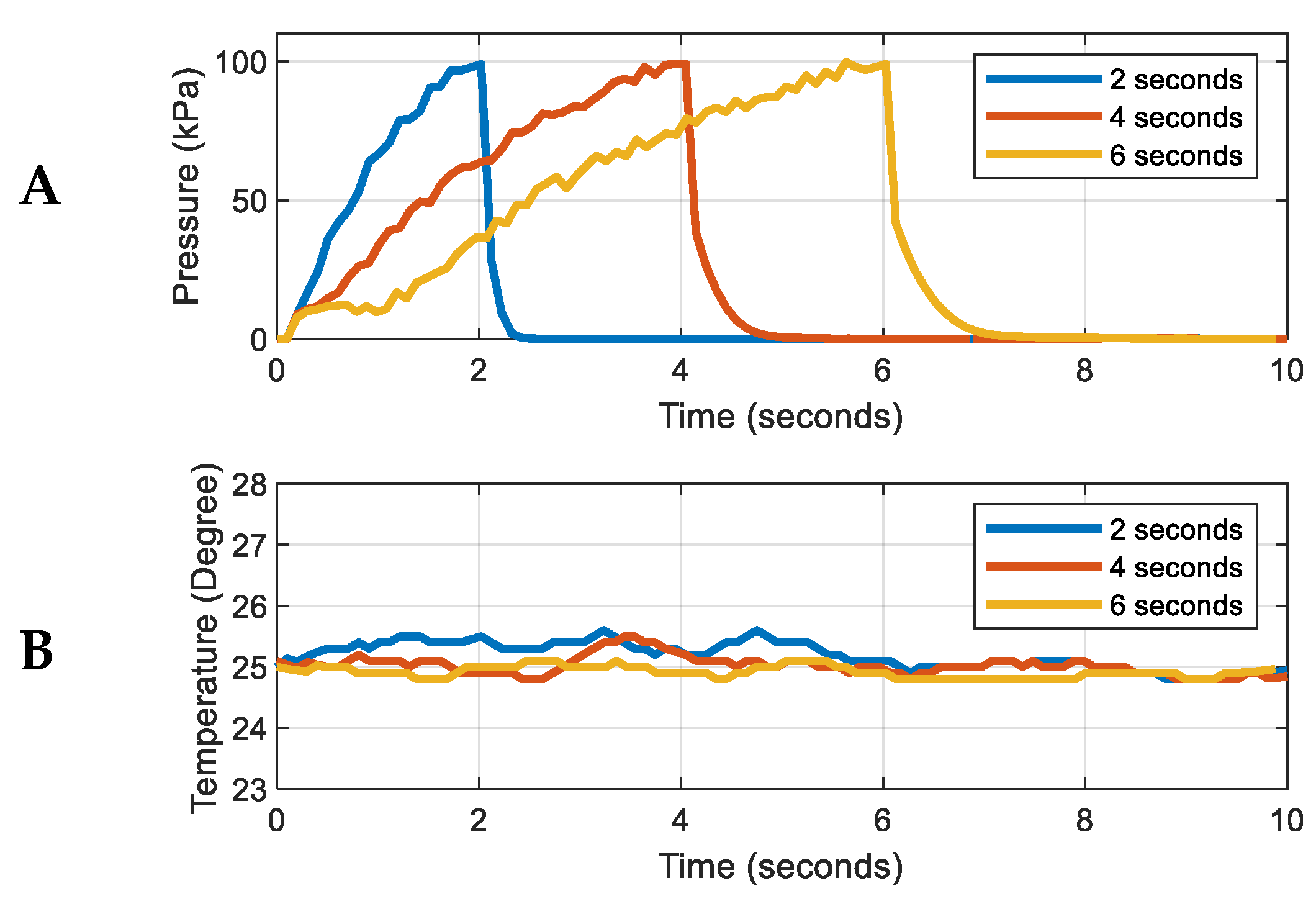
In order to determine air temperature variation in the actuator during the air compression process, pressure and temperature were recorded in inflating and deflating experiments with a pressure sensor and a thermistor temperature sensor installed in the air intake of the actuator, as well as a proportional valve to control air flow rate. In the experiments, air pressure increased during inflations from 0 to 100 kPa in 2, 4, and 6 s, respectively, and then rapidly deflated.
In the fastest inflation case, as shown in Figure 4, the temperature changes by approximately 0.6 °C over 2 s, while the pressure changes by ~100 kPa, corresponding to ~0.3 °C/s and ~0.006 °C/kPa. In relative terms, ΔT/T is on the order of (0.6/sample number)/300 ≈ 5 × 10⁻⁵ (0.005%), where T = 300 (K), ΔT is temperature difference in a sampling period, and the sample number is 40 in 2 s with the sampling period Δt = 0.05 s, indicating that the isothermal approximation introduces only a small error in the mass update over each sampling period. Heat in a pressurized air container is dissipated from the container surface to the surrounding environment. A plausible reason for the smaller temperature rise observed in our setup is the actuator’s substantially larger effective heat-transfer area and thin flexible walls, which lead to faster heat exchange with the ambient air. Specifically, our system consists of six airbags, each approximately 0.14 m × 0.13 m in the deflated state; considering two dominant heat-exchange surfaces per airbag, the total surface area is approximately 0.2184 m2. Therefore, in this paper, an isothermal approximation is adopted under our experimental conditions.
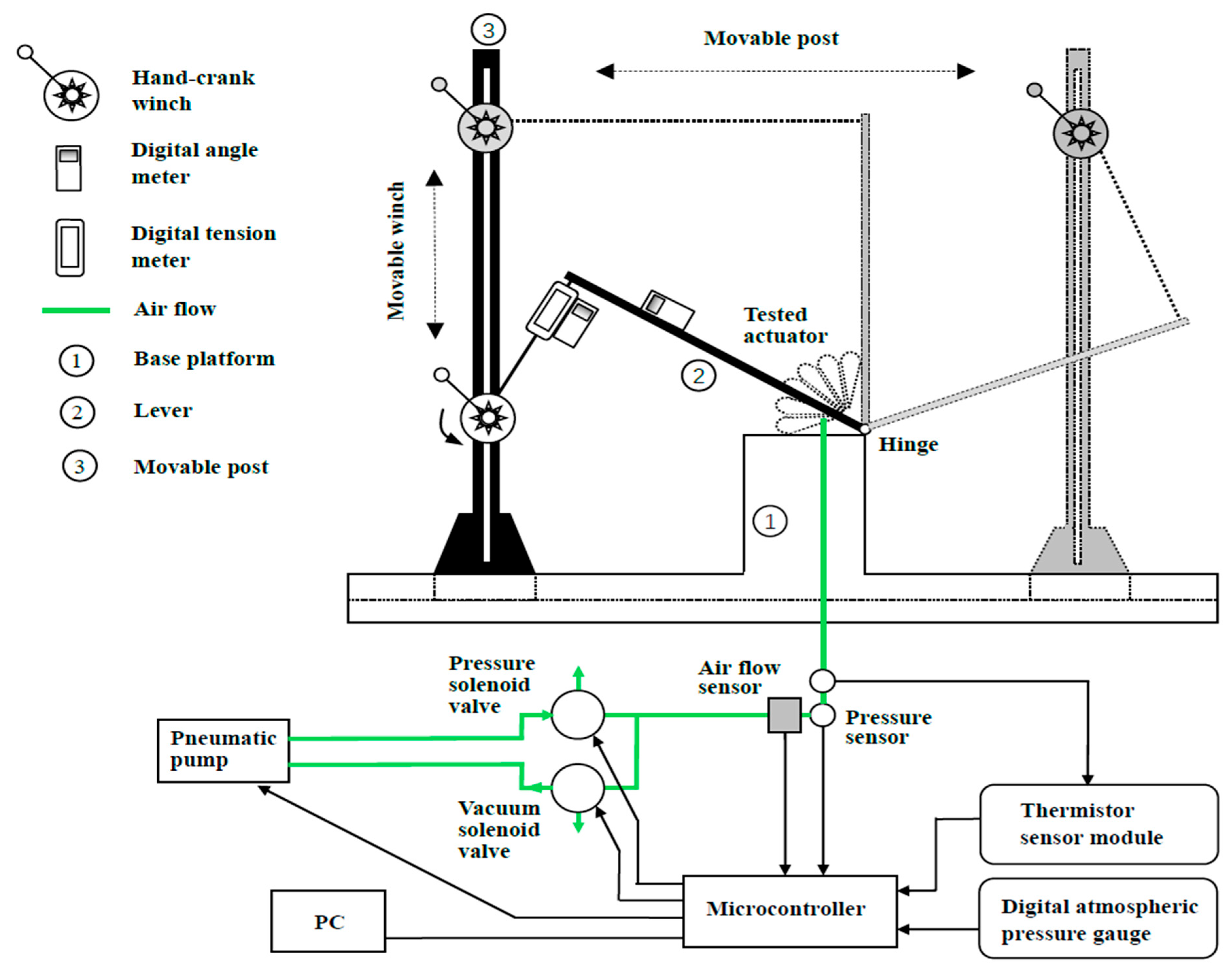
To accurately measure the performance of the soft actuators, an experimental setup was developed as shown in Figure 5 based on previous reports [4,30,31,32,33,34,37].
The experimental setup consists of a lever ② connected to the base platform ① by a hinge with a range of motion from 0 to 180 degrees. The actuator under test is secured between the lever and the base platform. The lever, with its 180-degree range of motion, is used to control the bending angle of the actuator. The top of the lever is connected by a soft rope to a hand-crank winch, mounted on a movable post ③. The post can move horizontally along the base platform, while the winch can move vertically along the post. This setup allows the manipulation of the actuator’s bending angle using the rope and lever. A digital tension meter is placed in the middle of the rope to measure the actuator’s torque. Additionally, a digital angle meter is mounted on the lever to record the actuator’s bending angle. When adjusting the positions of the post and hand-crank winch, another digital angle meter, aligned parallel to the tension force direction, is mounted on the digital tension meter to monitor and ensure that the tension force remains perpendicular to the lever. The pneumatic and electronic components consist of one pneumatic pump, an air pressure solenoid valve, a vacuum solenoid valve, a digital air flow-sensor (MF5708), a digital air-pressure sensor (XGZP6847A), a microprocessor, a PC, air tubes, and electric drive modules [18]. The pressure solenoid valve and the vacuum solenoid valve are used to switch the air flow direction from the pneumatic pump. A BY-2003P digital atmospheric pressure gauge is used to measure the current pressure, and a thermistor sensor module is used to measure the air temperature, both of which are input into the microprocessor. The upper and lower confidence limits of the angle are from 30° to 180°, the torque from 0 to 80 N·m, the air mass from 0 g to 4 g, and the pressure from 0 kPa to 72 kPa.

3.3. Applying Neural Networks to Fit Pneumatic Equations

Neural networks can rapidly approximate arbitrary nonlinear functions [38,39,40]. They are widely used for curve fitting [41,42,43,44]. In order to obtain the pneumatic state-space model and prediction functions expressed by the implicit functions (8), (9), (11), and (12), neural networks are employed to fit the nonlinear experimental data of the actuator’s torque (128 samples), bending angle (128 samples), air pressure (128 samples), and air mass (128 samples), totaling 512 samples, at temperature T = 25°.
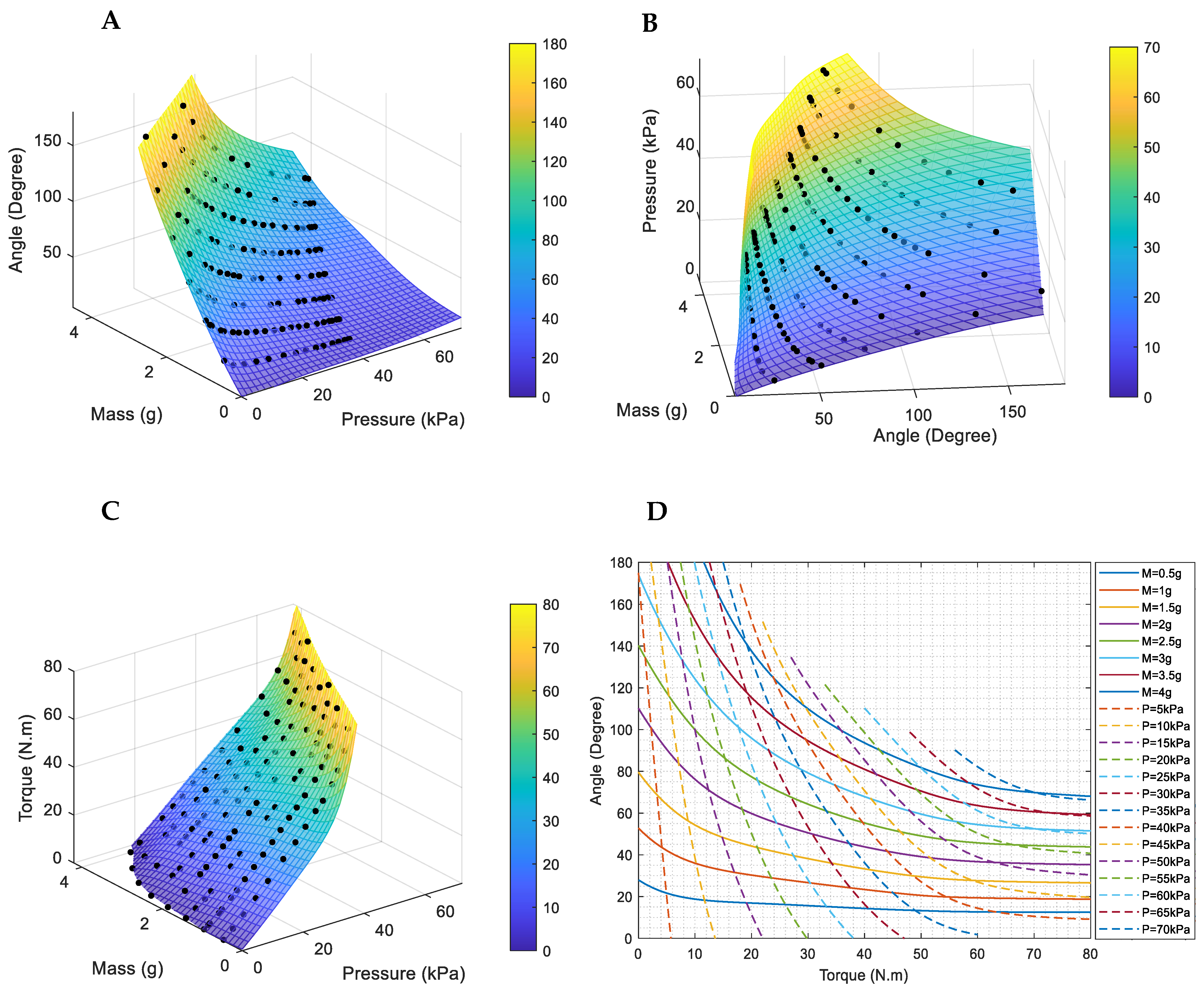
The experimentally recorded air mass M, air pressure P, and bending angle θ can be fitted into a three-dimensional surface to implement (8), which is a nonlinear function. Hence, a two-layer feedforward neural network, denoted as Net_C, is constructed with a hidden layer consisting of 10 neurons using sigmoid transfer functions and an output layer using a linear transfer function. Having too many neurons in the hidden layer may increase the risk of overfitting (high training but low validation accuracy), while having too few may lead to underfitting (low training accuracy). The optimal number of neurons requires fine-tuning by multiple experiments. The Bayesian regularization training function is selected for this network. The measured data for air mass M and air pressure P are organized into a two-dimensional array [M, P] to serve as the input for the neural network, with the recorded bending angle θ serving as the training target. After 1086 training iterations, the neural network achieved a mean squared error (MSE) of 0.09631 and an R-squared value of 0.99998. The fitting results of the neural network with inputs [M, P]T and output [θ] are shown as a three-dimensional surface in Figure 6A, which is a continuous, monotonic, and single-valued function and provides a comprehensive view of the relationship between these variables. The experimentally recorded data points are marked with black dots (‘•’) to highlight their alignment with the neural network’s output. While this three-dimensional visualization provides an overall understanding, its perspective may make precise comparisons less intuitive.
The neural network’s fitted function is shown by a curved surface, and the experimentally recorded data are marked with ‘*’. Different colors are used to represent different mass values (M), as indicated in the legend.
Next, the recorded data [M, θ] T as input and the recorded pressure P as output were used to train a second neural network Net_A, which has a hidden layer consisting of 11 neurons using sigmoid transfer functions and an output layer using a linear transfer function to implement (9). This fitted three-dimensional surface representation is shown in Figure 6B.
To further explore the relationships among air mass M, pressure P, and torque τ, a third neural network Net_B, which has a hidden layer consisting of 9 neurons using sigmoid transfer functions and an output layer using a linear transfer function to implement (11). The network was trained using [M, P] T as input and τ as the output. This fitted three-dimensional surface representation, as shown in Figure 6C.
Lastly, a fourth neural network Net_D with 2 hidden layers, each layer consisting of 20 neurons using sigmoid transfer functions and an output layer using a linear transfer function, was trained using [M, P] T as inputs, with the recorded torque τ and bending angle θ as the outputs, to construct a four-dimensional function for implementing (12). The four-dimensional surface is projected to a pressure-angle plane in Figure 6D.
Figure 6D presents the neural network Net_D’s fitting function (12), highlighting the nonlinear relationship between these variables and how the neural network captures this interaction effectively. This result demonstrates the importance of the coupled dynamics of the torque and bending angle model for predictive control in soft actuators.
In Figure 6A–C, the neural network’s fitted function is shown by curved surfaces, and the experimentally recorded data are marked with ‘*’. In Figure 6D, different colors are used, representing different mass values (M) and pressure (P), as indicated in the legend.
Architectures of the four neural networks are listed in Table 1. In the training examples, the fitting errors of the four neural networks are listed in Table 2, which summarizes the fitting performance of the four neural networks used to model various relationships in the actuator system. Each network corresponds to a specific fitting equation, with the fitting errors evaluated using the MSE and the R-squared value. Overall, the results demonstrate the reliability of the neural network models in capturing the dynamics of the actuator system.
All networks have one hidden layer with a sigmoid activation function and output layers with linear activation functions. Training was performed using Bayesian regularization, which improves generalization and reduces overfitting for the small datasets.
The trained neural network Net_C can implement the first-order backward difference equation (13); the Net_A can implement (14); and the Net_B implements (15) for simulation studies. For these neural networks, the lower and upper confidence limits are as follows: angle (30° to 180°), torque (0 to 80 N·m), air mass (0 to 4 g), pressure (0 to 72 kPa), and temperature, which is fixed at 25 °C.

4. Simulation Studies During Squat-to-Stand Motion

To demonstrate the controllability and computational feasibility of the soft actuator model, as shown in Figure 1, an angle-sensorless controlled actuator—for driving the extension and flexion motion of the lower limb during a squat-to-stand movement—was simulated.

4.1. Torque Analysis of the Knee and Ankle Joints During Squat-to-Stand Motion

4.1.1. Standing Posture

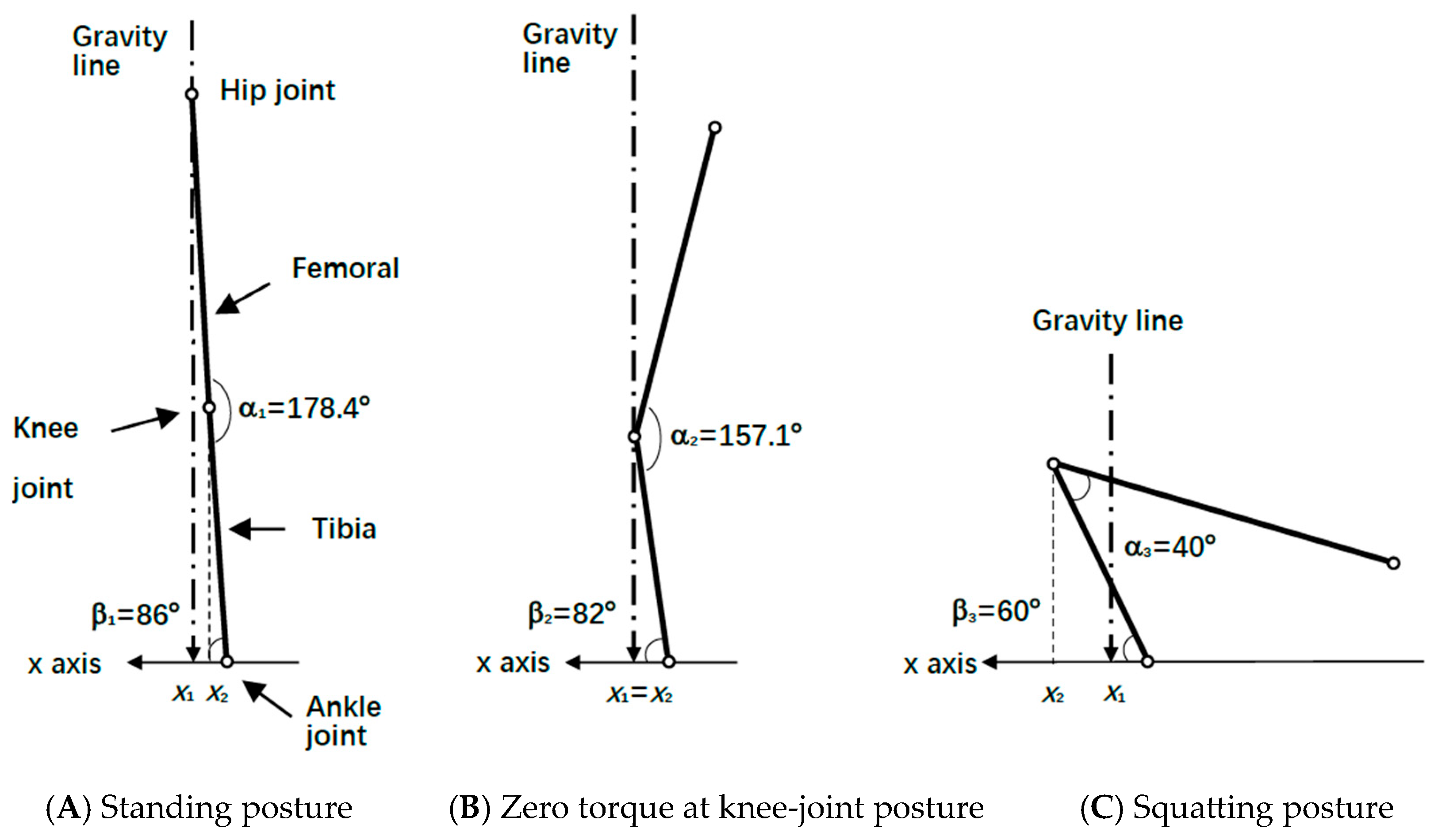
As shown in Figure 7A, Kazuhiro Hasegawa and colleagues used a 3D X-ray imaging system [45] to scan 136 healthy individuals, finding that while standing, the distance from the gravity line to the ankle joint is x1 = 4.8 cm; the knee joint’s projection onto the x-axis is at x2 = 2.4 cm; the ankle-joint angle β1 = 86° with the average tibia length LT = 34.4 cm; and the knee-joint angle α1 = 178.4° [45].

4.1.2. Zero Torque at Knee-Joint Posture

As shown in Figure 7B, when the gravity line passes through the knee joint (zero moment arm), which results in a load of 0 N·m (torque-free position).

4.1.3. Squatting Posture

As shown in Figure 7C, reference [46] indicates that the limited knee flexion angle during a deep squat is α3 = 40°, while reference [47] specifies the limited ankle flexion angle of the lower leg relative to the x-axis as β3 = 60°. At this point, the additional weight generates a clockwise torque on the knee joint.
As the ankle-joint angle β extends from 60° in the squat position to 86° in the standing position, the knee-joint angle α simultaneously extends from 40° in the squat to 178.4° in the standing position. For simplicity, it is assumed that during the squat-to-stand transition, the flexion and extension of the ankle and knee joints occur proportionally.
β = S α 40 + 60
where β is the ankle-joint angle (60–86°); α is the knee-joint angle (40–178.4°); and the proportional coefficient S = 0.188.
Referring to Figure 7C, the load-induced torque and rotational inertia on the knee joint are determined by the ankle-joint angle. During the squat-to-stand transition, it is assumed here that the center of mass remains constant. Under this assumption, the load-induced torque and rotational inertia on the knee joint can be calculated as follows:
τ k n e e = 9.8 W L T cos β x 1
J k n e e = W L T cos β x 1 2
where LT represents the length of the tibia, β is the ankle-joint angle, τknee (N·m) is the torque applied to the knee joint by the load, and Jknee (kg·m2) is the rotational inertia. W (kg) is the additional load on a single leg, and x1 is the distance from the gravity line to the ankle joint.
The proportional relationship between the knee- and ankle-joint angles from (25) is substituted into (26) and (27), respectively.
τ k n e e = 9.8 W L T cos S α 40 + 60 x 1
J k n e e = W L T cos S α 40 + 60 x 1 2
where τknee represents the torque applied to the knee joint by the load, Jknee is the inertia.
Referring to Figure 7, the torque applied to the ankle joint by the load can be calculated as follows:
τ a n k l e = 9.8 W x 1
J a n k l e = W x 1 2
where τankle represents the torque applied to the ankle joint by the load, Jankle is the inertia. When the center of gravity line is unchanged during squat-to-stand movement, x1 is a constant, so that the torque and inertia of the additional load remain constant.

4.2. Simulation Model of Angle-Sensorless Control of Actuator

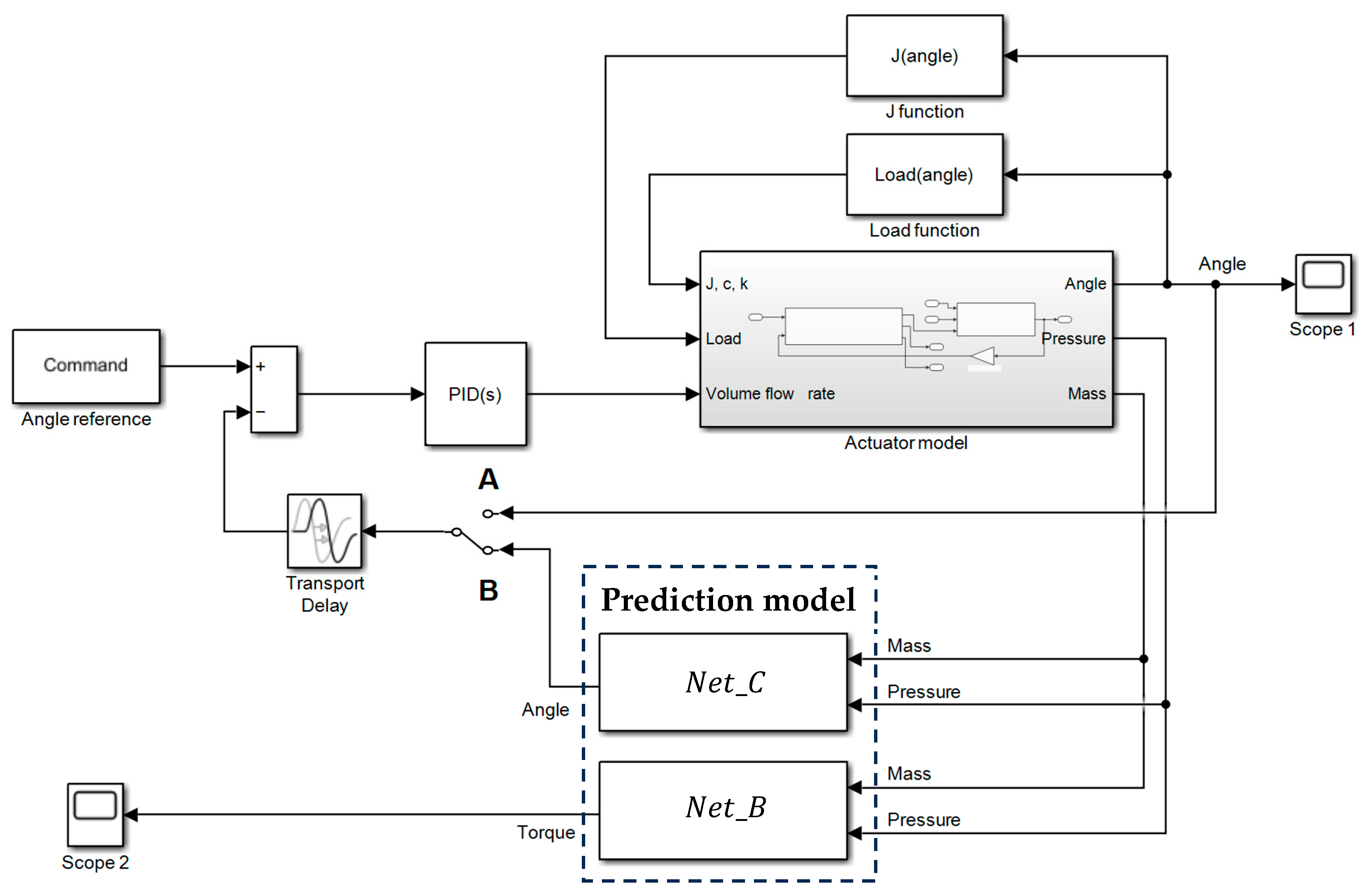
As shown in Figure 8, the simulation model of the angle-sensorless controlled actuator consists of several key components: the actuator model as shown in Figure 1, which consists of a pneumatic model and a mechanical model; a PID controller; a load function from (28); a J function from (29); and an angle command. The air volumetric flow rate output from the PID controller is fed into the actuator model, while the internal pressure and air mass output from the actuator model are used in (13) and (15) to predict the bending angle and torque. This predicted angle is then fed back into the PID controller for adjusting the air volumetric flow rate to control the actuator’s bending angle. A transport delay block is added to the control system to simulate the dynamics hysteresis of a proportional valve. A switch block is used to simulate two different feedback loops. When the switch state is ‘A’, the feedback signal is the actuator angle. When the switch state is ‘B’, the feedback signal is the predicted angle. The load function simulates the load torque during the actuator’s bending process, taking the bending angle as input and modeling the load variation as a function of the angle. The J function takes the bending angle as input and outputs the mechanical model parameters J, c, and k, which are then fed into the mechanical model within the actuator system. Two scope modules (Scope 1 and Scope 2) are used to display the angle and torque throughout the simulation process.

4.3. Simulation Results Worn on Ankle with a Constant Load

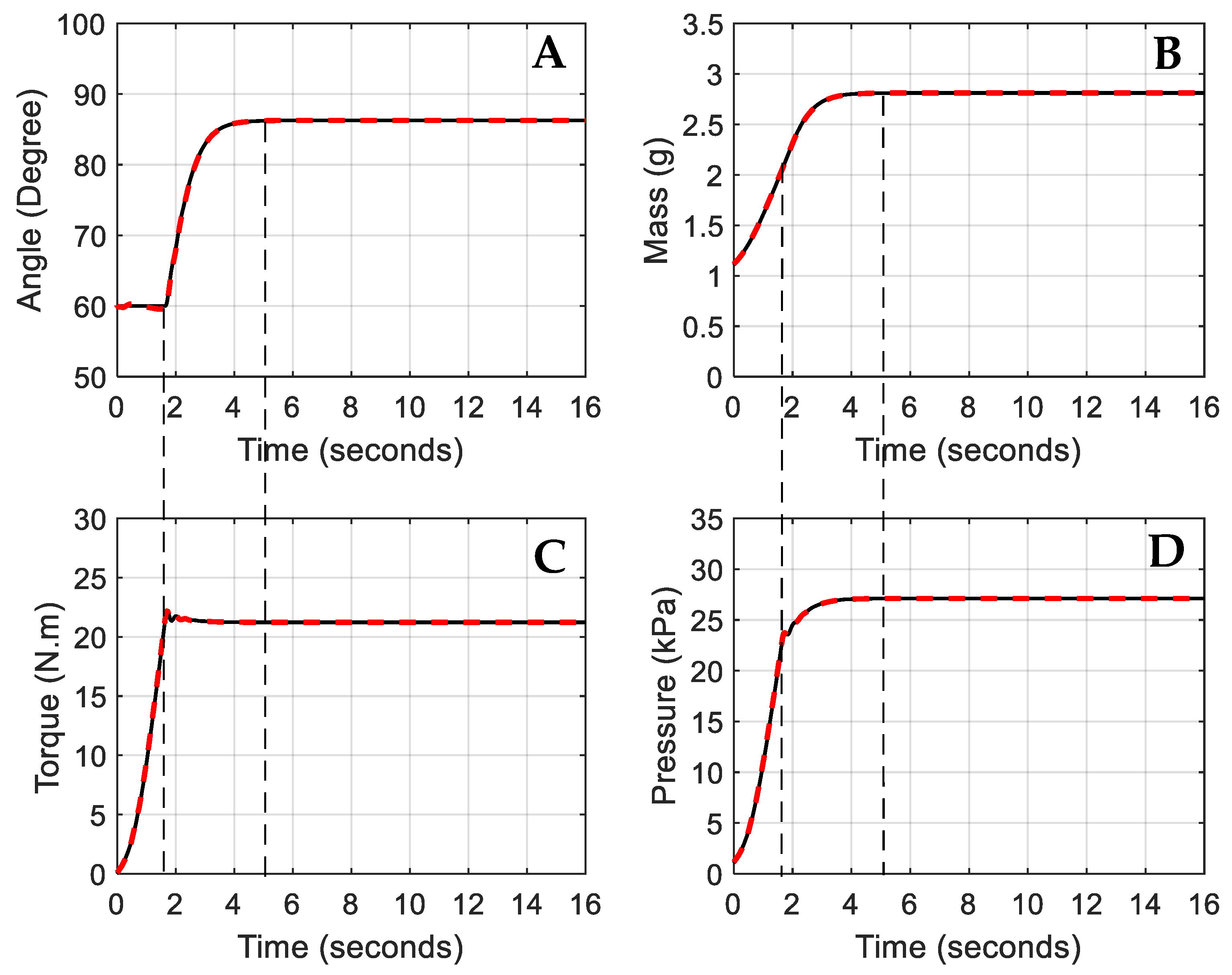
The control system simulation model of the angle-sensorless controlled actuator worn on the ankle is shown in Figure 8. Under a load of 45 kg on one leg, the dynamic simulation results are shown in Figure 9. Control system simulation parameters: constant load = 21.2 N·m from (30), J = 0.1037 kg·m2 from (31), damping coefficient c = 1, stiffness coefficient k = 0.05, the bending angle range is 60–86°, and the transport delay of the proportional valve is constant at 0.2 s. The simulation times are 0–16 s and the step size Δt = 0.05 s. The actuator is pre-inflated and bent to 60°, as the starting point of the simulation. An isothermal condition was assumed, with T = 25° (constant). Hence, T(n) + T(n−1) = 2T in (5), and Equation (5) simplifies to Equation (32), which was used in the simulations. Hence, (5) becomes the following:
M n + 1 = M n + μ σ n 2 R T P a n + P a n 1 t
In Figure 9, the solid black line represents the simulation results when the system is controlled by actuator’s bending angle, while the dashed red line represents the results when the system is controlled by the predicted angle.
In the initial state, τ = 0 N·m and θ = 60°. From Figure 6D, when the x-axis τ = 0 N·m and the y-axis θ = 60°, it was found that M = 1.2 g. These initial conditions are used as input to Net_A, and the initial pressure is calculated to be P = 1.6 kPa. The simulation is divided into three stages. In the first stage (0–1.6 s), the actuator angle is at 60 degrees, and the actuator encounters resistance when it contacts the skin surface of the tibia. As the injected air mass increases to 2.1 g (Figure 9B), the internal pressure rises to 23.7 kPa (Figure 9D), the torque increases to 21.2 N·m (Figure 9C), and the bending angle stabilizes at 60° (Figure 9A). In the second stage (1.6–4.5 s), with the continued increase in air mass and internal pressure, the actuator’s torque exceeds the load torque, causing the knee-joint angle to increase rapidly and reach 86° (Figure 9A). In the final stage (after 4.5 s), the actuator’s torque is 21.2 N·m (Figure 9C), and the bending angle remains at 86° (Figure 9A), with an air mass of 2.8g (Figure 9B) and internal pressure of 27.1 kPa (Figure 9D). During the simulation, the volumetric flow rate was less than 30 dm3/min.

4.4. Simulation Results Worn on Knee with a Variable Load

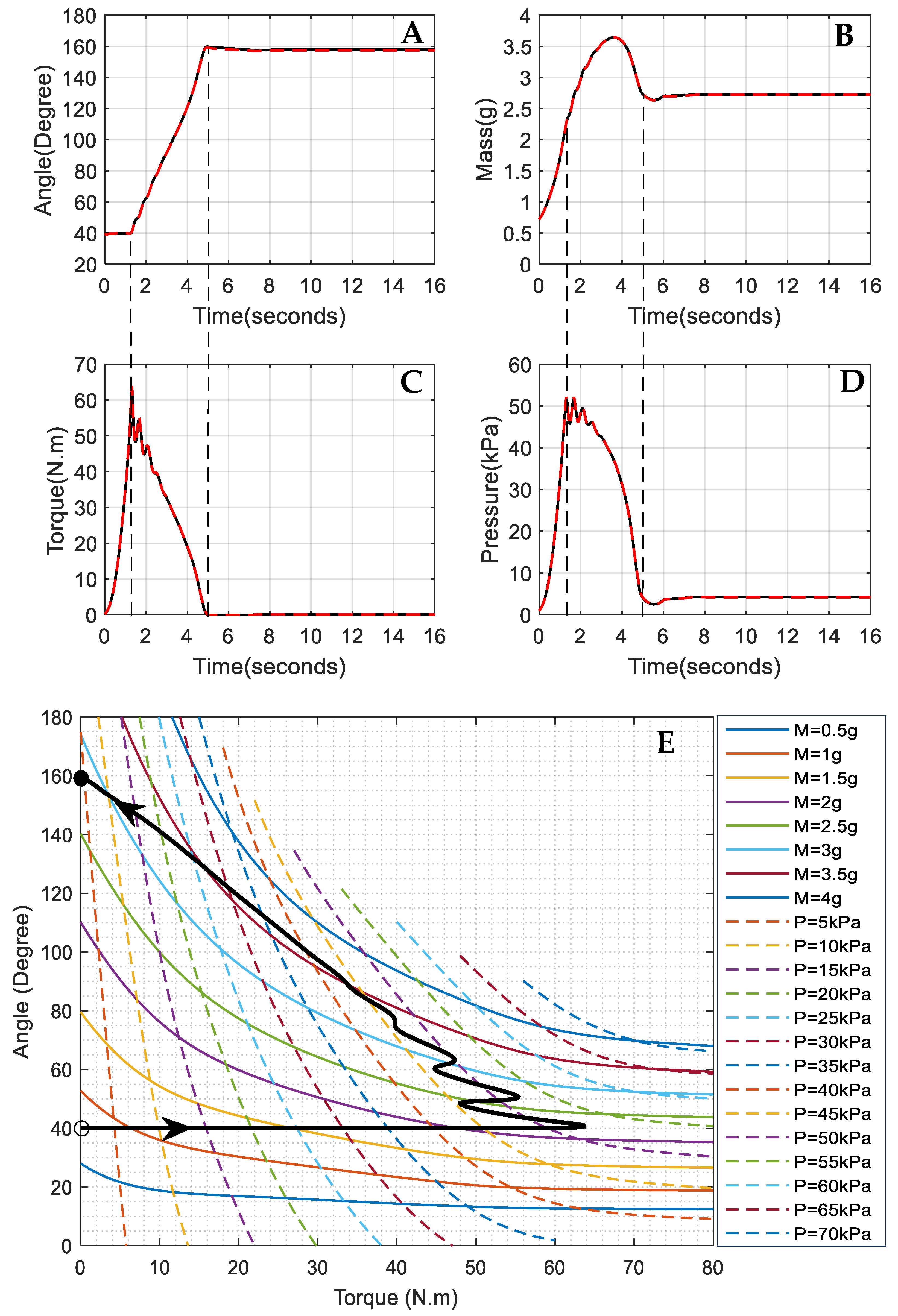
The control system simulation model of the angle-sensorless controlled actuator worn on the knee is shown in Figure 8. Under a load of 45 kg on one leg, the simulation results are shown in Figure 10. The load and rotational inertia vary with the bending angle, as described by (27) and (28). The control system simulation parameters are as follows: a variable load torque range of 0–54.7 N·m, a rotational inertia range of 0–0.69 kg·m2, damping coefficient c = 2.5, and stiffness coefficient k = 0.02. The bending angle ranges from 40° to 157.1°, temperature T = 25°, and the transport delay of the proportional valve is constant at 0.2 s. The simulation times are 0–16 s and the step size Δt = 0.05 s. The actuator is pre-inflated and bent to 40°, as the starting point of the simulation.
Figure 10 shows the dynamic simulation results for the angle-sensorless controlled actuator worn on the knee; the solid black line represents the simulation results when the system is controlled by the actuator’s bending angle, while the dashed red line represents the results when the system is controlled by the predicted angle.
The simulation is divided into three stages. At the starting point, τ = 0 N.m and θ = 40°. From Figure 6D, when the x-axis τ = 0 and the y-axis θ = 40°, it was found that M = 0.77 g. These initial conditions are used as input to Net_A, and the initial pressure is calculated to be P = 1.1 kPa. In the first stage (0–1.3 s), as the actuator contacts the skin surface of the femur, resistance is encountered, leading to an increase in actuator torque (Figure 10C), while the bending angle stabilizes at 40° (Figure 10A). As the injected air mass increases to 2.23 g (Figure 10B), the internal pressure rises from 0 to 51 kPa (Figure 10D), and the torque increases from 0 to 60 N·m (Figure 10C). In the second stage (1.3–5 s), further increases in air mass and internal pressure cause the actuator’s torque to exceed the load torque. This torque difference generates acceleration, driving the knee-joint angle to 157.1° (Figure 10A). In this stage, due to the variable load, the torque and pressure waveforms produce some ripples in the motion-control response. In the final stage (after 5 s), the bending angle remains stable at 157.1° (Figure 10A), with an air mass of 2.73 g (Figure 10B), internal pressure of 4.37 kPa (Figure 10D), zero torque (Figure 10C), and zero load. Throughout the simulation, the volumetric flow rate varies between 62 dm3/min and −43 dm3/min, where a negative flow rate indicates air being drawn out of the actuator.
In order to verify the simulation, the angle–torque–mass–pressure trajectory of the knee-joint simulation results was projected to the four-dimensional surface (Figure 6D) fitted by the experimental data, as shown in Figure 10E.
The simulation results demonstrate that the angle-sensorless actuator is controllable and computationally feasible and can effectively assist individuals in transitioning from a squatting position to a standing position, even when bearing an additional weight of 90 kg, such as a barbell. The actuator works at internal pressures below 51 kPa, minimizing discomfort for the wearer while enhancing overall usability and comfort.

5. Conclusions and Future Works

This paper presents a dynamic model established using data-driven modeling through a neural network that can be utilized for simulation analysis in the dynamic control process of soft actuators and used for the future design of a stable and robust control system for pneumatic soft exoskeletons. Computer simulation results demonstrate that the air mass within the actuator is a crucial state variable in the kinematic and dynamic systems of pneumatic soft actuators. The proposed ideal gas law-based modeling method is universally applicable to pneumatic actuators.
As a case study, this paper discusses a soft actuator made from TPU composite fabric, designed to assist the femur and tibia muscles of a healthy individual during a squat-to-stand motion while bearing an additional weight of 90 kg. This actuator may also have potential applications for individuals with lower-limb muscle weakness, though further studies are needed to evaluate its effectiveness. By injecting more air into the actuator to increase internal pressure, the actuator can provide greater assistance to the muscles. Using experimental data and a neural network fitting method, four pneumatic functions are fitted. These functions have practical applications. For example, using air mass and internal pressure to predict the torque and the bending angle, it is possible to control the actuator without relying on torque and angle sensors.
In the control simulation study, a fixed valve delay was assumed, which has limitations because valve dynamics and time delays may vary with operating conditions. In future work, adaptive delay compensation or online identification modules could be integrated (e.g., delay estimation from pressure/flow responses, phase-lead compensation, or adaptive predictors) to improve robustness.
For wearable applications, additional factors should be considered, including contact pressure distribution and potential peak-pressure areas, mitigation strategies (e.g., padding, strap design, and contact geometry), material selection and skin compatibility (e.g., silicone grades and liners), and user comfort and safety issues (e.g., heat, moisture, and slipping).
Future work will explore multi-actuator coordination, integration with adaptive/robust control, and embedded real-time deployment, as well as pathways toward human-subject validation and clinical trials. For real-time wearable operation, performance will be further evaluated under rapid actuation and varying ambient conditions, and compensation strategies for thermal transients and spatial non-uniformity will be developed. In addition, the dataset will be expanded across a wider range of pressures, inflation/deflation rates, and loads, and will be evaluated using k-fold cross-validation. Physically consistent data augmentation strategies for pneumatic time-series data will also be investigated.

6. Patents

The following patents are related to the research line reported in this manuscript and have been granted or published:
Shi, Wenyuan. Soft Exoskeleton Control Method and Device, Chinese Patent CN117226852B, granted on 26 January 2024 (Patent No. ZL202311490476.3).
Shi, Wenyuan. Pneumatic Soft Actuator and Control Method Thereof, Chinese Patent CN119407751B, granted on 2 December 2025 (Patent No. ZL202411762391.0).
Shi, Wenyuan. Sensorless Control Method and Device for Pneumatic Soft Actuators, Chinese Patent CN119388401B, granted on 18 July 2025 (Patent No. ZL202411762397.8).
Shi, Wenyuan. Experimental System for Pneumatic Soft Actuators and Measurement, Chinese Utility Model Patent CN223477638U, granted on 28 October 2025 (Patent No. ZL202422973915.2).

Author Contributions

Methodology, W.S.; software, W.S.; validation, W.S.; formal analysis, W.S.; writing—original draft preparation, W.S. and M.B.J.W.; writing—review and editing, W.S. and M.B.J.W. All authors have read and agreed to the published version of the manuscript.

Funding

This research received no external funding.

Institutional Review Board Statement

Ethical review and approval were waived for this study because human involvement was limited to non-invasive demonstration photographs of the prototype wearable actuator.

Informed Consent Statement

Informed consent was obtained from all subjects involved in the study.

Data Availability Statement

All data supporting the findings of this study are included within the article. No additional datasets were generated.

Conflicts of Interest

The authors declare no conflicts of interest. This research received no external funding. The funders had no role in the design of the study; in the collection, analyses, or interpretation of data; in the writing of the manuscript; or in the decision to publish the results.

References

  1. Haghshenas-Jaryani, M.; Patterson, R.M.; Bugnariu, N.; Wijesundara, M.B. A pilot study on the design and validation of a hybrid exoskeleton robotic device for hand rehabilitation. J. Hand Ther. 2020, 33, 198–208. [Google Scholar] [CrossRef] [PubMed]
  2. Ridremont, T.; Singh, I.; Bruzek, B.; Jamieson, A.; Gu, Y.; Merzouki, R.; Wijesundara, M.B.J. Pneumatically actuated soft robotic hand and wrist exoskeleton for motion assistance in rehabilitation. Actuators 2024, 13, 180. [Google Scholar] [CrossRef]
  3. Thalman, C.M.; Lam, Q.P.; Nguyen, P.H.; Sridar, S.; Polygerinos, P. A novel soft elbow exosuit to supplement bicep lifting capacity. In Proceedings of the IEEE/RSJ International Conference on Intelligent Robots and Systems (IROS), Madrid, Spain, 1–5 October 2018; pp. 6965–6971. [Google Scholar]
  4. Kabir, P.; Zareinejad, M.; Talebi, H.A.; Soleimanifar, M.; Mavajian, M.; Ashoori, M. Development and evaluation of a soft wearable knee rehabilitation apparatus. In Proceedings of the RSI International Conference on Robotics and Mechatronics (ICRoM), Tehran, Iran, 2–4 November 2022; pp. 159–164. [Google Scholar]
  5. Pedaran, A.; Zareinejad, M.; Talebi, H.A.; Soleimanifar, M.; Ahmadjou, A.; Ashoori, M. Design and implementation of a soft robotic rehabilitation device for ankle motion exercises. In Proceedings of the RSI International Conference on Robotics and Mechatronics (ICRoM), Tehran, Iran, 2–4 November 2022; pp. 317–322. [Google Scholar]
  6. Hu, Y.; Liu, J.; Spielberg, A.; Tenenbaum, J.B.; Freeman, W.T.; Wu, J.; Rus, D.; Matusik, W. ChainQueen: A real-time differentiable physical simulator for soft robotics. In Proceedings of the IEEE International Conference on Robotics and Automation (ICRA), Montreal, QC, Canada, 20–24 May 2019; pp. 6265–6271. [Google Scholar]
  7. Hori, Y.; Konishi, S. Design improvement of the conversion mechanism from balloon inflation to bending motion for inflatable film actuators. Microsyst. Nanoeng. 2023, 9, 55. [Google Scholar] [CrossRef]
  8. Kim, H.; Na, H.; Noh, S.; Chang, S.; Kim, J.; Kong, T.; Shin, G.; Lee, C.; Lee, S.; Park, Y.-L.; et al. Inherently integrated microfiber-based flexible proprioceptive sensor for feedback-controlled soft actuators. npj Flex. Electron. 2024, 8, 15. [Google Scholar] [CrossRef]
  9. Kan, Z.; Pang, C.; Zhang, Y.; Yang, Y.; Wang, M.Y. Soft actuator with programmable design: Modeling, prototyping, and applications. Soft Robot. 2022, 9, 907–925. [Google Scholar] [CrossRef]
  10. Ibrahim, S.; Krause, J.C.; Olbrich, A.; Raatz, A. Modeling and reconstruction of state variables for low-level control of soft pneumatic actuators. Front. Robot. AI 2021, 8, 557830. [Google Scholar] [CrossRef]
  11. Jiang, Q.; Xu, F. Design and motion analysis of adjustable pneumatic soft manipulator for grasping objects. IEEE Access 2020, 8, 191920–191929. [Google Scholar] [CrossRef]
  12. Tawk, C.; Zhou, H.; Sariyildiz, E.; Panhuis, M.I.H.; Spinks, G.M.; Alici, G. Design, modeling, and control of a 3D-printed monolithic soft robotic finger with embedded pneumatic sensing chambers. IEEE/ASME Trans. Mechatron. 2021, 26, 876–887. [Google Scholar] [CrossRef]
  13. Wang, T.; Zhang, Y.; Zhu, S. A dynamical model with order reduction for a fluidic bending-type soft actuator. In Proceedings of the IEEE International Conference on Information and Automation (ICIA), Wuyishan, China, 11–13 August 2018; pp. 1–6. [Google Scholar]
  14. Xavier, M.; Fleming, A.; Yong, Y.K. Finite element modeling of soft fluidic actuators: Overview and recent developments. Adv. Intell. Syst. 2020, 3, 2000187. [Google Scholar] [CrossRef]
  15. Xavier, M.S.; Fleming, A.J.; Yong, Y.K. Nonlinear estimation and control of bending soft pneumatic actuators using feedback linearization and UKF. IEEE/ASME Trans. Mechatron. 2022, 27, 1919–1927. [Google Scholar] [CrossRef]
  16. Rotondo, D. Weighted Linearization of Nonlinear Systems. IEEE Trans. Circuits Syst. II Express Briefs 2022, 69, 3239–3243. [Google Scholar] [CrossRef]
  17. Haghshenas-Jaryani, M.; Wijesundara, M. A quasi-static model for studying physical interaction between a soft robotic digit and a human finger. In Proceedings of the ASME International Design Engineering Technical Conferences and Computers and Information in Engineering Conference (IDETC/CIE), Quebec City, QC, Canada, 26–29 August 2018. [Google Scholar]
  18. Shi, W.Y.; Wijesundara, M.B. Angular velocity control of pneumatic soft robotic digits. ASME Lett. Dyn. Syst. Control 2021, 1, 031015. [Google Scholar] [CrossRef]
  19. Rapp, P.; Weickgenannt, M.; Tarín, C.; Sawodny, O. Valve flow rate identification and robust force control for a pneumatic actuator used in a flight simulator. In Proceedings of the American Control Conference (ACC), Montréal, QC, Canada, 27–29 June 2012; pp. 1806–1813. [Google Scholar]
  20. Carneiro, J.F.; de Almeida, F.G. Pneumatic servo valve models based on artificial neural networks. Proc. Inst. Mech. Eng. Part I J. Syst. Control Eng. 2011, 225, 393–411. [Google Scholar]
  21. Deimel, R.; Radke, M.; Brock, O. Mass control of pneumatic soft continuum actuators with commodity components. In Proceedings of the IEEE/RSJ International Conference on Intelligent Robots and Systems (IROS), Daejeon, Republic of Korea, 9–14 October 2016. [Google Scholar]
  22. Nguyen, P.H.; Mohd, I.B.I.; Sparks, C.; Arellano, F.L.; Zhang, W.; Polygerinos, P. Fabric soft poly-limbs for physical assistance of daily living tasks. In Proceedings of the IEEE International Conference on Robotics and Automation (ICRA), Montreal, QC, Canada, 20–24 May 2019; pp. 8429–8435. [Google Scholar]
  23. Joshi, S.; Paik, J. Sensorless force and displacement estimation in soft actuators. Soft Matter 2023, 19, 2554–2563. [Google Scholar] [CrossRef]
  24. Sacchini, A.; Tessari, F.; Vassallo, C.; Maludrottu, S.; De Momi, E.; Laffranchi, M.; De Michieli, L. Sensorless impedance control for the TWIN lower limb exoskeleton: A preliminary study. In Proceedings of the IEEE RAS/EMBS International Conference on Biomedical Robotics and Biomechatronics (BioRob), Seoul, Republic of Korea, 21–24 August 2022; pp. 1–7. [Google Scholar]
  25. Habib, M.K.; Ayankoso, S.A.; Nagata, F. Data-driven modeling: Concept, techniques, challenges and a case study. In Proceedings of the IEEE International Conference on Mechatronics and Automation (ICMA), Takamatsu, Japan, 8–11 August 2021; pp. 1000–1007. [Google Scholar]
  26. Editorial. The rise of data-driven modeling. Nat. Rev. Phys. 2021, 3, 383. [Google Scholar] [CrossRef]
  27. Gallos, I.K.; Lehmberg, D.; Dietrich, F.; Siettos, C. Data-driven modelling of brain activity using neural networks, diffusion maps, and the Koopman operator. Chaos 2024, 34, 013151. [Google Scholar] [CrossRef]
  28. Tamaddon-Jahromi, H.R.; Chakshu, N.K.; Sazonov, I.; Evans, L.M.; Thomas, H.; Nithiarasu, P. Data-driven inverse modelling through neural network (deep learning) and computational heat transfer. Comput. Methods Appl. Mech. Eng. 2020, 369, 113177. [Google Scholar] [CrossRef]
  29. Tian, J.; Zeng, G.; Zhao, J.; Zhu, X.; Zhang, Z. A data-driven modeling method of virtual synchronous generator based on LSTM neural network. IEEE Trans. Ind. Inform. 2024, 20, 5428–5439. [Google Scholar] [CrossRef]
  30. Fang, J.; Yuan, J.; Wang, M.; Xiao, L.; Yang, J.; Lin, Z.; Xu, P.; Hou, L. Novel accordion-inspired foldable pneumatic actuators for knee assistive devices. Soft Robot. 2020, 7, 95–107. [Google Scholar] [CrossRef]
  31. Sridar, S.; Veale, A.J.; Sartori, M.; van der Kooij, H. Exploiting a simple asymmetric pleating method to realize a textile-based bending actuator. IEEE Robot. Autom. Lett. 2023, 8, 1794–1801. [Google Scholar] [CrossRef]
  32. Nassour, F.; Hamker, F.H.; Cheng, G. High-performance perpendicularly-enfolded-textile actuators for soft wearable robots: Design and realization. IEEE Trans. Med. Robot. Bionics 2020, 2, 309–319. [Google Scholar] [CrossRef]
  33. Chen, H.; Ma, Y.; Chen, W. Design and optimization of an origami-inspired foldable pneumatic actuator. IEEE Robot. Autom. Lett. 2024, 9, 1278–1285. [Google Scholar] [CrossRef]
  34. Park, J.; Choi, J.; Kim, S.J.; Seo, K.-H.; Kim, J. Design of an inflatable wrinkle actuator with fast inflation/deflation responses for wearable suits. IEEE Robot. Autom. Lett. 2020, 5, 3799–3805. [Google Scholar] [CrossRef]
  35. Cash, J.R. Backward differentiation formulae. In Encyclopedia of Applied Computational Mathematics; Engquist, B., Ed.; Springer: Berlin, Germany, 2015. [Google Scholar]
  36. Jungers, M.; Shakib, M.F.; van de Wouw, N. Discrete-time convergent nonlinear systems. IEEE Trans. Autom. Control 2024, 69, 6731–6745. [Google Scholar] [CrossRef]
  37. Veale, A.; Staman, K.; van der Kooij, H. Soft, wearable, and pleated pneumatic interference actuator provides knee extension torque for sit-to-stand. Soft Robot. 2021, 8, 28–43. [Google Scholar] [CrossRef]
  38. Kratsios, A. The universal approximation property. Ann. Math. Artif. Intell. 2021, 89, 435–469. [Google Scholar] [CrossRef]
  39. Higgins, I. Generalizing universal function approximators. Nat. Mach. Intell. 2021, 3, 192–193. [Google Scholar] [CrossRef]
  40. Chen, T.; Chen, H. Universal approximation to nonlinear operators by neural networks with arbitrary activation functions and its applications to dynamic systems. IEEE Trans. Neural Netw. 1995, 6, 911–917. [Google Scholar] [CrossRef] [PubMed]
  41. Bishop, C.M.; Roach, C.M. Fast curve fitting using neural networks. Rev. Sci. Instrum. 1992, 63, 4450–4456. [Google Scholar] [CrossRef]
  42. Li, M.; Wibowo, S.; Guo, W. Nonlinear curve fitting using extreme learning machines and radial basis function networks. Comput. Sci. Eng. 2019, 21, 6–15. [Google Scholar] [CrossRef]
  43. Castello, O.; Resta, M. A machine-learning-based approach for natural gas futures curve modeling. Energies 2023, 16, 4746. [Google Scholar] [CrossRef]
  44. Gonzalez-Diaz, R.; Mainar, E.; Paluzo-Hidalgo, E.; Rubio, B. Neural-network-based curve fitting using totally positive rational bases. Mathematics 2020, 8, 2197. [Google Scholar] [CrossRef]
  45. Hasegawa, K.; Okamoto, M.; Hatsushikano, S.; Shimoda, H.; Ono, M.; Homma, T.; Watanabe, K. Standing sagittal alignment of the whole axial skeleton with reference to the gravity line in humans. J. Anat. 2017, 230, 619–630. [Google Scholar] [CrossRef] [PubMed]
  46. Hartmann, H.; Wirth, K.; Klusemann, M. Analysis of the load on the knee joint and vertebral column with changes in squatting depth and weight load. Sports Med. 2013, 43, 993–1008. [Google Scholar] [CrossRef] [PubMed]
  47. Racu Cazacu, C.M.; Doroftei, I. Structural and kinematic aspects of a new ankle rehabilitation device. Appl. Mech. Mater. 2014, 658, 507–512. [Google Scholar]
Figure 1. The dynamic model of the soft actuator consists of a neural–network pneumatic model and a mechanical model.
Actuators 15 00146 g001
Figure 2. Angle sensorless control scheme for the actuator, where θ∗ is an angle command and the green color lines represent the airflow.
Actuators 15 00146 g002
Figure 3. (A,B). the actuators worn on knee and ankle in the deflated state. (C,D). the actuators worn on knee and ankle in the inflated state.
Actuators 15 00146 g003
Figure 4. Pressure vs. temperature when air is injected into the soft actuator. (A). Inflating and rapid deflating processes during 0 and 100 kPa with various rates. (B). Corresponding temperatures in the actuator.
Actuators 15 00146 g004
Figure 5. An experimental setup for recording the actuator’s variables, where hand-crank winch rotate in the counterclockwise direction. The experimental configuration and mechanical layout are protected by a granted Chinese patent (CN Patent No. ZL202422973915.2).
Actuators 15 00146 g005
Figure 6. The experimental results and the neural-network-based fitted functions. Black dot represents the experimental data, while the curved surfaces in (AC) and solid lines and dashed lines in (D) represent the neural network fitting results at temperature T = 25°.
Actuators 15 00146 g006
Figure 7. Schematic representation of the human femur, tibia, center of gravity line, joints, and bending angles. The dotted line indicates the line of gravity, while the thick solid lines depict the femur and tibia. Knee-joint angle, ankle-joint angle, knee-joint torque, and ankle-joint torque for various lower-limb postures under a load on one leg. (A). Standing posture. (B). Zero-torque posture. (C). Squatting posture.
Actuators 15 00146 g007
Figure 8. Simulation model of the angle-sensorless controlled actuator worn on ankle and knee.
Actuators 15 00146 g008
Figure 9. Simulation results for ankle-joint actuator control with 45 kg load applied to one leg. (A). Actuator’s bending angle. (B). Air mass. (C). Output torque. (D). Air pressure.
Actuators 15 00146 g009
Figure 10. Simulation results for knee-joint actuator control, driving one leg with a 45 kg load. (A). The solid black line represents the actuator’s bending angle, while the dashed red line represents the predicted angle. (B). Air mass, (C). Output torque. (D). Air pressure. (E). Black line represents the angle–torque–mass–pressure trajectory of the knee-joint simulation results, arrow represents the movement direction.
Actuators 15 00146 g010
Table 1. Architecture of neural networks.
Neural
Networks
InputTargetHidden Layer
Neurons
Output
Neurons
Samples
at T = 25°
Net_A (Figure 6B)[M, θ]P101128 × 3
Net_B (Figure 6C)[M, P]τ91128 × 3
Net_C (Figure 6A)[M, P]θ111128 × 3
Net_D (Figure 6D)[M, P][θ, τ]202128 × 4
Table 2. The four neural network functions and fitting errors.
Neural NetworksFitting EquationsIterationsMSER-Squared Value
Net_A P = N e t _ A M , θ , T 25410.071420.99989
Net_B τ = N e t _ B M , P , T 13420.049250.99971
Net_C θ = N e t _ C M , P , T 10860.096310.99998
Net_D θ , τ = N e t _ D M , P , T 8570.0588730.99982
Disclaimer/Publisher’s Note: The statements, opinions and data contained in all publications are solely those of the individual author(s) and contributor(s) and not of MDPI and/or the editor(s). MDPI and/or the editor(s) disclaim responsibility for any injury to people or property resulting from any ideas, methods, instructions or products referred to in the content.