
Article

A Finite-Time Tracking Control Scheme Using an Adaptive Sliding-Mode Observer of an Automotive Electric Power Steering Angle Subjected to Lumped Disturbance

1
Department of Smart Motor Vehicles, Woosong College, Daejeon 34644, Republic of Korea
2
School of Engineering and Technology, Vinh University, Vinh 43100, Nghe An, Vietnam
*
Author to whom correspondence should be addressed.
Actuators 2026, 15(2), 92; https://doi.org/10.3390/act15020092 (registering DOI)
Submission received: 26 December 2025 / Revised: 21 January 2026 / Accepted: 24 January 2026 / Published: 2 February 2026
(This article belongs to the Section Control Systems)

Abstract

Steering angle control in self-driving cars is usually organized in layers combining trajectory planning, path tracking, and low-level actuator control. The steering controller converts the planned path into a desired steering angle and then ensures accurate tracking by the electric power steering (EPS). However, automotive electric power steering (AEPS) systems face many problems caused by model uncertainties, disturbances, and unknown system dynamics. In this paper, a robust finite-time control strategy based on an adaptive backstepping scheme is proposed to handle these problems. First, radial basis function neural networks (NNs) are designed to approximate the unknown system dynamics. Then, an adaptive sliding-mode disturbance observer (ASMDO) is introduced to address the impacts of the lumped disturbance. Enhanced control performance for the AEPS system is implemented using a combination of the above technologies. Numerical simulations and a hardware-in-the-loop (HIL) experimental verification are performed to demonstrate the significant improvement in performance achieved using the proposed strategy.

1. Introduction

Automotive electric power steering (AEPS) systems are designed to assist drivers by reducing the steering effort required and by enhancing vehicle safety [1,2,3]. AEPS systems can be classified into two types: hydraulic, and electric steering control, with the latter being more widely used. Fast and accurate tracking of the desired command signal in AEPS systems can significantly improve drivability, fuel efficiency, and overall control comfort. Consequently, many researchers have focused on developing robust control strategies to achieve these objectives [4,5]. However, AEPS systems are often challenged by factors such as model uncertainties, transmission friction, external disturbances, and unmodeled dynamics, all of which can degrade control performance [6,7]. Addressing these issues is essential to ensure satisfactory tracking and reliable system behaviors.
Most previous works have omitted unknown system dynamics from AEPS dynamic behaviors, to simplify the control design [8]. Nevertheless, intelligent approximation approaches such as fuzzy inference systems and artificial neural networks (ANNs) have been explored to address the limitations posed by unknown nonlinear dynamics [9,10], [11,12,13]. In [14], an ANN-based identifier was employed to address the unknown dynamics of an AEPS system, with the Levenberg–Marquardt algorithm being used to enhance tracking accuracy and maintain optimal EPS performance; however, disturbance effects were not considered. In [15], a neuroadaptive approach incorporating a simplified type-2 radial basis function network was proposed to approximate unknown functions in an AEPS system, but experimental validation was not provided. In [16], a fuzzy logic system combined with a genetic algorithm was utilized to optimize controller parameters, thereby improving system stability and adaptability under complex conditions; however, finite-time convergence was not achieved. In [17], the issue of unknown nonlinear frictional resistance in AEPS, which led to poor dynamic performance, was addressed using a PID-backpropagation neural network with proportional self-tuning. However, the development of a neural network-based observer for AEPS systems has not yet been investigated, particularly for handling the simultaneous challenges of unknown system dynamics and external disturbances.
In the design of AEPS control schemes, incorporating observers is essential for estimating lumped disturbance and uncertainty. A disturbance observer is typically employed to address the effects of disturbances and uncertainties, thereby enhancing overall control performance [18,19]. In [20], a combination of a least-squares state variable filter and an instrumental-variable state filter algorithm was used to eliminate model mismatches and achieve satisfactory tracking performance in an AEPS system. In [21], Lubna et al. proposed a disturbance rejection scheme to enhance the robustness of AEPS. Moreover, the integration of an observer into a variable-gain sliding-mode steering angle controller was designed to address issues such as dead zone, chattering, and static friction in the steering system. In [22], an extended state observer (ESO) was employed to estimate both state variables and unknown disturbances in an AEPS system. Subsequently, the ESO was combined with an adaptive robust control scheme to improve control performance. However, the aforementioned studies were limited to simulation-based evaluations and lacked experimental validation on a real AEPS system.
Many control approaches have been introduced for AEPS systems; these include PID [23], sliding-mode control (SMC) [24], adaptive backstepping control [25,26], model predictive control [27], and intelligent control [28], among others. Due to the advantages of the backstepping (BS) technique in control design, various BS-based schemes have been effectively applied to AEPS and other nonlinear systems to achieve stable performance under lumped disturbances [29,30,31,32]. In [33], a novel combination of the backstepping technique and a fuzzy logic system was developed to mitigate the effects of errors and phase difference phenomena in an AEPS system, with control performance being evaluated and validated under several simulation conditions. In [34], a backstepping-based quasi-SMC was proposed for electric vehicle systems. In [35], an adaptive backstepping control was reported to solve the impacts of parameters and disturbances for vehicle active steering. In [36], a disturbance-rejection-based adaptive fuzzy sliding-mode control strategy was presented, and it was demonstrated that achieving satisfactory steering-angle tracking performance is critical for EPS systems, particularly in safety-critical applications. Recent studies [37] have introduced adaptive output-constrained control methods for EPS systems under variable steering load conditions to meet prescribed performance requirements. However, when using these approaches, the tracking error is only guaranteed to be bounded; there is no guarantee of convergence in finite time.
Motivated by the above-mentioned discussion, the main goal of this study is to design a finite-time tracking control scheme using an adaptive sliding-mode observer of an automotive electric power steering angle subjected to lumped disturbance. The innovation of this paper can be stated in the following points:
(1) Compared to previous works [14,15,16], a robust finite-time control strategy based on an adaptive backstepping control (ABSC) scheme is proposed to handle model uncertainties, disturbances, and unknown system dynamics in an AEPS system.
(2) Radial basis function neural networks (RBFNNs) are designed to approximate the unknown system dynamics. An adaptive sliding-mode disturbance observer (ASMDO) to compensate for the effects of lumped disturbances is investigated. The system stability achieved using the proposed strategy is demonstrated using the Lyapunov theorem.
(3) Simulation studies and hardware-in-the-loop (HIL) experimental validation are conducted to demonstrate the significant performance improvements achieved by the proposed methodology.
The structure of the article is organized as follows: Section 2 presents the modelling of the AEPS system and the control objectives. Section 3 details the design of the finite-time backstepping controller and the adaptive sliding-mode disturbance observer (ASMDO). Simulation studies and experimental studies using a hardware-in-the-loop (HIL) system are detailed in Section 4. Finally, conclusions drawn are presented in Section 5.

2. Description and Mathematical Modelling

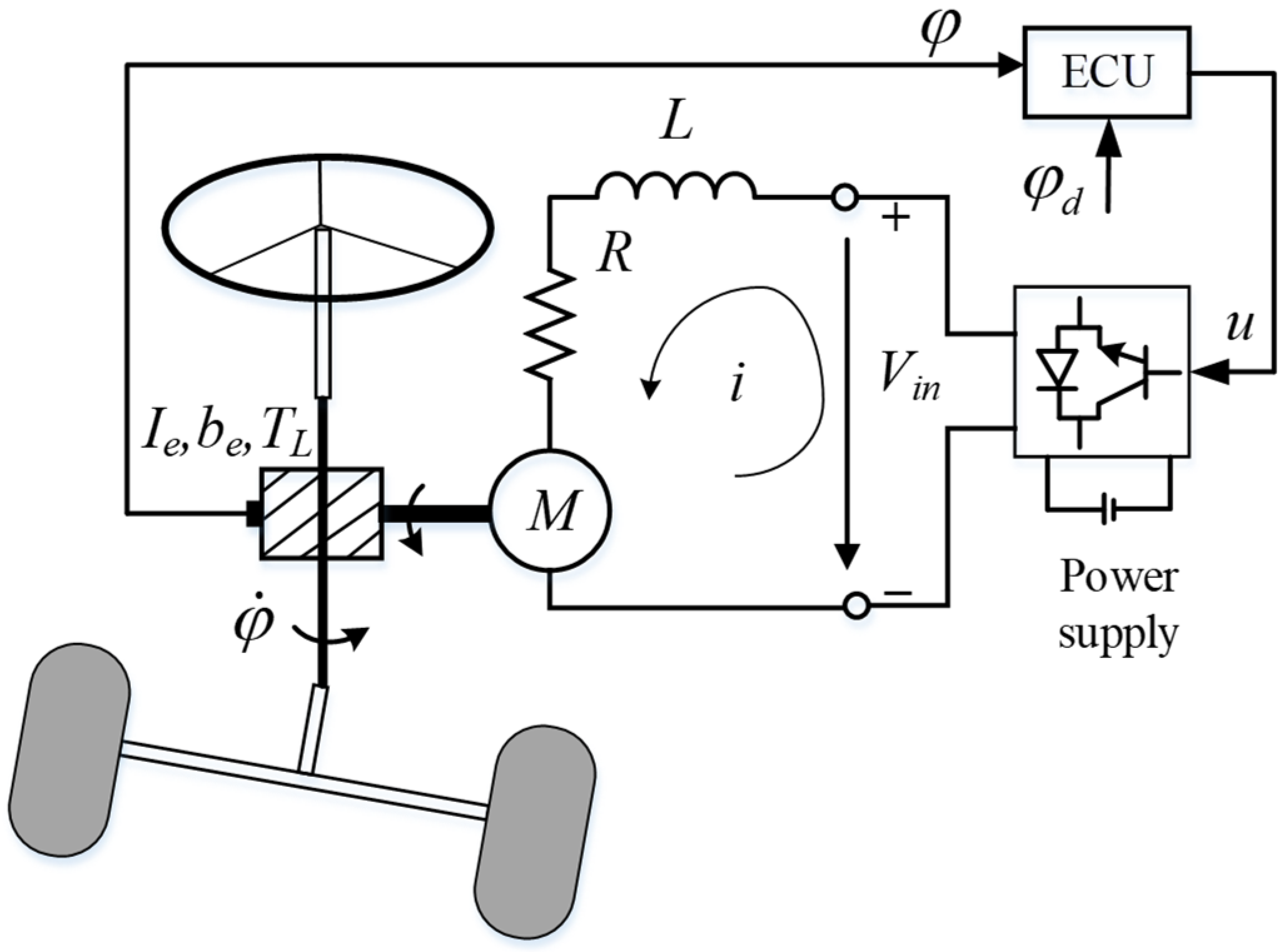
The AEPS under study contains a direct-current motor integrated with a position (angle) sensor, a steering column, a steering wheel, and a power supply. In addition, a transmission mechanism is deployed to reduce speed and boost torque. The topology of the AEPS system is displayed in Figure 1. This system’s mathematical model results from the above-mentioned components, as detailed below [25]:
φ ¨ = b e I e φ ˙ + K T I e i 1 I e T L i ˙ = K e L φ ˙ R L i + V in   L u
where φ, φ ˙ , and φ ¨ represent the position, speed, and acceleration, respectively, of the DC motor; u defines the duty cycle of pulse-width modulation (PWM); Vin is the DC voltage supply; L, R, and i define armature inductance, resistance, and armature current, respectively; KT and Ke define the torque factor and the back electromotive force factor, respectively; and Ie, TL, and be represent, respectively, the equivalent inertia, the EPS load torque, and the equivalent damping of the EPS system.
The system state variables are selected as follows: ε = φ φ ˙ K T I e i T = ε 1 ε 2 ε 3 T . The EPS system can be formulated as follows:
ε ˙ 1 = ε 2 ε ˙ 2 = ε 3 + m 1 ε 2 + d 1 ε ˙ 3 = q u + m 2 ε 2 + m 3 ε 3 + d 2
where q = KT·Vin/(L·Ie), m1 = −be/Ie, m2 = −KT·Ke/(L·Ie), and m3 = −R/L denote the known factors; d1 = −TL/Ie + Δm1ε2 and d2 = Δm2ε2 + Δm3ε3 are the lumped disturbances; and Δmi (i = 1, 2, 3) are the parametric uncertainties.
Remark 1.
The objective of control methodology is to propose an adaptive neural network controller that the automotive electric power steering angle precisely follows the desired angle signal as closely as possible.

3. Controller Algorithm

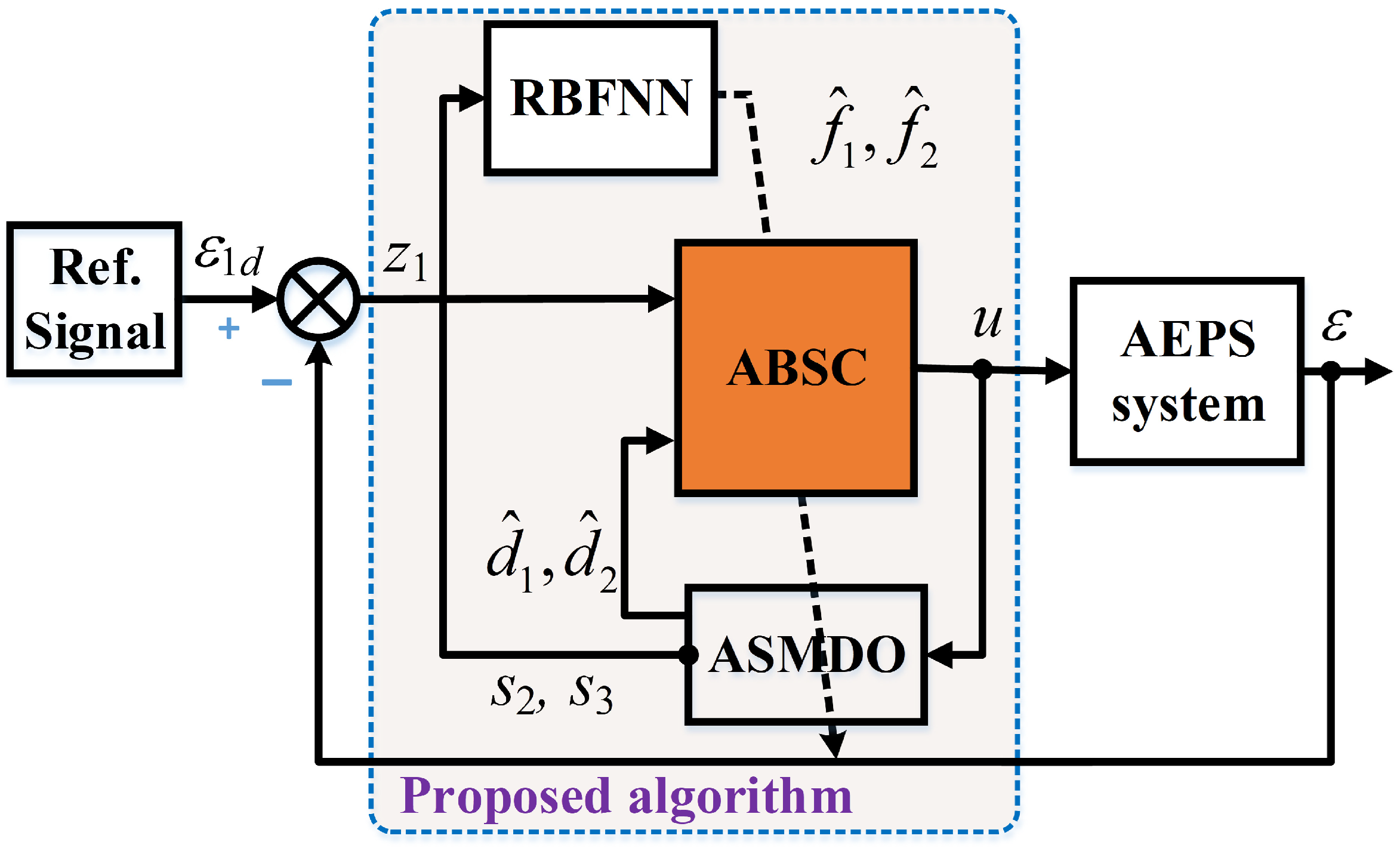
In this section, a combination of a backstepping approach, an adaptive control law, and a disturbance estimation is given to build a control law and achieve high tracking performance. A schematic diagram of the proposed algorithm is presented in Figure 2. The step-by-step control implementation is described as follows.

3.1. Adaptive Sliding-Mode Disturbance Observer (ASMDO)

Lemma 1 
([12,13,38]). For an arbitrary nonlinear function g, there is a RBF neural network that can approximate g, such as the following:  f i ε   = W i θ * T   + ς i , i = 2 , 3 . Herein, θ(ε) = [θ1(ε), θ2(ε), …,  θm(ε)]T is a Gaussian function that obeysθ‖ ≤ 1; σ(ε) defines an NN approximation error; |σ(ε)| < σm(ε) and σm(ε) > 0; and W i * T denotes an ideal NN weight vector. The expression can be written as follows:
σ i = arg min sup f i ε W i * T θ i ε
where  θ i ε i n = exp ε i n ω j 2 2 b j 2 ; εin denotes the input vector of NN;  j = 1 ÷ L ; L is the number of basic functions; and ωj and bj are the center and width, respectively, of the Gaussian function.
We define f 2 ε = m 1 ε 2   and   f 3 ε = m 2 ε 2 + m 3 ε 3 as the unknown nonlinear functions. Using RBF neural networks to approximate the continuous function fi, we obtain the following:
f ^ i ε = W ^ i T θ i ε
where W ^ i = W ^ i W ^ i * ,   W ^ i , and   f ˜ i = f ^ i f i = W ˜ i θ i T σ i , i = 2 , 3 define the weight estimation error, the estimated value, and the approximation error, respectively, of the nonlinear function fi.
Lemma 2
 ([39]). For the positive arbitrary c0, Young’s inequality can be described as follows:
x 1 x 2 c 0 p p x 1 p + 1 q c 0 q x 2 q
where  x 1 , x 2 R , p , q > 1   and   q 1 p 1 = 1 .
An adaptive sliding-mode disturbance observer (ASMDO) is introduced to estimate and compensate for lumped disturbances in the control design. Compared with conventional observers, including disturbance observers [21] and extended state observers [22], the ASMDO provides advantages such as reduced reliance on auxiliary variables and integrated neural network modeling. Consequently, by properly tuning the observer gains, the ASMDO is capable of estimating the lumped uncertainties with high accuracy. The ASMDO can be established as follows:
ξ ˙ 2 = μ 2 s 2 D 1 sgn s 2 η 2 s 2 α 2 + W ^ 2 T θ 2 + ε 3 ξ ˙ 3 = μ 3 s 3 D 2 sgn s 3 η 3 s 3 α 3 + W ^ 3 T θ 3 + q u
where s i = ξ i ε i , i = 2 , 3 denote the auxiliary variables; μ i , D i 1 ,   and   η i , i = 2 , 3 define the positive constants; and α i = 2 l i + 1 / 2 l i + 3 , l i Ν .
The matched and mismatched disturbances can be estimated by
d ^ i 1 = μ 2 s i D i 1 sgn s i η i s i α i , i { 2 , 3 }
where d ^ i denotes the estimated disturbance value.
The adaptive law is defined as follows:
W ^ ˙ i = Γ i θ i s i χ i W ^ i , i { 2 , 3 }
where Γ i   and   χ i denote the constant gains.
The Lyapunov function (LFU) can be chosen as follows:
V A S O B i = 1 2 s i 2 + 1 2 Γ i W ˜ i T W ˜ i , i = 2 , 3
The time derivative of VASMDOi can be calculated by
V ˙ A S O B i = s i s ˙ i + Γ i 1 W ˜ i T W ˜ ˙ i = s i ξ ˙ i ε ˙ i + Γ i 1 W ˜ i T W ^ ˙ i = s i μ i s i D i 1 sgn s i η i s i α i + W ^ i T θ i W i θ i * T ς i d i 1 + Γ i 1 W ˜ i T W ^ ˙ i = μ i s i 2 D i 1 s i η i s i α i + 1 s i d i 1 s i ς i + W ˜ i T θ i s i + Γ i 1 W ^ ˙ i μ i s i 2 D i 1 d i 1 s i η i s i α i + 1 s i ς i χ i W ˜ i T W ^ i
Applying Young’s inequality, the following is yielded:
s i ς i 1 2 s i 2 + 1 2 ς i m 2 i = 2 3 χ i W ˜ i T W ^ i i = 2 3 χ i 2 W ˜ i 2 + χ i 2 W i * 2
Substituting Equation (11) into Equation (10), one obtains
V ˙ A S O B = i = 2 3 V ˙ A S O B i i = 2 3 μ i 1 2 s i 2 i = 2 3 χ i 2 W ˜ i 2 + 1 2 i = 2 3 ς i m 2 + i = 2 3 χ i 2 W i * 2 V ˙ A S O B Π V ˙ A S O B + Ψ
where Π =   m i n   μ i 1 2 , χ i 2   and   Ψ = 1 2 i = 2 3 ς i m 2 + i = 2 3 χ i 2 W i * 2 .
Theorem 1.
Considering the presented system (2), under the ASMDO designed using Equations (6) and (7) and the adaptive law set out in Equation (8), the disturbance approximation errors of di−1 and  W ˜ i , i = 2 , 3  are bounded and go to the small region, i.e.,  W ˜ i w i m , d ˜ i 1 d i m , i = 2 , 3 ; w i m > 0 , d i m > 0 .
Proof of Theorem 1.
It is revealed from Equation (12) that lim t V A S O B = Ψ Π . This implies that the Lyapunov function VASMDO in (9) is convergent. Therefore, Theorem 1 is demonstrated. □

3.2. Synthesis of Adaptive Finite-Time Backstepping Control (ABSC) Design

Step 1: The tracking error and adaptive law are proposed as follows:
z 1 = ε 1 ε 1 d z i = ε i β i 1 , i = 2 , 3
where ε1d defines the target signal and βi is the virtual law, to be defined later.
Differentiating (13) with respect to time yields the following:
z ˙ 1 = ε 2 ε ˙ 1 d
The intermediate control law is now introduced, as follows:
β 1 = ρ 11 z 1 ρ 12 z 1 λ 12 ρ 13 z 1 λ 13 + ε ˙ 1 d
where 0 < λ 12 < 1   and   λ 13 > 1 , ρ 11 , ρ 12 ,   and   ρ 13 define the positive scalars.
The Lyapunov function can be designed as follows:
V 1 = 1 2 z 1 2
Taking the derivative of (16) yields the following:
V ˙ 1 = z 1 z ˙ 1 = z 1 z 2 + β 1 ε ˙ 1 d = z 1 z 2 z 1 ρ 11 z 1 + ρ 12 z 1 λ 12 + ρ 13 z 1 λ 13
Step 2: Differentiating the error between the virtual signal η1 and ξ2 in (13) with respect to time, we get
z ˙ 2 = ε 3 + f 2 + d 1 β ˙ 1 = z 3 + β 2 + f 2 + d 1 β ˙ 1
We now propose the virtual control law, as follows:
β 2 = ρ 21 z 2 ρ 22 z 2 λ 22 ρ 23 z 2 λ 23 f ^ 2 d ^ 1 z 1 + β ˙ 1
where 0 < λ 22 < 1   and   λ 23 > 1 ; and ρ 21 , ρ 22 ,   and   ρ 23 define the positive scalars.
The LFC in Step 2 can be formulated as follows:
V 2 = V 1 + 1 2 z 2 2
Taking the derivative of (20) yields the following:
V ˙ 2 = V ˙ 1 + z 2 z ˙ 2 = V ˙ 1 + z 2 z 3 + β 2 + f 2 + d 1 β ˙ 1 = z 2 z 3 i = 1 2 z i ρ i 1 z i + ρ i 2 z i λ i 2 + ρ i 3 z 2 λ i 3 z 2 f ˜ 2 z 2 d ˜ 1
Step 3: Differentiating the error between the virtual signal η2 and ξ3 in (13) with respect to time, we get
z ˙ 3 = ε ˙ 3 β ˙ 2 = q u + f 3 + d 2 β ˙ 2
We propose the virtual control law as follows:
u = 1 q ρ 31 z 3 ρ 32 z 3 λ 32 ρ 33 z 3 λ 33 f ^ 3 d ^ 2 z 2 + β ˙ 2
where 0 < λ 32 < 1   and   λ 33 > 1 , ρ 31 , ρ 32 ,   and   ρ 33 define the positive scalars.
The Lyapunov candidate function in step 3 can be formulated as follows:
V 3 = V 2 + 1 2 z 3 2
Taking the derivative of (24), the following is deduced:
V ˙ 3 = V ˙ 2 + z 3 z ˙ 3 = V ˙ 2 + z 3 q u + f 3 + d 2 β ˙ 2 = i = 1 3 z i ρ i 1 z i + ρ i 2 z i λ i 2 + ρ i 3 z i λ i 3 i = 2 3 z i f ˜ i i = 2 3 z i d ˜ i 1
Selecting V = V3 as the Lyapunov function, we obtain
V ˙ i = 1 3 ρ i 1 z i 2 i = 1 3 ρ i 2 z i λ i 2 + 1 i = 2 3 z i f ˜ i i = 2 3 z i d ˜ i 1
From Theorem 1, utilizing Young’s inequality, we obtain
i = 1 3 z i f ˜ i i = 1 3 1 2 z i 2 + 1 2 f i m 2 i = 2 3 z i d ˜ i 1 i = 2 3 1 2 z i 2 + 1 2 d i m 2
where f i m = w i m + σ i m .
Substituting (27) into (26), the following is yielded:
V ˙ i = 1 3 ρ i 1 1 z i 2 i = 1 3 ρ i 2 z i 2 λ t + 1 2 i = 1 3 f i m 2 + 1 2 i = 1 2 d i m 2 V ˙ Π 1 V Π 2 V λ i 2 + 1 2 + Ψ 1
where Π 1 =   λ m i n ρ i 1 1   , Π 2 =   λ m i n ρ i 2   , λ t = λ i 2 + 1 2 , and   Ψ 1 = 1 2 i = 1 3 f i m 2 + 1 2 i = 1 2 d i m 2 .
Theorem 2.
Considering the EPS system (2), under the presented ASMDO (6), as well as the adaption law (8), the intermediate control law (15) and (19), and the actual controller (23), the error state variables  z i  in (13) and system states of the EPS system satisfy that  z i 0   as   t , i = 1 , 2 , 3  in finite time.
Remark 2.
It is noted that finite-time convergence is particularly critical for electric power steering systems, due to their safety-critical role and real-time operational requirements. Unlike asymptotic convergence, which only guarantees error reduction over an infinite time horizon, finite-time convergence ensures that errors in steering-angle and torque tracking are eliminated within a known and bounded time. This property is essential for rapid driver–vehicle interaction, effective disturbance rejection, and safe operation under dynamic driving conditions, especially in autonomous and steer-by-wire applications.
Proof of Theorem 2.
It is revealed from Equation (28) that the residual set of the solution of the AEPS system is presented by
lim t T r V ( x ) min Ψ 1 1 θ 0 Π 1 , Ψ 1 1 θ 0 Π 2 1 λ t where   θ 0   satisfies   0 < θ 0 < 1 .  
where θ 0   satisfies   0 < θ 0 < 1 .
We can now state that V is bounded, and convergence time is obtained as in [40], as follows:
T r max t 0 + 1 θ 0 Π 1 ( 1 λ t ) ln θ 0 Π 1 V 1 λ t t 0 + Π 2 Π 2 t 0 + 1 Π 1 ( 1 λ t ) ln Π 1 V 1 λ t t 0 + θ 0 Π 2 θ 0 Π 2
Therefore, Theorem 2 is verified. □

4. Results and Discussion

4.1. Simulation Results

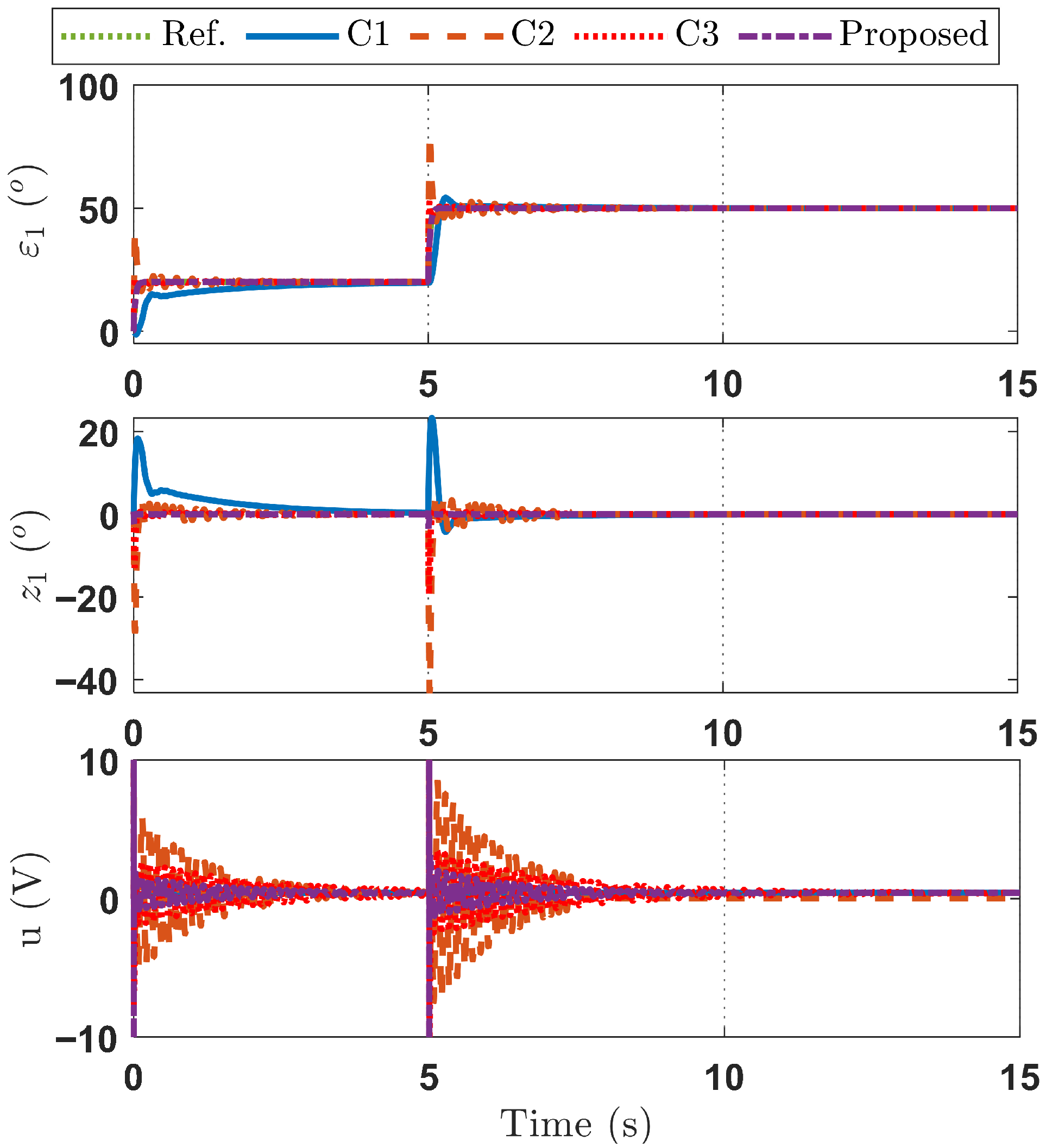
In a MATLAB/SIMULINK 2024a environment, simulation studies of two cases are performed to demonstrate the advantage of the suggested methodology. The simulation time is Tf = 15 s. The first reference tracking trajectory is given as ε1d = 60(1 − cos(0.75πt)(1 − et), where t ∈ [0, Tf]. The second reference, i.e., a step signal, is given as ε1d = 20 if (t ≤ 5 s) and ε1d = 50 if (5 < tTf). The AEPS system parameters in simulations are presented as follows: Vin = 12 V, La = 0.006 H, Ke = KT = 0.05 V/(rad/s), R = 0.35 Ω, Ie = 0.0002 kg·m2, and be = 0.0001 Nm/(rad/s).
Three other control strategies are used for the purpose of performance comparison, including a PI controller (C1), as follows:
u = k p ε 1 d ε 1 + k i 0 t ε 1 d ε 1 d t
where kp = 12, ki = 6, and a sliding-mode controller with super twisting algorithm (C2) is expressed as follows:
u = k 1 ε 1 d ε 1 1 / 2 s i g n ε 1 d ε 1 k 2 0 t s i g n ε 1 d ε 1 d t
where k1 = 5.2, k2 = 4.5, and an adaptive backstepping controller without disturbance observer (C3) is expressed as follows:
W ^ ˙ i = Γ i θ i s i χ i W ^ i , i { 2 , 3 } d ^ i 1 = μ 2 s i D i 1 sgn s i η i s i α i , i { 2 , 3 } β 1 = ρ 11 z 1 ρ 12 z 1 λ 12 ρ 13 z 1 λ 13 + ε ˙ 1 d β 2 = ρ 21 z 2 ρ 22 z 2 λ 22 ρ 23 z 2 λ 23 f ^ 2 d ^ 1 z 1 + β ˙ 1 u = 1 q ρ 31 z 3 ρ 32 z 3 λ 32 ρ 33 z 3 λ 33 f ^ 3 d ^ 2 z 2 + β ˙ 2
where the control gain of C3 is chosen to be the same as that of the proposed strategy. The gain parameters of the proposed methodology are designed as follows:
Γ i = 5 , χ i = 0.3 , μ i = 0.6 , D 1 = 10 , D 2 = 50 , α i = 9 / 11 , ρ 11 = 25 , ρ 12 = 10 , ρ 13 = 0.6 , λ 12 = λ 22 = λ 32 = 7 / 6 , λ 13 = λ 23 = λ 33 = 6 / 7 , ρ 21 = 85 , ρ 22 = 10 , λ 12 = 7 / 6 , ρ 23 = 0.6 , ρ 31 = 65 , ρ 32 = 10 , λ 32 = 7 / 6 , ρ 33 = 0.6 .
Remark 3.
Based on the developed control law in (33), guidelines for parameter selection are provided as follows: First, the finite-time backstepping control parameters ρ1i, ρ2i, ρ3i, (i = 1, 2, 3) are selected. Next, the observer gains μ i , D i 1 ,   and   η i , i = 2 , 3  are determined. Then, the adaptation rates of the neural network weights  Γ i   and   χ i (i = 2, 3) are tuned. Finally, the influence of these parameters on the behavior of the AEPS system can be assessed through simulation studies and experimental validation.
Case 1.
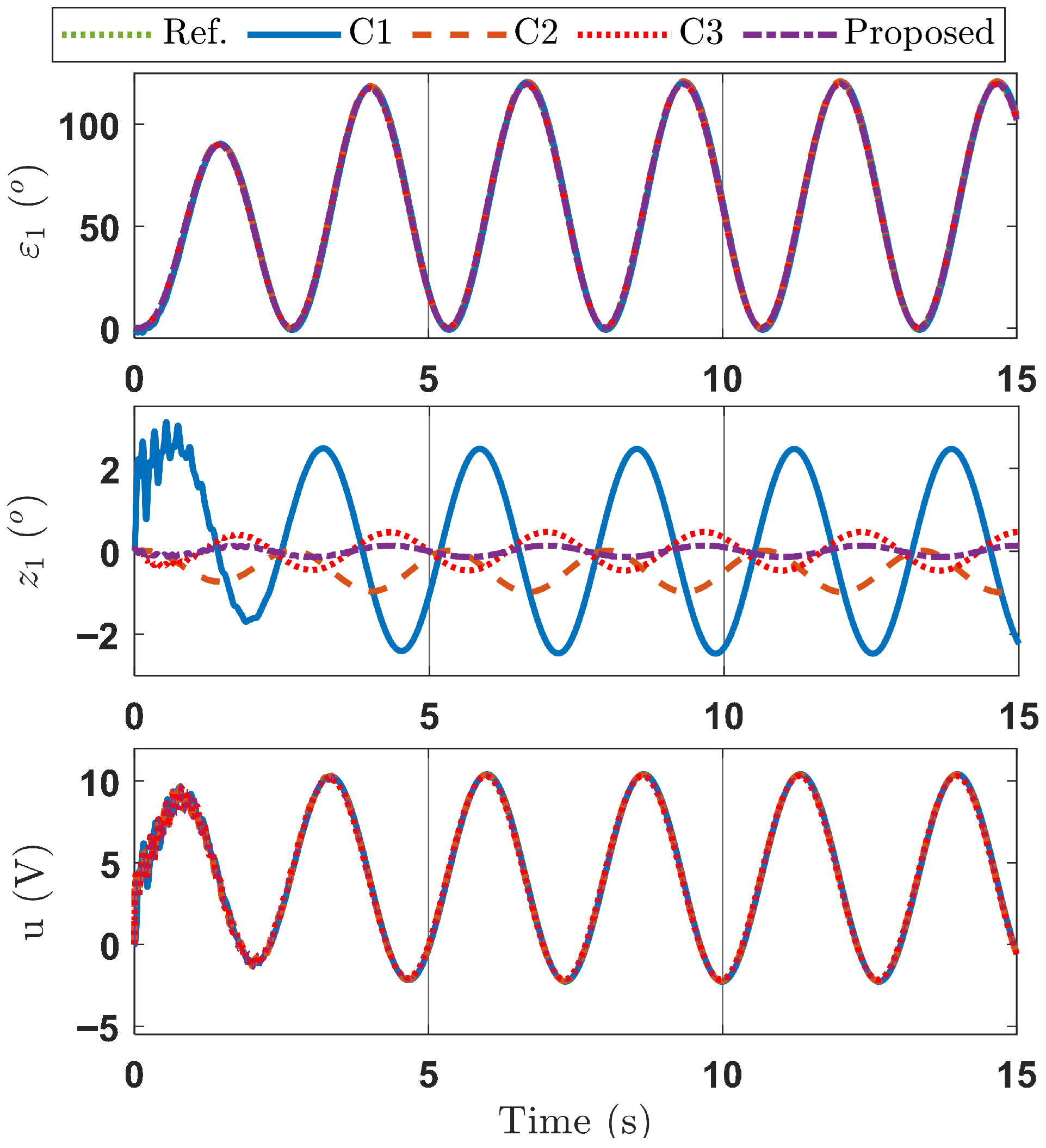
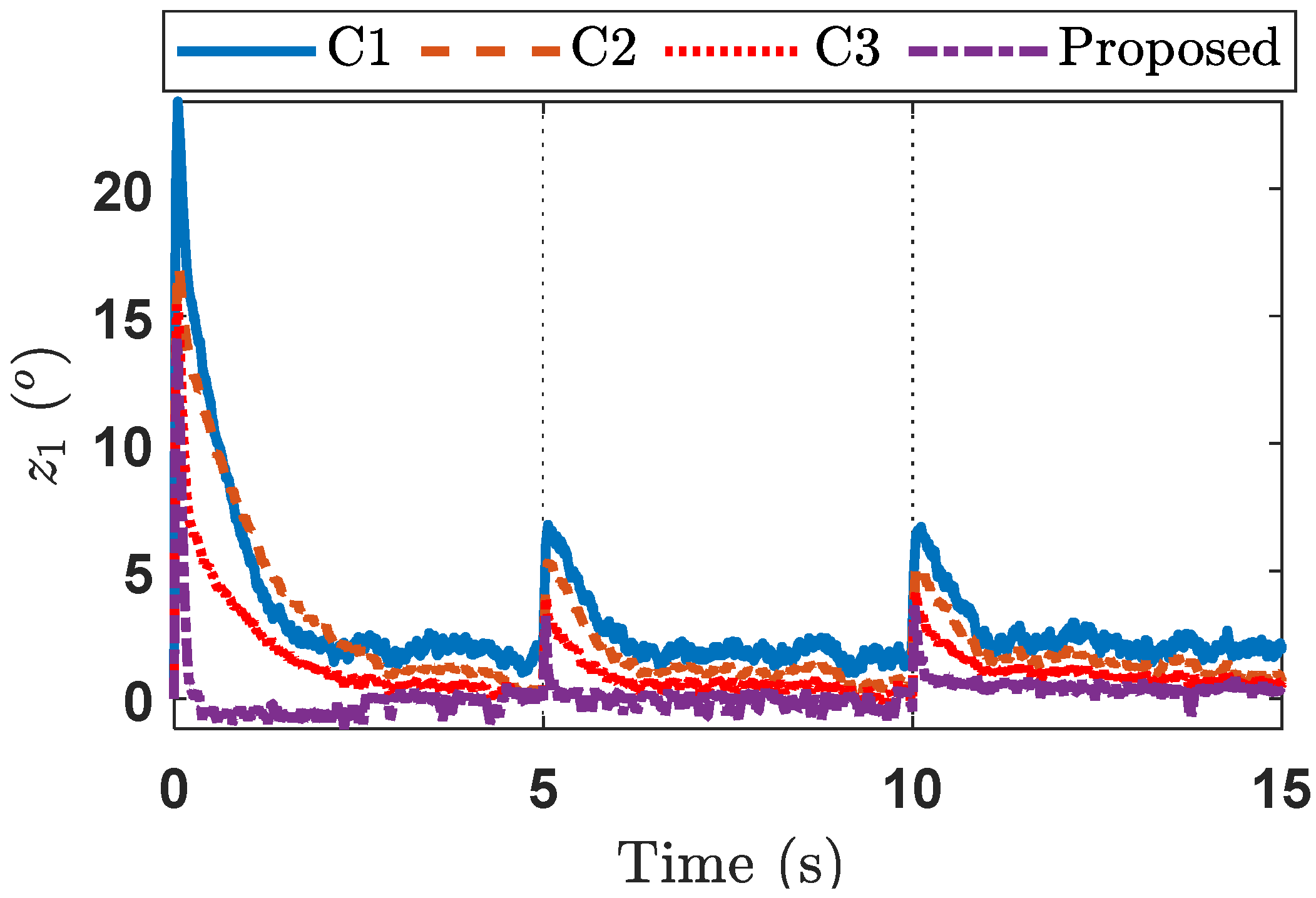
The simulation results for this case study are provided in Figure 3 and Figure 4. From the first subgraph of Figure 3, the tracking control performance under the influence of disturbances and uncertainties may be evaluated. It is evident that the proposed algorithm provides more precise control than other control methods. The second subgraph of Figure 3 presents the tracking errors of the various controllers. The C1 controller performs significantly worse than any other controller, exhibiting the largest tracking error. Although C2 and C3 demonstrate better tracking performance than C1, their errors remain larger than those obtained using the proposed method. The third subgraph of Figure 3 shows the control action signals of the steering angles. To further compare the performance of the four controllers, quantitative metrics—including root mean square error ( e r m s ) and maximum error ( e m a x )—are provided in Table 1, in addition to the graphical results. It can be observed that the proposed strategy achieves the lowest values of  e r m s  and  e m a x .
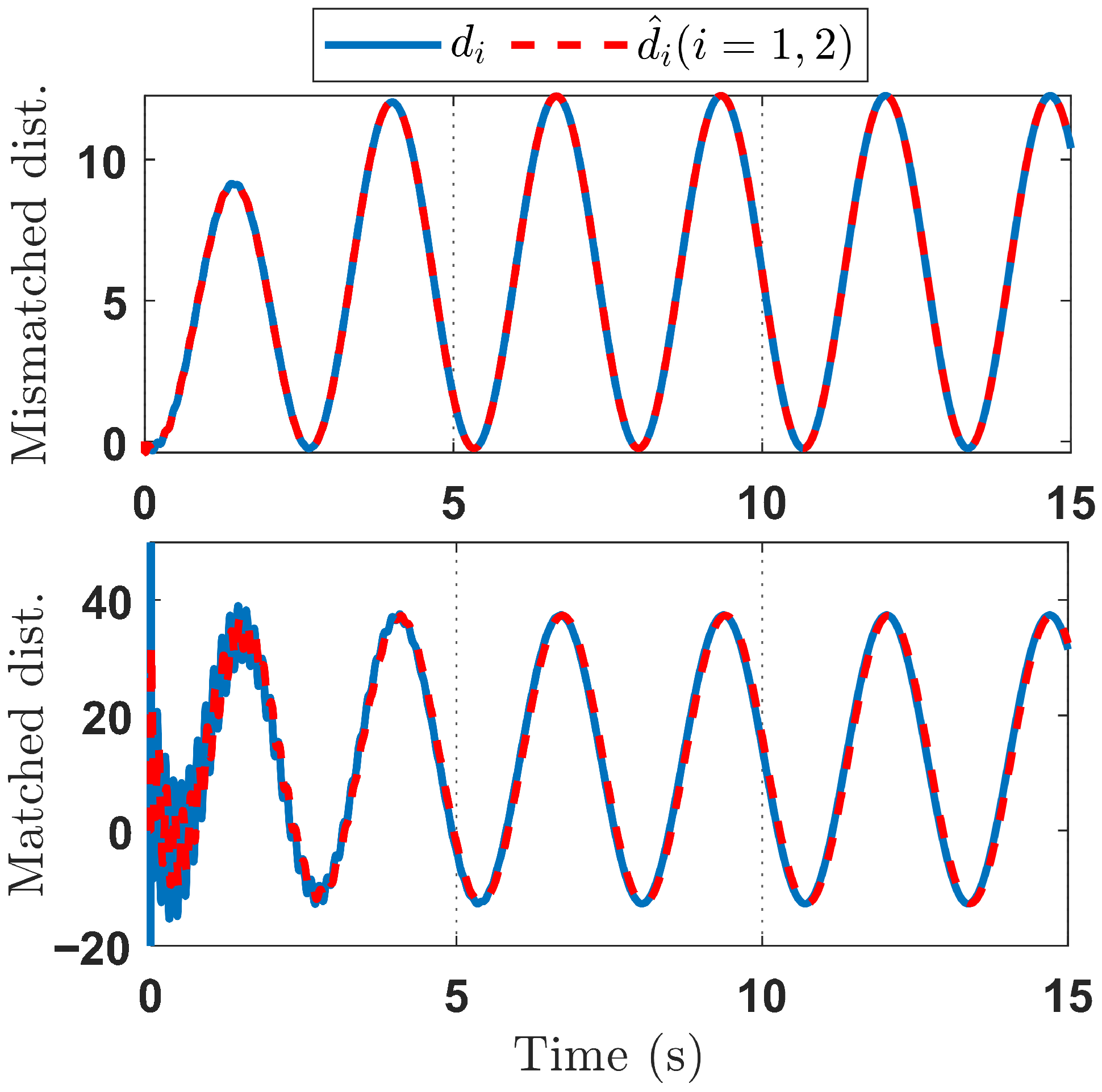
The effective estimation capability of the ASMDO is illustrated in Figure 4. The ASMDO demonstrates superior stability and accuracy, contributing to the enhanced control performance of the proposed strategy.
Case 2.
The simulation results for this case study are presented in Figure 5 and Figure 6. In the first subgraph of Figure 5, the results indicate that all four schemes can effectively track their reference signals. However, the control responses of C1, C2, and C3 all exhibit significant overshoot, particularly around 0 to 5 s where the desired signal changes rapidly. For ease of comparison, the tracking errors of the four controllers are displayed in the second subgraph of Figure 5. It is evident that the proposed method exhibits the lowest tracking error and exhibits less overshoot compared to the other control methods. Finally, the control signals are presented in the third subgraph of Figure 5.
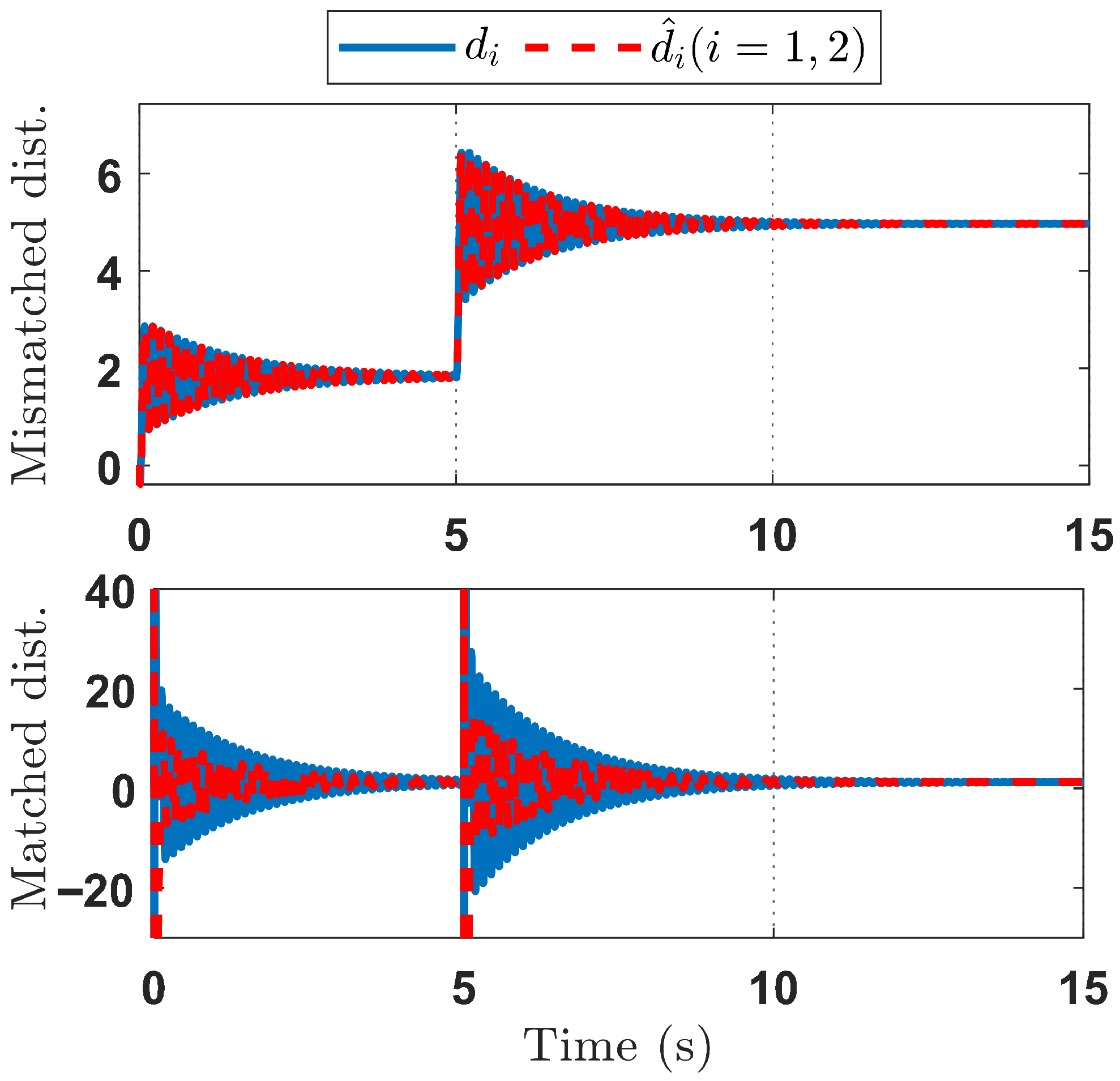
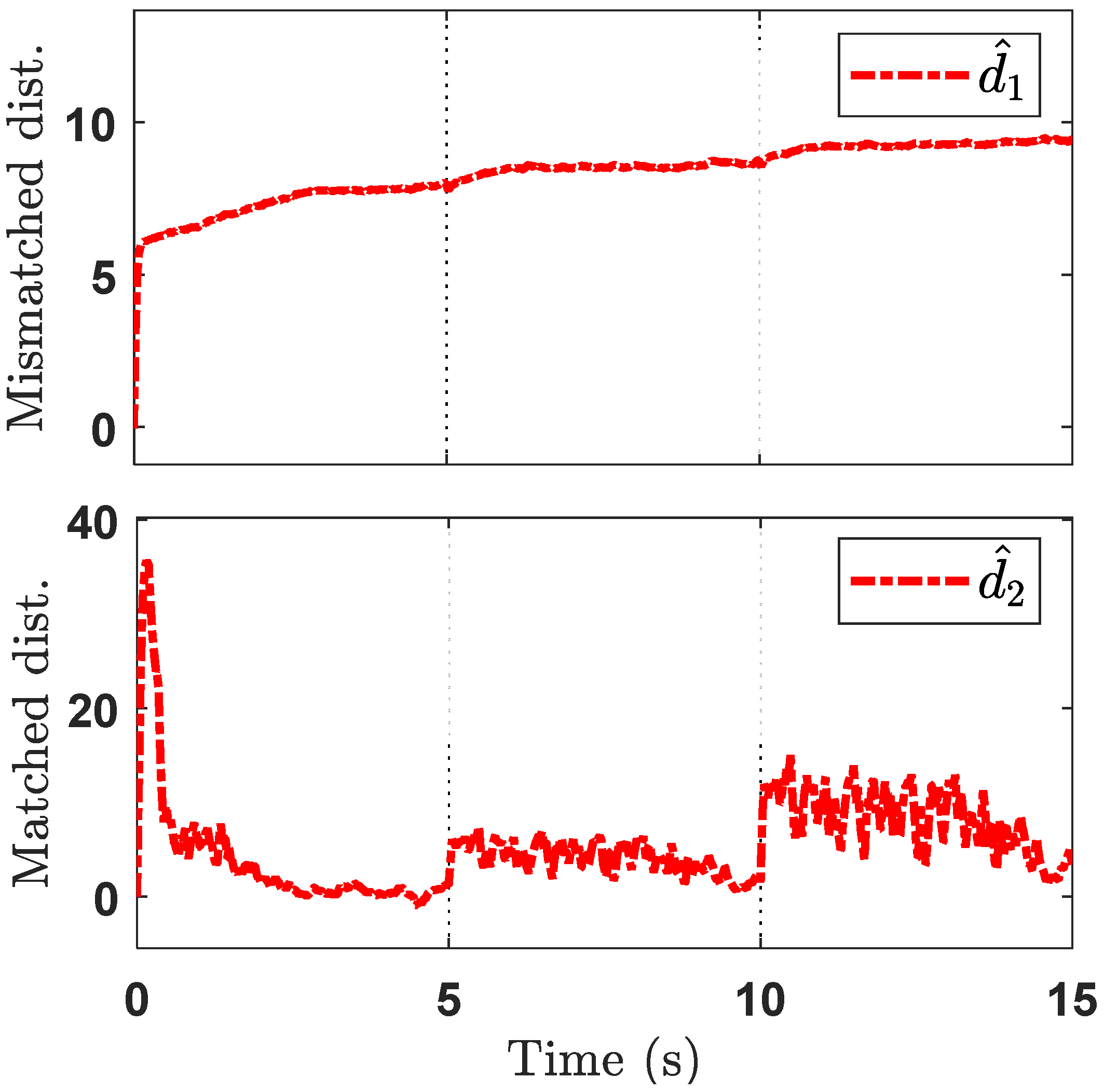
The disturbance estimation curves are presented in Figure 6. These show that both matched and mismatched disturbances are successfully estimated and fed into the proposed control algorithm. As a result, the tracking performance of the suggested method is significantly enhanced. Therefore, the simulation results reconfirm that the proposed scheme is both effective and feasible for the AEPS system.

4.2. Experimental Results

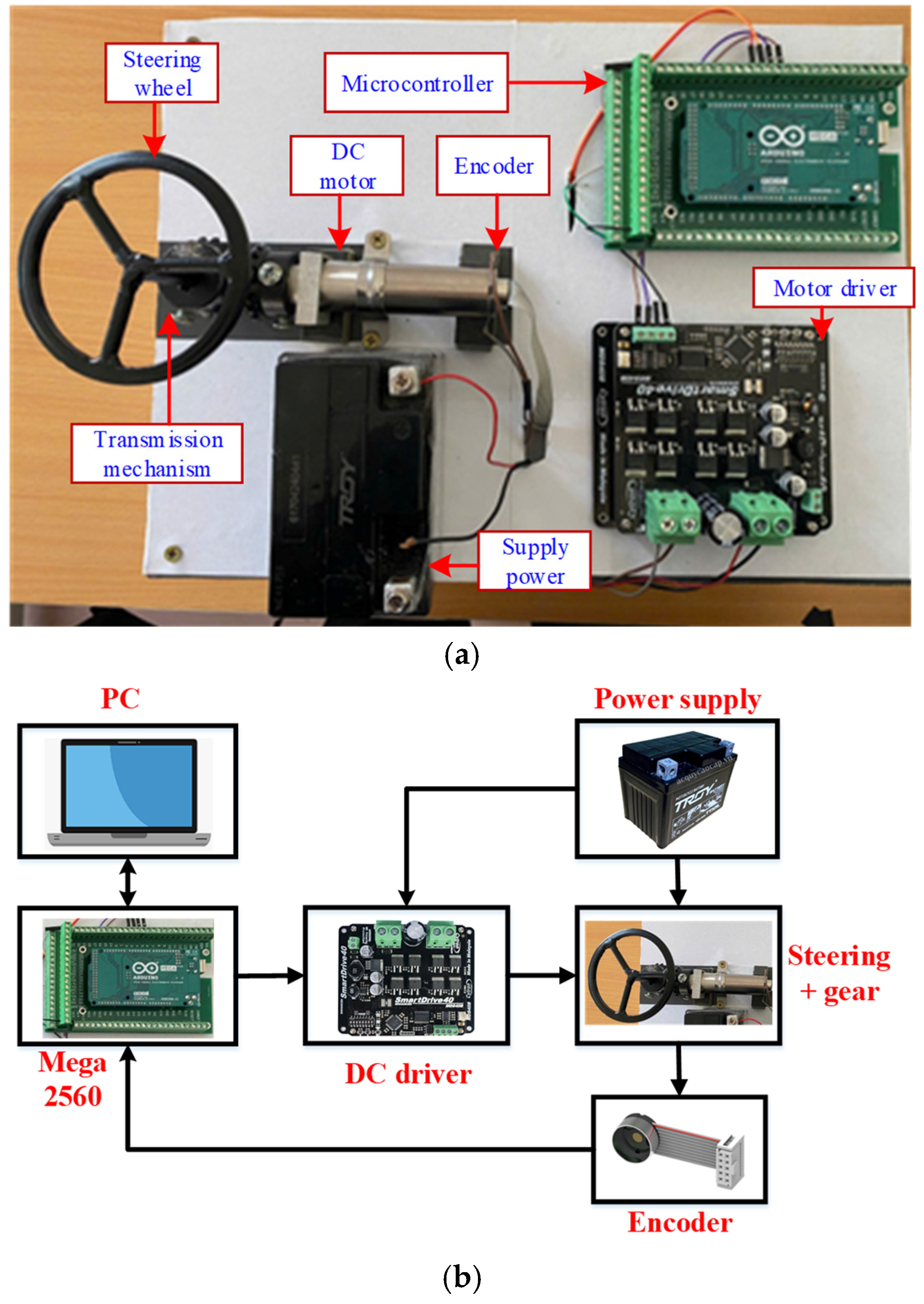
Hardware-in-the-loop testing of the AEPS system is utilized to verify the efficiency of the suggested strategy, as displayed in Figure 7. Figure 7a gives an overview of the experiment platform. Figure 7b shows the connection of the electrical and mechanical parts. Herein, the Arduino Mega 2560 microcontroller serves as the central controller of the system, receiving input from encoder sensors mounted on the motors to monitor their speed and position. The microcontroller interfaces with a MATLAB/SIMULINK-integrated computer, receiving encoder feedback and transmitting control commands to the MDS40B motor driver, which adjusts each motor’s speed and direction using PWM signals. The system employs a 12V MAXON DC motor connected to the steering wheel via a gear mechanism. By adjusting the current supplied to the motor, the control circuit governs the steering wheel’s movement, ensuring precise and efficient operation of the model. Details regarding the equipment specifications and sensor precision are provided in Table 2.
In the experiment, the sampling time is set to 0.01 s. For data acquisition, the output position of the steering wheel is measured by the ENX 16 EASY encoder and sent to an Arduino, which communicates with a PC running MATLAB/Simulink through the Real-Time Windows Target Toolbox. The actual position is collected via the ‘To workspace’ block in MATLAB/Simulink, then compared with the desired signal to calculate the tracking error. This error is then fed into the proposed control algorithm developed in MATLAB/Simulink, which generates the control signal for the SmartDrive40 MDS40B motor driver. All signals—including the actual position, desired signal, tracking error, control input, and others—are collected using the ‘To Workspace’ block in MATLAB/Simulink and then plotted using commands in the MATLAB command window.
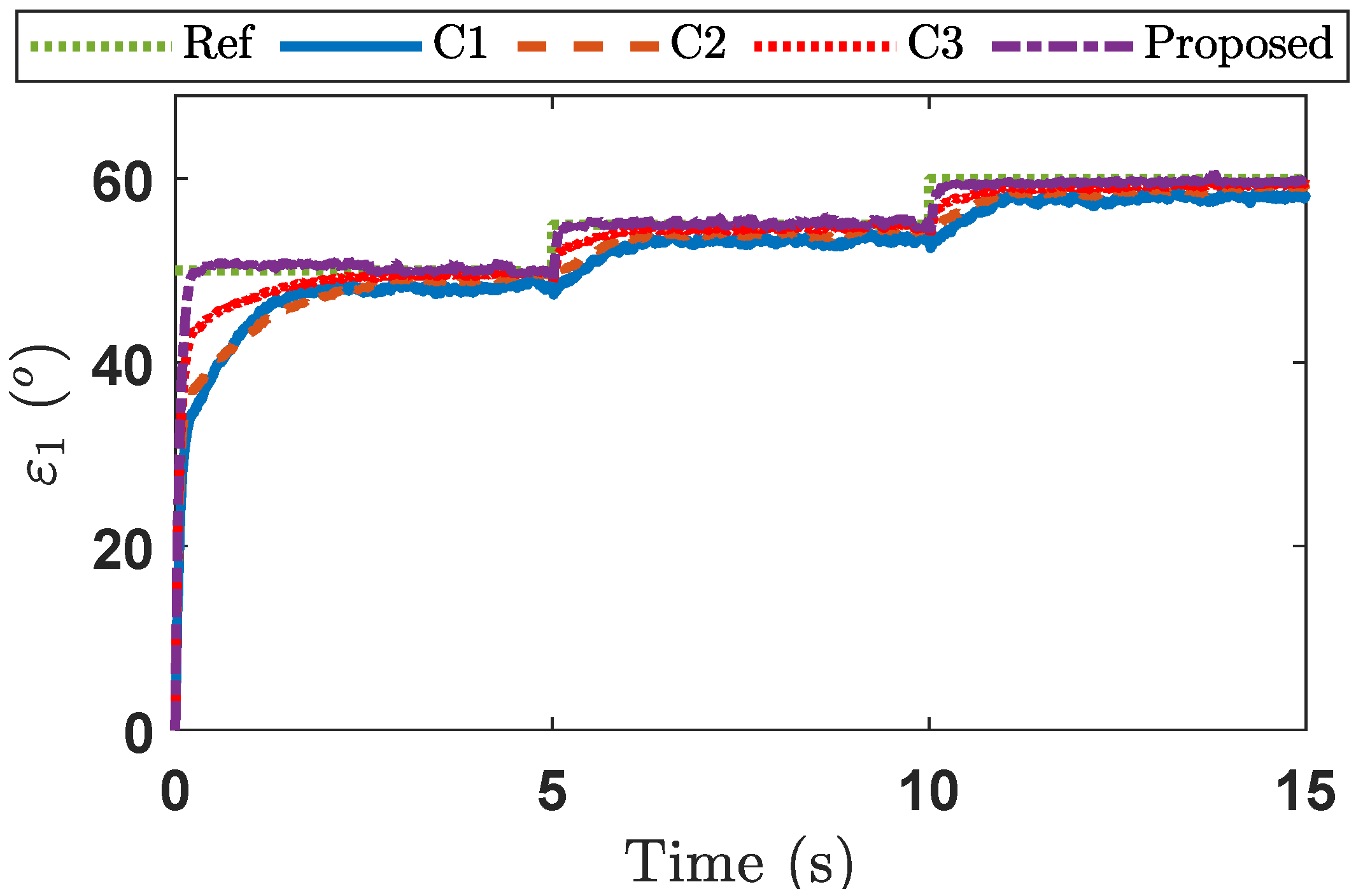
The reference trajectory signal, i.e., a multistep signal, is given as ε1d = 50 if (t ≤ 5 s), ε1d = 55 if (5 ≤ t ≤ 10 s), and ε1d = 60 if (5 < tTf).
The experimental results are depicted in Figure 8, Figure 9 and Figure 10, and are consistent with the simulation results. As shown in Figure 8, the tracking performance of all four controllers is satisfactory. However, the proposed controller, indicated by the purple line, achieves the highest accuracy. Figure 9 displays the tracking errors of different strategies. It can be observed that the proposed scheme yields a tracking error lower than that obtained using any existing control method.
Figure 10 presents the disturbance estimation results. These demonstrate that the ASMDO effectively estimates the lumped disturbance. Consequently, the impact of the disturbance is mitigated, leading to improved control performance using the proposed methodology. Overall, the results confirm that the proposed control scheme outperforms existing approaches.

5. Conclusions

For this work, we proposed an adaptive finite-time backstepping control-based disturbance observer for an AEPS system with unknown dynamics and disturbance. We deployed an RBFNN to approximate the unknown dynamics function of the AEPS system. Meanwhile, an adaptive sliding-mode disturbance observer (ASMDO) was constructed to estimate the lumped disturbance. By integrating the RBFNN and ASMDO into the finite-time backstepping control scheme, performance control was significantly improved. The system stability of the closed-loop AEPS system was confirmed by the Lyapunov principle. Finally, from simulation and HIL experiment results, we concluded that the proposed control effectively tracked the desired trajectory, with excellent performance being exhibited. In future work, the optimal tuning of control gains for the proposed control strategy will be investigated to further enhance control performance. In addition, sensor fault handling and the implementation of finite-time steering angle tracking on a real autonomous vehicle will be pursued.

Author Contributions

Conceptualization, J.U.Y. and V.N.D.; software, V.D.P. and T.A.M.; methodology, J.U.Y. and V.C.L.; validation, T.A.M.; formal analysis, D.T.D. and V.C.L.; investigation, V.D.P. and D.T.D.; data curation, S.P.H. and V.N.D.; writing—original draft preparation, J.U.Y. and V.D.P.; writing—review and editing, T.S.D. and S.P.H.; supervision, V.D.P. and T.S.D. All authors have read and agreed to the published version of the manuscript.

Funding

This research received no external funding.

Institutional Review Board Statement

Not applicable.

Informed Consent Statement

Not applicable.

Data Availability Statement

Data are contained within the article.

Conflicts of Interest

The authors declare no conflicts of interest.

Nomenclature

ε i System state variables
qKnown factor
miUnknown factors
diLumped disturbance
^ Estimation of •
˜ = ^ Estimation error of •
ViLyapunov function
WNN weight vector
ρ1i, ρ2i, ρ3iControl parameters
μ i , D i 1 ,   and   η i Observer gains
Γ i   and   χ i Adaptation rates
ziTracking errors
βiVirtual control law
uControl input

References

  1. Paden, B.; Cap, M.; Yong, S.Z.; Yershov, D.; Frazzoli, E. A Survey of Motion Planning and Control Techniques for Self-Driving Urban Vehicles. IEEE Trans. Intell. Veh. 2016, 1, 33–55. [Google Scholar] [CrossRef]
  2. Guan, X.; Zhang, Y.-N.; Duan, C.-G.; Yong, W.-L.; Lu, P.-P. Study on decomposition and calculation method of EPS assist characteristic curve. Proc. Inst. Mech. Eng. Part D J. Automob. Eng. 2021, 235, 2166–2175. [Google Scholar]
  3. Lin, Z.Y.; Chang, W.J.; Aslam, M.S.; Su, C.L.; Lin, Y.H. Difference State Feedback Fuzzy Control of Nonlinear Discrete-Time Ship Steering System in Descriptor Form. Int. J. Fuzzy Syst. 2025, 27, 1257–1278. [Google Scholar]
  4. Lee, J.H.; Moon, H.T.; Yoo, J.Y. Current sensorless drive method for electric power steering. Int. J. Autom. Technol. 2012, 13, 1141–1147. [Google Scholar] [CrossRef]
  5. Phan, V.D.; Phan, V.Q.; Dang, T.S.; Trinh, N.H.; Nguyen, P.N.; Luong, N.M.; Nguyen, B.U.; Phan, Q.C.; Bui, H.P.; Nguyen, P.C.A.; et al. Design of Adaptive Fuzzy-PID for Adaptive Cruise Control of Electric Vehicle Using DC Motor: Theory and Experiment. In Proceedings of the 1st International Conference on Sustainability and Emerging Technologies for Smart Manufacturing; Springer: Singapore, 2025; pp. 1–11. [Google Scholar]
  6. Lee, D.; Kim, K.-S.; Kim, S. Controller Design of an Electric Power Steering System. IEEE Trans. Control. Syst. Technol. 2018, 26, 748–755. [Google Scholar] [CrossRef]
  7. Kim, S.; Choi, M.; Sung, J. Experimental Verifications of Electric Power Steering Controller Based on Discrete-Time Sliding Mode Control with Disturbance Observer. Int. J. Automot. Technol. 2023, 24, 883–888. [Google Scholar] [CrossRef]
  8. Liao, Y.G.; Du, H.I. Modelling and analysis of electric power steering system and its effect on vehicle dynamic behaviour. Int. J. Veh. Auton. Syst. 2003, 1, 153–166. [Google Scholar] [CrossRef]
  9. Chang, W.J.; Lin, Y.H.; Lee, Y.C.; Ku, C.C. Investigating Formation and Containment Problem for Nonlinear Multi-Agent Systems via Interval Type-2 Fuzzy Sliding Mode Tracking Approach. IEEE Trans. Fuzzy Syst. 2024, 32, 4163–4177. [Google Scholar]
  10. Nguyen, T.H.; Do, T.C.; Phan, V.D.; Ahn, K.K. Working Performance Improvement of a Novel Independent Metering Valve System by Using a Neural Network-Fractional Order-Proportional-Integral-Derivative Controller. Mathematics 2023, 11, 4819. [Google Scholar]
  11. Phan, V.D.; Phan, Q.C.; Ahn, K.K. Observer-Based Adaptive Fuzzy Tracking Control for a Valve-Controlled Electro-Hydraulic System in Presence of Input Dead Zone and Internal Leakage Fault. Int. J. Fuzzy Syst. 2025. [Google Scholar] [CrossRef]
  12. Yang, X.; Li, J.; Ge, S.; Liang, X.; Han, T. Command Filter-Based Adaptive Neural Control for Nonstrict-Feedback Nonlinear Systems with Prescribed Performance. Fractal Fract. 2020, 8, 339. [Google Scholar] [CrossRef]
  13. Liu, D.; Liu, J.; Sun, C.; Dai, B. Convex Optimization-Based Adaptive Neural Network Control for Unmanned Surface Vehicles Considering Moving Obstacles. J. Mar. Sci. Eng. 2025, 13, 587. [Google Scholar] [CrossRef]
  14. Hartono, R.; Cha, H.R.; Shin, K.J. Design of Electric Power Steering System Identification and Control for Autonomous Vehicles Based on Artificial Neural Network. IEEE Access 2024, 12, 108460–108471. [Google Scholar] [CrossRef]
  15. Amirkhani, A.; Shirzadeh, M.; Heydari, J. Automotive Electric Power Steering Control with Robust Observer Based Neuroadaptive Type-2 Radial Basis Function Methodology. IEEE Open J. Veh. Technol. 2024, 5, 592–605. [Google Scholar] [CrossRef]
  16. Nguyen, T.A.; Iqbal, J. Improving stability and adaptability of automotive electric steering systems based on a novel optimal integrated algorithm. Eng. Comput. 2024, 41, 991–1034. [Google Scholar] [CrossRef]
  17. Li, Y.; Wu, G.; Wu, L.; Chen, S. Electric power steering nonlinear problem based on proportional–integral–derivative parameter self-tuning of back propagation neural network. Proc. Inst. Mech. Eng. Part C J. Mech. Eng. Sci. 2020, 234, 4725–4736. [Google Scholar] [CrossRef]
  18. Dao, H.V.; Na, S.; Nguyen, D.G.; Ahn, K.K. High accuracy contouring control of an excavator for surface flattening tasks based on extended state observer and task coordinate frame approach. Autom. Constr. 2021, 130, 103845. [Google Scholar] [CrossRef]
  19. Phan, V.D.; Sy, P.H.; Ahn, K.K. Disturbance Attenuation-Based Global Integral Sliding Mode Control of an Electro-Hydraulic System with Prescribed Performance. IEEE Access 2024, 12, 105108–105118. [Google Scholar] [CrossRef]
  20. Nguyen, V.G.; Guo, X.; Zhang, C.; Tran, X.K. Parameter Estimation, Robust Controller Design and Performance Analysis for an Electric Power Steering System. Algorithms 2019, 12, 57. [Google Scholar] [CrossRef]
  21. Khasawneh, L.; Das, M. A Robust Electric Power-Steering-Angle Controller for Autonomous Vehicles with Disturbance Rejection. Electronics 2022, 11, 1337. [Google Scholar] [CrossRef]
  22. Nguyen, T.A. Fuzzy sliding mode control based on an adaptive sliding surface and extended state observer for automotive electric power steering. Adv. Mech. Eng. 2025, 17, 16878132251315517. [Google Scholar] [CrossRef]
  23. Emirler, M.T.; Uygan, İ.M.C.; Güvenç, B.A.; Güvenç, L. Robust PID Steering Control in Parameter Space for Highly Automated Driving. Int. J. Veh. Technol. 2014, 2014, 259465. [Google Scholar] [CrossRef]
  24. Lu, S.; Lian, M.; Liu, M.; Cho, C.; Piao, C. Adaptive fuzzy sliding mode control for electric power steering system. J. Mech. Sci. Technol. 2017, 31, 2643–2650. [Google Scholar] [CrossRef]
  25. Wang, X.; Wang, W.; Li, L.; Shi, J.; Xie, B. Adaptive Control of DC Motor Servo System with Application to Vehicle Active Steering. IEEE/ASME Trans. Mechatron. 2019, 24, 1054–1063. [Google Scholar]
  26. Kang, C.M.; Kim, W.; Chung, C.C. Observer-based backstepping control method using reduced lateral dynamics for autonomous lane-keeping system. ISA Trans. 2018, 83, 214–226. [Google Scholar]
  27. Murilo, A.; Rodrigues, R.; Teixeira, E.L.S.; Santos, M.M.D. Design of a Parameterized Model Predictive Control for Electric Power Assisted Steering. Control Eng. Pract. 2019, 90, 331–341. [Google Scholar]
  28. Hanifah, R.A.; Toha, S.F.; Ahmad, S.; Hassan, M.K. Swarm-Intelligence Tuned Current Reduction for Power-Assisted Steering Control in Electric Vehicles. IEEE Trans. Ind. Electron. 2018, 65, 7202–7210. [Google Scholar] [CrossRef]
  29. Wang, J.; Wang, Q.; Jin, L.; Song, C. Independent wheel torque control of 4WD electric vehicle for differential drive assisted steering. Mechatronics 2011, 21, 63–76. [Google Scholar] [CrossRef]
  30. Tao, Y. A New Control Framework of Electric Power Steering System Based on Admittance Control. IEEE Trans. Control Syst. Technol. 2015, 23, 762–769. [Google Scholar]
  31. Alex, A.; Saleem, A. A Lyapunov-Based Dual Controller Approach with PSO Tuning for Steer-by-Wire Systems with Artificial Steering Feel. IEEE Access 2024, 12, 188976–188992. [Google Scholar] [CrossRef]
  32. Liem, D.T.; Truong, D.Q.; Ahn, K.K. A torque estimator using online tuning grey fuzzy PID for applications to torque-sensorless control of DC motors. Mechatronics 2015, 26, 45–63. [Google Scholar] [CrossRef]
  33. Nguyen, D.N.; Nguyen, T.A. Fuzzy Backstepping Control to Enhance Electric Power Steering System Performance. IEEE Access 2024, 12, 88681–88695. [Google Scholar] [CrossRef]
  34. Hameed, A.H.; Al-Samarraie, S.A.; Humaidi, A.J.; Saeed, N. Backstepping-Based Quasi-Sliding Mode Control and Observation for Electric Vehicle Systems: A Solution to Unmatched Load and Road Perturbations. World Electr. Veh. J. 2024, 15, 419. [Google Scholar]
  35. Jeong, Y.W.; Kim, J.S.; Kang, C.M.; Chung, C.C. Backstepping control design for the second-order electric power steering system using augmented observer. In Proceedings of the 2017 56th Annual Conference of the Society of Instrument and Control Engineers of Japan (SICE), Kanazawa, Japan, 19–22 September 2017. [Google Scholar]
  36. Nguyen, T.A. Sliding mode control based on active disturbance rejection control for improving performance of an electric power steering system. Proc. Inst. Mech. Eng. Part D J. Automob. Eng. 2025. [Google Scholar] [CrossRef]
  37. Zhao, X.; Zhao, L. Performance-guaranteed adaptive switching tracking control for steer-by-wire system with disturbance observer. Nonlinear Dyn. 2025, 113, 35107–35123. [Google Scholar]
  38. Phan, V.D.; Truong, H.V.A.; Le, V.C.; Ho, S.P.; Ahn, K.K. Adaptive neural observer-based output feedback anti-actuator fault control of a nonlinear electro-hydraulic system with full state constraints. Sci. Rep. 2025, 15, 3044. [Google Scholar]
  39. Ba, D.X.; Dinh, T.Q.; Bae, J.; Ahn, K.K. An Effective Disturbance-Observer-Based Nonlinear Controller for a Pump-Controlled Hydraulic System. IEEE/ASME Trans. Mechatron. 2020, 25, 32–43. [Google Scholar]
  40. Yu, J.; Shi, P.; Zhao, L. Finite-time command filtered backstepping control for a class of nonlinear systems. Automatica 2018, 92, 173–180. [Google Scholar] [CrossRef]
Figure 1. Configuration of the AEPS system.
Actuators 15 00092 g001
Figure 2. Topology of the proposed strategy.
Actuators 15 00092 g002
Figure 3. Performance trajectories of the other strategies in Case 1 simulation.
Actuators 15 00092 g003
Figure 4. Curves of estimated disturbances under the proposed strategy in Case 1 simulation.
Actuators 15 00092 g004
Figure 5. Performance trajectories of the other strategies in Case 2 simulation.
Actuators 15 00092 g005
Figure 6. Curves of estimated disturbances under the proposed strategy in Case 2 simulation.
Actuators 15 00092 g006
Figure 7. Structure of the experimental AEPS system: (a) overview, (b) wire connection.
Actuators 15 00092 g007
Figure 8. Performance trajectories of all strategies in experiment.
Actuators 15 00092 g008
Figure 9. Tracking error comparison of different controllers in experiment.
Actuators 15 00092 g009
Figure 10. Curves of estimated disturbances under the proposed strategy in experiment.
Actuators 15 00092 g010
Table 1. Quantitative metrics of four controllers in simulation and experiment.
C1C2C3Proposed
Case 1eRMS1.73420.57850.32010.0956
emax3.11460.98530.46590.1415
Case 2eRMS3.01292.49420.86560.1011
emax9.28418.14706.33013.4153
ExperimenteRMS2.53222.81652.12691.0354
emax7.12065.60414.47502.5618
Table 2. Hardware specifications of the real AEPS system.
ComponentsParametersSpecification
DC motorTypeDCX-26L
Rated power22 [W]
Dimensions (D × L)Ø26 × 57 [mm]
Nominal torque46.1 [Nm]
Speed constant445 r/min/V
CommutationPrecious metal brushes
EncoderTypeENX 16 EASY
Supply voltage+4.5 to +5 [V]
Number of channels3 (ChA, ChB, ChI)
Counts per turn (N)1024
Dimensions (D × L)Ø15.8 × 8.5 [mm]
Number of pins10
ArduinoModelAVR ATmega 2560 (8 bit)
Input supply7 to 12 [V]
Number of DI/DO pins54
Number of AI pins16
Number of PWM pins12
BatteryModelTROY TTX5L
Voltage12 [V]
Capacity3.5 [Ah]
Dimensions (L × W × H)114 × 70 × 86 [mm]
DC motor driverTypeSmartDrive40 MDS40B
Maximum current40 [A]
Input voltage10 to 45 [V]
Dimensions (L × W)124 × 107 [mm]
Input modesAnalog, PWM
Disclaimer/Publisher’s Note: The statements, opinions and data contained in all publications are solely those of the individual author(s) and contributor(s) and not of MDPI and/or the editor(s). MDPI and/or the editor(s) disclaim responsibility for any injury to people or property resulting from any ideas, methods, instructions or products referred to in the content.