Research on Levitation Control of a Two-Degree-of-Freedom System Based on IWOA-ISMC



Abstract
1. Introduction
2. Modeling of a Two-Degree-of-Freedom Levitation System
3. IWOA-ISMC Control Strategy Design
3.1. Improved Whale Optimization Algorithm
3.1.1. Logistic Chaotic Map and Opposition-Based Learning for Initialization
3.1.2. Annealing-Driven Search
3.1.3. The Adaptive-Weighted Exploitation Phase of WOA
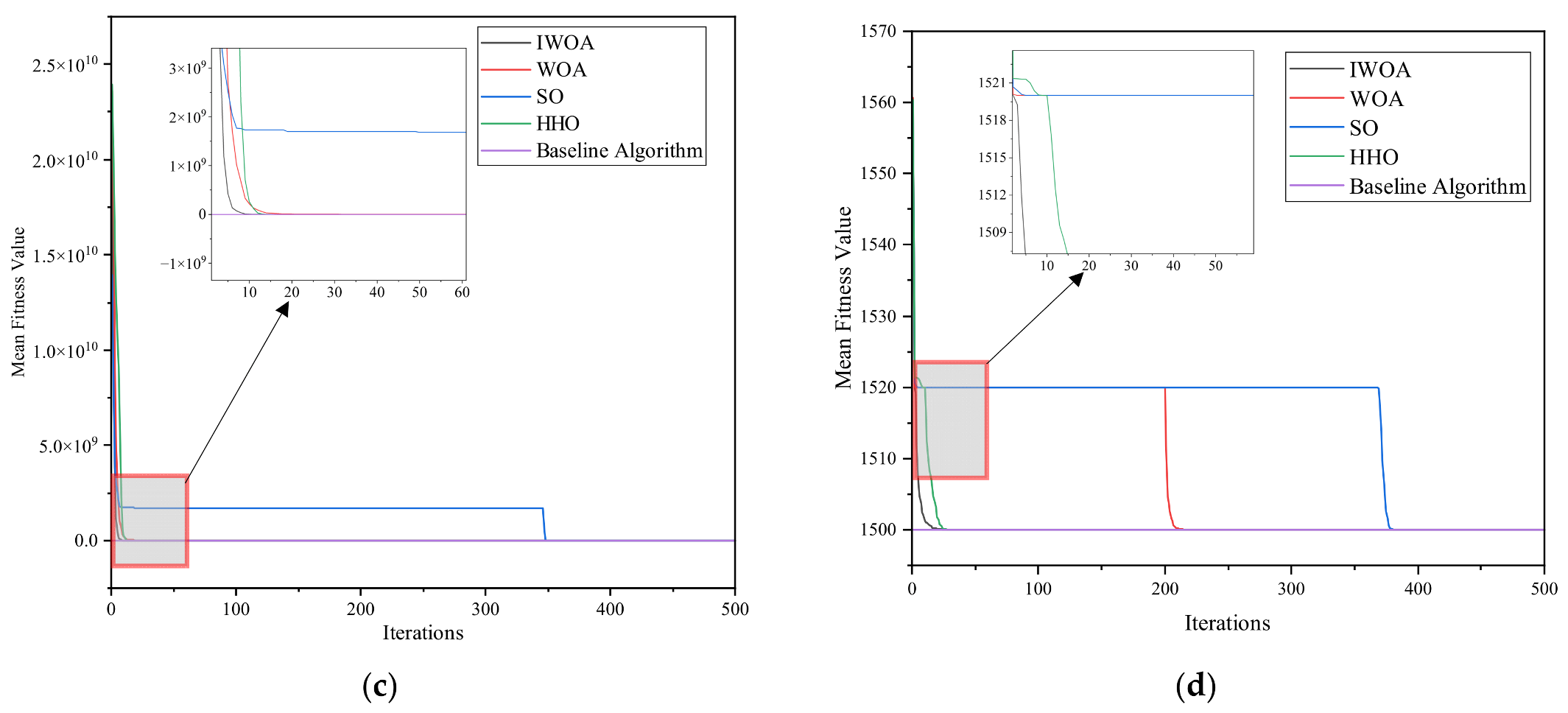
3.2. Performance Validation of the Improved Whale Optimization Algorithm
3.3. ISMC Design
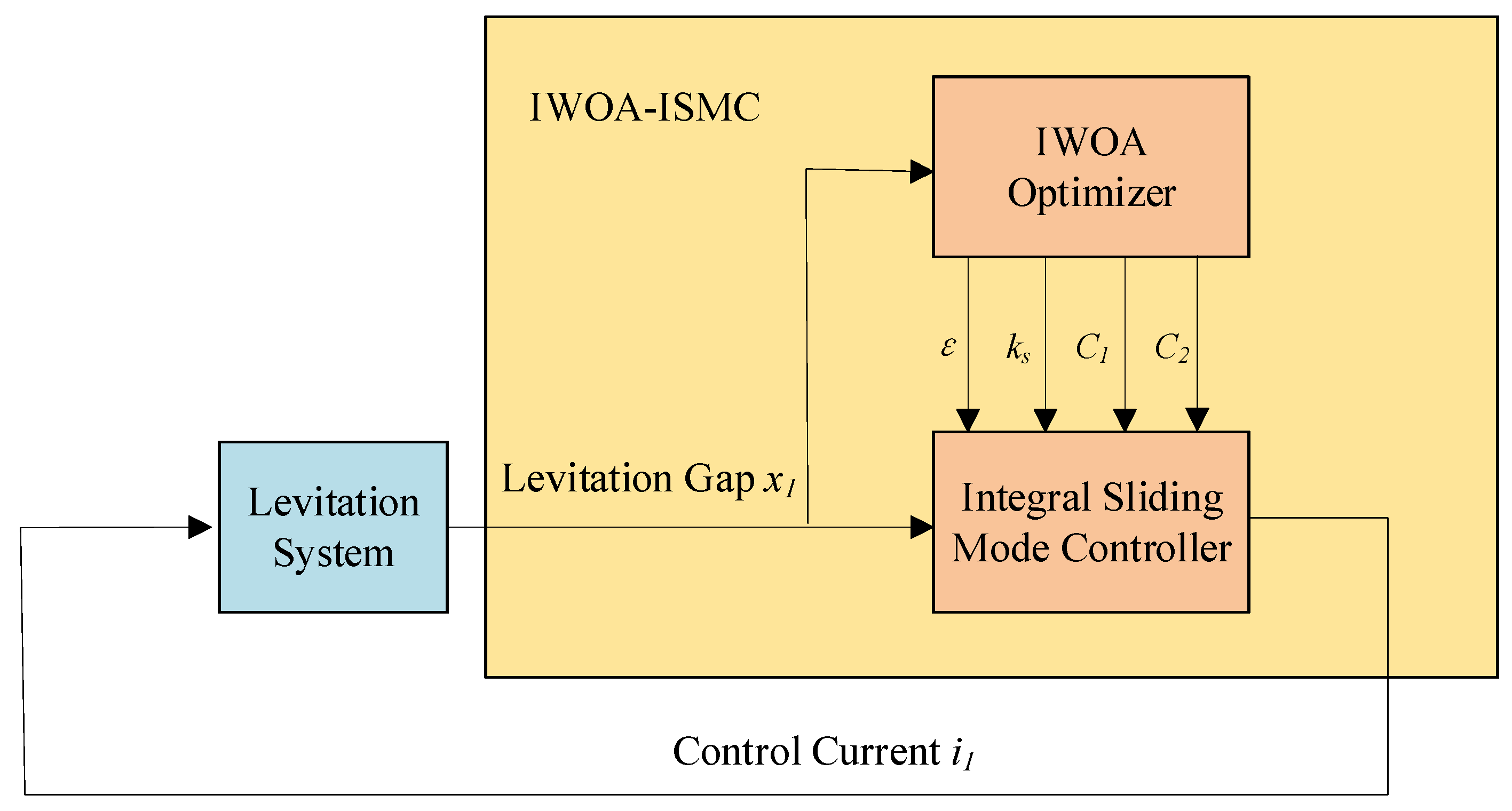
3.4. Design of IWOA-ISMC Control Framework
4. Comparison of Simulation Performance of the Levitation System Under Different Operating Conditions
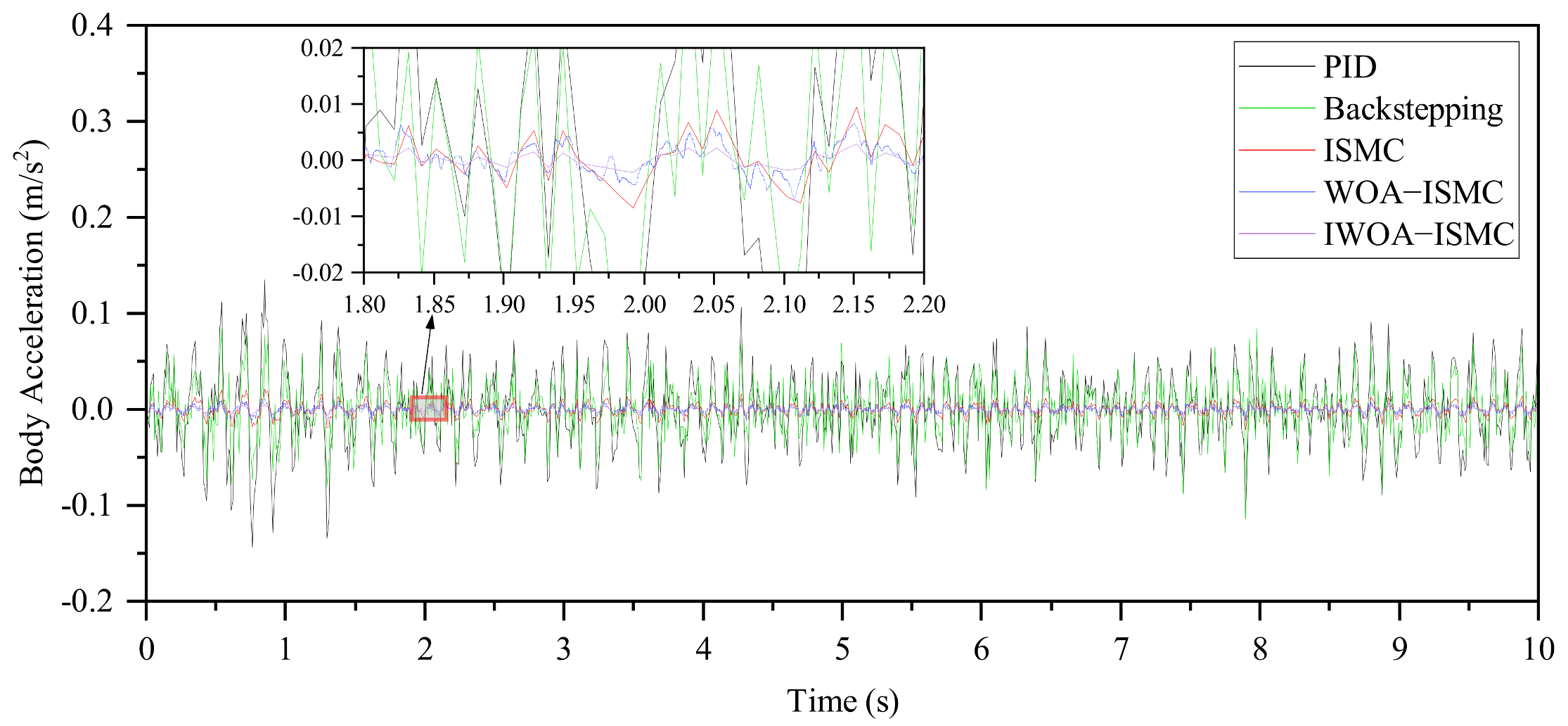
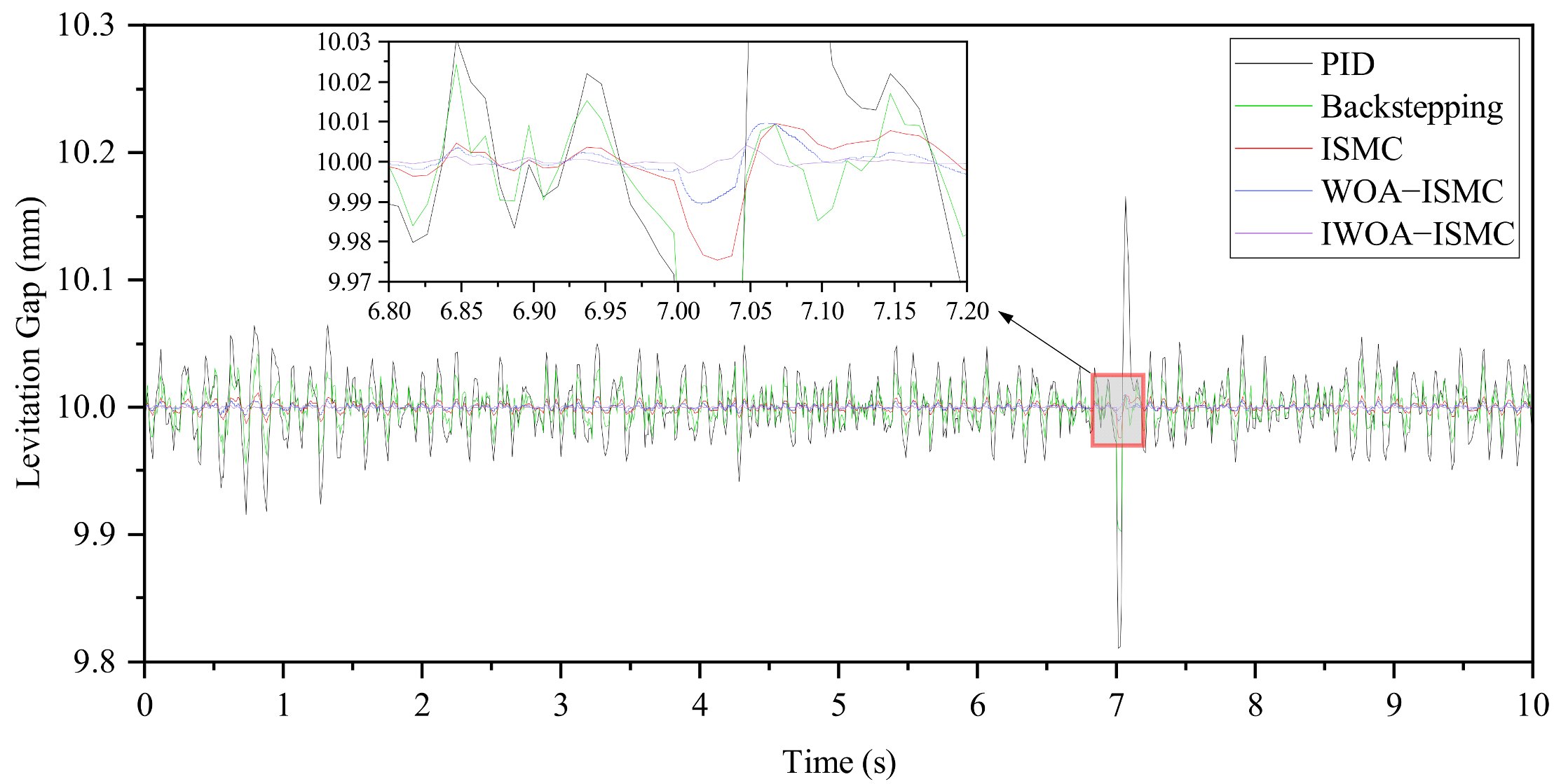
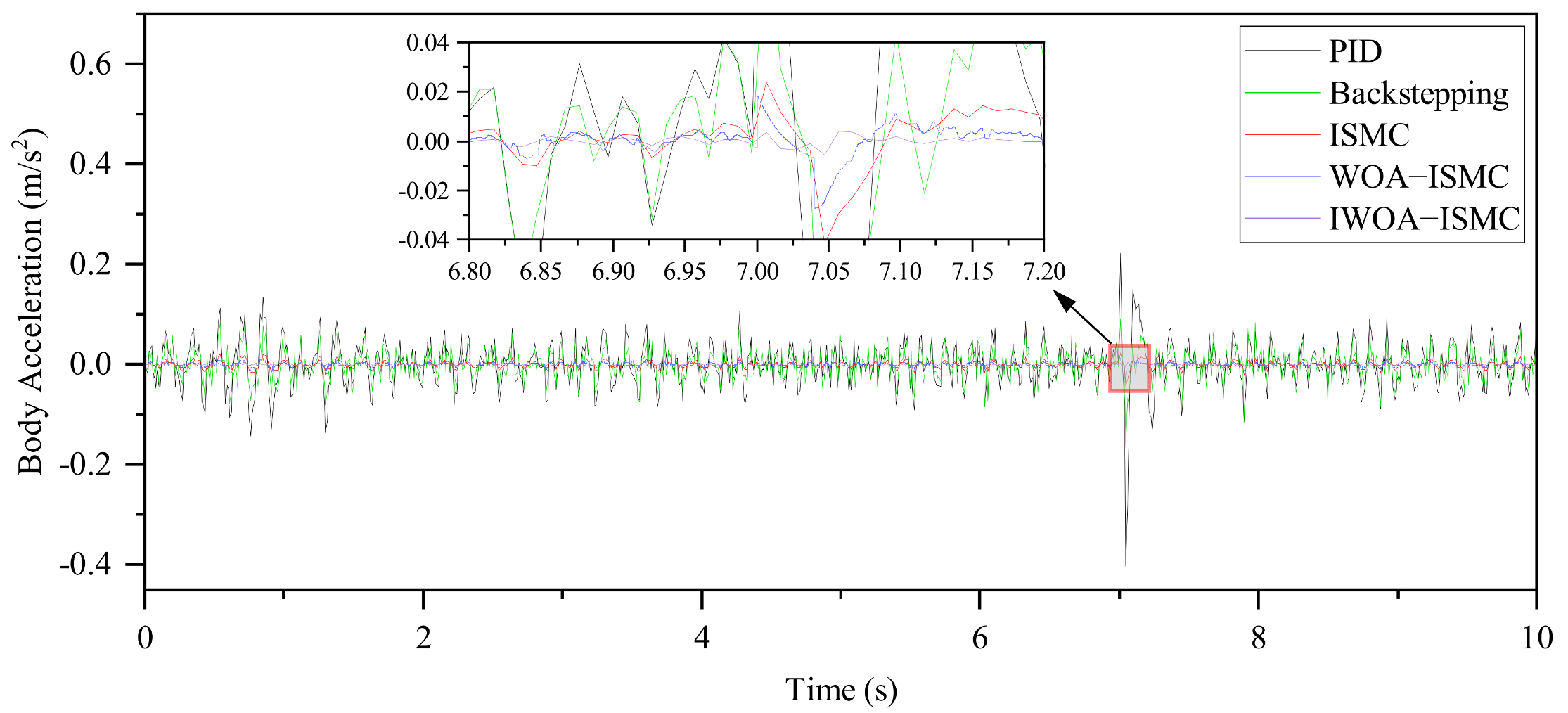
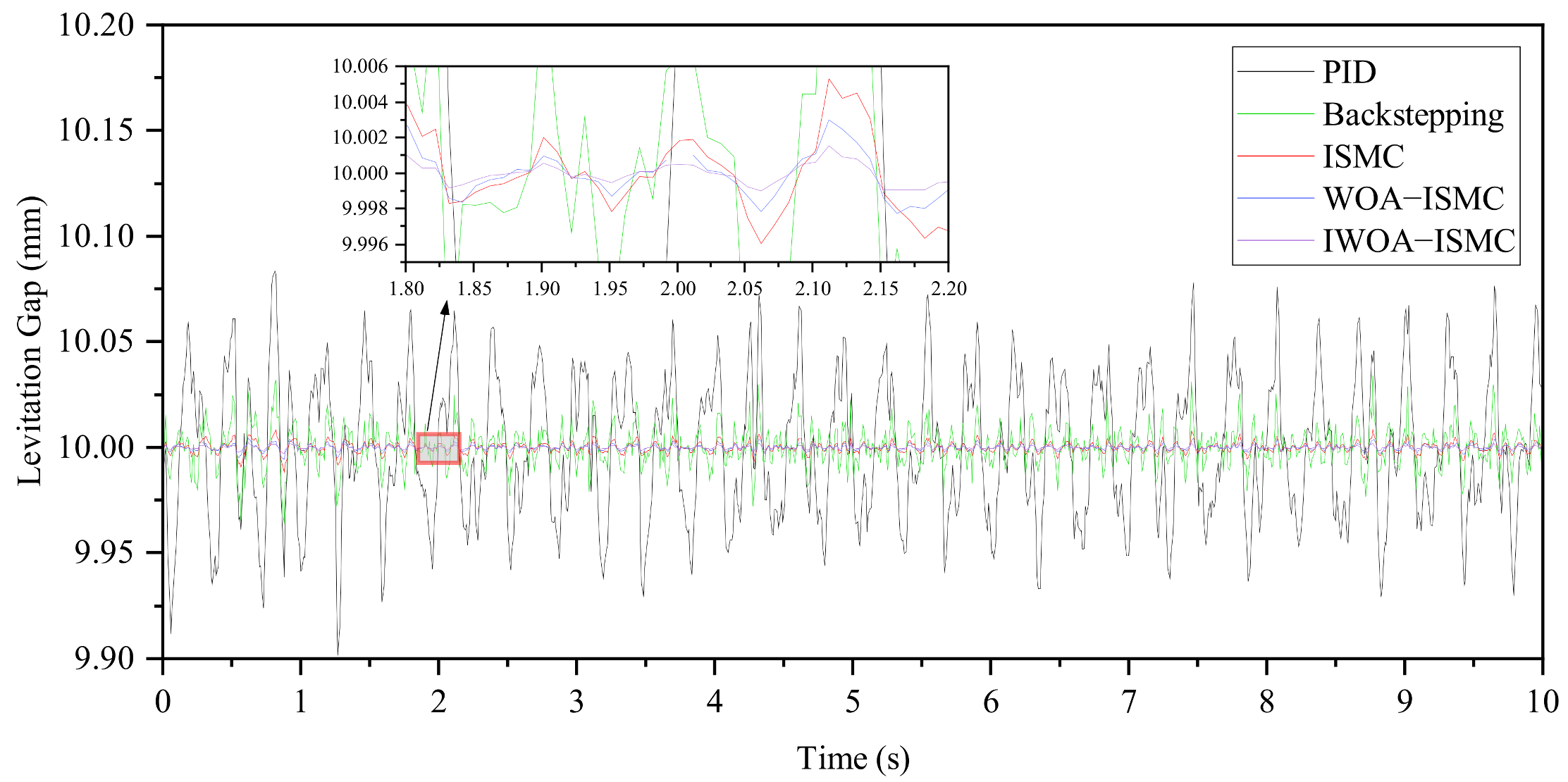
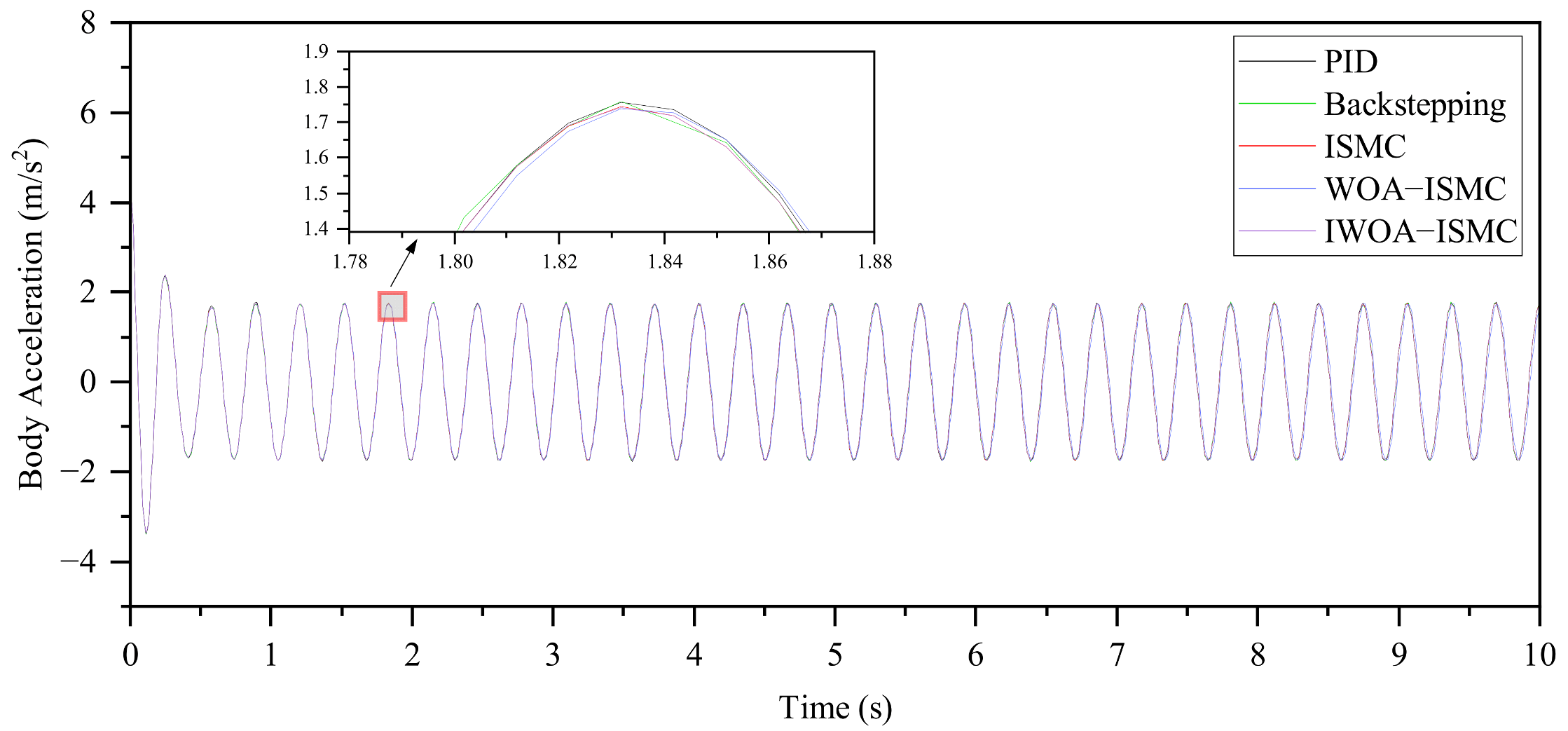
4.1. Simulation Performance Comparison Under Track Irregularities
4.2. Simulation Performance Comparison Under Sudden Force Disturbance
4.3. Simulation Performance Comparison Under Aerodynamic Lift Disturbance
5. Conclusions
Author Contributions
Funding
Institutional Review Board Statement
Informed Consent Statement
Data Availability Statement
Conflicts of Interest
References
- Zhai, W.; Zhao, C. Frontiers and challenges of sciences and technologies in modern railway engineering. J. Southwest Jiaotong Univ. 2016, 51, 209–226. [Google Scholar]
- Deng, Z.; Liu, Z.; Li, H.; Zhang, W. Development status and prospect of maglev train. J. Southwest Jiaotong Univ. 2022, 57, 455–474, 530. [Google Scholar]
- Xv, F.; Luo, S.; Deng, Z. Study on key technologies and whole speed range application of maglev rail transport. J. China Railw. Soc. 2019, 41, 40–49. [Google Scholar]
- Lee, H.-W.; Kim, K.-C.; Lee, J. Review of Maglev Train Technologies. IEEE Trans. Magn. 2006, 42, 1917–1925. [Google Scholar] [CrossRef]
- Sun, Y.; Xu, J.; Chen, C.; Hu, W. Reinforcement Learning-Based Optimal Tracking Control for Levitation System of Maglev Vehicle with Input Time Delay. IEEE Trans. Instrum. Meas. 2022, 71, 7500813. [Google Scholar] [CrossRef]
- Sun, Y.; Xu, J.; Lin, G.; Sun, N. Adaptive Neural Network Control for Maglev Vehicle Systems with Time-Varying Mass and External Disturbance. Neural Comput. Appl. 2023, 35, 12361–12372. [Google Scholar] [CrossRef]
- Long, Z.; Hong, H.; Zhou, X. Research of nonlinear control for maglev train. Control Theory Appl. 2003, 20, 399–402. [Google Scholar]
- Acharya, D.S.; Mishra, S.K.; Swain, S.K.; Ghosh, S. Real-Time Implementation of Fractional-Order PID Controller for Magnetic Levitation Plant with Time Delay. IEEE Trans. Instrum. Meas. 2022, 71, 3001011. [Google Scholar] [CrossRef]
- de Jesus Rubio, J.; Lughofer, E.; Pieper, J.; Cruz, P.; Ivan Martinez, D.; Ochoa, G.; Antonio Islas, M.; Garcia, E. Adapting H-Infinity Controller for the Desired Reference Tracking of the Sphere Position in the Maglev Process. Inf. Sci. 2021, 569, 669–686. [Google Scholar] [CrossRef]
- Yau, J.D. Vibration Control of Maglev Vehicles Traveling over a Flexible Guideway. J. Sound Vib. 2009, 321, 184–200. [Google Scholar] [CrossRef]
- Guo, Z.; Li, Z.; Tan, C. Speed tracking control of permanent magnet maglev trains based on DMC-FOPID control algorithm and adaptive PSO. J. China Railw. Soc. 2023, 45, 74–84. [Google Scholar]
- Feng, Y.; Zhang, P.; Zou, J.; Deng, Z. System identification and IMC-PID parameter tuning method for a maglev ball system. J. Vib. Shock 2025, 44, 66–75. [Google Scholar] [CrossRef]
- Yang, Y.; Huang, C.; Dai, C.; Long, Z. An Active Resisting Disturbance Control Method for High-Speed Maglev Train with Weak Model Dependence. ISA Trans. 2025, 163, 172–183. [Google Scholar] [CrossRef]
- Chen, P.; Shi, T.; Yu, M.; Chen, Y.; Shi, Y. Sliding mode active disturbance rejection levitation control algorithm of the medium- and low-speed maglev vehicles. J. Railw. Sci. Eng. 2023, 20, 682–693. [Google Scholar] [CrossRef]
- Sun, Y.; Qiang, H.; Xu, J.; Lin, G. Internet of Things-Based Online Condition Monitor and Improved Adaptive Fuzzy Control for a Medium-Low-Speed Maglev Train System. IEEE Trans. Ind. Informat. 2020, 16, 2629–2639. [Google Scholar] [CrossRef]
- Sathiyavathi, S. Design of Sliding Mode Controller for Magnetic Levitation System. Comput. Electr. Eng. 2019, 78, 184–203. [Google Scholar] [CrossRef]
- Chen, C.; Xv, J.; Lin, G.; Rong, L.; Sun, Y. Sliding mode control of maglev train suspension system with neural network acceleration feedback. J. Tongji Univ. (Nat. Sci.) 2021, 49, 1642–1651. [Google Scholar]
- Sun, Y.; Xu, J.; Qiang, H.; Lin, G. Adaptive Neural-Fuzzy Robust Position Control Scheme for Maglev Train Systems with Experimental Verification. IEEE Trans. Ind. Electron. 2019, 66, 8589–8599. [Google Scholar] [CrossRef]
- Mirjalili, S.; Lewis, A. The Whale Optimization Algorithm. Adv. Eng. Softw. 2016, 95, 51–67. [Google Scholar] [CrossRef]
- Mohammed, H.M.; Umar, S.U.; Rashid, T.A. A Systematic and Meta-Analysis Survey of Whale Optimization Algorithm. Comput. Intell. Neurosci. 2019, 2019, 8718571. [Google Scholar] [CrossRef]
- Nadimi-Shahraki, M.H.; Zamani, H.; Varzaneh, Z.A.; Mirjalili, S. A Systematic Review of the Whale Optimization Algorithm: Theoretical Foundation, Improvements, and Hybridizations. Arch. Comput. Methods Eng. 2023, 30, 4113–4159. [Google Scholar] [CrossRef] [PubMed]
- Xv, H.; Zhang, D.; Wang, Y.; Song, T.; Fan, Y. Hybrid strategy to improve whale optimization algorithm. Comput. Eng. Des. 2020, 41, 3397–3404. [Google Scholar] [CrossRef]
- Wu, Z.; Mou, Y. Improved whale optimization algorithm. Appl. Res. Comput. 2020, 37, 3618–3621. [Google Scholar] [CrossRef]
- Wang, Z.; Li, Y.; Tang, Y. An Efficient Hybrid DE-WOA Algorithm for Numerical Function Optimization. In Proceedings of the 2019 IEEE 28th International Symposium on Industrial Electronics (ISIE), Vancouver, BC, Canada, 12–14 June 2019; pp. 2629–2634. [Google Scholar]
- Kaur, G.; Arora, S. Chaotic Whale Optimization Algorithm. J. Comput. Des. Eng. 2018, 5, 275–284. [Google Scholar] [CrossRef]
- Jin, Q.; Xu, Z.; Cai, W.; Jin, Q.; Xu, Z.; Cai, W. An Improved Whale Optimization Algorithm with Random Evolution and Special Reinforcement Dual-Operation Strategy Collaboration. Symmetry 2021, 13, 238. [Google Scholar] [CrossRef]
- Shen, Y.; Zhang, C.; Soleimanian Gharehchopogh, F.; Mirjalili, S. An Improved Whale Optimization Algorithm Based on Multi-Population Evolution for Global Optimization and Engineering Design Problems. Expert Syst. Appl. 2023, 215, 119269. [Google Scholar] [CrossRef]
- He, J.; He, Z.; Liu, J.; Zhang, Y.; Zhang, F.; Liang, F.; Wang, T.; Xiao, L.; Wang, X. An Effective Power Optimization Approach Based on Whale Optimization Algorithm with Two-Populations and Mutation Strategies. Chin. J. Electron. 2024, 33, 423–435. [Google Scholar] [CrossRef]
- Liu, L.; Bai, K.; Dan, Z.; Zhang, S.; Liu, Z. Whale Optimization Algorithm with Global Search Strategy. J. Chin. Comput. Syst. 2020, 41, 1820–1825. [Google Scholar]
- Sun, Y.; Chen, Y. Multi-Population Improved Whale Optimization Algorithm for High Dimensional Optimization. Appl. Soft Comput. 2021, 112, 107854. [Google Scholar] [CrossRef]
- Wang, Z.; Dou, Z.; Dong, J.; Si, S.; Wang, C. Adaptive dynamic whale optimization algorithm based on multi-strategy improvement. Comput. Eng. Des. 2022, 43, 2638–2645. [Google Scholar] [CrossRef]
- Rai, R.; Sasmal, B.; Das, A.; Bharasa, T.; Dhal, K.G.; Naskar, P.K. Opposition Based Learning for Metaheuristic Algorithms: Theory, Variants, Applications, and Performance Evaluation. Swarm Evol. Comput. 2026, 100, 102271. [Google Scholar] [CrossRef]



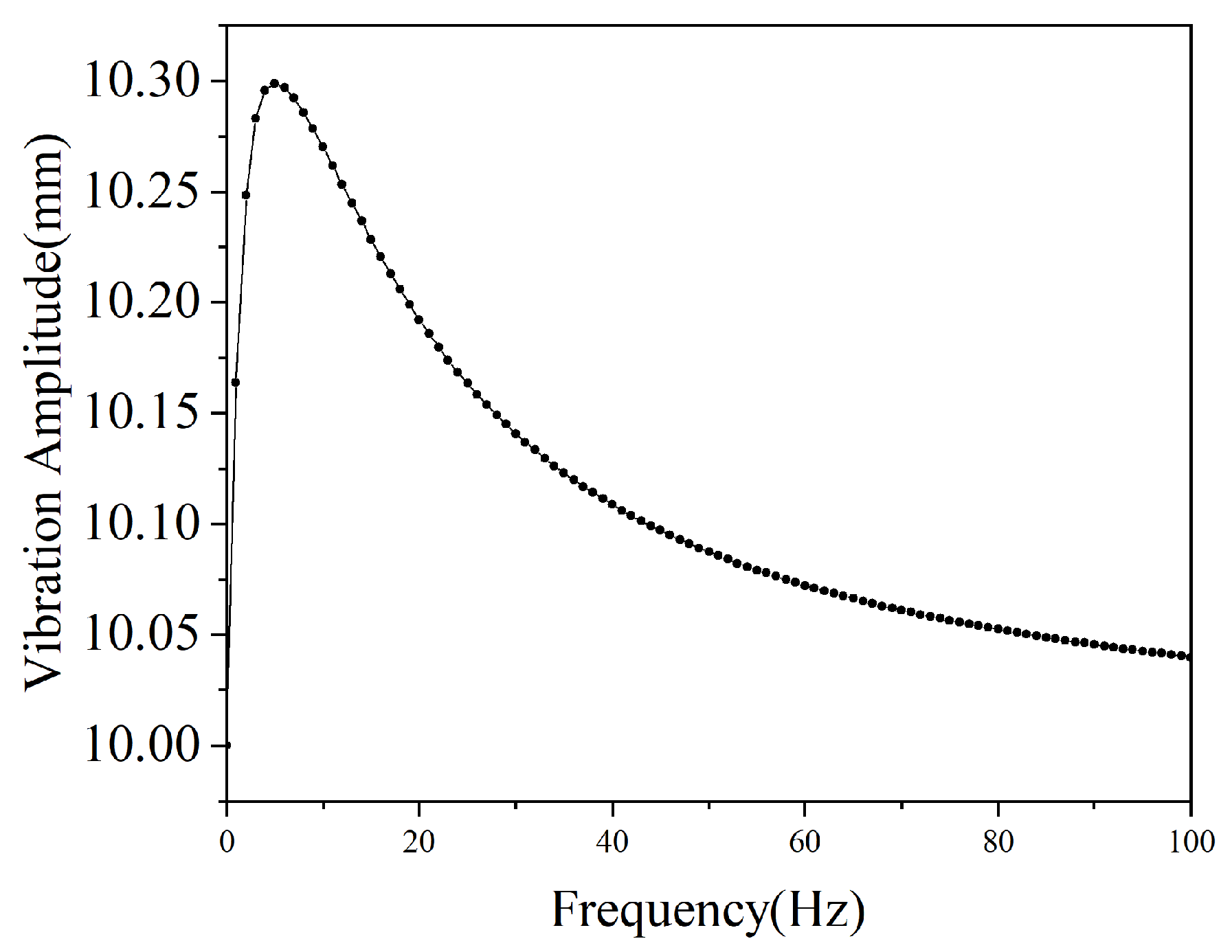





| Physical Parameters | Unit | Value |
|---|---|---|
| Levitation frame mass m1 | kg | 100 |
| Vehicle body levitated mass m2 | kg | 230 |
| Number of turns of the electromagnet coil N | Turns | 340 |
| Pole face area of the electromagnet As | mm2 | 15,000 |
| Target levitation gap xref | mm | 10 |
| Equilibrium current i0 | A | 24.7 |
| Function Name | Mathematical Model |
|---|---|
| F1 | |
| F4 | |
| F5 | |
| F15 |
| IWOA-ISMC Algorithm |
|---|
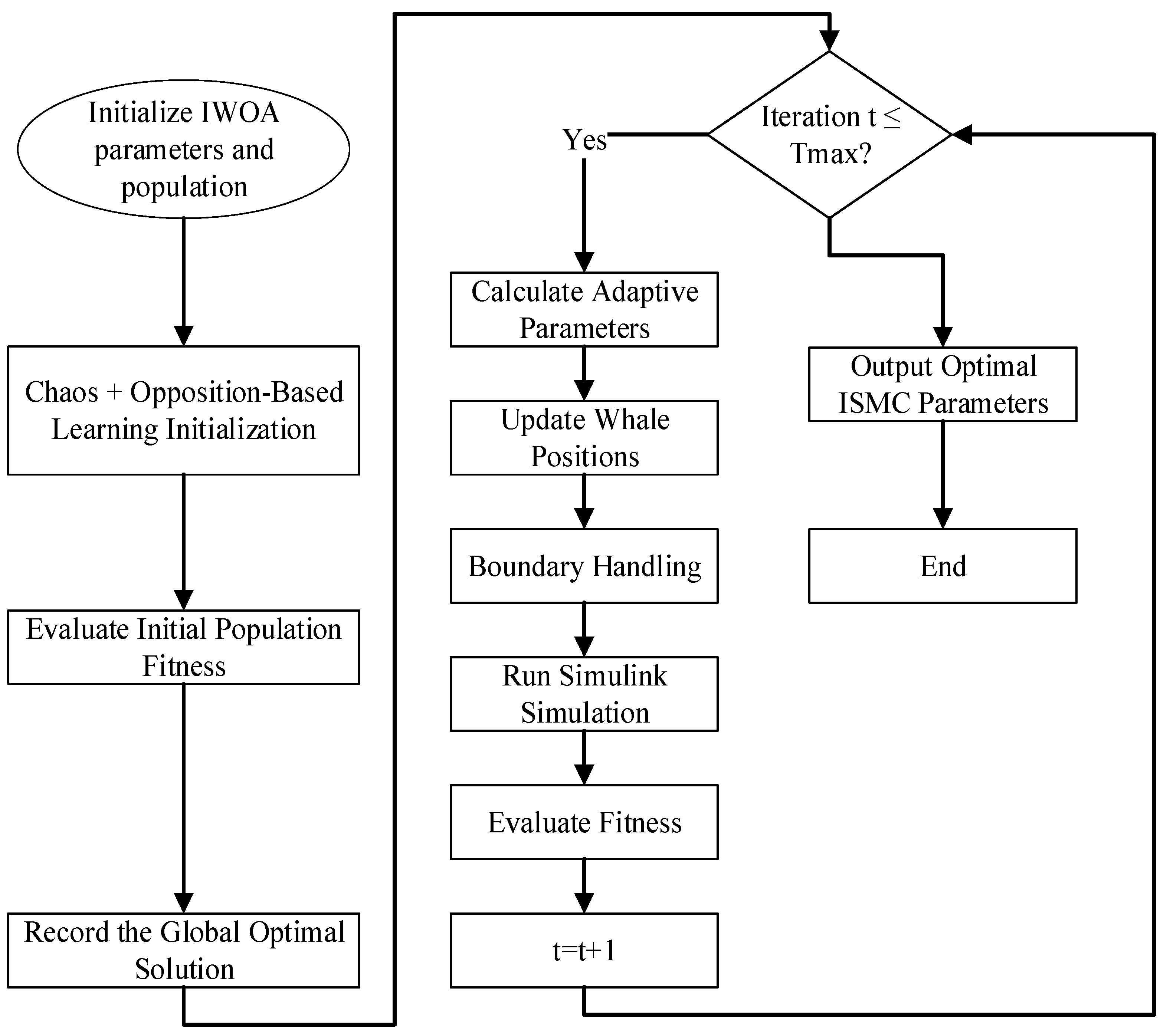
| Global optimal solution Xbest Initialization and Evaluation: Generate the initial parameter population using chaotic mapping and opposition-based learning. Substitute each parameter set into the levitation system for simulation. Calculate the fitness of all individuals based on system performance. Record the individual with the best fitness as Xbest. Main Optimization Loop (repeated for Tmax iterations): a. Update the control coefficient a and the adaptive weight ω. b. For each individual in the population: i. According to a random probability, select the “encircling”, “search”, or “spiral” strategy to generate new parameters. ii. Ensure that the new parameters remain within the prescribed bounds. iii. Apply the new parameters to the ISMC. iv. Perform levitation control simulation of the two-degree-of-freedom model. v. Compute the fitness based on the levitation gap obtained from the simulation. vi. If the new parameters yield better performance, replace the old individual. vii. If the new parameters outperform Xbest, update Xbest. c. Apply the elitism strategy. End Return Xbest to the ISMC for levitation control. |
| Mean Absolute Deviation | Standard Deviation | Peak-to-Peak Value | |
|---|---|---|---|
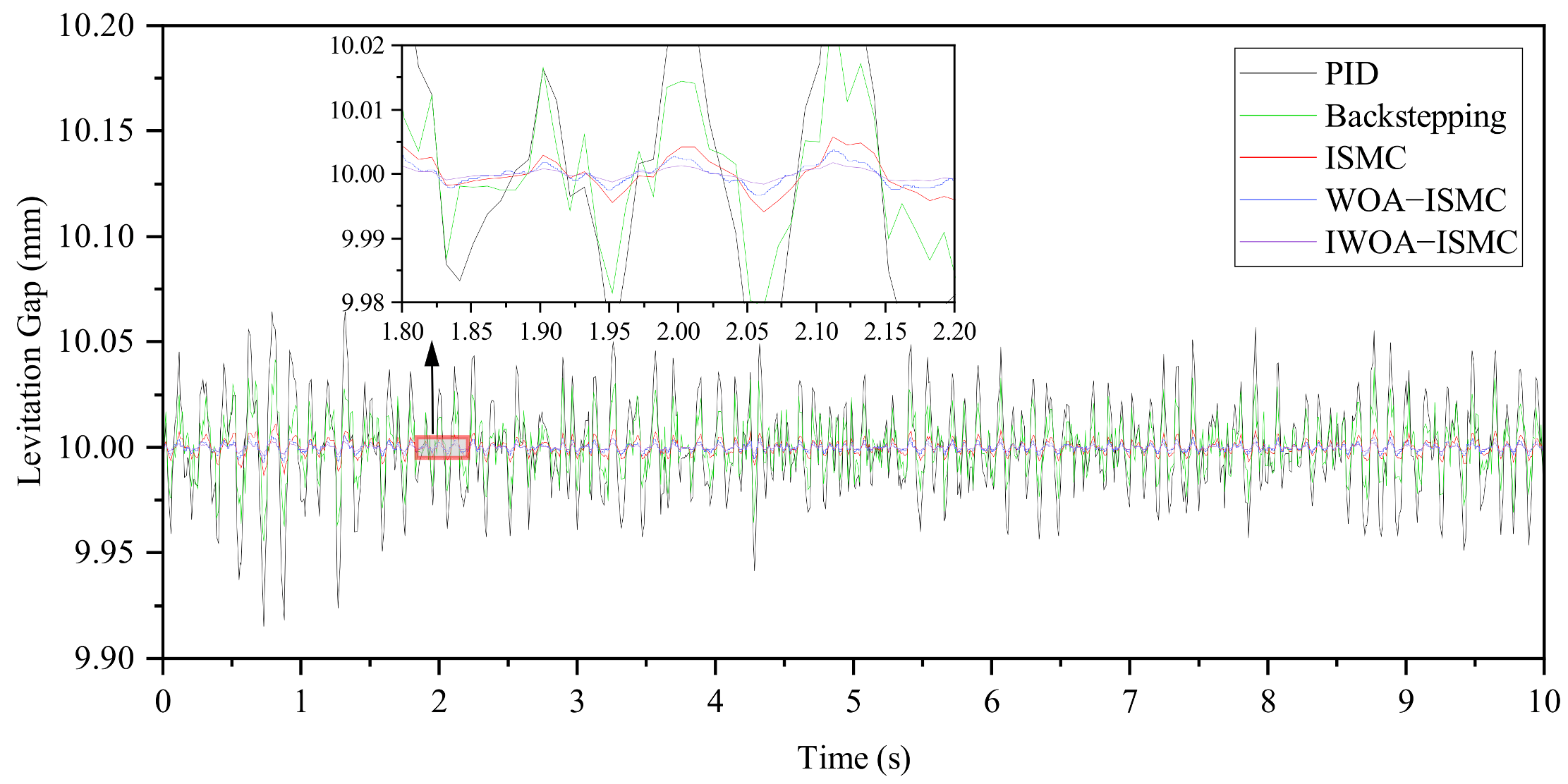
| PID | 0.018440000 | 0.02301 | 0.14927 |
| Backstepping | 0.010800000 | 0.01342 | 0.08553 |
| ISMC | 0.002900000 | 0.00360 | 0.02437 |
| WOA-ISMC | 0.001580000 | 0.00197 | 0.01293 |
| IWOA-ISMC | 0.000806317 | 0.00101 | 0.00678 |
| Mean Absolute Deviation | Standard Deviation | Peak-to-Peak Value | |
|---|---|---|---|
| PID | 0.019640000 | 0.026830000 | 0.35586 |
| Backstepping | 0.011140000 | 0.014690000 | 0.13858 |
| ISMC | 0.003040000 | 0.003930000 | 0.03591 |
| WOA-ISMC | 0.001640000 | 0.002100000 | 0.02022 |
| IWOA-ISMC | 0.000517899 | 0.000658846 | 0.00705 |
| Mean Absolute Deviation | Standard Deviation | Peak-to-Peak Value | |
|---|---|---|---|
| PID | 0.02880000 | 0.03415000 | 0.18200 |
| Backstepping | 0.007410000 | 0.00953000 | 0.07015 |
| ISMC | 0.001990000 | 0.00254000 | 0.02000 |
| WOA-ISMC | 0.001090000 | 0.00139000 | 0.01007 |
| IWOA-ISMC | 0.000529522 | 0.00068252 | 0.00530 |
Disclaimer/Publisher’s Note: The statements, opinions and data contained in all publications are solely those of the individual author(s) and contributor(s) and not of MDPI and/or the editor(s). MDPI and/or the editor(s) disclaim responsibility for any injury to people or property resulting from any ideas, methods, instructions or products referred to in the content. |
© 2026 by the authors. Licensee MDPI, Basel, Switzerland. This article is an open access article distributed under the terms and conditions of the Creative Commons Attribution (CC BY) license.
Share and Cite
Hao, Z.; Hao, L.; Liu, P.; Wang, R.; Wang, M. Research on Levitation Control of a Two-Degree-of-Freedom System Based on IWOA-ISMC. Actuators 2026, 15, 118. https://doi.org/10.3390/act15020118
Hao Z, Hao L, Liu P, Wang R, Wang M. Research on Levitation Control of a Two-Degree-of-Freedom System Based on IWOA-ISMC. Actuators. 2026; 15(2):118. https://doi.org/10.3390/act15020118
Chicago/Turabian StyleHao, Ziyang, Linjie Hao, Pengfei Liu, Ruichen Wang, and Meiqi Wang. 2026. "Research on Levitation Control of a Two-Degree-of-Freedom System Based on IWOA-ISMC" Actuators 15, no. 2: 118. https://doi.org/10.3390/act15020118
APA StyleHao, Z., Hao, L., Liu, P., Wang, R., & Wang, M. (2026). Research on Levitation Control of a Two-Degree-of-Freedom System Based on IWOA-ISMC. Actuators, 15(2), 118. https://doi.org/10.3390/act15020118