Article

Research on the Flow and Heat Transfer Characteristics of a Molten Salt Globe Valve Based on an Electromagnetic Induction Heating System


1
School of Petrochemical Technology, Lanzhou University of Technology, Lanzhou 730050, China
2
Machinery Industry Pump and Special Valve Engineering Research Center, Lanzhou University of Technology, Lanzhou 730050, China
*
Author to whom correspondence should be addressed.
Actuators 2026, 15(1), 50; https://doi.org/10.3390/act15010050
Submission received: 29 October 2025 / Revised: 24 December 2025 / Accepted: 24 December 2025 / Published: 13 January 2026
(This article belongs to the Section Control Systems)

Abstract

To promote the transition to a cleaner energy structure and support the achievement of the “carbon peak and carbon neutrality” goals, concentrated solar power (CSP) technology has attracted increasing attention. The molten salt globe valve, as a key control component in CSP systems, faces significant challenges related to low-temperature salt crystallization and thermal stress control. This study proposes an active electromagnetic induction heating method based on a triangular double-helix cross-section coil to address issues such as molten salt blockage in the seal bellows and excessive thermal stress during heating. First, electromagnetic simulation comparisons show that the ohmic loss of the proposed coil is approximately 3.5 times and 1.8 times higher than that of conventional circular and rectangular coils, respectively, demonstrating superior heating uniformity and energy efficiency. Second, transient electromagnetic-thermal-fluid-structure multiphysics coupling analysis reveals that during heating, the temperature in the bellows seal region stabilizes above 543.15 K, exceeding the solidification point of the molten salt, while the whole valve reaches thermal stability within about 1000 s, effectively preventing local solidification. Finally, thermal stress analysis indicates that under a preheating condition of 473.15 K, the transient thermal shock stress on the valve body and bellows is reduced by 266.84% and 253.91%, respectively, compared with the non-preheating case, with peak stresses remaining below the allowable stress limit of the material, thereby significantly extending the service life of the valve. This research provides an effective solution for ensuring reliable operation of molten salt valves and improving the overall performance of CSP systems.

1. Introduction

New energy technology is one of the main components of achieving the goal of “carbon emission peak and carbon neutrality” [1,2]. The use of renewable energy is the only way for my country to achieve carbon neutrality [3]. In some chemical reactions that require precise temperature control, molten salt is often used as a heat carrier due to its high boiling point, high specific heat capacity, low viscosity and other characteristics. The molten salt globe valve can accurately control the flow of molten salt so that the molten salt flow can be introduced or cut off as needed at different reaction stages, meeting the complex process requirements of chemical production and ensuring that the chemical reaction is carried out under suitable temperature and other conditions [4]. In addition, a large amount of waste heat is generated during the chemical production process. Using molten salt to recover waste heat is an effective way to save energy [5].
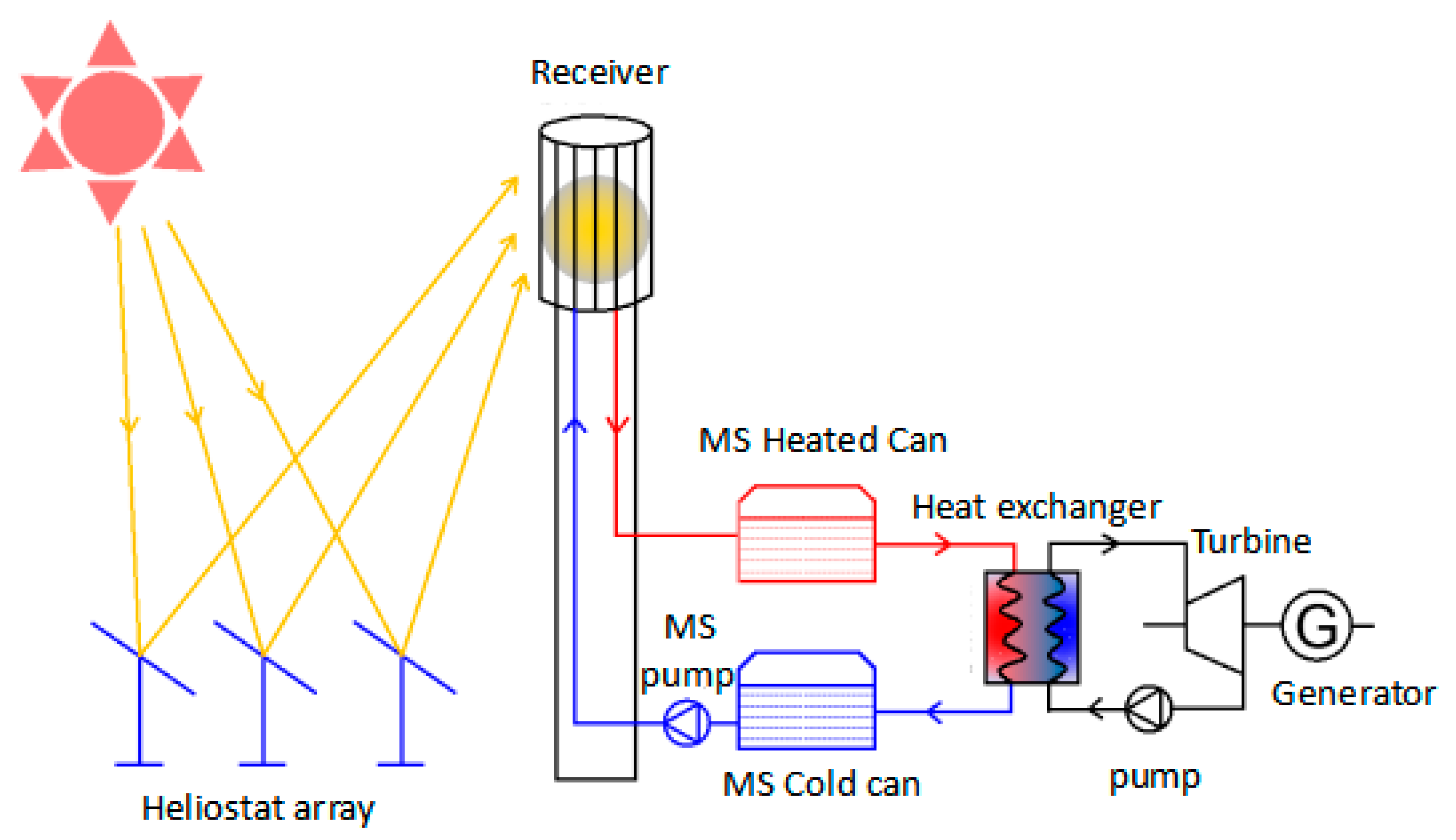
In the fundamental research field investigating the interaction between magnetic fields and conductive fluids, the team led by Ma Chongfang at Beijing University of Technology [6] once utilized permanent magnets to construct a static magnetic field, studying the enhancement effect of the magnetic field on heat transfer during molten salt jet impingement. Their results indicated that, under specific conditions, the magnetic field exhibited a certain enhancement effect on molten salt heat transfer. This research revealed an observable interaction between the magnetic field and molten salt as a conductive fluid, providing a foundational physical phenomenon for understanding more complex magneto-thermal coupling mechanisms. After conducting experimental research and numerical simulation research, Zhang Yongle [7] applied eddy current induction heating technology to the field of molten salt heat storage and heating, built a molten salt electromagnetic induction heating experimental system, and used the induction coil as the research object to explore the temperature change law of the medium and cooling water under different medium working conditions and coil current working conditions. In the study of high-temperature transient thermal stress, foreign scholars Anzelina Marek and Jerzy Okrajni [8] discussed the problem of determining the stress-strain characteristics of selected components in power plants. The purpose was to prove the possibility of using measured steam temperature and selected point temperature to investigate the element-defined heat transfer problem and boundary conditions, as well as to verify the correctness of the operation and detailed computer model. Foreign scholars P. FERRO et al. [9] studied the elastic-plastic stress field caused by thermal loads. Under the assumption of steady-state heat transfer and plane strain conditions, the thermal and mechanical problems require the numerical solution of the ordinary differential equation (ODE) system obtained by expanding the “stress function method”. By considering different boundary conditions, the asymptotic distribution of the generated residual stress is obtained. Through the systematic review and in-depth investigation of previous academic research results, it can be found that the molten salt globe valve is a key device for medium on-off control in high-temperature molten salt systems. Its working environment is often accompanied by multiple extreme conditions such as strong electromagnetic interference, high-speed flowing molten salt medium, severe temperature gradient and complex structural stress. In concentrated solar power (CSP) systems, molten salt valves suffer from a thermal stress cracking failure rate of 8.3% due to sudden temperature changes, leading to annual plant shutdown and maintenance costs increasing by millions of yuan. Concurrently, traditional electric tracing devices exhibit low heating efficiency (only 75%), and the startup time required to melt solidified salt in valves during winter can be as long as one hour, severely impacting plant operational efficiency and economics. Addressing this industry pain point, this paper proposes a novel triangular double-helix induction coil design. By contrasting the shortcomings of conventional technologies (such as electric tracing and ordinary helical coils), the “replacement value” or “upgrade value” of this research is clearly defined to avoid aimless discussion. As shown in Figure 1, when high-temperature molten salt medium flows back from the cooling tower, passes through the molten salt stop valve, and enters the cold salt tank circuit, the medium’s temperature is around 300 °C, which is perilously close to its dangerous crystallization temperature of 270 °C. Crystallization and solidification of molten salt at low temperatures can easily cause crystal accumulation and jamming in the valve’s bellows, leading to poor opening/closing performance or even accidents. Building upon a review and summary of current insulation technologies, this paper creatively proposes a triangular double-helix cross-section induction coil structure for high-temperature molten salt stop valves. To ensure that the designed specially shaped induction coil can prevent the crystallization, solidification, and accumulation of molten salt medium in the valve’s operational section, a transient electromagnetic-thermal-fluid-structure coupled simulation was conducted for the triangular double-helix coil. This simulation investigates the flow and heat transfer patterns of the molten salt medium under the influence of the coil and assesses whether the transient thermal shock stress on the molten salt stop valve—subjected to dual heat sources—meets the safety and stability requirements for operation.

2. Research on Electromagnetic Induction Coil in Confined Space of Molten Salt Globe Valve

2.1. Basic Requirements for Electromagnetic Induction Coil Design

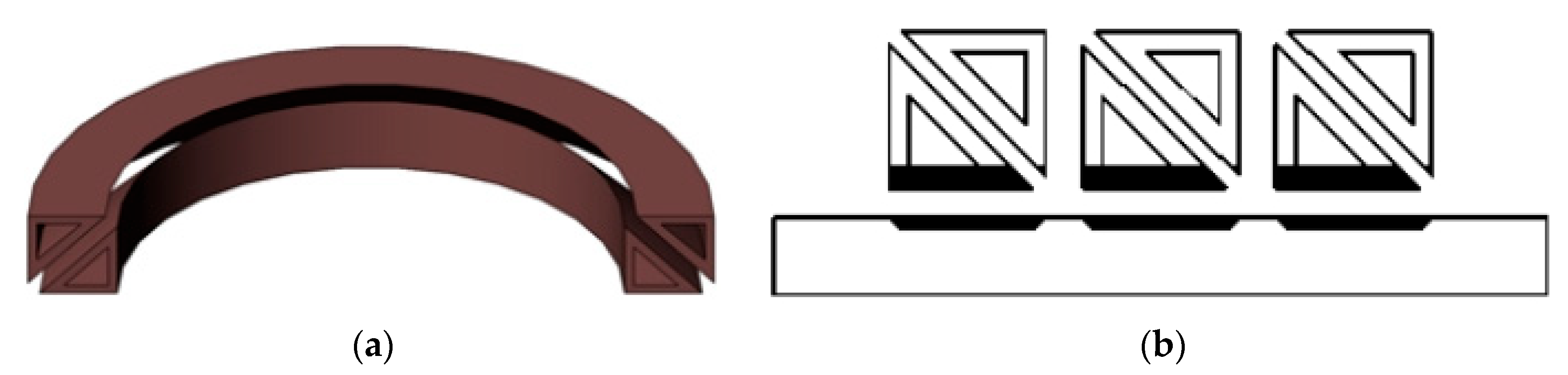
Based on a comprehensive review of the current state of insulation technologies, an innovative electromagnetic induction triangular double-helix cross-section coil structure has been proposed for high-temperature molten salt globe valves. A schematic diagram of this structure is shown in Figure 2, where part (a) illustrates the overall three-dimensional configuration of the curved double-helix coil, and part (b) presents the detailed cross-section composed of triangular units. As shown, the coil is wound into a double-helix shape. The triangular cross-section effectively increases the conductive area of the current path, minimizes magnetic flux leakage, and promotes a uniform distribution of the induced magnetic field, thereby enhancing the coil’s heat generation efficiency. Furthermore, due to the two current paths in the triangular double-helix design, the heat generation capacity is effectively doubled while maintaining a sufficient conductive area.
The following design principles should be followed when designing the induction coil structure [10]:
(1)
The temperature of the molten salt globe valve operating section should be as uniform as possible;
(2)
The magnetic loss of the coil should be as small as possible, and the electrical efficiency should be as high as possible;
(3)
Insulation should be ensured between each turn of the coil;
(4)
The coil is simple to manufacture, has sufficient mechanical strength, a long service life, and is easy to industrialize.
When the induction coil is working, both ends of the coil are connected to an AC power supply. Under the combined effect of the three major effects of the electromagnetic field—“skin effect”, “proximity effect” and “ring effect” [11] on the electromagnetic induction coil, the current in the induction coil will be concentrated on one side of the hollow copper wire. When the wall thickness of the hollow copper wire is large, the copper wire material will be wasted. When the wall thickness of the hollow copper wire is small, the current density in the copper wire will increase, and the energy loss will increase under the action of the Joule heating effect. The principle of selecting the wall thickness of the induction coil is shown in Formula (1):
B 0 = 1.57 Δ 1
where Δ1 is the skin depth of the current on the copper wire, mm; B0 is the wall thickness of the induction coil, mm.
To minimize the resistance of the electromagnetic induction coil while achieving high heating efficiency, based on accumulated experience, the wall thickness of the electromagnetic induction coil is generally selected to be B0 ≥ 1.2Δ1. Table 1 shows empirical values for induction coil wall thickness under different current frequency conditions. Considering the actual heating frequency of medium frequency heating, the final selected induction coil wall thickness is 1.00 mm.
As the number of turns increases, the thermal efficiency of the electromagnetic induction coil also increases. However, when the number of turns increases to a certain critical value, the increase in the number of turns will no longer have a significant effect on the improvement of thermal efficiency. In severe cases, it may even damage the induction coil, shorten its service life, and cause economic losses [12]. Therefore, in the structural design of the electromagnetic induction coil, the selection of the number of coil turns is crucial. Taking into account the limited structural space of the molten salt globe valve operating section and the size of the designed triangular spiral induction coil, the number of coil turns is finally determined to be 10 turns. The distance between the molten salt globe valve and the electromagnetic induction coil directly affects the heating effect. The closer the distance between the two, the stronger the electromagnetic-magnetic-thermal coupling effect, the higher the thermal efficiency, the faster the heating rate, and the shorter the time to reach the required temperature. If the distance between the two is too close, short circuits are likely to occur, shortening the service life of the induction coil; the farther the distance between the two, the weaker the electromagnetic-magnetic-thermal coupling effect and the lower the energy conversion rate. In order to improve the thermal efficiency of the electromagnetic induction coil and ensure the service life of the hollow copper wire, the gap between the electromagnetic induction coil and the molten salt globe valve should be kept at a reasonable distance. The selection principle of the gap is shown in Table 2. Since the nominal size of the molten salt globe valve is DN50, which meets the requirement that the workpiece diameter is greater than 30 mm, the gap size between the induction coil and the molten salt globe valve is selected as 3.0 mm.
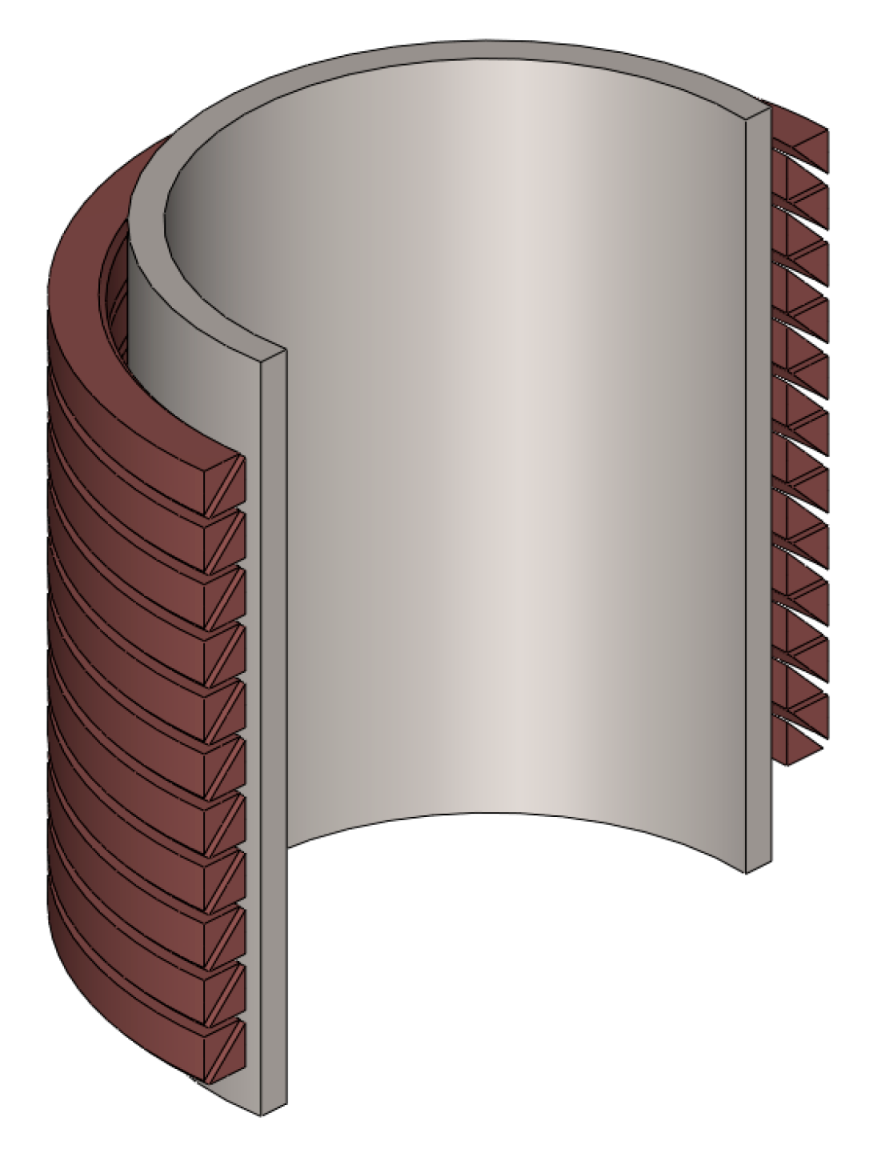
As shown in Figure 3, the induction coil with a triangular double helix cross-section is designed with a wall thickness of 1.00 mm, a triangular double helix cross-section, 10 turns, and a distance of 3.0 mm between the induction coil and the molten salt globe valve. The slight effect caused by this is ignored during electromagnetic field analysis, but its effect must be considered during temperature field analysis.
Furthermore, in the electromagnetic-thermal coupled model of this study, to focus on the relative comparison of the macroscopic heating effect on the main valve body and the electromagnetic coupling efficiency among coils with different cross-sections, the induction coils are treated as ideal conductors. The internal hollow structure and cooling effects of the coils are not simulated. Although neglecting the coil’s self-heating effect may affect the prediction accuracy of the absolute temperature field and thermal stress under long-term operation, this study primarily focuses on the relative heating performance and thermal stress suppression effects of different coil structures under identical excitation conditions. Additionally, by neglecting the internal hollow structure of the coils, their cross-section is simplified to a solid triangle, and their cooling effect is disregarded [14]. Consequently, temperature changes in the coils are not considered in the simulation.

2.2. Comparative Verification of Induction Coil Heating Performance

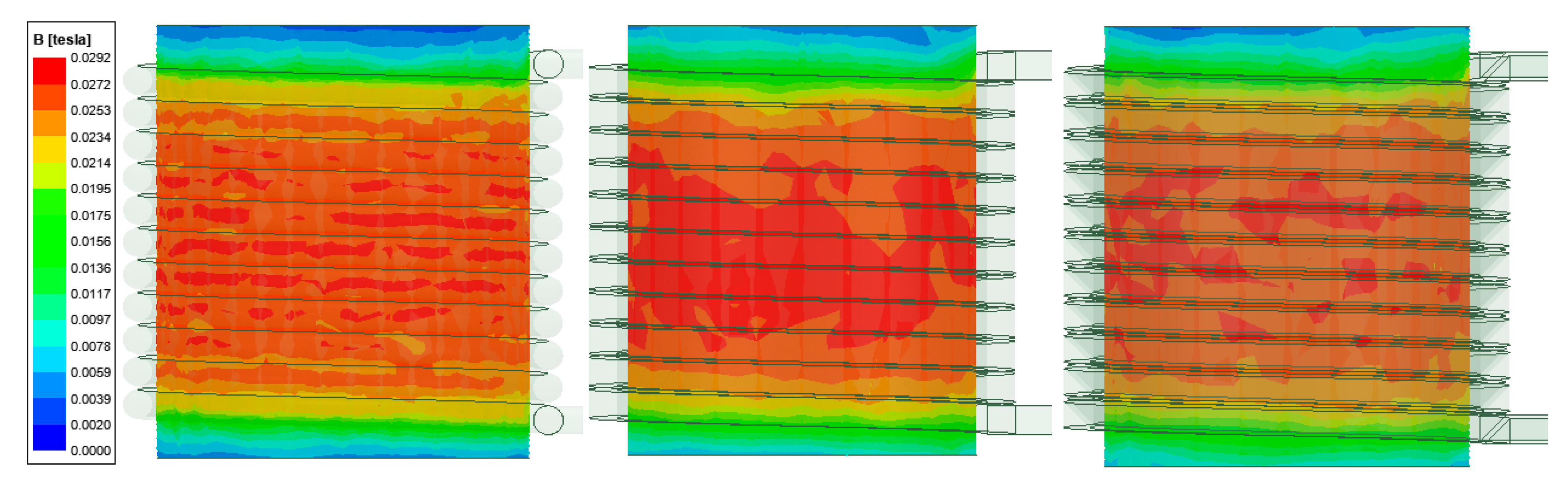
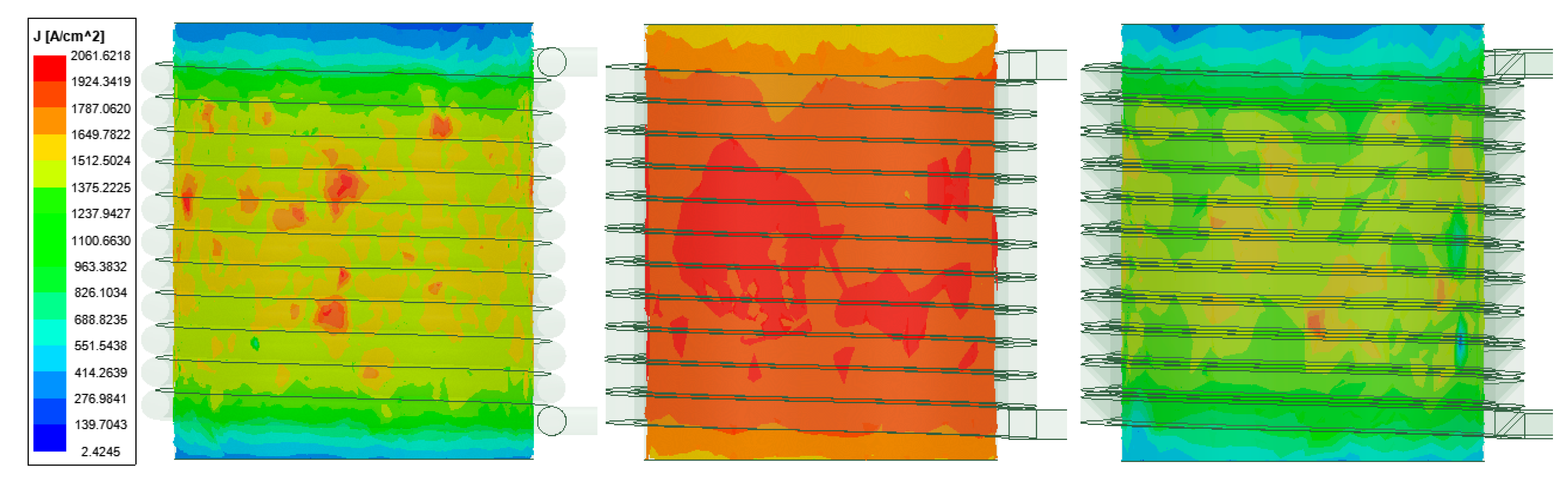
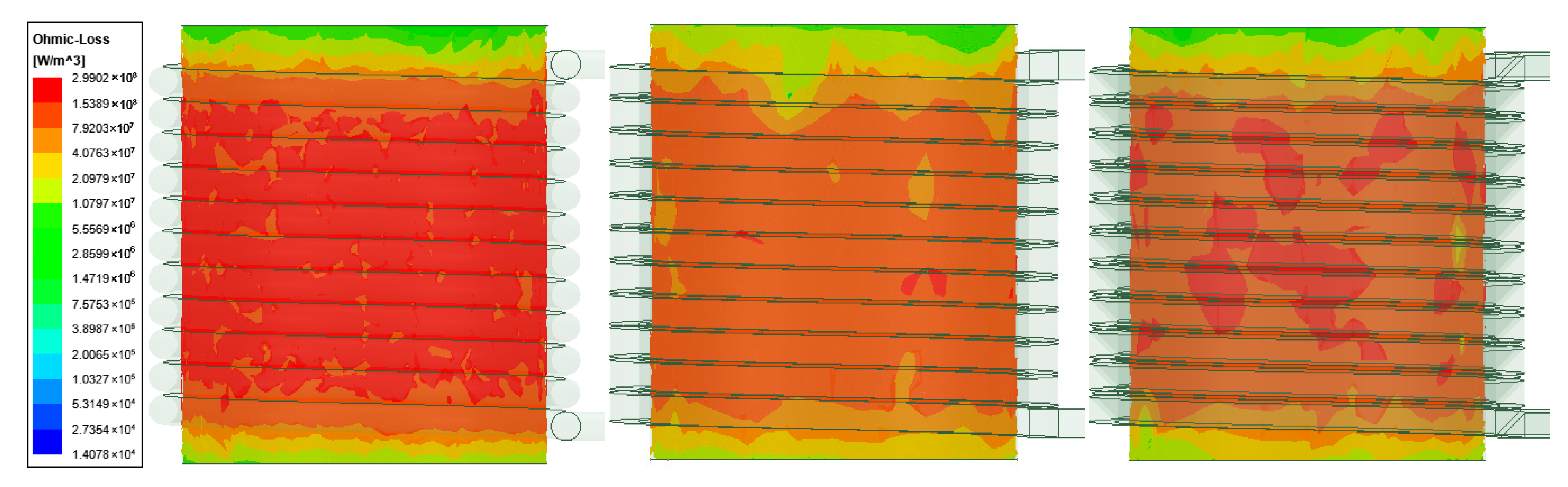
The electromagnetic performance of the induction coils with conventional circular cross-sections, rectangular cross-sections, and the innovative triangular cross-section designed in this paper was simulated and calculated. A combined finite element model of the circular cross-section induction coil and the test pipe was imported into Maxwell, and the solution domain (i.e., the air domain) was set so that the combined finite element model was completely contained within the solution domain. The test pipe material was set to structural steel, the induction coil material was set to copper TP2, and the medium of the solution domain was set to air. Excitation was set on the circular, rectangular, and triangular cross-section induction coils [15,16,17,18]. Comparative cloud plots of the magnetic induction intensity amplitude, current density amplitude, and ohmic loss of the three different cross-sectional electromagnetic induction coils were obtained, as shown in Figure 4, Figure 5 and Figure 6. Figure 3 depicts the amplitude cloud diagrams of magnetic induction intensity for induction coils with circular, rectangular, and triangular cross—sections. In order to maintain local contrast and more effectively demonstrate the spatial morphology at each moment and the ascending trend of the maximum value with time, each panel employs its exclusive color scale range. It is worth noting that the identical color among different panels does not signify the same absolute value.
Through electromagnetic field simulation calculations of circular, rectangular, and triangular double-helix cross-section induction coils under identical conditions of turns, current, and frequency (results shown in Figure 4, Figure 5 and Figure 6), it was found that the amplitude and distribution of magnetic flux density and current density were relatively similar for the circular and rectangular coils. In contrast, the triangular double-helix coil showed significant enhancement in both parameters. Furthermore, its ohmic loss reached approximately 2.85 times that of the rectangular coil and 4.52 times that of the circular coil (corresponding to relative increases of 184.8% and 351.5%, respectively). In induction heating, the ohmic loss of the coil directly influences the strength of the alternating magnetic field. The results above indicate that the triangular double-helix coil achieves a markedly stronger magnetic field output at the cost of higher ohmic loss, thereby significantly enhancing the eddy current heating capability for the operational section of the molten salt stop valve body. Consequently, although the coil’s own loss increases, the heating effect and temperature rise rate on the target region are substantially improved. This lays the foundation for subsequent rapid and uniform valve thermal maintenance.

3. Basic Research on the Theory of Transient Electromagnetic-Fluid-Thermal-Solid Coupled Flow Heat Transfer in Molten Salt Media

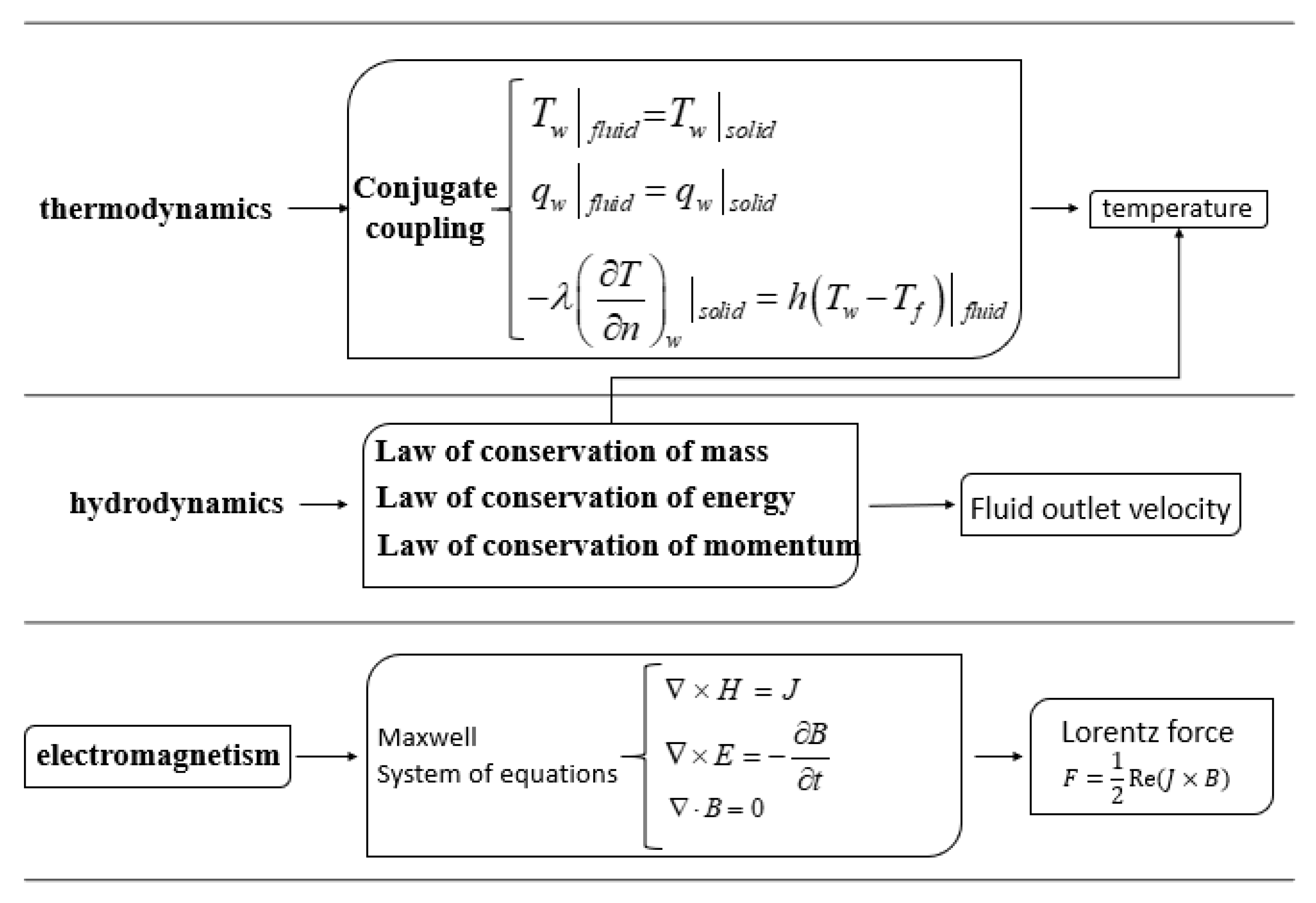
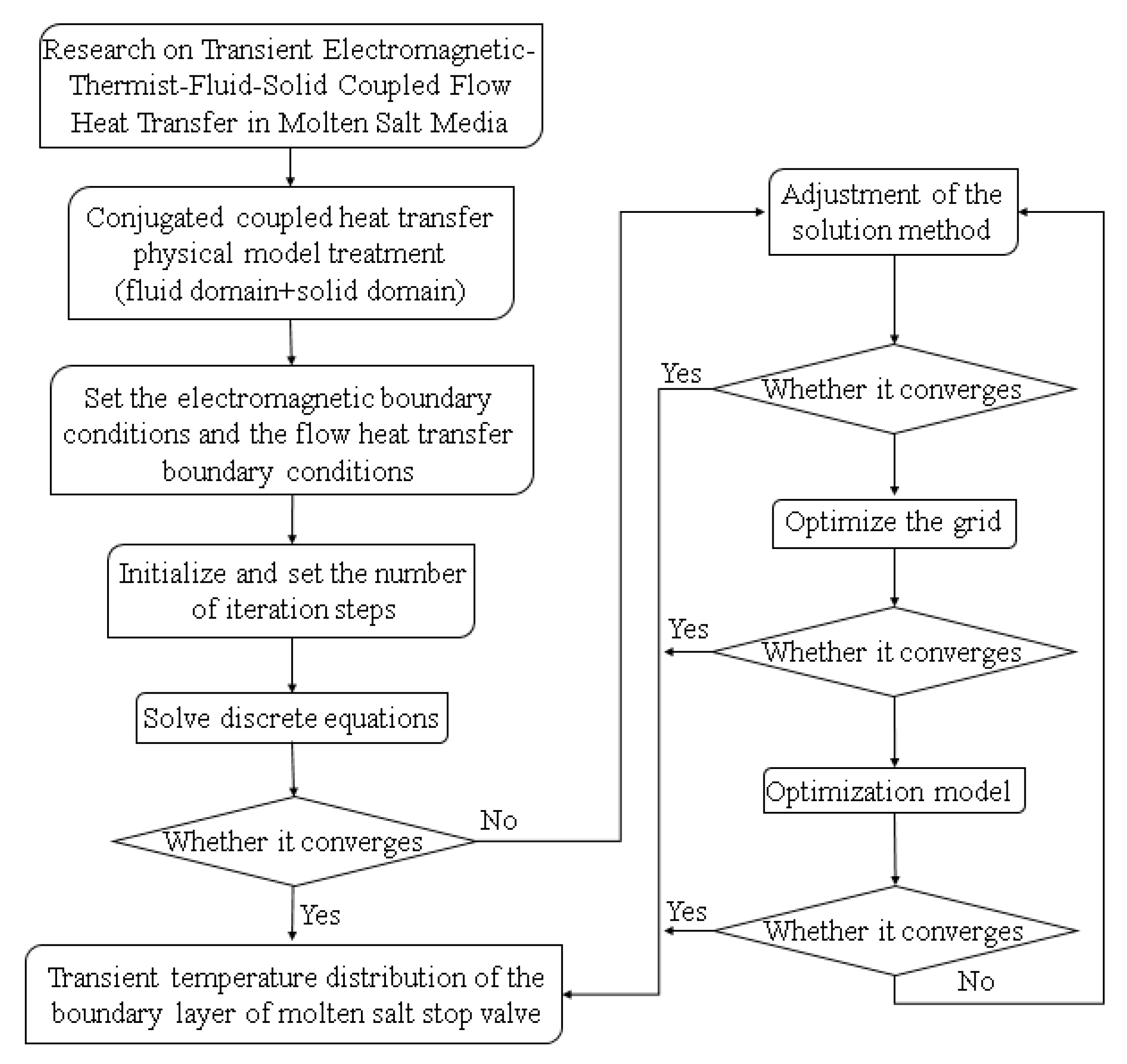
Based on the electromagnetic-thermal-fluid-solid coupling calculation method, the electromagnetic induction heating law of the triangular double-helix cross-section induction coil was studied, as well as the flow and heat transfer law of the molten salt medium in the molten salt globe valve under the action of electromagnetic induction heating. The transient temperature change law of each key point during the operation of the molten salt globe valve was analyzed to provide a guarantee for the safe and stable flow of the molten salt medium in the molten salt globe valve. The process of heating the molten salt globe valve using the electromagnetic induction principle and compensating for the heat loss of the medium in the molten salt globe valve is a complex electromagnetic-thermal-fluid-solid coupling problem. The electromagnetic-thermal-fluid-solid coupling control equation consists of three parts: first, the electromagnetic field is solved based on the Maxwell equations to calculate the induced current and alternating magnetic field on the molten salt globe valve body, and the alternating magnetic field and induced current in the molten salt medium; second, the flow field is solved based on the three continuity equations of the molten salt medium to calculate the velocity of the molten salt medium; and third, the temperature of the molten salt globe valve and the fluid is solved based on the conjugate heat transfer equation [19,20,21]. The electromagnetic-thermal-fluid-solid coupling relationship diagram is shown in Figure 7. The specific steps of electromagnetic-thermal-fluid-solid coupling simulation are shown in Figure 8.

3.1. Governing Electromagnetic Field Equations

Theoretical research and numerical analysis of electromagnetic fields are based on solving Maxwell’s equations, which primarily consist of Ampere’s circuit law, Faraday’s law of induction, Gauss’s magnetic field law, and Gauss’s electric field law.
Ampere’s circuit law can be expressed in integral form as:
Γ H d l = Ω J + D t d S
where J is the current density vector conducted within the molten salt globe valve, expressed in A/m2; D is the electric flux density at the surface of the molten salt globe valve, expressed in C/m2.
Faraday’s law of induction can be expressed in integral form as:
ε = d ϕ B d t
where ε is the induced electromotive force (emf), V; ϕ B = B S d S is the magnetic flux through the area S enclosed by the closed loop, Wb.
The Gaussian magnetic field law can be expressed in integral form as:
S B d S = 0
Gaussian Law is expressed in integral form as:
S D d S = V ρ d v
where ρ is the charge density in the molten salt globe valve, C/m3; V is the volume enclosed by the closed surface S.
The corresponding differential forms are shown in (6)–(9):
× H = J + D t
× E = B t
B = 0
D = ρ
To obtain the boundary conditions for Equations (6)–(9), we need to determine the relationship between the magnetic field intensity H in the electromagnetic field, the electric field intensity E in the electromagnetic field, the magnetic induction intensity amplitude B in the electromagnetic field, the electric flux density D in the electromagnetic field, and the current density J in the electromagnetic field, and add the following three boundary conditions:
D = ε E
B = μ H
J = σ E
where μ is the magnetic permeability of the molten salt globe valve material; ε is the dielectric constant of the molten salt globe valve material.
During the electromagnetic induction heating process, the effect of displacement current on electromagnetic induction heating can be ignored, so Equations (6)–(9) can be simplified to:
× H = J
× E = B t
B = 0
D = ρ
When solving electromagnetic fields, the electric field calculation and magnetic field calculation are first separated to obtain the electric field and magnetic field equations, respectively. This makes the electromagnetic field problem simpler to solve and the numerical calculation more convenient. The separated variables to be used in the simplification are the vector magnetic potential A and the scalar electric potential φ, which are in the following form:
B = × A
E = φ
The definition of vector magnetic potential and scalar electric potential according to Equations (17) and (18) can be used in accordance with the laws of Maxwell’s equations. The partial differential equations of the magnetic field and electric field in induction heating can be derived:
2 A μ ε 2 A t 2 = μ J
2 = 2 x 2 + 2 y 2 + 2 z 2
The finite element method can be used to numerically solve (19) and (20) to obtain the distribution of magnetic and electric fields in the molten salt globe valve with induction heating. Then, through data processing, physical quantities such as the magnetic field intensity H, electric field intensity E, magnetic induction intensity amplitude B and the direction of magnetic induction intensity B, electric flux density D, current density amplitude J and the direction of current density J in the electromagnetic field can be obtained.

3.2. Control Equations of Flow Field and Temperature Field

(1)
Control equations of molten salt medium and air fluid domain
The model established based on the conjugate heat transfer method needs to include the molten salt medium and air fluid domain and the molten salt globe valve solid domain, and different control equations are used in different regions [22]. The flow of molten salt medium and air follows three basic fluid dynamics principles. Applying the fluid dynamics principles to a suitable flow model and expressing them with mathematical equations can obtain the governing equations of the flow field (Governing Equations). According to the actual flow conditions of the molten salt medium, the molten salt medium is set as an incompressible fluid flow, and the solution of the governing equations is as follows:
1)
Mass conservation equation: In the fluid flow, the mass increment of the microelement per unit time is equal to the mass of the fluid flowing into the microelement during this time period. Its mathematical expression is:
ρ t + ρ u x + ρ v z + ρ w z = 0 d i v u = u x x + u y z + u z z
The tensor form of Formula (21) can be rewritten as a vector form:
ρ t + d i v ρ u = 0
In the formula, ρ represents the fluid density, kg/m3; t represents the time of fluid flow, s; u represents the fluid velocity vector, m/s; and u, v, and w are the components of the fluid velocity vector u in the x, y, and z directions.
2)
Momentum conservation equation: This is actually a statement of Newton’s second law, stating that the rate of change in momentum of the fluid medium in a microelement with respect to time is equal to the sum of the various external forces acting on that microelement.
In a three-dimensional flow domain, the momentum conservation equations in the x, y, and z directions can be expressed as:
ρ u t + d i v ρ u u = p x + τ x x x + τ y x y + τ z x z + F x
ρ v t + d i v ρ v u = p y + τ x y x + τ y y y + τ z y z + F y
ρ w t + d i v ρ w u = p z + τ x z x + τ y z y + τ z z z + F z
where p is the pressure on the element, Pa; τxy, τyx, and τzx are the three components of the viscous stress τ acting on the element; Fx, Fy, and Fz are the external forces acting on the element, N.
3)
Energy Conservation Equation: This is actually the first law of thermodynamics, stating that the rate of increase in energy in an element is equal to the net heat flow into the element plus the work done on the element by the body and surface forces. The energy conservation equation is expressed as:
ρ T t + d i v ρ u T = d i v k C p grad T + S T
where k is the heat transfer coefficient of the fluid, W/m2·K; T is the temperature of the fluid, K; cp is the specific heat capacity of the fluid, J/(kg·°C); ST is the viscous dissipation term of the fluid; ρf is the density of the fluid, kg/m3; u is the flow velocity condition of the fluid, m/s.
(2)
Control equation of the solid domain of the molten salt globe valve
The heat transfer mode inside the molten salt globe valve is heat conduction, and its heat balance equation [23] is as follows:
ρ T c p T T t = T x i λ ( T ) T x i + Q
where ρs is the density of the solid domain, kg/m3; T is the wall temperature of the solid domain, K; cp is the specific heat capacity of the material in the solid domain, J/(kg·°C); λ is the thermal conductivity of the solid domain, W/m·K; Q is the heat generation power per unit volume in the solid domain, W.
(3)
Governing equations of fluid-solid interface coupling
Applying the third-class boundary condition [24], the temperature at the fluid-solid interface of the conjugate heat transfer model of the molten salt globe valve is obtained:
T w | f l u i d = T w | s o l i d
q w | f l u i d = q w | s o l i d
λ T n w | s o l i d = h T w T f | f l u i d
where qw is the heat flux at the fluid-solid interface between the fluid domain and the solid domain, W/m2; n is the wall normal of the solid domain; λ is the thermal conductivity of the solid domain, W/m·K; h is the convective heat transfer coefficient, W/m2·K; Tw and Tf are the fluid temperatures at the fluid-solid interface and its vicinity (boundary layer), respectively.
The above conjugate heat transfer equations are combined to obtain the heat transfer coefficient, which is substituted into the heat conduction equation. The temperature difference between adjacent iteration steps is checked and automatically iterated to make the solver converge and finally obtain the transient temperature field information of the molten salt globe valve calculation domain [25].

3.3. Thermal Stress Equation

The temperature field of the molten salt globe valve obtained by the conjugate heat transfer calculation in Chapter 3 is input as a load into the statics module to calculate the thermal stress of the molten salt globe valve. The calculation equation can be expressed as:
M u ¨ + C u ˙ + K u = P
C T T ˙ + K T T = Q T
where [M] is the mass matrix; [C] is the damping matrix; [K] is the stiffness matrix; [P] is the load vector; [C(T)] is the specific heat matrix; [K(T)] is the heat transfer matrix; [Q(T)] is the heat flow load vector; u is the displacement; and T is the temperature. The above equation is usually solved using the explicit integration method:
u ˙ i + 1 2 N = u ˙ i 1 2 N + Δ t i + 1 + Δ t i 2 u ¨ i N u i + 1 N = u i N + Δ t i + 1 u ˙ i + 1 2 N
T i + 1 N = T i N + Δ t i + 1 T ˙ i N
where i is the increment. The displacement component uses the central differential integration rule, while the temperature uses the forward differential integration rule. During the analysis, the temperature distribution and thermal deformation are calculated, thus affecting the stress analysis. Simultaneously, the stress distribution also affects the temperature solution, thus achieving full coupling.

4. Finite Element Analysis of Transient Electromagnetic-Fluid-Thermal-Solid Coupled Flow and Heat Transfer in Molten Salt Media

4.1. Geometric Model and Its Reasonable Simplification

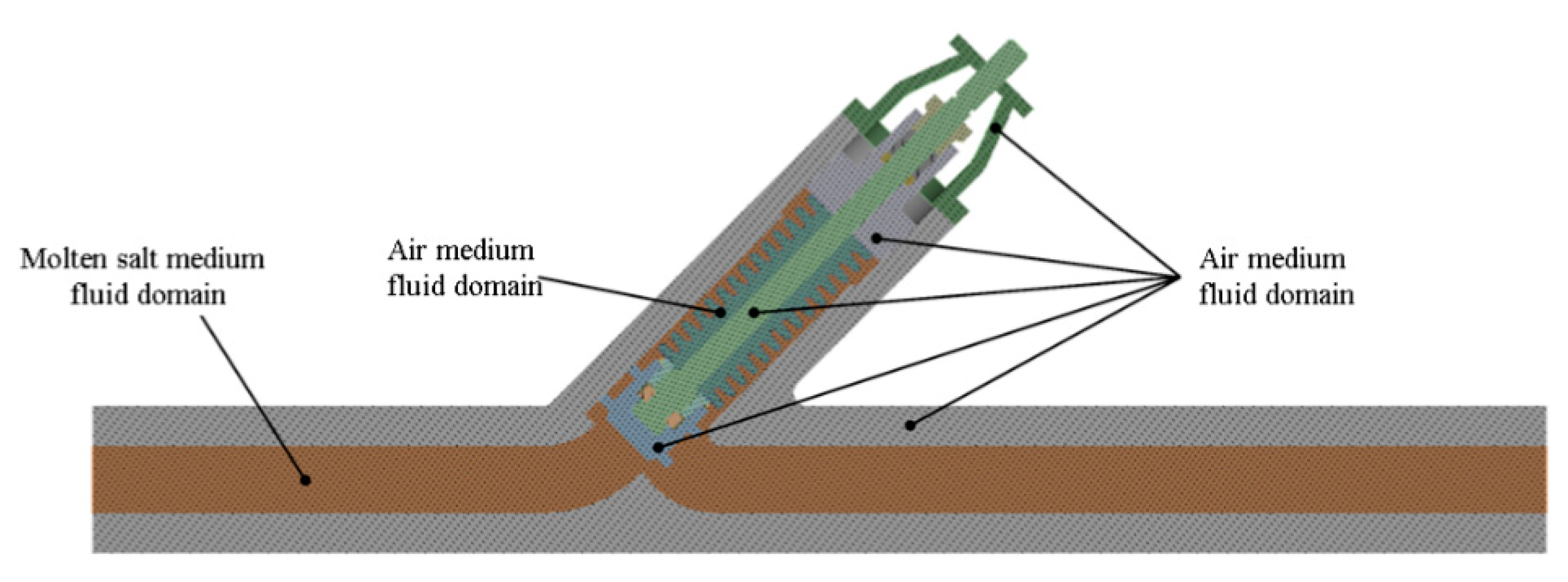
Based on the 2D design drawings of a DN50 molten salt globe valve, a fully open model of the valve was constructed using 3D modeling software. Based on the structure of the triangular double-helix induction coil and the molten salt globe valve, the specific material parameters for each component are shown in Table 3. Figure 9 shows the conjugate heat transfer geometry model of the molten salt globe valve, which includes the molten salt medium fluid domain and the molten salt globe valve solid domain. To ensure uniform flow of the molten salt medium at the valve inlet and fully developed flow after the valve, and to eliminate the effects of fluid disturbances caused by insufficient flow development at the inlet and outlet, a straight pipe section with a length of 5 times the length of the valve was added before the valve and a straight pipe section with a length of 10 times the length after the valve was added. Simplification was also performed on process chamfers, fillets, and other structures with minimal impact on flow analysis. This simplification primarily addressed small chamfers and threaded connections in non-critical stress-bearing areas of the valve, as well as accessory components with minimal impact on electromagnetic and flow field distribution. The simplification approach retained the geometric features of the valve core flow channel, the induction coil body, and key sealing structures. The reasonably simplified 3D model was imported into ANSYS Workbench 2022 Space Claim and Design Modeler for reverse modeling to generate internal flow channels.

4.2. Mesh Division and Mesh Independence Test

(1)
Maxwell electromagnetic field grid division and grid independence test
When the total number of mesh elements for the induction coil, molten salt stop valve, and air domain in Maxwell reached 139,953, it can be observed from Table 4 that further increasing the mesh count resulted in essentially no change in the maximum amplitude of magnetic flux density and the maximum current density. The results calculated with the 139,953-element mesh (medium refinement level) showed relative errors compared to the baseline values (from the 102,564-element mesh) of 44.62% for magnetic flux density and 31.19% for current density. The results from the 154,289-element mesh (highest refinement level) further approached the baseline values, with relative errors less than 1% (0.96% for magnetic flux density and 0.93% for current density). This demonstrates a reasonable convergence trend of “mesh refinement → error reduction → result stabilization,” which aligns with the principles of numerical computation convergence. Therefore, it is concluded that when the mesh count in Maxwell reaches 139,953, further increases in mesh elements have a negligible impact on the calculated results while introducing additional computational difficulty.
(2)
Flow field meshing and mesh independence check
From Table 5, it can be observed that as the mesh count in Fluent increases, the calculated maximum temperature within the solid domain of the molten salt stop valve remains essentially unchanged. The result calculated with the 6,578,282-element mesh (medium refinement level) shows a relative error close to 1.72% compared to the baseline value (from the 5,742,896-element mesh). The result from the 7,745,289-element mesh (highest refinement level) further approaches the baseline value, with the relative error reduced to 0.06%, which is less than 1%. This exhibits a reasonable convergence trend of “mesh refinement → error reduction → result stabilization,” aligning with the principles of numerical computation convergence. Therefore, it is concluded that when the mesh count in Fluent reaches approximately 6.58 million (6,578,282), further increases in the number of mesh elements have a negligible impact on the calculated results while introducing additional computational difficulty.
(3)
Meshing and Mesh Independence Test in Statics
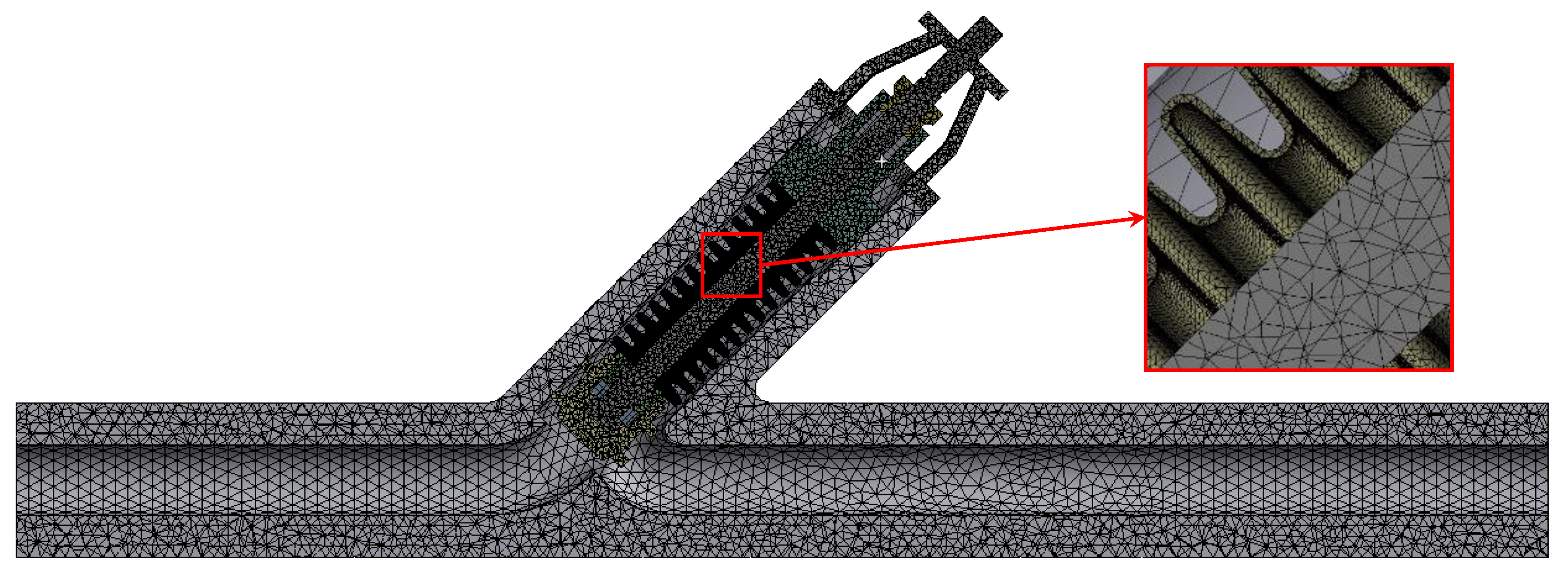
The transient shock thermal stress of the molten salt globe valve and the transient conjugate heat transfer share a finite element model. In the statics module, the fluid domain in the conjugate heat transfer geometric model needs to be suppressed, and finally the finite element analysis model of the transient shock thermal stress of the molten salt globe valve is obtained. The molten salt globe valve model is meshed using adaptive meshing and local meshing technology, and the bellows is meshed. The mesh independence test is shown in Table 6. Considering the calculation accuracy and cost, a small number of units with a maximum stress value difference of no more than 1% is selected for numerical simulation. The final number of mesh nodes is determined to be 1,443,276 and the number of mesh units is 790,965. The mesh model is shown in Figure 10.

4.3. Load and Boundary Condition Setting

A mixture of 60% NaNO3 and 40% KNO3 is used as the medium for the molten salt globe valve. The freezing point is 238 °C and the operating temperature is 270~565 °C (543.15~838.15 K). In order to effectively reduce the impact of thermal stress of the molten salt medium on the valve body wall when the salt is introduced, the molten salt globe valve should be preheated before the molten salt medium is introduced into the molten salt globe valve [26]. The molten salt globe valve is preheated with hot air. The preheating parameters of the molten salt globe valve are shown in Table 7. The thermal physical parameters of the hot air are shown in Table 8. The temperature of the hot air at the outlet of the fuel heater is 573.15 K, the hot air flow rate is 480 m3/h, the medium material is high-temperature molten salt, and the size of the hot air inlet and outlet pipes is ϕ57 mm × 3.5 mm. At 543.15 K, the material parameters of the molten salt medium are shown in Table 9.
Boundary conditions such as gravity load and medium pressure of 6.4 MPa are applied to the molten salt globe valve. At the same time, the high-temperature expansion phenomenon of the molten salt globe valve is considered. The far-end displacement constraint is imposed on the pipeline inlet end face, and the axial freedom constraint is imposed on the pipeline outlet end face. Friction contact is set between the contact surface of the globe valve disc and the sealing ring, where the sealing ring surface is the contact surface and the valve disc surface is the target surface. The friction coefficient is set to 0.45. The augmented Lagrangian contact algorithm is adopted and asymmetric contact behavior is set.

4.4. Maxwell Electromagnetic Field Finite Element Analysis Results

(1)
Calculation of magnetic induction intensity B
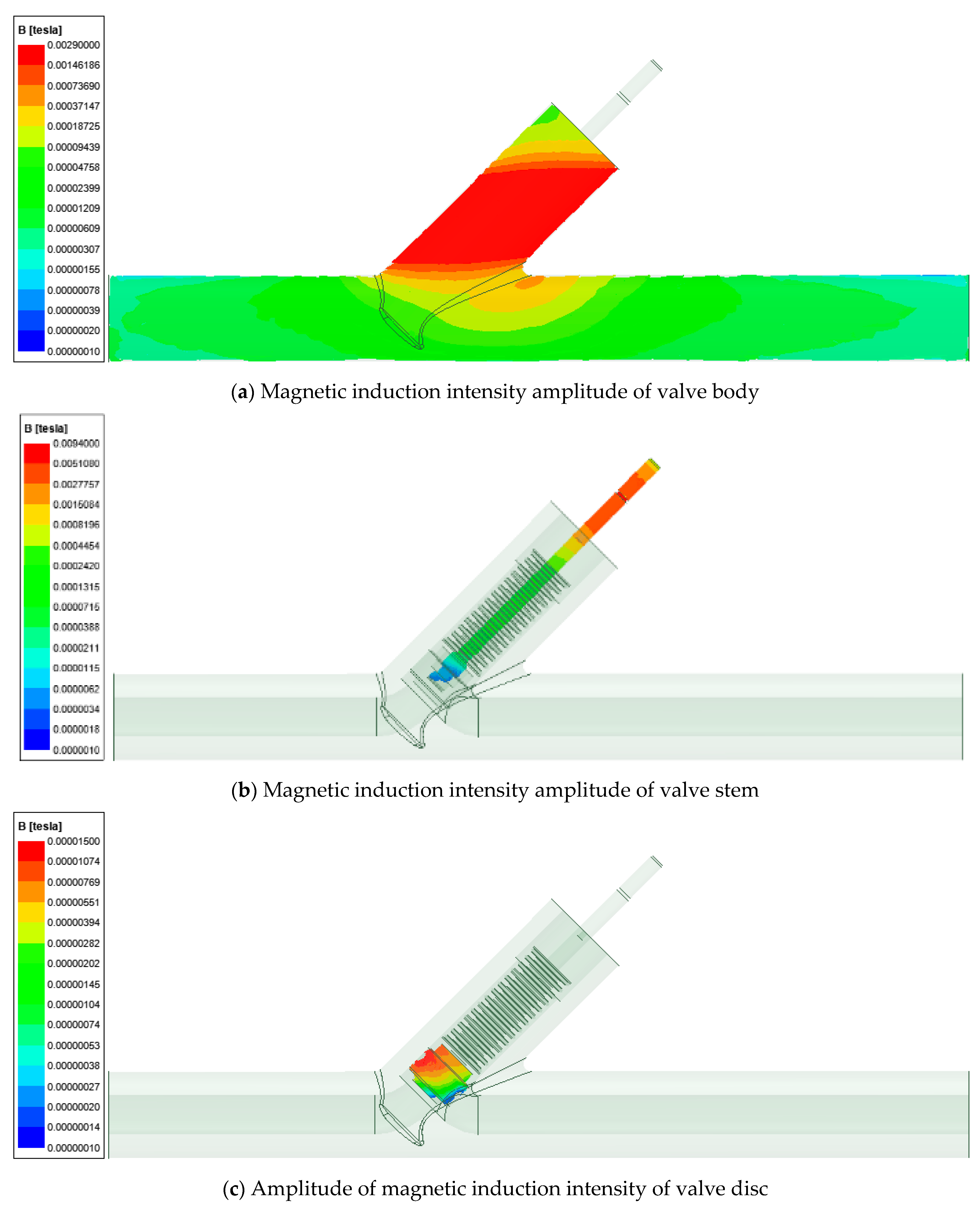
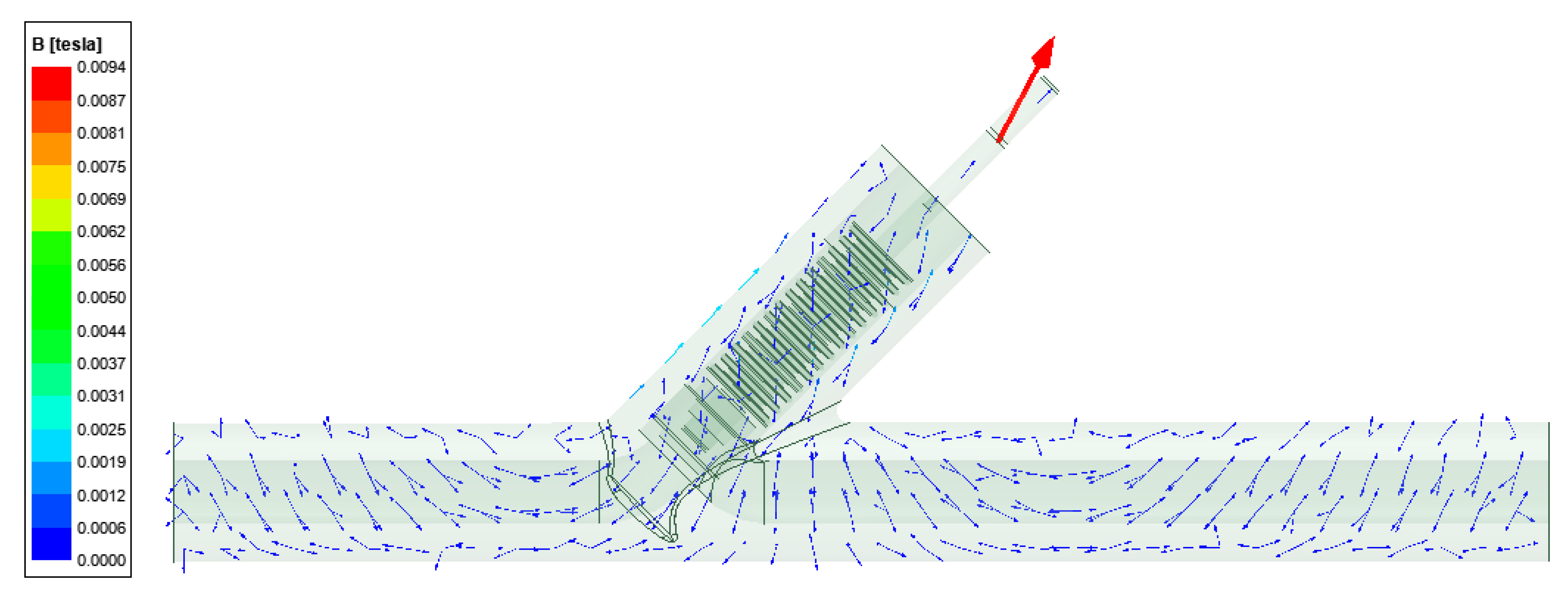
Magnetic induction intensity B refers to the physical quantity that describes the strength and direction of the magnetic field. The model was imported into Maxwell, and the corresponding material parameters and excitation (10 turns, 30 A, 10 kHz) were set. The calculated magnetic field cloud map and vector map distribution of the molten salt globe valve body are shown in Figure 11 and Figure 12.
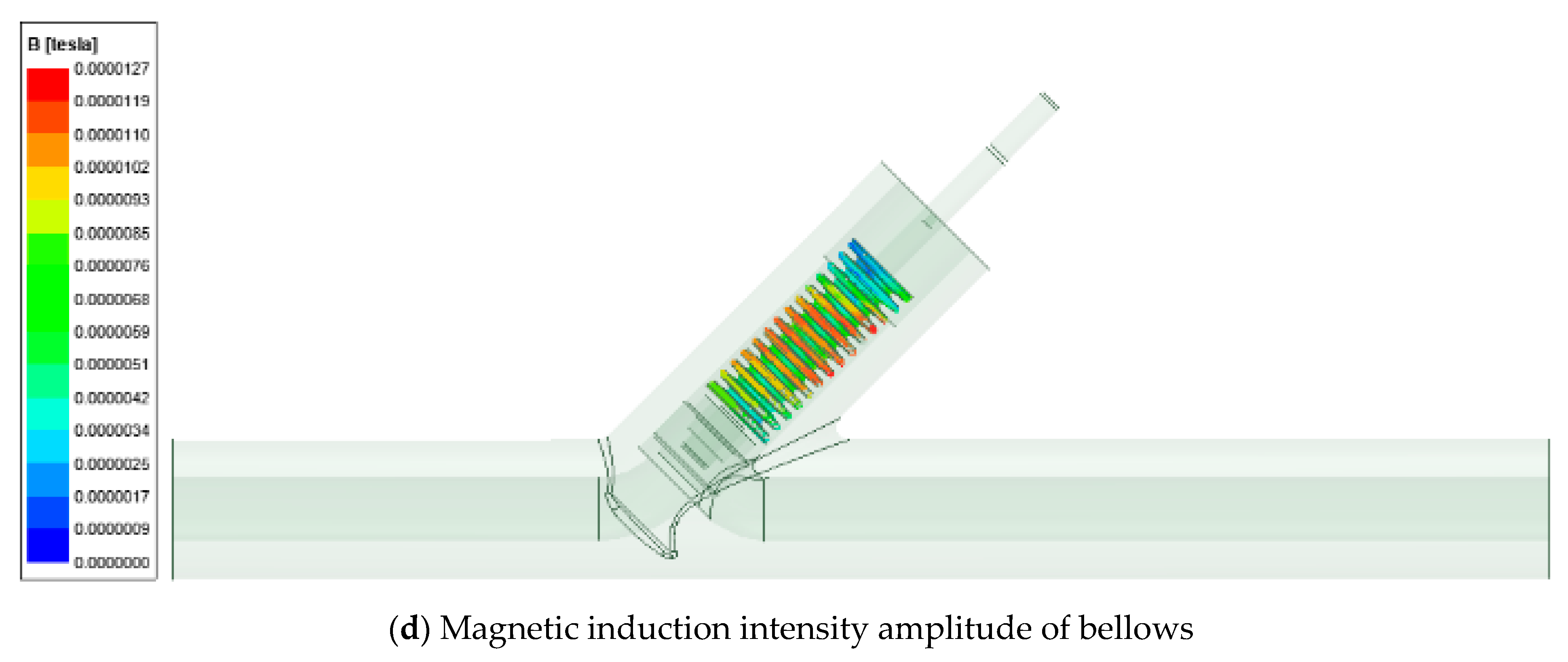
Figure 11 shows that the maximum magnetic induction intensity amplitude under the induction coil parameters during the insulation phase is located at the valve stem, at the exact center of the induction coil, with a maximum value of 0.0094 T. Because the theoretical calculations take fewer external disturbances into account, the simulated values are slightly higher than the theoretical values. The maximum magnetic induction intensity amplitude on the valve body is 0.0029 T, gradually decreasing toward the sides along the molten salt globe valve flow path. The maximum magnetic induction intensity amplitude on the valve stem is 0.0094 T, reaching its peak at the stem end. The maximum magnetic induction intensity on the valve disc is 0.000015 T, gradually decreasing from the upper left to the lower right. The maximum magnetic induction intensity amplitude on the bellows is 0.0000127 T, reaching its peak in the center and decreasing toward the ends. In summary, the magnetic induction intensity is greatest at the valve stem. To prevent electromagnetic induction heating under actual operating conditions, the valve stem must be made of the weakly conductive material Inconel 625. Table 1 shows that the relative electrical conductivity of the valve stem material is an order of magnitude lower than that of the valve body, bellows, and other materials.
As shown in Figure 12, under the induction coil parameters during the thermal maintenance stage, the system’s magnetic field distribution exhibits distinct spatial characteristics: the direction of the maximum magnetic flux density in the coil region is essentially vertically upward, while the magnetic flux density within the molten salt stop valve body is primarily distributed along the flow channel direction. This spatial distribution characteristic, combined with the phase properties of the magnetic field, determines the final heating efficacy. Figure 12 displays the magnetic flux density contour at the zero-phase instant. According to Faraday’s law, a time-varying magnetic field induces a solenoidal electric field, which manifests in the frequency domain as leading by 90°. Furthermore, based on Ohm’s law, the induced eddy current density within the metallic material of the valve body is in phase with the electric field. Consequently, under sinusoidal alternating excitation, the generated magnetic field lags behind the applied excitation current or electric field by approximately 90° in phase.

4.5. Finite Element Analysis Results of Fluent Flow Field and Temperature Field

Fluent computational fluid dynamics software was used to compare the transient temperature changes in the molten salt globe valve under the induction coil parameters during the insulation stage. The results obtained in the ANSYS Workbench 2022 Maxwell module were imported into Fluent, and the Fluent module was used to realize the integration of the heat transfer of the inner wall surface of the molten salt globe valve and the heat transfer of the internal molten salt medium [27,28].
(1)
Transient temperature analysis monitoring point calibration
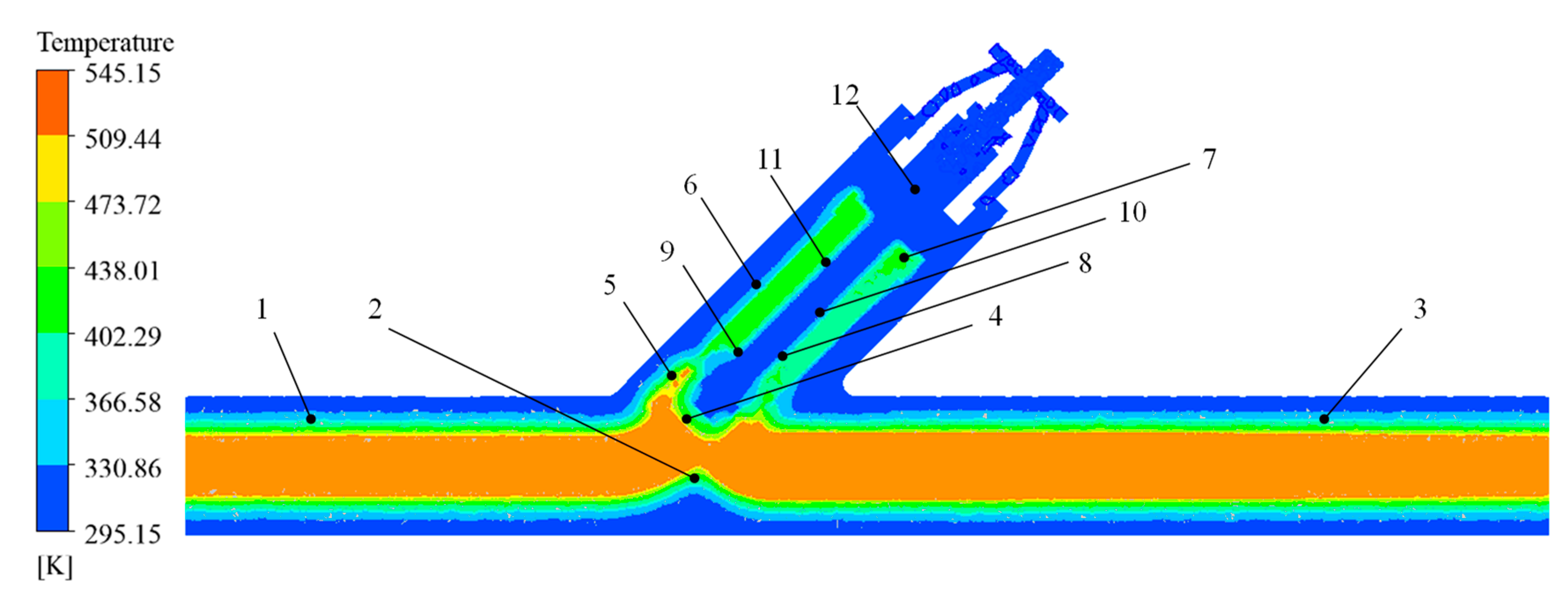
As shown in Figure 13, the temperature distribution cloud map of the molten salt globe valve at 20 s under the induction coil parameters during the insulation stage and the distribution of each monitoring point. The conjugate heat transfer process transfers heat through the fluid-solid interface, and the temperature of the part in direct contact with the molten salt at 20 s rises by about 100 K. In order to study the transient heat transfer of the molten salt globe valve during operation, 12 monitoring points were reasonably selected at the boundary layer at the discontinuity of the valve body internal structure, the disc boundary layer, the valve stem boundary layer, the boundary layer at the discontinuity of the bellows structure, the flow channel boundary layer, the pipeline boundary layer in front of the valve, and the pipeline boundary layer behind the valve. The temperature changes in each monitoring point with time under the induction coil parameters during the insulation stage were analyzed. Monitoring point 1: Pipe wall in front of the valve; Monitoring point 2: Valve structural discontinuity; Monitoring point 3: Boundary layer in the pipe behind the valve; Monitoring point 4: Valve disc; Monitoring point 5: Operating section wall monitoring point a; Monitoring point 6: Operating section wall monitoring point b; Monitoring point 7: Operating section wall monitoring point c; Monitoring point 8: Bellows monitoring point a; Monitoring point 9: Bellows monitoring point b; Monitoring point 10: Bellows monitoring point c; Monitoring point 11: Bellows monitoring point d; Monitoring point 12: Filling monitoring point
(2)
Transient temperature analysis at each monitoring point
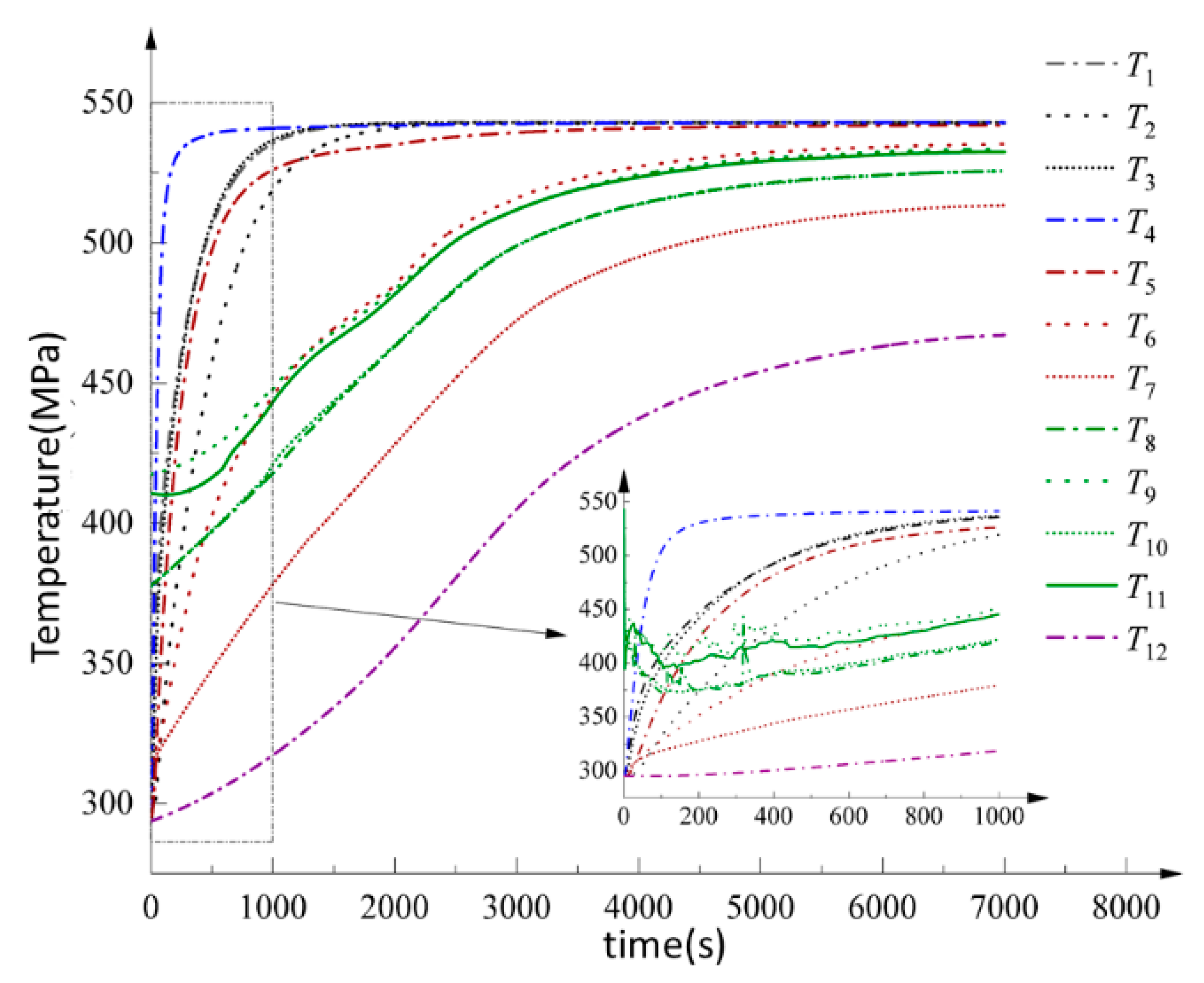
The transient temperature changes of various parts of the molten salt globe valve during the transient heat transfer process are analyzed. Figure 14 shows the temperature time history curves of each monitoring point. Overall, the temperature of each monitoring point shows an upward trend. The temperature of monitoring point 1 and monitoring point 3 rises rapidly to 545 K before 1500 s, and reaches a steady state and remains near 545 K after 1500 s; monitoring point 2 reaches a steady state later than monitoring point 1, and the temperature stabilizes at around 545 K after 2000 s; monitoring point 4 reaches a steady state earlier than monitoring point 1, and the temperature stabilizes at around 545 K before 500 s.

4.6. Structural Field Finite Element Analysis Results

The temperature information at different critical moments calculated in the Fluent software was imported into the structural field and used as load input. At the same time, pressure load, gravity load and inlet and outlet constraint boundary conditions were applied to analyze the stress distribution results of the molten salt globe valve at different times.

4.6.1. Analysis of Shock Thermal Stress of Molten Salt Globe Valve Without Preheating Treatment

(1)
Analysis of transient shock thermal stress of molten salt globe valve body without preheating treatment
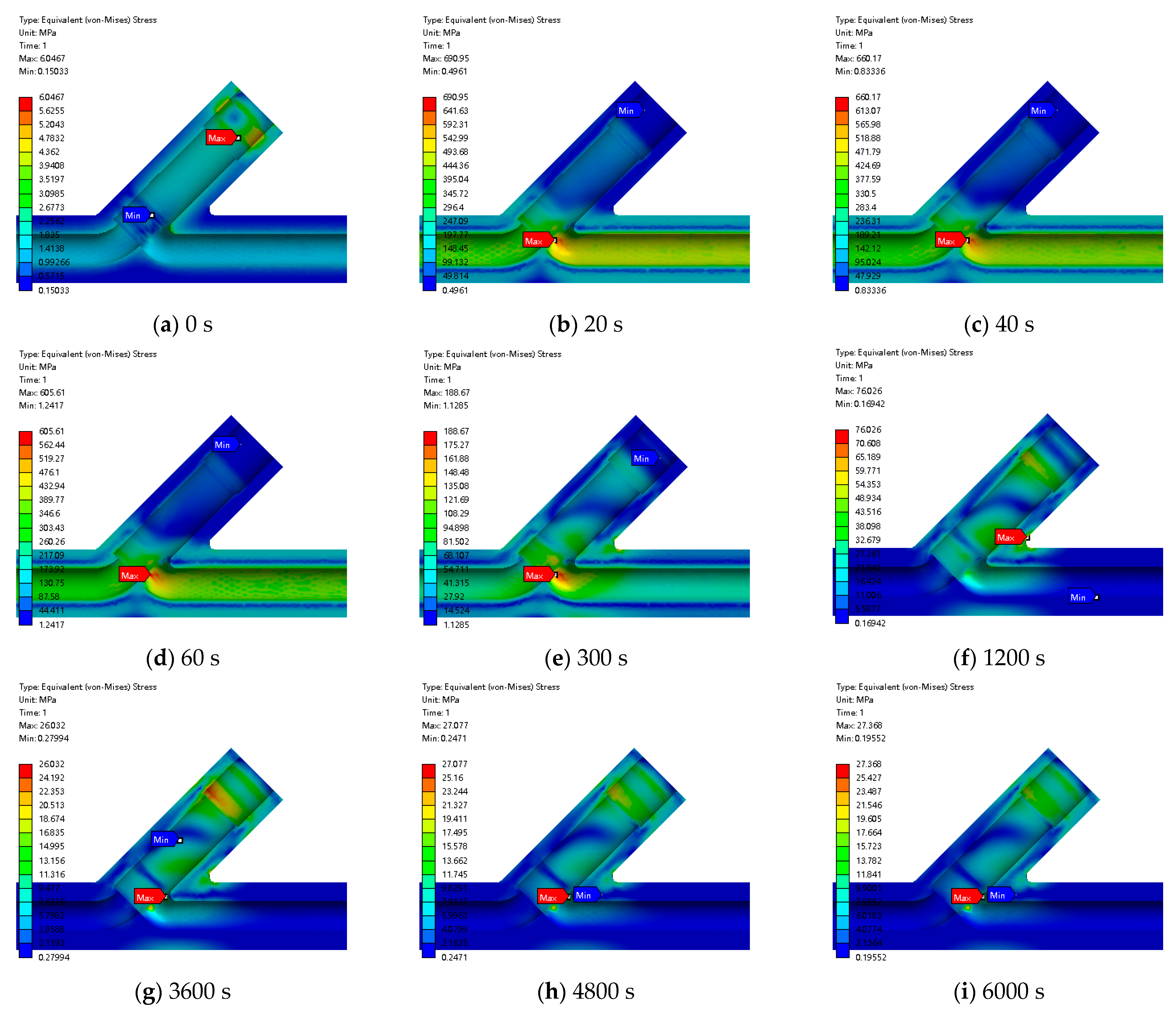
The temperature distribution information at 12 critical time points under the working conditions in Section 4.4 was imported to obtain the transient shock thermal stress distribution at 9 critical time points under the condition of no preheating treatment. Figure 14 shows the transient shock thermal stress cloud map of the valve body at 9 key points.
Shortly after the medium flows into the molten salt globe valve, the medium and the inner wall of the flow channel undergo convective heat exchange. In this process, there is both heat convection and heat conduction. Due to the thick wall thickness of the inlet and outlet flow channels and the action of the medium pressure, the temperature difference stress between the inner and outer walls is large. As the temperature gradient in this area further increases, it reaches its maximum at 20 s, and the thermal stress in this area also reaches a maximum stress value of 690.95 MPa, as shown in Figure 15b, resulting in local overstress. The maximum transient shock thermal stress is located at the discontinuity of the valve body structure. Thereafter, as the temperature gradient in this area gradually slows, the generated thermal stress also gradually decreases. Finally, after 3600 s as shown in Figure 15g, the shock thermal stress decreases to 26.03 MPa and stabilizes, which is less than the allowable stress of the molten salt globe valve body material and meets the strength requirements.
(2)
Analysis of transient shock thermal stress of the bellows of the molten salt globe valve under non-preheating conditions
The temperature distribution information at 12 key time points under the working conditions in Section 4.4 was imported to obtain the transient shock thermal stress distribution at 9 key time points under the non-preheating treatment condition. Figure 16 shows the transient shock thermal stress cloud map of the bellows at 9 key points.
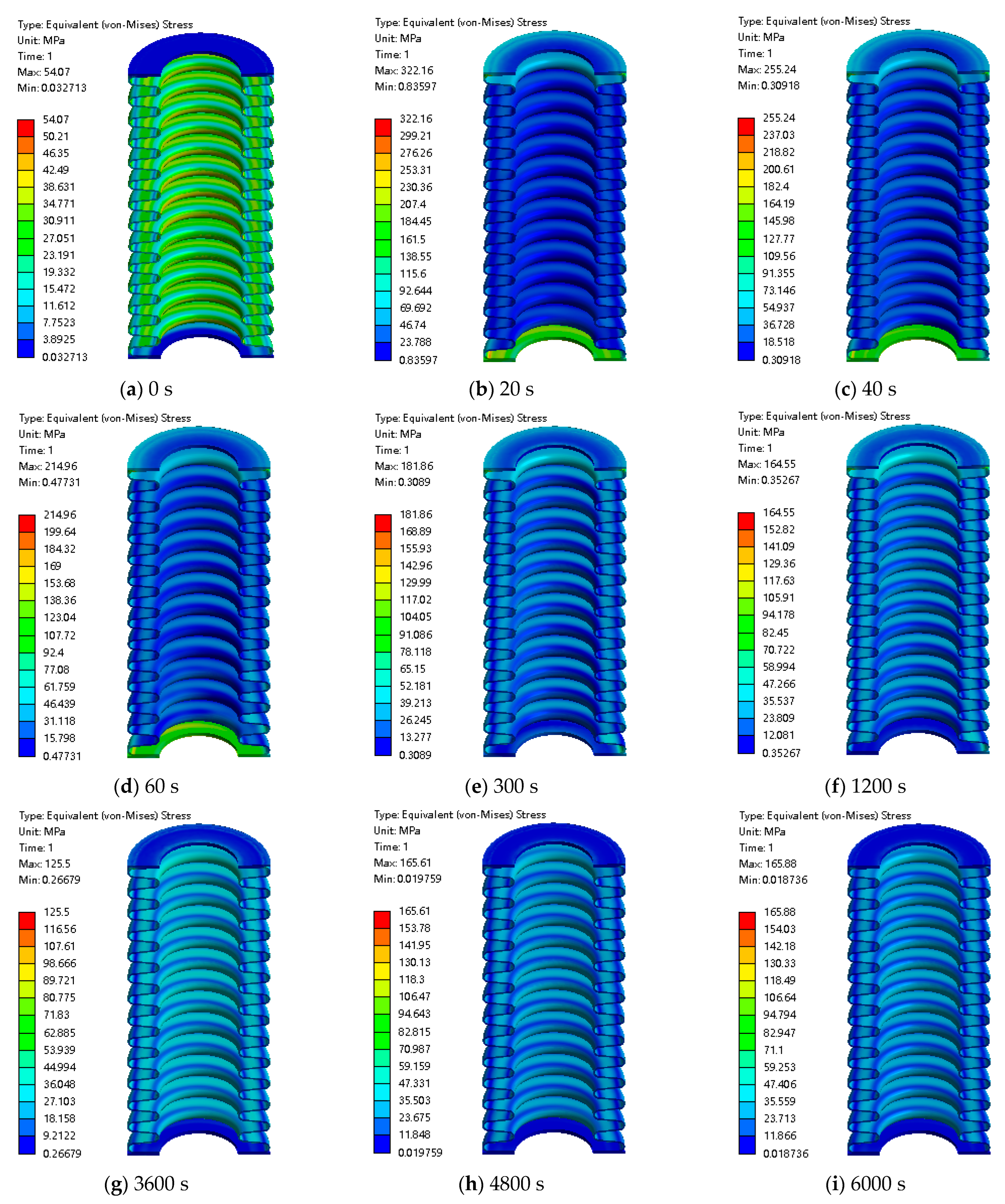
Shortly after the medium flows into the molten salt globe valve, the medium has not yet flowed through the outside of the bellows. As time goes by, the temperature gradient of this part further increases. When the temperature gradient reaches the maximum at 20 s, the temperature difference stress of this part also reaches the maximum stress value of 322.16 MPa as shown in Figure 16b, resulting in local overstress. The maximum value of transient shock thermal stress is located at the top and bottom of the bellows where they are welded to the stuffing box and valve disc, respectively. After that, as the temperature gradient in this part gradually slowed down, the generated temperature difference stress also gradually decreased. Finally, after 4800 s as shown in Figure 16h, the impact thermal stress was reduced to about 165.61 MPa and stabilized, which was less than the allowable stress of the molten salt globe valve bellows material and met the strength requirements.
Figure 15 and Figure 16 show that when the molten salt medium begins to enter the molten salt globe valve from the pipeline, a large temperature difference between the molten salt globe valve and the medium creates a large temperature gradient on the inner and outer sides of the globe valve wall. This is the source of shock thermal stress. To reduce the shock thermal stress caused by the molten salt medium, the molten salt medium must be preheated before entering the molten salt globe valve.

4.6.2. Analysis of Shock Thermal Stress of Molten Salt Globe Valve Under Preheating Conditions

(1)
Numerical Simulation Study of the Preheating Process
The flow and heat transfer of hot air within the molten salt stop valve body satisfy the conservation laws of mass, momentum, and energy. During the study of preheating the valve body with hot air, the effects of radiative heat transfer were neglected. A transient thermal simulation of the preheating process for the molten salt stop valve body was conducted using ANSYS Fluent. The hot air parameters were set as follows: the outer side of the insulation layer was set with a natural convection boundary condition, with an air temperature of 293.15 K and a convective heat transfer coefficient of 6 W/(m2·°C). The initial temperature of the molten salt stop valve body was set to 293.15 K, and the fluid domain temperature was set to 473.15 K. The governing equations were solved using the finite volume method. The k–ε model was selected to solve the turbulence model, with a convergence residual of 1 × 10⁻³. The pressure-velocity coupling was handled using the SIMPLE algorithm, and the pressure discretization scheme employed was PRESTO.
When calculating conjugate heat transfer in the Fluent module, the obtained temperature information of the molten salt stop valve under the applied preheating temperature conditions was imported. Boundary conditions, including gravity load and a medium pressure of 6.4 MPa, were applied to the molten salt stop valve. High-temperature expansion of the valve was also considered. A remote displacement constraint was applied to the pipe inlet end face, while an axial free constraint was applied to the pipe outlet end face. A frictional contact was defined between the contact surfaces of the valve disc and the inner wall of the valve’s operational section, where the inner wall surface was set as the contact surface and the valve disc surface as the target surface, with a friction coefficient of 0.45. The augmented Lagrangian contact algorithm was used, and asymmetric contact behavior was specified.
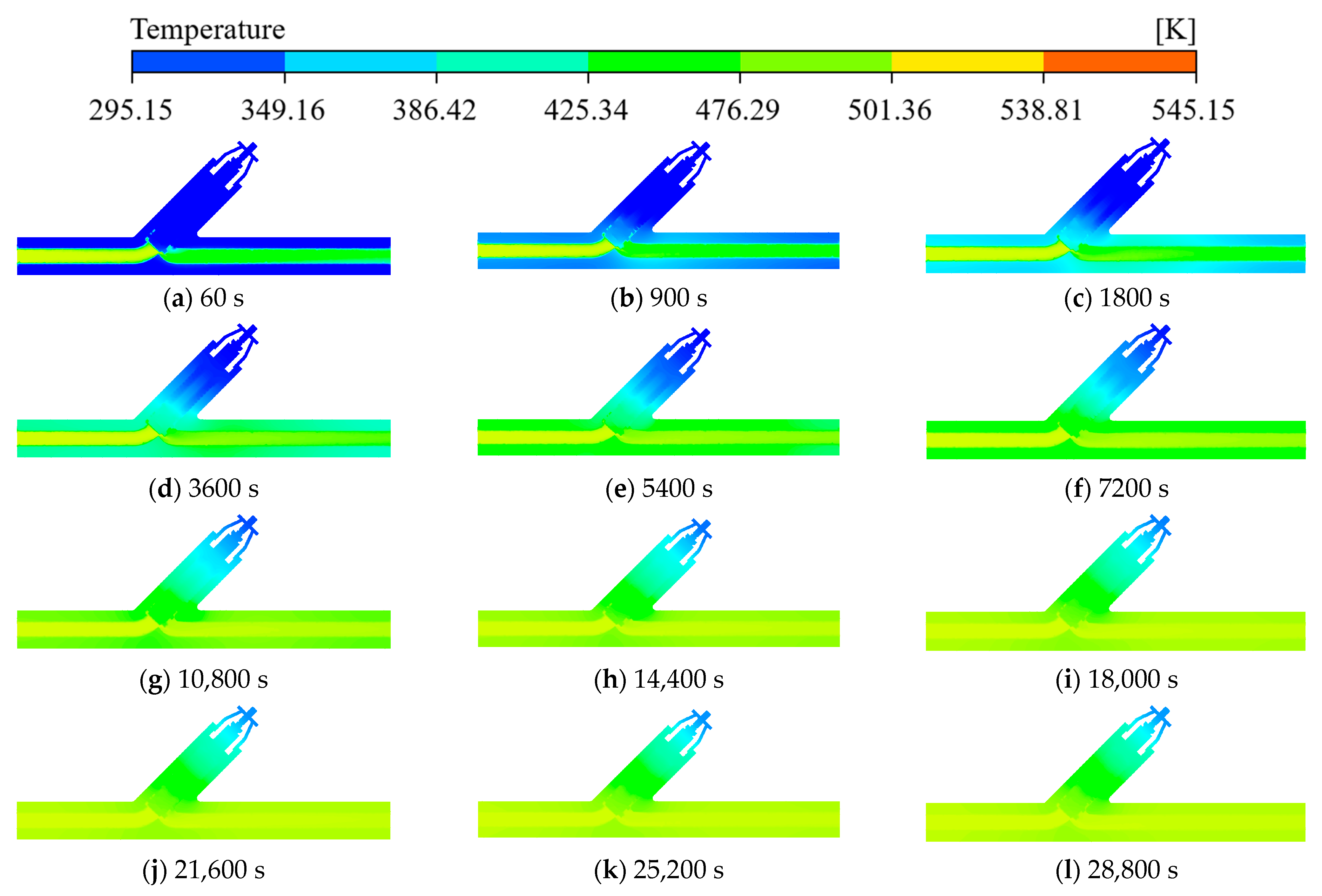
Hot air at 523.15 K was introduced into the molten salt stop valve for preheating. As the air temperature inside the valve continuously increased, the temperatures of the valve body wall and internal components also rose correspondingly. The tank was considered prepared for salt introduction after 600 min of preheating with hot air. The temperature distributions at 12 selected time points—60 s, 900 s, 1800 s, 3600 s, 5400 s, 7200 s, 10,800 s, 14,400 s, 18,000 s, 21,600 s, 25,200 s, and 28,800 s—are shown in Figure 17. These distributions served as boundary condition inputs for the subsequent transient temperature calculation. After the hot air began preheating the valve body, all components experienced rapid temperature increases. The heating rate was relatively high initially and then gradually slowed down. The preheating process continued for 18,000 s, resulting in a final average stable temperature of 473.15 K for the critical parts of the valve body.
As shown in Figure 17, at around 60 s, as the 523.15 K hot air enters the molten salt stop valve, heat exchange begins between the hot air and the surfaces of the pipeline and valve body. By approximately 900 s, the pipeline temperature starts to rise, reaching about 380 K, while the operational section of the molten salt stop valve has not yet begun to warm up. Around 1800 s, the pipeline temperature increases further to about 420 K, and the operational section of the valve starts to heat up gradually from the bottom upwards. By roughly 7200 s, the section of pipeline not far downstream of the valve has warmed to about 480 K. At around 10,800 s, this downstream pipeline section reaches approximately 500 K, close to the hot air temperature, and the entire operational section of the valve has also begun to heat up. Near 14,400 s, heating is nearly complete for almost all areas of the flow channel. The lower part of the valve’s operational section reaches about 450 K, while the upper part reaches about 425 K. After 18,000 s (the preheating process lasts about 5 h), preheating is complete. The temperature of the valve’s operational section reaches 470 K, and the pipeline temperature approaches the hot air temperature infinitely closely. Due to limitations imposed by the heat transfer parameters of the air medium and the valve material, heat is lost during the transfer from the hot air. Consequently, upon completion of preheating, the temperature of the valve’s operational section is lower than that of the pipeline sections upstream and downstream of the valve.
(2)
Analysis of Thermal Shock Stress in the Molten Salt Stop Valve under Preheating Conditions
The temperature information at different critical moments under five preheating conditions calculated in Fluent software was imported into the structural field as load input. Simultaneously, medium pressure loads and gravity loads were applied, and inlet and outlet constraint boundary conditions were set. The transient shock thermal stress distribution of the molten salt globe valve at different times was analyzed.
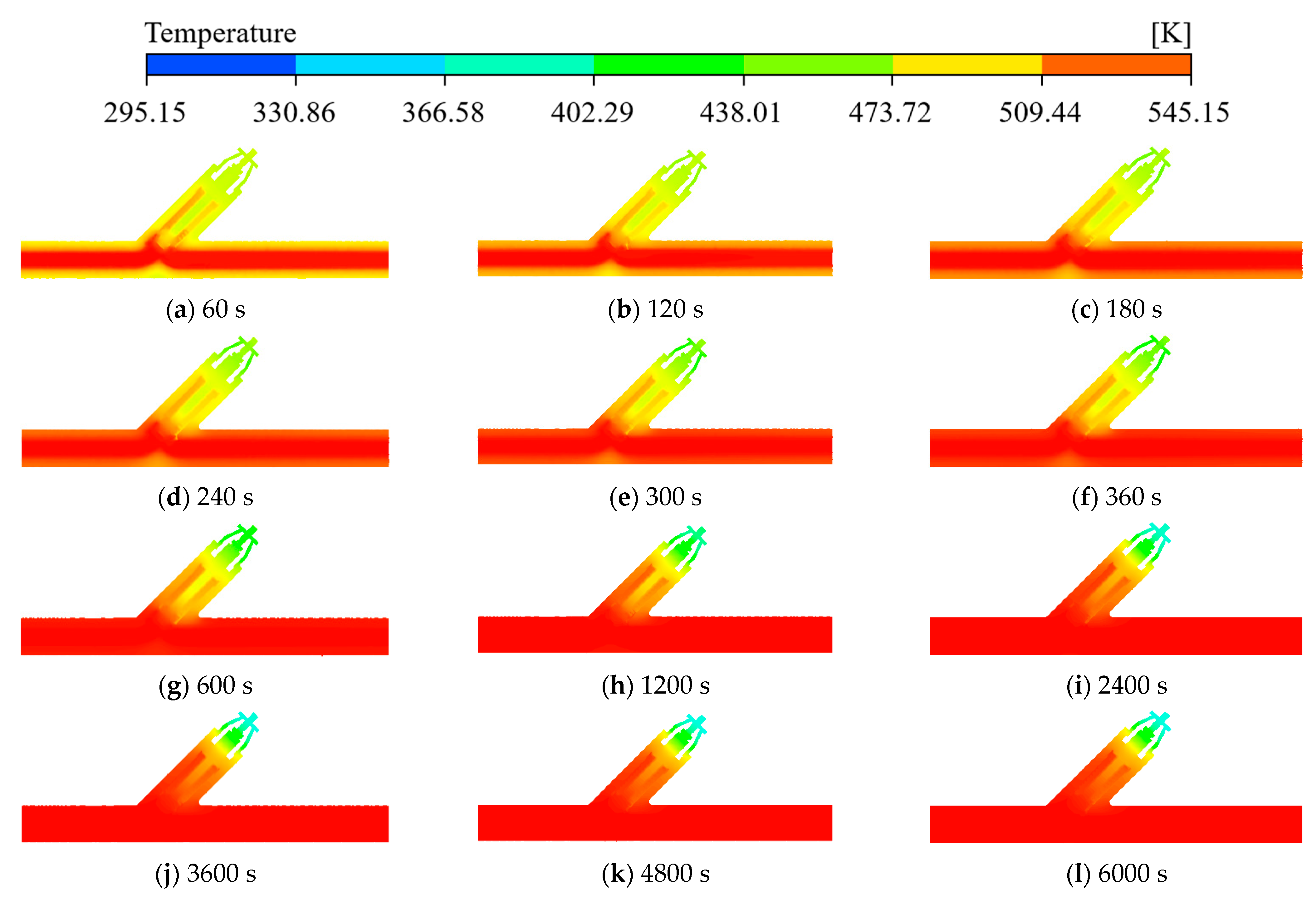
Transient temperature analysis of various monitoring points of the molten salt globe valve under preheating conditions at 473.15 K showed that the temperature changes rapidly and the temperature difference is large near the flow of the molten salt medium. The transient thermal stress generated by this large temperature difference should also be large. Each monitoring point exhibited a significant temperature gradient in the 2000 s before transient heat transfer, and the temperature changed slowly after 6000 s. Therefore, the temperature distributions at 12 time points (60 s, 120 s, 180 s, 240 s, 300 s, 360 s, 600 s, 1200 s, 2400 s, 3600 s, 4800 s, and 6000 s) were rationally selected, as shown in Figure 18, to serve as the load input for the next transient shock thermal stress test. Figure 18 shows that as the molten salt medium enters the molten salt globe valve, heat exchange begins between the medium and the pipe and valve body surfaces. Because the globe valve and pipe have been preheated, the pipe temperature equals the medium temperature after 180 s.
Figure 18 shows that, without preheating, the pipe temperature only reached the medium temperature after 420 s. This indicates that preheating reduces the heat exchange time between the wall and the medium, thereby reducing the temperature gradient between the wall and the medium. Starting at 60 s, the molten salt medium has entered the bellows, but the electromagnetic induction heating effect is not yet apparent. From 120 s to 240 s, the molten salt medium temperature gradually decreases. With the electromagnetic induction heating, the molten salt medium within the bellows begins to heat up. After 300 s, the temperature in some areas rises to around 540 K; after 1200 s, the temperature in most areas rises to around 540 K; and after 2400 s, the temperature in all areas of the bellows remains around 543.15 K.
The initial temperature of the molten salt globe valve is 473.15 K. As the molten salt medium flows through the valve, the temperature becomes evenly distributed along the flow path and increases uniformly along the valve stem axis. The temperature of the valve body near the flow path changes rapidly. As time goes by, the molten salt medium outside the valve stem and inside the bellows gradually stabilizes at above 543.15 K, preventing the molten salt medium from crystallizing and solidifying in the bellows, accumulating and clogging, and ensuring the safe and stable operation of the molten salt globe valve.
(a)
Analysis of transient shock thermal stress of the molten salt globe valve body under preheating conditions
The temperature distribution information at 12 key time points under preheating conditions of 473.15 K is imported to obtain the transient shock thermal stress distribution at 9 key time points under preheating conditions. Figure 19 shows the transient shock thermal stress cloud map of the 9 key points.
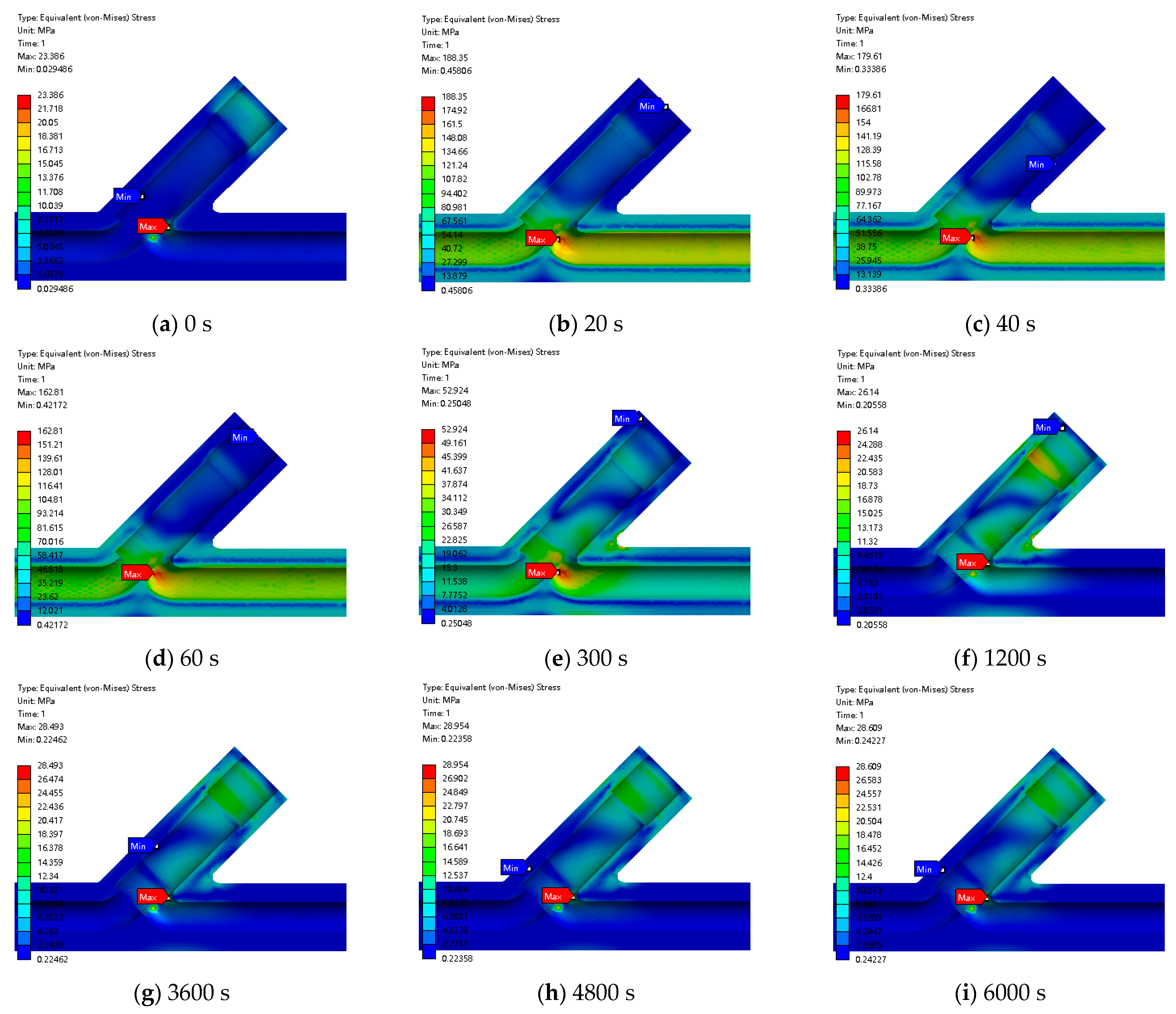
Shortly after the molten salt medium flows into the molten salt globe valve, it undergoes convective heat exchange with the inner wall of the flow channel. This process involves both convection and conduction. Due to the thick walls of the inlet and outlet flow channels and the medium pressure, a large thermal stress difference is generated between the inner and outer walls. As the temperature gradient in this area increases further, reaching its maximum value at 20 s, the thermal stress also reaches a maximum value of 188.35 MPa, as shown in Figure 19b. This value is less than the allowable stress of the molten salt globe valve body material and meets the strength requirements. The maximum transient shock thermal stress occurs at the discontinuity of the valve body structure. Subsequently, as the temperature gradient in this area gradually decreases, the generated thermal stress also gradually decreases. Finally, after 3600 s, as shown in Figure 19g, the thermal stress decreases to 28.493 MPa and stabilizes, less than the allowable stress of the globe valve body material and meeting the strength requirements. Compared to the valve body at the same time without preheating, the maximum transient shock thermal stress is reduced by 266.84%. When the valve body reaches steady state, the transient thermal shock stress on the valve body remains relatively unchanged. This indicates that preheating can effectively reduce transient thermal shock stress caused by short-term heat exchange.
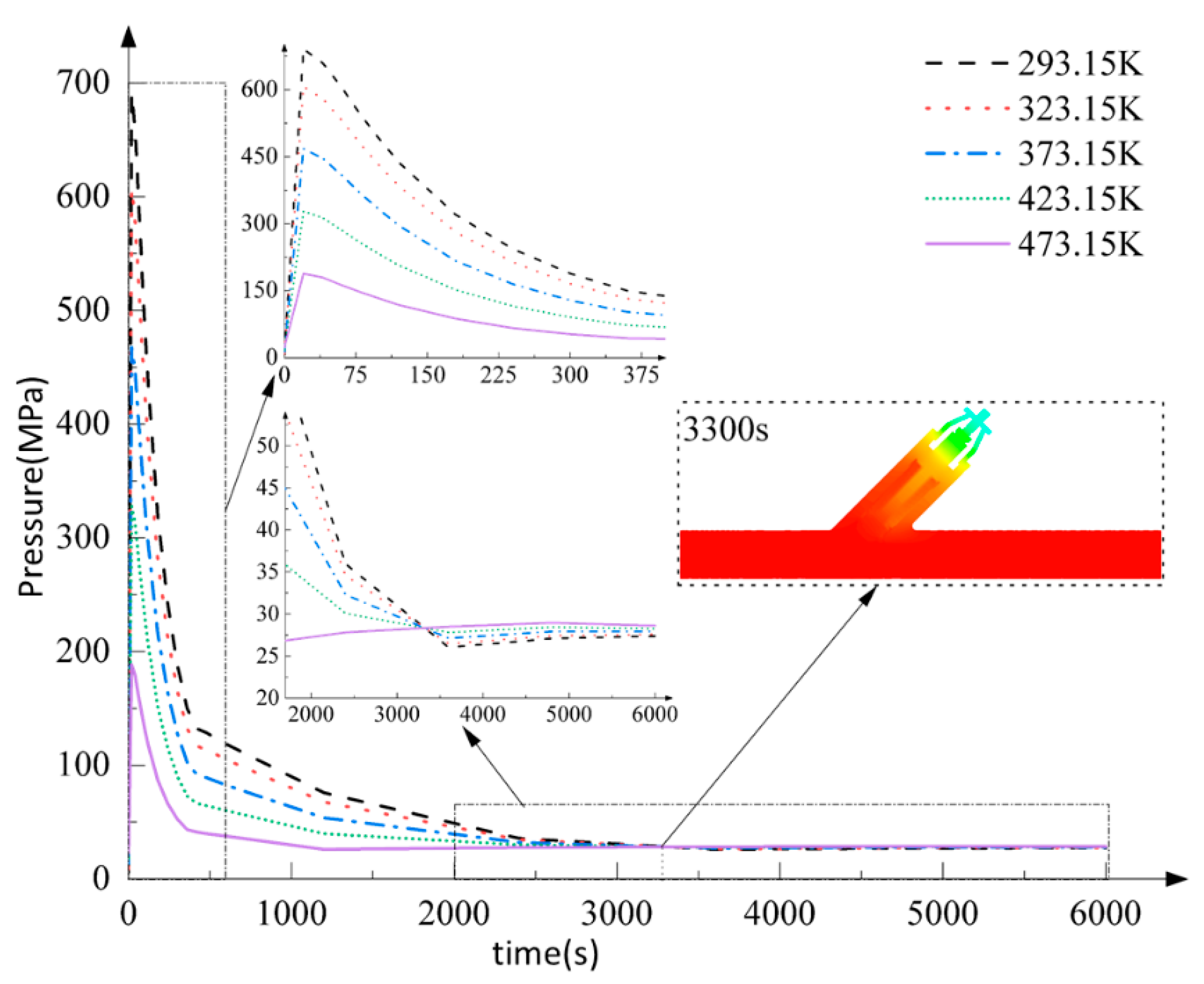
As shown in Figure 20, the transient thermal shock stress on the molten salt globe valve body exhibits a pattern of rapid increase, then a steady decrease, and finally stabilization under different preheating temperature conditions. Furthermore, the maximum transient thermal shock stress on the valve body decreases with increasing preheating temperature.
(b)
Transient shock thermal stress analysis of the bellows of the molten salt globe valve under preheating conditions
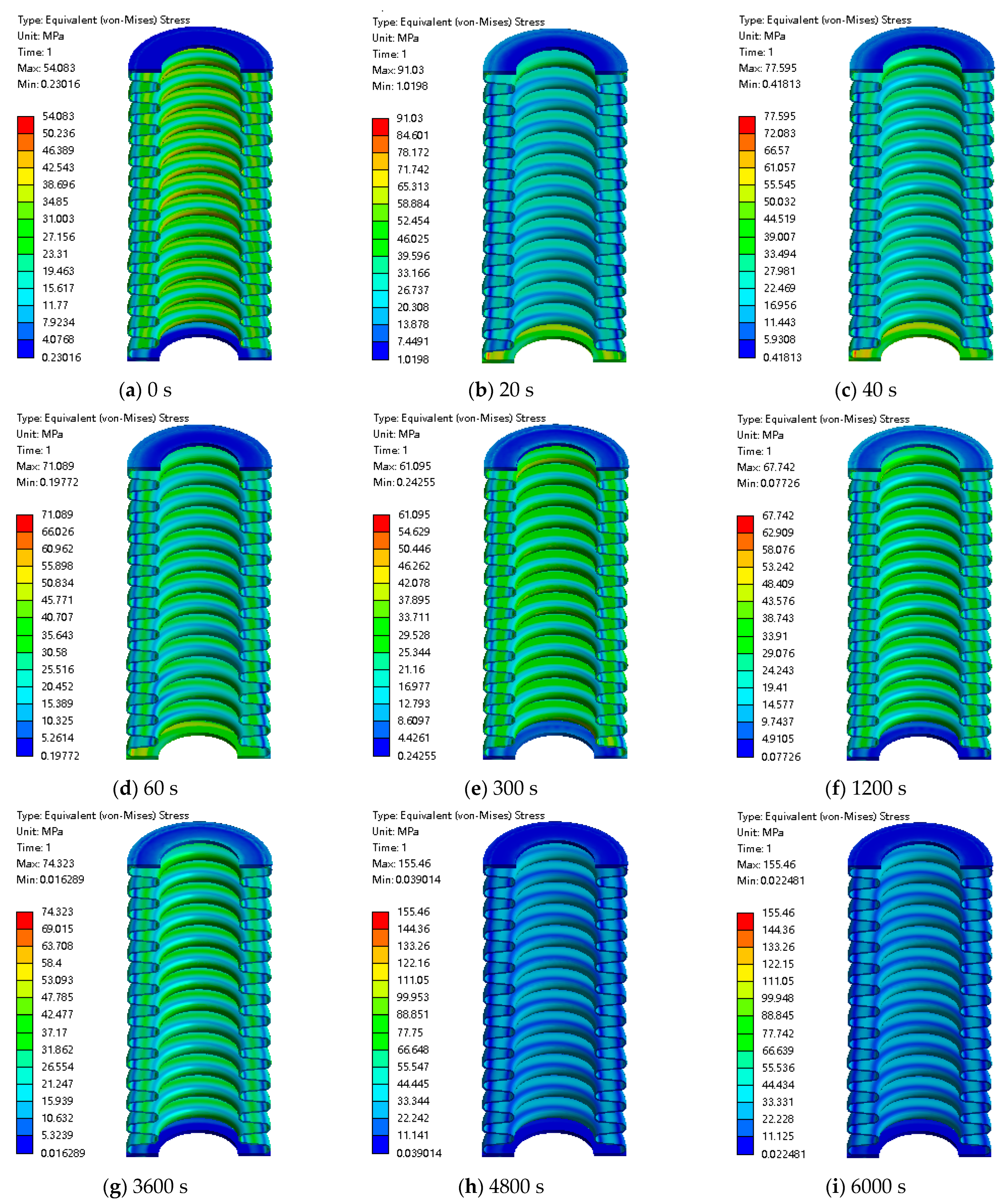
The temperature distribution information at 12 key time points under the preheating condition of 473.15 K was imported to obtain the transient shock thermal stress distribution of the bellows at 9 key time points under the preheating condition. Figure 21 shows the transient shock thermal stress cloud diagram of the bellows at 9 key points.
Shortly after the medium flows into the molten salt globe valve, it has not yet flowed through the exterior of the bellows. As time increases, the temperature gradient in the bellows increases further, reaching its maximum at 20 s. The temperature differential stress at this location also reaches a maximum stress value of 91.03 MPa, as shown in Figure 21b. This is less than the allowable stress of the molten salt globe valve bellows material and meets the strength requirements. During the entire heating process, the transient thermal stress of the bellows reaches a maximum value of 155.46 MPa after 4800 s. This is due to the thin bellows wall thickness. After 4800 s, the medium force is greater than the transient shock thermal stress caused by the temperature difference. Therefore, the maximum transient thermal stress of the bellows after 4800 s is greater than the transient shock thermal stress generated in the initial short period of time. The maximum values are located at the top and bottom of the bellows where they are welded to the stuffing box and valve disc, respectively. Figure 21g show that after the transient thermal shock stress of the bellows reaches equilibrium, it remains greater than the transient thermal shock stress during equilibrium. This is because the bellows’ thin wall thickness results in a greater stress from the medium pressure than during equilibrium, leading to a final rise and then stabilization of the stress. Subsequently, as the temperature gradient in this area gradually decreases, the resulting thermal stress also gradually decreases. Finally, after 4800 s (as shown in Figure 21h, the transient thermal shock stress decreases to approximately 155.46 MPa and stabilizes, less than the allowable stress of the globe valve bellows material and meeting the strength requirements. Compared to the maximum transient thermal shock stress of the bellows at the same time without preheating, the maximum transient thermal shock stress after heat treatment is reduced by 253.91%. When the bellows finally reach steady state, the transient thermal shock stress remains similar, demonstrating that preheating effectively reduces transient thermal shock stress during short-term heat exchange.
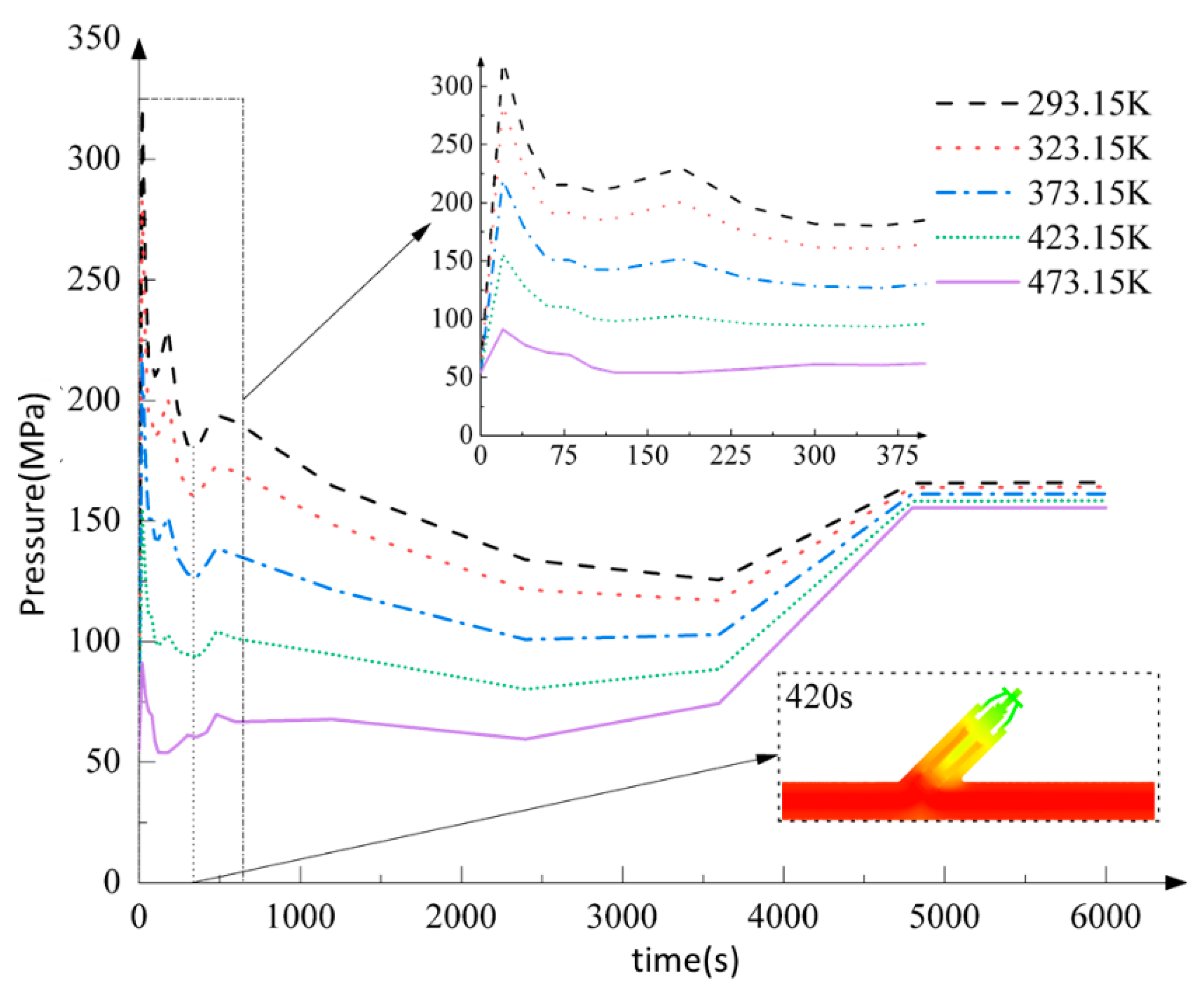
As shown in Figure 22, the transient thermal shock stress of the molten salt globe valve bellows under different preheating temperature conditions shows a pattern of first increasing rapidly, then decreasing in an oscillating manner, then increasing evenly, and finally stabilizing. Furthermore, the maximum transient thermal shock stress of the bellows decreases with increasing preheating temperature.
Figure 19, Figure 20, Figure 21 and Figure 22 show that when preheating at 473.15 K is performed, the temperature difference between the molten salt globe valve and the medium decreases, thereby reducing the temperature gradient on the inner and outer sides of the globe valve wall, and the shock thermal stress is also reduced accordingly. In summary, preheating can effectively reduce the magnitude of transient shock thermal stress in the molten salt globe valve. As shown in Table 10, the transient shock thermal stress after preheating is reduced by more than 250% compared to before preheating.
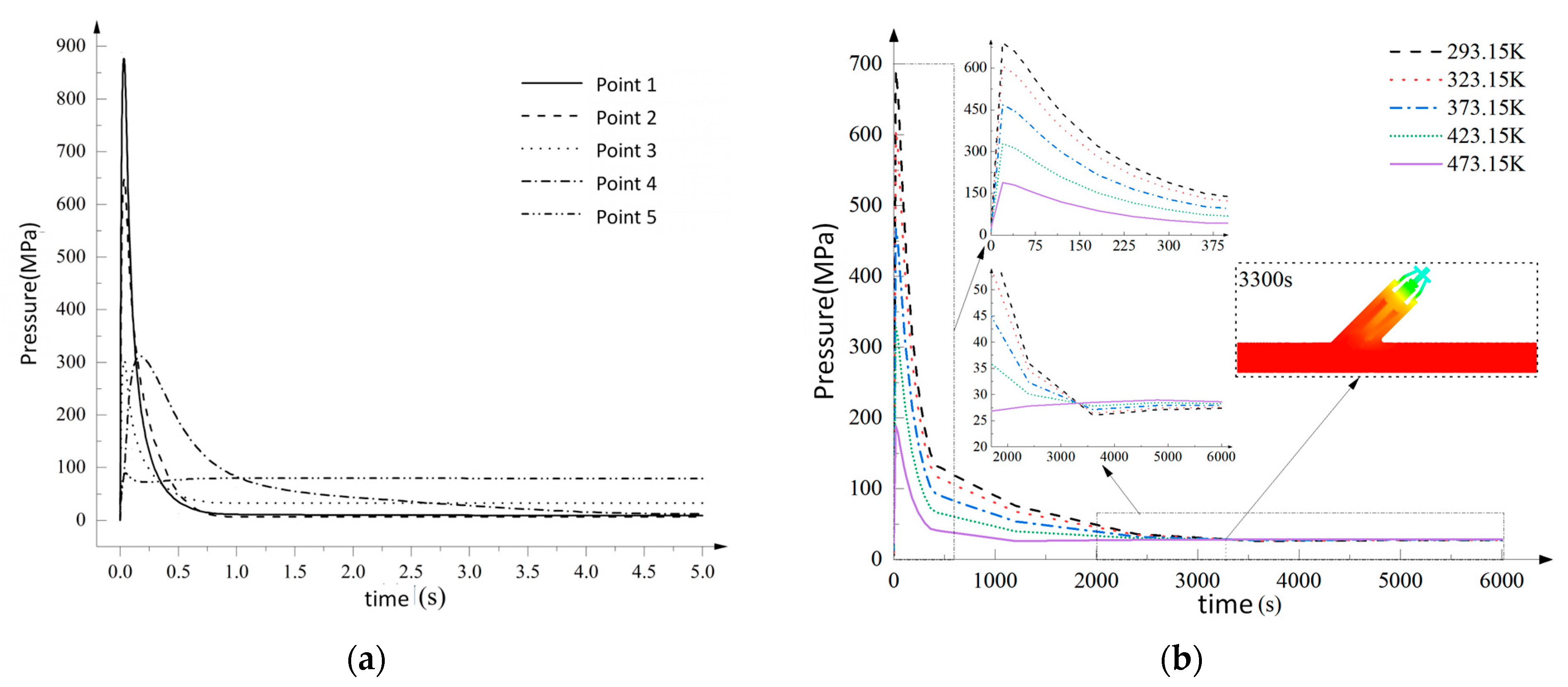
According to the study in Reference [29], which conducted a numerical simulation of thermal shock stress on a nuclear-grade double-bellows stop valve, and based on theories related to fluid-structure coupling and thermal boundary conditions, the variation patterns of the temperature field, thermal stress, and fatigue life at different monitoring points on the valve body at various time points were investigated. The simulated results were extracted and fitted to obtain the time-stress distribution trend curves for different measurement points on the valve body, as shown in Figure 23a. The figure indicates that the temperature at different measurement points on the valve body initially rises rapidly, then declines slowly, and eventually stabilizes at a certain temperature over time. The transient thermal shock stress variation curves of the molten salt stop valve under different working conditions in Section 4.6.2 are shown in Figure 23b. A comparative analysis with the time-stress curves in Figure 23a reveals that the magnitudes of the two transient thermal shock stress results are consistent, and their variation trends are fundamentally aligned. Based on the above analysis, it can be concluded that the calculation of transient thermal shock stress during the operation of the Concentrated Solar Power (CSP) system is validated.

5. Summary

This study addresses the key issue of seal bellows failure in molten salt globe valves in CSP systems caused by salt crystallization at low temperatures, proposing an electromagnetic induction-based active heating method using a triangular double-helix coil. The effectiveness of the method was systematically validated through multiphysics coupled numerical simulations of electromagnetics, heat transfer, fluid flow, and structural mechanics. The main conclusions are as follows:
(1)
Efficient and directional heating with significantly improved energy utilization was achieved. The proposed triangular double-helix cross-section induction coil maintains an electromagnetic field distribution consistent with conventional coils while increasing ohmic losses (heat generation capacity) by approximately 3.5 times and 1.8 times compared to traditional circular and rectangular coils, respectively. This provides an efficient and controllable solution for precise anti-crystallization heating of molten salt valves.
(2)
Temperature stability in critical regions was ensured, enhancing system safety. During heating, the temperature in the bellows seal region stabilized above 543.15 K (270 °C), exceeding the solidification point of common nitrate molten salts (~220 °C), effectively preventing local solidification. Other valve regions reached thermal stability within approximately 1000 s, demonstrating that the method precisely protects vulnerable areas while avoiding overall overheating, achieving a balance between safety and efficiency in engineering applications.
(3)
Preheating substantially reduced thermal stress and extended valve lifespan. Under a preheating condition of 473.15 K (200 °C), the maximum transient thermal shock stress on the valve body and bellows decreased by 266.84% and 253.91%, respectively, compared to the non-preheating condition. The peak stresses (188.35 MPa and 91.03 MPa) remained below the allowable stress of the material. This not only addresses molten salt solidification but also provides clear process guidance for suppressing thermal fatigue failure and improving valve service life.
(4)
System operational reliability and cost-effectiveness were enhanced. The method directly mitigates the risk of valve freezing and clogging at low temperatures, improving the cold start success rate and all-weather operational capability of CSP plants, which is of practical significance for grid stability. The stress reduction of over 250% significantly extends valve lifespan, reducing unplanned downtime and maintenance costs.
(5)
The method exhibits good scalability and technological potential. The electromagnetic induction heating approach and coil design are modular and can be extended to other molten salt equipment in CSP systems (e.g., pipelines, pumps, heat exchangers), forming a systematic anti-solidification solution. Additionally, it provides reliable valve technology support for next-generation CSP systems operating at higher temperatures (e.g., using chloride molten salts).
In summary, the active heating method based on the triangular double-helix induction coil proposed in this study has been quantitatively validated in terms of heating efficiency, temperature control, stress suppression, and system adaptability. It not only provides an efficient solution to prevent crystallization-induced failure in molten salt globe valves but also offers strong support for improving the overall reliability, cost-effectiveness, and technological maturity of CSP thermal energy storage systems, demonstrating clear prospects for engineering applications.

Author Contributions

Conceptualization, S.L. and B.Z.; methodology, X.W. and B.Z.; software, X.W.; validation, B.Z. and X.W.; formal analysis, Y.T. and X.M.; investigation, Y.T.; resources, X.M.; data curation, X.M.; writing—original draft preparation, B.Z. and X.W.; writing—review and editing, S.L. and L.Y.; visualization, L.Y.; supervision, S.L.; project administration, L.Y.; funding acquisition, S.L. All authors have read and agreed to the published version of the manuscript.

Funding

Science and Technology Program Funding of Gansu Province. Project Number: 22CX8GA125; The Double First-Class Key Program of Gansu Provincial Department of Education.

Data Availability Statement

Use is permitted upon the author’s approval.

Conflicts of Interest

The authors declare no conflict of interest.

Abbreviations

B0coil wall thickness, mm;Ttemperature, K;
Δ 1 current penetration depth, mm;cpspecific heat capacity, J/(kg·℃);
Sturn spacing of a coil, mm;STviscous dissipation term;
Rimpedance of the molten salt globe valve loop, Ω;ρfmedium density, kg/m3;
Eelectric field intensity, V/m;ρssolid density, kg/m3;
Ielectric current, A;λthermal conductivity of the solid domain, W/m·K;
ffrequency, kHz;Qvolumetric heat generation rate, W;
Bamplitude of magnetic flux density, T;qwfluid-solid interface heat flux, W/m2;
Jcurrent density, A/cm2;nnormal to the solid wall;
Delectric flux density, C/m2;Twtemperature at the fluid-solid interface, K;
ρcharge volume density, C/m3;Tfambient fluid temperature, K;
μpermeability, H/m;Tambambient temperature, K;
εpermittivity, C2/(N·M2);σsbStefan-Boltzmann constant;
Avector magnetic potential, AT;TWwall temperature, K;
φscalar potential, V;wffluid side of the wall;
ttime, s;wssolid side of the wall;
uvelocity vector, m/s;kffluid-side heat transfer coefficient, W/m2·K;
uthe x-component of velocity u, m/s;kssolid-side heat transfer coefficient, W/m2·K;
vthe y-component of velocity u, m/s;ε0surface emissivity;
wthe z-component of velocity u, m/s;iincrement;
ppressure on a fluid element, Pa;αtlinear expansion coefficient, °C−1
τxycomponents of the stress τ, Pa;[M]mass matrix;
τyxcomponents of the stress τ, Pa;[C]damping matrix;
τzxcomponents of the stress τ, Pa;[K]stiffness matrix;
Fxforces acting on the infinitesimal element, N;[P]load vector;
Fyforces acting on the infinitesimal element, N;[C(T)]specific heat matrix;
Fzforces acting on the infinitesimal element, N;[K(T)]heat transfer matrix;
kheat transfer coefficient, W/m2·K;[Q(T)]heat flux load vector.

References

  1. Xie, J.Y.; Dong, B. Hollow and substrate-supported Prussian blue, its analogs, and their derivatives for green water splitting. Chin. J. Catal. 2021, 42, 1843–1864. [Google Scholar] [CrossRef]
  2. Li, J.G.; Zhang, R.; Yang, P.H.; Pan, J.Y.; Wei, H.Q.; Chen, L. Optical investigations on lean combustion improvement of natural gas engines via turbulence enhancement. J. Cent. South Univ. 2022, 29, 2225–2238. [Google Scholar] [CrossRef]
  3. Jin, S.Y.; Li, J.Z.; Zi, Z.Y.; Liu, Y.L.; Wu, B.Y. Effects of different combustion modes on the thermal efficiency and emissions of a diesel pilot-ignited natural gas engine under low-medium loads. J. Cent. South Univ. 2022, 29, 2213–2224. [Google Scholar] [CrossRef]
  4. Zhou, Z.; Zhang, Z.; Wang, J. Methods and Applications of Tracking Low-Carbon Energy Technology Frontiers; Enterprise Management Press: Beijing, China, 2023. [Google Scholar]
  5. Huang, B. Petrochemical Automatic Control Design Manual; Chemical Industry Press: Beijing, China, 2020. [Google Scholar]
  6. Gao, F.; Chen, Y.; Zhao, J.; Ma, C. Effect of magnetic field on heat transfer of molten salt jet impingement. J. Chem. Ind. Eng. 2021, S02, 92–97. (In Chinese) [Google Scholar]
  7. Zhang, Y.; Zhang, X.; Wu, Y.; Lu, Y.; Ma, C. Thermal performance analysis of molten salt electromagnetic induction heating system. Energy Storage Sci. Technol. 2019, 8, 7. [Google Scholar]
  8. Anżelina, M.; Okrajni, J. Local Stress-Strain Behavior of a High-Temperature Steam Valve Under Transient Mechanical and Thermal Loading. J. Mater. Eng. Perform. 2014, 23, 31–38. [Google Scholar]
  9. Zhang, X.Y.; Li, X.F. Transient thermal stress intensity factors for a circumferential crack in a hollow cylinder based on generalized fractional heat conduction. Int. J. Therm. Sci. 2017, 121, 336–347. [Google Scholar] [CrossRef]
  10. Xu, Z.S. Design of Open-Type Special-Shaped Induction Coil and Numerical Study of Multi-Field Coupling in Induction Brazing. Master’s Thesis, Qingdao University of Science and Technology, Qingdao, China, 2024. [Google Scholar]
  11. Chen, G.; Zhang, S.; Fan, L.; Chen, Y.; Jin, W. Internal crack detection of Koch fractal eddy current sensor based on flexibility difference measurement. Chin. J. Sci. Instrum. 2023, 44, 234–242. [Google Scholar]
  12. Wang, L.; Duan, R.; Li, B.; Long, B.; Wang, K.; Bai, Y. Selection of coil scheme for induction heat correction of thin plate welding deformation. Pet. Eng. Constr. 2022, 48, 53–60. [Google Scholar]
  13. Wang, S.; Liu, A.; Qian, B. Heat Treatment Equipment; Harbin Institute of Technology Press: Harbin, China, 2011. [Google Scholar]
  14. Tan, Y. Numerical Simulation of Magnetic-Thermal Field Coupled Ignition and Stable Combustion in Induction Heating. Master’s Thesis, Harbin Institute of Technology, Harbin, China, 2021. [Google Scholar]
  15. Geng, Z.; Zhang, J.; Kong, N.; Ma, S.; Wang, B.; Han, R. Design and analysis of space repeatable mechanical locking and electromagnetic unlocking mechanism. J. Beijing Univ. Aeronaut. Astronaut. 2024, 50, 3947–3956. [Google Scholar]
  16. Phoomatna, R.; Pai, A.S.; Meo, A.; Chureemart, J.; Chureemart, P. Dimensional scaling effects on critical current density and magnetization switching in CoFeB-based magnetic tunnel junction. J. Phys. D Appl. Phys. 2024, 57, 185002. [Google Scholar]
  17. Yuan, F.; Yang, W.; Han, Y.; Chen, W.; Jang, L.; Tang, B. Study on transformer winding temperature rise calculation and structural parameter optimization based on electromagnetic-heat bidirectional coupling. High Volt. Technol. 2024, 50, 952–961+I0001. [Google Scholar]
  18. Su, X.; Cheng, H.; Shi, H.; Fu, Z. Transient thermal analysis of electromagnetic system of hydraulic electromagnetic release. Mech. Des. Manuf. 2021, 10, 202–206. [Google Scholar]
  19. Liang, Y.; Wang, X.; Deng, J.; Liu, Y.; Song, G.; Zhong, R.; Zhang, D.; Zhu, D. Research on liquid metal inter-packet flow simulation method based on sub-channel concept. Nucl. Power Eng. 2023, 44, 61–66. [Google Scholar]
  20. Xu, X.; Liu, D.; Zheng, J.; Cai, W.; Gu, H.; Zhang, H. Conjugate heat transfer characteristics of hot air impingement jet on asphalt pavement. J. Harbin Inst. Technol. 2024, 56, 148–157. [Google Scholar]
  21. Ranjan, J.M.; Kumar, M. Investigation of an improved cold plate design with circuitous minichannel: A computational study involving the effect of conjugate heat transfer. Int. J. Numer. Methods Heat Fluid Flow 2024, 34, 1446–1478. [Google Scholar]
  22. Miao, H.; Chen, Y.; Lv, L.; Wang, X.; Xu, G. Analysis of flow-induced vibration of heat exchange tubes based on bidirectional fluid-structure coupling. Nucl. Technol. 2018, 41, 80–86. [Google Scholar]
  23. Rukolaine, S.A. Hyperbolicity of the ballistic-conductive model of heat conduction: The reverse side of the coin. Z. Für Angew. Math. Und Phys. 2024, 75, 50. [Google Scholar] [CrossRef]
  24. Kostanovskiy, A.V.; Kostanovskaya, M.E. Local Entropy Rate of Production at Boundary Conditions of the Third Kind. Meas. Tech. 2023, 66, 336–342. [Google Scholar]
  25. Wu, M. Study on the Coupling Relationship Between Working Process and Heat Transfer in GDI Gasoline Engine Cylinder and Simulation Method. Master’s Thesis, Tianjin University, Tianjin, China, 2018. [Google Scholar]
  26. Shi, H. Research on Thermal Performance and Leakage and Seepage Characteristics of Molten Salt Thermal Storage System. Master’s Thesis, Zhejiang University, Hangzhou, China, 2021. [Google Scholar]
  27. Yeong, H.L.; Soo, G.P. Power Prediction of Induction Range Considering Current Waveform in Time-Harmonic Finite Element Simulation. J. Electr. Eng. Technol. 2022, 18, 359–365. [Google Scholar] [CrossRef]
  28. Venthan, S.M.; Kumar, P.S.; Kumar, S.S.; Sudarsan, S.; Rangasamy, G. A computational study of the impact of fluid flow characteristics on convective heat transfer with Hall current using the MHD non-Newtonian fluid model. Chem. Eng. Res. Des. 2024, 203, 789–799. [Google Scholar] [CrossRef]
  29. Li, S.X.; Luo, X.Y.; Lv, X.; Zhang, N.; Xu, X. Numerical Simulation of Nuclear Grade Double-Bellows Stop Valve under Transient Thermal Shock Stress. Nucl. Power Eng. 2018, 39, 71–76. [Google Scholar]
Figure 1. Schematic diagram of the Concentrated Solar Power (CSP) system.
Actuators 15 00050 g001
Figure 2. Schematic diagram of the electromagnetic induction triangular double-helix cross-section induction coil structure. (a) Triangular spiral induction coil. (b) Current distribution and induced current in the workpiece.
Actuators 15 00050 g002
Figure 3. Cross-sectional shape of the triangular double-helix induction coil.
Actuators 15 00050 g003
Figure 4. Magnetic induction intensity amplitude cloud diagram of circular, rectangular, and triangular cross-section induction coils.
Actuators 15 00050 g004
Figure 5. Current density amplitude cloud diagram of circular, rectangular, and triangular cross-section induction coils.
Actuators 15 00050 g005
Figure 6. Ohmic loss cloud diagram of circular, rectangular, and triangular cross-section induction coils.
Actuators 15 00050 g006
Figure 7. Electromagnetic-thermal-fluid-solid coupling relationship diagram.
Actuators 15 00050 g007
Figure 8. Detailed steps of electromagnetic-thermal-fluid-solid coupling simulation.
Actuators 15 00050 g008
Figure 9. Geometry model of electromagnetic-thermal-fluid-solid coupling finite element analysis.
Actuators 15 00050 g009
Figure 10. Grid model for transient shock thermal stress analysis of molten salt globe valve.
Actuators 15 00050 g010
Figure 11. Magnetic induction intensity amplitude cloud map.
Actuators 15 00050 g011aActuators 15 00050 g011b
Figure 12. Vector diagram of magnetic induction intensity direction.
Actuators 15 00050 g012
Figure 13. Conjugate heat transfer temperature distribution of the molten salt globe valve at 20 s.
Actuators 15 00050 g013
Figure 14. Temperature time history curves at each monitoring point of the molten salt globe valve.
Actuators 15 00050 g014
Figure 15. Stress cloud diagram of valve body at different time points without preheating.
Actuators 15 00050 g015
Figure 16. Stress cloud diagram of the bellows at different time points without preheating.
Actuators 15 00050 g016
Figure 17. Temperature distribution at selected time points during the preheating process.
Actuators 15 00050 g017
Figure 18. Temperature distribution at the critical moment of conjugate heat transfer under preheating conditions at 473.15 K.
Actuators 15 00050 g018
Figure 19. Stress cloud diagram of the valve body at different time points under preheating condition of 473.15 K.
Actuators 15 00050 g019
Figure 20. Stress line graph of valve body at different time points under five preheating conditions.
Actuators 15 00050 g020
Figure 21. Stress cloud diagram of the bellows at different time points under preheating condition of 473.15 K.
Actuators 15 00050 g021
Figure 22. Stress line graph of bellows at different time points under five preheating conditions.
Actuators 15 00050 g022
Figure 23. Comparison of transient thermal shock stress time-history curves. (a) Time-stress distribution trend curve from literature [29], (b) Stress polyline graph of valve body at different time points.
Actuators 15 00050 g023
Table 1. Wall thickness selection of induction coil [10].
Current Frequency f (Hz)The Calculated Value of B0 (mm)The Best Value of B0 (mm)
10003.503.00~4.00
25002.202.00
80000.801.50
10,0001.101.50
250,0000.220.25
400,0000.170.15
Table 2. Selection of gap size between induction coil and molten salt globe valve [13].
Diameter of Work (mm)Gap Size (mm)
<301.5~2.5
>302.5~5.0
Table 3. Physical properties of main materials.
UnitMaterialsρ (kg/m3)Relative PermeabilityRelative Electrolytic Leakage (S/m)
Valve bodyA351 CF8780011.35 × 106
Valve stemInconel 62578501.00067.80 × 105
Valve clack, Valve seatF347H + STL6793011.20 × 106
Corrugated pipe, Packing gland316H
stainless steel
792011.45 × 106
Induction coilCopper TP289400.9999916.00 × 107
Table 4. Verification of grid independence of electromagnetic field grid model.
The Number of Meshes in MaxwellThe Maximum Magnetic Induction Intensity
Amplitude (T)
Relative
Error
The Maximum
Current Density (A/cm2)
Relative Error
102,5640.0065-43.5426-
139,9530.009444.62%57.123131.19%
154,2890.009490.96%57.65210.93%
Table 5. Verification of grid independence of flow field grid model.
The Number of Fluid Grids in FluentThe Maximum Temperature (K) of the Solid Domain of the Molten Salt Globe Valve)Relative Error
5,742,896541.524-
6,578,282550.8591.72%
7,745,289551.2170.06%
Table 6. Grid independence test table of molten salt globe valve.
Element NumberThe Maximum Stress Value of the Valve Body (MPa)Maximum Stress of Bellows (MPa)Relative ErrorThe Maximum Stress Value of the Valve Disc (MPa)Relative
Error
735,412681.24354.24-984.21-
790,965690.95322.161.4%1008.906.4%
844,527691.59321.450.93%1007.340.22%
Table 7. Molten salt globe valve preheating parameters.
Number of UnitsNumerical Value
Dimensions of the inlet and outlet pipes/mmϕ57 × 3.5
Hot air flow rate/(m3/h)480
Hot air temperature/K523.15
Table 8. Thermophysical properties of 523.15 K hot air.
Number of UnitsNumerical Value
Density/(kg/m3)0.566
Specific heat capacity/(J/(kg·°C))1059
Thermal conductivity/(W/(m·K))0.049
Dynamic viscosity/(Pa·s)3.14 × 10−5
Table 9. Medium physical properties.
MediumDensity (kg/m3)Viscosity (Pa·s)Specific Heat Capacity (J/(kg·°C))Thermal
Conductivity (W/(m·°C))
molten salt17340.0011615390.548
Table 10. Transient shock thermal stress before and after preheating.
MediumDensity (kg/m3)Viscosity (Pa·s)Specific Heat Capacity (J/(kg·°C))
Valve body690.95 MPa188.35 MPa266.84%
Corrugated tube322.16 MPa91.03 MPa253.91%
Disclaimer/Publisher’s Note: The statements, opinions and data contained in all publications are solely those of the individual author(s) and contributor(s) and not of MDPI and/or the editor(s). MDPI and/or the editor(s) disclaim responsibility for any injury to people or property resulting from any ideas, methods, instructions or products referred to in the content.