1. Introduction
Iterative Learning Control (ILC) is a powerful control strategy designed for systems performing repetitive tasks [
1,
2,
3]. Unlike traditional control methods that rely solely on real-time adjustments, ILC exploits task repeatability to improve performance by using data from previous cycles to refine control inputs iteratively. This approach is particularly effective in applications requiring high precision, such as robotic assembly, semiconductor manufacturing, and robot-assisted medicine, where it can compensate for persistent disturbances or systematic errors. Recent advances in computational power have further enhanced ILC’s practicality, enabling its implementation in increasingly complex systems.
The key advantage of ILC lies in its ability to improve tracking performance through iterative learning. While Proportional-Integral-Derivative (PID) controllers remain popular for their simplicity and performance, they lack the ability to use past iterations information to improve accuracy in subsequent ones [
4,
5,
6]. For instance, in robot-assisted medical procedures, PID controllers only respond to the immediate errors without utilizing historical data. In contrast, ILC achieves superior accuracy by continuously optimizing performance over successive iterations. This learning capability becomes particularly valuable in applications where system dynamics are partially unknown or too complex to model precisely. Furthermore, ILC’s data-driven nature allows it to adapt to subtle changes in system behavior that might otherwise go unnoticed.
However, ILC’s effectiveness depends critically on two factors: the accuracy of system modeling and appropriate selection of learning parameters. Modeling inaccuracies can lead to misguided adjustments, causing slow convergence or instability, while poorly tuned parameters may induce oscillations. Additionally, ILC assumes highly repeatable task conditions, which limits its effectiveness in variable environments like automated warehousing systems with fluctuating operational conditions. These limitations become particularly apparent when dealing with non-repetitive disturbances or when the reference trajectory changes significantly between iterations.
To overcome these limitations, researchers have integrated optimization algorithms with ILC frameworks [
7,
8,
9]. For example, Particle Swarm Optimization (PSO) has proven particularly effective for optimizing ILC parameters like learning gain [
10,
11,
12]. In manufacturing applications, PSO-ILC has demonstrated significant performance improvements in complex environments where traditional tuning methods fall short. Nevertheless, the computational complexity of standard PSO has motivated the development of simplified alternatives. The trade-off between computational efficiency and optimization performance remains an active area of research, especially for real-time applications with strict timing constraints.
Recent work has introduced computationally efficient variants such as Social-only PSO (SO-PSO) [
13] and the Weightless Swarm Algorithm (WSA) [
14,
15,
16]. These approaches reduce computational demands by eliminating certain parameters: SO-PSO removes cognitive components while WSA omits velocity calculations. Although these simplified algorithms maintain effective optimization capabilities for real-time applications, they exhibit reduced flexibility and slower convergence in high-dimensional or complex problem spaces compared to standard PSO. Experimental results have shown that these algorithms can achieve comparable performance to standard PSO in many practical scenarios while requiring significantly fewer computational resources. This makes them particularly attractive for embedded systems with limited processing power.
Building on these developments, this paper proposes a new hybrid approach, SO-PSO-ILC, to balance computational efficiency with control performance. We systematically compare its effectiveness against both PSO-ILC and WSA-ILC across various operational scenarios. The choice between these methods depends on specific application requirements including precision demands, computational constraints, and task complexity. Our comparative analysis considers not only tracking accuracy but also convergence speed and computational overhead, providing practical insights for control system designers. The results demonstrate that the proposed SO-PSO-ILC offers a favorable compromise between performance and efficiency in most test cases.
The remainder of this paper is organized as follows.
Section 2 presents the modeling framework, including manipulator dynamics, system linearization, and our proposed control scheme.
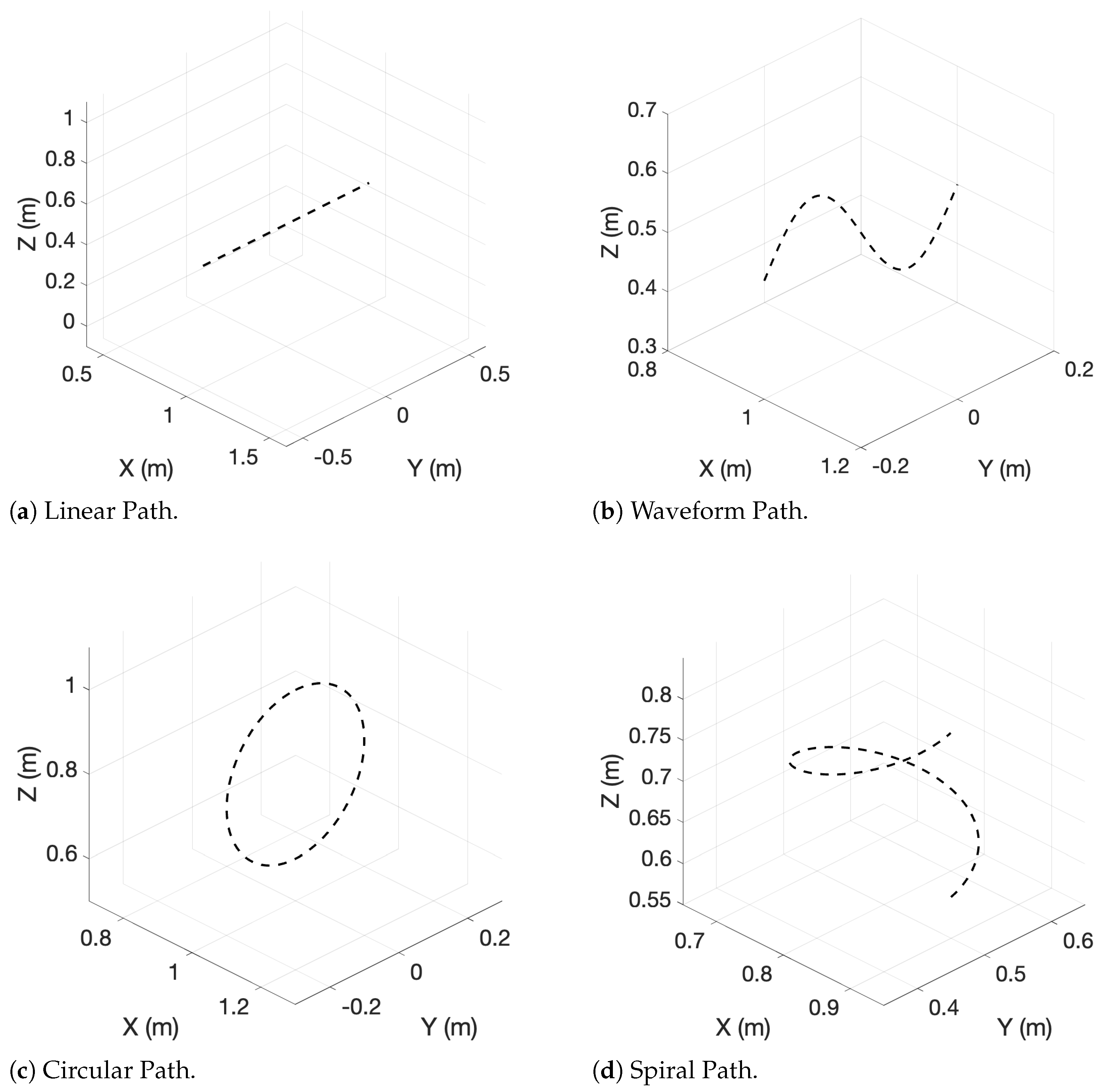
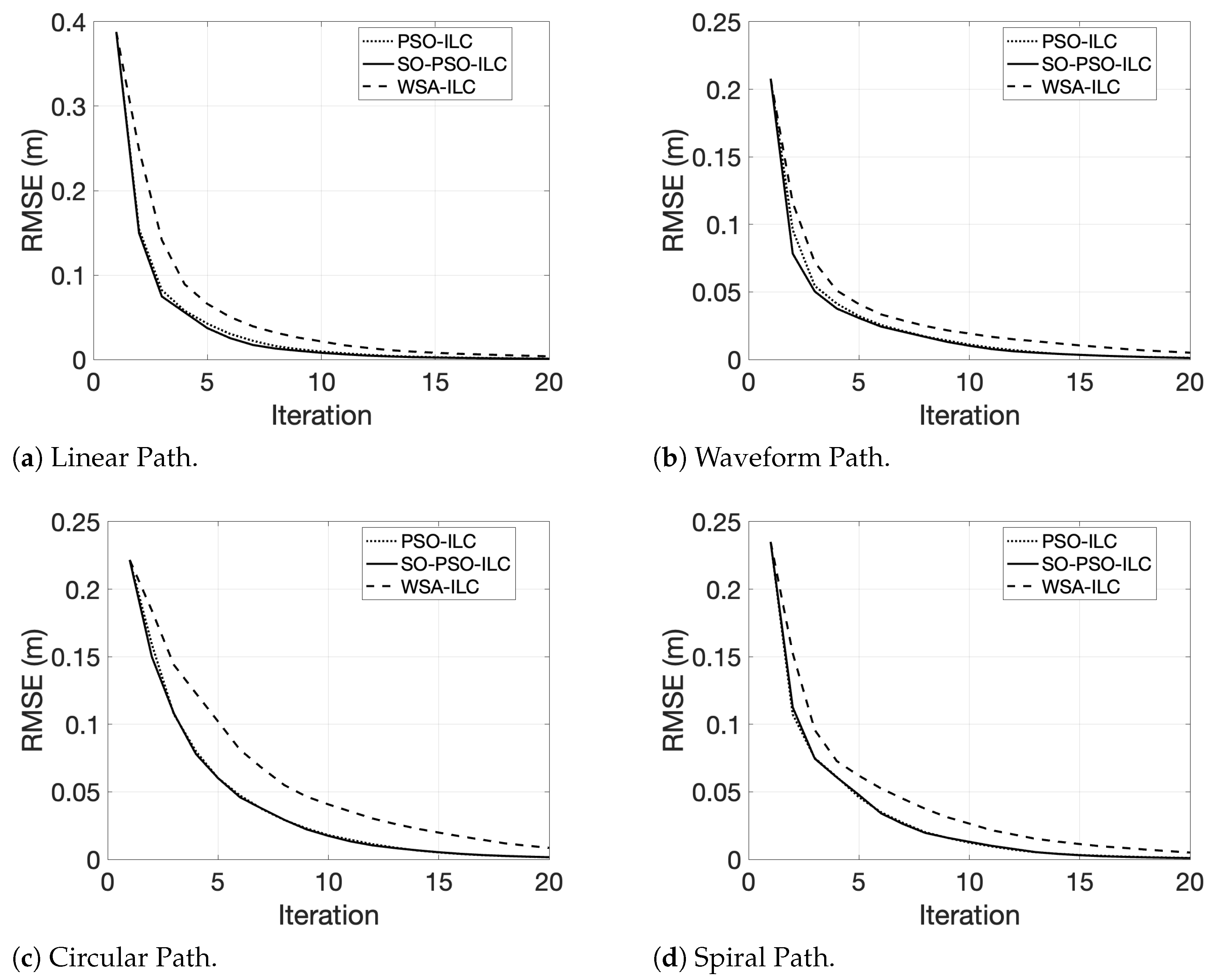
Section 3 evaluates and compares the performance of PSO-ILC, SO-PSO-ILC, and WSA-ILC controllers across different trajectory scenarios.
Section 4 provides an in-depth analysis of the results, discusses the trade-offs between computational efficiency and tracking performance, and compares the proposed approach with other ILC strategies. Finally,
Section 5 summarizes our key contributions and discusses potential improvements for future work, including directions for extending the proposed approach to more challenging control scenarios.
2. Methodology
This section presents the robotic manipulator control framework. We first establish the dynamic model, then develop the linearization approach, followed by the integrated control scheme. Finally, we derive convergence conditions through Lyapunov-based analysis.
2.1. Robotic System Modeling
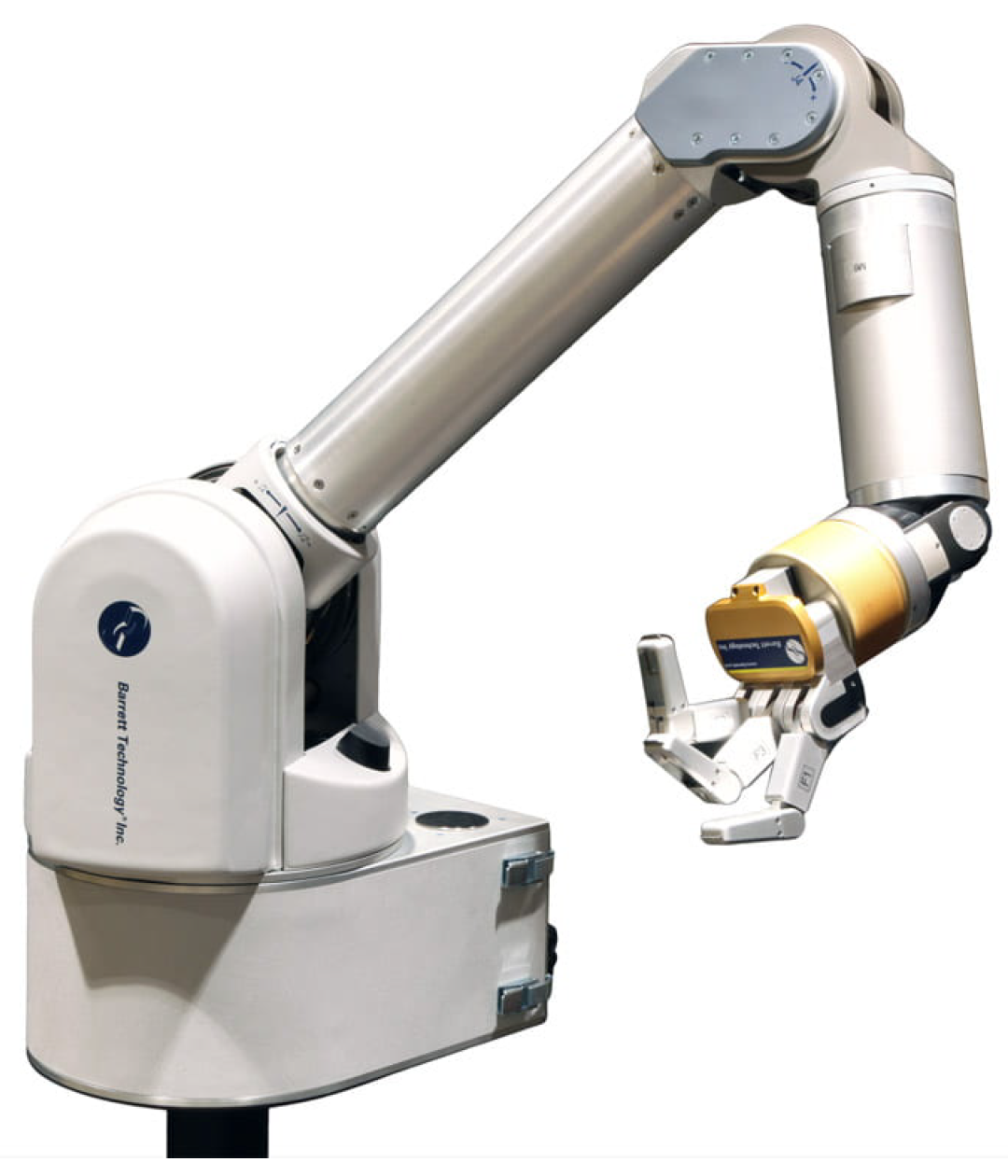
The dynamic model serves as the foundation for controller design. Consider an
n-DOF robotic manipulator governed by:
where
denotes time,
represents the joint position vector,
represents the joint velocity vector,
represents joint acceleration vector,
is the inertia matrix,
is Coriolis and centrifugal matrix,
is the total torque due to gravity,
is the torque disturbance,
is the control input torque vector applied at the joints.
For iterative operations, the dynamics of the manipulator at the
k-th iteration are described by:
where the subscript
k denotes the joint states and control torque input at the
k-th iteration.
To enable iterative control, the dynamics are linearized around the desired trajectory
. A first-order Taylor expansion is performed for each term with respect to the deviations from the desired trajectory:
The resulting linearized dynamics are expressed as:
where the following terms are defined:
2.2. Iterative Learning Control Design
The following assumptions ensure the linearized dynamics (
4) are well-posed and guarantee convergence of the iterative learning scheme:
- 1.
The desired trajectory is smooth, continuously differentiable, and achievable over the operating interval .
- 2.
The signals , , , and are uniformly bounded for all .
- 3.
The initial conditions are reset at each iteration such that and for all iterations k. This ensures alignment of resetting conditions and leads to and .
- 4.
The matrix is skew-symmetric.
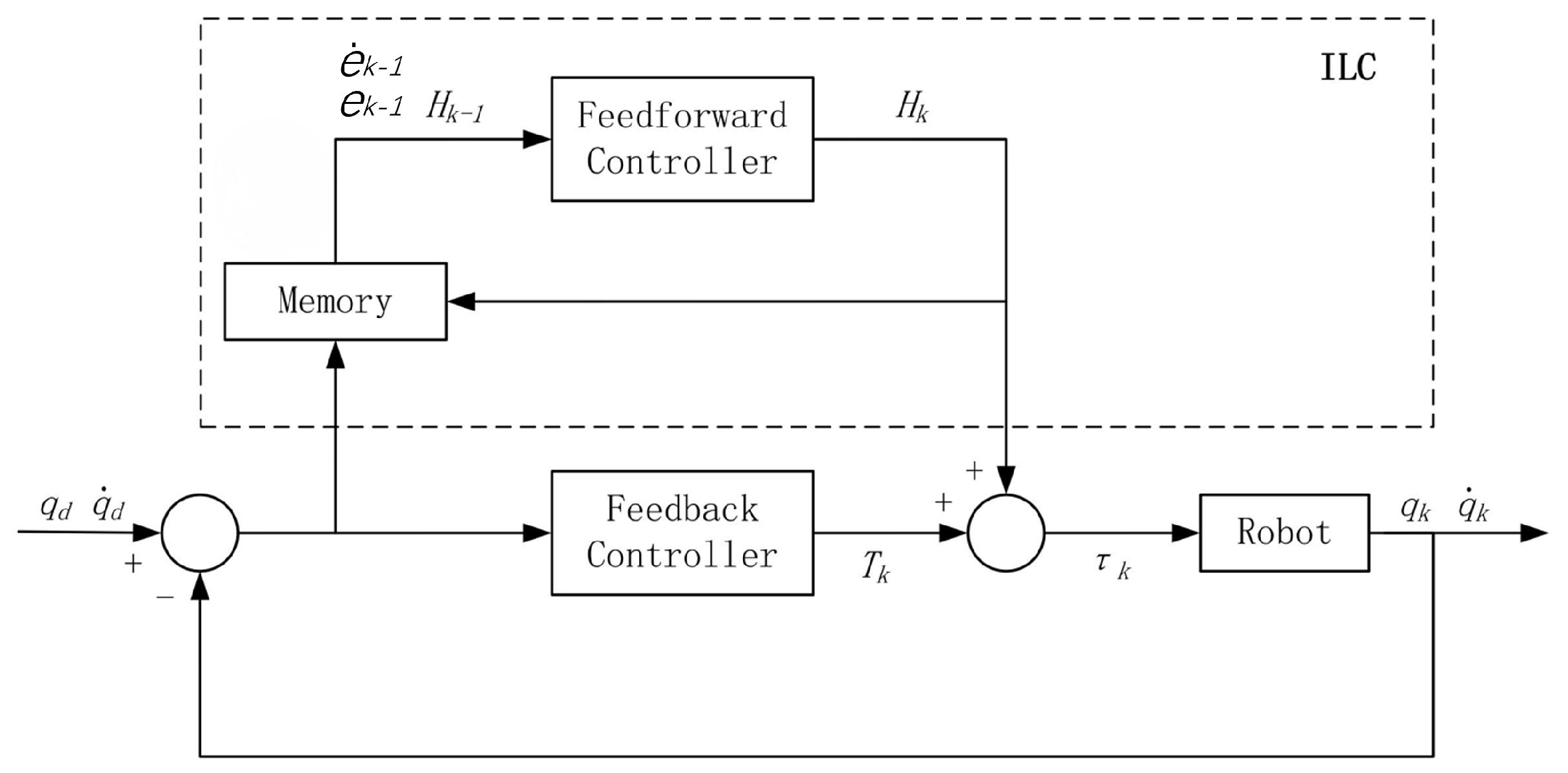
Under Assumptions 1–4, the proposed controller architecture combines feedback correction and feedforward learning in a hybrid structure developed by [
17]. As illustrated in
Figure 1, the control input at each iteration
k integrates two complementary components through:
where
represents the total control torque,
serves as the feedback correction term for real-time error compensation, and
functions as the feedforward learning term that accumulates knowledge across iterations.
The feedback component generates immediate corrective actions based on current tracking errors according to:
with
and
being symmetric positive definite gain matrices for position and velocity errors respectively. The feedback gains
and
are designed to be sufficiently large while maintaining a proportional relationship:
In parallel, the feedforward component evolves through an iterative learning process described by:
where the learning gain
. This dual-mechanism approach provides multiple advantages: immediate disturbance rejection through feedback control, progressive performance improvement via feedforward learning, and comprehensive compensation for both transient and persistent disturbances.
Here outlines the convergence analysis using a Lyapunov function candidate, establishing the conditions under which the proposed ILC scheme guarantees error reduction over iterations.
Definition 1. For a matrix that depends on a variable s, the maximum norm of over a domain is defined as: Definition 2. For a symmetric matrix , the minimum eigenvalue, denoted as , is defined as: Definition 3. The Lyapunov function candidate for the k-th iteration is defined as:whereand Theorem 1 (Condition of Convergence)
. For all and , given the control input defined in Equation (9) and the learning law in Equation (12), the following properties hold:andThese properties are satisfied if the controller fulfills the following conditions: The detailed proof of this theorem, based on Lyapunov stability analysis for hybrid ILC frameworks, follows the approach in [17]. Remark 1. The learning gain α must be carefully chosen at each iteration to strictly satisfy the stability conditions (20)–(22). This ensures that the energy difference remains non-positive and that the tracking error converges monotonically to zero. Remark 2. In practical implementation, it is essential to monitor the error norm for oscillations. When instability is detected, α should be reduced while ensuring to maintain learning capability.
2.3. Swarm Optimization Algorithms
PSO is an effective approach for solving complex optimization problems [
18,
19,
20]. Building upon biological foundations, the standard PSO framework implements a systematic search process. In this formulation, a population of particles explores a
D-dimensional search space, with each particle
i maintaining two key vectors: its current position
and velocity
. These vectors are initialized randomly within predefined bounds that define the feasible region of the problem.
The algorithm iteratively updates each particle’s trajectory based on both personal experience and swarm intelligence. The velocity update equation combines three components:
where
w represents the inertia weight that balances exploration and exploitation, while
and
are cognitive and social acceleration coefficients respectively. The terms
and
denote random numbers sampled uniformly from
, introducing stochasticity to the search process.
tracks the best solution found by particle
i, and
represents the best solution discovered by the entire swarm.
Following the velocity update, each particle’s position is adjusted using:
The Social-only PSO (SO-PSO) variant reduces computational complexity by removing the cognitive component. This simplification halves the number of terms in the velocity update equation compared to standard PSO, leading to fewer arithmetic operations and reduced memory requirements per iteration:
This modified approach accelerates convergence by directing particles toward the current best solution without individual exploration. However, the reduced population diversity raises the susceptibility to a premature convergence in some cases. The SO-PSO algorithm exhibits particular effectiveness in optimization problems featuring well-defined global optima and relatively smooth search spaces.
Weightless Swarm Algorithm (WSA) is another variant which enhances computational efficiency through strategic simplifications. By eliminating the inertia weight
w and cognitive coefficient
, the WSA reduces both parameter tuning requirements and computational overhead. The modified velocity update equation becomes:
Compared to PSO and SO-PSO, WSA adopts a more aggressive strategy. While this enables faster convergence and lower computational resource consumption on simple optimization problems (e.g., unimodal functions), its aggressive approach also makes it more prone to falling into local optima.
2.4. Hybrid SO-PSO-ILC Algorithm
The integration of swarm algorithms (PSO, SO-PSO, and WSA) with ILC enables autonomous adaptation of the learning gain , eliminating manual parameter tuning. These hybrid approaches (PSO-ILC, SO-PSO-ILC, and WSA-ILC) iteratively optimize to minimize tracking error while preserving stability, consistent with Lyapunov-based conditions.
The optimization process begins by initializing a swarm of particles, where each particle represents a candidate value for the learning gain, randomly generated within predefined bounds . For each candidate , the ILC system is simulated, and the resulting tracking error over the task duration T is evaluated. The learning gain that achieves the minimum tracking error is selected.
The detailed procedure of the SO-PSO-ILC algorithm is summarized in Algorithm 1. The key innovation is the embedding of social-only PSO optimization within the ILC loop, where at each iteration, the learning gain
is autonomously optimized to minimize tracking error before updating the feedforward learning term.
| Algorithm 1 SO-PSO-ILC |
Require: Desired trajectory ; Feedback gains , ; Max iterations
Ensure: Optimized control input - 1:
Initialize , - 2:
while and not converged do - 3:
- 4:
Execute Trial k: - 5:
Apply - 6:
Measure , compute error and RMSE - 7:
SO-PSO Optimization: - 8:
Initialize swarm of candidate learning gains - 9:
while swarm not converged do - 10:
Update velocities: - 11:
Update positions: - 12:
Evaluate for each , update - 13:
end while - 14:
Set optimal gain - 15:
Update Learning Law: - 16:
- 17:
end while - 18:
return
|
4. Discussion
The parameters for the swarm algorithms (e.g.,
,
,
) were selected based on standard values commonly employed in the literature [
22,
23,
24]. This specific combination is widely adopted as a robust and well-performing default for a wide range of applications. A small population size was used to prioritize computational efficiency in this proof-of-concept study, a choice supported by findings in [
10] indicating that the performance of swarm-based ILC is not significantly influenced by increases in population size.
The performance differences observed in
Section 3 can be attributed to the inherent characteristics of each swarm optimization strategy. The comprehensive analysis reveals that SO-PSO-ILC exhibits dual advantages in both convergence speed and final accuracy across multiple trajectory types. The proposed SO-PSO-ILC achieves the best overall performance with moderate computational resource consumption, optimally balancing computational efficiency and tracking accuracy. Its hybrid optimization strategy enhances performance without imposing an excessive computational burden. Although the absolute simulation time difference is minimal on a desktop PC, SO-PSO-ILC’s primary advantage lies in its simplified algorithmic structure, which inherently requires fewer computational operations per iteration than a standard PSO-based approach. This makes it a more suitable candidate for applications where computational throughput is a critical constraint.
The proposed SO-PSO-ILC can be viewed as a form of data-driven ILC [
25,
26,
27]. Its operation is primarily governed by the iterative processing of input-output data to optimize performance, thereby significantly reducing the dependency on an accurate system model. For a broader perspective,
Table 3 provides a qualitative comparison of the proposed SO-PSO-ILC with other prominent ILC strategies, including conventional (model-based) ILC, adaptive ILC [
7,
28,
29], and model predictive ILC [
30,
31]. The key advantage of our approach lies in its autonomous nature, which eliminates the need for manual parameter tuning or a precise system model, while maintaining a favorable computational profile.
While this study presents a simulation-based validation, the proposed SO-PSO-ILC scheme possesses features relevant for real-world application. Its hybrid feedback-feedforward structure offers inherent robustness: the feedback component provides real-time correction against non-repetitive disturbances such as sensor noise and model uncertainties within each iteration, while the ILC learns to cancel repetitive errors. This structure is particularly advantageous for dealing with real-world imperfections and initial modeling inaccuracies.
5. Conclusions
This study demonstrates that the proposed SO-PSO-ILC algorithm achieves superior precision while maintaining computational efficiency. It outperforms both PSO-ILC and WSA-ILC across all tested trajectories. The key advantage lies in its autonomy, as the integration of swarm intelligence eliminates the need for manual tuning of learning gains, which represents a significant hurdle in traditional ILC implementation. This characteristic makes the algorithm particularly suitable for systems where accurate models are difficult to obtain.
A notable limitation is the simulation-only validation, which does not account for real-world constraints such as actuator saturation and measurement noise. Future work will focus on experimental validation under dynamic operating conditions.
Overall, the integration of swarm intelligence with ILC frameworks presents a promising direction for developing autonomous, self-optimizing robotic control systems in precision applications.