Article

An Optimized Position Control via Reinforcement-Learning-Based Hybrid Structure Strategy

Department of Electrical Engineering, Myongji University, Yongin 17058, Republic of Korea
*
Author to whom correspondence should be addressed.
Actuators 2025, 14(4), 199; https://doi.org/10.3390/act14040199
Submission received: 3 March 2025 / Revised: 13 April 2025 / Accepted: 19 April 2025 / Published: 21 April 2025
(This article belongs to the Special Issue Analysis and Design of Linear/Nonlinear Control System)

Abstract

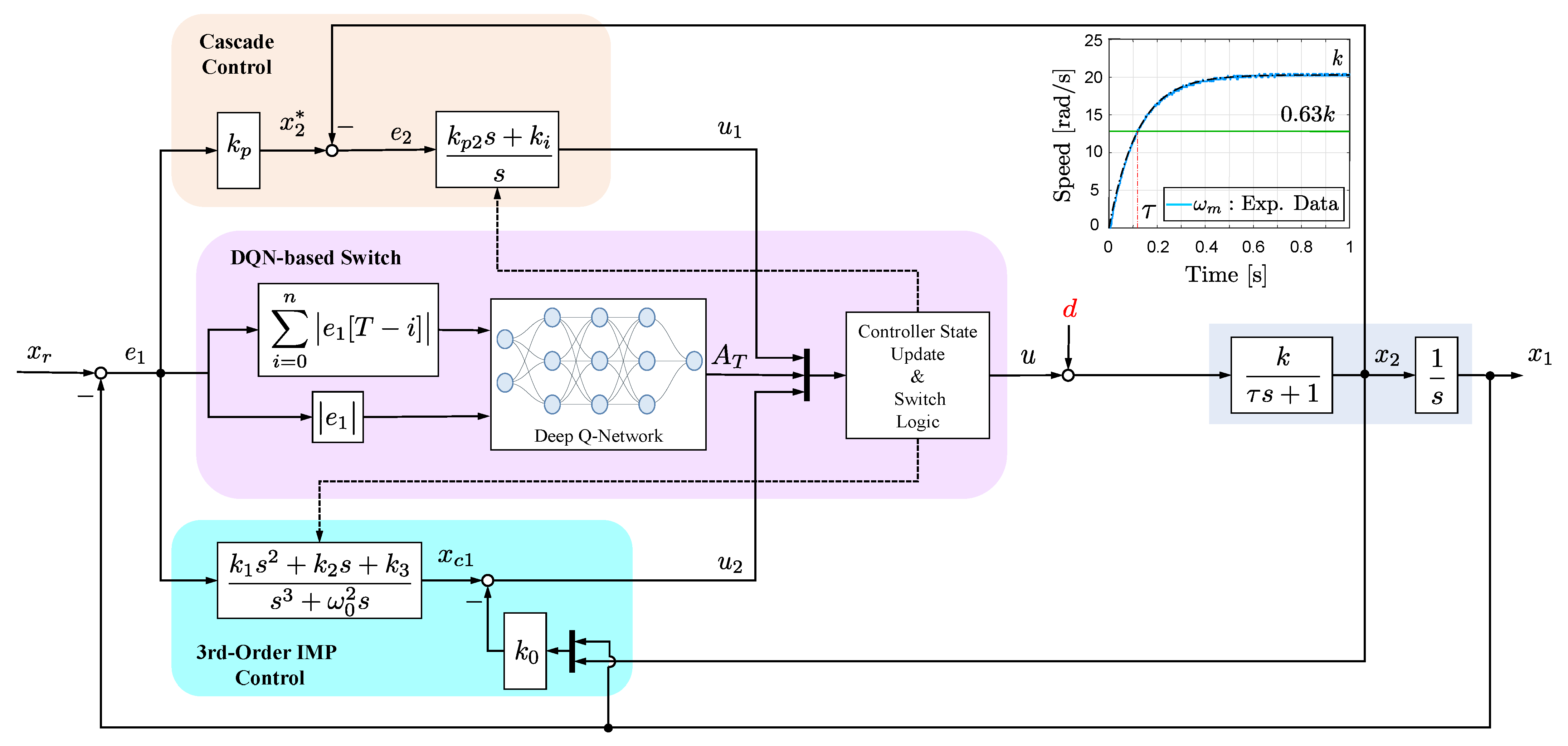
Most control system implementations rely on single structures optimized for specific performance criteria through rigorous derivation. While effective for their intended purpose, such controllers often underperform in areas outside their primary optimization focus and involve performance trade-offs. A notable example is the Internal Model Principle (IMP) controller, renowned for its robustness and precision in reference tracking under periodic disturbances. However, IMP controllers exhibit poor transient-state performance, characterized by significant overshoot and oscillatory responses, which remains a persistent challenge. To address this limitation, this paper proposes a reinforcement learning (RL)-based hybrid control scheme that overcomes the trade-off in IMP controllers between achieving zero steady-state tracking error and a fast transient response. The proposed method integrates a cascade control structure, optimized for transient-state performance, with an IMP controller, optimized for robust reference tracking under sinusoidal disturbances, through switching logic governed by a Deep Q-Network model. Smooth transitions between control modes are ensured using an internal state update mechanism. The proposed approach is validated through simulations and experimental tests on a direct current (DC) motor position control system. The results demonstrate that the hybrid structure effectively resolves the trade-off associated with IMP controllers, yielding improved performance metrics, such as rapid convergence to the reference, reduced transient overshoot, and enhanced nominal performance recovery against disturbances.
Keywords: Internal Model Principle; hybrid control; reinforcement-learning-based control; robust position control; transient response Internal Model Principle; hybrid control; reinforcement-learning-based control; robust position control; transient response