
Article

Nonlinear Adaptive Control of Maglev System Based on Parameter Identification
by
Haiyan Qiang
1,2,
Sheng Qiao
1,
Hengyue Huang
1,
Ping Cheng
1 and
Yougang Sun
3,4,*
1
Logistics Engineering College, Shanghai Maritime University, Shanghai 201306, China
2
Key Laboratory of Railway Industry of Maglev Technology (TJU), National Railway Administration of P. R. C, Shanghai 201804, China
3
State Key Laboratory of High-speed Maglev Transportation Technology, College of Transportation, Tongji University, Shanghai 201804, China
4
National Maglev Transportation Engineering R&D Center, Tongji University, Shanghai 201804, China
*
Author to whom correspondence should be addressed.
Actuators 2025, 14(3), 115; https://doi.org/10.3390/act14030115
Submission received: 14 January 2025 / Revised: 22 February 2025 / Accepted: 25 February 2025 / Published: 26 February 2025
(This article belongs to the Special Issue Advanced Theory and Application of Magnetic Actuators—2nd Edition)

Abstract

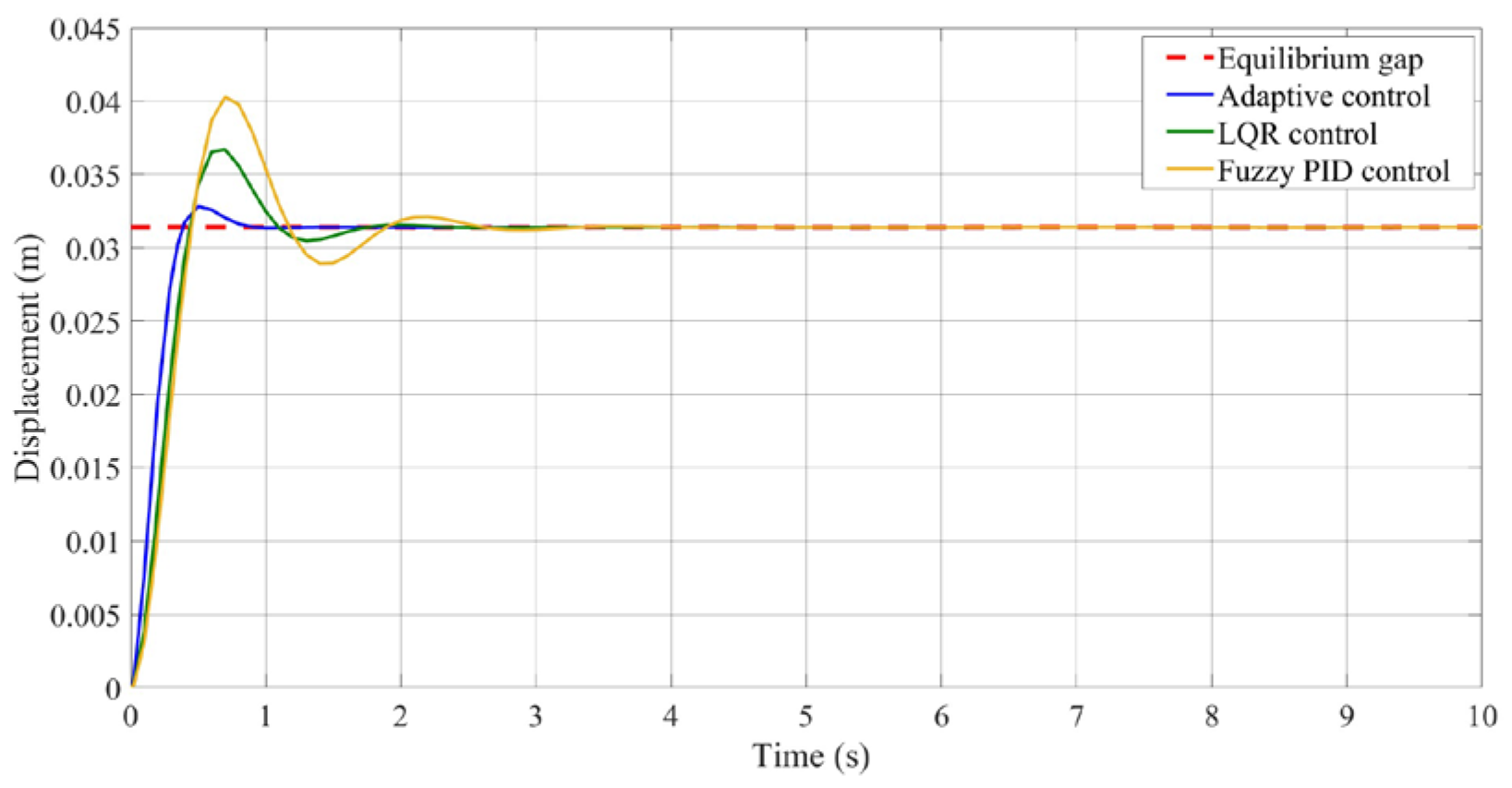
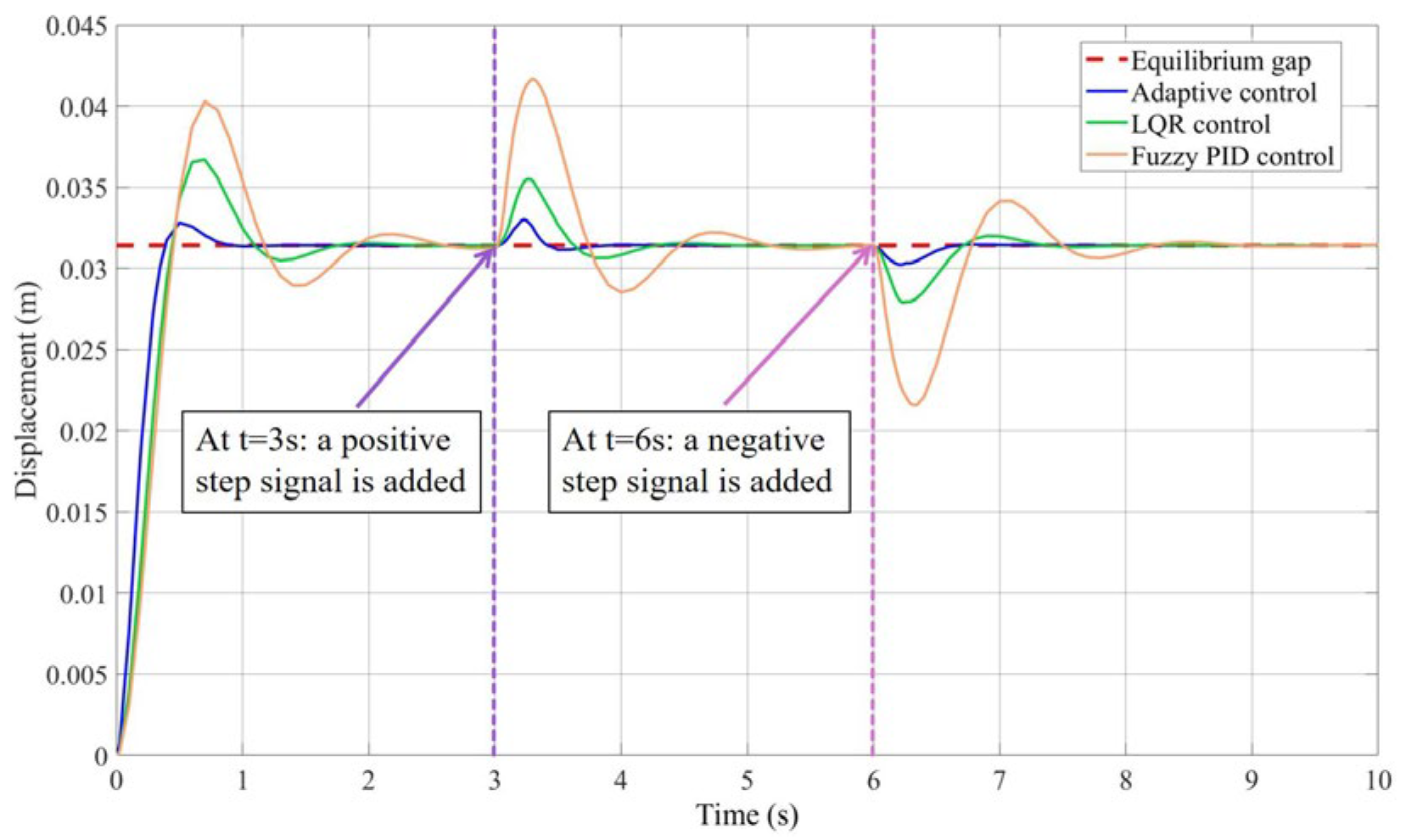
To address the nonlinearity and control problems of the Maglev system caused by external disturbances and internal factors of the system, this study first established a kinematic model of a single-point levitation system. Secondly, based on the nonlinear characteristics of the kinematic model, Gaussian noise was introduced into the model as input disturbance, and a neural network was used to train the constructed model. A nonlinear autoregressive model with exogenous inputs was constructed, and the Recursive Least Squares method with Forgetting Factor (RLS-FF) was used to perform parameter identification on the levitation system by combining the training data, further constructing an accurate model of the levitation system. Then, based on the accurate model of the levitation system, the backstepping method was adopted to design an adaptive controller for the levitation system, and its stability was verified. Simulation analysis was conducted on the MATLAB/Simulink platform, and comparisons were made with the LQR control method and the Fuzzy-PID control method that verified that the designed controller had a faster response speed and better self-regulation ability. At the same time, interference signals were introduced into the simulation to simulate the actual scene, and the good anti-interference ability and adaptive performance of the designed controller were further verified.
Keywords: levitation system; nonlinearity; parameter identification; adaptive control; backstepping method levitation system; nonlinearity; parameter identification; adaptive control; backstepping method