


Abstract
Nonlinear robotic systems often operate under widely varying conditions that challenge traditional linear control approaches. The Linear Parameter-Varying (LPV) paradigm overcomes these limitations and offers a unifying framework by representing the system’s time-varying dynamics as a convex blend of linear models. This enables both controller and observer synthesis through convex optimization, while considering nonlinearities and time-dependent behavior. This paper presents a linear matrix inequality (LMI)-based methodology for simultaneous stabilization control and state estimation in robotic application within the LPV/polytopic setting. Parallel to controller design, the full-state estimation challenge posed by limited sensors in robotics is addressed. An LPV observer architecture, based on the Luemberger observer, is proposed. The simultaneous observer/controller gains synthesis is then reduced to an LMI feasibility problem. The efficacy of our approach is then demonstrated and illustrated through simulations.
1. Introduction
LPV or polytopic systems, also known as multiple-models, or the Takagi–Sugeno framework, represent a specific class of dynamic models that bridge the gap between linear time-invariant systems and the nonlinear ones, allowing parameters to vary with time, operating conditions, or measurable/unmeasurable decision variables while maintaining a linear structure and reducing complexity through a divide-and-conquer strategy [1,2,3]. The obtained sub-models are interpolated using convex weighting or activation functions (the system is represented as a convex combinations of linear vertices within a polytope, capturing parameter variations and uncertainties), enabling the extension of linear control concepts such as stability analysis via Lyapunov theory and linear matrix inequalities (LMIs) to nonlinear contexts facilitating the nonlinearities, uncertainties, and time-varying parameters handling and making it particularly suitable for systems requiring global modeling, with stability LMI-based constraints, which represents one of the main advantages of this approach [4,5,6,7,8].
Known as a powerful strategy for modeling and controlling complex nonlinear systems, the LPV framework is particularly valuable for robotic systems, such as flexible manipulators, soft robots, unmanned aerial vehicles (UAVs), and humanoid robots, where dynamics can change due to factors like payload variations, environmental disturbances, or structural compliance. In the abundant literature, the terms LPV, polytopic, and Takagi–Sugeno frameworks are used interchangeably, as they describe equivalent convex-model representations of nonlinear systems. This strategy focuses on designing controllers that ensure asymptotic stability and robust performance across the parameter variation range, often using techniques like gain-scheduling or Lyapunov-based methods to handle uncertainties and disturbances. Complementing this, observer design plays a crucial role in estimating unmeasurable states or faults in LPV systems, enabling output feedback control and fault-tolerant strategies. Observers, such as robust unknown-input observers or -based ones, are integrated to detect sensor/actuator faults, compensate for input delays, and maintain system reliability in applications like satellite attitude control or hypersonic vehicles. The use of LPV stabilization control and observer design strategy enhances robotic autonomy, safety, and efficiency, ensuring advanced fault-tolerant operations in real-world scenarios ranging from soft robotics for delicate manipulation to aerial systems navigating dynamic environments [9,10,11,12,13].
Recent studies have extended LPV and polytopic approaches toward practical robotic and actuator systems, emphasizing real-time adaptation, fault tolerance, and disturbance rejection. For example, in ref. [14], the authors proposed a gain-scheduling control strategy for axial piston pumps based on an LPV model, achieving real-time compensation of nonlinear hydraulic dynamics without secondary control loops. Similarly, in ref. [15], model predictive control (MPC) was combined with a disturbance observer to enhance pointing accuracy and robustness under external disturbances. In ref. [16], for instance, an LPV-based controller for a floating-piston pneumatic actuator was presented, modeling the full nonlinear actuator, transforming it into a quasi-LPV representation, and designing an LPV controller that handles actuator motion limits and model reduction for real-time implementation. In ref. [17], for example, the authors propose an observer-based fault-tolerant predictive control scheme for LPV systems subject to input constraints and sensor faults, deriving both state and sensor fault estimators along with controller gains via LMIs.
In the following contribution, tools, methods, and implementation details will be given in order to demonstrate how this multiple models polytopic strategy enhances stability and control performances in robotic environments. It proposes a unified LMI-based approach for simultaneous stabilization and state estimation in robotic systems modeled within the LPV/polytopic framework, highlighting the interest of a unique approach for modeling, control, and estimation. The results validation is given through simulation results demonstrating stability and convergence of the two robotic systems, i.e., the quadrotor and a humanoid model.
2. Materials and Methods
In the following section, the polytopic multiple models approach will be presented, highlighting its interest and the different tools used for control/estimation problems.
The Polytopic approach or Multiple Model approach (MMA) in control theory refers to the use of a set of models to represent different dynamics or operating regimes of a nonlinear or time-varying system, instead of relying on a single (often linearized) model. It utilizes a bank of models (typically linear or locally valid approximations), each representing the system behavior under specific conditions. These conditions are given by the so-called weighting functions/activation functions that allow us to interpolate models defined around different operating points.
In this modeling approach, the dynamic behavior of the system is accurately captured by the judicious interconnection of a set of linear sub-models, each of them being valid in a particular operating zone of the system. The complete partition of the operating space of the system is performed using the so-called decision variable, which is assumed to be known and real-time available (e.g., the inputs and/or exogenous signals), or unknown (unmeasurable/state). Notice that the contribution of each sub-model is quantified by the so-called weighting functions that must satisfy the convex sum property.
This approach will allow us to use a common theory to deal simultaneously with the system nonlinearities, uncertainties, unknown time-varying parameters, stabilization, observation, and control design problem. One can distinguish two principle architectures: firstly, the homogeneous models, where sub-models share a same state space (e.g., Takagi–Sugeno (T-S) structures), which are obtained mainly thanks to the sector nonlinear transformation and represent an exact rewriting of the model, without any loss of information [18,19,20]—this representation presents the main advantage of conserving the nonlinear behavior of the original system, and consists in a polytopic rewriting of the model; and secondly, the heterogeneous ones, where outputs are interpolated across potentially different state spaces and are derived thanks to a partition of the system’s operating range into distinct regions, each approximated by local linear time-invariant sub-model blended via membership functions [21,22,23]. The main purpose of this second multiple-model/polytopic approach comes from the fact that the use of a single linear model for modeling the dynamic behavior of a system in the whole operating space can be unsuitable because the linearity assumption of the system is only valid in the neighborhood of an operating point, which shows the necessity of a more global representation.
The polytopic/multiple-model approach is also known as an efficient approach to manage complex nonlinear systems; it represents a unique, common strategy for modeling, estimation and control allowing one to extend several linear theoretical concepts to nonlinear systems.
The major advantage of this technique consists in the fact that the properties of the nonlinear systems are expressed by a collection of linear subsystems, i.e., in a polytopic paradigm, where the overall system model is obtained by merging the local subsystems through time-varying blending processes called weighting functions. Based on the convex property of the weighting functions and to the linearity of the subsystems defining the vertices, certain major results can be generalized for nonlinear systems like the LMI formulation and the Lyapunov theory.
2.1. General Concepts of the Multiple-Model/Polytopic Framework:
Instead of relying on a single linearization around one operating point, a nonlinear system can be represented by a set of simpler models, each valid in a restricted region of operation. These models are then blended in time using weighting functions that depend on measurable or estimated decision variables. This idea, formalized in the well-known Takagi–Sugeno fuzzy modeling approach [1,2], allows one to capture nonlinear dynamics through a convex interpolation of linear subsystems.
Mathematically, if we denote by , , and the state, input, and output vectors, the global system can be expressed as a weighted representation of local models:
where are non-negative weighting functions satisfying . The variable represents the decision variables.
This representation is particularly interesting since it enables the use of linear control tools, such as Lyapunov-based stability analysis and linear matrix inequalities (LMIs), while taking into consideration system nonlinearities and parameter variations. In the following, we apply this framework for designing both controllers and observers to robotic applications.
2.2. Tools: The Linear Matrix Inequalities (LMIs)
Control problems often involve constraints on system stability, performance, and robustness. When formulated as convex problems, they can be solved efficiently, providing global optimal solutions.Which means that if the problem satisfies convexity, local optima are global optima, making the problem efficiently solvable.
In control theory, LMIs can handle constraints in various control problems, including robust control, state estimation, and multi-objective optimization. They are widely used for stability analysis, controller design, and optimization of dynamic systems. LMIs provide convex constraints, making them computationally efficient to solve using numerical methods.
Indeed, when talking about optimization problems using linear matrix inequalities (LMIs), the objective is to solve a control problem by ensuring feasibility and robustness through convex optimization techniques. The considered methodology is the following:
- Formulate the control problem (state-space representation, stability conditions, constraints).
- Convert constraints to LMIs (using Lyapunov theory, system norms, robust control methods).
- Solve the LMIs using demidefinite programming (via optimization solvers).
- Extract controller gains (state-feedback or dynamic controllers).
2.3. Basic Properties of the Polytopic/Multiple-Model Systems
Stability analysis
In this section, the stability analysis of polytopic T-S systems is discussed. The major advantage of the polytopic modeling approach is the fact that this one has been shown to be a universal approximator. Which means that given any real-valued continuous function on a compact subset of , there is a polytopic/MM model that will approximate this function to any accuracy, where universal controllers mean that given any process that can be controlled by a continuous-time controller, it can also be controlled by a polytopic/MM controller, i.e., a Parallel Distributed Compensation (PDC) Controller.
In refs. [5,19], the authors presented sufficient conditions for the stability of T-S models using a quadratic Lyapunov approach. The stability depends on the existence of a common positive definite matrix guarantying the stability of all local subsystems. These stability conditions may be expressed in linear matrix inequality () form [24].
The negativity condition of the is guaranteed based on the Lyapunov theory and due to the convex sum property of the weighting functions and the quadratic form of the input vector.
If we consider an autonomous polytopic system
and the following Lyapunov function candidate ()
then the system is stable if, for
The negativity condition of the is guaranteed based on the Lyapunov theory and due to the convex sum property of the weighting functions and the quadratic form of the input vector.
Observer design
In many robotic systems, not all states can be measured directly, either because of sensor limitations or due to cost and reliability constraints. To overcome this, state observers are introduced so that control strategies can rely on estimated quantities rather than full measurements.
Consider a nonlinear system represented by a convex combination of linear submodels:
where are the weighting functions as introduced earlier with measurable decision variables . A standard observer structure interpolates local Luenberger-type observers as follows:
with denoting the observer gain matrices to be determined.
Defining the estimation error , the dynamics can be written as
The design objective is to guarantee stability of the error system while minimizing its sensitivity to exogenous inputs and modeling uncertainties. This requirement can be expressed through Lyapunov conditions, leading to a set of linear matrix inequalities (LMIs). Solving these LMIs yields the observer gains that ensure asymptotic convergence of the estimated states.
The advantage of this formulation is that both observer and controller can be designed within a unified convex optimization framework. This facilitates the synthesis of output-feedback control laws in robotics, where reliable state reconstruction is essential for tasks such as UAV attitude stabilization or humanoid balance control.
Control design
The objective of control design in the LPV/polytopic setting is to ensure closed-loop stability and satisfactory performance across the full range of operating conditions. Instead of relying on a single linear model, the controller is expressed as a convex interpolation of local feedback laws that mirror the system polytopic structure.
For the polytopic representation
a state-feedback law of the form
is considered, where are the local controller gains to be computed. This strategy, often referred to as Parallel Distributed Compensation (PDC), introduced in [5,19], guarantees the system stability.
The closed-loop dynamics can be expressed as
To establish stability, one seeks a common quadratic Lyapunov function:
such that the time derivative of is negative for all possible weighting functions. This condition leads to a set of linear matrix inequalities (LMIs), which can be efficiently solved using convex optimization solvers. The solution provides the gain matrices that stabilize the system across the full operating domain.
This LMI-based procedure allows additional performance objectives to be considered, such as disturbance attenuation or robustness to parameter variations. By formulating these objectives as convex constraints, one can synthesize controllers that not only guarantee stability but also optimize performance criteria relevant to robotics applications, e.g., trajectory tracking or disturbance rejection in UAVs and humanoid robots.
3. Results
To validate the theoretical framework introduced above, two representative robotic applications case studies are presented: (i) attitude stabilization of a quadrotor UAV, and (ii) balance control of a humanoid robot modeled with the Linear Inverted Pendulum Model (LIPM). In both cases, the LPV/polytopic approach is used to approximate the nonlinear dynamics and to synthesize stabilizing controllers and observers via LMI-based design.
3.1. Quadrotor Attitude Stabilization
The first study concerns a quadrotor whose nonlinear dynamics are well documented in the literature [25,26,27]. Instead of repeating the full derivation, we directly employ the standard six-state attitude model expressed in terms of roll, pitch, and yaw angles and their angular velocities.
The quadrotor’s nonlinear model is rewritten as a polytopic combination of linear models based on the sector nonlinearity approach.
The nonlinear model of the quadrotor is given by the following:
where is defined as . The control inputs of motors are denoted and written as a function of the angular velocities of the rotors as follows:
corresponds to the Roll angle [rad], to the Pitch angle [rad], and to the Yaw angle [rad]. The moment of inertia among axes x, y, and z are denoted , , and respectively. , , and are the rotor inertia, propeller thrust and drag coefficients and , , and the friction aerodynamic coefficients.
For more detailed of this model, readers can see [26].
The system Equation (12) can be expressed as a quasi-LPV model given by
with the following suitable state, output, and input vectors:
The system matrices are given by
and
Assuming that angular velocity variation occurs between given minimum and maximum values, applying the sector nonlinearity approach [1,4,6], and choosing the following premise variables
a Quasi-LPV model is deduced:
By definition, the sector nonlinearity transformation gives:
Based on the definition and convex sum property of the F functions, we can factorize our system as
The constant matrices and are obtained by replacing the variables in the matrices and with the appropriate bound:
and the indexes ( and ) are equal to 1 or 2 and indicate which partition of the jth premise variable ( or ) is involved in the ith submodel. The following polytopic T-S representation with subsystems is then obtained [27]:
More details on how to obtain the adequate matrices and weighting functions are available in [4,27].
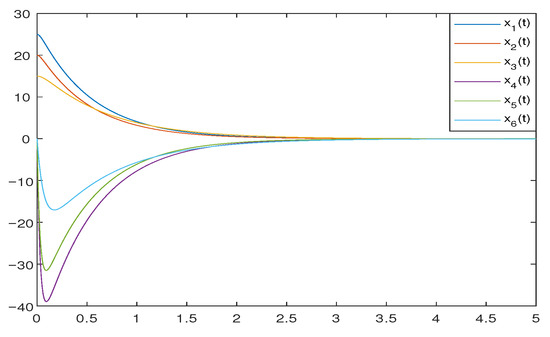
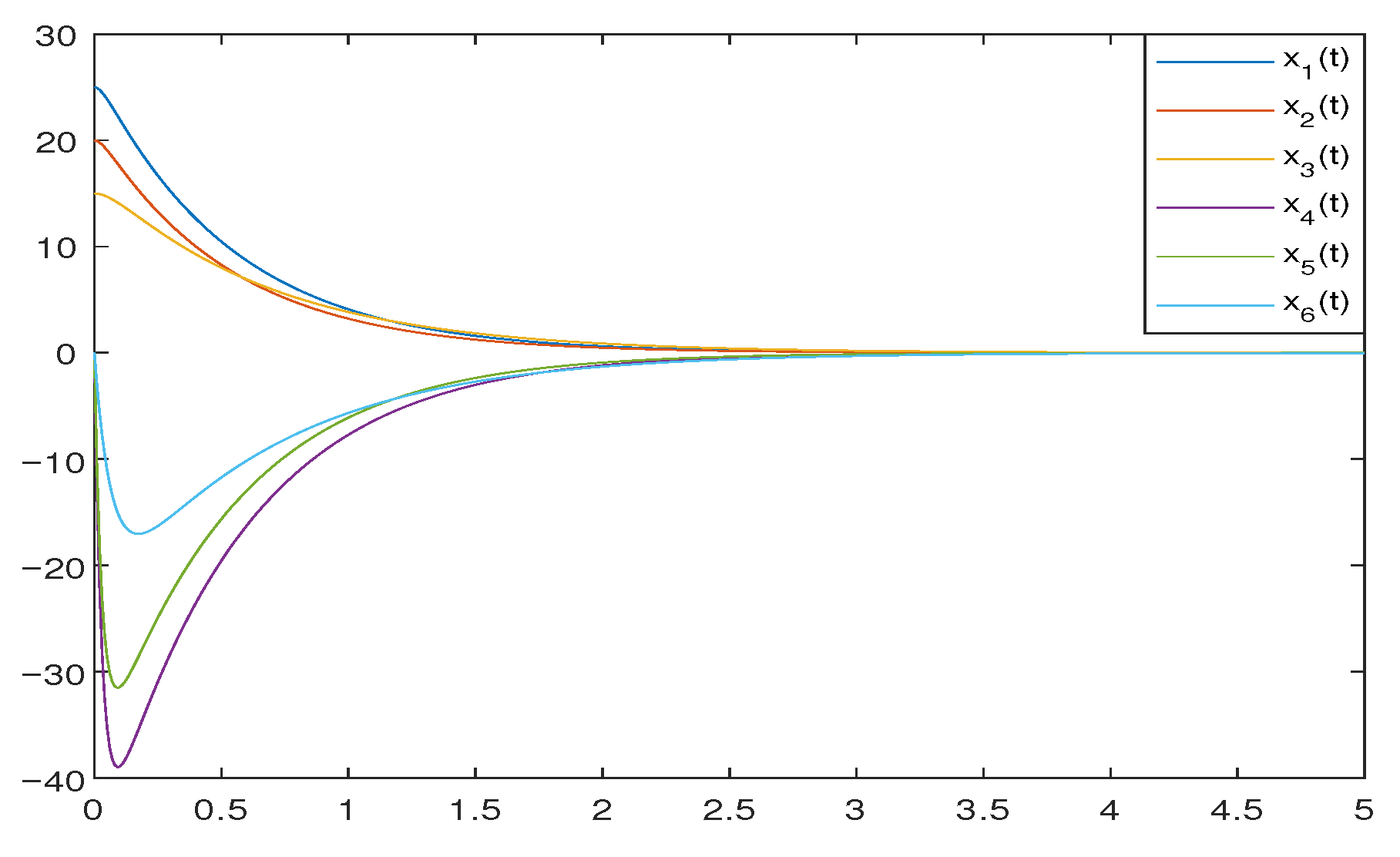
Using the proposed PDC-based state-feedback strategy, and based on the quadratic Lyapunov function defined above, , gain matrices are obtained by solving the corresponding LMIs. Figure 1 shows the evolution of the system states under the designed controller. The results confirm that the closed-loop system achieves asymptotic stability: the attitude angles converge to zero, and the angular rates are damped rapidly despite the nonlinear coupling terms.
Figure 1.
Evolution of the outputs in time.
3.2. LPV Stabilization Control and Observer Design of Humanoid Robot—Simple Case Study
The second case study addresses a simplified humanoid robot model. Balance is represented through the LIPM dynamics, where the center of gravity (COG) is regulated to track a reference Zero Moment Point (ZMP) trajectory. To capture variations in the COG height, the model is expressed as a convex interpolation of two linear subsystems, producing a compact two-vertex polytopic structure.
An LMI-based controller, combined with an LPV observer, is synthesized to ensure robust stabilization across these operating conditions.
Let us assume that the COG height is constant, , and that the desired ZMP trajectory () is typically predefined (e.g., based on foot placements during walking). The COG trajectory is generated to follow the ZMP trajectory while maintaining dynamic balance using the state-space representation:
where g is gravitational acceleration and h is the height of the COG.
The variables are defined as follows:
- : COG position, velocity, and acceleration in the sagittal plane.
- : COG position, velocity, and acceleration in the lateral plane.
- : ZMP position in the sagittal and lateral planes.
The Linear Inverted Pendulum Model (LIPM) state-space representation is then given by the following:
where the state vector is defined as
and the system matrices are given by
Here, assumes full state feedback.
In the humanoid robot with LIPM dynamics, we aim to control the center of gravity (COG) such that the robot remains balanced and follows a desired trajectory. The dynamics depend on parameters like the height of the COG (h), which can vary due to motion or external disturbances. The polytopic approach approximates the system dynamics as a convex combination of linear models (vertices of a polytope). Control is designed to ensure stability and performance across the entire range of operating conditions.
The LIPM assumes the height of the COG (h) is approximately constant. We approximate the system as a convex combination of two or more linear models corresponding to different COG heights h. For simplicity, consider two models:
- Sub-system 1 (): Higher COG height (e.g., when the robot is standing straight).
- Sub-system 2 (): Lower COG height (e.g., when the robot is crouching).
The system matrices are parameterized as follows:
where is a blending factor depending on the operating condition.
The Polytope vertices are defined as follows:
For :
For :
Control Design: for the system:
The polytopic MM uses membership functions to interpolate between the vertices and :
where
- and are the membership functions.
- , ensuring the convexity of the model.
The membership functions are defined as follows:
Thus, the system becomes
LMI-Based Control for Takagi–Sugeno Model
Consider the general case system with a polytopic form of the control input:
where gains are computed so as to guarantee stability for all possible values of , and based on Lyapunov theory (let us consider the following quadratic Lyapunov function: ), the LMI constraints to be solved are given by
where
Stabilization and Control design/Observer-based state-feedback controller
In the following, let us combine the observer (Luenberger type) and control design with the LMI/polytopic approach:
Defining the estimation error as ,
with augmented state vector defined as and
- Considering the Lyapunov function , the augmented system stability is ensured if the following constraints are satisfied for :
- Controller and observer gains and are obtained by solving the BMIs above. One way to linearize these constraints would be the use of the descriptor approach.
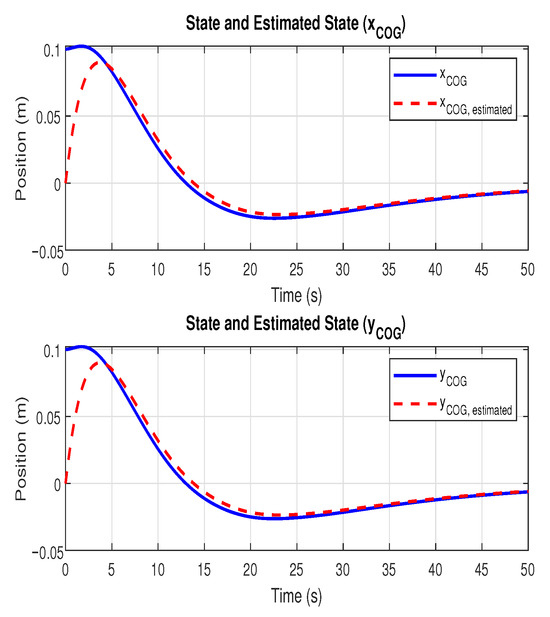
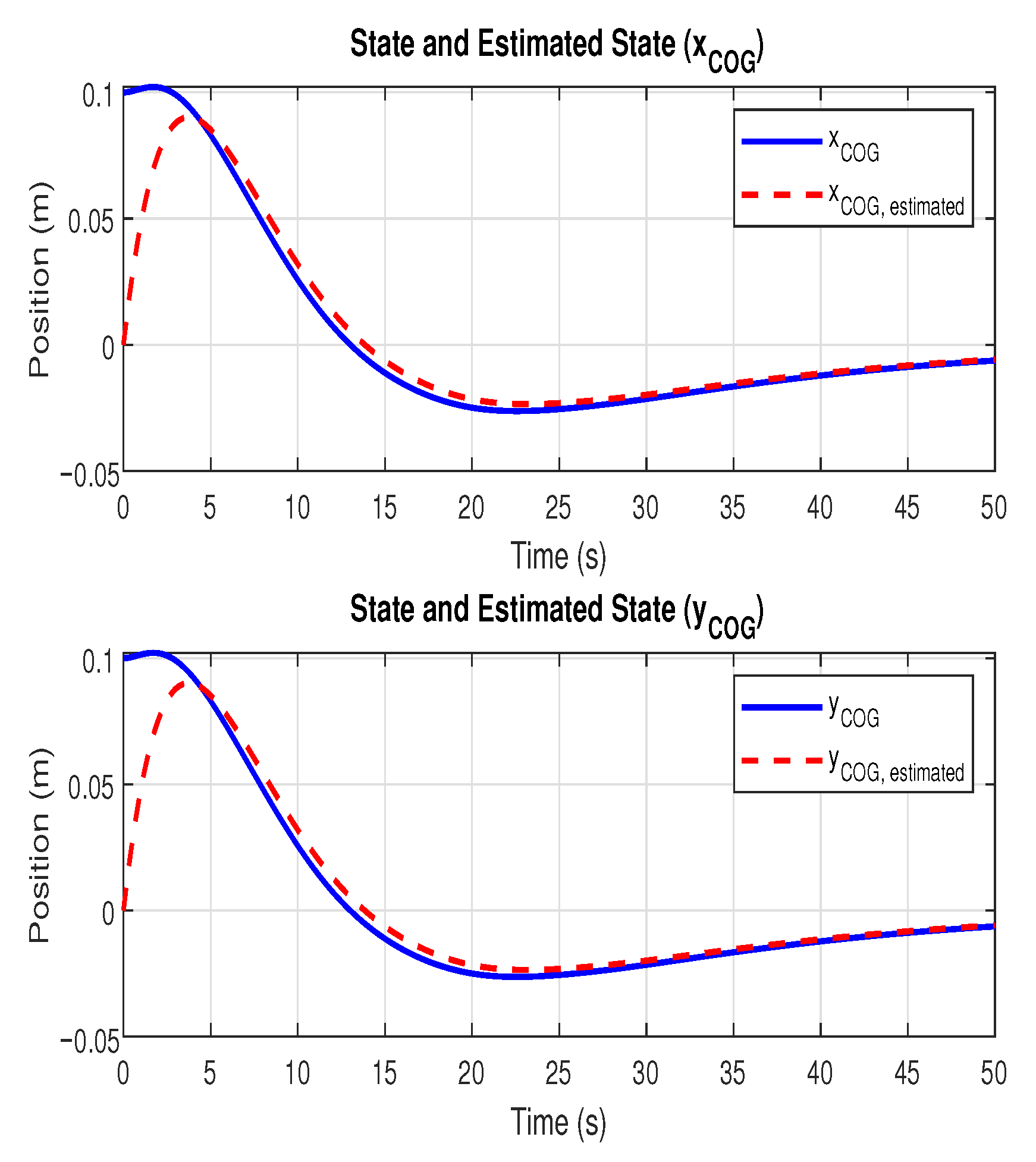
In the following, let us illustrate the proposed approach with a simulation example. We consider the LIMP LPV T-S with SnT representation model; the polytopic stabilization and observer-based feedback controller detailed above was considered and the following simulation obtained:
The obtained results highlight the COG Position Stabilization, such that stabilize over time, converging to the desired value (usually zero). This indicates that the system has reached a steady state where no further corrections are required. Indeed, we notice that the COG position converges to the desired steady-state value (e.g., , ). We can conclude on the system stability, since the COG position converges to the desired value and the control inputs stabilize, indicating proper controller performance and results validation, since the implemented controllers and observer designs work as expected.
These two examples highlight the efficiency of the proposed approach. For the quadrotor, the controller successfully stabilizes a highly coupled nonlinear system; and for the humanoid robot, the polytopic observer ensures reliable state reconstruction despite parameter variations. These results highlight the advantages of LPV/polytopic methods in robotic applications where system dynamics evolve with operating conditions.
4. Discussion
The obtained results confirm the efficiency and robustness of the proposed LPV/polytopic control and estimation strategy for nonlinear robotic systems. The two presented case studies, the quadrotor attitude stabilization and the humanoid robot balance control, illustrate how the methodology enables simultaneous controller and observer synthesis through convex optimization, providing a unified framework for stability and performance analysis under parameter variations.
In the quadrotor case, the LMI-based synthesis ensured asymptotic stability of the roll, pitch, and yaw dynamics despite strong nonlinear couplings and aerodynamic cross terms. The results (see Figure 1) demonstrate that the attitude angles converge rapidly to zero and that the proposed controller efficiently compensates for the nonlinear interaction between rotational axes. These outcomes are consistent with theoretical expectations derived from the Lyapunov-based convex stability conditions. Compared to traditional gain-scheduling or PID-based strategies, the proposed LPV/LMI approach achieves smoother transient behavior and better damping characteristics across a wide range of angular rates. This behavior is in ad-equation with recent LPV control studies for aerial systems [9,10,12], confirming the efficiency of the approach.
For the humanoid robot case, the results (Figure 2) confirm that the LPV observer and controller combination maintains balance by ensuring convergence of the center of gravity (COG) to the desired Zero Moment Point (ZMP) trajectory. The convex blending of subsystem models corresponding to different COG heights allowed the system to remain stable across significant variations in the operating point, which would challenge classical linear controllers. The close agreement between estimated and true COG trajectories further validates the accuracy of the observer design. This result highlights the potential of the proposed approach for applications requiring real-time adaptation and robust estimation, such as bipedal locomotion, collaborative robots, and compliant actuation systems.
Figure 2.
COG position and its estimate stabilization in both the sagittal and the lateral plan.
The proposed LMI-based controller/observer synthesis therefore demonstrates several key advantages: (i) guaranteed stability through a common quadratic Lyapunov function, (ii) ease of implementation via convex optimization, and (iii) flexibility to handle time-varying or uncertain parameters in robotic systems. At the same time, the approach provides a systematic means of designing both state-feedback and observer gains within a single convex framework, a feature that remains challenging in nonlinear or hybrid control contexts.
Nonetheless, some limitations must be highlighted. The LMI conditions, although convex, may become conservative in high-dimensional systems or when the number of vertices in the polytopic representation increases. This conservatism can lead to infeasibility in certain cases. Future work will therefore focus on reducing conservatism through parameter-dependent Lyapunov functions. Experimental implementation on physical robotic platforms will also be pursued to further validate the approach under practical and physical constraints.
Overall, the results and comparative discussion confirm that the proposed LPV/polytopic stabilization and estimation methodology is a powerful and flexible solution for robotic systems operating under nonlinear and time-varying conditions. It bridges the gap between linear control theory and nonlinear robotics, offering a structured yet practical framework capable of addressing the increasing complexity of modern autonomous systems.
5. Conclusions
This paper presented a unified Linear Parameter-Varying (LPV) and polytopic framework for simultaneous stabilization control and state estimation in robotic systems. The proposed methodology combines controller and observer synthesis within a single convex optimization structure based on linear matrix inequalities (LMIs), ensuring global stability while accounting for nonlinearities and parameter variations. The approach was validated through two representative robotic case studies: a quadrotor attitude control problem and a humanoid balance control scenario modeled via the Linear Inverted Pendulum Model (LIPM).
The obtained simulation results demonstrated that the LMI-based LPV/polytopic formulation provides fast and robust convergence of the system states and ensures stability. In both cases, the designed controllers achieved smooth transient responses, while the observer structure guaranteed accurate state reconstruction.
The developed framework provides a systematic and computationally efficient approach that can be extended to other robotic platforms such as manipulators, aerial or underwater vehicles, and legged robots. Future work will focus on several directions like experimental implementation on real robotic systems to validate robustness under hardware constraints and sensor noise and reduction in LMI conservatism through parameter-dependent Lyapunov functions and less restrictive convex formulations.
In conclusion, the proposed LPV/polytopic LMI-based control and estimation strategy bridges the gap between classical linear control and nonlinear robotic systems. It combines theoretical rigor with practical applicability, contributing to the advancement of robust and adaptive control methodologies for modern intelligent robotic systems.
Funding
This research was funded thanks to the French Embassy in Japan and the Japan Exploration Program.
Data Availability Statement
The original contributions presented in this study are included in the article. Further inquiries can be directed to the corresponding author.
Acknowledgments
The author would like to especially thank Guillaume CARON and Mitsuharu MORISAWA for our rich scientific discussions, their help and support, and for hosting me at the CNRS-AIST JRL-Joint Robotic Laboratory during my stay at Tsukuba campus.
Conflicts of Interest
The author declare no conflicts of interest.
References
- Takagi, T.; Sugeno, M. Fuzzy identification of systems and its applications to modeling and control. IEEE Trans. Syst. Man Cybern. 1985, 15, 116–132. [Google Scholar] [CrossRef] [Scilit]
- Sugeno, M.; Kang, G. Structure identification of fuzzy model. Fuzzy Sets Syst. 1988, 28, 15–33. [Google Scholar] [CrossRef] [Scilit]
- Bezzaoucha, S.; Voos, H.; Darouach, M. A survey on the polytopic Takagi-Sugeno approach: Application to the inverted pendulum. In The Inverted Pendulum: From Theory to New Innovations in Control and Robotics; The Institution of Engineering and Technology IET-Publishing: London, UK, 2017; pp. 283–308. [Google Scholar] [CrossRef] [Scilit]
- Tanaka, K.; Wang, H. Fuzzy Control Systems Design and Analysis: A Linear Matrix Inequality Approach; John Wiley and Sons, Inc.: New York, NY, USA, 2001. [Google Scholar] [CrossRef] [Scilit]
- Tanaka, K.; Ikeda, T.; Wang, H. Fuzzy regulators and fuzzy observers: Relaxed stability conditions and LMI based designs. IEEE Trans. Fuzzy Syst. 1998, 6, 250–265. [Google Scholar] [CrossRef] [Scilit]
- Tanaka, K.; Hori, T.; Wang, H. A Multiple Lyapunov Function Approach to Stabilization of Fuzzy Control Systems. IEEE Trans. Fuzzy Syst. 2003, 11, 582–589. [Google Scholar] [CrossRef] [Scilit]
- Bezzaoucha Rebaï, S. Linear Matrix Inequalities (LMIs) in Control Engineering. In Proceedings of the 7th International Conference on Control and Computer Vision (ICCCV 2025), Wuhan, China, 28–30 March 2025. [Google Scholar]
- Bezzaoucha Rebaï, S. Advanced control and Observer Design via LMIs. In Proceedings of the 2nd World Symposium on Intelligent System and Electronic Devices (SISED2024), Nagoya, Japan, 5–7 November 2024. [Google Scholar]
- Saeed, A.; Bhatti, A.I.; Malik, F.M. LMIs-Based LPV Control of Quadrotor with Time-Varying Payload. Appl. Sci. 2023, 13, 6553. [Google Scholar] [CrossRef] [Scilit]
- Chaabani, S.; Azouz, N. Quasi-LPV Approach for the Stabilization of an Innovative Quadrotor. Modelling 2025, 6, 60. [Google Scholar] [CrossRef] [Scilit]
- Chaubey, S.; Puig, V. Autonomous Vehicle State Estimation and Mapping Using Takagi–Sugeno Modeling Approach. Sensors 2022, 22, 3399. [Google Scholar] [CrossRef] [Scilit] [PubMed]
- Medero, A.; Puig, V. LPV Control and Virtual-Sensor-Based Fault Tolerant Strategies for a Three-Axis Gimbal System. Sensors 2022, 22, 6664. [Google Scholar] [CrossRef] [Scilit] [PubMed]
- Kermiche, S.; Saidi, M.L.; Abbassi, H.A.; Ghodbane, H. Takagi-Sugeno Based Controller for Mobile Robot Navigation. J. Appl. Sci. 2006, 6, 1838–1844. [Google Scholar] [CrossRef] [Scilit]
- Wang, H.; Liu, T.; Zhang, X. Real-Time Gain-Scheduling Controller for Axial Piston Pump Based on LPV Model. Actuators 2025, 14, 421. [Google Scholar] [CrossRef] [Scilit]
- Hu, Y.; Chen, J.; Li, S. A Composite Control Method Based on Model Predictive Control and a Disturbance Observer for the Acquisition, Tracking, and Pointing System. Actuators 2024, 13, 417. [Google Scholar] [CrossRef] [Scilit]
- Szabó, Á.; Bécsi, T.; Aradi, S.; Gáspár, P. LPV-Based Controller Design of a Floating Piston Pneumatic Actuator. Actuators 2020, 9, 98. [Google Scholar] [CrossRef] [Scilit]
- Abboudi, A.; Bououden, S.; Chadli, M.; Boulkaibet, I.; Neji, B. Observer-Based Fault-Tolerant Predictive Control for LPV Systems with Sensor Faults: An Active Car Suspension Application. Appl. Sci. 2022, 12, 684. [Google Scholar] [CrossRef] [Scilit]
- Johansen, T.A. Fuzzy model based control: Stability, robustness, and performance issues. IEEE Trans. Fuzzy Syst. 1994, 2, 221–234. [Google Scholar] [CrossRef] [Scilit] [PubMed]
- Wang, H.O.; Tanaka, K.; Griffin, M.F. An approach to fuzzy control of nonlinear systems: Stability and design issues. IEEE Trans. Fuzzy Syst. 1996, 4, 14–23. [Google Scholar] [CrossRef] [Scilit]
- Feng, G. A Survey on Analysis and Design of Model-Based Fuzzy Control Systems. IEEE Trans. Fuzzy Syst. 2006, 14, 676–697. [Google Scholar] [CrossRef] [Scilit]
- Filev, D. Fuzzy modeling of complex systems. Int. J. Approx. Reason. 1991, 5, 281–290. [Google Scholar] [CrossRef] [Scilit]
- Gasso, K.; Mourot, G.; Ragot, J. Structure identification in multiple model representation: Elimination and merging of local models. In Proceedings of the 40th IEEE Conference on Decision and Control, Orlando, FL, USA, 4–7 December 2001. [Google Scholar]
- Gregorcic, G.; Lightbody, G. Control of highly nonlinear processes using self-tuning control and multiple/local model approaches. In Proceedings of the 2000 IEEE International Conference on Intelligent Engineering Systems (INES 2000), Portoroz, Slovenie, 17–19 September 2000. [Google Scholar]
- Boyd, S.; El Ghaoui, L.; Feron, E.; Balakrishnan, V. Linear Matrix Inequalities in System and Control Theory; SIAM: Philadelphia, PA, USA, 1994. [Google Scholar]
- Rabhi, A.; Chadli, M.; Pegard, C. Robust Fuzzy Control for Stabilization of a Quadrotor. In Proceedings of the 15th International Conference on Advanced Robotics, Tallinn, Estonia, 20–23 June 2011. [Google Scholar]
- Torres, F.; Rabhi, A.; Lara, D.; Romero, G.; Pégard, C. Fuzzy State Feedback for Attitude Stabilization of Quadrotor. Int. J. Adv. Robot. Syst. 2016, 13. [Google Scholar] [CrossRef] [Scilit]
- Bezzaoucha Rebai, S. Robust Attitude Stabilization of Quadrotor subject to Stealthy Actuator Attacks. In Proceedings of the IEEE 5th International Conference on Control, Robotics and Informatics (ICCRI 2022), Danang, Vietnam, 2–4 April 2022. [Google Scholar] [CrossRef] [Scilit]
Disclaimer/Publisher’s Note: The statements, opinions and data contained in all publications are solely those of the individual author(s) and contributor(s) and not of MDPI and/or the editor(s). MDPI and/or the editor(s) disclaim responsibility for any injury to people or property resulting from any ideas, methods, instructions or products referred to in the content. |
© 2025 by the author. Licensee MDPI, Basel, Switzerland. This article is an open access article distributed under the terms and conditions of the Creative Commons Attribution (CC BY) license (https://creativecommons.org/licenses/by/4.0/).