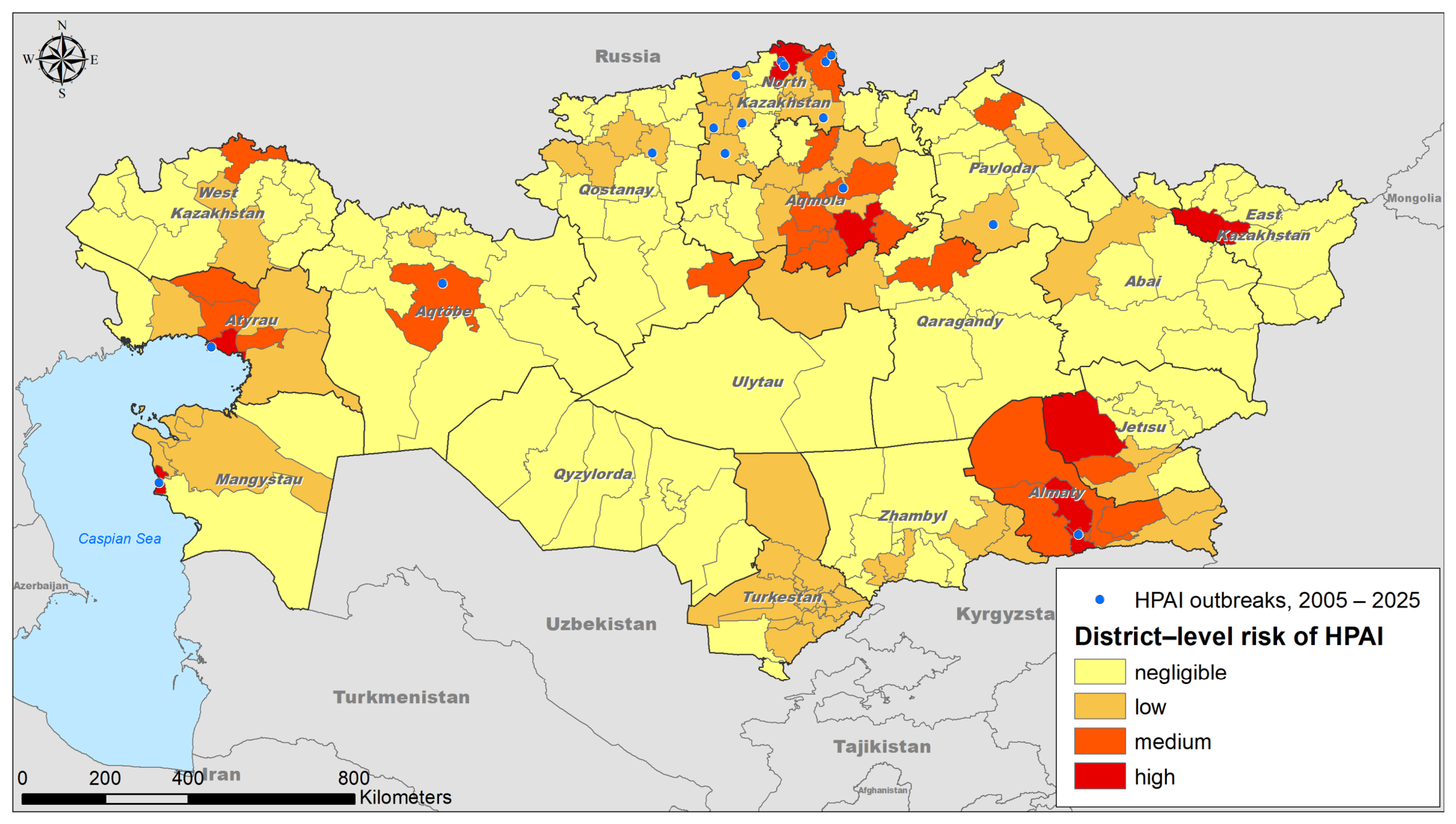


District-Level Risk Mapping of Highly Pathogenic Avian Influenza in Poultry in Kazakhstan Using a Multi-Criteria Decision Model
 , , ,
, , ,
Abstract
1. Introduction
2. Materials and Methods
2.1. General Approach
2.2. Selection and Processing of Risk Indicators
- i.
- Priority wild bird observation density: Migratory waterfowl act as the primary natural reservoir for HPAI viruses. To quantify this risk, citizen science data from the eBird Basic Dataset (EBD) for the period 2019–2023 were utilized [34]. Observations of 137 priority risk species, previously identified based on their susceptibility and involvement in HPAI outbreaks in Kazakhstan [30], were extracted. A kernel density estimation (KDE) was performed to evaluate the spatial concentration of these observations. KDE was implemented using the standard Kernel Density tool in ArcGIS Pro, which applies a quartic kernel, with a fixed search radius (bandwidth) of 3° and the planar distance method. The mean density value was subsequently calculated for each district using zonal statistics tool in ArcGIS Pro.
- ii.
- Wild bird census in wetlands: Wetlands serve as critical ecological interfaces for pathogen transmission between wild birds and domestic poultry [24,35]. A national wetlands database [36,37] was used to identify water bodies. The annual mean number of observations for risk species recorded in the eBird database within a 10-m buffer of these wetlands was calculated and aggregated at the district level to represent the local magnitude of the wildlife–environment interface.
- iii.
- Environmental virus survival (days): Virus persistence in the environment decreases as temperature increases, with low temperatures extending the window for indirect transmission through contaminated water or surfaces [38]. Meteorological raster data providing monthly minimum temperatures were extracted from ERA5 Google and Copernicus Data Store and processed within Kazakhstan boundary [39]. The mean minimum temperature for each district was extracted using zonal statistics in ArcGIS Pro software. To transform this temperature into an estimate of virus survival time, a logarithmic regression function previously validated in early warning tools was applied [40]:t(T) = −7.82 ln(T) + 29.94, where t is the virus survival time in days, and T is the temperature in degrees Celsius. A truncation rule was applied for temperatures below 1 °C to avoid numerical inconsistencies while reflecting maximum persistence under freezing conditions.
- iv and v.
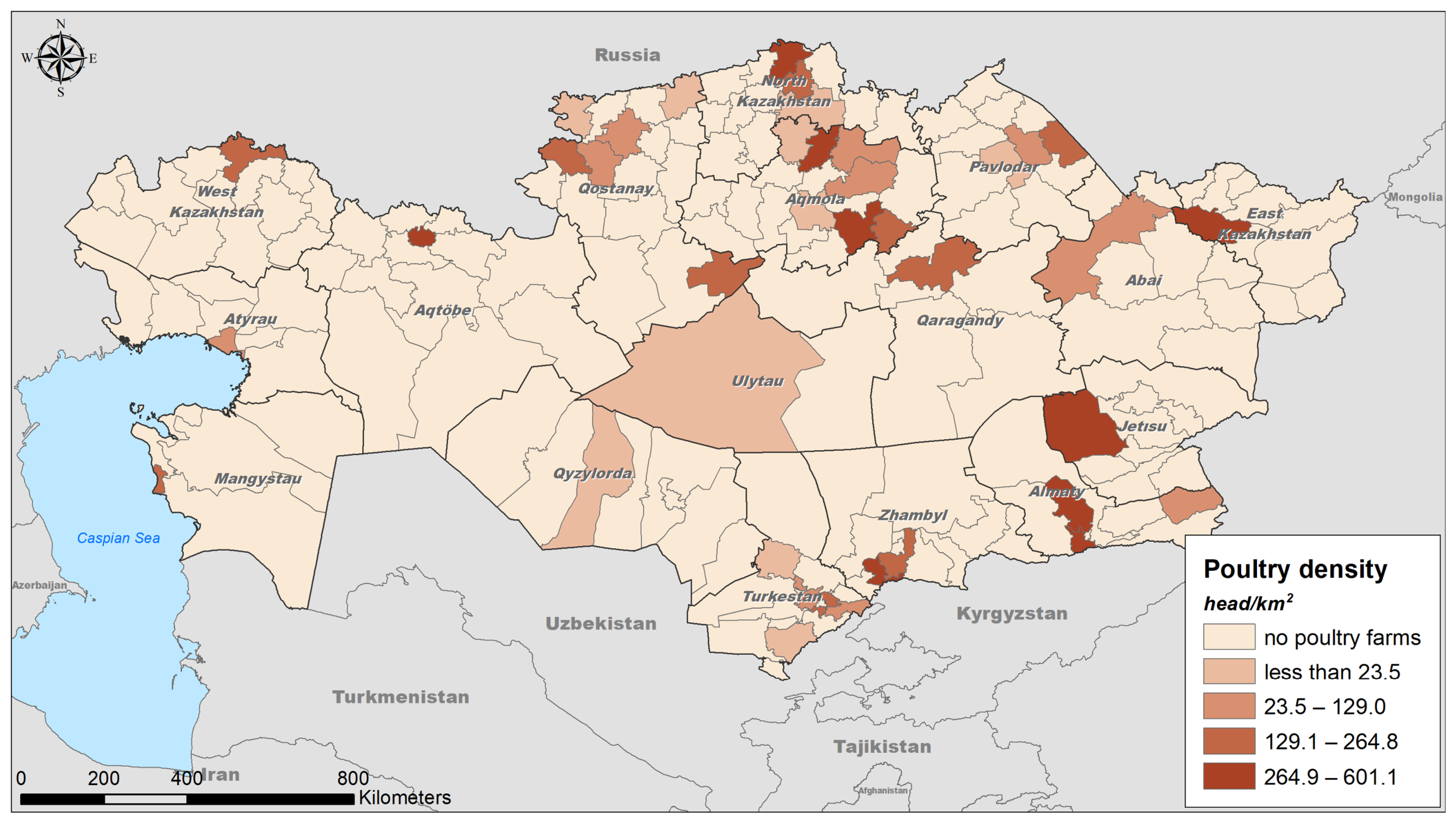
- Poultry farm counts and farm capacity: The structure and density of the poultry production system are critical determinants of HPAI spread and amplification. Higher densities increase transmission risk due to greater contact rates and connectivity, while farm capacity influences outbreak probability and magnitude [41,42]. Georeferenced data on the location and capacity of poultry farms in Kazakhstan were provided by the national veterinary authorities [43]. These data were spatially joined to the district boundaries to calculate two distinct variables per district, namely, the total number of poultry farms (farm counts) and the total number of domestic birds (farm capacity).
2.3. Multi-Criteria Decision Analysis Using TOPSIS
- (a)
- a normalized decision matrix (dimensions districts × criteria/variable) was specified.
- (b)
- Each criterion column was multiplied by a weight factor that represents the relative contribution of the variable to the risk index and reflects its epidemiological importance, thereby producing a weighted normalized matrix.
- (c)
- Ri+ and Ri− were identified based on the maximum and minimum estimated alternative, respectively.
- (d)
- For each district (i), the Euclidean distances to Ri+ (Di^+) and Ri− (Di^−) were computed across all criteria.
- (e)
- The TOPSIS score for each district i (Ci) was computed as Di^−/(Di^+ + Di^−), so that Ci represents a composited estimate of risk for the district with extreme values of 0 (no risk) and 1 (highest possible risk).
2.4. Weighting Schemes
2.5. Model Validation and Mapping
3. Results
4. Discussion
Author Contributions
Funding
Institutional Review Board Statement
Informed Consent Statement
Data Availability Statement
Conflicts of Interest
References
- Alexander, D.J. Avian Influenza and Newcastle Disease: A Field and Laboratory Guide; Springer: Milan, Italy, 2009; p. 186. [Google Scholar] [CrossRef] [Scilit]
- Onischenko, G.G.; Netesov, S.V.; Agafonov, A.P.; Safatov, A.S.; Buryak, G.A.; Generalov, V.M.; Sergeyev, A.N.; Drozdov, I.G. Highly pathogenic avian influenza: A new pandemic threat and possibilities to resist it. Vestn. Ross. Akad. Meditsinskikh Nauk. 2006, 12, 36–42. [Google Scholar]
- De Bruin, A.C.M.; Funk, M.; Spronken, M.I.; Gultyaev, A.P.; Fouchier, R.A.M.; Richard, M. Hemagglutinin Subtype Specificity and Mechanisms of Highly Pathogenic Avian Influenza Virus Genesis. Viruses 2022, 14, 1566. [Google Scholar] [CrossRef] [Scilit] [PubMed]
- Shi, J.; Zeng, X.; Cui, P.; Yan, C.; Chen, H. Alarming situation of emerging H5 and H7 avian influenza and effective control strategies. Emerg. Microbes Infect. 2023, 12, 2155072. [Google Scholar] [PubMed]
- Guo, F.; Li, Y.; Yu, S.; Liu, L.; Luo, T.; Pu, Z.; Xiang, D.; Shen, X.; Irwin, D.M.; Liao, M.; et al. Adaptive evolution of human-isolated H5Nx avian influenza a virus. Front. Microbiol. 2019, 10, 1328. [Google Scholar] [CrossRef] [Scilit] [PubMed]
- Burrough, E.R.; Magstadt, D.R.; Petersen, B.; Timmermans, S.J.; Gauger, P.C.; Zhang, J.; Siepker, C.; Mainenti, M.; Li, G.; Thompson, A.C.; et al. Highly Pathogenic Avian Influenza A(H5N1) Clade 2.3.4.4b Virus Infection in Domestic Dairy Cattle and Cats, United States, 2024. Emerg. Infect. Dis. 2024, 30, 1335–1343. [Google Scholar] [CrossRef] [Scilit] [PubMed]
- Webby, R.J.; Uyeki, T.M. An Update on Highly Pathogenic Avian Influenza A(H5N1) Virus, Clade 2.3.4.4b. J. Infect. Dis. 2024, 230, 533–542. [Google Scholar] [CrossRef] [Scilit] [PubMed]
- Krammer, F.; Hermann, E.; Rasmussen, A.L. Highly pathogenic avian influenza H5N1: History, current situation, and outlook. J. Virol. 2025, 99, e02209-24. [Google Scholar] [CrossRef] [Scilit] [PubMed]
- The World Organization for Animal Health (WOAH). Avian Influenza. Available online: https://www.woah.org/en/disease/avian-influenza/ (accessed on 25 May 2026).
- World Health Organization. Assessment of Risk Associated with Recent Influenza A(H5N1) Clade 2.3.4.4b Viruses. Available online: https://www.who.int/publications/m/item/assessment-of-risk-associated-with-recent-influenza-a(h5n1)-clade-2.3.4.4b-viruses (accessed on 5 June 2026).
- Islam, A.; Hossain, M.E.; Amin, E.; Islam, S.; Islam, M.; Sayeed, M.A.; Hasan, M.M.; Miah, M.; Hassan, M.M.; Rahman, M.Z.; et al. Epidemiology and Phylodynamics of Multiple Clades of H5N1 Circulating in Domestic Duck Farms in Different Production Systems in Bangladesh. Front. Public Health 2023, 11, 1168613. [Google Scholar] [CrossRef] [Scilit] [PubMed]
- Updated Joint FAO/WHO/WOAH Public Health Assessment of Recent High Pathogenicity Avian Influenza A(H5) Virus Events in Animals and People. Available online: https://www.woah.org/app/uploads/2026/05/2026-05-18-fao-woah-who-h5-assessment.pdf (accessed on 9 June 2026).
- Organización Mundial de Sanidad Animal. Distribution of HPAI New Outbreaks in Poultry, and Corresponding Subtypes; OMSA: Paris, France, 2023; Available online: https://www.woah.org/app/uploads/2023/02/hpai-situation-report-20230216.pdf (accessed on 26 May 2026).
- Organización Mundial de Sanidad Animal. Influenza Aviar—WOAH—Organización Mundial de Sanidad Animal; OMSA: Paris, France, 2023; Available online: https://www.woah.org/en/disease/avian-influenza/#ui-id-2 (accessed on 26 May 2026).
- Agüero, M.; Monne, I.; Sanchez, A.; Zecchin, B.; Fusaro, A.; Ruano, M.J.; del Valle Arrojo, M.; Fernandez-Antonio, R.; Souto, A.M.; Tordable, P.; et al. Highly pathogenic avian influenza A(H5N1) virus infection in farmed minks, Spain, October 2022. Eurosurveillance 2023, 28, 2300001. [Google Scholar] [CrossRef] [Scilit] [PubMed]
- United Nations. Avian Flu Reported in 108 Countries Across Five Continents, Says UN Health Agency. Available online: https://news.un.org/en/story/2024/12/1158286 (accessed on 28 May 2026).
- Enikeeva, A.I.; Panova, A.S.; Vasiltsova, N.N.; Danilenko, A.V.; Shadrinova, K.N.; Svyatchenko, S.V.; Ivanova, K.I.; Onkhonova, G.S.; Goncharova, N.I.; Tregubchak, T.V.; et al. Review of the Epizootic and Epidemic Situation regarding Highly Pathogenic Avian Influenza in Russia and Globally in 2025. Probl. Part. Danger. Infect. 2026, 1, 17–25. (In Russian) [Google Scholar] [CrossRef] [Scilit]
- Nagy, S.; Langendoen, T. Flyway Trend Analyses Based on Data from the African-Eurasian Waterbird Census from the Period of 1967–2018; Wetlands International: Wageningen, The Netherlands, 2020; Available online: http://iwc.wetlands.org/index.php/aewatrends8 (accessed on 22 July 2026).
- Si, Y.; Skidmore, A.K.; Wang, T.; De Boer, W.F.; Debba, P.; Toxopeus, A.G.; Li, L.; Prins, H.H.T. Spatio-temporal dynamics of global H5N1 outbreaks match bird migration patterns. Geospat. Health 2009, 4, 65. [Google Scholar] [CrossRef] [Scilit] [PubMed]
- Kydyrmanov, A.; Sayatov, M.; Karamendin, K.; Zhumatov, K.; Asanova, S.; Daulbayeva, K.; Starick, E.; Fereidouni, S. Monitoring of Influenza A Viruses in Wild Bird Populations in Kazakhstan in 2002–2009. Arch. Virol. 2017, 162, 147–155. [Google Scholar] [PubMed]
- Schielzeth, H.; Eichhorn, G.; Heinicke, T.; Kamp, J.; Koshkin, M.A.; Koshkin, A.V.; Lachmann, L. Waterbird population estimates for a key staging site in Kazakhstan: A contribution to wetland conservation on the Central Asian flyway. Bird Conserv. Int. 2008, 18, 71–86. [Google Scholar] [CrossRef] [Scilit]
- Gilbert, M.; Pfeiffer, D.U. Risk factor modelling of the spatio-temporal patterns of highly pathogenic avian influenza (HPAIV) H5N1: A review. Spat. Spatiotemporal Epidemiol. 2012, 3, 173–183. [Google Scholar] [CrossRef] [Scilit] [PubMed]
- Si, Y.; de Boer, W.F.; Gong, P. Different Environmental Drivers of Highly Pathogenic Avian Influenza H5N1 Outbreaks in Poultry and Wild Birds. PLoS ONE 2013, 8, e53362. [Google Scholar] [CrossRef] [Scilit] [PubMed]
- Velkers, F.C.; Manders, T.T.M.; Vernooij, J.C.M.; Stahl, J.; Slaterus, R.; Stegeman, J.A. Association of Wild Bird Densities around Poultry Farms with the Risk of Highly Pathogenic Avian Influenza Virus Subtype H5N8 Outbreaks in the Netherlands, 2016. Transbound. Emerg. Dis. 2021, 68, 76–87. [Google Scholar] [PubMed]
- Sultankulova, K.; Argimbayeva, T.; Aubakir, N.; Bopi, A.; Omarova, Z.; Melisbek, A.; Karamendin, K.; Kydyrmanov, A.; Chervyakova, O.; Kerimbayev, A.; et al. Reassortants of the Highly Pathogenic Influenza Virus A/H5N1 Causing Mass Swan Mortality in Kazakhstan from 2023 to 2024. Animals 2024, 14, 3211. [Google Scholar] [CrossRef] [Scilit] [PubMed]
- Kydyrmanov, A.; Karamendin, K.; Kassymbekov, Y.; Daulbayeva, K.; Sabyrzhan, T.; Khan, Y.; Nuralibekov, S.; Baikara, B.; Fereidouni, S. Mass Mortality in Terns and Gulls Associated with Highly Pathogenic Avian Influenza Viruses in Caspian Sea, Kazakhstan. Viruses 2024, 16, 1661. [Google Scholar] [CrossRef] [Scilit] [PubMed]
- Sputnik Kazakhstan. Avian Flu in Kazakhstan: About 2 Million Birds Died in 2020. Available online: https://ru.sputnik.kz/20210106/ptichiy-gripp-v-kazakhstan-okolo-2-millionov-ptits-pogiblo-v-2020-godu-15935875.html (accessed on 29 May 2026).
- Amirgazin, A.; Shevtsov, A.; Karibayev, T.; Berdikulov, M.; Kozhakhmetova, T.; Syzdykova, L.; Ramankulov, Y.; Shustov, A.V. Highly Pathogenic Avian Influenza Virus of the A/H5N8 Subtype, Clade 2.3.4.4b, Caused Outbreaks in Kazakhstan in 2020. PeerJ 2022, 10, e13038. [Google Scholar] [CrossRef] [Scilit] [PubMed]
- Abenova, A.; Mukhanbetkaliyev, Y.Y.; Kadyrov, A.; Sytnik, I.I.; Shevtsov, A.; Korennoy, F.I.; Martin, I.I.; Perez, A.M.; Abdrakhmanov, S.K. Environmental Suitability of Kazakhstan to Highly Pathogenic Avian Influenza Using Data on Eurasian Outbreaks, 2020–2024. Viruses 2025, 17, 574. [Google Scholar] [CrossRef] [Scilit] [PubMed]
- Iglesias, I.; Ruzmatov, S.; Ibañez-Porras, P.; Kadyrov, A.; Bakishev, T.; Korennoy, F.; Perez, A.; Abdrakhmanov, S. Risk assessment of highly pathogenic Avian Influenza (HPAI) in wild bird species in Kazakhstan. Ger. J. Vet. Res. 2025, 5, 76–93. [Google Scholar] [CrossRef] [Scilit]
- Bekshin, Z.; Temirbekova, A.; Nurbekova, Z.; Amirkhanova, N.; Satenova, A.; Askarov, A.; Zakarya, K.; Abduraimov, Y.; Rsaliyev, A. Epidemiology, Virology, and Control of Highly Pathogenic Avian Influenza in Kazakhstan. Pathogens 2025, 14, 1084. [Google Scholar] [CrossRef] [Scilit] [PubMed]
- Annual Reporting Meeting of the Members of the Union of Poultry Farmers of Kazakhstan. Available online: https://ptica.kz/news/otchetnoe-godovoe-sobranie-chlenov-ojufl-sojuz-pticevodov-kazahstana?lang=en (accessed on 20 June 2026).
- Malczewski, J. GIS-Based Multicriteria Decision Analysis: A Survey of the Literature. Int. J. Geogr. Inf. Sci. 2006, 20, 703–726. [Google Scholar] [CrossRef] [Scilit]
- Sullivan, B.L.; Wood, C.L.; Iliff, M.J.; Bonney, R.E.; Fink, D.; Kelling, S. EBird: A citizen-based bird observation network in the biological sciences. Biol. Conserv. 2009, 142, 2282–2292. [Google Scholar] [CrossRef] [Scilit]
- Central Veterinary Institute; Wageningen University. Risk factors of primary introduction of highly pathogenic and low pathogenic avian influenza virus into European poultry holdings, considering at least material contaminated by wild birds and contact with wild birds. EFSA Support. Publ. 2017, 14, 1282. [Google Scholar] [CrossRef] [Scilit]
- Kazakhstan Waterways (OpenStreetMap Export). Available online: https://data.humdata.org/dataset/hotosm_kaz_waterways (accessed on 12 May 2026).
- JRC Global Surface Water Mapping Layers, v1.4. Available online: https://developers.google.com/earth-engine/datasets/catalog/JRC_GSW1_4_GlobalSurfaceWater (accessed on 12 May 2026).
- Keeler, S.P.; Dalton, M.S.; Cressler, A.M.; Berghaus, R.D.; Stallknecht, D.E. Abiotic factors affecting the persistence of avian influenza virus in surface waters of waterfowl habitats. Appl. Environ. Microbiol. 2014, 80, 2910–2917. [Google Scholar] [CrossRef] [Scilit] [PubMed]
- ERA5-Land Daily Aggregated—ECMWF Climate Reanalysis. Available online: https://developers.google.com/earth-engine/datasets/catalog/ECMWF_ERA5_LAND_DAILY_AGGR (accessed on 20 July 2026).
- Ibáñez-Porras, P.; de la Torre, A.; Gómez-Pérez, J.I.; Tomás-Tenllado, C.; García, E.; Cáceres, G.; Pérez, A.; Iglesias, I. DiFLUsion: A Novel Space-Time Alert System for HPAI. Ger. J. Vet. Res. 2024, 4, 31–42. [Google Scholar] [CrossRef] [Scilit]
- Lambert, S.; Durand, B.; Andraud, M.; Delacourt, R.; Scoizec, A.; Le Bouquin, S.; Rautureau, S.; Bauzile, B.; Guinat, C.; Fourtune, L.; et al. Two Major Epidemics of Highly Pathogenic Avian Influenza Virus H5N8 and H5N1 in Domestic Poultry in France, 2020–2022. Transbound. Emerg. Dis. 2022, 69, 3160–3166. [Google Scholar] [CrossRef] [Scilit] [PubMed]
- EFSA (European Food Safety Authority); ECDC (European Centre for Disease Prevention and Control); Alexakis, L.; Buczkowski, H.; Ducatez, M.; Fusaro, A.; Gonzales, J.L.; Kuiken, T.; Ståhl, K. Avian Influenza Overview September–December 2024. EFSA J. 2025, 23, 9204. [Google Scholar] [CrossRef] [Scilit]
- Bureau of National Statistics of the Agency for Strategic Planning and Reforms of the Republic of Kazakhstan. Animal Husbandry of the Republic of Kazakhstan: 2025; Bureau of National Statistics: Astana, Kazakhstan, 2025. Available online: https://stat.gov.kz/ (accessed on 20 June 2026).
- Hwang, C.L.; Yoon, K. Multiple Attribute Decision Making: Methods and Applications. In Lecture Notes in Economics and Mathematical Systems; Springer: Berlin/Heidelberg, Germany, 1981; Volume 186. [Google Scholar]
- El Allaki, F.; Christensen, J.; Vallières, A. A Modified TOPSIS (Technique for Order of Preference by Similarity to Ideal Solution) Applied to Choosing Appropriate Selection Methods in Ongoing Surveillance for Avian Influenza in Canada. Prev. Vet. Med. 2019, 165, 36–43. [Google Scholar] [CrossRef] [Scilit] [PubMed]
- Saaty, T.L. The Analytic Hierarchy Process: Planning, Priority Setting, Resource Allocation; McGraw-Hill: New York, NY, USA, 1980. [Google Scholar]
- Robin, X.; Turck, N.; Hainard, A.; Tiberti, N.; Lisacek, F.; Sanchez, J.-C.; Müller, M. PROC: An Open-Source Package for R and S+ to Analyze and Compare ROC Curves. BMC Bioinform. 2011, 12, 77. [Google Scholar] [CrossRef] [Scilit] [PubMed]
- Youden, W.J. Index for rating diagnostic tests. Cancer 1950, 3, 32–35. [Google Scholar] [CrossRef] [Scilit]
- Jenks, G.F. The Data Model Concept in Statistical Mapping. Int. Yearb. Cartogr. 1967, 7, 186–190. [Google Scholar]
- What Is the Jenks Optimization Method? (ArcGIS Knowledge Base). 2025. Available online: https://support.esri.com/en-us/knowledge-base/what-is-the-jenks-optimization-method-1462479759617-000006743 (accessed on 22 July 2026).


| Priority Wild Bird Observation Density | Farm Count | Wild Bird Census (Wetlands) | Poultry Census | Virus Survival (Days) | AHP Weight | |
|---|---|---|---|---|---|---|
| Priority wild bird observation density | 1 | 5/4 | 5/4 | 8/5 | 5/2 | 0.276 |
| Farm count | 4/5 | 1 | 1 | 4/3 | 2 | 0.222 |
| Wild bird census (wetlands) | 4/5 | 1 | 1 | 4/3 | 2 | 0.222 |
| Poultry census | 5/8 | 3/4 | 3/4 | 1 | 3/2 | 0.168 |
| Virus survival (days) | 2/5 | 1/2 | 1/2 | 2/3 | 1 | 0.111 |
Disclaimer/Publisher’s Note: The statements, opinions and data contained in all publications are solely those of the individual author(s) and contributor(s) and not of MDPI and/or the editor(s). MDPI and/or the editor(s) disclaim responsibility for any injury to people or property resulting from any ideas, methods, instructions or products referred to in the content. |
© 2026 by the authors. Licensee MDPI, Basel, Switzerland. This article is an open access article distributed under the terms and conditions of the Creative Commons Attribution (CC BY) license.
Share and Cite
Mukhanbetkaliyeva, A.A.; Iglesias Martin, I.; Korennoy, F.I.; Kadyrov, A.S.; Mukhanbetkaliyev, Y.Y.; Ruzmatov, S.I.; Abenova, A.Z.; Bakishev, T.G.; Perez, A.M.; Abdrakhmanov, S.K. District-Level Risk Mapping of Highly Pathogenic Avian Influenza in Poultry in Kazakhstan Using a Multi-Criteria Decision Model. Pathogens 2026, 15, 796. https://doi.org/10.3390/pathogens15080796
Mukhanbetkaliyeva AA, Iglesias Martin I, Korennoy FI, Kadyrov AS, Mukhanbetkaliyev YY, Ruzmatov SI, Abenova AZ, Bakishev TG, Perez AM, Abdrakhmanov SK. District-Level Risk Mapping of Highly Pathogenic Avian Influenza in Poultry in Kazakhstan Using a Multi-Criteria Decision Model. Pathogens. 2026; 15(8):796. https://doi.org/10.3390/pathogens15080796
Chicago/Turabian StyleMukhanbetkaliyeva, Aizada A., Irene Iglesias Martin, Fedor I. Korennoy, Alimzhan S. Kadyrov, Yersyn Y. Mukhanbetkaliyev, Saidulla I. Ruzmatov, Asem Zh. Abenova, Temirlan G. Bakishev, Andres M. Perez, and Sarsenbay K. Abdrakhmanov. 2026. "District-Level Risk Mapping of Highly Pathogenic Avian Influenza in Poultry in Kazakhstan Using a Multi-Criteria Decision Model" Pathogens 15, no. 8: 796. https://doi.org/10.3390/pathogens15080796
APA StyleMukhanbetkaliyeva, A. A., Iglesias Martin, I., Korennoy, F. I., Kadyrov, A. S., Mukhanbetkaliyev, Y. Y., Ruzmatov, S. I., Abenova, A. Z., Bakishev, T. G., Perez, A. M., & Abdrakhmanov, S. K. (2026). District-Level Risk Mapping of Highly Pathogenic Avian Influenza in Poultry in Kazakhstan Using a Multi-Criteria Decision Model. Pathogens, 15(8), 796. https://doi.org/10.3390/pathogens15080796