Systematic Review

Clinical Outcomes of Campylobacter Bacteremia: A Systematic Review with Meta-Analysis

1
Infectious Diseases Unit, Trieste University Hospital (Azienda Sanitaria Universitaria Giuliano Isontina), 34125 Trieste, Italy
2
Health Directorate, Local Health Authority of Bologna, 40124 Bologna, Italy
3
Department of Biomedical and Neuromotor Sciences, University of Bologna, 40138 Bologna, Italy
4
Department of Medicine, University of Verona, 37124 Verona, Italy
5
Department of Medicine, Surgery and Pharmacy, University of Sassari, 07100 Sassari, Italy
6
Clinical Department of Medical, Surgical and Health Sciences, Trieste University, 34129 Trieste, Italy
7
Department of Microbiology, "Iuliu Hațieganu" University of Medicine and Pharmacy, 400012 Cluj-Napoca, Romania
8
Microbiology and Virology Unit, Great Metropolitan Hospital “Bianchi-Melacrino-Morelli”, 89100 Reggio Calabria, Italy
9
Department of Internal Medicine (Digestive Diseases), Yale School of Medicine, Yale University, New Haven, CT 06510, USA
10
Liver Clinic, Trieste University Hospital (Azienda Sanitaria Universitaria Giuliano Isontina), 34125 Trieste, Italy
11
Foodborne and Waterborne Diseases Research Center, Research Institute for Gastroenterology and Liver Diseases, Shahid Beheshti University of Medical Sciences, Tehran 1985717411, Iran
12
Department of Clinical Medicine and Surgery, Section of Infectious Diseases, University of Naples ’Federico II’, 80131 Napoli, Italy
*
Author to whom correspondence should be addressed.
Pathogens 2026, 15(7), 686; https://doi.org/10.3390/pathogens15070686
Submission received: 1 May 2026 / Revised: 17 June 2026 / Accepted: 22 June 2026 / Published: 29 June 2026
(This article belongs to the Section Bacterial Pathogens)

Abstract

Purpose: Campylobacter spp. are a common cause of acute enteric infections. In immunocompromised or elderly patients, they can lead to extraintestinal infections, including bacteremia. The clinical significance of Campylobacter bacteremia is not fully understood. Methods: We conducted a systematic review and meta-analysis on Campylobacter spp. bacteremia, including studies published up to June 2024. Results: Twenty-five retrospective observational studies, published between 1978 and 2024, were included. The studies involved a total of 2480 patients, with a mean age range across studies from 1 to 70 years; 62.45% were male. The pooled prevalence of Campylobacter species was: C. jejuni 60% [95% CI 0.45–0.73], C. coli 8% [95% CI 0.04–0.13], C. fetus 7% [95% CI 0.03–0.15], and other species 9% [95% CI 0.04–0.16]. Mortality was the primary outcome in 22 studies, with a pooled case-fatality risk of 5% [95% CI 0.03–0.09]. Univariate meta-regression showed higher mortality associated with C. fetus (β = 3.217, [95% CI 0.632–5.802], p = 0.017), immunocompromised status (β = 2.749, [95% CI 0.316–5.184], p = 0.029), and chronic liver disease (β = 5.072, [95% CI 0.424–9.720], p = 0.034). Regarding complications, secondary localizations (e.g., endovascular infections) showed a pooled prevalence of 9% [95% CI: 0.04–0.18]; relapses, 3% [95% CI 0.02–0.04]; endocarditis, 2% [95% CI 0.01–0.03]; and persistent bacteremia, 1% [95% CI 0.001–0.27]. Conclusion: Campylobacter spp. bacteremia shows a considerable risk of mortality and complications.

1. Introduction

Campylobacter spp. are a common cause of acute enteric infections in humans [1]. In Europe, in 2024, there were 168,396 confirmed cases of human campylobacteriosis, corresponding to a notification rate of 55.3 cases per 100,000 of the population, showing an increase compared to 2023 [2]. Campylobacter jejuni is the most significant species and the leading cause of gastroenteritis in humans worldwide. It is followed by Campylobacter coli and Campylobacter fetus. Other Campylobacter species, such as Campylobacter hyointestinalis, Campylobacter upsaliensis, Campylobacter lari, and Campylobacter ureolyticus, are emerging as causes of human infections [3]. Poultry is considered the principal reservoir of Campylobacter spp., but cattle, domestic animals and swine can also be involved. Human infection typically results from ingesting contaminated food, milk or water [4]. Other well-known risk factors are international travel and direct contact with farm animals [5].
The incubation period of campylobacteriosis ranges from two to five days after exposure [1]. Clinical presentations include abdominal pain, fever, nausea, and/or vomiting [1]. Although being mostly self-limiting, lasting around a week, hospitalization is required in up to 23% of cases in Europe [2]. Among immunocompromised hosts, elderly people, and children, Campylobacter spp. can cause serious extraintestinal infections, especially bacteremia [6,7]. In this context, C. fetus stands out among Campylobacter species as being more frequently associated with invasive infections [8].
To date, no specific international guidelines are available for campylobacteriosis management and treatment. Nonetheless, the most used antibiotics include fluoroquinolones, macrolides, and tetracyclines. Infections caused by C. fetus are typically managed with parenteral antibiotic therapy, particularly aminoglycosides and/or carbapenems [9]. Antimicrobial resistance in Campylobacter spp. is increasing worldwide [10], and reports of multidrug-resistant (MDR) strains, particularly C. coli, are becoming increasingly common [11]. In 2022 the European Centre for Disease Prevention and Control (ECDC) reported high resistance to fluoroquinolones (69.1 % for C. jejuni and 70.6 % for C. coli) and tetracycline (46.6 % for C. jejuni and 71.2 % for C. coli). Macrolides still retain good activity against Campylobacter spp. (0.9 % resistance for C. jejuni and 7.8 % for C. coli) [12].
Bloodstream infections (BSIs) are generally correlated to augmented mortality [13]. However, the clinical relevance of Campylobacter spp. bacteremia remains poorly defined, particularly with regard to species-specific prognosis, complications, predictors of mortality, and the role of appropriate antimicrobial therapy. Therefore, we conducted a systematic review and meta-analysis to assess the prevalence, clinical characteristics, and outcomes of Campylobacter-associated bacteremia.

2. Methods

This study followed the Preferred Reporting Items for Systematic Reviews and Meta-Analyses (PRISMA) guidelines [14]. The study protocol was registered with PROSPERO (registration number: CRD42024504893) on 1 February 2024.

2.1. Data Sources and Search Strategy

For this systematic review and meta-analysis, we searched MEDLINE, Embase, and the Web of Science Database using specific keywords and terms related to Campylobacter bacteremia.
The searches covered studies in humans published from inception until December 31, 2023. The search was re-run to update the data collection until June 2024.
The complete research strategy is reported in the Supplementary Materials.
Six reviewers (SG, VZ, AB, CF, LF, RB) independently screened the titles and abstracts of articles identified through the electronic searches against the eligibility criteria. The full texts of potentially relevant articles were then independently assessed, with discrepancies resolved by consensus among the entire study group.

2.2. Study Selection

Eligible studies included observational studies (both retrospective and prospective) and case series with at least 15 patients, examining patients of all ages diagnosed with Campylobacter BSI. The studies had to report at least one of the two primary outcomes. We included papers published in English, without geographical restrictions.

2.3. Data Extraction

Data was extracted into a standardized report, documenting the following: first author, year of publication, country, study design, baseline characteristics (median age, gender distribution, main comorbidities), setting, number of patients, Campylobacter species involved, risk factors (e.g., consumption of undercooked meat, recent travel, contact with livestock, recent abdominal surgery or trauma, outbreak involvement), identification method, resistance rates (e.g., to ciprofloxacin, erythromycin, tetracycline, gentamicin, and meropenem), clinical presentation (e.g., fever, sepsis, septic shock, gastrointestinal symptoms, coinfections), treatment (drug and duration), and outcomes (30-day mortality and complications). Data extraction was conducted by six reviewers (SG, VZ, AB, CF, LF, RB).
Discrepancies in data extraction were resolved by discussion. If adjusted effect sizes related to mortality predictors were available from multivariable models, these were also extracted.
Attempts were made to contact authors via email to obtain relevant information not available in the full texts.

2.4. Assessment of Study Bias

Quality assessment of the included studies was independently carried out through the tool developed by Hoy and colleagues [15] by four reviewers (VZ, RB, CF and LF). Discrepancies were resolved by consensus among the entire study group. A score of 1 (yes) or 0 (no) was attributed to each item, producing a final quality score range from 0 to 10 (poor to good).

2.5. Study Outcome Definition

Our study had two co-primary outcomes. The first was to assess the pooled, relative prevalence of different Campylobacter spp. strains responsible for BSIs globally, mainly (but not only) C. jejuni, C. fetus, and C. coli. The second was to assess the overall case-fatality risk associated with Campylobacter spp. BSIs.
The secondary outcomes were the following: to evaluate the main antimicrobial resistance patterns among Campylobacter spp. strains responsible for BSIs; to determine the most frequent clinical manifestations accompanying Campylobacter spp. BSIs; and to assess the proportions of the most relevant complications of Campylobacter spp. BSIs. Moreover, a comparison between cases undergoing appropriate treatment (defined as the receipt of at least one active antimicrobial agent in vitro) and the ones not receiving appropriate treatment with all-cause mortality as an outcome was performed.
Pre-planned sensitivity analyses were carried out to verify the robustness of the results in the face of potential outliers.
The impact of pre-specified covariates on the relative proportion of the different Campylobacter species and on the case-fatality risk due to Campylobacter spp. BSIs was assessed. For instance, how the proportion of a given species and how the burden of death varied over time; the impact of time as moderator was also analyzed for resistance to key antibiotics.
Although the original study protocol included, as additional outcomes, the assessment of the main risk factors for Campylobacter spp. BSIs and the most frequently prescribed antimicrobial regimens, the data ultimately proved too limited to allow for a proper analysis.

2.6. Statistical Analysis

In the light of the anticipated large variation in the regions and times of the included studies, we resorted to a random-effects model for the meta-analysis. The prevalence of each species was calculated by dividing the number of relative cases by the overall number of BSIs by Campylobacter spp. in each study, and the case-fatality risk was computed similarly. In line with the newest development regarding meta-analysis of proportions, to calculate the pooled prevalences of interest with 95% confidence intervals (CIs) we used generalized linear mixed models (GLMMs), a one-step approach allowing us to fully account for within-study uncertainties, implying smaller biases and mean squared errors, and higher coverage probabilities than two-step methods [16]. Among the various methods available to CIs for individual study results, the Clopper–Pearson interval was chosen. The restricted maximum likelihood estimator [17] was used to calculate the heterogeneity variance τ2. We used Knapp–Hartung adjustments [18] to compute the CI around the pooled effect.
Regarding the comparison between appropriate versus inappropriate treatment, in anticipation of a meta-analysis of rare events, the analysis itself was conducted within a proposed framework to guide evidence synthesis, particularly in cases involving studies with zero-events in one or both arms [19]. Our case fell into a category defined as “MA-MZ” within this framework: zero-events occurring in both single and double arms, and the total events count in neither arm is zero; pooled odds ratios (ORs) with 95% CIs were also estimated in this case, resorting to a GLMM with an exact noncentral hypergeometric-normal likelihood [19]. This one-stage approach treats each study as a stratum or cluster, allowing the overall effect size to be computed using the population average method [19]. When appropriate, risk difference (RD) was used as an alternative to OR, following the guidelines of the aforementioned framework [19].
Statistical heterogeneity between studies was evaluated using Cochran’s Q statistic and the I2 statistic, with heterogeneity classified as low, moderate, or high for I2 values of less than 50%, 50–74%, and 75% or greater, respectively [20].
Alongside pooled effect sizes with their 95% CIs, a prediction interval was also reported to account for the variation in treatment effects across different settings, including potential effects in future patients [21].
Additionally, meta-regression was performed to explore between-study heterogeneity, considering several pre-specified study-level variables based on clinical plausibility. The meta-regression yielded regression coefficients showing how the pooled prevalence varied across categories of categorical factors or increases with a unit increase in continuous explanatory variables such age or the proportion of patients with given features (e.g., percentage of immunosuppressed, subjects with diabetes mellitus and so on). Regarding the first co-primary outcome (relative proportion of Campylobacter spp. strains responsible for BSIs), a univariate meta-regression considering the mid-year of each observation as a moderator effect was carried out. Concerning the second co-primary outcome (case-fatality risk due to Campylobacter spp. BSIs), a univariate meta-regression involving several potential moderators was performed: predictors that were found to be related to the outcome (p value ≤ 0.20) were then entered in a multiple meta-regression model wherein the threshold for statistical significance was set at p ≤ 0.05.
For continuous variables, means and standard deviations (SDs) were obtained from sample size, medians, interquartile ranges (IQRs), and minimum/maximum values if not provided [22].
In case of missing values among predictors, data were imputed through multiple imputation by chained equations assuming that data were missing at random [23].
A subgroup analysis was conducted only based on geographical area, defined according to the World Health Organization regional grouping of countries.
Additionally, sensitivity analyses about the two co-primary outcomes were performed to assess the impact on effect size and I2 by removing one study at a time (leave-one-out analysis).
Eventually, Doi plots and the Luis Furuya–Kanamori (LFK) index were used to assess if small-study effects were present, to assess publication bias. The LFK index values on a symmetrical mountain-like graph fall into three categories: within ±1, no asymmetry is indicated; between ±1 and ±2, moderate asymmetry is indicated; and exceeding ±2 shows substantial asymmetry [24].
All analyses were performed using R (R language; R Foundation for Statistical Computing, Vienna, Austria), exploiting the following packages: dmetar, meta, metafor, mice. Only the Doi plots with the related LFK index were obtained by means of MetaXL version 5.3 (Ersatz, EpiGear International, Sunrise Beach, Australia) [25].

2.7. Deviations from Protocol

Two deviations from the pre-registered protocol occurred during the review process. First, we included studies reporting at least 15 cases of Campylobacter spp. bacteremia, whereas the original protocol specified a minimum of 20 cases. This change was made to increase the number of eligible studies and better reflect the rarity of the condition. The revised threshold was based only on sample size and was applied uniformly, independently of study results or reported outcomes, thereby limiting the risk of meaningful selection bias. Second, while the protocol initially planned for no language restrictions, the inclusion criteria were revised to include only studies published in English due to resource constraints. These deviations are acknowledged to ensure transparency and reproducibility.

3. Results

3.1. Systematic-Review Search Results

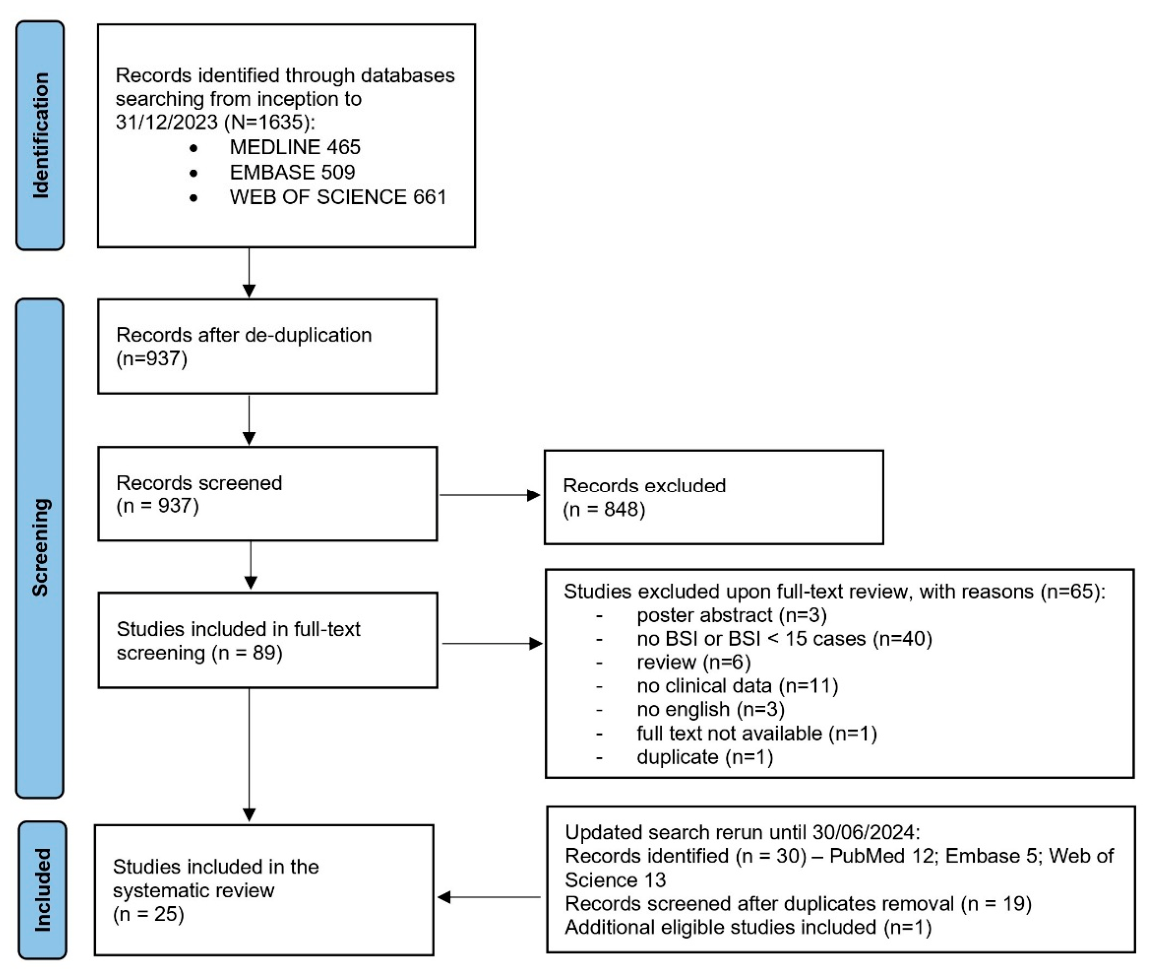
Through the search, 509 studies were obtained from Embase, 661 from Web of Science and 465 from Medline. After removal of duplicates, 937 studies were screened, out of which 89 full-text articles were assessed for eligibility. Sixty-five were excluded, leaving a total 24 studies to be included. Another eligible study identified after the search was re-run to update data collection until June 2024 has been included. The PRISMA diagram showing the flow of study selection, including the identification, screening, eligibility, and inclusion of studies, is presented in Figure 1.

3.2. Study Characteristics and Methodological Assessment

No randomized controlled trials were found during the search period. All studies included in this review were case series and retrospective observational cohort studies, published between 1978 and 2024. The geographical distribution of the studies was as follows: 12 from Europe, 7 from Asia, 3 from Australia, 2 from Africa, and one from America. Quality assessment of the included studies was carried out through the tool developed by Hoy and colleagues [15]. A score of 1 (yes) or 0 (no) was attributed for each item, producing a final quality score range from 0 to 10 (poor to good), as shown in Supplementary Table S1. Among the included studies, the risk of bias was assessed as moderate in ten cases; in all remaining studies, it was judged to be low.
The study characteristics are summarized in Table 1.

3.3. Patients’ Characteristics in Meta-Analyses

The 25 papers included in the meta-analysis reported a total of 2480 patients, with a mean age widely ranging across studies, the lowest equal to 1 year [6] and highest equal to 70 years [35]. Overall, 62.45% of the patients were male. All studies except one reported the comorbidities of the included patients. Only nine studies reported risk factors for BSI. Among them, the most frequently reported was contact with livestock/cattle (in 48 patients), followed by recent travel (in 24 patients). For further details on patient characteristics, see Table 1.

3.4. Prevalence Meta-Analyses

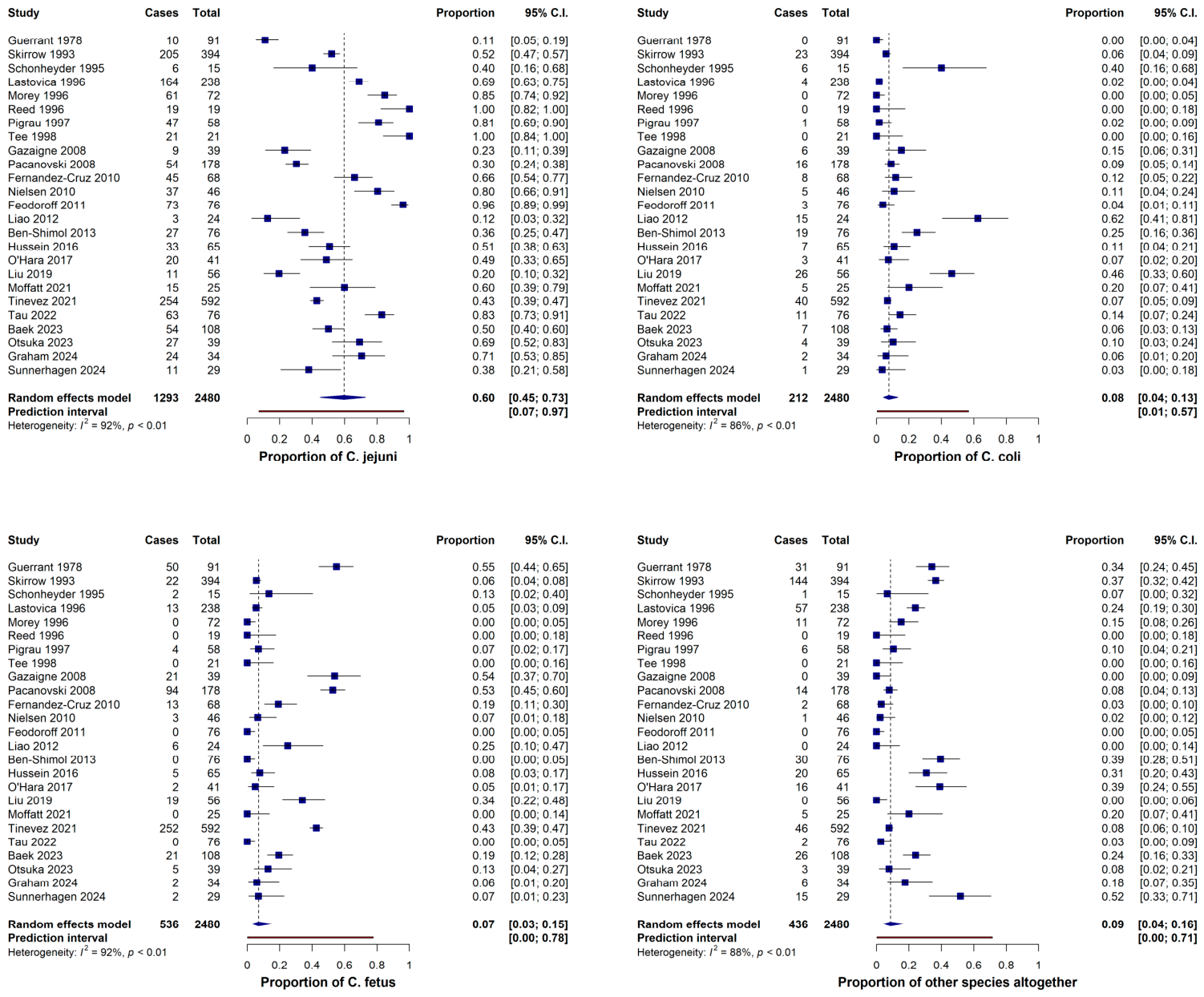
The pooled prevalences worldwide of Campylobacter species have been reported as follows: C. jejuni was 60% [95% CI 0.45–0.73], C. coli was 8% [95% CI 0.04–0.13], C. fetus was 7% [95% CI 0.03–0.15], and other species was 9% [95% CI 0.04–0.16], as shown in Figure 2.

3.5. Mortality Meta-Analyses

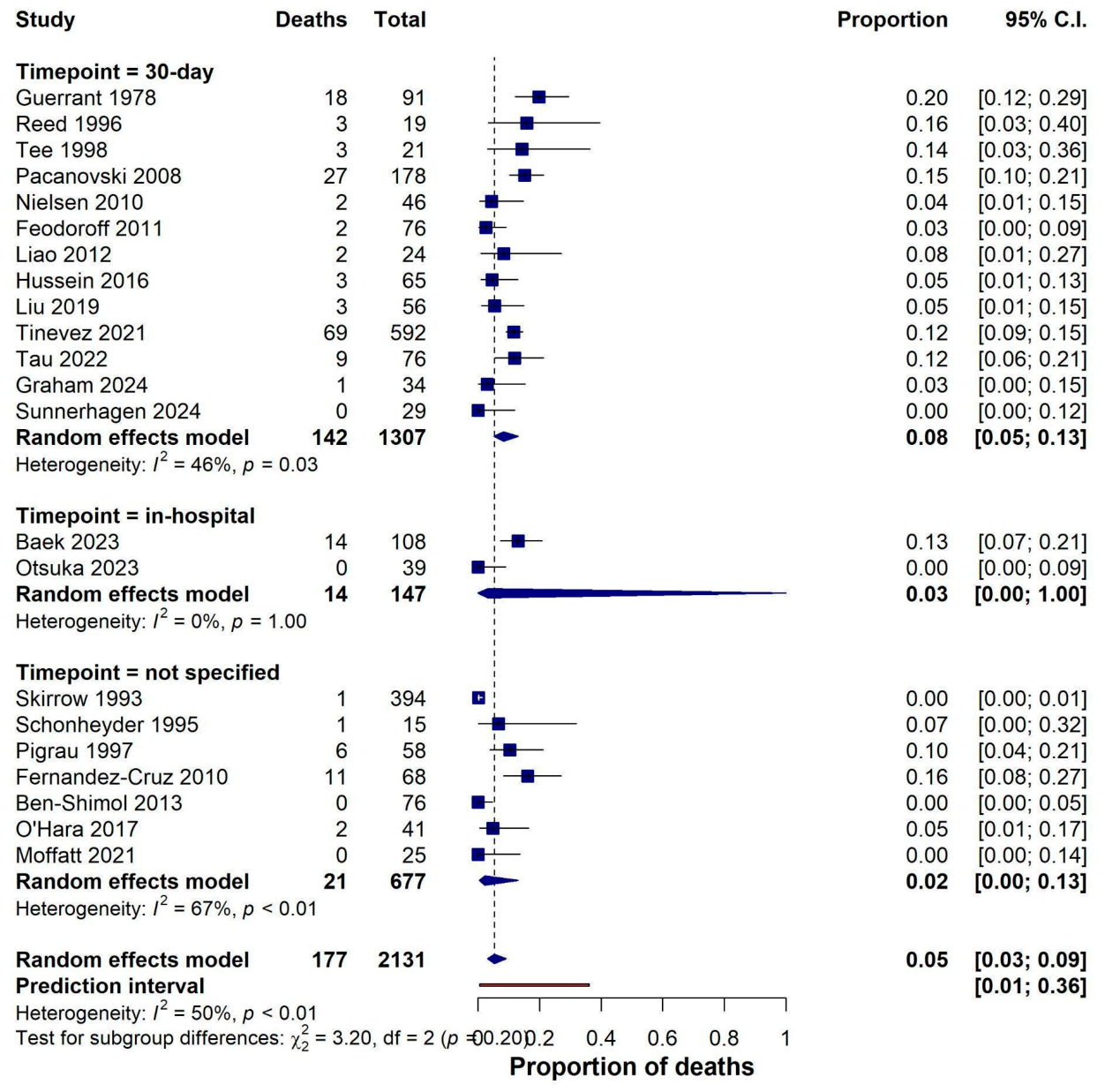
Twenty-two studies reported mortality as a main outcome, with 13 specifying 30 days from the diagnosis of bacteremia as the time point, 2 reporting in-hospital mortality, and 7 not specifying the time point. The overall case-fatality risk associated with Campylobacter spp. BSI was 5% [95% CI 0.03–0.09] (Figure 3). Supplementary Figure S18 presents a forest plot of the pooled mortality analysis stratified by the World Health Organization region.

3.6. Secondary Outcomes

We evaluated the main antimicrobial resistance patterns among Campylobacter spp. strains responsible for BSIs. The pooled prevalence of strains resistant to ciprofloxacin, erythromycin, and tetracycline were as follows: 37% [95% CI 0.25–0.50], 4% [95% CI 0.03–0.06], and 12% [95% CI 0.02–0.51] (Supplementary Figures S1–S3). Resistance to gentamicin and carbapenem were also investigated and the pooled prevalences were 1% [95% 0.00–0.05] and 0% [95% 0.00–0.32], respectively (Supplementary Figures S4 and S5). Resistance to two or three classes of antibiotics simultaneously was not reported.
Regarding clinical presentation, the pooled prevalence of patients with fever was 75% [95% CI 0.63–0.85], while 61% [95% CI 0.52–0.70] presented with gastrointestinal symptoms. Additionally, 34% of patients with Campylobacter BSI had a concomitant positive stool culture [95% CI 0.15–0.59] (Supplementary Figures S6–S8).
We further analyzed complications associated with Campylobacter BSI. The pooled prevalence of secondary localization in Campylobacter bacteremia was 9% [95% CI 0.04–0.18], while the pooled prevalence of endocarditis was 2% [95% CI 0.01–0.03] (Supplementary Figures S9 and S10). Other common secondary localizations were endovascular infection, skin and soft tissue infections, and osteomyelitis. The pooled prevalence of relapses was 3% [95% CI 0.02–0.04], while it was 1% for persistent BSI [95% CI 0.001–0.27] (Supplementary Figures S11 and S12).
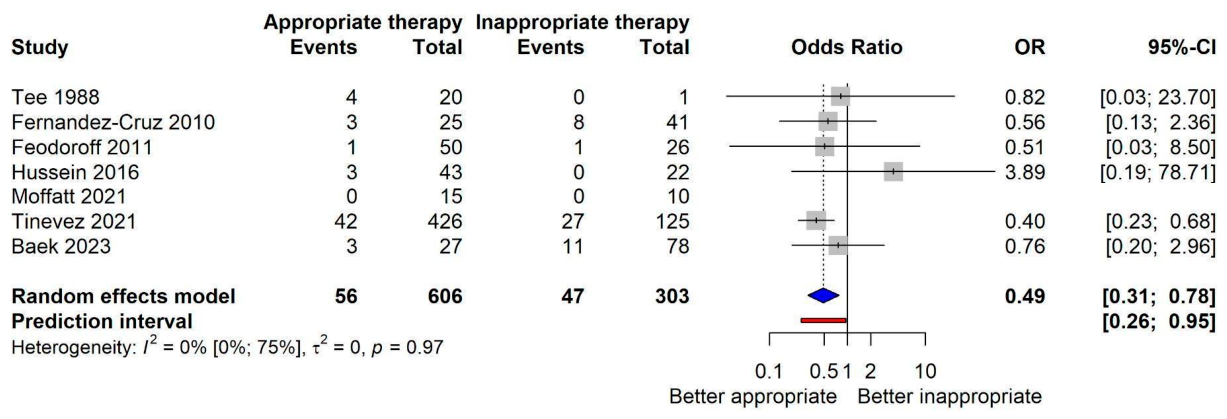
Pooled analysis demonstrated that appropriate therapy was significantly associated with a reduced risk of mortality compared to inappropriate therapy (OR 0.49, 95% CI 0.31–0.78; prediction interval 0.26–0.95), with no observed heterogeneity (I2 = 0%) (Figure 4).

3.7. Meta-Regression

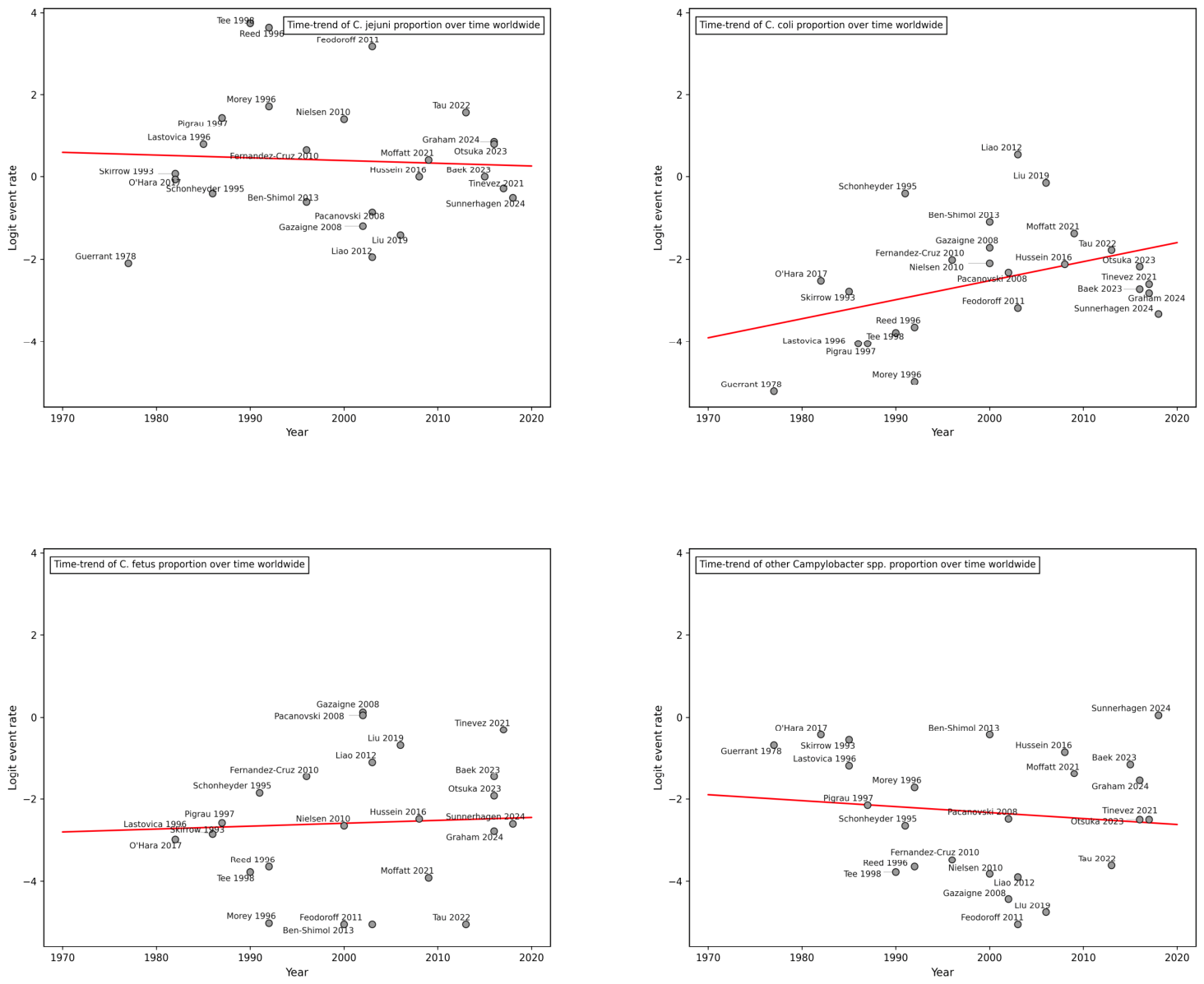
Univariate meta-regression showed no statistically significant temporal trends in the global proportions of Campylobacter species. The coefficient for C. coli was 0.046 (95% CI, −0.003–0.096, p = 0.066), suggesting a possible increasing trend. All other species showed non-significant associations with time (Table 2).
These findings are visually reflected in the scatterplots and fitted regression lines shown in Figure 5.
Univariate meta-regression on death found out that C. fetus (β = 3.217, [95% CI 0.632–5.802], p = 0.017) immunocompromised status (β = 2.749, [95% CI 0.316–5.184], p = 0.029), and chronic liver disease (β = 5.072, [95% CI 0.424–9.720], p = 0.034) are associated with an increased risk of mortality in patients with Campylobacter bacteremia. Interestingly, infections caused by Campylobacter species other than C. jejuni, C. coli, and C. fetus were associated with a significantly lower risk of death (β = -3.808, 95% CI -7.503 to -0.114; p = 0.044) (Table 3).
However, in the multivariate meta-regression model, none of these variables remained statistically significant. C. fetus and other Campylobacter species showed borderline associations with mortality (p = 0.061 and p = 0.065, respectively), while the effects of immunocompromised status and chronic liver disease were attenuated (Table 4).
Additional meta-regression analyses on antimicrobial resistance trends are available in the Supplementary Material (Supplementary Figure S14 and S15, Table S5).

4. Discussion

The findings from this systematic review and meta-analysis highlight that Campylobacter spp. bacteremia, although relatively rare compared to enteric infections, is associated with a non-negligible mortality rate and a considerable risk of complications. The pooled case-fatality rate was 5% (95% CI 0.03–0.09).
Among the Campylobacter species, C. jejuni accounted for most blood isolates (pooled worldwide prevalence of 60%), whereas C. fetus represented 7%. Although less frequent, C. fetus infection was significantly associated with an increased risk of mortality in univariate meta-regression analysis (β = 3.217, p = 0.017); however, this association was attenuated in the multivariate model. Some previous studies even suggested that C. fetus causes a disproportionately higher rate of invasive infections compared to other Campylobacter species, underscoring its propensity for systemic spread [11]. Nevertheless, the specific pathogenic mechanisms that differentiate C. fetus from other Campylobacter spp. remain poorly understood. Two major virulence factors have been identified that may explain the heightened pathogenicity of C. fetus: a type IV secretion system and surface layer proteins, which undergo antigenic variation and shield the bacterium from host immune defenses, facilitating immune evasion [47,48].
In terms of complications, secondary localization was observed in 9% of patients (95% CI 0.04–0.18), while endocarditis occurred in 2% (95% CI 0.01–0.03). Other common secondary localizations included endovascular infections, skin and soft tissue infections, and osteomyelitis [7,8,38,49]. In the available studies, C. fetus was the species most frequently associated with secondary localizations. These findings highlight the need for clinicians to actively consider and investigate potential secondary localizations in patients with Campylobacter bacteremia, especially in those presenting with persistent symptoms or risk factors for metastatic infection. However, these estimates should be interpreted with caution, as complication data were available from only 13 studies and reporting was uneven across cohorts. Notably, a concomitant positive stool culture was present in only 34% of cases, highlighting that bacteremia can occur in the absence of ongoing enteritis symptoms—a finding that has diagnostic implications.
Host-related factors were equally important. In univariate meta-regression analyses, immunocompromised status was associated with an increased risk of death (β = 2.749, p = 0.029), as was chronic liver disease (β = 5.072, p = 0.034), although these associations were attenuated in the multivariable model. This is not surprising, as most Campylobacter bacteremia cases reported in the literature have occurred in these high-risk populations [7,26]. Regarding immunosuppression, the wide heterogeneity of reported conditions—ranging from solid organ transplantation to hematologic malignancies and congenital immunodeficiencies—precluded any meaningful stratified analysis.
Antibiotic therapy played a crucial role in patient outcomes. Our pooled analysis demonstrated that appropriate therapy was significantly associated with reduced mortality (OR 0.49, 95% CI 0.31–0.78). However, this analysis was based on only seven studies, and due to the limited number of events, it was not possible to perform any stratified analysis according to the specific type of antibiotic regimen. Although there are no standardized international guidelines for the treatment of Campylobacter BSIs, current practices favor fluoroquinolones, macrolides, or tetracyclines for mild enteric disease. However, for systemic infections, particularly those caused by C. fetus, parenteral agents such as carbapenems or aminoglycosides are often necessary [9]. Resistance patterns support this approach: the pooled resistance rates were 37% for ciprofloxacin and 12% for tetracyclines, but only 4% for macrolides, and virtually 0–1% for gentamicin and carbapenems. According to global surveillance data on Campylobacter resistance, these numbers are quite low [12,50]. This likely reflects the broad time span of the studies included in the review.
The overall quality of the evidence included in this review can be considered moderate. All 25 studies were observational in design, predominantly retrospective, and no randomized controlled trials were identified. This may limit the ability to draw causal inferences, although the overall risk of bias was low in the vast majority of studies. Recently, a systematic review and meta-analysis on Campylobacter bacteremia including fewer cases reported a mortality rate of 7.2%, consistent with our findings and further underscoring their clinical relevance [51].
The study has some limitations. Firstly, only English-language studies were included, which could have introduced selection bias. Secondly, since most studies originated from Europe, the geographic imbalance may have contributed to publication bias. Thirdly, the studies span 1978 to 2024, a period marked by substantial changes in diagnostic technologies, therapeutic strategies, population health characteristics, and the taxonomy of Campylobacter spp. Finally, differences in diagnostic protocols, microbiological methods, and definitions of outcomes may have introduced heterogeneity; therefore, some pooled estimates should be interpreted as context-dependent rather than universally generalizable.
Future research should aim to address these gaps. Prospective multicenter studies would help clarify optimal treatment strategies, including duration and choice of antibiotics for different Campylobacter species. Given the particularly severe course of C. fetus infections, longer or combination therapies may be warranted, but data are currently insufficient. Furthermore, exploration of host–pathogen interactions and Campylobacter virulence factors may provide insight into mechanisms of invasive disease and identify potential therapeutic targets.
In conclusion, Campylobacter bacteremia is a clinically relevant condition associated with non-negligible mortality and a substantial risk of complications. While outcomes are generally favorable, C. fetus infection and immunosuppression may identify patients at increased risk of death. Prompt detection, species-level identification, susceptibility testing, and appropriate antibiotic therapy are essential to optimize patient outcomes.

Supplementary Materials

The following supporting information can be downloaded at: https://www.mdpi.com/article/10.3390/pathogens15070686/s1. PRISMA 2020 checklist; Rsearch Strategy; Supplementary Figures; Table S1; Other supplementary tables.

Author Contributions

Conceptualization, V.Z., L.P., and S.D.B.; methodology, V.Z., N.B., M.G., and A.E.M.; investigation, V.Z., S.G., R.B., C.F., L.F. (Lisa Fusaro), A.B., G.M.N., and D.A.T.; writing, review and editing, V.Z., S.G., R.B., C.F., L.F. (Lisa Fusaro), A.B., N.B., G.M.N., L.P., D.A.T., M.G., L.S.C., L.F. (Luca Frulloni), A.Y., S.D.B., and A.E.M.; supervision, L.S.C., L.F. (Luca Frulloni), A.Y., S.D.B., and A.E.M. All authors have read and agreed to the published version of the manuscript.

Funding

The authors declare that no funds, grants, or other support were received during the preparation of this manuscript.

Data Availability Statement

No new data were created or analyzed in this study.

Acknowledgments

We thank Anna Blackberg for her kind availability and for providing valuable clarifications regarding her published work.

Conflicts of Interest

The authors declare no conflicts of interest.

References

  1. Fitzgerald, C. Campylobacter. Clin. Lab. Med. 2015, 35, 289–298. [Google Scholar] [CrossRef] [Scilit] [PubMed]
  2. European Food Safety Authority; European Centre for Disease Prevention and Control. The European Union One Health 2024 Zoonoses Report. EFSA J. 2025, 23, e9759. [Google Scholar] [CrossRef] [Scilit] [PubMed]
  3. Costa, D.; Iraola, G. Pathogenomics of Emerging Campylobacter Species. Clin. Microbiol. Rev. 2019, 32, 10–1128. [Google Scholar] [CrossRef] [Scilit]
  4. Rukambile, E.; Sintchenko, V.; Muscatello, G.; Kock, R.; Alders, R. Infection, colonization and shedding of Campylobacter and Salmonella in animals and their contribution to human disease: A review. Zoonoses Public Health 2019, 66, 562–578. [Google Scholar] [CrossRef] [Scilit] [PubMed]
  5. Domingues, A.R.; Pires, S.M.; Halasa, T.; Hald, T. Source attribution of human campylobacteriosis using a meta-analysis of case-control studies of sporadic infections. Epidemiol. Infect. 2012, 140, 970–981. [Google Scholar] [PubMed]
  6. Reed, R.P.; Friedland, I.R.; Wegerhoff, F.O.; Khoosal, M. Campylobacter bacteremia in children. Pediatr. Infect. Dis. J. 1996, 15, 345–348. [Google Scholar] [CrossRef] [Scilit] [PubMed]
  7. Pacanowski, J.; Lalande, V.; Lacombe, K.; Boudraa, C.; Lesprit, P.; Legrand, P.; Trystram, D.; Kassis, N.; Arlet, G.; Mainardi, J.; et al. Campylobacter bacteremia: Clinical features and factors associated with fatal outcome. Clin. Infect. Dis. 2008, 47, 790–796. [Google Scholar] [CrossRef] [Scilit] [PubMed]
  8. Tinévez, C.; Velardo, F.; Ranc, A.G.; Dubois, D.; Pailhoriès, H.; Codde, C.; Join-Lambert, O.; Gras, E.; Corvec, S.; Neuwirth, C.; et al. Retrospective Multicentric Study on Campylobacter spp. Bacteremia in France: The Campylobacteremia Study. Clin. Infect. Dis. 2022, 75, 702–709. [Google Scholar] [PubMed]
  9. Bennett, J.E.; Dolin, R.; Blaser, M.J. Mandell, Douglas, and Bennett’s Principles and Practice of Infectious Diseases E-Book: 2-Volume Set; Elsevier Health Sciences: Amsterdam, The Netherlands, 2019. [Google Scholar]
  10. Qin, X.; Wang, X.; Shen, Z. The rise of antibiotic resistance in Campylobacter. Curr. Opin. Gastroenterol. 2023, 39, 9–15. [Google Scholar] [PubMed]
  11. Zerbato, V.; Di Bella, S.; Pol, R.; Luzzati, R.; Sanson, G.; Ambretti, S.; Andreoni, S.; Aschbacher, R.; Bernardo, M.; Bielli, A.; et al. Human Campylobacter spp. infections in Italy. Eur. J. Clin. Microbiol. Infect. Dis. 2024, 43, 895–904. [Google Scholar] [CrossRef] [Scilit] [PubMed]
  12. Campylobacteriosis Annual Epidemiological Report for 2022. Available online: https://www.ecdc.europa.eu/sites/default/files/documents/CAMP_AER_2022_final.pdf (accessed on 19 May 2025).
  13. McNamara, J.F.; Righi, E.; Wright, H.; Hartel, G.F.; Harris, P.N.A.; Paterson, D.L. Long-term morbidity and mortality following bloodstream infection: A systematic literature review. J. Infect. 2018, 77, 1–8. [Google Scholar] [CrossRef] [Scilit] [PubMed]
  14. Moher, D.; Liberati, A.; Tetzlaff, J.; Altman, D.G. Preferred reporting items for systematic reviews and meta-analyses: The PRISMA statement. PLoS Med. 2009, 6, 339. [Google Scholar] [CrossRef] [Scilit] [PubMed]
  15. Hoy, D.; Brooks, P.; Woolf, A.; Blyth, F.; March, L.; Bain, C.; Baker, P.; Smith, E.; Buchbinder, R. Assessing risk of bias in prevalence studies: Modification of an existing tool and evidence of interrater agreement. J. Clin. Epidemiol. 2012, 65, 934–939. [Google Scholar] [CrossRef] [Scilit] [PubMed]
  16. Lin, L.; Chu, H. Meta-analysis of proportions using generalized linear mixed models. Epidemiology 2020, 31, 713–717. [Google Scholar] [CrossRef] [Scilit] [PubMed]
  17. Viechtbauer, W. Bias and Efficiency of Meta-Analytic Variance Estimators in the Random-Effects Model. J. Educ. Behav. Stat. 2005, 30, 261–293. [Google Scholar] [CrossRef] [Scilit]
  18. Knapp, G.; Hartung, J. Improved tests for a random effects meta-regression with a single covariate. Stat. Med. 2003, 22, 2693–2710. [Google Scholar] [CrossRef] [Scilit] [PubMed]
  19. Xu, C.; Furuya-Kanamori, L.; Zorzela, L.; Lin, L.; Vohra, S. A proposed framework to guide evidence synthesis practice for meta-analysis with zero-events studies. J. Clin. Epidemiol. 2021, 135, 70–78. [Google Scholar] [PubMed]
  20. Higgins, J.P.T.; Thompson, S.G.; Deeks, J.J.; Altman, D.G. Measuring inconsistency in meta-analyses. BMJ 2003, 327, 557–560. [Google Scholar] [CrossRef] [Scilit] [PubMed]
  21. IntHout, J.; Ioannidis, J.P.A.; Rovers, M.M.; Goeman, J.J. Plea for routinely presenting prediction intervals in meta-analysis. BMJ Open 2016, 6, e010247. [Google Scholar] [CrossRef] [Scilit] [PubMed]
  22. Wan, X.; Wang, W.; Liu, J.; Tong, T. Estimating the sample mean and standard deviation from the sample size, median, range and/or interquartile range. BMC Med. Res. Methodol. 2014, 14, 135. [Google Scholar] [CrossRef] [Scilit] [PubMed]
  23. Heymans, M.W.; Twisk, J.W.R. Handling missing data in clinical research. J. Clin. Epidemiol. 2022, 151, 185–188. [Google Scholar] [CrossRef] [Scilit] [PubMed]
  24. Furuya-Kanamori, L.; Barendregt, J.J.; Doi, S.A.R. A new improved graphical and quantitative method for detecting bias in meta-analysis. Int. J. Evid. Based Healthc. 2018, 16, 195–203. [Google Scholar] [CrossRef] [Scilit] [PubMed]
  25. Barendregt, J.J.; Doi, S.A.; Lee, Y.Y.; Norman, R.E.; Vos, T. Meta-analysis of prevalence. J. Epidemiol. Community Health 2013, 67, 974–978. [Google Scholar] [CrossRef] [Scilit] [PubMed]
  26. Skirrow, M.B.; Jones, D.M.; Sutcliffe, E.; Benjamin, J. Campylobacter bacteraemia in England and Wales, 1981-91. Epidemiol. Infect. 1993, 110, 567–573. [Google Scholar] [CrossRef] [Scilit] [PubMed]
  27. Schønheyder, H.C.; Søgaard, P.; Frederiksen, W. A survey of Campylobacter bacteremia in three Danish counties, 1989 to 1994. Scand. J. Infect. Dis. 1995, 27, 145–148. [Google Scholar] [CrossRef] [Scilit] [PubMed]
  28. Pigrau, C.; Bartolome, R.; Almirante, B.; Planes, A.-M.; Gavalda, J.; Pahissa, A. Bacteremia Due to Campylobacter Species: Clinical Findings and Antimicrobial Susceptibility Patterns. Clin. Infect. Dis. 1997, 25, 1414–1420. [Google Scholar] [CrossRef] [Scilit] [PubMed]
  29. Gazaigne, L.; Legrand, P.; Renaud, B.; Bourra, B.; Taillandier, E.; Brun-Buisson, C.; Lesprit, P. Campylobacter fetus bloodstream infection: Risk factors and clinical features. Eur. J. Clin. Microbiol. Infect. Dis. 2008, 27, 185–189. [Google Scholar] [PubMed]
  30. Nielsen, H.; Hansen, K.K.; Gradel, K.O.; Kristensen, B.; Ejlertsen, T.; Østergaard, C.; Schønheyder, H.C. Bacteraemia as a result of Campylobacter species: A population-based study of epidemiology and clinical risk factors. Clin. Microbiol. Infect. 2010, 16, 57–61. [Google Scholar] [CrossRef] [Scilit] [PubMed]
  31. Fernández-Cruz, A.; Muñoz, P.; Mohedano, R.; Valerio, M.; Marín, M.; Alcalá, L.; Rodriguez-Créixems, M.; Cercenado, E.; Bouza, E. Campylobacter bacteremia: Clinical characteristics, incidence, and outcome over 23 years. Medicine 2010, 89, 319–330. [Google Scholar] [PubMed]
  32. Feodoroff, B.; Lauhio, A.; Ellström, P.; Rautelin, H. A Nationwide Study of Campylobacter jejuni and Campylobacter coli Bacteremia in Finland Over a 10-Year Period, 1998–2007, With Special Reference to Clinical Characteristics and Antimicrobial Susceptibility. Clin. Infect. Dis. 2011, 53, e99–e106. [Google Scholar] [PubMed]
  33. O’Hara, G.A.; Fitchett, J.R.A.; Klein, J.L. Campylobacter bacteremia in London: A 44-year single-center study. Diagn. Microbiol. Infect. Dis. 2017, 89, 67–71. [Google Scholar] [CrossRef] [Scilit] [PubMed]
  34. Graham, A.; Hawkins, L.; Balasegaram, S.; Narasimhan, S.; Wain, J.; Clarke, J.; Manuel, R. A decade of Campylobacter and Campylobacter bacteraemias in a district general hospital and the surrounding London and South East region, England. J. Infect. 2024, 88, 15–20. [Google Scholar] [PubMed]
  35. Sunnerhagen, T.; Grenthe, R.; Kampmann, C.; Karlsson Söbirk, S.; Bläckberg, A. Campylobacter Infections With and Without Bacteremia: A Comparative Retrospective Population-Based Study. Open Forum Infect. Dis. 2024, 11, ofae131. [Google Scholar] [CrossRef] [Scilit] [PubMed]
  36. Liao, C.-H.; Chuang, C.-Y.; Huang, Y.-T.; Lee, P.-I.; Hsueh, P.-R. Bacteremia caused by antimicrobial resistant Campylobacter species at a medical center in Taiwan, 1998-2008. J. Infect. 2012, 65, 392–399. [Google Scholar] [PubMed]
  37. Liu, Y.H.; Yamazaki, W.; Huang, Y.T.; Liao, C.H.; Sheng, W.H.; Hsueh, P.R. Clinical and microbiological characteristics of patients with bacteremia caused by Campylobacter species with an emphasis on the subspecies of C. fetus. J. Microbiol. Immunol. Infect. 2019, 52, 122–131. [Google Scholar] [CrossRef] [Scilit] [PubMed]
  38. Baek, Y.J.; Song, J.E.; Kim, E.J.; Choi, H.; Sohn, Y.; Jeon, Y.D.; Lee, E.H.; Ahn, J.Y.; Jeong, S.J.; Ku, N.S.; et al. Trends, clinical characteristics, antimicrobial susceptibility patterns, and outcomes of Campylobacter bacteraemia: A multicentre retrospective study. Infection 2024, 52, 857–864. [Google Scholar] [PubMed]
  39. Otsuka, Y.; Hagiya, H.; Takahashi, M.; Fukushima, S.; Maeda, R.; Sunada, N.; Yamada, H.; Kishida, M.; Fujita, K.; Otsuka, F. Clinical characteristics of Campylobacter bacteremia: A multicenter retrospective study. Sci. Rep. 2023, 13, 1–6. [Google Scholar] [CrossRef] [Scilit]
  40. Newell, D.G.; Ketley, J.M.; Feldman, R.A. Campylobacters, Helicobacters, and Related Organisms; Springer Science & Business Media: Berlin/Heidelberg, Germany, 1997. [Google Scholar]
  41. Ben-Shimol, S.; Carmi, A.; Greenberg, D. Demographic and clinical characteristics of Campylobacter bacteremia in children with and without predisposing factors. Pediatr. Infect. Dis. J. 2013, 32, e414–e418. [Google Scholar] [CrossRef] [Scilit] [PubMed]
  42. Hussein, K.; Raz-Pasteur, A.; Shachor-Meyouhas, Y.; Geffen, Y.; Oren, I.; Paul, M.; Kassis, I. Campylobacter bacteraemia: 16 years of experience in a single centre. Infect. Dis. 2016, 48, 796–799. [Google Scholar] [CrossRef] [Scilit]
  43. Tau, L.; Adler, A.; Shalom, O.; Paran, Y.; Poradosu, R.C.; Shasha, D.; Ben-Ami, R. Clinical features and outcomes of bacteremic and non-bacteremic Campylobacteriosis: A case–control study. Infection 2022, 50, 1225–1231. [Google Scholar] [PubMed]
  44. Tee, W.; Mijch, A. Campylobacter jejuni bacteremia in human immunodeficiency virus (HIV)-infected and non-HIV-infected patients: Comparison of clinical features and review. Clin. Infect. Dis. 1998, 26, 91–96. [Google Scholar] [PubMed]
  45. Moffatt, C.R.M.; Kennedy, K.J.; O’Neill, B.; Selvey, L.; Kirk, M.D. Bacteraemia, antimicrobial susceptibility and treatment among Campylobacter-associated hospitalisations in the Australian Capital Territory: A review. BMC Infect. Dis. 2021, 21, 848. [Google Scholar] [CrossRef] [Scilit] [PubMed]
  46. Guerrant, R.L.; Lahita, R.G.; Winn, W.C., Jr.; Roberts, R.B. Campylobacteriosis in man: Pathogenic mechanisms and review of 91 bloodstream infections. Am. J. Med. 1978, 65, 584–592. [Google Scholar] [CrossRef] [Scilit] [PubMed]
  47. Wagenaar, J.A.; van Bergen, M.A.P.; Blaser, M.J.; Tauxe, R.V.; Newell, D.G.; van Putten, J.P.M. Campylobacter fetus Infections in Humans: Exposure and Disease. Clin. Infect. Dis. 2014, 58, 1579–1586. [Google Scholar] [CrossRef] [Scilit] [PubMed]
  48. Lv, G.B.; Miller, W.G.; Yee, E.; Gorkiewicz, G.; Forbes, K.J.; Zomer, A.L.; Wagenaar, J.A.; Duim, B. Campylobacter fetus Subspecies Contain Conserved Type IV Secretion Systems on Multiple Genomic Islands and Plasmids. PLoS ONE 2016, 11, e0152832. [Google Scholar] [CrossRef] [Scilit] [PubMed]
  49. Tinévez, C.; Lehours, P.; Ranc, A.-G.; Belaroussi, Y.; Cazanave, C.; Puges, M.; Velardo, F.; Dubois, D.; Neuwirth, C.; Pailhoriès, H.; et al. Multicenter Retrospective Study of Vascular Infections and Endocarditis Caused by Campylobacter spp., France. Emerg. Infect. Dis. 2023, 29, 484–492. [Google Scholar] [CrossRef] [Scilit] [PubMed]
  50. Antibiotic Resistance Threats in the United States for 2019. Available online: https://www.cdc.gov/antimicrobial-resistance/media/pdfs/2019-ar-threats-report-508.pdf?CDC_AAref_Val=https://www.cdc.gov/drugresistance/pdf/threats-report/2019-ar-threats-report-508.pdf (accessed on 19 May 2025).
  51. Paniagua-García, M.; Bernal, J.M.; Sánchez-Suero, M.P.; Pachón, J.; Pachón-Ibáñez, M.E.; Vallejo-Vaz, A.J.; Cordero, E. The clinical characteristics and outcomes of Campylobacter spp. bloodstream infection: A systematic review and meta-analysis. Eur. J. Clin. Microbiol. Infect. Dis. 2026. ahead of print. [Google Scholar] [CrossRef] [Scilit] [PubMed]
Figure 1. Literature selection procedure.
Pathogens 15 00686 g001
Figure 2. Forest plots illustrating the pooled prevalence of Campylobacter species: C. jejuni, C. coli, C. fetus, and other species.
Pathogens 15 00686 g002
Figure 3. Forest plot illustrating the pooled analysis of mortality outcome.
Pathogens 15 00686 g003
Figure 4. Forest plot of studies comparing appropriate versus inappropriate therapy.
Pathogens 15 00686 g004
Figure 5. Time trends in the proportion of Campylobacter species worldwide based on univariate meta-regression. Each plot shows logit event rates by year with fitted regression lines for C. jejuni, C. coli, C. fetus, and other species. The red line in each panel is the fitted regression line from the univariate meta-regression, showing the predicted logit-transformed proportion of each Campylobacter group as a function of study year. The slope represents the estimated change in the logit proportion per calendar year: a downward-sloping line indicates a declining proportion over time, and an upward-sloping line an increasing proportion.
Pathogens 15 00686 g005
Table 1. Included studies.
Author (Country, Year)Study design and periodN° of Campylobacter BSIs (jejuni; coli; fetus; others)Mean age (years)N° of male/all subjects (%)Comorbidities (n°)Setting Risk factors (n°)N° of patients with concomitant positive stool cultureAntibiotics resistance (n° of resistant strains)Signs and symptoms at BSI diagnosisTreatment (drugs, combination, days of therapy, appropriate therapy)Mortality (time point)ComplicationsReference
Skirrow M.B. (UK, 1993)Retrospective multicentric (1981-1991)394
(205; 23; 22; 144)
45.9165/250 (66%)Median CCI n/a
DM 11
CRF 16
CLD 15
CVD n/a
PHV n/a
IC 74
n/an/an/an/aFever n/a
Sepsis n/a
Septic shock n/a
GI symptoms 170
Coinfections n/a
n/a1/394 (time point not specified)n/a[26]
Schønheyder H.C. (Denmark, 1995)Retrospective multicentric (1989-1994)15
(6; 6; 2; 1)
497/15 (46.7%)Median CCI n/a
DM 2
CRF 1
CLD 2
CVD 2
PHV 1
IC 6
n/a2 undecooked meat
2 recent travel
1 contact with livestock/cattle
8CIP 0/15
ERY 2/15
TET 0/15
GEN 0/15
MEM n/a
Fever 14
Sepsis n/a
Septic shock n/a
GI symptoms 8
Coinfections n/a
Combination therapy (n°) 61/15 (time point not specified)Relapses 2/15
IE 1/25
Persistent BSI n/a
Secondary localizations n/a
[27]
Pigrau C. (Spain, 1997)Retrospective monocentric (1979-1996)58
(47; 1; 4; 6)
39.438/58 (65.5%)Median CCI n/a
DM 4
CRF 3
CLD 20
CVD n/a
PHV n/a
IC 13
n/an/a15CIP 13/24
ERY 4/58
TET 0/58
GEN 0/58
MEM n/a
Fever 53
Sepsis n/a
Septic shock 1
GI symptoms 18
Coinfections n/a
N° days of therapy (range) 14-216/57 (time point not specified)Relapses 1/57
IE n/a
Persistent BSI n/a
Secondary localizations 11/57
[28]
Pacanowski J. (France, 2008)Retrospective multicentric (2000-2004)178
(54;16; 94; 14)
64124/178 (69.7%)Median CCI n/a
DM 31
CRF n/a
CLD 69
CVD n/a
PHV n/a
IC 141
n/an/a13CIP 50/157
ERY 12/156
TET n/a
GEN 4/147
IPM 0/73
Fever 74
Sepsis n/a
Septic shock n/a
GI symptoms 58
Coinfections 7
IPM (n°) 1227/178 (30-day)Relapses n/a
IE 6/178
Persistent BSI n/a
Secondary localizations 43/178
[7]
Gazaigne L. (France, 2008)Case series (1998-2006)39
(9; 6; 24; 0)
67.618/21 (85.7%)Median CCI n/a
DM 5
CRF n/a
CLD 3
CVD 2
PHV 1
IC 4
Inpatients (not specified)n/an/aCIP 4/21
ERY 1/21
TET 3/21
GEN 0/21
IPM 0/21
Fever 12
Sepsis n/a
Septic shock 2
GI symptoms 4
Coinfections n/a
CIP (n°) 2
ERY (n°) 4
GEN (n°) 2
IPM (n°) 6
Other drugs (n°) 18
Combination therapy (n°) 11
N° days of therapy (median) 28 (9 days - 3.5 months)
5/18 (3 months)Relapses 2/18
IE 1/18
Persistent BSI n/a
Secondary localizations 12/18
[29]
Nielsen H. (Denmark, 2010)Retrospective multicentric (1995-2004)46
(37; 5; 3; 1)
50.333/46 (71.7%)Median CCI n/a
DM 3
CRF n/a
CLD 4
CVD 11
PHV n/a
IC 10
Inpatients (not specified)6 abdominal surgery/trauman/aCIP 9/35
ERY 3/40
TET n/a
GEN 1/18
MEM n/a
Fever n/a
Sepsis n/a
Septic shock n/a
GI symptoms 27
Coinfections n/a
Combination therapy (n°) 212/46 (28-day)Relapses 0/46
IE 1/46
Persistent BSI n/a
Secondary localizations 1/46
[30]
Fernández-Cruz A. (Spain, 2010)Retrospective monocentric (1985-2007)68
(45; 8; 13; 2)
51.456/68 (82.3%)Median CCI n/a
DM 0
CRF 3
CLD 21
CVD 3
PHV n/a
IC 15
n/an/a8CIP 19/38
ERY 4/37
TET n/a
GEN 2/35
IPM 0/30
Fever 55
Sepsis n/a
Septic shock 9
GI symptoms 58
Coinfections 11
CIP (n°) 9
ERY (n°) 4
TET (n°) 1
GEN (n°) 1
IPM (n°) 2
Other drugs (n°) 27
Appropriate therapy (n°, %) 25/66 (38%)
11/68 (time point not specified)Relapses 7/68
IE 0/68
Persistent BSI 0/68
Secondary localizations 0/68
[31]
Feodoroff B. (Finland, 2011)Retrospective multicentric (1998-2007)76
(73; 3; 0; 0)
47.356/76 (73.7%)Median CCI n/a
DM 1
CRF 1
CLD 4
CVD 1
PHV n/a
IC 6
n/a16 recent traveln/aCIP 5/76
ERY 0/76
TET 3/76
GEN 0/76
MEM 0/76
Fever 64
Sepsis n/a
Septic shock n/a
GI symptoms 60
Coinfections n/a
Appropriate therapy (n°, %) 50/76 (66%)2/76 (30-day)Relapses n/a
IE 0/76
Persistent BSI 0/76
Secondary localizations 1/76
[32]
O’Hara G.A. (UK, 2017)Retrospective monocentric (1972-2013)41
(20; 3; 2; 16)
4627/41 (65.8%)Median CCI n/a
DM 4
CRF 3
CLD 4
CVD n/a
PHV n/a
IC 12
Inpatients and outpatients (not specified)n/an/aCIP 9/26
ERY 1/30
TET n/a
GEN n/a
MEM n/a
Fever 35
Sepsis 1
Septic shock n/a
GI symptoms 34
Coinfections n/a
CIP (n°) 5
Other drugs (n°) 16
Combination therapy (n°) 16
Appropriate therapy (n°, %) 7/29 (24%)
2/41 (time point not specified)Relapses n/a
IE 1/41
Persistent BSI n/a
Secondary localization n/a
[33]
Tinévez C. (France, 2021)Retrospective multicentric (2015-2019)592
(254; 40; 252; 46)
66.3402/592 (67.9%)Median CCI n/a
DM 128
CRF 118
CLD 75
CVD n/a
PHV n/a
IC 257
n/an/a160CIP 249/592
ERY 22/592
TET 167/592
GEN 3/592
IPM 0/592
Fever 426
Sepsis n/a
Septic shock 43
GI symptoms 233
Coinfections 34
Combination therapy (n°) 133
N° days of therapy (median) 10 (5-15)
N° days of therapy for complications (median) 41.5 (17-46)
Appropriate therapy (n°, %) 430/551 (78%)
69/592 (30-day)Relapses 18/592
IE 12/592
Persistent BSI n/a
Secondary localizations 80/592
[8]
Graham A. (UK, 2024)Retrospective multicentric (2012-2021)34
(24; 2; 2; 6)
69.321/34 (61.7%)Median CCI n/a
DM 7
CRF n/a
CLD n/a
CVD 11
PHV n/a
IC 10
n/an/a27CIP 14/28
ERY 0/28
TET n/a
GEN n/a
MEM n/a
Fever 12
Sepsis n/a
Septic shock n/a
GI symptoms 22
Coinfections n/a
GEN (n°) 6
MEM (n°) 13
Other drugs (n°) 23
N° days of therapy (median) 13 (10-14)
Appropriate therapy (n°, %) 28/34 (82%)
1/34 (30-day)Relapses n/a
IE n/a
Persistent BSI 1/34
Secondary localizations n/a
[34]
Sunnerhagen T. (Sweden, 2024)Retrospective multicentric (2015-2022)29
(11; 1; 2; 15)
7022/29 (75.8%)Median CCI 2 (0.5-5)
DM 3
CRF 9
CLD 1
CVD 6
PHV n/a
IC 15
Inpatients (not specified)1 recent travel
2 contact with livestock/meat
2 outbreak involvement
6CIP 6/18
ERY 1/18
TET n/a
GEN n/a
MEM n/a
Fever 24
Sepsis 6
Septic shock 2
GI symptoms 20
Coinfections n/a
CIP (n°) 5
ERY (n°) 4
Other drugs (n°) 12
N° days of therapy (median) 13 (9-17)
0/29 (30-day)n/a[35]
Liao C.-H. (Taiwan, 2012)Case series (1998-2008)24
(3; 15; 6; 0)
45.316/24 (66.7%)Median CCI n/a
DM 5
CRF 10
CLD 9
CVD 2
PHV n/a
IC 16
n/a8 abdominal surgery/trauma1CIP 15/24
ERY n/a
TET n/a
GEN n/a
IPM 0/24
Fever 14
Sepsis n/a
Septic shock n/a
GI symptoms 15
Coinfections n/a
Other drugs (n°) 23
Appropriate therapy (n°, %) 11/24 (46%)
2/24 (30-day)Relapses n/a
IE n/a
Persistent BSI 9/24
Secondary localizations 3/24
[36]
Liu Y. H. (Taiwan, 2019)Retrospective monocentric (1998-2014)56
(11; 26; 19; 0)
5435/56 (62.5%)Median CCI n/a
DM 7
CRF 10
CLD 13
CVD 27
PHV n/a
IC 30
n/an/an/an/aFever 10
Sepsis n/a
Septic shock n/a
GI symptoms 9
Coinfections n/a
n/a3/56 (30-day)Relapses n/a
IE n/a
Persistent BSI n/a
Secondary localizations 1/56
[37]
Baek Y.J. (South Korea, 2023)Retrospective multicentric (2010-2021)108
(54; 7; 21; 26)
5678/108 (72.2%)Median CCI n/a
DM 27
CRF 11
CLD 9
CVD 7
PHV n/a
IC 31
n/an/an/aCIP 45/76
ERY 3/73
TET 13/46
GEN 2/6
IPM 2/6
Fever 98
Sepsis n/a
Septic shock 14
GI symptoms 65
Coinfections n/a
Other drugs (n°) 81
Appropriate therapy (n°, %) 27/105 (26%)
14/108 (in hospital)Relapses n/a
IE n/a
Persistent BSI n/a
Secondary localizations 31/108
[38]
Otsuka Y. (Japan, 2023)Retrospective multicentric (2011-2021)39
(27; 4; 5; 3)
53,224/39 (61.5%)Median CCI n/a
DM 8
CRF 4
CLD 5
CVD n/a
PHV n/a
IC 5
Inpatients and outpatients (not specified)8 undecooked meatn/an/aFever 35
Sepsis n/a
Septic shock n/a
GI symptoms 21
Coinfections n/a
N° days of therapy (median) 9 (4-15)0/39 (in hospital)Relapses n/a
IE n/a
Persistent BSI n/a
Secondary localizations 6/39
[39]
Lastovica, AJ. (South Africa, 1996)Retrospective monocentric (1977-1995)238
(164; 4; 13; 57)
4.114/238 (5.9%)Median CCI n/a
DM n/a
CRF n/a
CLD 5
CVD 1
PHV n/a
IC 2
n/a2 abdominal surgery/trauman/an/aFever 6
Sepsis 58
Septic shock 0
GI symptoms 160
Coinfections n/a
n/an/an/a[40]
Reed R.P. (South Africa, 1996)Retrospective multicentric (1991-1994)19
(19; 0; 0; 0)
111/19 (57.9%)Median CCIn/a
DM n/a
CRF n/a
CLD n/a
CVD n/a
PHV n/a
IC 16
Medical wardn/a0n/aFever 7
Sepsis n/a
Septic shock n/a
GI symptoms 15
Coinfections 1
Other drugs (n°) 11
N° days of therapy <= 5 days
3/19 (30-day)n/a[6]
Ben-Shimol S. (Israel, 2013)Retrospective monocentric (1989-2010)76
(27; 19; 0; 30)
4.755/76 (72.4%)Median CCI n/a
DM 0
CRF 2
CLD 2
CVD 0
PHV 0
IC 27
ED/medical wardn/a10CIP 13/38
ERY 0/17
TET 13/30
GEN 0/25
MEM 0/7
Fever 47
Sepsis n/a
Septic shock n/a
GI symptoms 45
Coinfections n/a
n/a0/76 (time point not specified)n/a[41]
Hussein K. (Israel, 2016)Retrospective monocentric (2000-2015)65
(33; 7; 5; 20)
42.336/55 (65.4%)Median CCI n/a
DM 8
CRF 7
CLD 9
CVD 9
PHV n/a
IC 37
Inpatients (not specified)n/a4CIP 38/58
ERY 2/59
TET 28/48
GEN 1/27
MEM 1/7
Fever 55
Sepsis n/a
Septic shock n/a
GI symptoms 34
Coinfections n/a
CIP 9
ERY 3
GEN 1
Other drugs (n°) 26
Combination therapy (n°) 16
N° days of therapy (median) 11 (2-23)
Appropriate therapy (n°, %) 43/65 (66%)
3/65 (30-day)Relapses 3/65
IE n/a
Persistent BSI n/a
Secondary localizations 6/65
[42]
Tau L. (Israel, 2022)Retrospective monocentric (2007-2020)76
(63; 11; 0; 2)
62.348/76 (63.1%)Median CCI 5 (2-6)
DM 19
CRF 15
CLD n/a
CVD 29
PHV n/a
IC 46
Inpatients (not specified)n/a14CIP 55/70
ERY 2/69
TET n/a
GEN n/a
MEM n/a
Fever 64
Sepsis n/a
Septic shock n/a
GI symptoms 50
Coinfections n/a
Appropriate therapy (n°, %) 55/76 (72%)9/76 (30-day)Relapses 0/76
IE n/a
Persistent BSI 0/76
Secondary localizations n/a
[43]
Morey, F. (Australia, 1996)Retrospective monocentric (1990-1995)72
(61; 0; 0; 11)
347/72 (65.3%)Median CCI n/a
DM n/a
CRF n/a
CLD n/a
CVD n/a
PHV n/a
IC 13
n/an/an/an/an/an/an/an/a[40]
Tee W. (Australia, 1998)Retrospective monocentric (1985-1995)21
(21; 0; 0; 0)
39.417/21 (81%)Median CCI n/a
DM n/a
CRF n/a
CLD n/a
CVD n/a
PHV n/a
IC 12
n/a5 recent travel21CIP 3/21
ERY 0/21
TET n/a
GEN 0/21
MEM n/a
Fever 20
Sepsis 1
Septic shock n/a
GI symptoms 18
Coinfections 6
CIP (n°) 10
ERY (n°) 9
TET (n°) 2
GEN (n°) 7
Other drugs (n°) 11
Combination therapy (n°) 15
Appropriate therapy (n°, %) 20/20 (100%)
3/21 (30-day)Relapses 3/21
IE 0/21
Persistent BSI 1/21
Secondary localizations 4/21
[44]
Moffatt C.R.M. (Australia, 2021)Case series
(2004-2013)
25 (15; 5; 0; 5)38.815/25 (60%)Median CCI n/a
DM 5
CRF 1
CLD 3
CVD n/a
PHV n/a
IC 8
Inpatients (not specified)n/an/aCIP 4/25
ERY 1/25
TET n/a
GEN n/a
MEM n/a
Fever n/a
Sepsis n/a
Septic shock n/a
GI symptoms 23
Coinfections n/a
CIP (n°) 11
TET (n°) 1
Other drugs (n°) 3
Appropriate therapy (n°, %) 15/15 (100%)
0/25 (time point not specified)n/a[45]
Guerrant R.L. (USA, 1978)Retrospective multicentric
(n/a)
91 (10; 0; 50; 31)n/a65/91 (71.4%)n/an/a45 contact with livestock/cattlen/an/aFever 84
Sepsis n/a
Septic shock n/a
GI symptoms 38
Coinfections n/a
n/a18/91 (30-day)n/a[46]
BSI = Bloodstream infection; CCI = Charlson comorbidity index; CIP = ciprofloxacin; CLD = chronic liver disease; CRF = chronic renal failure; CVD = cardiovascular disease; DM = diabetes mellitus; ERY = erythromycin; GEN = gentamicin; GI = gastrointestinal; IC = immunocompromised; IE = infective endocarditis; IPM = imipenem; MEM = meropenem; n/a = not available; PHV = patients with prosthetic heart valves; TET = tetracycline; UK = United Kingdom; USA = United States of America. In the treatment column, we consider “Other drugs” to include all drugs except ciprofloxacin, erythromycin, tetracycline, gentamicin, meropenem, and imipenem.
Table 2. Univariate meta-regression of time trend in Campylobacter species proportions (worldwide).
SpeciesCoefficientStandard Error (SE)95% Confidence Interval (CI)p-Value
C. jejuni−0.0070.024−0.057;0.0440.781
C. coli0.0460.024−0.003;0.0960.066
C. fetus0.0070.033−0.059;0.0740.825
Other species−0.0140.027−0.070;0.0410.593
Table 3. Results of univariate meta-regression analyses on mortality.
VariableCoefficientStandard Error (SE)95% Confidence Interval (CI)p-Value
Age (mean)0.0100.018−0.028;0.0470.589
Gender (male)3.3233.779−4.609;11.2540.390
Mid-year of the study−0.0150.023−0.062;0.0320.519
C. jejuni−0.0061.015−2.137;2.1240.995
C. coli−1.0241.787−4.775;2.7270.574
C. fetus3.2171.2320.632;5.8020.017
Other species−3.8081.760−7.503; −0.1140.044
Immunocompromised status2.7491.150.316;5.184 0.029
Chronic liver disease5.0722.1730.424;9.7200.034
Diabetes mellitus2.5213.421−4.772;9.8140.472
Chronic kidney disease0.9412.980−5.494;7.3770.757
Cardiovascular disease0.2412.327−4.970;5.4530.920
Concomitant positive stool culture−0.6911.117−3.123;1.7400.547
Ciprofloxacin resistance1.1401.574−2.394;4.6750.486
Tetracycline resistance−1.1461.966−5.518;3.2270.573
Erythromycin resistance9.2618.299−9.115; 27.6390.289
Gentamicin resistance1.9913.866−6.613;10.5960.617
Carbapenems resistance 1.0703.114−5.794;7.9360.737
Days of therapy−0.1040.126−0.464;0.2550.457
Endocarditis13.63031.008−56.644;83.9040.670
Relapse2.3309.840−21.155;25.8140.820
Table 4. Results of multivariate meta-regression analyses on mortality.
VariableCoefficient (Estimate)Standard Error (SE)95% CIp Value
C. fetus2.3231.132−0.125;4.7710.061
Campylobacter other species−3.1341.564−6.495;0.2260.065
Immunocompromised status1.7381.089−0.632;4.1080.136
Chronic liver disease0.7102.382−4.600;6.0210.772
Disclaimer/Publisher’s Note: The statements, opinions and data contained in all publications are solely those of the individual author(s) and contributor(s) and not of MDPI and/or the editor(s). MDPI and/or the editor(s) disclaim responsibility for any injury to people or property resulting from any ideas, methods, instructions or products referred to in the content.