

Pathogens Associated with Domestic Cats (Felis catus), Their Public Health Impact on Children, and Implications of Urban Management


Abstract
1. Introduction
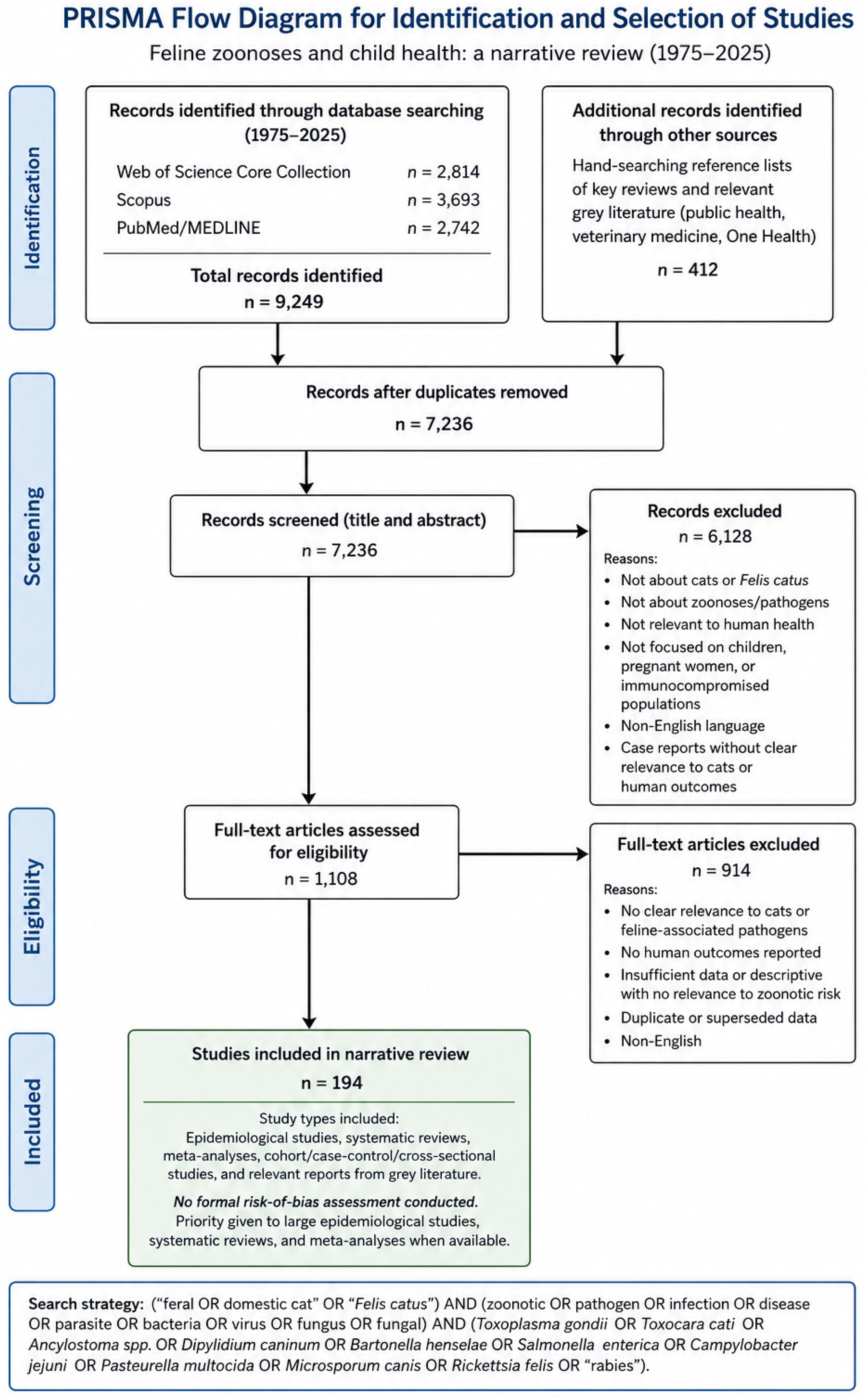
2. Methods

| Pentade | Estimated Publications | Key Themes |
|---|---|---|
| 1975–1979 | <10 | Early disease reports |
| 1980–1984 | ~30 | Toxoplasma, Campylobacter, Bartonella |
| 1990–1994 | ~100 | Epidemiology and zoonotic recognition |
| 2000–2004 | ~250 | Global reviews and diagnostics |
| 2010–2014 | ~450 | Urban ecology and One Health |
| 2020–2024 | ~3000 | Pandemic-era multi-pathogen research |
3. Major Zoonotic Pathogens Associated with Domestic Cats
4. Parasitic Infections
4.1. Toxoplasma gondii
4.2. Intestinal Helminths: Toxocara cati and Ancylostoma spp.
4.3. Fleas, Tapeworms, and Other Vector-Borne Parasites
5. Bacterial Infections
5.1. Bartonella henselae and Cat Scratch Disease
5.2. Pasteurella multocida and Other Bite-Associated Enteric Bacteria
5.3. Rickettsial Agents
6. Viral and Fungal Infections
6.1. Viral Infections
6.2. Fungal Infections
7. Transmission Routes and Specific Risks for Children
8. Epidemiological Trends and One Health Perspectives (1975–2025)
9. Urban Cat Ecology and Implications for Child Health
10. Urban Cat Management
11. Prevention, Education, and Risk Reduction
- Routine veterinary care: Regular vaccination, deworming, and flea/tick control for pet cats reduces the prevalence and shedding of many pathogens [52].
- Hygiene and litter management: Changing litter daily and wearing gloves and washing hands thoroughly after handling cats or cleaning litter boxes minimizes exposure to T. gondii and enteric bacteria [6].
- Child safety and education: Teaching children safe handling of cats, discouraging rough play, and reinforcing hand-washing after animal contact or outdoor play reduces the risk of bites, scratches, and ingestion of contaminated material [75].
- Clinical red flags after sandbox exposure: If a child has eaten sand or visible fecal material and later develops fever, persistent cough, abdominal pain, eye pain or visual changes, seizures, or prolonged gastrointestinal symptoms, medical evaluation is recommended, with mention of sandbox exposure so clinicians can consider parasitic infections [83].
- Environmental management: Covering sandboxes, discouraging cats from defecating in children’s play areas, and maintaining clean public spaces reduces environmental contamination by parasitic stages [84].
- Tailored guidance for vulnerable groups: Pregnant women and immunocompromised individuals should receive specific advice on minimizing exposure to cat feces and avoiding contact with stray or sick cats [6].
12. Research Gaps
13. Conclusions
Funding
Institutional Review Board Statement
Informed Consent Statement
Data Availability Statement
Acknowledgments
Conflicts of Interest
Abbreviations
| MDPI | Multidisciplinary Digital Publishing Institute |
| TNR | Trap–Neuter–Return |
| HIV/AIDS | Human Immunodeficiency Viruses |
| VLM | Visceral Larva Migrans |
| OLM | Ocular Larva Migrans |
| CSD | Cat Scratch Disease |
| FIV | Feline Immunodeficiency Virus |
| FeLV | Feline Leukemia Virus |
References
- Crawford, C.; Rand, J.; Rohlf, V.; Scotney, R.; Bennett, P. Solutions-Based Approach to Urban Cat Management-Case Studies of a One Welfare Approach to Urban Cat Management. Animals 2023, 13, 3423. [Google Scholar] [CrossRef] [Scilit]
- Dillenseger, C. Stray cats between urban planning, heritagization and ecofeminism. In Digital Compendium of Texts and Visual Material; Maloutas, T., Spyrellis, S., Eds.; Athens Social Atlas: Athens, Greece, 2023; Available online: https://www.athenssocialatlas.gr/en/article/feral-athens/ (accessed on 23 June 2026).
- Wolf, P.J.; Schaffner, J.E. The Road to TNR: Examining Trap-Neuter-Return Through the Lens of Our Evolving Ethics. Front. Vet. Sci. 2019, 5, 341. [Google Scholar] [CrossRef] [Scilit] [PubMed]
- Gerhold, R.W.; Jessup, D.A. Zoonotic diseases associated with free roaming cats. Zoonoses Public Health 2013, 60, 189–195. [Google Scholar] [CrossRef] [Scilit] [PubMed]
- Sumi, A.; Toyoda, S.; Kanou, K.; Fujimoto, T.; Mise, K.; Kohei, Y.; Koyama, A.; Kobayashi, N. Association between meteorological factors and reported cases of hand, foot, and mouth disease from 2000 to 2015 in Japan. Epidemiol. Infect. 2017, 145, 2896–2911. [Google Scholar] [CrossRef] [Scilit] [PubMed]
- Montoya, J.G.; Rosso, F. Diagnosis and management of toxoplasmosis. Clin. Perinatol. 2005, 32, 705–726. [Google Scholar] [CrossRef] [Scilit] [PubMed]
- Ismael, S.S.; Hasan, S.H. What can you get from your Cat? Biol. Times Mag. 2023, 2, 3–4. [Google Scholar]
- Szentivanyi, T.; Oedin, M.; Rocha, R. Cat–wildlife interactions and zoonotic disease risk: A call for more and better community science data. Mammal Rev. 2024, 54, 93–104. [Google Scholar]
- Chomel, B.B. Emerging and re-emerging zoonoses of dogs and cats. Animals 2014, 4, 434–445. [Google Scholar] [CrossRef] [Scilit] [PubMed]
- Diakou, A.; Di Cesare, A.; Accettura, P.M.; Barros, L.; Iorio, R.; Paoletti, B.; Frangipane di Regalbono, A.; Halos, L.; Beugnet, F.; Traversa, D. Intestinal parasites and vector-borne pathogens in stray and free-roaming cats living in continental and insular Greece. PLoS Negl. Trop. Dis. 2017, 11, e0005335. [Google Scholar] [CrossRef] [Scilit] [PubMed]
- Sykes, J.E.; Reagan, K.L.; Nally, J.E.; Galloway, R.L.; Haake, D.A. Role of diagnostics in epidemiology, management, surveillance, and control of leptospirosis. Pathogens 2022, 11, 395. [Google Scholar] [CrossRef] [Scilit] [PubMed]
- Ratti, G. Feline Infectious Diseases: Genetic Characterization of Emerging and Zoonotic Pathogens. Ph.D. Thesis, Università Degli Studi di Milano, Milan, Italy, 2024; 162p. Available online: https://hdl.handle.net/2434/1064869 (accessed on 23 June 2026).
- Foley, J.E.; Sellon, R.K.; Mills, W.Z.; Evermann, J.F.; Sykes, J.E.; Rankin, S.C. Clinical Epidemiology in Infectious Diseases and Interpretation of Diagnostic Tests. In Greene’s Infectious Diseases of the Dog and Cat; WB Saunders: Philadelphia, PA, USA, 2021; pp. 64–71. [Google Scholar]
- Sanyaolu, A. Epidemiology of zoonotic diseases in the United States: A comprehensive review. J. Infect. Dis. Epidemiol. 2016, 2, 021. [Google Scholar] [CrossRef] [Scilit]
- Melidou, A.; Enkirch, T.; Willgert, K.; Adlhoch, C.; Alm, E.; Lamb, F.; Marangon, S.; Monne, I.; Stegeman, J.A. Drivers for a pandemic due to avian influenza and options for One Health mitigation measures. EFSA J. 2024, 22, e8735. [Google Scholar] [CrossRef] [Scilit]
- Bruno, L.; Nappo, M.A.; Frontoso, R.; Montinaro, S.; Di Lecce, R.; Guarnieri, C.; Ferrari, L.; Corradi, A. Avian Influenza Viruses: Global Panzootic, Host Range Expansion and Emerging One-Health Threats. Vet. Sci. 2026, 13, 67. [Google Scholar] [CrossRef] [Scilit] [PubMed]
- Marchi, S.; Guarducci, G.; Marotta, M.G.; Peccetti, B.; Viviani, S.; Messina, G.; Montomoli, E.; Martella, V.; Camero, M.; Trombetta, C.M. Improving the ONE HEALTH approach: A lesson from SARS-CoV-2 pandemic. J. Prev. Med. Hyg. 2024, 65, E312. [Google Scholar] [PubMed]
- Sikkema, R.S.; Koopmans, M. Viral emergence and pandemic preparedness in a One Health framework. Nat. Rev. Microbiol. 2026, 24, 29–44. [Google Scholar] [PubMed]
- Stose, L.L. Cat Scratch Fever (Bartonella spp.). In The One Health Model as Applied to Zoonotic Diseases; Samples, O.M., McCommon, G.W., Terrill, T.H., Stose, L.L., Eds.; Wiley Online Library: Hoboken, NJ, USA, 2025. [Google Scholar] [CrossRef] [Scilit]
- Natoli, E.; Maragliano, L.; Cariola, G.; Faini, A.; Bonanni, R.; Cafazzo, S.; Fantini, C. Management of feral domestic cats in the urban environment of Rome (Italy). Prev. Vet. Med. 2006, 77, 180–185. [Google Scholar] [CrossRef] [Scilit] [PubMed]
- Veronesi, F.; Santilli, A.; Laus, F.; De Martino, L. The effects and contribution of childhood diseases on the geographical distribution of all-cause under-five mortality in Uganda. Parasite Epidemiol. Control 2019, 5, e00089. [Google Scholar] [CrossRef] [Scilit] [PubMed]
- Gunther, I.; Finkler, H.; Gabet, A.; Shochat, E.; Klement, E.; Terkel, J. Reduction of free-roaming cat population requires high-intensity neutering in spatial contiguity to mitigate compensatory effects. Proc. Nat. Acad. Sci. USA 2022, 119, e2119000119. [Google Scholar] [CrossRef] [Scilit] [PubMed]
- Lepczyk, C.A.; Fantle-Lepczyk, J.E.; Dunham, K.D.; Bonnaud, E.; Lindner, J.; Doherty, T.S.; Woinarski, J.C. A global synthesis and assessment of free-ranging domestic cat diet. Nat. Commun. 2023, 14, 7809. [Google Scholar] [CrossRef] [Scilit] [PubMed]
- Lozano, J.; Macías-Díaz, J.; Calzada, J.; Virgós, E. Four Years of Promising Trap–Neuter–Return (TNR) in Córdoba, Spain: A Scalable Model for Urban Feline Management. Animals 2025, 15, 482. [Google Scholar] [CrossRef] [Scilit] [PubMed]
- Rahman, M.T.; Sobur, M.A.; Islam, M.S.; Ievy, S.; Hossain, M.J.; El Zowalaty, M.E.; Rahman, A.T.; Ashour, H.M. Zoonotic Diseases: Etiology, Impact, and Control. Microorganisms 2020, 8, 1405. [Google Scholar] [CrossRef] [Scilit] [PubMed]
- Schäfer, I.; Kohn, B.; Volkmann, M.; Müller, E. Retrospective evaluation of vector-borne pathogens in cats living in Germany (2012–2020). Parasites Vectors 2021, 14, 123. [Google Scholar] [CrossRef] [Scilit] [PubMed]
- Chomel, B.B.; Boulouis, H.J.; Maruyama, S.; Breitschwerdt, E.B. Bartonella spp. in pets and effect on human health. Emerg. Infect. Dis. 2006, 12, 389–394. [Google Scholar] [CrossRef] [Scilit] [PubMed]
- Goldstein, E.J.C.; Abrahamian, F.M. Diseases Transmitted by Cats. In Infections of Leisure; Schlossberg, D., Ed.; John Wiley & Sons: Hoboken, NJ, USA, 2016. [Google Scholar] [CrossRef] [Scilit]
- Azócar-Aedo, L. Global prevalence and epidemiology of leptospirosis in domestic cats, a systematic review and meta-analysis. Vet. Méx. OA 2022, 9, 1129. [Google Scholar] [CrossRef] [Scilit]
- Chothe, S.K.; Srinivas, S.; Misra, S.; Nallipogu, N.C.; Gilbride, E.; LaBella, L.; Mukherjee, S.; Gauthier, C.H.; Pecoraro, H.L.; Webb, B.T.; et al. Marked neurotropism and potential adaptation of H5N1 clade 2.3. 4.4. b virus in naturally infected domestic cats. Emerg. Microbes Infect. 2025, 14, 2440498. [Google Scholar] [CrossRef] [Scilit] [PubMed]
- Pennisi, M.G.; Marsilio, F.; Hartmann, K.; Lloret, A.; Addie, D.; Belák, S.; Boucraut-Baralon, C.; Egberink, H.; Frymus, T.; Gruffydd-Jones, T.; et al. Bartonella species infection in cats: ABCD guidelines on prevention and management. J. Feline Med. Surg. 2013, 15, 563–569. [Google Scholar] [CrossRef] [Scilit] [PubMed]
- Baneth, G.; Peri Markovich, M.; Nachum-Biala, Y.; Yasur-Landau, D.; Leszkowicz Mazuz, M.; Jaffe, C.L. Retrospective study of canine leishmaniosis in Israel. Parasites Vectors 2025, 18, 257. [Google Scholar] [CrossRef] [Scilit] [PubMed]
- Pal, M.; Tolawak, D.; Garedaghi, Y. A comprehensive review on major zoonotic parasites from dogs and cats. Int. J. Med. Parasitol. Epidemiol. Sci. 2023, 4, 4. [Google Scholar] [CrossRef] [Scilit]
- Udainiya, S.; Tiwari, A.; Mishra, A.; Dubey, A. Zoonotic diseases of dogs and cats. In Introduction to Diseases, Diagnosis, and Management of Dogs and Cats; Academic Press: London, UK, 2024. [Google Scholar] [CrossRef] [Scilit]
- Dubey, J.P. Toxoplasmosis of Animals and Humans, 2nd ed.; CRC Press: Boca Raton, FL, USA, 2016; pp. 559–572. [Google Scholar]
- Bowman, D.D.; Montgomery, S.P.; Zajac, A.M.; Eberhard, M.L.; Kazacos, K.R. Hookworms of dogs and cats as agents of cutaneous larva migrans. Trends Parasitol. 2010, 26, 162–167. [Google Scholar] [CrossRef] [Scilit] [PubMed]
- Rousseau, J.; Castro, A.; Novo, T.; Maia, C. Dipylidium caninum in the twenty-first century: Epidemiological studies and reported cases in companion animals and humans. Parasites Vectors 2022, 15, 131. [Google Scholar] [CrossRef] [Scilit] [PubMed]
- Little, S.; Braff, J.; Duncan, K.; Elsemore, D.; Hanna, R.; Hanscom, J.; Lee, A.; Martin, K.A.; Sobotyk, C.; Starkey, L.; et al. Diagnosis of canine intestinal parasites: Improved detection of Dipylidium caninum infection through coproantigen testing. Vet. Parasitol. 2023, 324, 110073. [Google Scholar] [CrossRef] [Scilit] [PubMed]
- McShane, D.B.; Kong, H.H.; Myers, S.A. Bartonella infections: Bacillary angiomatosis, cat scratch disease and bartonellosis. In Harper’s Textbook of Pediatric Dermatology; Wiley: Hoboken, NJ, USA, 2011; Volume 1, pp. 58–61. [Google Scholar]
- Homsi, Y.; Milam, E.; Dayoub, N. Cutaneous Bacillary Angiomatosis: A Rare and Forgotten Infection in Immunocompromised Patient. Avicenna J. Med. 2025, 15, 176–180. [Google Scholar] [CrossRef] [Scilit] [PubMed]
- Chlebicz, A.; Śliżewska, K. Campylobacteriosis, salmonellosis, yersiniosis, and listeriosis as zoonotic foodborne diseases: A review. Int. J. Environ. Res. Public Health 2018, 15, 863. [Google Scholar] [CrossRef] [Scilit] [PubMed]
- Wang, Z.; Tao, X.; Liu, S.; Zhao, Y.; Yang, X. An update review on Listeria infection in pregnancy. Infect. Drug Resist. 2021, 14, 1967–1978. [Google Scholar] [CrossRef] [Scilit] [PubMed]
- Benavides, J.A.; Megid, J.; Campos, A.; Hampson, K. Using surveillance of animal bite patients to decipher potential risks of rabies exposure from domestic animals and wildlife in Brazil. Front. Public Health 2020, 8, 318. [Google Scholar] [CrossRef] [Scilit] [PubMed]
- Tuglo, L.S.; Branda, F.; Mohapatra, R.K.; Pattnaik, P.; Sahu, A.R.; Mishra, S. Spill-over rabies transmission–a neglected aspect in african rabies control efforts. Infect. Dis. 2026, 58, 560–564. [Google Scholar]
- Brown, L.D.; Macaluso, K.R. Rickettsia felis, an emerging flea-borne rickettsiosis. Curr. Trop. Med. Rep. 2016, 3, 27–39. [Google Scholar] [CrossRef] [Scilit] [PubMed]
- Caravedo Martinez, M.A.; Ramírez-Hernández, A.; Blanton, L.S. Manifestations and management of flea-borne rickettsioses. Res. Rep. Trop. Med. 2021, 12, 1–14. [Google Scholar] [CrossRef] [Scilit] [PubMed]
- Rostami, A.; Riahi, S.M.; Holland, C.V.; Taghipour, A.; Khalili-Fomeshi, M.; Fakhri, Y.; Omrani, V.F.; Hotez, P.J.; Gasser, R.B. Seroprevalence estimates for toxocariasis in people worldwide: A systematic review and meta-analysis. PLoS Negl. Trop. Dis. 2019, 13, e0007809. [Google Scholar] [CrossRef] [Scilit] [PubMed]
- Gweryina, R.I.; Ashezua, T.T.; Edeh, A. Compartmental modelling for the transmission dynamics of ringworm disease in humans and pets with bifurcation analysis. Discov. Public Health 2025, 22, 898. [Google Scholar] [CrossRef] [Scilit]
- Shapiro, K.; Bahia-Oliveira, L.; Dixon, B.; Dumètre, A.; de Wit, L.A.; VanWormer, E.; Villena, I. Environmental transmission of Toxoplasma gondii: Oocysts in water, soil and food. Food Waterborne Parasitol. 2019, 15, e00049. [Google Scholar] [CrossRef] [Scilit] [PubMed]
- Zhu, S.; Shapiro, K.; VanWormer, E. Dynamics and epidemiology of Toxoplasma gondii oocyst shedding in domestic and wild felids. Transbound. Emerg. Dis. 2022, 69, 2412–2423. [Google Scholar] [CrossRef] [Scilit] [PubMed]
- Marín-García, P.J.; Planas, N.; Llobat, L. Toxoplasma gondii in foods: Prevalence, control, and safety. Foods 2022, 11, 2542. [Google Scholar] [CrossRef] [Scilit] [PubMed]
- Hill, S.L.; Cheney, J.M.; Taton-Allen, G.F.; Reif, J.S.; Bruns, C.; Lappin, M.R. Prevalence of enteric zoonotic organisms in cats. J. Am. Vet. Med. Assoc. 2000, 216, 687–692. [Google Scholar] [CrossRef] [Scilit] [PubMed]
- Vetter, J.C.M.; Leegwater-vd Linden, M.E. Skin penetration of infective hookworm larvae: I. The path of migration of infective larvae of Ancylostoma braziliense in canine skin. Z. Parasitenkd. 1977, 53, 255–262. [Google Scholar] [CrossRef] [Scilit] [PubMed]
- Xie, Y.H.; Chongsuvivatwong, V.; Tan, Y.; Tang, Z.Z.; Sornsrivichai, V.; McNeil, E.B. Important roles of public playgrounds in the transmission of hand, foot, and mouth disease. Epidemiol. Infect. 2015, 143, 1432–1441. [Google Scholar] [CrossRef] [Scilit] [PubMed]
- Kwong, L.H.; Ercumen, A.; Pickering, A.J.; Unicomb, L.; Davis, J.; Luby, S.P. Age-related changes to environmental exposure: Variation in the frequency that young children place hands and objects in their mouths. J. Expo. Sci. Environ. Epidemiol. 2020, 30, 205–216. [Google Scholar] [CrossRef] [Scilit] [PubMed]
- Clark, N.J.; Seddon, J.M.; Šlapeta, J.; Wells, K. Parasite spread at the domestic animal-wildlife interface: Anthropogenic habitat use, phylogeny and body mass drive risk of cat and dog flea (Ctenocephalides spp.) infestation in wild mammals. Parasites Vectors 2018, 11, 8. [Google Scholar] [CrossRef] [Scilit] [PubMed]
- Higgins, J.A.; Radulovic, S.; Jaworski, D.C.; Azad, A.F. Acquisition of the cat scratch disease agent Bartonella henselae by cat fleas (Siphonaptera: Pulicidae). J. Med. Entomol. 1996, 33, 490–495. [Google Scholar] [CrossRef] [Scilit] [PubMed]
- Zarea, A.A.K.; Tempesta, M.; Odigie, A.E.; Mrenoshki, D.; Fanelli, A.; Martella, V.; Decaro, N.; Greco, G. The Global Molecular Prevalence of Bartonella spp. in Cats and Dogs: A Systematic Review and Meta-Analysis. Transbound. Emerg. Dis. 2023, 2023, 7867562. [Google Scholar] [CrossRef] [Scilit] [PubMed]
- Hirunkanokpun, S.; Thepparit, C.; Foil, L.D.; Macaluso, K.R. Horizontal transmission of Rickettsia felis between cat fleas, Ctenocephalides felis. Mol. Ecol. 2011, 20, 4577–4586. [Google Scholar] [CrossRef] [Scilit] [PubMed]
- Purewal, R.; Christley, R.; Kordas, K.; Joinson, C.; Meints, K.; Gee, N.; Westgarth, C. Companion animals and child/adolescent development: A systematic review of the evidence. Int. J. Environ. Res. Public Health 2017, 14, 234. [Google Scholar] [CrossRef] [Scilit] [PubMed]
- Cuomo, C.A. The relaunch of microbiology spectrum. Microbiol. Spectr. 2021, 9, 10–1128. [Google Scholar] [CrossRef] [Scilit] [PubMed]
- Wei, B.; Liu, C.; Zhu, J.; Zou, X.; Zhang, Z. Pasteurella multocida infection: A differential retrospective study of 482 cases of P. multocida infection in patient of different ages. BMC Infect. Dis. 2025, 25, 313. [Google Scholar] [CrossRef] [Scilit] [PubMed]
- Beauruelle, C.; Plouzeau, C.; Grillon, A.; Isnard, C.; Corvec, S.; Degand, N.; Jacquier, H.; Amara, M.; Mizrahi, A.; Diedrich, T.; et al. Capnocytophaga zoonotic infections: A 10-year retrospective study (the French CANCAN study). Eur. J. Clin. Microbiol. Infect. Dis. 2022, 41, 581–588. [Google Scholar] [CrossRef] [Scilit] [PubMed]
- Schriefer, M.E.; Sacci, J.B.; Dumler, J.S.; Bullen, M.G.; Azad, A.F. Identification of a novel rickettsial infection in a patient diagnosed with murine typhus. J. Clin. Microbiol. 1994, 32, 949–954. [Google Scholar] [CrossRef] [Scilit] [PubMed]
- Fehlner-Gardiner, C.; Gongal, G.; Tenzin, T.; Sabeta, C.; De Benedictis, P.; Rocha, S.M.; Vargas, A.; Cediel-Becerra, N.; Gomez, L.C.; Maki, J.; et al. Rabies in cats—An emerging public health issue. Viruses 2024, 16, 1635. [Google Scholar] [CrossRef] [Scilit] [PubMed]
- Das, M.; Yustyniuk, V.; Perez, A.M.; Aguirreburualde, M.S.P. Global Perspectives on Rabies Control and Elimination: A Scoping Review of Dog Owners’ Knowledge, Attitudes, and Practices. Pathogens 2025, 14, 728. [Google Scholar] [CrossRef] [Scilit] [PubMed]
- Hobi, S.; Tam, W.Y.J.; Tse, M.; Nekouei, O.; Chai, Y.; Hill, F.I.; Cheung, E.; Botes, W.; Saulnier-Troff, F.; McDermott, C.T.; et al. Microsporum canis Causes Cutaneous and Extracutaneous Feline Dermatophytic Pseudomycetomas: Molecular Identification and Clinicopathological Characteristics. J. Fungi 2024, 10, 576. [Google Scholar] [CrossRef] [Scilit]
- Barrs, V.R.; Bęczkowski, P.M.; Talbot, J.J.; Hobi, S.; Teoh, S.N.; Hernandez Muguiro, D.; Shubitz, L.F.; Sandy, J. Invasive fungal infections and oomycoses in cats: 1. Diagnostic approach. J. Feline Med. Surg. 2024, 26, 1098612X231219696. [Google Scholar] [CrossRef] [Scilit] [PubMed]
- Eissa, N. Fungal diseases of dogs and cats. In Introduction to Diseases, Diagnosis, and Management of Dogs and Cats; Academic Press: London, UK, 2024; pp. 523–532. [Google Scholar]
- Septelici, D.; Carbone, G.; Cipri, A.; Esposito, S. Management strategies for common animal bites in pediatrics: A narrative review on the latest progress. Microorganisms 2024, 12, 924. [Google Scholar] [CrossRef] [Scilit] [PubMed]
- Dixit, B.; Kumar, R.; Dixit, A.K.; Singh, A.K. Risk Factors Associated with Parasitic Diseases in Dogs and Cats. In Principles and Practices of Canine and Feline Clinical Parasitic Diseases; Rana, T., Ed.; Wiley Online Library: Hoboken, NJ, USA, 2024; pp. 19–30. [Google Scholar] [CrossRef] [Scilit]
- Morelli, S.; Diakou, A.; Di Cesare, A.; Colombo, M.; Traversa, D. Canine and feline parasitology: Analogies, differences, and relevance for human health. Clin. Microbiol. Rev. 2021, 34, e00266-20. [Google Scholar] [CrossRef] [Scilit] [PubMed]
- Aleem, M.T.; Munir, F.; Shakoor, A. Parasitic diseases of dogs and cats. In Introduction to Diseases, Diagnosis, and Management of Dogs and Cats; Rana, T., Ed.; Academic Press: London, UK, 2024; pp. 479–488. [Google Scholar]
- Kumar, M.; Saadaoui, M.; Al Khodor, S. Infections and pregnancy: Effects on maternal and child health. Front. Cell. Infect. Microbiol. 2022, 12, 873253. [Google Scholar] [CrossRef] [Scilit] [PubMed]
- Jackson, L.A.; Perkins, B.A.; Wenger, J.D. Cat scratch disease in the United States: An analysis of three national databases. Am. J. Public Health 1993, 83, 1707–1711. [Google Scholar] [CrossRef] [Scilit] [PubMed]
- Andityas, M.; Nuraini, D.M.; Sota, P.; Loong, S.K.; Sripa, B.; Sukon, P.; Tangkawattana, P.; Tangkawattana, S. Feline leptospirosis prevalence worldwide: A systematic review and meta-analysis of diagnostic approaches. Vet. World 2024, 17, 255. [Google Scholar] [CrossRef] [Scilit] [PubMed]
- Schulz, C.; Martina, B.; Mirolo, M.; Müller, E.; Klein, R.; Volk, H.; Egberink, H.; Gonzalez-Hernandez, M.; Kaiser, F.; von Köckritz-Blickwede, M.; et al. SARS-CoV-2–specific antibodies in domestic cats during first COVID-19 wave, Europe. Emerg. Infect. Dis. 2021, 27, 3115. [Google Scholar] [CrossRef] [Scilit] [PubMed]
- Coleman, K.K.; Bemis, I.G. Avian influenza virus infections in felines: A systematic review of two decades of literature. Open Forum Infect. Dis. 2025, 12, ofaf261. [Google Scholar] [CrossRef] [Scilit] [PubMed]
- Loss, S.R.; Will, T.; Marra, P.P. The impact of free ranging domestic cats on wildlife of the United States. Nat. Commun. 2013, 4, 1396. [Google Scholar] [CrossRef] [Scilit] [PubMed]
- Pena, H.; Soares, R.; Amaku, M.; Dubey, J.; Gennari, S. Toxoplasma gondii infection in cats from São Paulo state, Brazil: Seroprevalence, oocyst shedding, isolation in mice, and biologic and molecular characterization. Res. Vet. Sci. 2006, 81, 58–67. [Google Scholar] [CrossRef] [Scilit] [PubMed]
- Natoli, E. The intrinsic moral value of individuals: A bioethical approach to domestic cats and damaged species. Appl. Anim. Behav. Sci. 2024, 271, 106175. [Google Scholar] [CrossRef] [Scilit]
- Peris, M.P.; Planas, S.; Langa, J.; Laborda, A.; Castillo, J.A.; Gracia, M.J. Seroprevalence of zoonotic pathogens in stray cats in an urban area of northeast Spain. Vet. Parasitol. Reg. Stud. Rep. 2024, 53, 101052. [Google Scholar] [CrossRef] [Scilit] [PubMed]
- Callahan, G.N. Eating dirt. In Health and Healing in Comparative Perspective; Whitaker, E.D., Ed.; Routledge: Oxfordshire, UK, 2016; pp. 467–474. [Google Scholar] [CrossRef] [Scilit]
- Torrey, E.F. Sentinel Seals, Safe Cats, and Better Treatments. In Parasites, Pussycats and Psychosis: The Unknown Dangers of Human Toxoplasmosis; Springer International Publishing: Cham, Switzerland, 2021; pp. 121–133. [Google Scholar] [CrossRef] [Scilit]
- Spindel, M.; Sykes, J.E. Prevention and management of infectious diseases in multiple-cat environments. In Greene’s Infectious Diseases of the Dog and Cat; WB Saunders: Philadelphia, PA, USA, 2021; pp. 187–196. [Google Scholar]
- Candela, M.G.; Fanelli, A.; Carvalho, J.; Serrano, E.; Domenech, G.; Alonso, F.; Martínez-Carrasco, C. Urban landscape and infection risk in free-roaming cats. Zoonoses Public Health 2022, 69, 295–311. [Google Scholar] [CrossRef] [Scilit] [PubMed]
- Cotterell, J.; Rand, J.; Scotney, R. Urban cat Management in Australia—Evidence-based strategies for success. Animals 2025, 15, 1083. [Google Scholar] [CrossRef] [Scilit] [PubMed]

| Pathogen/Group | Main Human Syndromes | Key Transmission Route(s) from Cats | Particular Relevance for Children/Vulnerable Groups | Key References |
|---|---|---|---|---|
| Toxoplasma gondii | Congenital toxoplasmosis, encephalitis in immunocompromised | Ingestion of oocysts from cat-contaminated soil, sandboxes, litter, food, or water; undercooked meat | Severe congenital disease in infants of mothers infected during pregnancy; severe CNS disease in immunocompromised hosts | [24,27,28,29] |
| Toxocara cati | Visceral and ocular larva migrans | Ingestion of embryonated eggs from contaminated soil, sand, or surfaces | Disproportionate burden in young children using sandboxes/playgrounds; risk of permanent visual loss | [25,30,31,32] |
| Ancylostoma spp. | Cutaneous larva migrans | Skin penetration by infective larvae in contaminated sand/soil | Common in children playing barefoot; intense pruritus and secondary infections | [36] |
| Dipylidium caninum | Mild GI symptoms, anal pruritus | Ingestion of infected fleas from cats | Mostly affects young children; highlights importance of flea control | [37,38] |
| Bartonella henselae | Cat scratch disease, bacillary angiomatosis (immunocompromised) | Scratches, bites, contamination of broken skin with flea feces | Highest CSD incidence in children 5–9 years; severe disseminated disease in immunocompromised | [39,40] |
| Salmonella enterica, Campylobacter jejuni, Listeria monocytogenes | Gastroenteritis, invasive infections, pregnancy complications (Listeria) | Fecal contamination of environment, hands, or food; sometimes bites/scratches | Children particularly susceptible to dehydration and complications; pregnancy risk for Listeria | [41,42] |
| Microsporum canis and other dermatophytes | Ringworm (dermatophytosis) of skin and scalp | Direct contact with infected cats or contaminated fomites | One of the most common pet-associated zoonoses in children; recurrent household outbreaks | [26,43,44,45] |
| Flea-borne Rickettsia felis, R. typhi | Flea-borne spotted fever, murine typhus | Bites of infected fleas from cats | Febrile illness, sometimes severe; exposure linked to flea-infested cats in crowded urban settings | [46,47] |
| Rabies virus | Acute, almost invariably fatal encephalitis | Bites or saliva contact from rabid cats (spillover from wildlife or dogs) | Even rare events have catastrophic outcomes; children at particular risk of under-reported bites and delayed post-exposure prophylaxis | [43,44] |
Disclaimer/Publisher’s Note: The statements, opinions and data contained in all publications are solely those of the individual author(s) and contributor(s) and not of MDPI and/or the editor(s). MDPI and/or the editor(s) disclaim responsibility for any injury to people or property resulting from any ideas, methods, instructions or products referred to in the content. |
© 2026 by the author. Licensee MDPI, Basel, Switzerland. This article is an open access article distributed under the terms and conditions of the Creative Commons Attribution (CC BY) license.
Share and Cite
Yosef, R. Pathogens Associated with Domestic Cats (Felis catus), Their Public Health Impact on Children, and Implications of Urban Management. Pathogens 2026, 15, 673. https://doi.org/10.3390/pathogens15070673
Yosef R. Pathogens Associated with Domestic Cats (Felis catus), Their Public Health Impact on Children, and Implications of Urban Management. Pathogens. 2026; 15(7):673. https://doi.org/10.3390/pathogens15070673
Chicago/Turabian StyleYosef, Reuven. 2026. "Pathogens Associated with Domestic Cats (Felis catus), Their Public Health Impact on Children, and Implications of Urban Management" Pathogens 15, no. 7: 673. https://doi.org/10.3390/pathogens15070673
APA StyleYosef, R. (2026). Pathogens Associated with Domestic Cats (Felis catus), Their Public Health Impact on Children, and Implications of Urban Management. Pathogens, 15(7), 673. https://doi.org/10.3390/pathogens15070673