Ticks and Tick-Borne Microorganisms in Australian Wildlife: A Scoping One Health Evidence Synthesis of Reported Associations and Knowledge Gaps



Abstract
1. Introduction
2. Materials and Methods
2.1. Literature Search
2.2. Literature Selection and Assessment
2.3. Data Extraction
3. Results and Discussion
3.1. Studies on Ticks
3.1.1. Species of Wildlife
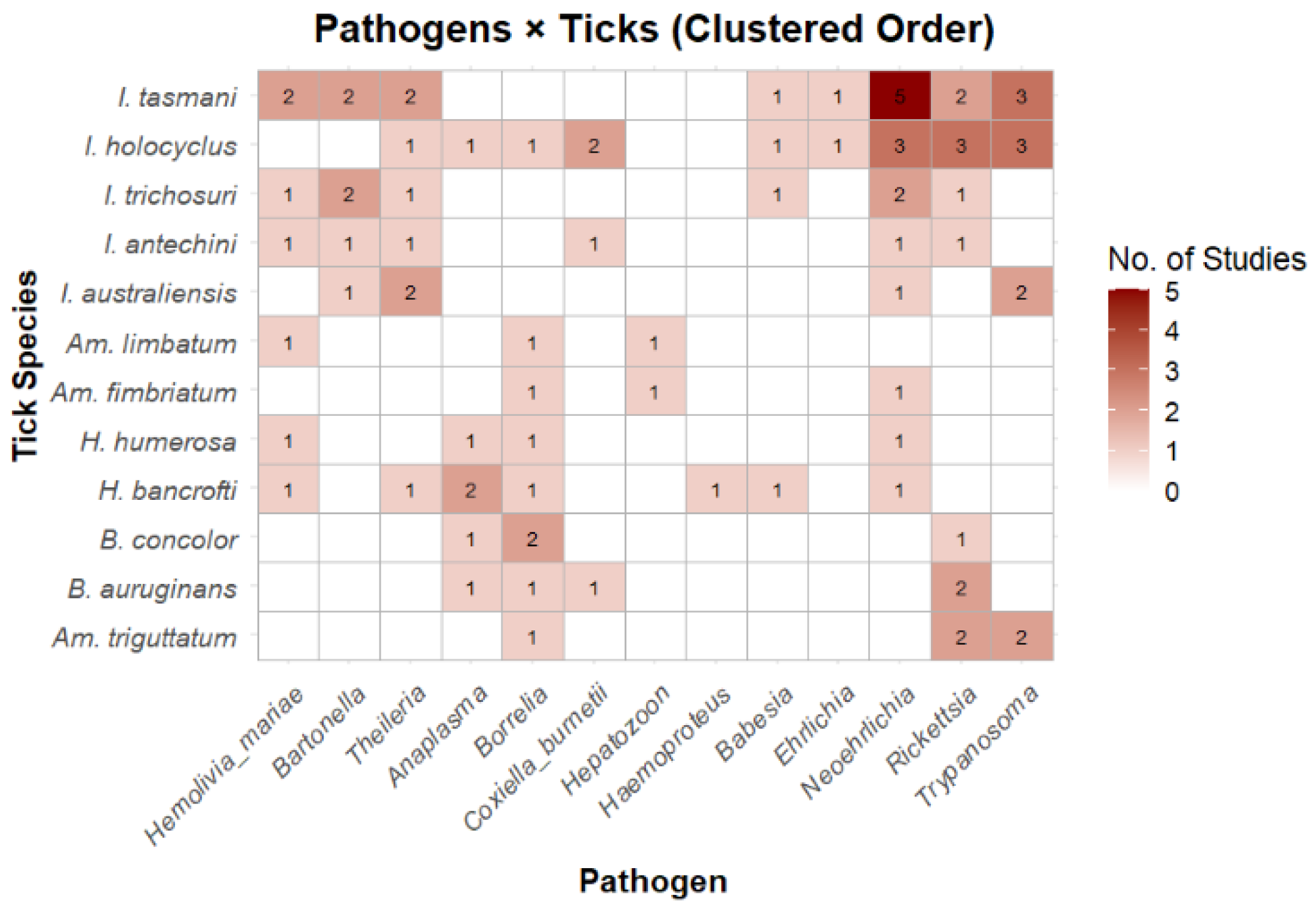
3.1.2. Species of Ticks

| Genus | Species | Selected Reference(s) |
|---|---|---|
| Ixodes | I. holocyclus [31, 23], I. tasmani [35], I. hirsti [9, 22], I. fecialis [15], I. trichosuri [12], I. australiensis [11], I. cornuatus [5, 1], I. eudyptidis [4], I. laridis [4], I. antechini [3], I. myrmecobii [3], I. victoriensis [3], I. woyliei [3], I. kohlsi [3], I. confusus [2], I. simplex [2], I. heathi [1], I. cordifer [1], I. ornithorhynchi [1], I. barkeri [1] | [41,42,47,48,52,53] |
| Amblyomma | Am. triguttatum [18, 1], Am. limbatum [7], Am. fimbriatum [5], Am. moreliae [5], Am. vikirri [2], Am. albolimbatum [1], Am. australiense [1], Am. echidnae [1], Am. cyprium cyprium [1], Am. sp. nr. limbatum [1], Am. calabyi [1] | [46,54,58,59] |
| Bothriocroton | B. hydrosauri [1,9], B. tachyglossi [2], B. concolor [1], B. auruginans [1], B. undatum [1] | [50] |
| Haemaphysalis | H. bancrofti [16], H. humerosa [8], H. longicornis [6], H. ratti [5], H. petrogalis [2], H. lagostrophi [2], H. bremneri [2] | [50,60] |
| Rhipicephalus | Rh. (sanguineus) linnaei [1] | [36] |
| Ornithodoros | O. gurneyi [1], O. capensis [1] | [45,55] |
| Argas | Ar. robertsi [10], Ar. dewae [2], Ar. lagenoplastis [1] | [56,57,61,62] |
3.1.3. Identification of Ticks
3.1.4. Pathogenic Effects of Ticks
3.1.5. Wildlife Tick Epidemiology and Ecology
3.1.6. Public Health and Companion Animal Considerations
3.2. Studies of Tick-Borne Microorganisms in Australian Wildlife
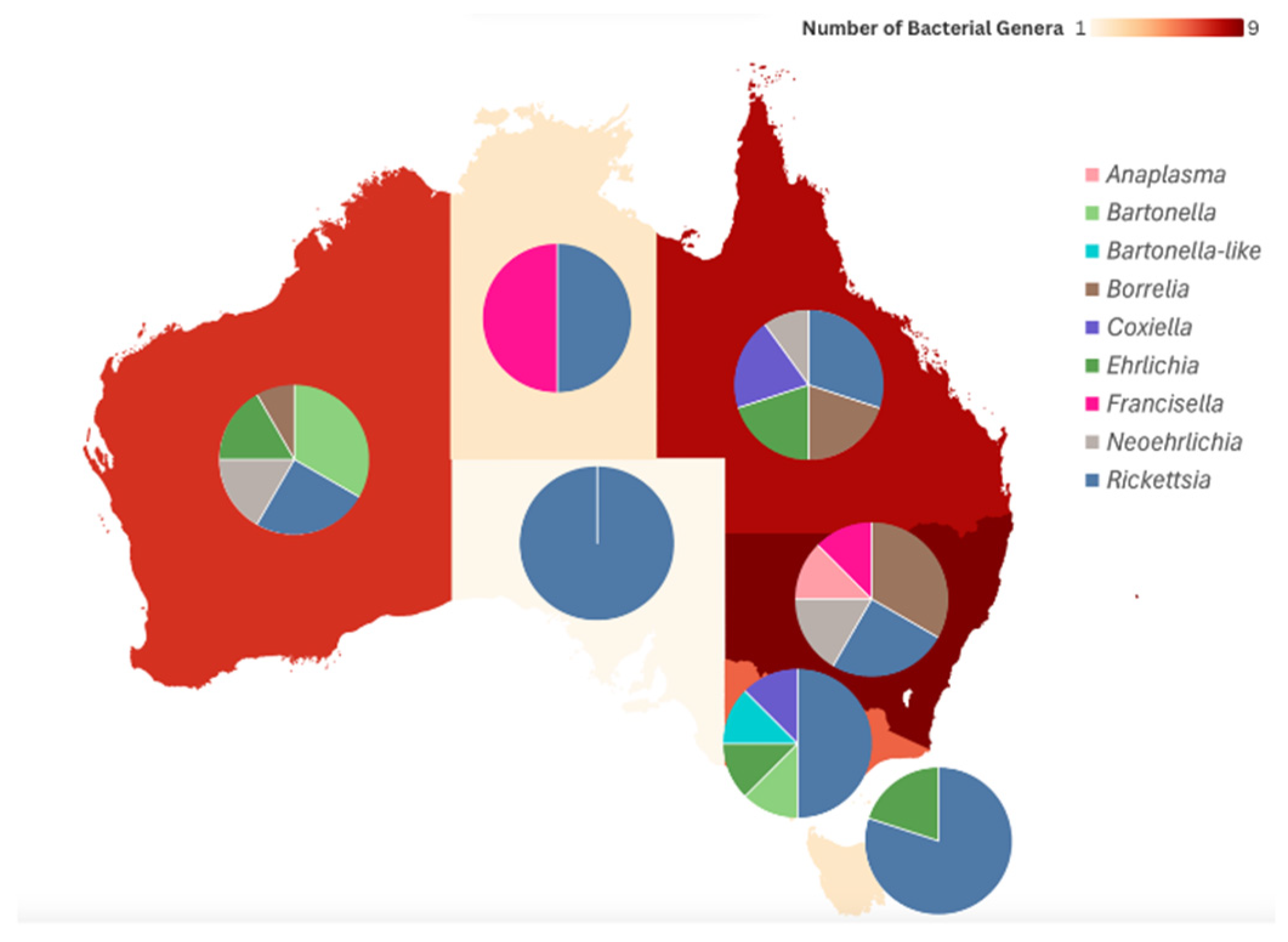
3.2.1. Bacteria
Anaplasmataceae
| Species | Host/Vector | Reference |
|---|---|---|
| Anaplasma sp. | Echidna (Bothriocroton concolor) | [36] |
A. bovis-like sp. | Long-nosed Bandicoot (Haemaphysalis bancrofti, H. humerosa) | |
| Red-necked Wallaby (H. bancrofti) | ||
| Anaplasma sp. | Bare-nosed wombat (B. auruginans) | [50] |
| Anaplasma sp. | Unspecified (Ixodes holocyclus) | [39] |
| A. platys | Deer (tissue) | [51] |
| A. bovis | Questing (H. bancrofti) | [31] |
Borrelia
| Species | Host/Vector/Tissue | Reference |
|---|---|---|
| Ca. Borrelia tachyglossi | Echidna (B. concolor) | [137] |
| Northern brown Bandicoot (Haemaphysalis humerosa) | [36] | |
| Borrelia sp. | No host (H. bancrofti) | [31] |
| Borrelia sp. | Black Rat (tissue) | [51] |
| Bush Rat (tissue) | ||
| Swamp Rat (tissue) | ||
| Borrelia sp. closely related to Ca. Borrelia ivorensis | Bare-nosed Wombat (B. auruginans) | [50] |
| Ca. Borrelia undatum | Lace Monitor (B. undatum) | [54] |
| Borrelia spp. | [81] | |
| Ca. Borrelia rubricentralis | Perentie (Amblyomma calabyi) | [54] |
| Borrelia sp. | Perentie (Am. limbatum, Am. fimbriatum) | [54] |
| Borrelia sp. | Echidna (Ixodes holocyclus) | [39] |
Coxiella
| Species | Host/Vector/Tissue | Reference |
|---|---|---|
| C. burnetii | Brush-tailed Possum (blood) | [142] |
| Northern Brown Bandicoot (Ixodes holocyclus, blood, sera) | ||
| Agile Wallaby (blood, sera) | ||
| Black-striped Wallaby (blood, sera) | ||
| Red Kangaroo (blood) | ||
| Eastern Grey Kangaroo (Amblyomma triguttatum, blood, sera) | ||
| Rufous Bettong (sera) | ||
| Common Wallaroo (blood) | ||
| Coxiella sp. | Bare-nosed Wombat (B. auruginans) | [72] |
| C. burnetii | [50] | |
| Coxiella-like sp. | [32] | |
| C. burnetii | Western-barred Bandicoot (Haemaphysalis humerosa) | [60] |
| Coxiella-like sp. | Echidna (B. concolor) | [36] |
| Coxiella sp. | Red Fox (H. longicornis) | |
| Coxiella-like sp. | Mountain Brush-tailed Possum (I. trichosuri) | [32] |
| Coxiella-like sp. | Mixed Black Noddy (Ornithodoros capensis) | [55] |
| C. burnetii | Kookaburra (I. holocyclus) |
Rickettsia
| Species | Host/Vector/Tissue | References |
|---|---|---|
| Rickettsia australis | Brush-tailed possum, Black Rat, Bush Rat, Bare-nosed Wombat, Swamp Antechinus (antibodies) | [148] |
| Rickettsia honei | Reptiles (B. hydrosauri) | [149] |
| Rickettsia sp. [SFG] | Shingleback skink (Amblyomma albolimbatum) | [44] |
| Rickettsia sp. | No host (B. concolor, Haemaphysalis bancrofti, H. humerosa, Ixodes antechini, I. australiensis, I. holocyclus, I. tasmani) | [36] |
| Brush-tailed possum (Am. triguttatum) | [51] | |
| No Host (H. bancrofti) | [31] | |
| Rickettsia australis | No Host (I. holocyclus) | |
| Rickettsia sp. | Northern brown Bandicoot (I. tasmani) | [75] |
| Northern Bettong (Amblyomma sp.) | ||
| Northern Bettong (Am. triguttatum) | ||
| Mixed Black Noddy (Ornithodoros capensis) | [55] | |
| Rickettsia sp. 777c | Echidna (B. tachyglossi) | |
| Rickettsia monacensis | ||
| Rickettsia sp. 777b/774e | ||
| Rickettsia sp. | ‘Bandicoot’ [unspecified] (H. humerosa) | |
| Rickettsia fournieri [SFG] | Fairy Martin (Argas lagenoplastis) | [56] |
Rickettsia sp. | Yellow-spotted monitor (Am. fimbriatum) | [152] |
| Water Python (Am. fimbriatum) | ||
| Green-tree snake (Am. fimbriatum) | ||
| Rickettsia gravesii [SFG] | Feral Pig (Am. triguttatum) | [153] |
| Rickettsia bellii | Echidna (B. concolor) | [72] |
| Rickettsia massiliae | Bare-nosed Wombat (B. auruginans) | |
| Ca. Rickettsia tasmanensis [SFG] | Tasmanian devil (I. tasmani) | [154] |
| Rickettsia sp. | Bare-nosed Wombat (B. auruginans), Mountain Brushtail possum (I. trichosuri), Southern brown Bandicoot (I. trichosuri, I. tasmani) | [32] |
| Rickettsia [SFG] | Eastern Blue-tongue lizard (Am. moreliae) | [84] |
| Rickettsia spp. | Shingleback Skink (B. hydrosauri) | [155] |
| Rickettsia cf. tamurae | Lace Monitor (B. undatum) | [81] |
| Rickettsia sp. | Unspecified (I. holocyclus) | [39] |
| Rickettsia sp. (“Rickettsia tasmanensis”) [SFG] | Tasmanian Devil (I. tasmani) | [156] |
| Rickettsia (“Koala Rickettsia”) [SFG] | Koala (I. tasmani) | [157] |
| Rickettsia japonica str. argasii | Gould’s Wattled Bat (Ar. dewae), Unidentified Bat sp. (Ar. dewae) | [57] |
3.2.2. Protozoa
Babesia
| Species | Host/Vector/Tissue | References |
|---|---|---|
| Babesia macropus | Eastern Grey Kangaroo (Haemaphysalis sp.) | [164] |
| Eastern Grey Kangaroo (tissue, blood), Agile Wallaby (tissue, blood) | [165] | |
| Babesia sp. | Northern Brown Bandicoot (blood) | [166] |
| Babesia lohae | Brush-tailed Possum (blood) | [31] |
| Questing (Ixodes trichosuri) | ||
| Babesia mackerrasorum | Questing (Haemaphysalis humerosa) | |
| Babesia sp. | Brush-tailed Possum (I. holocyclus, I. tasmani) | [64] |
| Brush-tailed Bettong (blood) | [167] | |
| [168] | ||
| Brush-tailed Possum (blood) | [125] | |
| Tasmanian Devil (blood) | [169] | |
| Little Penguin (blood) | [170] | |
| Babesia thylacis | Northern Quoll (blood) | [171] |
Theileria
| Species | Host/Vector/Tissue | References |
|---|---|---|
| Theileria ornithorhynchi | Platypus (Ixodes ornithorhynchi) | [97] |
| Theileria sp. | Platypus (blood) | [178] |
| T. ornithorhynchi | [175] | |
| Theileria sp. | Western Grey Kangaroo (I. australiensis) | [179] |
| Long-nosed Bandicoot (I. tasmani) | [64] | |
| T. orientalis | Red Fox (Haemaphysalis longicornis) | |
| T. fuliginosa | Western Grey Kangaroo (blood) | [180] |
| T. penicillata | Brush-tailed Bettong (blood) | |
| T. brachyuri | Quokka (blood) | [174] |
| Theileria spp. | ||
| Theileria sp. | Theileria sp. nov | |
| T. lupei | Eastern Quoll (blood) | |
| Eastern Bettong (blood) | ||
| Swamp Wallaby (blood) | ||
| T. c.f. peramelis | Long-nosed Bandicoot (blood) | [31] |
| Theileria sp. nov | Multiple marsupials (blood) | [174] |
| T. penicillata | Brush-tailed Bettong (blood) | [168] |
| T. apogeana | ||
| T. penicillata | Brush-tailed Bettong (blood) | [181] |
| T. c.f peramelis | Black Rat (blood) | [125] |
| Theileria sp. | Brush-tailed Possum (blood) | |
| Burrowing Bettong (blood) | [167] | |
| Eastern Quoll (I. fecialis) | [182] | |
| T. paparinii | Eastern Quoll (I. cornuatus [misidentified as I. holocyclus]) | |
| Theileria sp. | Koala (I. tasmani) | [32] |
| Mountain Brush-tailed Possum (I. trichosuri) | ||
| Agile Antechinus (I. tasmani, I. antechini) | ||
| Southern Brown Bandicoot (I. tasmani) | ||
| T. gilberti | Gilbert’s Potoroo (I. australiensis, I. fecialis, blood) | [183] |
| T. worthingtonorum | Quokka (blood) | [174] |
| T. tachyglossus | Echidna (blood) | [175] |
3.3. Other Tick-Borne Microorganisms (Trypanosoma, Hepatozoon, Arboviruses)
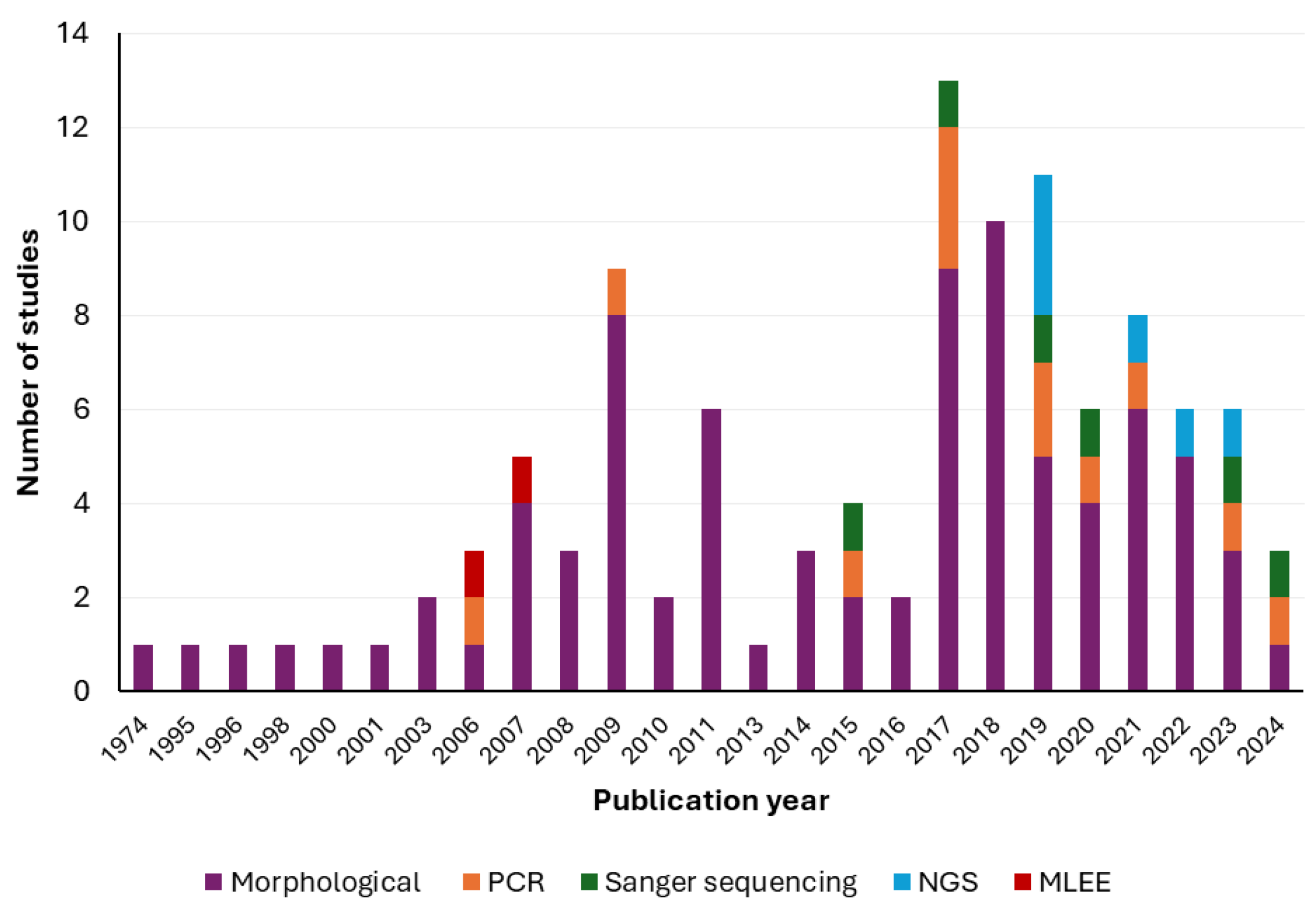
3.4. Identification Methods of Tick-Borne Microorganisms
3.5. Genetic Diversity and Phylogeography of Wildlife Ticks and Tick-Borne Microorganisms
4. Conclusions and Future Implications
Supplementary Materials
Author Contributions
Funding
Data Availability Statement
Conflicts of Interest
References
- Barker, S.C.; Barker, D. Ticks in Australia: Endemics; exotics; which ticks bite humans? Microbiol. Aust. 2018, 39, 194–199. [Google Scholar] [CrossRef] [Scilit]
- Barker, S.C.; Barker, D. Ticks of Australasia: 125 species of ticks in and around Australia. Zootaxa 2023, 5253, 1–670. [Google Scholar] [CrossRef] [Scilit] [PubMed]
- Hall-Mendelin, S.; Craig, S.B.; Hall, R.A.; O’Donoghue, P.; Atwell, R.B.; Tulsiani, S.M.; Graham, G.C. Tick paralysis in Australia caused by Ixodes holocyclus Neumann. Ann. Trop. Med. Parasitol. 2011, 105, 95–106. [Google Scholar] [CrossRef] [Scilit] [PubMed]
- Barker, S.C.; Walker, A.R. Ticks of Australia: The species that infest domestic animals and humans. Zootaxa 2014, 3816, 1–144. [Google Scholar] [CrossRef] [Scilit] [PubMed]
- Barker, S.C.; Walker, A.R.; Campelo, D. A list of the 70 species of Australian ticks; diagnostic guides to and species accounts of Ixodes holocyclus (paralysis tick), Ixodes cornuatus (southern paralysis tick) and Rhipicephalus australis (Australian cattle tick); and consideration of the place of Australia in the evolution of ticks with comments on four controversial ideas. Int. J. Parasitol. 2014, 44, 941–953. [Google Scholar] [CrossRef] [Scilit] [PubMed]
- Dehhaghi, M.; Kazemi Shariat Panahi, H.; Holmes, E.C.; Hudson, B.J.; Schloeffel, R.; Guillemin, G.J. Human tick-borne diseases in Australia. Front. Cell. Infect. Microbiol. 2019, 9, 3. [Google Scholar] [CrossRef] [Scilit] [PubMed]
- Anderson, J.F.; Magnarelli, L.A. Biology of ticks. Infect. Dis. Clin. N. Am. 2008, 22, 195–215. [Google Scholar] [CrossRef] [Scilit] [PubMed]
- Estrada-Peña, A. Ticks as vectors: Taxonomy, biology and ecology. Rev. Sci. Tech. 2015, 34, 53–65. [Google Scholar] [CrossRef] [Scilit] [PubMed]
- Estrada-Peña, A.; Venzal, J.M.; Kocan, K.M.; Sonenshine, D.E. Overview: Ticks as vectors of pathogens that cause disease in humans and animals. Front. Biosci. 2008, 13, 6938–6946. [Google Scholar] [CrossRef] [Scilit] [PubMed]
- Jongejan, F.; Uilenberg, G. The global importance of ticks. Parasitology 2004, 129, S3–S14. [Google Scholar] [CrossRef] [Scilit] [PubMed]
- Gilbert, L. The impacts of climate change on ticks and tick-borne disease risk. Annu. Rev. Entomol. 2021, 66, 373–388. [Google Scholar] [CrossRef] [Scilit] [PubMed]
- Tsao, J.I.; Hamer, S.A.; Han, S.; Sidge, J.L.; Hickling, G.J. The contribution of wildlife hosts to the rise of ticks and tick-borne diseases in North America. J. Med. Entomol. 2021, 58, 1565–1587. [Google Scholar] [CrossRef] [Scilit] [PubMed]
- Chapman, A.D. Numbers of Living Species in Australia and the World; Australian Biological Resources Study: Canberra, Australia, 2009. [Google Scholar]
- Cresswell, I.; Murphy, H. Australia State of the Environment 2016: Biodiversity; Australian Government Department of the Environment and Energy: Canberra, Australia, 2017. [Google Scholar]
- Dielenberg, J.; Bekessy, S.; Cumming, G.S.; Dean, A.J.; Fitzsimons, J.A.; Garnett, S.; Goolmeer, T.; Hughes, L.; Kingsford, R.T.; Legge, S.; et al. Australia’s biodiversity crisis and the need for the Biodiversity Council. Ecol. Manag. Restor. 2023, 24, 69–74. [Google Scholar] [CrossRef] [Scilit]
- Taylor-Brown, A.; Booth, R.; Gillett, A.; Mealy, E.; Ogbourne, S.M.; Polkinghorne, A.; Conroy, G.C. The impact of human activities on Australian wildlife. PLoS ONE 2019, 14, e0206958. [Google Scholar] [CrossRef] [Scilit] [PubMed]
- Scanes, C.G. Human activity and habitat loss: Destruction, fragmentation, and degradation. In Animals and Human Society; Scanes, C.G., Toukhsati, S.R., Eds.; Academic Press: London, UK, 2018; pp. 451–482. [Google Scholar]
- Driga, A.M.; Drigas, A.S. Climate change 101: How everyday activities contribute to the ever-growing issue. Int. J. Recent Contrib. Eng. Sci. IT 2019, 7, 22–31. [Google Scholar] [CrossRef] [Scilit]
- Onyango, M.G.; Ciota, A.T.; Kramer, L.D. The vector-host-pathogen interface: The next frontier in the battle against mosquito-borne viral diseases? Front. Cell. Infect. Microbiol. 2020, 10, 564518. [Google Scholar] [CrossRef] [Scilit] [PubMed]
- Stephen, C.; Duncan, C. Climate Change and Animal Health; CRC Press: Boca Raton, FL, USA, 2022. [Google Scholar]
- Jones, K.E.; Patel, N.G.; Levy, M.A.; Storeygard, A.; Balk, D.; Gittleman, J.L.; Daszak, P. Global trends in emerging infectious diseases. Nature 2008, 451, 990–993. [Google Scholar] [CrossRef] [Scilit] [PubMed]
- McArthur, D.B. Emerging infectious diseases. Nurs. Clin. N. Am. 2019, 54, 297–311. [Google Scholar] [CrossRef] [Scilit] [PubMed]
- Oskam, C.; Ronai, I.; Irwin, P. The emergence of tick-borne diseases in domestic animals in Australia. In Climate, Ticks and Disease; CABI: Wallingford, UK, 2021; pp. 424–429. [Google Scholar]
- Schnall, J.; Oliver, G.; Braat, S.; Macdonell, R.; Gibney, K.B.; Kanaan, R.A. Characterising DSCATT: A case series of Australian patients with debilitating symptom complexes attributed to ticks. Aust. N. Z. J. Psychiatry 2021, 56, 974–984. [Google Scholar] [CrossRef] [Scilit] [PubMed]
- Irwin, P.J.; Robertson, I.D.; Westman, M.E.; Perkins, M.; Straubinger, R.K. Searching for Lyme borreliosis in Australia: Results of a canine sentinel study. Parasites Vectors 2017, 10, 114. [Google Scholar] [CrossRef] [Scilit] [PubMed]
- Jackson, S.; Groves, C. Taxonomy of Australian Mammals; CSIRO Publishing: Melbourne, Australia, 2015. [Google Scholar]
- Baker, A.M.; Gynther, I. Strahan’s Mammals of Australia, 4th ed.; Reed New Holland: Wahroonga, Australia, 2023. [Google Scholar]
- Bush, A.O.; Lafferty, K.D.; Lotz, J.M.; Shostak, A.W. Parasitology meets ecology on its own terms: Margolis et al. revisited. J. Parasitol. 1997, 83, 575–583. [Google Scholar] [CrossRef] [Scilit]
- Fenner, A.L.; Bull, C.M. Bothriocroton hydrosauri (formerly Aponomma hydrosauri) (Denny, 1843) (Acari: Ixodidae), new parasite record for the endangered pygmy bluetongue lizard, Tiliqua adelaidensis (Scincidae) from Australia. Comp. Parasitol. 2007, 74, 378–379. [Google Scholar] [CrossRef] [Scilit]
- Vilcins, I.M.; Old, J.M.; Koertner, G.; Deane, E.M. Ectoparasites and skin lesions in wild-caught spotted-tailed quoll (Dasyurus maculatus) (Marsupialia: Dasyuridae). Comp. Parasitol. 2008, 75, 271–277. [Google Scholar] [CrossRef] [Scilit]
- Gofton, A.W.; Blasdell, K.R.; Taylor, C.; Banks, P.B.; Michie, M.; Roy-Dufresne, E.; Poldy, J.; Wang, J.; Dunn, M.; Tachedjian, M.; et al. Metatranscriptomic profiling reveals diverse tick-borne bacteria, protozoans and viruses in ticks and wildlife from Australia. Transbound. Emerg. Dis. 2022, 69, e2389–e2407. [Google Scholar] [CrossRef] [Scilit] [PubMed]
- Ghafar, A.; Davies, N.; Tadepalli, M.; Breidahl, A.; Death, C.; Haros, P.; Li, Y.; Dann, P.; Cabezas-Cruz, A.; Moutailler, S.; et al. Unravelling the diversity of microorganisms in ticks from Australian wildlife. Pathogens 2023, 12, 153. [Google Scholar] [CrossRef] [Scilit] [PubMed]
- Taylor, C.L.L.; Egan, S.L.L.; Gofton, A.W.; Irwin, P.J.; Oskam, C.L.L.; Hochuli, D.F.; Banks, P.B. An invasive human commensal and a native marsupial maintain tick populations at the urban fringe. Med. Vet. Entomol. 2023, 37, 460–471. [Google Scholar] [CrossRef] [Scilit] [PubMed]
- Burnard, D.; Weaver, H.; Gillett, A.; Loader, J.; Flanagan, C.; Polkinghorne, A. Novel Chlamydiales genotypes identified in ticks from Australian wildlife. Parasites Vectors 2017, 10, 46. [Google Scholar] [CrossRef] [Scilit] [PubMed]
- Hillman, A.E.; Lymbery, A.J.; Elliot, A.D.; Ash, A.L.; Thompson, R.C.A. Parasitic infections of brushtail possums Trichosurus vulpecula in urbanised environments and bushland in the greater Perth region, Western Australia. Wildl. Biol. 2018, 2018, 1–8. [Google Scholar] [CrossRef] [Scilit]
- Egan, S.L.; Loh, S.M.; Banks, P.B.; Gillett, A.; Ahlstrom, L.; Ryan, U.M.; Irwin, P.J.; Oskam, C.L. Bacterial community profiling highlights complex diversity and novel organisms in wildlife ticks. Ticks Tick-Borne Dis. 2020, 11, 101407. [Google Scholar] [CrossRef] [Scilit] [PubMed]
- Taylor, C.L.; Lydecker, H.W.; Lo, N.; Hochuli, D.F.; Banks, P.B. Invasive rabbits host immature Ixodes ticks at the urban-forest interface. Ticks Tick-Borne Dis. 2020, 11, 101439. [Google Scholar] [CrossRef] [Scilit] [PubMed]
- Hill, A.G.; Clark, N.J.; Tokonami, F. Tick paralysis in Australian birds caused by Ixodes holocyclus. Aust. Vet. J. 2021, 99, 522–528. [Google Scholar] [CrossRef] [Scilit] [PubMed]
- Gofton, A.W.; Oskam, C.L.; Lo, N.; Beninati, T.; Wei, H.; McCarl, V.; Murray, D.C.; Paparini, A.; Greay, T.L.; Holmes, A.J.; et al. Inhibition of the endosymbiont “Candidatus Midichloria mitochondrii” during 16S rRNA gene profiling reveals potential pathogens in Ixodes ticks from Australia. Parasites Vectors 2015, 8, 345. [Google Scholar] [CrossRef] [Scilit] [PubMed]
- Krige, A.S.; Loh, S.M.; Oskam, C.L. New host records for ticks (Acari: Ixodidae) from the echidna (Tachyglossus aculeatus) revealed in Australian museum survey. Aust. J. Zool. 2017, 65, 379–382. [Google Scholar]
- Barker, D.; Kelava, S.; Shao, R.; Seeman, O.D.; Jones, M.K.; Nakao, R.; Barker, S.C.; Apanaskevich, D.A. Description of the female, nymph and larva and mitochondrial genome, and redescription of the male of Ixodes barkeri Barker, 2019 (Acari: Ixodidae), from the short-beaked echidna, Tachyglossus aculeatus, with a consideration of the most suitable subgenus for this tick. Parasites Vectors 2022, 15, 117. [Google Scholar] [CrossRef] [Scilit] [PubMed]
- Ash, A.; Elliot, A.; Godfrey, S.; Burmej, H.; Abdad, M.Y.; Northover, A.; Wayne, A.; Morris, K.; Clode, P.; Lymbery, A.; et al. Morphological and molecular description of Ixodes woyliei n. sp. (Ixodidae) with consideration for co-extinction with its critically endangered marsupial host. Parasites Vectors 2017, 10, 70. [Google Scholar] [CrossRef] [Scilit] [PubMed]
- Payne, E.; Sinn, D.L.; Spiegel, O.; Leu, S.T.; Wohlfeil, C.; Godfrey, S.S.; Gardner, M.; Sih, A. Consistent individual differences in ecto-parasitism of a long-lived lizard host. Oikos 2020, 129, 1061–1071. [Google Scholar] [CrossRef] [Scilit]
- Tadepalli, M.; Vincent, G.; Hii, S.F.; Watharow, S.; Graves, S.; Stenos, J. Molecular evidence of novel spotted fever group Rickettsia species in Amblyomma albolimbatum ticks from the shingleback skink (Tiliqua rugosa) in southern Western Australia. Pathogens 2021, 10, 35. [Google Scholar] [CrossRef] [Scilit] [PubMed]
- Norval, G.; Sharrad, R.D.; Gardner, M.G. A mammal tick with a taste for lizard blood: Parasitism by the kangaroo soft tick, Ornithodoros gurneyi on sleepy lizards (Tiliqua rugosa). Ticks Tick-Borne Dis. 2022, 13, 101859. [Google Scholar] [CrossRef] [Scilit] [PubMed]
- Vilcins, I.M.E.; Ujvari, B.; Old, J.M.; Deane, E. Molecular and morphological description of a Hepatozoon species in reptiles and their ticks in the Northern Territory, Australia. J. Parasitol. 2009, 95, 434–442. [Google Scholar] [CrossRef] [Scilit] [PubMed]
- Weaver, H.J. Redescription of Ixodes victoriensis Nuttall, 1916 (Ixodida: Ixodidae) from marsupials in Victoria, Australia. Syst. Appl. Acarol. 2016, 21, 820–829. [Google Scholar] [CrossRef] [Scilit]
- Heath, A.C.G.; Palma, R.L. A new species of tick (Acari: Ixodidae) from seabirds in New Zealand and Australia, previously misidentified as Ixodes eudyptidis. Zootaxa 2017, 4324, 285–314. [Google Scholar] [CrossRef] [Scilit]
- Kwak, M.L.; Madden, C.; Wicker, L. Ixodes heathi n. sp. (Acari: Ixodidae), a co-endangered tick from the critically endangered mountain pygmy possum (Burramys parvus), with notes on its biology and conservation. Exp. Appl. Acarol. 2018, 76, 413–419. [Google Scholar] [CrossRef] [Scilit] [PubMed]
- Beard, D.; Stannard, H.J.; Old, J.M. Morphological identification of ticks and molecular detection of tick-borne pathogens from bare-nosed wombats (Vombatus ursinus). Parasites Vectors 2021, 14, 60. [Google Scholar] [CrossRef] [Scilit] [PubMed]
- Egan, S.L.; Taylor, C.L.; Banks, P.B.; Northover, A.S.; Ahlstrom, L.A.; Ryan, U.M.; Irwin, P.J.; Oskam, C.L. The bacterial biome of ticks and their wildlife hosts at the urban-wildland interface. Microb. Genom. 2021, 7, 000730. [Google Scholar] [CrossRef] [Scilit] [PubMed]
- Barker, D.; Kelava, S.; Seeman, O.D.; Shao, R.; Seaniger, J.R.; Jones, M.K.; Apanaskevich, M.A.; Nakao, R.; Apanaskevich, D.A.; Barker, S.C. Rediscovery of Ixodes confusus in Australia with the first description of the male from Australia, a redescription of the female and the mitochondrial (mt) genomes of five species of Ixodes. Int. J. Parasitol. Parasites Wildl. 2022, 18, 1–11. [Google Scholar] [CrossRef] [Scilit] [PubMed]
- Jackson, J.; Beveridge, I.; Chilton, N.B.; Andrews, R.H. Distributions of the paralysis ticks Ixodes cornuatus and Ixodes holocyclus in south-eastern Australia. Aust. Vet. J. 2007, 85, 420–424. [Google Scholar] [CrossRef] [Scilit] [PubMed]
- Gofton, A.W.; Popa-Baez, A.; Takano, A.; Soennichsen, K.; Michie, M.; Short, M.; Supriyono, S.; Pascoe, J.; Cusbert, S.; Mulley, R. Characterisation and comparative genomics of three new Varanus-associated Borrelia spp. from Indonesia and Australia. Parasites Vectors 2023, 16, 317. [Google Scholar] [CrossRef] [Scilit] [PubMed]
- Chalada, M.J.; Stenos, J.; Vincent, G.; Barker, D.; Bradbury, R.S. A molecular survey of tick-borne pathogens from ticks collected in Central Queensland, Australia. Vector Borne Zoonotic Dis. 2018, 18, 151–163. [Google Scholar] [CrossRef] [Scilit] [PubMed]
- Diop, A.; Barker, S.C.; Eberhard, M.; Barker, D.; Thi Tien, N.; Di Pinto, F.; Raoult, D.; Mediannikov, O. Rickettsia fournieri sp. nov., a novel spotted fever group rickettsia from Argas lagenoplastis ticks in Australia. Int. J. Syst. Evol. Microbiol. 2018, 68, 3781–3784. [Google Scholar] [CrossRef] [Scilit] [PubMed]
- Izzard, L.; Chung, M.; Dunning Hotopp, J.C.; Vincent, G.; Paris, D.; Graves, S.; Stenos, J. Isolation of a divergent strain of Rickettsia japonica from Dew’s Australian bat argasid ticks (Argas (Carios) dewae) in Victoria, Australia. Ticks Tick-Borne Dis. 2018, 9, 1484–1488. [Google Scholar] [CrossRef] [Scilit] [PubMed]
- Keirans, J.E.; Bull, C.M.; Duffield, G.A. Amblyomma vikirri n. sp. (Acari: Ixodida: Ixodidae), a parasite of the gidgee skink Egernia stokesii (Reptilia: Scincidae) from South Australia. Syst. Parasitol. 1996, 34, 1–9. [Google Scholar] [CrossRef] [Scilit]
- Waudby, H.P.; Petit, S.; Dixon, B.; Andrews, R.H. Hosts of the exotic ornate kangaroo tick, Amblyomma triguttatum triguttatum Koch, on southern Yorke Peninsula, South Australia. Parasitol. Res. 2007, 101, 1323–1330. [Google Scholar] [CrossRef] [Scilit] [PubMed]
- Bennett, M.D.; Woolford, L.; Banazis, M.J.; O’Hara, A.J.; Warren, K.S.; Nicholls, P.K.; Sims, C.; Fenwick, S.G. Coxiella burnetii in western barred bandicoots (Perameles bougainville) from Bernier and Dorre Islands in Western Australia. Ecohealth 2011, 8, 519–524. [Google Scholar] [CrossRef] [Scilit] [PubMed]
- Hoogstraal, H.; Kaiser, M.N.; McClure, H.E. Subgenus Persicargas (Ixodoidea: Argasidae: Argas). 20. A. (P.) robertsi parasitizing nesting wading birds and domestic chickens in Australian and Oriental regions, viral infections, and host migration. J. Med. Entomol. 1974, 11, 513–524. [Google Scholar] [CrossRef] [Scilit]
- St George, T.D.; Cybinski, D.H.; Main, A.J.; McKilligan, N.; Kemp, D.H. Isolation of a new arbovirus from the tick Argas robertsi from a cattle egret (Bubulcus ibis coromandus) colony in Australia. Aust. J. Biol. Sci. 1984, 37, 85–89. [Google Scholar] [CrossRef] [Scilit] [PubMed]
- Oorebeek, M.; Kleindorfer, S. The prevalence and intensity of tick infestation in passerines from South Australia. Emu 2009, 109, 121–125. [Google Scholar] [CrossRef] [Scilit]
- Loh, S.M.; Egan, S.; Gillett, A.; Banks, P.B.; Ryan, U.M.; Irwin, P.J.; Oskam, C.L. Molecular surveillance of piroplasms in ticks from small and medium-sized urban and peri-urban mammals in Australia. Int. J. Parasitol. Parasites Wildl. 2018, 7, 197–203. [Google Scholar] [CrossRef] [Scilit] [PubMed]
- Andrews, R.H.; Petney, T.N. The distribution of reptile ticks in South Australia: More complex than assumed. Syst. Appl. Acarol. 2008, 13, 184–187. [Google Scholar] [CrossRef] [Scilit]
- Roberts, F.H.S. Australian Ticks; Commonwealth Scientific and Industrial Research Organization: Melbourne, Australia, 1970. [Google Scholar]
- Barbosa, A.D.; Gofton, A.W.; Paparini, A.; Codello, A.; Greay, T.; Gillett, A.; Warren, K.; Irwin, P.; Ryan, U. Increased genetic diversity and prevalence of co-infection with Trypanosoma spp. in koalas (Phascolarctos cinereus) and their ticks identified using next-generation sequencing (NGS). PLoS ONE 2017, 12, e0181279. [Google Scholar] [CrossRef] [Scilit] [PubMed]
- Lydecker, H.W.; Hochuli, D.F.; Banks, P.B. Peri-urban black rats host a rich assembly of ticks and healthier rats have more ticks. Ticks Tick-Borne Dis. 2019, 10, 749–753. [Google Scholar] [CrossRef] [Scilit] [PubMed]
- Krige, A.S.; Thompson, R.C.A.; Seidlitz, A.; Keatley, S.; Wayne, J.; Clode, P.L. Molecular detection of Trypanosoma spp. in questing and feeding ticks (Ixodidae) collected from an endemic region of south-west Australia. Pathogens 2021, 10, 1037. [Google Scholar] [CrossRef] [Scilit] [PubMed]
- Brown, B.; Copeman, D.B. Zoonotic importance of parasites in wild dogs caught in the vicinity of Townsville. Aust. Vet. J. 2003, 81, 700–702. [Google Scholar] [CrossRef] [Scilit] [PubMed]
- Andrews, R.H.; Beveridge, I.; Bull, C.M.; Chilton, N.B.; Dixon, B.; Petney, T. Systematic status of Aponomma tachyglossi Roberts (Acari: Ixodidae) from echidnas, Tachyglossus aculeatus, from Queensland, Australia. Syst. Appl. Acarol. 2006, 11, 23–39. [Google Scholar] [CrossRef] [Scilit]
- Vilcins, I.M.E.; Old, J.M.; Deane, E. Molecular detection of Rickettsia, Coxiella and Rickettsiella DNA in three native Australian tick species. Exp. Appl. Acarol. 2009, 49, 229–242. [Google Scholar] [CrossRef] [Scilit] [PubMed]
- Storey-Lewis, B.; Mitrovic, A.; McParland, B. Molecular detection and characterisation of Babesia and Theileria in Australian hard ticks. Ticks Tick-Borne Dis. 2018, 9, 471–478. [Google Scholar] [CrossRef] [Scilit] [PubMed]
- Waudby, H.P.; Petit, S.; Matthews, B.; Sharp, A.; Pradhan, R.; Dale, B. Investigation of ticks and red blood cell parasites of a population of reintroduced mainland tammar wallabies (Notamacropus eugenii eugenii). Aust. Mammal. 2019, 41, 269–272. [Google Scholar] [CrossRef] [Scilit]
- Hussain-Yusuf, H.; Stenos, J.; Vincent, G.; Shima, A.; Abell, S.; Preece, N.D.; Tadepalli, M.; Hii, S.F.; Bowie, N.; Mitram, K.; et al. Screening for Rickettsia, Coxiella and Borrelia species in ticks from Queensland, Australia. Pathogens 2020, 9, 1016. [Google Scholar] [CrossRef] [Scilit] [PubMed]
- Barnden, B.; Slender, A.L.; Sharrad, R.D.; Gardner, M.G. Changes in parasite species distributions could be driven by host range expansions: The case of hybridisation between two Australian reptile ticks. Aust. J. Zool. 2022, 70, 153–163. [Google Scholar]
- Steventon, C.; Harley, D.; Wicker, L.; Legione, A.R.; Devlin, J.M.; Hufschmid, J. An assessment of ectoparasites across highland and lowland populations of Leadbeater’s possum (Gymnobelideus leadbeateri): Implications for genetic rescue translocations. Int. J. Parasitol. Parasites Wildl. 2022, 18, 152–156. [Google Scholar] [CrossRef] [Scilit] [PubMed]
- Kleindorfer, S.; Lambert, S.; Paton, D.C. Ticks (Ixodes sp.) and blood parasites (Haemoproteus spp.) in New Holland honeyeaters (Phylidonyris novaehollandiae): Evidence for site specificity and fitness costs. Emu 2006, 106, 113–118. [Google Scholar] [CrossRef] [Scilit]
- Chapman, T.W.; Marando, L.; Oorebeek, M.; Kleindorfer, S. Genetic structure in ixodid ticks from Kangaroo Island and the South Australia mainland. Aust. J. Entomol. 2009, 48, 40–46. [Google Scholar] [CrossRef] [Scilit]
- Hammer, J.F.; Emery, D.; Bogema, D.R.; Jenkins, C. Detection of Theileria orientalis genotypes in Haemaphysalis longicornis ticks from southern Australia. Parasites Vectors 2015, 8, 229. [Google Scholar] [CrossRef] [Scilit] [PubMed]
- Panetta, J.L.; Šíma, R.; Calvani, N.E.D.; Hajdušek, O.; Chandra, S.; Panuccio, J.; Šlapeta, J. Reptile-associated Borrelia species in the goanna tick (Bothriocroton undatum) from Sydney, Australia. Parasites Vectors 2017, 10, 616. [Google Scholar] [CrossRef] [Scilit] [PubMed]
- Taggart, P.L.; Schultz, D. Do avian ticks (Ixodes hirsti) influence host phenotype in New Holland honeyeaters (Phylidonyris novaehollandiae)? Trans. R. Soc. S. Aust. 2017, 141, 48–56. [Google Scholar]
- Moon, K.L.; Chown, S.L.; Fraser, C.I. Tandem host-parasite dispersal inferred from similarities in phylogeographical patterns among little penguins and their ‘terrestrial’ ectoparasites. J. Biogeogr. 2019, 46, 2520–2531. [Google Scholar] [CrossRef] [Scilit]
- Kim, M.M.; Shea, G.; Šlapeta, J. Detection of tick-borne bacterial DNA (Rickettsia sp.) in reptile ticks Amblyomma moreliae from New South Wales, Australia. Parasitol. Res. 2024, 123, 89. [Google Scholar] [CrossRef] [Scilit] [PubMed]
- McCann, K.M.; Grant, W.N.; Spratt, D.M.; Hedtke, S.M. Cryptic species diversity in ticks that transmit disease in Australia. Int. J. Parasitol. Parasites Wildl. 2019, 10, 125–131. [Google Scholar] [CrossRef] [Scilit] [PubMed]
- Harvey, E.; Rose, K.; Eden, J.S.; Lo, N.; Abeyasuriya, T.; Shi, M.; Doggett, S.L.; Holmes, E.C. Extensive diversity of RNA viruses in Australian ticks. J. Virol. 2019, 93, e01358-18. [Google Scholar] [CrossRef] [Scilit] [PubMed]
- Abouelhassan, E.M.; El-Gawady, H.M.; Abdel-Aal, A.A.; El-Gayar, A.K.; Esteve-Gassent, M.D. Comparison of some molecular markers for tick species identification. J. Arthropod Borne Dis. 2019, 13, 153–164. [Google Scholar] [CrossRef] [Scilit]
- Korshunova, T.; Picton, B.; Furfaro, G.; Mariottini, P.; Pontes, M.; Prkić, J.; Fletcher, K.; Malmberg, K.; Lundin, K.; Martynov, A. Multilevel fine-scale diversity challenges the ‘cryptic species’ concept. Sci. Rep. 2019, 9, 6732. [Google Scholar] [CrossRef] [Scilit] [PubMed]
- Barker, S.C.; Kelava, S.; Mans, B.J.; Apanaskevich, D.A.; Seeman, O.D.; Gofton, A.W.; Shao, R.; Teo, E.J.M.; Evasco, K.L.; Soennichsen, K.F.; et al. The first cryptic genus of Ixodida, Cryptocroton n. gen. for Amblyomma papuanum Hirst, 1914: A tick of North Queensland, Australia, and Papua New Guinea. Zootaxa 2024, 5410, 91–111. [Google Scholar] [CrossRef] [Scilit] [PubMed]
- Léger, E.; Liu, X.; Masseglia, S.; Noël, V.; Vourc’h, G.; Bonnet, S.; McCoy, K.D. Reliability of molecular host-identification methods for ticks: An experimental in vitro study with Ixodes ricinus. Parasites Vectors 2015, 8, 433. [Google Scholar] [CrossRef] [Scilit] [PubMed]
- Galletti, M.F.B.M.; Hecht, J.A.; McQuiston, J.R.; Gartin, J.; Cochran, J.; Blocher, B.H.; Ayres, B.N.; Allerdice, M.E.J.; Beati, L.; Nicholson, W.L.; et al. Applying MALDI-TOF MS to resolve morphologic and genetic similarities between two Dermacentor tick species of public health importance. Sci. Rep. 2024, 14, 19834. [Google Scholar] [CrossRef] [Scilit] [PubMed]
- Andrews, R.H.; Chilton, N.B. Multilocus enzyme electrophoresis: A valuable technique for providing answers to problems in parasite systematics. Int. J. Parasitol. 1999, 29, 213–253. [Google Scholar] [CrossRef] [Scilit] [PubMed]
- Jackson, J.; Chilton, N.B.; Beveridge, I.; Morris, M.; Andrews, R.H. Genetic variation within the ticks Ixodes holocyclus and Ixodes cornuatus from south-eastern Australia. Int. J. Parasitol. 2000, 30, 1159–1166. [Google Scholar] [CrossRef] [Scilit] [PubMed]
- Andrews, R.H.; Petney, T.N. Variation in the attachment sites of ticks to Australian lizards. Syst. Appl. Acarol. 2007, 12, 91–97. [Google Scholar] [CrossRef] [Scilit]
- Lydecker, H.W.; Etheridge, B.; Price, C.; Banks, P.B.; Hochuli, D.F. Landscapes within landscapes: A parasite utilizes different ecological niches on the host landscapes of two host species. Acta Trop. 2019, 193, 60–65. [Google Scholar] [CrossRef] [Scilit] [PubMed]
- McKenzie, R.A. Observations on diseases of free-living and captive koalas (Phascolarctos cinereus). Aust. Vet. J. 1981, 57, 243–246. [Google Scholar] [CrossRef] [Scilit] [PubMed]
- Whittington, R.J.; Spratt, D.M. Lesions associated with metazoan parasites of wild platypuses (Ornithorhynchus anatinus). J. Wildl. Dis. 1989, 25, 521–526. [Google Scholar] [CrossRef] [Scilit] [PubMed]
- Campbell, F.E.; Atwell, R.B.; Smart, L. Effects of the paralysis tick, Ixodes holocyclus, on the electrocardiogram of the spectacled flying fox, Pteropus conspicillatus. Aust. Vet. J. 2003, 81, 328–331. [Google Scholar] [CrossRef] [Scilit] [PubMed]
- Barnes, T.S.; Goldizen, A.W.; Morton, J.M.; Coleman, G.T. Parasites of the brush-tailed rock-wallaby (Petrogale penicillata). J. Wildl. Dis. 2010, 46, 218–228. [Google Scholar] [CrossRef] [Scilit] [PubMed]
- Buettner, P.G.; Westcott, D.A.; Maclean, J.; Brown, L.; McKeown, A.; Johnson, A.; Wilson, K.; Blair, D.; Luly, J.; Skerratt, L.; et al. Tick paralysis in spectacled flying-foxes (Pteropus conspicillatus) in North Queensland, Australia: Impact of a ground-dwelling ectoparasite finding an arboreal host. PLoS ONE 2013, 8, e73078. [Google Scholar] [CrossRef] [Scilit] [PubMed]
- Gemmell, R.T.; Cepon, G.; Green, P.E.; Stewart, N.P. Some effects of tick infestations on juvenile northern brown bandicoot (Isoodon macrourus). J. Wildl. Dis. 1991, 27, 269–275. [Google Scholar] [CrossRef] [Scilit] [PubMed]
- Spencer, A.J.; Canfield, P.J. Haematological characterisation of heavy tick infestation in koalas (Phascolarctos cinereus). Comp. Haematol. Int. 1993, 3, 225–229. [Google Scholar] [CrossRef] [Scilit]
- Vogelnest, L.; Woods, R. Medicine of Australian Mammals; CSIRO Publishing: Collingwood, Australia, 2009. [Google Scholar]
- Kitsou, C.; Fikrig, E.; Pal, U. Tick host immunity: Vector immunomodulation and acquired tick resistance. Trends Immunol. 2021, 42, 554–574. [Google Scholar] [CrossRef] [Scilit] [PubMed]
- Pfäffle, M.; Littwin, N.; Muders, S.V.; Petney, T.N. The ecology of tick-borne diseases. Int. J. Parasitol. 2013, 43, 1059–1077. [Google Scholar] [CrossRef] [Scilit] [PubMed]
- Chilton, N.B.; Andrews, R.H.; Bull, C.M. Influence of temperature and relative humidity on the moulting success of Amblyomma limbatum and Aponomma hydrosauri (Acari: Ixodidae) larvae and nymphs. Int. J. Parasitol. 2000, 30, 973–979. [Google Scholar] [CrossRef] [Scilit] [PubMed]
- Turni, C.; Smales, L.R. Parasites of the bridled nailtail wallaby (Onychogalea fraenata) (Marsupialia: Macropodidae). Wildl. Res. 2001, 28, 403–411. [Google Scholar] [CrossRef] [Scilit]
- Lorch, D.; Fisher, D.O.; Spratt, D.M. Variation in ectoparasite infestation on the brown antechinus, Antechinus stuartii, with regard to host, habitat and environmental parameters. Aust. J. Zool. 2007, 55, 169–176. [Google Scholar] [CrossRef] [Scilit]
- Waudby, H.P.; Petit, S. Seasonal density fluctuations of the exotic ornate kangaroo tick, Amblyomma triguttatum triguttatum Koch, and its distribution on Yorke Peninsula, South Australia. Parasitol. Res. 2007, 101, 1203–1208. [Google Scholar] [CrossRef] [Scilit] [PubMed]
- Holz, P.H.; Lumsden, L.F.; Hufschmid, J. Ectoparasites are unlikely to be a primary cause of population declines of bent-winged bats in south-eastern Australia. Int. J. Parasitol. Parasites Wildl. 2018, 7, 423–428. [Google Scholar] [CrossRef] [Scilit] [PubMed]
- Wang, J.; Selleck, P.; Yu, M.; Ha, W.; Rootes, C.; Gales, R.; Wise, T.; Crameri, S.; Chen, H.; Broz, I.; et al. Novel phlebovirus with zoonotic potential isolated from ticks, Australia. Emerg. Infect. Dis. 2014, 20, 1040–1043. [Google Scholar] [CrossRef] [Scilit] [PubMed]
- Gauci, P.J.; McAllister, J.; Mitchell, I.R.; St George, T.D.; Cybinski, D.H.; Davis, S.S.; Gubala, A.J. Hunter Island Group phlebovirus in ticks, Australia. Emerg. Infect. Dis. 2015, 21, 2246–2248. [Google Scholar] [CrossRef] [Scilit] [PubMed]
- Taggart, P.L.; Traub, R.; Fui, S.; Weinstein, P. Attempt to uncover reservoirs of human spotted fever rickettsiosis on the Fleurieu Peninsula, South Australia. J. Vector Borne Dis. 2018, 55, 239–241. [Google Scholar] [CrossRef] [Scilit] [PubMed]
- Kada, S.; McCoy, K.D.; Boulinier, T. Impact of life stage-dependent dispersal on the colonization dynamics of host patches by ticks and tick-borne infectious agents. Parasites Vectors 2017, 10, 375. [Google Scholar] [CrossRef] [Scilit] [PubMed]
- Lydecker, H.; Stanfield, E.; Lo, N.; Hochuli, D.; Banks, P. Are urban bandicoots solely to blame for tick concerns? Aust. Zool. 2015, 37, 288–293. [Google Scholar] [CrossRef] [Scilit]
- Kwak, M.L. The first records of human infestation by the hard tick Ixodes (Endopalpiger) australiensis (Acari: Ixodidae), with a review of human infestation by ticks in Australia. Exp. Appl. Acarol. 2018, 74, 185–190. [Google Scholar] [CrossRef] [Scilit] [PubMed]
- Norval, G.; Sharrad, R.D.; Gardner, M.G. Three instances of reptile ticks parasitising humans. Acarologia 2020, 60, 607–611. [Google Scholar] [CrossRef] [Scilit]
- Egan, S.L.; Lettoof, D.C.; Oskam, C.L. First record of the stump-tailed lizard tick, Amblyomma albolimbatum (Ixodida, Ixodidae) parasitising a human. Ticks Tick-Borne Dis. 2022, 13, 101873. [Google Scholar] [CrossRef] [Scilit] [PubMed]
- Commins, S.P. Diagnosis & management of alpha-gal syndrome: Lessons from 2,500 patients. Expert Rev. Clin. Immunol. 2020, 16, 667–677. [Google Scholar] [CrossRef] [Scilit] [PubMed]
- Vlahov, D.; Galea, S. Urbanization, urbanicity, and health. J. Urban Health 2002, 79, S1–S12. [Google Scholar] [CrossRef] [Scilit] [PubMed]
- Bradley, C.A.; Altizer, S. Urbanization and the ecology of wildlife diseases. Trends Ecol. Evol. 2007, 22, 95–102. [Google Scholar] [CrossRef] [Scilit] [PubMed]
- Becker, D.J.; Hall, R.J.; Forbes, K.M.; Plowright, R.K.; Altizer, S. Anthropogenic resource subsidies and host–parasite dynamics in wildlife. Philos. Trans. R. Soc. Lond. B Biol. Sci. 2018, 373, 20170086. [Google Scholar] [CrossRef] [Scilit] [PubMed]
- Webster, K.N.; Hill, N.J.; Burnett, L.; Deane, E.M. Ectoparasite infestation patterns, haematology and serum biochemistry of urban-dwelling common brushtail possums. Wildl. Biol. 2014, 20, 206–216. [Google Scholar] [CrossRef] [Scilit]
- Hillman, A.E.; Lymbery, A.J.; Elliot, A.D.; Thompson, R.C.A. Urban environments alter parasite fauna, weight and reproductive activity in the quenda (Isoodon obesulus). Sci. Total Environ. 2017, 607–608, 1466–1478. [Google Scholar] [CrossRef] [Scilit] [PubMed]
- Egan, S.L.; Taylor, C.L.; Austen, J.M.; Banks, P.B.; Northover, A.S.; Ahlstrom, L.A.; Ryan, U.M.; Irwin, P.J.; Oskam, C.L. Haemoprotozoan surveillance in peri-urban native and introduced wildlife from Australia. Curr. Res. Parasitol. Vector Borne Dis. 2021, 1, 100052. [Google Scholar] [CrossRef] [Scilit] [PubMed]
- Battilani, M.; De Arcangeli, S.; Balboni, A.; Dondi, F. Genetic diversity and molecular epidemiology of Anaplasma. Infect. Genet. Evol. 2017, 49, 195–211. [Google Scholar] [CrossRef] [Scilit] [PubMed]
- Jonsson, N.N.; Bock, R.E.; Jorgensen, W.K. Productivity and health effects of anaplasmosis and babesiosis on Bos indicus cattle and their crosses, and the effects of differing intensity of tick control in Australia. Vet. Parasitol. 2008, 155, 1–9. [Google Scholar] [CrossRef] [Scilit] [PubMed]
- Brown, G.K.; Martin, A.R.; Roberts, T.K.; Aitken, R.J. Detection of Ehrlichia platys in dogs in Australia. Aust. Vet. J. 2001, 79, 554–558. [Google Scholar] [CrossRef] [Scilit] [PubMed]
- Shapiro, A.J.; Brown, G.; Norris, J.M.; Bosward, K.L.; Marriot, D.J.; Balakrishnan, N.; Breitschwerdt, E.B.; Malik, R. Vector-borne and zoonotic diseases of dogs in north-west New South Wales and the Northern Territory, Australia. BMC Vet. Res. 2017, 13, 238. [Google Scholar] [CrossRef] [Scilit] [PubMed]
- Arraga-Alvarado, C.M.; Qurollo, B.A.; Parra, O.C.; Berrueta, M.A.; Hegarty, B.C.; Breitschwerdt, E.B. Case report: Molecular evidence of Anaplasma platys infection in two women from Venezuela. Am. J. Trop. Med. Hyg. 2014, 91, 1161–1165. [Google Scholar] [CrossRef] [Scilit] [PubMed]
- Gofton, A.W.; Doggett, S.; Ratchford, A.; Oskam, C.L.; Paparini, A.; Ryan, U.; Irwin, P. Bacterial profiling reveals novel “Ca. Neoehrlichia”, Ehrlichia, and Anaplasma species in Australian human-biting ticks. PLoS ONE 2015, 10, e0145449. [Google Scholar] [CrossRef] [Scilit] [PubMed]
- Gofton, A.W.; Waudby, H.P.; Petit, S.; Greay, T.L.; Ryan, U.M.; Irwin, P.J. Detection and phylogenetic characterisation of novel Anaplasma and Ehrlichia species in Amblyomma triguttatum subsp. from four allopatric populations in Australia. Ticks Tick-Borne Dis. 2017, 8, 749–756. [Google Scholar] [CrossRef] [Scilit] [PubMed]
- Rar, V.; Golovljova, I. Anaplasma, Ehrlichia, and “Candidatus Neoehrlichia” bacteria: Pathogenicity, biodiversity, and molecular genetic characteristics, a review. Infect. Genet. Evol. 2011, 11, 1842–1861. [Google Scholar] [CrossRef] [Scilit] [PubMed]
- Seo, M.G.; Ouh, I.O.; Kwak, D. Detection and genotypic analysis of Anaplasma bovis and A. phagocytophilum in horse blood and lung tissue. Int. J. Mol. Sci. 2023, 24, 3239. [Google Scholar] [CrossRef] [Scilit] [PubMed]
- Karpathy, S.E.; Kingry, L.; Pritt, B.S.; Berry, J.C.; Chilton, N.B.; Dergousoff, S.J.; Cortinas, R.; Sheldon, S.W.; Oatman, S.; Anacker, M.; et al. Anaplasma bovis-like infections in humans, United States, 2015–2017. Emerg. Infect. Dis. 2023, 29, 1904–1907. [Google Scholar] [CrossRef] [Scilit] [PubMed]
- Chalada, M.J.; Stenos, J.; Bradbury, R.S. Is there a Lyme-like disease in Australia? Summary of the findings to date. One Health 2016, 2, 42–54. [Google Scholar] [CrossRef] [Scilit] [PubMed]
- Loh, S.M.; Gofton, A.W.; Lo, N.; Gillett, A.; Ryan, U.M.; Irwin, P.J.; Oskam, C.L. Novel Borrelia species detected in echidna ticks, Bothriocroton concolor, in Australia. Parasites Vectors 2016, 9, 339. [Google Scholar] [CrossRef] [Scilit] [PubMed]
- Tang, T.; Zhu, Y.; Zhang, Y.Y.; Chen, J.J.; Tian, J.B.; Xu, Q.; Jiang, B.G.; Wang, G.L.; Golding, N.; Mehlman, M.L.; et al. The global distribution and the risk prediction of relapsing fever group Borrelia: A data review with modelling analysis. Lancet Microbe 2024, 5, e442–e451. [Google Scholar] [CrossRef] [Scilit] [PubMed]
- Carley, J.; Pope, J. A new species of Borrelia (B. queenslandica) from Rattus villosissimus in Queensland. Aust. J. Exp. Biol. Med. Sci. 1962, 40, 255–261. [Google Scholar] [CrossRef] [Scilit] [PubMed]
- Celina, S.S.; Černý, J. Coxiella burnetii in ticks, livestock, pets and wildlife: A mini-review. Front. Vet. Sci. 2022, 9, 1068129. [Google Scholar] [CrossRef] [Scilit] [PubMed]
- Maurin, M.; Raoult, D. Q fever. Clin. Microbiol. Rev. 1999, 12, 518–553. [Google Scholar] [CrossRef] [Scilit] [PubMed]
- Cooper, A.; Stephens, J.; Ketheesan, N.; Govan, B. Detection of Coxiella burnetii DNA in wildlife and ticks in Northern Queensland, Australia. Vector Borne Zoonotic Dis. 2013, 13, 12–16. [Google Scholar] [CrossRef] [Scilit] [PubMed]
- Graves, S.R.; Jackson, C.; Hussain-Yusuf, H.; Vincent, G.; Nguyen, C.; Stenos, J.; Webster, M. Ixodes holocyclus tick-transmitted human pathogens in north-eastern New South Wales, Australia. Trop. Med. Infect. Dis. 2016, 1, 4. [Google Scholar] [CrossRef] [Scilit] [PubMed]
- Duron, O.; Noël, V.; McCoy, K.D.; Bonazzi, M.; Sidi-Boumedine, K.; Morel, O.; Vavre, F.; Zenner, L.; Jourdain, E.; Durand, P.; et al. The recent evolution of a maternally-inherited endosymbiont of ticks led to the emergence of the Q fever pathogen, Coxiella burnetii. PLoS Pathog. 2015, 11, e1004892. [Google Scholar] [CrossRef] [Scilit] [PubMed]
- Duron, O.; Sidi-Boumedine, K.; Rousset, E.; Moutailler, S.; Jourdain, E. The importance of ticks in Q fever transmission: What has (and has not) been demonstrated? Trends Parasitol. 2015, 31, 536–552. [Google Scholar] [CrossRef] [Scilit] [PubMed]
- Fang, R.; Blanton, L.S.; Walker, D.H. Rickettsiae as emerging infectious agents. Clin. Lab. Med. 2017, 37, 383–400. [Google Scholar] [CrossRef] [Scilit] [PubMed]
- Sexton, D.J.; Dwyer, B.; Kemp, R.; Graves, S. Spotted fever group rickettsial infections in Australia. Rev. Infect. Dis. 1991, 13, 876–886. [Google Scholar] [CrossRef] [Scilit] [PubMed]
- Graves, S.R.; Stewart, L.; Stenos, J.; Stewart, R.S.; Schmidt, E.; Hudson, S.; Banks, J.; Huang, Z.H.; Dwyer, B. Spotted fever group rickettsial infection in south-eastern Australia: Isolation of rickettsiae. Comp. Immunol. Microbiol. Infect. Dis. 1993, 16, 223–233. [Google Scholar] [CrossRef] [Scilit] [PubMed]
- Stenos, J.; Graves, S.; Popov, V.L.; Walker, D.H. Aponomma hydrosauri, the reptile-associated tick reservoir of Rickettsia honei on Flinders Island, Australia. Am. J. Trop. Med. Hyg. 2003, 69, 314–317. [Google Scholar] [CrossRef] [Scilit]
- Unsworth, N.B.; Stenos, J.; Graves, S.R.; Faa, A.G.; Cox, G.E.; Dyer, J.R.; Boutlis, C.S.; Lane, A.M.; Shaw, M.D.; Robson, J.; et al. Flinders Island spotted fever rickettsioses caused by “marmionii” strain of Rickettsia honei, Eastern Australia. Emerg. Infect. Dis. 2007, 13, 566–573. [Google Scholar] [CrossRef]
- Tomassone, L.; Portillo, A.; Nováková, M.; de Sousa, R.; Oteo, J.A. Neglected aspects of tick-borne rickettsioses. Parasites Vectors 2018, 11, 263. [Google Scholar] [CrossRef] [Scilit] [PubMed]
- Vilcins, I.M.; Fournier, P.E.; Old, J.M.; Deane, E. Evidence for the presence of Francisella and spotted fever group Rickettsia DNA in the tick Amblyomma fimbriatum (Acari: Ixodidae), Northern Territory, Australia. J. Med. Entomol. 2009, 46, 926–933. [Google Scholar] [CrossRef] [Scilit] [PubMed]
- Li, A.Y.; Adams, P.J.; Abdad, M.Y.; Fenwick, S.G. High prevalence of Rickettsia gravesii sp. nov. in Amblyomma triguttatum collected from feral pigs. Vet. Microbiol. 2010, 146, 59–62. [Google Scholar] [CrossRef] [Scilit] [PubMed]
- Izzard, L.; Graves, S.; Cox, E.; Fenwick, S.; Unsworth, N.; Stenos, J. Novel Rickettsia in ticks, Tasmania, Australia. Emerg. Infect. Dis. 2009, 15, 1654–1656. [Google Scholar] [CrossRef] [Scilit] [PubMed]
- Whiley, H.; Custance, G.; Graves, S.; Stenos, J.; Taylor, M.; Ross, K.; Gardner, M.G. Rickettsia detected in the reptile tick Bothriocroton hydrosauri from the lizard Tiliqua rugosa in South Australia. Pathogens 2016, 5, 41. [Google Scholar] [CrossRef] [Scilit] [PubMed]
- Vilcins, I.M.; Old, J.M.; Deane, E. Detection of a Hepatozoon and spotted fever group Rickettsia species in the common marsupial tick (Ixodes tasmani) collected from wild Tasmanian devils (Sarcophilus harrisii), Tasmania. Vet. Parasitol. 2009, 162, 23–31. [Google Scholar] [CrossRef] [Scilit] [PubMed]
- Vilcins, I.M.; Old, J.M.; Deane, E.M. Detection of a spotted fever group Rickettsia in the tick Ixodes tasmani collected from koalas in Port Macquarie, Australia. J. Med. Entomol. 2008, 45, 745–750. [Google Scholar] [CrossRef] [Scilit]
- Abdad, M.Y.; Abdallah, R.A.; Karkouri, K.E.; Beye, M.; Stenos, J.; Owen, H.; Unsworth, N.; Robertson, I.; Blacksell, S.D.; Nguyen, T.T.; et al. Rickettsia gravesii sp. nov.: A novel spotted fever group rickettsia in Western Australian Amblyomma triguttatum triguttatum ticks. Int. J. Syst. Evol. Microbiol. 2017, 67, 3156–3161. [Google Scholar] [CrossRef] [Scilit] [PubMed]
- Greay, T.L.; Evasco, K.L.; Evans, M.L.; Oskam, C.L.; Magni, P.A.; Ryan, U.M.; Irwin, P.J. Illuminating the bacterial microbiome of Australian ticks with 16S and Rickettsia-specific next-generation sequencing. Curr. Res. Parasitol. Vector Borne Dis. 2021, 1, 100037. [Google Scholar] [CrossRef] [Scilit] [PubMed]
- Stewart, A.; Armstrong, M.; Graves, S.; Hajkowicz, K. Rickettsia australis and Queensland tick typhus: A rickettsial spotted fever group infection in Australia. Am. J. Trop. Med. Hyg. 2017, 97, 24–29. [Google Scholar] [CrossRef] [Scilit] [PubMed]
- Bock, R.; Jackson, L.; De Vos, A.; Jorgensen, W. Babesiosis of cattle. Parasitology 2004, 129, S247–S269. [Google Scholar] [CrossRef] [Scilit] [PubMed]
- Senanayake, S.N.; Paparini, A.; Latimer, M.; Andriolo, K.; Dasilva, A.J.; Wilson, H.; Xayavong, M.V.; Collignon, P.J.; Jeans, P.; Irwin, P.J. First report of human babesiosis in Australia. Med. J. Aust. 2012, 196, 350–352. [Google Scholar] [CrossRef] [Scilit] [PubMed]
- Barker, I.; Beveridge, I.; Bradley, A.; Lee, A.K. Observations on spontaneous stress-related mortality among males of the dasyurid marsupial Antechinus stuartii Macleay. Aust. J. Zool. 1978, 26, 435–447. [Google Scholar] [CrossRef] [Scilit]
- Dawood, K.E.; Morgan, J.A.; Busfield, F.; Srivastava, M.; Fletcher, T.I.; Sambono, J.; Jackson, L.A.; Venus, B.; Philbey, A.W.; Lew-Tabor, A.E. Observation of a novel Babesia spp. in eastern grey kangaroos (Macropus giganteus) in Australia. Int. J. Parasitol. Parasites Wildl. 2013, 2, 54–61. [Google Scholar] [CrossRef] [Scilit] [PubMed]
- Donahoe, S.L.; Peacock, C.S.; Choo, A.Y.L.; Cook, R.W.; O’Donoghue, P.; Crameri, S.; Vogelnest, L.; Gordon, A.N.; Scott, J.L.; Rose, K. A retrospective study of Babesia macropus associated with morbidity and mortality in eastern grey kangaroos (Macropus giganteus) and agile wallabies (Macropus agilis). Int. J. Parasitol. Parasites Wildl. 2015, 4, 268–276. [Google Scholar] [CrossRef] [Scilit] [PubMed]
- Barbosa, A.; Reiss, A.; Jackson, B.; Warren, K.; Paparini, A.; Gillespie, G.; Stokeld, D.; Irwin, P.; Ryan, U. Prevalence, genetic diversity and potential clinical impact of blood-borne and enteric protozoan parasites in native mammals from northern Australia. Vet. Parasitol. 2017, 238, 94–105. [Google Scholar] [CrossRef] [Scilit] [PubMed]
- Paparini, A.; Ryan, U.M.; Warren, K.; McInnes, L.M.; de Tores, P.; Irwin, P.J. Identification of novel Babesia and Theileria genotypes in the endangered marsupials, the woylie (Bettongia penicillata ogilbyi) and boodie (Bettongia lesueur). Exp. Parasitol. 2012, 131, 25–30. [Google Scholar] [CrossRef] [Scilit] [PubMed]
- Northover, A.S.; Godfrey, S.S.; Keatley, S.; Lymbery, A.J.; Wayne, A.F.; Cooper, C.; Pallant, L.; Morris, K.; Thompson, R.C.A. Increased Trypanosoma spp. richness and prevalence of haemoparasite co-infection following translocation. Parasites Vectors 2019, 12, 126. [Google Scholar] [CrossRef] [Scilit] [PubMed]
- Egan, S.L.; Ruiz-Aravena, M.; Austen, J.M.; Barton, X.; Comte, S.; Hamilton, D.G.; Hamede, R.K.; Ryan, U.M.; Irwin, P.J.; Jones, M.E.; et al. Blood parasites in endangered wildlife—Trypanosomes discovered during a survey of haemoprotozoa from the Tasmanian devil. Pathogens 2020, 9, 873. [Google Scholar] [CrossRef] [Scilit] [PubMed]
- Vanstreels, R.E.; Woehler, E.J.; Ruoppolo, V.; Vertigan, P.; Carlile, N.; Priddel, D.; Finger, A.; Dann, P.; Herrin, K.V.; Thompson, P.; et al. Epidemiology and molecular phylogeny of Babesia sp. in little penguins Eudyptula minor in Australia. Int. J. Parasitol. Parasites Wildl. 2015, 4, 198–205. [Google Scholar] [CrossRef] [Scilit] [PubMed]
- Bangs, M.J. Babesia thylacis (Apicomplexa: Babesiidae) in a northern quoll, Dasyurus hallucatus (Marsupialia: Dasyuridae), from Western Australia. J. Helminthol. Soc. Wash. 1996, 63, 266–268. [Google Scholar]
- Greay, T.L.; Zahedi, A.; Krige, A.S.; Owens, J.M.; Rees, R.L.; Ryan, U.M.; Oskam, C.L.; Irwin, P.J. Endemic, exotic and novel apicomplexan parasites detected during a national study of ticks from companion animals in Australia. Parasites Vectors 2018, 11, 197. [Google Scholar] [CrossRef] [Scilit] [PubMed]
- Jenkins, C. Bovine theileriosis in Australia: A decade of disease. Microbiol. Aust. 2018, 39, 215–219. [Google Scholar] [CrossRef] [Scilit]
- Barbosa, A.D.; Austen, J.; Portas, T.J.; Friend, J.A.; Ahlstrom, L.A.; Oskam, C.L.; Ryan, U.M.; Irwin, P.J. Sequence analyses at mitochondrial and nuclear loci reveal a novel Theileria sp. and aid in the phylogenetic resolution of piroplasms from Australian marsupials and ticks. PLoS ONE 2019, 14, e0225822. [Google Scholar] [CrossRef] [Scilit] [PubMed]
- Šlapeta, J.; Saverimuttu, S.; Vogelnest, L.; Sangster, C.; Hulst, F.; Rose, K.; Thompson, P.; Whittington, R. Deep-sequencing to resolve complex diversity of apicomplexan parasites in platypuses and echidnas: Proof of principle for wildlife disease investigation. Infect. Genet. Evol. 2017, 55, 218–227. [Google Scholar] [CrossRef] [Scilit] [PubMed]
- Kessell, A.E.; Boulton, J.G.; Dutton, G.J.; Woodgate, R.; Shamsi, S.; Peters, A.; Connolly, J.H. Haemolytic anaemia associated with Theileria sp. in an orphaned platypus. Aust. Vet. J. 2014, 92, 443–449. [Google Scholar] [CrossRef] [Scilit] [PubMed]
- Kwak, M.L.; Griffiths, J.; Barry, D.; Begent, M.; Hoang, T.; Taafua, L.; Chiovitti, A. The first DNA barcodes for the Australian platypus tick Ixodes ornithorhynchi Lucas, 1846 (Acari: Ixodidae) to facilitate conservation efforts for a declining parasite and its host. Acarologia 2018, 58, 845–849. [Google Scholar] [CrossRef] [Scilit]
- Macgregor, J.W.; Holyoake, C.S.; Munks, S.A.; Connolly, J.H.; Robertson, I.D.; Fleming, P.A.; Warren, K.S. Investigation into individual health and exposure to infectious agents of platypuses (Ornithorhynchus anatinus) in two river catchments in northwest Tasmania. J. Wildl. Dis. 2017, 53, 258–271. [Google Scholar] [CrossRef] [Scilit] [PubMed]
- Loh, S.M.; Paparini, A.; Ryan, U.; Irwin, P.; Oskam, C. Identification of Theileria fuliginosa-like species in Ixodes australiensis ticks from western grey kangaroos (Macropus fuliginosus) in Western Australia. Ticks Tick-Borne Dis. 2018, 9, 632–637. [Google Scholar] [CrossRef] [Scilit] [PubMed]
- Clark, P.; Spencer, P.B.S. Description of three new species of Theileria Bettencourt, Franca & Borges, 1907 from Macropodoidea in Western Australia. Trans. R. Soc. S. Aust. 2007, 131, 100–106. [Google Scholar] [CrossRef] [Scilit]
- Rong, J.; Bunce, M.; Wayne, A.; Pacioni, C.; Ryan, U.; Irwin, P. A high prevalence of Theileria penicillata in woylies (Bettongia penicillata). Exp. Parasitol. 2012, 131, 157–161. [Google Scholar] [CrossRef] [Scilit] [PubMed]
- Portas, T.J.; Evans, M.J.; Spratt, D.; Vaz, P.K.; Devlin, J.M.; Barbosa, A.D.; Wilson, B.A.; Rypalski, A.; Wimpenny, C.; Fletcher, D.; et al. Baseline health and disease assessment of founder eastern quolls (Dasyurus viverrinus) during a conservation translocation to mainland Australia. J. Wildl. Dis. 2020, 56, 547–559. [Google Scholar] [CrossRef] [Scilit] [PubMed]
- Lee, J.Y.; Ryan, U.M.; Jefferies, R.; McInnes, L.M.; Forshaw, D.; Friend, J.A.; Irwin, P.J. Theileria gilberti n. sp. (Apicomplexa: Theileriidae) in the Gilbert’s potoroo (Potorous gilbertii). J. Eukaryot. Microbiol. 2009, 56, 290–295. [Google Scholar] [CrossRef] [Scilit] [PubMed]
- Büscher, P.; Cecchi, G.; Jamonneau, V.; Priotto, G. Human African trypanosomiasis. Lancet 2017, 390, 2397–2409. [Google Scholar] [CrossRef] [Scilit] [PubMed]
- Austen, J.M.; Ryan, U.M.; Friend, J.A.; Ditcham, W.G.F.; Reid, S.A. Vector of Trypanosoma copemani identified as Ixodes sp. Parasitology 2011, 138, 866–872. [Google Scholar] [CrossRef] [Scilit] [PubMed]
- Krige, A.S.; Thompson, R.C.A.; Clode, P.L. ‘Hang on a tick’—Are ticks really the vectors for Australian trypanosomes? Trends Parasitol. 2019, 35, 596–606. [Google Scholar] [CrossRef] [Scilit] [PubMed]
- Mackie, J.T.; Stenner, R.; Gillett, A.K.; Barbosa, A.; Ryan, U.; Irwin, P.J. Trypanosomiasis in an Australian little red flying fox (Pteropus scapulatus). Aust. Vet. J. 2017, 95, 259–261. [Google Scholar] [CrossRef] [Scilit] [PubMed]
- Greay, T.L.; Barbosa, A.D.; Rees, R.L.; Paparini, A.; Ryan, U.M.; Oskam, C.L.; Irwin, P.J. An Australian dog diagnosed with an exotic tick-borne infection: Should Australia still be considered free from Hepatozoon canis? Int. J. Parasitol. 2018, 48, 805–815. [Google Scholar] [CrossRef] [Scilit] [PubMed]
- Baneth, G.; Allen, K. Hepatozoonosis of dogs and cats. Vet. Clin. N. Am. Small Anim. Pract. 2022, 52, 1341–1358. [Google Scholar] [CrossRef] [Scilit] [PubMed]
- Schäfer, I.; Müller, E.; Nijhof, A.M.; Aupperle-Lellbach, H.; Loesenbeck, G.; Cramer, S.; Naucke, T.J. First evidence of vertical Hepatozoon canis transmission in dogs in Europe. Parasites Vectors 2022, 15, 296. [Google Scholar] [CrossRef] [Scilit] [PubMed]
- Uiterwijk, M.; Vojta, L.; Šprem, N.; Beck, A.; Jurković, D.; Kik, M.; Duscher, G.G.; Hodžić, A.; Reljić, S.; Sprong, H.; et al. Diversity of Hepatozoon species in wild mammals and ticks in Europe. Parasites Vectors 2023, 16, 27. [Google Scholar] [CrossRef] [Scilit] [PubMed]
- Labuda, M.; Nuttall, P.A. Tick-borne viruses. Parasitology 2004, 129, S221–S245. [Google Scholar] [CrossRef] [Scilit] [PubMed]
- Humpherysmith, I.; Cybinski, D.H.; Byrnes, K.A.; St George, T.D. Seroepidemiology of arboviruses among seabirds and island residents of the Great Barrier Reef and Coral Sea. Epidemiol. Infect. 1991, 107, 435–440. [Google Scholar] [CrossRef] [Scilit] [PubMed]
- Major, L.; La Linn, M.; Slade, R.W.; Schroder, W.A.; Hyatt, A.D.; Gardner, J.; Cowley, J.; Suhrbier, A. Ticks associated with Macquarie Island penguins carry arboviruses from four genera. PLoS ONE 2009, 4, e4375. [Google Scholar] [CrossRef] [Scilit] [PubMed]
- O’Brien, C.A.; Hall-Mendelin, S.; Hobson-Peters, J.; Deliyannis, G.; Allen, A.; Lew-Tabor, A.; Rodriguez-Valle, M.; Barker, D.; Barker, S.C.; Hall, R.A. Discovery of a novel iflavirus sequence in the eastern paralysis tick Ixodes holocyclus. Arch. Virol. 2018, 163, 2451–2457. [Google Scholar] [CrossRef] [Scilit] [PubMed]
- Porter, A.F.; Pettersson, J.H.; Chang, W.S.; Harvey, E.; Rose, K.; Shi, M.; Eden, J.S.; Buchmann, J.; Moritz, C.; Holmes, E.C. Novel hepaci- and pegi-like viruses in native Australian wildlife and non-human primates. Virus Evol. 2020, 6, veaa064. [Google Scholar] [CrossRef] [Scilit] [PubMed]
- Gofton, A.W.; Loh, S.M.; Barbosa, A.D.; Paparini, A.; Gillett, A.; Macgregor, J.; Oskam, C.L.; Ryan, U.M.; Irwin, P.J. A novel Ehrlichia species in blood and Ixodes ornithorhynchi ticks from platypuses (Ornithorhynchus anatinus) in Queensland and Tasmania, Australia. Ticks Tick-Borne Dis. 2018, 9, 435–442. [Google Scholar] [CrossRef] [Scilit] [PubMed]
- Swei, A.; Kwan, J.Y. Tick microbiome and pathogen acquisition altered by host blood meal. ISME J. 2017, 11, 813–816. [Google Scholar] [CrossRef] [Scilit] [PubMed]
- Landesman, W.J.; Mulder, K.; Allan, B.F.; Bashor, L.A.; Keesing, F.; LoGiudice, K.; Ostfeld, R.S. Potential effects of blood meal host on bacterial community composition in Ixodes scapularis nymphs. Ticks Tick-Borne Dis. 2019, 10, 523–527. [Google Scholar] [CrossRef] [Scilit] [PubMed]
- Goethert, H.K.; Mather, T.N.; Buchthal, J.; Telford, S.R. Retrotransposon-based blood meal analysis of nymphal deer ticks demonstrates spatiotemporal diversity of Borrelia burgdorferi and Babesia microti reservoirs. Appl. Environ. Microbiol. 2021, 87, e02370-20. [Google Scholar] [CrossRef] [Scilit] [PubMed]
- Teo, E.J.M.; Vial, M.N.; Hailu, S.; Kelava, S.; Zalucki, M.P.; Furlong, M.J.; Barker, D.; Barker, S.C. Climatic requirements of the eastern paralysis tick, Ixodes holocyclus, with a consideration of its possible geographic range up to 2090. Int. J. Parasitol. 2021, 51, 241–249. [Google Scholar] [CrossRef] [Scilit] [PubMed]
- Ngnindji-Youdje, Y.; Diarra, A.Z.; Lontsi-Demano, M.; Berenger, J.M.; Tchuinkam, T.; Parola, P. MALDI-TOF MS identification of cattle ticks from Cameroon. Ticks Tick-Borne Dis. 2023, 14, 102159. [Google Scholar] [CrossRef] [Scilit] [PubMed]
- Eisen, L. Vector competence studies with hard ticks and Borrelia burgdorferi sensu lato spirochetes: A review. Ticks Tick-Borne Dis. 2020, 11, 101359. [Google Scholar] [CrossRef] [Scilit] [PubMed]
- Richards, S.L.; Langley, R.; Apperson, C.S.; Watson, E. Do tick attachment times vary between different tick-pathogen systems? Environments 2017, 4, 37. [Google Scholar] [CrossRef] [Scilit]
- Eisen, L. Pathogen transmission in relation to duration of attachment by Ixodes scapularis ticks. Ticks Tick-Borne Dis. 2018, 9, 535–542. [Google Scholar] [CrossRef] [Scilit] [PubMed]
- McOrist, S.; Smales, L. Morbidity and mortality of free-living and captive echidnas, Tachyglossus aculeatus (Shaw), in Australia. J. Wildl. Dis. 1986, 22, 375–380. [Google Scholar] [CrossRef] [Scilit] [PubMed]
- Laan, B.; Handasyde, K.; Beveridge, I. Occurrence of the tick Haemaphysalis bancrofti Nuttall & Warburton, 1915 in Victoria with additional data on its distribution and with scanning electron micrographs of life cycle stages. Proc. R. Soc. Vic. 2011, 123, 189–199. [Google Scholar]
- Vilcins, I.M.; Kosoy, M.; Old, J.M.; Deane, E.M. Bartonella-like DNA detected in Ixodes tasmani ticks (Acari: Ixodida) infesting koalas (Phascolarctos cinereus) in Victoria, Australia. Vector Borne Zoonotic Dis. 2009, 9, 499–503. [Google Scholar] [CrossRef] [Scilit] [PubMed]
- Laan, B.; Handasyde, K.; Beveridge, I. Observations on the biology and distribution of the tick Ixodes hirsti Hassall, 1931 (Acari: Ixodoidea). Proc. R. Soc. Vic. 2011, 123, 200–216. [Google Scholar]
- Hall, J.; Rose, K.; Austen, J.; Egan, S.; Bilney, R.; Kambouris, P.; MacGregor, C.; Dexter, N. Baseline health parameters for a newly established population of long-nosed potoroo (Potorous tridactylus) at Booderee National Park, Australia. J. Wildl. Dis. 2021, 57, 515–524. [Google Scholar] [CrossRef] [Scilit] [PubMed]
- Kaewmongkol, G.; Kaewmongkol, S.; Burmej, H.; Bennett, M.D.; Fleming, P.A.; Adams, P.J.; Wayne, A.F.; Ryan, U.; Irwin, P.J.; Fenwick, S.G. Diversity of Bartonella species detected in arthropod vectors from animals in Australia. Comp. Immunol. Microbiol. Infect. Dis. 2011, 34, 411–417. [Google Scholar] [CrossRef] [Scilit] [PubMed]
- Portas, T.; Fletcher, D.; Spratt, D.; Reiss, A.; Holz, P.; Stalder, K.; Devlin, J.; Taylor, D.; Dobroszczyk, D.; Manning, A.D. Health evaluation of free-ranging eastern bettongs (Bettongia gaimardi) during translocation for reintroduction in Australia. J. Wildl. Dis. 2014, 50, 210–223. [Google Scholar] [CrossRef] [Scilit] [PubMed]
- Tozer, S.J.; Lambert, S.B.; Strong, C.L.; Field, H.E.; Sloots, T.P.; Nissen, M.D. Potential animal and environmental sources of Q fever infection for humans in Queensland. Zoonoses Public Health 2014, 61, 105–112. [Google Scholar] [CrossRef] [Scilit] [PubMed]
- Jackson, J. A new host record for Ixodes holocyclus Neumann and Ixodes cordifer Neumann (Acarina: Ixodidae) in Australia. Aust. J. Entomol. 1998, 37, 113–114. [Google Scholar] [CrossRef] [Scilit]
- Weaver, H.J. New host records for ticks (Ixodidae) from the northern quoll (Dasyurus hallucatus) in north Queensland. Aust. J. Zool. 2014, 62, 268–271. [Google Scholar] [CrossRef] [Scilit]
- Oakwood, M.; Spratt, D.M. Parasites of the northern quoll, Dasyurus hallucatus (Marsupialia: Dasyuridae) in tropical savanna, Northern Territory. Aust. J. Zool. 2000, 48, 79–90. [Google Scholar] [CrossRef] [Scilit]
- Kaewmongkol, G.; Kaewmongkol, S.; Owen, H.; Fleming, P.A.; Adams, P.J.; Ryan, U.; Irwin, P.J.; Fenwick, S.G. Candidatus Bartonella antechini: A novel Bartonella species detected in fleas and ticks from the yellow-footed antechinus (Antechinus flavipes), an Australian marsupial. Vet. Microbiol. 2011, 149, 517–521. [Google Scholar] [CrossRef] [Scilit] [PubMed]
- Chakma, S.; Picard, J.; Duffy, R.; Constantinoiu, C.; Gummow, B. A survey of zoonotic pathogens carried by non-indigenous rodents at the interface of the Wet Tropics of North Queensland, Australia. Transbound. Emerg. Dis. 2017, 64, 185–193. [Google Scholar] [CrossRef] [Scilit] [PubMed]
- Smales, L.R.; Miller, A.K.; Obendorf, D.L. Parasites of the water rat, Hydromys chrysogaster, from Victoria and South Australia. Aust. J. Zool. 1990, 37, 657–663. [Google Scholar]
- Mulder, E.; Smales, L.R. Parasites of Rattus colletti (Rodentia: Muridae) from the Adelaide River floodplain, Northern Territory, and comparison with assemblages in other Rattus species. Aust. J. Zool. 2009, 57, 377–383. [Google Scholar] [CrossRef] [Scilit]
- Heise-Pavlov, P.M.; Heise-Pavlov, S.R. Feral pigs in tropical lowland rainforest of northeastern Australia: Ecology, zoonoses and management. Wildl. Biol. 2003, 9, 21–27. [Google Scholar] [CrossRef] [Scilit]
- Fenner, A.L.; Godfrey, S.S.; Bull, C.M. Using social networks to deduce whether residents or dispersers spread parasites in a lizard population. J. Anim. Ecol. 2011, 80, 835–843. [Google Scholar] [CrossRef] [Scilit] [PubMed]
- Petney, T.N.; Dixon, B.R.; Andrews, R.H. A new host and disquieting distribution record for Amblyomma triguttatum triguttatum. Syst. Appl. Acarol. 2008, 13, 182–183. [Google Scholar] [CrossRef] [Scilit]
- Duffield, G.A.; Bull, C.M. Microhabitat choice and its role in determining the distribution of the reptile tick Amblyomma vikirri. Aust. J. Ecol. 1996, 21, 255–263. [Google Scholar] [CrossRef] [Scilit]
- Smallridge, C.J.; Bull, C.M. Prevalence of infection by the protozoan Hemolivia mariae in ticks. Parasitol. Res. 2001, 87, 169–172. [Google Scholar] [CrossRef] [Scilit] [PubMed]
- Bull, C.M.; Burzacott, D. The impact of tick load on the fitness of their lizard hosts. Oecologia 1993, 96, 415–419. [Google Scholar] [CrossRef] [Scilit] [PubMed]
- Guzinski, J.; Bull, C.M.; Donnellan, S.C.; Gardner, M.G. Molecular genetic data provide support for a model of transmission dynamics in an Australian reptile tick, Bothriocroton hydrosauri. Mol. Ecol. 2009, 18, 227–234. [Google Scholar] [CrossRef] [Scilit] [PubMed]
- Tucker, A.D. First record of parasitism by a tick on an Australian freshwater crocodile. Mem. Qld. Mus. 1995, 38, 686. [Google Scholar] [CrossRef] [Scilit]
- Kwak, M.L.; Madden, C. The first record of infestation by a native tick (Acari: Ixodidae) on the Australian emu (Dromaius novaehollandiae) and a review of tick paralysis in Australian birds. Exp. Appl. Acarol. 2017, 73, 103–107. [Google Scholar] [CrossRef] [Scilit] [PubMed]
- Moon, K.L.; Chown, S.L.; Loh, S.M.; Oskam, C.L.; Fraser, C.I. Australian penguin ticks screened for novel Borrelia species. Ticks Tick-Borne Dis. 2018, 9, 410–414. [Google Scholar] [CrossRef] [Scilit] [PubMed]
- Moon, K.L.; Banks, S.C.; Fraser, C.I. Phylogeographic structure in penguin ticks across an ocean basin indicates allopatric divergence and rare trans-oceanic dispersal. PLoS ONE 2015, 10, e0128514. [Google Scholar] [CrossRef] [Scilit] [PubMed]
- Wicks, R.M.; Spencer, P.B.S.; Moolhuijzen, P.; Clark, P. Morphological and molecular characteristics of a species of Hepatozoon Miller, 1908 (Apicomplexa: Adeleorina) from the blood of Isoodon obesulus (Marsupialia: Peramelidae) in Western Australia. Syst. Parasitol. 2006, 65, 19–25. [Google Scholar] [CrossRef] [Scilit] [PubMed]
- Short, M.; Lowe, K.; Michie, M.; Smith, I.; Blasdell, K.; Maier, A.G.; Gofton, A.W. Tick-borne piroplasms and trypanosomes incidentally detected in eastern grey kangaroos (Macropus giganteus) during a mortality and morbidity event in southern New South Wales, Australia. Int. J. Parasitol. Parasites Wildl. 2024, 25, 100982. [Google Scholar] [CrossRef] [Scilit] [PubMed]
- Tricco, A.C.; Lillie, E.; Zarin, W.; O’Brien, K.K.; Colquhoun, H.; Levac, D.; Moher, D.; Peters, M.D.; Horsley, T.; Weeks, L.; et al. PRISMA extension for scoping reviews (PRISMA-ScR): Checklist and explanation. Ann. Intern. Med. 2018, 169, 467–473. [Google Scholar] [CrossRef] [Scilit]




Disclaimer/Publisher’s Note: The statements, opinions and data contained in all publications are solely those of the individual author(s) and contributor(s) and not of MDPI and/or the editor(s). MDPI and/or the editor(s) disclaim responsibility for any injury to people or property resulting from any ideas, methods, instructions or products referred to in the content. |
© 2026 by the authors. Licensee MDPI, Basel, Switzerland. This article is an open access article distributed under the terms and conditions of the Creative Commons Attribution (CC BY) license.
Share and Cite
Brar, K.; Mustafa, B.E.; Beveridge, I.; Gauci, C.; Jabbar, A.; Ghafar, A. Ticks and Tick-Borne Microorganisms in Australian Wildlife: A Scoping One Health Evidence Synthesis of Reported Associations and Knowledge Gaps. Pathogens 2026, 15, 646. https://doi.org/10.3390/pathogens15060646
Brar K, Mustafa BE, Beveridge I, Gauci C, Jabbar A, Ghafar A. Ticks and Tick-Borne Microorganisms in Australian Wildlife: A Scoping One Health Evidence Synthesis of Reported Associations and Knowledge Gaps. Pathogens. 2026; 15(6):646. https://doi.org/10.3390/pathogens15060646
Chicago/Turabian StyleBrar, Kabir, Bahar E. Mustafa, Ian Beveridge, Charles Gauci, Abdul Jabbar, and Abdul Ghafar. 2026. "Ticks and Tick-Borne Microorganisms in Australian Wildlife: A Scoping One Health Evidence Synthesis of Reported Associations and Knowledge Gaps" Pathogens 15, no. 6: 646. https://doi.org/10.3390/pathogens15060646
APA StyleBrar, K., Mustafa, B. E., Beveridge, I., Gauci, C., Jabbar, A., & Ghafar, A. (2026). Ticks and Tick-Borne Microorganisms in Australian Wildlife: A Scoping One Health Evidence Synthesis of Reported Associations and Knowledge Gaps. Pathogens, 15(6), 646. https://doi.org/10.3390/pathogens15060646