


Abstract
Madagascar experienced a severe measles epidemic between September 2018 and mid-2019, resulting in more than 146,000 cases and 1200 deaths, primarily among children under 15 years of age. This epidemic occurred in a context of low vaccination coverage. Prior to this outbreak, no genotyping data were available for the measles virus (MeV) or rubella virus (RuV) in Madagascar. This study aimed to molecularly characterize MeV and RuV strains circulating during the epidemic. A total of 310 biological samples (gingival swabs, urine, and stool) were collected from 288 suspected cases with a mean age of 11.4 years. Viral detection was performed using real-time RT-PCR, followed by conventional RT-PCR and sequencing of the N and H genes for MeV and of the E1 gene for RuV. Co-circulation of the two viruses was observed, with positivity rates of 39.9% (115/288) for MeV and 40.0% (70/175) for RuV. The mean age differed significantly between MeV-positive (12.0 years) and RuV-positive (7.2 years) patients, with 35.1% and 43.8% of cases occurring in children under five years of age, respectively. Phylogenetic analysis showed that all MeV strains belonged to genotype [B3], and they were highly similar to strains circulating globally in 2018–2019, suggesting recent introduction. In contrast, all RuV strains belonged to genotype [2B] and displayed greater genetic diversity, consistent with endemic rubella circulation in a partially vaccinated or unvaccinated population. This study provides the first genotyping data for Madagascar essential for monitoring virus circulation and supporting elimination efforts in the African region.
1. Introduction
Measles is a highly contagious infectious disease characterized by high fever, cough, coryza, conjunctivitis, and a distinctive maculopapular rash. It remains a major cause of morbidity and mortality worldwide. The causative agent, measles virus (MeV), is an enveloped, non-segmented negative-sense single-stranded RNA virus. MeV is a member of the genus Morbillivirus within the family Paramyxoviridae. Its genome contains six genes encoding the nucleoprotein (N), phosphoprotein (P), matrix (M), fusion (F), hemagglutinin (H), and polymerase (L) proteins. MeV strains are divided into eight clades (A–H) and 24 genotypes (A, B1 to B3, C1 and C2, D1 to D11, E, F, G1 to G3, H1, and H2) [1,2].
Rubella, also characterized by a maculopapular rash and fever, is generally a mild disease primarily affecting children. Complications of rubella include arthritis and, more rarely, encephalitis, but infection with Rubella virus (RuV) is also associated with severe birth defects when women are infected early in pregnancy, with long-term health consequences for children born with congenital rubella syndrome (CRS) [3,4]. RuV belongs to the genus Rubivirus within the family Matonaviridae [5]. RuV is an enveloped virus with a non-segmented, positive-sense single-stranded RNA genome. Its genome encodes two non-structural proteins (P90 and P150) and three structural proteins (C, E1, and E2) [6]. On the basis of E1 gene sequences, RuV strains are divided into two clades. Clade 1 is divided into 10 genotypes (1a and 1B to 1J), and clade 2 into three (2A to 2C). Of these, four genotypes, namely 1E, 1G, 1J, and 2B, are reported to circulate commonly in different regions of the world [7].
Both measles and rubella are vaccine-preventable diseases. With measles and rubella elimination efforts underway in many countries, the distribution of genotypes may change, with some previously common genotypes becoming less frequent as vaccination coverage increases. To effectively monitor the interruption of endemic transmission of MeV and RuV and track changes in genotype distribution, viral sequence characterization combined with case investigations is therefore essential [8,9].
In Madagascar, the Expanded Program on Immunization (EPI) has been in place since 1976 and includes measles-containing vaccines (MCVs) in its vaccination calendar. Until 2020, a single dose of MCV was administered at 9 months of age. MCV2, scheduled between 15 and 18 months of age, was introduced in October 2020. Following mass vaccination campaigns in September and October 2004, national surveillance of suspected measles cases was established. Since then, the National Reference Laboratory (NRL) for measles and rubella, hosted by the Virology unit at the Institut Pasteur de Madagascar, has been responsible for serological diagnosis using ELISA. From late 2004 to August 2018, the NRL received and tested 7072 sera, of which 39 (0.5%) and 1762 (24.9%) were IgM-positive for MeV and RuV, respectively. Starting in epidemiological week 35 (September) of 2018, Madagascar experienced a massive measles epidemic, which was officially declared nationwide in October 2018. By May 2019, the country had reported 146,277 measles cases, including 1394 laboratory-confirmed cases and 144,883 cases confirmed by epidemiological link [10]. The number of deaths reached over 1200 people, predominantly children under 15 years of age. The epidemic continued through the first half of 2019 but began to subside around mid-2019 following extensive vaccination campaigns. During the emergency response, about 7.2 million children aged six months to nine years were vaccinated [10]. The outbreak was largely controlled by September 2019.
Prior to this epidemic, Madagascar had one of the lowest measles vaccination coverage rates globally. According to the WHO–UNICEF estimates of national coverage (WUENIC) data, the coverage of MCV1 in Madagascar was estimated to be between 55% and 81% from 2002 to 2018, while the administrative coverage was between 61% and 98% (https://worldhealthorg.shinyapps.io/wuenic-trends/, accessed on 23 May 2025). The low coverage was likely related to vaccine hesitancy and limited access to vaccination services in certain regions of the country. This Malagasy outbreak was one of the largest during the global measles resurgence of 2018–2019, which affected all regions of the world, with other major hotspots in Ukraine, India, the Philippines, and parts of Europe and the USA.
During the epidemic, the NRL implemented molecular biology techniques to diagnose and genotype both viruses. In parallel, additional biological samples (gingival, urine, and stool) were collected from suspected measles patients for molecular confirmation of suspected cases and genetic characterization of viruses from confirmed cases. This study aimed to molecularly characterize the MeV and RuV strains that circulated in Madagascar during the 2018–2019 epidemic.
2. Materials and Methods
2.1. Ethics Statement
For the patient samples included in the study, the participant or a parent or legal guardian provided written informed consent. Ethical approval was obtained from the Ethics Committee for Biomedical Research of the Ministry of Public Health of Madagascar (Comité d’Ethique de la Recherche Biomédicale auprès du Ministère de la Santé Publique de Madagascar # 96/MSANP/CERBM) issued on 28 August 2018.
2.2. Sample Collection
For patients suspected of having measles, one to three types of samples were collected. Samples were collected within the first four days after rash onset. Gingival specimens were swabbed and preserved into viral transport medium (VTM). Urine samples were collected in sterile tubes and stool samples by rectal swabbing. After collection, all samples were sent to the NRL at 4 °C and either processed immediately upon arrival or stored at −80 °C until analysis. A total of 310 specimens, consisting of 288 gingival swabs, 13 stool, and 9 urine samples, were collected from 288 patients (Table 1).
Table 1.
Detection of measles virus (MeV) and rubella virus (RuV) by patient and specimen types.
2.3. Molecular Screening for MeV and RuV
Viral RNA extraction from 140 µL of clinical specimens was performed using the QIAamp® Viral RNA mini kit (Qiagen, Hilden, Germany) according to the manufacturer’s instructions. RNA was eluted in a final volume of 65 µL and stored at −80 °C. Real-time RT-PCR assays were performed for the detection of measles and rubella viruses on an ABI 7500 Real-Time PCR system (Applied Biosystems, Foster City, CA, USA), following CDC protocols. Primers, probes, and control RNAs were provided by CDC as kits. Primers and probe for MeV were described by Hummel et al., and those for RuV by Schulz et al., respectively [11,12]. In addition, RNA presence and integrity were confirmed using primers specific to the human RNase P gene [11,12,13]. For MeV, samples with a Ct value below 38 were considered positive and used for genotyping. All negative specimens for MeV were then tested for RuV. Those with a Ct value below 40 were considered positive and further used for genotyping.
2.4. Genotyping of MeV and RuV
All samples positive for MeV and RuV by real-time RT-PCR were subsequently tested by conventional RT-PCR for genotyping. Genetic characterization was based on sequence analysis of the N and H genes for MeV and the E1 gene for RuV, following previously published protocols [14,15,16,17,18]. Positive controls (RNA provided by CDC) and negative controls (RNase-free water) were included in each run. PCR products were visualized by agarose gel electrophoresis prior to sequencing.
2.5. Phylogenetic Analysis
Amplification products were sent for sequencing to GENEWIZ Europe (Leipzig, Germany). Raw sequences were analyzed and edited using CLC Genome Workbench 8.1. (Qiagen, Aarhus A/S, Aarhus, Denmark). Then, for each gene, a multiple-sequence alignment was built using the ClustalW program, using the obtained sequences and other closely related sequences via BLAST + 2.16.0 (blast.ncbi.nlm.nih.gov/Blast.cgi), as well as WHO reference sequences and sublineage reference sequences retrieved from the GenBank, MeaNS, and RubeNS databases. The sequences were translated into amino acids, and both nucleotide and amino acid sequences were checked for irregularities. Pairwise sequence identity (at the nucleotide and amino acid levels) of the different coding sequences was calculated with MEGA version 7 (www.megasoftware.net) using uncorrected p-distances [19]. Phylogenetic trees were inferred from the aligned nucleotide sequences by using a maximum likelihood phylogenetic approach, applying the best-fitted model of nucleotide substitution for our datasets, as determined using MEGA v7 under corrected Akaike information criteria (AICc). Five hundred bootstrap replicates were generated.
2.6. Statistical Analyses
Statistical analyses were performed using R software 4.4.2 version (http://www.R-project.org/). Univariable logistic regression was performed to evaluate the association between age groups and viral positivity. Statistical significance was assessed using p-values derived from the Wald test.
2.7. Accession Numbers
Sequences reported in this paper were named according to WHO recommendations and were deposited in the GenBank database under accession numbers PV648754 to PV648867, PV659707 to 659779, and PV648868 to PV648912 for the N, H, and E1 sequences, respectively. In the MeaNS database, they are available under ID numbers (MeaNS2 Seq. id.) 172788 to 172803; 172805 to 172807; 172809; 172811 to 172834; and 172844 to 172849. In the RubeNS database, the sequences are available under ID numbers (RubeNS2 Seq. id.) 16648 to 16678.
3. Results
A total of 310 samples were collected from 288 suspected measles patients: three types of samples (gingival, stool and urine) were collected for nine patients, two types of samples (gingival and stool) for four patients and only gingival samples for 275 patients (Table 1). The male-to-female ratio (M:F) was 0.79 (127/161), with a mean age of 11.4 years (range: 0–65 years).
All samples were tested for MeV by quantitative RT-PCR. The positivity rate was 39.9% with 115 of 288 patients testing positive for MeV (Table 1 and Table 2). The mean age of the positive patients was 12.0 years (range: 0.1–65 years). The overall sample-based detection rate of MeV was 40.3% (125/310) with 39.9% of gingival samples (115/288), 61.5% of stool (8/13), and 22.2% of urine samples (n = 2/9) being positive (Table 2).
Table 2.
Frequency of measles virus (MeV) and rubella virus (RuV) detection by specimen types using real-time RT-PCR.
Of the 125 samples positive for MeV by quantitative RT-PCR, 111 were positive for the N gene using conventional RT-PCR: 101 gingival samples (87.8%), eight stool samples (100%), and two urine samples (100%). In addition, 65 samples were positive for both H1 and H2 gene fragments, including 57 gingival samples (49.6%), seven stool samples (87.5%), and one urine sample (50%) (Table S1). The 14 samples negative for both genes had Ct values greater than 33.9 in the real-time assay. Samples (n = 11) with discrepancies in H1 and H2 amplifications had Ct values ranging from 21.6 to 24.5 in the real-time assay.
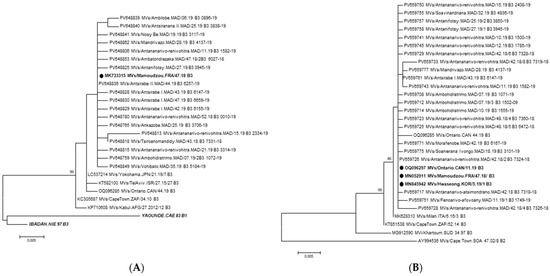
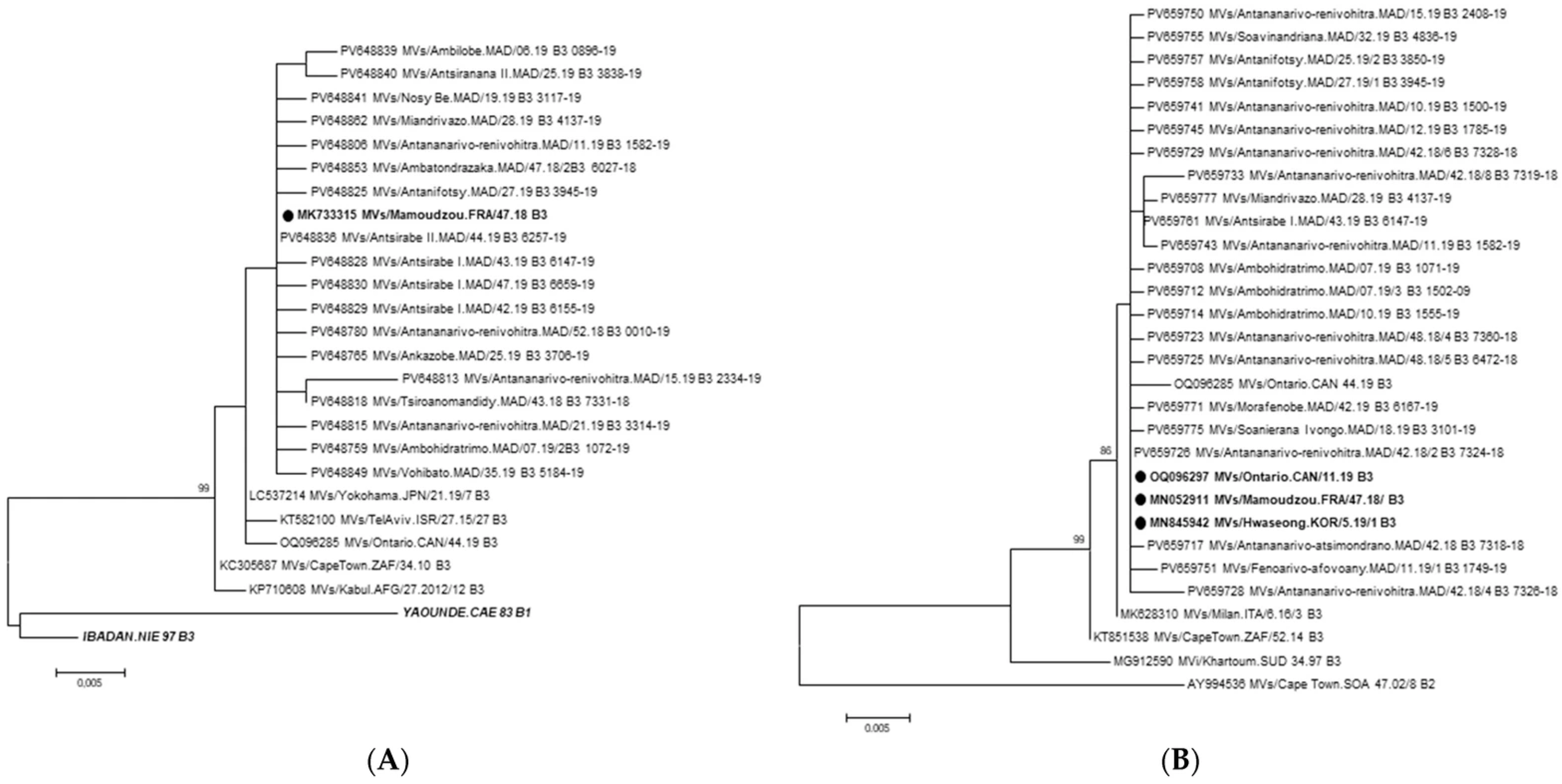
For the N gene, 100 sequences of 450 bp (nucleotide positions 1126–1575 according to Y-14 strain, accession number U01998) were obtained from the 111 amplicons sent for sequencing. The remaining sequences were partial and were excluded from further analyses. These sequences exhibited 98.9% to 100% nucleotide identity and 98.7% to 100% amino acid identity across the 450 bp (150 aa) sequences. They showed 99.1% to 100% nucleotide identity with the MVs/Mamoudzou.FRA/47.18 [B3] strain detected in Mayotte (Comoros Islands, Indian Ocean) in 2018. In addition, 47 sequences of 936 bp of the H gene (nucleotide positions 510–1445 according to the MVs/Milan.ITA/3.16/2 [B3] strain, accession number MK628300) were obtained from the 65 samples from which the H1 + H2 fragments were amplified. They displayed 99.7% to 100% nucleotide identity and 97.1% to 100% amino acid identity among themselves over the 936 bp (312 aa) sequences. They shared 99.8% to 100% nucleotide identity with MVs/Mamoudzou.FRA/47.18 [B3], MVs/Hwaseong.KOR/5.19/1 [B3], and MVs/Ontario.CAN/11.19 [B3] strains, identified in 2018 and 2019. Phylogenetic analyses were performed on the nucleotide sequences of the N and H genes of MeV (Figure 1). To construct the trees, and for clarity, given that many sequences had 100% nucleotide identity between them, only one sequence from each was used (Figure 1). Consequently, 18 and 22 Malagasy sequences of the N and H genes were included, respectively. All MeV strains detected during this outbreak belonged to the [B3] genotype.
Figure 1.
Phylogenetic analysis of the N gene (450 bp) (A) and H gene (936 bp) (B) sequences of MeV. The scale bar indicates the number of nucleotide substitutions per site. Isolates with solid black circles represent the closest available sequences, and those in bold and italic correspond to reference viruses. Only bootstrap values > 75% are indicated.
In another hand, search for RuV was carried out in 175 patients: 173 who tested negative for MeV (including five patients from whom three types of samples were collected and 168 from whom only a gingival sample was collected), and the two from whom three types of samples were collected but whose urine samples were negative for MeV (Table 1). The M:F ratio was 0.84 (80/95), and the mean age was 10.9 years (range: 0–61 years). The RuV positivity rate was 40.0% (70/175) (Table 1 and Table 2). The mean age of the positive patients was 7.2 years (range: 0.6–33.8 years). The overall sample-based positivity rate was 40.0% (74/185), including 39.9% of gingival samples (69/173), 60% of stool (3/5), and 28.6% of urine samples (2/7) being positive (Table 2).
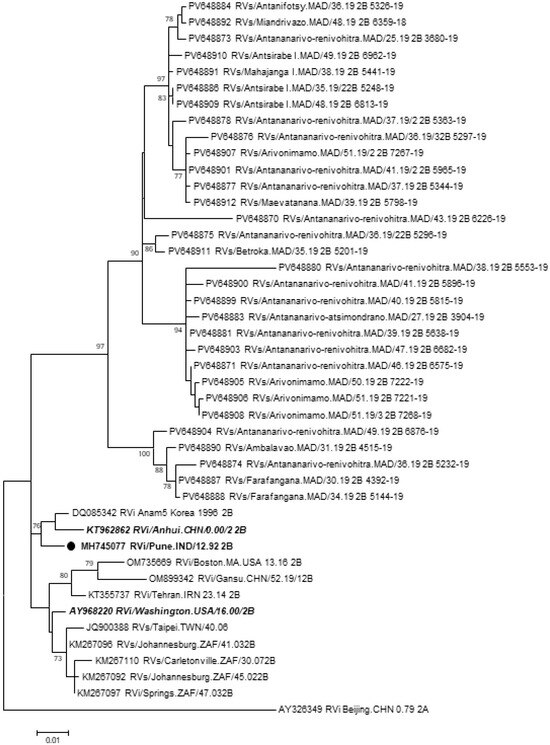
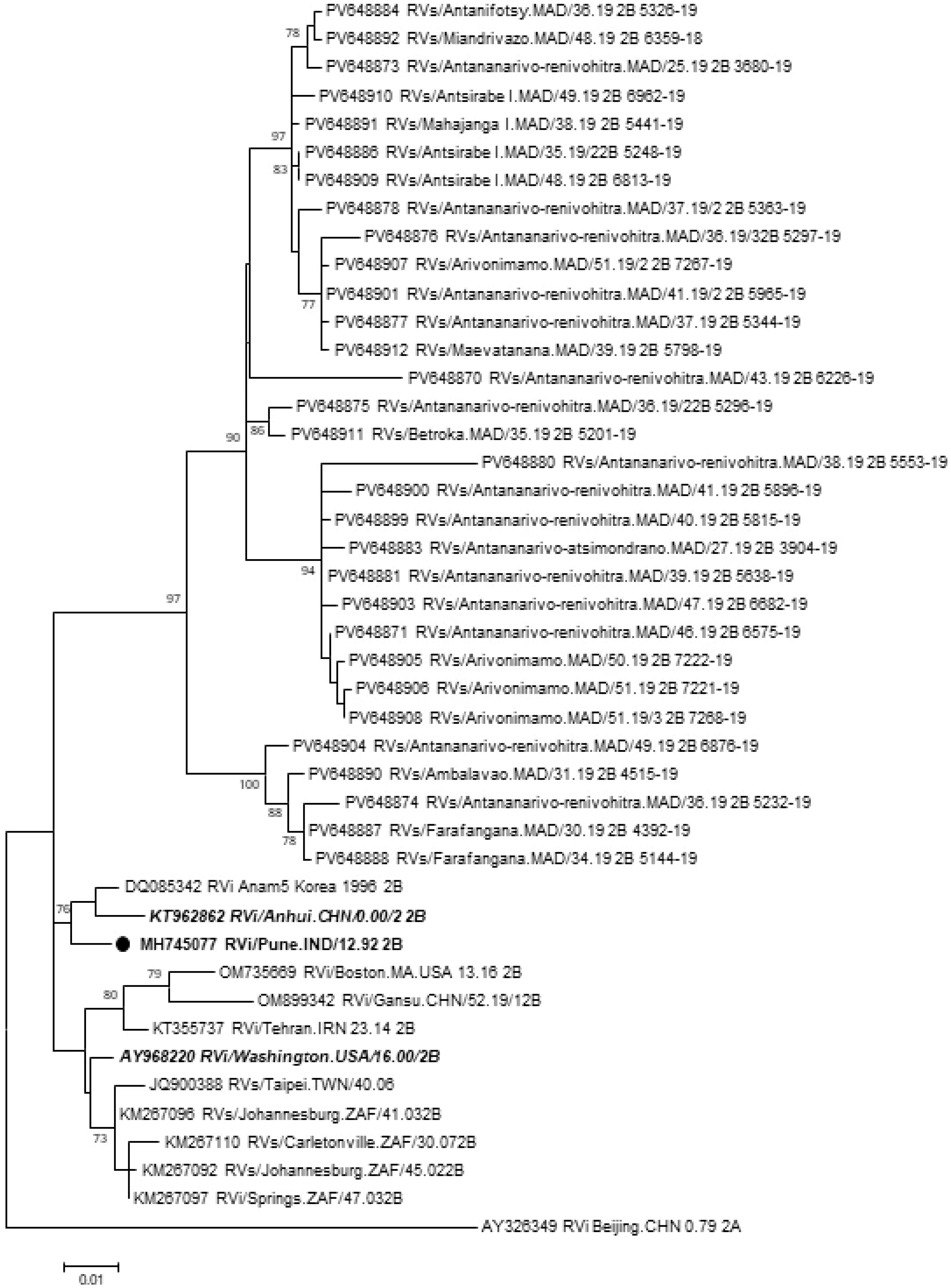
Of the 74 samples positive for RuV by quantitative RT-PCR, 47 (63.5%) were positive for the E1 gene by conventional RT-PCR, including 44 gingival samples (63.8%), one stool sample (33.3%), and two urine samples (100%) (Table S2). The 27 negative samples had Ct values greater than 31.4 in the real-time assay. Forty-three E1 gene sequences were obtained. Sequences of 739 bp in length (nucleotide positions 8731 to 9469 according to the RVi/Seattle.WA.USA/16.00 [2B] strain, accession number JN635293) were obtained for 31 of the 43 RT-PCR products sent for sequencing. They exhibited between themselves 94.3% to 99.9% nucleotide identity and 94.3% to 100% amino acid identity over the 739 bp (246 aa) sequences. They were most closely related to the RVi/Pune.IND/12.92 [2B] strain, showing 94.7% to 96.3% nucleotide identity. BLAST analyses confirmed that all sequences belonged to genotype [2B]. Of note, all Malagasy strains possessed signature mutations at positions G8805C, C8904T, and T/C8958A (nucleotide positions relative to JN635293), compared to other sequences of genotype [2B]. These three polymorphic sites were nevertheless synonymous substitutions. Phylogenetic analysis demonstrated that all Malagasy sequences formed a single, well-supported monophyletic clade (bootstrap value = 97), distinct from RuV sequences from other countries (Figure 2). In addition, they displayed substantial genetic diversity. Within this monophyletic clade, they branched into several distinct well-supported monophyletic sub-clades in which some Malagasy sequences are as genetically distant from each other as some international strains are from one another.
Figure 2.
Phylogenetic analysis of E1 gene sequences (739 bp) of RuV. The scale bar indicates the number of nucleotide substitutions per site. Sequences in bold and italic correspond to reference viruses. Bootstrap values are indicated when >70%.
4. Discussion
This study reveals the co-circulation of MeV (genotype [B3]) and RuV (genotype [2B]) in Madagascar during the 2018–2019 epidemic, with positivity rates of approximately 40% among the tested specimens for each virus.
The specimens analyzed in this study were collected through the national laboratory surveillance system for case confirmation and were not intended to constitute a statistically random sample of all measles cases reported nationally during the outbreak. Nevertheless, they showed broad geographic coverage, with samples originating from all six provinces of Madagascar (22 out of 23 regions), and the demographic characteristics were broadly consistent with national surveillance data [10]. The age distribution of tested suspected cases was broadly consistent with national surveillance data, with a median age of 6.5 years, compared with 6 years nationally, and 73.3% of tested cases aged less than 15 years versus 77% nationally. Sex distribution was also broadly comparable, although females were slightly overrepresented in the tested subset. Vaccination history was insufficiently documented for robust comparison. Overall, these findings support that the molecular dataset reasonably reflected the main epidemiological patterns of the national outbreak and was suitable for virological analysis.
Among tested suspected cases, 33.9% (39/115) of MeV-positive patients and 45.7% (32/70) of RuV-positive patients were children under 5 years of age (Table 3). The substantial burden of both viruses among suspected cases, together with their distinct age distributions (average 12.0 years for MeV vs. 7.2 years for RuV), confirms gaps in vaccination coverage and/or waning immunity in the population. The higher measles positivity observed among individuals aged 10–14 years may also reflect the accumulation of susceptible cohorts resulting from historical gaps in routine immunization and incomplete catch-up vaccination. This interpretation is consistent with previous work in Madagascar showing that major measles outbreaks can occur when immunity deficits build up across successive birth cohorts [20,21].
Table 3.
Detection of measles virus (MeV) and rubella virus (RuV) by age groups.
The positivity rates varied across sample types, ranging from 22.2% to 61.5% for MeV and from 28.6% to 60% for RuV, with stool samples showing the highest rates for both viruses. Gingival specimens yielded similar positivity rates of approximately 40% for both viruses. However, the small number of urine and stool samples limits interpretations regarding the optimal specimen type. In any case, although the search for MeV in stool is uncommon, this study demonstrates the value of this sample type for the molecular diagnosis of measles and rubella, as has already been shown for oral/gingival and urine samples by numerous studies worldwide [22,23,24,25,26,27,28,29,30,31,32].
Molecular characterization also provides insights into transmission dynamics. Malagasy MeV strains were highly similar to strains that circulated in Mayotte, South Korea, and Canada in 2018–2019, suggesting recent introduction or linkage to broader circulation patterns of a globally circulating [B3] genotype. In contrast, Malagasy RuV strains displayed greater within-country genetic diversity and formed a distinct monophyletic clade, suggesting local circulation over time. While the substantial genetic diversity within Malagasy sequences may indicate long-term endemic persistence with multiple co-circulating lineages, the absence of international strains clustering with Malagasy ones suggests that recent introductions have either not occurred or have not established persistent transmission chains. These findings indicate that rubella elimination in Madagascar is achievable but would require sustained high vaccination coverage and strong surveillance across all regions of the country.
5. Conclusions
Genotyping of MeV and RuV is a key component of measles and rubella surveillance and elimination strategies. This study provides the first molecular data on circulating MeV and RuV strains in Madagascar, and it improves our understanding of virus circulation in the African region. Sustained molecular monitoring will be essential to evaluate the impact of vaccination programs, document interruption of endemic transmission, detect reintroduction rapidly, and support national and global measles and rubella elimination goals.
Supplementary Materials
The following supporting information can be downloaded at https://www.mdpi.com/article/10.3390/pathogens15050514/s1, Table S1: Genotyping results per gene (and fragment) and specimen type for MeV; Table S2: Genotyping results per specimen type for RuV.
Author Contributions
R.R., methodology, investigation, formal analysis, software, conceptualization, supervision, validation, project administration, and writing—original draft; J.R., methodology, investigation, software, and supervision; E.A., methodology and investigation; A.E.A., methodology and investigation; A.R., methodology and investigation; L.R., investigation; N.H.R., methodology, formal analysis, and writing—review and editing; S.F.A., formal analysis, software, and writing—review and editing; J.M.H., writing—review and editing; V.L., methodology, formal analysis, software, validation, supervision, writing—original draft, and writing—review and editing. All authors have read and agreed to the published version of the manuscript.
Funding
This surveillance study was supported by WHO through the Technical Services agreement (TSA) number: 2025/1577838.
Institutional Review Board Statement
Ethical approval was obtained from the Ethics Committee for Biomedical Research of the Ministry of Public Health of Madagascar (Comité d’Ethique de la Recherche Biomédicale auprès du Ministère de la Santé Publique de Madagascar # 96/MSANP/CERBM) issued on 28 August 2018.
Informed Consent Statement
Informed consent was obtained from all subjects involved in the study.
Data Availability Statement
The original contributions presented in this study are included Material and methods/Accession number section. Further inquiries can be directed to the corresponding author.
Conflicts of Interest
The authors declare that they have no conflicts of interest.
References
- Rota, P.A.; Brown, K.; Mankertz, A.; Santibanez, S.; Shulga, S.; Muller, C.P.; Hubschen, J.M.; Siqueira, M.; Beirnes, J.; Ahmed, H.; et al. Global distribution of measles genotypes and measles molecular epidemiology. J. Infect. Dis. 2011, 204, S514–S523. [Google Scholar] [CrossRef] [Scilit]
- WHO. Measles virus nomenclature update: 2012. Relev. Epidemiol. Hebd. 2012, 87, 73–81. [Google Scholar]
- CDC. Rubella (German Measles, Three-Day Measles). Available online: https://www.cdc.gov/rubella/index.html (accessed on 23 May 2025).
- WHO. Global Measles and Rubella Strategic Plan: 2012–2020; World Health Organization, Ed.; WHO: Geneva, Switzerland, 2012; p. 42. [Google Scholar]
- Walker, P.J.; Siddell, S.G.; Lefkowitz, E.J.; Mushegian, A.R.; Dempsey, D.M.; Dutilh, B.E.; Harrach, B.; Harrison, R.L.; Hendrickson, R.C.; Junglen, S.; et al. Changes to virus taxonomy and the International Code of Virus Classification and Nomenclature ratified by the International Committee on Taxonomy of Viruses (2019). Arch. Virol. 2019, 164, 2417–2429. [Google Scholar] [CrossRef] [Scilit]
- Das, P.K.; Kielian, M. Molecular and Structural Insights into the Life Cycle of Rubella Virus. J. Virol. 2021, 95, e02349-20. [Google Scholar] [CrossRef] [Scilit]
- WHO. Rubella virus nomenclature update: 2013. Relev. Epidemiol. Hebd. 2013, 88, 337–343. [Google Scholar]
- WHO. Expanded Programme on Immunization (EPI). Standardization of the nomenclature for describing the genetic characteristics of wild-type measles viruses. Relev. Epidemiol. Hebd. 1998, 73, 265–269. [Google Scholar]
- WHO; UNICEF. Measles: Mortality Reduction and Regional Elimination: Strategic Plan 2001–2005; World Health Organization, Ed.; WHO: Geneva, Switzerland, 2001; p. 33. [Google Scholar]
- Sodjinou, V.D.; Douba, A.; Nimpa, M.M.; Masembe, Y.V.; Randria, M.; Ndiaye, C.F. Madagascar 2018–2019 measles outbreak response: Main strategic areas. Pan Afr. Med. J. 2020, 37, 20. [Google Scholar] [CrossRef] [Scilit]
- Hummel, K.B.; Lowe, L.; Bellini, W.J.; Rota, P.A. Development of quantitative gene-specific real-time RT-PCR assays for the detection of measles virus in clinical specimens. J. Virol. Methods 2006, 132, 166–173. [Google Scholar] [CrossRef] [Scilit]
- Schulz, H.; Neale, M.; Zubach, V.; Severini, A.; Hiebert, J. Development of a rapid, internally controlled, two target, real-time RT-PCR for detection of rubella virus. J. Virol. Methods 2022, 303, 114500. [Google Scholar] [CrossRef] [Scilit] [PubMed]
- Emery, S.L.; Erdman, D.D.; Bowen, M.D.; Newton, B.R.; Winchell, J.M.; Meyer, R.F.; Tong, S.; Cook, B.T.; Holloway, B.P.; McCaustland, K.A.; et al. Real-time reverse transcription-polymerase chain reaction assay for SARS-associated coronavirus. Emerg. Infect. Dis. 2004, 10, 311–316. [Google Scholar] [CrossRef] [Scilit] [PubMed]
- Kim, J.M.; Park, S.; Kim, S.; Park, K.R.; Wang, J.S.; Chung, Y.S. Genetic Analysis of the Measles Virus From the Outbreaks in South Korea, 2019. Front. Microbiol. 2021, 12, 763107. [Google Scholar] [CrossRef] [Scilit] [PubMed]
- Namuwulya, P.; Abernathy, E.; Bukenya, H.; Bwogi, J.; Tushabe, P.; Birungi, M.; Seguya, R.; Kabaliisa, T.; Alibu, V.P.; Kayondo, J.K.; et al. Phylogenetic analysis of rubella viruses identified in Uganda, 2003–2012. J. Med. Virol. 2014, 86, 2107–2113. [Google Scholar] [CrossRef] [Scilit]
- WHO. Standardization of the nomenclature for genetic characteristics of wild-type rubella viruses. Relev. Epidemiol. Hebd. 2005, 80, 126–132. [Google Scholar]
- WHO. Global distribution of measles and rubella genotypes—update. Relev. Epidemiol. Hebd. 2006, 81, 474–479. [Google Scholar]
- Xu, S.; Zhang, Y.; Zhu, Z.; Liu, C.; Mao, N.; Ji, Y.; Wang, H.; Jiang, X.; Li, C.; Tang, W.; et al. Genetic characterization of the hemagglutinin genes of wild-type measles virus circulating in china, 1993–2009. PLoS ONE 2013, 8, e73374. [Google Scholar] [CrossRef] [Scilit]
- Kumar, S.; Stecher, G.; Tamura, K. MEGA7: Molecular Evolutionary Genetics Analysis Version 7.0 for Bigger Datasets. Mol. Biol. Evol. 2016, 33, 1870–1874. [Google Scholar] [CrossRef] [Scilit]
- Raherindrasana, A.; Metcalf, C.J.; Heraud, J.M.; Cauchemez, S.; Winter, A.; Wesolowski, A.; Razafindratsimandresy, R.; Randriamampionona, L.; Rafalimanantsoa, S.A.; Masembe, Y.; et al. Towards better targeting: Lessons from a posthoneymoon measles outbreak in Madagascar, 2018–2019. BMJ Glob. Health 2020, 5, e003153. [Google Scholar] [CrossRef] [Scilit]
- Winter, A.K.; Wesolowski, A.P.; Mensah, K.J.; Ramamonjiharisoa, M.B.; Randriamanantena, A.H.; Razafindratsimandresy, R.; Cauchemez, S.; Lessler, J.; Ferrari, M.J.; Metcalf, C.J.E.; et al. Revealing Measles Outbreak Risk With a Nested Immunoglobulin G Serosurvey in Madagascar. Am. J. Epidemiol. 2018, 187, 2219–2226. [Google Scholar] [CrossRef] [Scilit] [PubMed]
- Eckerle, I.; Keller-Stanislawski, B.; Santibanez, S.; Buderus, S.; Hillmann, M.; Drosten, C.; Eis-Hubinger, A.M. Nonfebrile seizures after mumps, measles, rubella, and varicella-zoster virus combination vaccination with detection of measles virus RNA in serum, throat, and urine. Clin. Vaccine Immunol. 2013, 20, 1094–1096. [Google Scholar] [CrossRef] [Scilit] [PubMed]
- Vaidya, S.R.; Kamble, M.B.; Kumbhar, N.S. Laboratory-based investigation of fever with rash cases in the Maharashtra State-India, 2014 to 2017. J. Med. Virol. 2019, 91, 972–978. [Google Scholar] [CrossRef] [Scilit]
- Kalaycioglu, A.T.; Yolbakan, S.; Guldemir, D.; Korukluoglu, G.; Coskun, A.; Cosgun, Y.; Durmaz, R. Towards measles elimination: Phylogenetic analysis of measles viruses in Turkey (2012–2013) and identification of genotype D8. J. Med. Virol. 2016, 88, 1867–1873. [Google Scholar] [CrossRef] [Scilit] [PubMed]
- Duraisamy, R.; Rota, P.A.; Palani, G.; Elango, V.; Sambasivam, M.; Lowe, L.; Lopareva, E.; Ramamurty, N. Molecular characterization of wild-type measles viruses in Tamil Nadu, India, during 2005–2006: Relationship of genotype D8 strains from Tamil Nadu to global strains. J. Med. Virol. 2012, 84, 348–357. [Google Scholar] [CrossRef] [Scilit]
- Shakya, A.K.; Shukla, V.; Maan, H.S.; Dhole, T.N. Identification of different lineages of measles virus strains circulating in Uttar Pradesh, North India. Virol. J. 2012, 9, 237. [Google Scholar] [CrossRef] [Scilit]
- Vaidya, S.R.; Chowdhury, D.T. Measles virus genotypes circulating in India, 2011–2015. J. Med. Virol. 2017, 89, 753–758. [Google Scholar] [CrossRef] [Scilit] [PubMed]
- Magurano, F.; Fortuna, C.; Marchi, A.; Benedetti, E.; Bucci, P.; Baggieri, M.; Nicoletti, L. Molecular epidemiology of measles virus in Italy, 2002–2007. Virol. J. 2012, 9, 284. [Google Scholar] [CrossRef] [Scilit]
- McMahon, J.L.; Northill, J.A.; Finger, M.; Lyon, M.; Lambert, S.B.; Mackay, I.M. Laboratory methods supporting measles surveillance in Queensland, Australia, 2010–2017. Access Microbiol. 2020, 2, acmi000093. [Google Scholar] [CrossRef] [Scilit]
- Oude Munnink, B.B.; Phan, M.V.; Kellam, P.; Cotten, M.; Consortium, V. Complete Genome Characterization of Two Wild-Type Measles Viruses from Vietnamese Infants during the 2014 Outbreak. Genome Announc. 2016, 4. [Google Scholar] [CrossRef] [Scilit]
- Waku-Kouomou, D.; Landreau, D.; Olivier, S.; Palmyre, P.; Benoit-Catin, T.; Freymuth, F.; Wild, T.F. Molecular characterization of measles virus circulating in the Indian Ocean Islands during 2005–2006 and in France in 2006. J. Med. Virol. 2007, 79, 1381–1387. [Google Scholar] [CrossRef] [Scilit]
- Uchino, K.; Miyoshi, T.; Mori, Y.; Komase, K.; Okayama, F.; Shibata, Y.; Yoshida, H.; Numata, T.; Takeda, M.; Tanaka, T. Comparison of virological and serological methods for laboratory confirmation of rubella. J. Clin. Virol. 2020, 123, 104257. [Google Scholar] [CrossRef] [Scilit] [PubMed]

Disclaimer/Publisher’s Note: The statements, opinions and data contained in all publications are solely those of the individual author(s) and contributor(s) and not of MDPI and/or the editor(s). MDPI and/or the editor(s) disclaim responsibility for any injury to people or property resulting from any ideas, methods, instructions or products referred to in the content. |
© 2026 by the authors. Licensee MDPI, Basel, Switzerland. This article is an open access article distributed under the terms and conditions of the Creative Commons Attribution (CC BY) license.