Article

Prevalence of pfdhfr-pfdhps Sextuple and Gametocyte-Associated Quintuple Sulfadoxine-Pyrimethamine Resistance Mutations in Plasmodium falciparum Isolates from Pregnant Women in Mozambique

by
Yasmina Drissi-El Boukili
1,2,
Eduard Rovira-Vallbona
1,†,
Pieter Guetens
1,
Driss Chiheb
1,
Johanna Helena Kattenberg
1,
Luc Kestens
1,2,
Sonia Maria Mauricio Enosse
3,4,
Anna Rosanas-Urgell
1,* and
Paulo Arnaldo
1,2,3
1
Department of Biomedical Sciences, Institute of Tropical Medicine, 2000 Antwerp, Belgium
2
Faculty of Pharmaceutical, Biomedical and Veterinary Sciences, University of Antwerp, 2610 Antwerp, Belgium
3
Divisão de Investigação em Saúde e Bem-Estar, Instituto Nacional de Saúde, Maputo 264, Mozambique
4
Malaria Consortium, Maputo 118, Mozambique
*
Author to whom correspondence should be addressed.
Current affiliation: ISGlobal, 08036 Barcelona, Spain.
Pathogens 2026, 15(5), 504; https://doi.org/10.3390/pathogens15050504
Submission received: 23 March 2026 / Revised: 27 April 2026 / Accepted: 4 May 2026 / Published: 7 May 2026
(This article belongs to the Special Issue Epidemiology and Molecular Diagnosis of Vector-Borne Diseases)

Abstract

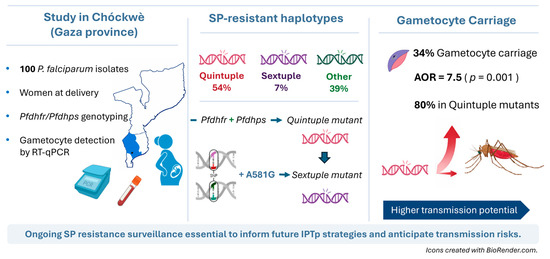
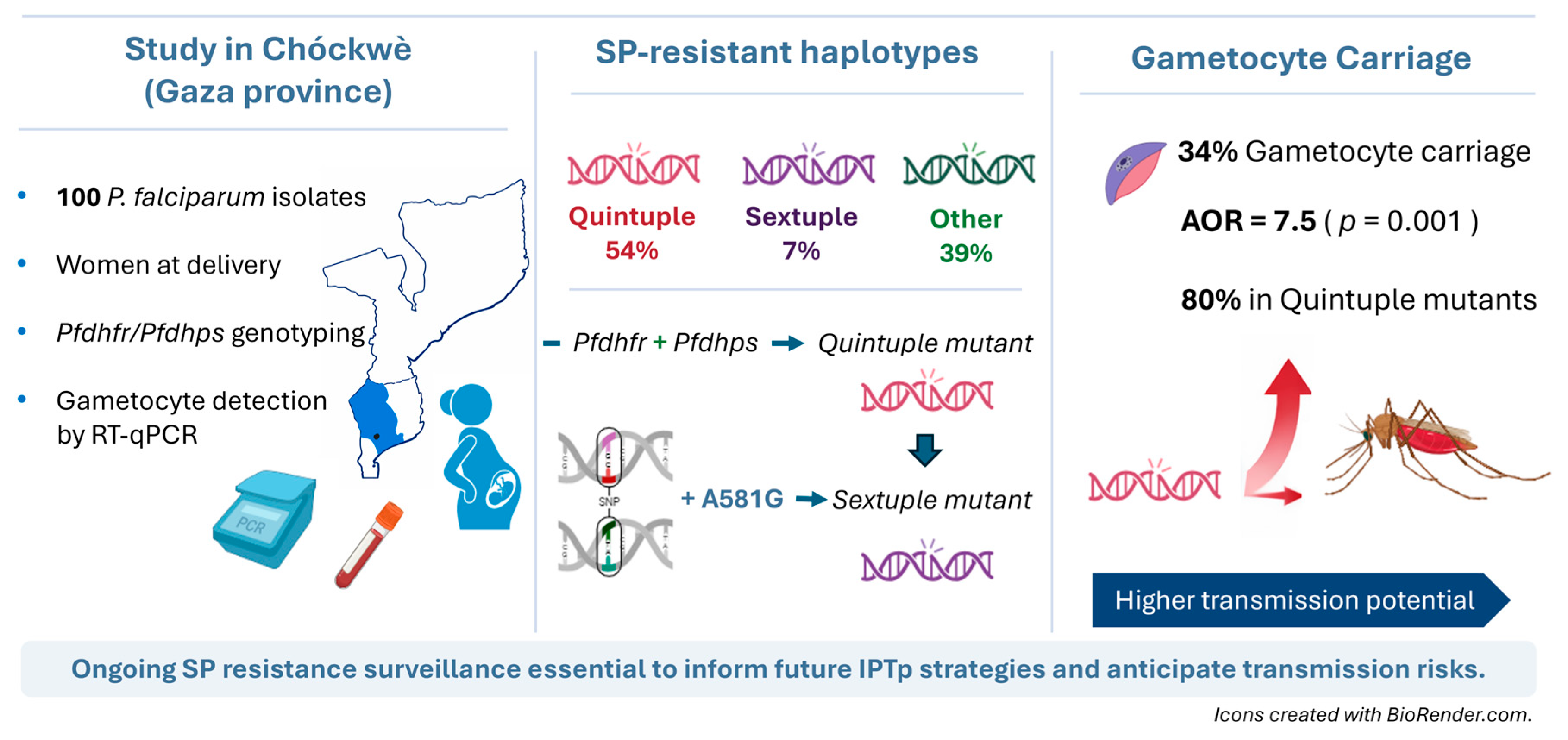
Intermittent preventive treatment with sulfadoxine-pyrimethamine (IPTp-SP) remains the main strategy to prevent malaria in pregnancy. However, continued drug pressure may also contribute to the emergence of resistant parasites and impact the gametocyte carriage and subsequent infectiousness. Pregnant women are thought to be a potential reservoir for malaria transmission due to the increased carriage of gametocytes following long-lasting infections. We used molecular methods to examine 100 Plasmodium falciparum (P. falciparum) isolates collected from Mozambican women at delivery in 2014-15 to determine sulfadoxine-pyrimethamine (SP) resistance polymorphisms in P. falciparum dihydrofolate reductase (pfdhfr) and dihydropteroate synthetase (pfdhps) genes, as well as the presence of gametocytes by RT-qPCR. Overall, 54% and 7% of parasites harbored quintuple and sextuple pfdhfr/pfdhps mutant haplotypes, respectively. Gametocytes were detected in 34% of isolates. Gametocyte carriage was significantly associated with quintuple mutant infections (AOR = 7.5, p = 0.001), which accounted for 80% of infections with detectable gametocytes. Results indicate the relevance of ongoing surveillance of SP resistance in Mozambique to guide future evaluation of alternative intermittent preventive treatment in pregnancy (IPTp) approaches as resistance levels evolve and anticipate potential implications for parasite transmission and maternal–fetal health.

Graphical Abstract

1. Introduction

Malaria remains a major cause of maternal and perinatal morbidity and mortality in sub-Saharan Africa (SSA). Approximately 33 million pregnant women in SSA are at risk of acquiring Plasmodium falciparum (P. falciparum) each year [1]. Although Plasmodium malariae and Plasmodium ovale are present in Mozambique, accounting for approximately 9% and 1% of cases, respectively, their contribution to malaria burden and control strategies remains limited compared to Plasmodium falciparum, which predominates (approximately 90% of the cases) [2]. Current interventions to prevent malaria in pregnancy (MiP) and improve pregnancy outcomes include the use of long-lasting insecticidal nets (LLINs), administration of intermittent preventive treatment in pregnancy with sulfadoxine-pyrimethamine (IPTp-SP) and timely treatment with effective antimalarial drugs [1,3]. IPTp-SP should be given starting from the second trimester, at monthly intervals, with a minimum of three doses continuing until delivery, at antenatal care (ANC) visits [3,4].
The effectiveness of sulfadoxine-pyrimethamine (SP) for IPTp is increasingly compromised by the emergence and spread of SP-resistant strains [5]. This resistance is primarily due to specific point mutations in the P. falciparum dihydrofolate reductase (pfdhfr) and dihydropteroate synthase (pfdhps) genes coding for the enzymes targeted by SP. Cumulative point mutations in the pfdhfr and pfdhps genes are associated with increased resistance to SP [6]. The quintuple mutant parasite, characterized by pfdhfr substitutions N51I, C59R, and S108N and pfdhps substitutions A437G and K540E, associated with mid-level resistance, has been linked to a higher risk of SP treatment failure in children with malaria and a reduced prophylactic period in pregnant women [5,7,8,9,10], although protection against low birth weight (LBW) is sustained [8,11]. The emergence of the pfdhps A581G mutation on a quintuple mutant background, forming the so-called sextuple mutant associated with high-level resistance [12,13], has led to a reduced effectiveness of IPTp-SP in preventing malaria infections [14]. IPTp-SP remains effective at reducing LBW and maternal anemia, even in areas with high SP resistance (although the protective effect is less than in areas with lower levels of resistance), possibly through non-malaria effects on fetal growth [15]. In contrast, other studies did not find a statistically significant association between A581G mutations and reduced IPTp-SP efficacy [16,17]. Additional mutations, such as pfdhfr I164L and pfdhps S436F and A613S, are associated with increased SP resistance [13,18,19]. Other mutations have been reported in key molecular markers that play a significant role in resistance to different classes of antimalarial drugs [20].
In Mozambique, IPTp-SP was implemented in 2006 [21] and the national guidelines were updated in 2014 to implement equal or more than three SP doses during pregnancy as recommended by WHO. The prevalence of the quintuple mutant haplotype in individuals infected with P. falciparum increased significantly over time, from 80% in 2015 to 89% in 2018, reaching 95% in Maputo (southern Mozambique) in 2018 [22]. A recent genomic surveillance study conducted in 2021–2022 reported similarly high prevalences nationwide, ranging from 87.8% to 92.7% [20]. In Gaza province, the quintuple mutant increased from 56% in 2006 to 76% in 2010 [23], and further to 89.5% in 2018 [22,24]. In contrast, the prevalences of pfdhps A581G and A613S and pfdhfr I164L mutations remained low, below 1% nationwide in 2018 [22], and below 2% in 2021–2022 [20]. Among pregnant women receiving IPTp-SP in Maputo province (Manhiça district) between 2016 and 2019, 94% carried the quintuple mutant haplotype. However, no pfdhps A581G mutation, indicative of the sextuple mutant associated with reduced SP efficacy, was observed [22,24].
SP has limited gametocytocidal activity, particularly against mature gametocytes [25,26,27]. Several studies have reported increased microscopic and submicroscopic gametocyte carriage following SP administration, often at densities sufficient to infect Anopheles mosquitoes [28,29,30,31]. It has also been shown that SP can influence gametocyte sex ratio [32,33,34,35,36] in favor of more male gametocytes, which may have implications in increasing infectivity to mosquitos [34,36,37]. Therefore, even when IPTp-SP can effectively clear asymptomatic infections in pregnant women, it may simultaneously increase gametocyte carriage, alter sex ratios, and thus contribute to the human infectious reservoir [36,38]. In this context, the potential of IPTp-SP to select resistant strains through gametocyte-mediated transmission needs consideration, particularly in areas with high resistance prevalence [9,14,28,39].
In this study, we assessed the frequency of pfdhfr/pfdhps mutations in P. falciparum parasites collected from pregnant women at delivery in the rural Chókwè district, Gaza province, Mozambique, between 2014 and 2015. We analyzed associations between mutant haplotypes and parasitological and pregnancy outcomes as well as the impact of IPTp-SP on gametocyte carriage and densities.

2. Materials and Methods

2.1. Study Site, Population and Samples

In this study, we analyzed 100 samples from pregnant women who had P. falciparum infection at the time of delivery and participated in a descriptive observational study published elsewhere [40]. In brief, the original study enrolled 914 pregnant women at delivery in Chókwè district, Southern Mozambique, as part of a previous hospital-based survey conducted between June 2014 and June 2015. Chókwè is endemic for P. falciparum and characterized by perennial malaria transmission. Detailed descriptions of the study site and population have been described before [40]. Immediately after delivery, a 3 mL venous blood sample was collected from each woman into EDTA-containing tubes. From this, 200 µL was transferred into an EDTA microtainer, and 100 µL into RNAprotect, for subsequent DNA and RNA extraction, respectively.

2.2. DNA Extraction and P. falciparum Diagnosis

Molecular detection of P. falciparum infections was performed by qPCR using a TaqMan probe-based assay as previously described [41] (see Table S1 in [41] for full assay details). Briefly, DNA was extracted, according to the manufacturer’s instructions, from 200 μL of blood using a QIAamp 96 DNA blood kit (Qiagen, Hilden, Germany) and eluted in 200 μL of water. Five microliters of DNA was used for qPCR analysis targeting P. falciparum var gene acidic terminal sequence (varATS, ~59 copies per genome) as previously described [41]. Reactions were performed on a thermocycler platform (StepOne Plus Real-time PCR System, Applied Biosystems, Waltham, MA, USA) and data acquisition was carried out using StepOne Software, v2.3). Parasite densities were obtained by interpolating cycle thresholds (Ct) from a standard curve of infected erythrocytes diluted in whole blood (from 100,000 to 0.01 parasites/μL of blood). Samples with Ct values ≤ 38.5 Ct were considered positive. The limit of detection (LOD) was 0.04 parasites/μL of blood. Placental infections were detected in placental tissues by histological examination as described elsewhere [40].

2.3. Genotyping pfdhfr and pfdhps Genes

To genotype mutations at the pfdhfr loci (N51I, C59R, S108N, and I164L) and the pfdhps loci (S436F, A437G, K540E, and A581G), we performed PCR-restriction fragment length polymorphism (PCR-RFLP) on a Biometra T professional gradient Thermocycler (Thistle Scientific Ltd., Glasgow, UK) using primers and nested-PCR protocols described previously [42,43]. Primer pairs and restriction enzymes used for pfdhfr and pfdhps polymorphism detection are described in Table S1. This method was used due to its high sensitivity to detecting mixed infections, observed at high proportion in regions with moderate-to-high malaria transmission. Detailed experimental conditions for PCR-RFLP analyses, including restriction enzyme digestion parameters, reaction buffers, digestion controls, and electrophoresis conditions (gel composition, running conditions, and molecular weight markers), are provided in the Supplementary Materials. Restriction enzyme digestions were performed on 5 µL of PCR product in a final volume of 15 μL according to the manufacturer’s instructions (New England Biolabs, Ipswich, MA, USA). Double digestions were carried out for specific codons: at codon 581 using BslI and BstUI, and at codon 164 using DraI, with reactions incubated at the temperatures and durations recommended by the manufacturer (Supplementary Materials). Plasmid controls for PCR-RFLP obtained from MR4-BEI resources “https://www.beiresources.org/MR4Home.aspx (accessed on 23 March 2026)” were used as wild-type and mutant controls for pfdhfr and pfdhps polymorphisms (Supplementary Materials and Figure S1). The specific plasmids included were FR-3D7 (MRA199), FR-V1/S (MRA195), PS-FCR (MRA192), PS-Dd2 (MRA193), PS-Mali (MRA191), and PS-Peru (MRA190), as detailed in the Supplementary Materials and Figure S1. We defined mixed alleles as mutants.

2.4. Multiplicity of Infection

To determine the multiplicity of infection (MOI), P. falciparum merozoite protein 1 and 2 (pfmsp1 and pfmsp2) were amplified by PCR and analyzed by capillary electrophoresis (Genoscreen, Lille, France) [44,45]. MOI was defined as the highest frequency of pfmsp1 or pfmsp2 alleles in a single sample.

2.5. RNA Extraction and Quantification of Gametocytes by Pfs25 RT-qPCR and Light Microscopy

RNA extraction of P. falciparum varATS positive samples was done using the RNeasy Plus 96 Kit (Qiagen, Hilden, Germany) from 100 μL of blood collected into 500 μL of RNAprotect stabilizer reagent (Qiagen) using the manufacturer’s instructions. Extracted RNA was eluted in a final volume of 90 μL of RNase-free water (Qiagen). RNA extractions were treated with on-column DNase I treatment (Qiagen) to remove DNA contaminants, according to the manufacturer’s instructions. Pfs25 female gametocyte-specific transcripts were detected using a one-step reverse transcription qPCR (RT-qPCR) [46,47]. Details are further described in the Supplementary Materials. Briefly, P. falciparum gametocyte densities were quantified using a 7-point standard curve ranging from 105 to 0.1 gametocytes/μL generated from cultured 3D7 P. falciparum stage V gametocytes, prepared as described elsewhere [47]. The LOD of this assay was 0.1 gametocytes/µL of blood. Samples with Ct values higher than the last standard curve point were considered to contain <0.1 gametocytes/µL, i.e., LOD. Mature P. falciparum gametocytes were detected in peripheral blood smears by light microscopy (LM) with 5% Giemsa staining (pH = 7.2) for 25 min [48].

2.6. Data Analysis

Data were analyzed using STATA version 14.2 (Stata Corp LLC, College Station, TX, USA) and RStudio software (version 2025.09.1; Posit Software, PBC, Boston, MA, USA; RRID: SCR_000432). A significance level of p ≤ 0.05 was assigned to all analyses. Parity was categorized as primigravidae (first pregnancy) and multigravidae (two or more pregnancies). Low birth weight was defined as birth weight at delivery less than 2500 g. Age was categorized as <20 and ≥20 years old. Binary variables for mutant haplotypes were defined as those carrying a specific mutation or haplotype versus all the others. Haplotypes were built in monoallelic infections at dhfr and dhps loci, or when only one of the haplotype positions had multiple alleles. In infections with multiple variants at more than one loci, haplotypes were estimated as “mutant haplotypes”. Samples were grouped by “mutant haplotype”, quintuple mutant (triple pfdhfr + double pfdhps); sextuple mutant (quintuple + A581G); and “other” haplotypes (including triple pfdhfr, wild-type, and others described in Table S2).
Frequencies of point mutations and infection haplotypes were determined both overall and stratified by IPTp-SP uptake (<3 vs. ≥3 doses). Associations between risk factors and mutation carriage were assessed using univariate and multivariate regression analyses. Similar models were used to evaluate associations between mutant haplotypes and adverse pregnancy outcomes, among other risk factors. Categorical variables were compared using the χ2 test or Fisher’s exact test, as appropriate. Continuous variables were compared using Student’s t-test and the Kruskal–Wallis test, as appropriate.
Gametocyte density data (gametocytes/µL of blood) were strongly right-skewed and deviated from normality. Gametocyte densities were log10-transformed prior to regression analyses to reduce skewness and improve linearity; however, the transformed data remained non-normally distributed. Raw gametocyte densities are reported for descriptive and comparative purposes. Differences in gametocyte carriage across mutant haplotype groups were assessed using Fisher’s exact test, and differences in gametocyte densities across mutant haplotype and IPTp-SP uptake groups were assessed using the Kruskal–Wallis test. Frequencies of gametocyte carriers were also compared among IPTp-SP uptake groups (none, one, two vs. ≥3 doses) using the χ2 test. Median [IQR] gametocyte densities were visualized using dot plots.
Univariate and multivariate logistic regression models were used to examine risk factors associated with mutant (SP-resistant) haplotypes and gametocyte carriage. Linear regression models were applied to assess associations with gametocyte densities and the effect of mutant haplotypes on pregnancy outcomes. Model assumptions for linear regression were evaluated by visual inspection of residual diagnostic plots. Effect estimates from linear models are presented on the log scale, corresponding to multiplicative differences in gametocyte density.

3. Results

3.1. Characteristics of the Study Participants

The demographic and parasitological characteristics of the 100 pregnant women with a P. falciparum infection at delivery included in this study are described in Table 1. Seventy-three percent (73/100) of women had a submicroscopic P. falciparum infection (positive by qPCR and negative by LM) at delivery, and 54% (54/100) of women received ≥ 3 IPTp-SP doses. Submicroscopic infections at delivery were present in 75.6% (65/86) of women that received at least one dose of IPTp-SP and 57.1% (8/14) among those that did not receive IPTp (p = 0.15). MOI was successfully determined in 95 samples with median n [IQR] MOI of 3.00 [2.0–4.0] clones/sample. Polyclonal infections were found in 83% of cases (83/95). There were five samples that could not be amplified to assess MOI (Table 1).

3.2. Frequency of P. falciparum pfdhfr-pfdhps Alleles

Genotyping results are summarized in Table 2, Table 3 and Table S2.
Mutations in the pfdhfr and pfdhps genes were highly prevalent, detected in 92% and 91% of isolates, respectively (Table 2). The pfdhfr triple mutant haplotype (IRN [N51I, C59R, S108N]) was observed in 79% of isolates, with only two samples carrying the additional I164L mutation (Table 3). Similarly, the pfdhps double mutation (GE [A437G, K540E]) was detected in 57% of isolates, while the A581G mutation was present in 14% of samples, with 71.4% carrying the triple mutant haplotype (GEG [A437G, K540E, and A581G]) and being polyclonal. When combining pfdhfr-pfdhps haplotypes, the quintuple mutant (IRN-GE) was observed in 54% of isolates, and the sextuple mutant (IRN-GEG) in 7%, while only 2% of isolates were wild-type.

3.3. Risk Factors for Carriage of Quintuple and Sextuple Mutant Parasites

We investigated risk factors associated with quintuple and sextuple mutation carriage. Results from the multivariate analysis are shown in Table 4 (the univariate analysis is shown in Table S3). Parasite density at delivery (peripheral parasite density ≥ 100 p/µL) was not associated with increased carriage of resistant parasites. However, pregnant women receiving ≥3 IPTp-SP doses had higher odds (AOR = 3.7, p = 0.004; Table 4) of carrying quintuple mutant parasites (IRN-GE), while no association was observed in women carrying the sextuple mutant parasites.
We also investigated whether the odds of adverse pregnancy outcomes, i.e., LBW, placental malaria and pre-term delivery, was higher in women carrying quintuple and sextuple mutant parasites at delivery. Results from the multivariate analysis did not show significant associations between the carriage of resistant parasites and adverse outcomes (Table 5; the univariate analysis is presented in Table S4).
There was no significant difference in the proportion of monoclonal (MOI = 1) and polyclonal (MOI ≥ 2) infections between participants carrying parasites with no mutations and those carrying parasites with one or more mutations (p = 0.63; Table S5). The distribution of pfmsp1 and pfmsp2 allelic families did not significantly differ among study participants carrying parasites with no mutations (wild-type) compared to those with one or more mutations.
The median MOI across mutant haplotype groups was 4.5 [2.5–5.5] in “wild-type” parasites, 3 [2.0–3.0] in study participants carrying “quintuple (dhfr/dhps),” and 3 [2.0–3.0] “sextuple (dhfr/dhps)” parasites, and 3.5 [2.5–5.0] in participants carrying in parasites with “other haplotypes” (Supplementary File Table S5).

3.4. IPTp-SP and Gametocyte Carriage

Pfs25 transcripts were detected in 34/100 women at delivery using one-step RT-qPCR, resulting in an overall gametocyte carriage prevalence of 34% in the study population. In contrast, only 2/100 women were positive for gametocytes by LM. Most gametocyte carriers harbored parasites with quintuple mutations (26/34, 80%) (Table 6).
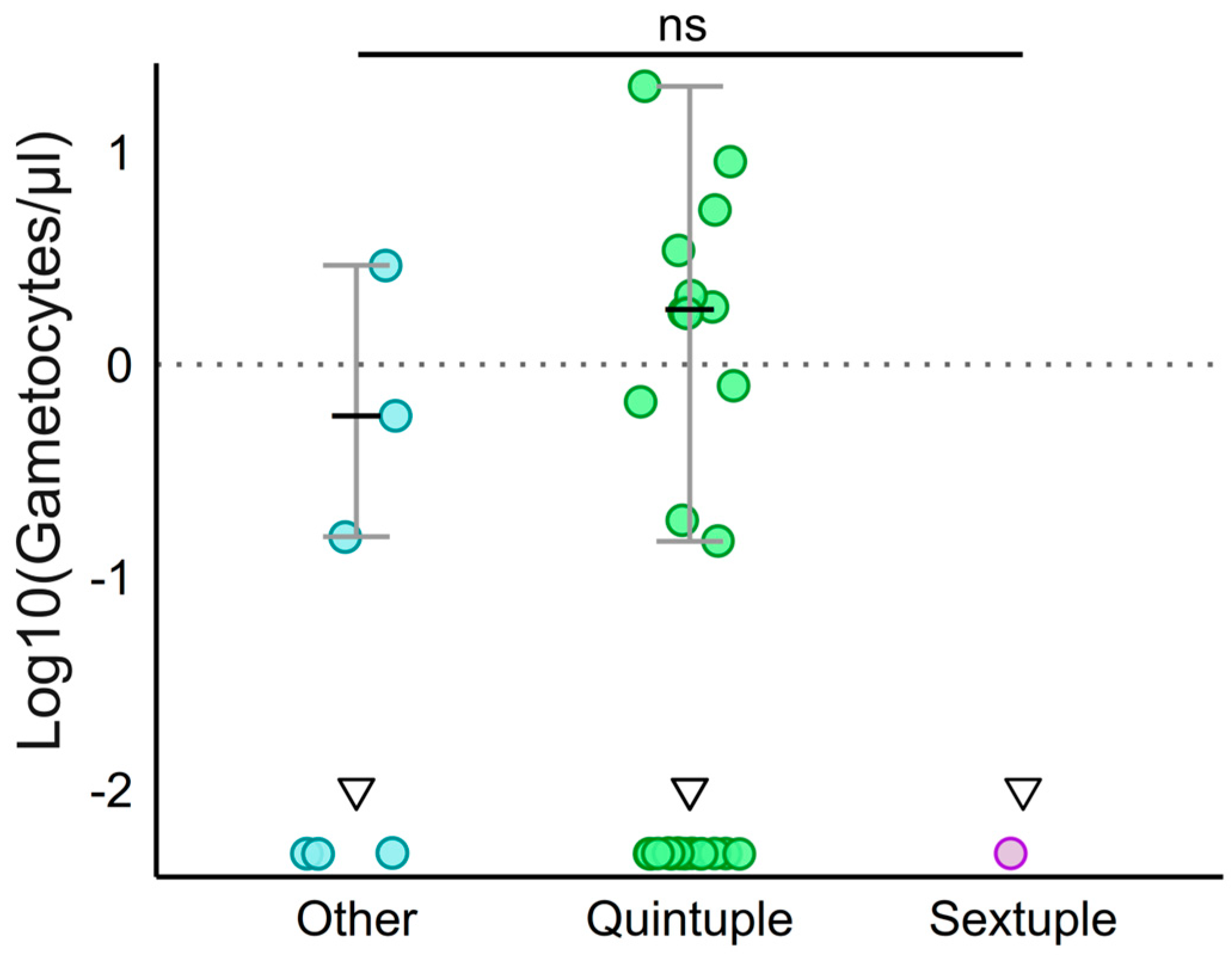
Gametocyte carriage was more prevalent in infections with quintuple mutant parasites compared to sextuple and other haplotypes (Fisher’s exact test, p = 0.0011; Table 6). Median [IQR] gametocyte densities were low across all haplotype groups (1.76 [0.62–3.19]) and did not differ significantly between haplotypes (Kruskal–Wallis test, p = 0.31; Figure 1, Table 6). Similarly, gametocyte carriage and densities did not differ significantly across IPTp-SP dose groups (χ2 test, p = 0.40; Kruskal–Wallis test, p = 0.39, respectively) (Table S6).
To investigate factors associated with gametocyte carriage, we performed a multivariate logistic regression analysis (Table 7). Mutant haplotype was the only significant predictor: women with infections with quintuple mutant parasites had 7.5-fold higher odds of carrying gametocytes (AOR = 7.5, 95% CI 2.5–27.3, p = 0.001). Age, place of residence, gravidity, IPTp-SP dose, parasite density, and placental malaria were not significantly associated with gametocyte carriage in the adjusted models (Table 7).
We further investigated factors associated with gametocyte density, modeled as a continuous variable in univariate linear regression. However, none of the variables included in the analysis were significantly associated with gametocyte density (Table 8), indicating that age, place of residence, gravidity, number of IPTp-SP doses, parasite density, placental infection, or the presence of SP resistance markers may not be drivers of increased gametocyte densities among pregnant women in our study population.

4. Discussion

Although SP is no longer recommended for the treatment of P. falciparum malaria due to widespread resistance, IPTp-SP remains the main strategy to prevent MiP across most SSA countries [49]. Even in areas with a high prevalence of pfdhfr and pfdhps mutations, IPTp-SP continues to reduce LBW and maternal anemia, despite its reduced efficacy in preventing infection [9]. Regular monitoring of SP molecular resistance markers therefore remains essential.
In this study, nearly all P. falciparum samples (98%) from pregnant women carried mutations in pfdhfr and/or pfdhps, with a high prevalence of the clinically relevant quintuple (pfdhfr N51I, C59R, S108N and pfdhps A437G, K540E; IRN-GE) and sextuple (pfdhfr N51I, C59R, S108N and pfdhps A437G, K540E, A581G, IRN-GEG) mutant haplotypes in 54% and 7% of infections, respectively, while mutations such as I164L (2%) and A581G (14%) remained less frequent. The quintuple mutant prevalence is consistent with earlier reports from Gaza province in 2006 [23], and aligns with the increasing prevalence over time observed across Mozambique between 2006 (56.2%) and 2022 (>87%) [11,20,23]. In contrast, the higher frequency of the additional pfdhps A581G mutation observed in our study (14%) compared to previous reports (≤1.6%) [11,20] may reflect ongoing local selection pressure under sustained IPTp-SP use. Relatively high IPTp-SP coverage in parts of Mozambique (approximately 47–63% receiving ≥3 doses) may contribute to this elevated A581G prevalence [40,50].
Although samples analyzed in this study were collected in 2014–2015, they provide relevant insights into SP resistance dynamics. The relatively high A581G prevalence (14%) compared to recently published studies may reflect specific selection pressure in IPTp-SP-exposed pregnant women and epidemiological heterogeneity [20]. These findings highlight population and spatial variation in resistance patterns.
The predominance of quintuple mutant haplotypes in our study is consistent with patterns across East and Southern Africa, where the combination of the pfdhfr triple mutant (N51I, C59R, S108N) and pfdhps (A437G, K540E)—defining the quintuple mutant haplotype—is highly prevalent, though frequencies vary geographically [51]. However, in a study of children in Gaza province, the A581G mutation was not present [52], suggesting that drug exposure during pregnancy exerts distinct selection pressures. A Ghanaian study identified a correlation between A581G-carrying parasites and elevated plasma SP concentrations during delivery, though mutant frequencies did not differ between women receiving≥ 3 versus <3 IPTp-SP doses [8,53,54,55,56,57], illustrating that drug pressure influences A581G selection differently across regions.
The emergence of sextuple pfdhfr/pfdhps haplotype has been associated with progressive reductions in IPTp-SP’s efficacy against infection [15]. Nevertheless, the protective effect on LBW persists in several regions, potentially due to SP’s non-parasitic activity via anti-inflammatory or antibacterial effects [8,15,58,59]. Our findings showed no association between sextuple haplotypes and LBW. This is consistent with existing research suggesting that the efficacy of IPTp-SP is determined by broader, population-level resistance patterns rather than the presence of specific individual haplotypes [15]. Importantly, IPTp-SP has been shown to provide benefits in Mozambique [11], indicating that it remains effective despite the presence of SP resistance markers.
Participants infected with quintuple—but not sextuple—mutants had higher asexual parasite densities, which may indicate reduced SP clearance and prolonged infection duration. Although the prevalence of K540E in our study (79%) was slightly lower than in settings where it exceeds 90% [60], these findings still suggest compromised SP efficacy. Parasite density, however, also reflects host immunity and parity, so these associations should be interpreted cautiously. Persistent infections contribute both to adverse outcomes [61] and to continued transmission.
The pfdhfr I164L mutation was detected at low frequency (2%) and, although not previously reported in Mozambique [20,24,62], has been observed also at low frequencies in Tanzania [13,63,64], Uganda [13,65,66], Ghana and Burkina Faso [67]. I164L is known to substantially increase pyrimethamine resistance when present in the pfdhfr triple-mutant background [68]. Although it was not detected in combination with a fully resistant pfdhfr/pfdhps background in our study, its emergence is concerning and underscores the importance of continued molecular surveillance [15,51].
The reduced effectiveness of IPTp-SP in areas with high resistance is largely explained by the SP’s long elimination half-life, which maintains subtherapeutic concentrations that suppress sensitive parasites while allowing resistant genotypes to persist and expand [69,70,71]. In pregnant women, intermittent SP dosing, partial immunity, and asymptomatic parasitemia further promote survival and transmission of resistant parasites [72,73].
At delivery, all women were asymptomatic; 73% had submicroscopic infections and 34% carried gametocytes detected only by RT-qPCR. Among gametocyte carriers, 80% harbored the quintuple and 2.9% the sextuple haplotype. These findings suggest that while SP can lower parasite density, it may fail to act as a preventative measure against new infections or as an effective curative treatment for drug-resistant strains. Asymptomatic infected women thus represent a non-negligible human reservoir, potentially contributing to the spread of resistant parasites [57,74,75].
Infection with the quintuple mutant haplotype was the main predictor of gametocyte carriage, consistent with previous reports linking SP resistance to increased gametocytemia [76], while no association was observed with IPTp-SP use [29,77,78]. However, higher IPTp-SP exposure (≥ 3 doses) was associated with increased odds of carrying quintuple mutants, suggesting that drug pressure may contribute to the selection of resistant parasites and influence gametocyte dynamics [69,70,71]. We also observed higher asexual parasite densities in quintuple mutant infections, which are known to be associated with increased likelihood of gametocyte carriage [28,79]. Together, these findings suggest that pregnant women infected with resistant strains may contribute more to malaria transmission [31]. However, gametocyte carriage was assessed only at delivery, limiting the evaluation of temporal dynamics and the cumulative effect of repeated SP use on gametocyte conversion.
Evidence indicates that even low-density gametocytemia can contribute to malaria transmission [35]. Lower gametocyte densities following SP treatment may partly reflect mobilization of sequestered bone marrow gametocytes into peripheral circulation [80]. Unlike artemisinin derivatives, SP has not been shown to induce gametocyte conversion in vitro [33,81]. Overall, these findings underscore the need for longitudinal studies in Mozambique with repeated sampling and gametocyte quantification after SP exposure—such as those conducted in Nigeria [32], South Africa [76], and Burkina Faso [82]—to elucidate how SP exposure shapes gametocyte biology and transmission potential [34].
In conclusion, the emergence of highly resistant malaria strains in Mozambique indicates that SP may be failing to clear infections, potentially reducing the benefit of additional doses. The considerable burden of submicroscopic gametocyte carriers infected with resistant parasites suggests that pregnant women may act as a significant reservoir for transmission of resistant malaria back into the community [15]. Overall, the high rate of resistance-associated mutations to SP highlights a growing threat to the effectiveness of current malaria prevention strategies in pregnancy.

Supplementary Materials

The following supporting information can be downloaded at: https://www.mdpi.com/article/10.3390/pathogens15050504/s1, METHODS: Pfdhfr and pfdhps genotyping—Restriction fragment length polymorphism, Reverse transcription quantitative PCR for detection of Pfs25 gametocyte-specific transcripts; Figure S1: Visualization of pfdhfr and pfdhps genotyping results by PCR-restriction fragment length polymorphism (PCR-RFLP) using agarose gel electrophoresis; Table S1: Sequence of primer pairs and restriction enzymes used for pfdhfr and pfdhps polymorphism detection, size of amplicons and covered amino acids, and assessment of Pfs25 gametocyte-specific transcripts by RT-qPCR; Table S2: Prevalence of P. falciparum dhfr and dhps haplotype combinations found at a low frequency; Table S3: Univariate analysis of risk factors associated with carriage of quintuple and sextuple mutant haplotypes (n = 100); Table S4: Effect of mutant haplotypes and other risk factors on adverse pregnancy outcomes in Chókwè district (n = 100) (univariate analysis); Table S5: Parasite variability, shown as multiplicity of infection (MOI) in different mutation haplotypes; Table S6: Frequency of gametocyte carriage and gametocyte densities by IPTp-SP uptake group. References [42,43,46,47] are cited in the Supplementary Materials.

Author Contributions

Conceptualization, P.A., Y.D.-E.B., E.R.-V. and A.R.-U.; methodology, P.A., Y.D.-E.B. and A.R.-U.; validation, P.A., Y.D.-E.B., E.R.-V. and A.R.-U.; formal analysis, P.A., Y.D.-E.B., E.R.-V., J.H.K. and A.R.-U.; investigation, P.A., Y.D.-E.B., J.H.K., P.G., E.R.-V. and D.C.; resources, A.R.-U. and S.M.M.E.; data curation, P.A., Y.D.-E.B., J.H.K., E.R.-V. and A.R.-U.; writing—original draft preparation, P.A., Y.D.-E.B. and A.R.-U.; writing—review and editing, P.A., Y.D.-E.B., A.R.-U., E.R.-V., J.H.K., L.K. and S.M.M.E.; visualization, P.A. and Y.D.-E.B.; supervision, A.R.-U., L.K. and S.M.M.E.; project administration, A.R.-U. and S.M.M.E.; funding acquisition, P.A., A.R.-U. and S.M.M.E. All authors have read and agreed to the published version of the manuscript.

Funding

The funding source was not involved in the study design, data collection and analysis, decision to submit the work for publication, or preparation of the manuscript. This study was financially supported by: the Flemish International Cooperation Agency under the BICMINS project at the Institute of Tropical Medicine (ITM) and Instituto Nacional de Saúde (INS) (PhD scholarship to P.A., and principal investigators A.R.-U. and S.M.M.E.), the Research Foundation Flanders (FWO: https://www.fwo.be/en/, accessed on 3 May 2026) with scholarship “PhD fellowship strategic basic research” to Y.D.-E.B. under grant number 1S74321N, funding of the Malariology Unit (to A.R.-U.) and the Belgium Directorate-General Development Cooperation and Humanitarian Aid, FA5 (to J.H.K.) (DGD: https://diplomatie.belgium.be/en/about-us/directorate-general-developmentcooperation-and-humanitarian-aid-dgd, accessed on 3 May 2026).

Institutional Review Board Statement

The study was conducted in accordance with the Declaration of Helsinki, and the protocol was approved by the Ethics Committee of National Mozambican Ethics review committee (CNBS) (protocol code IRB 00002657 on the 20 December 2013), and the institutional review boards (IRBs) of the Institute of Tropical Medicine (protocol code IRB AB/ac/059 on the 25 March 2014) and the University of Antwerp (protocol code IRB B300201421228 on the 26 May 2014).

Informed Consent Statement

Informed consent was obtained from all subjects involved in the study or their legal representatives.

Data Availability Statement

The original data presented in the study are openly available in Zenodo at DOI: https://doi.org/10.5281/zenodo.18788858 (anonymized dataset). Due to the sensitive nature of the data, the authors are unable to share demographic and health data directly. Requests for data access should be sent to the Institute of Tropical Medicine’s (ITM’s) data access contact point (ITMresearchdataaccess@itg.be). All requests will be reviewed by the ITM’s Data Access Committee, who will also manage approved data sharing.

Acknowledgments

The authors are very grateful to all the pregnant women who participated in this study, to all the nurses from the participating health facilities, and to the Chókwè district authorities. We acknowledge the institutional support of the Instituto Nacional de Saúde-INS, the Institute of Tropical Medicine-ITM, and the Chókwè Health Research and Training Centre (CITSC).

Conflicts of Interest

The authors declare no conflicts of interest.

References

  1. WHO. World Malaria Report 2024: Addressing Inequity in the Global Malaria Response. Available online: https://www.who.int/teams/global-malaria-programme/reports/world-malaria-report-2024 (accessed on 10 August 2025).
  2. Mabunda, S.; Casimiro, S.; Quinto, L.; Alonso, P. A country-wide malaria survey in Mozambique. I. Plasmodium falciparum infection in children in different epidemiological settings. Malar. J. 2008, 7, 216. [Google Scholar] [CrossRef] [PubMed]
  3. WHO. Updated WHO Policy Recommendation: Intermittent Preventive Treatment of Malaria in Pregnancy Using Sulfadoxine–Pyrimethamine (IPTp-SP). Available online: https://www.who.int/publications/i/item/WHO-HTM-GMP-2014.4 (accessed on 5 April 2019).
  4. WHO. Meeting Report of the Evidence Review Group on Intermittent Preventive Treatment (IPT) of Malaria in Pregnancy. Available online: https://www.who.int/publications/m/item/meeting-report-of-the-evidence-review-group-on-intermittent-preventive-treatment-of-malaria-in-pregnancy (accessed on 16 May 2024).
  5. Mousa, A.; Cuomo-Dannenburg, G.; Thompson, H.A.; Bell, D.J.; D’Alessandro, U.; Gosling, R.; Nahum, A.; Barnes, K.I.; Raman, J.; Workmann, L.; et al. Impact of dhps mutations on sulfadoxine-pyrimethamine protective efficacy and implications for malaria chemoprevention. Nat. Commun. 2025, 16, 4268. [Google Scholar] [CrossRef]
  6. Heinberg, A.; Kirkman, L. The molecular basis of antifolate resistance in Plasmodium falciparum: Looking beyond point mutations. Ann. N. Y. Acad. Sci. 2015, 1342, 10–18. [Google Scholar] [CrossRef]
  7. Kublin, J.G.; Dzinjalamala, F.K.; Kamwendo, D.D.; Malkin, E.M.; Cortese, J.F.; Martino, L.M.; Mukadam, R.A.; Rogerson, S.J.; Lescano, A.G.; Molyneux, M.E.; et al. Molecular markers for failure of sulfadoxine–pyrimethamine and chlorproguanil–dapsone treatment of Plasmodium falciparum malaria. J. Infect. Dis. 2002, 185, 380–388. [Google Scholar] [CrossRef]
  8. Desai, M.; Gutman, J.; Taylor, S.M.; Wiegand, R.E.; Khairallah, C.; Kayentao, K.; Ouma, P.; Coulibaly, S.O.; Kalilani, L.; Mace, K.E.; et al. Impact of Sulfadoxine-Pyrimethamine Resistance on Effectiveness of Intermittent Preventive Therapy for Malaria in Pregnancy at Clearing Infections and Preventing Low Birth Weight. Clin. Infect. Dis. 2016, 62, 323–333. [Google Scholar] [CrossRef] [PubMed]
  9. van Eijk, A.M.; Larsen, D.A.; Kayentao, K.; Koshy, G.; Slaughter, D.E.C.; Roper, C.; Okell, L.C.; Desai, M.; Gutman, J.; Khairallah, C.; et al. Effect of Plasmodium falciparum sulfadoxine-pyrimethamine resistance on the effectiveness of intermittent preventive therapy for malaria in pregnancy in Africa: A systematic review and meta-analysis. Lancet Infect. Dis. 2019, 19, 546–556. [Google Scholar] [CrossRef] [PubMed]
  10. Amimo, F.A.-O.; Lambert, B.; Magit, A.; Sacarlal, J.; Hashizume, M.; Shibuya, K. Plasmodium falciparum resistance to sulfadoxine-pyrimethamine in Africa: A systematic analysis of national trends. BMJ Glob. Health 2020, 5, e003217. [Google Scholar] [CrossRef] [PubMed]
  11. Matambisso, G.; Brokhattingen, N.; Maculuve, S.; Cístero, P.; Mbeve, H.; Escoda, A.; Bambo, G.; Cuna, B.; Melembe, C.; Ndimande, N.; et al. Sustained clinical benefit of malaria chemoprevention with sulfadoxine-pyrimethamine (SP) in pregnant women in a region with high SP resistance markers. J. Infect. Dis. 2024, 88, 106144. [Google Scholar] [CrossRef]
  12. Alifrangis, M.; Lusingu, J.P.; Mmbando, B.; Dalgaard, M.B.; Vestergaard, L.S.; Ishengoma, D.; Khalil, I.F.; Theander, T.G.; Lemnge, M.M.; Bygbjerg, I.C. Five-year surveillance of molecular markers of Plasmodium falciparum antimalarial drug resistance in Korogwe District, Tanzania: Accumulation of the 581G mutation in the P. falciparum dihydropteroate synthase gene. Am. J. Trop. Med. Hyg. 2009, 80, 523–527. [Google Scholar] [CrossRef]
  13. Naidoo, I.; Roper, C. Mapping ‘partially resistant’, fully resistant’, and ‘super resistant’ malaria. Trends Parasitol. 2013, 29, 505–515. [Google Scholar] [CrossRef]
  14. Chico, R.M.; Cano, J.; Ariti, C.; Collier, T.J.; Chandramohan, D.; Roper, C.; Greenwood, B. Influence of malaria transmission intensity and the 581G mutation on the efficacy of intermittent preventive treatment in pregnancy: Systematic review and meta-analysis. Trop. Med. Int. Health 2015, 20, 1621–1633. [Google Scholar] [CrossRef]
  15. van Eijk, A.M.; Stepniewska, K.; Khairallah, C.; Rodriguez, E.; Ahn, J.; Gutman, J.R.; Ter Kuile, F.O.; group, I.-S.E.S. The impact of sulfadoxine&pyrimethamine resistance on the effectiveness of intermittent preventive treatment for the prevention of malaria in pregnancy in Africa: An updated systematic review and meta-analysis. Lancet Infect. Dis. 2025, 25, 1336–1346. [Google Scholar] [CrossRef]
  16. Gesase, S.; Gosling, R.D.; Hashim, R.; Ord, R.; Naidoo, I.; Madebe, R.; Mosha, J.F.; Joho, A.; Mandia, V.; Mrema, H.; et al. High Resistance of Plasmodium falciparum to Sulphadoxine/Pyrimethamine in Northern Tanzania and the Emergence of dhps Resistance Mutation at Codon 581. PLoS ONE 2009, 4, e4569. [Google Scholar] [CrossRef]
  17. Plowe, C.V. Malaria chemoprevention and drug resistance: A review of the literature and policy implications. Malar. J. 2022, 21, 104. [Google Scholar] [CrossRef]
  18. Andriantsoanirina, V.; Durand, R.; Pradines, B.; Baret, E.; Bouchier, C.; Ratsimbasoa, A.; Ménard, D. In vitro susceptibility to pyrimethamine of DHFR I164L single mutant Plasmodium falciparum. Malar. J. 2011, 10, 283. [Google Scholar] [CrossRef] [PubMed]
  19. Boateng, R.A.; Myers-Hansen, J.L.; Dolling, N.N.O.; Mensah, B.A.; Brodsky, E.; Mazumder, M.; Ghansah, A. Global Analysis of Plasmodium falciparum Dihydropteroate Synthase Variants Associated with Sulfadoxine Resistance Reveals Variant Distribution and Mechanisms of Resistance: A Computational-Based Study. Molecules 2022, 28, 145. [Google Scholar] [CrossRef]
  20. Boene, S.; Rovira-Vallbona, E.; da Silva, C.; García-Ulloa, M.; Rafael, B.; Canana, N.; Aranda-Díaz, A.; Cisteró, P.; García-Fernández, C.; Tembisse, D.; et al. Antimalarial drug resistance and population structure of Plasmodium falciparum in Mozambique using genomic surveillance at health facilities in 2021 and 2022. Sci. Rep. 2025, 15, 29335. [Google Scholar] [CrossRef] [PubMed]
  21. Tiago, A.; Mabunda, S.; Sauté, F.; Candrinho, B.; Caupers, P.; de-Carvalho, E.; Mutemba, R. Normas de Tratamento da Malária em Moçambique. Ministério da Saúde. Programa Nacional de Controlo da Malária; Fac. Medicina/UEM (Ministério da Saúde): Maputo, Mozambique, 2017. [Google Scholar]
  22. da Silva, C.; Boene, S.; Datta, D.; Rovira-Vallbona, E.; Aranda-Díaz, A.; Cisteró, P.; Hathaway, N.; Tessema, S.; Chidimatembue, A.; Matambisso, G.; et al. Targeted and whole-genome sequencing reveal a north-south divide in P. falciparum drug resistance markers and genetic structure in Mozambique. Commun. Biol. 2023, 6, 619. [Google Scholar] [CrossRef]
  23. Raman, J.; Mauff, K.; Muianga, P.; Mussa, A.; Maharaj, R.; Barnes, K.I. Five years of antimalarial resistance marker surveillance in Gaza Province, Mozambique, following artemisinin-based combination therapy roll out. PLoS ONE 2011, 6, e25992. [Google Scholar] [CrossRef][Green Version]
  24. Chaves, C.R.; da Silva, C.; Salamandane, A.; Nogueira, F. Mapping Antimalarial Drug Resistance in Mozambique: A Systematic Review of Plasmodium falciparum Genetic Markers Post-ACT Implementation. Int. J. Mol. Sci. 2024, 25, 13645. [Google Scholar] [CrossRef] [PubMed]
  25. Schneider, P.; Bousema, T.; Omar, S.; Gouagna, L.; Sawa, P.; Schallig, H.; Sauerwein, R. (Sub)microscopic Plasmodium falciparum gametocytaemia in Kenyan children after treatment with sulphadoxine-pyrimethamine monotherapy or in combination with artesunate. Int. J. Parasitol. 2006, 36, 403–408. [Google Scholar] [CrossRef]
  26. Birkholtz, L.-M.; Alano, P.; Leroy, D. Transmission-blocking drugs for malaria elimination. Trends Parasitol. 2022, 38, 390–403. [Google Scholar] [CrossRef]
  27. Shekalaghe, S.; Drakeley, C.; Gosling, R.; Ndaro, A.; van Meegeren, M.; Enevold, A.; Alifrangis, M.; Mosha, F.; Sauerwein, R.; Bousema, T. Primaquine Clears Submicroscopic Plasmodium falciparum Gametocytes that Persist after Treatment with Sulphadoxine-Pyrimethamine and Artesunate. PLoS ONE 2007, 2, e1023. [Google Scholar] [CrossRef] [PubMed][Green Version]
  28. Bousema, T.; Drakeley, C. Epidemiology and infectivity of Plasmodium falciparum and Plasmodium vivax gametocytes in relation to malaria control and elimination. Clin. Microbiol. Rev. 2011, 24, 377–410. [Google Scholar] [CrossRef]
  29. Beavogui, A.H.; Djimde, A.A.; Gregson, A.; Toure, A.M.; Dao, A.; Coulibaly, B.; Ouologuem, D.; Fofana, B.; Sacko, A.; Tekete, M.; et al. Low infectivity of Plasmodium falciparum gametocytes to Anopheles gambiae following treatment with sulfadoxine–pyrimethamine in Mali. Int. J. Parasitol. 2010, 40, 1213–1220. [Google Scholar] [CrossRef]
  30. Kiszewski, A.E. Blocking Plasmodium falciparum Malaria Transmission with Drugs: The Gametocytocidal and Sporontocidal Properties of Current and Prospective Antimalarials. Pharmaceuticals 2011, 4, 44–68. [Google Scholar] [CrossRef]
  31. WWARN. Gametocyte Study Group. Gametocyte carriage in uncomplicated Plasmodium falciparum malaria following treatment with artemisinin combination therapy: A systematic review and meta-analysis of individual patient data. BMC Med. 2016, 14, 79. [Google Scholar] [CrossRef] [PubMed]
  32. Sowunmi, A.; Balogun, S.T.; Gbotosho, G.O.; Happi, C.T. Plasmodium falciparum gametocyte sex ratios in symptomatic children treated with antimalarial drugs. Acta Trop. 2009, 109, 108–117. [Google Scholar] [CrossRef]
  33. Portugaliza, H.P.; Miyazaki, S.; Geurten, F.J.A.; Pell, C.; Rosanas-Urgell, A.; Janse, C.J.; Cortés, A. Artemisinin exposure at the ring or trophozoite stage impacts Plasmodium falciparum sexual conversion differently. eLife 2020, 9, e60058. [Google Scholar] [CrossRef] [PubMed]
  34. Tadesse, F.G.; Meerstein-Kessel, L.; Gonçalves, B.P.; Drakeley, C.; Ranford-Cartwright, L.; Bousema, T. Gametocyte Sex Ratio: The Key to Understanding Plasmodium falciparum Transmission? Trends Parasitol. 2019, 35, 226–238. [Google Scholar] [CrossRef]
  35. Henry, N.B.; Sermé, S.S.; Siciliano, G.; Sombié, S.; Diarra, A.; Sagnon, N.f.; Traoré, A.S.; Sirima, S.B.; Soulama, I.; Alano, P. Biology of Plasmodium falciparum gametocyte sex ratio and implications in malaria parasite transmission. Malar. J. 2019, 18, 70. [Google Scholar] [CrossRef] [PubMed]
  36. Jafari-Guemouri, S.; Dhiab, J.; Massougbodji, A.; Deloron, P.; Tuikue, N.N. Dynamics of Plasmodium falciparum gametocyte carriage in pregnant women under intermittent preventive treatment with sulfadoxine–pyrimethamine in Benin. Malar. J. 2018, 17, 356. [Google Scholar] [CrossRef]
  37. Santolamazza, F.; Avellino, P.; Siciliano, G.; Yao, F.A.; Lombardo, F.; Ouedraogo, J.B.; Modiano, D.; Alano, P.; Mangano, V.D. Detection of Plasmodium falciparum male and female gametocytes and determination of parasite sex ratio in human endemic populations by novel, cheap and robust RTqPCR assays. Malar. J. 2017, 16, 468. [Google Scholar] [CrossRef]
  38. Bousema, T.; Okell, L.; Felger, I.; Drakeley, C. Asymptomatic malaria infections: Detectability, transmissibility and public health relevance. Nat. Rev. Microbiol. 2014, 12, 833–840. [Google Scholar] [CrossRef]
  39. Bradley, J.; Stone, W.; Da, D.F.; Morlais, I.; Dicko, A.; Cohuet, A.; Guelbeogo, W.M.; Mahamar, A.; Nsango, S.; Soumaré, H.M.; et al. Predicting the likelihood and intensity of mosquito infection from sex specific Plasmodium falciparum gametocyte density. eLife 2018, 7, e34463. [Google Scholar] [CrossRef]
  40. Arnaldo, P.; Rovira-Vallbona, E.; Langa, J.S.; Salvador, C.; Guetens, P.; Chiheb, D.; Xavier, B.; Kestens, L.; Enosse, S.M.; Rosanas-Urgell, A. Uptake of intermittent preventive treatment and pregnancy outcomes: Health facilities and community surveys in Chokwe district, southern Mozambique. Malar. J. 2018, 17, 109. [Google Scholar] [CrossRef]
  41. Hofmann, N.; Mwingira, F.; Shekalaghe, S.; Robinson, L.J.; Mueller, I.; Felger, I. Ultra-sensitive detection of Plasmodium falciparum by amplification of multi-copy subtelomeric targets. PLoS Med. 2015, 12, e1001788. [Google Scholar] [CrossRef]
  42. Duraisingh, M.T.; Curtis, J.; Warhurst, D.C. Plasmodium falciparum: Detection of polymorphisms in the dihydrofolate reductase and dihydropteroate synthetase genes by PCR and restriction digestion. Exp. Parasitol. 1998, 89, 1–8. [Google Scholar] [CrossRef] [PubMed]
  43. Plowe, C.V.; Cortese, J.F.; Djimde, A.; Nwanyanwu, O.C.; Watkins, W.M.; Winstanley, P.A.; Estrada-Franco, J.G.; Mollinedo, R.E.; Avila, J.C.; Cespedes, J.L.; et al. Mutations in Plasmodium falciparum dihydrofolate reductase and dihydropteroate synthase and epidemiologic patterns of pyrimethamine-sulfadoxine use and resistance. J. Infect. Dis. 1997, 176, 1590–1596. [Google Scholar] [CrossRef] [PubMed]
  44. Schoepflin, S.; Valsangiacomo, F.; Lin, E.; Kiniboro, B.; Mueller, I.; Felger, I. Comparison of Plasmodium falciparum allelic frequency distribution in different endemic settings by high-resolution genotyping. Malar. J. 2009, 8, 250. [Google Scholar] [CrossRef]
  45. MMV; WHO. Medicines for Malaria Venture & World Health Organization (2008). In Proceedings of the Methods and Techniques for Clinical Trials on Antimalarial Drug Efficacy: Genotyping to Identify Parasite Populations: Informal Consultation Organized by the Medicines for Malaria Venture and Cosponsored by the World Health Organization, Amsterdam, The Netherlands, 29–31 May 2007; World Health Organization: Geneva, Switzerland, 2007; p. 45. [Google Scholar]
  46. Wampfler, R.; Mwingira, F.; Javati, S.; Robinson, L.; Betuela, I.; Siba, P.; Beck, H.P.; Mueller, I.; Felger, I. Strategies for detection of Plasmodium species gametocytes. PLoS ONE 2013, 8, e76316. [Google Scholar] [CrossRef]
  47. Rovira-Vallbona, E.; Contreras-Mancilla, J.J.; Ramirez, R.; Guzmán-Guzmán, M.; Carrasco-Escobar, G.; Llanos-Cuentas, A.; Vinetz, J.M.; Gamboa, D.; Rosanas-Urgell, A. Predominance of asymptomatic and sub-microscopic infections characterizes the Plasmodium gametocyte reservoir in the Peruvian Amazon. PLoS Negl. Trop. Dis. 2017, 11, e0005674. [Google Scholar] [CrossRef]
  48. Ministério da Saúde (MISAU). Manual de diagnóstico laboratorial da malária. In Programa Nacional de Controlo da Malária; Ministério da Saúde: Brasília, Brazil, 2011. [Google Scholar]
  49. Sundararaman, S.A.; Odom John, A.R. Prevention of malaria in pregnancy: The threat of sulfadoxine-pyrimethamine resistance. Front. Pediatr. 2022, 10, 966402. [Google Scholar] [CrossRef]
  50. Pons-Duran, C.; Llach, M.; Sacoor, C.; Sanz, S.; Macete, E.; Arikpo, I.; Ramírez, M.; Meremikwu, M.; Mbombo Ndombe, D.; Méndez, S.; et al. Coverage of intermittent preventive treatment of malaria in pregnancy in four sub-Saharan countries: Findings from household surveys. Int. J. Epidemiol. 2021, 50, 550–559. [Google Scholar] [CrossRef]
  51. White, N.F.D.; Whitton, G.; Wasakul, V.; Amenga-Etego, L.; Dara, A.; Andrianaranjaka, V.; Randrianarivelojosia, M.; Miotto, O.; D’Alessandro, U.; Djimdé, A.; et al. Disparate co-evolution and prevalence of sulfadoxine and pyrimethamine resistance alleles and haplotypes at dhfr and dhps genes across Africa. Sci. Rep. 2025, 15, 13222. [Google Scholar] [CrossRef] [PubMed]
  52. Gupta, H.; Macete, E.; Bulo, H.; Salvador, C.; Warsame, M.; Carvalho, E.; Ménard, D.; Ringwald, P.; Bassat, Q.; Enosse, S.; et al. Drug-Resistant Polymorphisms and Copy Numbers in Plasmodium falciparum, Mozambique, 2015. Emerg. Infect. Dis. 2018, 24, 40–48. [Google Scholar] [CrossRef]
  53. Harrington, W.E.; Mutabingwa, T.K.; Muehlenbachs, A.; Sorensen, B.; Bolla, M.C.; Fried, M. Competitive facilitation of drug-resistant Plasmodium falciparum malaria parasites in pregnant women who receive preventive treatment. Proc. Natl. Acad. Sci. USA 2009, 106, 9027–9032. [Google Scholar] [CrossRef]
  54. Tan, K.R.; Katalenich, B.L.; Mace, K.E.; Nambozi, M.; Taylor, S.M.; Meshnick, S.R.; Wiegand, R.E.; Chalwe, V.; Filler, S.J.; Kamuliwo, M.; et al. Efficacy of sulphadoxine-pyrimethamine for intermittent preventive treatment of malaria in pregnancy, Mansa, Zambia. Malar. J. 2014, 13, 227. [Google Scholar] [CrossRef] [PubMed]
  55. Mbonye, A.K.; Birungi, J.; Yanow, S.K.; Shokoples, S.; Malamba, S.; Alifrangis, M. The prevalence of P. falciparum resistance markers to sulphadoxine–pyrimethamine among pregnant women receiving intermittent preventive treatment of malaria in Uganda. Antimicrob. Agents Chemother. 2015, 59. [Google Scholar] [CrossRef] [PubMed]
  56. Bertin, G.; Briand, V.; Bonaventure, D.; Carrieu, A.; Massougbodji, A.; Cot, M.; Deloron, P. Molecular markers of resistance to sulphadoxine-pyrimethamine during intermittent preventive treatment of pregnant women in Benin. Malar. J. 2011, 10, 196. [Google Scholar] [CrossRef]
  57. Okell, L.C.; Griffin, J.T.; Roper, C. Mapping sulphadoxine-pyrimethamine-resistant Plasmodium falciparum malaria in infected humans and in parasite populations in Africa. Sci. Rep. 2017, 7, 7389. [Google Scholar] [CrossRef]
  58. Harrington, W.E.; Mutabingwa, T.K.; Kabyemela, E.; Fried, M.; Duffy, P.E. Intermittent treatment to prevent pregnancy malaria does not confer benefit in an area of widespread drug resistance. Clin. Infect. Dis. 2011, 53, 224–230. [Google Scholar] [CrossRef] [PubMed]
  59. Minja, D.T.; Schmiegelow, C.; Mmbando, B.; Boström, S.; Oesterholt, M.; Magistrado, P. Plasmodium falciparum mutant haplotype infection during pregnancy associated with reduced birthweight, Tanzania. Emerg. Infect. Dis. 2013, 19, 1446. [Google Scholar] [CrossRef]
  60. Walker, P.G.T.; Floyd, J.; ter Kuile, F.; Cairns, M. Estimated impact on birth weight of scaling up intermittent preventive treatment of malaria in pregnancy given sulphadoxine-pyrimethamine resistance in Africa: A mathematical model. PLoS Med. 2017, 14, e1002243. [Google Scholar] [CrossRef]
  61. Umbers, A.J.; Stanisic, D.I.; Ome, M.; Wangnapi, R.; Hanieh, S.; Unger, H.W.; Robinson, L.J.; Lufele, E.; Baiwog, F.; Siba, P.M.; et al. Does Malaria Affect Placental Development? Evidence from In Vitro Models. PLoS ONE 2013, 8, e55269. [Google Scholar] [CrossRef]
  62. Fernandes, N.; Figueiredo, P.; do Rosário, V.E. Analysis of sulphadoxine/pyrimethamine resistance-conferring mutations of Plasmodium falciparum from Mozambique reveals the absence of the dihydrofolate reductase 164L mutant. Malar. J. 2007, 6, 35. [Google Scholar] [CrossRef] [PubMed]
  63. Nzila, A.; Ochong, E.; Nduati, E.; Gilbert, K.; Winstanley, P.; Ward, S.; Marsh, K. Why has the dihydrofolate reductase 164 mutation not consistently been found in Africa yet? Trans. R. Soc. Trop. Med. Hyg. 2005, 99, 341–346. [Google Scholar] [CrossRef] [PubMed]
  64. Malisa, A.L.; Pearce, R.J.; Mutayoba, B.M.; Abdullah, S.; Mshinda, H.; Kachur, P.S.; Bloland, P.; Roper, C. The evolution of pyrimethamine resistant dhfr in Plasmodium falciparum of south-eastern Tanzania: Comparing selection under SP alone vs SP+artesunate combination. Malar. J. 2011, 10, 317. [Google Scholar] [CrossRef]
  65. Lynch, C.; Pearce, R.; Pota, H.; Cox, J.; Abeku, T.A.; Rwakimari, J. Emergence of a dhfr mutation conferring high-level drug resistance in Plasmodium falciparum populations from southwest Uganda. J. Infect. Dis. 2008, 197, 1598–1604. [Google Scholar] [CrossRef]
  66. Mbogo, G.W.; Nankoberanyi, S.; Tukwasibwe, S.; Baliraine, F.N.; Nsobya, S.L.; Conrad, M.D.; Arinaitwe, E.; Kamya, M.; Tappero, J.; Staedke, S.G.; et al. Temporal changes in prevalence of molecular markers mediating antimalarial drug resistance in a high malaria transmission setting in Uganda. Am. J. Trop. Med. Hyg. 2014, 91, 54–61. [Google Scholar] [CrossRef]
  67. Millogo, K.S.; Zabré, A.; Sondo, P.; Kaboré, B.; Kouevi, A.F.C.; Compaoré, E.W.; Bayala, I.M.C.; Ismaïla, B.; Hien, S.F.; Rouamba, T.; et al. Seasonal malaria chemoprevention and mutations in Pfdhfr and Pfdhps genes in children in the health district of Nanoro, Burkina Faso. Malar. World J. 2025, 16, 5. [Google Scholar] [CrossRef]
  68. Nzila, A.M.; Mberu, E.K.; Sulo, J.; Dayo, H.; Winstanley, P.A.; Sibley, C.H.; Watkins, W.M. Towards an understanding of the mechanism of pyrimethamine-sulfadoxine resistance in Plasmodium falciparum: Genotyping of dihydrofolate reductase and dihydropteroate synthase of Kenyan parasites. Antimicrob. Agents Chemother. 2000, 44, 991–996. [Google Scholar] [CrossRef]
  69. Gatton, M.L.; Martin, L.B.; Cheng, Q. Evolution of resistance to sulfadoxine-pyrimethamine in Plasmodium falciparum. Antimicrob. Agents Chemother. 2004, 48, 2116–2123. [Google Scholar] [CrossRef]
  70. White, N.J. How antimalarial drug resistance affects post-treatment prophylaxis. Malar. J. 2008, 7, 9. [Google Scholar] [CrossRef] [PubMed]
  71. Talisuna, A.O.; Okello, P.E.; Erhart, A.; Coosemans, M.; D’Alessandro, U. Defining and Defeating the Intolerable Burden of Malaria III: Progress and Perspectives: Supplement to Volume 77(6) of American Journal of Tropical Medicine and Hygiene; American Society of Tropical Medicine and Hygiene: Northbrook, IL, USA, 2007; Volume Supplement to 77(6). [Google Scholar]
  72. Teboh-Ewungkem, M.I.; Mohammed-Awel, J.; Baliraine, F.N.; Duke-Sylvester, S.M. The effect of intermittent preventive treatment on anti-malarial drug resistance spread in areas with population movement. Malar. J. 2014, 13, 428. [Google Scholar] [CrossRef]
  73. Venkatesan, M.; Alifrangis, M.; Roper, C.; Plowe, C.V. Monitoring antifolate resistance in intermittent preventive therapy for malaria. Trends Parasitol. 2013, 29, 497–504. [Google Scholar] [CrossRef] [PubMed]
  74. Zhou, Z.; Mitchell, R.M.; Kariuki, S.; Odero, C.; Otieno, P.; Otieno, K.; Onyona, P.; Were, V.; Wiegand, R.E.; Gimnig, J.E.; et al. Assessment of submicroscopic infections and gametocyte carriage of Plasmodium falciparum during peak malaria transmission season in a community-based cross-sectional survey in western Kenya, 2012. Malar. J. 2016, 15, 421. [Google Scholar] [CrossRef] [PubMed]
  75. Rabinovich, R.N.; Drakeley, C.; Djimde, A.A.; Hall, B.F.; Hay, S.I.; Hemingway, J.; Kaslow, D.C.; Noor, A.; Okumu, F.; Steketee, R.; et al. malERA: An updated research agenda for malaria elimination and eradication. PLoS Med. 2017, 14, e1002456. [Google Scholar] [CrossRef]
  76. Barnes, K.I.; Little, F.; Mabuza, A.; Mngomezulu, N.; Govere, J.; Durrheim, D.; Roper, C.; Watkins, B.; White, N.J. Increased gametocytemia after treatment: An early parasitological indicator of emerging sulfadoxine-pyrimethamine resistance in falciparum malaria. J. Infect. Dis. 2008, 197, 1605–1613. [Google Scholar] [CrossRef]
  77. Fehintola, F.A.; Balogun, S.T.; Adeoye, S.B. Intermittent Preventive Treatment during Pregnancy with Sulphadoxine-Pyrimethamine May Promote Plasmodium falciparum Gametocytogenesis. Med. Princ. Pract. 2011, 21, 63–67. [Google Scholar] [CrossRef]
  78. Farid, R.; Dixon, M.W.; Tilley, L.; McCarthy, J.S. Initiation of gametocytogenesis at very low parasite density in Plasmodium falciparum infection. J. Infect. Dis. 2017, 215, 1167–1174. [Google Scholar] [CrossRef] [PubMed]
  79. Kone, A.; van-de-Vegte-Bolmer, M.; Siebelink-Stoter, R.; van Gemert, G.J.; Dara, A.; Niangaly, H.; Luty, A.; Doumbo, O.K.; Sauerwein, R.; Djimde, A.A. Sulfadoxine–pyrimethamine impairs Plasmodium falciparum gametocyte infectivity and Anopheles mosquito survival. Int. J. Parasitol. 2010, 40, 1221–1228. [Google Scholar] [CrossRef]
  80. Joice, R.; Nilsson, S.K.; Montgomery, J.; Dankwa, S.; Egan, E.; Morahan, B.; Seydel, K.B.; Bertuccini, L.; Alano, P.; Williamson, K.C.; et al. Plasmodium falciparum transmission stages accumulate in the human bone marrow. Sci. Transl. Med. 2014, 6, 244re245. [Google Scholar] [CrossRef]
  81. Poran, A.; Nötzel, C.; Aly, O.; Mencia-Trinchant, N.; Harris, C.T.; Guzman, M.L.; Hassane, D.C.; Elemento, O.; Kafsack, B.F.C. Single-cell RNA sequencing reveals a signature of sexual commitment in malaria parasites. Nature 2017, 551, 95–99. [Google Scholar] [CrossRef] [PubMed]
  82. Barry, A.; Bradley, J.; Stone, W.; Guelbeogo, M.W.; Lanke, K.; Ouedraogo, A.; Soulama, I.; Nébié, I.; Serme, S.S.; Grignard, L.; et al. Higher gametocyte production and mosquito infectivity in chronic compared to incident Plasmodium falciparum infections. Nat. Commun. 2021, 12, 2443. [Google Scholar] [CrossRef] [PubMed]
Figure 1. Gametocyte densities by mutant haplotype. Individual-level log10-transformed gametocyte densities (gametocytes/µL of blood) are visualized (Y-axis), amongst 34 gametocyte carriers, with each dot representing one individual sample. Medians (black and bold horizontal lines) and interquartile ranges (gray error bars) were overlaid per group in samples above LOD (≥0.01 gametocytes/µL). Samples below the LOD (<0.01 gametocytes/µL) are included and indicated with dots with on top a downward-facing triangle by haplotype. Mutant haplotypes are ordered as “Other” haplotypes, i.e., “Triple pfdhfr” and wild-type among others described in Table S2 (n = 6, 3 above and 3 below LOD), “Quintuple (dhfr/dhps)” (n = 27, 12 above and 15 below LOD), and “Sextuple (dhfr/dhps)” (n = 1 below LOD). Data points represent individual samples. Non-significant p-value (p = 0.31) is indicated with a large horizontal bold line (Kruskal–Wallis test). Abbreviations: dhfr, dihydrofolate reductase; dhps, dihydropteroate synthase; IQR, interquartile range; LOD, limit of detection by RT-qPCR; RT-qPCR, reverse transcription quantitative polymerase chain reaction; SP, sulfadoxine-pyrimethamine.
Pathogens 15 00504 g001
Table 1. Demographic and parasitological characteristics of the study population.
CharacteristicsValues (N = 100)
Median age in years (IQR)20 (18–27.5)
Gestational age, weeks (IQR)38 (37–40)
Education
None/primary 53 (53.0%)
Secondary47 (47.0%)
Place of residence
Urban57 (57.0%)
Rural43 (43.0%)
Gravidity
Primigravidae (1)45 (45.0%)
Multigravidae (≥2)55 (55.0%)
No. IPTp-SP doses received
None12 (12.0%)
1 dose11 (11.0%)
2 doses23 (23.0%)
≥3 doses54 (54.0%)
Timing of first ANC visit
<28 weeks93 (93.0%)
≥28 weeks7 (7.0%)
Bed net use
Yes89 (89.0%)
No11 (11.0%)
Characteristics of P. falciparuminfection at delivery
Microscopic27 (27.0%)
Submicroscopic73 (73.0%)
Parasitemia p/µL, median (IQR)3.1 [0.18–367.9]
Parasitemia subgroups p/µL
<100 p/μL67 (67.0%)
≥100 p/μL33 (33.0%)
Placental malaria (by histology)
Yes28 (28.0%)
No72 (72.0%)
Maternal anemia at delivery (n = 98)
Hb < 11g/dL51 (51.0%)
Hb ≥ 11g/dL47 (47.0%)
Birth weight (BW)
BW < 2500g8 (8.0%)
BW ≥ 2500g92 (92.0%)
Multiplicity of infection (n = 95) §
MOI, median [IQR]3.0 [2.0–4.0]
MOI = 112 (12.6%)
MOI ≥ 2 83 (83.4%)
Abbreviations: ANC, antenatal care; BW, birth weight; Hb, hemoglobin; IQR, interquartile range; IPTp-SP, intermittent preventive treatment in pregnancy with sulfadoxine-pyrimethamine; MOI, Multiplicity of Infection. ¶—In two samples Hb results were not available. §—Five samples were excluded from the analysis due to lack of results.
Table 2. Prevalence of P. falciparum dhfr and dhps mutant alleles per isolate.
GeneMutationN (Mutation Prevalence)
dhfrN51I89 (89%)
C59R86 (86%)
S108N90 (90%)
I164L2 (2%)
dhpsA437F1 (1%)
A437G74 (74%)
K540E79 (79%)
A581G14 (14%)
A613S10 (10%)
Abbreviations: dhfr, dihydrofolate reductase gene; dhps, dihydropteroate synthetase gene.
Table 3. Prevalence of P. falciparum dhfr and dhps combined mutation haplotypes.
Haplotype TypeMutation AllelesN (Prevalence)
dhfr— (wild-type)8 (8.0%)
N51I/C59R/S108N80 (80.0%)
N51I/C59R/S108N/I164L2 (2.0%)
— (others) *10 (10%)
dhps— (wild-type)11 (11.0%)
A437G/K540E56 (56.0%)
A437G/K540E/A581G10 (10.0%)
— (others) *23 (23%)
dhfr/dhpsN51I/C59R/S108N + A437G/K540E (Quintuple)54 (54.0%)
N51I/C59R/S108N + A437G/K540E/A581G (Sextuple)7 (7.0%)
N51I/C59R/S108N + A437G/K540E/A163S 3 (3.0%)
— (others) *36 (36%)
* Composition of other mutations and combinations is presented in Table S2. Abbreviations: dhfr, dihydrofolate reductase gene; dhps, dihydropteroate synthetase gene.
Table 4. Multivariate analysis of risk factors associated with carriage of mutant haplotypes (N = 100).
Quintuple Haplotype (n = 54) §Sextuple Haplotype (n = 7) §
VariableNn [%]OR95% CIp-Valuen [%]OR 95%CIp-Value
Age (years)
<204021 (52.5)0.80.2–2.90.381 (2.5)0.20.02–3.30.29
≥206033 (55.0) Ref. 6 (10.0) Ref.
Education
None/primary5335 (66.0)2.20.2–5.60.094 (7.6)1.30.2–7.10.78
Secondary4719 (40.4) Ref. 3 (6.4) Ref.
Place of residence
Urban5726 (45.6) Ref. 6 (10.5) Ref.
Rural4328 (65.1)2.10.8–5.10.111 (2.3)0.20.02–1.70.14
Gravidity
Primigravidae (1)4522 (48.8)0.90.3–3.20.972 (4.4)0.90.11–7.50.95
Multigravidae (≥2)5531 (56.4) Ref. 5 (9.1) Ref.
No. IPTp-SP doses received
<3 doses4627 (58.7) Ref. 3 (6.5) Ref.
≥3 doses5427 (50.0)3.71.5–9.100.0044 (7.4)1.00.2–5.40.97
Parasite density, p/µL 
<100 p/μL6737 (55.2) Ref. 5 (7.5) Ref.
≥100 p/μL3317 (51.5)1.00.4–2.70.972 (6.1)0.80.1–5.10.82
§ Adjusted for significant variables in the multivariate analysis (education, place of residence and parasite density) and variables with biological relevance (age, gravidity, IPTp-SP uptake). Peripheral parasite density, Statistical significance is indicated with p < 0.05. Abbreviations: CI, confidence interval, IPTp-SP, intermittent preventive treatment for malaria in pregnancy with sulfadoxine-pyrimethamine, OR, odds ratio; Ref., Reference category.
Table 5. Effect of mutant haplotypes on adverse pregnancy outcomes in Chókwè district (N = 100) * (Multivariate analysis).
VariableNBW < 2500 gPlacental Malaria ¥Gestational Age ** (<37 wk)
n [%]OR [95%CI]p-Valuen [%]OR [95%CI]p-Value n [%]OR [95%CI]p-Value
Mutant haplotype
Sextuple ǂ71 (14.3)6.6(0.3–119)0.201 (14.3)0.3 (0.03–2.8)0.282 (28.6)1.2 (0.2–8.5)0.84
Quintuple §543 (5.6)1.3 (0.2–8.6)0.7713 (24.1)0.5 (0.2–1.6)0.299 (16.7)0.7 (0.2–2.4)0.64
Others394 (10.3)Ref. 14 (35.9)Ref. 10 (25.6)Ref.
Age (years)
<20406 (15.0)10.2(1.3–76.0)0.0213 (32.5)1.3(0.4–4.4)0.657 (17.5)2.2(0.4–10.6)0.29
≥20602 (3.3)Ref. 15 (25.0)Ref. 14 (23.3)Ref.
Education
None/primary 534 (3.7)1.2(0.2–6.6)0.7513 (24.5)0.8(0.3–2.2)0.7410 (18.9)0.7(0.3–2.3)0.67
Secondary474 (8.5)Ref. 15 (31.9)Ref. 11 (23.4)Ref.
Place of residence
Urban575 (8.8)Ref. 18 (31.8)Ref. 13 (24.1)Ref.
Rural433 (6.9)0.6(0.1–3.5)0.6310 (23.3)0.6(0.3–1.6)0.388 (18.6)0.8(0.2–2.4)0.75
Gravidity
Primigravidae (1)458 (17.7)N/A 14 (31.1)0.9 (0.3–3.2)0.976 (13.3)0.2(0.04–0.90.03
Multigravidae (≥2)550 (0.0)Ref. 14 (25.5)Ref. 15 (27.3)Ref.
No. IPTp-SP doses received
<3 doses461 (2.2)0.1 (0.01–0.96)0.0513 (28.3)1.2(0.4–3.4)0.626 (13.0)0.3 (0.1–1.0)0.07
≥3 doses547 (13.0)Ref. 15 (27.8)Ref. 15 (27.8)Ref.
* Effect of carrying mutations on pregnancy outcomes in the multivariate analyses is adjusted for all variables in the univariate analysis. Variables with biological relevance: age, gravidity, IPTp uptake. Placental malaria detected by histology; ¥ Placental malaria as detected by histology; ** Indicates gestational age at delivery. § IRN-GE, ǂ IRN-GEG. Statistical significance is indicated with p < 0.05. Abbreviations: BW, birth weight; CI, confidence interval; wk, weeks; IPTp-SP, intermittent preventive treatment for malaria in pregnancy with sulfadoxine-pyrimethamine; OR, odds ratio; Ref., Reference category.
Table 6. Gametocyte carriage and densities by mutant haplotype.
Mutant Haplotype
Total
N = 100
Other °
n = 39
Quintuple
n = 54
Sextuple
n = 7
p-Value
Gametocyte carrier n (n/N %)34 (34.0)6 (15.4)27 (50.0)1 (14.3)0.0011
No gametocyte carriers with densities < LOD193151
No gametocyte carriers with densities > LOD 153120
Median gametocyte density (n = 15)1.760.571.81NA0.31
Interquartile range [IQR][0.62–3.19][0.36–1.75][0.76–3.92][NA–NA]
Gametocyte carriage was defined as the presence of gametocytes detected by RT-qPCR. Gametocyte densities were quantified by RT-qPCR, log10-transformed for regression analyses, and raw values (per µL) are reported in this analysis. Statistical tests used to assess differences between mutant haplotype groups: Fisher’s exact test (group counts < 5) for gametocyte carriage, and Kruskal–Wallis for gametocyte densities. Statistical significance is indicated with p < 0.05. Abbreviations and definitions: NA: not able to quantify n= 0 or 1; LOD, limit of detection (=0.1 gametocytes/µL); ° Other haplotypes, ‘Triple pfdhfr’ and wild-type amongst others described in Table S2; Quintuple haplotype, dhfr-dhps, IRNI-SGEA; RT-qPCR, reverse transcription quantitative polymerase chain reaction; Sextuple haplotype, dhfr-dhps, IRNI-SGEG; SP: Sulfadoxine-pyrimethamine.
Table 7. Univariate and multivariate logistic regression analysis of risk factors associated with gametocyte carriage * (N = 100).
Gametocyte Carriage
VariableNo.Yes No. [%]OR 95%CIp-ValueAOR * 95%CIp-Value
Mutant haplotype $
Other °396 (15.4)Ref. Ref.
Quintuple §5427 (50.0)5.5 (2.09–16.5)0.0017.5 (2.5–27.3)0.001
Sextuple ǂ71 (14.3)0.9 (0.04–6.9)0.941.7 (0.08–14.9)0.67
Age, years
<204016 (40.0)1.6 (0.7–3.6)0.301.7 (0.5–6.7)0.41
≥206018 (30.0)Ref. Ref.
Place of residence
Urban5714 (24.6)Ref. Ref.
Rural 4320 (46.5)2.7 (1.2–6.4)0.0242.3 (0.9–5.9)0.09
Gravidity
Primigravidae (1)4517 (37.8)1.4 (0.6–3.1)0.471.3 (0.3–4.6)0.73
Multigravidae (≥2)5517 (30.9)Ref. Ref.
No. IPTp-SP doses received
<3 doses4616 (34.8)Ref. Ref.
≥3 doses5418 (33.3)0.9 (0.4–2.2)0.881.9 (0.7–5.5)0.23
Parasite density ᴪ ¶
<100 p/μL6723 (34.3)Ref. Ref.
≥100 p/μL3311 (33.3)1.0 (0.39–2.3)0.921.1 (0.4–3.1)0.92
Placental infection ¥
Yes289 (32.1)0.9 (0.3–2.2)0.811.1 (0.4–3.6)0.82
No7225 (34.7)Ref. Ref.
* Analysis of risk factors associated with gametocyte carriage in the multivariate analyses is adjusted for all variables in the univariate analysis. § dhfr-dhps, IRNI-SGEA; ǂ dhfr-dhps, IRNI-SGEG. Statistical significance is indicated with p < 0.05. Gametocyte carriage was defined as the presence of gametocytes detected by RT-qPCR. Abbreviations: CI, confidence interval; IPTp-SP, intermittent preventive treatment for malaria in pregnancy with sulfadoxine-pyrimethamine; OR, odds ratio. Definitions: ° Other haplotypes, ‘Triple pfdhfr’ and wild-type amongst others described in Table S2; ¥ Placental malaria as detected by histology; ᴪ Peripheral parasite density; Ref., Reference category; RT-qPCR, reverse transcription quantitative polymerase chain reaction.
Table 8. Univariate and multivariate linear regression analysis of risk factors associated with increased gametocyte densities * (N = 100).
Gametocyte Density (log10, Gametocytes/µL)
Variablenn/N [%]Mean (SD)Coefficient (95%CI, p-Value) (Univariate)
Mutant haplotype $
Other °320.00.3 (0.2)Ref.
Quintuple §1280.00.5 (0.1)0.23 (−0.27 to 0.74, p = 0.34)
Sextuple ǂ000.0NA NA
Age, years
<20850.00.6 (0.4)0.33 (−0.04 to 0.70, p = 0.08)
≥20750.00.3 (0.2)Ref.
Place of residence
Urban320.00.6 (0.4)Ref.
Rural 1280.00.4 (0.3)−0.21 (−0.62 to 0.20, p = 0.30)
Gravidity
Primigravidae (1)960.00.6 (0.4)0.22 (−0.19 to 0.62, p = 0.27)
Multigravidae (≥2)640.00.4 (0.3)Ref.
No. IPTp doses received
<3 doses960.00.6 (0.4)Ref.
≥3 doses640.00.4 (0.3)−0.24 (−0.65 to 0.17, p = 0.22)
Parasite density ᴪ ¶
<100 p/μL640.00.5 (0.4)Ref.
≥100 p/μL960.00.2 (0.1)−0.37 (−0.85 to 0.11, p = 0.12)
Placental infection ¥
Yes320.00.3 (0.2)−0.21 (−0.62 to 0.20, p = 0.28)
No1280.00.6 (0.4)Ref.
* Analysis of risk factors associated with gametocyte densities in the multivariate analyses is adjusted for all variables in the univariate analysis, only samples with gametocyte densities above the limit of detection (LOD) are included (>0.1 gametocytes/µL). Gametocyte densities were measured by RT-qPCR. Abbreviations: CI, confidence interval; IPTp-SP, intermittent preventive treatment for malaria in pregnancy with sulfadoxine-pyrimethamine; OR, odds ratio. Definitions: § dhfr-dhps, IRNI-SGEA; ǂ dhfr-dhps, IRNI-SGEG; NA: not able to quantify n = 0 or 1; ° Other haplotypes, ‘Triple pfdhfr’ and wild-type amongst others described in Table S2; ¥ Placental malaria as detected by histology; ᴪ Peripheral parasite density; Ref., Reference category; RT-qPCR, reverse transcription quantitative polymerase chain reaction.
Disclaimer/Publisher’s Note: The statements, opinions and data contained in all publications are solely those of the individual author(s) and contributor(s) and not of MDPI and/or the editor(s). MDPI and/or the editor(s) disclaim responsibility for any injury to people or property resulting from any ideas, methods, instructions or products referred to in the content.