4.1. Clinical Applications of RISK6
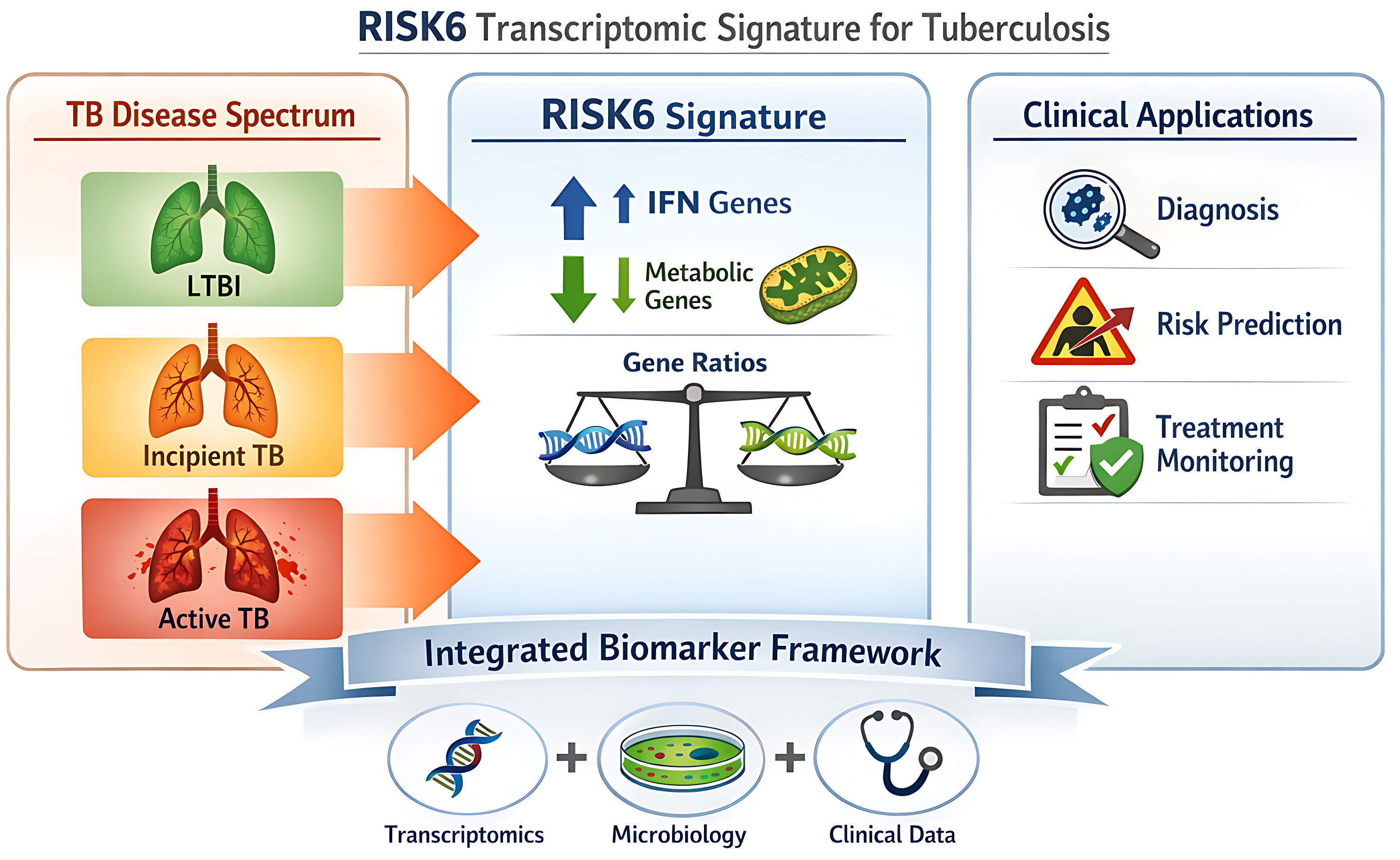
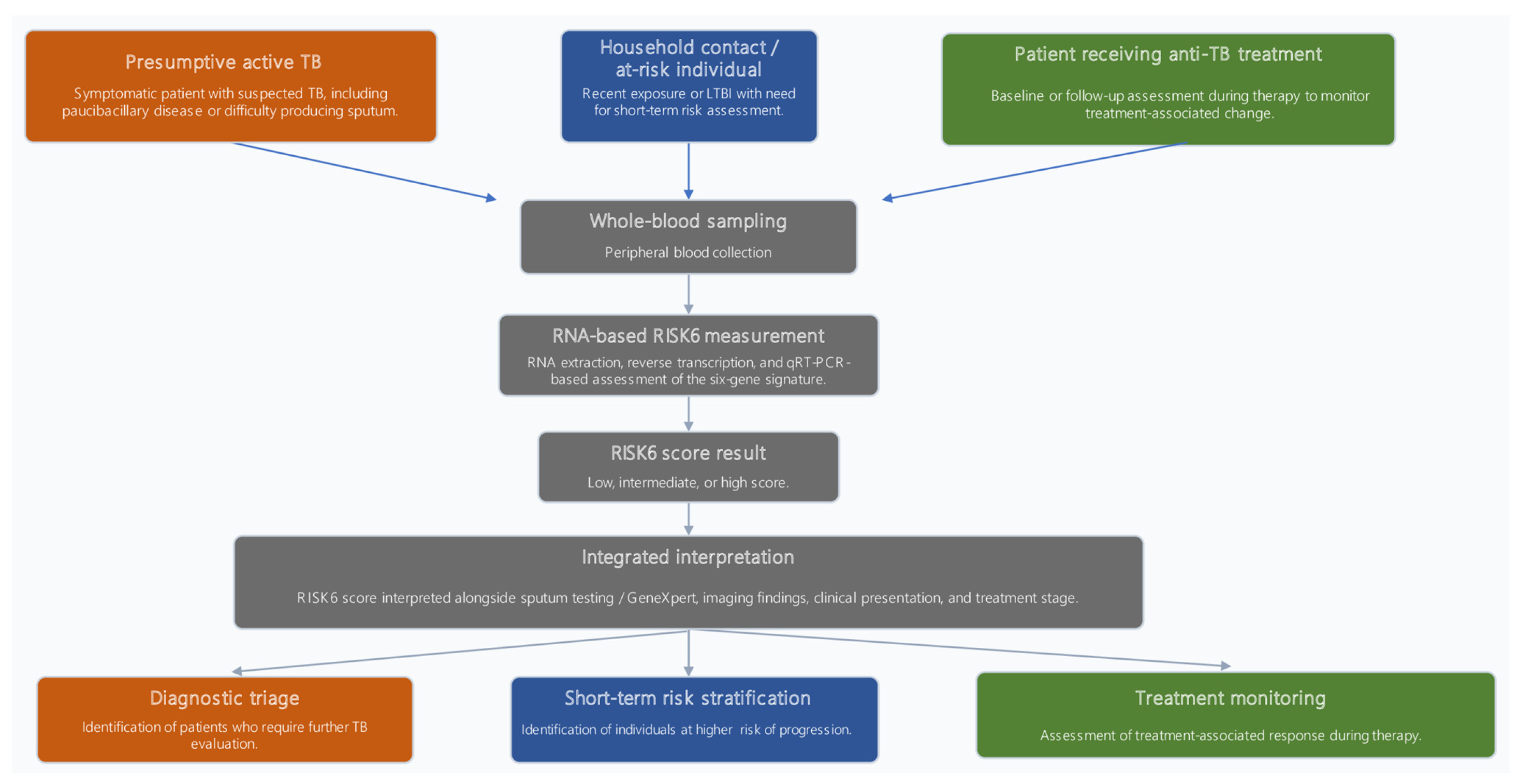
Beyond summarizing existing evidence, this review proposes a unified conceptual framework (
Figure 4) to guide the clinical integration of RISK6. This framework links patient context, biomarker measurement, and multi-modal data integration to support decision-making across diagnosis, risk stratification, and treatment monitoring.
The RISK6 transcriptomic signature demonstrates clinically relevant utility across several key domains of TB management, including diagnosis, prediction of disease progression, and treatment monitoring. Unlike conventional pathogen-based diagnostics, which primarily reflect bacillary detection, RISK6 captures dynamic host immune responses associated with disease activity. This feature makes RISK6 particularly attractive as a clinically informative biomarker, as it provides complementary insight into both biological activity and treatment response rather than functioning solely as a static diagnostic readout. Collectively, the available evidence suggests that the greatest value of RISK6 lies not in a single isolated application, but in its potential to serve as a multi-purpose biomarker platform across the continuum of TB care.
4.1.1. Diagnostic Application
RISK6 has demonstrated generally strong diagnostic performance in distinguishing active TB from latent infection and healthy individuals across multiple cohorts, with reported area under the curve (AUC) values approaching 0.94 and favorable sensitivity and specificity profiles [
10,
15]. However, performance variability across populations and clinical settings should be considered when interpreting these findings.
From a clinical perspective, RISK6 is particularly relevant in settings where conventional microbiological diagnostics are limited, such as in patients with paucibacillary disease, extrapulmonary TB, or inability to produce sputum. In contrast to pathogen-based assays, host transcriptomic biomarkers reflect the overall immune response to infection, thereby providing complementary information to microbiological testing [
2,
3].
However, this host-response-based approach is inherently associated with reduced specificity, as interferon-driven gene expression may also be observed in other infectious or inflammatory conditions [
4,
5]. This limitation underscores the importance of interpreting RISK6 within a broader clinical and microbiological context.
Taken together, the available evidence supports the role of RISK6 as a potential triage tool within integrated diagnostic frameworks, rather than as a standalone replacement for established microbiological methods.
4.1.2. Prognostic Application (Prediction of Disease Progression)
One of the most clinically significant applications of RISK6 is its ability to predict progression from latent TB infection to active disease. Prospective cohort studies have demonstrated that RISK6 performs best in identifying individuals at imminent risk of developing active TB, particularly within a short-term window of approximately 6–9 months prior to clinical diagnosis [
8,
11].
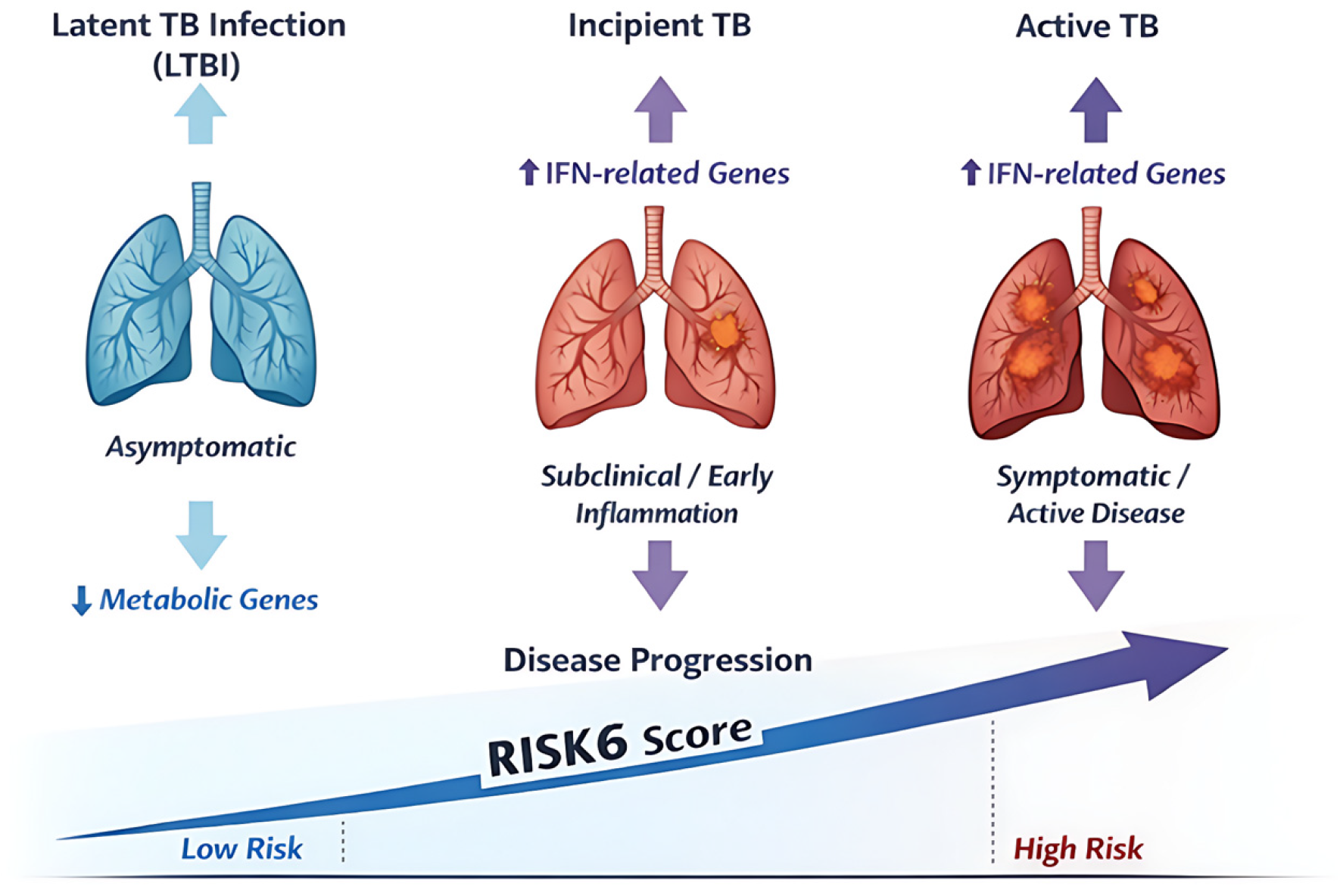
This temporal performance aligns with the concept of incipient TB, in which early immune activation precedes overt clinical disease. In this context, elevated RISK6 scores reflect underlying interferon-driven immune responses associated with subclinical disease progression, supporting its role as an early warning biomarker.
Importantly, variability in prognostic performance across populations remains a critical consideration. Differences in geographic setting, host genetic background, and epidemiological context may influence the predictive accuracy of transcriptomic signatures. In particular, HIV co-infection has been shown to significantly alter host immune responses and gene expression profiles, potentially affecting the performance of RISK6 and other interferon-driven signatures [
5,
21].
These findings underscore the need for population-specific validation and careful interpretation of prognostic results in diverse clinical settings
However, the predictive performance of RISK6 declines over longer follow-up intervals, limiting its utility for long-term risk stratification [
11,
19,
20]. This suggests that RISK6 is most effective when applied within defined screening intervals rather than as a single baseline assessment.
From a clinical standpoint, these findings position RISK6 as a tool for short-term risk enrichment, enabling identification of individuals who may benefit from targeted preventive interventions. Nevertheless, its optimal use requires integration into longitudinal or repeated testing strategies to maximize predictive accuracy.
Overall, RISK6 should be interpreted as a dynamic prognostic biomarker for incipient TB, rather than a static predictor of long-term disease risk.
4.1.3. Treatment Monitoring
RISK6 has demonstrated substantial potential as a biomarker for monitoring treatment response in TB. Multiple studies have shown that RISK6 scores decline significantly during effective anti-TB therapy, reflecting reductions in disease activity and normalization of host immune responses [
9,
15,
17,
22].
This dynamic behavior distinguishes RISK6 from conventional microbiological markers, as transcriptomic changes may occur earlier than sputum culture conversion or smear negativity. As such, RISK6 has the potential to serve as an early indicator of treatment efficacy, providing clinically actionable information during the initial phases of therapy.
It is important to distinguish between validated findings and emerging evidence in this context. The consistent decline of RISK6 scores during effective therapy has been demonstrated across multiple cohorts, representing a relatively well-established observation [
9,
15,
22]. In contrast, its role as an early surrogate marker for treatment outcomes or as a predictor of treatment failure remains an area of emerging evidence that requires further prospective validation.
From a practical perspective, this application is particularly valuable in patients with smear-negative or extrapulmonary TB, where microbiological monitoring is limited or delayed. In such settings, host-response biomarkers may provide an alternative means of assessing treatment response.
However, several challenges remain. The absence of standardized thresholds for defining treatment response limits clinical applicability, and variability across populations may affect longitudinal interpretation. In addition, current evidence remains limited in MDR-TB, where treatment response assessment is most critical.
Taken together, RISK6 represents a promising dynamic biomarker for treatment monitoring, with particular potential for early response assessment. Its clinical utility is likely to be maximized when integrated with microbiological and clinical parameters rather than used as a standalone tool.
4.1.4. Integration into Clinical Practice
Based on the available evidence, RISK6 shows strong potential for integration into clinical workflows as part of a multi-modal diagnostic and monitoring strategy. Rather than replacing existing microbiological methods, RISK6 is best positioned as a complementary biomarker that enhances clinical decision-making by providing insight into host immune activity.
One of the most promising applications is the integration of RISK6 with established microbiological parameters, such as time to positivity (TTP) and sputum culture conversion, to improve assessment of disease activity and treatment response [
22]. This combined approach may enable a more comprehensive evaluation of both bacillary burden and host response, particularly in complex clinical scenarios.
In addition, the use of RISK6 may support risk stratification and individualized patient management, aligning with the broader shift toward precision medicine in TB care. By identifying patients at higher risk of disease progression or suboptimal treatment response, RISK6 has the potential to inform more tailored therapeutic and monitoring strategies. In this context, RISK6 may serve as a decision-support biomarker within integrated clinical pathways, informing key steps such as triage testing, initiation of therapy, and longitudinal monitoring, particularly when combined with microbiological and clinical parameters.
However, successful clinical implementation requires several prerequisites, including assay standardization, definition of clinically meaningful thresholds, and validation across diverse populations. Furthermore, integration into routine care will depend on the development of scalable, cost-effective platforms that are feasible in resource-limited settings.
Overall, RISK6 is unlikely to function as a standalone clinical tool but may provide the greatest value when incorporated into integrated diagnostic and monitoring frameworks combining transcriptomic, microbiological, and clinical data.
4.1.5. Relevance to Drug-Resistant TB
Despite the growing interest in host RNA transcriptomic biomarkers, evidence regarding the performance of RISK6 in drug-resistant TB remains limited. Most available studies have been conducted in drug-sensitive populations, leaving a significant gap in understanding its applicability in MDR-TB [
14].
From a mechanistic perspective, it can be hypothesized that persistent or dysregulated interferon-driven immune activation may contribute to suboptimal treatment response in MDR-TB. In this context, sustained elevation of RISK6 scores during therapy could reflect ongoing host inflammatory activity despite microbiological treatment, potentially identifying patients at risk of delayed culture conversion or treatment failure. This hypothesis is biologically plausible given the central role of interferon signaling in TB pathogenesis and its association with disease activity.
This gap is particularly important given the clinical complexity of MDR-TB, which is characterized by prolonged treatment duration, higher rates of treatment failure, and limited options for microbiological monitoring. In this context, a host-response biomarker such as RISK6 may offer additional value by capturing dynamic changes in immune activity that are not fully reflected by conventional microbiological measures. If validated, this relationship would position RISK6 as a potential early indicator of treatment response in MDR-TB, complementing conventional microbiological markers such as sputum culture conversion and time to positivity, and enabling earlier identification of patients who may require treatment modification or intensified monitoring. This may enable earlier identification of patients at risk of suboptimal treatment response, thereby facilitating timely treatment modification or intensified clinical monitoring.
From a theoretical and translational perspective, RISK6 has the potential to contribute to early treatment response assessment and identification of patients at risk of poor outcomes or treatment failure. Such applications are especially relevant in MDR-TB, where timely evaluation of treatment efficacy remains a major clinical challenge.
However, the lack of robust validation studies in MDR-TB populations limits current clinical applicability. Differences in disease biology, treatment regimens, and host immune responses may influence transcriptomic profiles, necessitating dedicated studies in drug-resistant cohorts.
Overall, while RISK6 represents a promising candidate biomarker for MDR-TB, its role remains exploratory and requires further validation before integration into clinical practice.
This integrated approach aligns with the shift toward precision TB medicine, where biomarker-guided strategies may enable earlier diagnosis, improved risk stratification, and more responsive treatment monitoring. The clinical applications of RISK6 across diagnosis, prognosis, and treatment monitoring, along with their strengths, limitations, and translational implications, are summarized in
Table 2.
Emerging evidence further suggests that combining transcriptomic signatures may enhance predictive performance, indicating that RISK6 is likely to be most effective as part of integrated biomarker strategies rather than as a standalone tool [
16].
4.1.6. Translational Perspective
Taken together, the available evidence indicates that RISK6 functions as a multi-dimensional biomarker capable of capturing dynamic host immune responses across the TB disease spectrum. Its consistent performance across diagnostic, prognostic, and treatment monitoring applications highlights its potential as a unified platform rather than a single-purpose tool.
From a translational standpoint, the greatest strength of RISK6 lies in its parsimonious design and ratio-based structure, which enhance analytical robustness and facilitate implementation using simplified platforms such as quantitative PCR [
9,
19,
20]. This makes RISK6 particularly attractive for deployment in resource-limited settings, where scalable and cost-effective diagnostic tools are critically needed.
However, current evidence suggests that the clinical value of RISK6 is maximized when interpreted within integrated frameworks that combine transcriptomic, microbiological, and clinical parameters [
16]. Such an approach aligns with the evolving paradigm of precision TB medicine, in which biomarker-guided strategies may enable earlier diagnosis, improved risk stratification, and more responsive treatment monitoring.
Importantly, RISK6 should not be viewed as a replacement for existing diagnostic or monitoring tools, but rather as a complementary component within a broader clinical decision-making framework. Future research should therefore focus on standardization of assay platforms, validation across diverse populations, and integration into real-world clinical workflows.
Overall, RISK6 represents a promising translational biomarker platform with the potential to bridge key gaps in TB management, although further validation is required to support widespread clinical implementation.
This framework provides a conceptual basis for integrating RISK6 into real-world clinical decision pathways.
4.2. Limitations and Challenges
Despite the promising potential of RISK6 as a host transcriptomic biomarker, several important limitations must be considered before its translation into routine clinical practice. The marked heterogeneity across included studies limits direct comparability of reported performance metrics and constrains the ability to perform quantitative synthesis. The variability in study setting, HIV status, and cohort size further contributes to heterogeneity in reported performance metrics. These challenges span biological variability, methodological constraints, and implementation barriers, reflecting the inherent complexity of host-response-based biomarkers in TB. These observations underscore the importance of context-specific validation in diverse populations.
The key limitations are discussed in the following sections.
4.2.1. Variability Across Populations
A major limitation of RISK6 is the variability in performance across different geographic and epidemiological settings. Multicohort studies have demonstrated that transcriptomic signatures, including RISK6, do not consistently meet target product profile benchmarks when applied across diverse populations [
12,
16].
This variability is likely driven by differences in host genetic background, environmental exposures, TB endemicity, and the presence of comorbid conditions. In particular, co-infections such as HIV may substantially alter immune responses and gene expression profiles, thereby affecting the diagnostic and prognostic performance of transcriptomic biomarkers [
5,
21].
These findings highlight the need for context-specific validation and potential recalibration of RISK6 before clinical implementation. Without such adaptation, the generalizability of the signature across different populations remains limited.
4.2.2. Limited Long-Term Predictive Performance
While RISK6 demonstrates strong performance in predicting short-term progression to active TB, its predictive accuracy declines over longer follow-up intervals. Several studies have shown that transcriptomic signatures perform optimally within a defined temporal window, typically within 6–12 months prior to disease onset, with reduced sensitivity and specificity beyond this period [
8,
11].
This temporal limitation suggests that RISK6 primarily captures biological processes associated with incipient or subclinical TB rather than long-term susceptibility to disease. As a result, its utility as a standalone tool for long-term risk stratification remains limited.
From a clinical perspective, this constraint implies that single baseline measurements may be insufficient for sustained risk prediction. Instead, repeated or interval-based testing strategies may be required to maintain predictive accuracy over time.
Overall, the time-dependent nature of RISK6 highlights the importance of aligning its clinical application with appropriate screening intervals, reinforcing its role as a dynamic biomarker for short-term risk assessment rather than a static predictor of long-term disease risk.
4.2.3. Limited Specificity of Interferon-Driven Signatures
A fundamental limitation of RISK6 lies in its reliance on interferon-driven gene expression, which is not specific to TB. Interferon-inducible pathways are activated in a wide range of infectious and inflammatory conditions, including viral infections and autoimmune diseases, leading to overlapping transcriptomic profiles [
4,
5].
As a result, elevated RISK6 scores may not exclusively reflect TB-related immune responses, increasing the risk of false-positive interpretations in certain clinical contexts. This limitation is inherent to host-response-based biomarkers and represents a key challenge in distinguishing TB from other inflammatory states.
From a clinical perspective, this reduced specificity underscores the need to interpret RISK6 results in conjunction with microbiological findings and clinical assessment. Reliance on transcriptomic signatures alone may lead to diagnostic ambiguity, particularly in settings with high prevalence of co-infections or systemic inflammatory conditions.
Overall, the lack of disease-specific transcriptional signatures highlights the importance of integrated diagnostic approaches, in which host transcriptomic biomarkers such as RISK6 are combined with pathogen-based and clinical data to improve diagnostic accuracy.
4.2.4. Lack of Standardized Thresholds
Another important limitation of RISK6 is the lack of standardized thresholds for clinical interpretation. Although multiple studies have demonstrated strong discriminatory performance, there is currently no universally accepted cut-off value to define diagnostic or prognostic categories [
12,
23].
This lack of standardization limits comparability across studies and complicates the translation of RISK6 into clinical decision-making. Variations in study populations, assay platforms, and analytical methods may lead to differences in optimal threshold values, further contributing to heterogeneity in reported performance.
From a clinical perspective, the absence of defined thresholds poses a significant barrier to implementation, as clinicians require clear and actionable criteria to guide diagnosis, risk stratification, and treatment monitoring. Without standardized cut-offs, interpretation of RISK6 results remains context-dependent and may reduce confidence in its clinical use.
Overall, establishing robust and reproducible thresholds through large-scale validation studies is essential for the integration of RISK6 into routine clinical practice.
4.2.5. Limited Evidence in Drug-Resistant TB
A critical limitation of the current evidence base is the limited availability of studies evaluating RISK6 in drug-resistant TB. Most published data have been derived from drug-sensitive TB populations, resulting in a significant gap in understanding the performance of RISK6 in MDR-TB [
14].
This limitation is particularly important given the distinct clinical and biological characteristics of MDR-TB, including prolonged disease course, more complex treatment regimens, and higher rates of treatment failure. These factors may influence host immune responses and, consequently, transcriptomic signatures.
From a clinical perspective, the lack of data in MDR-TB restricts the generalizability of RISK6, especially in settings where drug resistance is prevalent. This represents a major barrier to implementation, as biomarkers intended for clinical use must demonstrate consistent performance across different disease subtypes.
Overall, further studies specifically designed to evaluate RISK6 in MDR-TB populations are essential to determine its role in treatment monitoring, prognosis, and clinical decision-making in this high-risk group.
4.2.6. Need for Multi-Biomarker Approaches
An additional limitation of RISK6 lies in its use as a single biomarker to represent a highly complex and heterogeneous disease process. Tuberculosis pathogenesis involves dynamic interactions between host immunity, pathogen burden, and environmental factors, which may not be fully captured by a single transcriptomic signature.
Emerging evidence suggests that combining multiple biomarkers may improve diagnostic and prognostic performance compared to individual signatures [
16,
24,
25]. Integrating transcriptomic data with microbiological, clinical, and radiological parameters may provide a more comprehensive assessment of disease activity and treatment response.
From a translational perspective, this supports a shift toward multi-biomarker frameworks, in which RISK6 functions as one component within a broader diagnostic and monitoring strategy rather than as a standalone tool. Such integrated approaches are more likely to improve accuracy, robustness, and clinical applicability across diverse patient populations.
Overall, the need for multi-biomarker approaches reflects the inherent complexity of TB and highlights the importance of combining complementary data sources to optimize clinical decision-making.
4.2.7. Implementation Challenges
Beyond biological and methodological limitations, several practical challenges must be considered for the implementation of RISK6 in routine clinical settings. These include the cost of molecular testing, the requirement for laboratory infrastructure, and the need for trained personnel, particularly in resource-limited settings where the burden of TB is highest [
2,
3].
In addition, variability in assay platforms and lack of standardized protocols may affect reproducibility and comparability across different laboratories. Ensuring consistent sample collection, processing, and analysis is essential for reliable application of transcriptomic biomarkers in clinical practice.
From a health systems perspective, integration of RISK6 into existing diagnostic workflows presents further challenges. Adoption will depend not only on analytical performance but also on cost-effectiveness, accessibility, and compatibility with current clinical pathways.
Overall, addressing these implementation barriers will be critical to translating the potential of RISK6 into real-world clinical impact, particularly in high-burden and resource-constrained settings.
4.2.8. Translational Perspective on Limitations
Taken together, these limitations highlight the inherent complexity of translating host transcriptomic biomarkers such as RISK6 into clinical practice. While individual challenges—ranging from biological variability and limited specificity to lack of standardization and implementation barriers—may appear distinct, they are closely interconnected and collectively influence real-world applicability.
From a translational perspective, these constraints underscore that RISK6 is unlikely to function effectively as a standalone biomarker. Instead, its clinical value is maximized when incorporated into integrated diagnostic and monitoring frameworks that combine transcriptomic, microbiological, and clinical data.
Furthermore, the need for repeated measurements, context-specific calibration, and standardized assay platforms reflects a broader shift toward dynamic and adaptive biomarker strategies in TB. This aligns with the evolving paradigm of precision medicine, where multi-dimensional data are used to guide individualized patient management.
Importantly, addressing these limitations does not diminish the value of RISK6, but rather defines the pathway for its optimal use. Future research should therefore prioritize multicohort validation, development of standardized thresholds, and integration into scalable clinical platforms to enable meaningful implementation.
Overall, the limitations of RISK6 should be viewed not as barriers, but as key considerations that inform its role as part of a broader, integrated biomarker ecosystem in TB care.
4.3. Comparison with Other Transcriptomic Signatures
The expanding landscape of host blood transcriptomic biomarkers in TB necessitates comparative evaluation of RISK6 against both earlier and more recent transcriptomic models. Although many signatures are derived from overlapping interferon-driven immune pathways, they differ substantially in gene number, intended clinical application, analytical complexity, and translational feasibility. Positioning RISK6 within this broader context is therefore essential to define its relative strengths, limitations, and potential clinical role.
4.3.1. Comparison with Early Multi-Gene Signatures
Early transcriptomic signatures, including the ACS16 and ACS11 models, provided important proof of concept that whole-blood RNA profiles could predict progression to active TB before overt clinical disease [
6,
19,
20]. These studies were foundational in establishing the biological relevance of host-response biomarkers and in demonstrating the prognostic potential of interferon-driven transcriptional signatures.
However, despite their predictive value, these earlier multi-gene models were relatively complex and therefore less suitable for routine clinical implementation. Larger gene sets increase analytical burden, require more extensive assay development, and limit scalability for near-patient testing.
In contrast, RISK6 was developed as a parsimonious six-gene signature using a pair-ratio approach designed to improve analytical robustness and reduce vulnerability to technical variation [
9]. This reduction in gene number, together with its ratio-based structure, represents a substantial translational advantage by facilitating incorporation into simplified PCR-based platforms.
Taken together, the comparison with early multi-gene signatures suggests that the principal advantage of RISK6 lies not in replacing the biological insights generated by earlier models, but in translating those insights into a more practical and clinically deployable biomarker format.
4.3.2. Comparison in Prognostic Performance
Among host RNA transcriptomic signatures, prognostic performance has been one of the most extensively studied applications, particularly in predicting progression from latent infection to active TB. Several early and contemporary signatures have demonstrated the ability to identify individuals at increased risk of developing active disease, especially within a defined short-term window prior to clinical diagnosis [
6,
11,
19].
Comparative studies suggest that many transcriptomic models share similar predictive patterns, reflecting common underlying interferon-driven immune responses associated with incipient TB. However, differences in study design, population characteristics, and follow-up duration contribute to variability in reported performance across signatures.
In this context, RISK6 demonstrates prognostic performance comparable to larger and more complex models, particularly for short-term risk prediction within approximately 6–12 months before disease onset [
8,
11]. Importantly, its parsimonious structure enables this level of performance while maintaining greater analytical simplicity.
Nevertheless, as with other transcriptomic signatures, the predictive accuracy of RISK6 declines over longer time horizons, limiting its utility for long-term risk stratification. This limitation appears to be a common feature across prognostic models and reflects the dynamic nature of host immune activation during the transition from latent to active disease.
Overall, comparative evidence indicates that RISK6 performs similarly to other established transcriptomic signatures in prognostic applications, with the added advantage of a simplified and more clinically adaptable design.
4.3.3. Comparison in Diagnostic Application
Host RNA transcriptomic signatures have been widely evaluated for their ability to distinguish active TB from latent infection and non-TB controls. Several models have demonstrated high diagnostic accuracy in controlled research settings, often achieving AUC values above 0.80 [
10,
11].
However, comparative analysis suggests that differences in diagnostic performance between individual signatures are often modest and highly dependent on study design, population characteristics, and reference standards. Larger gene signatures may show slightly higher accuracy in discovery cohorts, but these advantages are frequently reduced in validation studies and real-world settings.
In this context, RISK6 demonstrates diagnostic performance comparable to other established transcriptomic models, while offering important practical advantages related to its parsimonious design [
9,
15]. Its six-gene structure and ratio-based approach facilitate implementation using simplified platforms such as quantitative PCR, enhancing scalability and potential for clinical deployment.
Nevertheless, similar to other host-response biomarkers, RISK6 is limited by reduced specificity, as interferon-driven gene expression may overlap with other infectious and inflammatory conditions [
4,
5]. This limitation is not unique to RISK6 but reflects a broader challenge across transcriptomic diagnostic approaches.
Overall, comparative evidence indicates that RISK6 achieves diagnostic performance similar to more complex transcriptomic signatures, with the added benefit of improved translational feasibility, supporting its role as a practical component within integrated diagnostic frameworks.
4.3.4. Comparison in Treatment Monitoring
The use of host RNA transcriptomic signatures for treatment monitoring has gained increasing attention, as these biomarkers capture dynamic changes in immune activity during therapy. Several transcriptomic models have demonstrated the ability to reflect treatment response, although the extent and consistency of these changes vary across signatures [
9,
17].
Compared with other transcriptomic approaches, RISK6 shows a consistent pattern of decline during effective anti-TB therapy, corresponding to reduced disease activity and normalization of host immune responses [
9,
15,
22]. This dynamic behavior supports its potential role as a biomarker for monitoring treatment response.
Importantly, transcriptomic changes captured by RISK6 may occur earlier than conventional microbiological markers, such as sputum culture conversion, providing a potential advantage for early assessment of treatment efficacy. While similar trends have been reported in other signatures, the simplicity and reproducibility of RISK6 may enhance its practical utility in longitudinal monitoring.
However, comparative evidence remains limited, and variability in study design, sampling intervals, and patient populations complicates direct comparison between models. As such, while RISK6 appears promising for treatment monitoring, further head-to-head studies are needed to define its relative performance.
Overall, RISK6 demonstrates comparable or potentially advantageous performance in treatment monitoring relative to other transcriptomic signatures, particularly due to its consistent dynamic response and translational feasibility.
4.3.5. Emerging Role of Composite Signatures
Recent developments in TB biomarker research have highlighted the potential advantages of composite or integrated biomarker approaches over single transcriptomic signatures. Given the complex and heterogeneous nature of TB, reliance on a single biomarker may be insufficient to fully capture disease dynamics.
Emerging evidence suggests that combining transcriptomic signatures with other biological and clinical parameters—such as microbiological data, radiological findings, and clinical scores—may improve diagnostic accuracy, prognostic performance, and treatment monitoring capabilities [
16,
24,
25]. These integrated models aim to leverage complementary information from different domains to enhance overall predictive performance.
Within this evolving landscape, RISK6 may serve as a core component of composite biomarker frameworks rather than as a standalone tool. Its parsimonious structure, reproducibility, and demonstrated utility across multiple clinical applications make it well suited for integration into multi-modal diagnostic and monitoring strategies.
However, the development and validation of composite signatures remain in early stages, and challenges related to model complexity, standardization, and clinical implementation persist. Further studies are required to determine optimal combinations of biomarkers and to evaluate their performance in real-world settings.
Overall, the emergence of composite biomarker strategies represents a shift toward more comprehensive and precision-oriented approaches in TB care, in which RISK6 may play a central but complementary role.
4.3.6. Overall Positioning of RISK6
Taken together, comparative evaluation of transcriptomic signatures indicates that RISK6 occupies a distinct position within the current biomarker landscape. While it does not consistently outperform all other models in every clinical application, it demonstrates a favorable balance between diagnostic performance, prognostic utility, and treatment monitoring capability.
A key strength of RISK6 lies in its parsimonious six-gene design and ratio-based structure, which enhance analytical robustness and facilitate translation into scalable platforms such as quantitative PCR [
9,
19]. In contrast to more complex multi-gene signatures, this simplified architecture improves feasibility for implementation in real-world clinical settings, particularly in resource-limited environments.
In addition, RISK6 demonstrates multi-purpose applicability across several stages of TB care, including diagnosis, prediction of short-term disease progression, and monitoring of treatment response. This versatility distinguishes it from many other transcriptomic models that are optimized for a single clinical function.
However, consistent with the broader limitations of host-response biomarkers, RISK6 should not be considered a standalone solution. Its optimal clinical value is likely achieved when integrated with microbiological and clinical parameters within multi-modal diagnostic and monitoring frameworks.
Overall, RISK6 represents a practical and translationally promising biomarker platform that bridges the gap between high-dimensional discovery models and clinically deployable tools, although further validation is required to support widespread implementation.
A comparative overview is presented in
Table 3, with all statements supported by corresponding literature to ensure transparency and traceability.
Notably, the advantage of RISK6 lies less in consistently outperforming other signatures and more in achieving a pragmatic balance between performance, simplicity, and translational feasibility.
4.4. Future Perspectives and Relevance to Drug-Resistant TB
Future research on host transcriptomic biomarkers should move beyond proof-of-concept performance and focus on their integration into clinically meaningful and scalable frameworks. In this context, RISK6 is particularly relevant because its parsimonious design, dynamic behavior, and multi-purpose applicability position it as a promising candidate for translational development. At the same time, the greatest unmet need may lie in drug-resistant TB, where improved tools for risk stratification, treatment monitoring, and early identification of poor response are urgently required. Accordingly, future perspectives on RISK6 should be considered not only in terms of broader precision TB medicine, but also in relation to its potential contribution to MDR-TB care.
4.4.1. Toward Precision TB Medicine
The future development of host transcriptomic biomarkers is closely aligned with the broader shift toward precision TB medicine. Rather than applying uniform diagnostic and monitoring strategies to all patients, precision approaches aim to tailor clinical decisions according to individual disease biology, risk of progression, and treatment response.
In this context, RISK6 represents a promising biomarker platform because it captures dynamic host immune activity across multiple stages of TB. Its demonstrated utility in diagnosis, short-term risk prediction, and treatment monitoring suggests that it may contribute to more individualized approaches to patient assessment and follow-up [
9,
11,
16].
Importantly, the relevance of RISK6 to precision medicine lies not only in its performance characteristics, but also in its translational feasibility. Its parsimonious structure and ratio-based design make it more amenable to scalable implementation than larger and more complex transcriptomic models [
9,
19,
20].
However, realization of this precision medicine framework will require more than biomarker discovery alone. Standardized assays, clinically validated thresholds, repeated-measurement strategies, and integration with existing clinical workflows will all be necessary to translate transcriptomic signatures into actionable tools for individualized TB care.
Overall, RISK6 aligns well with the evolving paradigm of precision TB medicine, in which biomarker-guided strategies may enable earlier diagnosis, more refined risk stratification, and more responsive treatment monitoring.
4.4.2. Expanding the Role in MDR-TB
The potential role of RISK6 in MDR-TB represents a critical area for future research. Compared to drug-sensitive TB, MDR-TB is characterized by prolonged treatment duration, higher rates of treatment failure, and more complex clinical management, highlighting the need for improved biomarkers to guide patient care. To address these gaps, future research should adopt more rigorous and targeted study designs.
Future research should prioritize prospective longitudinal studies specifically designed to evaluate the relationship between RISK6 dynamics and treatment outcomes in MDR-TB. Such studies should incorporate serial blood sampling at predefined time points alongside microbiological assessments, including sputum culture conversion and time to positivity, to determine whether changes in RISK6 scores correlate with treatment response, failure, or relapse.
In addition, stratified analyses based on HIV status, disease severity, and treatment regimen may provide further insight into the variability of transcriptomic responses in MDR-TB populations. Integration of RISK6 into multi-modal biomarker models combining transcriptomic, microbiological, and clinical parameters should also be explored to improve predictive accuracy and clinical utility.
In this context, RISK6 may offer particular value as a dynamic host-response biomarker capable of capturing changes in disease activity and treatment response. Early identification of inadequate treatment response or risk of treatment failure is especially important in MDR-TB, where delays in clinical decision-making may lead to poorer outcomes.
Although current evidence remains limited, the biological basis of RISK6 suggests that it may be applicable across different forms of TB, including drug-resistant disease. However, differences in host immune response, treatment regimens, and disease progression patterns in MDR-TB may influence transcriptomic profiles and biomarker performance [
14,
27].
From a translational perspective, expanding the application of RISK6 to MDR-TB will require dedicated validation studies in drug-resistant cohorts, including longitudinal designs that assess its role in treatment monitoring and outcome prediction.
Overall, the extension of RISK6 into MDR-TB represents both a major opportunity and a critical research priority, with the potential to address important gaps in current TB management.
4.4.3. Integration with Microbiological Markers
A key direction for future research is the integration of host transcriptomic biomarkers such as RISK6 with established microbiological parameters. While microbiological tests, including sputum culture and molecular assays, provide direct evidence of pathogen presence and bacillary burden, they offer limited insight into host immune activity and disease dynamics.
In contrast, transcriptomic signatures capture host-response patterns that reflect underlying inflammatory activity and treatment response. Combining these complementary data sources may provide a more comprehensive assessment of TB, integrating both pathogen burden and host immune status.
In particular, integration with microbiological markers such as TTP and culture conversion may enhance the evaluation of treatment response and disease activity [
22]. Such combined approaches may enable earlier identification of treatment failure or delayed response, which is especially relevant in complex cases, including MDR-TB.
From a translational perspective, the integration of transcriptomic and microbiological data represents a critical step toward more precise and dynamic monitoring strategies. However, standardized frameworks for combining these biomarkers are still lacking, and further studies are needed to define optimal integration models.
Overall, combining RISK6 with microbiological markers may improve clinical decision-making by providing a more holistic view of TB disease processes.
4.4.4. Toward Multi-Biomarker Models
Future advances in TB biomarker research are likely to move toward multi-biomarker models that integrate diverse sources of biological and clinical information. Given the complexity and heterogeneity of TB, reliance on a single biomarker is unlikely to provide sufficient accuracy across all clinical scenarios.
Multi-biomarker approaches aim to combine complementary data, including transcriptomic signatures, microbiological findings, radiological features, and clinical parameters, to improve overall diagnostic and prognostic performance [
16,
24,
25]. Such models have the potential to capture different dimensions of disease biology, including pathogen burden, host immune response, and structural lung involvement.
Within this framework, RISK6 may serve as a central component due to its demonstrated utility across multiple clinical applications and its relative simplicity compared to larger transcriptomic signatures. Its integration into composite models may enhance predictive performance while maintaining feasibility for clinical implementation.
However, the development of multi-biomarker models introduces additional challenges, including increased model complexity, the need for standardized integration strategies, and validation across diverse populations. Ensuring that such models remain clinically practical and cost-effective will be essential for their successful translation.
Overall, the shift toward multi-biomarker approaches reflects an evolution from single-parameter diagnostics toward more comprehensive and individualized strategies for TB management.
4.4.5. Translation into Clinical Practice
The successful translation of RISK6 into clinical practice will depend on multiple factors beyond analytical performance. While existing studies demonstrate promising diagnostic, prognostic, and treatment monitoring capabilities, several practical considerations must be addressed to enable real-world implementation.
A key requirement is the development of standardized and scalable assay platforms. The parsimonious six-gene structure of RISK6 makes it well suited for implementation using quantitative PCR-based systems, which are widely available and potentially adaptable for near-patient testing [
9,
19,
20]. This represents a significant advantage over more complex transcriptomic signatures that require high-throughput sequencing or advanced computational analysis.
In addition, clear clinical use cases must be defined to guide integration into existing diagnostic and monitoring workflows. Potential applications include triage testing, short-term risk stratification, and early assessment of treatment response, particularly in settings where conventional microbiological tools are limited or delayed.
Implementation of RISK6 in clinical settings would require access to molecular diagnostic platforms, such as quantitative PCR systems, as well as standardized protocols for sample collection, processing, and analysis. In addition, trained laboratory personnel and quality control systems are essential to ensure reproducibility and reliability of results.
However, implementation will also require validation in diverse real-world populations, establishment of standardized thresholds, and demonstration of cost-effectiveness. At present, data on the cost-effectiveness of RISK6 are limited, and further studies evaluating its economic impact will be essential to support large-scale implementation. Health system factors, including infrastructure, training, and accessibility, will further influence adoption, particularly in high-burden, resource-limited settings [
2,
3].
While RISK6 shows strong translational potential, its clinical application remains investigational and requires further validation before routine implementation.
Overall, the successful translation of RISK6 into clinical practice will depend on coordinated efforts in assay development, validation, and integration into routine care pathways.
4.4.6. Future Directions
Future research on RISK6 and other host transcriptomic biomarkers should prioritize large-scale, multicohort validation studies across diverse populations. Such efforts are essential to ensure generalizability and to address the variability in performance observed across different geographic and clinical settings.
In addition, the establishment of standardized assay platforms and clinically relevant thresholds will be critical to enable consistent interpretation and integration into clinical workflows. Longitudinal studies incorporating repeated measurements are also needed to better define the temporal dynamics of RISK6 and optimize its use in treatment monitoring and short-term risk prediction.
Another important direction is the expansion of research into underrepresented populations, particularly individuals with MDR-TB, HIV co-infection, and extrapulmonary disease. These groups represent key clinical scenarios in which improved biomarkers are urgently needed.
Furthermore, future studies should explore the integration of RISK6 into multi-biomarker frameworks that combine transcriptomic, microbiological, and clinical data. Advances in digital health and data integration platforms may facilitate the development of such models, enabling more precise and individualized approaches to TB management.
Future research should also prioritize standardization of assay platforms, validation across diverse populations, and prospective clinical trials to establish the clinical utility of RISK6 in real-world settings.
Overall, advancing RISK6 from a promising research tool to a clinically actionable biomarker will require coordinated efforts in validation, standardization, and integration, with a focus on real-world applicability and impact in high-burden settings.




 ,
,