1. Introduction
The Eurasian lynx (
Lynx lynx) sits at the top of the food chain in the European and Asian ecosystems where it lives. Its primary prey consists of wild ungulates (roe deer (
Capreolus capreolus), red deer (
Cervus elaphus) and wild boar (
Sus scrofa)), although it may also consume certain rodent species [
1,
2,
3]. As a large carnivore, the Eurasian lynx can serve as a host for parasite assemblages acquired from its prey, which occupy lower trophic levels. This is particularly relevant for assessing interspecific ecological relationships and trophic transmission, as well as predator–prey dynamics and interactions between intermediate and definitive host. Such information is also valuable for understanding parasite circulation in wildlife populations and its potential relevance to host health [
4]. At present, the Eurasian lynx distribution range is largely continuous in Northern Europe (Scandinavia and Russia) but fragmented into small populations in Central and Western Europe [
5]. Population densities reported in the Transcarpathian habitats are among the highest across Eurasia, underlining the relevance of the Romanian Carpathian population for the conservation of the species. However, as in other parts of its range, the Eurasian lynx may be exposed to pressures such as habitat degradation, habitat fragmentation, human disturbance, and road mortality. Therefore, the species is strictly protected under Annex IV of Directive 92/43/EEC and Romanian Law 407/2006 on wildlife protection [
6]. Although the Eurasian lynx is currently classified as Least Concern on the IUCN Red List, the population inhabiting the Romanian Carpathians is considered one of the most important in Europe in terms of population size and conservation relevance [
7]. However, studies on the helminth fauna of this species in Romania remain scarce. Available studies from Romania have focused primarily on parasitic zoonoses in wild carnivores or on cardiopulmonary parasites in wild felids, rather than specifically on cestode diversity in Eurasian lynx. These parasite groups are relevant to host health; however, species-level identification of cestodes using molecular approaches has remained lacking [
8,
9,
10].
Taenia lynciscapreoli was first suggested as a distinct taxon in Finland by Lavikainen et al. (2013) [
11] and was subsequently confirmed there in 2016 by Haukisalmi et al. (2016) [
12] on the basis of morphological and molecular criteria. Given that interspecific morphological differences within the genus
Taenia may be subtle and therefore prone to misinterpretation, molecular tools such as
cox1 and
nad1 based sequencing are particularly valuable for accurate species identification [
13,
14].
Taenia lynciscapreoli has a heteroxenous life cycle in which Eurasian lynx acts as the definitive host and ungulates—primarily the roe deer—serve as natural intermediate hosts [
12,
13,
14]. New intermediate hosts for
T. lynciscapreoli have been reported in Sweden, where molecular confirmation of the metacestode in semi-domesticated reindeer (
Rangifer tarandus tarandus) suggests either accidental infection or a broader ecological plasticity than previously assumed for this parasite [
15].
Within the broader aim of improving current knowledge of parasite diversity, host–parasite relationships, and wildlife health in the Eurasian lynx as a protected species in the Carpathian region, we report the first molecular identification of T. lynciscapreoli in Romania.
2. Materials and Methods
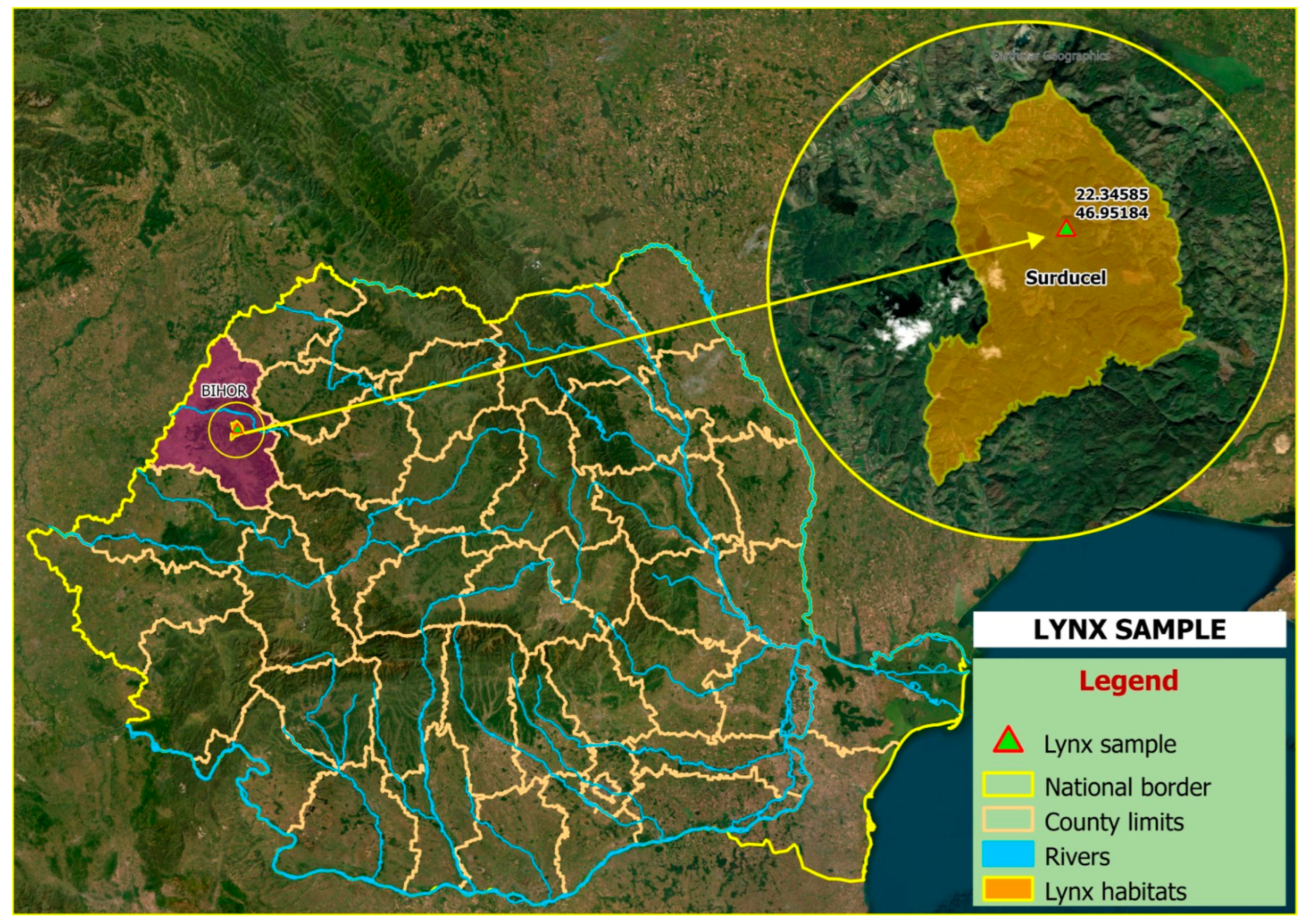
On 2 March 2022, an adult male Eurasian lynx was found dead following a road traffic collision in the Apuseni Mountains (Surducel hunting ground), Bihor County, Romania (46.820240° N, 21.669641° E) (
Figure 1). The carcass was transported to the Clinic of Parasitic Diseases, Faculty of Veterinary Medicine, University of Life Sciences “King Mihai I” from Timișoara, for parasitological investigations. Previous to the examination, biosafety procedures were implemented in accordance with international guidance from the World Organisation for Animal Health (WOAH) [
16] and the European Food Safety Authority (EFSA) [
17], and the carcass was stored at −80 °C for 48 h to inactivate potential zoonotic agents.
The entire small intestine of the animal was removed and placed separately in a 20 L plastic container, then dissected and systematically examined for the presence of adult cestodes (tapeworms). No parasite-associated gross intestinal lesions were observed at necropsy. When parasites were detected, they were carefully recovered using fine forceps, rinsed several times in physiological saline, and kept in 70% ethanol for subsequent morphological assessment and molecular characterization. However, deep freezing affected the structural integrity of the helminths, and standard morphological identification could not be performed [
18]. Therefore, the cestode specimens were stored in 70% ethanol for further molecular identification analyses.
Genomic DNA was extracted from proglottids, using the DNeasy Blood & Tissue Kit (Qiagen, Valencia, CA, USA) following the manufacturer’s instructions. A negative extraction control (nuclease-free water) was included in each extraction batch to monitor potential contamination. DNA was stored at −20 °C until further processing. The oligonucleotide primers used for amplification of the mitochondrial gene fragments analyzed in this study are summarized in
Table 1.
A fragment of the mitochondrial cytochrome c oxidase subunit 1 (
cox1) gene was amplified using primers EgCOI 1 and EgCOI 2, as described by Bowles et al. (1992) [
19] and modified by Bart et al. (2006) [
20]. PCR was performed in a final volume of 30 μL containing 2 μL of template DNA, 15 μL of HotStart PCR Master Mix (Qiagen GmbH, Hilden, Germany), 0.5 μM of each primer, and nuclease-free water to volume (10 μL). The cycling conditions were 95 °C for 15 min, followed by 38 cycles at 94 °C for 30 s, 55 °C for 30 s, and 72 °C for 30 s, with a final extension at 72 °C for 5 min.
A fragment of the mitochondrial
12S rRNA gene was amplified using primers P60 and P375 according to Dinkel et al. (2004) [
21]. PCR was carried out in a total volume of 50 μL containing 5 μL of DNA template, 25 μL of HotStart PCR Master Mix (Qiagen GmbH, Hilden, Germany), 0.5 μM of each primer, and 15 μL of nuclease-free water. Cycling conditions were 95 °C for 15 min, followed by 40 cycles at 93 °C for 60 s, 55 °C for 90 s, and 72 °C for 2 min, and a final extension at 72 °C for 5 min. A no-template control (nuclease-free water) was included in each PCR run.
In addition, a fragment of the mitochondrial NADH dehydrogenase subunit 1 (
nad1) gene was amplified using primers JB11 and JB12 [
22]. Reactions (30 μL) contained 2 μL of DNA, 15 μL of HotStart PCR Master Mix (Qiagen GmbH, Hilden, Germany), 0.5 μM of each primer, and 10 μL of nuclease-free water. The thermal profile consisted of 95 °C for 15 min, followed by 35 cycles at 94 °C for 30 s, 53 °C for 1 min, and 72 °C for 30 s, with a final extension at 72 °C for 5 min.
PCR products were visualized by capillary gel electrophoresis using the QIAxcel system (Qiagen GmbH, Hilden, Germany). Amplicons were purified and Sanger sequenced by GENEWIZ (Leipzig, Germany). Sequence identity was assessed using BLAST ( 2.17.0) against the NCBI database [
23]. Sequences were deposited in GenBank under accession numbers PV843597 (
cox1), PV844409 (
12S rRNA), and PV855065 (
nad1). Phylogenetic analysis was reconstructed with maximum likelihood (ML) inference based on an alignment of
cox1 gene sequences, including the sequences obtained in this study as well as sequences available for representative Cestoda species in GenBank. The Jukes-Cantor substitution model was chosen according to the model selection function of the CLC Main Workbench 22.0.2 software (Qiagen) [
24]. 1000 bootstrap replicates were performed to estimate the branch robustness.
3. Results
Following the necropsy of the Eurasian lynx from the Surducel hunting ground, Bihor County, nine adult cestodes, consistent with the family Taeniidae were detected.
PCR assays, targeting cox1, 12S rRNA, and nad1, on the genomic DNA of proglottids yielded positive amplicons. Sanger sequencing of the resulting cox1, 12S rRNA, and nad1 fragments confirmed species identity as Taenia lynciscapreoli.
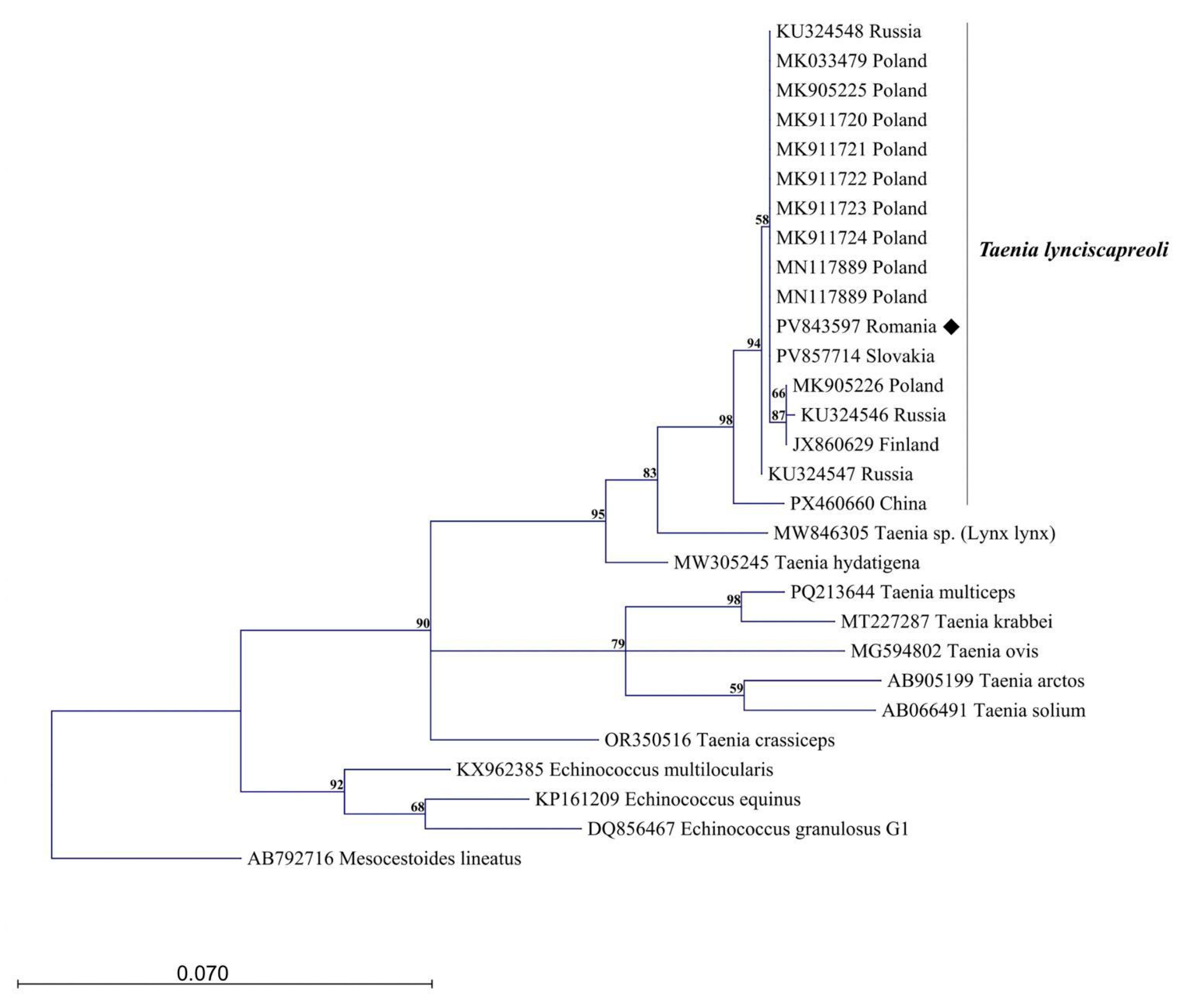
The phylogenetic analysis was based on a 391 bp
cox1 sequence. The
cox1 sequence obtained in this study (PV843597) showed 100% identity with the
T. lynciscapreoli reference sequence MK033479 in GenBank, confirming that the Romanian isolate belongs to this species. In addition, the
nad1 sequence (PV855065) showed 99.39% identity with the
T. lynciscapreoli reference sequence JX860630. No comparative
12S rRNA sequence of
T. lynciscapreoli was available in GenBank, except for the sequence generated and deposited in the present study, which represents the first
12S record available for this species. In the phylogenetic tree, the Romanian isolate clustered within the European lineage, which is distinct from the Chinese
T. lynciscapreoli clade. Within the European cluster, a subcluster comprising isolates from Finland, Russia, and Poland was identified; however, the Romanian isolate did not group within this subcluster. The phylogenetic tree also underscores the close relationship between
T. lynciscapreoli and a novel taeniid species recently detected in a lynx in China, currently referred to as
Taenia spp. (MW846305) (
Figure 2).
4. Discussion
The present study represents the first report and molecular characterization of T. lynciscapreoli in Eurasian lynx from Romania. Although the necropsy examination involved a single host individual, molecular identification was based on sequencing of a single cestode specimen selected from the nine adult worms recovered at necropsy, using the mitochondrial cox1, 12S rRNA, and nad1 genes. This finding provides an important contribution to current knowledge of the geographic distribution of this cestode in Europe.
Coprological surveys have reported the presence of
Taenia spp. in Eurasian lynx from Poland [
25] and Finland [
26], as well as in the Iberian lynx (
Lynx pardinus) [
27], while necropsy-based investigations have revealed
Taenia spp. in lynx from Estonia [
28].
The Eurasian lynx has been reported as the only definitive host for
T. laticollis and for an unidentified
Taenia species in Finland [
11] and China [
29]. In addition, the bobcat (
Lynx rufus) is the definitive host for
Taenia rileyi in Arkansas [
30].
The specific prey–predator relationship underlying the transmission of T. lynciscapreoli is supported by the demonstrated conspecificity between adult worms recovered from Eurasian lynx and metacestodes identified in roe deer, as shown morphologically and through
cox1 and
nad1 sequencing in Finland and Poland [
12,
14].
The use of three genetic markers (
cox1,
12S rRNA, and
nad1) in the present study provides robust certainty for molecular diagnosis. The confirmation of
T. lynciscapreoli in a Eurasian lynx specimen originating from Bihor County is ecologically plausible, as this area is characterized by extensive forest habitats and substantial densities of roe deer [
2], the natural intermediate host for this parasite. Moreover, the ecological similarity between the Western Carpathians and the mountainous regions of Poland—where
T. lynciscapreoli is well documented—supports the hypothesis of a largely continuous distribution across the European range of the Eurasian lynx [
14,
31]. Reports from Finland and Russia have shown that this species is widely distributed throughout the natural range of the Eurasian lynx and was likely underdiagnosed previously due to its morphological similarity to other
Taenia species [
12].
Evidence for broader ecological plasticity is provided by Kautto et al. (2022) [
15], who reported new intermediate hosts in Sweden based on molecular confirmation of
T. lynciscapreoli metacestodes in semi-domesticated reindeer. Overall, the Romanian findings are consistent with this European biogeographic pattern, suggesting that the species is not confined to isolated subpopulations but rather constitutes a stable component of the parasite fauna of the Eurasian lynx.
Although the present study is based on a single host specimen, the molecular identification of
T. lynciscapreoli in the Eurasian lynx is epidemiologically relevant for wildlife in Romania and contributes to a better understanding of trophic relationships between the predator (Eurasian lynx) and ungulate populations within Carpathian ecosystems. Furthermore, in the current national context—where available studies have focused mainly on zoonotic helminths in wild carnivores in general or on cardiopulmonary nematodes and filarioid infections in wild felids [
8,
9,
10]—important knowledge gaps still remain regarding the parasite fauna of Eurasian lynx in Romania. In this context, the genetic confirmation of
T. lynciscapreoli in the Eurasian lynx contributes to the mapping of this cestode’s European distribution.
To our knowledge, this case report represents the most southern identification of T. lynciscapreoli within the broader distribution of Eurasian lynx. Nevertheless, the small sample size and the inability to estimate true prevalence at regional or national level represent its main limitations. Future work should include investigations of metacestodes in intermediate hosts (particularly roe deer) as well as systematic post-mortem examinations of Eurasian lynx specimens, especially opportunistically recovered road-killed individuals. Such an approach would improve knowledge on the distribution, diversity, and parasite burden of T. lynciscapreoli in Romania, and could also help clarify its transmission patterns within Carpathian ecosystems.
5. Conclusions
This study reports, for the first time, the molecular identification of Taenia lynciscapreoli in the Eurasian lynx from Romania and, to our knowledge, constitutes the first record from Southeastern Europe, demonstrating the presence of the parasite in the Carpathian region based on sequencing of the mitochondrial markers cox1, 12S rRNA, and nad1.
Phylogenetic inference based on the cox1 fragment placed the Romanian isolate within the European lineage of the species, distinct from the Chinese clade, supporting a European biogeographic pattern and suggesting parasite circulation consistent with the distribution of the definitive host and intermediate hosts (particularly the roe deer) in Carpathian habitats. Future studies should also investigate the potential health impact of such infections and include host-related data such as age, sex, and nutritional status, in order to improve the interpretation of parasite findings in a protected wildlife species.
Further studies are needed to expand molecular surveillance of definitive hosts (Eurasian lynx) and intermediate hosts (particularly roe deer and other potential cervids) in order to clarify the ecology, host specificity, and regional dynamics of this cestode. Beyond their parasitological significance, such data may also contribute to wildlife health assessment and support conservation and management strategies for the Eurasian lynx as a protected species.
Author Contributions
Conceptualization, M.M.F.M., A.-M.M., and N.M.; methodology, M.M.F.M., A.-M.M., A.S., and F.S.; software, D.-C.P.; validation, R.B., K.I., and N.M.; investigation, M.M.F.M., A.-M.M., and D.-C.P.; resources, D.-C.P.; data curation, N.M.; writing—original draft preparation, M.M.F.M., A.-M.M., and N.M.; writing—review and editing, A.S., F.S., R.B., K.I., and N.M.; visualization, M.M.F.M., A.-M.M., R.B., and N.M.; supervision, N.M.; project administration, N.M. All authors have read and agreed to the published version of the manuscript.
Funding
The publication of the present paper was supported by the University of Life Sciences “King Mihai I” from Timisoara, Romania. This research was also supported by the European Commission‘s Directorate-General for Health and Food Safety (DG SANTE) under the grant agreement no. 101200161: “Work programme 2025–2027 of the European Union Reference Laboratory for the Parasites (EURL-P)”. The funders had no role in study design, data collection, data analysis, data interpretation, or writing of the report.
Institutional Review Board Statement
The animal study protocol was approved by the Institutional Review Board of the Bioethics Commission of the University of Life Sciences “King Mihai I” from Timisoara (protocol code 650 and approved on 2 March 2026).
Informed Consent Statement
Not applicable.
Data Availability Statement
The original contributions presented in this study are included in the article. Further inquiries can be directed to the corresponding author(s).
Conflicts of Interest
The authors declare no conflicts of interest.
References
- Cotta, V.; Bodea, M. Vânatul României; Editura Agrosilvică: Bucuresti, România, 1969. [Google Scholar]
- Micu, I. Etologia Faunei Cinegetice; Editura Ceres: Bucuresti, România, 2005. [Google Scholar]
- Negruțiu, A.; Șelaru, N.; Codreanu, C.; Iordache, D. Fauna Cinegetică și Salmonicolă; Editura Didactică și Pedagogică: Bucuresti, România, 1983. [Google Scholar]
- Hughes, D.P.; Bordeur, J.; Thomas, F. Host Manipulation by Parasites; Oxford University Press: Oxford, UK, 2012. [Google Scholar]
- Ionescu, O. Managementul Carnivorelor Mari în România (Teză de Abilitare); Universitatea Transilvania din Brașov: Brașov, România, 2016. [Google Scholar]
- Legea Vânătorii și a Protecției Fondului Cinegetic nr. 407 din 9 Noiembrie 2006. Available online: https://mmediu.ro/domenii/mediu/legislatie-vanatoare/ (accessed on 19 October 2025).
- Iosif, R.; Popescu, V.D.; Ungureanu, L.; Șerban, C.; Dyck, M.A.; Promberger-Fürpass, B. Eurasian lynx density and habitat use in one of Europe’s strongholds, the Romanian Carpathians. J. Mammal. 2022, 103, 415–424. [Google Scholar] [CrossRef]
- Deak, G.; Ionică, A.M.; Pop, R.A.; Mihalca, A.D.; Gherman, C.M. New insights into the distribution of cardio-pulmonary nematodes in road-killed wild felids from Romania. Parasit. Vectors 2022, 15, 153. [Google Scholar] [CrossRef] [PubMed]
- Gherman, C.; Cozma, V.; Mircean, V.; Brudașcă, F.; Rus, N.; Deteșan, A. Zoonoze helmintice la specii de carnivore sălbatice din fauna României. Sci. Parasitol. 2002, 3, 17–21. [Google Scholar]
- Ionică, A.M.; Matei, I.A.; D’Amico, G.; Ababii, J.; Daskalaki, A.A.; Sándor, A.D.; Enache, D.V.; Gherman, C.M.; Mihalca, A.D. Filarioid infections in wild carnivores: A multispecies survey in Romania. Parasit. Vectors 2017, 10, 332. [Google Scholar] [CrossRef] [PubMed]
- Lavikainen, A.; Haukisalmi, V.; Deksne, G.; Holmala, K.; Lejeune, M.; Isomursu, M.; Jokelainen, P.; Näreaho, A.; Laakkonen, J.; Hoberg, E.P.; et al. Molecular identification of Taenia spp. in the Eurasian lynx (Lynx lynx) from Finland. Parasitology 2013, 140, 653–662. [Google Scholar] [CrossRef] [PubMed]
- Haukisalmi, V.; Konyaev, S.; Lavikainen, A.; Isomursu, M.; Nakao, M. Description and life-cycle of Taenia lynciscapreoli sp. n. (Cestoda, Cyclophyllidea). ZooKeys 2016, 584, 1–23. [Google Scholar] [CrossRef] [PubMed]
- Kiyan, V.; Smagulova, A.; Manapov, N.; Jazina, K.; Uakhit, R.; Bulashev, A.; Lider, L.; Leontyev, S. Parasitic fauna of Lepus europaeus and Lepus timidus in Kazakhstan: Parasitological profile and molecular identification. Biology 2025, 14, 1083. [Google Scholar] [CrossRef] [PubMed]
- Myczka, A.W.; Jeżewski, W.; Filip-Hutsch, K.J.; Pyziel, A.M.; Kowal, J.; Demiaszkiewicz, A.W.; Laskowski, Z. The morphological and molecular identification of the tapeworm, Taenia lynciscapreoli, in intermediate and definitive hosts in Poland. Int. J. Parasitol. Parasites Wildl. 2020, 11, 213–220. [Google Scholar] [CrossRef] [PubMed]
- Kautto, A.H.; Grandi, G.; Höglund, J. Taenia lynciscapreoli in semi-domesticated reindeer (Rangifer tarandus tarandus, L.) in Sweden. Int. J. Parasitol. Parasites Wildl. 2022, 18, 148–151. [Google Scholar] [CrossRef]
- World Organisation for Animal Health (WOAH). Available online: https://www.woah.org/en/home/ (accessed on 19 October 2025).
- European Food Safety Authority (EFSA). Available online: https://www.efsa.europa.eu/en (accessed on 19 October 2025).
- Zajac, A.M.; Conboy, G.A.; Little, S.E.; Reichard, M.V. Veterinary Clinical Parasitology, 9th ed.; Wiley-Blackwell: Hoboken, NJ, USA, 2021; p. 432. [Google Scholar]
- Bowles, J.; Blair, D.; McManus, D.P. Genetic variants within the genus Echinococcus identified by mitochondrial sequencing. Mol. Biochem. Parasitol. 1992, 54, 165–174. [Google Scholar] [CrossRef] [PubMed]
- Bart, J.-M.; Knapp, J.; Gottstein, B.; El-Garch, F.; Giraudoux, P.; Glowatzki, M.-L.; Berthoud, H.; Maillard, S.; Piarroux, R. EmsB, a tandem repeated multi-loci microsatellite, new tool to investigate the genetic diversity of Echinococcus multilocularis. Infect. Genet. Evol. 2006, 6, 390–400. [Google Scholar] [CrossRef] [PubMed]
- Dinkel, A.; Njoroge, E.M.; Zimmermann, A.; Wälz, M.; Zeyhle, E.; Elmahdi, I.E.; Mackenstedt, U.; Romig, T. A PCR system for detection of species and genotypes of the Echinococcus granulosus-complex, with reference to the epidemiological situation in eastern Africa. Int. J. Parasitol. 2004, 34, 645–653. [Google Scholar] [CrossRef] [PubMed]
- Bowles, J.; McManus, D.P. NADH dehydrogenase 1 gene sequences compared for species and strains of the genus Echinococcus. Int. J. Parasitol. 1993, 23, 969–972. [Google Scholar] [CrossRef]
- National Library of Medicine. Available online: http://blast.ncbi.nlm.nih.gov/Blast.cgi (accessed on 19 October 2025).
- QIAGEN CLC Genomics Workbench. Available online: https://digitalinsights.qiagen.com (accessed on 19 October 2025).
- Zczesna, J.; Popiołek, M.; Schmidt, K.; Kowalczyk, R. Coprological study on helminth fauna in Eurasian lynx (Lynx lynx) from the Białowieza Primeval Forest in eastern Poland. J. Parasitol. 2008, 94, 981–984. [Google Scholar] [CrossRef] [PubMed]
- Deksne, G.; Laakkonen, J.; Näreaho, A.; Jokelainen, P.; Holmala, K.; Kojola, I.; Sukura, A. Endoparasites of the Eurasian lynx (Lynx lynx) in Finland. J. Parasitol. 2013, 99, 229–234. [Google Scholar] [CrossRef] [PubMed]
- Acosta, L.; León-Quinto, T.; Bornay-Llinares, F.J.; Simón, M.A.; Esteban, J.G. Helminth parasites in faecal samples from the endangered Iberian lynx (Lynx pardinus). Vet. Parasitol. 2011, 179, 175–179. [Google Scholar] [CrossRef] [PubMed]
- Valdmann, H.; Moks, E.; Talvik, H. Helminth fauna of Eurasian lynx (Lynx lynx) in Estonia. J. Wildl. Dis. 2004, 40, 356–360. [Google Scholar] [CrossRef] [PubMed]
- Liu, G.; Zhao, S.; Hornok, S.; Chen, X.; Wang, S.; Tan, W.; Gu, X.; Wang, Y. Taenia laticollis and a potentially novel Taenia species from the Eurasian lynx (Lynx) in Northwestern China. Int. J. Parasitol. Parasites Wildl. 2021, 16, 183–186. [Google Scholar] [CrossRef] [PubMed]
- McAllister, C.T.; Robison, H.W.; Woodyard, E.T.; Rosser, T.G. Selected helminth parasites (Cestoda, Nematoda) of bobcat, Lynx rufus (Carnivora: Felidae) in northeastern Arkansas. J. Ark. Acad. Sci. 2021, 75, 77–79. [Google Scholar] [CrossRef]
- Kołodziej-Sobocińska, M.; Yakovlev, Y.; Schmidt, K.; Hurníková, Z.; Ruczyńska, I.; Bednarski, M.; Tokarska, M. Update of the helminth fauna in Eurasian lynx (Lynx lynx) in Poland. Parasitol. Res. 2018, 117, 2613–2621. [Google Scholar] [CrossRef] [PubMed]
| Disclaimer/Publisher’s Note: The statements, opinions and data contained in all publications are solely those of the individual author(s) and contributor(s) and not of MDPI and/or the editor(s). MDPI and/or the editor(s) disclaim responsibility for any injury to people or property resulting from any ideas, methods, instructions or products referred to in the content. |





 ,
,