Systematic Review

The Role of Microbiota and Fecal Transplantation in Inflammatory Bowel Disease


by
Isabel Lagos
1,
Edith Pérez de Arce
2,
Ilaria Faggiani
3,4,
Ferdinando D’Amico
3,4,
Alessandra Zilli
3,4,
Federica Furfaro
3,4,
Sara Massironi
3,4,
Clelia Cicerone
3,4,
Virginia Solitano
3,4,
Tommaso Lorenzo Parigi
3,4,
Laurent Peyrin-Biroulet
5,
Silvio Danese
3,4 and
Mariangela Allocca
3,4,*
1
Department of Gastroenterology, Clinica Las Condes, Estoril 450, Santiago 8380453, Chile
2
Department of Gastroenterology, Hospital Clinico Universidad de Chile, Dr. Carlos Lorca Tobar 999, Santiago 8380456, Chile
3
Department of Gastroenterology and Endoscopy, IRCCS San Raffaele Hospital, Via Oglettina 60, 20132 Milan, Italy
4
Department of Gastroenterology, Vita Salute San Raffaele University, Via Oglettina 60, 21132 Milan, Italy
5
Department of Gastroenterology, INFINY Institute, INSERM NGERE, CHRU Nancy, F-54500 Vandoeuvre-lès-Nancy, France
*
Author to whom correspondence should be addressed.
Pathogens 2026, 15(4), 451; https://doi.org/10.3390/pathogens15040451

Submission received: 28 February 2026 / Revised: 7 April 2026 / Accepted: 13 April 2026 / Published: 21 April 2026

Abstract

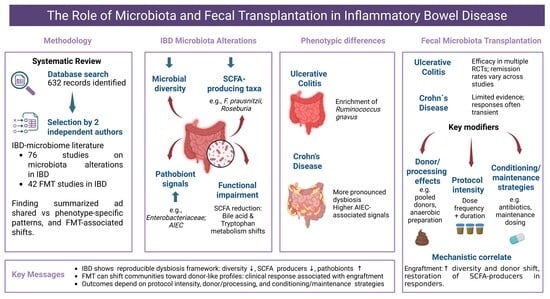
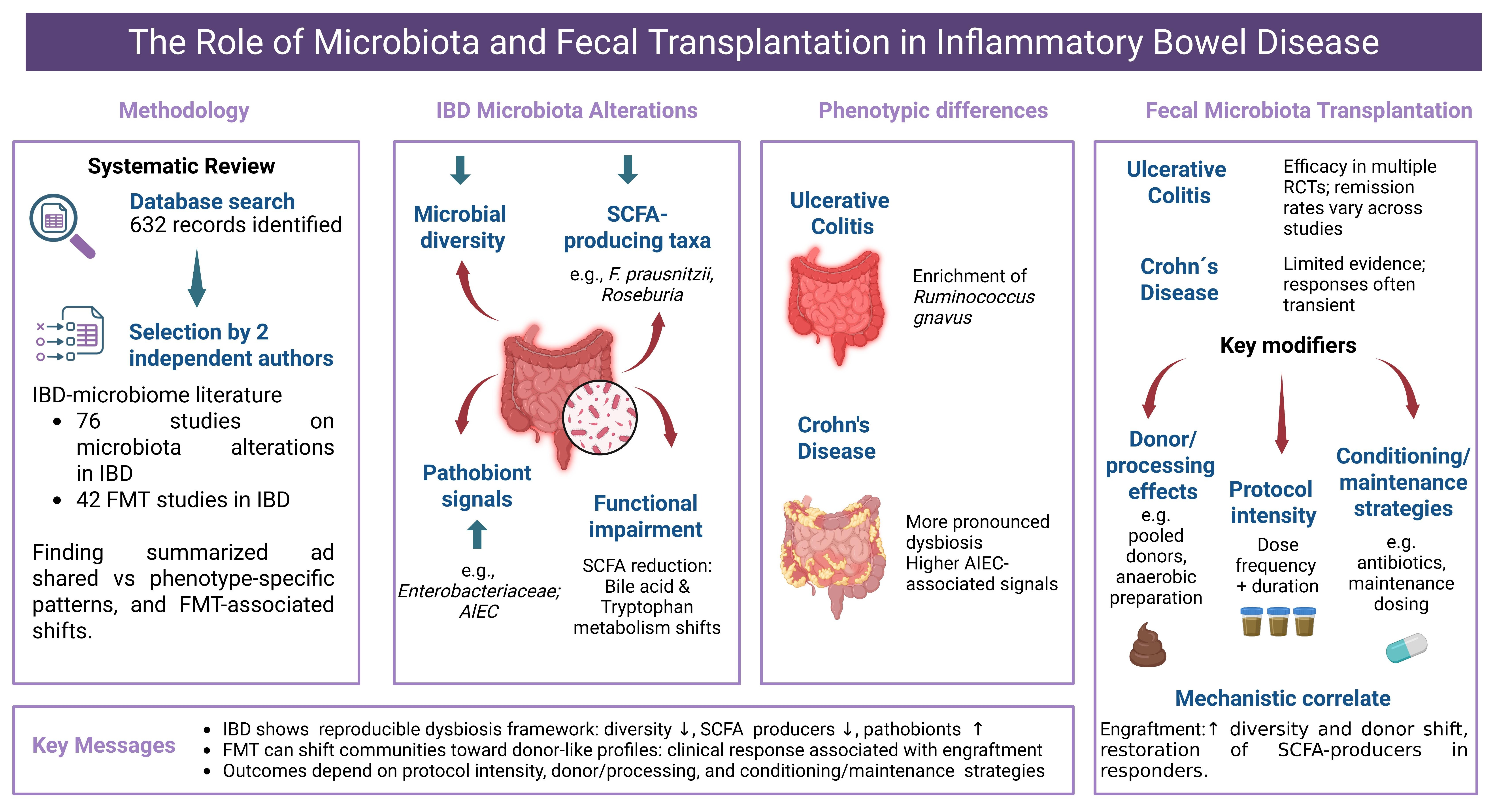
Inflammatory bowel diseases (IBDs), including ulcerative colitis (UC) and Crohn’s disease (CD), are consistently associated with alterations in gut microbial communities, although the extent and characteristics of these alterations vary across studies, supporting a potential role of the microbiota in disease pathogenesis and therapeutic modulation. We conducted a systematic review to synthesize current evidence on microbiota alterations in IBD and the clinical application of fecal microbiota transplantation (FMT). A total of 118 studies were included (76 focused on microbiota profiling and 42 evaluated FMT as therapy). Across heterogeneous study designs and microbial characterization methods, reduced microbial diversity was the most consistently reported alteration, generally more pronounced in CD than in UC. Depletion of Faecalibacterium prausnitzii—a key butyrate producer with anti-inflammatory properties—was commonly reported, often accompanied by functional impairment in short-chain fatty acid production. Microbial patterns were frequently associated with mucosal inflammation and varied across disease phenotypes; these patterns have been increasingly explored as predictors of treatment response and relapse, although mechanistic interpretation remains limited and causal relationships are difficult to establish. Evidence from randomized controlled trials suggests potential efficacy of FMT in UC, particularly with intensive or repeated protocols, whereas data in CD remain limited and heterogeneous, with signals of benefit often appearing transient. FMT was generally well tolerated, but long-term safety data remain scarce. Emerging multi-omic approaches are reshaping the field by integrating taxonomic and functional insights, with potential implications for risk stratification, diagnosis, prognosis, and therapeutic optimization. Further standardized, longitudinal, and mechanistically oriented studies are required to translate microbiome research into clinically actionable strategies in IBD.
Keywords: inflammatory bowel disease; Crohn’s disease; ulcerative colitis; microbiota; gastrointestinal microbiome; fecal microbiota transplantation; bile acids inflammatory bowel disease; Crohn’s disease; ulcerative colitis; microbiota; gastrointestinal microbiome; fecal microbiota transplantation; bile acids
Graphical Abstract