Climate Change Impacts on Plant-Parasitic Nematodes in Agroecosystems

 , ,
, ,  ,
,  ,
,  and
and
Abstract
1. Introduction
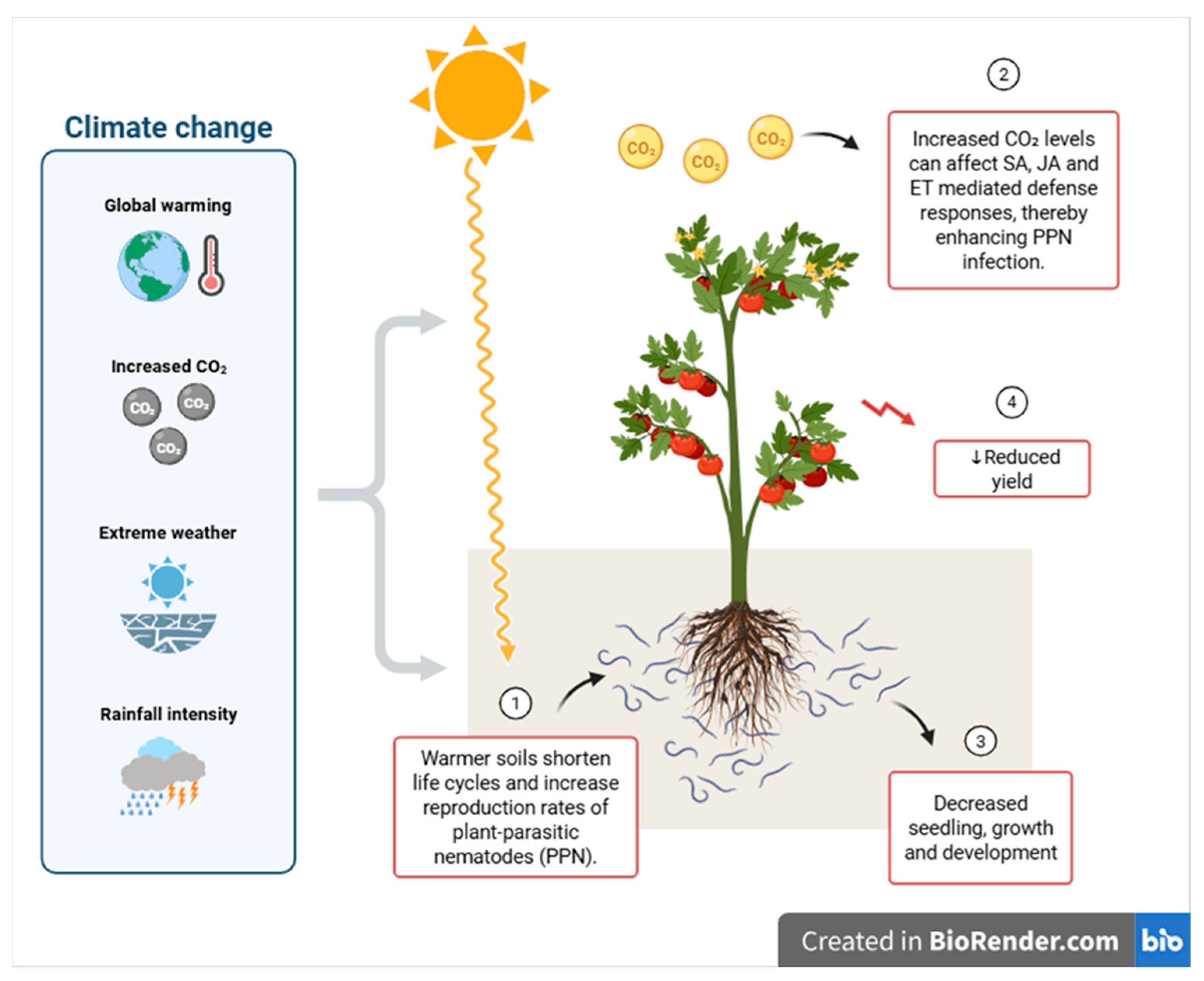
2. Global Warming and Plant-Parasitic Nematodes in Agroecosystems
3. Key Climate Change Drivers Affecting Plant-Parasitic Nematodes
3.1. Rising Temperature and Thermal Responses of Plant-Parasitic Nematodes
3.2. Elevated Atmospheric CO2 and Plant–Nematode Interactions
3.3. Altered Rainfall Regimes and Soil Moisture Dynamics
3.4. Extreme Climate Events and Nematode Population Responses
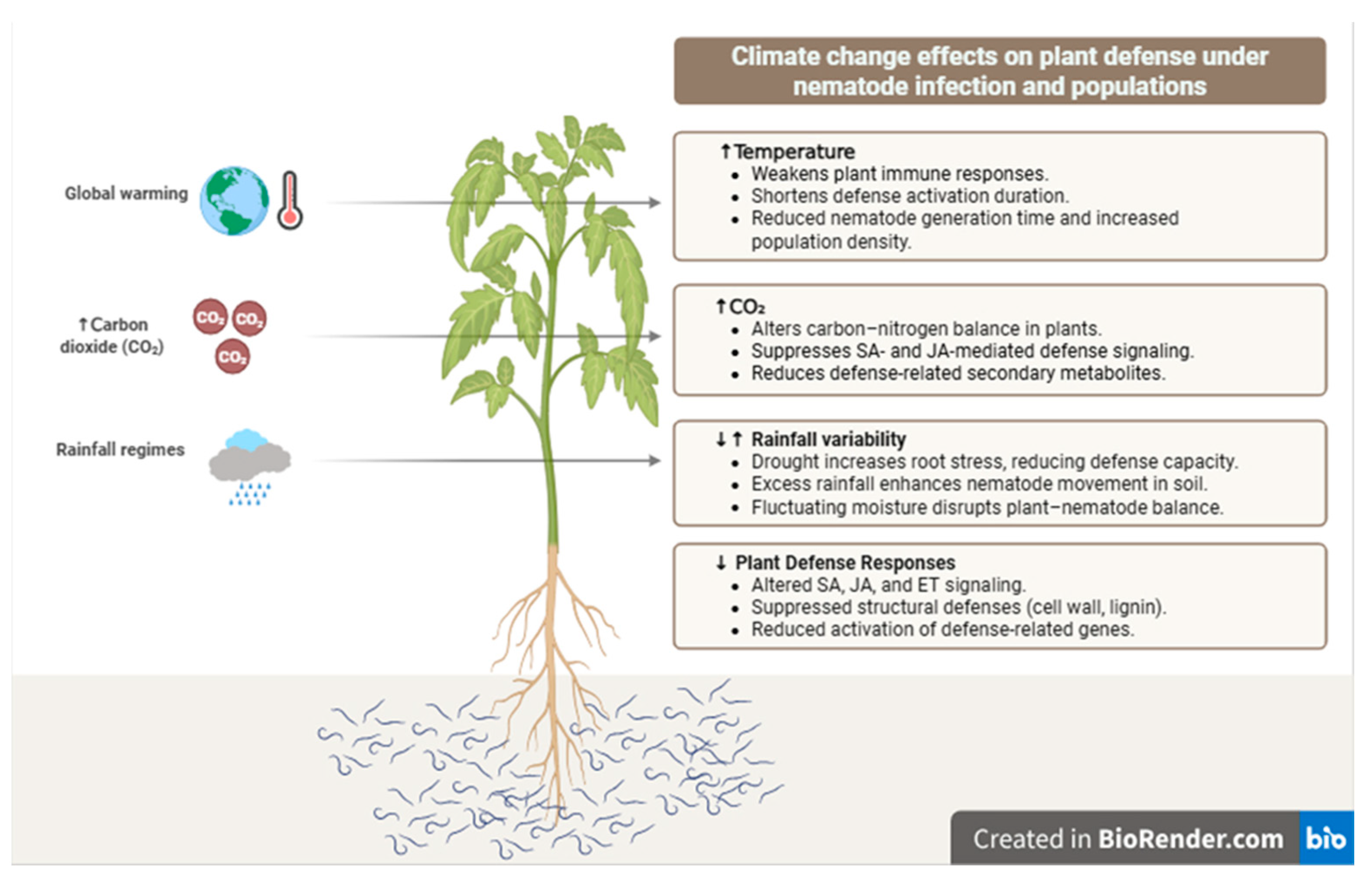
4. Plant Defense Responses, Nematode Biology, and Ecosystem-Level Interactions
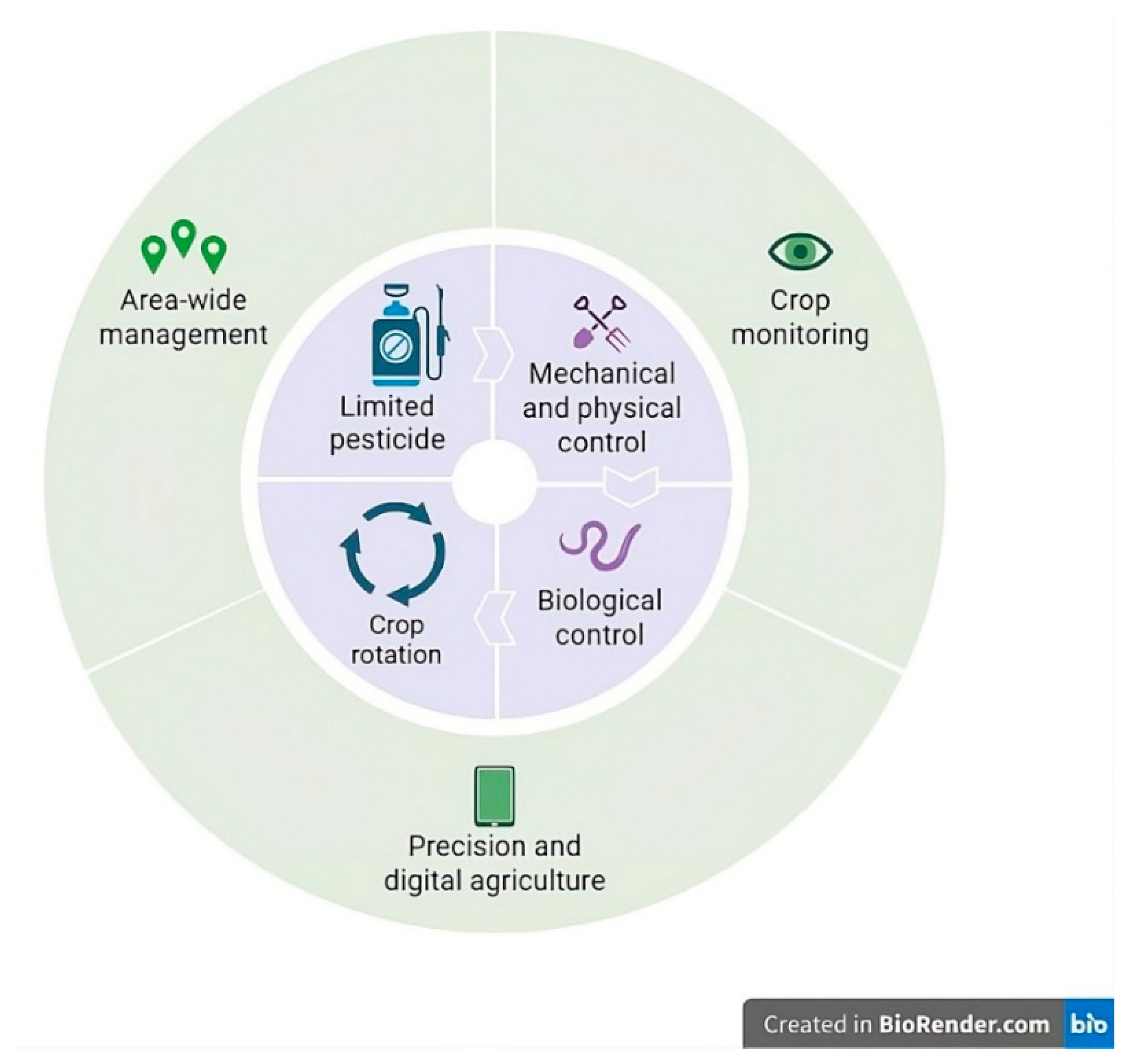
5. Climate-Adaptive Strategies for Managing Plant-Parasitic Nematodes
6. Conclusions and Future Prospects
Author Contributions
Funding
Institutional Review Board Statement
Informed Consent Statement
Data Availability Statement
Conflicts of Interest
Abbreviations
| PPN | Plant-parasitic nematode |
| CO2 | Carbon dioxide |
| FACE | Free-air CO2 enrichment |
| IPM | Integrated Pest Management |
References
- Filonchyk, M.; Peterson, M.P.; Zhang, L.; Hurynovich, V.; He, Y. Greenhouse gases emissions and global climate change: Examining the influence of CO2, CH4, and N2O. Sci. Total Environ. 2024, 935, 173359. [Google Scholar] [CrossRef] [Scilit]
- Fuhrer, J. Agroecosystem responses to combinations of elevated CO2, ozone, and global climate change. Agric. Ecosyst. Environ. 2003, 97, 1–20. [Google Scholar] [CrossRef] [Scilit]
- Fang, P.; Wang, T.; Yang, D.; Tang, L.; Yang, Y. Substantial increases in compound climate extremes and associated socio-economic exposure across China under future climate change. npj Clim. Atmos. Sci. 2025, 8, 17. [Google Scholar] [CrossRef] [Scilit]
- Islam, F.S. Global impact of climate change: Glacial melt, sea level rise, water salinization and emergent pathogen risks. Asian J. Environ. Ecol. 2025, 24, 91–113. [Google Scholar] [CrossRef] [Scilit]
- Trap, J.; Brondani, M.; Plassard, C.; Hedde, M.; Puissant, J. Ecosystem functions supported by soil bacterivorous nematodes. Geoderma 2025, 463, 117575. [Google Scholar] [CrossRef] [Scilit]
- Yeates, G.W.; Newton, P.C.; Ross, D.J. Response of soil nematode fauna to naturally elevated CO2 levels influenced by soil pattern. Nematology 1999, 1, 285–293. [Google Scholar] [CrossRef] [Scilit]
- Jones, J.T.; Haegeman, A.; Danchin, E.G.; Gaur, H.S.; Helder, J.; Jones, M.G.; Perry, R.N. Top 10 plant-parasitic nematodes in molecular plant pathology. Mol. Plant Pathol. 2013, 14, 946–961. [Google Scholar] [CrossRef] [Scilit]
- Abad, P.; Gouzy, J.; Aury, J.M.; Castagnone-Sereno, P.; Danchin, E.G.; Deleury, E.; Wincker, P. Genome sequence of the metazoan plant-parasitic nematode Meloidogyne incognita. Nat. Biotechnol. 2008, 26, 909–915. [Google Scholar] [CrossRef] [Scilit]
- Elling, A.A. Major emerging problems with minor Meloidogyne species. Phytopathology 2013, 103, 1092–1102. [Google Scholar] [CrossRef] [Scilit]
- Carvalho, R.P.; Guerra, C.; Cano-Díaz, C.; Mendes, S.; Costa, S.R. Distribution of plant-parasitic nematode communities across land-use types in the North of Portugal. Appl. Soil Ecol. 2025, 206, 105852. [Google Scholar] [CrossRef] [Scilit]
- Norton, D.C. Ecology of Plant-Parasitic Nematodes; Wiley: New York, NY, USA, 1978. [Google Scholar]
- Yarba, M.M.; Çetintaş, R. Relationship between plant parasitic nematodes population and soil moisture and temperature. Indian Phytopathol. 2025, 77, 169–173. [Google Scholar] [CrossRef] [Scilit]
- Rashidifard, M.; Singh, S.; Du Preez, G.; Ashrafi, S. Impact of climate change on plant nematodes and diseases complexes. In Nematode Disease Complexes in Agricultural Crops; CABI: Wallingford, UK, 2025; pp. 341–353. [Google Scholar]
- Perry, R.N.; Moens, M. Survival of parasitic nematodes outside the host. In Molecular and Physiological Basis of Nematode Survival; CAB International: Wallingford, UK, 2011; pp. 1–27. [Google Scholar]
- Renčo, M.; Adámek, M.; Jílková, V.; Devetter, M. Post-fire recovery of soil nematode communities depends on fire severity. Diversity 2022, 14, 1116. [Google Scholar] [CrossRef] [Scilit]
- Dutta, T.K.; Vicente, C.S.; Maleita, C.M.; Phani, V. Impact of global climate change on the interaction between plants and plant-parasitic nematodes. Front. Plant Sci. 2023, 14, 1195970. [Google Scholar] [CrossRef] [Scilit]
- Sagar, G.C.; Banakar, P.; Harshman, D.; Khanal, C. Elevated soil temperatures impact nematode reproduction biology. Stresses 2025, 5, 2. [Google Scholar] [CrossRef] [Scilit]
- Kergunteuil, A.; Campos-Herrera, R.; Sánchez-Moreno, S.; Vittoz, P.; Rasmann, S. The abundance, diversity, and metabolic footprint of soil nematodes is highest in high elevation alpine grasslands. Front. Ecol. Evol. 2016, 4, 84. [Google Scholar] [CrossRef] [Scilit]
- Bebber, D.P.; Ramotowski, M.A.; Gurr, S.J. Crop pests and pathogens move polewards in a warming world. Nat. Clim. Change 2013, 3, 985–988. [Google Scholar] [CrossRef] [Scilit]
- Somasekhar, N.; Prasad, J.S. Plant–nematode interactions: Consequences of climate change. In Crop Stress and Its Management: Perspectives and Strategies; Springer: Dordrecht, The Netherlands, 2011; pp. 547–564. [Google Scholar]
- Ferris, J.M.; Ferris, V.R. Biology of plant-parasitic nematodes. Plant Nematode Interact. 1998, 36, 21–35. [Google Scholar]
- Dutta, T.K.; Phani, V. The pervasive impact of global climate change on plant-nematode interaction continuum. Front. Plant Sci. 2023, 14, 1143889. [Google Scholar] [CrossRef] [Scilit]
- Ullah, S.S.; Abbas, A.; Gogi, M.D.; Siddique, S.; Ali, M.A. Occurrence and Molecular Characterization of Root-Knot Nematodes on Tunnel-Grown Cucumber (Cucumis sativus) in Balochistan Province of Pakistan. Physiol. Mol. Plant Pathol. 2025, 140, 102868. [Google Scholar] [CrossRef] [Scilit]
- Nielsen, M.; Cook, B.I.; Marvel, K.; Ting, M.; Smerdon, J.E. The changing influence of precipitation on soil moisture drought with warming in the Mediterranean and western North America. Earth’s Future 2024, 12, e2023EF003987. [Google Scholar] [CrossRef] [Scilit]
- McSorley, R. Adaptations of nematodes to environmental extremes. Florida Entomol. 2003, 86, 138–142. [Google Scholar] [CrossRef] [Scilit]
- Felek, A.F.; Akyazı, F. Nematodlarda olumsuz çevre koşullarına karşı adaptasyonlar. Türk. Entomol. Bül. 2017, 7, 191–203. [Google Scholar]
- Pausch, J.; Kuzyakov, Y. Carbon input by roots into the soil: Quantification of rhizodeposition from root to ecosystem scale. Glob. Change Biol. 2018, 24, 1–12. [Google Scholar] [CrossRef] [Scilit] [PubMed]
- Sun, Y.; Yin, J.; Cao, H.; Li, C.; Kang, L.; Ge, F. Elevated CO2 influences nematode-induced defense responses of tomato genotypes differing in the JA pathway. PLoS ONE 2011, 6, e19751. [Google Scholar] [CrossRef] [Scilit]
- Berliner, J.; Ganguly, A.K.; Kamra, A.; Sirohi, A.; Vp, D. Effect of elevated carbon dioxide on population growth of root-knot nematode, Meloidogyne incognita in tomato. Indian Phytopathol. 2023, 76, 309–315. [Google Scholar] [CrossRef] [Scilit]
- Das, A.K.; Lee, D.S.; Woo, Y.J.; Sultana, S.; Mahmud, A.; Yun, B.W. The impact of flooding on soil microbial communities and their functions: A review. Stresses 2025, 5, 30. [Google Scholar] [CrossRef] [Scilit]
- Smolik, J.D.; Rogers, L.E. Effects of cattle grazing and wildfire on soil-dwelling nematodes of the shrub-steppe ecosystem. Rangeland Ecol. Manag. 1976, 29, 304–306. [Google Scholar] [CrossRef] [Scilit]
- Velloso, J.A.; Maquilan, M.A.D.; Campos, V.P.; Brito, J.A.; Dickson, D.W. Temperature effects on development of Meloidogyne enterolobii and M. floridensis. J. Nematol. 2022, 54, 20220013. [Google Scholar] [CrossRef] [Scilit]
- Evans, A.A.; Perry, R.N. Survival mechanisms. In Root-Knot Nematodes; CABI: Wallingford, UK, 2009; pp. 201–222. [Google Scholar]
- Gao, R.; Liu, L.; Zhao, L.; Cui, S. Potentially suitable geographical area for Monochamus alternatus under current and future climatic scenarios based on optimized MaxEnt model. Insects 2023, 14, 182. [Google Scholar] [CrossRef] [Scilit]
- Wang, J.; Deng, J.; Yan, W.; Zheng, Y. Habitat suitability of pine wilt disease in Northeast China under climate change scenario. Forests 2023, 14, 1687. [Google Scholar] [CrossRef] [Scilit]
- Liu, Y.; Wang, W.; Liu, P.; Zhou, H.; Chen, Z.; Suonan, J. Plant-soil mediated effects of long-term warming on soil nematodes of alpine meadows on the Qinghai–Tibetan Plateau. Biology 2022, 11, 1596. [Google Scholar] [CrossRef] [Scilit]
- Chen, H.; Luo, S.; Li, G.; Jiang, W.; Qi, W.; Hu, J.; Du, G. Large-scale patterns of soil nematodes across grasslands on the Tibetan Plateau: Relationships with climate, soil and plants. Diversity 2021, 13, 369. [Google Scholar] [CrossRef] [Scilit]
- Jones, L.M.; Koehler, A.K.; Trnka, M.; Balek, J.; Challinor, A.J.; Atkinson, H.J.; Urwin, P.E. Climate change is predicted to alter the current pest status of Globodera pallida and G. rostochiensis in the United Kingdom. Glob. Change Biol. 2017, 23, 4497–4507. [Google Scholar] [CrossRef] [Scilit]
- Pridannikov, M.V.; Zinovieva, S.V.; Khudyakova, E.A.; Limantseva, L.A.; Osipov, F.A.; Dergunova, N.N.; Petrosyan, V.G. Range dynamics of potato cyst nematode Globodera rostochiensis under conditions of global climate change in Russia. Russ. J. Biol. Invasions 2022, 13, 510–529. [Google Scholar] [CrossRef] [Scilit]
- Rebetez, M.; Dobbertin, M. Climate change may already threaten Scots pine stands in the Swiss Alps. Theor. Appl. Climatol. 2004, 79, 1–9. [Google Scholar] [CrossRef] [Scilit]
- Ghini, R.; Hamada, E.; Pedro Júnior, M.J.; Marengo, J.A.; Gonçalves, R.R.D.V. Risk analysis of climate change on coffee nematodes and leaf miner in Brazil. Pesq. Agropec. Bras. 2008, 43, 187–194. [Google Scholar] [CrossRef] [Scilit]
- Leach, M.; Agudelo, P.; Gerard, P. Effect of temperature on the embryogenesis of geographic populations of Rotylenchulus reniformis. J. Nematol. 2009, 41, 23. [Google Scholar]
- Colagiero, M.; Ciancio, A. Climate changes and nematodes: Expected effects and perspectives for plant protection. Redia 2012, 94, 113–118. [Google Scholar]
- Kaczmarek, A.; Mackenzie, K.; Kettle, H.; Blok, V. Influence of soil temperature on Globodera rostochiensis and Globodera pallida. Phytopathol. Mediterr. 2014, 53, 396–405. [Google Scholar]
- Yan, X.; Wang, K.; Song, L.; Wang, X.; Wu, D. Daytime warming has stronger negative effects on soil nematodes than night-time warming. Sci. Rep. 2017, 7, 44888. [Google Scholar] [CrossRef] [Scilit]
- Khanal, C.; Land, J. Study on two nematode species suggests climate change will inflict greater crop damage. Sci. Rep. 2023, 13, 14185. [Google Scholar] [CrossRef] [Scilit]
- Wang, J.; Shi, X.; Li, L.; Zhang, X. Changes in soil nematodes in rhizosphere and non-rhizosphere soils following combined elevated CO2 and canopy warming in a winter wheat field. Geoderma 2021, 386, 114907. [Google Scholar] [CrossRef] [Scilit]
- Li, Z.; Ahammed, G.J. Salicylic acid and jasmonic acid in elevated CO2-induced plant defense response to pathogens. J. Plant Physiol. 2023, 286, 154019. [Google Scholar] [CrossRef] [Scilit]
- Mueller, K.E.; Blumenthal, D.M.; Carrillo, Y.; Cesarz, S.; Ciobanu, M.; Hines, J.; Eisenhauer, N. Elevated CO2 and warming shift the functional composition of soil nematode communities in a semiarid grassland. Soil Biol. Biochem. 2016, 103, 46–51. [Google Scholar] [CrossRef] [Scilit]
- Neher, D.A.; Weicht, T.R. Nematode genera in forest soil respond differentially to elevated CO2. J. Nematol. 2013, 45, 214. [Google Scholar]
- Agrios, G. Plant Pathology, 5th ed.; Elsevier Academic Press: Amsterdam, The Netherlands, 2005; p. 922. [Google Scholar]
- Yeates, G.W.; Tate, K.R.; Newton, P.C.D. Response of the fauna of a grassland soil to doubling of atmospheric carbon dioxide concentration. Biol. Fertil. Soils 1997, 25, 307–315. [Google Scholar] [CrossRef] [Scilit]
- Hungate, B.A.; Jaeger, C.H.; Gamara, G.; Chapin, F.S.; Field, C.B. Soil microbiota in two annual grasslands: Responses to elevated atmospheric CO2. Oecologia 2000, 124, 589–598. [Google Scholar] [CrossRef] [Scilit] [PubMed]
- Yeates, G.W.; Newton, P.C.D.; Ross, D.J. Significant changes in soil microfauna in grazed pasture under elevated carbon dioxide. Biol. Fertil. Soils 2003, 38, 319–326. [Google Scholar] [CrossRef] [Scilit]
- Niklaus, P.A.; Alphei, J.; Ebersberger, D.; Kampichler, C.; Kandeler, E.; Tscherko, D. Six years of in situ CO2 enrichment evoke changes in soil structure and soil biota of nutrient-poor grassland. Glob. Change Biol. 2003, 9, 585–600. [Google Scholar] [CrossRef] [Scilit]
- Sonnemann, I.; Wolters, V. The microfood web of grassland soils responds to a moderate increase in atmospheric CO2. Glob. Change Biol. 2005, 11, 1148–1155. [Google Scholar] [CrossRef] [Scilit]
- Li, Q.; Liang, W.; Jiang, Y.; Shi, Y.; Zhu, J.; Neher, D.A. Effect of elevated CO2 and N fertilisation on soil nematode abundance and diversity in a wheat field. Appl. Soil Ecol. 2007, 36, 63–69. [Google Scholar] [CrossRef] [Scilit]
- Li, Q.; Xu, C.; Liang, W.; Zhong, S.; Zheng, X.; Zhu, J. Residue incorporation and N fertilization affect the response of soil nematodes to elevated CO2 in a Chinese wheat field. Soil Biol. Biochem. 2009, 41, 1497–1503. [Google Scholar] [CrossRef] [Scilit]
- Ayres, E.; Wall, D.H.; Simmons, B.L.; Field, C.B.; Milchunas, D.G.; Morgan, J.A.; Roy, J. Belowground nematode herbivores are resistant to elevated atmospheric CO2 concentrations in grassland ecosystems. Soil Biol. Biochem. 2008, 40, 978–985. [Google Scholar] [CrossRef] [Scilit]
- Sticht, C.; Schrader, S.; Giesemann, A.; Weigel, H.J. Sensitivity of nematode feeding types in arable soil to free air CO2 enrichment (FACE) is crop specific. Pedobiologia 2009, 52, 337–349. [Google Scholar] [CrossRef] [Scilit]
- Wang, J.; Li, M.; Zhang, X.; Liu, X.; Li, L.; Shi, X.; Pan, G. Changes in soil nematode abundance and composition under elevated CO2 and canopy warming in a rice paddy field. Plant Soil 2019, 445, 425–437. [Google Scholar] [CrossRef] [Scilit]
- Jones, F.G.W.; Larbey, D.W.; Parrott, D.M. The influence of soil structure and moisture on nematodes, especially Xiphinema, Longidorus, Trichodorus and Heterodera spp. Soil Biol. Biochem. 1969, 1, 153–165. [Google Scholar] [CrossRef] [Scilit]
- Greco, N.; Vito, M.D. Population dynamics and damage levels. In Root-Knot Nematodes; CABI: Wallingford, UK, 2009; pp. 246–274. [Google Scholar]
- Stevnbak, K.; Maraldo, K.; Georgieva, S.; Bjørnlund, L.; Beier, C.; Schmidt, I.K.; Christensen, S. Suppression of soil decomposers and promotion of long-lived, root herbivorous nematodes by climate change. Eur. J. Soil Biol. 2012, 52, 1–7. [Google Scholar] [CrossRef] [Scilit]
- Vandegehuchte, M.L.; Sylvain, Z.A.; Reichmann, L.G.; De Tomasel, C.M.; Nielsen, U.N.; Wall, D.H.; Sala, O.E. Responses of a desert nematode community to changes in water availability. Ecosphere 2015, 6, 1–15. [Google Scholar] [CrossRef] [Scilit]
- Fleming, T.R.; McGowan, N.E.; Maule, A.G.; Fleming, C.C. Prevalence and diversity of plant parasitic nematodes in Northern Ireland grassland and cereals, and the influence of soils and rainfall. Plant Pathol. 2016, 65, 1539–1550. [Google Scholar] [CrossRef] [Scilit]
- Franco, A.L.; Gherardi, L.A.; de Tomasel, C.M.; Andriuzzi, W.S.; Ankrom, K.E.; Shaw, E.A.; Bach, E.M.; Sala, O.E.; Wall, D.H. Drought suppresses soil predators and promotes root herbivores in mesic, but not in xeric grasslands. Proc. Natl. Acad. Sci. USA 2019, 116, 12883–12888. [Google Scholar] [CrossRef] [Scilit] [PubMed]
- Franco, A.L.C.; Gherardi, L.A.; de Tomasel, C.M.; Andriuzzi, W.S.; Ankrom, K.E.; Bach, E.M.; Guan, P.; Sala, O.E.; Wall, D.H. Root herbivory controls the effects of water availability on the partitioning between above- and below-ground grass biomass. Funct. Ecol. 2020, 34, 2403–2410. [Google Scholar] [CrossRef] [Scilit]
- Ankrom, K.E.; Franco, A.L.C.; Fonte, S.J.; Gherardi, L.A.; de Tomasel, C.M.; Andriuzzi, W.S.; Shaw, E.A.; Sala, O.E.; Wall, D.H. Ecto- and endoparasitic nematodes respond differently across sites to changes in precipitation. Oecologia 2020, 193, 761–771. [Google Scholar] [CrossRef] [Scilit] [PubMed]
- Ankrom, K.E.; Franco, A.L.C.; Fonte, S.J.; Gherardi, L.A.; de Tomasel, C.M.; Wepking, C.; Guan, P.; Cui, S.; Sala, O.E.; Wall, D.H. Ecological maturity and stability of nematode communities in response to precipitation manipulations in grasslands. Appl. Soil Ecol. 2022, 170, 104263. [Google Scholar] [CrossRef] [Scilit]
- Martinez-Villalobos, C.; Fu, D.; Loikith, P.C.; Neelin, J.D. Accelerating increase in the duration of heatwaves under global warming. Nat. Geosci. 2025, 18, 716–723. [Google Scholar] [CrossRef] [Scilit]
- Ripple, W.J.; Wolf, C.; Mann, M.E.; Rockström, J.; Gregg, J.W.; Xu, C.; Wunderling, N.; Perkins-Kirkpatrick, S.E.; Schaeffer, R.; Broadgate, W.J.; et al. The 2025 state of the climate report: A planet on the brink. BioScience 2025, 75, 1016–1027. [Google Scholar] [CrossRef] [Scilit]
- Neher, D.A. Role of nematodes in soil health and their use as indicators. J. Nematol. 2001, 33, 161–168. [Google Scholar] [PubMed]
- Hasegawa, T.; Sakurai, G.; Fujimori, S.; Takahashi, K.; Hijioka, Y.; Masui, T. Extreme climate events increase risk of global food insecurity and adaptation needs. Nat. Food 2021, 2, 587–595. [Google Scholar] [CrossRef] [Scilit]
- Goverse, A.; Smant, G. The activation and suppression of plant innate immunity by parasitic nematodes. Annu. Rev. Phytopathol. 2014, 52, 243–265. [Google Scholar] [CrossRef] [Scilit]
- Kammerhofer, N.; Radakovic, Z.; Regis, J.M.; Dobrev, P.; Vankova, R.; Grundler, F.M.; Wieczorek, K. Role of stress-related hormones in plant defence during early infection of the cyst nematode Heterodera schachtii in Arabidopsis. New Phytol. 2015, 207, 778–789. [Google Scholar] [CrossRef] [Scilit]
- Haegeman, A.; Mantelin, S.; Jones, J.T.; Gheysen, G. Functional roles of effectors of plant-parasitic nematodes. Gene 2012, 492, 19–31. [Google Scholar] [CrossRef] [Scilit]
- Siddique, S.; Grundler, F.M. Parasitic nematodes manipulate plant development to establish feeding sites. Curr. Opin. Microbiol. 2018, 46, 102–108. [Google Scholar] [CrossRef] [Scilit] [PubMed]
- Classen, A.T.; Sundqvist, M.K.; Henning, J.A.; Newman, G.S.; Moore, J.A.; Cregger, M.A.; Patterson, C.M. Direct and indirect effects of climate change on soil microbial and soil microbial–plant interactions: What lies ahead? Ecosphere 2015, 6, 1–21. [Google Scholar] [CrossRef] [Scilit]
- Kerry, B.R. Rhizosphere interactions and the exploitation of microbial agents for the biological control of plant-parasitic nematodes. Annu. Rev. Phytopathol. 2000, 38, 423–441. [Google Scholar] [CrossRef] [Scilit]
- Okulewicz, A. The impact of global climate change on the spread of parasitic nematodes. Ann. Parasitol. 2017, 63, 15–20. [Google Scholar]
- Abd-Elgawad, M.M. Integrated nematode management strategies: Optimization of combined nematicidal and multi-functional inputs. Plants 2025, 14, 1004. [Google Scholar] [CrossRef] [Scilit]
- Kogan, M. Integrated pest management: Historical perspectives and contemporary developments. Annu. Rev. Entomol. 1998, 43, 243–270. [Google Scholar] [CrossRef] [Scilit] [PubMed]
- Fourie, H.; De Waele, D. Integrated pest management (IPM) of nematodes. In Integrated Management of Insect Pests; Burleigh Dodds Science Publishing: Cambridge, UK, 2019; pp. 771–840. [Google Scholar]
- Kratochvil, R.J.; Sardanelli, S.; Everts, K.; Gallagher, E. Evaluation of crop rotation and other cultural practices for management of root-knot and lesion nematodes. Agron. J. 2004, 96, 1419–1428. [Google Scholar] [CrossRef] [Scilit]
- Katan, J. Solar heating (solarization) control of soilborne pests. Annu. Rev. Phytopathol. 1981, 19, 211–236. [Google Scholar] [CrossRef] [Scilit]
- Nico, A.I.; Jiménez-Díaz, R.M.; Castillo, P. Solarization of soil in piles for the control of Meloidogyne incognita in olive nurseries in southern Spain. Plant Pathol. 2003, 52, 770–778. [Google Scholar] [CrossRef] [Scilit]
- Coyne, D.L.; Cortada, L.; Dalzell, J.J.; Claudius-Cole, A.O.; Haukeland, S.; Luambano, N.; Talwana, H. Plant-parasitic nematodes and food security in Sub-Saharan Africa. Annu. Rev. Phytopathol. 2018, 56, 381–403. [Google Scholar] [CrossRef] [Scilit]
- Bui, H.X.; Desaeger, J.A. Efficacy of nonfumigant nematicides against Meloidogyne javanica as affected by soil temperature under pasteurized and natural soil conditions. Pest Manag. Sci. 2021, 77, 3179–3186. [Google Scholar] [CrossRef] [Scilit]
- Poveda, J.; Abril-Urias, P.; Escobar, C. Biological control of plant-parasitic nematodes by filamentous fungi inducers of resistance: Trichoderma, mycorrhizal and endophytic fungi. Front. Microbiol. 2020, 11, 992. [Google Scholar] [CrossRef] [Scilit]
- Mukhtar, T.; Hussain, M.A.; Kayani, M.Z. Biocontrol potential of Pasteuria penetrans, Pochonia chlamydosporia, Paecilomyces lilacinus and Trichoderma harzianum against Meloidogyne incognita in okra. Phytopathol. Mediterr. 2013, 52, 66–76. [Google Scholar]
- Wu, Y.; Yang, Z.; Jiang, Z.; Nizamani, M.M.; Zhang, H.; Liu, M.; Li, K. Isolation, identification, and evaluation of the predatory activity of Chinese Arthrobotrys species towards economically important plant-parasitic nematodes. J. Fungi 2023, 9, 1125. [Google Scholar] [CrossRef] [Scilit] [PubMed]
- Contreras-Soto, M.B.; Tovar-Pedraza, J.M.; Solano-Báez, A.R.; Bayardo-Rosales, H.; Márquez-Licona, G. Biocontrol strategies against plant-parasitic nematodes using Trichoderma spp.: Mechanisms, applications, and management perspectives. J. Fungi 2025, 11, 517. [Google Scholar] [CrossRef] [Scilit] [PubMed]
- Vasantha-Srinivasan, P.; Park, K.B.; Kim, K.Y.; Jung, W.J.; Han, Y.S. The role of Bacillus species in the management of plant-parasitic nematodes. Front. Microbiol. 2025, 15, 1510036. [Google Scholar] [CrossRef] [Scilit]
- Selvaraj, S.; Ganeshamoorthi, P.; Pandiaraj, T. Potential impacts of recent climate change on biological control agents in agro-ecosystem: A review. Int. J. Biodivers. Conserv. 2013, 5, 845–852. [Google Scholar]
- Zahoor, A.; Arshad, U.; Niaz, Z.; Shafique, M.S.; Sarwar, N.; Jabran, M. Reshaping the Plant Microbiomes for Sustainable Disease Management. Integr. Plant Biotechnol. 2024, 2, 63–75. [Google Scholar] [CrossRef] [Scilit]
- Afzal, A.; Mukhtar, T. Revolutionizing nematode management to achieve global food security goals—An overview. Heliyon 2024, 10, e25325. [Google Scholar] [CrossRef] [Scilit]
- Wubie, M.; Temesgen, Z. Resistance mechanisms of tomato (Solanum lycopersicum) to root-knot nematodes (Meloidogyne species). J. Plant Breed. Crop Sci. 2019, 11, 33–40. [Google Scholar]
- Fayyaz, M.; Abbas, A.; Sufyan, M.; Ali, M.A. Efficacy of Biochar Developed from Different Feedstocks at Different Temperatures for Mitigating Root Knot Nematodes in Lycopersicon esculentum Mill. Pak. J. Agric. Sci. 2024, 61, 1127–1135. [Google Scholar]
- Fayyaz, M.; Abbas, A.; Arshad, U.; Azeem, F.; Joyia, F.A.; Hajjaji, A.; Ali, M.A. Field-Based Evaluation of Sugarcane Bagasse Biochar for Managing Root-Knot Nematodes in Tomato. Physiol. Mol. Plant Pathol. 2025, 139, 102825. [Google Scholar] [CrossRef] [Scilit]
- Mustafa, A.; Saeed, Q.; Farooqi, Z.U.R.; Arshad, U.; Holatko, J.; Wei, W.; Mahmood, M.; Brtnicky, M.; Chen, W.; Rebi, A.; et al. Beyond One-Size-Fits-All: Tailoring Engineered Biochar for Purpose-Specific Rhizosphere Engineering in Crop Production, Protection, and Soil Remediation. Biochar 2025, 8, 3. [Google Scholar] [CrossRef] [Scilit]
- Tratwal, A.; Jakubowska, M.; Pietrusińska-Radzio, A. Decision support systems in integrated pest and disease management: Innovative elements in sustainable agriculture. Sustainability 2025, 17, 8111. [Google Scholar] [CrossRef] [Scilit]
- Molendijk, L.P.; Sikora, R.A. Decision support systems in integrated nematode management: The need for a holistic approach. In Integrated Nematode Management: State-of-the-Art and Visions for the Future; CABI: Wallingford, UK, 2021; pp. 428–438. [Google Scholar]
- Žibrat, U.; Viaene, N.; Širca, S.; van Beek, J.; Susič, N.; Stare, B.G. Nemdetect: Early detection of quarantine nematodes in potatoes using remote sensing. EFSA Support. Publ. 2023, 20, 8143E. [Google Scholar] [CrossRef] [Scilit]



| Cropping System | Experimental System | Nematode | Temperature Response | Country | Reference |
|---|---|---|---|---|---|
| Laboratory growth test | Controlled environment developmental assays | Meloidogyne spp. (incl. M. enterolobii, M. floridensis) | Accelerated development at higher temperatures | Laboratory-based | [32] |
| Potato | Controlled-climate growth chamber experiments | Globodera rostochiensis, G. pallida | Population increase in G. rostochiensis; limited response in G. pallida | United Kingdom | [38] |
| Pine forest | Long-term ecosystem observation and tree-based sampling | Bursaphelenchus mucronatus, B. xylophilus | Higher occurrence and broader distribution under warmer conditions | Switzerland | [40] |
| Coffee plantation | Climate-based simulation model | Meloidogyne incognita | Increased disease risk under elevated temperature scenarios | Brazil | [41] |
| Laboratory incubation | Controlled laboratory incubation across temperature gradients | Rotylenchulus reniformis | Embryogenesis maintained at elevated temperatures with population-specific optima | USA | [42] |
| Carrot | Temperature-driven simulation experiment | Heterodera carotae | Increased juvenile density and egg production | Italy | [43] |
| Potato | Soil-temperature controlled hatch and biological assays | Globodera rostochiensis, G. pallida | Species-specific differences in hatch response to warming | Europe | [44] |
| Grassland | Active field warming through infrared radiation | Aphelenchoides spp., Paratylenchus spp., Pratylenchus spp., Rotylenchus spp. | Daytime warming exerted stronger suppressive effects than nighttime warming | China | [45] |
| Laboratory growth test | Controlled soil-temperature assays (direct & indirect heat exposure) | Rotylenchulus reniformis, Meloidogyne floridensis | Reduced reproduction with species-specific survival and virulence responses | USA | [46] |
| Cropping System | Experimental System | Nematode | CO2-Related Response | Country | Reference |
|---|---|---|---|---|---|
| Pasture/grassland | Natural soil venting (CO2 enrichment) | Pratylenchus spp. | Higher population levels associated with CO2 enrichment | New Zealand | [6] |
| Rice and wheat rotation | Free-air CO2 enrichment (FACE) | Filenchus spp., Psilenchus spp., Hirschmanniella spp., Pratylenchus spp. | Nematode abundance unchanged, while community diversity increased | China | [47] |
| Grassland | Factorial field experiment (elevated CO2 × warming) | Plant-feeding nematodes | Weak CO2-only effect; shift under CO2 × warming | USA | [49] |
| Ryegrass/white clover | Controlled environment | Dorylaimus spp., Trichodorus spp. | Increased nematode abundance under elevated CO2 | New Zealand | [52] |
| Grassland | Open-top chambers | Meloidogyne spp., Neopsilenchus spp., Paratylenchus spp., Gracilacus spp., Xiphinema spp. | Overall increase in nematode abundance | USA | [53] |
| Grassland | Free-air CO2 enrichment (FACE) | Tylenchus spp., Longidorus spp. | Positive population response to elevated CO2 | New Zealand | [54] |
| Grassland | Screen-aided CO2 control | Not specified | No significant change in nematode abundance | Switzerland | [55] |
| Grassland | Free-air CO2 enrichment (FACE) | Not specified | Transient increase followed by a return to baseline levels | Germany | [56] |
| Rice–wheat rotation | Free-air CO2 enrichment (FACE) | Psilenchus spp., Hirschmanniella spp., Filenchus spp., Tylenchus spp. | Increased abundance under elevated CO2 conditions | China | [57,58] |
| Grassland | Open-top chambers | Heterodera spp., Meloidogyne spp., Longidorus spp., Trichodorus spp., Criconema spp., Tylenchus spp., Tylenchulus spp. | No overall response, despite increased abundance of anguinid root feeders | USA | [59] |
| Sugar beet/wheat rotation | Free-air CO2 enrichment (FACE) | Not specified | Increased nematode abundance under elevated CO2 | Germany | [60] |
| Rice paddy field | Elevated CO2 + canopy warming (field) | Pratylenchus | CO2 increases abundance, while warming reduces diversity. | China | [61] |
| Cropping System | Experimental System | Nematode | Precipitation Response | Country | Reference |
|---|---|---|---|---|---|
| Grassland/heathland | Summer rain exclusion (field) | Not specified | Community shift toward long-lived taxa | Denmark | [64] |
| Desert ecosystem | Long-term precipitation manipulation | Not specified | Increased abundance under higher precipitation | USA | [65] |
| Grasslands and cereal systems | Field-based observational sampling | Meloidogyne minor, Heterodera spp., Pratylenchus spp. | Higher abundance with rainfall variability | Northern Ireland | [66] |
| Grassland | Field precipitation manipulation | Not specified | Drought increased root-feeders at mesic site | USA | [67] |
| Blue grama grass (Bouteloua gracilis) | Greenhouse soil-moisture experiment | Not specified | Water stress intensified root herbivory | USA | [68] |
| Desert grassland to tallgrass prairie | Field precipitation manipulation | Ditylenchus spp., Hemicycliophora spp., Hoplolaimus spp., Pratylenchus spp., Rotylenchus spp., Subanguina spp. | Endoparasites favored by higher rainfall | USA | [69] |
| Arid to mesic grasslands | Long-term precipitation manipulation | Paratylenchus spp., Helicotylenchus spp., Hoplolaimus spp., Trichodorus spp., Xiphinema spp., Longidorus spp. | Opposite responses across moisture gradients | USA | [70] |
Disclaimer/Publisher’s Note: The statements, opinions and data contained in all publications are solely those of the individual author(s) and contributor(s) and not of MDPI and/or the editor(s). MDPI and/or the editor(s) disclaim responsibility for any injury to people or property resulting from any ideas, methods, instructions or products referred to in the content. |
© 2026 by the authors. Licensee MDPI, Basel, Switzerland. This article is an open access article distributed under the terms and conditions of the Creative Commons Attribution (CC BY) license.
Share and Cite
Bozbuğa, R.; Ulaş, F.; Urtekin, Ö.; Aasim, M.; İmren, M.; Lahlali, R.; Ali, M.A.; Mokrini, F.; Dababat, A. Climate Change Impacts on Plant-Parasitic Nematodes in Agroecosystems. Pathogens 2026, 15, 425. https://doi.org/10.3390/pathogens15040425
Bozbuğa R, Ulaş F, Urtekin Ö, Aasim M, İmren M, Lahlali R, Ali MA, Mokrini F, Dababat A. Climate Change Impacts on Plant-Parasitic Nematodes in Agroecosystems. Pathogens. 2026; 15(4):425. https://doi.org/10.3390/pathogens15040425
Chicago/Turabian StyleBozbuğa, Refik, Furkan Ulaş, Özlem Urtekin, Muhammad Aasim, Mustafa İmren, Rachid Lahlali, Muhammad Amjad Ali, Fouad Mokrini, and Abdelfattah Dababat. 2026. "Climate Change Impacts on Plant-Parasitic Nematodes in Agroecosystems" Pathogens 15, no. 4: 425. https://doi.org/10.3390/pathogens15040425
APA StyleBozbuğa, R., Ulaş, F., Urtekin, Ö., Aasim, M., İmren, M., Lahlali, R., Ali, M. A., Mokrini, F., & Dababat, A. (2026). Climate Change Impacts on Plant-Parasitic Nematodes in Agroecosystems. Pathogens, 15(4), 425. https://doi.org/10.3390/pathogens15040425