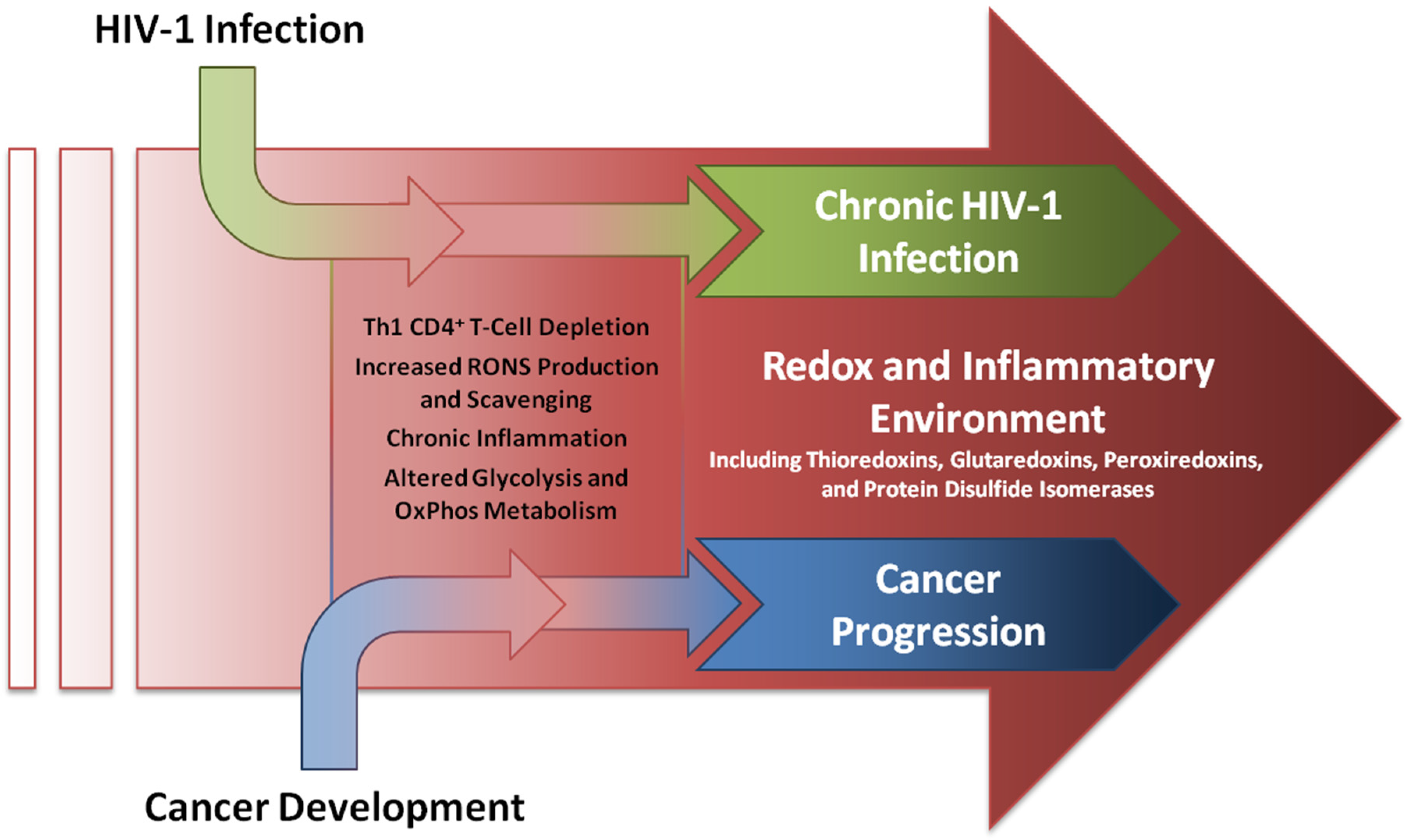
Inflammation and RONS Dysregulation by Redox Enzymes as Mechanistic Links in HIV-1–Cancer Comorbidity


Abstract
1. Introduction: Cancer in People with HIV-1
2. The Redox Environment
Under Normal Conditions
3. Redox as a Factor of HIV-1 Infection and Control
3.1. Redox Interaction with HIV-1 Entry Mechanisms and Relevance to ART Control
3.2. Redox Influence on HIV-1 Transcription Mechanisms
3.3. HIV-1 Infection Effects on Glycolysis/Oxidative Phosphorylation
3.4. Redox Influence on HIV-1 Latency Control
3.5. Th1 CD4+ T-Cell Depletion
3.6. ART Interactions
4. Redox as a Factor of Cancer Development and Progression
4.1. Graded Response to RONS: Cellular and Immune Signaling vs. Tumorigenesis vs. Cell Death
4.2. Diverse Tolerances for RONS and Redox Capacities by Cell Type
4.3. Targeting Redox Enzymes for Cancer Treatment

| Drug | Target | Cancer Trials | HIV-1 Trials |
|---|---|---|---|
| PX-12 | TXN1 | Advanced Solid Tumors [151,153,154] Gastrointestinal [152] Pancreatic Adenocarcinoma [150,155] | - |
| Arsenic Trioxide | TXNRD1 | Acute Myeloid Leukemia [166] Acute Promyelocytic Leukemia [167,168,169,170,171,172,173,174] Glioma [175] Neuroblastoma [176] Ovarian [177] Pancreatic Adenocarcinoma [178] Pediatric Cancers [179] | Latency Reversal [165] |
| Auranofin | TXNRD1 | Glioblastoma [180] Leukemia [181] Ovarian [157,158,182] Small and Non-Small Cell Lung Cancer [156] | HIV-1 Cure [183,184] |
| Ethaselen | TXNRD1 | Non-Small Cell Lung Cancer [159] | - |
4.4. Anti-Tumor Roles of CD4+ T-Cells
4.5. Other Inflammatory Comorbidities
5. Current and Future Research Targeting Redox Enzymes in Co-Infection
5.1. Targets and Translation
5.2. As Supplement to Existing Therapy
5.3. Translational Challenges
Author Contributions
Funding
Institutional Review Board Statement
Informed Consent Statement
Data Availability Statement
Acknowledgments
Conflicts of Interest
References
- Vrinzen, C.E.J.; Delfgou, L.; Stadhouders, N.; Hermens, R.P.M.G.; Merkx, M.A.W.; Bloemendal, H.J.; Jeurissen, P.P.T. A Systematic Review and Multilevel Regression Analysis Reveals the Comorbidity Prevalence in Cancer. Cancer Res. 2023, 83, 1147–1157. [Google Scholar] [CrossRef]
- Odeny, T.A.; Fink, V.; Muchengeti, M.; Gopal, S. Cancer in People with HIV. Infect. Dis. Clin. N. Am. 2024, 38, 531–557. [Google Scholar] [CrossRef]
- Goyal, G.; Enogela, E.M.; Burkholder, G.A.; Kitahata, M.M.; Crane, H.M.; Eulo, V.; Achenbach, C.J.; Farel, C.E.; Hunt, P.W.; Jacobson, J.M.; et al. Burden of Chronic Health Conditions Among People with HIV and Common Non-AIDS-Defining Cancers. J. Natl. Compr. Cancer Netw. JNCCN 2025, 23, e257018. [Google Scholar] [CrossRef] [PubMed]
- Coghill, A.E.; Shiels, M.S.; Suneja, G.; Engels, E.A. Elevated Cancer-Specific Mortality Among HIV-Infected Patients in the United States. J. Clin. Oncol. 2015, 33, 2376–2383. [Google Scholar] [CrossRef]
- Cattelan, A.M.; Mazzitelli, M.; Presa, N.; Cozzolino, C.; Sasset, L.; Leoni, D.; Bragato, B.; Scaglione, V.; Baldo, V.; Parisi, S.G. Changing Prevalence of AIDS and Non-AIDS-Defining Cancers in an Incident Cohort of People Living with HIV over 28 Years. Cancers 2023, 16, 70. [Google Scholar] [CrossRef]
- Spence, A.B.; Levy, M.E.; Monroe, A.; Castel, A.; Timpone, J.; Horberg, M.; Adams-Campbell, L.; Kumar, P. Cancer Incidence and Cancer Screening Practices Among a Cohort of Persons Receiving HIV Care in Washington, DC. J. Community Health 2021, 46, 75–85. [Google Scholar] [CrossRef] [PubMed]
- Rihana, N.; Nanjappa, S.; Sullivan, C.; Velez, A.P.; Tienchai, N.; Greene, J.N. Malignancy Trends in HIV-Infected Patients Over the Past 10 Years in a Single-Center Retrospective Observational Study in the United States. Cancer Control 2018, 25, 1073274818797955. [Google Scholar] [CrossRef] [PubMed]
- Chiao, E.Y.; Coghill, A.; Kizub, D.; Fink, V.; Ndlovu, N.; Mazul, A.; Sigel, K. The Effect of Non-AIDS-Defining Cancers on People Living with HIV. Lancet Oncol. 2021, 22, e240–e253. [Google Scholar] [CrossRef]
- Cornejo-Juárez, P.; Cavildo-Jerónimo, D.; Volkow-Fernández, P. Non-AIDS Defining Cancer (NADC) among HIV-Infected Patients at an Oncology Tertiary-Care Center in Mexico. AIDS Res. Ther. 2018, 15, 16. [Google Scholar] [CrossRef]
- Coghill, A.E.; Brownstein, N.C.; Sinha, S.; Thompson, Z.J.; Dickey, B.L.; Hoogland, A.I.; Johnstone, P.A.; Suneja, G.; Jim, H.S. Patient-Reported Outcomes in Cancer Patients with HIV. Cancers 2022, 14, 5889. [Google Scholar] [CrossRef]
- Coghill, A.E.; Suneja, G.; Rositch, A.F.; Shiels, M.S.; Engels, E.A. HIV Infection, Cancer Treatment Regimens, and Cancer Outcomes Among Elderly Adults in the United States. JAMA Oncol. 2019, 5, e191742. [Google Scholar] [CrossRef] [PubMed]
- Hysell, K.; Yusuf, R.; Barakat, L.; Virata, M.; Gan, G.; Deng, Y.; Perez-Irizarry, J.; Vega, T.; Goldberg, S.B.; Emu, B. Decreased Overall Survival in HIV-Associated Non-Small-Cell Lung Cancer. Clin. Lung Cancer 2021, 22, e498–e505. [Google Scholar] [CrossRef]
- Madu, A.; Ocheni, S.; Ibegbulam, O.; Aguwa, E.; Madu, K. Pattern of CD4 T-Lymphocyte Values in Cancer Patients on Cytotoxic Therapy. Ann. Med. Health Sci. Res. 2013, 3, 498–503. [Google Scholar] [CrossRef]
- Benhar, M.; Shytaj, I.L.; Stamler, J.S.; Savarino, A. Dual Targeting of the Thioredoxin and Glutathione Systems in Cancer and HIV. J. Clin. Investig. 2016, 126, 1630–1639. [Google Scholar] [CrossRef]
- Gavegnano, C.; Savarino, A.; Owanikoko, T.; Marconi, V.C. Crossroads of Cancer and HIV-1: Pathways to a Cure for HIV. Front. Immunol. 2019, 10, 2267. [Google Scholar] [CrossRef] [PubMed]
- Sun, L.; Yu, A.; Yang, Y.; Wang, Z.; Wang, W.; Luo, L. Exploring the Role of Thioredoxin System in Cancer Immunotherapy. J. Cancer 2025, 16, 66–80. [Google Scholar] [CrossRef] [PubMed]
- Nie, Q.; Yang, J.; Zhou, X.; Li, N.; Zhang, J. The Role of Protein Disulfide Isomerase Inhibitors in Cancer Therapy. ChemMedChem 2025, 20, e202400590. [Google Scholar] [CrossRef]
- Germon, A.; Heesom, K.J.; Amoah, R.; Adams, J.C. Protein Disulfide Isomerase A3 Activity Promotes Extracellular Accumulation of Proteins Relevant to Basal Breast Cancer Outcomes in Human MDA-MB-A231 Breast Cancer Cells. Am. J. Physiol. Cell Physiol. 2023, 324, C113–C132. [Google Scholar] [CrossRef]
- Xing, F.; Song, Z.; Cheng, Z. High Expression of PDIA4 Promotes Malignant Cell Behavior and Predicts Reduced Survival in Cervical Cancer. Oncol. Rep. 2022, 48, 184. [Google Scholar] [CrossRef]
- Rahman, N.S.A.; Zahari, S.; Syafruddin, S.E.; Firdaus-Raih, M.; Low, T.Y.; Mohtar, M.A. Functions and Mechanisms of Protein Disulfide Isomerase Family in Cancer Emergence. Cell Biosci. 2022, 12, 129. [Google Scholar] [CrossRef]
- Ma, Y.S.; Feng, S.; Lin, L.; Zhang, H.; Wei, G.H.; Liu, Y.S.; Yang, X.L.; Xin, R.; Shi, Y.; Zhang, D.D.; et al. Protein Disulfide Isomerase Inhibits Endoplasmic Reticulum Stress Response and Apoptosis via Its Oxidoreductase Activity in Colorectal Cancer. Cell. Signal. 2021, 86, 110076. [Google Scholar] [CrossRef]
- Reiser, K.; Francois, K.O.; Schols, D.; Bergman, T.; Jornvall, H.; Balzarini, J.; Karlsson, A.; Lundberg, M. Thioredoxin-1 and Protein Disulfide Isomerase Catalyze the Reduction of Similar Disulfides in HIV Gp120. Int. J. Biochem. Cell Biol. 2012, 44, 556–562. [Google Scholar] [CrossRef]
- Ye, Z.W.; Zhang, J.; Aslam, M.; Blumental-Perry, A.; Tew, K.D.; Townsend, D.M. Protein Disulfide Isomerase Family Mediated Redox Regulation in Cancer. Adv. Cancer Res. 2023, 160, 83–106. [Google Scholar] [CrossRef]
- Yang, S.; Jackson, C.; Karapetyan, E.; Dutta, P.; Kermah, D.; Wu, Y.; Wu, Y.; Schloss, J.; Vadgama, J.V. Roles of Protein Disulfide Isomerase in Breast Cancer. Cancers 2022, 14, 745. [Google Scholar] [CrossRef]
- Hu, J.; Abulimiti, Y.; Wang, H.; Yang, D.; Wang, X.; Wang, Y.; Ji, P. Thioredoxin: A Key Factor in Cold Tumor Formation and a Promising Biomarker for Immunotherapy Resistance in NSCLC. Respir. Res. 2025, 26, 179. [Google Scholar] [CrossRef] [PubMed]
- Muri, J.; Kopf, M. The Thioredoxin System: Balancing Redox Responses in Immune Cells and Tumors. Eur. J. Immunol. 2023, 53, 2249948. [Google Scholar] [CrossRef] [PubMed]
- Harshithkumar, R.; Shah, P.; Jadaun, P.; Mukherjee, A. ROS Chronicles in HIV Infection: Genesis of Oxidative Stress, Associated Pathologies, and Therapeutic Strategies. Curr. Issues Mol. Biol. 2024, 46, 8852–8873. [Google Scholar] [CrossRef] [PubMed]
- Cruz-Lorenzo, E.; Ramirez, N.-G.P.; Lee, J.; Pandhe, S.; Wang, L.; Hernandez-Doria, J.; Spivak, A.M.; Planelles, V.; Petersen, T.; Jain, M.K.; et al. Host Cell Redox Alterations Promote Latent HIV-1 Reactivation through Atypical Transcription Factor Cooperativity. Viruses 2022, 14, 2288. [Google Scholar] [CrossRef]
- Stegmann, M.; Metcalfe, C.; Barclay, A.N. Immunoregulation through Membrane Proteins Modified by Reducing Conditions Induced by Immune Reactions. Eur. J. Immunol. 2013, 43, 15–21. [Google Scholar] [CrossRef]
- Fonseca, C.; Soiffer, R.; Ho, V.; Vanneman, M.; Jinushi, M.; Ritz, J.; Neuberg, D.; Stone, R.; DeAngelo, D.; Dranoff, G. Protein Disulfide Isomerases Are Antibody Targets during Immune-Mediated Tumor Destruction. Blood 2009, 113, 1681–1688. [Google Scholar] [CrossRef]
- Reiser, K.; Mathys, L.; Curbo, S.; Pannecouque, C.; Noppen, S.; Liekens, S.; Engman, L.; Lundberg, M.; Balzarini, J.; Karlsson, A. The Cellular Thioredoxin-1/Thioredoxin Reductase-1 Driven Oxidoreduction Represents a Chemotherapeutic Target for HIV-1 Entry Inhibition. PLoS ONE 2016, 11, e0147773. [Google Scholar] [CrossRef]
- Lundberg, M.; Mattsson, Å.; Reiser, K.; Holmgren, A.; Curbo, S. Inhibition of the Thioredoxin System by PX-12 (1-Methylpropyl 2-Imidazolyl Disulfide) Impedes HIV-1 Infection in TZM-Bl Cells. Sci. Rep. 2019, 9, 5656. [Google Scholar] [CrossRef] [PubMed]
- Powell, L.E.; Foster, P.A. Protein Disulphide Isomerase Inhibition as a Potential Cancer Therapeutic Strategy. Cancer Med. 2021, 10, 2812–2825. [Google Scholar] [CrossRef]
- Lurain, K. Treating Cancer in People with HIV. J. Clin. Oncol. 2023, 41, 3682–3688. [Google Scholar] [CrossRef]
- Rodriguez, N.R.; Fortune, T.; Hegde, E.; Weinstein, M.P.; Keane, A.M.; Mangold, J.F.; Swartz, T.H. Oxidative Phosphorylation in HIV-1 Infection: Impacts on Cellular Metabolism and Immune Function. Front. Immunol. 2024, 15, 1360342. [Google Scholar] [CrossRef]
- Mathys, L.; Balzarini, J. The Role of Cellular Oxidoreductases in Viral Entry and Virus Infection-Associated Oxidative Stress: Potential Therapeutic Applications. Expert. Opin. Ther. Targets 2016, 20, 123–143. [Google Scholar] [CrossRef]
- Blanco, A.; Coronado, R.A.; Arun, N.; Ma, K.; Dar, R.D.; Kieffer, C. Monocyte to Macrophage Differentiation and Changes in Cellular Redox Homeostasis Promote Cell Type-Specific HIV Latency Reactivation. Proc. Natl. Acad. Sci. USA 2024, 121, e2313823121. [Google Scholar] [CrossRef] [PubMed]
- Jovanović, M.; Podolski-Renić, A.; Krasavin, M.; Pešić, M. The Role of the Thioredoxin Detoxification System in Cancer Progression and Resistance. Front. Mol. Biosci. 2022, 9, 883297. [Google Scholar] [CrossRef] [PubMed]
- Patwardhan, R.S.; Sharma, D.; Sandur, S.K. Thioredoxin Reductase: An Emerging Pharmacologic Target for Radiosensitization of Cancer. Transl. Oncol. 2022, 17, 101341. [Google Scholar] [CrossRef]
- Xing, F.; Hu, Q.; Qin, Y.; Xu, J.; Zhang, B.; Yu, X.; Wang, W. The Relationship of Redox with Hallmarks of Cancer: The Importance of Homeostasis and Context. Front. Oncol. 2022, 12, 862743. [Google Scholar] [CrossRef]
- Deng, J.; Pan, T.; Liu, Z.; McCarthy, C.; Vicencio, J.M.; Cao, L.; Alfano, G.; Suwaidan, A.A.; Yin, M.; Beatson, R.; et al. The Role of TXNIP in Cancer: A Fine Balance between Redox, Metabolic, and Immunological Tumor Control. Br. J. Cancer 2023, 129, 1877–1892. [Google Scholar] [CrossRef]
- Glorieux, C.; Liu, S.; Trachootham, D.; Huang, P. Targeting ROS in Cancer: Rationale and Strategies. Nat. Rev. Drug Discov. 2024, 23, 583–606. [Google Scholar] [CrossRef]
- Johnson, S.S.; Liu, D.; Ewald, J.T.; Robles-Planells, C.; Pulliam, C.; Christensen, K.A.; Bayanbold, K.; Wels, B.R.; Solst, S.R.; O’Dorisio, M.S.; et al. Auranofin Inhibition of Thioredoxin Reductase Sensitizes Lung Neuroendocrine Tumor Cells (NETs) and Small Cell Lung Cancer (SCLC) Cells to Sorafenib as Well as Inhibiting SCLC Xenograft Growth. Cancer Biol. Ther. 2024, 25, 2382524. [Google Scholar] [CrossRef]
- Chiu, J.; Hogg, P.J. Allosteric Disulfides: Sophisticated Molecular Structures Enabling Flexible Protein Regulation. J. Biol. Chem. 2019, 294, 2949–2960. [Google Scholar] [CrossRef]
- Hogg, P.J. Targeting Allosteric Disulphide Bonds in Cancer. Nat. Rev. Cancer 2013, 13, 425–431. [Google Scholar] [CrossRef] [PubMed]
- Feige, M.J.; Braakman, I.; Hendershot, L.M. CHAPTER 1.1 Disulfide Bonds in Protein Folding and Stability. In Oxidative Folding of Proteins: Basic Principles, Cellular Regulation and Engineering; The Royal Society of Chemistry: Cambridge, UK, 2018; pp. 1–33. ISBN 978-1-78262-990-0. [Google Scholar]
- Ferreira, R.B.; Wang, M.; Law, M.E.; Davis, B.J.; Bartley, A.N.; Higgins, P.J.; Kilberg, M.S.; Santostefano, K.E.; Terada, N.; Heldermon, C.D.; et al. Disulfide Bond Disrupting Agents Activate the Unfolded Protein Response in EGFR- and HER2-Positive Breast Tumor Cells. Oncotarget 2017, 8, 28971–28989. [Google Scholar] [CrossRef]
- Qin, M.; Wang, W.; Thirumalai, D. Protein Folding Guides Disulfide Bond Formation. Proc. Natl. Acad. Sci. USA 2015, 112, 11241–11246. [Google Scholar] [CrossRef]
- Jomova, K.; Raptova, R.; Alomar, S.Y.; Alwasel, S.H.; Nepovimova, E.; Kuca, K.; Valko, M. Reactive Oxygen Species, Toxicity, Oxidative Stress, and Antioxidants: Chronic Diseases and Aging. Arch. Toxicol. 2023, 97, 2499–2574. [Google Scholar] [CrossRef] [PubMed]
- Lu, J.; Holmgren, A. The Thioredoxin Antioxidant System. Free Radic. Biol. Med. 2014, 66, 75–87. [Google Scholar] [CrossRef]
- Foo, J.; Bellot, G.; Pervaiz, S.; Alonso, S. Mitochondria-Mediated Oxidative Stress during Viral Infection. Trends Microbiol. 2022, 30, 679–692. [Google Scholar] [CrossRef] [PubMed]
- Gu, X.; Mu, C.; Zheng, R.; Zhang, Z.; Zhang, Q.; Liang, T. The Cancer Antioxidant Regulation System in Therapeutic Resistance. Antioxidants 2024, 13, 778. [Google Scholar] [CrossRef]
- Tran, N.; Mills, E.L. Redox Regulation of Macrophages. Redox Biol. 2024, 72, 103123. [Google Scholar] [CrossRef]
- Iciek, M.; Bilska-Wilkosz, A.; Kozdrowicki, M.; Górny, M. Reactive Sulfur Species and Their Significance in Health and Disease. Biosci. Rep. 2022, 42, BSR20221006. [Google Scholar] [CrossRef]
- Lee, S.; Kim, S.M.; Lee, R.T. Thioredoxin and Thioredoxin Target Proteins: From Molecular Mechanisms to Functional Significance. Antioxid. Redox Signal 2013, 18, 1165–1207. [Google Scholar] [CrossRef]
- Mougiakakos, D.; Johansson, C.C.; Jitschin, R.; Bottcher, M.; Kiessling, R. Increased Thioredoxin-1 Production in Human Naturally Occurring Regulatory T Cells Confers Enhanced Tolerance to Oxidative Stress. Blood 2011, 117, 857–861. [Google Scholar] [CrossRef]
- Gurjar, S.A.; Wheeler, J.X.; Wadhwa, M.; Thorpe, R.; Kimber, I.; Derrick, J.P.; Dearman, R.J.; Metcalfe, C. The Impact of Thioredoxin Reduction of Allosteric Disulfide Bonds on the Therapeutic Potential of Monoclonal Antibodies. J. Biol. Chem. 2019, 294, 19616–19634. [Google Scholar] [CrossRef]
- Holmgren, A. Thioredoxin and Glutaredoxin Systems. J. Biol. Chem. 1989, 264, 13963–13966. [Google Scholar] [CrossRef]
- Arnér, E.S.; Holmgren, A. Physiological Functions of Thioredoxin and Thioredoxin Reductase. Eur. J. Biochem. 2000, 267, 6102–6109. [Google Scholar] [CrossRef] [PubMed]
- Passam, F.; Chiu, J.; Ju, L.; Pijning, A.; Jahan, Z.; Mor-Cohen, R.; Yeheskel, A.; Kolšek, K.; Thärichen, L.; Aponte-Santamaría, C.; et al. Mechano-Redox Control of Integrin de-Adhesion. eLife 2018, 7, e34843. [Google Scholar] [CrossRef] [PubMed]
- Mangold, J.F.; Swartz, T.H. Redox Regulation of HIV-1: The Thioredoxin Pathway, Oxidative Metabolism, and Latency Control. Front. Physiol. 2025, 16, 1651148. [Google Scholar] [CrossRef] [PubMed]
- Oberacker, T.; Kraft, L.; Schanz, M.; Latus, J.; Schricker, S. The Importance of Thioredoxin-1 in Health and Disease. Antioxidants 2023, 12, 1078. [Google Scholar] [CrossRef] [PubMed]
- Jomova, K.; Alomar, S.Y.; Valko, R.; Fresser, L.; Nepovimova, E.; Kuca, K.; Valko, M. Interplay of Oxidative Stress and Antioxidant Mechanisms in Cancer Development and Progression. Arch. Toxicol. 2026, 100, 27–73. [Google Scholar] [CrossRef]
- Li, B.; Ming, H.; Qin, S.; Nice, E.C.; Dong, J.; Du, Z.; Huang, C. Redox Regulation: Mechanisms, Biology and Therapeutic Targets in Diseases. Signal Transduct. Target. Ther. 2025, 10, 72. [Google Scholar] [CrossRef] [PubMed]
- Wang, Y.; He, J.; Lian, S.; Zeng, Y.; He, S.; Xu, J.; Luo, L.; Yang, W.; Jiang, J. Targeting Metabolic–Redox Nexus to Regulate Drug Resistance: From Mechanism to Tumor Therapy. Antioxidants 2024, 13, 828. [Google Scholar] [CrossRef]
- Gallorini, M.; Carradori, S.; Panieri, E.; Sova, M.; Saso, L. Modulation of NRF2: Biological Dualism in Cancer, Targets and Possible Therapeutic Applications. Antioxid. Redox Signal. 2024, 40, 636–662. [Google Scholar] [CrossRef]
- Choi, E.-H.; Park, S.-J. TXNIP: A Key Protein in the Cellular Stress Response Pathway and a Potential Therapeutic Target. Exp. Mol. Med. 2023, 55, 1348–1356. [Google Scholar] [CrossRef]
- Schrode, N.; Fortune, T.; Keane, A.M.; Mangold, J.F.; Tweel, B.; Beaumont, K.G.; Swartz, T.H. Single-Cell Transcriptomics of Human Tonsils Reveals Nicotine Enhances HIV-1-Induced NLRP3 Inflammasome and Mitochondrial Activation. Viruses 2024, 16, 1797. [Google Scholar] [CrossRef]
- Chettimada, S.; Lorenz, D.R.; Misra, V.; Wolinsky, S.M.; Gabuzda, D. Small RNA Sequencing of Extracellular Vesicles Identifies Circulating miRNAs Related to Inflammation and Oxidative Stress in HIV Patients. BMC Immunol. 2020, 21, 57. [Google Scholar] [CrossRef] [PubMed]
- Chettimada, S.; Lorenz, D.R.; Misra, V.; Dillon, S.T.; Reeves, R.K.; Manickam, C.; Morgello, S.; Kirk, G.D.; Mehta, S.H.; Gabuzda, D. Exosome Markers Associated with Immune Activation and Oxidative Stress in HIV Patients on Antiretroviral Therapy. Sci. Rep. 2018, 8, 7227. [Google Scholar] [CrossRef]
- Nakamura, H.; De Rosa, S.; Roederer, M.; Anderson, M.T.; Dubs, J.G.; Yodoi, J.; Holmgren, A.; Herzenberg, L.A.; Herzenberg, L.A. Elevation of Plasma Thioredoxin Levels in HIV-Infected Individuals. Int. Immunol. 1996, 8, 603–611. [Google Scholar] [CrossRef]
- Wang, N.-C.; Chen, H.-W.; Lin, T.-Y. Association of Protein Disulfide Isomerase Family A, Member 4, and Inflammation in People Living with HIV. Int. J. Infect. Dis. 2023, 126, 79–86. [Google Scholar] [CrossRef]
- Moolla, N.; Killick, M.; Papathanasopoulos, M.; Capovilla, A. Thioredoxin (Trx1) Regulates CD4 Membrane Domain Localization and Is Required for Efficient CD4-Dependent HIV-1 Entry. Biochim. Biophys. Acta (BBA)-Gen. Subj. 2016, 1860, 1854–1863. [Google Scholar] [CrossRef]
- Cerutti, N.; Killick, M.; Jugnarain, V.; Papathanasopoulos, M.; Capovilla, A. Disulfide Reduction in CD4 Domain 1 or 2 Is Essential for Interaction with HIV Glycoprotein 120 (Gp120), Which Impairs Thioredoxin-Driven CD4 Dimerization. J. Biol. Chem. 2014, 289, 10455–10465. [Google Scholar] [CrossRef] [PubMed]
- Matthias, L.J.; Azimi, I.; Tabrett, C.A.; Hogg, P.J. Reduced Monomeric CD4 Is the Preferred Receptor for HIV. J. Biol. Chem. 2010, 285, 40793–40799. [Google Scholar] [CrossRef] [PubMed]
- Matthias, L.J.; Yam, P.T.; Jiang, X.M.; Vandegraaff, N.; Li, P.; Poumbourios, P.; Donoghue, N.; Hogg, P.J. Disulfide Exchange in Domain 2 of CD4 Is Required for Entry of HIV-1. Nat. Immunol. 2002, 3, 727–732. [Google Scholar] [CrossRef]
- Ou, W.; Silver, J. Role of Protein Disulfide Isomerase and Other Thiol-Reactive Proteins in HIV-1 Envelope Protein-Mediated Fusion. Virology 2006, 350, 406–417. [Google Scholar] [CrossRef]
- Matthias, L.J.; Hogg, P.J. Redox Control on the Cell Surface: Implications for HIV-1 Entry. Antioxid. Redox Signal. 2003, 5, 133–138. [Google Scholar] [CrossRef]
- Khan, M.M.; Simizu, S.; Lai, N.S.; Kawatani, M.; Shimizu, T.; Osada, H. Discovery of a Small Molecule PDI Inhibitor That Inhibits Reduction of HIV-1 Envelope Glycoprotein Gp120. ACS Chem. Biol. 2011, 6, 245–251. [Google Scholar] [CrossRef] [PubMed]
- Markovic, I.; Stantchev, T.S.; Fields, K.H.; Tiffany, L.J.; Tomic, M.; Weiss, C.D.; Broder, C.C.; Strebel, K.; Clouse, K.A. Thiol/Disulfide Exchange Is a Prerequisite for CXCR4-Tropic HIV-1 Envelope-Mediated T-Cell Fusion during Viral Entry. Blood 2004, 103, 1586–1594. [Google Scholar] [CrossRef]
- Stantchev, T.S.; Paciga, M.; Lankford, C.R.; Schwartzkopff, F.; Broder, C.C.; Clouse, K.A. Cell-Type Specific Requirements for Thiol/Disulfide Exchange during HIV-1 Entry and Infection. Retrovirology 2012, 9, 97. [Google Scholar] [CrossRef]
- Azimi, I.; Matthias, L.J.; Center, R.J.; Wong, J.W.; Hogg, P.J. Disulfide Bond That Constrains the HIV-1 Gp120 V3 Domain Is Cleaved by Thioredoxin. J. Biol. Chem. 2010, 285, 40072–40080. [Google Scholar] [CrossRef] [PubMed]
- Ang, C.G.; Hyatt, N.L.; Le Minh, G.; Gupta, M.; Kadam, M.; Hogg, P.J.; Smith, A.B.; Chaiken, I.M. Conformational Activation and Disulfide Exchange in HIV-1 Env Induce Cell-Free Lytic/Fusogenic Transformation and Enhance Infection. J. Virol. 2025, 99, e0147124. [Google Scholar] [CrossRef] [PubMed]
- Benlarbi, M.; Richard, J.; Clemente, T.; Bourassa, C.; Tolbert, W.D.; Gottumukkala, S.; Messier-Peet, M.; Medjahed, H.; Pazgier, M.; Maldarelli, F.; et al. CD4 T Cell Counts Are Inversely Correlated with Anti-Gp120 Cluster A Antibodies in Antiretroviral Therapy-Treated PLWH. eBioMedicine 2025, 118, 105856. [Google Scholar] [CrossRef]
- Benlarbi, M.; Richard, J.; Bourassa, C.; Tolbert, W.D.; Chartrand-Lefebvre, C.; Gendron-Lepage, G.; Sylla, M.; El-Far, M.; Messier-Peet, M.; Guertin, C.; et al. Plasma Human Immunodeficiency Virus 1 Soluble Glycoprotein 120 Association with Correlates of Immune Dysfunction and Inflammation in Antiretroviral Therapy–Treated Individuals with Undetectable Viremia. J. Infect. Dis. 2023, 229, 763–774. [Google Scholar] [CrossRef] [PubMed]
- Levast, B.; Barblu, L.; Coutu, M.; Prévost, J.; Brassard, N.; Peres, A.; Stegen, C.; Madrenas, J.; Kaufmann, D.E.; Finzi, A. HIV-1 Gp120 Envelope Glycoprotein Determinants for Cytokine Burst in Human Monocytes. PLoS ONE 2017, 12, e0174550. [Google Scholar] [CrossRef]
- Planès, R.; Serrero, M.; Leghmari, K.; BenMohamed, L.; Bahraoui, E. HIV-1 Envelope Glycoproteins Induce the Production of TNF-α and IL-10 in Human Monocytes by Activating Calcium Pathway. Sci. Rep. 2018, 8, 17215. [Google Scholar] [CrossRef]
- Ivanov, A.V.; Valuev-Elliston, V.T.; Ivanova, O.N.; Kochetkov, S.N.; Starodubova, E.S.; Bartosch, B.; Isaguliants, M.G. Oxidative Stress during HIV Infection: Mechanisms and Consequences. Oxid. Med. Cell. Longev. 2016, 2016, 8910396. [Google Scholar] [CrossRef]
- Simenauer, A.; Assefa, B.; Rios-Ochoa, J.; Geracia, K.; Hybertson, B.; Gao, B.; McCord, J.; Elajaili, H.; Nozik-Grayck, E.; Cota-Gomez, A. Repression of Nrf2/ARE Regulated Antioxidant Genes and Dysregulation of the Cellular Redox Environment by the HIV Transactivator of Transcription. Free Radic. Biol. Med. 2019, 141, 244–252. [Google Scholar] [CrossRef]
- Valentín-Guillama, G.; López, S.; Kucheryavykh, Y.V.; Chorna, N.E.; Pérez, J.; Ortiz-Rivera, J.; Inyushin, M.; Makarov, V.; Valentín-Acevedo, A.; Quinones-Hinojosa, A.; et al. HIV-1 Envelope Protein Gp120 Promotes Proliferation and the Activation of Glycolysis in Glioma Cell. Cancers 2018, 10, 301. [Google Scholar] [CrossRef]
- Kavanagh Williamson, M.; Coombes, N.; Juszczak, F.; Athanasopoulos, M.; Khan, M.B.; Eykyn, T.R.; Srenathan, U.; Taams, L.S.; Dias Zeidler, J.; Da Poian, A.T.; et al. Upregulation of Glucose Uptake and Hexokinase Activity of Primary Human CD4+ T Cells in Response to Infection with HIV-1. Viruses 2018, 10, 114. [Google Scholar] [CrossRef]
- Kishimoto, N.; Yamamoto, K.; Abe, T.; Yasuoka, N.; Takamune, N.; Misumi, S. Glucose-Dependent Aerobic Glycolysis Contributes to Recruiting Viral Components into HIV-1 Particles to Maintain Infectivity. Biochem. Biophys. Res. Commun. 2021, 549, 187–193. [Google Scholar] [CrossRef] [PubMed]
- Zhang, Y.; Jiang, T.; Li, A.; Li, Z.; Hou, J.; Gao, M.; Huang, X.; Su, B.; Wu, H.; Zhang, T.; et al. Adjunct Therapy for CD4+ T-Cell Recovery, Inflammation and Immune Activation in People Living with HIV: A Systematic Review and Meta-Analysis. Front. Immunol. 2021, 12, 632119. [Google Scholar] [CrossRef]
- Nabatanzi, R.; Cose, S.; Joloba, M.; Jones, S.R.; Nakanjako, D. Effects of HIV Infection and ART on Phenotype and Function of Circulating Monocytes, Natural Killer, and Innate Lymphoid Cells. AIDS Res. Ther. 2018, 15, 7. [Google Scholar] [CrossRef]
- Abadi, T.; Teklu, T.; Wondmagegn, T.; Alem, M.; Desalegn, G. CD4+ T Cell Count and HIV-1 Viral Load Dynamics Positively Impacted by H. pylori Infection in HIV-Positive Patients Regardless of ART Status in a High-Burden Setting. Eur. J. Med. Res. 2024, 29, 178. [Google Scholar] [CrossRef]
- An, Q.; Duan, L.; Wang, Y.; Wang, F.; Liu, X.; Liu, C.; Hu, Q. Role of CD4+ T Cells in Cancer Immunity: A Single-Cell Sequencing Exploration of Tumor Microenvironment. J. Transl. Med. 2025, 23, 179. [Google Scholar] [CrossRef] [PubMed]
- Tolomeo, M.; Cascio, A. The Complex Dysregulations of CD4 T Cell Subtypes in HIV Infection. Int. J. Mol. Sci. 2024, 25, 7512. [Google Scholar] [CrossRef] [PubMed]
- Schank, M.; Zhao, J.; Wang, L.; Nguyen, L.N.T.; Zhang, Y.; Wu, X.Y.; Zhang, J.; Jiang, Y.; Ning, S.; El Gazzar, M.; et al. ROS-Induced Mitochondrial Dysfunction in CD4 T Cells from ART-Controlled People Living with HIV. Viruses 2023, 15, 1061. [Google Scholar] [CrossRef] [PubMed]
- Hokello, J.; Tyagi, K.; Owor, R.O.; Sharma, A.L.; Bhushan, A.; Daniel, R.; Tyagi, M. New Insights into HIV Life Cycle, Th1/Th2 Shift during HIV Infection and Preferential Virus Infection of Th2 Cells: Implications of Early HIV Treatment Initiation and Care. Life 2024, 14, 104. [Google Scholar] [CrossRef]
- Kim, S.-H.; Oh, J.; Choi, J.-Y.; Jang, J.-Y.; Kang, M.-W.; Lee, C.-E. Identification of Human Thioredoxin as a Novel IFN-Gamma-Induced Factor: Mechanism of Induction and Its Role in Cytokine Production. BMC Immunol. 2008, 9, 64. [Google Scholar] [CrossRef]
- Plugis, N.M.; Weng, N.; Zhao, Q.; Palanski, B.A.; Maecker, H.T.; Habtezion, A.; Khosla, C. Interleukin 4 Is Inactivated via Selective Disulfide-Bond Reduction by Extracellular Thioredoxin. Proc. Natl. Acad. Sci. USA 2018, 115, 8781–8786. [Google Scholar] [CrossRef]
- Maagaard, A.; Kvale, D. Long Term Adverse Effects Related to Nucleoside Reverse Transcriptase Inhibitors: Clinical Impact of Mitochondrial Toxicity. Scand. J. Infect. Dis. 2009, 41, 808–817. [Google Scholar] [CrossRef] [PubMed]
- Masiá, M.; Padilla, S.; Bernal, E.; Almenar, M.V.; Molina, J.; Hernández, I.; Graells, M.L.; Gutiérrez, F. Influence of Antiretroviral Therapy on Oxidative Stress and Cardiovascular Risk: A Prospective Cross-Sectional Study in HIV-Infected Patients. Clin. Ther. 2007, 29, 1448–1455. [Google Scholar] [CrossRef]
- Mandas, A.; Iorio, E.L.; Congiu, M.G.; Balestrieri, C.; Mereu, A.; Cau, D.; Dessì, S.; Curreli, N. Oxidative Imbalance in HIV-1 Infected Patients Treated with Antiretroviral Therapy. J. Biomed. Biotechnol. 2009, 2009, 749575. [Google Scholar] [CrossRef] [PubMed]
- Hulgan, T.; Morrow, J.; D’Aquila, R.T.; Raffanti, S.; Morgan, M.; Rebeiro, P.; Haas, D.W. Oxidant Stress Is Increased during Treatment of Human Immunodeficiency Virus Infection. Clin. Infect. Dis. 2003, 37, 1711–1717. [Google Scholar] [CrossRef] [PubMed]
- Wang, X.; Chai, H.; Lin, P.H.; Yao, Q.; Chen, C. Roles and Mechanisms of Human Immunodeficiency Virus Protease Inhibitor Ritonavir and Other Anti-Human Immunodeficiency Virus Drugs in Endothelial Dysfunction of Porcine Pulmonary Arteries and Human Pulmonary Artery Endothelial Cells. Am. J. Pathol. 2009, 174, 771–781. [Google Scholar] [CrossRef] [PubMed]
- Manda, K.R.; Banerjee, A.; Banks, W.A.; Ercal, N. Highly Active Antiretroviral Therapy Drug Combination Induces Oxidative Stress and Mitochondrial Dysfunction in Immortalized Human Blood-Brain Barrier Endothelial Cells. Free Radic. Biol. Med. 2011, 50, 801–810. [Google Scholar] [CrossRef]
- Gratton, R.; Tricarico, P.M.; Guimaraes, R.L.; Celsi, F.; Crovella, S. Lopinavir/Ritonavir Treatment Induces Oxidative Stress and Caspaseindependent Apoptosis in Human Glioblastoma U-87 MG Cell Line. Curr. HIV Res. 2018, 16, 106–112. [Google Scholar] [CrossRef]
- Lombardi, F.; Belmonti, S.; Sanfilippo, A.; Borghetti, A.; Iannone, V.; Salvo, P.F.; Fabbiani, M.; Visconti, E.; Giambenedetto, S.D. Factors Associated with Oxidative Stress in Virologically Suppressed People Living with HIV on Long-Term Antiretroviral Therapy. AIDS Res. Ther. 2024, 21, 100. [Google Scholar] [CrossRef]
- Akkoyunlu, Y.; Kocyigit, A.; Okay, G.; Guler, E.M.; Aslan, T. Integrase Inhibitor-Based Antiretroviral Treatments Decrease Oxidative Stress Caused by HIV Infection. Eur. Rev. Med. Pharmacol. Sci. 2020, 24, 12389–12394. [Google Scholar] [CrossRef]
- Coburn, S.B.; Pimentel, N.; Leyden, W.; Kitahata, M.; Moore, R.D.; Althoff, K.N.; Gill, M.J.; Lang, R.; Horberg, M.A.; D’Souza, G.; et al. Brief Report: Protease Inhibitors Versus Nonnucleoside Reverse Transcriptase Inhibitors and the Risk of Cancer Among People with HIV. J. Acquir. Immune Defic. Syndr. 2024, 96, 393–398. [Google Scholar] [CrossRef]
- Maandi, S.C.; Maandi, M.T.; Patel, A.; Manville, R.W.; Mabley, J.G. Divergent Effects of HIV Reverse Transcriptase Inhibitors on Pancreatic Beta-Cell Function and Survival: Potential Role of Oxidative Stress and Mitochondrial Dysfunction. Life Sci. 2022, 294, 120329. [Google Scholar] [CrossRef]
- Damiano, O.M.; Stevens, A.J.; Kenwright, D.N.; Seddon, A.R. Chronic Inflammation to Cancer: The Impact of Oxidative Stress on DNA Methylation. Front. Biosci. Landmark Ed. 2025, 30, 26142. [Google Scholar] [CrossRef]
- Salaheldin, Y.A.; Mahmoud, S.S.M.; Ngowi, E.E.; Gbordzor, V.A.; Li, T.; Wu, D.-D.; Ji, X.-Y. Role of RONS and eIFs in Cancer Progression. Oxid. Med. Cell. Longev. 2021, 2021, 5522054. [Google Scholar] [CrossRef]
- Choudhury, F.K. Mitochondrial Redox Metabolism: The Epicenter of Metabolism during Cancer Progression. Antioxidants 2021, 10, 1838. [Google Scholar] [CrossRef]
- Chun, K.-S.; Kim, D.-H.; Surh, Y.-J. Role of Reductive versus Oxidative Stress in Tumor Progression and Anticancer Drug Resistance. Cells 2021, 10, 758. [Google Scholar] [CrossRef]
- Brandl, N.; Seitz, R.; Sendtner, N.; Müller, M.; Gülow, K. Living on the Edge: ROS Homeostasis in Cancer Cells and Its Potential as a Therapeutic Target. Antioxidants 2025, 14, 1002. [Google Scholar] [CrossRef] [PubMed]
- Ranbhise, J.S.; Singh, M.K.; Ju, S.; Han, S.; Yun, H.R.; Kim, S.S.; Kang, I. The Redox Paradox: Cancer’s Double-Edged Sword for Malignancy and Therapy. Antioxidants 2025, 14, 1187. [Google Scholar] [CrossRef]
- Sies, H.; Belousov, V.V.; Chandel, N.S.; Davies, M.J.; Jones, D.P.; Mann, G.E.; Murphy, M.P.; Yamamoto, M.; Winterbourn, C. Defining Roles of Specific Reactive Oxygen Species (ROS) in Cell Biology and Physiology. Nat. Rev. Mol. Cell Biol. 2022, 23, 499–515. [Google Scholar] [CrossRef]
- Sies, H. Oxidative Eustress: On Constant Alert for Redox Homeostasis. Redox Biol. 2021, 41, 101867. [Google Scholar] [CrossRef] [PubMed]
- Ghareeb, H.; Metanis, N. The Thioredoxin System: A Promising Target for Cancer Drug Development. Chemistry 2020, 26, 10175–10184. [Google Scholar] [CrossRef] [PubMed]
- Cao, Y.; Zhou, X.; Nie, Q.; Zhang, J. Inhibition of the Thioredoxin System for Radiosensitization Therapy of Cancer. Eur. J. Med. Chem. 2024, 268, 116218. [Google Scholar] [CrossRef] [PubMed]
- Zhang, J.; Li, X.; Han, X.; Liu, R.; Fang, J. Targeting the Thioredoxin System for Cancer Therapy. Trends Pharmacol. Sci. 2017, 38, 794–808. [Google Scholar] [CrossRef] [PubMed]
- Shorsh Hamad, D.; Soleimani, A.; Muhammad Said, K. Targeting Redox-Dependent Signaling Pathways for Cancer Treatment: Opportunities and Challenges. J. Med. Chem. Sci. 2026, 9, 96–110. [Google Scholar] [CrossRef]
- Shirmanova, M.V.; Gavrina, A.I.; Kovaleva, T.F.; Dudenkova, V.V.; Zelenova, E.E.; Shcheslavskiy, V.I.; Mozherov, A.M.; Snopova, L.B.; Lukyanov, K.A.; Zagaynova, E.V. Insight into Redox Regulation of Apoptosis in Cancer Cells with Multiparametric Live-Cell Microscopy. Sci. Rep. 2022, 12, 4476. [Google Scholar] [CrossRef]
- Li, Y.; Zhao, B.; Peng, J.; Tang, H.; Wang, S.; Peng, S.; Ye, F.; Wang, J.; Ouyang, K.; Li, J.; et al. Inhibition of NF-κB Signaling Unveils Novel Strategies to Overcome Drug Resistance in Cancers. Drug Resist. Updates 2024, 73, 101042. [Google Scholar] [CrossRef]
- Doskey, C.M.; Buranasudja, V.; Wagner, B.A.; Wilkes, J.G.; Du, J.; Cullen, J.J.; Buettner, G.R. Tumor Cells Have Decreased Ability to Metabolize H2O2: Implications for Pharmacological Ascorbate in Cancer Therapy. Redox Biol. 2016, 10, 274–284. [Google Scholar] [CrossRef]
- Du, J.; Nelson, E.S.; Simons, A.L.; Olney, K.E.; Moser, J.C.; Schrock, H.E.; Wagner, B.A.; Buettner, G.R.; Smith, B.J.; Teoh, M.L.T.; et al. Regulation of Pancreatic Cancer Growth by Superoxide. Mol. Carcinog. 2013, 52, 555–567. [Google Scholar] [CrossRef]
- Aykin-Burns, N.; Ahmad, I.M.; Zhu, Y.; Oberley, L.W.; Spitz, D.R. Increased Levels of Superoxide and Hydrogen Peroxide Mediate the Differential Susceptibility of Cancer Cells Vs. Normal Cells to Glucose Deprivation. Biochem. J. 2009, 418, 29–37. [Google Scholar] [CrossRef] [PubMed]
- Wijeratne, S.S.K.; Cuppett, S.L.; Schlegel, V. Hydrogen Peroxide Induced Oxidative Stress Damage and Antioxidant Enzyme Response in Caco-2 Human Colon Cells. J. Agric. Food Chem. 2005, 53, 8768–8774. [Google Scholar] [CrossRef]
- Djuric, Z.; KuKuruga, M.; Everett-Bauer, C.K.; Nakeff, A.N. Flow Cytometric Analysis of DNA Damage in Nucleoids from Cultured Human Breast Epithelial Cells Treated with Hydrogen Peroxide. Free Radic. Biol. Med. 1998, 24, 326–331. [Google Scholar] [CrossRef]
- Li, Y.; Guo, J.; Zhang, H.; Lam, C.W.K.; Luo, W.; Zhou, H.; Zhang, W. Protective Effect of Thymidine on DNA Damage Induced by Hydrogen Peroxide in Human Hepatocellular Cancer Cells. ACS Omega 2020, 5, 21796–21804. [Google Scholar] [CrossRef]
- Bai, L.-Y.; Chiu, C.-F.; Wu, C.-Y.; Weng, J.-R. Hydrogen Peroxide and Cisplatin Regulate the ROS/PKM2 Pathway to Affect the Growth of Cancer. Am. J. Cancer Res. 2025, 15, 4082–4091. [Google Scholar] [CrossRef]
- Guo, C.; Ding, P.; Xie, C.; Ye, C.; Ye, M.; Pan, C.; Cao, X.; Zhang, S.; Zheng, S. Potential Application of the Oxidative Nucleic Acid Damage Biomarkers in Detection of Diseases. Oncotarget 2017, 8, 75767–75777. [Google Scholar] [CrossRef] [PubMed]
- Iglesias-Pedraz, J.M.; Comai, L. Measurements of Hydrogen Peroxide and Oxidative DNA Damage in a Cell Model of Premature Aging. In Aging: Methods and Protocols; Curran, S.P., Ed.; Springer: New York, NY, USA, 2020; pp. 245–257. ISBN 978-1-0716-0592-9. [Google Scholar]
- Narayanan, D.; Ma, S.; Özcelik, D. Targeting the Redox Landscape in Cancer Therapy. Cancers 2020, 12, 1706. [Google Scholar] [CrossRef]
- Kong, H.; Chandel, N.S. Regulation of Redox Balance in Cancer and T Cells. J. Biol. Chem. 2018, 293, 7499–7507. [Google Scholar] [CrossRef] [PubMed]
- Yoo, M.-H.; Xu, X.-M.; Carlson, B.A.; Patterson, A.D.; Gladyshev, V.N.; Hatfield, D.L. Targeting Thioredoxin Reductase 1 Reduction in Cancer Cells Inhibits Self-Sufficient Growth and DNA Replication. PLoS ONE 2007, 2, e1112. [Google Scholar] [CrossRef]
- Kirkpatrick, D.L.; Powis, G. Clinically Evaluated Cancer Drugs Inhibiting Redox Signaling. Antioxid. Redox Signal. 2017, 26, 262–273. [Google Scholar] [CrossRef] [PubMed]
- Fan, J.; Yu, H.; Lv, Y.; Yin, L. Diagnostic and Prognostic Value of Serum Thioredoxin and DJ-1 in Non-Small Cell Lung Carcinoma Patients. Tumour Biol. J. Int. Soc. Oncodev. Biol. Med. 2016, 37, 1949–1958. [Google Scholar] [CrossRef]
- Qu, T.; Zhang, J.; Xu, N.; Liu, B.; Li, M.; Liu, A.; Li, A.; Tang, H. Diagnostic Value Analysis of Combined Detection of Trx, CYFRA21-1 and SCCA in Lung Cancer. Oncol. Lett. 2019, 17, 4293–4298. [Google Scholar] [CrossRef]
- Lee, Y.J.; Kim, Y.; Choi, B.B.; Kim, J.R.; Ko, H.M.; Suh, K.H.; Lee, J.S. The Blood Level of Thioredoxin 1 as a Supporting Biomarker in the Detection of Breast Cancer. BMC Cancer 2022, 22, 12. [Google Scholar] [CrossRef]
- Li, J.; Cheng, Z.-J.; Liu, Y.; Yan, Z.-L.; Wang, K.; Wu, D.; Wan, X.-Y.; Xia, Y.; Lau, W.Y.; Wu, M.-C.; et al. Serum Thioredoxin Is a Diagnostic Marker for Hepatocellular Carcinoma. Oncotarget 2015, 6, 9551–9563. [Google Scholar] [CrossRef]
- Buczyńska, A.; Kościuszko, M.; Sidorkiewicz, I.; Adamska, A.; Siewko, K.; Dzięcioł, J.; Szelachowska, M.; Popławska-Kita, A.; Krętowski, A.J. Thioredoxin and Tetraspanin 30 (CD63) as Potential Biomarkers for Angioinvasion in Papillary Thyroid Cancer. Sci. Rep. 2025, 16, 63. [Google Scholar] [CrossRef]
- Sugiki, S.; Horie, T.; Kunii, K.; Sakamoto, T.; Nakamura, Y.; Chikazawa, I.; Morita, N.; Ishigaki, Y.; Miyazawa, K. Integrated Bioinformatic Analyses Reveal Thioredoxin as a Putative Marker of Cancer Stem Cells and Prognosis in Prostate Cancer. Cancer Inform. 2025, 24, 11769351251319872. [Google Scholar] [CrossRef]
- Zhu, Y.; Hu, Y.; Shi, J.; Wei, X.; Song, Y.; Tang, C.; Zhang, W. Plasma Thioredoxin Reductase as a Potential Biomarker for Gynecologic Cancer. Technol. Cancer Res. Treat. 2023, 22, 15330338231184995. [Google Scholar] [CrossRef]
- Hu, Y.; Zhu, Y.; Shi, J.; Wei, X.; Tang, C.; Guan, X.; Zhang, W. Plasma Thioredoxin Reductase as a Potential Diagnostic Biomarker for Breast Cancer. Clin. Breast Cancer 2024, 24, e464–e473.e3. [Google Scholar] [CrossRef]
- Delgobo, M.; Gonçalves, R.M.; Delazeri, M.A.; Falchetti, M.; Zandoná, A.; Nascimento das Neves, R.; Almeida, K.; Fagundes, A.C.; Gelain, D.P.; Fracasso, J.I.; et al. Thioredoxin Reductase-1 Levels Are Associated with NRF2 Pathway Activation and Tumor Recurrence in Non-Small Cell Lung Cancer. Free Radic. Biol. Med. 2021, 177, 58–71. [Google Scholar] [CrossRef] [PubMed]
- Liu, W.; Xiao, Z.; Dong, M.; Li, X.; Huang, Z. Decreased Expression of TXNIP Is Associated with Poor Prognosis and Immune Infiltration in Kidney Renal Clear Cell Carcinoma. Oncol. Lett. 2024, 27, 97. [Google Scholar] [CrossRef] [PubMed]
- Cascadian Therapeutics Inc. A Randomized Phase II Open-Label Study of Two Different Dose Levels of PX-12 in Patients with Advanced Carcinoma of the Pancreas Whose Tumors Have Progressed on Gemcitabine or on a Gemcitabine-Containing Combination [Clinical Trial Registration] [Internet]. clinicaltrials.gov; 2018 May. Clinical Trial Registration No.: NCT00417287. Available online: https://clinicaltrials.gov/study/NCT00417287 (accessed on 23 June 2025).
- Ramanathan, R.K.; Kirkpatrick, D.L.; Belani, C.P.; Friedland, D.; Green, S.B.; Chow, H.-H.S.; Cordova, C.A.; Stratton, S.P.; Sharlow, E.R.; Baker, A.; et al. A Phase I Pharmacokinetic and Pharmacodynamic Study of PX-12, a Novel Inhibitor of Thioredoxin-1, in Patients with Advanced Solid Tumors. Clin. Cancer Res. 2007, 13, 2109–2114. [Google Scholar] [CrossRef] [PubMed]
- Baker, A.; Adab, K.; Raghunand, N.; Chow, H.; Stratton, S.; Squire, S.; Boice, M.; Pestano, L.; Kirkpatrick, D.; Dragovich, T. A Phase IB Trial of 24-Hour Intravenous PX-12, a Thioredoxin-1 Inhibitor, in Patients with Advanced Gastrointestinal Cancers. Investig. New Drugs 2013, 31, 631–641. [Google Scholar] [CrossRef]
- Ramanathan, R.K.; Stephenson, J.J.; Weiss, G.J.; Pestano, L.A.; Lowe, A.; Hiscox, A.; Leos, R.A.; Martin, J.C.; Kirkpatrick, L.; Richards, D.A. A Phase I Trial of PX-12, a Small-Molecule Inhibitor of Thioredoxin-1, Administered as a 72-Hour Infusion Every 21 Days in Patients with Advanced Cancers Refractory to Standard Therapy. Investig. New Drugs 2012, 30, 1591–1596. [Google Scholar] [CrossRef]
- Ramanathan, R.K.; Dragovich, T.; Richards, D.; Stephenson, J.; Pestano, L.; Hiscox, A.; Leos, R.; Chow, S.; Millard, J.; Kirkpatrick, L. Results from Phase Ib Studies of PX-12, a Thioredoxin Inhibitor in Patients with Advanced Solid Malignancies. J. Clin. Oncol. 2009, 27, 2571. [Google Scholar] [CrossRef]
- Ramanathan, R.K.; Abbruzzese, J.; Dragovich, T.; Kirkpatrick, L.; Guillen, J.M.; Baker, A.F.; Pestano, L.A.; Green, S.; Von Hoff, D.D. A Randomized Phase II Study of PX-12, an Inhibitor of Thioredoxin in Patients with Advanced Cancer of the Pancreas Following Progression after a Gemcitabine-Containing Combination. Cancer Chemother. Pharmacol. 2011, 67, 503–509. [Google Scholar] [CrossRef]
- Mayo Clinic. A Phase I-II Trial of Combined PKCι and mTOR Inhibition for Patients with Advanced or Recurrent Lung Cancer (NSCLC and SCLC) Without Standard Treatment Options [Clinical Trial Registration] [Internet]. clinicaltrials.gov; 2025 August. Clinical Trial Registration No.: NCT01737502. Available online: https://clinicaltrials.gov/study/NCT01737502 (accessed on 9 April 2026).
- Mayo Clinic. Phase II Trial to Evaluate the Efficacy of Auranofin and Sirolimus in Serous Ovarian Cancer Patients with Recurrent Disease [Clinical Trial Registration] [Internet]. clinicaltrials.gov; 2025 April. Clinical Trial Registration No.: NCT03456700. Available online: https://clinicaltrials.gov/study/NCT03456700 (accessed on 31 March 2026).
- Jatoi, A.; Foster, N.R.; Wahner Hendrickson, A.; Block, M.S.; Weroha, S.J.; Asmus, E.J.; Murray, N.R.; Fields, A.P. A Phase 2 Trial of Protein Kinase C Iota Inhibition with the Combination of Auranofin and Sirolimus in Patients with Recurrent Ovarian Cancer. Am. J. Clin. Oncol. 2025. Epub ahead of print. [Google Scholar] [CrossRef] [PubMed]
- Zhang, Y. Phase 1c Single Arm Study of Thioredoxin Reductase Inhibitor Ethaselen, for the Treatment of Thioredoxin Reductase High Expressed Advanced Non-Small Cell Lung Cancers Who Have Received More than Two Lines Standard Treatment. [Clinical Trial Registration] [Internet]. clinicaltrials.gov; 2022 March. Clinical Trial Registration No.: NCT02166242. Available online: https://clinicaltrials.gov/study/NCT02166242 (accessed on 23 June 2025).
- Wang, L.; Yang, Z.; Fu, J.; Yin, H.; Xiong, K.; Tan, Q.; Jin, H.; Li, J.; Wang, T.; Tang, W.; et al. Ethaselen: A Potent Mammalian Thioredoxin Reductase 1 Inhibitor and Novel Organoselenium Anticancer Agent. Free Radic. Biol. Med. 2012, 52, 898–908. [Google Scholar] [CrossRef]
- Fu, J.-N.; Li, J.; Tan, Q.; Yin, H.-W.; Xiong, K.; Wang, T.-Y.; Ren, X.-Y.; Zeng, H.-H. Thioredoxin Reductase Inhibitor Ethaselen Increases the Drug Sensitivity of the Colon Cancer Cell Line LoVo towards Cisplatin via Regulation of G1 Phase and Reversal of G2/M Phase Arrest. Investig. New Drugs 2011, 29, 627–636. [Google Scholar] [CrossRef] [PubMed]
- Lu, J.; Chew, E.-H.; Holmgren, A. Targeting Thioredoxin Reductase Is a Basis for Cancer Therapy by Arsenic Trioxide. Proc. Natl. Acad. Sci. USA 2007, 104, 12288–12293. [Google Scholar] [CrossRef]
- Li, T.; Ma, R.; Zhang, Y.; Mo, H.; Yang, X.; Hu, S.; Wang, L.; Novakovic, V.A.; Chen, H.; Kou, J.; et al. Arsenic Trioxide Promoting ETosis in Acute Promyelocytic Leukemia through mTOR-Regulated Autophagy. Cell Death Dis. 2018, 9, 75. [Google Scholar] [CrossRef] [PubMed]
- Yan, M.; Wang, H.; Wei, R.; Li, W. Arsenic Trioxide: Applications, Mechanisms of Action, Toxicity and Rescue Strategies to Date. Arch. Pharm. Res. 2024, 47, 249–271. [Google Scholar] [CrossRef] [PubMed]
- Li, L. The Effect of Arsenic Trioxide on Eliminating HIV-1 Reservoir Combined with cART [Clinical Trial Registration] [Internet]. clinicaltrials.gov; 2022 September. Clinical Trial Registration No.: NCT03980665. Available online: https://clinicaltrials.gov/study/NCT03980665 (accessed on 9 April 2026).
- The University of Hong Kong. A Phase 2 Study of Oral Arsenic Trioxide (Arsenol®)-Based Low-intensity Treatment for Previously Untreated or Relapsed/Refractory TP53-Mutated Myeloid Malignancies [Clinical Trial Registration] [Internet]. clinicaltrials.gov; 2025 June. Clinical Trial Registration No.: NCT06778187. Available online: https://clinicaltrials.gov/study/NCT06778187 (accessed on 9 April 2026).
- Grupo Argentino de Tratamiento de la Leucemia Aguda. Real World Evidence of First Line Treatment with Arsenic Trioxide Plus All Trans Retinoic Acid in Adult Patients with Acute Promyelocytic Leukemia [Clinical Trial Registration] [Internet]. clinicaltrials.gov; 2024 January. Clinical Trial Registration No.: NCT04897490. Available online: https://clinicaltrials.gov/study/NCT04897490 (accessed on 9 April 2026).
- SDK Therapeutics Inc. A Randomized, Open Label, Single-Centre, Single-Dose, 4-Period, 4-Treatment Cross-over Study to Evaluate the Pharmacokinetics of Oral Arsenic Trioxide Solution (SDK001) Under Fasting and Fed Conditions, to Compare to Intravenous Arsenic Trioxide, and to Evaluate Interaction with Calcium Carbonate in Patients with Acute Promyelocytic Leukemia. [Clinical Trial Registration] [Internet]. clinicaltrials.gov; 2025 November. Clinical Trial Registration No.: NCT06882031. Available online: https://clinicaltrials.gov/study/NCT06882031 (accessed on 9 April 2026).
- SDK Therapeutics Inc. LATITUDE—A Phase 3, Randomized, Open-Label, 3-Cohort, 2-Period, 2-Sequence, Crossover Trial to Evaluate the Pharmacokinetics, Safety, and Efficacy of Oral Arsenic Trioxide Versus Intravenous Arsenic Trioxide for Consolidation Therapy in Participants with Newly Diagnosed, Non-High-Risk, Acute Promyelocytic Leukemia [Clinical Trial Registration] [Internet]. clinicaltrials.gov; 2025 December. Clinical Trial Registration No.: NCT07296445. Available online: https://clinicaltrials.gov/study/NCT07296445 (accessed on 9 April 2026).
- Technische Universität Dresden. A Randomized Phase III Study to Compare Arsenic Trioxide (ATO) Combined to ATRA and Idarubicin Versus Standard ATRA and Anthracyclines-Based Chemotherapy (AIDA Regimen) for Patients with Newly Diagnosed, High-Risk Acute Promyelocytic Leukemia [Clinical Trial Registration] [Internet]. clinicaltrials.gov; 2025 February. Clinical Trial Registration No.: NCT02688140. Available online: https://clinicaltrials.gov/study/NCT02688140 (accessed on 9 April 2026).
- Zhejiang Provincial People’s Hospital. A Study to Explore the Efficacy and Safety of Interferon-α Combined with ATO and Venetoclax in the Treatment of Arsenic-Resistant Acute Promyelocytic Leukemia [Clinical Trial Registration] [Internet]. clinicaltrials.gov; 2024 June. Clinical Trial Registration No.: NCT06450145. Available online: https://clinicaltrials.gov/study/NCT06450145 (accessed on 9 April 2026).
- The University of Hong Kong. Frontline Oral Arsenic Trioxide-Based Induction in Newly Diagnosed Acute Promyelocytic Leukaemia [Clinical Trial Registration] [Internet]. clinicaltrials.gov; 2025 June. Clinical Trial Registration no.: NCT04687176. Available online: https://clinicaltrials.gov/study/NCT04687176 (accessed on 9 April 2026).
- Orsenix LLC. A Phase I, Two-Part Study to Determine the Recommended Dose and Evaluate the Safety and Tolerability of a Novel Oral Arsenic Trioxide Formulation (ORH-2014) in Subjects with Advanced Hematological Disorders [Clinical Trial Registration] [Internet]. clinicaltrials.gov; 2019 March. Clinical Trial Registration No.: NCT03048344. Available online: https://clinicaltrials.gov/study/NCT03048344 (accessed on 9 April 2026).
- Associazione Italiana Ematologia Oncologia Pediatrica. Treatment Study for Children and Adolescents with Acute Promyelocytic Leukemia [Clinical Trial Registration] [Internet]. clinicaltrials.gov; 2024 April. Clinical Trial Registration No.: NCT04793919. Available online: https://clinicaltrials.gov/study/NCT04793919 (accessed on 9 April 2026).
- Northwestern University. A Phase I/II Trial of Arsenic Trioxide and Temozolomide in Combination with Radiation Therapy for Patients with Malignant Gliomas [Clinical Trial Registration] [Internet]. clinicaltrials.gov; 2020 February. Clinical Trial Registration No.: NCT00275067. Available online: https://clinicaltrials.gov/study/NCT00275067 (accessed on 9 April 2026).
- Sun Yat-Sen Memorial Hospital of Sun Yat-Sen University. A Prospective, Single-arm, Multicentre Phase II Clinical Study of Arsenic Trioxide in Combination with Chemotherapy and MAPK Pathway Inhibitors for Stage 4/M Neuroblastoma [Clinical Trial Registration] [Internet]. clinicaltrials.gov; 2025 April. Clinical Trial Registration No.: NCT06933394. Available online: https://clinicaltrials.gov/study/NCT06933394 (accessed on 9 April 2026).
- Xie, X. Fuzuloparib Plus Arsenic Trioxide in Patients with Platinum Resistance Relapsed Ovarian Cancer [Clinical Trial Registration] [Internet]. clinicaltrials.gov; 2024 December. Clinical Trial Registration No.: NCT04518501. Available online: https://clinicaltrials.gov/study/NCT04518501 (accessed on 9 April 2026).
- Breadner, D. A Phase 1 Study of ATRA and SDK002 in Combination with Chemotherapy and Anti-PD-L1 Inhibitor in Patients with Advanced Pancreatic Ductal Adenocarcinoma. [Clinical Trial Registration] [Internet]. clinicaltrials.gov; 2026 January. Clinical Trial Registration No.: NCT07348107. Available online: https://clinicaltrials.gov/study/NCT07348107 (accessed on 9 April 2026).
- Li, Y. Clinical Research on Efficacy and Safety of Arsenic Trioxide Combined with Chemotherapy in p53-Mutated Pediatric Cancer Patients: A Prospective, Single-Arm, Multi-Center Study [Clinical Trial Registration] [Internet]. clinicaltrials.gov; 2024 January. Clinical Trial Registration No.: NCT06088030. Available online: https://clinicaltrials.gov/study/NCT06088030 (accessed on 9 April 2026).
- Halatsch, M.-E.; Kast, R.E.; Karpel-Massler, G.; Mayer, B.; Zolk, O.; Schmitz, B.; Scheuerle, A.; Maier, L.; Bullinger, L.; Mayer-Steinacker, R.; et al. A Phase Ib/IIa Trial of 9 Repurposed Drugs Combined with Temozolomide for the Treatment of Recurrent Glioblastoma: CUSP9v3. Neuro-Oncol. Adv. 2021, 3, vdab075. [Google Scholar] [CrossRef]
- University of Kansas Medical Center. A Phase I Phase II Two-Step Study of the Oral Gold Compound Auranofin in Chronic Lymphocytic Leukemia (CLL), Small Lymphocytic Lymphoma (SLL), Prolymphocytic Lymphoma (PLL) [Clinical Trial Registration] [Internet]. clinicaltrials.gov; 2016 January. Clinical Trial Registration No.: NCT01419691. Available online: https://clinicaltrials.gov/study/NCT01419691 (accessed on 9 April 2026).
- Mayo Clinic. A Pilot Trial to Evaluate the Feasibility Auranofin (Ridaura®) for Asymptomatic Patients with First-Recurrence Epithelial Ovarian Cancer [Clinical Trial Registration] [Internet]. clinicaltrials.gov; 2019 July. Clinical Trial Registration No.: NCT01747798. Available online: https://clinicaltrials.gov/study/NCT01747798 (accessed on 9 April 2026).
- Diaz, R.S. Multi Interventional Study Exploring HIV-1 Residual Replication: A Step Towards HIV-1 Eradication and Sterilizing Cure [Clinical Trial Registration] [Internet]. clinicaltrials.gov; 2020 July. Clinical Trial Registration No.: NCT02961829. Available online: https://clinicaltrials.gov/study/NCT02961829 (accessed on 9 April 2026).
- Diaz, R.S. Multi Interventional Approaches to Mitigate HIV Reservoirs Aiming the Sustained HIV Remission Without Use of Antiretrovirals [Clinical Trial Registration] [Internet]. clinicaltrials.gov; 2025 August [Cited 2026 Apr 9]. Clinical Trial Registration No.: NCT06805656. Available online: https://clinicaltrials.gov/study/NCT06805656 (accessed on 9 April 2026).
- Février, M.; Dorgham, K.; Rebollo, A. CD4+ T Cell Depletion in Human Immunodeficiency Virus (HIV) Infection: Role of Apoptosis. Viruses 2011, 3, 586–612. [Google Scholar] [CrossRef]
- Kravtsov, D.S.; Erbe, A.K.; Sondel, P.M.; Rakhmilevich, A.L. Roles of CD4+ T Cells as Mediators of Antitumor Immunity. Front. Immunol. 2022, 13, 972021. [Google Scholar] [CrossRef]
- Montauti, E.; Oh, D.Y.; Fong, L. CD4+ T Cells in Antitumor Immunity. Trends Cancer 2024, 10, 969–985. [Google Scholar] [CrossRef] [PubMed]
- Lv, T.; Cao, W.; Li, T. HIV-Related Immune Activation and Inflammation: Current Understanding and Strategies. J. Immunol. Res. 2021, 2021, 7316456. [Google Scholar] [CrossRef]
- Darenskaya, M.A.; Kolesnikova, L.I.; Kolesnikov, S.I. Oxidative Stress: Pathogenetic Role in Diabetes Mellitus and Its Complications and Therapeutic Approaches to Correction. Bull. Exp. Biol. Med. 2021, 171, 179–189. [Google Scholar] [CrossRef] [PubMed]
- Kansal, H.; Chopra, V.; Garg, K.; Sharma, S. Role of Thioredoxin in Chronic Obstructive Pulmonary Disease (COPD): A Promising Future Target. Respir. Res. 2023, 24, 295. [Google Scholar] [CrossRef]
- Kim, D.-S.; Scherer, P.E. Obesity, Diabetes, and Increased Cancer Progression. Diabetes Metab. J. 2021, 45, 799–812. [Google Scholar] [CrossRef]
- Gallagher, E.J.; LeRoith, D. Obesity and Diabetes: The Increased Risk of Cancer and Cancer-Related Mortality. Physiol. Rev. 2015, 95, 727–748. [Google Scholar] [CrossRef]
- Benáková, Š.; Holendová, B.; Plecitá-Hlavatá, L. Redox Homeostasis in Pancreatic β-Cells: From Development to Failure. Antioxidants 2021, 10, 526. [Google Scholar] [CrossRef]
- Head, R.; Islam, S.; Martin, J.H. Approaches to Repurposing Reverse Transcriptase Antivirals in Cancer. Br. J. Clin. Pharmacol. 2025, 91, 2494–2506. [Google Scholar] [CrossRef] [PubMed]
- Seo, M.J.; Kim, I.Y.; Lee, D.M.; Park, Y.J.; Cho, M.Y.; Jin, H.J.; Choi, K.S. Dual Inhibition of Thioredoxin Reductase and Proteasome Is Required for Auranofin-Induced Paraptosis in Breast Cancer Cells. Cell Death Dis. 2023, 14, 42. [Google Scholar] [CrossRef] [PubMed]
- Gamberi, T.; Chiappetta, G.; Fiaschi, T.; Modesti, A.; Sorbi, F.; Magherini, F. Upgrade of an Old Drug: Auranofin in Innovative Cancer Therapies to Overcome Drug Resistance and to Increase Drug Effectiveness. Med. Res. Rev. 2022, 42, 1111–1146. [Google Scholar] [CrossRef]
- Diaz, R.S.; Shytaj, I.L.; Giron, L.B.; Obermaier, B.; Della Libera, E.; Galinskas, J.; Dias, D.; Hunter, J.; Janini, M.; Gosuen, G.; et al. Potential Impact of the Antirheumatic Agent Auranofin on Proviral HIV-1 DNA in Individuals under Intensified Antiretroviral Therapy: Results from a Randomised Clinical Trial. Int. J. Antimicrob. Agents 2019, 54, 592–600. [Google Scholar] [CrossRef]
- Zhang, X.; Selvaraju, K.; Saei, A.A.; D’Arcy, P.; Zubarev, R.A.; Arnér, E.S.; Linder, S. Repurposing of Auranofin: Thioredoxin Reductase Remains a Primary Target of the Drug. Biochimie 2019, 162, 46–54. [Google Scholar] [CrossRef]
- Wang, J.; Sun, D.; Huang, L.; Wang, S.; Jin, Y. Targeting Reactive Oxygen Species Capacity of Tumor Cells with Repurposed Drug as an Anticancer Therapy. Oxid. Med. Cell. Longev. 2021, 2021, 8532940. [Google Scholar] [CrossRef]
- Tang, Z.; Kang, B.; Li, C.; Chen, T.; Zhang, Z. GEPIA2: An Enhanced Web Server for Large-Scale Expression Profiling and Interactive Analysis. Nucleic Acids Res. 2019, 47, W556–W560. [Google Scholar] [CrossRef]
- Shao, Z. Reverse Triple Negative Immune Resistant Breast Cancer [Clinical Trial Registration] [Internet]. clinicaltrials.gov; 2025 November. Clinical Trial Registration No.: NCT05076682. Available online: https://clinicaltrials.gov/study/NCT05076682 (accessed on 9 April 2026).
- Advancing Clinical Therapeutics Globally for HIV/AIDS and Other Infections. A Randomized Evaluation of Antiretroviral Therapy Alone or with Delayed Chemotherapy Versus Antiretroviral Therapy with Immediate Adjunctive Chemotherapy for Treatment of Limited Stage AIDS-KS in Resource-Limited Settings (REACT-KS) AMC 067 [Clinical Trial Registration] [Internet]. clinicaltrials.gov; 2019 November. Clinical Trial Registration No.: NCT01352117. Available online: https://clinicaltrials.gov/study/NCT01352117 (accessed on 9 April 2026).
- Institut Bergonié. Phase I Dose Escalation Trial of Efavirenz for Patients with Solid Tumours or Non-Hodgkin Lymphoma in Therapeutic Failure. [Clinical Trial Registration] [Internet]. clinicaltrials.gov; 2021 January. Clinical Trial Registration No.: NCT01878890. Available online: https://clinicaltrials.gov/study/NCT01878890 (accessed on 9 April 2026).
- Institut Bergonié. A Phase II Trial to Assess the Efficacy of Efavirenz as Second-Line Monotherapy for the Treatment of Advanced Pancreatic Adenocarcinomas. [Clinical Trial Registration] [Internet]. clinicaltrials.gov; 2025 August. Clinical Trial Registration No.: NCT00964171. Available online: https://clinicaltrials.gov/study/NCT00964171 (accessed on 9 April 2026).
- Institut Bergonié. A Phase II Trial to Assess the Efficacy of Efavirenz in Metastatic Patients with Androgen-Independent Prostate Cancer [Clinical Trial Registration] [Internet]. clinicaltrials.gov; 2022 March. Clinical Trial Registration No.: NCT00964002. Available online: https://clinicaltrials.gov/study/NCT00964002 (accessed on 9 April 2026).
- Houédé, N.; Pulido, M.; Mourey, L.; Joly, F.; Ferrero, J.-M.; Bellera, C.; Priou, F.; Lalet, C.; Laroche-Clary, A.; Raffin, M.C.; et al. A Phase II Trial Evaluating the Efficacy and Safety of Efavirenz in Metastatic Castration-Resistant Prostate Cancer. Oncologist 2014, 19, 1227–1228. [Google Scholar] [CrossRef]
- Chiou, P.-T.; Ohms, S.; Board, P.G.; Dahlstrom, J.E.; Rangasamy, D.; Casarotto, M.G. The Antiviral Drug Efavirenz in Breast Cancer Stem Cell Therapy. Cancers 2021, 13, 6232. [Google Scholar] [CrossRef] [PubMed]
- Elango, V.D.; Mugundan, U.M.; Mg, R. Efavirenz: New Hope in Cancer Therapy. Cureus 2024, 16, e67776. [Google Scholar] [CrossRef] [PubMed]
- Hecht, M.; Harrer, T.; Körber, V.; Sarpong, E.O.; Moser, F.; Fiebig, N.; Schwegler, M.; Stürzl, M.; Fietkau, R.; Distel, L.V. Cytotoxic Effect of Efavirenz in BxPC-3 Pancreatic Cancer Cells Is Based on Oxidative Stress and Is Synergistic with Ionizing Radiation. Oncol. Lett. 2018, 15, 1728–1736. [Google Scholar] [CrossRef] [PubMed]

Disclaimer/Publisher’s Note: The statements, opinions and data contained in all publications are solely those of the individual author(s) and contributor(s) and not of MDPI and/or the editor(s). MDPI and/or the editor(s) disclaim responsibility for any injury to people or property resulting from any ideas, methods, instructions or products referred to in the content. |
© 2026 by the authors. Licensee MDPI, Basel, Switzerland. This article is an open access article distributed under the terms and conditions of the Creative Commons Attribution (CC BY) license.
Share and Cite
Ang, C.G.; Eyunni, S.; Chaiken, I.M. Inflammation and RONS Dysregulation by Redox Enzymes as Mechanistic Links in HIV-1–Cancer Comorbidity. Pathogens 2026, 15, 423. https://doi.org/10.3390/pathogens15040423
Ang CG, Eyunni S, Chaiken IM. Inflammation and RONS Dysregulation by Redox Enzymes as Mechanistic Links in HIV-1–Cancer Comorbidity. Pathogens. 2026; 15(4):423. https://doi.org/10.3390/pathogens15040423
Chicago/Turabian StyleAng, Charles Gotuaco, Shreya Eyunni, and Irwin M. Chaiken. 2026. "Inflammation and RONS Dysregulation by Redox Enzymes as Mechanistic Links in HIV-1–Cancer Comorbidity" Pathogens 15, no. 4: 423. https://doi.org/10.3390/pathogens15040423
APA StyleAng, C. G., Eyunni, S., & Chaiken, I. M. (2026). Inflammation and RONS Dysregulation by Redox Enzymes as Mechanistic Links in HIV-1–Cancer Comorbidity. Pathogens, 15(4), 423. https://doi.org/10.3390/pathogens15040423