Global Research Trends in Emerging Zoonosis Due to (the Filarial Nematode) Dirofilaria repens (1955–2025): A Bibliometric Analysis of a Climate-Driven Expansion

 , , , ,
Abstract
1. Introduction
2. Materials and Methods
2.1. Study Design and Methodological Framework
2.2. Search Strategy and Data Sources
2.3. Study Selection and Data Normalization (Inclusion Criteria)
2.4. Bibliometric Analysis and Visualization
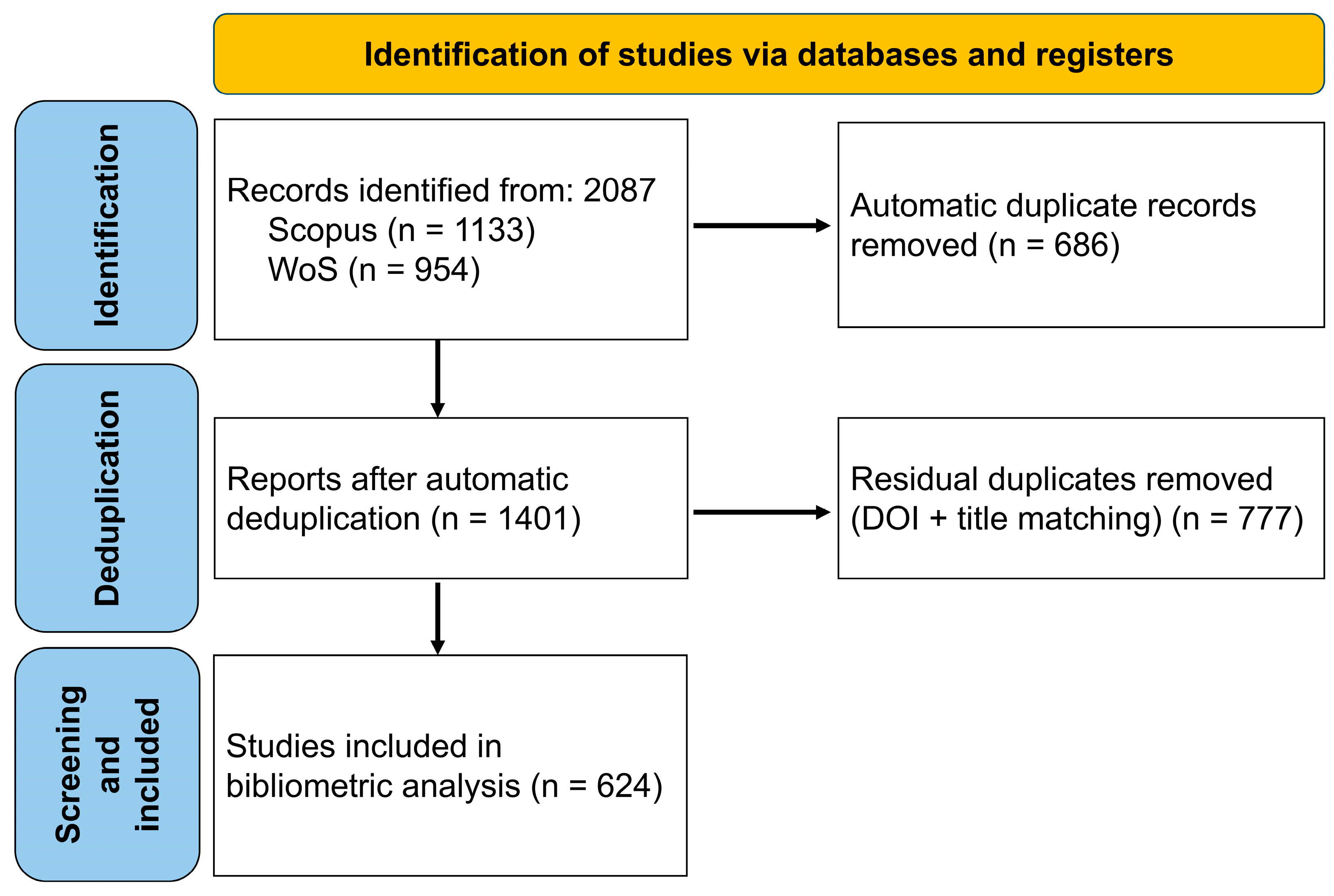
2.5. Study Selection Flowchart
3. Results
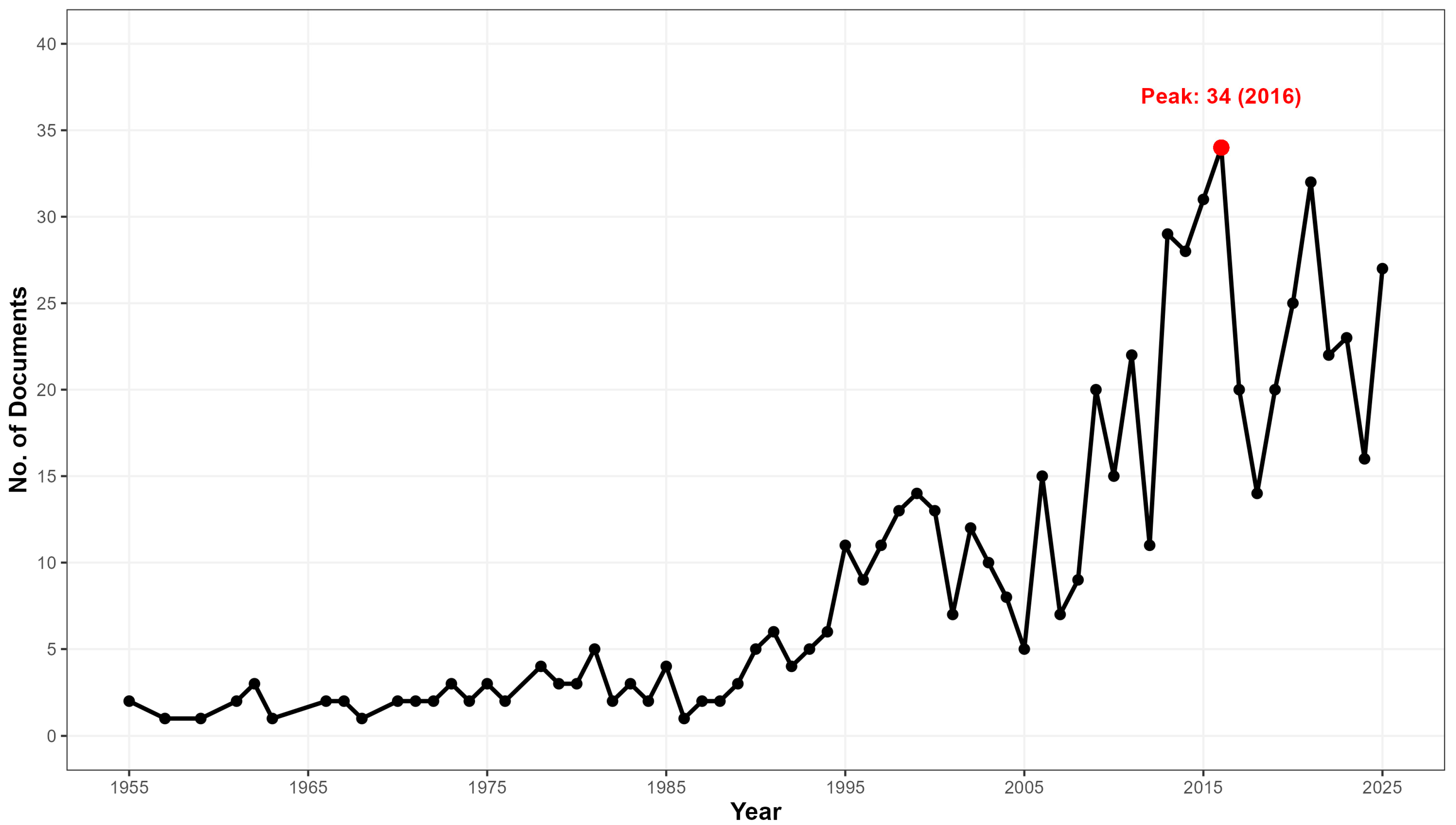
3.1. Evolution of Scientific Production and Source Analysis
3.2. Geographical Distribution and International Collaboration Networks
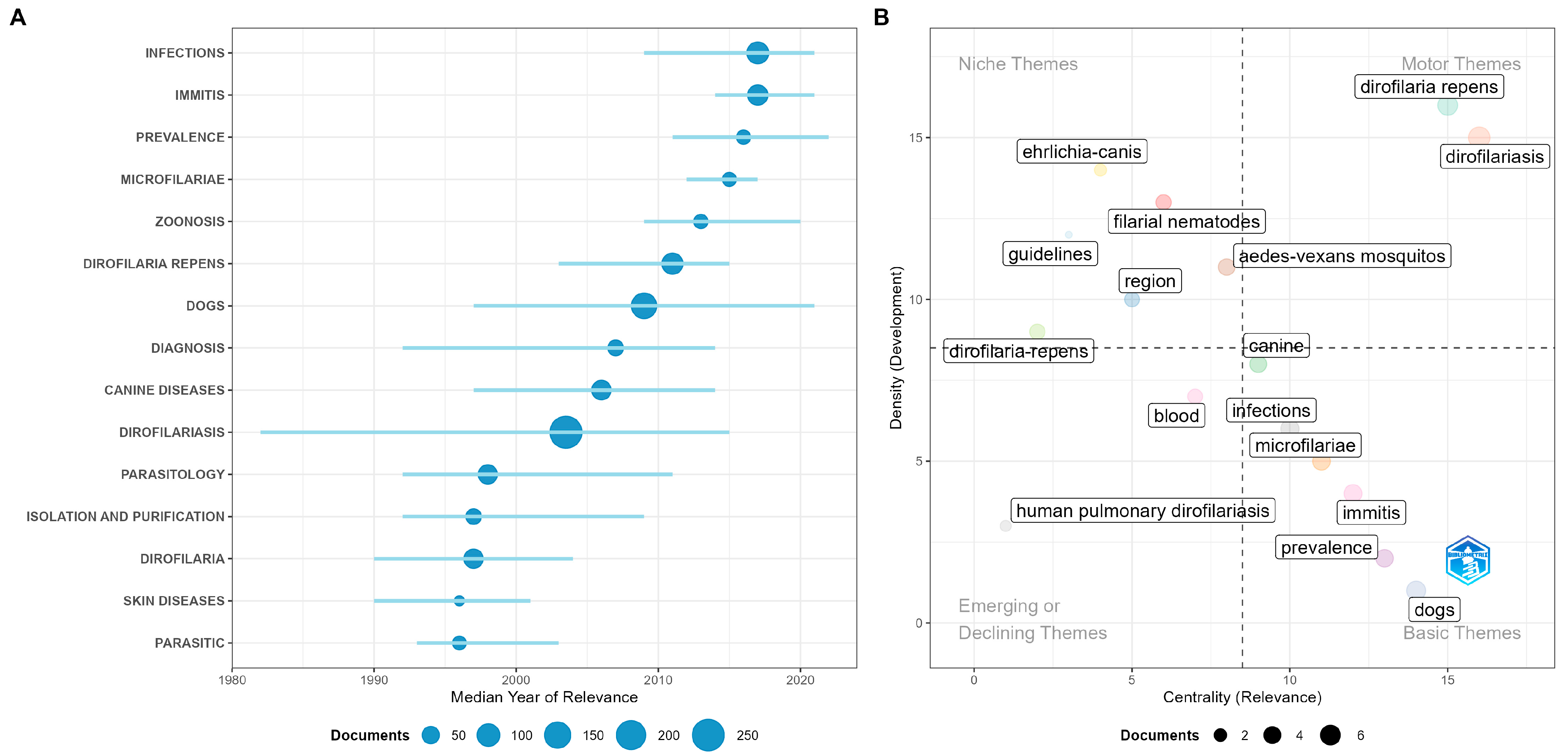
3.3. Thematic Analysis and Research Evolution
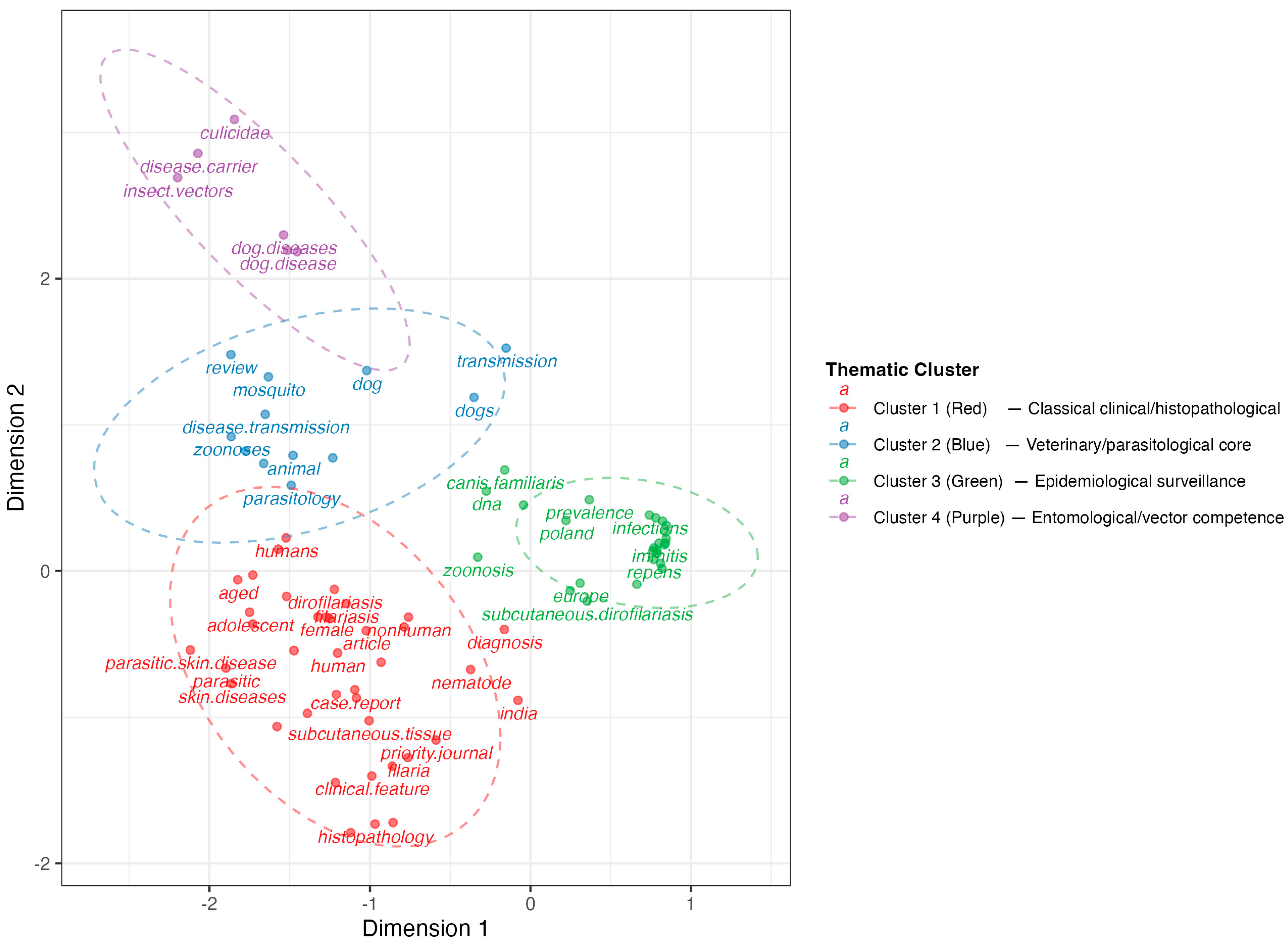
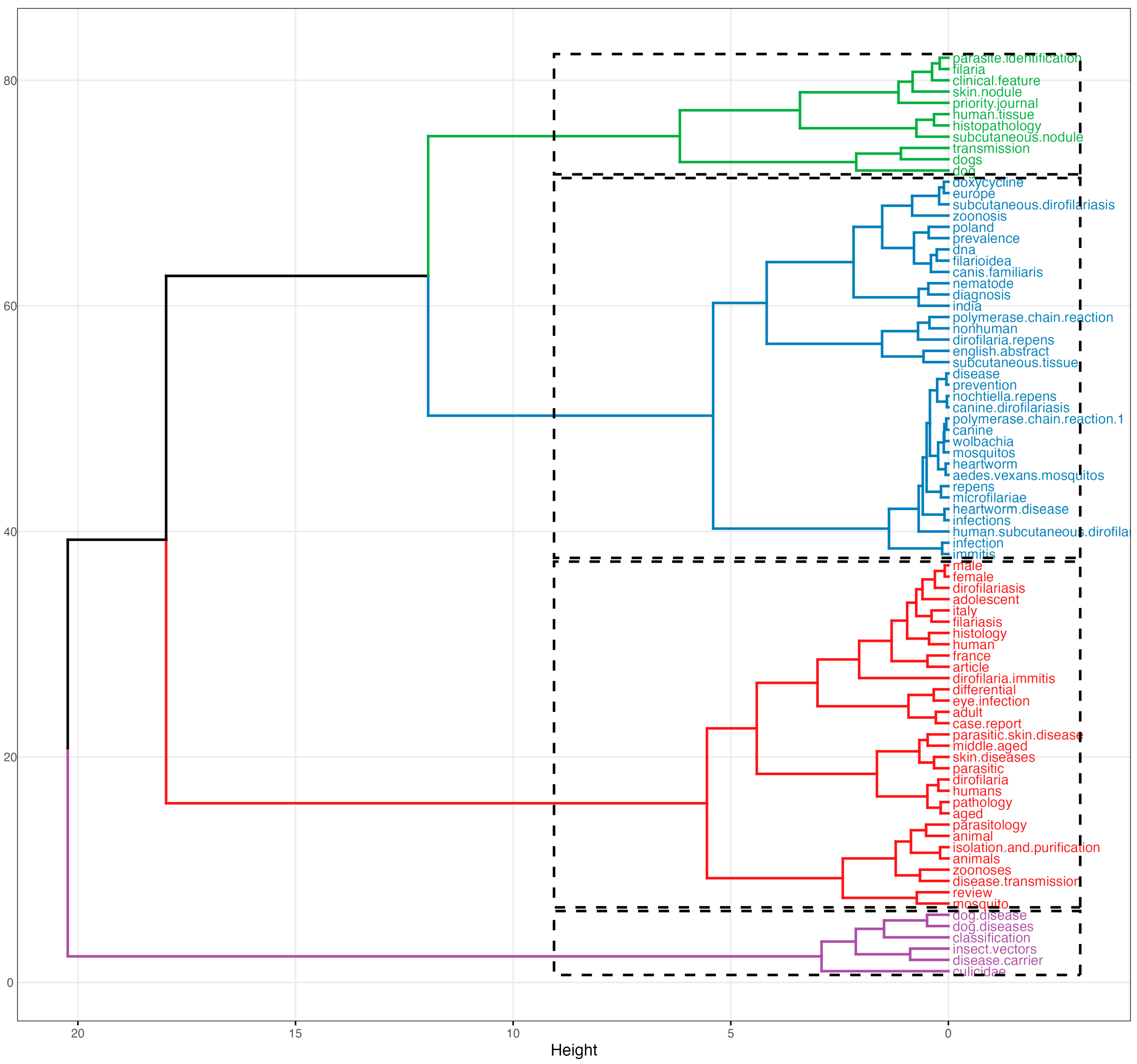
3.4. Intellectual Organization and Conceptual Structure of the Field
4. Discussion
5. Conclusions
Supplementary Materials
Author Contributions
Funding
Institutional Review Board Statement
Informed Consent Statement
Data Availability Statement
Conflicts of Interest
References
- Pampiglione, S.; Rivasi, F. Human dirofilariasis due to Dirofilaria (Nochtiella) repens: An update of world literature from 1995 to 2000. Parassitologia 2000, 42, 231–254. [Google Scholar] [PubMed]
- Genchi, C.; Kramer, L. Subcutaneous dirofilariosis (Dirofilaria repens): An infection spreading throughout the old world. Parasit. Vectors 2017, 10, 517. [Google Scholar] [CrossRef] [PubMed]
- Mendoza-Roldan, J.A.; Gabrielli, S.; Cascio, A.; Manoj, R.R.S.; Bezerra-Santos, M.A.; Benelli, G.; Brianti, E.; Latrofa, M.S.; Otranto, D. Zoonotic Dirofilaria immitis and Dirofilaria repens infection in humans and an integrative approach to the diagnosis. Acta Trop. 2021, 223, 106083. [Google Scholar] [CrossRef] [PubMed]
- Momčilović, S.; Jovanović, A.; Gasser, R.B. Human dirofilariasis—A potentially significant nematode zoonosis in an era of climate change. J. Infect. 2025, 90, 106460. [Google Scholar] [CrossRef]
- Genchi, C.; Kramer, L.H. The prevalence of Dirofilaria immitis and D. repens in the Old World. Vet. Parasitol. 2020, 280, 108995. [Google Scholar] [CrossRef]
- Cancrini, G.; Scaramozzino, P.; Gabrielli, S.; Di Paolo, M.; Toma, L.; Romi, R. Aedes albopictus and Culex pipiens implicated as natural vectors of Dirofilaria repens in central Italy. J. Med. Entomol. 2007, 44, 1064–1066. [Google Scholar] [CrossRef]
- Perles, L.; Dantas-Torres, F.; Krücken, J.; Morchón, R.; Walochnik, J.; Otranto, D. Zoonotic dirofilariases: One, no one, or more than one parasite. Trends Parasitol. 2024, 40, 257–270. [Google Scholar] [CrossRef]
- Simón, F.; González-Miguel, J.; Diosdado, A.; Gómez, P.J.; Morchón, R.; Kartashev, V. The Complexity of Zoonotic Filariasis Episystem and Its Consequences: A Multidisciplinary View. Biomed. Res. Int. 2017, 2017, 6436130. [Google Scholar] [CrossRef]
- Genchi, C.; Kramer, L.H.; Rivasi, F. Dirofilarial infections in Europe. Vector Borne Zoonotic Dis. 2011, 11, 1307–1317. [Google Scholar] [CrossRef]
- Capelli, G.; Genchi, C.; Baneth, G.; Bourdeau, P.; Brianti, E.; Cardoso, L.; Danesi, P.; Fuehrer, H.P.; Giannelli, A.; Ionică, A.M.; et al. Recent advances on Dirofilaria repens in dogs and humans in Europe. Parasit. Vectors 2018, 11, 663. [Google Scholar] [CrossRef]
- Ying, Z.; Upadhyay, A.; Wang, J.; Han, Q.; Liu, Q. The prevalence of canine dirofilariasis in China: A systematic review and meta-analysis. Parasit. Vectors 2023, 16, 207. [Google Scholar] [CrossRef] [PubMed]
- Simón, F.; Siles-Lucas, M.; Morchón, R.; González-Miguel, J.; Mellado, I.; Carretón, E.; Montoya-Alonso, J.A. Human and animal dirofilariasis: The emergence of a zoonotic mosaic. Clin. Microbiol. Rev. 2012, 25, 507–544. [Google Scholar] [CrossRef] [PubMed]
- Hattendorf, C.; Lühken, R. Vectors, host range, and spatial distribution of Dirofilaria immitis and D. repens in Europe: A systematic review. Infect. Dis. Poverty 2025, 14, 58. [Google Scholar] [CrossRef] [PubMed]
- Ghasemi, E.; Shamsinia, S.; Taghipour, A.; Anvari, D.; Bahadory, S.; Shariatzadeh, S.A.; Kordi, B.; Majidiani, H.; Borji, H.; Chaechi Nosrati, M.; et al. Filarial worms: A systematic review and meta-analysis of diversity in animals from Iran with emphasis on human cases. Parasitology 2020, 147, 909–921. [Google Scholar] [CrossRef]
- Trotz-Williams, L.A.; Trees, A.J. Systematic review of the distribution of the major vector-borne parasitic infections in dogs and cats in Europe. Vet. Rec. 2003, 152, 97–105. [Google Scholar] [CrossRef]
- Mayta-Tovalino, F.; Diaz-Barrera, M.E.; Runzer-Colmenares, F.M.; Pacheco-Mendoza, J. RAMIBS: Reporting and Measurement of Items for Bibliometric or Scientometric Studies in Health Sciences. J. Int. Oral Health 2024, 16, 253–256. [Google Scholar] [CrossRef]
- Page, M.J.; McKenzie, J.E.; Bossuyt, P.M.; Boutron, I.; Hoffmann, T.C.; Mulrow, C.D.; Shamseer, L.; Tetzlaff, J.M.; Akl, E.A.; Brennan, S.E.; et al. The PRISMA 2020 statement: An updated guideline for reporting systematic reviews. BMJ 2021, 372, n71. [Google Scholar] [CrossRef]
- Fuehrer, H.P.; Morelli, S.; Unterköfler, M.S.; Bajer, A.; Bakran-Lebl, K.; Dwużnik-Szarek, D.; Farkas, R.; Grandi, G.; Heddergott, M.; Jokelainen, P.; et al. Dirofilaria spp. and Angiostrongylus vasorum: Current Risk of Spreading in Central and Northern Europe. Pathogens 2021, 10, 1268. [Google Scholar] [CrossRef]
- Pękacz, M.; Basałaj, K.; Miterpáková, M.; Rusiecki, Z.; Stopka, D.; Graczyk, D.; Zawistowska-Deniziak, A. An unexpected case of a dog from Poland co-infected with Dirofilaria repens and Dirofilaria immitis. BMC Vet. Res. 2024, 20, 66. [Google Scholar] [CrossRef]
- Genchi, C.; Mortarino, M.; Rinaldi, L.; Cringoli, G.; Traldi, G.; Genchi, M. Changing climate and changing vector-borne disease distribution: The example of Dirofilaria in Europe. Vet. Parasitol. 2011, 176, 295–299. [Google Scholar] [CrossRef]
- Medlock, J.M.; Leach, S.A. Effect of climate change on vector-borne disease risk in the UK. Lancet Infect. Dis. 2015, 15, 721–730. [Google Scholar] [CrossRef]
- European Society of Dirofilariosis and Angiostrongylosis (ESDA). Available online: https://www.esda.vet (accessed on 12 February 2026).
- Noack, S.; Harrington, J.; Carithers, D.S.; Kaminsky, R.; Selzer, P.M. Heartworm disease—Overview, intervention, and industry perspective. Int. J. Parasitol. Drugs Drug Resist. 2021, 16, 65–89. [Google Scholar] [CrossRef]
- Rossi, A.; Peix, Á.; Pavlikovskaya, T.; Sagach, O.; Nikolaenko, S.; Chizh, N.; Kartashev, V.; Simón, F.; Siles-Lucas, M. Genetic diversity of Dirofilaria spp. isolated from subcutaneous and ocular lesions of human patients in Ukraine. Acta Trop. 2015, 142, 1–4. [Google Scholar] [CrossRef]



| Indicator | Value |
|---|---|
| Main information | |
| Timespan | 1955:2025 |
| Sources (journals, books, etc) | 277 |
| Documents | 624 |
| Annual growth rate % | 3.79% |
| Document average age | 17.9 |
| Average citations per doc | 13.43 |
| Document contents | |
| Keywords plus | 1052 |
| Author’s keywords | 671 |
| Authors and collaboration | |
| Total authors | 2474 |
| Authors of single-authored docs | 34 |
| Co-authors per doc | 5.29 |
| International co-authorships % | 16.19% |
| Country | Total Documents | SCP | MCP | MCP Ratio |
|---|---|---|---|---|
| Italy | 88 | 68 | 20 | 22.7% |
| India | 49 | 47 | 2 | 4.1% |
| Germany | 38 | 25 | 13 | 34.2% |
| Poland | 38 | 31 | 7 | 18.4% |
| France | 32 | 30 | 2 | 6.3% |
| USA | 20 | 15 | 5 | 25.0% |
| Spain | 18 | 10 | 8 | 44.4% |
| Austria | 12 | 11 | 1 | 8.3% |
| Croatia | 12 | 11 | 1 | 8.3% |
| Hungary | 12 | 10 | 2 | 16.7% |
Disclaimer/Publisher’s Note: The statements, opinions and data contained in all publications are solely those of the individual author(s) and contributor(s) and not of MDPI and/or the editor(s). MDPI and/or the editor(s) disclaim responsibility for any injury to people or property resulting from any ideas, methods, instructions or products referred to in the content. |
© 2026 by the authors. Licensee MDPI, Basel, Switzerland. This article is an open access article distributed under the terms and conditions of the Creative Commons Attribution (CC BY) license.
Share and Cite
Aguilar-Elena, R.; Rodríguez-Escolar, I.; Collado-Cuadrado, M.; Infante González-Mohino, E.; Balmori-de la Puente, A.; Gil-Abad, A.; Morchón, R. Global Research Trends in Emerging Zoonosis Due to (the Filarial Nematode) Dirofilaria repens (1955–2025): A Bibliometric Analysis of a Climate-Driven Expansion. Pathogens 2026, 15, 386. https://doi.org/10.3390/pathogens15040386
Aguilar-Elena R, Rodríguez-Escolar I, Collado-Cuadrado M, Infante González-Mohino E, Balmori-de la Puente A, Gil-Abad A, Morchón R. Global Research Trends in Emerging Zoonosis Due to (the Filarial Nematode) Dirofilaria repens (1955–2025): A Bibliometric Analysis of a Climate-Driven Expansion. Pathogens. 2026; 15(4):386. https://doi.org/10.3390/pathogens15040386
Chicago/Turabian StyleAguilar-Elena, Raúl, Iván Rodríguez-Escolar, Manuel Collado-Cuadrado, Elena Infante González-Mohino, Alfonso Balmori-de la Puente, Alberto Gil-Abad, and Rodrigo Morchón. 2026. "Global Research Trends in Emerging Zoonosis Due to (the Filarial Nematode) Dirofilaria repens (1955–2025): A Bibliometric Analysis of a Climate-Driven Expansion" Pathogens 15, no. 4: 386. https://doi.org/10.3390/pathogens15040386
APA StyleAguilar-Elena, R., Rodríguez-Escolar, I., Collado-Cuadrado, M., Infante González-Mohino, E., Balmori-de la Puente, A., Gil-Abad, A., & Morchón, R. (2026). Global Research Trends in Emerging Zoonosis Due to (the Filarial Nematode) Dirofilaria repens (1955–2025): A Bibliometric Analysis of a Climate-Driven Expansion. Pathogens, 15(4), 386. https://doi.org/10.3390/pathogens15040386