Article

The Exploration of Therapeutic Antivirals for Human Papillomavirus in the Last 40 Years: Bibliometric Research

1
Faculty of Medicine, Dalian University of Technology, Dalian 116024, China
2
School of Health and Life Sciences, Qingdao Central Hospital, University of Health and Rehabilitation Science, Qingdao 266113, China
3
Office of Academic Affairs, Chengdu University of Technology, Chengdu 610095, China
*
Authors to whom correspondence should be addressed.
These authors contributed equally to this work.
Pathogens 2026, 15(3), 265; https://doi.org/10.3390/pathogens15030265
Submission received: 20 January 2026 / Revised: 24 February 2026 / Accepted: 25 February 2026 / Published: 2 March 2026

Abstract

Human papillomavirus (HPV) is a well-known carcinogenic DNA virus, responsible for about 4% of all cancer cases globally. Effective antiviral treatments for those who are already infected with HPV are still in their early stages, despite the fact that prophylactic vaccinations have shown impressive success in preventing new infections. Effective treatments for HPV-related malignancies are also hampered by the fact that current articles address a wide spectrum of pathways but lack thorough systematic studies. In this work, we use bibliometric techniques to examine research trends and innovative approaches in the development of HPV antivirals over the last 40 years. Our results are intended to offer insightful information and direct future research into effective antiviral treatments for HPV-induced cancers.

1. Introduction

Human papillomavirus (HPV) is an unenveloped DNA virus from the ancient Papillomaviridae family, which includes over 200 types [1]. Most HPV infections cause no symptoms while infection with certain high-risk types can persist and cause cancer [2]. HPV is linked to about 4% of all cancer cases worldwide, including cervical cancer, for which over 90% of cases are caused by HPV, leading to about 300,000 deaths each year [3]. In addition, HPV causes penile cancers, head and neck cancers, and other anogenital cancers [4,5]. Collectively, these HPV-associated cancers pose a substantial clinical and economic burden, with costs exceeding USD 700 million [6,7]. Therefore, it is critical to reduce HPV transmission and prevent its cancer-causing effects to improve global public health.
Prophylactic vaccines, which were developed based on HPV’s major capsid protein (L1 protein) [8], have reduced HPV-related diseases in many developed countries by reducing initial HPV infection [9]. In developing regions, however, there was limited vaccination coverage because of high vaccine costs, limited access, and low awareness [10]. As a result, morbidity rates remain high, and more than 600,000 new diagnoses each year cannot benefit from current vaccines. Moreover, current vaccines showed constrained benefits to people that were already infected by HPV [3,11,12]. Thus, there is an urgent need for effective antiviral treatments that can work alongside vaccines and treat established infections.
There have not been approved clinical antiviral therapies that target HPV’s lifecycle/pathological process for HPV-infected patients. However, many experimental attempts aiming to stop HPV-driven cancer have been published [13,14,15]. By understanding how HPV causes cancer, researchers have identified new treatment paths.
E6 and E7 are two well-evidenced oncoproteins produced by high-risk HPV. In the host cells, E6 promotes the degradation of the tumor suppressor protein p53, while E7 inactivates the retinoblastoma protein (pRB). This disruption of key cell cycle checkpoints is a cornerstone of HPV-induced carcinogenesis and caused E6 and E7 to be valuable targets for antiviral drugs [16,17,18]. Moreover, HPV also evades host immune surveillance, for example, the inhibition of innate immune signaling pathways, particularly the interferon (IFN) response and the cytosolic DNA-sensing cGAS-STING pathway. In addition, it has been reported that the replication genes E1 and E2, which initiate HPV genome replication and gene expression, are also considered to be good targets for high-risk HPV therapies because of their roles in the regulation of viral oncogene expression, inhibition of innate immune responses, and interaction with host proliferation-related factors [1,19,20,21].
Based on the mechanisms above, HPV therapeutic antiviral drugs can be mainly categorized as (i) immune response modifiers (e.g., Imiquimod), which activate pattern recognition receptors to counteract viral immune evasion and stimulate a protective immune response; (ii) antiviral agents (e.g., Cidofovir), which aim to inhibit viral replication or restore tumor suppressor function; and (iii) therapeutic vaccines, designed to elicit targeted T-cell responses against the persistently expressed E6 and E7 oncoproteins [22,23,24,25,26,27]. There has been increasing interest in recent decades in developing therapeutics to accelerate the “90-70-90” target (90% girls are vaccinated by the age of 15 years old; 70% women are screened with a high-performance test by the age of 35 and again by 45 years of age; and 90% of women identified with cervical disease received treatment) made by the WHO [28]. However, the existence of thousands of existing publications makes it challenging for researchers to identify overarching trends, prioritize the most promising therapeutic avenues, and avoid duplication of effort. Thus, a systematic analysis of publications is necessary to map the intellectual landscape, identify knowledge gaps, highlight convergent findings, and illuminate emerging innovative strategies, thereby informing a more efficient and targeted direction for researchers.
Bibliometric analysis provides a quantitative and systematic approach for characterizing the large-scale scientific literature. It enables the reconstruction of knowledge structures, the outlining of research evolution, and the identification of research hotspots. These methods allow investigators to extract field-level patterns—such as research hotspots, collaboration networks, and shifts in conceptual focus—from thousands of publications as an addition to typical reviews. Recent methodological developments have further strengthened the reliability of such analyses [29,30]. Optimized citation time window strategies improve the assessment of research impact by balancing short-term citation fluctuations with long-term scholarly influence, thereby reducing distortions caused by temporal citation accumulation. In parallel, scalable techniques for identifying semantically equivalent cue words enhance the detection of conceptual uncertainty and transitions between research topics. Together, these advances improve the precision and interpretive depth of bibliometric evaluations.
Thus, the present study aims to conduct a comprehensive bibliometric analysis of the literature published over the past four decades regarding antiviral strategies against HPV-induced cancers. We seek to integrate scattered findings, identify cutting-edge technologies, and provide a structured foundation to guide future research toward clinically viable antiviral treatments.

2. Materials and Methods

2.1. Data Collection and Statistics

In the context of the present study, the “antiviral” refers to therapeutic interventions aimed at clearing an established HPV infection, treating HPV-induced lesions, or counteracting the oncogenic activities of viral proteins (notably E6 and E7) in already infected cells. This includes, but is not limited to, antiviral agents (e.g., Cidofovir), immune response modifiers (e.g., Imiquimod), and therapeutic vaccines. Prophylactic measures, such as preventive vaccines, were explicitly excluded from our search strategy and analysis.
The initial dataset was retrieved from the Web of Science Core Collection (WoSCC, https://www.webofscience.com/wos/woscc/) database. The search strategy combined two sets of topic keywords using the Boolean operator AND:
  • Set A (Therapeutic Antivirals): (“antiviral*” OR “anti-viral” OR “antiviral agent*” OR “antiviral drug*” OR “antiviral therap*” OR “antiviral treatment*” OR cidofovir OR interferon OR ribavirin OR acyclovir OR valacyclovir OR ganciclovir OR imiquimod OR “therapeutic vaccine*” OR “targeted drug*”)
  • Set B (HPV): (HPV OR “human papillomavirus” OR papillomaviridae OR HPV16 OR HPV18)
The search parameters were set as follows: Publication Years: 1985–2025; Document Type: Article. This query aimed to identify studies focusing on the development of antiviral therapeutics for HPV. The retrieved records were exported in the “Full Record and Cited References” format and saved as plain text files. These files served as the primary dataset for our analysis. After removing duplicates and conducting data cleaning, a total of 2198 records were retained for subsequent analyses.
The software Bibexcel (Version 2016-02-12, https://homepage.univie.ac.at/juan.gorraiz/bibexcel/, Accessed on 12 February 2016) was used to calculate the frequency and co-occurrence of key items (e.g., keywords, countries). Microsoft Excel 2021 (https://www.microsoft.com/, Accessed on 21 August 2024) and OriginLab 2025b (https://www.originlab.com/, Accessed on 18 October 2025) were used for data preprocessing, statistical calculations, and visualizations.

2.2. The Construction of Co-Occurrence Networks

All 2198 publication records were imported to CiteSpace (Version.6.3.1, https://citespace.podia.com/, Accessed on 8 October 2025) as a dataset to construct a co-occurrence network among Countries, Institutes, and Categories. The networks were distinguished by using color-coded nodes and edges. Nodes are composed of different colored “tree rings” whose thickness indicates the number of co-occurrences each year. A red ring each year indicates a citation burst. The purple ring is used to indicate the degree of inter-node sexual centrality. A node with high intermediate centrality makes sense because it connects one node to another. The co-occurrence network of Keywords was constructed by VOSviewer (Version 1.6.20, https://www.vosviewer.com, Accessed on 18 September 2021) using a “.net” file generated by Bibexcel.

2.3. Burst Detection and Cluster Analysis

The processed dataset of 2198 documents were imported into CiteSpace to construct co-occurrence networks for Countries/Regions, Institutions, and Research Categories as what was described by Wu et al. in the year 2022 [31].
In these networks:
  • Nodes represented the entities (e.g., Countries, Institutions).
  • Edges represented the co-occurrence relationships between entities.
  • Node Colors were used to distinguish different clusters.
  • Tree Rings within each node indicated the number of publications or co-occurrences each year, with the ring’s thickness proportional to the count.
  • A red ring highlighted a year in which the node experienced a citation burst.
  • A purple ring indicated that the node had a high betweenness centrality, meaning it played a crucial intermediary role in connecting different parts of the network.
Additionally, VOSviewer (Version 1.6.20, https://www.vosviewer.com/, Accessed on 18 September 2021) was used to construct a Keyword co-occurrence Network. The input file for VOSviewer was a “.net” file generated by Bibexcel from the same dataset.

2.4. Identification of Core Publications

To identify the most influential publications in the field, the full record dataset was imported into CiteNetExplorer (Version 1.0.0, https://www.citnetexplorer.nl/, Accessed on 20 September 2021) to construct a citation path. Publications were then ranked in descending order based on their internal citation scores within this network. The top 30 most cited publications were selected as the core literature for further in-depth analysis.

3. Results and Discussion

After entirely searching from WOSCC database and carefully removing the duplicated or unrelated records, the 2198 publication records (composition of the records was listed in Table 1) were finally be included to further analysis. To construct a general view of this field, we quantify and statist the basic information of the records. The results were shown below.

3.1. Quantitative Analysis of Basic Information

3.1.1. Annual Publication Trend

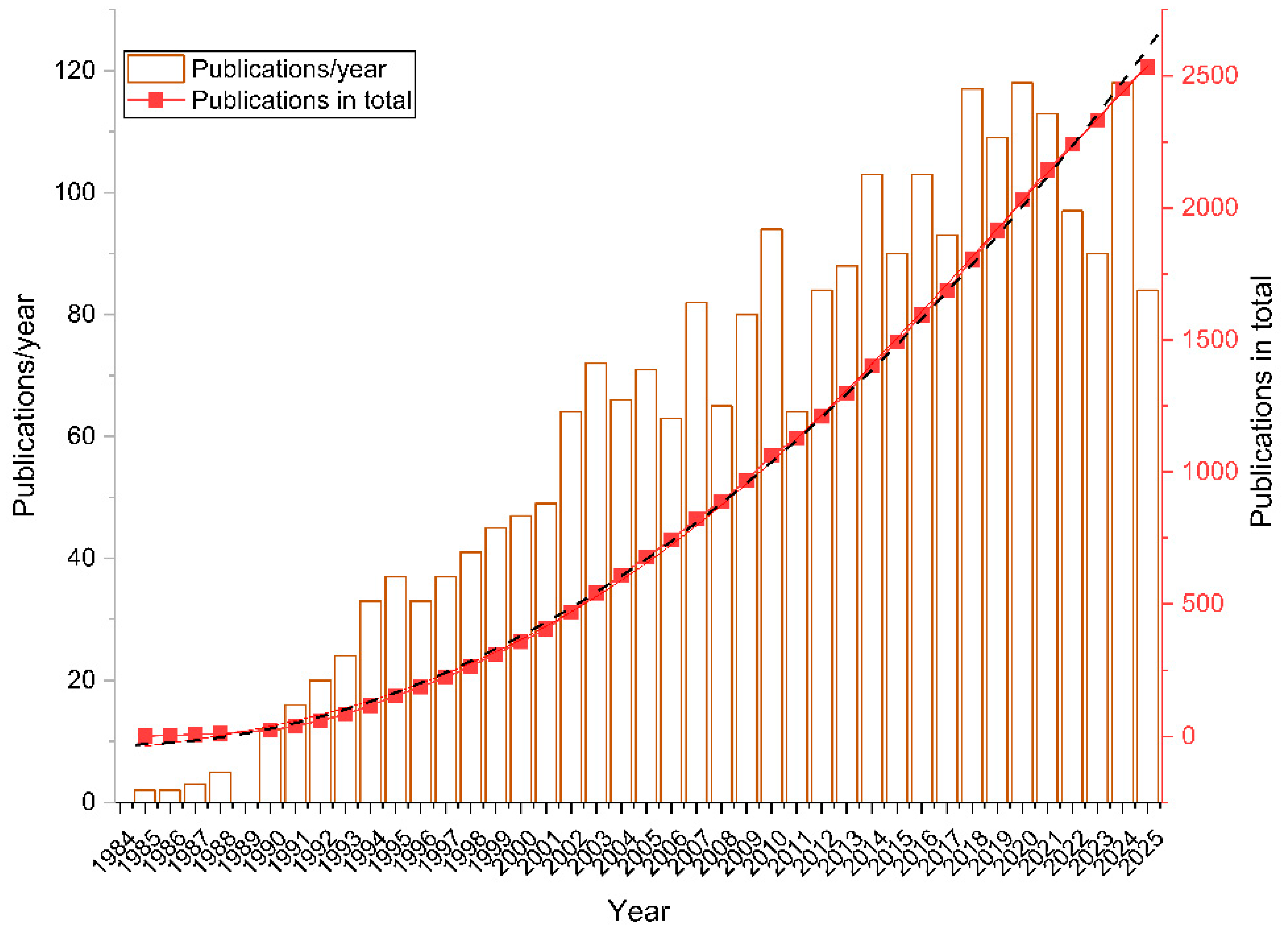
We quantified annual and cumulative publication counts in the field of therapeutic HPV antiviral development from 1985 to 2025 (Figure 1). The annual number of publications increased from just 2 per year in 1985–1986 to a peak of 117 in 2018, reflecting growing research interest over time. Notable declines were observed in specific years, including 2006 (63 articles), 2008 (65), 2011 (64), 2022 (97), and 2023 (90). Cumulative publication growth followed a strongly fitted polynomial trend (Formula 1).
y = 1.5261 x 2 + 108789 x 41.532 R 2 = 0.9994
Formula 1. The polynomial function of the article accumulations. y—the number of the accumulated publications at the time point. x—years from 1985.
Annual publication counts serve as an indicator of field activity. A rapid rise from 1985 to 2003 aligns with growing recognition of HPV’s oncogenic potential. However, there are two significant fluctuations in year 2006 and 2019, respectively. fluctuations in publication counts may coincide with major events in the field—such as the introduction of prophylactic HPV vaccines [32,33], or the global shift of virology research during the COVID-19 pandemic [34]—but that these associations do not imply direct causation.
Despite these fluctuations, the cumulative publication curve suggests a consistent upward trajectory, indicative of sustained developmental interest. However, the relatively modest total output highlights persistent challenges—such as methodological or theoretical limitations—that warrant further investigation to accelerate effective antiviral design. Together, these findings underscore a continuing demand for HPV therapeutics, though research priority appears susceptible to competing public health emergencies.

3.1.2. Analysis of Published Journals

To gain insight into the intellectual landscape of anti-HPV therapy research, we identified the top 10 most productive journals in this field (Table 2), which reveals the interdisciplinary nature and evolving focus of HPV antiviral research. Journal of Virology leads with 81 publications, establishing virology as the foundational discipline. The significant presence of high-impact (Q1) journals in immunology (Frontiers in Immunology, 5-year IF: 6.8) and oncology (International Journal of Cancer, 5-year IF: 5.9) underscores the field’s translational ambition and scientific requirement.
The publisher distribution, with 40% of top journals belonging to ELSEVIER, indicates consolidated knowledge dissemination in established life sciences domains. However, the prominence of broad-scope journals like PLOS One and Scientific Reports suggests the field also benefits from wide, cross-disciplinary visibility.
The distribution of journals reveals a clear shift in research priorities. Most core publications appear in immunology and virology journals, reflecting a strong focus on understanding HPV’s immune evasion and developing immune-based therapies such as immunomodulators and therapeutic vaccines. In contrast, pharmacology and drug delivery journals are underrepresented. This suggests a gap—and an opportunity—for future studies to explore how antiviral agents can be better delivered and absorbed, which is essential for improving their clinical effectiveness.

3.2. Country, Institution, and Author Cooperation Network

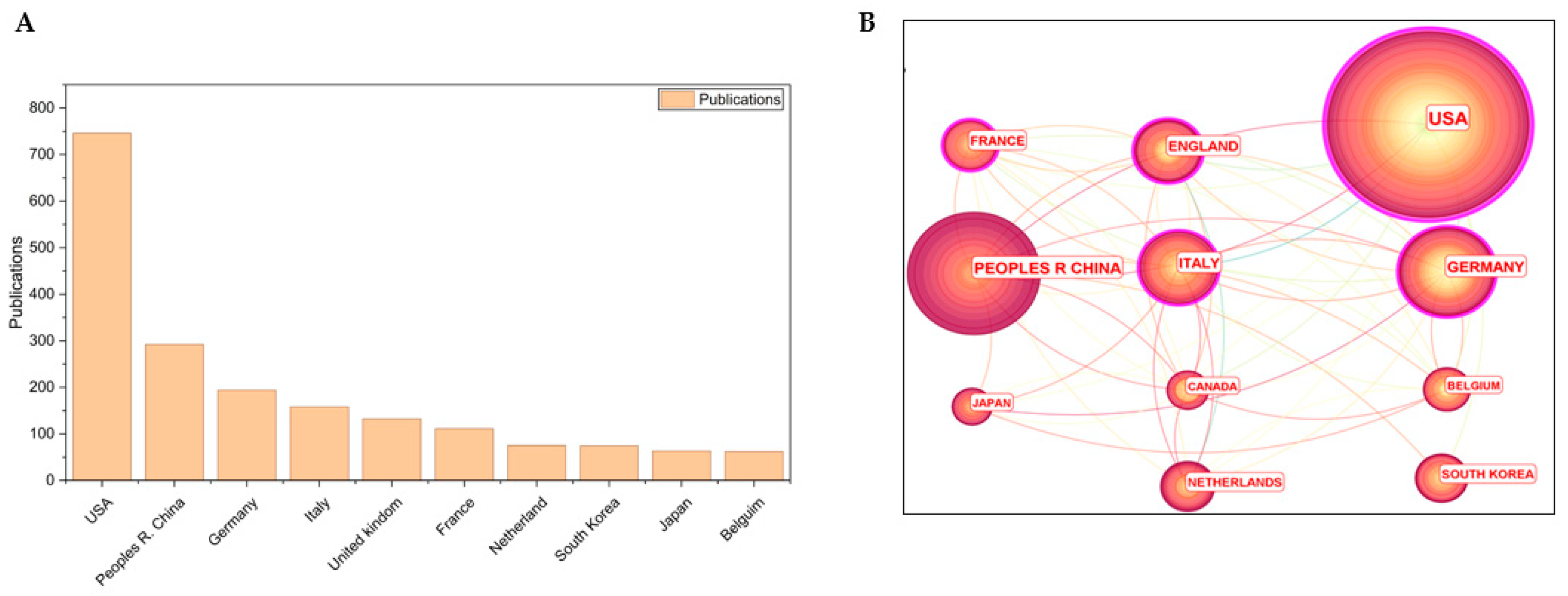
Next, we analyzed international collaboration patterns in HPV therapeutic research (Figure 2A,B). Publication output varied substantially among countries. Seven countries published over 100 articles each over the past 40 years. The United States led with 746 publications, followed by China (292), Germany (194), Italy (158), the United Kingdom (132), and France (111). As illustrated in Figure 2B, collaborative networks are widespread, with stronger linkages observed among Western European countries. Interestingly, although the U.S. and China produced the most publications, they exhibited relatively limited collaboration with other countries. The strongest partnerships have formed predominantly within the last decade.
Publication activity in developed countries appears temporally dispersed, whereas China—a relative latecomer—showed a notable concentration of publications within the past five years. This geographic asymmetry mirrors patterns observed during the development of prophylactic HPV vaccines. Although international collaboration exists, top-producing countries tend to conduct research independently, possibly reflecting divergent national HPV transmission profiles and intervention strategies [35,36]. The widespread adoption of vaccination programs—which have reduced HPV incidence over time [37,38]—may help explain the growing interest in therapeutic options, especially as prophylactic vaccines are ineffective against established infections. China’s distinctive pattern, with a sharp rise in publications coinciding with the introduction of its domestically developed prophylactic vaccine (Cecolin®) [39], suggests a strategic shift toward therapeutic research in anticipation of future declines in HPV incidence. This implicates both national public health planning and scientific capacity-building as drivers of research focus.
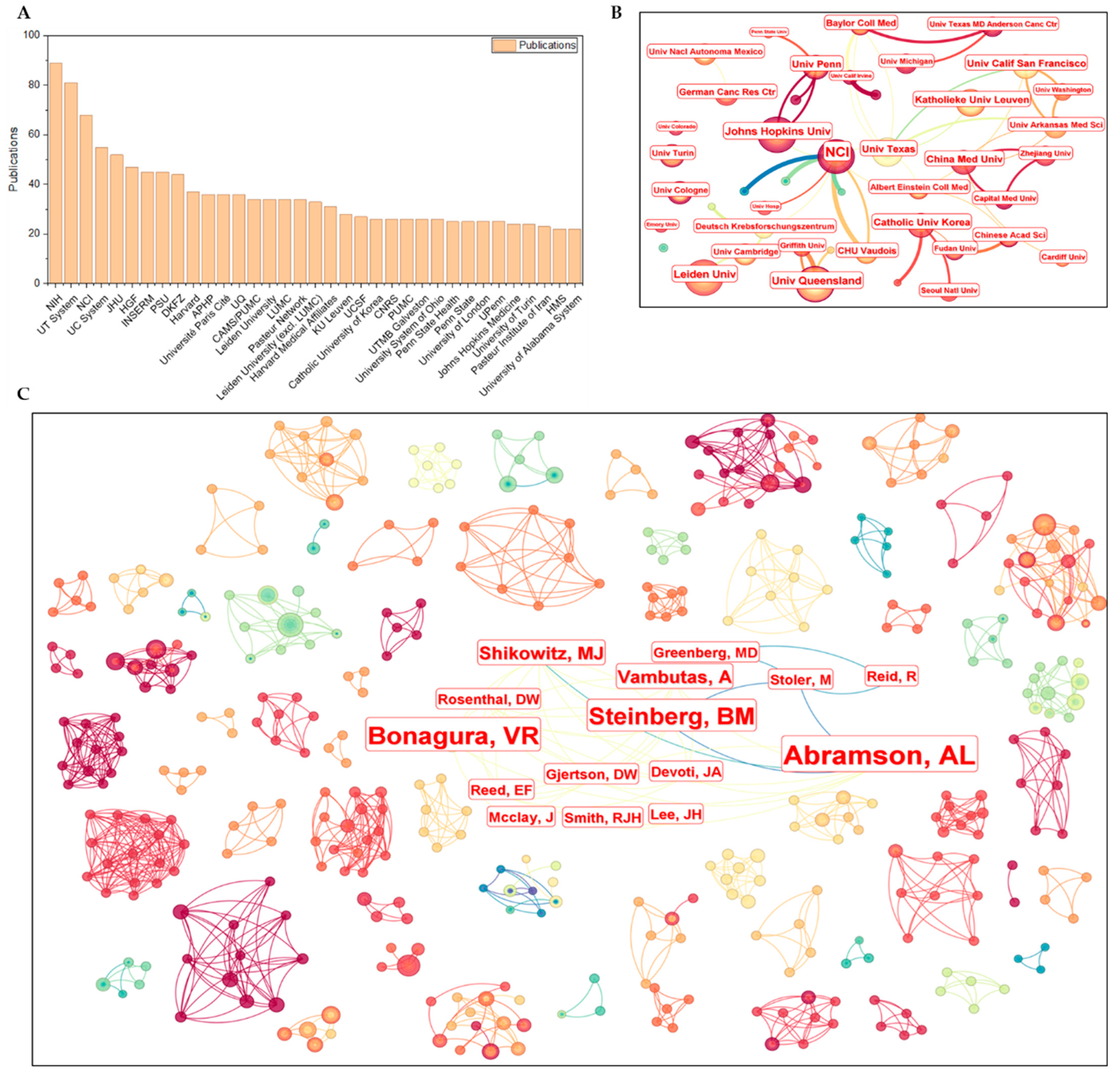
The institutions contributing at least 1% of the total publications are presented in Figure 3A,B. Among the 35 institutions meeting this threshold, 17 were from the United States, including all the top five—the National Institutes of Health (NIH), the University of Texas system, the National Cancer Institute (NCI), the University of California system, and Johns Hopkins University—which together accounted for 15.7% of the publications. Eleven institutions were based in Europe (18.7% of publications), and four were in Asia (5.0%). Collaborative networks among these institutions appeared stable and closely interconnected (Figure 3B), particularly within national boundaries. Unlike the stable and specialized profiles observed among European and U.S. institutions, those in Asia—such as those from China and South Korea—tended to exhibit broader research interests across multiple institutions, resulting in a more divergent and less converged collaborative structure.
This pattern is consistent with the author-level collaboration network illustrated in Figure 3C, revealing modest yet stable collaborative relationships among researchers worldwide. Two distinct forms of collaboration are evident in the author co-occurrence network: (a) team-based structures centered around principal investigators, characterized by sub-networks with high-centrality nodes, and (b) decentralized collaborations among equal contributors, represented by sub-networks with more random node centrality. As indicated by the color gradient in Figure 3C, most collaborations are clustered within specific time intervals. Specifically, nodes with bluer hues correspond to earlier collaborations, while redder nodes indicate more recent ones. Notably, one network—annotated with author names in Figure 3C—exhibits a sustained collaboration spanning over ten years. To identify prominent investigators, the top 30 most prolific authors based on publication output are summarized in Table 3.
To summary, the decentralized collaboration patterns across Countries, Institutions, and Authors reflect an establishing yet geographically constrained research landscape.

3.3. Identification of Core Bibliography

To identify core publications that have contributed significantly to the development of this field, citation records were analyzed using CitNetExplorer (v1.0.0) and ranked by internal citation score (Table 4). The most highly cited publications emphasize that HPV persistence and carcinogenesis are driven by sophisticated immune evasion mechanisms, primarily mediated by the viral oncoproteins E6 and E7. These proteins disrupt interferon signaling by targeting key molecules such as IRF-3 [40], IRF-1 [41], Tyk2 [42], STAT-1 [43,44], and p48 [45], and inhibit the cGAS-STING DNA sensing pathway [46]. Moreover, HPV oncoproteins could promote an immunosuppressive microenvironment characterized by Th2 skewing and regulatory T-cell infiltration [47]. Therapeutic advances have emerged through three complementary strategies: (a) immune response modifiers [48] (e.g., imiquimod [22]), which activate innate immunity via TLR7 [49] and promote Th1-dominant cytokine response [50]; (b) antiviral agents such as cidofovir [24], which inhibit viral replication and restore tumor suppressor function; and (c) therapeutic vaccines targeting E6/E7 [27], capable of inducing specific and durable T-cell responses associated with clinical regression. Together, these approaches underscore that successful clearance of HPV infection requires multimodal strategies to counteract viral immune suppression and robustly engage both innate and adaptive immunity.
These core publications (Table 4) reveal a coherent and evolving narrative of the field’s understanding of HPV pathogenesis and therapeutic intervention. The highly cited works collectively underscore that the persistence of HPV and progression to cancer are fundamentally enabled by the virus’s ability to suppress host innate and adaptive immunity, a function masterminded by the E6 and E7 oncoproteins.
Early foundational studies identified the direct targeting of the interferon (IFN) signaling cascade as a primary immune evasion strategy. For instance, seminal papers demonstrated that E6 binds and inhibits interferon regulatory factor-3 (IRF-3), a key transcription factor for IFN production [40], while E7 was shown to abrogate signaling by interferon-α [42,45] and inactivate IRF-1 [41]. Subsequent research expanded this paradigm, revealing that HPV oncoproteins also impair JAK-STAT signaling by associating with Tyk2 [42] and suppressing STAT-1 expression [43,44]. More recently, the focus has shifted to the cGAS-STING DNA-sensing pathway [51], with landmark publications showing that HPV oncogenes antagonize this critical cytosolic surveillance mechanism to avoid detection of viral DNA [46,52].
This mechanistic understanding directly informed the three major therapeutic strategies reflected in the core literature: (i) host Immune Activation using agents like Imiquimod, a TLR7 agonist that induces a Th1-dominant cytokine milieu [22,50,53], effectively “reversing” the local immune suppression; (ii) Antiviral action with drugs like Cidofovir, which not only inhibits viral replication but has been shown to restore p53 function and enhance the sensitivity of HPV-positive cells to other therapies [24,25]; and (iii) Therapeutic Vaccination designed to elicit cytotoxic T-lymphocytes specifically targeting E6 and E7 oncoproteins, with clinical efficacy demonstrated in trials of DNA-based vaccines like VGX-3100 [54,55]. The progression of these strategies from basic discovery to clinical validation, as captured by the citation network, highlights a field that is increasingly translational and mechanism-driven.
It is also important to emphasize that high citation counts reflect the influence of core publications in shaping the field, for example, by proposing immune evasion mechanisms or identifying antiviral targets. However, citation impact does not imply that these targets have been experimentally validated or translated into clinical use. Many of these studies offer conceptual frameworks that have inspired further research. Notably, several highly cited papers link HPV virulence to key cellular pathways such as NF-κB and p53. These pathways are essential for normal cell function, so targeting those pathways requires caution to avoid potential adverse effects.
Table 4. The top 30 most cited core publications on HPV antivirals.
NOArticleJournalYearCite Score
1Vaccination against HPV-16 oncoproteins for vulvar intraepithelial neoplasia [54]New England Journal of medicine200989
2Human papillomavirus 16 E6 oncoprotein binds to interferon regulatory factor-3 and inhibits its transcriptional activity [40]Genes & development199866
3Papillomavirus type 16 oncogenes downregulate expression of interferon-responsive genes and upregulate proliferation-associated and NF-κB responsive genes in cervical keratinocytes [56]Journal of Virology200149
4Safety, efficacy, and immunogenicity of vgx-3100, a therapeutic synthetic DNA vaccine targeting human papillomavirus 16 and 18 E6 and E7 proteins for cervical intraepithelial neoplasia 2/3: a randomized, double-blind, placebo-controlled phase 2b trial [55]Lancet201546
5Treatment of severe laryngeal papillomatosis with intralesional injections of cidofovir [(s)-1-(3-hydroxy-2-phosphonylmethoxypropy) cytosine] [24]Journal of Medical Virology199845
6Treatment of genital warts with an immune-response modifier (imiquimod) [22]Journal of the American Academy of Dermatology199845
7Microarray analysis identifies interferon-inducible genes and STAT-1 as major transcriptional targets of human papillomavirus type 31 [43]Journal of Virology200045
8Treatment of vulvar intraepithelial neoplasia with topical imiquimod [23]New England Journal of Medicine200845
9The human papillomavirus E7 oncoprotein abrogates signaling mediated by interferon-α [45]Virology199944
10Inactivation of interferon regulatory factor-1 Tumor suppressor protein by HPV E7 oncoprotein implication for the E7-mediated immune evasion mechanism in cervical carcinogenesis [41]Journal of Biological Chemistry200044
11A randomized, controlled, molecular study of condylomata acuminata clearance during treatment with imiquimod [53]Journal of Infectious Diseases199839
12The human papilloma virus (HPV)-18 E6 oncoprotein physically associates with TYK2 and impairs JAK-STAT activation by interferon-α [42]Oncogene199939
13Phase II trial of imiquimod and HPV therapeutic vaccination in patients with vulval intraepithelial neoplasia [57]British Journal of Cancer201039
14Cytokine production patterns in cervical intraepithelial neoplasia: association with human papillomavirus infection [50]Journal of the National Cancer Institute199734
15Imiquimod, a patient-applied immune response modifier for treatment of external genital warts [58]Antimicrobial Agents and Chemotherapy199832
16High-risk human papillomaviruses repress constitutive kappa interferon transcription via E6 to prevent pathogen recognition receptor and antiviral gene expression [59]Journal of Virology201132
17Successful treatment of a squamous papilloma of the hypopharynx–esophagus by local injections of (s)-1-(3-hydroxy-2-phosphonylmethoxypropyl) cytosine [60]Journal of Medical Virology199531
18Antiproliferative effects of acyclic nucleoside phosphonates on human papillomavirus (HPV)-harboring cell lines compared with HPV-negative cell lines [61]Oncology Research199828
19Antiviral agent cidofovir restores p53 function and enhances the radiosensitivity in HPV-associated cancers [25]Oncogene200228
20Phase II double-blind, placebo-controlled study of the safety and efficacy of cidofovir topical gel for the treatment of patients with human papillomavirus infection [26]Clinical Infectious diseases200127
21Immune responses to human papillomavirus [62]Vaccine200627
22Leukoregulin and gamma-interferon inhibit Human papillomavirus type-16 gene transcription in human papillomavirus-immortalized human cervical cells [27]Cancer Research199226
23Detection of human papillomavirus (HPV) 16-specific CD4+ T-cell immunity in patients with persistent hpv16-induced vulvar intraepithelial neoplasia in relation to clinical impact of imiquimod treatment [47]Clinical Cancer Research200526
24Carrageenan is a potent inhibitor of papillomavirus infection [63]PLoS Patho-gens200626
25Success or failure of vaccination for hpv16-positive vulvar lesions correlates with kinetics and phenotype of induced T-cell responses [64]Proceedings of the National Academy of Sciences of the United States of America201026
26Selective inhibition of human papillomavirus-induced cell proliferation by (s)-1-[3-hydroxy-2-(phosphonyl methoxy)propyl]cytosine [65]Antimicrobial Agents and Chemotherapy199925
27HPV: from infection to cancer [49]Biochemical Society Transactions200725
28DNA tumor virus oncogenes antagonize the cGAS-STING DNA-sensing pathway [46]Science201525
29Suppression of STAT-1 expression by human papillomaviruses is necessary for differentiation-dependent genome amplification and plasmid maintenance [44]Journal of Virology201124
30Vaccination against oncoproteins of HPV16 for noninvasive vulvar/vaginal lesions: lesion clearance is related to the strength of the T-cell response [66]Clinical Cancer Research201624

3.4. Tracing the Evolution of the Disciplines

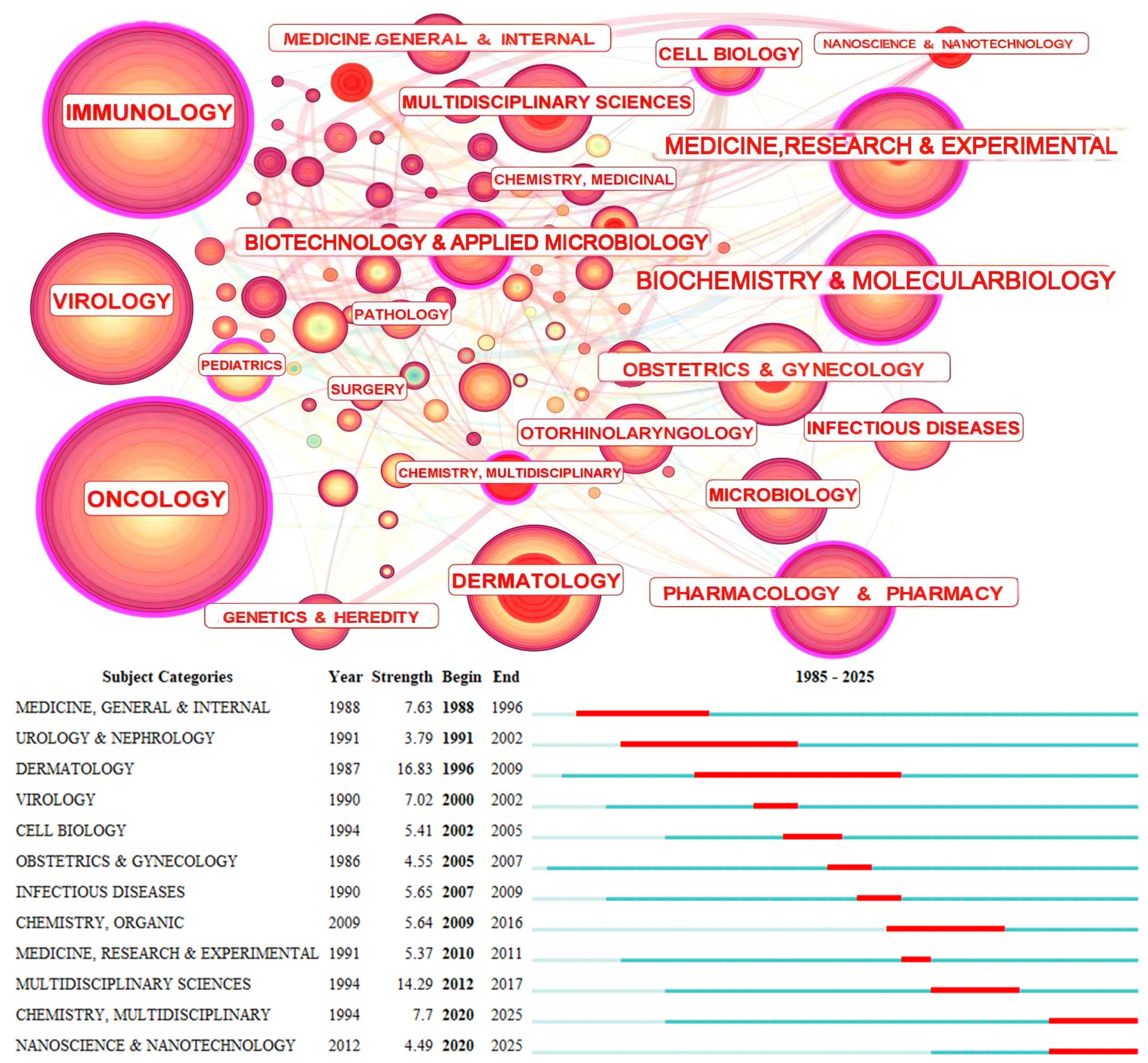
The evolutionary trajectory and research frontiers in HPV therapy development have been further explored through the construction of citation networks and the detection of burst terms in Categories and Keywords. As shown in Figure 4, this field has attracted widespread interest across multiple disciplines, with significant contributions from Cancer biology, Immunology, Pharmacology, Virology, and Chemistry. Among these, 12 subject categories exhibited citation bursts. The earliest bursts occurred in Medicine (General & Internal), Urology & Nephrology, and Dermatology, lasting between 8 and 13 years. In contrast, the most recent bursts—observed in Nanotechnology and Multidisciplinary Chemistry—emerged in 2020 and persist to the present. This shift in active research categories reflects an evolution from intradisciplinary approaches to increasingly interdisciplinary strategies. The emergence of nanotechnology may indicate a growing focus on precise therapeutic targeting and efforts toward translational applications. Certain domains, including Virology, Immunology, and Oncology, did not exhibit citation bursts, suggesting sustained and continuous interest throughout the entire period. These patterns imply that key aspects of HPV pathology remain incompletely understood, and that novel therapeutic strategies are likely to continue emerging in the future.
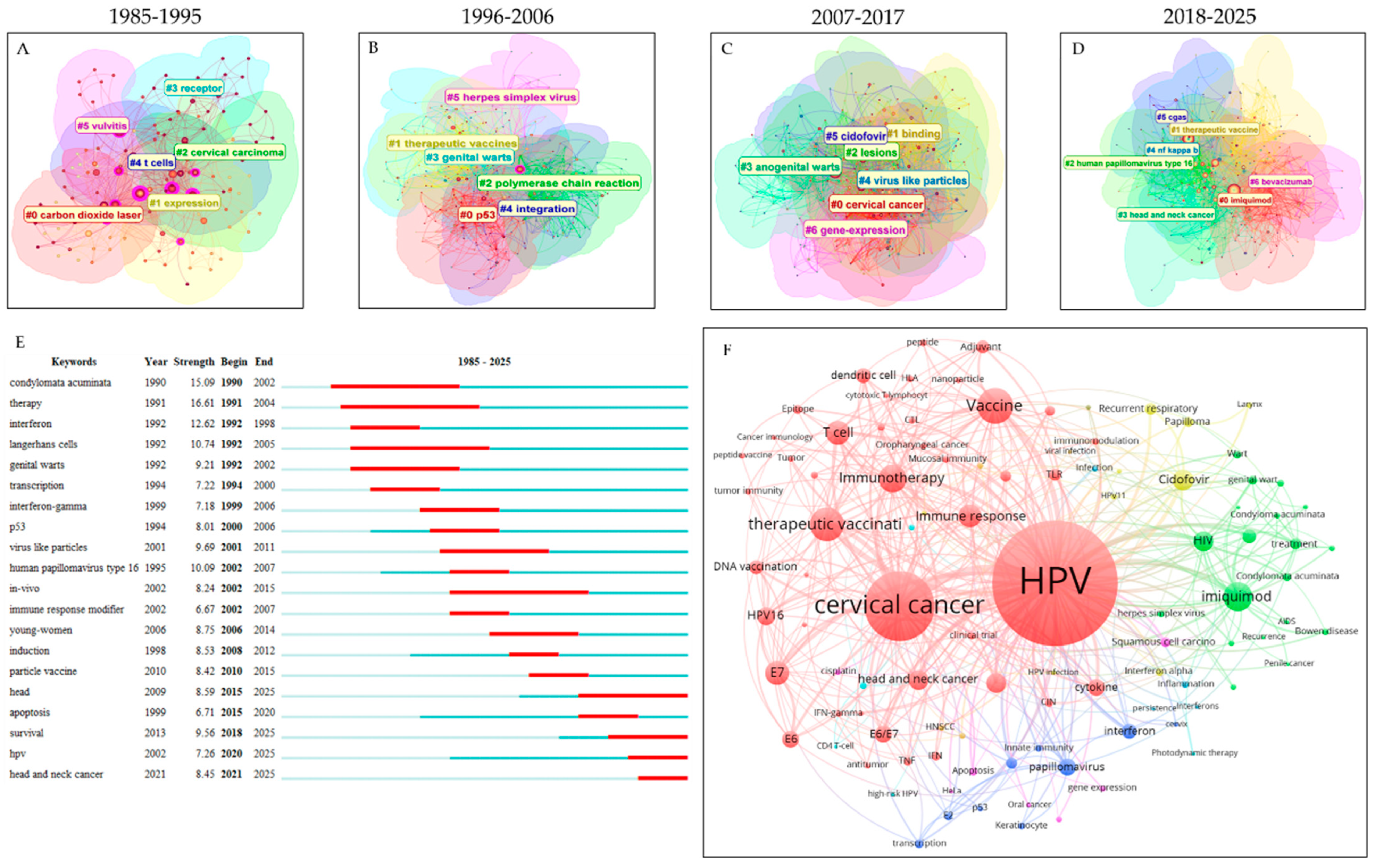
A strong correlation among keywords was observed within the clustered co-occurrence network of the discipline (Figure 5). To trace the temporal evolution of research themes, the network was reconstructed using reference data divided into four time slices and subsequently clustered using CiteSpace (Figure 5A–D). In the first decade, keywords were grouped into five major clusters: #1 gene expression, #2 cervical carcinoma, #3 receptors, #4 T-cells, and #5 vulvitis (Figure 5A). In the following decade, new research hotspots emerged, including #0 p53, #1 therapeutic vaccines, #2 polymerase chain reaction (PCR), and #3 genital warts (Figure 5B). Between 2007 and 2017, more therapy-specific clusters appeared, such as #5 cidofovir and #4 virus-like particles, alongside persistent themes like #0 cervical cancer, #3 anogenital warts, and #6 gene expression (Figure 5C). The most recent period has been marked by investigations into novel therapeutic targets (e.g., #4 NF-κB and #5 cGAS) and agents (e.g., #0 imiquimod and #6 bevacizumab), accompanied by growing attention to #3 head and neck cancer (Figure 5D).
To further elucidate evolutionary trends in research focus, the 25 keywords with the strongest citation bursts are displayed in Figure 5E. The evolution of HPV antiviral development exhibits a progressive shift from early emphasis on condylomata acuminata (prevalent during 1990–2002) to recent interest in head and neck cancer (2021–2025). Most bursts persisted for approximately a decade, and overlapping intervals between consecutive terms reflect strong thematic continuity within the field. Consistent with the cluster analysis, the burst detection reveals a trend toward more precise molecular targeting and expanding clinical indications.
Finally, to provide an integrated conceptual overview, a keyword co-occurrence network was constructed using VOSviewer after merging synonymous terms and removing duplicates (Figure 5F). The network reveals one dominant cluster related to vaccine development (red) and three subsidiary clusters associated with specific agents: interferon (blue), cidofovir (yellow), and imiquimod (green). The structure also suggests distinct therapeutic preferences; for example, imiquimod appears frequently in contexts involving co-infections, whereas cidofovir, though typically applied topically, is also investigated for low-risk HPV-associated respiratory papillomatosis.
The keyword evolution and burst analysis collectively illustrate a dynamic and maturing research landscape in HPV therapeutics. The early focus on virological basics and generalized immunology has progressively given way to mechanism-driven drug discovery [67] and targeted therapies [68]. The emergence of themes such as NF-κB [56,69] and cGAS signaling [21,52,70,71,72] indicates a growing emphasis on intracellular innate immune pathways, while the sustained interest in vaccines and virus-like particles underscores the continued importance of immunoprevention [73]. The shift in disease focus from cervical cancer to head and neck cancers reflects both clinical need and expanding therapeutic applicability. The co-occurrence network further highlights the diversity of intervention strategies, from immunomodulators to antiviral agents, each occupying distinct niches within the treatment spectrum. The segregated yet connected clustering pattern suggests that while research subcommunities have specialized, cross-disciplinary awareness remains active. Overall, these findings depict a field that is increasingly interdisciplinary, translational, and biomarker-informed. Future efforts will likely continue to integrate mechanistic insight with clinical innovation, particularly in personalized therapies and combination regimens.

4. Conclusions and Perspectives

This bibliometric analysis maps the intellectual landscape and evolving trajectory of antiviral research for HPV-induced cancers over the past four decades. Our findings illustrate a clear paradigm shift from descriptive virology and symptom management towards a deep, mechanism-based understanding of HPV–host interactions, paving the way for targeted therapeutic strategies.
The analysis of publication trends, collaboration networks, and conceptual evolution consistently highlights the centrality of HPV’s immune evasion mechanisms, masterminded by the E6 and E7 oncoproteins. The field’s progression is evident in the keyword and category bursts, moving from general virology and clinical observation to specific molecular targets (e.g., NF-κB, cGAS-STING) and innovative platforms like nanotechnology. The sustained, non-bursting activity in core fields like Immunology and Virology indicates a solid foundation upon which new interdisciplinary approaches are being built.

4.1. Future Research Directions

Despite significant progress, challenges remain. Based on the gaps and emerging trends identified in our analysis, we propose the following concrete directions for future research:

4.1.1. Novel Target Discovery

While E6 and E7 remain prime targets, the intricate network of host–virus interactions is not fully elucidated. Future work should employ systematic approaches (e.g., CRISPR screens, proteomics) to identify novel host dependency factors that can be therapeutically exploited.

4.1.2. Advanced Delivery and Formulations

HPV infections are very common and there is not an adequate medical treatment. Despite that several agents (e.g., nucleoside analogs, oncoprotein inhibitors and antineoplastic agent) have currently been used for treatments in HPV-associated lesions both clinically and pre-clinically [74,75,76,77], the therapeutic efficiency and related mechanisms should be further investigated to avoid inaccurate inferences.
The emergence of “Nanotechnology” as a burst term signals a growing focus on overcoming delivery challenges. Thus, Future efforts should prioritize the development of smart nanocarriers to improve the bioavailability, tumor targeting, and intracellular delivery of existing agents (e.g., Cidofovir) and novel nucleic acid-based therapeutics. Virus-like particles (VLPs) have obtained wide interest in HPV therapy development. Although prophylactic HPV VLP vaccines do not directly eliminate established HPV infection and current vaccines showed constrained benefits to people that already infected by HPV [3,11,12], certain studies have reported measurable post-treatment benefits or “primary prophylactic” effects in women treated for HPV-associated lesions [78,79]. In specific clinical windows, VLP-based vaccination has also been explored as an adjunctive therapeutic intervention [80]. Considering the lack of virologic confirmation, further preclinical/clinical investigations are needed to decipher the therapeutic efficiency of the current HPV capsid protein based VLPs.
On the other hand, VLPs are increasingly used as delivery platforms for therapeutic agents, including nucleic acids and immunomodulators [81,82]. This emerging application positions VLPs within the broader therapeutic development pipeline, even though they are not used as antivirals directly. In addition, other newly established platforms provided new opportunities for HPV therapeutic development [83].
Taken together, the accumulated evidence over the past four decades has progressively clarified the conceptual and methodological pathways for HPV antiviral development.

4.1.3. Rational Combination Therapies

Co-occurrence networks reveal distinct clusters for vaccines, immunomodulators, and direct antivirals, suggesting complementary mechanisms. Combining systemic immune activation (e.g., therapeutic vaccines) with local immune modulation (e.g., Imiquimod) may yield synergistic effects and warrants systematic evaluation in future clinical trials.

4.1.4. Expanding Clinical Scope

The strong citation burst for “head and neck cancer” reflects the shifting epidemiology of HPV-associated disease. Oropharyngeal cancers exhibit distinct microenvironmental features compared with anogenital cancers, underscoring the need to adapt antiviral strategies to these emerging clinical contexts.4.1.5 Fostering Global Collaboration.
The observed geographic asymmetry in research output and the relatively limited international collaboration between top-producing countries represent a missed opportunity. Purposeful North–South and cross-continental partnerships, particularly to include regions with high HPV burden, are essential to ensure that research outcomes are globally relevant and translatable.

4.2. Limitations of the Study and Perspectives

This bibliometric analysis offers a structured, data-driven overview of four decades of HPV antiviral research. However, several methodological limitations must be clarified and discussed.
First, Bibliometric analysis evaluates the influence of publications mainly through citation-based indicators [29]. Because citations accumulate over time, older studies naturally gain more references and may appear more important within the citation network than newer work [30]. This can lead investigators to identify well-established or classic studies more easily than recent research that may represent state-of-the-art advances but has not yet been widely cited. To reduce this temporal imbalance, we applied citation-burst detection to highlight recent publications that have attracted rapid attention. Although this approach helps identify emerging topics, it cannot fully offset the inherent advantage of long-standing literature. Consequently, the key works identified in Section 3.3 reflect established citation trends but may not fully capture the most recent or innovative studies. This underscores the need for careful, independent evaluation of newly published research beyond what bibliometric indicators alone can provide.
Second, it is critical to separate the scope of this study from that of a typical narrative review. Narrative reviews offer a qualitative summary of mechanisms and clinical findings [84], whereas bibliometric approaches focus on macro-level patterns like collaboration networks, thematic evolution, and publication trends. In this sense, our analysis depicts the larger research environment, whereas narrative reviews delve into individual scientific pathways. Instead of being interchangeable, these strategies are complementary.
Third, the data source limits the bibliometric analysis. We relied solely on the Web of Science Core Collection, which may have excluded important papers published in non-indexed journals, non-English languages, preprints, or clinical trial databases. Furthermore, search string constraints may have unintentionally left out certain relevant papers despite careful query design.
Lastly, metrics based on citations show scholarly interest rather than necessarily scientific significance or translational usefulness. In other words, highly cited publications should not be seen as necessarily excellent. Unlike traditional reviews that focus on the detailed content and interpretation of individual studies, bibliometric methods—such as co-occurrence network analysis—can rapidly identify hotspots and interests of investigators in HPV pathogenicity from large volumes of literature. However, these targets may lack experimental validation (e.g., gain- or loss-of-function studies) or may be biologically undruggable. Therefore, bibliometric findings require careful filtering and critical evaluation to avoid misleading conclusions. A comprehensive understanding of the field benefits from combining bibliometric analysis of historical trends with systematic reviews of recent mechanistic and clinical evidence. Both approaches are essential and complementary in guiding future research.
In summary, this study not only charts the historical development of the field but also provides a strategic foundation to guide future endeavors. By leveraging mechanistic insights and embracing interdisciplinary collaboration, the research community can accelerate the development of effective antiviral therapies to alleviate the global burden of HPV-associated cancers.

Supplementary Materials

The following supporting information can be downloaded at: https://www.mdpi.com/article/10.3390/pathogens15030265/s1.

Author Contributions

Conceptualization, Z.J. and L.J.; methodology, Z.J. and L.J.; software, L.J.; validation, C.W., P.Q. and Z.L. (Zhangrong Lou); formal analysis, Z.J.; investigation, Z.J. and L.J.; data curation, Z.J. and L.J.; writing—original draft preparation, Z.J. and L.J.; writing—review and editing, Z.J., Z.L. (Zhenqing Li) and L.J.; visualization, L.J.; supervision, C.W., P.Q. and Z.L. (Zhenqing Li); project administration, C.W., P.Q. and Z.L. (Zhangrong Lou); funding acquisition, Z.J. All authors have read and agreed to the published version of the manuscript.

Funding

This research was funded by 2023 JOINT FUND PROJECT DOCTORAL RESEARCH STRT-UP PROJECT, LIAONING PROVINCIAL DEPARTMENT of SCIENCE and TECHNOLOGY–DALIAN UNIVERSITY OF TECHNOLOGY, funding date: 1 December 2023 to 30 November 2025, funding number 2023-BSBA-057.

Institutional Review Board Statement

Not applicable.

Informed Consent Statement

Not applicable.

Data Availability Statement

The original contributions presented in this study are included in the article/Supplementary Materials. Further inquiries can be directed to the corresponding authors.

Acknowledgments

We appreciate the working conditions (e.g., PC devices, working area, as well as access to campus network and software) provided by Stefan Schwartz and Naoko Kajitani at Uppsala University during the preparation of this manuscript. During the preparation of this manuscript, Grammarly (https://app.grammarly.com/) and Quillbot (https://quillbot.com/), were used to correct grammatical mistakes.

Conflicts of Interest

The authors declare no conflicts of interest.

Abbreviations

The following abbreviations are used in this manuscript:
HPVHuman papillomavirus
USDUnited States Dollar
pRBRetinoblastoma protein
IFNInterferon
cGAS-STINGCyclic GMP-AMP synthase–stimulator of interferon genes
WHOWorld Health Organization
WoSCCWeb of Science Core Collection
COVID-19Coronavirus disease 2019
NIHNational Institutes of Health
NCINational Cancer Institute
IRF-3Interferon Regulatory Factor 3
IRF-1Interferon Regulatory Factor 1
Tyk2Tyrosine kinase 2
STAT-1Signal Transducer and Activator of Transcription 1
Th2Helper T cell 2
TLR7Toll-like receptor 7
Th1Helper T cell 1
JAKJanus kinases
NF-κBNuclear factor kappa-light-chain-enhancer of activated B cells
PCRPolymerase chain reaction
CRISPRClustered Regularly Interspaced Short Palindromic Repeats
VLPsVirus-like particles

References

  1. McBride, A.A. Human papillomaviruses: Diversity, infection and host interactions. Nat. Rev. Microbiol. 2022, 20, 95–108. [Google Scholar] [CrossRef] [Scilit] [PubMed]
  2. Cubie, H.A. Diseases associated with human papillomavirus infection. Virology 2013, 445, 21–34. [Google Scholar] [CrossRef] [Scilit] [PubMed]
  3. Arbyn, M.; Weiderpass, E.; Bruni, L.; de Sanjosé, S.; Saraiya, M.; Ferlay, J.; Bray, F. Estimates of incidence and mortality of cervical cancer in 2018: A worldwide analysis. Lancet Glob. Health 2020, 8, E191–E203. [Google Scholar] [CrossRef] [Scilit]
  4. de Sanjosé, S.; Bruni, L.; Alemany, L. HPV in genital cancers (at the exception of cervical cancer) and anal cancers. Presse Médicale 2014, 43, e423–e428. [Google Scholar] [CrossRef] [Scilit] [PubMed]
  5. Sasidharanpillai, S.; Ravishankar, N.; Kamath, V.; Bhat, P.V.; Bhatt, P.; Arunkumar, G. Prevalence of human papillomavirus (HPV) DNA among men with oropharyngeal and anogenital cancers: A systematic review and meta-analysis. Asian Pac. J. Cancer Prev. 2021, 22, 1351. [Google Scholar] [CrossRef] [Scilit] [PubMed]
  6. De Martel, C.; Plummer, M.; Vignat, J.; Franceschi, S. Worldwide burden of cancer attributable to HPV by site, country and HPV type. Int. J. Cancer 2017, 141, 664–670. [Google Scholar] [CrossRef] [Scilit]
  7. Tadese, B.K.; You, X.D.; Ndao, T.; Tota, J.E.; Chen, Y.T.; Chowdhary, A.; Pan, J.; Costa, A.C.; Mugo, N. The Burden of HPV Infections and HPV-Related Diseases Among People With HIV: A Systematic Literature Review. J. Med. Virol. 2025, 97, 18. [Google Scholar] [CrossRef] [Scilit]
  8. Castle, P.; Maza, M. Prophylactic HPV vaccination: Past, present, and future. Epidemiol. Infect. 2016, 144, 449–468. [Google Scholar] [CrossRef] [Scilit]
  9. Serrano, B.; Brotons, M.; Bosch, F.X.; Bruni, L. Epidemiology and burden of HPV-related disease. Best Pract. Res. Clin. Obstet. Gynaecol. 2018, 47, 14–26. [Google Scholar] [CrossRef] [Scilit]
  10. Yousefi, Z.; Aria, H.; Ghaedrahmati, F.; Bakhtiari, T.; Azizi, M.; Bastan, R.; Hosseini, R.; Eskandari, N. An Update on Human Papilloma Virus Vaccines: History, Types, Protection, and Efficacy. Front. Immunol. 2022, 12, 11. [Google Scholar] [CrossRef] [Scilit]
  11. Wang, R.; Huang, H.P.; Yu, C.L.; Li, X.F.; Wang, Y.; Xie, L.Z. Current status and future directions for the development of human papillomavirus vaccines. Front. Immunol. 2024, 15, 16. [Google Scholar] [CrossRef] [Scilit]
  12. Khallouf, H.; Grabowska, A.K.; Riemer, A.B. Therapeutic vaccine strategies against human papillomavirus. Vaccines 2014, 2, 422–462. [Google Scholar] [CrossRef] [Scilit] [PubMed]
  13. Gelbard, M.K.; Munger, K. Human papillomaviruses: Knowns, mysteries, and unchartered territories. J. Med. Virol. 2023, 95, 18. [Google Scholar] [CrossRef] [Scilit] [PubMed]
  14. Messa, L.; Loregian, A. HPV-induced cancers: Preclinical therapeutic advancements. Expert Opin. Investig. Drugs 2022, 31, 79–93. [Google Scholar] [CrossRef] [Scilit]
  15. Kermanshahi, A.Z.; Ebrahimi, F.; Taherpoor, A.; Eslami, N.; Baghi, H.B. HPV-driven cancers: A looming threat and the potential of CRISPR/Cas9 for targeted therapy. Virol. J. 2025, 22, 156. [Google Scholar] [CrossRef] [Scilit] [PubMed]
  16. Younas, S.; Malik, Z.I.; Khan, M.U.; Manzoor, S.; Rehman, H.M.; Hammad, H.M.; Akter, S. Identification of novel therapeutic inhibitors against E6 and E7 oncogenes of HPV-16 associated with cervical cancer. PLoS ONE 2025, 20, e0323595. [Google Scholar] [CrossRef] [Scilit]
  17. Almeida, A.M.; Queiroz, J.A.; Sousa, F.; Sousa, Â. Cervical cancer and HPV infection: Ongoing therapeutic research to counteract the action of E6 and E7 oncoproteins. Drug Discov. Today 2019, 24, 2044–2057. [Google Scholar] [CrossRef] [Scilit]
  18. Pal, A.; Kundu, R. Human papillomavirus E6 and E7: The cervical cancer hallmarks and targets for therapy. Front. Microbiol. 2020, 10, 3116. [Google Scholar] [CrossRef] [Scilit]
  19. Parish, J.L.; Kowalczyk, A.; Chen, H.-T.; Roeder, G.E.; Sessions, R.; Buckle, M.; Gaston, K. E2 proteins from high-and low-risk human papillomavirus types differ in their ability to bind p53 and induce apoptotic cell death. J. Virol. 2006, 80, 4580–4590. [Google Scholar] [CrossRef] [Scilit]
  20. Baedyananda, F.; Chaiwongkot, A.; Varadarajan, S.; Bhattarakosol, P. HPV16 E1 dysregulated cellular genes involved in cell proliferation and host DNA damage: A possible role in cervical carcinogenesis. PLoS ONE 2021, 16, e0260841. [Google Scholar] [CrossRef] [Scilit]
  21. Li, J.-X.; Zhang, J.; Li, C.-H.; Li, Y.-F.; Chen, H.-M.; Li, T.; Zhang, Q.; Kong, B.-H.; Wang, P.-H. Human papillomavirus E1 proteins inhibit RIG-I/MDA5-MAVS, TLR3-TRIF, cGAS-STING, and JAK-STAT signaling pathways to evade innate antiviral immunity. Front. Immunol. 2025, 16, 1549766. [Google Scholar] [CrossRef] [Scilit] [PubMed]
  22. Beutner, K.R.; Spruance, S.L.; Hougham, A.J.; Fox, T.L.; Owens, M.L.; Douglas, J.M. Treatment of genital warts with an immune-response modifier (imiquimod). J. Am. Acad. Dermatol. 1998, 38, 230–239. [Google Scholar] [CrossRef] [Scilit] [PubMed]
  23. van Seters, M.; van Beurden, M.; Kate, F.J.W.T.; Beckmann, I.; Ewing, P.C.; Eijkemans, M.J.C.; Kagie, M.J.; Meijer, C.J.M.; Aaronson, N.K.; KleinJan, A.; et al. Treatment of vulvar intraepithelial neoplasia with topical imiquimod. N. Engl. J. Med. 2008, 358, 1465–1473. [Google Scholar] [CrossRef] [Scilit]
  24. Snoeck, R.; Wellens, W.; Desloovere, C.; Van Ranst, M.; Naesens, L.; De Clercq, E.; Feenstra, L. Treatment of severe laryngeal papillomatosis with intralesional injections of cidofovir (S)-1-(3-hydroxy-2-phosphonylmethoxypropy) cytosine. J. Med. Virol. 1998, 54, 219–225. [Google Scholar] [CrossRef] [Scilit]
  25. Abdulkarim, B.; Sabri, S.; Deutsch, E.; Chagraoui, H.; Maggiorella, L.; Thierry, J.; Eschwege, F.; Vainchenker, W.; Chouaïb, S.; Bourhis, J. Antiviral agent Cidofovir restores p53 function and enhances the radiosensitivity in HPV-associated cancers. Oncogene 2002, 21, 2334–2346. [Google Scholar] [CrossRef] [Scilit]
  26. Snoeck, R.; Bossens, M.; Parent, D.; Delaere, B.; Degreef, H.; Van Ranst, M.; Noël, J.C.; Wulfsohn, M.S.; Rooney, J.F.; Jaffe, H.S.; et al. Phase II double-blind, placebo-controlled study of the safety and efficacy of cidofovir topical gel for the treatment of patients with human papillomavirus infection. Clin. Infect. Dis. 2001, 33, 597–602. [Google Scholar] [CrossRef] [Scilit]
  27. Woodworth, C.D.; Lichti, U.; Simpson, S.; Evans, C.H.; Dipaolo, J.A. Leukoregulin and Gamma-Interferon Inhibit Human Papillomavirus Type-16 Gene-Transcription in Human Papillomavirus-Immortalized Human Cervical Cells. Cancer Res. 1992, 52, 456–463. [Google Scholar]
  28. World Health Organization. Global Strategy to Accelerate the Elimination of Cervical Cancer as a Public Health Problem; World Health Organization: Geneva, Switzerland, 2020. [Google Scholar]
  29. Wang, J. Citation time window choice for research impact evaluation. Scientometrics 2013, 94, 851–872. [Google Scholar] [CrossRef] [Scilit]
  30. Chen, C.; Song, M.; Heo, G.E. A scalable and adaptive method for finding semantically equivalent cue words of uncertainty. J. Informetr. 2018, 12, 158–180. [Google Scholar] [CrossRef] [Scilit]
  31. Wu, T.; Huang, W.; Qi, J.P.; Li, Y.X.; Zhang, Y.; Jiang, H.; Wang, J.; Zhang, J.; Jiang, Z.Y.; Chen, L.; et al. Research trends and frontiers on antiphospholipid syndrome: A 10-year bibliometric analysis (2012–2021). Front. Pharmacol. 2022, 13, 16. [Google Scholar] [CrossRef] [Scilit]
  32. Kahn, J.A.; Brown, D.R.; Ding, L.; Widdice, L.E.; Shew, M.L.; Glynn, S.; Bernstein, D.I. Vaccine-type human papillomavirus and evidence of herd protection after vaccine introduction. Pediatrics 2012, 130, e249–e256. [Google Scholar] [CrossRef] [Scilit]
  33. Kjaer, S.K.; Olesen, F.; Toftager-Larsen, K.; Sand, C.; Strauss, G.I.; Hoffmann, T.U.; Ottesen, B.S. The first HPV vaccine is now available. Ugeskr. Laeger 2006, 168, 3827–3828. [Google Scholar] [PubMed]
  34. Hailu, R.; Mehrotra, A.; Huskamp, H.A.; Busch, A.B.; Barnett, M.L. Telemedicine Use and Quality of Opioid Use Disorder Treatment in the US During the COVID-19 Pandemic. JAMA Netw. Open 2023, 6, 12. [Google Scholar] [CrossRef] [Scilit]
  35. O’Connor, S.M.; Taylor, C.E.; Hughes, J.M. Emerging infectious determinants of chronic diseases. Emerg. Infect. Dis. 2006, 12, 1051. [Google Scholar] [CrossRef] [Scilit]
  36. Escoffery, C.; Petagna, C.; Agnone, C.; Perez, S.; Saber, L.B.; Ryan, G.; Dhir, M.; Sekar, S.; Yeager, K.A.; Biddell, C.B. A systematic review of interventions to promote HPV vaccination globally. BMC Public Health 2023, 23, 1262. [Google Scholar] [CrossRef] [Scilit] [PubMed]
  37. Brewer, N.T.; Fazekas, K.I. Predictors of HPV vaccine acceptability: A theory-informed, systematic review. Prev. Med. 2007, 45, 107–114. [Google Scholar] [CrossRef] [Scilit]
  38. Hymel, P.A. Decreasing risk: Impact of HPV vaccination on outcomes. Am. J. Manag. Care 2006, 12, S473–S483. [Google Scholar] [PubMed]
  39. Akhatova, A.; Azizan, A.; Atageldiyeva, K.; Ashimkhanova, A.; Marat, A.; Iztleuov, Y.; Suleimenova, A.; Shamkeeva, S.; Aimagambetova, G. Prophylactic Human Papillomavirus Vaccination: From the Origin to the Current State. Vaccines 2022, 10, 21. [Google Scholar] [CrossRef] [Scilit]
  40. Ronco, L.V.; Karpova, A.Y.; Vidal, M.; Howley, P.M. Human papillomavirus 16 E6 oncoprotein binds to interferon regulatory factor-3 and inhibits its transcriptional activity. Genes Dev. 1998, 12, 2061–2072. [Google Scholar] [CrossRef] [Scilit]
  41. Park, J.S.; Kim, E.J.; Kwon, H.J.; Hwang, E.S.; Namkoong, S.E.; Um, S.J. Inactivation of interferon regulatory factor-1 tumor suppressor protein by HPV E7 oncoprotein—Implication for the E7-mediated immune evasion mechanism in cervical carcinogenesis. J. Biol. Chem. 2000, 275, 6764–6769. [Google Scholar] [CrossRef] [Scilit]
  42. Li, S.Y.; Labrecque, S.; Gauzzi, M.C.; Cuddihy, A.R.; Wong, A.H.T.; Pellegrini, S.; Matlashewski, G.J.; Koromilas, A.E. The human papilloma virus (HPV)-18 E6 oncoprotein physically associates with Tyk2 and impairs Jak-STAT activation by interferon-α. Oncogene 1999, 18, 5727–5737. [Google Scholar] [CrossRef] [Scilit]
  43. Chang, Y.J.E.; Laimins, L.A. Microarray analysis identifies interferon-inducible genes and Stat-1 as major transcriptional targets of human papillomavirus type 31. J. Virol. 2000, 74, 4174–4182. [Google Scholar] [CrossRef] [Scilit]
  44. Hong, S.Y.; Mehta, K.P.; Laimins, L.A. Suppression of STAT-1 Expression by Human Papillomaviruses Is Necessary for Differentiation-Dependent Genome Amplification and Plasmid Maintenance. J. Virol. 2011, 85, 9486–9494. [Google Scholar] [CrossRef] [Scilit]
  45. Barnard, P.; McMillan, N.A.J. The human papillomavirus E7 oncoprotein abrogates signaling mediated by interferon-α. Virology 1999, 259, 305–313. [Google Scholar] [CrossRef] [Scilit]
  46. Lau, L.; Gray, E.E.; Brunette, R.L.; Stetson, D.B. DNA tumor virus oncogenes antagonize the cGAS-STING DNA-sensing pathway. Science 2015, 350, 568–571. [Google Scholar] [CrossRef] [Scilit] [PubMed]
  47. van Poelgeest, M.I.E.; van Seters, M.; van Beurden, M.; Kwappenberg, K.M.C.; Heijmans-Antonissen, C.; Drijfhout, J.W.; Melief, C.J.M.; Kenter, G.G.; Heirnerhorst, T.J.M.; Offringa, R.; et al. Detection of human papillomavirus (HPV) 16-specific CD4+T-cell immunity in patients with persistent HPV16-induced vulvar intraepithelial neoplasia in relation to clinical impact of imiquimod treatment. Clin. Cancer Res. 2005, 11, 5273–5280. [Google Scholar] [CrossRef] [Scilit] [PubMed]
  48. Tomai, M.A.; Miller, R.L.; Lipson, K.E.; Vasilakos, J.P.; Woulfe, S.L. Immune response modifiers: Imiquimod and future drugs for modulating the immune response. Drug Discov. Today Ther. Strateg. 2006, 3, 343–352. [Google Scholar] [CrossRef] [Scilit]
  49. Stanley, M.A.; Pett, M.R.; Coleman, N. HPV: From infection to cancer. Biochem. Soc. Trans. 2007, 35, 1456–1460. [Google Scholar] [CrossRef] [Scilit]
  50. Clerici, M.; Merola, M.; Ferrario, E.; Trabattoni, D.; Villa, M.L.; Stefanon, B.; Venzon, D.J.; Shearer, G.M.; DePalo, G.; Clerici, E. Cytokine production patterns in cervical intraepithelial neoplasia: Association with human papillomavirus infection. J. Natl. Cancer Inst. 1997, 89, 245–250. [Google Scholar] [CrossRef] [Scilit]
  51. Zhu, Q.; Yu, S. The role of cGAS-STING signaling in HPV infection and HPV-related cancers. Front. Immunol. 2025, 16, 1709613. [Google Scholar] [CrossRef] [Scilit] [PubMed]
  52. Lou, M.; Huang, D.B.; Zhou, Z.B.; Shi, X.Y.; Wu, M.W.; Rui, Y.J.; Su, J.M.; Zheng, W.W.; Yu, X.F. DNA virus oncoprotein HPV18 E7 selectively antagonizes cGAS-STING-triggered innate immune activation. J. Med. Virol. 2023, 95, 8. [Google Scholar] [CrossRef] [Scilit] [PubMed]
  53. Tyring, S.K.; Arany, I.; Stanley, M.A.; Tomai, M.A.; Miller, R.L.; Smith, M.H.; McDermott, D.J.; Slade, H.B. A randomized, controlled, molecular study of condylomata acuminata clearance during treatment with imiquimod. J. Infect. Dis. 1998, 178, 551–555. [Google Scholar] [CrossRef] [Scilit]
  54. Kenter, G.G.; Welters, M.J.P.; Valentijn, A.; Lowik, M.J.G.; der Meer, D.M.A.B.-V.; Vloon, A.P.G.; Essahsah, F.; Fathers, L.M.; Offringa, R.; Drijfhout, J.W.; et al. Vaccination against HPV-16 Oncoproteins for Vulvar Intraepithelial Neoplasia. N. Engl. J. Med. 2009, 361, 1838–1847. [Google Scholar] [CrossRef] [Scilit]
  55. Trimble, C.L.; Morrow, M.P.; Kraynyak, K.A.; Shen, X.F.; Dallas, M.; Yan, J.; Edwards, L.; Parker, R.L.; Denny, L.; Giffear, M.; et al. Safety, efficacy, and immunogenicity of VGX-3100, a therapeutic synthetic DNA vaccine targeting human papillomavirus 16 and 18 E6 and E7 proteins for cervical intraepithelial neoplasia 2/3: A randomised, double-blind, placebo-controlled phase 2b trial. Lancet 2015, 386, 2078–2088. [Google Scholar] [CrossRef] [Scilit]
  56. Nees, M.; Geoghegan, J.M.; Hyman, T.; Frank, S.; Miller, L.; Woodworth, C.D. Papillomavirus type 16 oncogenes downregulate expression of interferon-responsive genes and upregulate proliferation-associated and NF-κB-responsive genes in cervical keratinocytes. J. Virol. 2001, 75, 4283–4296. [Google Scholar] [CrossRef] [Scilit]
  57. Daayana, S.; Elkord, E.; Winters, U.; Pawlita, M.; Roden, R.; Stern, P.L.; Kitchener, H.C. Phase II trial of imiquimod and HPV therapeutic vaccination in patients with vulval intraepithelial neoplasia. Br. J. Cancer 2010, 102, 1129–1136. [Google Scholar] [CrossRef] [Scilit] [PubMed]
  58. Beutner, K.R.; Tyring, S.K.; Trofatter, K.F.; Douglas, J.M.; Spruance, S.; Owens, M.L.; Fox, T.L.; Hougham, A.J.; Schmitt, K.A. Imiquimod, a patient-applied immune-response modifier for treatment of external genital warts. Antimicrob. Agents Chemother. 1998, 42, 789–794. [Google Scholar] [CrossRef] [Scilit] [PubMed]
  59. Reiser, J.; Hurst, J.; Voges, M.; Krauss, P.; Münch, P.; Iftner, T.; Stubenrauch, F. High-Risk Human Papillomaviruses Repress Constitutive Kappa Interferon Transcription via E6 To Prevent Pathogen Recognition Receptor and Antiviral-Gene Expression. J. Virol. 2011, 85, 11372–11380. [Google Scholar] [CrossRef] [Scilit]
  60. Vancutsem, E.; Snoeck, R.; Vanranst, M.; Fiten, P.; Opdenakker, G.; Geboes, K.; Janssens, J.; Rutgeerts, P.; Vantrappen, G.; Declercq, E. Successful Treatment of a Squamous Papilloma of The Hypopharynx-Esophagus by Local Injections of (S)-1-(3-Hydroxy-2-Phosphonylmethoxypropyl) Cytosine. J. Med. Virol. 1995, 45, 230–235. [Google Scholar] [CrossRef] [Scilit]
  61. Andrei, G.; Snoeck, R.; Piette, J.; Delvenne, P.; De Clercq, E. Antiproliferative effects of acyclic nucleoside phosphonates on human papillomavirus (HPV)-harboring cell lines compared with HPV-negative cell lines. Oncol. Res. 1998, 10, 523–531. [Google Scholar]
  62. Stanley, M. Immune responses to human papillomavirus. Vaccine 2006, 24, 16–22. [Google Scholar] [CrossRef] [Scilit] [PubMed]
  63. Buck, C.B.; Thompson, C.D.; Roberts, J.N.; Müller, M.; Lowy, D.R.; Schiller, J.T. Carrageenan is a potent inhibitor of papillomavirus infection. PLoS Pathog. 2006, 2, e69. [Google Scholar] [CrossRef] [Scilit]
  64. Welters, M.J.P.; Kenter, G.G.; van Steenwijk, P.J.D.; Löwik, M.J.G.; der Meer, D.M.A.B.-V.; Essahsah, F.; Stynenbosch, L.F.M.; Vloon, A.P.G.; Ramwadhdoebe, T.H.; Piersma, S.J.; et al. Success or failure of vaccination for HPV16-positive vulvar lesions correlates with kinetics and phenotype of induced T-cell responses. Proc. Natl. Acad. Sci. USA 2010, 107, 11895–11899. [Google Scholar] [CrossRef] [Scilit]
  65. Johnson, J.A.; Gangemi, J.D. Selective inhibition of human papillomavirus-induced cell proliferation by (S)-1- 3-hydroxy-2-(phosphonylmethoxy)propyl cytosine. Antimicrob. Agents Chemother. 1999, 43, 1198–1205. [Google Scholar] [CrossRef] [Scilit]
  66. van Poelgeest, M.I.E.; Welters, M.J.P.; Vermeij, R.; Stynenbosch, L.F.M.; Loof, N.M.; der Meer, D.M.A.B.-V.; Löwik, M.J.G.; Hamming, I.L.E.; van Esch, E.M.G.; Hellebrekers, B.W.J.; et al. Vaccination against Oncoproteins of HPV16 for Noninvasive Vulvar/Vaginal Lesions: Lesion Clearance Is Related to the Strength of the T-Cell Response. Clin. Cancer Res. 2016, 22, 2342–2350. [Google Scholar] [CrossRef] [Scilit]
  67. Das, S.; Babu, A.; Medha, T.; Ramanathan, G.; Mukherjee, A.G.; Wanjari, U.R.; Murali, R.; Kannampuzha, S.; Gopalakrishnan, A.V.; Renu, K.; et al. Molecular mechanisms augmenting resistance to current therapies in clinics among cervical cancer patients. Med. Oncol. 2023, 40, 16. [Google Scholar] [CrossRef] [Scilit]
  68. Gupta, S.; Kumar, P.; Das, B.C. HPV: Molecular pathways and targets. Curr. Probl. Cancer 2018, 42, 161–174. [Google Scholar] [CrossRef] [Scilit] [PubMed]
  69. Cai, H.; Yan, L.; Liu, N.; Xu, M.; Cai, H. IFI16 promotes cervical cancer progression by upregulating PD-L1 in immunomicroenvironment through STING-TBK1-NF-kB pathway. Biomed. Pharmacother. 2020, 123, 109790. [Google Scholar] [CrossRef] [Scilit]
  70. Chen, S.; Ye, S.; Huang, G.; Sun, Z.; Feng, Q.; Wang, M.; Pantoja, R.; Sumer, B.D.; Gao, J. Stimuli-responsive STING nanovaccine for systemic therapy of HPV-induced cancers. Proc. Natl. Acad. Sci. USA 2025, 122, e2409570122. [Google Scholar] [CrossRef] [Scilit] [PubMed]
  71. Liu, M.; Zhang, J.; Chen, S.; Zheng, J.; Xiao, L.; Liu, X.; Cao, Y.; Zhu, S.; Chang, S. NIR-Triggered Metal-Polyphenol Nanoparticles Enhance HPV-Driven Cancer Immunotherapy via Immunogenic Cell Death and STING Sequential Activation. Adv. Healthc. Mater. 2025, 15, e02884. [Google Scholar] [PubMed]
  72. Shaikh, M.H.; Bortnik, V.; McMillan, N.A.; Idris, A. cGAS-STING responses are dampened in high-risk HPV type 16 positive head and neck squamous cell carcinoma cells. Microb. Pathog. 2019, 132, 162–165. [Google Scholar] [CrossRef] [Scilit]
  73. Șandru, F.; Radu, A.-M.; Petca, A.; Dumitrașcu, M.C.; Petca, R.-C.; Roman, A.-M. Unveiling the therapeutic horizon: HPV vaccines and their impact on cutaneous diseases—A comprehensive review. Vaccines 2024, 12, 228. [Google Scholar] [CrossRef] [Scilit]
  74. Pamonag, M.Z.; Seery, A.M.; Al Omari, A.I.; Alnouri, G.; Sataloff, R.T. Intralesional cidofovir: A systematic review of administration protocols and long-term recurrence rates in adult and juvenile recurrent respiratory papillomatosis. J. Voice 2025, 39, 1631–1640. [Google Scholar] [CrossRef] [Scilit] [PubMed]
  75. Gniech, T.; Humboldt, A.; Keith, K.A.; James, S.H.; Richert, C. A ProTide of AZT Shows Activity Against Human Papillomaviruses. ChemMedChem 2024, 19, e202300661. [Google Scholar] [CrossRef] [Scilit]
  76. Yuan, C.; Filippova, M.; Krstenansky, J.; Duerksen-Hughes, P. Flavonol and imidazole derivatives block HPV16 E6 activities and reactivate apoptotic pathways in HPV+ cells. Cell Death Dis. 2016, 7, e2060. [Google Scholar] [CrossRef] [Scilit]
  77. Ye, X.; Zhang, P.; Tao, J.; Wang, J.C.; Mafi, A.; Grob, N.M.; Quartararo, A.J.; Baddock, H.T.; Chan, L.J.; McAllister, F.E. Discovery of reactive peptide inhibitors of human papillomavirus oncoprotein E6. Chem. Sci. 2023, 14, 12484–12497. [Google Scholar] [CrossRef] [Scilit] [PubMed]
  78. Zhao, S.; Hu, S.; Xu, X.; Zhang, X.; Pan, Q.; Chen, F.; Zhao, F. Impact of HPV-16/18 AS04-adjuvanted vaccine on preventing subsequent infection and disease after excision treatment: Post-hoc analysis from a randomized controlled trial. BMC Infect. Dis. 2020, 20, 846. [Google Scholar] [CrossRef] [Scilit] [PubMed]
  79. Michalczyk, K.; Misiek, M.; Chudecka-Głaz, A. Can adjuvant HPV vaccination be helpful in the prevention of persistent/recurrent cervical dysplasia after surgical treatment?—A literature review. Cancers 2022, 14, 4352. [Google Scholar] [CrossRef] [Scilit]
  80. Huang, B.; Zhu, L.; Wei, H.; Shi, H.; Zhang, D.; Yuan, H.; Luan, L.; Zheng, N.; Xu, S.; Nawaz, W. Potent neutralizing humanized antibody with topical therapeutic potential against HPV18-related cervical cancer. Front. Immunol. 2021, 12, 678318. [Google Scholar] [CrossRef] [Scilit]
  81. Josi, R.; Speiser, D.E.; de Brot, S.; Vogt, A.-C.; Sevick-Muraca, E.M.; Tolstonog, G.V.; Bachmann, M.F.; Mohsen, M.O. A tetravalent nanovaccine that inhibits growth of HPV-associated head and neck carcinoma via dendritic and T cell activation. iScience 2024, 27, 109439. [Google Scholar] [CrossRef] [Scilit]
  82. Li, M.; Liang, Z.; Chen, C.; Yu, G.; Yao, Z.; Guo, Y.; Zhang, L.; Bao, H.; Fu, D.; Yang, X. Virus-like particle-templated silica-adjuvanted nanovaccines with enhanced humoral and cellular immunity. ACS Nano 2022, 16, 10482–10495. [Google Scholar] [CrossRef] [Scilit] [PubMed]
  83. Giusti, A.; Eusébio, D.; Costa, M.; Silveira, I.; Biswas, S.; Costa, D.; Sousa, Â. Development of RALA-Based Mannosylated Nanocarriers for Targeted Delivery of Minicircle DNA Vaccines Encoding HPV-16 Oncogenes. Vaccines 2025, 14, 18. [Google Scholar] [CrossRef] [Scilit] [PubMed]
  84. Pautasso, M. Ten simple rules for writing a literature review. PLoS Comput. Biol. 2013, 9, e1003149. [Google Scholar] [CrossRef] [Scilit] [PubMed]
Figure 1. Annual publication trend. The brown bars represented the counts of the annual publications. The red dots represented the accumulation of the publications. The black curve in dash was the fitting curve of cumulative publications.
Pathogens 15 00265 g001
Figure 2. Publication number (A) and cooperative relationship among countries (B). Node size: publication count. Node/link color: publication year (darker = more recent).
Pathogens 15 00265 g002
Figure 3. Publication number (A), cooperative relationship among institutions (B), and authors (C) Node size: publication count. Node/link color: publication year (darker = more recent). NIH—National institutes of health, USA; NCI—NIH National cancer institute, USA.
Pathogens 15 00265 g003
Figure 4. Citation network and burst of category. Node size: publication count. Node/link color: publication year (darker = more recent). Red dots in the middle of the nodes—citation burst.
Pathogens 15 00265 g004
Figure 5. Evolution of key words in the discipline. (AD) Clustered keyword co-occurrence networks. Node size: publication count. Node/link color: publication year (darker = more recent). Clusters were distinct by colors. (E) Keyword citation burst. (F) Co-occurrence networks of keywords used in all publications.
Pathogens 15 00265 g005
Table 1. Basic information of the publications.
ArticlesProceedingEarly AccessOthersAuthorsInstitutionsJournalsSubject
21147310110,885292072688
Table 2. Top 10 journals from 1985 to 2005.
JournalCounts5-Year IFCategoryQuartilePublisher
Journal of Virology813.5VirologyQ2AMER SOC MICROBIOLOGY
Plos one553.2Multidisciplinary ScienceQ2PUBLIC LIBARARY SCIENCE
International Journal of Cancer455.9OncologyQ1WILLEY
Vaccine443.5Immunology; Medicine, Research, experimentalQ2ELSVIER
Antiviral Research324.3Pharmacology & Pharmacy, VirologyQ1ELSVIER
Gynecologic oncology304.4Obstetrics & GynecologyQ1ELSEVIER
Journal of Medical Virology264.7VirologyQ1WILLEY
Virology262.5VirologyQ3ELSEVIER
Scientific Reports234.3MULTIDISCIPLINARY SCIENCEQ1NATURE PORTFOLIO
Frontiers in Immunology226.8IMMUNOLOGYQ1FRONTIERS MEIDA SA
Table 3. List of top 25 most prolific authors.
AuthorPublicationsCountryAffiliation
S.H. van der Burg15NetherlandLeiden University
Stephen K. Tyring14USAUniversity of Texas Medical Branch
Azam Bolhassani11IranPasteur Institute of Iran
Arany Istvan11USAUniversity of Texas Medical Branch
Clint T. Allen10USANational Institutes of Health
Iain M. Morgan9USAVirginia Commonwealth University
Cornelis (Kees) J.M. Melief8NetherlandLeiden University
Donalisio Manuela8ItalyUniversity of Turin
Claire D. James8USAVirginia Commonwealth University
Edith M. G. van Esch7NetherlandCatharina Hospital Eindhoven
Xu Wang7USAEmory University School of Medicine
David Lembo7ItalyUniversity of Turin
Allan L. Abramson7USALong Island Jewish Medical Center
Erik De Clercq7BelgiumUniversiteit Leuven
Hung, Chien-Fu7USAJohns Hopkins University
Mariëtte I.E. van Poelgeest6NetherlandLeiden University
Andrea Civra6ItalySan Luigi Gonzaga Hospital
Graciela Andrei6BelgiumKatholieke Universiteit
Jeffrey Schlom6USANational Institutes of Health
Cornelia L. Trimble,6USAJohns Hopkins University
Vincent R. Bonagura6USAFeinstein Institute for Medical Research
John T. Schiller6USANational Institutes of Health
Haim Abramovici6IsraelCarmel Medical Center
Robert Snoeck6BelgiumKatholieke Universiteit
Jocab Bornstein6IsraelBar Ilan University
Disclaimer/Publisher’s Note: The statements, opinions and data contained in all publications are solely those of the individual author(s) and contributor(s) and not of MDPI and/or the editor(s). MDPI and/or the editor(s) disclaim responsibility for any injury to people or property resulting from any ideas, methods, instructions or products referred to in the content.