Management Practices for the Control of Haematobia irritans, Dermatobia hominis, and Cochliomyia hominivorax in Cattle Across Latin America: A Sustainable, Collective Approach

 , ,
, ,  , , , ,
Abstract
1. Introduction
2. A Brief Description of the Main Diptera Affecting Cattle in LA
3. Economic Losses of Flies on Cattle in LA
4. Pathogen Transmission by Flies in Cattle
5. The Best Management Practices for the Sustainable Control of Flies That Affect Livestock in Argentina
5.1. An Overview of Cattle Demographics in Argentina
5.2. Epidemiology of Haematobia irritans
5.3. Epidemiology of Dermatobia hominis
5.4. Epidemiology of Cochliomyia hominivorax
5.5. Chemical Control of Haematobia irritans, Dermatobia hominis, and Cochliomyia hominivorax in Argentina
5.5.1. Chemical Control of H. irritans in Argentina
5.5.2. Chemical Control of C. hominivorax in Argentina
6. The Best Management Practices for the Sustainable Control of Flies That Affect Livestock in Brazil
6.1. An Overview of Cattle Demographics in Brazil
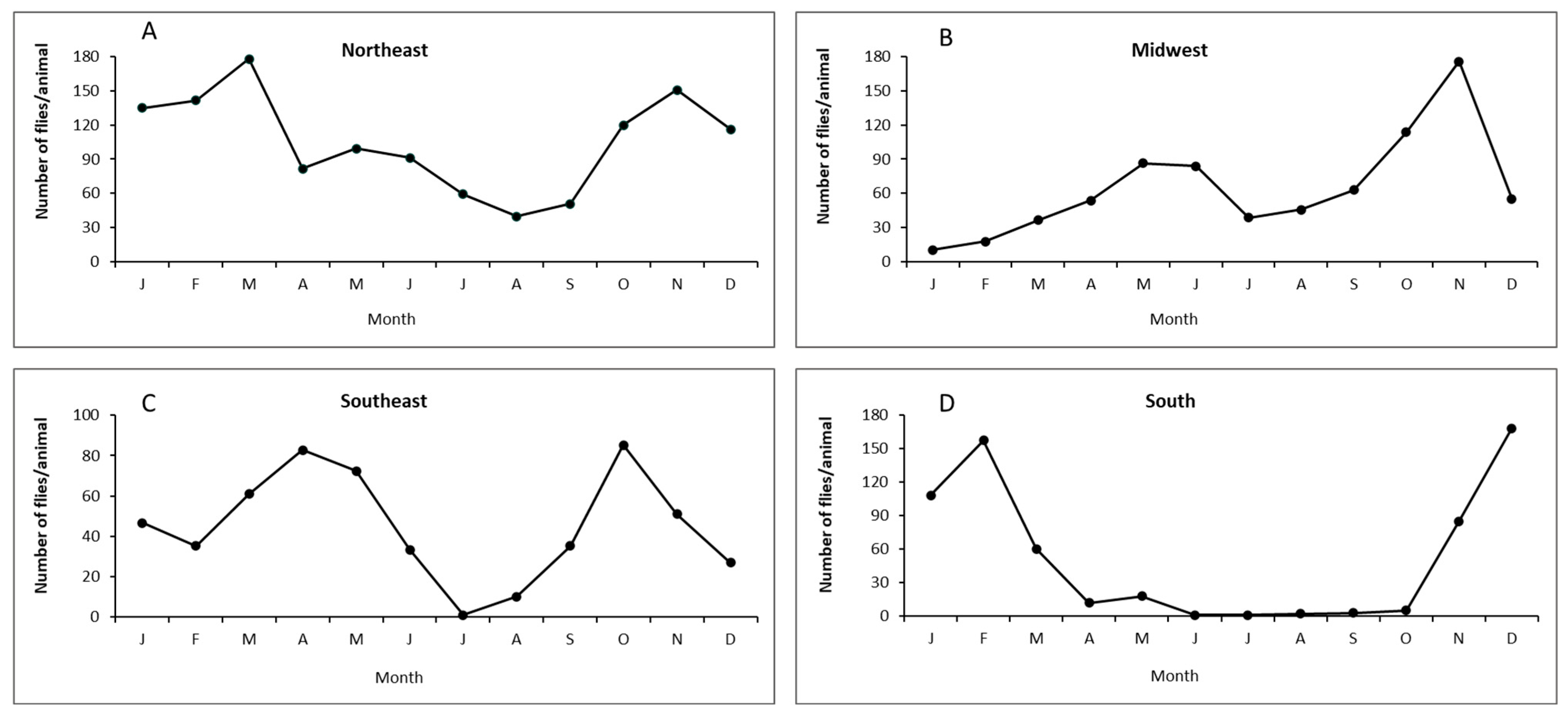
6.2. Epidemiology of Haematobia irritans
6.3. Epidemiology of Dermatobia hominis
6.4. Epidemiology of Cochliomyia hominivorax
6.5. Control of Haematobia irritans, Dermatobia hominis, and Cochliomyia hominivorax in Brazil
Chemical Control
6.6. Strategies for the Control of Flies on Cattle in Brazil
7. The Best Management Practices for the Sustainable Control of Flies That Affect Livestock in Colombia
7.1. An Overview of Cattle Demographics in Colombia
7.2. Epidemiology of Haematobia irritans
7.3. Epidemiology of Dermatobia hominis
7.4. Epidemiology of Cochliomyia hominivorax
7.5. Chemical Control of Haematobia irritans, Dermatobia hominis, and Cochliomyia hominivorax in Colombia
7.5.1. Chemical Control
7.5.2. Strategies for the Control of Flies on Cattle in Colombia
8. The Best Management Practices for the Sustainable Control of Flies That Affect Livestock in Mexico
8.1. An Overview of Cattle Demographics in Mexico
8.2. Epidemiology of Haematobia irritans
8.3. Epidemiology of Dermatobia hominis
8.4. Epidemiology of Cochliomyia hominivorax
8.5. Chemical Control of Haematobia irritans, Dermatobia hominis, and Cochliomyia hominivorax in Mexico
8.6. Strategies for the Control of Flies on Cattle in Mexico
9. The Best Management Practices for the Sustainable Control of Flies That Affect Livestock in Uruguay
9.1. An Overview of Cattle Demographics in Uruguay
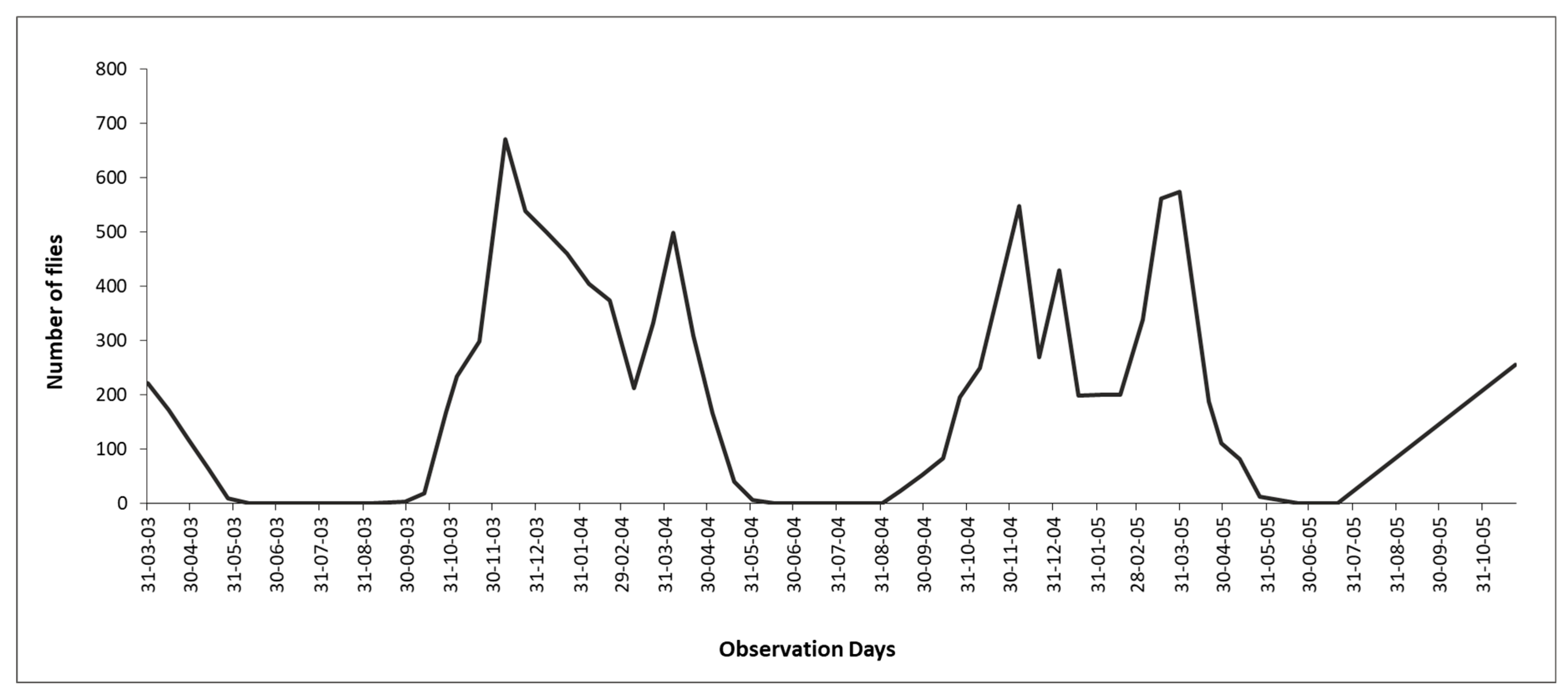
9.2. Epidemiology of Haematobia irritans
9.3. Epidemiology of Cochliomyia hominivorax
9.4. Control of Haematobia irritans and Cochliomyia hominivorax in Uruguay
10. Resistance Status of H. irritans, D. hominis, and C. hominivorax to Insecticides in LA
11. Non-Chemical Control of H. irritans, D. hominis and C. hominivorax in LA
11.1. Non-Chemical Control of Haematobia irritans
11.2. Non-Chemical Control of Dermatobia hominis
11.3. Non-Chemical Control of C. hominivorax
12. Conclusions
- Cattle infesting flies cause large economic and health losses to animal production in LA, mainly due to stress, loss of energy, altered grazing behavior, decreased weight gain, low conversion efficiency, and/or skin damage, in addition to costs related to prevention and control.
- Within the antiparasitic market of LA, six classes of insecticides are available for fly control in cattle, SPs, MLs, OPs, PPs, IGRs, and isoxazolines, as well as mixtures of several insecticide classes. Brazil has the largest number of insecticide products (301) registered for fly control in cattle.
- H. irritans management has long relied on insecticides for prophylactic and therapeutic fly control, and a greater effort is needed in the search for alternatives.
- The economic problems caused by H. irritans infestations and the continuous increase in its resistance to insecticides threaten the success in the control currently being carried out, requiring an integrated management approach that aims at both fly control and resistance management.
- Although visually counting horn flies over the animals has been considered a theoretical criterion for determining how severe the infesting burden could be, the timing of cattle treatments, observing behavioral changes (such as frequency of head tosses) may be a more practical and useful approach for making decisions regarding tactical control.
- Efficacy failures and chemical insecticide resistance of H. irritans, C. hominivorax and D. hominis have been reported in LA.
- Although biological control using the natural enemies of these dipteran flies, such as parasitoids, entomopathogenic bacteria, nematodes, and fungi, has demonstrated some in vitro and field efficacy for the control of H. irritans, their commercial availability and use are very limited in LA.
- Advances in biological control, vaccination technologies, plant products, physical control, management systems, new insecticides (e.g., isoxazolines), repellents, and cattle genetics will significantly enhance producers’ ability to reduce losses due to ectoparasitic cattle flies.
13. Recommendations
- In temperate regions of LA where horn fly diapauses, such as Uruguay, the use of insecticides during the fall, to reduce horn fly populations whose progeny will become dormant, is recommended to decrease the abundance of spring adults.
- In controlling horn flies in LA, insecticide treatments and other measures should be strategically planned for periods of higher infestation levels but tactically implemented only if truly necessary.
- The timing of treatment is a decision for the producer. Although horn fly counts on animals are considered a (theoretical) criterion for insecticide treatments (e.g., >200 flies/animal), we recommend a more practical approach, carrying out tactical chemical treatments of the herd when approximately 25% of the animals exhibit head tossing behavior within one minute of observation. Special attention should be paid to bulls due to their high susceptibility to horn flies, and their selective insecticide treatment is recommended if necessary.
- For D. hominis control in tropical regions of LA, it is recommended to prevent infestation during the rainy season by administering MLs every two months. In clinical cases, it is advisable to apply topical OP products directly to the nodules, perform manual larval extraction, and administer ML 1% subcutaneously (0.2 mg/kg body weight).
- When C. hominivorax myiasis is detected on animals (mainly in cattle), it is recommended to implement local treatment with larvicidal products (e.g., chlorpyriphos, coumaphos, propoxur, dichlorvos, fenitrothion, alone or in mixture with SPs). Additionally, the administration of MLs (e.g., DRM), fipronil or isoxazolines is recommended.
- Immediate prophylaxis against C. hominivorax infestations following surgical interventions (e.g., castration, dehorning) or parturition is critical to prevent myiasis and associated morbidity. Systemic endectocides such as macrocyclic lactones (e.g., IVM, DRM), phenylpyrazoles (e.g., fipronil), and isoxazolines have demonstrated efficacy in preventing larval establishment when administered according to approved protocols.
- Although resistance is a concern in some locations and countries, to protect calves from umbilical myiasis caused by C. hominivorax, the preventive application of MLs by injection is recommended in the first few hours/days after birth. To delay the development of resistance in H. irritans and C. hominivorax, it is recommended to rotate insecticides with different modes of action—which means alternating insecticide classes, considering the classes currently available on the LA market—and avoid using products from insecticide classes that have not demonstrated the expected efficacy.
- Strict adherence to the manufacturer’s label instructions for veterinary medicinal products is essential to ensure therapeutic efficacy and minimize risks to animal health, human safety, and the environment. Deviations from approved use, such as incorrect dosing, off-label administration, or failure to observe withdrawal periods, can result in adverse effects, including toxicity, antiparasitic resistance, and chemical residues in food products
Author Contributions
Funding
Institutional Review Board Statement
Informed Consent Statement
Data Availability Statement
Acknowledgments
Conflicts of Interest
Abbreviations
| OPs | Organophosphates |
| SPs | Synthetic pyrethroids |
| PPs | Phenylpyrazolones |
| IGRs | Insect growth regulators |
| MLs | Macrocyclic lactones |
| H. irritans | Haematobia irritans |
| D. hominis | Dermatobia hominis |
| C. hominivorax | Cochliomyia hominivorax |
| DRM | Doramectin |
| IVM | Ivermectin |
| MOX | Moxidectin |
| DPT | Days post-treatment |
Appendix A. Life Cycle and Main Biological Characteristics of Cattle Infesting Flies
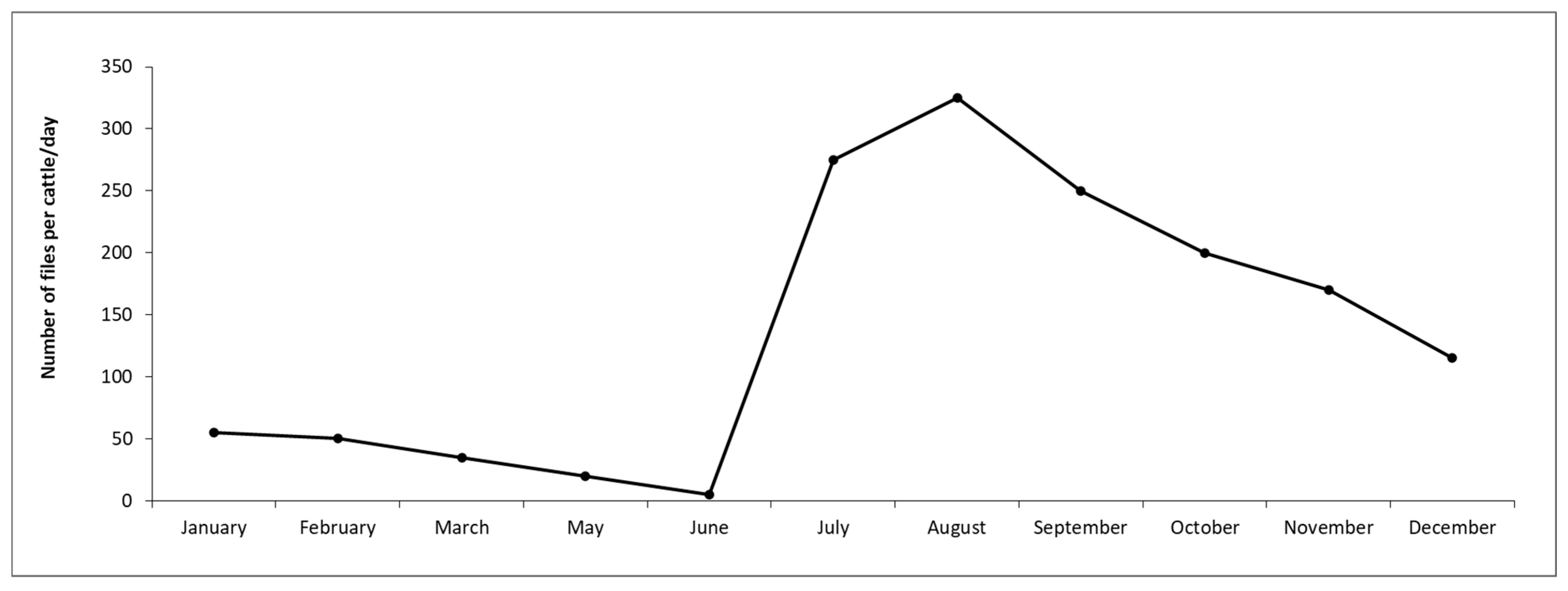
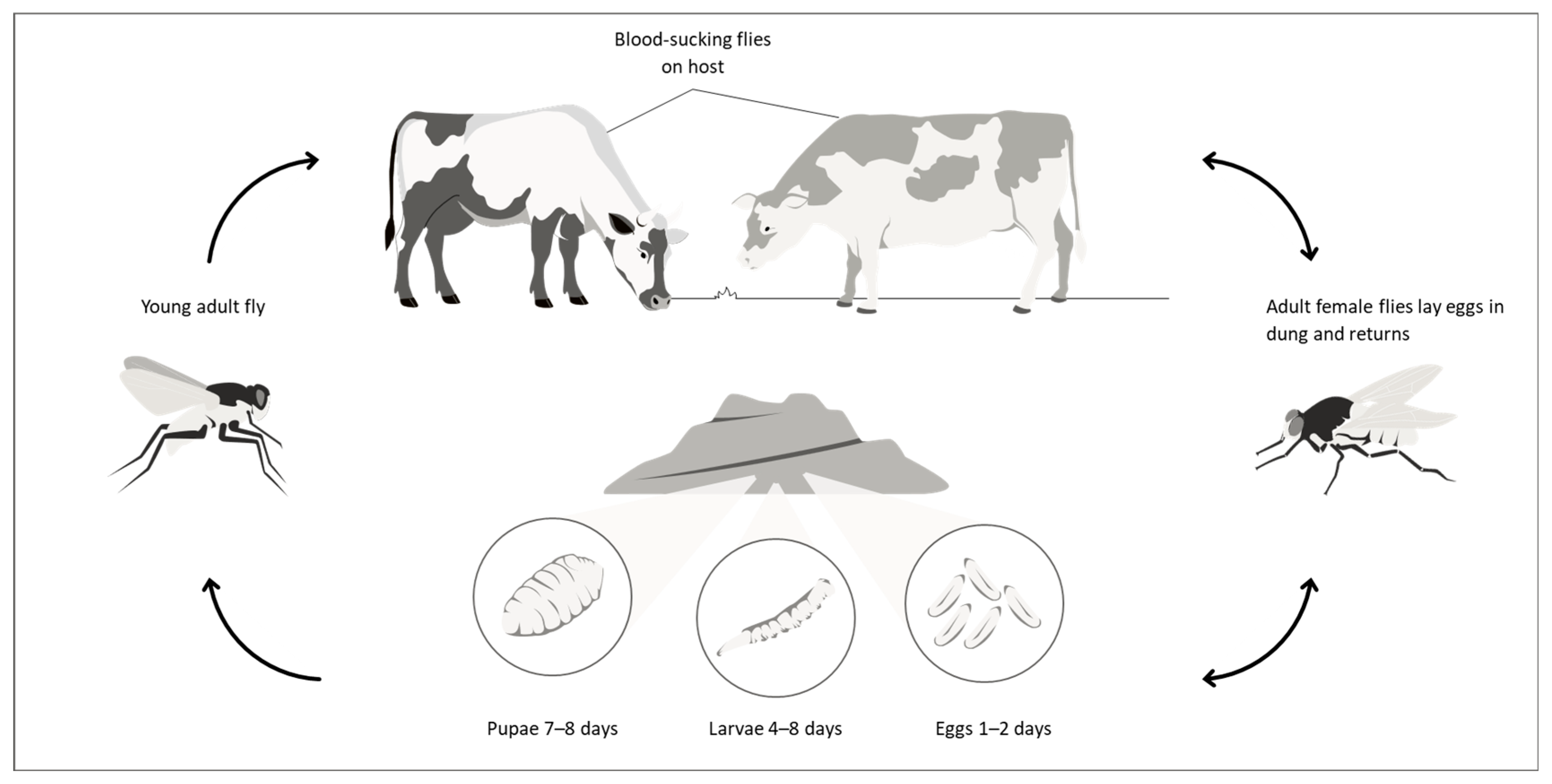
Appendix A.1. Haematobia irritans (Horn Fly)
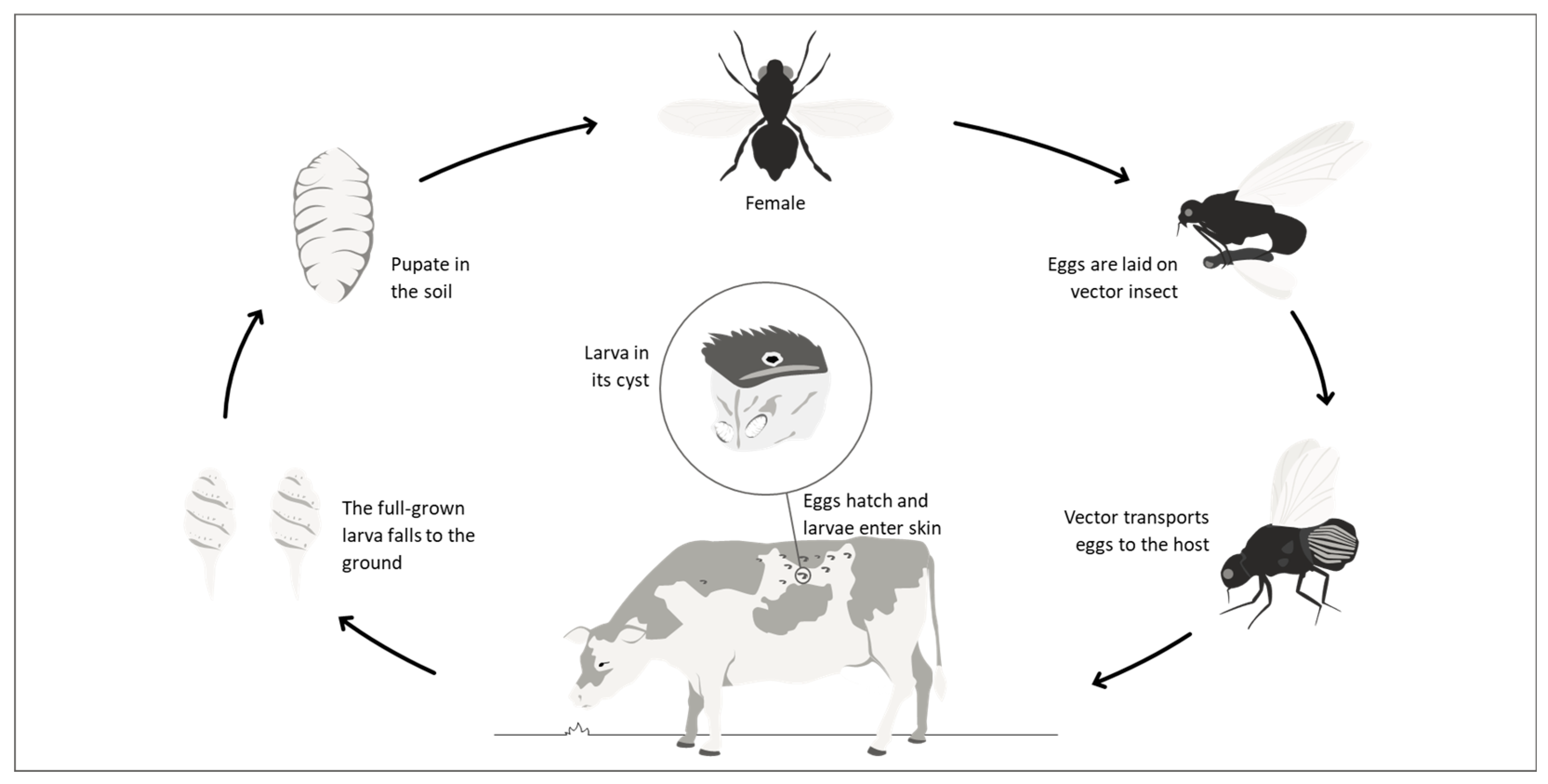
Appendix A.2. Dermatobia hominis (Bot Fly)
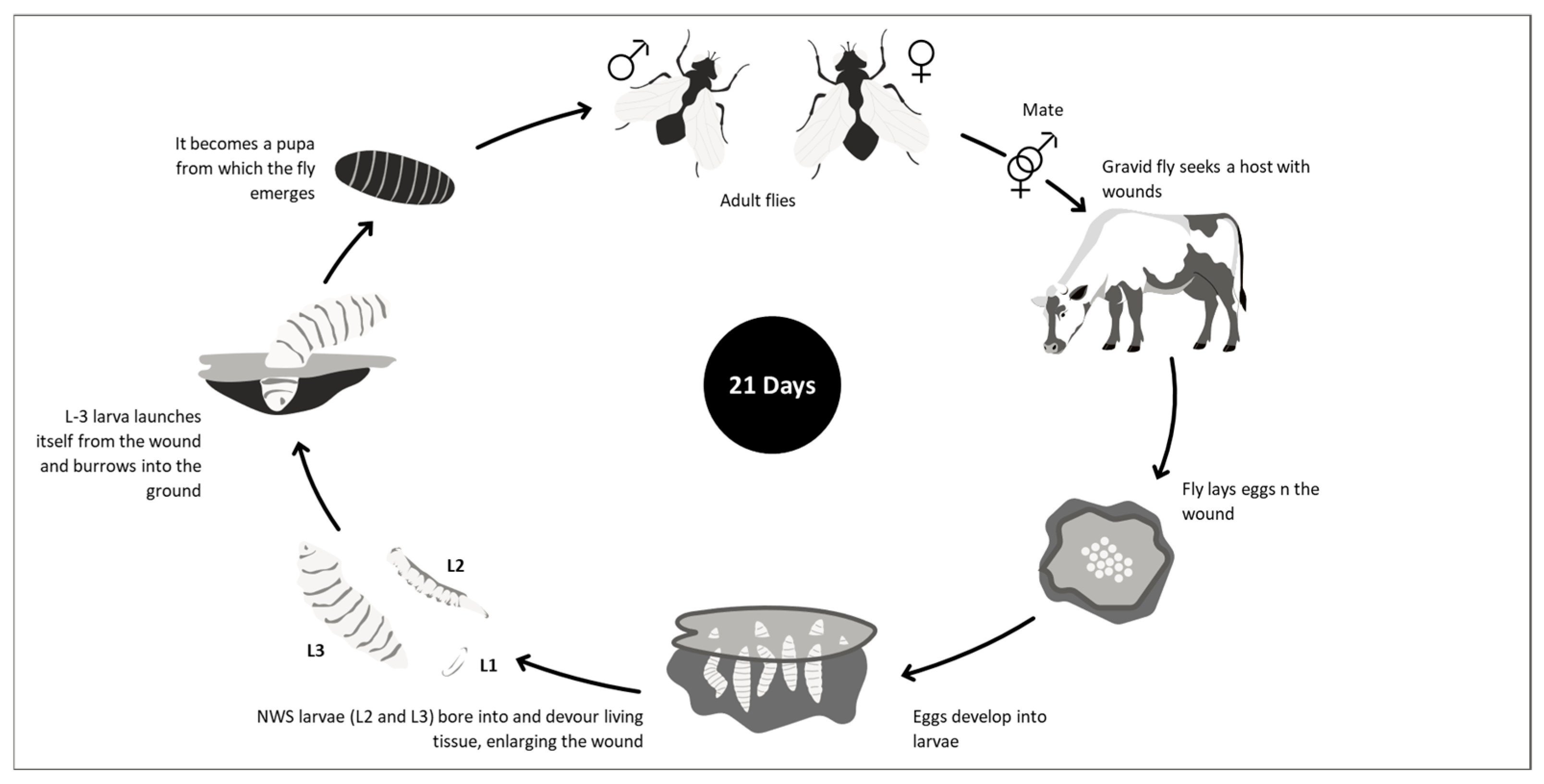
Appendix A.3. Cochliomyia hominivorax (New World Screwworm)
Appendix B. Current Situation of Cochliomyia hominivorax Distribution in Latin America
- North America: United States of America (1966) and Mexico (1991).
- Central America: Belize (1994), El Salvador (1995), Guatemala (1994), Honduras (1996), Nicaragua (1998), Costa Rica (2000), and Panama (2006).
- The Caribbean: Aruba (1954), Bonaire (1954), Curacao (1954, 1976 reinfestation), Puerto Rico (1975), US Virgin Islands (1971), and British Virgin Islands (1972).
- América del sur: Chile (1947 and in 2017 after a reintroduction episode).
- North America: Canada.
- The Caribbean: Antigua and Barbuda, Barbados, Bahamas, Dominica, Cayman Islands, Grenada, Guadeloupe, Saint Kitts and Nevis, Martinique, Montserrat, Saint Vincent and the Grenadines, Saint Lucia, and Turks and Caicos.
- The Caribbean: Cuba, Haiti, Jamaica, Dominican Republic, and Trinidad and Tobago.
- South America: Argentina, Bolivia, Brazil, Colombia, Ecuador, Guyana, French Guiana, Paraguay, Peru, Suriname, Uruguay, and Venezuela.
- Insufficient dispersal of sterile flies in Panama by COPEG, where only 20 mill flies/week were routinely produced, of which 16 mill were released in the border area between Colombia and Panama and 4 mill/week in the vicinity of the sterile fly production plant to mitigate the risk of the escape of fertile flies from the colony.
- Ineffective monitoring of the distribution of released sterile flies in the Darien province (i.e., by the use of sticky traps baited with liver bait stations).
- Loss of C. hominivorax strain effectiveness in the field as a result of long-term colonization.
- The fly’s ability to travel great distances. Its dispersion can be favored by strong air currents. It has been recorded that a fly can fly up to 290 km.
- Transport of live animals with screwworms or through skin hides without inspection.
- Transport of hunting trophies from an endemic area to a free area.
- Transport of vehicles that use beds to transport animals and that may harbor viable larvae or pupae.
- Favorable conditions for the development of screwworm fly in Central American countries (high temperatures and humidity).
- Lack of infrastructure (mainly for small producers) for the management of animals and to identify infestations and effectively treat screwworm larvae.
- Recurrent fights between animals (domestic and wild).
- Cross-border dislogement of wild animals with screwworms.
- Cross-border transport of infested pets by their owners without veterinary inspection.
- Unregulated and/or illegal movement of infested livestock, which are not inspected by trained veterinarians.
References
- Pérez de León, A.A.; Mitchell, R.D.; Watson, D.W. Ectoparasites of Cattle. Vet. Clin. N. Am. Food Anim. Pract. 2020, 36, 173–185. [Google Scholar] [CrossRef] [PubMed]
- Barbosa, R.R.; de Mello-Patiu, C.A.; de Mello, R.P.; Queiroz, M.M. New records of calyptrate dipterans (Fanniidae, Muscidae and Sarcophagidae) associated with the decomposition of domestic pigs in Brazil. Mem. Inst. Oswaldo Cruz. 2009, 104, 923–926. [Google Scholar] [CrossRef][Green Version]
- Jonsson, N.N.; Mayer, D.G. Estimation of the effects of buffalo fly (Haematobia irritans exigua) on the milk production of dairy cattle based on a meta-analysis of literature data. Med. Vet. Entomol. 1999, 13, 372–376. [Google Scholar] [CrossRef]
- Wileman, B.W.; Thomson, D.U.; Reinhardt, C.D.; Renter, D.G. Analysis of modern technologies commonly used in beef cattle production: Conventional beef production versus nonconventional production using meta-analysis. J. Anim. Sci. 2009, 87, 3418–3426. [Google Scholar] [CrossRef]
- Küntüz, T.; Güneş, Y.; Sarı, A.B.; Üstüner Keleş, O. Navigating the resistance: Current perspectives on ectoparasite control in veterinary medicine. J. Istanb. Vet. Sci. 2023, 7, 56–67. [Google Scholar] [CrossRef]
- Hua, J.; Relyea, R. The effect of common pyrethroid insecticide on wetland communities. Environ. Res. Commun. 2019, 1, 015003. [Google Scholar] [CrossRef]
- Miraballes, C.; Sanchez, J.; Barros, A.T.M.; Hitateguy, S.; Moreno, P.; Saporiti, T.; Riet-Correa, F. Influence of selective treatment of bulls on the infestation of Haematobia irritans on untreated cows. Vet. Parasitol. 2018, 260, 58–62. [Google Scholar] [CrossRef]
- Rodríguez-Vivas, R.I.; Torres-Acosta, J.F.J.; Cruz-Vázquez, C.; Almazán-García, C.; Alcalá-Canto, T.; Alonso-Díaz, M.A.; Chan-Pérez, J.I.; Domínguez García, D.I.; Fernández Salas, A.; Figueroa Castillo, J.A.; et al. Capítulo VII. Epidemiología y control de garrapatas, moscas y nematodos gastrointestinales que afectan a los bovinos en México. In Estado del Arte Sobre Investigación e Innovación Tecnológica en Ganadería Bovina Tropical, 2nd ed.; Red de Investigación e Innovación Tecnológica para la Ganadería Bovina Tropical (REDGATRO); INIFAP, UNAM, CONACYT: Mexico City, Mexico, 2018; pp. 255–308. ISBN 9786073711142. [Google Scholar]
- Catto, J.B.; Feijó, G.L.D.; Cançado, P.H.D.; Costa, J.A.A.; Barros, A.T.M. Influência da Mosca-dos-Chifres no Ganho de Peso e no Comportamento de Bovinos Nelore e Avaliação de Controle Estratégico de Longa Duração; Embrapa Gado de Corte: Campo Grande, Brazil, 2024; 30p. [Google Scholar]
- Barros, A.T.M.; Ravaglia, E.; Petzold, H.V.; Avellar, W. Avaliação da Estratégia de Tratamento Parcial do Rebanho no Controle da Mosca-dos-Chifres; Embrapa Pantanal, Boletim de Pesquisa e Desenvolvimento, 125; Embrapa Pantanal: Corumbá, Brazil, 2014; 15p, Available online: https://www.embrapa.br/busca-de-publicacoes/-/publicacao/994068/avaliacao-da-estrategia-de-tratamento-parcial-do-rebanho-no-controle-da-mosca-dos-chifres (accessed on 1 January 2026).
- Souza, A.P.; Valdomiro, B.; Ramos, C.I.; Dalagnol, C.A.; Henschel, G.S. Variação azonal de Haematobia irritans no planalto catarinense e eficiência do “controle dirigido”. Rev. Bras. Parasitol. Vet. 2005, 14, 11–15. [Google Scholar] [PubMed]
- Cardona, E.A. Sarcopromusca pruna (Diptera: Muscidae): Phoretic for Dermatobia hominis (Diptera: Cuterebridae) eggs in Colombia. Rev. Colomb. Cienc. Pecu. 2011, 24, 577–584. [Google Scholar] [CrossRef]
- Hernández-Jimenez, C.; Ojeda-Robertos, N.F.; Rodriguez-Vivas, R.I. Dermatobiosis cutánea bovina en la región selvática lluviosa y montañosa de México. Ecosist. Recursos Agrop. 2020, 7, e2303. [Google Scholar]
- Vargas-Terán, M. Todo lo Que Usted Debe Saber Sobre la Erradicación de la Miasis Causada por el Gusano Barrenador del Ganado; Proyecto OIEA RLA5075; IAEA: Vienna, Austria, 2020; pp. 1–45. [Google Scholar]
- Byford, R.L.; Craig, M.E.; Crosby, B.L. A review of ectoparasites and their effect on cattle production. J. Anim. Sci. 1992, 70, 597–602. [Google Scholar] [CrossRef] [PubMed]
- Bruce, W.G. The history and biology of the horn fly, Haematobia irritans (Linnaeus) with comments on control. Tech. Bull. N. Carol. Agric. Exp. Stn. 1964, 157, 1–33. [Google Scholar]
- Showler, A.T.; Osbrink, W.L.A.; Lohmeyer, K.H. Horn Fly, Haematobia irritans irritans (L.), Overwintering. Int. J. Insect Sci. 2014, 6, 43–47. [Google Scholar] [CrossRef]
- Mendes, J.; Linhares, A.X. Diapause, pupation sites and parasitism of the horn fly, Haematobia irritans, in south-eastern Brazil. Med. Vet. Entomol. 1999, 13, 185–190. [Google Scholar] [CrossRef]
- Scasta, J.D.; Smith, T. Commingled black and white cows (Bos taurus; Angus and Charolais) in high-elevation rangeland is differentially parasitized by Haematobia irritans. Anim. Prod. Sci. 2018, 59, 1727–1738. [Google Scholar] [CrossRef]
- Zhang, D.; Cupp, M.S.; Cupp, E.W. Processing of thrombostasin by a recombinant subtilisin-like proprotein convertase derived from the salivary glands of horn flies (Haematobia irritans). Insect Biochem. Mol. Biol. 2004, 34, 1289–1295. [Google Scholar] [CrossRef] [PubMed]
- Harris, R.L.; Miller, J.A.; Frazer, E.D. Horn flies and stable flies: Feeding activity. Ann. Entomol. Soc. Am. 1974, 67, 891–894. [Google Scholar] [CrossRef]
- Harris, R.L.; Frazer, E.D. Intake of blood by adult horn flies reared in the laboratory. Ann. Entomol. Soc. Am. 1970, 63, 1475–1476. [Google Scholar] [CrossRef]
- Dobson, R.C.; Kutz, F.W.; Sanders, D.P. Attraction of horn flies to testosterone-treated steers. J. Econ. Entomol. 1970, 63, 323–324. [Google Scholar] [CrossRef]
- Hall, M.J.R. Trapping the flies that cause myiasis: Their responses to host stimuli. Ann. Trop. Med. Parasitol. 1995, 9, 333–357. [Google Scholar] [CrossRef]
- Chaccour, C. Miasis forunculosa. Serie de 5 casos en indígenas de la etnia Pemón y revisión de la literatura. Dermatol. Venez. 2005, 43, 8–15. [Google Scholar]
- Nunzi, E.; Rongioletti, F.; Rebora, A. Dermatobia hominis infestation. Postgrad. Med. J. 1984, 60, 162–163. [Google Scholar] [CrossRef][Green Version]
- Rodríguez-Vivas, R.I.; Grisi, L.; Pérez de León, A.A.; Silva Villela, H.H.; Torres-Acosta, J.F.J.; Fragoso Sánchez, H.; Romero Salas, D.; Rosario Cruz, R.; Saldierna, F.; García Carrasco, D. Potential economic impact assessment for cattle parasites in Mexico. Rev. Mex. Cienc. Pec. 2017, 8, 61–74. [Google Scholar] [CrossRef]
- Grisi, L.; Leite, R.C.; Martins, J.R.; Barros, A.T.; Andreotti, R.; Cançado, P.H.; León, A.A.; Pereira, J.B.; Villela, H.S. Reassessment of the potential economic impact of cattle parasites in Brazil. Rev. Bras. Parasitol. Vet. 2014, 3, 150–156. [Google Scholar] [CrossRef]
- Rodríguez-Vivas, R.I.; Cruz-Vázquez, C.; Almazán, C.; Zárate-Ramos, J.J. Importance of Haematobia irritans in cattle in Mexico: Current situation and perspectives Review. Rev. Mex. Cienc. Pecu. 2023, 14, 384–411. [Google Scholar]
- Gutierrez, A.P.; Ponti, L. Eradication of invasive species: Why the biology matters. Environ. Entomol. 2013, 42, 395–411. [Google Scholar] [CrossRef] [PubMed]
- Barros, A.T.M.; Ravaglia, E.; Aquino, W.D.S.; Passos, W.M.; Leite, L.T.B. Eficácia de endectocidas injetáveis em infestações naturais por Cochliomyia hominivorax em bezerros no Pantanal. Embrapa Pantanal Circ. Técnica 2010, 90, 4. [Google Scholar]
- Signorini, P.M.; Anziani, O.; Rossner, M.V.; Gamietea, I.; Micheloud, J.; Lloberas, M.; Martinez, N.; Olmos, L.; Sarmiento, N.; Abdala, A. Insectos y ácaros de mayor importancia en la producción bovina nacional. Análisis del impacto de la miasis por Cochliomyia hominivorax sobre la producción ganadera en Argentina. Rev. IDIA 2022, 2, 95–102. [Google Scholar]
- Muzio, F.; Gil, A.; Marques, L.; Pérez Rama, R.; Piaggio, J.; Atuna, M.; Caponi, O.; Fernández, F.; Mendoza, R. Proyecto para erradicar el Gusano Barrenador en los países del MERCOSUR. In Anuario OPYPA; MGAP: Montevideo, Uruguay, 2009; pp. 391–400. [Google Scholar]
- Baraldo, J.; Durán, V. Evaluación costo beneficio ex ante del programa de erradicación de la mosca de la bichera en Uruguay. Est. Econ. Agric. Ambient. 2021, 21, 27. [Google Scholar]
- Villalobos, G.; Vega-Memije, M.E.; Maravilla, P.; Martinez-Hernandez, F. Myiasis caused by Dermatobia hominis: Countries with increased risk for travelers going to neotropic areas. Int. J. Dermatol. 2016, 55, 1060–1068. [Google Scholar] [CrossRef]
- Duque, Á.C.M.; Trujillo, V.S.A. Actividad del Metrifonato Suministrado en la sal Para el Tratamiento de Parásitos Gastrointestinales y Nuche en Bovinos. Ph.D. Thesis, Universidad de Antioquia, Medellín, Colombia, 1993. [Google Scholar]
- Foil, L.D.; Hogsette, J.A. Biology and control of tabanids, stable flies and horn flies. Rev. Sci. Tech. 1994, 13, 1125–1158. [Google Scholar] [CrossRef]
- Xavier, P.; Medeiros, M.A.; Serra-Freire, N.M. Avaliação da relação simbiótica entre Haematobia irritans (L.) (Diptera: Muscidae) e Dermatobia hominis (Linnaeus Jr., 1781) (Diptera: Cuterebridae) em propriedade de exploração zootécnica de bovinos. Rev. de Ciência e Tecnol. 2011, 11, 13–23. [Google Scholar]
- Anziani, O.S. Mosca de los Cuernos (Haematobia irritans), Guía Para el Control de los Parásitos Externos en Bovinos de Carne del Área Central de la Argentina. Ficha Nº 2. Área de Investigaciones en Producción Animal, EEA INTA Rafaela, Argentina. 2011. Available online: https://www.produccion-animal.com.ar/sanidad_intoxicaciones_metabolicos/parasitarias/parasitarias_bovinos/146-externos.pdf (accessed on 1 January 2026).
- Guglielmone, A.A.; Volpogni, M.M.; Quaino, O.R.; Anziani, O.S.; Mangold, J.A. Long term study of Haematobia irritans (Diptera: Muscidae) seasonal distribution in central Argentina with focus on winter fly abundance. Parasite 2001, 8, 369–373. [Google Scholar] [CrossRef] [PubMed][Green Version]
- Crudeli, S.M. La Ura está “corriendo” los límites de su hábitat. Voces Ecos 2017, 18, 30–31. [Google Scholar]
- García, M.A.B.; Ojeda, V.M.; Palazzo, M.M.; Filice, P.A.; Rodríguez, S.S. Dermatobia hominis: Una dermatosis inusual en zonas no endémicas. Dermatol. Argent. 2021, 27, 161–163. [Google Scholar] [CrossRef]
- Cardona–López, G.A.; Balbuena, O.; Luciani, C.A. Miasis del ganado en la región noreste de la provincia del Chaco. Vet. Argent 1994, 11, 305–313. [Google Scholar]
- Anziani, O.S.; Volpogni, M.M. Incidence of bovine myiasis in the central area of Argentina. Ann. N. Y. Acad. Sci. 1996, 791, 432–433. [Google Scholar] [CrossRef]
- Anziani, O.; Suárez, V. Epidemiología y control de dípteros en estado adulto y larvario en el área central de Argentina. In Enfermedades Parasitarias de Importancia Clínica y Productiva en Rumiantes; Mosca de la Bichera (Cochliomyia hominivorax); Hemisferio Sur: Montevideo, Uruguay, 2013; pp. 552–556. [Google Scholar]
- Gutierrez, A.P.; Ponti, L.; Arias, P.A. Deconstructing the eradication of New World screwworm in North America: Retrospective analysis and climate warming effects. Med. Vet. Entomol. 2019, 33, 282–295. [Google Scholar] [CrossRef] [PubMed]
- Anziani, O.S.; Suárez, V.H. Miasis. In Enfermedades Parasitarias de los Ovinos y Otros Rumiantes Menores en el Cono sur de América; Suárez, V.H., Olaechea, F.V., Rossanigo, C.E., Romero, J.R., Eds.; Ediciones INTA: Buenos Aires, Argentina, 2007; Chapter 3.3; pp. 217–230. [Google Scholar]
- Kaufman, O.E.; Burgess, E.R.; Weeks, E.E.I. Forced-Use Dust Bags for Management of External Parasites: ENY281. IFAS Ext. 2022, 1–5. Available online: https://journals.flvc.org/edis/article/view/120734/135132 (accessed on 1 January 2026). [CrossRef]
- Muchiut, S.; Anziani, O.S. El control de la mosca de los cuernos (Haematobia irritans) en vacas lecheras utilizando una formulación pour on conteniendo eprinomectina. In UNNE, Corrientes XXI Jornadas Nacionales y XVI Latinoamericanas de Fármaco–Toxicología Veterinaria (Abstract Book); F.C.V.–U.N.N.E.: Corrientes, Argentina, 2012. [Google Scholar]
- Anziani, O.S.; Zimmermannet, G.; Guglielmoe, A.A.; Forchieri, M.; Volpogni, M.M. Evaluation of insecticide ear tag containing ethion for control of pyrethroid resistance Haematobia irritans (L.) on dairy cattle. Vet. Parasitol. 2000, 91, 147–151. [Google Scholar] [CrossRef]
- Muchiut, S.; Miró, M.V.; Anziani, O.; Nava, S.; Lifschitz, A. Failure of doramectin and ivermectin in preventing Cochliomyia hominivorax myiasis in a subtropical region: A pharmacokinetic-pharmacodynamic study. Vet. Parasitol. 2025, 334, 110384. [Google Scholar] [CrossRef]
- Prichard, R.K. Resistance Against Macrocyclic Lactones. In Macrocyclic Lactones in Antiparasitic Therapy; Vercruysse, J., Rew, R.S., Eds.; CAB International: Wallingford, UK, 2002; pp. 163–182. [Google Scholar]
- da Costa, A.J.; de Souza Martins, J.R.; de Almeida Borges, F.; Vettorato, L.F.; Barufi, F.B.; de Oliveira Arriero Amaral, H.; Abujamra, L.C.; de Castro Rodrigues, D.; Lopes, W.D.Z. First report of the efficacy of a fluralaner-based pour-on product (Exzolt® 5%) against ectoparasites infesting cattle in Brazil. Parasites Vectors 2023, 16, 336. [Google Scholar] [CrossRef]
- FAO (Food and Agriculture Organization of the United Nations). With Major Processing by Our World in Data. “Milk Production—FAO” [Dataset]. Food and Agriculture Organization of the United Nations, “Production: Crops and Livestock Products” [Original Data]. 2025. Available online: https://web.archive.org/web/20250521010201/https://ourworldindata.org/grapher/milk-production-tonnes (accessed on 29 October 2025).
- Nunes, C.L.D.C.; Pflanzer, S.B.; Rezende-de-Souza, J.H.; Chizzotti, M.L. Beef production and carcass evaluation in Brazil. Anim. Front. 2024, 14, 15–20. [Google Scholar] [CrossRef]
- Malafaia, G.C.; Mores, G.V.; Casagranda, Y.G.; Barcellos, J.O.J.; Costa, F.P. The Brazilian beef cattle supply chain in the next decades. Livest. Sci. 2021, 253, 104704. [Google Scholar] [CrossRef]
- Rocha, D.T.; Carvalho, G.R.; Resende, J.C. Cadeia Produtiva do Leite no Brasil: Produção Primaria; Embrapa: Juiz de Fora, Brazil, 2020; 16p, Available online: https://ainfo.cnptia.embrapa.br/digital/bitstream/item/215880/1/CT-123.pdf (accessed on 1 January 2026).
- Lima, P.R.M.; Peripolli, V.; Josahkian, L.A.; Mcmanus, C. Geographical distribution of zebu breeds and their relationship with environmental variables and the human development index. Sci. Agric. 2023, 80, e20220008. [Google Scholar] [CrossRef]
- Madalena, F.E. Animal breeding and development-South American perspective. J. Anim. Breed. Genet. 2012, 129, 171–172. [Google Scholar] [CrossRef]
- Honer, M.R.; Bianchin, I.; Gomes, A. Mosca dos Chifres: Históricp, Biología e Controle; Empresa Brasileira de Pesquisa Agropecuária: Compo Grande, Brazil, 1990; p. 34. [Google Scholar]
- Barros, A.T.M.; Saueressig, T.M.; Gomes, A.; Koller, W.W.; Furlong, J.; Girão, E.S.; Pinheiro, A.C.; Alves-Branco, F.P.J.; Sapper, M.F.M.; Braga, R.M.; et al. Susceptibility of the horn fly, Haematobia irritans irritans (Diptera: Muscidae), to insecticides in Brazil. Rev. Bras. Parasitol. Vet. 2012, 21, 125–132. [Google Scholar] [CrossRef] [PubMed]
- Barros, A.T.M. Dynamics of Haematobia irritans irritans (Diptera: Muscidae) infestation on Nelore cattle in the Pantanal, Brazil. Mem. Inst. Oswaldo Cruz. 2001, 96, 445–450. [Google Scholar] [CrossRef]
- Melo, L.R.B.; Medeiros, M.A.; Beserra, L.A.F.; Barros, A.T.M.; Riet-Correa, F.; Azevedo, S.S.; Vilela, V.L.R. Development and number of generations of Haematobia irritans (Diptera: Muscidae) in bovine fecal masses in the semiarid region of Brazil. Vet. Parasitol. Reg. Stud. Rep. 2020, 20, 100411. [Google Scholar] [CrossRef] [PubMed]
- Barros, A.T.M. Desenvolvimento de Haematobia irritans em massas fecais de bovinos mantidas em laboratório. Pesq. Agropec. Bras. 2002, 37, 217–221. [Google Scholar] [CrossRef]
- Rodrigues, S.R.; Marchini, L.C. Estudo de temperaturas em massas fecais de bovinos e previsão do número de gerações anuais de Haematobia irritans (Diptera: Muscidae) em Piracicaba, SP, Brasil. Rev. Bras. Entomol. 2001, 45, 89–94. [Google Scholar]
- Medeiros, M.A.; Barros, A.T.M.; Medeiros, R.M.T.; Vieira, V.D.; Azevedo, S.S.; Riet-Correa, F. Sazonalidade da mosca-dos-chifres, Haematobia irritans, no semiárido brasileiro. Pesq. Vet. Bras. 2018, 38, 1307–1312. [Google Scholar] [CrossRef]
- Lima, L.G.F.; Perri, S.H.V.; Prado, A.P. Variation in population density of horn flies (Haematobia irritans irritans) (L.) (Diptera: Muscidae) in Nellore cattle (Bos indicus). Vet. Parasitol. 2003, 117, 309–314. [Google Scholar] [CrossRef]
- Martins, J.R.; Corrêa, B.L.; Ceresér, V.H.; Schmidt, E. Alguns Aspectos Sobre a Mosca-dos-Chifres, Haematobia Irritans; Circular Técnica; Centro de Pesquisa Veterinária Desidério Finamor: Porto Alegre, Rio Grande do Sul, Brazil, 1999.
- Moya–Borja, G.E. Erradicação ou manejo integrado das miíases neotropicais das Américas? Pesq. Vet. Bras. 2003, 23, 131–138. [Google Scholar] [CrossRef]
- Pinto, S.B.; Thomaz–Soccol, V.; Vendruscolo, E.; Rochadelli, R.; Ribeiro, P.B.; Freitag, A.; Henemann, C.; Uemura, M. Bioecologia de Dermatobia hominis (Linnaeus, 1758) em Palotina, Paraná, Brasil. Ciência Rural 2002, 32, 821–827. [Google Scholar] [CrossRef]
- Lombardero, O.J.; Moriena, R.A.; Racioppi, O. Epizootiologia de la ura (Dematobia hominis) en el nordeste argentino. Rev. Vet. 1980, 2, 11–27. [Google Scholar]
- Horn, S.C. Carrapato, Berne, Bicheira No Brasil; Ministério da Agricultura, Secretaria Nacional de Agropecuária: Brasília, Brazil, 1983; p. 115.
- Costa-Júnior, L.M.; Chaves, D.P.; Brito, D.R.B.; Santos, V.A.F.D.; Costa-Júnior, H.N.; Barros, A.T.M. A review on the occurrence of Cochliomyia hominivorax (Diptera: Calliphoridae) in Brazil. Rev. Bras. Parasitol. Vet. 2019, 28, 548–562. [Google Scholar] [CrossRef]
- Reck, J.; Marks, F.S.; Rodrigues, R.O.; Souza, U.A.; Webster, A.; Leite, R.; Gonzales, J.C.; Klafke, G.M.; Martins, J.R. Does Rhipicephalus microplus tick infestation increase the risk for myiasis caused by Cochliomyia hominivorax in cattle? Prev. Vet. Med. 2014, 113, 59–62. [Google Scholar] [CrossRef] [PubMed]
- Rocha Viana, O.V.; Charas dos Santos, I.F.; da Cruz, C.F.; Silva, D.P.; Lopes, B.F.; Bedin Marchi, B.A.; do Carmo Silva, F.; Ferreira Zadra, V.; Targino Silva, J.A.M.; Rabelo Andrade, E. Economic and production performance of crossbred F1 Nellore and Angus calves infested with Cochliomyia hominivorax larvae in Amazonic region, Brazil. Rev. Cad. Pedagógico 2025, 22, 1–15. [Google Scholar]
- Muniz, R.A.; Cerqueira-Leite, R.; Coronado, A.; Soraci, O.; Umehara, O.; Moreno, J.; Errecalde, J. Efficacy of injectable doramectin in the therapy and control of Dermatobia hominis infestations in Latin America. Vet. Parasitol. 1995, 60, 265–271. [Google Scholar] [CrossRef]
- Oliveira-Sequeira, T.C.G.; Amorim, R.M.; Borges, A.S.; Brant, M.P.R. Eficácia Terapêutica e Residual de Seis Formulações Inseticidas Sobre o Parasitismo por Larvas de Dermatobia hominis em Bovinos. Vet. Zootec. 2014, 21, 177–186. [Google Scholar]
- Borges, F.A.; Silva, H.C.; Buzzulini, C.; Soares, V.E.; Santos, E.; Oliveira, G.P.; Costa, A.J. Endectocide activity of a new long-action formulation containing 2.25% ivermectin + 1.25% abamectin in cattle. Vet. Parasitol. 2008, 155, 299–307. [Google Scholar] [CrossRef] [PubMed]
- FAO. Guidelines for Sustainable Tick Control and Acaricide Resistance Management in Livestock; FAO Animal Production and Health Guidelines, No. 38.; Food and Agriculture Organization of the United Nations: Rome, Italy, 2025. [Google Scholar] [CrossRef]
- Lopes, W.D.Z.; Chiummo, R.M.; Vettorato, L.F.; Rodrigues, D.C.; Sonada, R.B. The effectiveness of a fixed-dose combination pour-on formulation of 1.25% fipronil and 2.5% fluazuron against economically important ectoparasites and associated pharmacokinetics in cattle. Parasitol. Inter. 2017, 66, 627–634. [Google Scholar] [CrossRef]
- Campos, D.R.; Avelar, B.R.; Oliveira, G.F.; Alves, M.S.R.; Borges, D.A.; Medeiros, M.T.; Comendouros, K.; Scott, F.B. Eficácia da associação de cipermetrina, clorpirifós, butóxido de piperonila e fluazuron contra larvas de Dermatobia hominis em bovinos naturalmente infestados. Braz. J. Vet. Med. 2023, 39, 28–32. [Google Scholar] [CrossRef]
- ICA Censos Pecuarios Nacionales. Censo Bovino en Colombia. 2024. Available online: https://www.ica.gov.co/areas/pecuaria/servicios/epidemiologia-veterinaria/censos-2016/censo-2018 (accessed on 1 January 2026).
- ICA Instituto Colombiano Agropecuario. Listado de Medicamentos con Registro ICA. 2025. Available online: https://www.ica.gov.co/areas/pecuaria/servicios/regulacion-y-control-de-medicamentos-veterinarios/listados-vigentes (accessed on 1 January 2026).
- Arango, J.; Ruden, A.; Martinez-Baron, D.; Loboguerrero, A.M.; Berndt, A.; Chacón, M.; Torres, C.F.; Oyhantcabal, W.; Gomez, C.A.; Ricci, P.; et al. Ambition meets reality: Achieving GHG emission reduction targets in the livestock sector of Latin America. Front. Sustain. Food Syst. 2020, 4, 65. [Google Scholar] [CrossRef]
- Cuenca, N.J.; Chavarro, F.; Díaz, O.H. El sector de ganadería bovina en Colombia. Aplicación de modelos de series de tiempo al inventario ganadero. Rev. Fac. Cien. Econ. 2008, 16, 165–177. [Google Scholar]
- Gallego, F.A. Manejo Integrado de Moscas en el Ganado Bovino-22 de Junio de 2020. Publicado en CONtexto Ganadero. Available online: https://www.contextoganadero.com/reportaje/manejo-integrado-de-moscas-en-el-ganado-bovino (accessed on 1 January 2026).
- Rivera, B.; Aycardi, E.R. Epidemiological evaluation of external parasites in cattle from the Brazilian cerrados and the Colombian eastern plains. Zentralblatt Für Veterinärmedizin Reihe B 1985, 32, 417–424. [Google Scholar] [CrossRef]
- Benavides, E.; Abuabara, Y.; Pacheco, D.; Silva, J. Efecto de factores climáticos sobre fluctuaciones poblacionales de la mosca de los cuernos Haematobia irritans en condiciones del Caribe colombiano. In En Memorias 10º Simposio Internacional de Epidemiología y Economía Veterinaria; ISVEE 10: Viña del Mar, Chile, 2003; pp. 17–21. [Google Scholar]
- Naturalista, C.O. Nuche Dermatobia hominis. 2025. Available online: https://colombia.inaturalist.org/taxa/346227-Dermatobia-hominis (accessed on 1 January 2026).
- Forero-Becerra, E.G.; Cortés Vecino, J.A.; Villamil Jiménez, L.C. Aspectos económicos de la erradicación del gusano barrenador del ganado, Cochliomyia hominivorax (Coquere l, 1858), en Colombia. Rev. Fac. Med. Vet. Zootec. 2007, 54, 324–341. [Google Scholar]
- Urbano-Del Valle, S.E.; Tovío-Martínez, E.G.; Duque-Serna, F.L. Distribución de la miasis orgánica y mucocutánea por Cochliomyia hominivorax en la región maxilofacial según la situación estacional anual. Dermatol. Rev. Mex. 2023, 67, 26–32. [Google Scholar]
- Hafez, A.M. Risk assessment of resistance to diflubenzuron in Musca domestica: Realized heritability and cross-resistance to fourteen insecticides from different classes. PLoS ONE 2022, 17, e0268261. [Google Scholar] [CrossRef] [PubMed]
- López, G.V.; Grisi do, N.C.; González, C.D. Efectividad de una mezcla de cipermetrina y clorpirifós para el control de la mosca Haematobia irritans. Rev. MVZ 2011, 16, 2628–2633. [Google Scholar] [CrossRef][Green Version]
- López-Valencia, G.; Ruíz, B.; Jhon, D.; Avendaño, R.A.; Ramírez, P.J.A. Evaluación de un producto a base de cipermetrina + clorpirifos sobre larvas de Dermatobia hominis en bovinos en Titiribí, Antioquia. Rev. CES Med. Vet. Zoot. 2007, 2, 21–27. [Google Scholar]
- Peel, D.S.; Johnson, R.J.; Mathews, K.H. Cow-Calf Beef Production in Mexico. A Report from the Economic Research Service. USDA. 2010. Available online: https://ers.usda.gov/sites/default/files/_laserfiche/outlooks/37412/8057_ldpm19601.pdf?v=10865 (accessed on 1 January 2026).
- Rodríguez-Vivas, R.I.; Manrique-Saide, P.; Ramírez-Cruz, G.T.; Cob-Galera, L.; Rosado-Aguilar, J.A.; Bolio-González, M. Insectos y ácaros de importancia médica y veterinaria. In Diversidad y Desarrollo Humano en Yucatán; CICY, CONABIO, SEDUMA: Mérida, Mexico, 2010; pp. 303–305. [Google Scholar]
- Maldonado-Simán, E.; Amándola-Massiotti, R.; Cadena-Meneses, J.A.; Bermúdez-Villanueva, L.; Kunz, S.E. Observaciones preliminares de la fluctuación estacional de Haematobia irritans en el centro de México. Rev. Cient. Univ. Los Andes 2006, 6, 31–38. [Google Scholar]
- Alonso-Díaz, M.A.; Acosta-Rodríguez, R.; Maldonado-Simán, E.; Ramírez-Valverde, R.; Bermúdez-Villanueva, L. Dinámica poblacional de Haematobia irritans en bovinos del trópico mexicano. Rev. Cient. 2007, 17, 330–334. [Google Scholar]
- Galindo-Velasco, E.; Cruz-Vázquez, C.; Lezama-Gutierrez, R.; Reyes-Velázquez, W.P.; Aguilar-Espinoza, S.; Pescador-Rubio, A. Fluctuación poblacional de Haematobia irritans (Diptera: Muscidae) en un hato bovino en Tecomán, Colima, México. Vet. Mex. 2008, 39, 181–186. [Google Scholar]
- Almazán, G.C.; Castillo, S.S.; Loredo, O.J.; García-Vázquez, Z. Dinámica poblacional de Haematobia irritans en un hato de bovinos de Soto la Marina, Tamaulipas, México. Vet. Méx. 2021, 32, 149–152. [Google Scholar]
- Thomas, D.B. The pattern of Dermatobia (Diptera: Cuterebridae) myiasis in cattle in tropical Mexico. J. Med. Entomol. 1988, 25, 131–135. [Google Scholar] [CrossRef] [PubMed]
- Rodríguez-Vivas, R.I.; Ojeda Robertos, N.; Reyes Novelo, E. Miasis foruncular producida por Dermatobia hominis en los bovinos. México Ganadero. 2024, 625, 90–93. [Google Scholar]
- DINESA (Dirección Nacional de Salud Animal SENASICA) Avance, 08.; Gusano Barrenador del Ganado Boletín Informativo de la, C.P.A. 2025, pp. 1–32. Available online: https://issuu.com/serviciodesanidad/docs/avance_08_2025 (accessed on 15 September 2025).
- Cruz–González, G.; Romero-Salas, D.; Rodríguez-Vivas, R.I.; Alonso-Díaz, M.A. El gusano barrenador del ganado Cochliomyia hominivorax: Factores que impulsan un reingreso a México. Bioagrociencias 2025, 18, 54–62. [Google Scholar] [CrossRef]
- Maldonado-Simán, E.; Cadena-Meneses, J.A.; Sumano-López, H.; Martínez-Hernández, A.; Bermúdez-Villanueva, L. Evaluación de la eficacia del diazinón y la ivermectina en el control de la mosca del cuerno (Haematobia irritans) en bovinos en pastoreo en Tuxpan, Veracruz, México. Vet. Méx. 2003, 34, 262–667. [Google Scholar]
- DIEA-MGAP, Anuario Estadístico Agropecuario. Available online: https://www.gub.uy/ministerio-ganaderia-agricultura-pesca/diea/anuario2024 (accessed on 1 January 2026).
- Carballo, M. Dípteros picadores y perturbadores, in Enfermedades de importancia económica en Bovinos. In Bases Epidemiológicas Para su Prevención y Control; Nari, A., Fiel, C.A., Eds.; Editorial Hemisferio Sur: Montevideo, Uruguay, 1994; ISBN 9974-556-89-9. [Google Scholar]
- Cuore, U.; Reberon, S.; Alza, D.; Trelles, A.; Mautone, G.; Solari, M.A. Epidemiología y Control de Hematobia irritans en la Cuenca Lechera Sur. In Congreso Nacional de Veterinaria (Abstract Book); Universidad de Murci: Montevideo, Uruguay, 2005. [Google Scholar]
- Cuore, U.; Solari, M.A.; Trelles, A. Control Sustentable en Condiciones de Silvopastoreo, con Énfasis en la Garrapata Rhipicephalus (Boophilus) microplus y Hemoparásitos; Proyecto INIA-FPTA Serie 80; INIA: Montevideo, Uruguay, 2019. [Google Scholar]
- Castro, E.; Gil, A.; Piaggio, J.; Chifflet, L.; Farias, N.A.; Solari, M.A. Estudio de la variación individual de vacunos a la infestación natural por Haematobia irritans (Diptera: Muscidae). In Proceedings of the 12th International Symposium of the World Association of Veterinary Laboratory Diagnosticians. OIE Seminar on Biotechnology, VII Congreso Nacional de Medicina Veterinaria (Abstract Book); OIE: Montevideo, Uruguay, 2005. [Google Scholar]
- Castro-Janer, E.; Gil, A.; Piaggio, J.; Chifflet, L.; Farias, N.A.; Solari, M.A.; Moon, R.D. Population dynamics of horn fly, Haematobia irritans irritans (L.) (Diptera: Muscidae), on Hereford cattle in Uruguay. Vet. Parasitol. 2008, 151, 286–299. [Google Scholar] [CrossRef]
- Ackermann, N.; Barboza, N.; Cortelezzi, A.; Duran, V. Anuario OPIPA. Programa Sanitario para Erradicar la “bichera”: Avances para la Evaluación ex Ante con un Modelo de Equilibrio General Computable. 2020. Available online: https://descargas.mgap.gub.uy/OPYPA/Anuarios/anuario2020/anuario2020.pdf (accessed on 1 January 2026).
- Carballo, M.; Heinzen, T.; Colombo, A.; Rodríguez, M. Datos obtenidos a partir de una encuesta relativa a la incidencia de miasis cutáneas en diferentes zonas del Uruguay. Veterinaria 1991, 28, 5–15. [Google Scholar]
- Marques, L.; Fernández, F.; Iriarte, V. Estudios Epidemiológicos de las Miasis Cutáneas a Cochliomyia hominivorax en el Uruguay; INIA Serie: FPTA No 82; INIA: Montevideo, Uruguay, 2019; ISBN 978-9974-38-438-5. [Google Scholar]
- Castro, E. Mosca de los cuernos: Efecto en ganado de carne en Uruguay. Rev. Plan Agropecu. 2003, 108, 1–3. [Google Scholar]
- Cuore, U.; Solari, M.A.; Castro Janer, E.; Valledor, M. Epidemiología y control de dípteros en estado adulto y larvario en Uruguay. In Enfermedades Parasitarias de Importancia Clínica y Productiva en Rumiantes. Fundamentos Epidemiológicos Para su Diagnóstico y Control; Field, C., Nari, A., Eds.; Editorial Hemisferio Sur: Buenos Aires, Argentina, 2013; ISBN 978-9974-674-36-3. [Google Scholar]
- Barros, A.T.M.; Schumaker, T.T.S.; Koller, W.W.; Klafke, G.M.; Albuquerque, T.A.D.; Gonzalez, R. Mechanisms of pyrethroid resistance in Haematobia irritans (Muscidae) from Mato Grosso do Sul state, Brazil. Rev. Bras. Parasitol. Vet. 2013, 22, 136–142. [Google Scholar] [CrossRef]
- Sabatini, G.A.; Ribolla, P.E.; Barros, A.; Guerrero, F.D.; Schumaker, T.T. Knockdown resistance in pyrethroid-resistant horn fly (Diptera: Muscidae) populations in Brazil. Rev. Bras. Parasitol. Vet. 2009, 18, 8–14. [Google Scholar] [CrossRef] [PubMed]
- Leite, R.C.; Umehara, O.L.; Caprioni, L., Jr.; Oliveira, P.R.; Facury-Filho, E.J.; Okano, H. Efficacy and persistence of doramectin and ivermectin against natural infestations of Dermatobia hominis larvae in cattle. Rev. Bras. Parasitol. Vet. 1999, 8, 161–166. [Google Scholar]
- Conde, M.H.; Borges, D.G.L.; Freitas, M.G.F.; Silva, M.C.; Borges, F.A. First report of Dermatobia hominis resistant to doramectin in cattle. Vet. Parasitol. 2021, 289, 109335. [Google Scholar] [CrossRef] [PubMed]
- Carvalho, R.A.; Torres, T.T.; Paniago, M.G.; Azeredo-Espin, A.M.L. Molecular characterization of esterase E3 gene associated with organophosphorus insecticide resistance in the New World screwworm fly, Cochliomyia hominivorax. Med. Vet. Entomol. 2009, 23, 86–91. [Google Scholar] [CrossRef]
- Silva, N.M.; de Carvalho, R.A.; de Azeredo-Espin, A.M.L. Acetylcholinesterase cDNA sequencing and identification of mutations associated with organophosphate resistance in Cochliomyia hominivorax (Diptera: Calliphoridae). Vet. Parasitol. 2011, 177, 190–195. [Google Scholar] [CrossRef]
- Silva, N.M.; Azeredo-Espin, A.M. Investigation of mutations associated with pyrethroid resistance in populations of the New World Screwworm fly, Cochliomyia hominivorax (Diptera: Calliphoridae). Genet. Mol. Res. 2009, 8, 1067–1078. [Google Scholar] [CrossRef]
- Lopes, W.D.Z.; Teixeira, W.F.P.; Felippelli, G.; Cruz, B.C.; Maciel, W.G.; Matos, L.V.S.D.; Pereira, J.C.M.; Buzzulini, C.; Soares, V.E.; dos Santos, T.R.; et al. Ivermectina e abamectina em diferentes doses e vias de aplicação contra larvas de Cochliomyia hominivorax em bolsas escrotais de bovinos recém-castrados, provenientes da região sudeste do Brasil. Ciência Rural. 2013, 43, 2195–2201. [Google Scholar] [CrossRef]
- Miraballes, C.; Buscio, D.; Diaz, A.; Sanchez, J.; Riet-Correa, F.; Saravia, A.; Castro-Janer, E. Efficiency of a walk-through trap for Haematobia irritans control in milking cows in Uruguay. Vet. Parasitol. Reg. Stud. Reports. 2017, 10, 126–131. [Google Scholar] [CrossRef] [PubMed]
- Hernández-Hernández, B.; Cruz-Vázquez, C.; González-Martínez, A.; Perales-Segovia, C.; Martínez-Martínez, L. Parasitoides de pupas (Hymenoptera: Pteromalidae) de moscas (Diptera: Muscidae) asociadas al estiércol de ganado lechero en Aguascalientes, México. Folia Entomol. Mex. 2004, 43, 9–15. [Google Scholar]
- Sereno, F.T.P.S. Pupas de mosca-dos-chifres, Haematobia irritans, em massas fecais de bovinos Nelore no Pantanal. Pesq. Agropec. Bras. 2000, 35, 1685–1688. [Google Scholar] [CrossRef]
- Mochi, D.A.; Monteiro, A.C.; Simi, L.D.; Sampaio, A.A.M. Susceptibility of adult and larval stages of the horn fly, Haematobia irritans, to the entomopathogenic fungus Metarhizium anisopliae under field conditions. Vet. Parasitol. 2009, 166, 136–143. [Google Scholar] [CrossRef]
- Cruz-Vázquez, C.; Carvajal-Márquez, J.; Lezama-Gutiérrez, R.; Vitela-Mendoza, I.; Ángel-Sahagún, C.A. Efficacy of Metarhizium anisopliae in the control of the horn fly, Haematobia irritans (Diptera: Muscidae) under natural infestation conditions. Vet. Mex. OA. 2017, 4, 2. [Google Scholar] [CrossRef]
- De Velasco-Reyes, M.I.; Cruz-Vázquez, C.; Ángel-Sahagún, C.A.; Medina-Esparza, L.; Ramos-Parra, M. Control de Haematobia irritans y Stomoxys calcitrans con Metarhizium anisopliae en ganado naturalmente infestado. Rev. MVZ 2019, 24, 7091–7096. [Google Scholar] [CrossRef]
- Pérez-Cogollo, L.C.; Rodríguez-Vivas, R.I.; Basto-Estrella, G.; Reyes-Novelo, E.; Martínez-Morales, I.; Ojeda-Chi, M.M. Toxicidad y efectos adversos de las lactonas macrocíclicas sobre los escarabajos estercoleros: Una revisión. Rev. Mex. Biodiv. 2018, 89, 1293–1314. [Google Scholar] [CrossRef]
- Basto-Estrella, G.; Rodríguez-Vivas, R.I.; Delfín-González, H.; Navarro-Alberto, J.A.; Favila, M.E.; Reyes-Novelo, E. Dung removal by dung beetles (Coleoptera: Scarabaeidae) and macrocyclic lactone use on cattle ranches of Yucatan, Mexico. Rev. Biol. Trop. 2016, 64, 945–954. [Google Scholar] [CrossRef]
- Tarazona, M.A.M.; Ceballos, M.C.; Cuartas, C.A.; Naranjo, J.F.; Murgueitio, E.; Barahona, R.R. The Relationship Between Nutritional Status and Bovine Welfare Associated with the Adoption of Intensive Silvopastoral Systems in Tropical Conditions. In Enhancing Animal Welfare and Farmer Income Through Strategic Animal Feeding—Some Case Studies; FAO Animal Production and Health Paper No. 175: Rome, Italy, 2013; Available online: https://www.researchgate.net/publication/262766944_The_relationship_between_nutritional_status_and_bovine_welfare_associated_to_adoption_of_intensive_silvopastoral_systems_in_tropical_conditions (accessed on 1 January 2026).
- Mariategui, P.G. Ontherus sulcator (Fabricius) su importancia en el control de Haematobia irritans (Linneus) en campos de la cuenca del río Salado. In Revista Electrónica Escuela de Posgrado, Universidad Nacional San Martín; Universidad Nacional de Lomas de Zamora: Buenos Aires, Argentina, 2000. [Google Scholar]
- Oliveira, M.C.S.; Nicodemo, M.L.F.; Gusmão, M.R.; Pezzopane, J.R.M.; Bilhassi, T.B.; Santana, C.H.; Gonçalves, T.C.; Rabelo, M.D.; Giglioti, R. Differential Haematobia irritans infestation levels in beef cattle raised in silvopastoral and conventional pasture systems. Vet. Parasitol. 2017, 246, 96–99. [Google Scholar] [CrossRef][Green Version]
- Cruz-Carrillo, A.; Rodríguez, M.C.E.; Ortiz, L.C. Efecto insecticida in vitro del extracto etanólico de algunas plantas sobre la mosca adulta Haematobia irritans. Rev. Cuba. Plantas Med. 2011, 16, 216–226. [Google Scholar]
- Baron, R.W.; Lysyk, T.J. Antibody responses in cattle infested with Haematobia irritans irritans (Diptera: Muscidae). J. Med. Entomol. 1995, 32, 630–635. [Google Scholar] [CrossRef]
- Torres, L.; Almazán, C.; Ayllón, N.; Galindo, R.C.; Rosario-Cruz, R.; Quiroz-Romero, H.; de la Fuente, J. Functional genomics of the horn fly, Haematobia irritans (Linnaeus, 1758). BMC Genom. 2011, 12, 105. [Google Scholar] [CrossRef]
- Domingues, L.N.; Bendele, K.G.; Halos, L.; Moreno, Y.; Epe, C.; Figueiredo, M.; Liebstein, M.; Guerrero, F.D. Identification of anti-horn fly vaccine antigen candidates using a reverse vaccinology Approach. Parasites Vectors 2021, 14, 442. [Google Scholar] [CrossRef] [PubMed]
- Ribas, J.L.; Veríssimo, C.J.; Gutmanis, G.; Andrade, M.F.; Ribeiro, E.G.; Katiki, L.M. Control of Dermatobia hominis larvae by manual extraction is effective and does not cause abscess. Pesq. Vet. Bras. 2023, 43, 1–5. [Google Scholar] [CrossRef]
- Fernandes, N.L.M.; Socol, V.T.; Pinto, S.B.; Minozzo, J.; Lopes de Oliveira, C.A. Immune humoral and cellular response of nelore bovines immunized with larvae extract (L2 and L3) of Dermatobia hominis (Linnaeus Jr., 1781). Ciênc. Rural 2007, 37, 789–795. [Google Scholar] [CrossRef]
- Pérez-Staples, D.; Díaz-Fleischer, F.; Montoya, P. The sterile insect technique: Success and perspectives in neotropics. Neotrop. Entomol. 2021, 50, 172–185. [Google Scholar] [CrossRef] [PubMed]
- MGAP Ministerio de Ganadería, Agricultura y Pesca. 2024. Available online: https://www.gub.uy/ministerio-ganaderia-agricultura-pesca/tematica/mosca-bichera-gusano-barrenador-del-ganado (accessed on 1 January 2026).
- Basika, T.; Novas, R.; Saravia, A.; Bonilla, B.; Guglielmini, M.; Veroli, M.V.; Fresia, P.; Menchaca, A. Biotecnología de precisión para el control de la mosca de la bichera: Primeros avances en Uruguay. Rev. INIA. 2024, 77, 72–75. [Google Scholar]



| Chemical Group | Administration Forms | Fly Control | Countries |
|---|---|---|---|
| Insect growth regulator | |||
| Diflubenzuron 3% | Oral added to food | H. irritants * | Argentina, Brazil, Mexico |
| Diflubenzuron 25% | Oral added to food | H. irritants * | Brazil |
| Isoxazolines | |||
| Fluralaner 5% | Pour-on | D. hominis, C. hominivorax, H. irritans | Argentina, Brazil, Mexico, Uruguay |
| Fluralaner 2.5% | Pour-on | D. hominis, C. hominivorax, H. irritans | Brazil |
| Macrocyclic lactones | |||
| Ivermectin 0.8% | Injectable | D. hominis | Brazil |
| Ivermectin 0.5% | Injectable | D. hominis | Brazil |
| Ivermectin 1% | Injectable, pour-on | D. hominis, C. hominivorax, H. irritans | Argentina, Brazil, Colombia, Mexico, Uruguay |
| Ivermectin 3.15% | Injectable | D. hominis, C. hominivorax, H. irritans | Mexico, Uruguay, Brazil |
| Ivermectin 3.25% | Injectable | D. hominis, C. hominivorax | Brazil |
| Ivermectin 3.5% | Injectable | D. hominis, C. hominivorax | Brazil |
| Ivermectin 3.6% | Injectable | D. hominis | Brazil |
| Ivermectin 3.75% | Injectable | D. hominis | Brazil |
| Ivermectin 4% | Injectable | D. hominis | Brazil |
| Abamectin 0.5% | Injectable, pour-on | D. hominis, H. irritans, | Brazil |
| Abamectin 1.13% | Injectable | D. hominis, C. hominivorax, H. irritans | Argentina |
| Abamectin 1% | Injectable, pour-on | D. hominis, C. hominivorax, H. irritans | Brazil |
| Abamectin 2% | Injectable | C. hominivorax | Brazil |
| Doramectin 0.5% | Injectable | D. hominis, C. hominivorax | Brazil |
| Doramectin 1% | Injectable | D. hominis, C. hominivorax, H. irritans | Argentina, Brazil, Colombia, Mexico, Uruguay |
| Doramectin 1.1% | Injectable | D. hominis, C. hominivorax | Brazil |
| Doramectin 3.13% | Injectable | D. hominis, C. hominivorax, H. irritans | Argentina, Uruguay |
| Doramectin 3.15% | Injectable | D. hominis, C. hominivorax | Brazil |
| Doramectin 3.5% | Injectable | D. hominis, C. hominivorax, H. irritans | Brazil |
| Moxidectin 1% | Injectable | D. Hominis, H. irritans | Colombia, Mexico |
| Abamectin 8% + piperonyl butoxide | Impregnated ear tag | H. irritans | Uruguay |
| Eprinomectin 0.5% | Pour-on, injectable | H. irritans, D. hominis | Argentina, Brazil |
| Eprinomectin 0.6% | Pour-on | H. irritans, D. hominis | Brazil |
| Eprinomectin 1% | Injectable, pour-on | H. irritans, D. hominis | Brazil |
| Eprinomectin 2% | Injectable | H. irritans, D. hominis | Brazil |
| Eprinomectin 4.8% | Injectable | C. hominivorax, H. irritans | Brazil |
| Eprinomectin 5% | Injectable | D. hominis, C. hominivorax, H. irritans | Brazil |
| Organophosphates | |||
| Coumaphos 20% | Spray | H. irritans | Mexico |
| Chlorpyriphos 5% | Spray | C. hominivorax | Brazil |
| Diazinon 21.4% | Impregnated ear tag | H. irritans | Colombia, Argentina, Mexico |
| Diazinon 40% | Impregnated ear tag | H. irritans | Argentina, Brazil, Uruguay |
| Diazinon 45% | Impregnated ear tag | H. irritans | Brazil |
| Diazinon 60% | Impregnated ear tag | H. irritans | Brazil |
| Diazinon 30% + chlorpyriphos 10% | Impregnated ear tag | H. irritans | Argentina, Brazil, Mexico |
| Diazinon 36% + fipronil 4% | Impregnated ear tag | H. irritans | Brazil |
| Diazinon 4% | Pour-on | C. hominivorax | Uruguay |
| Ethion 15% | Impregnated ear tag | H. irritans | Colombia, Mexico |
| Ethion 40% | Impregnated ear tag | H. irritans | Argentina, Brazil |
| Fenitrothion 6.63% | Pour-on, spray | C. hominivorax | Brazil, Uruguay |
| Fenitrothion 6.97% | Pour-on | C. hominivorax | Argentina, Uruguay |
| Fenitrothion 5% | Paste | C. hominivorax | Argentina |
| Fenthion 15% | Pour-on | D. hominis, C. hominivorax | Argentina |
| Trichlorfon 0.75% | Unguent | D. hominis, C. hominivorax | Brazil |
| Trichlorfon 30% | Pour-on | D. hominis, C. hominivorax, H. irritans | Brazil |
| Trichlorfon 50% | Pour-on, spray | D. hominis, C. hominivorax, H. irritans | Brazil |
| Trichlorfon 98% | Spray, oral | D. hominis, C. hominivorax, H. irritans | Brazil |
| Fenthion 15% | Spot-on | D. hominis, C. hominivorax, H. irritans | Brazil |
| Dichlorvos 74.45% | Spray | D. hominis | Brazil |
| Phenylpyrazoles | |||
| Fipronil 0.32% | Spray | D. hominis, C. hominivorax | Brazil |
| Fipronil 0.7% | Pour-on | C. hominivorax | Argentina, Uruguay |
| Fipronil 1% | Pour-on | D. hominis, C. hominivorax, H. irritans | Argentina, Brazil, Colombia, Mexico |
| Fipronil 3% | Pour-on | D. hominis, C. hominivorax, H. irritans | Brazil |
| Fipronil 3.2% | Pour-on | C. hominivorax | Argentina, Uruguay |
| Synthetic pyrethroids | |||
| Alfa-cypermethrin 1.5% + piperonyl butoxide 6% | Pour-on | H. irritans | Argentina, Uruguay |
| Alfa-cypermethrin 3% | Pour-on | H. irritans | Argentina, Uruguay |
| Alfamethrin 1% | Pour-on | H. irritans | Argentina, Uruguay |
| Cypermethrin 0.3% | Pour-on, topical solution | C. hominivorax | Argentina, Uruguay |
| Cypermethrin 2.5% | Pour-on | H. irritans | Argentina, Uruguay |
| Cypermethrin 3% | Paste | C. hominivorax | Argentina |
| Cypermethrin 15% | Pour-on, spray, dip | D. hominis, H. irritans | Argentina, Brazil, Colombia, Mexico, Uruguay |
| Cypermethrin 5% | Pour-on | H. irritans | Brazil, Uruguay, Argentina, |
| Cypermethrin 6% | Pour-on, spray | H. irritans | Argentina, Brazil, Uruguay |
| Cypermethrin 6% + piperonyl butoxide 7% | Pour-on | H. irritans | Argentina, Uruguay |
| Cyhalothrin 1% | Unguent | D. hominis, C. hominivorax | Brazil |
| Deltamethrin 3% | Dip | H. irritans | Argentina, Uruguay |
| Deltamethrin 25% | Spray, dip | D. hominis, H. irritans | Brazil, Colombia, Mexico |
| Flumethrin 3% | Pour-on, spray, dip | D. hominis, H. irritans | Mexico |
| Lambda-cyhalothrin 3% | Pour-on | H. irritans | Argentina, Uruguay |
| Permethrin 0.5% | Unguent, spray | D. hominis, C. hominivorax | Brazil |
| Mixtures of insecticides | |||
| Coumaphos 2% + propoxur 1.5% | Powder | C. hominivorax | Argentina, Mexico |
| Cypermethrin 15% + chlorpyriphos 25% | Spray, dip | H. irritans | Colombia, Brazil, Mexico |
| Cypermethrin 15% + chlorpyriphos 25% + piperonyl butoxide 1% | Spray | H. irritans, D. hominis | Brazil |
| Cypermethrin 15% + chlorpyriphos 25% + piperonyl butoxide 15% | Spray | H. irritans, D. hominis | Brazil |
| Cypermethrin 15% + chlorpyriphos 30% + fenthion 15% | Spray | H. irritans, D. hominis | Brazil |
| Chlorpyriphos 24% + permethrin 5% | Spray, dip | H. irritans | Colombia, Mexico |
| Cypermethrin 5% + ethion 15% | Pour-on | H. irritans, D. hominis | Argentina, Brazil |
| Cypermethrin 5% + trichlorphon 1% | Paste | C. hominivorax | Argentina |
| Cypermethrin 15% + chlorpyriphos 25% | Pour-on | D. hominis | Colombia, Mexico |
| Cypermethrin 2% + chlorpyriphos 0.4% | Pour-on | C. hominivorax | Argentina, Uruguay |
| Cypermethrin 2% + chlorpyriphos 2% | Pour-on | C. hominivorax | Argentina, Uruguay |
| Cypermethrin 2% + dichlorvos 1% | Pour-on, paste | C. hominivorax | Argentina |
| Cypermethrin 3% + imidacloprid 0.7% | Pour-on, paste | C. hominivorax | Argentina, Uruguay |
| Cypermethrin 0.15% + chlorfenviphos 2.5% | Powder | D. hominis, C. hominivorax | Brazil |
| Cypermethrin 0.4% + dichlorvos 1.6% + silver sulfadiazine + piperonyl butoxide | Spray | C. hominivorax | Argentina |
| Cypermethrin 0.4% + chlorfenviphos 1.6% | Spray | D. hominis, C. hominivorax | Brazil |
| Cypermethrin 0.4% + dichlorvos 1.6% | Spray | D. hominis, C. hominivorax | Brazil |
| Cypermethrin 0.4% + fenitrothion 0.5% | Pour-on | C. hominivorax | Argentina |
| Cypermethrin 0.5% + dichlorvos 1% + trichlorfon 2% | Topical solution | D. hominis, C. hominivorax | Brazil |
| Cypermethrin 0.5% + dichlorvos 1.8% | Spray | C. hominivorax | Brazil |
| Cypermethrin 4% + imidacloprid 4% + PPB 4% | Pour-on | C. hominivorax | Argentina |
| Cypermethrin 0.37% + dichlorvos (dichlorovinyl dimethyl phosphate) 1.6% | Spray | C. hominivorax | Argentina |
| Cypermethrin 0.1% + fenitrothion 0.5% | Spray | C. hominivorax | Argentina |
| Cypermethrin 1% + carbaryl 2% | Powder | C. hominivorax | Argentina, Brazil |
| Cypermethrin 1.625% + imidacloprid 0.82% | Spray | C. hominivorax | Brazil |
| Imidacloprid 0.15 + etofenprox 0.15% | Spray | C. hominivorax | Argentina |
| Cypermethrin 0.5% + diazinon 1.92% | Pour-on | C. hominivorax | Uruguay |
| Imidacloprid 0.70% + cypermethrin 4% | Pour-on | C. hominivorax | Uruguay |
| Abamectin 1% + cypermethrin 6% | Pour-on | H. irritans | Uruguay |
| Cypermethrin 5% + chlorpyriphos 2.5% | Pour-on | D. hominis, H. irritans | Argentina, Brazil, Uruguay |
| Cypermethrin 2% + imidacloprid 2% | Topical solution | C. hominivorax | Brazil |
| Cypermethrin 4% + imidacloprid 4% + fluazuron 3% | Pour-on | D. hominis, C. hominivorax, H. irritans | Brazil |
| Cypermethrin high cis 5% + chlorpyriphos 2.5% + piperonyl butoxide 1% | Pour-on | D. hominis, H. irritans | Brazil |
| Cypermethrin 5% + chlorpyriphos 7% | Pour-on | D. hominis, H. irritans | Brazil |
| Cypermethrin 5% + chlorpyriphos 7% + piperonyl butoxide 1% | Pour-on | D. hominis, H. irritans | Brazil |
| Cypermethrin 5% + chlorpyriphos 7% + piperonyl butoxide 5% | Pour-on | D. hominis, H. irritans | Brazil |
| Cypermethrin 5% + chlorpyriphos 7% + fluazuron 2.5% + piperonyl butoxide 5% | Pour-on | D. hominis, H. irritans | Brazil |
| Cypermethrin 5% + dichlorvos 45% | Spray | D. hominis, H. irritans | Brazil |
| Cypermethrin 5% + trichlorfon 30% + piperonyl butoxide 15% | Spray | D. hominis, H. irritans | Brazil |
| Cypermethrin 5% + fenitrothion 4% + piperonyl butoxide1% | Pour-on | H. irritans | Argentina |
| Cypermethrin 5% + trichlorfon 10% + piperonyl butoxide 5% | Pour-on | H. irritans | Argentina, Uruguay |
| Cypermethrin 5% + carbaryl 2% + piperonyl butoxide 7% | Pour-on | H. irritans | Uruguay |
| Cypermethrin 5.5% + fenitrothion 0.75% | Pour-on | H. irritans | Brazil |
| Cypermethrin 6% + chlorpyriphos 7% + piperonyl butoxide 0.5% | Pour-on | D. hominis, H. irritans | Brazil |
| Cypermethrin 6% + piperonyl butoxide 7% + carbaryl 2% | Pour-on | H. irritans | Argentina, Uruguay |
| Cypermethrin 6% + chlorpyriphos 7% | Pour-on | H. irritans | Brazil |
| Cypermethrin high cis 6% + chlorpyriphos 50% | Spray | D. hominis, H. irritans | Brazil |
| Cypermethrin 6% + chlorpyriphos 7% + piperonyl butoxide 5% + fluazuron 3% | Pour-on | D. hominis, H. irritans | Brazil |
| Cypermethrin 7.5% + chlorpyriphos 12.5% + piperonyl butoxide 30% | Spray | D. hominis, H. irritans | Brazil |
| Cypermethrin + 20% + chlorpyriphos 50% | Spray | H. irritans, C. hominivorax | Argentina, Brazil, Uruguay |
| Prallethrin 0.5% + trichlorfon 2% | Spray | C. hominivorax | Brazil |
| Fipronil 0.9% + abamectin 0.5% | Pour-on | D. hominis, C. hominivorax, H. irritans | Argentina, Brazil, Uruguay |
| Dichlorvos 60% + chlorfenvinphos 15% | Spray | D. hominis | Brazil |
| Dichlorvos 60% + chlorfenvinphos 20% | Spray | D. hominis, C. hominivorax, H. irritans | Brazil |
| Dichlorvos 1% + trichlorfon 2% | Topical solution | C. hominivorax | Brazil |
| Fenthion 15% + fluazuron 2.5% | Pour-on | H. irritans, D. hominis | Brazil |
| Chlorpyriphos 7% + fluazuron 2.5% | Pour-on | D. hominis, C. hominivorax, H. irritans | Brazil |
| Chlorpyriphos 0.71%+ dichlorvos 1.15% | Pour-on | C. hominivorax | Uruguay |
| Diazinon 2.15% + cyromazine 0.05% | Pour-on | C. hominivorax | Uruguay |
| Diazinon 2% + trichlorfon 1.5% + sulfathiazole 1% | Pour-on | C. hominivorax | Uruguay |
| Dichlorvos 0.83% + chlorfenvinphos 0.52% | Pour-on, spray | C. hominivorax | Argentina, Uruguay |
| Eprinomectin 4.8% + fluazuron 10% | Injectable | H. irritans | Brazil |
| Ivermectin 3.15% + fluazuron 8% | Injectable | D. hominis, C. hominivorax | Brazil |
| Eprinomectin 1.8% + fluazuron 8% | Injectable | H. irritans | Brazil |
| Doramectin 1% + eprinomectin 1% | Injectable | D. hominis | Brazil |
| Moxidectin 1% + eprinomectin 1% | Injectable | D. hominis | Brazil |
| Ivermectin 2% + abamectin 1.2% + doramectin 1% | Injectable | D. hominis, C. hominivorax | Brazil |
| Ivermectin 2.25% + abamectin 1.25% | Injectable | D. hominis | Brazil |
| Abamectin 0.5% + fluazuron 2.5% | Pour-on | C. hominivorax, H. irritans, D. hominis | Brazil |
| Abamectin 0.6% + fluazuron 3% | Pour-on | H. irritans | Brazil |
| Abamectin 5% + fluazuron 3% | Pour-on | D. hominis, H. irritans | Brazil |
| Fipronil 1% + fluazuron 2.5% | Pour-on | D. hominis, C. hominivorax, H. irritans | Brazil |
| Fipronil 1% + fluazuron 3% | Pour-on | D. hominis, C. hominivorax, H. irritans | Brazil |
| Fipronil 1.25% + fluazuron 2.5% | Pour-on | D. hominis, C. hominivorax, H. irritans | Brazil |
| Fipronil 1.25% + eprinomectin 0.5% + fluazuron 3% | Pour-on | D. hominis, C. hominivorax, H. irritans | Brazil |
| Fipronil 1.5% + fluazuron 8% | Spray | D. hominis, C. hominivorax, H. irritans | Brazil |
| Fipronil 5% + fluazuron 12.5% | Pour-on | H. irritans | Brazil |
| Diazinon 30% + chlorpyriphos 10% | Impregnated ear tag | H. irritans | Argentina, Mexico, Uruguay |
| Cypermethrin 5% + ethion 15% | Impregnated ear tag | H. irritans | Colombia, Mexico |
Disclaimer/Publisher’s Note: The statements, opinions and data contained in all publications are solely those of the individual author(s) and contributor(s) and not of MDPI and/or the editor(s). MDPI and/or the editor(s) disclaim responsibility for any injury to people or property resulting from any ideas, methods, instructions or products referred to in the content. |
© 2026 by the authors. Licensee MDPI, Basel, Switzerland. This article is an open access article distributed under the terms and conditions of the Creative Commons Attribution (CC BY) license.
Share and Cite
Rodriguez-Vivas, R.I.; Cutolo, A.A.; Barros, A.T.M.d.; Cuore, U.D.; Molento, M.B.; López-Osorio, S.; Rodrigues, D.S.; Spina, M.; Borges, F.A.; Lopes, W.D.Z.; et al. Management Practices for the Control of Haematobia irritans, Dermatobia hominis, and Cochliomyia hominivorax in Cattle Across Latin America: A Sustainable, Collective Approach. Pathogens 2026, 15, 177. https://doi.org/10.3390/pathogens15020177
Rodriguez-Vivas RI, Cutolo AA, Barros ATMd, Cuore UD, Molento MB, López-Osorio S, Rodrigues DS, Spina M, Borges FA, Lopes WDZ, et al. Management Practices for the Control of Haematobia irritans, Dermatobia hominis, and Cochliomyia hominivorax in Cattle Across Latin America: A Sustainable, Collective Approach. Pathogens. 2026; 15(2):177. https://doi.org/10.3390/pathogens15020177
Chicago/Turabian StyleRodriguez-Vivas, Roger I., Andre A. Cutolo, Antonio Thadeu M. de Barros, Ulises D. Cuore, Marcelo B. Molento, Sara López-Osorio, Daniel S. Rodrigues, Matias Spina, Fernando A. Borges, Welber D. Z. Lopes, and et al. 2026. "Management Practices for the Control of Haematobia irritans, Dermatobia hominis, and Cochliomyia hominivorax in Cattle Across Latin America: A Sustainable, Collective Approach" Pathogens 15, no. 2: 177. https://doi.org/10.3390/pathogens15020177
APA StyleRodriguez-Vivas, R. I., Cutolo, A. A., Barros, A. T. M. d., Cuore, U. D., Molento, M. B., López-Osorio, S., Rodrigues, D. S., Spina, M., Borges, F. A., Lopes, W. D. Z., Pulido-Medellin, M. O., Fiel, C. A., Costa-Junior, L. M., Anziani, O. S., Marques San Martín, L., & Sabatini, G. A. (2026). Management Practices for the Control of Haematobia irritans, Dermatobia hominis, and Cochliomyia hominivorax in Cattle Across Latin America: A Sustainable, Collective Approach. Pathogens, 15(2), 177. https://doi.org/10.3390/pathogens15020177