Challenges and Solutions in pgRNA Measurement: Toward Improved Monitoring of Hepatitis B Therapy

Abstract
1. Introduction
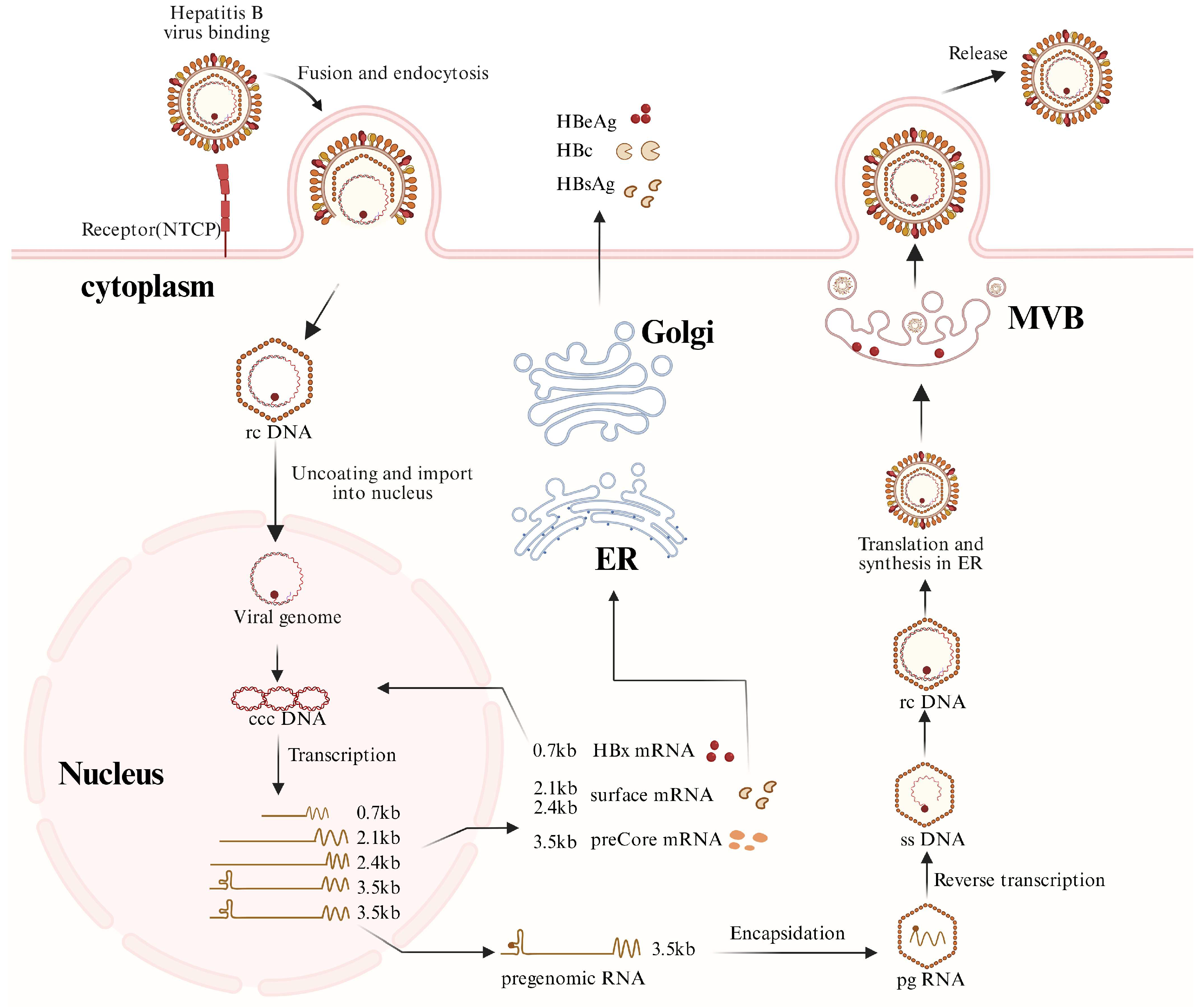
2. Molecular Biological Functions of HBV pgRNA
3. Impact of Preanalytical Variables on Plasma/Serum pgRNA Stability and Test Results
3.1. Storage Conditions and Stability of pgRNA in Plasma/Serum Specimens
3.2. Sample Processing Methods for pgRNA and Their Impact on Test Results
3.3. Mechanisms of pgRNA Degradation
4. HBV pgRNA Detection Technology: Platform Evolution, Standardization, and Clinical Translation
4.1. Detection Strategies for Specificity and Biological Identity
4.2. Target Region Design-Based One-Step Quantitative Detection
4.3. Nucleocapsid Capture-Based Detection of Encapsidated RNA
4.4. Automation and Result Comparability in Detection Platforms
4.4.1. Simultaneous Amplification and Testing (SAT) System
4.4.2. Fully Automated Standardized Platforms and Metrological Traceability
4.4.3. Highly Sensitive Automated Detection Platforms
4.5. High-Resolution Quantification and Transcript Structural Coverage
Multiplex Overlapping Digital PCR (ddOTs)
4.6. Advanced Technologies for Point-of-Care and Accessibility-Oriented Approaches
4.6.1. Immunochromatographic Test Based on Catalytic Hairpin Assembly
4.6.2. Isothermal Amplification-Clustered Regularly Interspaced Short Palindromic Repeats (CRISPR)-Coupled Detection System
4.7. Target Region Optimization and Comprehensive Detection Strategies
4.7.1. Metrological Traceability and Target Region Optimization for Serum HBV RNA
4.7.2. Multiple-Indicator Parallel Detection Strategy
5. Challenges and Future Perspectives in pgRNA Detection
5.1. Challenges in Methodology and Standardization
5.2. Technological Innovations and Methodological Breakthroughs
5.3. Clinical Integration and Prospects for Therapeutic Evaluation
Author Contributions
Funding
Institutional Review Board Statement
Informed Consent Statement
Data Availability Statement
Conflicts of Interest
References
- Collaborators, G.H.B.; Hiebert, L.; Han, H. Global, regional, and national burden of hepatitis B, 1990–2019: A systematic analysis for the Global Burden of Disease Study 2019. Lancet Gastroenterol. Hepatol. 2022, 7, 796–829. [Google Scholar] [CrossRef] [PubMed]
- Jeng, W.J.; Papatheodoridis, G.V.; Lok, A.S.F. Hepatitis B. Lancet 2023, 401, 1039–1052. [Google Scholar] [CrossRef] [PubMed]
- Block, T.M.; Guo, H.; Guo, J.T. Molecular virology of hepatitis B virus for clinicians. Clin. Liver Dis. 2007, 11, 685–706. [Google Scholar] [CrossRef] [PubMed]
- Mitra, B.; Thapa, R.J.; Guo, H.; Block, T.M. Host functions used by hepatitis B virus to complete its life cycle: Implications for developing host-targeting agents to treat chronic hepatitis B. Antivir. Res. 2018, 158, 185–198. [Google Scholar] [CrossRef]
- Hu, J.; Liu, K. Complete and Incomplete Hepatitis B Virus Particles: Formation, Function, and Application. Viruses 2017, 9, 56. [Google Scholar] [CrossRef]
- Shen, S.; Xie, Z.; Cai, D.; Yu, X.; Zhang, H.; Kim, E.S.; Zhou, B.; Hou, J.; Zhang, X.; Huang, Q.; et al. Biogenesis and molecular characteristics of serum hepatitis B virus RNA. PLoS Pathog. 2020, 16, e1008945. [Google Scholar] [CrossRef]
- Mu, D.; Yuan, F.C.; Chen, Y.; Jiang, X.Y.; Yan, L.; Jiang, L.Y.; Gong, J.P.; Zhang, D.Z.; Ren, H.; Liao, Y. Baseline value of intrahepatic HBV DNA over cccDNA predicts patient’s response to interferon therapy. Sci. Rep. 2017, 7, 5937. [Google Scholar] [CrossRef]
- Allweiss, L.; Dandri, M. The Role of cccDNA in HBV Maintenance. Viruses 2017, 9, 156. [Google Scholar] [CrossRef]
- Dong, J.; Ying, J.; Qiu, X.; Lu, Y.; Zhang, M. Advanced Strategies for Eliminating the cccDNA of HBV. Dig. Dis. Sci. 2018, 63, 7–15. [Google Scholar] [CrossRef]
- Sarin, S.K.; Kumar, M.; Lau, G.K.; Abbas, Z.; Chan, H.L.; Chen, C.J.; Chen, D.S.; Chen, H.L.; Chen, P.J.; Chien, R.N.; et al. Asian-Pacific clinical practice guidelines on the management of hepatitis B: A 2015 update. Hepatol. Int. 2016, 10, 1–98. [Google Scholar] [CrossRef]
- Levrero, M.; Testoni, B.; Zoulim, F. HBV cure: Why, how, when? Curr. Opin. Virol. 2016, 18, 135–143. [Google Scholar] [CrossRef]
- Wu, L.; Yang, Z.; Zheng, M. Biogenesis of serum HBV RNA and clinical phenomena of serum HBV RNA in chronic hepatitis B patients before and after receiving nucleos(t)ide analogues therapy. J. Viral Hepat. 2024, 31, 255–265. [Google Scholar] [CrossRef]
- Nassal, M. Hepatitis B viruses: Reverse transcription a different way. Virus Res. 2008, 134, 235–249. [Google Scholar] [CrossRef] [PubMed]
- Hu, J.; Seeger, C. Hepadnavirus Genome Replication and Persistence. Cold Spring Harb. Perspect. Med. 2015, 5, a021386. [Google Scholar] [CrossRef] [PubMed]
- Bartenschlager, R.; Schaller, H. Hepadnaviral assembly is initiated by polymerase binding to the encapsidation signal in the viral RNA genome. EMBO J. 1992, 11, 3413–3420. [Google Scholar] [CrossRef] [PubMed]
- Tavis, J.E.; Ganem, D. Evidence for activation of the hepatitis B virus polymerase by binding of its RNA template. J. Virol. 1996, 70, 5741–5750. [Google Scholar] [CrossRef]
- Nassal, M. Hepatitis B virus morphogenesis. Curr. Top. Microbiol. Immunol. 1996, 214, 297–337. [Google Scholar]
- Pollack, J.R.; Ganem, D. An RNA stem-loop structure directs hepatitis B virus genomic RNA encapsidation. J. Virol. 1993, 67, 3254–3263. [Google Scholar] [CrossRef]
- Wang, G.H.; Seeger, C. The reverse transcriptase of hepatitis B virus acts as a protein primer for viral DNA synthesis. Cell 1992, 71, 663–670. [Google Scholar] [CrossRef]
- Lamontagne, R.J.; Bagga, S.; Bouchard, M.J. Hepatitis B virus molecular biology and pathogenesis. Hepatoma Res. 2016, 2, 163–186. [Google Scholar] [CrossRef]
- Jones, S.A.; Hu, J. Hepatitis B virus reverse transcriptase: Diverse functions as classical and emerging targets for antiviral intervention. Emerg. Microbes Infect. 2013, 2, e56. [Google Scholar] [CrossRef] [PubMed]
- Tu, T.; Budzinska, M.A.; Shackel, N.A.; Urban, S. HBV DNA Integration: Molecular Mechanisms and Clinical Implications. Viruses 2017, 9, 75. [Google Scholar] [CrossRef] [PubMed]
- Schreiner, S.; Nassal, M. A Role for the Host DNA Damage Response in Hepatitis B Virus cccDNA Formation-and Beyond? Viruses 2017, 9, 125. [Google Scholar] [CrossRef] [PubMed]
- Terrault, N.A.; Lok, A.S.F.; McMahon, B.J.; Chang, K.M.; Hwang, J.P.; Jonas, M.M.; Brown, R.S.; Bzowej, N.H., Jr.; Wong, J.B. Update on prevention, diagnosis, and treatment of chronic hepatitis B: AASLD 2018 hepatitis B guidance. Hepatology 2018, 67, 1560–1599. [Google Scholar] [CrossRef]
- Van Bömmel, F.; Bartens, A.; Mysickova, A.; Hofmann, J.; Krüger, D.H.; Berg, T.; Edelmann, A. Serum hepatitis B virus RNA levels as an early predictor of hepatitis B envelope antigen seroconversion during treatment with polymerase inhibitors. Hepatology 2015, 61, 66–76. [Google Scholar] [CrossRef]
- van Bömmel, F.; van Bömmel, A.; Krauel, A.; Wat, C.; Pavlovic, V.; Yang, L.; Deichsel, D.; Berg, T.; Böhm, S. Serum HBV RNA as a Predictor of Peginterferon Alfa-2a Response in Patients With HBeAg-Positive Chronic Hepatitis B. J. Infect. Dis. 2018, 218, 1066–1074. [Google Scholar] [CrossRef]
- Sanders, R.; Bustin, S.; Huggett, J.; Mason, D. Improving the standardization of mRNA measurement by RT-qPCR. Biomol. Detect. Quantif. 2018, 15, 13–17. [Google Scholar] [CrossRef]
- Sebire, K.; McGavin, K.; Land, S.; Middleton, T.; Birch, C. Stability of human immunodeficiency virus RNA in blood specimens as measured by a commercial PCR-based assay. J. Clin. Microbiol. 1998, 36, 493–498. [Google Scholar] [CrossRef]
- Gerbehaye, A.-I.d.M.d.; Bodéus, M.; Robert, A.; Horsmans, Y.; Goubau, P. Stable hepatitis C virus RNA detection by RT-PCR during four days storage. BMC Infect. Dis. 2002, 2, 22. [Google Scholar] [CrossRef][Green Version]
- Deng, R.; Liu, S.; Shen, S.; Guo, H.; Sun, J. Circulating HBV RNA: From biology to clinical applications. Hepatology 2022, 76, 1520–1530. [Google Scholar] [CrossRef]
- Ohlendorf, V.; Bremer, B.; Sandmann, L.; Mix, C.; Tergast, T.; Cornberg, M.; Wedemeyer, H.; Deterding, K.; Maasoumy, B. Limited stability of Hepatitis B virus RNA in plasma and serum. Sci. Rep. 2024, 14, 27128. [Google Scholar] [CrossRef]
- Su, T.S.; Lai, C.J.; Huang, J.L.; Lin, L.H.; Yauk, Y.K.; Chang, C.M.; Lo, S.J.; Han, S.H. Hepatitis B virus transcript produced by RNA splicing. J. Virol. 1989, 63, 4011–4018. [Google Scholar] [CrossRef] [PubMed]
- Rosmorduc, O.; Petit, M.-A.; Pol, S.; Capel, F.; Bortolotti, F.; Berthelot, P.; Brechot, C.; Kremsdorf, D. In vivo and in vitro expression of defective hepatitis B virus particles generated by spliced hepatitis B virus RNA. Hepatology 1995, 22, 10–19. [Google Scholar] [PubMed]
- Anderson, M.; Stec, M.; Thi, E.P.; Picchio, G.; Mbanya, D.; Cloherty, G. Measuring hepatitis B pgRNA stability using an updated automated HBV pgRNA assay with increased sensitivity. Hepatol. Commun. 2023, 7, e0099. [Google Scholar] [CrossRef] [PubMed]
- Kuhns, M.C.; Holzmayer, V.; McNamara, A.L.; Anderson, M.; Cloherty, G.A. Hepatitis B seroconversion revisited: New insights into the natural history of acute hepatitis B virus (HBV) infection from quantitative and highly sensitive assays and novel biomarkers. Virol. J. 2021, 18, 235. [Google Scholar] [CrossRef]
- Hao, X.; Yuan, M.; Li, Y.; Li, R.; Li, X.; Yao, M. A molecular detection method for HBV pgRNA without RNA extraction based on nucleic acid hybridization. Diagn. Microbiol. Infect. Dis. 2025, 111, 116582. [Google Scholar] [CrossRef]
- Gao, M.; Feng, C.; Ying, R.; Nie, Y.; Deng, X.; Zhu, Y.; Tang, X.; Guan, Y.; Hu, F.; Li, F. A novel one-step quantitative reverse transcription PCR assay for selective amplification of hepatitis B virus pregenomic RNA from a mixture of HBV DNA and RNA in serum. Arch. Virol. 2019, 164, 2683–2690. [Google Scholar] [CrossRef]
- Liu, Y.; Nie, H.; Mao, R.; Mitra, B.; Cai, D.; Yan, R.; Guo, J.T.; Block, T.M.; Mechti, N.; Guo, H. Interferon-inducible ribonuclease ISG20 inhibits hepatitis B virus replication through directly binding to the epsilon stem-loop structure of viral RNA. PLoS Pathog. 2017, 13, e1006296. [Google Scholar] [CrossRef]
- Li, J.; Lin, S.; Chen, Q.; Peng, L.; Zhai, J.; Liu, Y.; Yuan, Z. Inhibition of hepatitis B virus replication by MyD88 involves accelerated degradation of pregenomic RNA and nuclear retention of pre-S/S RNAs. J. Virol. 2010, 84, 6387–6399. [Google Scholar] [CrossRef]
- Prakash, K.; Rydell, G.E.; Larsson, S.B.; Andersson, M.; Norkrans, G.; Norder, H.; Lindh, M. High serum levels of pregenomic RNA reflect frequently failing reverse transcription in hepatitis B virus particles. Virol. J. 2018, 15, 86. [Google Scholar] [CrossRef]
- Wu, Z.; Tan, S.; Xu, L.; Gao, L.; Zhu, H.; Ma, C.; Liang, X. NgAgo-gDNA system efficiently suppresses hepatitis B virus replication through accelerating decay of pregenomic RNA. Antivir. Res. 2017, 145, 20–23. [Google Scholar] [CrossRef]
- Block, T.M.; Gish, R.; Guo, H.; Mehta, A.; Cuconati, A.; Thomas London, W.; Guo, J.T. Chronic hepatitis B: What should be the goal for new therapies? Antivir. Res. 2013, 98, 27–34. [Google Scholar] [CrossRef]
- Butler, E.K.; Gersch, J.; McNamara, A.; Luk, K.C.; Holzmayer, V.; de Medina, M.; Schiff, E.; Kuhns, M.; Cloherty, G.A. Hepatitis B Virus Serum DNA andRNA Levels in Nucleos(t)ide Analog-Treated or Untreated Patients During Chronic and Acute Infection. Hepatology 2018, 68, 2106–2117. [Google Scholar] [CrossRef]
- Ryu, D.K.; Ahn, Y.; Ryu, W.S.; Windisch, M.P. Development of a novel hepatitis B virus encapsidation detection assay by viral nucleocapsid-captured quantitative RT-PCR. Biotechniques 2015, 59, 287–293. [Google Scholar] [CrossRef] [PubMed]
- Hu, X.; Zhao, L.; Ou, M.; Chen, Y.; Wei, H.; Xia, Y.; Xu, H.; Li, M.; Wang, J. Evaluation of reverse transcription-polymerase chain reaction and simultaneous amplification and testing for quantitative detection of serum hepatitis B virus RNA. Heliyon 2023, 9, e18557. [Google Scholar] [CrossRef] [PubMed]
- Liu, Y.; Jiang, M.; Xue, J.; Yan, H.; Liang, X. Serum HBV RNA quantification: Useful for monitoring natural history of chronic hepatitis B infection. BMC Gastroenterol. 2019, 19, 53. [Google Scholar] [PubMed]
- Xiang, Y.; Yang, Y.; Chen, P.; Lai, X.; Shi, S.; Li, S.; You, W. Analysis of serum hepatitis B virus RNA levels among HBsAg and HBsAb copositive patients and its correlation with HBV DNA. Medicine 2021, 100, e27433. [Google Scholar] [CrossRef]
- Cortese, M.F.; Riveiro-Barciela, M.; Tabernero, D.; Rodriguez-Algarra, F.; Palom, A.; Sopena, S.; Rando-Segura, A.; Roade, L.; Kuchta, A.; Ferrer-Costa, R.; et al. Standardized Hepatitis B Virus RNA Quantification in Untreated and Treated Chronic Patients: A Promising Marker of Infection Follow-Up. Microbiol. Spectr. 2022, 10, e0214921. [Google Scholar] [CrossRef]
- Wang, X.; Wang, Z.; Chi, X.; Wu, R.; Jin, Q.; Xu, H.; Gao, X.; Yu, L.; Chen, Y.; Shang, J.; et al. Efficacy of a combination of HBV RNA and HBeAg in predicting HBeAg seroconversion in patients treated with entecavir for 144 weeks. Int. J. Infect. Dis. 2020, 99, 171–178. [Google Scholar] [CrossRef]
- Pan, J.; Tian, Y.; Xu, J.; Luo, H.; Tan, N.; Han, Y.; Kang, Q.; Chen, H.; Yang, Y.; Xu, X. Dynamics of Hepatitis B Virus Pregenomic RNA in Chronic Hepatitis B Patients With Antiviral Therapy Over 9 Years. Front. Med. 2022, 9, 851717. [Google Scholar] [CrossRef]
- Ng, E.; Dobrica, M.O.; Harris, J.M.; Wu, Y.; Tsukuda, S.; Wing, P.A.C.; Piazza, P.; Balfe, P.; Matthews, P.C.; Ansari, M.A.; et al. An enrichment protocol and analysis pipeline for long read sequencing of the hepatitis B virus transcriptome. J. Gen. Virol. 2023, 104, 001856. [Google Scholar] [CrossRef]
- D’Arienzo, V.; Magri, A.; Harris, J.M.; Wing, P.A.C.; Ko, C.; Rubio, C.O.; Revill, P.A.; Protzer, U.; Balfe, P.; McKeating, J.A. A PCR assay to quantify patterns of HBV transcription. J. Gen. Virol. 2021, 102, 001373. [Google Scholar] [CrossRef] [PubMed]
- Wang, X.; Chi, X.; Wu, R.; Xu, H.; Gao, X.; Yu, L.; Liu, L.; Zhang, M.; Tan, Y.; Niu, J.; et al. Serum HBV RNA correlated with intrahepatic cccDNA more strongly than other HBV markers during peg-interferon treatment. Virol. J. 2021, 18, 4. [Google Scholar] [PubMed]
- Sarica, N.; Meki, I.; Lopez, O.; Jay, B.; Petitjean, G.; Neuveut, C. ddOTs: A multiplexed quantitative ddPCR approach for resolving overlapping hepatitis B virus transcripts to decipher cccDNA-driven transcription. bioRxiv 2025, bioRxiv:2025.08.27.672646. [Google Scholar]
- Yin, P.; Choi, H.M.; Calvert, C.R.; Pierce, N.A. Programming biomolecular self-assembly pathways. Nature 2008, 451, 318–322. [Google Scholar] [CrossRef]
- Yin, W.; Zhuang, J.; Li, J.; Xia, L.; Hu, K.; Yin, J.; Mu, Y. Digital Recombinase Polymerase Amplification, Digital Loop-Mediated Isothermal Amplification, and Digital CRISPR-Cas Assisted Assay: Current Status, Challenges, and Perspectives. Small 2023, 19, e2303398. [Google Scholar] [CrossRef]
- Chen, Y.; Yao, Y.; Ma, S.; Zhou, M.; Wang, J.; Abudushalamu, G.; Cai, S.; Gao, X.; Fan, X.; Wu, G. Detection of HBV pgRNA by catalytic hairpin assembly combined with two Kinds of immunochromatographic strips. Microchem. J. 2024, 207, 112075. [Google Scholar] [CrossRef]
- Zhu, C.; Li, J.; Yu, H.; Xu, K.; He, X.; Liu, Z.; Chen, J. CRISPR/Cas13a combined with reverse transcription-multienzyme isothermal rapid amplification for hepatitis B virus RNA detection. Anal. Chim. Acta 2025, 1370, 344389. [Google Scholar]
- Wu, X.; Liu, G.; Chang, Y.; Zheng, M.; Liu, L.; Xia, X.; Feng, Y. Rapid and sensitive detection of chikungunya virus using one-tube, reverse transcription, semi-nested multi-enzyme isothermal rapid amplification, and lateral flow dipstick assays. J. Clin. Microbiol. 2024, 62, e0038324. [Google Scholar] [CrossRef]
- Metsky, H.C.; Welch, N.L.; Pillai, P.P.; Haradhvala, N.J.; Rumker, L.; Mantena, S.; Zhang, Y.B.; Yang, D.K.; Ackerman, C.M.; Weller, J.; et al. Designing sensitive viral diagnostics with machine learning. Nat. Biotechnol. 2022, 40, 1123–1131. [Google Scholar] [CrossRef]
- Yu, G.; Chen, R.; Zheng, S.; Liu, Y.; Zou, J.; Gu, Z.; Jiang, B.; Gao, Q.; Dai, L.; Peng, J.; et al. A standardized assay for the quantitative detection of serum HBV RNA in chronic hepatitis B patients. Emerg. Microbes Infect. 2022, 11, 775–785. [Google Scholar] [CrossRef] [PubMed]
- Yan, R.; Cai, D.; Ouyang, L.; Colonno, R.; Huang, Q.; Kitrinos, K.M. Development of a sensitive, multi-assay platform to monitor low levels of HBV DNA and pgRNA in patients with chronic hepatitis B virus infection. J. Virol. Methods 2023, 311, 114640. [Google Scholar] [CrossRef] [PubMed]
- Lok, A.S.; Zoulim, F.; Dusheiko, G.; Ghany, M.G. Hepatitis B cure: From discovery to regulatory approval. J. Hepatol. 2017, 67, 847–861. [Google Scholar] [CrossRef] [PubMed]
- Ragozzino, E.; Faggioli, F.; Barba, M. Development of a one tube-one step RT-PCR protocol for the detection of seven viroids in four genera: Apscaviroid, Hostuviroid, Pelamoviroid and Pospiviroid. J. Virol. Methods 2004, 121, 25–29. [Google Scholar] [CrossRef]
- Wu, Y.; Wen, J.; Xiao, W.; Zhang, B. Pregenomic RNA: How to assist the management of chronic hepatitis B? Rev. Med. Virol. 2019, 29, e2051. [Google Scholar] [CrossRef]
- Laras, A.; Papatheodoridi, M.; Panopoulou, E.; Papatheodoridis, G.V.; Hadziyannis, S.J.; Hadziyannis, E. Serum hepatitis B virus RNA detectability, composition and clinical significance in patients with ab initio hepatitis B e antigen negative chronic hepatitis B. Virol. J. 2022, 19, 22. [Google Scholar] [CrossRef]
- Wang, M.L.; Liao, J.; Ye, F.; Tao, Y.C.; Wu, D.B.; He, M.; Tang, H.; Chen, E.Q. Distribution and factors associated with serum HBV pregenomic RNA levels in Chinese chronic hepatitis B patients. J. Med. Virol. 2021, 93, 3688–3696. [Google Scholar] [CrossRef]
- Bazinet, M.; Pântea, V.; Cebotarescu, V.; Cojuhari, L.; Jimbei, P.; Anderson, M.; Gersch, J.; Holzmayer, V.; Elsner, C.; Krawczyk, A.; et al. Persistent Control of Hepatitis B Virus and Hepatitis Delta Virus Infection Following REP 2139-Ca and Pegylated Interferon Therapy in Chronic Hepatitis B Virus/Hepatitis Delta Virus Coinfection. Hepatol. Commun. 2020, 5, 189–202. [Google Scholar] [CrossRef]


| Sample Type | Sample Handling Requirements | Storage Temperature | Storage Time | Reference |
|---|---|---|---|---|
| Human plasma or serum | Snap-frozen in liquid nitrogen and aliquots prepared | −80 °C | Long-term, about 2–3 years | [27] |
| Preservative solution such as RNA later or equivalent | 23–25 °C | Short-term: approximately one week | [27] | |
| Lysate or extracted total RNA (includes pgRNA) | Diluted in a stabilizing agent such as RNA storage solution and divide into equal portions | −80 °C | About 2–3 years | [27] |
| HBV pgRNA in plasma | —— | 4 °C and 25 °C | 2 days | [29] |
| 4 freeze–thaw cycles, 22 h frozen and 2 h thawed at 25 °C | −20 °C or −80 °C | About 4 days | [29] | |
| HBV pgRNA in plasma | —— | −20 and 4 °C | 30 days | [34] |
| —— | 25 and 37 °C | 7 days | [34] | |
| 3 freeze–thaw cycles, −80 °C frozen + 30 min thawed at 25 °C | −80 °C | About 3 days | [34] |
| Detection Platform/Method | Technical Principle | Limit of Detection (LOD) | DNA Removal Requirement | Primary Application Scenarios | References |
|---|---|---|---|---|---|
| Target Region-based One-step | Reverse transcription and PCR performed in a single tube, targeting pgRNA-specific sequences (e.g., poly(A)/preC regions) | Approximately 102 copies/mL | No | Methodology optimization studies; Selective pgRNA amplification | [35,36,37,38] |
| Encapsidated RNA detection based on nucleocapsid capture | Anti-HBc antibodies capture nucleocapsids, followed by quantification of encapsidated pgRNA after lysis | Depends on the specific system | Yes (DNase I) | Mechanism studies; Nucleocapsid assembly and antiviral drug screening | [39] |
| Simultaneous Amplification and Testing system (SAT) | Integration of RNA extraction, reverse transcription, and amplification detection into a fully automated closed system | Approximately 50 copies/mL | No | Routine clinical testing and high-throughput screening | [40,41,42] |
| Fully automated standardized platform with metrological traceability | Fully automated nucleic acid extraction and RT-qPCR, with results calibrated against international standards (IU/mL) | Approximately 1020 IU/mL | No | Reference laboratories; multicenter studies; long-term follow-up | [43] |
| Highly sensitive automated detection platform | Automated dual-target RT-qPCR improves sensitivity through optimized extraction volume and algorithm integration | Approximately 1022 copies/mL | No | Low viral load monitoring; treatment efficacy and discontinuation assessment | [37] |
| Multiplex overlapping digital PCR (ddOTs) | Droplet digital PCR with multiple overlapping target regions covering diverse pgRNA transcripts | Approximately 0.4 copies/μL | No | High-resolution absolute quantification; transcript heterogeneity analysis | [25,37,44] |
| Catalytic hairpin assembly based immunochromatographic test | Catalytic hairpin assembly signal amplification combined with lateral flow or fluorescent immunoassays | Approximately 102 copies/mL | No | Grassroots screening; Point-of-care testing; Resource-limited regions | [45,46,47] |
| Isothermal amplification-CRISPR coupled detection system | Isothermal reverse transcription amplification (RTMIRA) combined with CRISPR/Cas13a detection | Approximately 10 copies/mL | No | On-site rapid detection; Point-of-care testing (POCT); Subtype differentiation | [48,49,50] |
| Metrological traceability and systematic optimization strategy for target regions | Traceable reference material-based RT-qPCR, systematically optimize amplification target regions (e.g., preC/C) | Approximately 102 copies/mL | No | Cross-platform comparability studies; Standardization of detection | [51] |
| Multi-indicator parallel detection strategy | Parallel detection of HBV DNA, pgRNA, and total nucleic acid (TNA) in a single workflow | Platform-dependent | No | Residual replication assessment; antiviral mechanism analysis | [42,52] |
Disclaimer/Publisher’s Note: The statements, opinions and data contained in all publications are solely those of the individual author(s) and contributor(s) and not of MDPI and/or the editor(s). MDPI and/or the editor(s) disclaim responsibility for any injury to people or property resulting from any ideas, methods, instructions or products referred to in the content. |
© 2026 by the authors. Licensee MDPI, Basel, Switzerland. This article is an open access article distributed under the terms and conditions of the Creative Commons Attribution (CC BY) license.
Share and Cite
Zhu, Z.; Wu, J.; Li, J.; Wu, T. Challenges and Solutions in pgRNA Measurement: Toward Improved Monitoring of Hepatitis B Therapy. Pathogens 2026, 15, 153. https://doi.org/10.3390/pathogens15020153
Zhu Z, Wu J, Li J, Wu T. Challenges and Solutions in pgRNA Measurement: Toward Improved Monitoring of Hepatitis B Therapy. Pathogens. 2026; 15(2):153. https://doi.org/10.3390/pathogens15020153
Chicago/Turabian StyleZhu, Zhenkun, Jin Wu, Jinyuan Li, and Tao Wu. 2026. "Challenges and Solutions in pgRNA Measurement: Toward Improved Monitoring of Hepatitis B Therapy" Pathogens 15, no. 2: 153. https://doi.org/10.3390/pathogens15020153
APA StyleZhu, Z., Wu, J., Li, J., & Wu, T. (2026). Challenges and Solutions in pgRNA Measurement: Toward Improved Monitoring of Hepatitis B Therapy. Pathogens, 15(2), 153. https://doi.org/10.3390/pathogens15020153