
Molecular Detection of Theileria equi, Babesia caballi, and Borrelia burgdorferi Sensu Lato in Hippobosca equina from Horses in Spain
 , , , and
Abstract
1. Introduction
2. Materials and Methods
2.1. Study Area and Collection of Samples
2.2. Genomic DNA Extraction
2.3. PCR Assay for Insect Identification
2.4. PCR Assay for A. phagocytophilum and B. burgdorferi Screening
2.5. PCR Assay for Equine Piroplasms Screening
2.6. Nested PCR Assay for Equine Piroplasms Characterization
2.7. Equine Piroplasmosis Serology
2.8. Data Analysis
3. Results
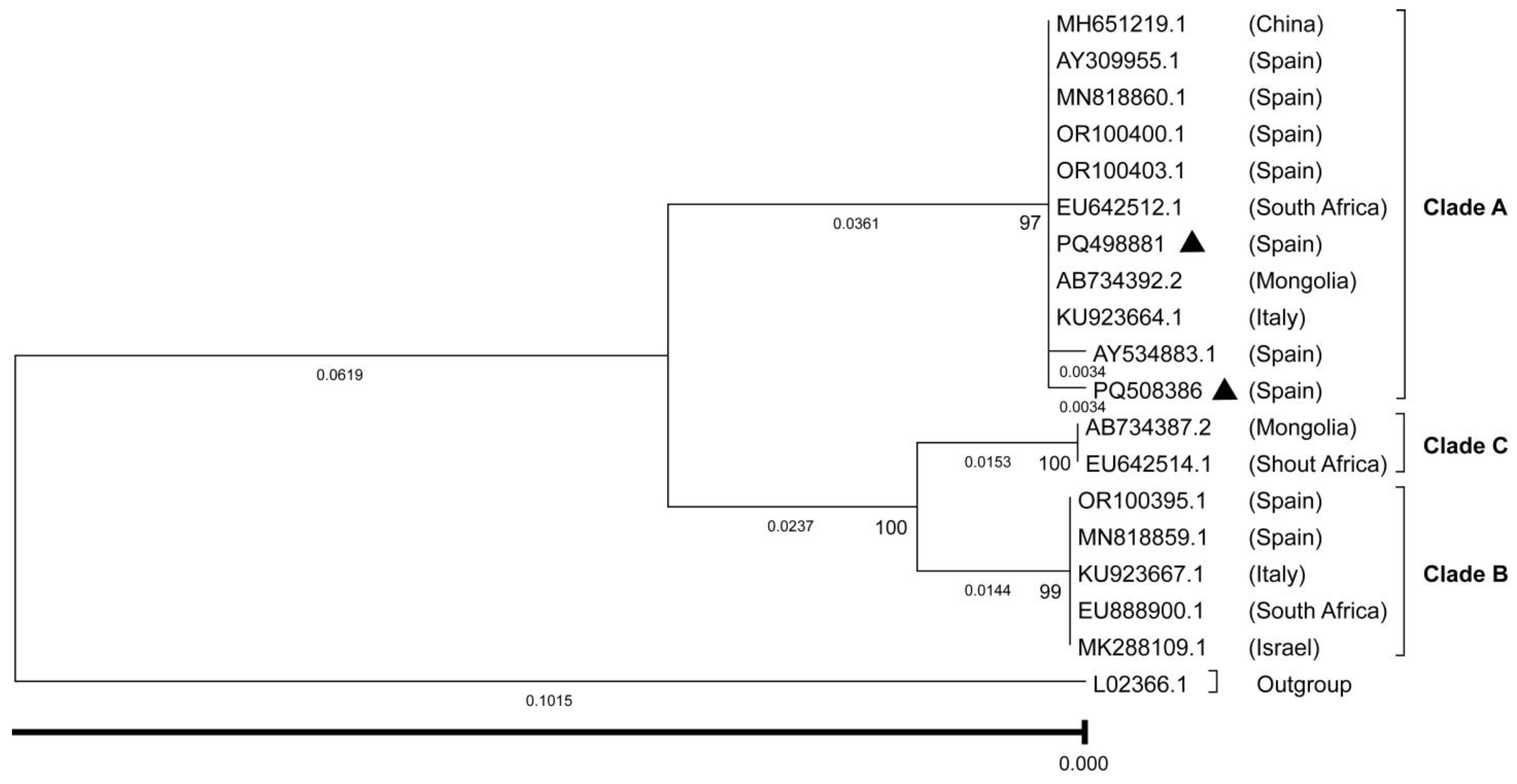
3.1. Identification and DNA Barcoding of Collected Hippoboscid Flies
3.2. A. phagocytophilum and B. burgdorferi Screening—Hippoboscid Flies and Horses
3.3. Equine Piroplasms Screening—Hippoboscid Flies
3.4. Equine Piroplasms Screening—Horses
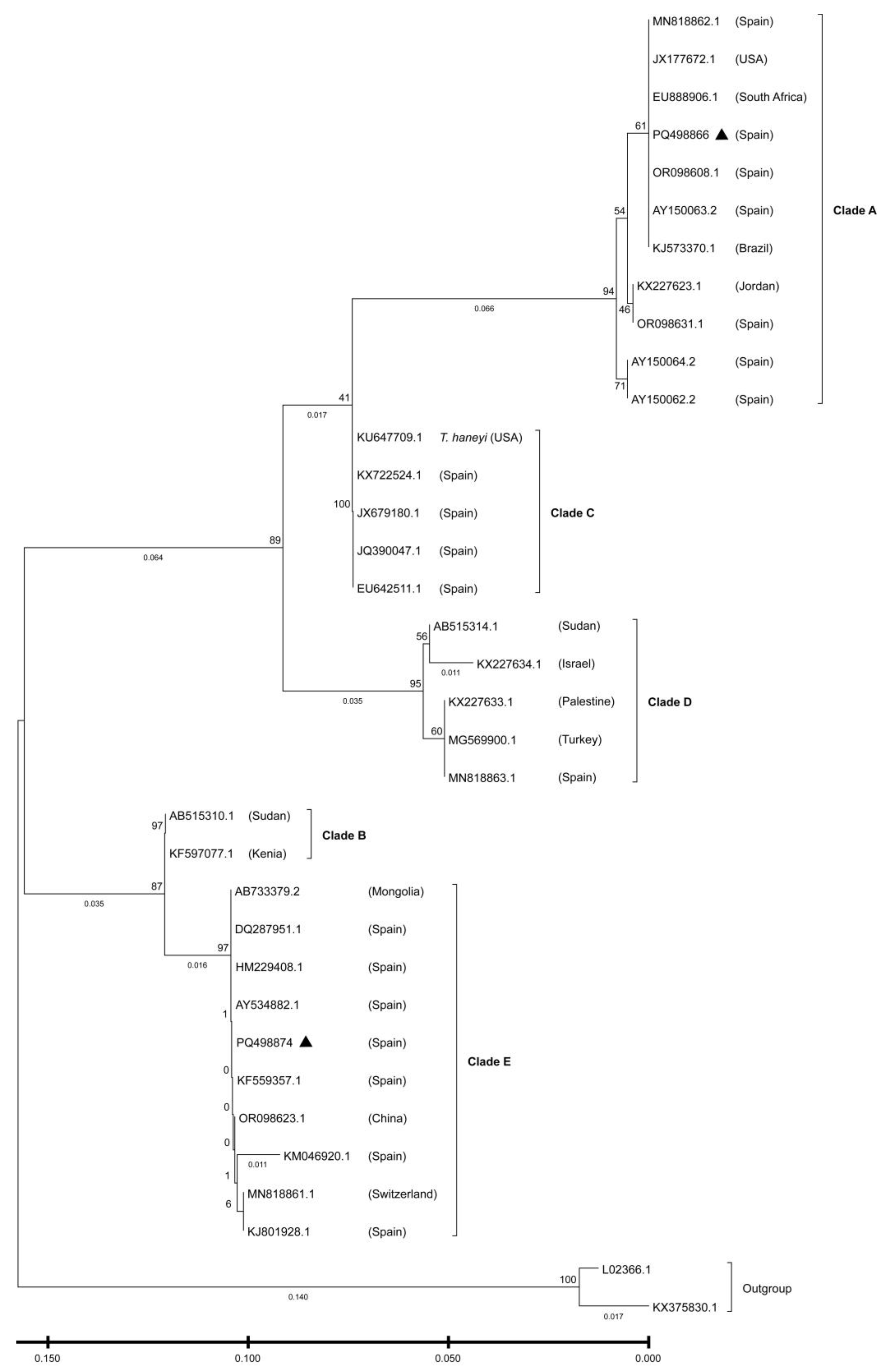
3.5. Equine Piroplasmosis Characterization and Phylogenetic Analysis
4. Discussion
5. Conclusions
Supplementary Materials
Author Contributions
Funding
Institutional Review Board Statement
Informed Consent Statement
Data Availability Statement
Acknowledgments
Conflicts of Interest
Abbreviations
| BLAST | Basic Local Alignment Search Tool |
| BOLD | Barcode of Life Data Systems |
| Cq | Quantification Cycle |
| COI | Cytochrome c oxidase subunit I |
| EP | Equine Piroplasmosis |
| MUSCLE | Multiple Sequence Comparison by Log-Expectation |
| NCBI | National Center for Biotechnology Information |
References
- Bequaert, J. The Hippoboscidae or louse-Flies (Diptera) of mammals and birds. Part I. Structure, physiology and natural history. Entomol. Am. 1953, 33, 211–442. [Google Scholar]
- Obona, J.; Sychra, O.; Gres, S.; Herman, P.; Manko, P.; Rohacek, J.; Sestakova, A.; Slapak, J.; Hromada, M. A revised annotated checklist of louse flies (Diptera, Hippoboscidae) from Slovakia. Zookeys 2019, 862, 129–152. [Google Scholar] [CrossRef]
- Zhang, D.; Liu, X.H.; Li, X.Y.; Cao, J.; Chu, H.J.; Li, K. Ultrastructural investigation of antennae in three cutaneous myiasis flies: Melophagus ovinus, Hippobosca equina, and Hippobosca longipennis (Diptera: Hippoboscidae). Parasitol. Res. 2015, 114, 1887–1896. [Google Scholar] [CrossRef]
- Decastello, A.; Farkas, R. Anaphylactic reaction caused by a horse-fly species (Hippobosca equina). Orvosi Hetil. 2009, 150, 1945–1948. [Google Scholar] [CrossRef]
- Sokol, R.; Michalski, M.M. Occurrence of Hippobosca equina in Polish primitive horses during the grazing season. Ann. Parasitol. 2015, 61, 119–124. [Google Scholar]
- Maslanko, W.; Szwaj, E.; Gazda, M.; Bartosik, K. Hippobosca equina L. (Hippoboscidae: Hippobosca)-An old enemy as an emerging threat in the Palearctic zone. Int. J. Environ. Res. Public Health 2022, 19, 16978. [Google Scholar] [CrossRef]
- Dittmar, K.; Porter, M.L.; Murray, S.; Whiting, M.F. Molecular phylogenetic analysis of nycteribiid and streblid bat flies (Diptera: Brachycera, Calyptratae): Implications for host associations and phylogeographic origins. Mol. Phylogenet. Evol. 2006, 38, 155–170. [Google Scholar] [CrossRef]
- Andreani, A.; Belcari, A.; Sacchetti, P.; Romani, R. Antennal morphology and fine structure of flagellar sensilla in Hippoboscid flies with special reference to Lipoptena fortisetosa (Diptera: Hippoboscidae). Insects 2022, 13, 236. [Google Scholar] [CrossRef]
- El-Geneady, M.A.; Ramadan, R.M.; Mahdy, O.A.; Kamel, M.S.; Salem, M.A. Hippobosca equina: Influences on oxidative stress and immune-regulating cytokine responses in horses. Med. Vet. Entomol. 2025; ahead of print. [Google Scholar] [CrossRef]
- Arafa, M.I.; Hamouda, S.M.; Rateb, H.Z.; Abdel-Hafeez, M.M.; Aamer, A.A. Oedematous Skin Disease (OSD) transmission among buffaloes. Glob. J. Med. Res. 2019, 19, 15–19. [Google Scholar]
- Abdullah, H.; Aboelsoued, D.; Farag, T.K.; Abdel-Shafy, S.; Abdel Megeed, K.N.; Parola, P.; Raoult, D.; Mediannikov, O. Molecular characterization of some equine vector-borne diseases and associated arthropods in Egypt. Acta Trop. 2022, 227, 106274. [Google Scholar] [CrossRef]
- Boucheikhchoukh, M.; Mechouk, N.; Benakhla, A.; Raoult, D.; Parola, P. Molecular evidence of bacteria in Melophagus ovinus sheep keds and Hippobosca equina forest flies collected from sheep and horses in northeastern Algeria. Comp. Immunol. Microbiol. Infect. Dis. 2019, 65, 103–109. [Google Scholar] [CrossRef]
- Halos, L.; Jamal, T.; Maillard, R.; Girard, B.; Guillot, J.; Chomel, B.; Vayssier-Taussat, M.; Boulouis, H.J. Role of Hippoboscidae flies as potential vectors of Bartonella spp. infecting wild and domestic ruminants. Appl. Environ. Microbiol. 2004, 70, 6302–6305. [Google Scholar] [CrossRef]
- Pena-Espinoza, M.; Em, D.; Shahi-Barogh, B.; Berer, D.; Duscher, G.G.; van der Vloedt, L.; Glawischnig, W.; Rehbein, S.; Harl, J.; Unterkofler, M.S.; et al. Molecular pathogen screening of louse flies (Diptera: Hippoboscidae) from domestic and wild ruminants in Austria. Parasit. Vectors 2023, 16, 179. [Google Scholar] [CrossRef]
- Maslanko, W.; Asman, M.; Bartosik, K.; Swislocka, M. First report of Bartonella sp. isolated from Hippobosca equina L. (Hippoboscidae: Hippobosca) in Lublin province, south-eastern Poland. Ann. Agric. Environ. Med. 2024, 31, 334–339. [Google Scholar] [CrossRef] [PubMed]
- Zhigailov, A.V.; Perfilyeva, Y.V.; Ostapchuk, Y.O.; Kulemin, M.V.; Ivanova, K.R.; Abdolla, N.; Kan, S.A.; Maltseva, E.R.; Berdygulova, Z.A.; Naizabayeva, D.A.; et al. Molecular detection and characterization of bovine viral diarrhea virus type 2 and bluetongue virus 9 in forest flies (Hippobosca equina) collected from livestock in southern Kazakhstan. Vet. Parasitol. Reg. Stud. Rep. 2023, 45, 100932. [Google Scholar] [CrossRef] [PubMed]
- Bogdan, A.M.; Mitrea, I.L.; Ionita, M. Equine granulocytic anaplasmosis: A systematic review and meta-analysis on clinico-pathological findings, diagnosis, and therapeutic management. Vet. Sci. 2024, 11, 269. [Google Scholar] [CrossRef]
- Silaghi, C.; Liebisch, G.; Pfister, K. Genetic variants of Anaplasma phagocytophilum from 14 equine granulocytic anaplasmosis cases. Parasit. Vectors 2011, 4, 161. [Google Scholar] [CrossRef]
- Gehlen, H.; Inerle, K.; Bartel, A.; Stockle, S.D.; Ulrich, S.; Briese, B.; Straubinger, R.K. Seroprevalence of Borrelia burgdorferi sensu lato and Anaplasma phagocytophilum infections in German horses. Animals 2023, 13, 1984. [Google Scholar] [CrossRef]
- Estrada-Pena, A.; Oteo, J.A.; Estrada-Pena, R.; Gortazar, C.; Osacar, J.J.; Moreno, J.A.; Castella, J. Borrelia burgdorferi sensu lato in ticks (Acari: Ixodidae) from two different foci in Spain. Exp. Appl. Acarol. 1995, 19, 173–180. [Google Scholar] [CrossRef] [PubMed]
- Amusategui, I.; Sainz, A.; Tesouro, M.A. Serological evaluation of Anaplasma phagocytophilum infection in livestock in northwestern Spain. Ann. N. Y Acad. Sci. 2006, 1078, 487–490. [Google Scholar] [CrossRef] [PubMed]
- Butler, C.M.; Houwers, D.J.; Jongejan, F.; van der Kolk, J.H. Borrelia burgdorferi infections with special reference to horses. A review. Vet. Q. 2005, 27, 146–156. [Google Scholar] [CrossRef] [PubMed]
- Tirosh-Levy, S.; Gottlieb, Y.; Fry, L.M.; Knowles, D.P.; Steinman, A. Twenty years of Equine Piroplasmosis research: Global distribution, molecular diagnosis, and phylogeny. Pathogens 2020, 9, 926. [Google Scholar] [CrossRef] [PubMed]
- Knowles, D.P.; Kappmeyer, L.S.; Haney, D.; Herndon, D.R.; Fry, L.M.; Munro, J.B.; Sears, K.; Ueti, M.W.; Wise, L.N.; Silva, M.; et al. Discovery of a novel species, Theileria haneyi n. sp., infective to equids, highlights exceptional genomic diversity within the genus Theileria: Implications for apicomplexan parasite surveillance. Int. J. Parasitol. 2018, 48, 679–690. [Google Scholar] [CrossRef]
- Scoles, G.A.; Ueti, M.W. Vector ecology of equine piroplasmosis. Annu. Rev. Entomol. 2015, 60, 561–580. [Google Scholar] [CrossRef]
- de Waal, D.T. Equine Piroplasmosis—A review. Br. Vet. J. 1992, 148, 6–14. [Google Scholar] [CrossRef]
- Friedhoff, K.T.; Tenter, A.M.; Muller, I. Haemoparasites of equines: Impact on international trade of horses. Rev. Sci. Tech. 1990, 9, 1187–1194. [Google Scholar]
- Wise, L.N.; Kappmeyer, L.S.; Mealey, R.H.; Knowles, D.P. Review of equine piroplasmosis. J. Vet. Intern. Med. 2013, 27, 1334–1346. [Google Scholar] [CrossRef]
- Zhao, L.; Wang, J.; Ding, Y.; Li, K.; He, B.; Li, F.; Zhang, L.; Li, X.; Liu, Y. Theileria ovis (Piroplasmida: Theileriidae) detected in Melophagus ovinus (Diptera: Hippoboscoidea) and Ornithodoros lahorensis (Ixodida: Argasidae) removed from sheep in Xinjiang, China. J. Med. Entomol. 2020, 57, 631–635. [Google Scholar] [CrossRef]
- Hao, L.; Yuan, D.; Li, S.; Jia, T.; Guo, L.; Hou, W.; Lu, Z.; Mo, X.; Yin, J.; Yang, A.; et al. Detection of Theileria spp. in ticks, sheep keds (Melophagus ovinus), and livestock in the eastern Tibetan Plateau, China. Parasitol. Res. 2020, 119, 2641–2648. [Google Scholar] [CrossRef]
- Lee, S.H.; Kim, K.T.; Kwon, O.D.; Ock, Y.; Kim, T.; Choi, D.; Kwak, D. Novel detection of Coxiella spp., Theileria luwenshuni, and T. ovis endosymbionts in deer keds (Lipoptena fortisetosa). PLoS ONE 2016, 11, e0156727. [Google Scholar] [CrossRef]
- Obona, J.; Fogasova, K.; Fulin, M.; Gres, S.; Manko, P.; Repasky, J.; Rohacek, J.; Sychra, O.; Hromada, M. Updated taxonomic keys for European Hippoboscidae (Diptera), and expansion in Central Europe of the bird louse fly Ornithomyacomosa (Austen, 1930) with the first record from Slovakia. Zookeys 2022, 1115, 81–101. [Google Scholar] [CrossRef]
- Hebert, P.D.; Penton, E.H.; Burns, J.M.; Janzen, D.H.; Hallwachs, W. Ten species in one: DNA barcoding reveals cryptic species in the neotropical skipper butterfly Astraptes fulgerator. Proc. Natl. Acad. Sci. USA 2004, 101, 14812–14817. [Google Scholar] [CrossRef] [PubMed]
- Courtney, J.W.; Kostelnik, L.M.; Zeidner, N.S.; Massung, R.F. Multiplex real-time PCR for detection of Anaplasma phagocytophilum and Borrelia burgdorferi. J. Clin. Microbiol. 2004, 42, 3164–3168. [Google Scholar] [CrossRef]
- Marconi, R.T.; Garon, C.F. Development of polymerase chain reaction primer sets for diagnosis of Lyme disease and for species-specific identification of Lyme disease isolates by 16S rRNA signature nucleotide analysis. J. Clin. Microbiol. 1992, 30, 2830–2834. [Google Scholar] [CrossRef]
- Camino, E.; Dorrego, A.; Carvajal, K.A.; Buendia-Andres, A.; de Juan, L.; Dominguez, L.; Cruz-Lopez, F. Serological, molecular and hematological diagnosis in horses with clinical suspicion of equine piroplasmosis: Pooling strengths. Vet. Parasitol. 2019, 275, 108928. [Google Scholar] [CrossRef]
- Camino, E.; Buendia, A.; Dorrego, A.; Pozo, P.; de Juan, L.; Dominguez, L.; Cruz-Lopez, F. Sero-molecular survey and risk factors of equine piroplasmosis in horses in Spain. Equine Vet. J. 2021, 53, 771–779. [Google Scholar] [CrossRef] [PubMed]
- Jefferies, R.; Ryan, U.M.; Irwin, P.J. PCR-RFLP for the detection and differentiation of the canine piroplasm species and its use with filter paper-based technologies. Vet. Parasitol. 2007, 144, 20–27. [Google Scholar] [CrossRef] [PubMed]
- Edgar, R.C. MUSCLE: Multiple sequence alignment with high accuracy and high throughput. Nucleic Acids Res. 2004, 32, 1792–1797. [Google Scholar] [CrossRef]
- Larsson, A. AliView: A fast and lightweight alignment viewer and editor for large datasets. Bioinformatics 2014, 30, 3276–3278. [Google Scholar] [CrossRef]
- Kumar, S.; Stecher, G.; Tamura, K. MEGA7: Molecular Evolutionary Genetics Analysis Version 7.0 for Bigger Datasets. Mol. Biol. Evol. 2016, 33, 1870–1874. [Google Scholar] [CrossRef]
- Nicolaiewsky, T.B.; Richter, M.F.; Lunge, V.R.; Cunha, C.W.; Delagostin, O.; Ikuta, N.; Fonseca, A.S.; da Silva, S.S.; Ozaki, L.S. Detection of Babesia equi (Laveran, 1901) by nested polymerase chain reaction. Vet. Parasitol. 2001, 101, 9–21. [Google Scholar] [CrossRef] [PubMed]
- Ueti, M.W.; Palmer, G.H.; Kappmeyer, L.S.; Scoles, G.A.; Knowles, D.P. Expression of equi merozoite antigen 2 during development of Babesia equi in the midgut and salivary gland of the vector tick Boophilus microplus. J. Clin. Microbiol. 2003, 41, 5803–5809. [Google Scholar] [CrossRef]
- Ueti, M.W.; Mealey, R.H.; Kappmeyer, L.S.; White, S.N.; Kumpula-McWhirter, N.; Pelzel, A.M.; Grause, J.F.; Bunn, T.O.; Schwartz, A.; Traub-Dargatz, J.L.; et al. Re-emergence of the apicomplexan Theileria equi in the United States: Elimination of persistent infection and transmission risk. PLoS ONE 2012, 7, e44713. [Google Scholar] [CrossRef]
- Soliman, S.M.; Attia, M.M.; Al-Harbi, M.S.; Saad, A.M.; El-Saadony, M.T.; Salem, H.M. Low host specificity of Hippobosca equina infestation in different domestic animals and pigeon. Saudi J. Biol. Sci. 2022, 29, 2112–2120. [Google Scholar] [CrossRef]
- Camino, E.; Cruz-Lopez, F.; de Juan, L.; Dominguez, L.; Shiels, B.; Coultous, R.M. Phylogenetic analysis and geographical distribution of Theileria equi and Babesia caballi sequences from horses residing in Spain. Ticks Tick Borne Dis. 2020, 11, 101521. [Google Scholar] [CrossRef] [PubMed]
- Jhaiaun, P.; Rudeekiatthamrong, A.; Chimnoi, W.; Nguyen, G.T.; Ngasaman, R.; Phasuk, J.; Kamyingkird, K. Molecular detection of hemoparasites in hematophagous insects collected from livestock farms in Northeastern Thailand. Insects 2025, 16, 207. [Google Scholar] [CrossRef] [PubMed]
- Hornok, S.; Takacs, N.; Szekeres, S.; Szoke, K.; Kontschan, J.; Horvath, G.; Sugar, L. DNA of Theileria orientalis, T. equi and T. capreoli in stable flies (Stomoxys calcitrans). Parasit. Vectors 2020, 13, 186. [Google Scholar] [CrossRef]



| Horse ID | Sex | Residence Province | Sampling Date | Positive/ Total Collected Flies | Species Result | Clade |
|---|---|---|---|---|---|---|
| Horse 1 | Mare | Segovia | 21 September 2021 | 1/1 | Theileria equi | E |
| Horse 2 | Stallion | Segovia | 21 September 2021 | 0/4 | - | - |
| Mule 1 | Molly | Segovia | 21 September 2021 | 0/2 | - | - |
| Horse 3 | Gelding | Segovia | 29 September 2021 | 0/2 | - | - |
| Horse 4 | Gelding | Toledo | 23 August 2022 | 3/52 | T. equi | A |
| Horse 5 | Gelding | Segovia | 19 September 2023 | 0/3 | - | - |
| 25 September 2023 | 0/4 | - | - | |||
| Horse 6 | Gelding | Segovia | 19 September 2023 | 1/3 | T. equi | E |
| 25 September 2023 | 1/3 | T. equi | E | |||
| 27 July 2024 | 3/3 | T. equi | E | |||
| Horse 7 | Mare | Segovia | 25 September 2023 | 1/5 | Babesia caballi | A |
| Horse 8 | Mare | Segovia | 25 September 2023 | 0/4 | - | - |
| Horse 9 | Gelding | Segovia | 25 September 2023 | 0/5 | - | - |
| 27 September 2023 | 0/18 | - | - | |||
| Horse 10 | Mare | Segovia | 25 September 2023 | 0/2 | - | - |
| 27 September 2023 | 0/1 | - | - | |||
| Horse 11 | Gelding | Madrid | 23 July 2024 | 0/3 | - | - |
| Horse 12 | Gelding | Madrid | 23 July 2024 | 0/2 | - | - |
| Horse 13 | Mare | Madrid | 23 July 2024 | 0/4 | - | - |
| Horse 14 | Mare | Segovia | 13 May 2024 | 1/2 | B. caballi | A |
| 7 July 2024 | 1/6 | T. equi | E | |||
| 14 July 2024 | 6/8 | T. equi | E | |||
| 9 August 2024 | 3/8 | T. equi | E | |||
| Horse 15 | Stallion | Menorca | 1 July 2024 | 0/1 | - | - |
| Horse 16 | Stallion | Menorca | 1 July 2024 | 0/1 | - | - |
| Horse 17 | Mare | Menorca | 1 July 2024 | 0/2 | - | - |
| Horse 18 | Stallion | Menorca | 1 July 2024 | 0/1 | - | - |
| Horse 19 | Stallion | Menorca | 1 July 2024 | 0/1 | - | - |
| Horse 20 | Stallion | Menorca | 1 July 2024 | 0/1 | - | - |
| Horse 21 | Stallion | Menorca | 2 July 2024 | 0/1 | - | - |
| Horse 22 | Mare | Menorca | 2 July 2024 | 0/2 | - | - |
| Horse 23 | Mare | Menorca | 2 July 2024 | 0/1 | - | - |
| Horse 24 | Stallion | Menorca | 2 July 2024 | 0/2 | - | - |
| Horse 25 | Stallion | Menorca | 2 July 2024 | 0/2 | - | - |
| Horse 26 | Mare | Menorca | 2 July 2024 | 0/1 | - | - |
| Horse 27 | Mare | Menorca | 2 July 2024 | 0/1 | - | - |
| Horse 28 | Mare | Menorca | 2 July 2024 | 0/1 | - | - |
| Horse 29 | Stallion | Menorca | 2 July 2024 | 0/1 | - | - |
| Horse 30 | Mare | Menorca | 3 July 2024 | 0/1 | - | - |
| Horse 31 | Stallion | Menorca | 3 July 2024 | 0/1 | - | - |
| Horse 32 | Stallion | Menorca | 3 July 2024 | 0/2 | - | - |
| Horse 33 | Mare | Menorca | 3 July 2024 | 0/1 | - | - |
| Horse 34 | Stallion | Menorca | 3 July 2024 | 0/1 | - | - |
Disclaimer/Publisher’s Note: The statements, opinions and data contained in all publications are solely those of the individual author(s) and contributor(s) and not of MDPI and/or the editor(s). MDPI and/or the editor(s) disclaim responsibility for any injury to people or property resulting from any ideas, methods, instructions or products referred to in the content. |
© 2026 by the authors. Licensee MDPI, Basel, Switzerland. This article is an open access article distributed under the terms and conditions of the Creative Commons Attribution (CC BY) license.
Share and Cite
Dorrego, A.; Olvera-Maneu, S.; Jose-Cunilleras, E.; Gago, P.; Raez, A.; Rivera, B.; Oporto, A.; Gonzalez, S.; Cruz-Lopez, F. Molecular Detection of Theileria equi, Babesia caballi, and Borrelia burgdorferi Sensu Lato in Hippobosca equina from Horses in Spain. Pathogens 2026, 15, 94. https://doi.org/10.3390/pathogens15010094
Dorrego A, Olvera-Maneu S, Jose-Cunilleras E, Gago P, Raez A, Rivera B, Oporto A, Gonzalez S, Cruz-Lopez F. Molecular Detection of Theileria equi, Babesia caballi, and Borrelia burgdorferi Sensu Lato in Hippobosca equina from Horses in Spain. Pathogens. 2026; 15(1):94. https://doi.org/10.3390/pathogens15010094
Chicago/Turabian StyleDorrego, Abel, Sergi Olvera-Maneu, Eduard Jose-Cunilleras, Paloma Gago, Alejandra Raez, Belen Rivera, Ariana Oporto, Sergio Gonzalez, and Fatima Cruz-Lopez. 2026. "Molecular Detection of Theileria equi, Babesia caballi, and Borrelia burgdorferi Sensu Lato in Hippobosca equina from Horses in Spain" Pathogens 15, no. 1: 94. https://doi.org/10.3390/pathogens15010094
APA StyleDorrego, A., Olvera-Maneu, S., Jose-Cunilleras, E., Gago, P., Raez, A., Rivera, B., Oporto, A., Gonzalez, S., & Cruz-Lopez, F. (2026). Molecular Detection of Theileria equi, Babesia caballi, and Borrelia burgdorferi Sensu Lato in Hippobosca equina from Horses in Spain. Pathogens, 15(1), 94. https://doi.org/10.3390/pathogens15010094