Article

Listeria monocytogenes in Jiaxing: Whole-Genome Sequencing Reveals New Threats to Public Health


Jiaxing Key Laboratory of Pathogenic Microbiology, Jiaxing Center for Disease Control and Prevention, Jiaxing 314050, China
*
Authors to whom correspondence should be addressed.
These authors contributed equally to this work.
Pathogens 2026, 15(1), 109; https://doi.org/10.3390/pathogens15010109

Submission received: 21 December 2025 / Revised: 15 January 2026 / Accepted: 16 January 2026 / Published: 19 January 2026
(This article belongs to the Section Bacterial Pathogens)

Abstract

(1) Background: Listeria monocytogenes (Lm) is recognized by the World Health Organization (WHO) as one of the four principal foodborne pathogens. This study aimed to investigate the molecular characteristics of Lm isolates from Jiaxing, China, using whole-genome sequencing (WGS) to enhance our understanding of their molecular epidemiology. (2) Methods: A total of 39 foodborne Lm isolates and 7 clinical Lm isolates were analyzed via WGS to identify resistance genes, virulence factors, lineage, sequence type (ST), and clonal complex (CC). Antibiotic susceptibility was assessed using Minimum Inhibitory Concentration (MIC) testing, and serotypes were confirmed via multiplex PCR. (3) Results: We found that 39 food isolates were mainly lineage II (66.67%), with 13 STs; ST8 was the dominant ST, and 2 new types, ST3210 and ST3405, were found. Among the seven clinical isolates, lineage I was dominant (57.14%), and ST87 was the dominant ST. Serotype 1/2a was dominant, accounting for 54.35%, followed by 1/2b, which accounted for 36.96%. The overall antimicrobial resistance rate was 13.04%, with a multidrug resistance rate of 2.17%. All strains harbored LIPI-1 and LIPI-2, and five strains carried LIPI-3 genes: one strain belonged to ST619 of lineage I, two strains belonged to ST224 of lineage I, and two strains belonged to ST11 of lineage II. (4) Conclusions: This study clarified the genotype and serotype characteristics of Listeria monocytogenes in Jiaxing, as well as their molecular characteristics relating to drug resistance and virulence, thus providing a technical basis for improving exposure risk assessment of Listeria monocytogenes. Continuous monitoring, prevention, and control are recommended to further improve regional public health and safety.

1. Introduction

Listeria monocytogenes (Lm) is a Gram-positive, non-spore-forming, facultative anaerobic, and intracellular pathogen that can grow at low temperatures and is widely distributed in nature. Lm is commonly found in various food products, particularly raw and cooked meats, with mortality rates from outbreaks linked to meat products ranging from 15% to 67% [1]. The bacterium can be transmitted through the foodborne route, whereby humans or animals consume food contaminated with Lm. Infection with Lm may lead to listeriosis, which is an infectious diseases causing significant clinical harm. In recent years, there have been multiple reports of listeriosis outbreaks caused by the contamination of food with Lm in several countries [2,3]. It is believed that 99% of Lm infections are foodborne [4]. In 2023, listeriosis had the highest mortality and hospitalization rates among the foodborne diseases reported by the European Union, making it the most serious foodborne disease [5]. The mortality rate (CFR) of listeriosis is approximately 20–30% [6]. The United States reports approximately 1500 cases of listeriosis annually, accounting for only 0.02% of major foodborne pathogen infections, but these lead to 4% of hospitalizations and 19% of deaths [7]. The prevalence rate of Lm in dairy products in Samsen Province, Türkiye, is 3.7% [8], while in Italian poultry production, the rate is 26.7% [9], which has aroused widespread global concern. From 1964 to 2010, 28 provinces in China reported a total of 82 epidemic-related cases, 147 clinical cases, and 479 isolates of Lm [10]. There are reports of 562 cases of Lm in mainland China from 2011 to 2017, indicating a significant increase in the number of patients over the past decade [11]. This pathogen has therefore become a serious public health problem in China.
Lm includes four phylogenetic lineages (lineage I, II, III, and the rare lineage IV). Most cases of human listeriosis are associated with lineage I Lm, while lineage II Lm is commonly found in natural and farm environments [12,13]. Lineages III and IV are relatively rare and often isolated from ruminants [4]. This bacterium can be divided into 14 serotypes and 5 major molecular serogroups (IIa, IIb, IIc, IVa, and IVb), among which serotypes 1/2a, 1/2b, 1/2c, and 4b account for over 95% of clinical cases [14]. Lm relies on virulence factors to invade host cells and is primarily mediated by pathogenicity islands such as LIPI-1, LIPI-2, LIPI-3, and LIPI-4 [15,16,17], in that Lm is associated with adhesion, invasion, and colonization in host cells. LIPI-1 encodes virulence factors InlA, InlB, and Listeria hemolysin O, which are crucial for the intracellular life cycle of Lm. LIPI-2 encodes ActA protein, which enables bacteria to move within host cells [13]. The distribution of LIPI-3 and LIPI-4 is significantly correlated with the high virulence of certain strains of Lm [18]. LIPI-3 carries the lls genes (llSA, llSB, llSD, llSG, llSH, llSP, llsX, and llSY), encoding Listeria hemolysin S, which has hemolysis and cytotoxicity and can exert bactericidal effects and alter the host microbiota during infection [19]. LIPI-4 is a specific fiber disaccharide-family phosphotransferase system [20], which has been shown to be closely associated with placental and central nervous system infections [21].
Since the first isolation of antibiotic-resistant Lm in 1988, its drug resistance has become an increasingly serious problem [22]. Multidrug-resistant Lm strains have been isolated from food and the environment [23], and the presence of multidrug-resistant (MDR) pathogens in food has become an increasingly concerning public health issue worldwide [24]. It has been reported that the emergence of strains resistant to first- and second-line antibiotics in China (penicillin ampicillin and erythromycin) has posed a significant challenge for clinical drug selection [25]. Monitoring the antimicrobial sensitivity of Lm is crucial for tracking the development of drug resistance.
To better understand the prevalence and potential risk of Lm in Jiaxing, this study analyzed 39 foodborne isolates and 7 clinical isolates of Lm in Jiaxing from 2023 to 2024 to elucidate their serotypes, STs, virulence factors, and antimicrobial resistance patterns. This study aims to enrich the molecular diversity data on Lm strains and provide scientific support for food safety risk assessment and clinical prevention strategies, thus enhancing the capacity for early warning and responses to public health issues caused by Lm.

2. Materials and Methods

2.1. Source of Strains

Samples of foodborne strains were collected from 908 food samples in 15 different categories in Jiaxing City to carry out food risk monitoring, according to the “National Food Pollution and Harmful Factors Risk Monitoring Manual (2023 and 2024)”. According to the instructions in this manual, 25 g (mL) of the sample was added to 225 mL of LB1 enrichment solution (Hopebio, Qingdao, China) at 30 °C ± 1 °C for 24 h. Then, 0.1 mL was transferred to 10 mL of LB2 enrichment solution (Hopebio, Qingdao China) at 30 °C ± 1 °C for 24 h. The Lb2 secondary enrichment solution was inoculated in the Listeria chromogenic medium (Hopebio, Qingdao, China) and cultured at 30 °C ± 1 °C for 48 h. Suspicious colonies (blue and surrounded by an opaque ring) were picked out and identified using a mass spectrometer (Brooke, Bremen, Germany). A total of 39 Lm-positive strains were isolated and detected in samples from the city, which were sent to the microbiology laboratory of Jiaxing Center for Disease Control and Prevention by the disease control departments of various counties and cities. Clinical isolates were derived from human cases. According to the active monitoring program of foodborne pathogens in Zhejiang Province (2023 and 2024), human strains were obtained from 7 Lm isolates collected from serum, feces, and vomit samples of patients with acute gastroenteritis in Jiaxing maternal and child health hospital. The identity of all strains was confirmed by the Microbiology Department of Jiaxing Center for Disease Control and Prevention using matrix-assisted laser desorption/ionization time-of-flight (MALDI-TOF) mass spectrometry (Bruker, Bremen, Germany).

2.2. Main Instruments and Reagents

Key instruments and reagents included the VITEK 2 Compact fully automated microbial identification and antimicrobial susceptibility testing system (BioMérieux, Craponne, France), a MALD-TOF MS instrument (Bruker, Bremen, Germany), the Illumina NextSeq 550 sequencing system (Illumina, San Diego, CA, USA), a Gram-positive antimicrobial susceptibility testing plate (Thermo Fisher, East Grinstead, UK), a bacterial susceptibility test strip (E-test) with Meropenem, a bacterial susceptibility test strip (E-test) with trimethoprim–sulfamethoxazole (Kangtai, Wenzhou, China), and an Lm serotyping nucleic acid multiplex real-time fluorescence PCR kit (XABT, Beijing, China).

2.3. Whole-Genome Sequencing

Lm strains, preserved with magnetic beads, were inoculated onto blood plates and incubated at 37 °C overnight. The colonies of Lm from the blood agar plate were picked, and the total DNA of the collected Lm was extracted by the magnetic bead method, according to the manufacturer’s instructions (Qiagen, Hilden, Germany). DNA purity was assessed using a fluorescence photometer (CLUBIO, Taiwan, China), with absorbance ratios (A260 nm/A280 nm) ranging from 1.8 to 2.0. Library preparation was performed using the NEB Next Ultra DNA Library Prep Kit for Illumina (Illumina, San Diego, CA, USA), followed by whole-genome sequencing on the Illumina NextSeq 550 sequencing system. Quality requirements for sequencing data included genome coverage ≥ 95%; gene region coverage ≥ 98%; overall coverage depth ≥ 100×; and base data quality value Q30 ≥ 85%. The sequencing results were spliced with SPAdes 3.6 software to obtain the optimal assembly results, while phylogenetic analysis was conducted using the MEGA 10.0.

2.4. Lineage, Multilocus Sequence Typing (MLST), Clonal Complexes (CCs), and Serotype

The sequence types (STs) were determined based on the whole-genome sequencing results for the strains using the MLST website (http://cge.food.dtu.dk/services/MLST/, accessed on 15 August 2025). The analyses of the CC type and lineage results were based on whole-genome sequencing of the strains, which were analyzed using the BIGSdb-LM database (http://bigsdb.pasteur.fr/listeria/, accessed on 15 August 2025). Serological typing was performed using the monocytic Lm serological typing PCR kit (XABT, Beijing, China).

2.5. Analysis of Virulence Factors

Virulence genes were analyzed using VirulenceFinder 2.0 (https://cge.food.dtu.dk/services/ToxFinder/, accessed on 17 August 2025), and the selected pathogenicity island included LIPI-1 (prfA, plcA, hly, mpl, actA, plcB), LIPI-2 (inlA, inlB, inlC, inlJ), and LIPI-3 (lllsA, lllsB, lllsD, lllsG, lllsH, lllsP, lllsX, lllsY). Additional virulence-associated loci (bsh, intA, ami, fbpA) were also analyzed, with a minimum nucleotide identity threshold of 80%.

2.6. Antibiotic Resistance Genes and Antimicrobial Susceptibility Testing of the Strain

ResFinder-4.5.0 Sever (http://cge.food.dtu.dk/services/ResFinder/, accessed on 19 August 2025) was used to retrieve resistance gene carriage. Penicillin, ampicillin, and erythromycin were tested for antimicrobial susceptibility using the Gram-positive antimicrobial susceptibility testing plate (Thermo Fisher, East Grinstead, UK). The results for trimethoprim–sulfamethoxazole and meropenem were obtained using the bacterial susceptibility test strip (Kangtai, Wenzhou, China). Interpreted in conjunction with the results of the CLSI M45-A3; Methods for Antimicrobial Dilution and Disk Susceptibility Testing of Infrequently Isolated or Fastidious Bacteria. Clinical and Laboratory Standards Institute: Wayne, United States, 2015, and EUCAST v15.0; Breakpoint tables for interpretation of MICs and zone diameters. European Committee on Antimicrobial Susceptibility Testing (EUCAST): Basel, Switzerland, 2025.

3. Results

3.1. Distribution of Lm Detected in Foods

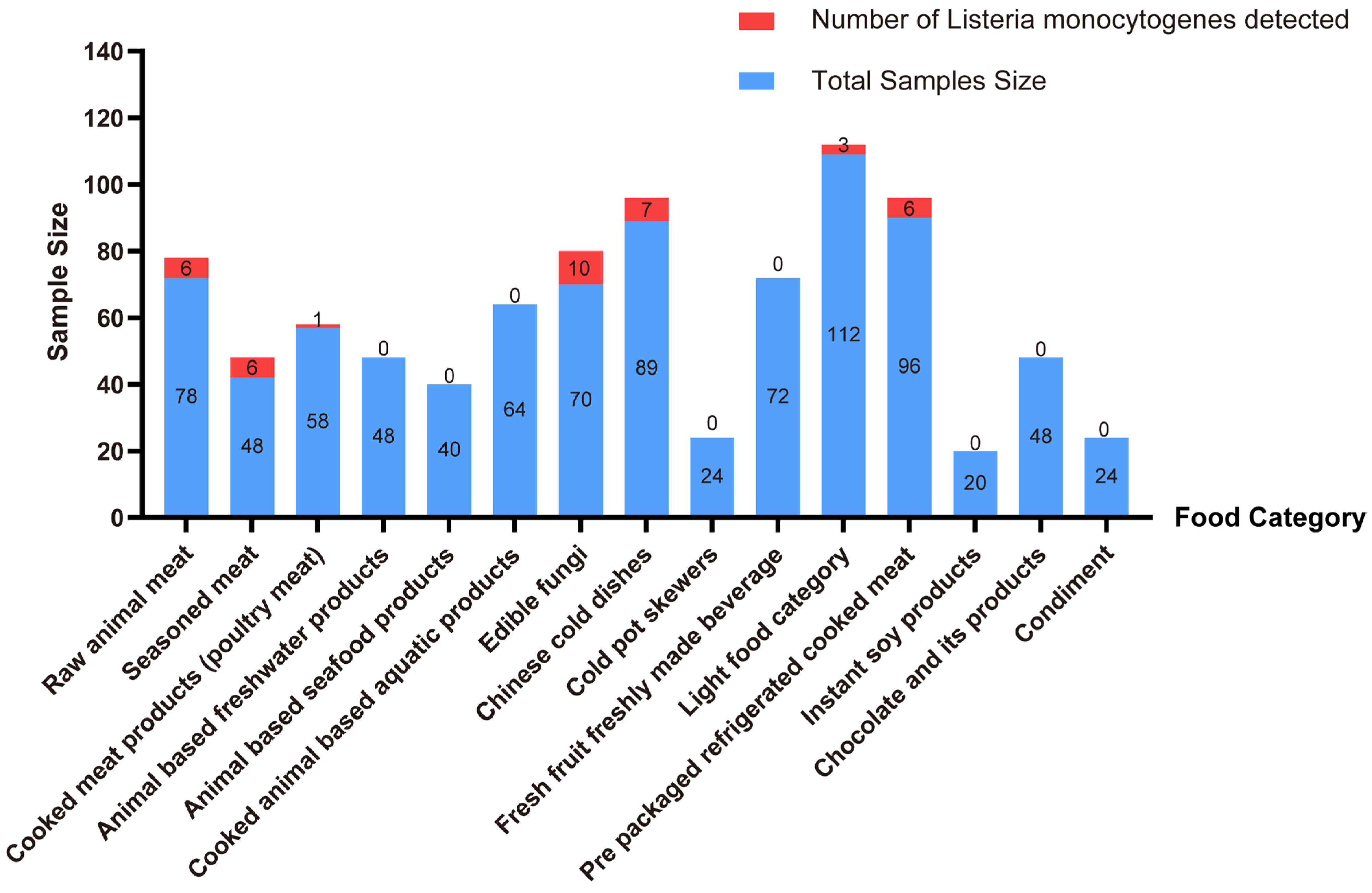
A total of 908 food products were collected for the 2023 to 2024 national food safety risk monitoring in Jiaxing City, in which 39 strains of Lm were detected (4.30%). Among them, the isolation rates in seasoned meat (12.50%, 6/48), edible fungi (12.50%, 10/80), raw animal meat (10.41%, 5/48), and cold Chinese dishes (7.29%, 7/96) were relatively high (Figure 1).

3.2. Serotype Identification

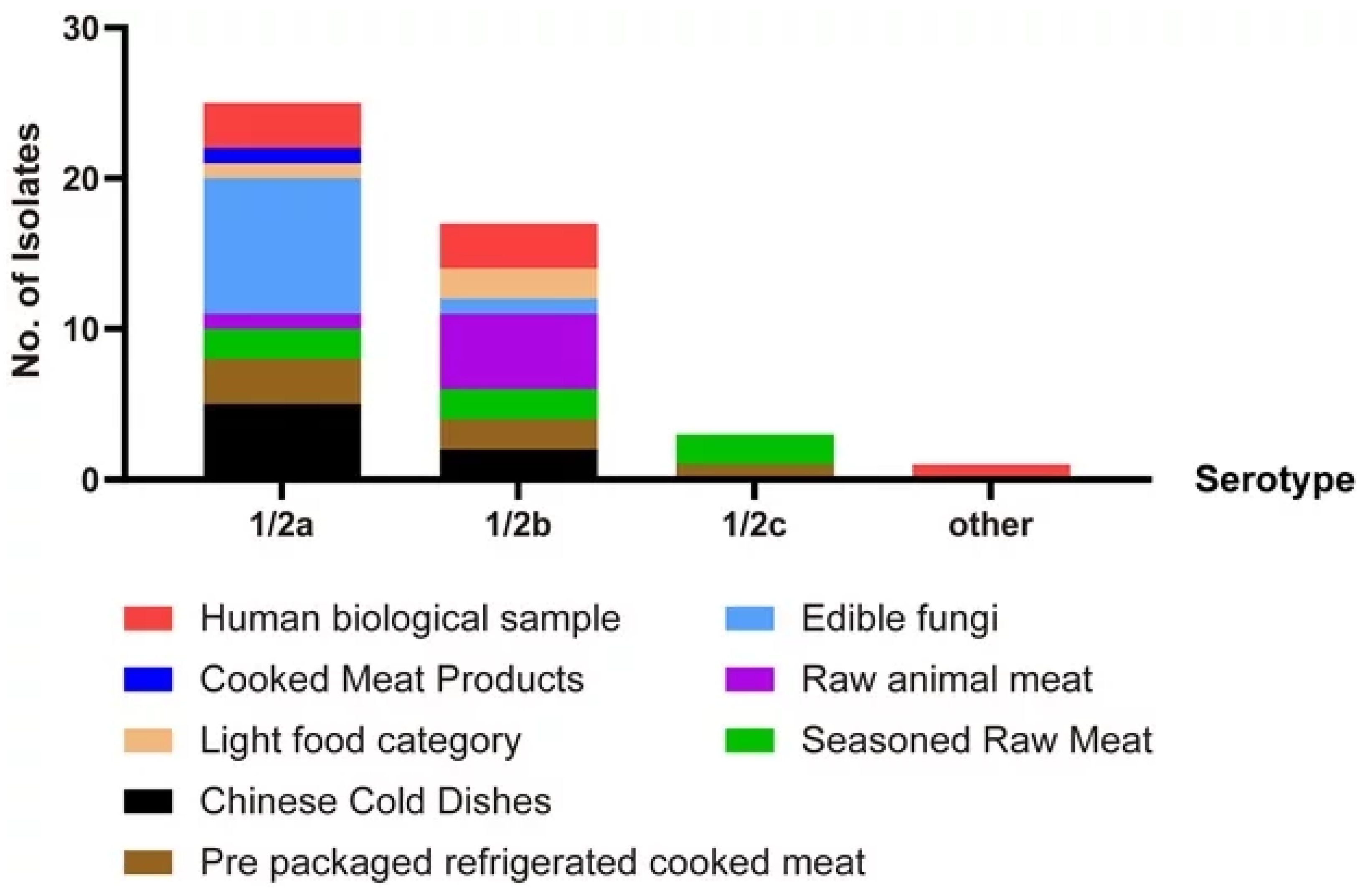
PCR results were used to classify the 46 strains of Lm into four serotypes. The 1/2a serotype was dominant, with 25 strains (54.35%), followed by 17 strains of 1/2b (36.96%), 3 strains of 1/2c (6.52%), and 1 strain of other serotypes (2.17%). In addition, 1/2a and 1/2b were widely distributed (Figure 2).

3.3. Lineage, ST, and CC Distribution

Of the 46 Lm strains, 39 were from food isolates and 7 were from clinical isolates. Among the food isolates, lineage II accounted for 66.67%, and lineage I accounted for 33.33%. The bacterium was divided into 13 STs, with 13 strains of the ST8 type being the highest number, accounting for 33.33%; there were 5 strains of the ST87 type, accounting for 12.87%. Among them, strains LMJX2321 and LMJX2402 are newly applied sequence types (STs) by our center, via the website https://bigsdb.pasteur.fr/, accessed on 1 September 2025, with their corresponding numbers being ST3210 and ST3405, respectively. Among the seven clinical isolates, lineage I accounted for 57.14%, and lineage II accounted for 42.86%, while there were three STs and four ST87 strains, accounting for 57.14%. In total, 14 clonal complexes (CCs) were identified, with CC8 being the dominant group, accounting for 28.26% (Table 1).

3.4. Virulence Factors

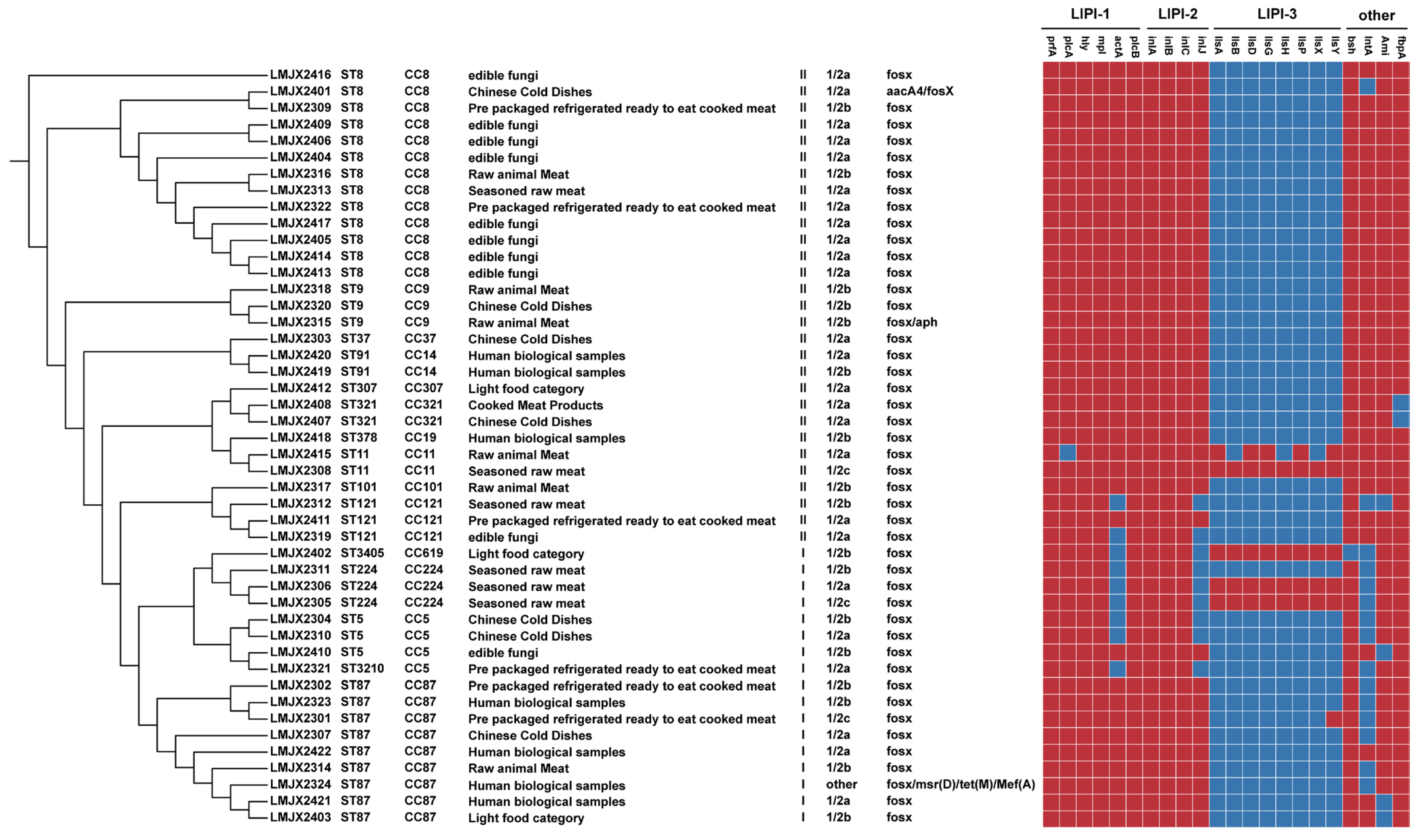
The 46 strains from the Lm samples all contain LIPI-1 and LIPI-2, as shown in Figure 3. The positive rates of the prfA, hly, mpl, and plcB genes in LIPI-1, as well as the virulence genes inlA, inlB, and inlC related to LIPI-2, were all 100%. The actA gene of LIPI-1 and the inlj gene of LIPI-2 were deleted in 19.57% (9/46) of the isolates. Five strains carrying LIPI-3 were isolated from prepared meat, light food, and raw animal meat. One strain carrying part of the virulence gene of LIPI-3 belongs to ST619 and pedigree I. The carrying rate of virulence genes of two strains was 100%, belonging to ST224 of lineage I, while the other two strains also carried all eight virulence genes of LIPI-3, belonging to ST11 of lineage II.

3.5. Resistance Factors and Results of Antimicrobial Susceptibility Testing

In this study, all 46 strains carried fosX resistance genes, with LMJX2315 carrying both aph resistance genes and LMJX2324 carrying both msr (D), tet (M), and Mef (A) resistance genes. LMJX2401 also carried the aaca4 resistance gene. All the above resistance genes were chromosomally located.
According to the standards of CLSI M45-a32015 and EUCAST, the overall drug resistance rate of the 46 strains was 13.04% (6/46). Resistance to penicillin and meropenem was observed in 2.17% (1/46) of isolates, resistance to ampicillin in 4.35% (2/46), and resistance to erythromycin and trimethoprim–sulfamethoxazole in 6.52% (3/46). Among the resistant isolates, four strains were resistant to a single antibiotic, one strain was resistant to two antibiotics, and one strain exhibited resistance to four antibiotics, qualifying as a multidrug-resistant strain. The multidrug resistance rate was therefore 2.17% (1/46) (Table 2).

4. Discussion

In this study, 908 food samples from different sources and ingredients in Jiaxing from 2023 to 2024 were detected. Of these, 39 samples were positive for Lm, representing an overall positive rate of 4.30%. The contamination rate of ready-to-eat food in Beijing is 7.11% [26], significantly higher than those of Heishan (0.7%) [27], Tokyo [28], Huzhou, Japan (2.4%) [29], and bulk retail food stores in Zhejiang Province (2.2%) [30]. This difference may be related to the sample size and composition, region, sanitary conditions, etc.
Lm is classified into 13 serotypes (1/2a, 1/2b, 1/2c, 4b, 3a, 3b, 3c, 4a, 4c, 4e, 4ab, 4d, and 7) based on serological reactions targeting flagellar (H) and somatic (O) antigens [31]. In the present study, the predominant serotypes of the 46 isolates were 1/2b, 1/2a, 1/2c, and others (except 1/2a, 1/2b, 1/2c, and 4b). These findings are consistent with the major serotypes that are reported to be prevalent in China [30,32,33,34]. However, unlike clinical isolates from countries such as France and Australia, where serotype 4b is the most prevalent [35,36], our study found 1/2a to be the dominant serotype, accounting for 54.53% of the total, followed by 1/2b, with 36.96%. Serotype 1/2a is widely distributed in various foods, which may be related to its more ready formation of biofilm and dominant position in the biofilm of mixed flora [37], making it more adaptable to different environments than other strains. Espinosa Mata et al. reported that the detection rate of serogroup 4B in Lm isolated from cheese was the highest [38]. In this study, the positive rate of 1/2a in edible fungi was as high as 90.9%, while the isolation rate of 1/2a in cold Chinese dishes was 71.4%, and the prevalence rate of 1/2b in raw meat was 83.33%. Whether there are specific dominant serotypes in different foods is worthy of further study. In this study, the serotype of one strain with other serotypes remains to be determined. In history, there have been numerous disease outbreaks caused by the change in the Lm serotype [2,39]. Relevant departments need to strengthen their monitoring to reduce the risk of foodborne listeriosis outbreaks.
According to genomic phylogeny, Lm can be classified into four lineages from I to IV. Among them, lineage I has a higher proportion of strains that were isolated from clinical cases and is associated with outbreaks of listeriosis, while lineage II is predominantly composed of strains isolated from food contamination and the environment [4,40]. The results of this study showed that lineage II was the main food isolate (66.67%), while lineage I was the dominant clinical isolate (57.14%), which was consistent with the conclusion of a previous study. In China, the most prevalent subtypes of Lm isolated from food sources are ST9 (29.1%), ST8 (10.7%), and ST87 (9.2%) [41,42,43]. The results of this study are slightly different: There are several STs in food isolates in Jiaxing, with ST8 (33.33%) and ST87 (12.82%) being the dominant STs. Studies have shown that the plasmid carried by ST8 helps improve its tolerance to high temperatures, salinity, acidic environments, oxidative stress, and disinfectants [44], in order to enhance its ability to become widely distributed and persist. In this study, 13 ST8 isolates accounted for 61.54% (8/13) of the edible fungi, which could be related to the acid–base environment and the impact of pollution on the soil in which common edible fungi are cultivated. In this study, the proportion of the ST87 genotype in clinical isolates was as high as 57.14% (4/7), and all these isolates came from critically ill patients, which was consistent with the main epidemic types of cases in China [30,45,46,47]. This suggests that the proportion of high-virulence epidemic strains of Lm in Jiaxing was relatively high. The proportion of ST87 in food isolates was only 12.82% (5/39), and there was a significant statistical difference in the distribution of ST87 between the two types of strains (p = 0.0166). It has been reported that the contaminated ST87 strain in ready-to-eat food is associated with clinical cases, suggesting that ST87 may be a high-risk genotype with strong pathogenicity and infection potential [48]. Four of the five ST87 strains that were isolated from food in this study came from chilled cooked meat, cold Chinese dishes, salads, and other ready-to-eat foods. Although no evidence of a direct correlation between ready-to-eat food and Lm in patients was found in this study, considering the dominant distribution of Lm ST87 in clinical isolates, it is still necessary to conduct in-depth research and monitoring at the molecular level for an extended period of time. ST3210 and ST3405 were both newly discovered in this study, which suggests that Lm in Jiaxing has undergone molecular-level variation and evolution, a phenomenon that warrants close monitoring by public health authorities.
The presence of virulence factors in Lm can reflect the different levels of harm caused by Lm strains. WGS allows for the identification of genes that are associated with high-pathogenicity islands. In the present study, 78.26% (36/46) of the isolates carried intact LIPI-1 and LIPI-2 virulence factors, suggesting that these virulence genes are relatively conserved in Lm. actA is critical for bacterial aggregation and biofilm formation [49], while the inlJ gene is directly involved in the passage through the intestinal barrier and the subsequent stages of infection [50] and a key virulence factor in Lm. In the present study, 19.57% (9/46) of the strains were deficient in both actA and inlJ, indicating possible gene loss in less pathogenic strains. The llsX gene in LIPI-3 enhances the hemolytic activity and cytotoxicity of Lm, altering the host microbiota during infection [51]. Five strains in this study carried the virulence factor of LIPI-3 and were isolated from seasoned raw meat, light food, and raw animal meat. One of these belonged lineage I (ST619), while two belonged to lineage I (ST224), carrying all virulence genes of LIPI-3, which has previously been reported in a corresponding study in Zhejiang [30]. Another two strains were found to belong to lineage II (ST11), with full virulence factor carriage (100%). This challenges previous findings that LIPI-3 is exclusive to lineage I [4,25,46,52], suggesting changes in virulence gene profiles. Food safety monitoring should therefore be strengthened.
The overall drug resistance rate of the 46 isolates analyzed in this study was 13.04%. The most effective drugs for treating listeriosis are penicillin and ampicillin. The foodborne Lm isolate from Jiaxing showed resistance to first-line clinical drugs (penicillin, ampicillin, and erythromycin), and multiple drug-resistant strains appeared, which aligns with previous national and international studies [53,54,55,56]. A strain from a ready-to-eat Chinese salad is resistant to four drugs (AMP-ERY-SXT-MEM), and its potential risk should not be ignored. Another strain isolated from Lm patient serum was resistant to both ERY and SXT. This shows that multidrug resistance occurs not only in food, but also in patients. Although the sample size of this study is limited compared with a large number of domestic and international studies, the results are somewhat biased. However, the emergence of multidrug-resistant strains also calls for attention. Through the establishment of an accurate monitoring system, real-time mastery of antimicrobial resistance trends could be achieved, in order to provide a scientific basis for the rational use of clinical medication and effectively curb the dissemination and proliferation of antimicrobial-resistant strains to protect public health.
This study is based on the monitoring data for Lm in Jiaxing from 2023 to 2024. Due to the limitation of the overall sample size, our conclusions may have some limitations. Firstly, there are only seven clinical isolates in this study, and the sample size is small, which may lead to deviation in the results. In the future, long-term monitoring should be carried out to expand the sample size. At the same time, combined with the results of virulence gene expression detection (such as mRNA or protein level) and other experiments, our understanding of the high-virulence pathogenic mechanism and clinical harm of st87 and other genotypes was further improved. Secondly, as a part of the food risk monitoring program in Zhejiang Province, the insufficient sample size in some food sample categories (such as 20 ready-to-eat bean products, 24 cold pot noodles, and 24 condiments) also lead to estimation bias regarding the prevalence of Lm in these categories, making it difficult to objectively reflect the real pollution level. Finally, this study did not cover the entire food chain from raw material procurement, processing, and storage to sales in its sampling and could not locate the key link of pollution. For food categories with high positive rates, future studies may sample the entire food production chain or implement processing and sales links to clarify pollution links and subsequently employ more targeted prevention and control measures.

5. Conclusions

Our findings reveal that Lm in Jiaxing has undergone molecular-level variations, exhibited diverse serotype distributions, and shown changes in virulence factor profiles. The emergence of strains that are resistant to first-line therapies and multidrug-resistant variants highlights the need for increased vigilance and ongoing in-depth investigation by relevant authorities. In the future, long-term monitoring and further research are needed to comprehensively reveal the evolutionary law and pathogenic mechanism of this strain and provide a scientific basis for formulating accurate prevention and control strategies.

Author Contributions

Conceptualization, L.G. and W.G.; methodology, P.L.; software, M.J.; validation, H.W. and X.L.; formal analysis, P.H.; investigation, P.H.; resources, G.Z.; data curation, L.G.; writing—original draft preparation, L.G.; writing—review and editing, Y.Y.; visualization, M.J.; supervision, X.L.; project administration, G.Z.; funding acquisition, Y.Y. All authors have read and agreed to the published version of the manuscript.

Funding

This study was supported by the Science and Technology Bureau of Jiaxing City: No. 2024AY30022, Disease Prevention and Control Innovation Team of Zhejiang Province: 2026JKP-07 and Science and the Medical Science and Technology Program of Zhejiang Province (2024KY1697).

Institutional Review Board Statement

This study was approved by the Jiaxing Municipal Center for Disease Control and Prevention Ethics Committee (2024-01, approved on 1 March 2024).

Informed Consent Statement

The human strains in this project come from the data of the “Zhejiang Province Foodborne Pathogen Activity Monitoring Project (2023 and 2024)”. According to protocol, designated hospitals will test positive for the strain and send strains directly to the Centers for Disease Control and Prevention for further analysis. The results are then recorded in the national foodborne monitoring and reporting system, which defaults to reporting information without the patient’s consent. This article does not involve any personal information on patients and only analyzes bacterial strains.

Data Availability Statement

The data used in this study are owned by the Jiaxing Center for Disease Control and Prevention and were made available for this research to support related management activities. These data can be requested from the corresponding authors. For inquiries, kindly direct requests to the Jiaxing Center for Disease Control and Prevention, through the corresponding (G.Z.) or first author (L.G.).

Conflicts of Interest

The authors declare no conflicts of interest.

References

  1. Matle, I.; Mbatha, K.R.; Madoroba, E. A review of Listeria monocytogenes from meat and meat products: Epidemiology, virulence factors, antimicrobial resistance and diagnosis. Onderstepoort J. Vet. Res. 2020, 87, e1–e20. [Google Scholar] [CrossRef] [PubMed]
  2. Garner, D.; Kathariou, S. Fresh Produce-Associated Listeriosis Outbreaks, Sources of Concern, Teachable Moments, and Insights. J. Food Prot. 2016, 79, 337–344. [Google Scholar] [CrossRef] [PubMed]
  3. Maurella, C.; Gallina, S.; Ru, G.; Adriano, D.; Bellio, A.; Bianchi, D.M.; Chiavacci, L.; Crescio, M.I.; Croce, M.; D’Errico, V.; et al. Outbreak of febrile gastroenteritis caused by Listeria monocytogenes 1/2a in sliced cold beef ham, Italy, May 2016. Euro. Surveill. 2018, 23, 17-00155. [Google Scholar] [CrossRef]
  4. Orsi, R.H.; den Bakker, H.C.; Wiedmann, M. Listeria monocytogenes lineages: Genomics, evolution, ecology, and phenotypic characteristics. Int. J. Med. Microbiol. IJMM 2011, 301, 79–96. [Google Scholar] [CrossRef]
  5. European Food Safety Authority; European Centre for Disease Prevention and Control. The European Union One Health 2023 Zoonoses report. EFSA J. Eur. Food Saf. Auth. 2024, 22, e9106. [Google Scholar] [CrossRef]
  6. Choi, M.H.; Park, Y.J.; Kim, M.; Seo, Y.H.; Kim, Y.A.; Choi, J.Y.; Yong, D.; Jeong, S.H.; Lee, K. Increasing Incidence of Listeriosis and Infection-associated Clinical Outcomes. Ann. Lab. Med. 2018, 38, 102–109. [Google Scholar] [CrossRef]
  7. Zhang, Y.; Liu, Y.Z.; Zhang, P.H.; Wang, D.; Zhang, X.Y. Genomic characteristics and antimicrobial resistance of Listeria monocytogenes isolated from food in Beijing, City 2022. Chin. J. Prev. Med. 2025, 59, 997–1003. [Google Scholar] [CrossRef]
  8. Terzi Gulel, G.; Gucukoglu, A. Serotyping and antibiotic resistance of Listeria monocytogenes isolated from raw water buffalo milk and milk products. J. Food Sci. 2020, 85, 2889–2895. [Google Scholar] [CrossRef]
  9. Iannetti, L.; Schirone, M.; Neri, D.; Visciano, P.; Acciari, V.A.; Centorotola, G.; Mangieri, M.S.; Torresi, M.; Santarelli, G.A.; Di Marzio, V.; et al. Listeria monocytogenes in poultry: Detection and strain characterization along an integrated production chain in Italy. Food Microbiol. 2020, 91, 103533. [Google Scholar] [CrossRef] [PubMed]
  10. Feng, Y.; Wu, S.; Varma, J.K.; Klena, J.D.; Angulo, F.J.; Ran, L. Systematic review of human listeriosis in China, 1964–2010. Trop. Med. Int. Health TM IH 2013, 18, 1248–1256. [Google Scholar] [CrossRef]
  11. Fan, Z.; Xie, J.; Li, Y.; Wang, H. Listeriosis in mainland China: A systematic review. Int. J. Infect. Dis. 2019, 81, 17–24. [Google Scholar] [CrossRef]
  12. Félix, B.; Capitaine, K.; Te, S.; Felten, A.; Gillot, G.; Feurer, C.; van den Bosch, T.; Torresi, M. Identification by High-Throughput Real-Time PCR of 30 Major Circulating Listeria monocytogenes Clonal Complexes in Europe. Microbiol. Spectr. 2023, 11, e0395422. [Google Scholar] [CrossRef] [PubMed]
  13. Pyz-Łukasik, R.; Paszkiewicz, W. Genetic Diversity and Potential Virulence of Listeria monocytogenes Isolates Originating from Polish Artisanal Cheeses. Foods 2022, 11, 2805. [Google Scholar] [CrossRef] [PubMed]
  14. Pontello, M.; Guaita, A.; Sala, G.; Cipolla, M.; Gattuso, A.; Sonnessa, M.; Gianfranceschi, M.V. Listeria monocytogenes serotypes in human infections (Italy, 2000–2010). Ann. Dell’istituto Super. Di Sanita 2012, 48, 146–150. [Google Scholar] [CrossRef] [PubMed]
  15. Chen, M.; Cheng, J.; Wu, Q.; Zhang, J.; Chen, Y.; Zeng, H.; Ye, Q.; Wu, S.; Cai, S.; Wang, J.; et al. Prevalence, Potential Virulence, and Genetic Diversity of Listeria monocytogenes Isolates From Edible Mushrooms in Chinese Markets. Front. Microbiol. 2018, 9, 1711. [Google Scholar] [CrossRef]
  16. Su, X.; Cao, G.; Zhang, J.; Pan, H.; Zhang, D.; Kuang, D.; Yang, X.; Xu, X.; Shi, X.; Meng, J. Characterization of internalin genes in Listeria monocytogenes from food and humans, and their association with the invasion of Caco-2 cells. Gut Pathog. 2019, 11, 30. [Google Scholar] [CrossRef]
  17. Rocourt, J.; Jacquet, C.; Reilly, A. Epidemiology of human listeriosis and seafoods. Int. J. Food Microbiol. 2000, 62, 197–209. [Google Scholar] [CrossRef]
  18. Song, Y.; Gao, B.; Cai, H.; Qin, X.; Xia, X.; Dong, Q.; Hirata, T.; Li, Z. Comparative analysis of virulence in Listeria monocytogenes: Insights from genomic variations and in vitro cell-based studies. Int. J. Food Microbiol. 2025, 435, 111188. [Google Scholar] [CrossRef]
  19. Yin, Y.; Yao, H. A hybrid sub-lineage of Listeria monocytogenes comprising hypervirulent isolates. Nat. Commun. 2019, 10, 4283. [Google Scholar] [CrossRef]
  20. Maury, M.M.; Tsai, Y.H.; Charlier, C.; Touchon, M.; Chenal-Francisque, V.; Leclercq, A.; Criscuolo, A.; Gaultier, C.; Roussel, S.; Brisabois, A.; et al. Uncovering Listeria monocytogenes hypervirulence by harnessing its biodiversity. Nat. Genet. 2016, 48, 308–313. [Google Scholar] [CrossRef]
  21. Wiktorczyk-Kapischke, N.; Skowron, K.; Wałecka-Zacharska, E. Genomic and pathogenicity islands of Listeria monocytogenes-overview of selected aspects. Front. Mol. Biosci. 2023, 10, 1161486. [Google Scholar] [CrossRef]
  22. Heger, W.; Dierich, M.P.; Allerberger, F. In vitro susceptibility of Listeria monocytogenes: Comparison of the E test with the agar dilution test. Chemotherapy 1997, 43, 303–310. [Google Scholar] [CrossRef]
  23. Maung, A.T.; Abdelaziz, M.N.S.; Mohammadi, T.N.; Zhao, J.; Ei-Telbany, M.; Nakayama, M.; Matsusita, K.; Masuda, Y.; Honjoh, K.I.; Miyamoto, T. Comparison of prevalence, characterization, antimicrobial resistance and pathogenicity of foodborne Listeria monocytogenes in recent 5 years in Japan. Microb. Pathog. 2023, 183, 106333. [Google Scholar] [CrossRef]
  24. Pérez-Rodríguez, F.; Mercanoglu Taban, B. A State-of-Art Review on Multi-Drug Resistant Pathogens in Foods of Animal Origin: Risk Factors and Mitigation Strategies. Front. Microbiol. 2019, 10, 2091. [Google Scholar] [CrossRef] [PubMed]
  25. Shen, J.; Zhang, G.; Yang, J.; Zhao, L.; Jiang, Y.; Guo, D.; Wang, X.; Zhi, S.; Xu, X.; Dong, Q.; et al. Prevalence, antibiotic resistance, and molecular epidemiology of Listeria monocytogenes isolated from imported foods in China during 2018 to 2020. Int. J. Food Microbiol. 2022, 382, 109916. [Google Scholar] [CrossRef]
  26. Wang, W.; Yan, S.; Bai, L.; Li, Z.; Du, C.; Li, F. Quantitative detection on contamination of Listeria monocytogenes isolated from retail ready-to-eat meats in Beijing. J. Hyg. Res. 2015, 44, 918–921. [Google Scholar]
  27. Daza Prieto, B.; Pietzka, A.; Martinovic, A.; Ruppitsch, W.; Zuber Bogdanovic, I. Surveillance and genetic characterization of Listeria monocytogenes in the food chain in Montenegro during the period 2014–2022. Front. Microbiol. 2024, 15, 1418333. [Google Scholar] [CrossRef] [PubMed]
  28. Shimojima, Y.; Ida, M.; Nakama, A.; Nishino, Y.; Fukui, R.; Kuroda, S.; Hirai, A.; Kai, A.; Sadamasu, K. Prevalence and contamination levels of Listeria monocytogenes in ready-to-eat foods in Tokyo, Japan. J. Vet. Med. Sci. 2016, 78, 1183–1187. [Google Scholar] [CrossRef]
  29. Zhang, P.; Ji, L.; Wu, X.; Chen, L.; Yan, W.; Dong, F. Prevalence, Genotypic Characteristics, and Antibiotic Resistance of Listeria monocytogenes From Retail Foods in Huzhou, China. J. Food Prot. 2024, 87, 100307. [Google Scholar] [CrossRef]
  30. Zhang, Y.; Dong, S.; Chen, H.; Chen, J.; Zhang, J.; Zhang, Z.; Yang, Y.; Xu, Z.; Zhan, L.; Mei, L. Prevalence, Genotypic Characteristics and Antibiotic Resistance of Listeria monocytogenes From Retail Foods in Bulk in Zhejiang Province, China. Front. Microbiol. 2019, 10, 1710. [Google Scholar] [CrossRef]
  31. Jadhav, S.; Bhave, M.; Palombo, E.A. Methods used for the detection and subtyping of Listeria monocytogenes. J. Microbiol. Methods 2012, 88, 327–341. [Google Scholar] [CrossRef]
  32. Li, W.W.; Guo, Y.C.; Zhan, L.; Ma, G.Z.; Yang, Z.S.; Liu, C.W.; Shen, Z.X.; Wang, D.; Zhang, X.A.; Song, X.H.; et al. Molecular epidemiology of Listeria monocytogenes isolated from ready-to-eat food in 2017 in China. Chin. J. Prev. Med. 2020, 54, 175–180. [Google Scholar] [CrossRef]
  33. Angelidis, A.S.; Grammenou, A.S.; Kotzamanidis, C. Prevalence, Serotypes, Antimicrobial Resistance and Biofilm-Forming Ability of Listeria monocytogenes Isolated from Bulk-Tank Bovine Milk in Northern Greece. Pathogens 2023, 12, 837. [Google Scholar] [CrossRef]
  34. Bouymajane, A.; Rhazi Filali, F.; Oulghazi, S.; Lafkih, N.; Ed-Dra, A.; Aboulkacem, A.; El Allaoui, A.; Ouhmidou, B.; Moumni, M. Occurrence, antimicrobial resistance, serotyping and virulence genes of Listeria monocytogenes isolated from foods. Heliyon 2021, 7, e06169. [Google Scholar] [CrossRef]
  35. Jennison, A.V.; Masson, J.J.; Fang, N.X.; Graham, R.M.; Bradbury, M.I.; Fegan, N.; Gobius, K.S.; Graham, T.M.; Guglielmino, C.J.; Brown, J.L.; et al. Analysis of the Listeria monocytogenes Population Structure among Isolates from 1931 to 2015 in Australia. Front. Microbiol. 2017, 8, 603. [Google Scholar] [CrossRef]
  36. Mammina, C.; Aleo, A.; Romani, C.; Pellissier, N.; Nicoletti, P.; Pecile, P.; Nastasi, A.; Pontello, M.M. Characterization of Listeria monocytogenes isolates from human listeriosis cases in Italy. J. Clin. Microbiol. 2009, 47, 2925–2930. [Google Scholar] [CrossRef]
  37. Pan, Y.; Breidt, F., Jr.; Kathariou, S. Competition of Listeria monocytogenes serotype 1/2a and 4b strains in mixed-culture biofilms. Appl. Environ. Microbiol. 2009, 75, 5846–5852. [Google Scholar] [CrossRef]
  38. Espinosa-Mata, E.; Mejía, L.; Villacís, J.E.; Alban, V.; Zapata, S. Detection and genotyping of Listeria monocytogenes in artisanal soft cheeses from Ecuador. Rev. Argent. Microbiol. 2022, 54, 53–56. [Google Scholar] [CrossRef] [PubMed]
  39. Gana, J.; Gcebe, N.; Moerane, R.; Ngoshe, Y.B.; Moabelo, K.; Adesiyun, A.A. Detection of Pathogenic Serogroups and Virulence Genes in Listeria monocytogenes Strains Isolated from Beef and Beef Products Retailed in Gauteng Province, South Africa, Using Phenotypic and Polymerase Chain Reaction (PCR)-Based Methods. Int. J. Microbiol. 2024, 2024, 8891963. [Google Scholar] [CrossRef]
  40. Lee, B.H.; Garmyn, D.; Gal, L.; Guérin, C.; Guillier, L.; Rico, A.; Rotter, B.; Nicolas, P.; Piveteau, P. Exploring Listeria monocytogenes Transcriptomes in Correlation with Divergence of Lineages and Virulence as Measured in Galleria mellonella. Appl. Environ. Microbiol. 2019, 85, e01370-19. [Google Scholar] [CrossRef] [PubMed]
  41. Ji, S.; Song, Z.; Luo, L.; Wang, Y.; Li, L.; Mao, P.; Ye, C.; Wang, Y. Whole-genome sequencing reveals genomic characterization of Listeria monocytogenes from food in China. Front. Microbiol. 2023, 13, 1049843. [Google Scholar] [CrossRef] [PubMed]
  42. He, Y.; Luo, Z.; Deng, H.; Chen, Q.; Luo, Y.; Li, Z.; Tang, W.; Ling, H. Genomic Insights into Antibiotic Resistance and Virulence of Listeria monocytogenes Isolated from Chongqing, China. Foodborne Pathog. Dis. 2025, 10, 700–708. [Google Scholar] [CrossRef]
  43. Zhang, X.; Liu, Y.; Zhang, P.; Niu, Y.; Chen, Q.; Ma, X. Genomic Characterization of Clinical Listeria monocytogenes Isolates in Beijing, China. Front. Microbiol. 2021, 12, 751003. [Google Scholar] [CrossRef] [PubMed]
  44. Naditz, A.L.; Dzieciol, M.; Wagner, M.; Schmitz-Esser, S. Plasmids contribute to food processing environment-associated stress survival in three Listeria monocytogenes ST121, ST8, and ST5 strains. Int. J. Food Microbiol. 2019, 299, 39–46. [Google Scholar] [CrossRef]
  45. Yu, W.; Huang, Y.; Ying, C.; Zhou, Y.; Zhang, L.; Zhang, J.; Chen, Y.; Qiu, Y. Analysis of Genetic Diversity and Antibiotic Options for Clinical Listeria monocytogenes Infections in China. Open Forum Infect. Dis. 2021, 8, ofab177. [Google Scholar] [CrossRef]
  46. Li, W.; Bai, L.; Fu, P.; Han, H.; Liu, J.; Guo, Y. The Epidemiology of Listeria monocytogenes in China. Foodborne Pathog. Dis. 2018, 15, 459–466. [Google Scholar] [CrossRef]
  47. Wang, Y.; Jiao, Y.; Lan, R.; Xu, X.; Liu, G.; Wang, X.; Zhang, L.; Pang, H.; Jin, D.; Dai, H.; et al. Characterization of Listeria monocytogenes isolated from human Listeriosis cases in China. Emerg. Microbes Infect. 2015, 4, e50. [Google Scholar] [CrossRef]
  48. Wang, H.; Luo, L.; Zhang, Z.; Deng, J.; Wang, Y.; Miao, Y.; Zhang, L.; Chen, X.; Liu, X.; Sun, S.; et al. Prevalence and molecular characteristics of Listeria monocytogenes in cooked products and its comparison with isolates from listeriosis cases. Front. Med. 2018, 12, 104–112. [Google Scholar] [CrossRef]
  49. Travier, L.; Guadagnini, S.; Gouin, E.; Dufour, A.; Chenal-Francisque, V.; Cossart, P.; Olivo-Marin, J.C.; Ghigo, J.M.; Disson, O.; Lecuit, M. ActA promotes Listeria monocytogenes aggregation, intestinal colonization and carriage. PLoS Pathog. 2013, 9, e1003131. [Google Scholar] [CrossRef]
  50. Sabet, C.; Toledo-Arana, A.; Personnic, N.; Lecuit, M.; Dubrac, S.; Poupel, O.; Gouin, E.; Nahori, M.A.; Cossart, P.; Bierne, H. The Listeria monocytogenes virulence factor InlJ is specifically expressed in vivo and behaves as an adhesin. Infect. Immun. 2008, 76, 1368–1378. [Google Scholar] [CrossRef] [PubMed]
  51. Chen, Y.; Chen, M.; Wang, J.; Wu, Q.; Cheng, J.; Zhang, J.; Sun, Q.; Xue, L.; Zeng, H.; Lei, T.; et al. Heterogeneity, Characteristics, and Public Health Implications of Listeria monocytogenes in Ready-to-Eat Foods and Pasteurized Milk in China. Front. Microbiol. 2020, 11, 642. [Google Scholar] [CrossRef]
  52. Tavares, R.M.; Silva, D.; Camargo, A.C.; Yamatogi, R.S.; Nero, L.A. Interference of the acid stress on the expression of llsX by Listeria monocytogenes pathogenic island 3 (LIPI-3) variants. Food Res. Int. (Ott. Ont.) 2020, 132, 109063. [Google Scholar] [CrossRef] [PubMed]
  53. Skowron, K.; Wałecka-Zacharska, E. Assessment of the Prevalence and Drug Susceptibility of Listeria monocytogenes Strains Isolated from Various Types of Meat. Foods 2020, 9, 1293. [Google Scholar] [CrossRef] [PubMed]
  54. Yan, H.; Neogi, S.B.; Mo, Z.; Guan, W.; Shen, Z.; Zhang, S.; Li, L.; Yamasaki, S.; Shi, L.; Zhong, N. Prevalence and characterization of antimicrobial resistance of foodborne Listeria monocytogenes isolates in Hebei province of Northern China, 2005–2007. Int. J. Food Microbiol. 2010, 144, 310–316. [Google Scholar] [CrossRef] [PubMed]
  55. Maung, A.T.; Mohammadi, T.N.; Nakashima, S.; Liu, P.; Masuda, Y.; Honjoh, K.I.; Miyamoto, T. Antimicrobial resistance profiles of Listeria monocytogenes isolated from chicken meat in Fukuoka, Japan. Int. J. Food Microbiol. 2019, 304, 49–57. [Google Scholar] [CrossRef]
  56. Chen, P.; Cheng, F.; Huang, Q.; Dong, Y.; Sun, P.; Peng, Q. Distribution and Antimicrobial Resistance Characterization of Listeria monocytogenes in Poultry Meat in Jiading District, Shanghai. J. Food Prot. 2024, 87, 100234. [Google Scholar] [CrossRef]
Figure 1. Detection of L. monocytogenes in different food sources.
Pathogens 15 00109 g001
Figure 2. Schematic diagram of sample composition of different serotypes of Listeria monocytogenes.
Pathogens 15 00109 g002
Figure 3. Phenotypic and genotypic characterization of Lm strains isolated from food and patients in Jiaxing City, China. Dendrogram of MLSTs, STs, CC types, PCR serotypes, antibiotic resistance profiles, and virulence factors were mapped using the ComplexHeatmap package. Legend: Red indicates the existence of the virulence gene, and blue indicates the deletion of the virulence gene.
Pathogens 15 00109 g003
Table 1. Distribution of Lm lineages, CCs, and STs of 46 strains.
Strain CategoryLineageCCSTNo. of StrainsProportion of Category (%)Proportion of Total Strains (%)
Food isolates
(39 strains)
I 1230.7726.09
CC5ST537.696.52
ST321012.562.17
CC224ST22437.696.52
CC87ST8737.696.52
CC619ST340512.562.17
II 2769.2358.70
CC8ST81333.3328.26
CC101ST10112.562.17
CC121ST12137.696.52
CC37ST3712.562.17
CC11ST1125.134.35
CC9ST937.696.52
CC321ST32125.134.35
CC307ST30712.562.17
Clinical isolates
(7 strains)
I 457.148.70
CC87ST87457.148.70
II 342.866.52
CC19ST378114.292.17
CC14ST91228.574.35
Total strainsI 16 34.78
II 30 65.22
46 100
Table 2. Resistance profile of Lm (n = 46).
No. of Antibiotic-
Resistant Profiles
Antibiotic-Resistant ProfileNo. of StrainsStrain SourcePercentage (%)
0 40-86.96
1 4 8.70
AMP1Duck wing2.17
ERY1Cold Chinese dishes2.17
SXT1Salad2.17
MEM1Edible fungi2.17
2ERY-SXT1Human serum2.17
4AMP-ERY-SXT-PEN1Cold Chinese Dishes2.17
Legend: 1 “AMP”—ampicillin; “ERY”—erythromycin; “SXT”—trimethoprim–sulfamethoxazole; “MEM”—meropenem; “PEN”—penicillin. 2 “ERY-SXT” indicates simultaneous resistance to erythromycin and compound sulfamethoxazole, while “AMP-ERY-SXT-PEN” indicates simultaneous resistance to ampicillin, erythromycin, compound sulfamethoxazole, and penicillin. 3 “-” represents all 40 strains of bacteria except drug-resistant bacteria, including 5 strains from cold Chinese dishes, 1 strain from cooked meat products, 9 strains from edible fungi, 6 strains from human biological samples, 2 strains from the light food category, 5 strains from prepackaged and refrigerated ready-to-eat cooked meat, 6 strains from seasoned raw meat, and 6 strains from raw animal meat.
Disclaimer/Publisher’s Note: The statements, opinions and data contained in all publications are solely those of the individual author(s) and contributor(s) and not of MDPI and/or the editor(s). MDPI and/or the editor(s) disclaim responsibility for any injury to people or property resulting from any ideas, methods, instructions or products referred to in the content.