Article

Leishmaniavirus Type 1 Enhances In Vitro Infectivity and Modulates the Immune Response to Leishmania (Viannia) Isolates


by
Armando A. Bonilla Fong
1,†,
Vanessa J. Pineda
2,†,
José E. Calzada
2,3,
Marcia Dalastra Laurenti
4,
Luiz Felipe Domingues Passero
5,6,
Davis Beltran
7,
Luis Fernando Chaves
8,9,*,
Azael Saldaña
10,* and
Kadir González
2,11,*
1
Programa de Maestría en Ciencias Parasitológicas, Facultad de Ciencias Naturales, Exactas y Tecnología, Universidad de Panamá, Panamá 0816-3366, Panama
2
Departamento de Investigación en Parasitología, Instituto Conmemorativo Gorgas de Estudios de la Salud, Panamá 0816-02593, Panama
3
Facultad de Medicina Veterinaria, Universidad de Panamá, Panamá 0816-3366, Panama
4
Laboratório de Patologia de Moléstias Infecciosas, Faculdade de Medicina, Universidade de São Paulo, São Paulo 01246-903, SP, Brazil
5
Institute of Biosciences, São Paulo State University (UNESP), São Vicente 11330-900, SP, Brazil
6
Institute for Advanced Studies of Ocean, São Paulo State University (UNESP), São Vicente 11350-011, SP, Brazil
7
Departamento de Investigación en Virología y Biotecnología, Centro de Citometría de Flujo, Instituto Conmemorativo Gorgas de Estudios de la Salud, Panamá 0816-02593, Panama
8
Department of Environmental and Occupational Health, School of Public Health-Bloomington, Bloomington, IN 47408, USA
9
Department of Geography, Indiana University, Bloomington, IN 47407, USA
10
Centro de Investigación y Diagnóstico de Enfermedades Parasitarias (CIDEP), Facultad de Medicina, Universidad de Panamá, Panamá 0816-3366, Panama
11
Departamento de Microbiología Humana, Facultad de Medicina, Universidad de Panamá, Panamá 0816-3366, Panama
*
Authors to whom correspondence should be addressed.
These authors contributed equally to this work.
Pathogens 2025, 14(12), 1263; https://doi.org/10.3390/pathogens14121263
Submission received: 17 November 2025 / Revised: 6 December 2025 / Accepted: 8 December 2025 / Published: 10 December 2025

Abstract

Leishmania RNA virus 1 (LRV-1) is a double-stranded RNA virus identified in several Leishmania spp. LRV-1 has been associated with increased disease severity and therapeutic failure in cutaneous leishmaniasis (CL). Although LRV-1 has been reported in the Americas, its influence on parasite infectivity and host immune responses remains poorly characterized in Panamanian isolates. In this study, we investigate the in vitro infectivity and immunomodulatory effects of LRV-1-positive (LRV-1+) versus LRV-1-negative (LRV-1) isolates of Leishmania (Viannia), including clinical strains of L. (V.) panamensis and L. (V.) guyanensis. A total of 21 isolates (nine LRV-1+, nine LRV-1, and three reference strains) were used to infect human U937 macrophages. The infectivity index (II) was measured at 24, 48, and 72 h post-infection. Cytokine levels of TNF-α, IFN-γ, IL-4, IL-6, IL-10, and IL-17 were quantified by flow cytometry, and IL-1β by ELISA at 24 and 48 h. LRV-1+ isolates exhibited significantly higher infectivity at 48 h (mean II = 1386.2) and 72 h (mean II = 1316.8) compared to LRV-1 isolates (mean II = 714.4 and 571.0, respectively; p < 0.001). Two L. (V.) panamensis LRV-1+ isolates associated with complicated CL cases displayed the highest II values. Cytokine analysis revealed that LRV-1+ isolates induced elevated TNF-α (p < 0.01) and IL-1β (p < 0.001), along with reduced IFN-γ (p < 0.01), while no significant differences were observed for IL-4, IL-6, IL-10, or IL-17. These findings indicate that LRV-1 enhances parasite infectivity and promotes a pro-inflammatory cytokine profile, which may contribute to disease persistence and treatment failure.

1. Introduction

Leishmania RNA virus (LRV) is a non-enveloped, double-stranded RNA virus belonging to the family Totiviridae, known to infect protozoan parasites of the genus Leishmania in both the Old and New World. Of the four identified species (LRV-1 to LRV-4), only LRV-1 and LRV-2 have demonstrated medical relevance due to their presence in Leishmania species pathogenic to humans [1,2,3,4,5,6,7]. LRV-1 is primarily found in American Leishmania species of the Viannia and Leishmania subgenera, while LRV-2 has been identified in Old World species belonging to the Leishmania and Sauroleishmania subgenera [8,9,10,11,12,13]. First detected in L. (V.) guyanensis, LRV-1 has been increasingly associated with exacerbated clinical outcomes in cutaneous leishmaniasis (CL), including lesion reactivation, treatment failure, and mucosal involvement [5,14,15,16,17,18].
The host immune response to Leishmania is largely governed by macrophages that play a crucial role in controlling Leishmania infection. Two main macrophage populations have been described: Th1-induced M1 macrophages (classically activated macrophages), which exhibit a pro-inflammatory profile and can eliminate the parasite by producing reactive oxygen species (ROS), and Th2-induced M2 macrophages (alternatively activated macrophages), which display an anti-inflammatory profile and increase arginase activity, providing a favorable environment for Leishmania replication [19,20,21,22].
A critical feature in the pathogenesis of LRV-infected Leishmania is the virus-driven dysregulation of these immune pathways. An imbalance between pro- and anti-inflammatory cytokines facilitates parasite dissemination and persistence, exacerbating tissue damage [23,24,25]. In L. (V.) guyanensis, LRV-1 has been shown to inhibit the NLRP3 inflammasome, a key innate immune sensor that restricts Leishmania replication within macrophages [14,26], while simultaneously upregulating pro-inflammatory mediators such as tumor necrosis factor-alpha (TNF-α), interleukin-6 (IL-6), interleukin-17 (IL-17), and interferon-gamma (IFN-γ) [23,25]; and thereby promoting the persistence of the parasite by improving survival in macrophages [27].
Similar immunomodulatory effects have been described in L. (V.) braziliensis, where LRV-1 infection correlates with increased in vitro infectivity and a cytokine profile skewed toward Th2 responses, impairing parasite control [28,29]. Transcriptomic analyses of infected human macrophages revealed that LRV-1-positive L. (V.) braziliensis triggers upregulation of type I IFN signaling pathways and pattern recognition receptors, including 2′-5′-oligoadenylate synthetase/ribonuclease L (OAS/RNase L) and retinoic acid-inducible gene I (RIG-I) [30].
Geographically, LRV-1 has been reported in multiple South American countries, including French Guiana, Suriname, Bolivia, Brazil, Peru, Ecuador, Colombia, and Venezuela, infecting various Viannia species such as L. (V.) guyanensis, L. (V.) braziliensis, L. (V.) panamensis, L. (V.) shawi, L. (V.) lainsoni, L. (V.) naiffi, L. (V.) peruviana, and L. (L.) amazonensis [9,16,30,31,32,33,34,35,36]. In Central America, LRV-1 has been detected in Costa Rica and Panama, predominantly in L. (V.) panamensis [29,36,37].
According to the 2024 PAHO report, Panama remains endemic for CL, recording approximately 1000 new cases annually. L. (V.) panamensis is the principal etiological agent, responsible for ~95% of localized cutaneous leishmaniasis (LCL) cases [38,39]. Less frequent but clinically relevant presentations include mucocutaneous leishmaniasis (MCL), disseminated CL (DCL), and anergic diffuse CL (ADCL), also attributed to L. (V.) panamensis [40,41,42].
Despite its clinical relevance, studies investigating the presence and pathogenic role of LRV-1 in L. (V.) panamensis remain limited. Preliminary data suggest that, unlike in L. (V.) guyanensis or L. (V.) braziliensis, LRV-1 in L. (V.) panamensis may not modulate cytokine responses significantly [29]. However, this observation warrants further research, particularly considering emerging reports linking LRV-1 to severe or treatment-refractory CL caused by L. (V.) panamensis [17,43].
Given this context, the present study investigates the role of LRV-1 in modulating parasite infectivity and immune response in macrophages using characterized L. (V.) panamensis and L. (V.) guyanensis clinical isolates. By comparing LRV-1-positive and negative isolates in an in vitro U937 macrophage infection model, we aim to elucidate potential immunological mechanisms and assess the contribution of LRV-1 in parasite spreading and persistence. These findings may offer new insights into the role of virus–parasite interactions in the pathogenesis of Leishmania (Viannia) infections and support further investigation of LRV-1 as a potential prognostic biomarker or therapeutic target in endemic regions.

2. Materials and Methods

2.1. Leishmania Isolates and Cell Lines

Twenty-one isolates of Leishmania (Viannia) spp. were analyzed in this study. Eighteen clinical isolates were obtained from patients diagnosed with localized cutaneous leishmaniasis (LCL) in Panama and selected from the biobank of the Department of Parasitology Research at the Instituto Conmemorativo Gorgas de Estudios de la Salud (DIP-ICGES). These isolates had been cryopreserved between 2016 and 2019. The panel included nine LRV-1 positive isolates (LRV-1+), nine LRV-1 negative isolates (LRV-1), and three reference strains (Table 1).
Within both the LRV-1+ and LRV-1 groups, eight isolates were identified as L. (V.) panamensis and one as L. (V.) guyanensis. Most clinical isolates were obtained from patients with uncomplicated LCL. However, two isolates corresponded to cases with atypical clinical features: one from a patient with 11 active lesions, and another from a case showing failure to respond to three cycles of pentavalent antimonial treatment.
For in vitro infection experiments, the human U937 macrophage cell line was employed, acquired from the American Type Culture Collection (ATCC, CRL-1593.2, Manassas, VA, USA).

2.2. Ethical Considerations

This study was approved by the Institutional Bioethics Committee of the ICGES (protocol code: 267/CBI/ICGES/21). The research involved retrospective analysis of parasite isolates and did not involve studies in animals or human subjects.

2.3. Selection and Characterization of Leishmania Isolates

To compare infectivity and cytokine response, two groups were chosen: Group 1, with nine LRV-1+ isolates, and Group 2, with nine LRV-1 isolates (Table 1). Each group included one isolate of L. (V.) guyanensis and eight of L. (V.) panamensis. The reference strains included L. (V.) guyanensis LRV-1+ (MHOM/BR/1975/WR4147), L. (V.) panamensis LRV-1 (MHOM/PA/1971/LS94), and L. (V.) braziliensis LRV-1 (MHOM/BR/1975/M2903). The presence of LRV-1 had been previously confirmed by RT-PCR targeting a 240 bp fragment from the ORF1 region [36]. Parasite species were confirmed via PCR-RFLP of the Hsp-70 gene [44].

2.4. RNA Extraction and LRV-1 Detection

Parasites were thawed and cultured in Schneider’s insect medium (Gibco™, 11590576, Paisley, United Kingdom) supplemented with 25% heat-inactivated Fetal Bovine Serum (FBS, Gibco™, A56697-01, Grand Island, NY, USA) until the stationary phase. Total RNA was extracted using the RNeasy Mini Kit (QIAGEN, Hilden, Germany) and quantified with a NanoDrop 2000 spectrophotometer (Thermo Fisher Scientific, Wilmington, DE, USA). Reverse transcription was performed using the SuperScript™ IV First-Strand Synthesis SuperMix kit (Thermo Fisher Scientific, 18091050, Vilnius, Lithuania). LRV-1 detection was carried out by RT-PCR using primers LRV-1F (5′-ATGCCTAAGAGTTTGGATTCG-3′) and LRV-1R (5′-ACAACCAGACGATTGCTGTG-3′) at 0.2 mM of each primer [37]. Amplicons were visualized in 1% agarose gels stained with SYBRTM Safe DNA Gel Stain (Invitrogen, S33102, Carlsbad, CA, USA).

2.5. Macrophage Differentiation

U937 cells were cultured in RPMI-1640 (Gibco™, 21875034, Grand Island, NY, USA) supplemented with 10% FBS and differentiated into macrophages using 100 ng/mL Phorbol 12-myristate 13-acetate (PMA; Abcam, ab120297, Waltham, MA, USA) for 72 h as described by Kariyawasam et al. (2017) [29].

2.6. In Vitro Infection Assay

Differentiated U937 macrophages (5 × 10⁵ cells/well) were seeded in 24-well plates containing 15 mm round coverslips and infected with stationary-phase promastigotes (day 6 of culture, 1 × 10⁷ parasites/mL). Parasites and cell viability were determined by the Trypan blue exclusion test (Trypan Blue stain, Gibco, 15250-061, Grand Island, NY, USA), and the inoculum was subsequently adjusted to 5 × 10⁶ parasites/well, corresponding to a multiplicity of infection (MOI) of 20:1 (parasite per macrophage). After 3 h, non-internalized parasites were removed. Infections were carried out in triplicate per isolate and repeated in two independent experiments (n = 6 per condition). The cultures were maintained in RPMI-1640 medium with 15% FBS at 35 °C and 5% CO2. Negative infection controls included uninfected U937 cells, while positive cytokine stimulation controls included U937 cells treated with 0.1 μg/mL E. coli O111:B4 lipopolysaccharide (LPS; Sigma-Aldrich, L2630, Saint Louis, MO, USA). At 24, 48, and 72 h post-infection, supernatants were collected and stored at −80 °C for cytokine analysis. Coverslips were washed with PBS, stained using Easy III Stain Kit (Azer Scientific, ES902-16, Morgantown, PA, USA), and mounted with Permount™ (Fisher Chemical, SP15-500, Fair Lawn, NJ, USA) for microscopic analysis. The infection index (II) was calculated as the percentage of infected macrophages multiplied by the average number of amastigotes per cell [29,45].

2.7. Cytokine Quantification

Cytokines IL-4, IL-6, IL-10, IL-17, TNF-α, and IFN-γ were quantified in supernatants collected at 24 and 48 h using the BD™ CBA Human Th1/Th2/Th17 Cytokine Kit (Becton Dickinson, 560484, San Diego, CA, USA), following the manufacturer’s protocol. Samples were analyzed in triplicate. Data acquisition was performed with a BD LSRFortessa™ X-20 flow cytometer (BD Biosciences, San Jose, CA, USA) and analyzed using BD FlowJo™ v10.
IL-1β levels were measured using a commercial ELISA kit (Abcam, ab100562, Waltham, MA, USA), according to the manufacturer’s instructions. Samples were analyzed in triplicate using a Multiskan™ FC microplate reader (Thermo Scientific™, Waltham, MA, USA).

2.8. Statistical Analysis

Infection indices (II) at 24, 48, and 72 h were compared using two-way ANOVA in GraphPad Prism 8.0.1 (GraphPad Software, Inc., 1995–2024). Cytokine concentrations were analyzed using the Shapiro–Wilk normality test and two-way ANOVA. Associations between infectivity and cytokine expression profiles were assessed using Spearman’s rank correlation. Principal Component Analysis (PCA) using the standardize method, selecting PCs based on eigenvalues greater than 1.0 (the “Kaiser rule”), was assessed. The eigenvalues were computed on a correlation matrix. Both analyses were implemented in GraphPad Prism 8.0.1.

3. Results

3.1. Infectivity Index (II) of Leishmania (Viannia) Isolates According to LRV-1 Status

Isolates harboring LRV-1 (LRV-1+) demonstrated a significantly higher average infectivity index (II) compared to LRV-1-negative (LRV-1) isolates (Figure 1). Within the LRV-1+ group, the II increased markedly from 24 h (mean II = 757.45) to 48 h post-infection (mean II = 1386.23; p < 0.001) and remained elevated at 72 h (mean II = 1316.77; p < 0.001). In contrast, LRV-1 isolates showed no statistically significant variation in II across the three time points (24 h: mean II = 456.00; 48 h: mean II = 714.43; 72 h: mean II = 571.01; p > 0.05).
When analyzing LRV-1+ isolates for the association between their presence and clinical complications, two L. (V.) panamensis isolates stood out with the highest II scores: Lp004 (mean II = 1515.30), obtained from a patient with 11 cutaneous lesions, and Lp005 (mean II = 1587.31), isolated from a case requiring three treatment cycles with pentavalent antimonial (Figure 1).

3.2. Infectivity Index (II) of Leishmania (Viannia) Isolates According to Species Stratification

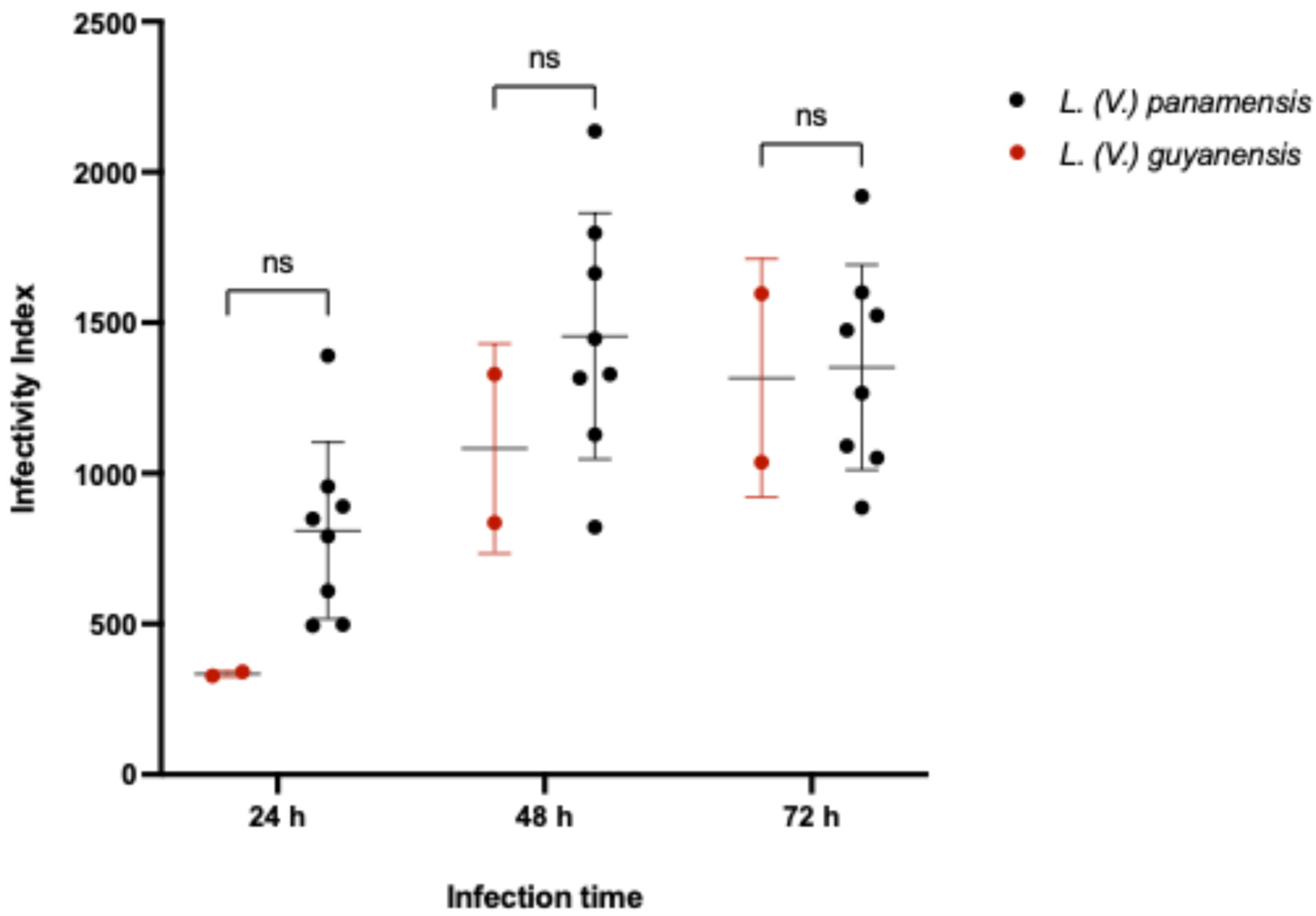
When infectivity was analyzed at the species level within the LRV-1+ group, no statistically significant difference was observed between L. (V.) panamensis and L. (V.) guyanensis isolates using a non-parametric Mann–Whitney test (Figure 2).
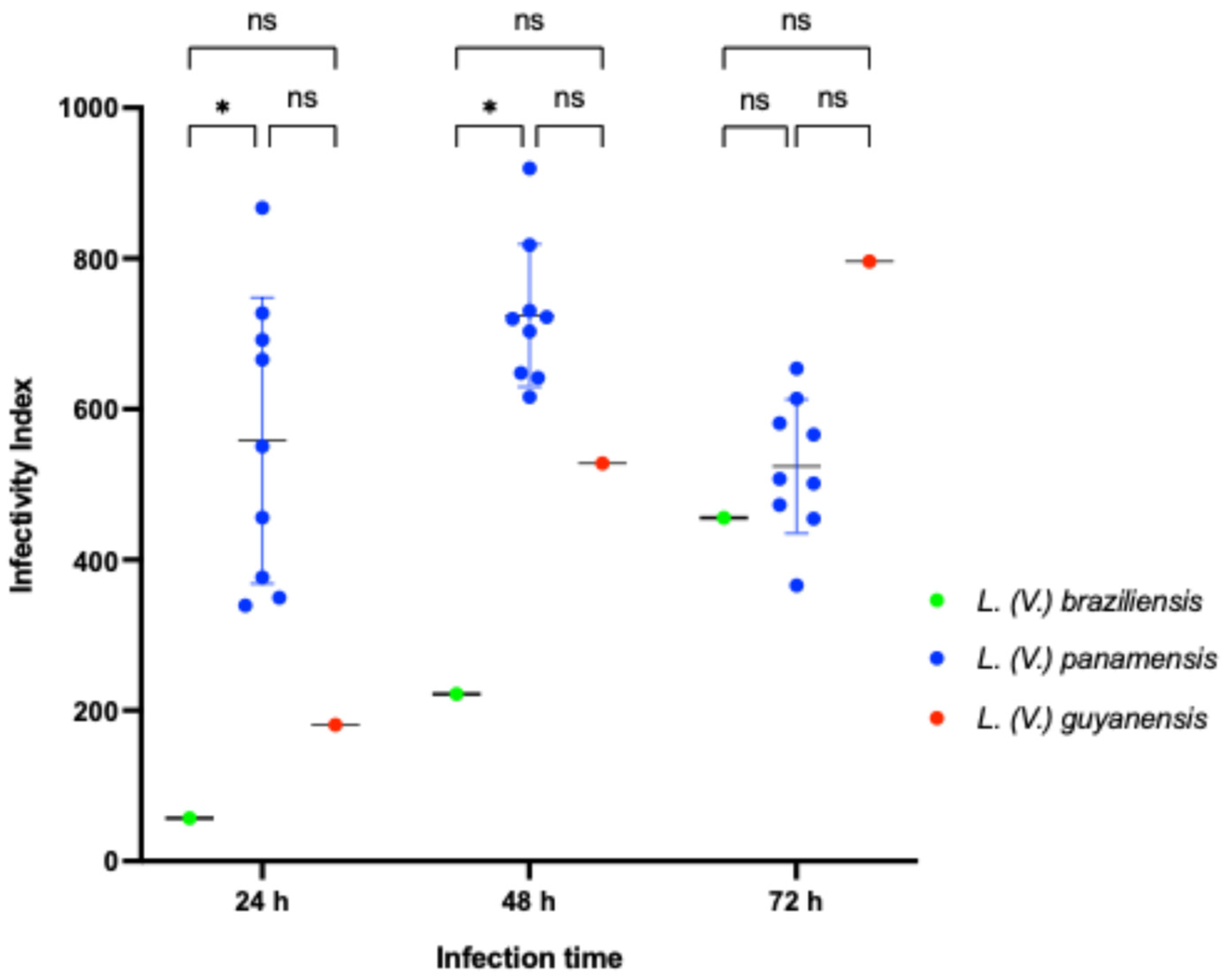
Although only one data point was analyzed for the reference strains of L. (V.) braziliensis M2903 and L. (V.) guyanensis LRV-1 isolate, the infectivity index (II) was compared among the LRV-1 isolates. According to the ANOVA, the II varied significantly across species (Figure 3). The L. (V.) panamensis isolates showed higher infectivity at 24 and 48 h compared to the reference strain L. (V.) braziliensis M2903 (p < 0.05). While L. (V.) guyanensis LRV-1 isolate and L. (V.) braziliensis M2903 showed a trend toward increasing infectivity over time, L. (V.) panamensis reached peak infectivity at 48 h, then declined slightly at 72 h.

3.3. Modulation of Pro-Inflammatory Cytokines TNF-α, IL-1β, and IFN-γ by LRV-1

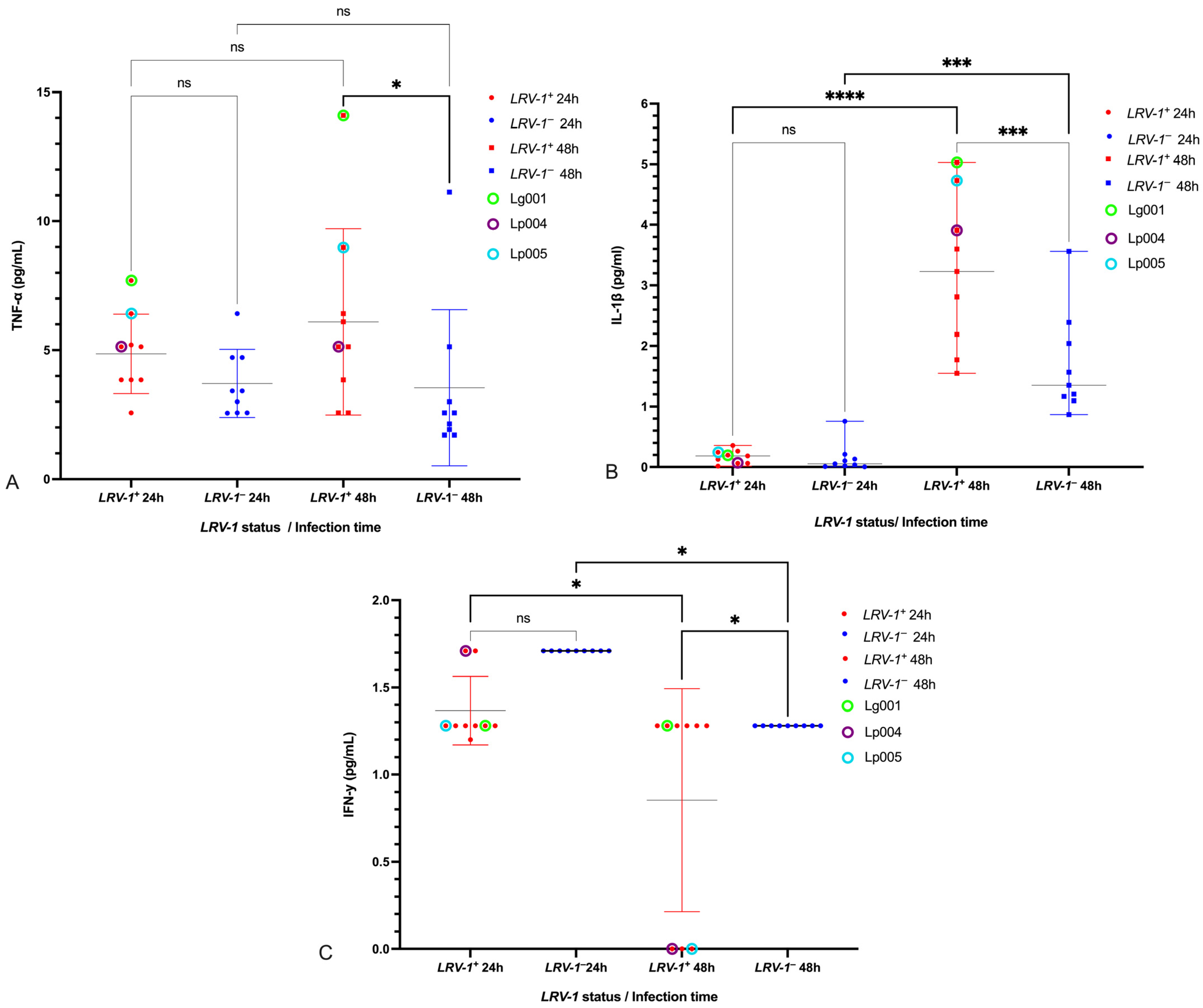
At 48 h post-infection, the supernatant of U937 macrophages infected with LRV-1+ isolates contained significantly higher concentrations of TNF-α (p < 0.01) and IL-1β (p < 0.0001), but a lower concentration of IFN-γ (p < 0.01), compared to macrophages infected with LRV-1 isolates (Figure 4, Figures S1 and S2).
Notably, isolates Lg001 and Lp005 induced high TNF-α levels at both 24 and 48 h, while IL-1β concentrations were highest in Lg001, Lp004, and Lp005 at 48 h. IFN-γ levels were undetectable at 48 h for Lp004 and Lp005 (0.00 pg/mL) (Figure 4).
When analyzed by Leishmania species, no overall differences in TNF-α or IL-1β levels were found between LRV-1+ and LRV-1 groups (p > 0.05).

3.4. Cytokines Unaffected by LRV-1 Status

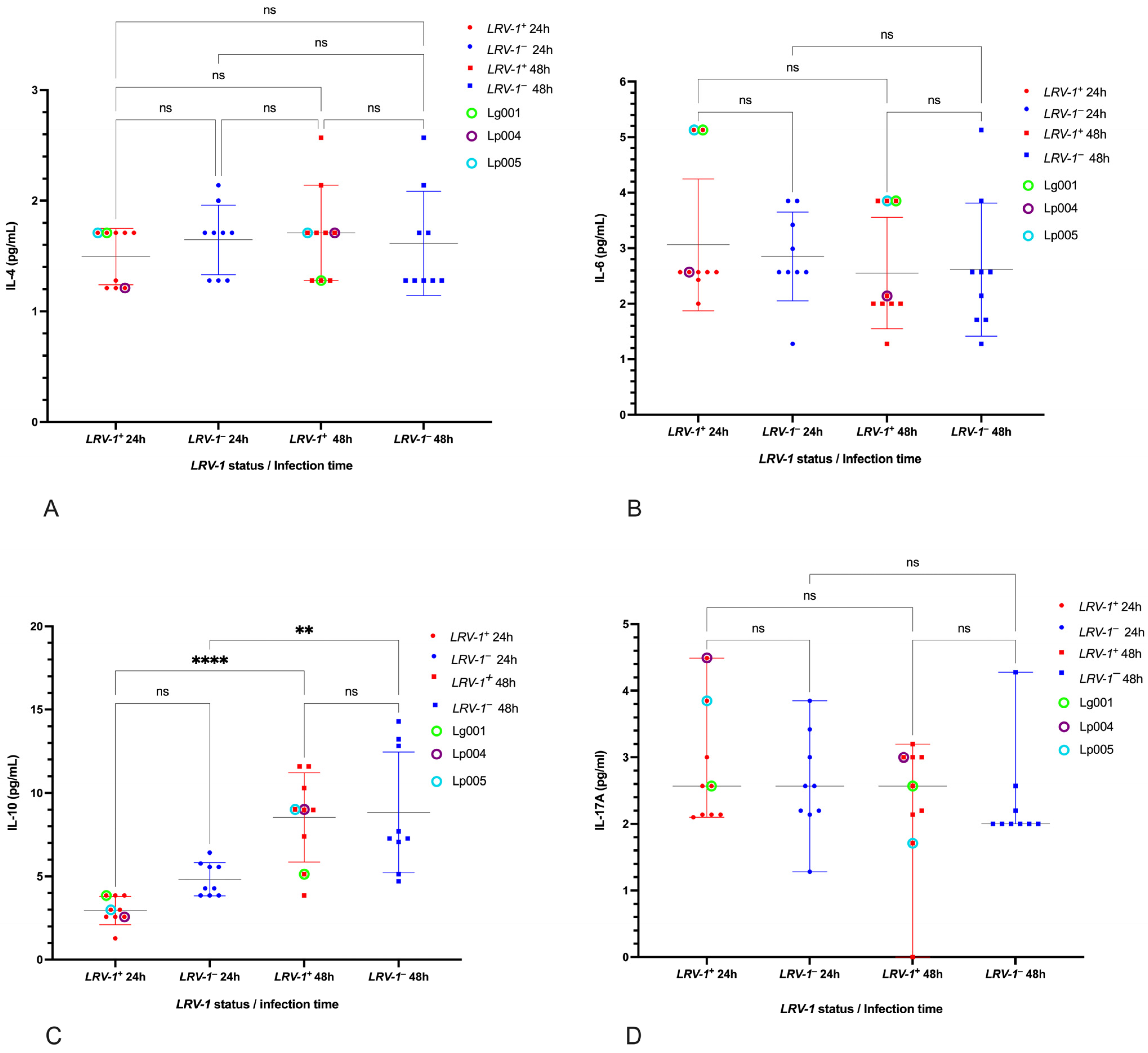
No statistically significant differences were found in IL-4, IL-6, IL-10, or IL-17 concentrations between LRV-1+ and LRV-1 isolates at 24 or 48 h (p > 0.05). However, a general increase in IL-10 was observed at 48 h in both groups (LRV-1+: p < 0.0001; LRV-1: p < 0.001). No differences were noted among Leishmania species for these cytokines (Figure 5).

3.5. Cytokine Responses in Reference Strains and LPS Control

At 24 h, the Lg4147 reference strain (LRV-1+) induced a significantly higher TNF-α concentration (10.30 pg/mL) than the average values for both LRV-1+ (5.13 pg/mL; p < 0.01) and LRV-1 (3.42 pg/mL; p < 0.001) clinical isolates, as well as the LpS94 strain (3.00 pg/mL; p < 0.01) (Figure S3A). IL-1β concentrations were also significantly elevated in Lg4147 and LbM2903 at 24 h compared to clinical isolates (p < 0.01 and p < 0.001, respectively), although the LbM2903 response declined at 48 h (Figure S3). The LPS control induced robust increases in TNF-α and IL-1β at both time points compared to all parasite isolates (p < 0.0001 and p < 0.01, respectively. Also, LPS induced an increase in IL-6 at 48 h compared to all clinical isolates (p < 0.001) and reference strains (p < 0.01). No significant differences in IFN-γ, IL-4, IL-10, and IL-17 were observed between reference strains, clinical isolates, or the LPS control (p > 0.05) (Figure S3).

3.6. Multivariate and Correlation Analysis

Spearman correlation analysis among LRV-1+ isolates at 24 h revealed positive correlations between IL-6 and TNF-α (r = 0.65, p < 0.03) and between IL-6 and IL-17 (r = 0.60, p < 0.04). At 48 h, a positive correlation between IL-6 and TNF-α persisted in this group (r = 0.79, p < 0.01). Among LRV-1 isolates, a significant negative correlation was found between the II and TNF-α levels at 24 h (r = −0.73, p < 0.01). (Figure S4).
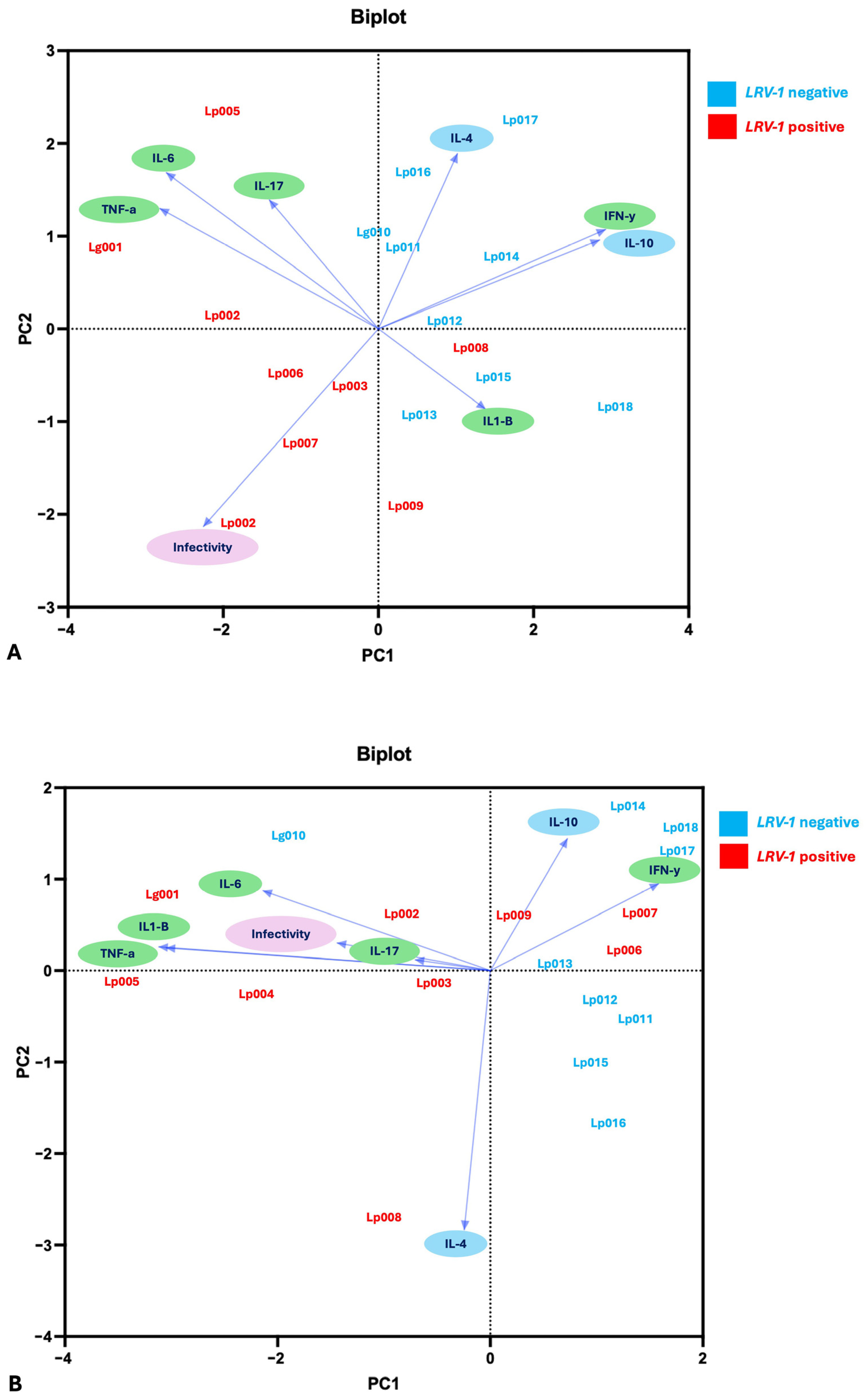
However, principal component analysis (PCA) using eight variables (infectivity, pro-inflammatory and anti-inflammatory cytokines), and the eighteen clinical isolates (nine LRV-1+ and nine LRV-1) provided further insight into isolate clustering based on cytokine profiles (Figure 6).
At 24 h, L. (Viannia) LRV-1 isolates were associated with IL-4, IL-10, and IFN-γ, whereas LRV-1+ isolates were more closely linked to IL-6, TNF-α, IL-17 (Lg001, Lp004, Lp005), and infectivity (Lp002 Lp006, Lp007, Lp003). IL-1β was shared across LRV-1+ (Lp008, Lp009) and several LRV-1 isolates (Lp013, Lp015, Lp018) (Figure 6A).
After 48 h, PCA revealed a shift: pro-inflammatory cytokines (IL-6, IL-17, IL-1β, TNF-α) and II were primarily associated with LRV-1+ isolates (Lg001, Lp002, Lp003, Lp004, Lp005). Meanwhile, IL-10 and IFN-γ were linked to several LRV-1 isolates (e.g., Lp011, Lp012, Lp013, Lp014, Lp017, Lp018), as well as to LRV-1+ isolates Lp006, Lp007, and Lp009 (Figure 6B).

4. Discussion

The role of Leishmania RNA Virus 1 (LRV-1) in the biology and pathogenesis of Leishmania spp. remains incompletely understood. While studies in murine models have linked the presence of LRV-1 to exacerbated cutaneous lesions [23], clinical data also suggest associations with treatment failure and symptomatic relapse in human leishmaniasis caused by species of the subgenus Viannia [15,16]. To explore the impact of LRV-1 on parasite infectivity, we evaluated the infectivity index (II) of Leishmania (Viannia) isolates using U937 macrophage-like cells, a well-established in vitro model of human macrophage infection [29,46].
Consistent with previous findings [29], our results show that LRV-1+ isolates exhibited significantly higher II than LRV-1 isolates, particularly after 48 and 72 h post-infection. This suggests that the presence of LRV-1 may enhance parasite survival and intracellular replication within human macrophages, in line with the hypothesis that LRV-1 acts as a virulence modulator through metabolic support or immune evasion [25,27,47].
When comparing LRV-1+ isolates of L. (V.) panamensis and L. (V.) guyanensis, we observed a similar increase in II over time. This is particularly notable given that L. (V.) panamensis has historically been considered less virulent than other Viannia species [48,49,50]. Our findings suggest that LRV-1 contributes to increased infectivity regardless of the intrinsic virulence traditionally attributed to the host species. Phylogenetic proximity between L. (V.) panamensis and L. (V.) guyanensis [51], as well as the circulation of the same LRV-1 genotype (A) in both species [37], may explain their similar biological behavior in vitro.
Among the LRV-1+ isolates, two L. (V.) panamensis isolates (Lp004 and Lp005) showed the highest II values. These isolates originated from patients with more complex clinical courses: one with 11 concurrent lesions and the other requiring three treatment cycles with pentavalent antimonial. This observation suggests a potential link between high in vitro infectivity and complicated clinical manifestations. However, this association was not generalized as most LRV-1+ isolates (7/9) originated from patients with uncomplicated LCL. It is therefore plausible that other factors, such as parasite genotype or host immune status, contribute to disease severity [52,53]. The reported phylogenetic divergence of Panamanian L. (V.) guyanensis from South American strains [54], along with the presence of multiple L. (V.) panamensis haplotypes in Panama [55], may contribute to this intra-species variation in infectivity and clinical presentation.
Our cytokine analyses further support the immunomodulatory role of LRV-1. At 48 h post-infection, U937 macrophages infected with LRV-1+ isolates exhibited elevated concentrations of TNF-α and IL-1β and reduced IFN-γ, compared to those infected with LRV-1 isolates. This cytokine profile is consistent with a pro-inflammatory profile that may promote parasite persistence by exacerbating local inflammation [16,23]. The reference strain Lg4147 (LRV-1+) exhibited similar cytokine behavior, reinforcing its value as a benchmark in in vitro models. Principal component analyses (PCA) at 48 h highlighted the association between the LRV-1+ isolates and increased TNF-α, IL-1β, IL-6, and II, supporting a coordinated inflammatory response. These results were reinforced with Spearman correlation analyses, where an association of IL-6 and TNF-α was observed in LRV-1+ isolates.
In contrast, LRV-1 isolates were associated with a mixed cytokine profile, including higher levels of IFN-γ and IL-10. IFN-γ plays a key role in parasite clearance via nitric oxide-mediated macrophage activation [56]. Notably, isolates Lp004 and Lp005, which were associated with clinical complications, exhibited undetectable IFN-γ at 48 h, a finding that may explain their higher II and apparent survival advantage. The inverse relationship between IFN-γ and II further supports the notion that suppression of this cytokine facilitates infection in vitro.
Although no statistically significant differences were observed for IL-4, IL-6, and IL-10 between groups, we did observe increased IL-10 production at 48 h in both LRV-1+ and LRV-1 isolates. This is consistent with previous studies suggesting that IL-10 contributes to parasite persistence by dampening host immune responses [57]. Interestingly, the L. (V.) panamensis LRV-1 reference strain (LpS94) showed elevated IL-10 production, reinforcing its association with a regulatory immune profile described in cutaneous leishmaniasis [58].
Analysis of species-specific cytokine responses revealed that L. (V.) guyanensis isolates, both LRV-1+ and LRV-1, tended to induce higher TNF-α levels, with Lg001 (LRV-1+) showing the highest concentrations at 48 h. Among L. (V.) panamensis isolates, Lp005 (LRV-1+) showed the highest TNF-α concentration, in agreement with its association with treatment failure. While TNF-α plays a key role in parasite killing, it is also implicated in tissue destruction during chronic inflammation [19,59,60]. Notably, IL-17 was detected in infections with both LRV-1+ and LRV-1 isolates without significant inter-group differences. Given that macrophages are not primary producers of IL-17 [61,62] these results should be interpreted with caution, though this cytokine has been implicated in chronicity and parasite persistence in other models [47].
In this context, LRV-1 detection could offer clinically relevant information by helping to identify patients at higher risk of persistent lesions or reduced treatment response, as suggested by other authors [15,16,43]. Due to the epidemiological importance of L. (V.) panamensis in Panama, adding LRV-1 screening to diagnostic workflows or research surveillance systems might improve patient stratification and guide clinical decisions, especially in areas with high transmission rates [36]. Although more clinical and genomic research is necessary to confirm its predictive ability and to understand the effects of parasite genotype, host immunity, and environmental factors, including LRV-1 as a supplementary biomarker, could be a significant step toward better disease management and public health strategies in endemic regions.
This study has limitations that should be considered when interpreting the findings. First, the limited number of isolates analyzed constrains the generalizability of the results, particularly regarding the intraspecific genetic diversity of Leishmania (Viannia) spp. and LRV-1 genotypes, which nevertheless could, at least, be representative of dominant genotypes in Panama. Second, LRV-1 detection was qualitative, and no quantification of viral load was performed using qRT-PCR. This limitation should be considered when interpreting the results, as the relative amount of virus could influence the degree of immunomodulation observed. Third, this study only used the U937 cell lineage. While the U937 in vitro model is a valuable tool for studying human macrophage infection, it does not fully replicate the complexity of the in vivo immune environment, which may influence the cytokine responses observed. Finally, the lack of longitudinal clinical or immunological data from the infected patients limits the ability to establish stronger correlations between LRV-1 presence, immune response, and clinical disease progression.
Taken together, these findings support the hypothesis that LRV-1 modulates host immune responses and enhances parasite infectivity, particularly in L. (V.) panamensis and L. (V.) guyanensis isolates. However, the presence of LRV-1 alone does not fully explain clinical severity in cutaneous leishmaniasis cases in Panama. Most LRV-1+ isolates were associated with mild or moderate disease presentations, contrasting with reports from other regions where LRV-1+ has been linked to mucocutaneous leishmaniasis or treatment failure [5,6]

5. Conclusions

In conclusion, our findings demonstrate that Leishmania (Viannia) LRV-1+ isolates exhibit increased infectivity and are associated with a distinct pro-inflammatory cytokine profile characterized by elevated TNF-α and IL-1β and decreased IFN-γ, which may facilitate parasite survival in macrophages. Although the relationship between LRV-1 and clinical outcomes is complex and likely influenced by parasite genetics, host immunity, and environmental context, our results indicate that LRV-1 detection in Leishmania (Viannia) isolates from Panama could serve as a valuable prognostic marker for identifying tegumentary leishmaniasis cases with higher potential for persistence and therapeutic resistance. Given the predominance of L. (V.) panamensis in the country and the significant annual burden of cutaneous leishmaniasis, incorporating LRV-1 screening into national surveillance programs and clinical management protocols could improve patient stratification, guide therapeutic decisions, and enhance disease control efforts in endemic regions of Panama. Further clinical and genomic studies are warranted to clarify the contribution of LRV-1 to disease severity, drug responsiveness, and long-term parasite persistence in human populations.

Supplementary Materials

The following supporting information can be downloaded at: https://www.mdpi.com/article/10.3390/pathogens14121263/s1. Figure S1: Cytokine concentrations from LRV-1+ Leishmania (Viannia) isolates, as detailed in the accompanying table. Bar graphs (A,B) and spider web plots (C,D) represent cytokine profiles at 24 h (A,C) and 48 h (B,D) post-infection.; Figure S2: Cytokine concentrations from LRV-1 Leishmania (Viannia) isolates, as detailed in the accompanying table. Bar graphs (A,B) and spider web plots (C,D) represent cytokine profiles at 24 h (A,C) and 48 h (B,D) post-infection.; Figure S3: Bar graphic showing the concentration of anti-inflammatory and pro-inflammatory cytokines of the reference strains, the LPS stimulation control, and the mean concentrations of the LRV-1+ and LRV-1- isolates used in this study. Figure S4: Heat map showing the results of correlation analysis between cytokines and infectivity in LRV-1 positive and negative isolates at 24 h (A) and 48 h (B). A: Heat map showing r values (Spearman correlation) with statistical significance at 24 h: Moderate correlation directly proportional in LRV-1+ isolates: IL-6/TNF-α: r = 0.65, p = 0.03, and IL-6/IL-17: r = 0.60, p = 0.04; strong inversely proportional correlation in LRV-1 isolates: IL-6/TNF-α: r = −0.73, p = 0.01. B. Heat map showing r values with statistical significance at 48 h: Strong proportional correlation in LRV-1+ isolates: IL-6/TNF-α: r = −0.79, p = 0.01.

Author Contributions

Conceptualization, K.G. and A.S.; methodology, A.A.B.F. and V.J.P.; software, K.G. and D.B.; validation, D.B., A.S., M.D.L., L.F.D.P., L.F.C. and K.G.; formal analysis, J.E.C. and L.F.D.P.; investigation, K.G.; resources, A.A.B.F., A.S., L.F.C. and K.G.; data curation, A.A.B.F., D.B., and V.J.P.; writing—original draft preparation, K.G.; writing—review and editing, J.E.C.; A.S., M.D.L., L.F.D.P. and L.F.C.; visualization, L.F.C.; supervision, K.G.; project administration, K.G.; funding acquisition, K.G. and L.F.C. All authors have read and agreed to the published version of the manuscript.

Funding

This research was funded by Secretaría Nacional de Ciencia, Tecnología e Innovación de Panamá (SENACYT), grant number FIED21-004, São Paulo Research Foundation (FAPESP) processes numbers: 2023/01641-1, and with the support of the Sistema Nacional de Investigación de Panamá (SNI-SENACYT), awarded to K.G., J.E.C., and A.S.; National Council for Scientific and Technological Development (CNPq), Brazil, awarded to M.D.L. and L.F.D.P. L.F.C. was funded by Indiana University. This work also received administrative support from the Gorgas Memorial Institute for Health Studies.

Institutional Review Board Statement

This study was approved by the Institutional Bioethics Committee of the ICGES (protocol code: 267/CBI/ICGES/21, dated 14 September 2021). The research involved retrospective analysis of parasite isolates and did not involve studies in animals or human subjects.

Informed Consent Statement

Not applicable.

Data Availability Statement

The data used to support the findings of this study are available from the corresponding author upon reasonable request, and the Supplementary Materials are available at: https://www.mdpi.com/article/10.3390/pathogens14121263/s1.

Acknowledgments

We appreciate the financial support of SENACYT grant FIED21-004, SNI-SENACYT, and the institutional support of ICGES, FM-USP, and UP.

Conflicts of Interest

The authors declare no conflicts of interest.

Abbreviations

The following abbreviations are used in this manuscript:
LRV-1Leishmaniavirus type 1
LRV-2Leishmaniavirus type 2
CLCutaneous Leishmaniasis
LCLLocalized Cutaneous Leishmaniasis
IIInfection Index
TNF-αTumoral necrosis factor alpha
IFN-γInterferon gamma

References

  1. Tarr, P.I.; Aline, R.F.; Smiley, B.L.; Scholler, J.; Keithly, J.; Stuart, K. LR1: A candidate RNA virus of Leishmania. Proc. Natl. Acad. Sci. USA 1988, 85, 9572. [Google Scholar] [CrossRef]
  2. Widmer, G.; Comeau, A.M.; Furlong, D.B.; Wirth, D.F.; Patterson, J.L. Characterization of a RNA virus from the parasite Leishmania. Proc. Natl. Acad. Sci. USA 1989, 86, 5979–5982. [Google Scholar] [CrossRef] [PubMed]
  3. Widmer, G.; Dooley, S. Phylogenetic analysis of Leishmania RNA virus and Leishmania suggests ancient virus-parasite association. Nucleic Acids Res. 1995, 23, 2300–2304. [Google Scholar] [CrossRef] [PubMed]
  4. Scheffter, S.M.; Ro, Y.T.; Chung, I.K.; Patterson, J.L. The Complete Sequence of Leishmania RNA Virus LRV2-1, a Virus of an Old World Parasite Strain. Virology 1995, 212, 84–90. [Google Scholar] [CrossRef]
  5. Ito, M.M.; Catanhêde, L.M.; Katsuragawa, T.H.; da Silva Junior, C.F.; Camargo, L.M.A.; Mattos Rde, G.; Vilallobos-Salcedo, J.M. Correlation between presence of Leishmania RNA virus 1 and clinical characteristics of nasal mucosal leishmaniosis. Braz. J. Otorhinolaryngol. 2015, 81, 533–540. Available online: https://linkinghub.elsevier.com/retrieve/pii/S1808869415001056 (accessed on 7 December 2025). [CrossRef]
  6. Cantanhêde, L.M.; da Silva Júnior, C.F.; Ito, M.M.; Felipin, K.P.; Nicolete, R.; Salcedo, J.M.V.; Porrozzi, R.; Cupolillo, E.; Ferreira, R.d.G.M. Further Evidence of an Association between the Presence of Leishmania RNA Virus 1 and the Mucosal Manifestations in Tegumentary Leishmaniasis Patients. PLoS Negl. Trop. Dis. 2015, 9, e0004079. [Google Scholar] [CrossRef]
  7. Grybchuk, D.; Kostygov, A.Y.; Macedo, D.H.; Votýpka, J.; Lukeš, J.; Yurchenko, V. RNA Viruses in Blechomonas (Trypanosomatidae) and Evolution of Leishmaniavirus. mBio 2018, 9, e01932-18. [Google Scholar] [CrossRef] [PubMed]
  8. Tirera, S.; Ginouves, M.; Donato, D.; Caballero, I.S.; Bouchier, C.; Lavergne, A.; Bourreau, E.; Mosnier, E.; Vantilcke, V.; Couppié, P.; et al. Unraveling the genetic diversity and phylogeny of Leishmania RNA virus 1 strains of infected Leishmania isolates circulating in French Guiana. PLoS Negl. Trop. Dis. 2017, 11, e0005764. [Google Scholar] [CrossRef]
  9. Cristhine, M.; Santana, O.; Chourabi, K.; Cantanhede, L.M.; Cupolillo, E. Exploring Host-Specificity: Untangling the Relationship Between Leishmania (Viannia) Species and Its Endosymbiont Leishmania RNA Virus 1. 2023. Available online: www.preprints.org (accessed on 14 August 2023).
  10. Saberi, R.; Fakhar, M.; Mohebali, M.; Anvari, D.; Gholami, S. Global status of synchronizing Leishmania RNA virus in Leishmania parasites: A systematic review with meta-analysis. Transbound. Emerg. Dis. 2019, 66, 2244–2251. [Google Scholar] [CrossRef]
  11. Klocek, D.; Grybchuk, D.; Tichá, L.; Votýpka, J.; Volf, P.; Kostygov, A.Y.; Yurchenko, V. Evolution of RNA viruses in trypanosomatids: New insights from the analysis of Sauroleishmania. Parasitol. Res. 2023, 122, 2279–2286. [Google Scholar] [CrossRef]
  12. Dutra-Rêgo, F.; Sérgio da Silva, E.; Valadares Lopes, V.; Gonçalves Teixeira-Neto, R.; Silva Belo, V.; Augusto Fonseca Júnior, A.; Andrade Pereira, D.; Paulino Pena, H.; Dalastra Laurenti, M.; Araújo Flores, G.V.; et al. First report of putative Leishmania RNA virus 2 (LRV2) in Leishmania infantum strains from canine and human visceral leishmaniasis cases in the southeast of Brazil. Mem. Inst. Oswaldo Cruz 2023, 118, e230071. [Google Scholar]
  13. Zolfaghari, A.; Beheshti-Maal, K.; Ahadi, A.M.; Monajemi, R. Identification of Leishmania species and frequency distribution of LRV1 and LRV2 viruses on cutaneous leishmaniasis patients in Isfahan Province, Iran. Indian J. Med. Microbiol. 2023, 41, 13–18. [Google Scholar] [CrossRef]
  14. de Carvalho, R.V.H.; Lima-Junior, D.S.; da Silva, M.V.G.; Dilucca, M.; Rodrigues, T.S.; Horta, C.V.; Silva, A.L.N.; da Silva, P.F.; Frantz, F.G.; Lorenzon, L.B.; et al. Leishmania RNA virus exacerbates Leishmaniasis by subverting innate immunity via TLR3-mediated NLRP3 inflammasome inhibition. Nat. Commun. 2019, 10, 5273. [Google Scholar] [CrossRef]
  15. Bourreau, E.; Ginouves, M.; Prévot, G.; Hartley, M.A.; Gangneux, J.P.; Robert-Gangneux, F.; Robert-Gangneux, F.; Dufour, J.; Sainte-Marie, D.; Bertolotti, A.; et al. Presence of Leishmania RNA Virus 1 in Leishmania guyanensis Increases the Risk of First-Line Treatment Failure and Symptomatic Relapse. J. Infect. Dis. 2016, 213, 105–111. Available online: https://academic.oup.com/jid/article-lookup/doi/10.1093/infdis/jiv355 (accessed on 25 April 2021). [CrossRef]
  16. Adaui, V.; Lye, L.F.; Akopyants, N.S.; Zimic, M.; Llanos-Cuentas, A.; Garcia, L.; Maes, I.; De Doncker, S.; Dobson, D.E.; Arevalo, J.; et al. Association of the Endobiont Double-Stranded RNA Virus LRV1 With Treatment Failure for Human Leishmaniasis Caused by Leishmania braziliensis in Peru and Bolivia. J. Infect. Dis. 2016, 213, 112–121. Available online: https://academic.oup.com/jid/article-lookup/doi/10.1093/infdis/jiv354 (accessed on 26 January 2021). [CrossRef]
  17. Pazmiño, F.A.; Parra-Muñoz, M.; Saavedra, C.H.; Muvdi-Arenas, S.; Ovalle-Bracho, C.; Echeverry, M.C. Mucosal leishmaniasis is associated with the Leishmania RNA virus and inappropriate cutaneous leishmaniasis treatment. PLoS ONE 2025, 20, e0317221. [Google Scholar] [CrossRef]
  18. Kariyawasam, R.; Lau, R.; Valencia, B.M.; Llanos-Cuentas, A.; Boggild, A.K. Leishmania RNA Virus 1 (LRV-1) in leishmania (viannia) braziliensis isolates from Peru: A description of demographic and clinical correlates. Am. J. Trop. Med. Hyg. 2020, 102, 280–285. [Google Scholar] [CrossRef]
  19. Duque, G.A.; Descoteaux, A. Macrophage cytokines: Involvement in immunity and infectious diseases. Front Immunol. 2014, 5, 491. [Google Scholar]
  20. Tomiotto-Pellissier, F.; da Silva Bortoleti, B.T.; Assolini, J.P.; Gonçalves, M.D.; Carloto, A.C.M.; Miranda-Sapla, M.M.; Conchon-Costa, I.; Bordignon, J.; Pavanelli, W.R. Macrophage Polarization in Leishmaniasis: Broadening Horizons. Front. Immunol. 2018, 9, 2529. [Google Scholar] [CrossRef] [PubMed]
  21. Anderson, C.F.; Mosser, D.M. A novel phenotype for an activated macrophage: The type 2 activated macrophage. J. Leukoc. Biol. 2002, 72, 101–106. Available online: http://www.ncbi.nlm.nih.gov/pubmed/12101268 (accessed on 1 November 2020). [CrossRef] [PubMed]
  22. Adams, D.O. Molecular interactions in macrophage activation. Immunol. Today 1989, 10, 33–35. Available online: https://linkinghub.elsevier.com/retrieve/pii/0167569989902983 (accessed on 11 November 2020). [CrossRef] [PubMed]
  23. Ives, A.; Ronet, C.; Prevel, F.; Ruzzante, G.; Fuertes-Marraco, S.; Schutz, F.; Zangger, H.; Revaz-Breton, M.; Lye, L.F.; Hickerson, S.M.; et al. Leishmania RNA virus controls the severity of mucocutaneous leishmaniasis. Science (1979) 2011, 331, 775–778. [Google Scholar] [CrossRef]
  24. Zangger, H.; Ronet, C.; Desponds, C.; Kuhlmann, F.M.; Robinson, J.; Hartley, M.A.; Prevel, F.; Castiglioni, P.; Pratlong, F.; Bastien, P.; et al. Detection of Leishmania RNA Virus in Leishmania Parasites. PLoS Negl. Trop. Dis. 2013, 7, e2006. [Google Scholar] [CrossRef]
  25. Hartley, M.A.; Ronet, C.; Zangger, H.; Beverley, S.M.; Fasel, N. Leishmania RNA virus: When the host pays the toll. Front. Cell. Infect. Microbiol. 2012, 2, 99. Available online: http://journal.frontiersin.org/article/10.3389/fcimb.2012.00099/abstract (accessed on 11 November 2020). [CrossRef] [PubMed]
  26. de Carvalho, R.V.H.; Lima-Júnior, D.S.; de Oliveira, C.V.; Zamboni, D.S. Endosymbiotic RNA virus inhibits Leishmania-induced caspase-11 activation. iScience 2021, 24, 102004. [Google Scholar] [CrossRef] [PubMed]
  27. Eren, R.O.; Reverte, M.; Rossi, M.; Hartley, M.A.; Castiglioni, P.; Prevel, F.; Martin, R.; Desponds, C.; Lye, L.F.; Drexler, S.K.; et al. Mammalian Innate Immune Response to a Leishmania-Resident RNA Virus Increases Macrophage Survival to Promote Parasite Persistence. Cell Host Microbe 2016, 20, 318–328. Available online: https://linkinghub.elsevier.com/retrieve/pii/S1931312816303456 (accessed on 7 December 2025). [CrossRef]
  28. Felipin, K.P.; Paloschi, M.V.; Silva, M.D.S.; Ikenohuchi, Y.J.; Santana, H.M.; Setúbal Sda, S.; Rego, C.M.A.; Lopes, J.A.; Boeno, C.N.; Serrath, S.N.; et al. Transcriptomics analysis highlights potential ways in human pathogenesis in Leishmania braziliensis infected with the viral endosymbiont LRV1. PLoS Negl. Trop. Dis. 2024, 18, e0012126. [Google Scholar] [CrossRef]
  29. Kariyawasam, R.; Grewal, J.; Lau, R.; Purssell, A.; Valencia, B.M.; Llanos-Cuentas, A.; Boggild, A.K. Influence of Leishmania RNA Virus 1 on Proinflammatory Biomarker Expression in a Human Macrophage Model of American Tegumentary Leishmaniasis. J. Infect. Dis. 2017, 216, 877–886. [Google Scholar] [CrossRef] [PubMed]
  30. Guilbride, L.; Myler, P.J.; Stuart, K. Distribution and sequence divergence of LRV1 viruses among different Leishmania species. Mol. Biochem. Parasitol. 1992, 54, 101–104. [Google Scholar] [CrossRef]
  31. Vieira-Gonçalves, R.; Fagundes-Silva, G.A.; Heringer, J.F.; Fantinatti, M.; Da-Cruz, A.M.; Oliveira-Neto, M.P.; Guerra, J.A.O.; Gomes-Silva, A. First report of treatment failure in a patient with cutaneous leishmaniasis infected by Leishmania (Viannia) naiffi carrying Leishmania RNA virus: A fortuitous combination? Rev. Soc. Bras. Med. Trop. 2019, 52, e20180323. [Google Scholar] [CrossRef]
  32. Ginouvès, M.; Simon, S.; Bourreau, E.; Lacoste, V.; Ronet, C.; Couppié, P.; Nacher, M.; Demar, M.; Prévot, G. Prevalence and distribution of Leishmania RNA virus 1 in leishmania parasites from French Guiana. Am. J. Trop. Med. Hyg. 2016, 94, 102–106. [Google Scholar] [CrossRef]
  33. Shita, E.Y.; Semegn, E.N.; Wubetu, G.Y.; Abitew, A.M.; Andualem, B.G.; Alemneh, M.G. Prevalence of Leishmania RNA virus in Leishmania parasites in patients with tegumentary leishmaniasis: A systematic review and meta-analysis. PLoS Negl. Trop. Dis. 2022, 16, e0010427. [Google Scholar] [CrossRef]
  34. Salinas, G.; Zamora, M.; Stuart, K.; Saravia, N. Leishmania RNA Viruses in Leishmania of the Viannia Subgenus. Am. J. Trop. Med. Hyg. 1996, 54, 425–429. Available online: https://www.ajtmh.org/view/journals/tpmd/54/4/article-p425.xml (accessed on 23 April 2021). [CrossRef]
  35. de Oliveira Ramos Pereira, L.; Maretti-Mira, A.C.; Rodrigues, K.M.; Lima, R.B.; de Oliveira-Neto, M.P.; Cupolillo, E.; Pirmez, C.; de Oliveira, M.P. Severity of tegumentary leishmaniasis is not exclusively associated with Leishmania RNA virus 1 infection in Brazil. Mem. Inst. Oswaldo Cruz 2013, 108, 665–667. [Google Scholar] [CrossRef] [PubMed]
  36. Bonilla, A.A.; Pineda, V.; Calzada, J.E.; Saldaña, A.; Dalastra Laurenti, M.; Goya, S.; Abrego, L.; González, K. Epidemiology and Genetic Characterization of Leishmania RNA Virus in Leishmania (Viannia) spp. Isol. Cutan. Leishmaniasis Endem. Areas Panama 2024, 12, 1317. [Google Scholar]
  37. Gonzalez, K.; De León, S.S.; Pineda, V.; Samudio, F.; Capitan-Barrios, Z.; Suarez, J.A.; Weeden, A.; Ortiz, B.; Rios, M.; Moreno, B.; et al. Detection of Leishmania RNA Virus 1 in Leishmania (Viannia) panamensis Isolates, Panama. Emerg. Infect. Dis. 2023, 29, 1250–1253. [Google Scholar] [CrossRef] [PubMed]
  38. Pan American Health Organization. Leishmaniasis: Epidemiological Report for the Americas Washinton, D.C. 2024. Available online: https://iris.paho.org/handle/10665.2/51742 (accessed on 1 April 2025).
  39. Vásquez, A.; Paz, H.; Alvar, J.; Perez, D.; Hernandez, C. Informe Final: Estudios Sobre la Epidemiología de la Leishmaniasis Panamá, en la parte Occidental de la República de Panamá; Instituto Conmemorativo Gorgas de Estudio de la Salud, INSA: Panama City, Panama, 1998. [Google Scholar]
  40. Freites, C.O.; Gundacker, N.D.; Pascale, J.M.; Saldaña, A.; Diaz-Suarez, R.; Jimenez, G.; Sosa, N.; García, E.; Jimenez, A.; Suarez, J.A. First case of diffuse leishmaniasis associated with leishmania panamensis. Open Forum Infect. Dis. 2018, 5, ofy281. [Google Scholar] [CrossRef]
  41. Levy, J.; Estripeaut, D.; Diaz, Y.; Pachar Flores, M.R.; Hernandez, C.; Garcia-Redondo, R.; Lozano-Durán, D.; Ramirez, J.D.; Suárez, J.A.; Paniz-Mondolfi, A. Borderline Disseminated (Intermediate) Cutaneous Leishmaniasis: A Case-Based Approach to Diagnosis and Clinical Management in Pediatric Population. Pediatr. Infect. Dis. J. 2025, 44, e258–e264. Available online: https://journals.lww.com/10.1097/INF.0000000000004761 (accessed on 2 April 2025). [CrossRef]
  42. de Vasquez, A.M.; Christensen, H.A.; Petersen, J.L. Short report epidemiologic studies on cutaneous leishmaniasis in eastern Panama. Am. J. Trop. Med. Hyg. 1999, 60, 54–57. Available online: https://www.ajtmh.org/view/journals/tpmd/60/1/article-p54.xml (accessed on 5 July 2021). [CrossRef]
  43. Kariyawasam, R.; Lau, R.; Valencia, B.M.; Llanos-Cuentas, A.; Boggild, A.K. Novel detection of Leishmania RNA virus-1 (LRV-1) in clinical isolates of Leishmania Viannia panamensis. Parasitology 2023, 151, 151–156. Available online: https://www.cambridge.org/core/product/identifier/S0031182023001221/type/journal_article (accessed on 5 December 2023). [CrossRef]
  44. Montalvo, A.M.; Fraga, J.; Maes, I.; Dujardin, J.C.; Van der Auwera, G. Three new sensitive and specific heat-shock protein 70 PCRs for global Leishmania species identification. Eur. J. Clin. Microbiol. Infect. Dis. 2012, 31, 1453–1461. Available online: http://www.ncbi.nlm.nih.gov/pubmed/22083340 (accessed on 12 April 2019). [CrossRef]
  45. Yamamoto, E.S.; Jesus, J.A.; Bezerra-Souza, A.; Laurenti, M.D.; Ribeiro, S.P.; Passero, L.F.D. Activity of Fenticonazole, Tioconazole and Nystatin on New World Leishmania Species. Curr. Top. Med. Chem. 2018, 18, 2338–2346. [Google Scholar] [CrossRef] [PubMed]
  46. Arena, A.; Capozza, A.B.; Delfino, D.; Iannello, D. Production of TNF alpha and interleukin 6 by differentiated u937 cells infected with leishmama major. Microbiologica 1997, 20, 233–240. [Google Scholar] [PubMed]
  47. Hartley, M.A.; Bourreau, E.; Rossi, M.; Castiglioni, P.; Eren, R.O.; Prevel, F.; Couppié, P.; Hickerson, S.M.; Launois, P.; Beverley, S.M.; et al. Leishmaniavirus-Dependent Metastatic Leishmaniasis Is Prevented by Blocking IL-17A. PLoS Pathog. 2016, 12, e1005852. [Google Scholar] [CrossRef]
  48. Reithinger, R.; Dujardin, J.C.; Louzir, H.; Pirmez, C.; Alexander, B.; Brooker, S. Cutaneous leishmaniasis. Lancet Infect. Dis. 2007, 7, 581–596. [Google Scholar] [CrossRef]
  49. Strazzulla, A.; Cocuzza, S.; Pinzone, M.R.; Postorino, M.C.; Cosentino, S.; Serra, A.; Cacopardo, B.; Nunnari, G. Mucosal Leishmaniasis: An Underestimated Presentation of a Neglected Disease. BioMed Res. Int. 2013, 2013, 805108. Available online: https://pmc.ncbi.nlm.nih.gov/articles/PMC3703408/ (accessed on 3 December 2025). [CrossRef] [PubMed]
  50. Llanes, A.; Restrepo, C.M.; Vecchio GDel Anguizola, F.J.; Lleonart, R. The genome of Leishmania panamensis: Insights into genomics of the L. (Viannia) subgenus. Sci. Rep. 2015, 5, 8550. Available online: http://www.nature.com/articles/srep08550 (accessed on 18 October 2019). [CrossRef]
  51. Montalvo Alvarez, A.M.; Nodarse, J.F.; Goodridge, I.M.; Fidalgo, L.M.; Marin, M.; Van Der Auwera, G.; Dujardin, J.C.; Bernal, I.D.V.; Muskus, C. Differentiation of Leishmania (Viannia) panamensis and Leishmania (V.) guyanensis using BccI for hsp70 PCR-RFLP. Trans. R. Soc. Trop. Med. Hyg. 2010, 104, 364–367. [Google Scholar] [CrossRef]
  52. Saidi, N.; Blaizot, R.; Prévot, G.; Aoun, K.; Demar, M.; Cazenave, P.A.; Bouratbine, A.; Pied, S. Clinical and immunological spectra of human cutaneous leishmaniasis in North Africa and French Guiana. Front. Immunol. 2023, 14, 1134020. [Google Scholar] [CrossRef]
  53. Sosa-Ochoa, W.; Zúniga, C.; Chaves, L.F.; Flores, G.V.A.; Pacheco, C.M.S.; da Matta, V.L.R.; Corbett, C.E.P.; Silveira, F.T.; Laurenti, M.D. Clinical and immunological features of human Leishmania (L.) infantum-infection, novel insights Honduras, central america. Pathogens 2020, 9, 554. [Google Scholar] [CrossRef]
  54. Davila, M.; Pineda, V.; Calzada, J.E.; Saldaña, A.; Samudio, F. Evaluation of cytochrome b sequence to identify leishmania species and variants: The case of Panama. Mem. Do Inst. Oswaldo Cruz 2021, 116, e200572. [Google Scholar] [CrossRef]
  55. Mendieta, D.; Vásquez, V.; Jaén, L.; Pineda, V.; Saldaña, A.; Calzada, J.E.; Samudio, F. Insights into the Genetic Diversity of Leishmania (Viannia) panamensis in Panama, Inferred via Multilocus Sequence Typing (MLST). Pathogens 2023, 12, 747. [Google Scholar] [CrossRef]
  56. Liese, J.; Schleicher, U.; Bogdan, C. The innate immune response against Leishmania parasites. Immunobiology 2008, 213, 377–387. [Google Scholar] [CrossRef]
  57. Mesquita, I.; Ferreira, C.; Barbosa, A.M.; Ferreira, C.M.; Moreira, D.; Carvalho, A.; Cunha, C.; Rodrigues, F.; Dinis-Oliveira, R.J.; Estaquier, J.; et al. The impact of IL-10 dynamic modulation on host immune response against visceral leishmaniasis. Cytokine 2018, 112, 16–20. [Google Scholar] [CrossRef]
  58. Sandoval Pacheco, C.M.; Araujo Flores, G.V.; Gonzalez, K.; De Castro Gomes, C.M.; Passero, L.F.D.; Tomokane, T.Y.; Sosa-Ochoa, W.; Zúniga, C.; Calzada, J.; Saldaña, A.; et al. Macrophage Polarization in the Skin Lesion Caused by Neotropical Species of Leishmania sp. J. Immunol. Res. 2021, 202, 5596876. [Google Scholar] [CrossRef] [PubMed]
  59. Scott, P.; Novais, F.O. Cutaneous leishmaniasis: Immune responses in protection and pathogenesis. Nat. Rev. Immunol. 2016, 16, 581–592. [Google Scholar] [CrossRef] [PubMed]
  60. Srivastava, S.; Shankar, P.; Mishra, J.; Singh, S. Possibilities and challenges for developing a successful vaccine for leishmaniasis. Parasites Vectors 2016, 9, 277. [Google Scholar] [CrossRef]
  61. Lockhart, E.; Green, A.M.; Flynn, J.L. IL-17 Production Is Dominated by γδ T Cells rather than CD4 T Cells during Mycobacterium tuberculosis Infection. J. Immunol. 2006, 177, 4662–4669. Available online: http://www.jimmunol.org/lookup/doi/10.4049/jimmunol.177.7.4662 (accessed on 15 September 2019). [CrossRef]
  62. Ghoreschi, K.; Laurence, A.; Yang, X.P.; Tato, C.M.; McGeachy, M.J.; Konkel, J.E.; Ramos, H.L.; Wei, L.; Davidson, T.S.; Bouladoux, N.; et al. Generation of pathogenic TH17 cells in the absence of TGF-β signalling. Nature 2010, 467, 967–971. Available online: http://www.nature.com/articles/nature09447 (accessed on 6 January 2022). [CrossRef] [PubMed]
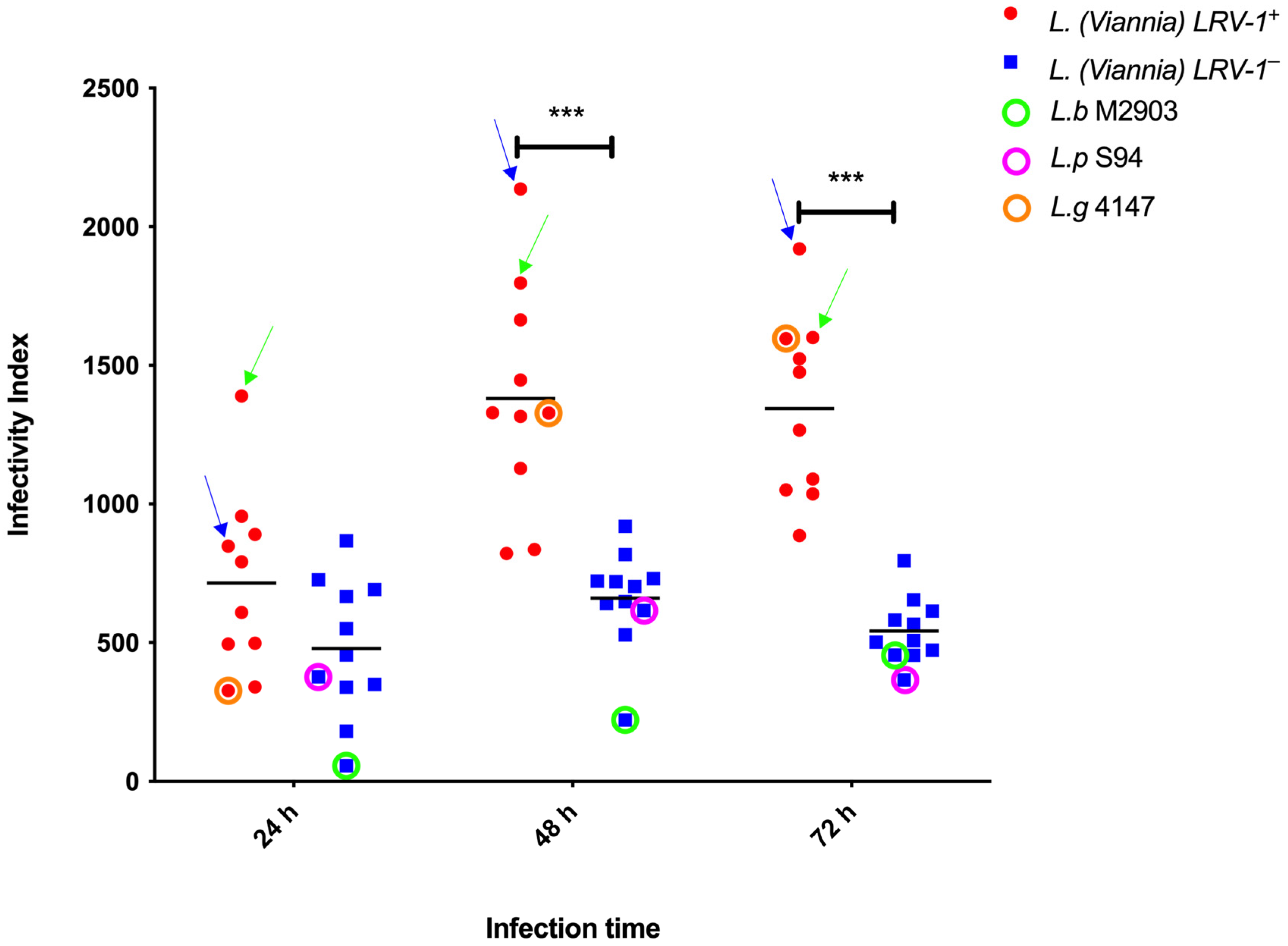
Figure 1. Scatter plot showing differences in infectivity between Leishmania LRV-1+ (red) and LRV-1 (blue) isolates at 24, 48, and 72 h post-infection. The LRV-1+ group includes nine clinical isolates, as well as the L. (V.) guyanensis reference strain 4147 (orange circle). The LRV-1 group includes nine clinical isolates, along with the reference strains L. (V.) panamensis (LpS94) (pink circle) and L. (V.) braziliensis (LbM2903) (green circle). Two L. (V.) panamensis isolates with the highest II values are highlighted: blue arrow indicates isolate Lp004; green arrow indicates isolate Lp005. ***: p < 0.0001. Tukey’s test was used for multiple comparison correction.
Pathogens 14 01263 g001
Figure 2. Scatter plot showing differences in the infectivity index (II) between LRV-1-positive L. (V.) panamensis (black) and L. (V.) guyanensis (red) isolates. The panel includes nine clinical isolates from both species, along with the reference strain L. (V.) guyanensis 4147. ns: not significant. Two-stage linear step-up procedure of Benjamini, Krieger and Yekutieli were used to multiple test correction.
Pathogens 14 01263 g002
Figure 3. Scatter plot showing differences in the infectivity index (II) among LRV-1 negative Leishmania (Viannia) species. Blue circles represent clinical isolates and the reference strain of L. (V.) panamensis; red circle represents the L. (V.) guyanensis isolate; green circle corresponds to the reference strain of L. (V.) braziliensis (LbM2903). ns: not significant; *: p < 0.01. Šídák’s test with a single pooled variance was used for multiple comparisons correction.
Pathogens 14 01263 g003
Figure 4. Scatter plots showing the concentrations of TNF-α (A), IL-1β (B), and IFN-γ (C) in the supernatants of U937 cells infected with Leishmania (Viannia) LRV-1+ and LRV-1 isolates at 24 and 48 h post-infection. Statistical comparisons were performed between groups. ns: not significant; *: p < 0.01; ***: p < 0.0001; ****: p < 0.00001. Tukey’s test was used for multiple comparison correction.
Pathogens 14 01263 g004
Figure 5. Scatter plots showing the concentrations of IL-4 (A), IL-6 (B), IL-10 (C), and IL-17 (D) in the supernatants of U937 cells infected with Leishmania (Viannia) LRV-1+ and LRV-1 isolates at 24 and 48 h post-infection. ns: not significant; **: p < 0.001; ****: p < 0.00001. Tukey’s test was used for multiple comparison correction.
Pathogens 14 01263 g005
Figure 6. Biplot of the principal component analysis (PCA) showing the distribution of Leishmania (Viannia) LRV-1+ (red) and LRV-1 (blue) isolates based on cytokine expression and infectivity index (II) variables at 24 and 48 h post-infection. 24 h (A). Proportion of explained variance for PC1: 29.47%, PC2: 20.63% and PC3: 14.19%. 48 h (B), Proportion of explained variance for PC1: 33.35%, PC2: 20.32% and PC3: 15.24%.
Pathogens 14 01263 g006
Table 1. General characteristics of the Leishmania isolates used in the in vitro infection experiments.
Isolate ID Leishmania Species LRV-1 StatusIsolate Description Origin Lesions
Lg001 L. (V.) guyanensisLRV-1+Group 1COC, PA1
Lp002 L. (V.) panamensisLRV-1+Group 1DA, PA1
Lp003 L. (V.) panamensisLRV-1+Group 1COL, PA4
Lp004 L. (V.) panamensisLRV-1+Group 1PAC, PA11
Lp005 L. (V.) panamensisLRV-1+Group 1COL, PA1 ^
Lp006 L. (V.) panamensisLRV-1+Group 1PO, PA1
Lp007 L. (V.) panamensisLRV-1+Group 1COL, PA1
Lp008 L. (V.) panamensisLRV-1+Group 1BT, PA1
Lp009 L. (V.) panamensisLRV-1+Group 1BT, PA1
Lg010 L. (V.) guyanensisLRV-1Group 2PO, PA1
Lp011 L. (V.) panamensisLRV-1Group 2COL, PA1
Lp012 L. (V.) panamensisLRV-1Group 2VE, PA1
Lp013 L. (V.) panamensisLRV-1Group 2PA, PA1
Lp014 L. (V.) panamensisLRV-1Group 2BT, PA1
Lp015 L. (V.) panamensisLRV-1Group 2DA, PA2
Lp016 L. (V.) panamensisLRV-1Group 2PA, PA5
Lp017 L. (V.) panamensisLRV-1Group 2PO, PA2
Lp018 L. (V.) panamensisLRV-1Group 2COL, PA1
Lg4147 (MHOM/BR/1975/WR4147)L. (V.) guyanensisLRV-1+Reference strainBRN/A
Lb566 (MHOM/BR/1975/M2903)L. (V.) braziliensisLRV-1Reference strainBRN/A
LpS94 (MHOM/PA/1971/LS94)L. (V.) panamensisLRV-1Reference strainPAN/A
^ Treatment failure. Abbreviations: Lg = L. (V.) guyanensis; Lp = L. (V.) panamensis; Lb = L. (V.) braziliensis; BR = Brazil; PA = Panamá; PAC = Panamá province; COC = Coclé province; COL = Colón province; PO = Panamá Oeste province; BT = Bocas del Toro province; VE = Veraguas province; DA = Darién province. N/A: Not available.
Disclaimer/Publisher’s Note: The statements, opinions and data contained in all publications are solely those of the individual author(s) and contributor(s) and not of MDPI and/or the editor(s). MDPI and/or the editor(s) disclaim responsibility for any injury to people or property resulting from any ideas, methods, instructions or products referred to in the content.