Systematic Review

A Systematical Review on ART Use in HTLV Infection: Clinical, Virological, and Immunological Outcomes

by
Tatiana Fernandez
1,2,
Cleyde Marconi
1,2,
Iris Montaño-Castellón
1,2,
Felice Deminco
1,2 and
Carlos Brites
1,2,*
1
Laboratório de Pesquisa em Infectologia (LAPI), Hospital Universitário Professor Edgard Santos, Federal University of Bahia, Salvador 40110-060, Brazil
2
Programa de Pós Graduação em Medicina e Saúde (PPgMS), Federal University of Bahia, Salvador 40110-060, Brazil
*
Author to whom correspondence should be addressed.
Pathogens 2024, 13(9), 721; https://doi.org/10.3390/pathogens13090721

Submission received: 8 July 2024 / Revised: 12 August 2024 / Accepted: 23 August 2024 / Published: 27 August 2024
(This article belongs to the Special Issue Viral Infections of Humans: Epidemiology and Control)

Abstract

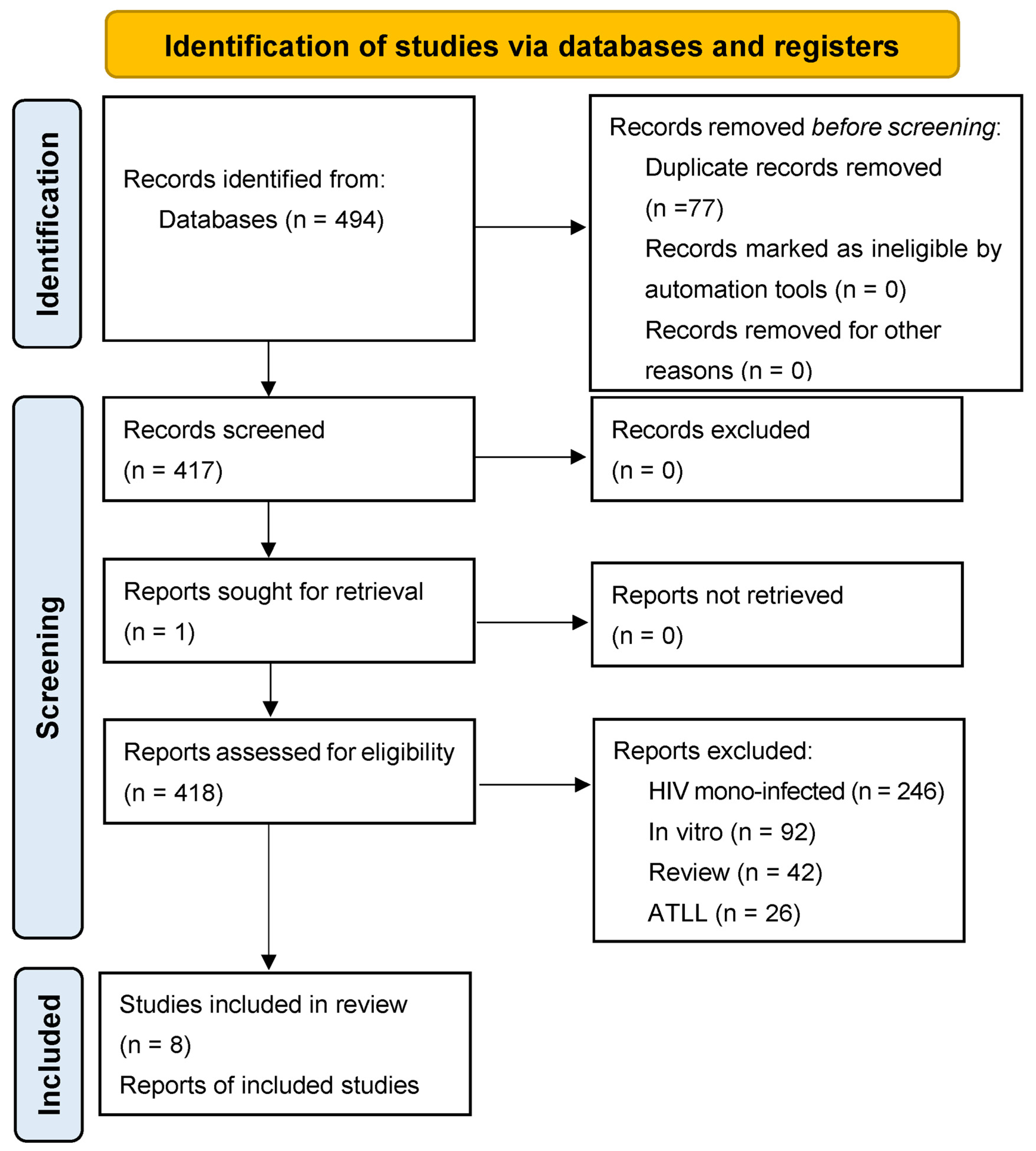
Human T-cell lymphotropic virus (HTLV) infection affects over ten million people worldwide, but there is no effective treatment so far. This review describes the virological, immunological, and clinical outcomes of antiretroviral therapy (ART) in people with HTLV infection. This systematic review followed PRISMA reporting guidelines and was registered in PROSPERO: CRD42022350076. The Newcastle–Ottawa Scale, adapted for cross-sectional studies, and Rob-2 were used to assess the methodological quality of these studies. Systematic searches were conducted in the Medline (PubMed), Scopus (Elsevier), Cochrane Library, and Web of Science (Clarivate Analytics) databases. We retrieved data from eight methodologically diverse articles on treatment of patients infected by HTLV-1 or HTLV-2 alone, or coinfected by HIV-1, who received Raltegravir, Tenofovir, Lamivudine, or Zidovudine. The proviral load decreased in three out of seven studies over 4 to 48 weeks of antiretroviral use. Cellular immune response (CD4, CD8, CD25, CD69, and CD71 cells) was evaluated in six studies. While no significant clinical improvement was observed, all studies reported clinical stability during treatment. Despite the demonstrated antiviral activity of ART, in vitro, clinical improvement was not proven. Most studies showed disease stability during ART use, suggesting potential clinical benefits. There is a need of larger, well-controlled trials to define the role of ART in the treatment of HTLV infection.
Keywords: HTLV; antiretroviral; treatment HTLV; antiretroviral; treatment