Article

Tick-Borne-Agents Detection in Patients with Acute Febrile Syndrome and Ticks from Magdalena Medio, Colombia


1
Grupo Biología de Sistemas, Escuela de Ciencias de la Salud, Facultad de Medicina, Universidad Pontificia Bolivariana, Medellín 050034, Colombia
2
Grupo de Investigación en Salud Pública, Escuela de Ciencias de la Salud, Facultad de Medicina, Universidad Pontificia Bolivariana, Medellín 050034, Colombia
3
Department of Internal Medicine, Medical Microbiology & Infectious Diseases and Community Health Sciences, University of Manitoba, Winnipeg, MB R3E 0J9, Canada
*
Author to whom correspondence should be addressed.
Pathogens 2022, 11(10), 1090; https://doi.org/10.3390/pathogens11101090

Submission received: 11 August 2022 / Revised: 1 September 2022 / Accepted: 13 September 2022 / Published: 24 September 2022

Abstract

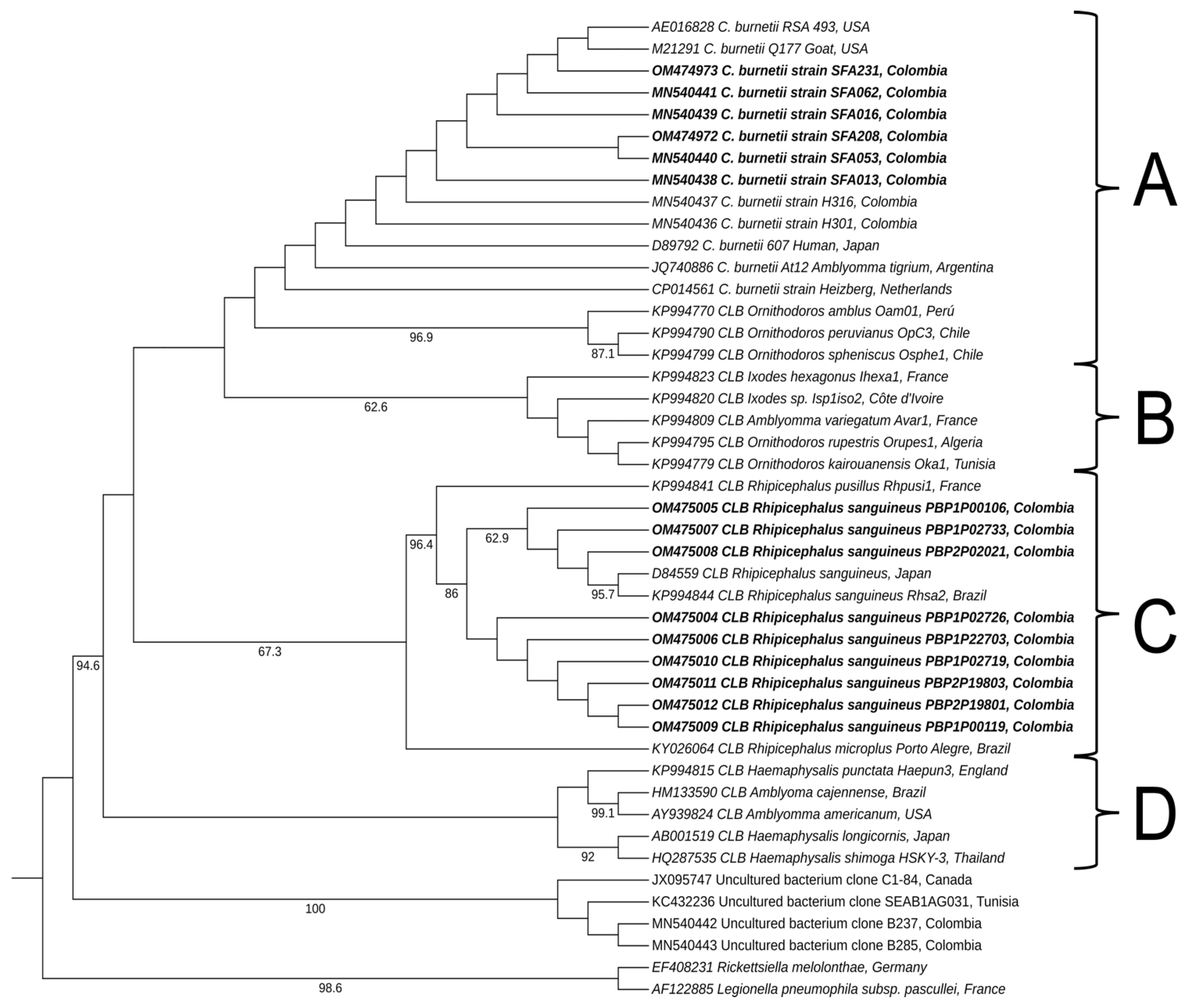
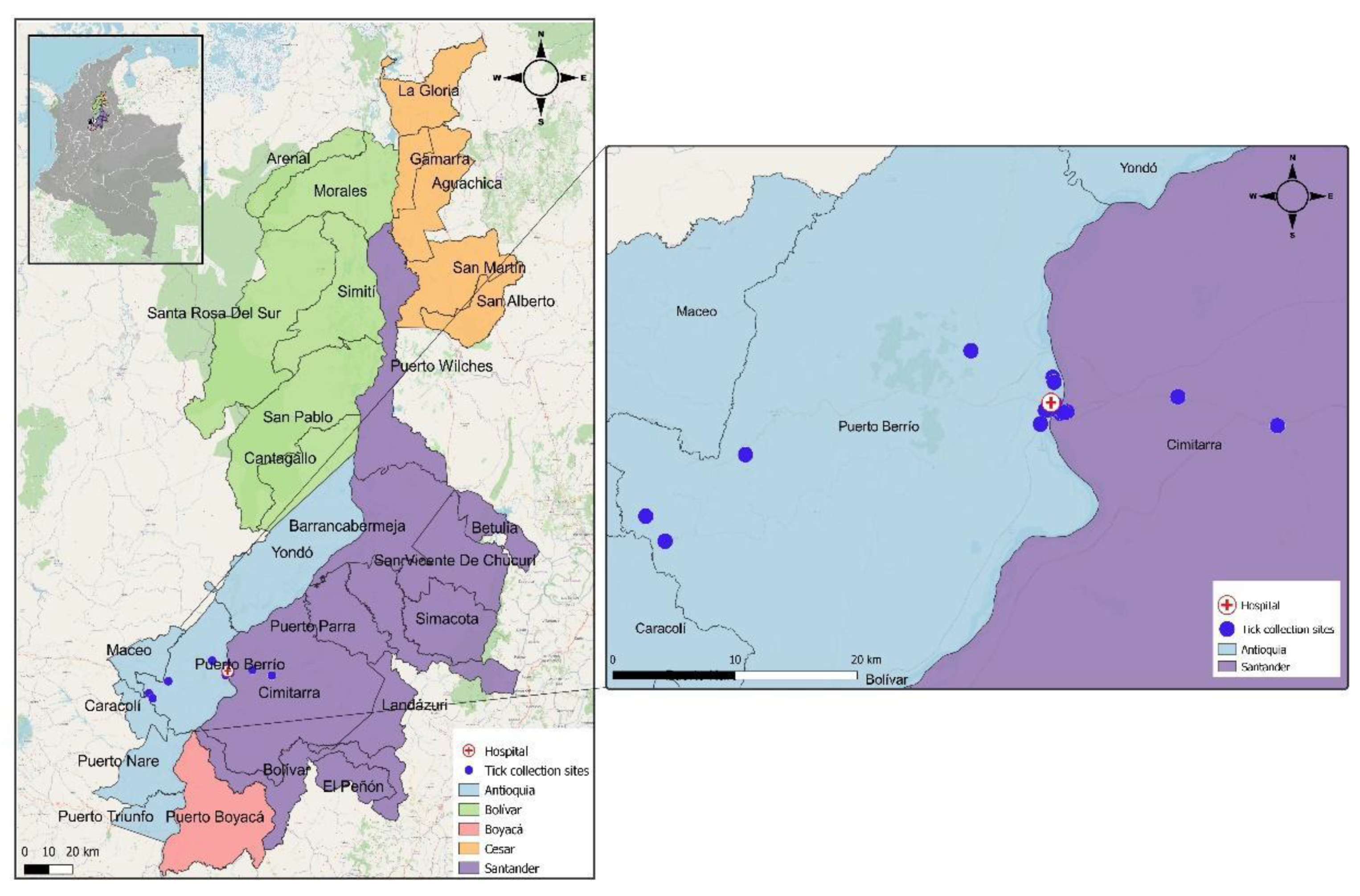
Acute febrile illness (AFI) is a morbid condition with a sudden onset of fever with at least seven days of evolution, where no signs or symptoms related to an apparent infection have been identified. In Latin America, a high proportion of disease is typically due to malaria and arboviruses. However, among the infectious etiologies, tick-borne diseases (TBDs) should also be considered, especially in areas where people come into direct contact with these arthropods. This study aims to describe the etiology and epidemiology related to tick-borne agents in patients with AFI and the tick’s natural infection by agents of TBD in the rural tropical Magdalena Medio region in Colombia, and explore the factors associated with the presence of Coxiella burnetii infection. We conduct a cohort study enrolling 271 patients with AFI to detect the bacteria of the genera Anaplasma, Ehrlichia, Coxiella, Rickettsia, Borrelia, and Francisella through molecular techniques, and additionally evaluate the presence of IgG antibodies with commercially available kits. We also conduct tick collection in the patient’s households or workplaces for the molecular screening of the same bacterial genera. Seropositivity to IgG antibodies was obtained for all the bacteria analyzed, with Francisella being the most common at 39.5% (107/271), followed by R. rickettsii at 31.4% (85/271), Ehrlichia at 26.9% (73/271), R. typhi at 15.5% (42/271), Anaplasma at 14.4% (39/271), and Borrelia at 6.6% (18/271). However, these bacteria were not detected by the molecular techniques used. Coxiella burnetii infection was detected in 39.5% of the patients: 49.5% only by phase I and II IgG antibodies, 33.6% only by real-time PCR, and 16.8% had a concordant positive result for both techniques. A total of 191 adult ticks, 111 females and 80 males, were collected and identified as Rhipicephalus sanguineus s.l. and Rhipicephalus microplus. In the 169 adult ticks in which natural infection was evaluated, Ehrlichia spp. was detected in 21.3% (36/169), Coxiella spp. in 11.8% (20/169), and Anaplasma spp. in 4.7% (8/169). In conclusion, we identified the prior exposition to Francisella, Anaplasma, Ehrlichia, Rickettsia, Borrelia, and Coxiella in patients through serological tests. We also detected the infection of C. burnetii using molecular techniques. In the ticks, we identified bacteria of the genera Coxiella, Anaplasma, and Ehrlichia. These results suggest the importance of these zoonotic agents as possible causes of AFI in this region.
Keywords: bacterial zoonoses; molecular diagnostic techniques; serologic tests; Coxiella bacterial zoonoses; molecular diagnostic techniques; serologic tests; Coxiella