Salmonella enterica Serovar Minnesota Biofilms, Susceptibility to Biocides, and Molecular Characterization
 , ,
, ,
Abstract
1. Introduction
2. Results and Discussion
2.1. Virulence Gene Characterization
2.2. Biofilm Formation × Temperature
2.3. Performance of Chemical Agents in Sessile S. Minnesota
2.4. Ultrastructure of Treated Biofilms
2.5. Phylogenetic Analysis
3. Materials and Methods
3.1. Samples and Sampling
3.2. Reactivation of Strains and Extraction of Genomic DNA
3.3. Identification of Specific Genes
3.4. Pulsed-Field Gel Electrophoresis (PFGE)
3.5. Biofilm Formation Index
3.6. Biofilm Formation Inhibition Test
3.7. Scanning Electron Microscopy
3.8. Analysis of Results
Author Contributions
Funding
Acknowledgments
Conflicts of Interest
References
- Centers for Disease Control and Prevention (CDC). Emerging and Zoonotic Infectious Diseases. Available online: https://www.cdc.gov/ncezid/what-we-do/our-topics.html (accessed on 3 April 2021).
- European Food Safety Authority. The European Union summary report on trends and sources of zoonoses, zoonotic agents and food-borne outbreaks in 2016. EFSA J. 2017, 15, 228. [Google Scholar] [CrossRef]
- Costa, R.G.; Festivo, M.L.; Araujo, M.S.; Reis, E.M.F.; Lázaro, N.S.; Rodrigues, D.P. Antimicrobial susceptibility and serovars of Salmonella circulating in commercial poultry carcasses and poultry products in Brazil. J. Food Prot. 2013, 76, 2011–2017. [Google Scholar] [CrossRef]
- Veterinary and Agrochemical Research Centre (CODA-CERVA). Scientific Report CODA-CERVA 2013–2014. Available online: https://www.sciensano.be/en/biblio/scientific-report-coda-cerva-2013-2014 (accessed on 21 April 2021).
- Voss-Rech, D.; Vaz, C.S.L.; Alves, L.; Coldebella, A.; Leão, J.A.; Rodrigues, D.P.; Back, A. A temporal study of Salmonellaenterica serotypes from broiler farms in Brazil. Poult. Sci. 2015, 94, 433–441. [Google Scholar] [CrossRef]
- Souza, A.P.O.; Taconeli, C.A.; Plugge, N.F.; Molento, C.F.M. Broiler Chicken Meat Inspection Data in Brazil: A First Glimpse into an Animal Welfare Approach. Braz. J. Poult. Sci. 2018, 20, 547–554. [Google Scholar] [CrossRef]
- Lambert, R.J.; Joynson, J.; Forbes, B. The relationships and susceptibilities of some industrial, laboratory and clinical isolates of Pseudomonas aeruginosa to some antibiotics and biocides. J. Appl. Microbiol. 2001, 91, 972–984. [Google Scholar] [CrossRef]
- Beier, R.C.; Callaway, T.R.; Andrews, K.; Poole, T.L.; Crippen, T.L.; Anderson, R.C.; Nisbet, D.J. Disinfectant and antimicrobial susceptibility profiles of Salmonella strains from feedlot water-sprinkled cattle: Hides and feces. J. Food Chem. Nanotechnol. 2017, 3, 50–59. [Google Scholar] [CrossRef]
- Beier, R.C.; Anderson, P.N.; Hume, M.E.; Poole, T.L.; Duke, S.E.; Crippen, T.L.; Sheffield, C.L.; Caldwell, D.J.; Byrd, J.A.; Anderson, R.C.; et al. Characterization of Salmonella enterica isolates from turkeys in commercial processing plants for resistance to antibiotics, disinfectants, and a growth promoter. Foodborne Pathog. Dis. 2011, 8, 593–600. [Google Scholar] [CrossRef] [PubMed]
- Nadi, Z.R.; Salehi, T.Z.; Tamai, I.A.; Foroushani, A.R.; Sillanpaa, M.; Dallal, M.M.S. Evaluation of antibiotic resistance and prevalence of common Salmonella enterica serovars isolated from foodborne outbreaks. Microchem. J. 2020, 155, 104660. [Google Scholar] [CrossRef]
- Brasão, S.C.; de Melo, R.T.; Prado, R.R.; Monteiro, G.P.; dos Santos, F.A.L.; Braz, R.F.; Rossi, D.A. Characterization and control of biofilms of Salmonella Minnesota of poultry origin. Food Biosci. 2021, 39, 100811. [Google Scholar] [CrossRef]
- Wang, H.; Hoffmann, M.; Laasri, A.; Jacobson, A.P.; Melka, D.; Curry, P.E.; Hammack, T.S.; Zheng, J. Complete genome sequence of Salmonellaenterica subsp. enterica serovar Minnesota Strain. Genome Biol. Evol. 2017, 9, 2727–2731. [Google Scholar] [CrossRef]
- Struelens, M.J.; De Ryck, R.; Deplano, A. Analysis of microbial genomic macrorestriction patterns by Pulsed-Field Gel Electrophoresis (PFGE) typing. In New Approaches for the Generation and Analysis of Microbial Typing Data; Dijkshoorn, L., Towner, K.J., Struelens, M., Eds.; Elsevier: Amsterdam, The Netherlands, 2001; pp. 159–176. [Google Scholar]
- Sanjay, M.K.; Shrideshikan, S.M.; Usha, M.S.; Philipraj, A.; Gaddad, S.M.; Shivannavar, C.T. Detection, amplification & sequence homology of sodC in clinical isolates of Salmonella sp. Indian J. Med. Res. 2010, 131, 565–570. [Google Scholar]
- Borges, K.A.; Furian, T.Q.; Borsoi, A.; Moraes, H.L.S.; Salle, C.T.P.; Nascimento, V.P. Detection of virulence-associated genes in Salmonella Enteritidis isolates from chicken in South of Brazil. Pesqui. Vet. Bras. 2013, 33, 1416–1422. [Google Scholar] [CrossRef]
- Ziech, R.E.; Perin, A.P.; Lampugnani, C.; Sereno, M.J.; Viana, C.; Soares, V.M.; Pereira, J.G.; Pinto, J.P.d.A.N.; dos Santos Bersot, L. Biofilm-producing ability and tolerance to industrial sanitizers in Salmonella spp. isolated from Brazilian poultry processing plants. LWTFood Sci. Technol. 2016, 68, 85–90. [Google Scholar] [CrossRef]
- Machado, S.; Pereira, V.; Aquino, M.; Santos, A.; Rodrigues, D.; Giombelli, A.; Nascimento, E. Serotyping and genotyping of Salmonella strains isolated from broilers, chicken carcasses before and after chilling, and frozen chicken breasts produced in the states of Mato Grosso do Sul and Santa Catarina, Brazil. Rev. Bras. Cienc. Avic. 2017, 19, 135–142. [Google Scholar] [CrossRef][Green Version]
- Silva, P.L.A.P.A.; Goulart, L.R.; Reis, T.F.M.; Mendonça, E.P.; Melo, R.T.; Penha, V.A.S.; Peres, P.A.B.M.; Hoepers, P.G.; Beletti, M.E.; Fonseca, B.B. Biofilm formation in different Salmonella serotypes isolated from poultry. Curr. Microbiol. 2019, 76, 124–129. [Google Scholar] [CrossRef] [PubMed]
- Rowlands, R.E.G.; Ristori, C.A.; Ikuno, A.A.; Barbosa, M.L.; Jakabi, M.; Franco, B.D.G.d.M. Prevalence of drug resistance and irulence features in Salmonella spp. isolated from foods associated or not with salmonelosis in Brazil. Rev. Inst. Med. Trop. Sao Paulo 2014, 56, 461–467. [Google Scholar] [CrossRef]
- Wang, Y.P.; Li, L.; Shen, J.Z.; Yang, F.J.; Wu, Y.N. Quinolone-resistance in Salmonella is associated with decreased mRNA expression of virulence genes invA and avrA, growth and intracellular invasion and survival. Vet. Microbiol. 2009, 133, 328–334. [Google Scholar] [CrossRef] [PubMed]
- Ahmed, H.A.; El-Hofy, F.I.; Shafik, S.M.; Abdelrahman, M.A.; Elsaid, G.A. Characterization of virulence-associated genes, antimicrobial resistance genes, and class 1 Integrons in Salmonellaenterica serovar Typhimurium isolates from chicken meat and humans in Egypt. Foodborne Pathog. Dis. 2016, 13, 281–288. [Google Scholar] [CrossRef]
- Amini, K.; Salehi, T.Z.; Nikbakht, G.; Ranjbar, R.; Amini, J. Molecular detection of invA and spv virulence genes in Salmonella enteritidis isolated from human and animals in Iran. Afr. J. Microbiol. Res. 2010, 4, 2202–2210. [Google Scholar] [CrossRef]
- Yoo, A.Y.; Yu, J.E.; Yoo, H.; Lee, T.H.; Lee, W.H.; Oh, J.-I.; Kang, H.Y. Role of sigma factor E in regulation of SalmonellaAgf expression. Biochem. Biophys. Res. Commun. 2013, 430, 131–136. [Google Scholar] [CrossRef] [PubMed]
- Melo, R.T.; Resende, A.R.; Mendonça, E.P.; Nalevaiko, P.C.; Monteiro, G.P.; Buiatte, A.B.G.; Rossi, D.A. Salmonella Minnesota de origem avícola apresenta fatores de virulência e risco potencial aos humanos. Arq. Bras. Med. Vet. Zootec. 2020, 72, 1353–1362. [Google Scholar] [CrossRef]
- Naves, P.; del Prado, G.; Huelves, L.; Gracia, M.; Ruiz, V.; Blanco, J.; Rodriguez-Cerrato, V.; Ponte, M.C.; Soriano, F. Measurement of biofilm formation by clinical isolates of Escherichia coli is method-dependent. J. Appl. Microbiol. 2008, 105, 585–590. [Google Scholar] [CrossRef] [PubMed]
- Dhakal, J.; Sharma, C.S.; Nannapaneni, R.; McDaniel, C.D.; Kim, T.; Kiess, A. Effect of chlorine-induced sublethal oxidative stress on the biofilm-forming ability of Salmonella at different temperatures, nutrient conditions, and substrates. J. Food Prot. 2019, 82, 78–92. [Google Scholar] [CrossRef]
- Lamas, A.; Regal, P.; Vázquez, B.; Miranda, J.M.; Cepeda, A.; Franco, C.M. Salmonella and Campylobacter biofilm formation: A comparative assessment from farm to fork. J. Sci. Food Agric. 2018, 98, 4014–4032. [Google Scholar] [CrossRef] [PubMed]
- Matches, J.R.; Liston, J. Low temperature growth of Salmonella. J. Food Sci. 1968, 33, 641–645. [Google Scholar] [CrossRef]
- Ariafar, M.N.; Buzrul, S.; Akçelik, N. Modeling and predicting the biofilm formation of Salmonella Virchow with respect to temperature and pH. Acta Biol. Hung. 2016, 67, 99–111. [Google Scholar] [CrossRef]
- Čabarkapa, I.; Škrinjar, M.; Lević, J.; Kokić, B.; Blagojev, N.; Milanov, D.; Suvajdžić, L. Biofilm forming ability of SalmonellaEnteritidis in vitro. Acta. Vet. Belgrade. 2015, 65, 371–389. [Google Scholar] [CrossRef]
- Agarwal, R.K.; Singh, S.; Bhilegaonkar, K.N.; Singh, V.P. Optimization of microtitre plate assay for the testing of biofilm formation ability in different Salmonella serotypes. Int. Food Res. J. 2011, 18, 1493–1498. [Google Scholar]
- Chousalkar, K.; Sims, S.; McWhorter, A.; Khan, S.; Sexton, M. The effect of sanitizers on microbial levels of chicken meat collected from commercial processing plants. Int. J. Environ. Res. Public Health 2019, 16, 4807. [Google Scholar] [CrossRef]
- Guastalli, B.H.L.; Batista, D.F.A.; Souza, A.I.S.; Guastalli, E.A.L.; Lopes, P.D.; Almeida, A.M.; Prette, N.; Barbosa, F.O.; Stipp, D.T.; Freitas Neto, O.C. Evaluation of disinfectants used in pre-chilling water tanks of poultry processing plants. Braz. J. Poultry Sci. 2016, 18, 217–224. [Google Scholar] [CrossRef][Green Version]
- Keeratipibul, S.; Techaruwichit, P. Tracking sources of Listeria contamination in a cooked chicken meat factory by PCR-RAPD-based DNA fingerprinting. Food Control 2012, 27, 64–72. [Google Scholar] [CrossRef]
- Maciel, M.J.; Machado, G.; Avancini, C.A.M. Investigation of resistance of Salmonella spp. isolated from products and raw material of animal origin (swine and poultry) to antibiotics and disinfectants. Rev. Bras. Saúde Prod. Anim. 2019, 20, e0162019. [Google Scholar] [CrossRef]
- Buffet-Bataillon, S.; Tattevin, P.; Bonnaure-Mallet, M.; Jolivet-Gougeon, A. Emergence of resistance to antibacterial agents: The role of quaternary ammonium compounds—A critical review. Int. J. Antimicrob. Agents 2012, 39, 381–389. [Google Scholar] [CrossRef]
- Lerma, L.L.; Benomar, N.; Muñoz, M.D.C.C.; Gálvez, A.; Abriouel, H. Correlation between antibiotic and biocide resistance in mesophilic and psychrotrophicPseudomonas spp. isolated from slaughterhouse surfaces throughout meat chain production. Food Microbiol. 2015, 51, 33–44. [Google Scholar] [CrossRef]
- Techaruvichit, P.; Takahashi, H.; Kuda, T.; Miya, S.; Keeratipibul, S.; Kimura, B. Adaptation of Campylobacter jejuni to biocides used in the food industry affects biofilm structure, adhesion strength, and cross-resistance to clinical antimicrobial compounds. Biofouling 2016, 32, 827–839. [Google Scholar] [CrossRef]
- Ritter, A.C.; Bacciu, D.; Santi, L.; da Silva, W.O.B.; Vainstein, M.H.; Rubino, S.; Uzzau, S.; Tondo, E.C. Investigation of rpoS and dps genes in sodium hypochlorite resistance of Salmonella Enteritidis SE86 isolated from foodborne illness outbreaks in southern Brazil. J. Food Prot. 2012, 75, 437–442. [Google Scholar] [CrossRef]
- Pfuntner, A. Sanitizers and disinfectants: The chemicals of prevention. Food Saf. Mag. 2011, 16, 18–19. [Google Scholar]
- Ohsumi, T.; Takenaka, S.; Wakamatsu, R.; Sakaue, Y.; Narisawa, N.; Senpuku, H.; Ohshima, H.; Terao, Y.; Okiji, T. Residual structure of Streptococcusmutans biofilm following complete disinfection favors secondary bacterial adhesion and biofilm re-development. PLoS ONE 2015, 10, e0116647. [Google Scholar] [CrossRef]
- Barah, F. Non-antibiotic biocides: An updated review. In Microbial Pathogens and Strategies for Combating Them: Science, Technology and Education; Méndez-Vilas, A., Ed.; Formatex: Badajóz, Spain, 2013; pp. 598–607. [Google Scholar]
- Moura, M.S.; Oliveira, R.P.; Melo, R.T.; Mendonça, E.P.; Fonseca, B.B.; Rossi, D.A. Genes de virulência e diversidade genética em Salmonella spp. isoladas de amostras de origem suína. Arq. Bras. Med. Vet. Zootec. 2014, 66, 1367–1375. [Google Scholar] [CrossRef]
- Food and Drug Administration (FDA). Bacteriological Analytical Manual Chapter 5: Salmonella. In Food and Drug Administration Bacteriological Analytical Manual; FDA: Silver Spring, MD, USA, 2007; pp. 1–21. [Google Scholar]
- Prager, R.; Rabsch, W.; Streckel, W.; Voigt, W.; Tietze, E.; Tschape, H. Molecular properties of Salmonellaenterica serotype Paratyphi B distinguish between its systemic and its enteric pathovars. J. Clin. Microbiol. 2003, 41, 4270–4278. [Google Scholar] [CrossRef] [PubMed]
- Oliveira, S.D.; Santos, L.R.; Schuch, D.M.T.; Silva, A.B.; Salle, C.T.P.; Canal, C.W. Detection and identification of salmonellas from poultry-related samples by PCR. Vet. Microbiol. 2002, 87, 25–35. [Google Scholar] [CrossRef]
- Collinson, S.K.; Doig, P.C.; Doran, J.L.; Clouthier, S.; Trust, T.J.; Kay, W.W. Thin, aggregative fimbriae mediate binding of Salmonella enteritidis to fibronectin. J. Bacteriol. 1993, 175, 12–18. [Google Scholar] [CrossRef] [PubMed]
- Choi, J.; Shin, D.; Ryu, S. Implication of Quorum Sensing in Salmonellaenterica serovar Typhimurium Virulence: The luxS gene is necessary for expression of genes in pathogenicity island 1. Infect. Immun. 2007, 75, 4885–4890. [Google Scholar] [CrossRef] [PubMed]
- Ribot, E.M.; Fair, M.A.; Gautom, R.; Cameron, D.N.; Hunter, S.B.; Swaminathan, B.; Barrett, T.J. Standardization of Pulsed-Field Gel Electrophoresis protocols for the subtyping of Escherichia coli O157:H7, Salmonella, and Shigella for PulseNet. Foodborne Pathog. Dis. 2006, 3, 59–67. [Google Scholar] [CrossRef] [PubMed]
- Kudirkienė, E.; Cohn, M.T.; Stabler, R.A.; Strong, P.C.R.; Šernienė, L.; Wren, B.W.; Nielsen, E.M.; Malakauskas, M.; Brøndsted, L. Phenotypic and genotypic characterizations of Campylobacter jejuni isolated from the broiler meat production process. Curr. Microbiol. 2012, 65, 398–406. [Google Scholar] [CrossRef]
- Birk, T.; Ingmer, H.; Andersen, M.T.; Jorgensen, K.; Brondsted, L. Chicken juice, a food-based model system suitable to study survival of Campylobacter jejuni. Lett. Appl. Microbiol. 2004, 38, 66–71. [Google Scholar] [CrossRef]
- Lu, X.; Samuelson, D.R.; Rasco, B.A.; Konkel, M.E. Antimicrobial effect of diallyl sulphide on Campylobacter jejuni biofilms. J. Antimicrob. Chemother 2012, 67, 1915–1926. [Google Scholar] [CrossRef]
- Brown, H.L.; Reuter, M.; Salt, L.J.; Cross, K.L.; Betts, R.P.; van Vliet, A.H.M. Chicken juice enhances surface attachment and biofilm formation of Campylobacterjejuni. Appl. Environ. Microbiol. 2014, 80, 7053–7060. [Google Scholar] [CrossRef]

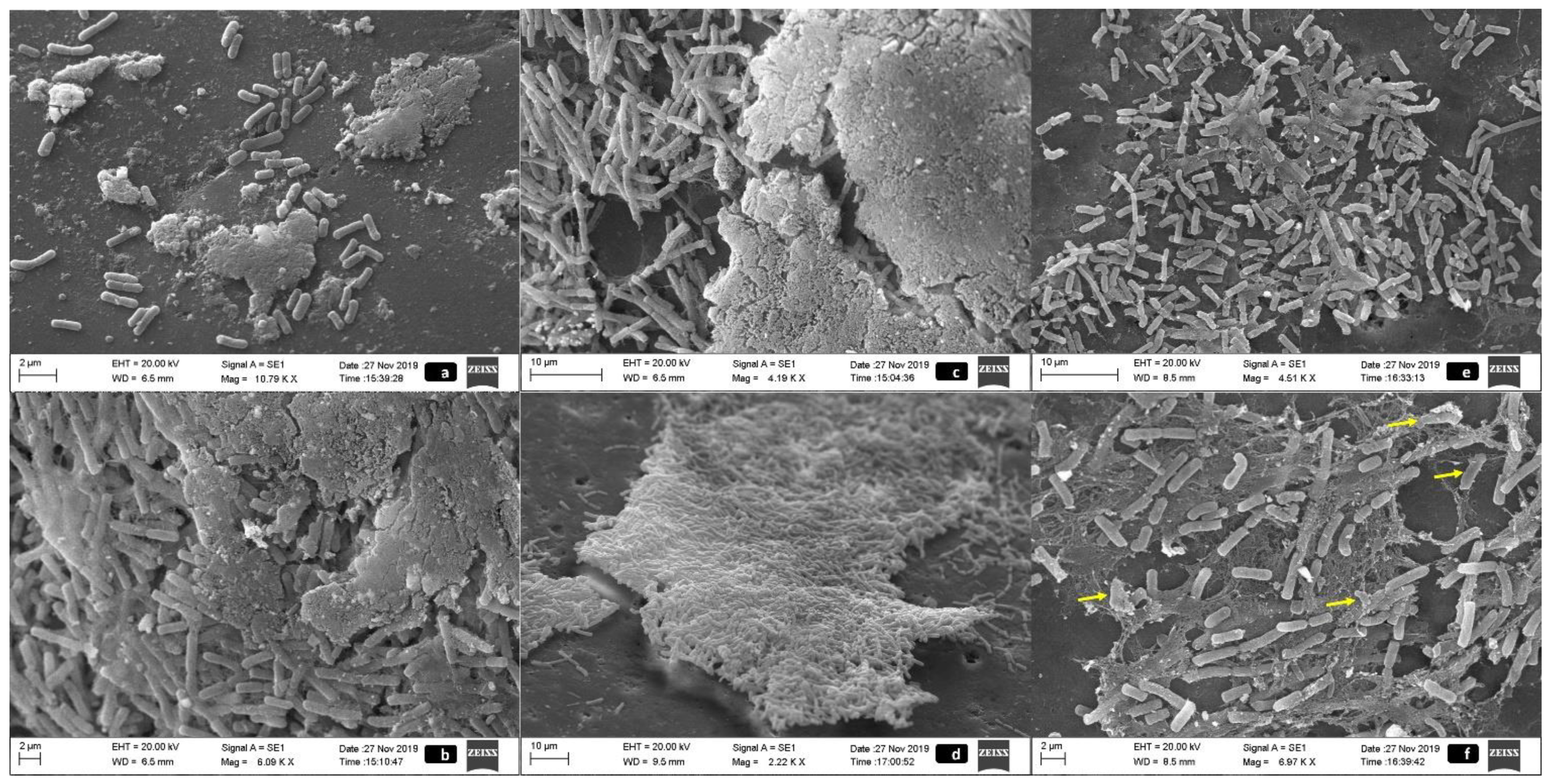
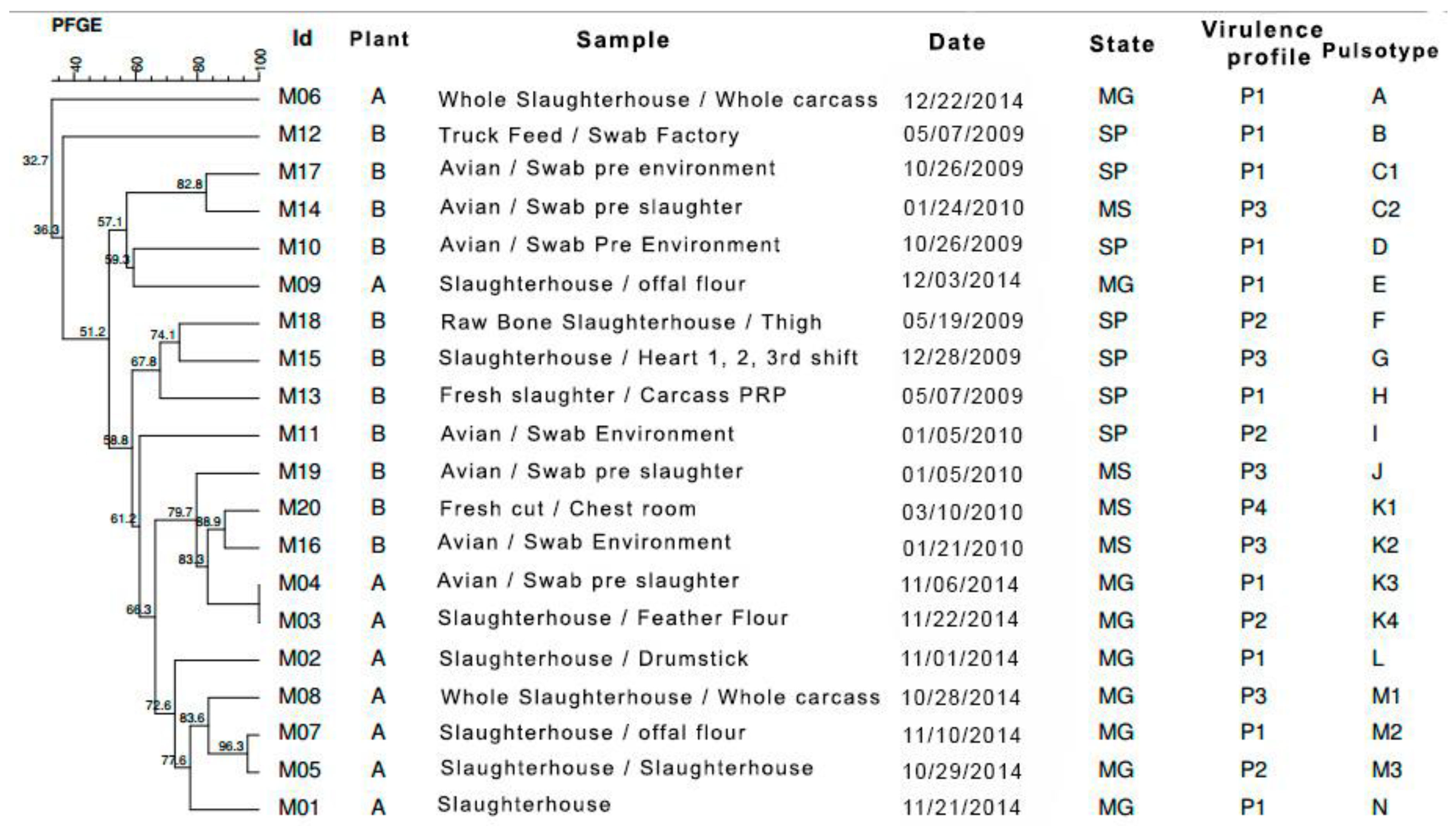

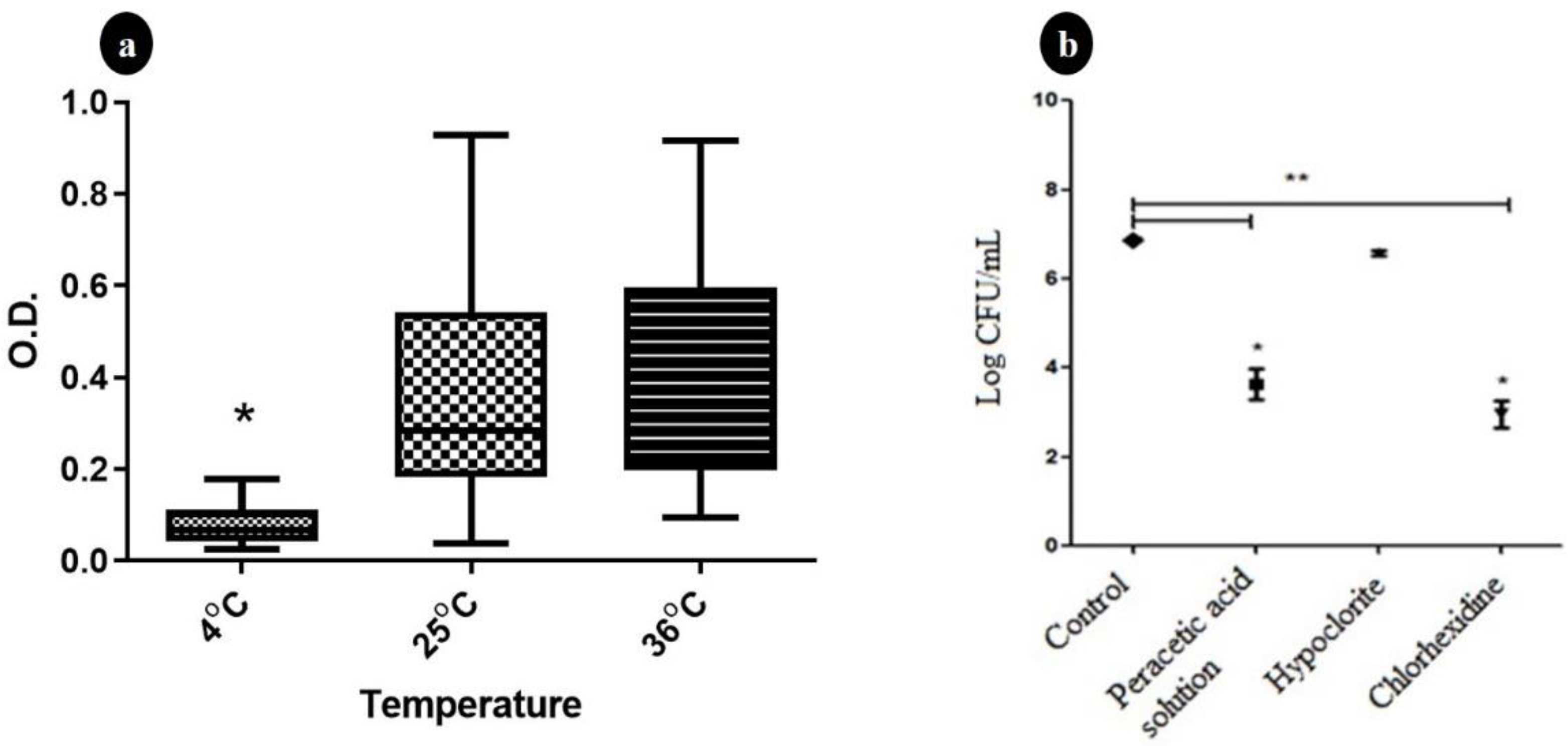
| Strains | 4 °C | 25 °C | 36 °C | Profile (a) | Profile (b) | Profile (c) | |||
|---|---|---|---|---|---|---|---|---|---|
| BFI | Class | BFI | Class | BFI | Class. | ||||
| M02 | 0.144 | NE | 0.226 | NE | 0.217 | NE | A | P1 | I |
| M13 | 0.025 | NE | 0.284 | NE | 0.095 | NE | A | P1 | I |
| M17 | 0.056 | NE | 0.219 | NE | 0.206 | NE | A | P1 | I |
| M03 | 0.056 | NE | 0.175 | NE | 0.269 | NE | A | P2 | II |
| M11 | 0.037 | NE | 0.039 | NE | 0.136 | NE | A | P2 | II |
| M18 | 0.077 | NE | 0.173 | NE | 0.196 | NE | A | P2 | II |
| M14 | 0.059 | NE | 0.179 | NE | 0.105 | NE | A | P3 | III |
| M16 | 0.039 | NE | 0.179 | NE | 0.215 | NE | A | P3 | III |
| M20 | 0.030 | NE | 0.196 | NE | 0.118 | NE | A | P4 | IV |
| M10 | 0.039 | NE | 0.229 | NE | 0.537 | W | B | P1 | IV |
| M01 | 0.159 | NE | 0.284 | NE | 0.916 | M | C | P1 | IV |
| M06 | 0.162 | NE | 0.471 | W | 0.431 | W | D | P1 | IV |
| M12 | 0.067 | NE | 0.517 | W | 0.421 | W | D | P1 | IV |
| M05 | 0.079 | NE | 0.493 | W | 0.438 | W | D | P2 | IV |
| M15 | 0.088 | NE | 0.576 | W | 0.644 | W | D | P3 | IV |
| M07 | 0.118 | NE | 0.550 | W | 0.866 | M | E | P1 | IV |
| M19 | 0.054 | NE | 0.462 | W | 0.875 | M | E | P3 | IV |
| M04 | 0.066 | NE | 0.891 | M | 0.539 | W | F | P1 | IV |
| M09 | 0.179 | NE | 0.928 | M | 0.547 | W | F | P1 | IV |
| M08 | 0.074 | NE | 0.870 | M | 0.612 | W | F | P3 | IV |
| Total N (%) | NE: 20 (100) | NE: 11 (55) | NE: 9 (45) | A: 9 (45) | P1: 10 (50) | I: 3 (15) | |||
| W: 0 | W: 6 (30) | W: 8 (40) | B: 1 (5) | P2: 4 (20) | II: 3 (15) | ||||
| M: 0 | M: 3 (15) | M: 3 (15) | C: 1 (5) | P3: 5 (25) | III: 2 (10) | ||||
| D: 4 (20) | P4: 1 (5) | IV: 12 (60) | |||||||
| E: 2 (10) | |||||||||
| F: 3 (15) | |||||||||
| Gene | Concentration | Amplicon (bp) | Primer | Reference |
|---|---|---|---|---|
| avrA | 20 pmol | 385 | GTTATGGACGGAACGACATCGG ATTCTGCTTCCCGCCGCC | [45] |
| sodC | 20 pmol | 500 | ATGAAGCGATTAAGTTTAGCGATGG TTTAATGACTCCGCAGGCGTAACGC | [14] |
| invA | 10 pmol | 284 | GTGAAATTATCGCCACGTTCGGGCAA TCATCGCACCGTCAAAGGAACC | [46] |
| sefA | 10 pmol | 488 | GATACTGCTGAACGTAGAAGG GCGTAAATCAGGATCTGCAGTAGC | [46] |
| agfA | 10 pmol | 350 | TCCACAATGGGGCGGCGGCG CCTGACGCACCATTACGCTG | [47] |
| lpfA | 10 pmol | 250 | CTTTCGCTGCTGAATCTGGT CAGTGTTAACAGAAACCAGT | [47] |
| luxS | 20 pmol | 1080 | GATAATCCTGAACTAAGCTTCTCCGC GGTTATGAGAAAAGCATGCACCGATCA | [48] |
Publisher’s Note: MDPI stays neutral with regard to jurisdictional claims in published maps and institutional affiliations. |
© 2021 by the authors. Licensee MDPI, Basel, Switzerland. This article is an open access article distributed under the terms and conditions of the Creative Commons Attribution (CC BY) license (https://creativecommons.org/licenses/by/4.0/).
Share and Cite
de Melo, R.T.; dos Reis Cardoso, T.; Peres, P.A.B.M.; Braz, R.F.; Monteiro, G.P.; Rossi, D.A. Salmonella enterica Serovar Minnesota Biofilms, Susceptibility to Biocides, and Molecular Characterization. Pathogens 2021, 10, 581. https://doi.org/10.3390/pathogens10050581
de Melo RT, dos Reis Cardoso T, Peres PABM, Braz RF, Monteiro GP, Rossi DA. Salmonella enterica Serovar Minnesota Biofilms, Susceptibility to Biocides, and Molecular Characterization. Pathogens. 2021; 10(5):581. https://doi.org/10.3390/pathogens10050581
Chicago/Turabian Stylede Melo, Roberta Torres, Taciano dos Reis Cardoso, Phelipe Augusto Borba Martins Peres, Raquelline Figueiredo Braz, Guilherme Paz Monteiro, and Daise Aparecida Rossi. 2021. "Salmonella enterica Serovar Minnesota Biofilms, Susceptibility to Biocides, and Molecular Characterization" Pathogens 10, no. 5: 581. https://doi.org/10.3390/pathogens10050581
APA Stylede Melo, R. T., dos Reis Cardoso, T., Peres, P. A. B. M., Braz, R. F., Monteiro, G. P., & Rossi, D. A. (2021). Salmonella enterica Serovar Minnesota Biofilms, Susceptibility to Biocides, and Molecular Characterization. Pathogens, 10(5), 581. https://doi.org/10.3390/pathogens10050581