1. Introduction: Shadows of Crises
In cultural memory studies, the role of photography in the process of remembering has been the subject of intense discussion, particularly in the context of trauma. To this day, Roland Barthes’ brilliant book
La chambre claire (
Barthes 1980,
Camera Lucida) is central to these discussions. In it, Barthes prominently formulates the insight that analogue photography is not only an iconic sign, i.e., not only a sign that bears a similarity to its referent, but that a photograph can also be read as an indexical sign, i.e., that it is an imprint of light, created in the same way as a track in the snow. While Barthes’ insight has been extremely fruitful for the study of traumatic remembering, it is surprising that other indexical signs—the echo, the shadow, the scar, and the ruin, to name but a few—have been neglected in memory studies. In this article, an attempt will be made to test a broader approach by bringing the key points of the discussion on iconicity (of photography and memory) into dialogue with a Norwegian comic, which explicitly names an indexical sign in its title, and to follow the traces of indexicality in it:
Kverneland’s (
2023) comic book
Skygger (
Shadows) is a dark autobiographical essay about how national and international crises of recent years overwhelmed the narrator. First there is Anders Behring Breivik’s terrorist attack of 22 July 2011 (pp. 25–27), then the beginning of the corona measures in spring 2020 (pp. 39–46), then Russia’s attack on Ukraine in February 2022 (pp. 55–57), and finally the moment in December 2000 when Kverneland finds his brother dead in his apartment (pp. 81–85). Since Kverneland addresses the events on Utøya, the pandemic and the war of aggression in the correct chronological order but ends the book with the suicide of his brother, the first event in terms of time, this suggests that the personal loss in 2000 triggered a trauma that has been present in the background of his experience of the later national and international crises. So, at the end of the book, it becomes clear that the individual trauma strings together all the other collective crises that Kverneland refers to earlier in the book.
But Skygger is also a comic about remembering World War II because Kverneland—born in 1963—recounts how family gatherings in the 1970s were still marked by the collective trauma of the German occupation in the 1940s. For Kverneland, therefore, drawing and writing about World War II is not a question of adequately representing historical events, but rather of recognising that the memory of World War II has a function in dealing with current crises.
In light of our goal to demonstrate how indexicality beyond the medium of photography can be made conceptually fruitful for memory studies, Skygger is an exceptionally fitting interlocutor, as the book begins with a reflection on the role photography plays in the aesthetics of Kverneland’s work as a comic artist. This reflection is sparked by a 1941 photograph of Soviet prisoners of war in a concentration camp. As I will show, the artistic transformation of this photograph from the context of World War II sets in motion a reflection on indexicality that runs through the entire book. Kverneland’s comic thus becomes an opportunity to assess the potential of Barthes’ concept of indexicality beyond the boundaries of photographic theory. A semiotic reading of Skygger can perhaps illustrate what a sensitivity to indexicality and its metaphors can do for cultural memory studies.
2. Discourse Nodes
Calling photography a shadow image is one of the topoi that have been circulating in photographic discourse from the very beginning. In one of the initial texts of photography theory from 1839, W.H.F. Talbot writes under the heading ‘On the Art of fixing a Shadow’: “The most transitory of things, a shadow, the proverbial emblem of all that’s fleeting and momentary, may be fettered by the spells of our ‘
natured magic,’ and may be fixed forever in the position which it seemed only destined for a single instant to occupy” (
Talbot 1839, p. 201). It is therefore not surprising that
Kverneland (
2023) calls his comic
Skygger (
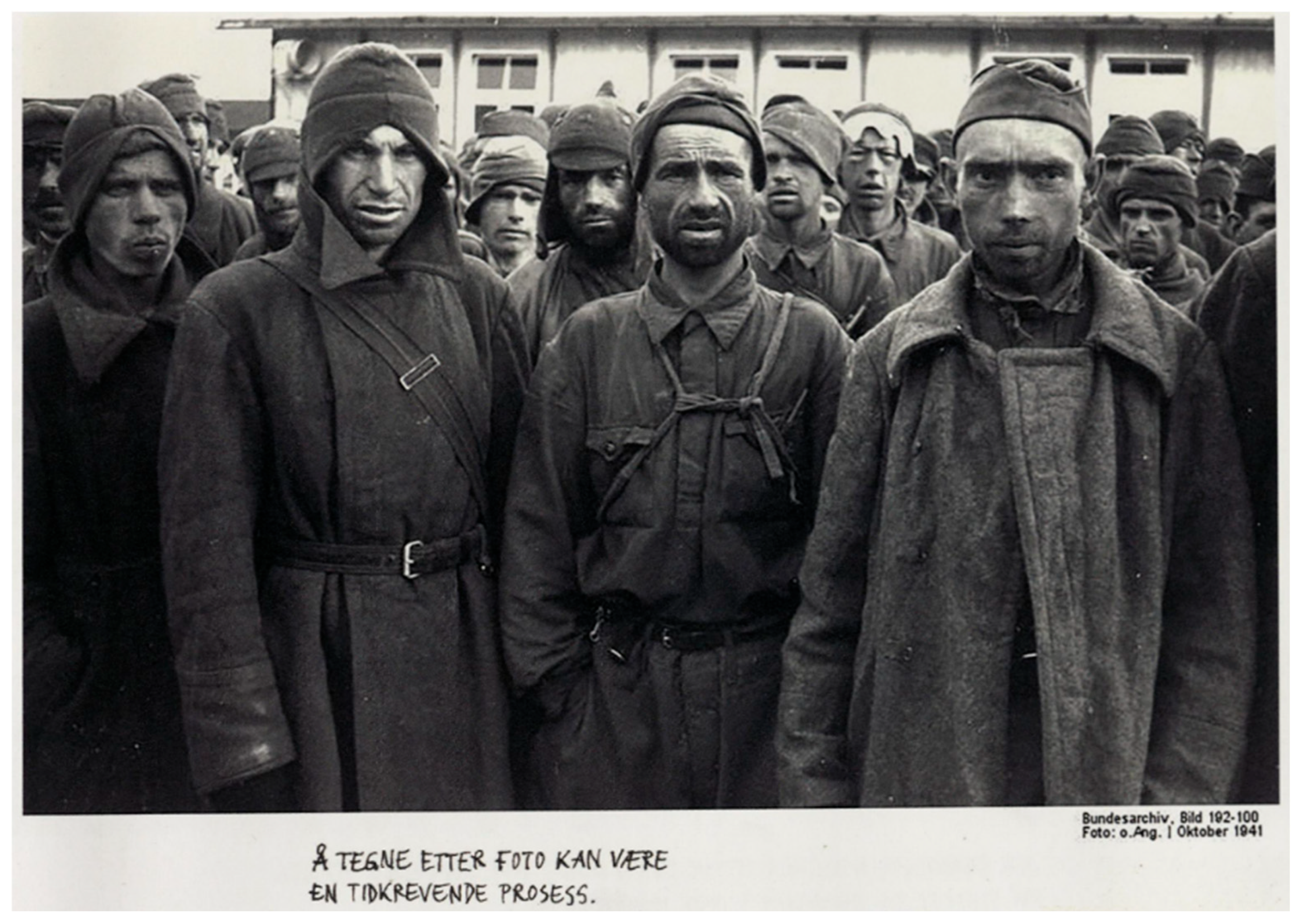
Shadows) given that its panels consist almost exclusively of photographs. I should be more precise: The comic does not consist of photographs but of drawings and watercolours, all of which are based on photographs and want to be recognised as such. In fact, the book contains only one ‘real’ photograph (see
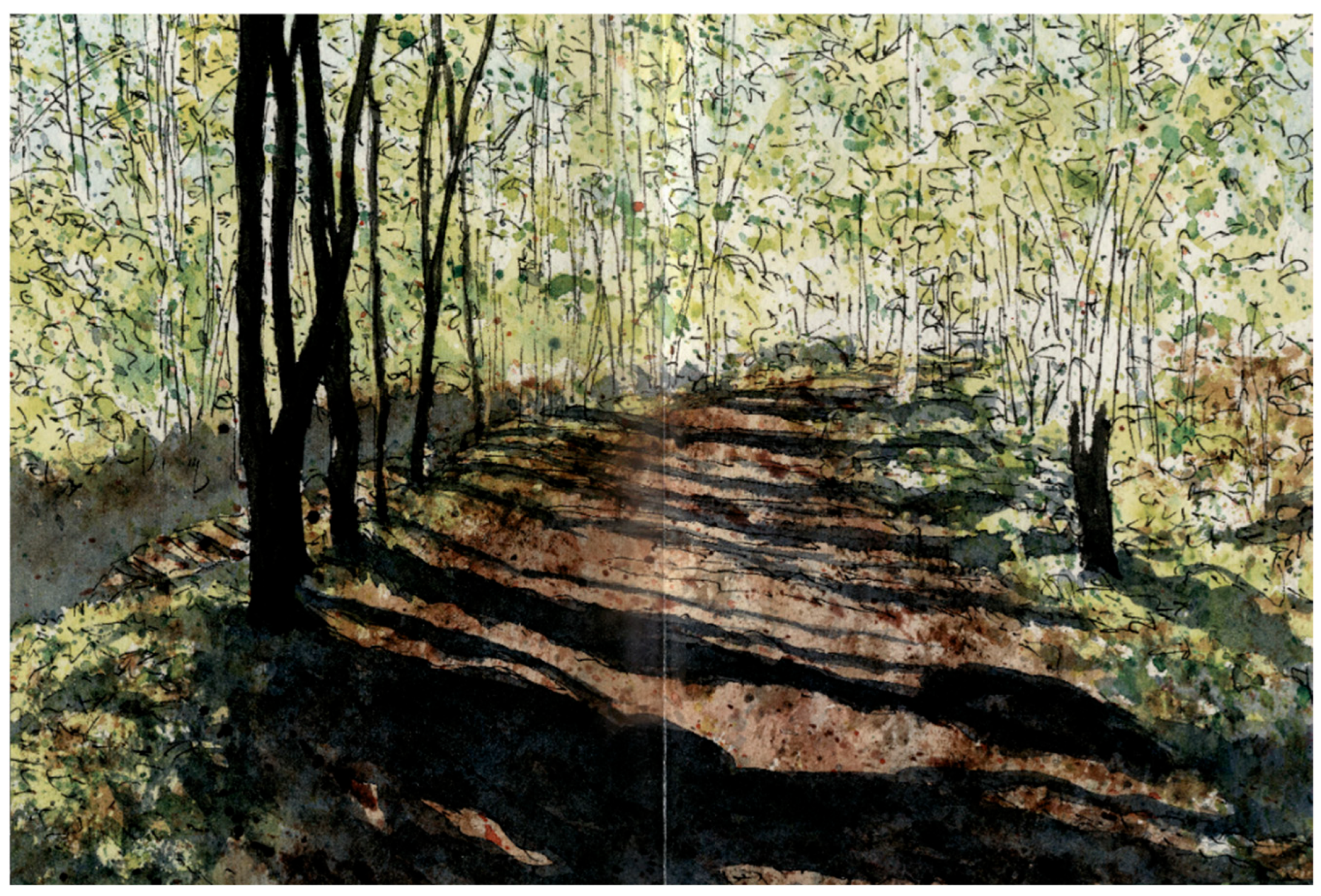
Figure 1), which comes from the German Federal Archives/Bundesarchiv, as can be read at the bottom right-hand edge of the photo. However, due to its prominent position at the beginning of the comic—preceded only by a coloured double page with a picture of a sunlit forest path—and the fact that this is the first panel accompanied by text, the photo controls the reading, which also determines the reception of the other photographs reproduced as drawings.
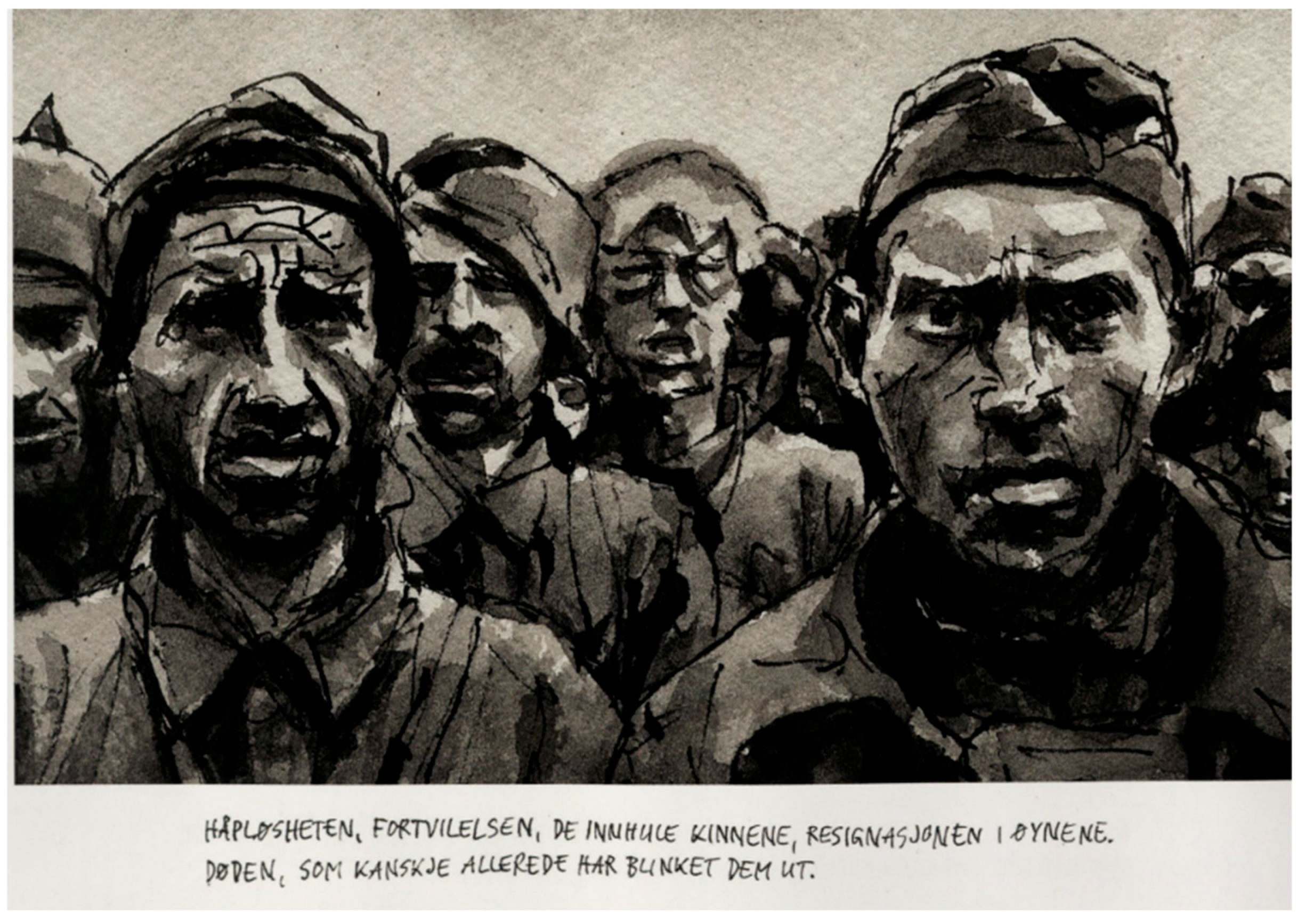
The photograph shows a group of starving Soviet prisoners in the Second World War looking directly into the lens of the camera—and thus into the eyes of the viewer. Over four pages, Kverneland documents and comments on how he translates this photograph into a drawing—from the first strokes through various stages of elaboration to the black-and-white colouring with watercolours. The first pages thus serve as a means by which Kverneland reflects on his own artistic work and the role of photography in it, whereas the following chapters can be read as an implementation of this aesthetic and thus also as an exploration of the difference between photography and drawing. At this point, it is important to note how this reflection is framed discursively: It begins with the aforementioned photograph from the Federal Archives and the statement “Drawing from photographs can be a time-consuming process. Sometimes it gives me a deeper immersion in the image than I would have had if I had just looked at it”
1 (see
Figure 1) and ends with a look into the eyes of the characters drawn and a realisation that gives the book its dark undertone: “The hopelessness, the despair, the hollow cheeks, the resignation in their eyes. Death, which may already have them in its sight” (see
Figure 2).
Kverneland thus presents a conglomerate of densely interwoven discourses on the very first pages: the reflection of aesthetic practices; the origin of photography from the shadows; the appropriation of other people’s photographs and memories for his own purposes; the temporal gap between the Second World War and the present at his drawing table; the difference between seeing only with one’s eyes and the delayed seeing with one’s eyes and drawing hand; the tension between the gaze on the picture and the gaze out of the picture; and finally, death, which interposes itself between these shifting gazes.
The reason I recapitulate the semiotic conceptual repertoire of Peirce, Barthes and Dubois below is because I believe that the concept of indexicality is the fulcrum around which all these discourses revolve. For Pierce and Barthes develop their semiotic terminology precisely in the distinction between photograph and drawing or painting. And Dubois considers the extent to which the semiotic distinction between photograph and drawing becomes relevant for the viewer’s response to the haunting gaze out of the picture. Index and icon each offer their own unique options for affirming or rejecting what the image shows.
3. Index—Icon—Symbol
What happens when a photograph is transformed into a drawing? This question can only be addressed if we know “by what essential feature it [a photograph] was to be distinguished from the community of images” (
Barthes 1981, p. 3), a question that Roland Barthes sets out to answer in his classic
La chambre claire: Note sur la photographie (1980). His answer: they have a different relationship to their referent, i.e., to what they show, even if what the photograph and the other images offer to the viewer is more or less identical:
I had to conceive […] how Photography’s Referent is not the same as the referent of other systems of representation. I call ‘photographic referent’ not the optionally real thing to which an image or a sign refers but the necessarily real thing which has been placed before the lens, without which there would be no photograph. Painting can feign reality without having seen it. Discourse [i.e., language] combines signs which have referents, of course, but these referents can be and are most often ‘chimeras’. Contrary to these imitations, in Photography I can never deny that the thing has been there. There is a superimposition here: of reality and the past. And since this constraint exists only for Photography, we must consider it, by reduction, as the very essence, the noeme of Photography. […] The name of Photography’s noeme will therefore be: ‘That-has-been’.
In French:
ça a été. Here, Barthes characterises photography in contrast to painting and all linguistic forms of representation (which he calls discourse). The latter two are united by the fact that their referents do not necessarily have to have a physical existence; they can be ‘feigned’ or ‘chimeras’—the painting of a flying carpet, for example, or the noun ‘unicorn’. But in order for an (analogue) photograph to come about, an object or a person must necessarily have been in front of the camera lens; this fact also applies if one cannot recognise what has actually been in front of the lens due to poor lighting or an unstable camera position. The fact that Barthes explains the noeme of photography as distinct from painting and discourse reminds us of Peirce’s trichotomy of index, icon, and symbol, even if Barthes does not mention Peirce and his terms.
2In Peirce’s writings there are a variety of sign categories,
3 each of which has a different function. The specific differentiation of icon/index/symbol has the aim—and only this aim—to clarify how signs relate to what they denote: An iconic sign has a relationship of similarity with its referent, which is why maps or architectural floor plans are iconic signs; they imitate the relationship between the individual elements of a landscape or a building. In the quotation above, Barthes uses the painting as an example of an icon: We recognise certain lines and colours as a tree because they have been chosen and arranged in a way that resembles the appearance of a tree. On the other side, the connection between an indexical sign and its referent is more or less direct, either through touch or a causal relationship or that of pointing (e.g., with the ‘index’ finger). The classic example is the smoke on the horizon, which can be read as an index for the fire that produces it, or the track in the snow that indicates the animal that left it. Finally, the attribution of a symbolic sign to its referent is purely conventional. The word ‘table’, for example, has no similarity or direct relationship to the object with four legs and a top that we are used to denote with it: “signs, which have become associated with their meaning by
usage” (
Peirce 1998, p. 5; my emphasis).
Barthes was not the first to categorise photography as an index, but Peirce did, and he already saw the need to work out the difference to iconic resemblance: The resemblance of a photo “is due to the photographs having been produced under such circumstances that they were physically forced to correspond point to point by nature. In that aspect, then, they belong to the second class of sign, those by physical connection” (
Peirce 1998, p. 6), and thus to the indices. The light is first refracted by the photographed object and then reflected in its refracted form through the lens into the camera, where it is imprinted onto the light-sensitive material of the film; the photo therefore draws its authenticity not from its similarity but from the fact that it is a witness that what is depicted actually existed: it has the effect of a clue or a fingerprint in a detective story. It is of utmost importance to point out the limitation that Peirce makes in the quoted formulation: ‘[I]n that aspect’, photographs belong to the indexical signs. This formulation implies that photography can also be an icon in other respects and—I would like to add right away—it can also be a symbol. For, what is often forgotten when using these well-established terms from the semiotic toolbox, and what Barthes leaves unmentioned, is that the objects themselves—the smoke, the map or the noun ‘table’—are not indexical, iconic or symbolic signs
per se. Rather, the same sign can be
read as indexical, iconic or symbolic; what is decisive for belonging to one of the three categories is the referent to which the sign refers. Let us take the painting of a tree, for example. If the idea is that the referent to which the lines and colours point is a tree, the painting is regarded as an icon for a tree. But if you recognise the brush in the shape of the lines of colour, you have read the painting as an indexical sign for the brush. Just as in the indexical formula ‘If smoke, then fire’, the application of paint with its specific contour, which the brush has left behind in the wet paint, can be read as a sign for the brush—or for the hand that guided the brush. Even a verbal utterance, with all its symbols that make up the message of the utterance, can be read indexically: The spoken word, for example, is an index of the speech instruments in the mouth, the tongue, the lips and the palate. Or even more accurately: precisely these sounds that I hear at this moment are indices of a certain tongue, a certain pair of lips and a certain palate.
The index thus has a specificity that dissolves into a higher degree of abstraction in the icon and the symbol: the tree in the painting is similar to every tree and thus an icon of the tree-like; but as an index, the green and brown of the painted tree only point to a specific brush, namely the one with which the tree was painted. To quote Peirce again: “Indices may be distinguished from other signs or representations, by […] that they refer to individuals, single units, single collections of units or single continua” (
Peirce 1931, vol. 2, para. 306).
4. One Image, Three Variations
What I have presented so far in rather abstract terms will demonstrate its functionality in the analysis of concrete aesthetic objects, that is, when the well-known semiotic concepts help us to more precisely grasp the various variants of the image with the Soviet prisoners of war, and when they reveal further dimensions of Kverneland’s comic along the way. We began by observing that the photograph of the prisoners is gradually transformed into a drawing in the first pages of the comic. In a first approximation, this transformation can be described as a change in semiotic status; an indexical sign is transformed into an iconic sign. How the meta-aesthetic reflection in the text under the images is to be understood remains to be discussed. However, it is already clear that by explaining his method of working, Kverneland by extension also infects our understanding of all the other images in the comic, for they are all recognisable as the result of the same method of transformation.
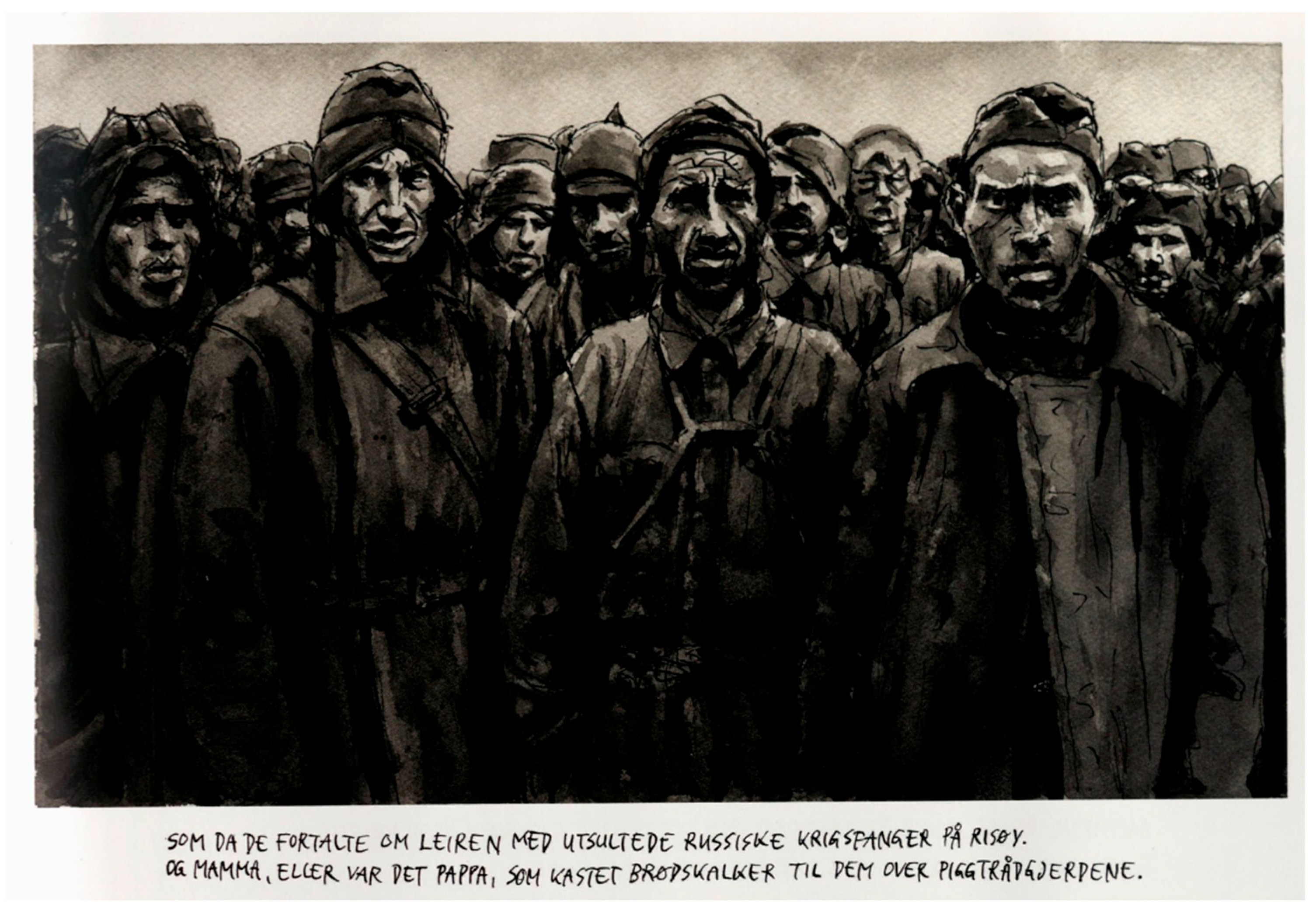
I would like to add a second observation. The image of the prisoners of war is not only relevant because of its position as a guiding element of the reading, but also because the same image appears in another chapter in
Skygger (see
Figure 3). One could assume that the image is being used here for its same iconic quality, as it was on the first pages of the book. However, the context tells a different story: After the chapters on his own aesthetics, on Breivik’s terrorism, on the COVID-19 pandemic and on the war in Ukraine, a new chapter begins with three pictures showing used coronavirus facemasks in the street dirt. The text that follows these three pictures: “Soon, the pandemic will be just a vague memory./Something we tell our children and grandchildren about, and they will roll their eyes./Just as we rolled our eyes at our parents”
4—then a drawing showing a photograph of a family celebration from the 1970s—“every time they talked about the war”
5 (
Kverneland 2023, pp. 62–63). What follows then are stories about the Second World War, drawn from the family’s own experiences but also from the collective national memory, such as the deportation of Norwegian Jews, the street celebrations at the end of the war, and the assaults on
tyskerjenter (=Norwegian women who had been in relationships with German soldiers). The pictures from pages 64 to 72 that illustrate these memories of the parents and grandparents are now (on page 69, see
Figure 3) joined by the drawing of the Soviet prisoners of war that we already know from page 14: “The old stories from the war come alive and feel relevant./Like when they told us about the camp with starving Russian prisoners of war on Risøy. And Mum, or was it Dad, who threw bread crusts to them over the barbed wire fences”
6 (
Kverneland 2023, pp. 68–69).
I have already mentioned that all the images Kverneland draws are based on photographs. These photos include a number of pictures from the artist’s private collection, such as pictures showing the path from his apartment to his studio, or those of his cabin, or of the Kverneland family celebrations. But the templates also include photos that can easily be found on the internet; for example, those showing bombed Ukrainian cities, or the photo with tyskerjenter or that of Moritz Rabinowitz, a Jewish merchant from Haugesund who was murdered in Sachsenhausen concentration camp. If you try to match these images with the memories that Kverneland recounts in the text, you come to a surprising conclusion. It turns out that some of the images illustrating family memories actually do not show what the text reports.
An example is the text “My grandfather […] was on board the very last boat sunk by the Germans, on 7 May 1945, the day before peace”
7 (
Kverneland 2023, p. 71), which is accompanied by an image that shows a bombed ship and people in lifeboats. But Kverneland is not depicting the burning
Sneland I, the ship on which his grandfather was a crew member. The photo can be found, for example, on the
Store Norske Leksikon website (see
Wisting 2025), where the ship is called
Columbus.
8 This incorrect attribution is not an instance of fraud, because Kverneland points out his aesthetic strategies at the beginning of the book: There he reveals that the photo of the prisoners comes from a public archive; the archive number is easily recognisable in the margin: ‘Bundesarchiv, Bild 192–100’. This information is enough to track it down on the internet and identify the people in the photo as Soviet prisoners of war—though not from a Norwegian camp on Risøy (as claimed in
Figure 3) but from the Austrian concentration camp at Mauthausen.
Thus, as in the case of the ship Sneland I, the drawing makes a Risøy memory visible by appropriating an image from Mauthausen. Unlike the first pages, which show the transition from photo to drawing, the character of the image does not change here: the drawing from page 14 is repeated without any modification. That something has changed nonetheless becomes clear when one pays attention to the different semiotic statuses of the three images. All three have the same visual content, but their semiotic pragmatics are different: just as the image changes its status from index to icon on the first pages, the icon is now transformed into a symbol: the people depicted still resemble the tortured victims of the Mauthausen concentration camp. But now they are no longer supposed to represent these people; instead, they now stand for certain memories of the Kverneland family. In other words, the third picture has the same content but a different referent. It is assigned to its referent not on the basis of a direct indexical reference or an iconic similarity to certain people, but solely on the basis of the fact that it accompanies the narrated memories. Kverneland sets a symbolic relationship like a lawmaker—and we obey when we recognise the parents’ war memories.
To summarise briefly: First, the photograph is a dominant indexical sign (ça a été); then it is transformed into an iconic sign for the prisoners in Mauthausen; on its third appearance, the image is used as a symbolic sign for the particular memories of the Kverneland family.
5. The Act Character of the Index
In the next step, I would like to outline in more detail what constitutes the indexical character of a photograph. This is where Philippe Dubois’ important book
L’acte photographique (1983—The Photographic Act) comes in handy. More consistently than anyone else, he further developed and differentiated Barthes’ theory of photography as a theory of signs. At one point he emphasises the moment of pure iconicity. Among other things, he refers to a formulation by Barthes that has been heavily criticised. In an early essay, Barthes called photography a “message without code”
9 (
Barthes 1961, p. 128). Dubois specifies that codes, of course, follow the production of a photograph. Beforehand, for example, the choice of what is photographed, why it is photographed at all (memory, reportage, diagnosis, representation), the current state of photographic technology, …; then, after the exposure, the chemical development, the choice of the cut-out, the distribution channel with its specific cultural practices (press, justice, archive, fashion, porn) … However, this does not exclude the basic photographic prerequisite that there is a moment when the object is reproduced without human intervention through the interaction of light and photographic film alone:
Only between these two series of codes, only at the moment of exposure itself, can the photograph be seen as a pure trace of an act (as a message without code). Only here, but really only here, does man neither intervene nor can he intervene […]. Here is a rupture, a momentary suspension of the code, an almost pure index. This moment lasts only a fraction of a second and is immediately caught up again by the codes, which will then never let it go again.
10
Dubois thus conceptualises photography as an act—and this applies to all indexical signs: they cannot be separated from the moment of their production. Dubois goes one step further: what is true of the indexical moment of photographic production is equally true of the moment of reception. This too is surrounded by cultural codes, for example, when we decipher a photograph and draw on historical and cultural knowledge—in other words, when we read the photograph as an icon or a symbol, for example, when we recognise the person photographed as (an icon of) Marilyn Monroe on the basis of her platinum blonde hair, her birthmark and her red pouting mouth, and identify her sultry gaze and slightly open mouth as symbols of erotic readiness. But for the moment, for the act in which I recognise the photograph as an index, only one thing is decisive, “that the photographed body touches me with its own rays” (
Barthes 1981, p. 81). And here, too, Barthes coined terms that became canonical: He calls the iconic and symbolic reading of the photograph “studium”, the moment of recognising the indexical dimension he calls “punctum”.
6. Indexicality in Memory Studies
Let us now turn to the specific interest that memory studies have in photography.
11 Their motivation stems from the reconstruction of memory in contexts of trauma. Now, the photographic punctum is connected to death in a very special way:
[T]he punctum is: he [the person depicted in the photo] is going to die. I read at the same time: This will be and this has been; I observe with horror an anterior future of which death is the stake. By giving me the absolute past of the pose […], the photograph tells me death in the future. […] I shudder […] over a catastrophe which has already occurred […]: there [in the punctum] is always a defeat of Time in them: that is dead and that is going to die.
This focus on the
memento mori makes Barthes’ theory interesting for Marianne Hirsch’s concept of post-memory, which became famous and influential in the 1990s and shaped much of the work in memory studies. She states that “[p]hotography is precisely the medium connecting memory and post-memory” (
Hirsch 1992–1993, p. 9). For in the photograph, there is a direct connection to the person depicted (their light from back then hits me today). Both the parents’ generation, who have direct memories of what the photo shows, and the children’s generation, who have no memories of their own, are touched in the same way by the punctum of the photo, by the That-has-been/
ça a été. This indexical proximity to the dead is equally valid for all photographs, but Hirsch sees in it a special relevance for what she calls the ‘Holocaust photograph’. It includes not only the horrific images from the extermination camps but also snapshots or photos of Jewish families from the 1930s; although the latter do not show the atrocities of the Nazis, the knowledge of the disastrous future of those depicted (i.e., of what happened historically between the indexical act of production and the indexical act of reception) infects the images of everyday happiness with the horror of the extermination camps. “[T]he utter conventionality and generality of the domestic family picture […] makes it impossible for us to comprehend how the person in the picture was, or could have been, exterminated” (
Hirsch 1992–1993, p. 7).
However, Hirsch is extremely inaccurate in her application of Barthes’
ça a été. The indexicality of a photograph bridges the temporal gap between then and now, and in doing so, it allows us to sense the death of the person depicted. But indexicality only aims at the anthropological fact that every human being will die; it knows nothing about the nature of the specific death. If I ‘see’ the Holocaust in a family photo from the early 1930s, then I have filled the photo with my knowledge. Hirsch says exactly that: “The horror of looking is not necessarily in the image but in the story we provide to fill in what is left out of the image” (
Hirsch 1992–1993, p. 7). But in saying this, Hirsch has left the realm of the index and is now in the realm of the icon and the symbol. For the family photos of people who were deported to the concentration camps a little later do not stir us with the light that emanated from the crematoria at the time; instead, there is a practice of remembrance in which I project the knowledge that I have about the death of those depicted into the photos. Indexically, I can only grasp their general mortality. But a specific death can only be represented iconically or symbolically. Marianne Hirsch thus reconstructs a symbolic reading of family photographs. Ultimately, her concept of post-memory has very little to do with Barthes’
ça a été and the indexical quality of photographs.
7. Iconic Autonomy
Let us now look at Kverneland’s comments on his own creative process when he transforms an indexical photo into an iconic drawing (
Kverneland 2023, pp. 11–14). (1) First, he notes that drawing “means that I have to study and analyse every detail”
12 (
Kverneland 2023, p. 12). In other words, the indexical punctum is replaced by the iconic studium of the photograph. (2) Kverneland then refers to his drawing as a ‘reimagination’ (gjendiktning—
Kverneland 2023, p. 13). The indexical moment par excellence is—as we have seen—the moment of exposure: in Dubois’ words quoted above: “Only here, but really only here, does man not intervene and cannot intervene”. But a reimagination is not a mechanical moment like the exposure but passes through a consciousness and thus gains a freedom vis-à-vis its original that mechanical production cannot give; a reimagination (gjendiktning) of a poem in a new language does not simply copy the source poem but is a poem in its own right, which may deal with the same subject but has a very distinct aesthetic structure:
Even though the drawing still resembles the photograph, it has become something else. It has acquired its own rhythm, its own rules, its own life./Each stroke I paint leads to the next stroke, and with each new stroke, the pain, hunger and suffering in each face become clearer to me.
13
When Kverneland says that the drawing takes on “its own rhythm, its own rules, its own life”, he means that the drawing develops an internal structure in the process of its creation that is not present in the photographic model. But there is more! This structure is not the result of the finished drawing but already controls the process of creation and guides the person drawing: “Each stroke I paint leads to the next stroke”. In other words, in contrast to the completely passive index of the photograph, the icon of the drawing gains independence from the reality it depicts. The photograph is an “emanation of the referent”, as
Barthes (
1981, p. 80) says; the drawing, on the other hand, faces its referent and challenges it to be compared with it. And lo and behold, it can even win this contest: “with each new stroke, the pain, hunger and suffering in each face become clearer”—clearer than in the photo.
What Kverneland explains here about his personal creative process is confirmed by Dubois as the characteristics of indexicality and iconicity per se. By tracing the photo, Kverneland is thus working out what, according to Dubois, is already inherent in photography, depending on whether we read it as an index or as an icon, whether we choose the punctum or the studium as our mode of viewing. Whenever the punctum gives way to the studium, that is, when, in looking at a photograph, we are no longer interested in the This-has-really-been/ça a été but in the content of the image—the hunger and suffering of the prisoners, in this case—the photo loses its link to its referent and becomes autonomous:
[A]s soon as the index image has been permanently written into and has been fixed for posterity, that is to say as soon as the image intends to go beyond its referent, to eternalise it, to freeze it in representation, and thus to substitute itself, as a fixed trace, for its inevitable absence, then this image loses a part of what made it indexically pure, it loses its temporal connection. The index becomes partially autonomous. It opens up to iconisation, that is to say, to death. The iconising fixation, by killing the indexing to referential time, marks the beginning of the death work of the representation. It mummifies.
8. Iconic Death and Indexical Death
This finally brings us to the shadow. The last quote comes from Dubois in the context of the chapter on ‘shadow stories’ (‘Histoires d’ombre’). There, he recalls the myth of the origin of painting as told by Pliny in his
Historia Naturalis. It is about a farewell scene between two lovers. On the eve of a long separation, a young woman fixes the shadow of her lover on a wall by tracing the outline of the shadow with a piece of coal.
15 Two aspects are important here: (1) The
shadow is a pure index, an indexical sign for the person or thing that casts it: without a referent, there is no shadow. If the referent disappears, the shadow disappears at the same moment. (2) The shadow
drawing, however, is part of a memory project. The young woman is concerned with using the shadow (which, of course, signifies the presence of its referent) to capture the presence of someone who will soon be absent. In the moment of redrawing, in the moment of fixing time, she creates the first photograph in Barthes’ sense: “The shadow always asserts an ‘It
is there’, whereas the drawing of the shadow always asserts an ‘It
has been there’”
16 (
Dubois 1983, p. 120).
In this history of the origin of painting, Dubois sees the dilemma that every indexicality in the process of remembering strives towards iconicity, but that in doing so, precisely that which is to be saved is lost, namely life, to which the indexical trace still provides access. Once again Dubois:
A grand phantasm of any indexical representation: to affirm the existence of the referent as undeniable proof of what has taken place, and at the same time to immortalise it, to fix it beyond its own absence; but also, at the same time, to mark this mummified referent as inevitably lost, from now on inaccessible as such to the present: it is in the same movement, to eternalise him as a sign and to consign him as a referent to an inexorable absence, to oblivion, to loss, to death.
17
After all, what is immortalised in the course of iconisation is not the referent, whose existence is still proved by the index, but an image that has become autonomous vis-à-vis the referent.
For the second time, the semiotic tool points to the existential involvement of death in the process of signification. However, as will be shown in the practice of analysing Kverneland’s Skygger, it is crucial to distinguish between the respective characters of these two deaths. I call them iconic death and indexical death. Iconic death can be described as follows: the referent is depicted, and we think we see it. But this seeing of similarities (this recognition) is systematically divided into two steps. At first, we only see an image, and then we compare this image with the person depicted. Iconicity involves a comparison of two independent units that could also be regarded in isolation. As long as we are unable to take the second step, we only see an image that has nothing to do with the specific person. In other words, the person depicted is not relevant for the reception of the autonomous image. So when we start the process of iconisation in the case of a photograph, when we gradually move from the punctum to the studium, from an indexical reading to an iconic reading, from a shadow to a silhouette, then the person depicted is gradually replaced by the image; he or she becomes irrelevant and disappears.
This death does not have the same ambivalent relationship to life as the indexical death. Since the indexical is
per se heteronomous, it is not imaginable without its referent. Therefore, the indexical sign connects us, the viewers, to the existence of the depicted, even if he or she is already dead. Marianne Hirsch expresses this ambivalence as follows: “It is precisely the indexical nature of the photo, its status as relic, or trace, or fetish—its ‘direct’ connection with the material presence of the photographed person—that intensifies its status as harbinger of death and, at the same time and concomitantly, its capacity to signify life” (
Hirsch 1992–1993, p. 6).
When you look at a photograph, you have to accept one of these two deaths. In the icon, the referent is dead in the sense of absent, even if you recognise them as you remember them. In the index, an imprint of the referent is still present, even if you do not necessarily recognise them in the imprint.
9. Indices of Light
This differentiation of semiotic terminology with its existential dimension provides us with the tools to understand the forces at work in Kverneland’s comic and how the different episodes of the comic come together to form an inner unity. The comic measures the horror and the consolation that arise from the two variants of death described:
First of all, it should be noted that Kverneland’s memoir is drawn, i.e., it belongs to a predominantly iconic medium. However, almost all chapters (which, by the way, are separated from each other by completely black pages) show or thematise indexical signs. This begins with the meta-aesthetic introductory chapter, which ensures that the viewer knows that a photograph is behind each drawing. In the chapter with the family war memories, this aspect is emphasised again, since the images there with their brownish colour palette imitate old, yellowed photographs.
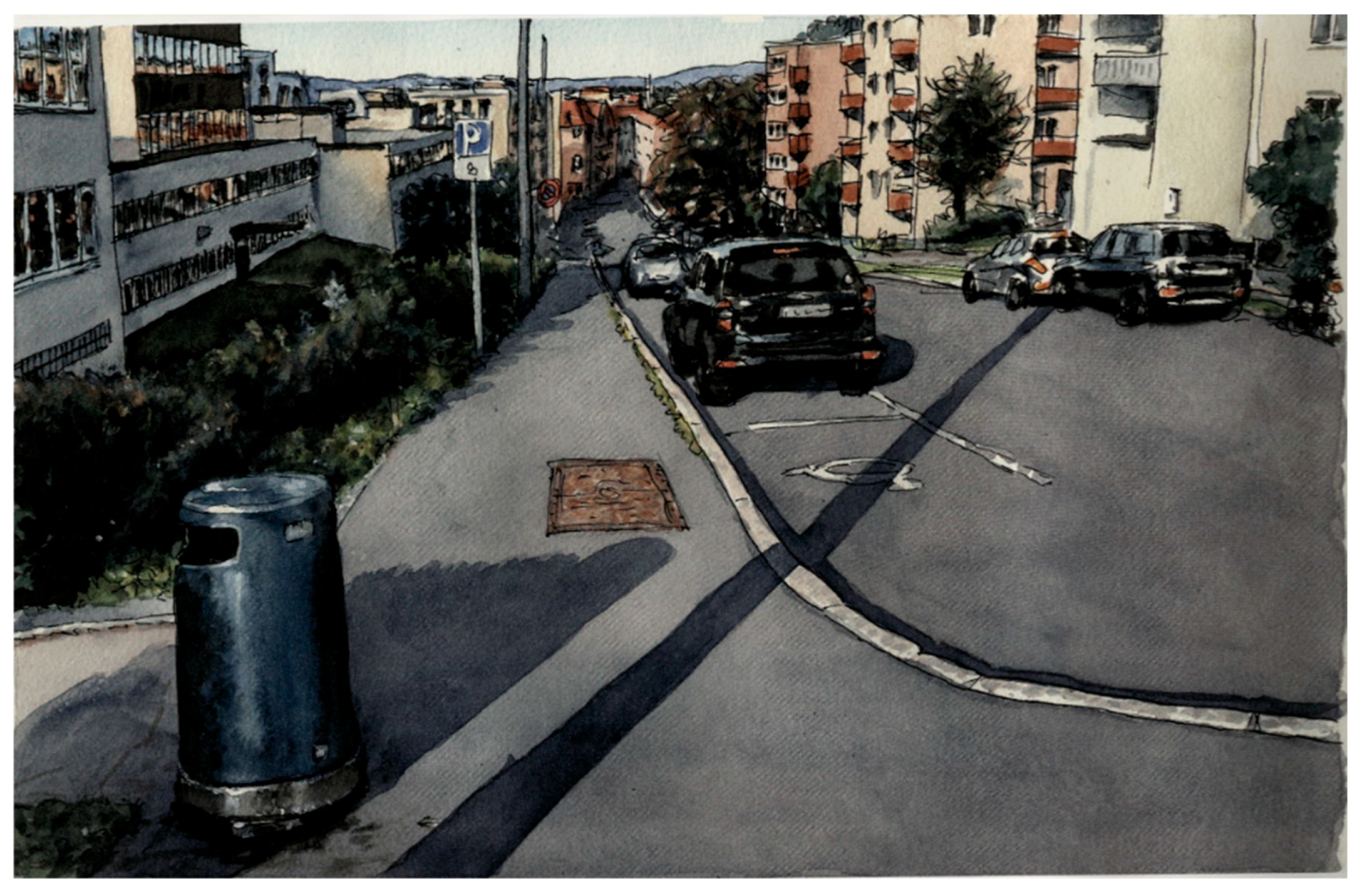
In addition, shadows play an immense role as motifs of numerous images, especially in the form of elongated cast shadows. These images show, for example, a forest path (see
Figure 4) that has a zebra pattern created by the numerous shadows of the surrounding trees; in another picture (see
Figure 5), the shadow of a street lamp cuts diagonally through the picture of a street, whereby the lantern itself cannot be seen and thus only has a presence in the picture as its shadow; there are also pictures showing shadows cast by garden fences, buildings, railings on park paths or in stairwells, and repeatedly by trees.
To be clear: it is only shadows—in its three versions of ‘cast shadow’, ‘attached shadow’, and ‘shading’
18—that allow vision to model space and thus allow us orientation and movement in space. Therefore, no illusionist painting or drawing can avoid imitating shadows iconically; art history has repeatedly pointed this out (
Stoichita 1997). In Kverneland’s images, too, the shadow is a
sine qua non of realistic painting, but he does more than that. He uses every means at his disposal to draw attention to this
sine qua non, to detach it from its merely functional role for the eye and to make it the centre of attention. And his first means is, of course, the title
Skygger/
Shadows that draws the reader’s attention to this indexical phenomenon.
A third form of indexically generated images are reflections on flat surfaces such as shop windows, mirrors and polished car bonnets. And so numerous pictures in the book show large puddles on the street, reflecting fragments of the sky and the surrounding trees. The book revolves around these three phenomena of photography, shadows, and reflections—all indices produced by light.
10. The Fear for Indexical Death
Then, one has to remember that indexicality in the last chapter of the comic is linked to trauma, as I have already shown above. There are only a few exceptions to the rule that the drawings are based on photographs.
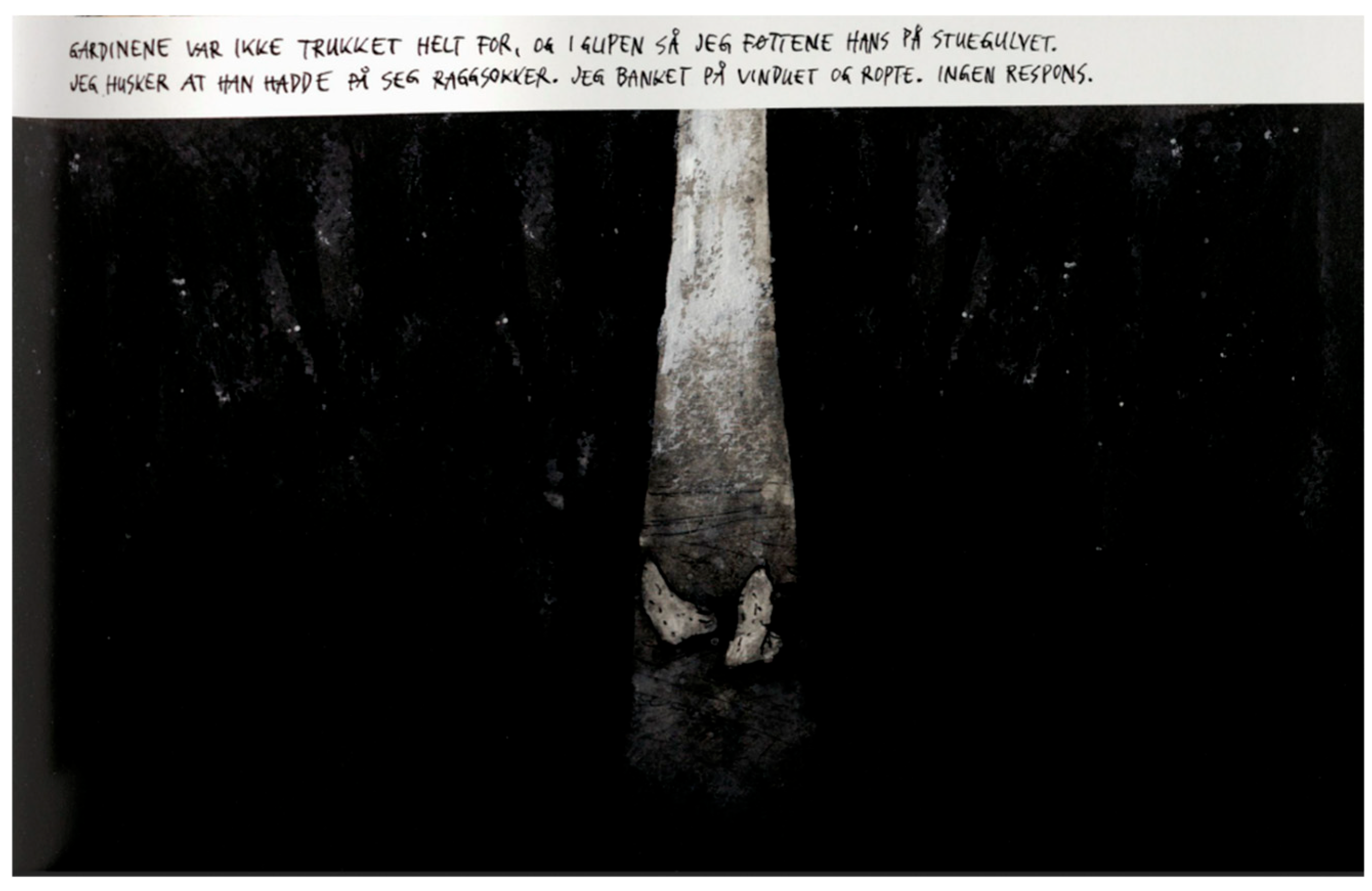
19 One of these exceptions can be found in the last chapter. There, only the text—not the images—tells the story of how Kverneland finds his dead brother: since his brother has not answered his phone calls as usual, Kverneland decides to go and see him. When his brother does not open the door, Kverneland climbs onto the balcony and looks through the window: “The curtains weren’t completely drawn, and through the gap I could see his feet on the living room floor. I remember that he was wearing wool socks. I knocked on the window and shouted. No response”
20 (
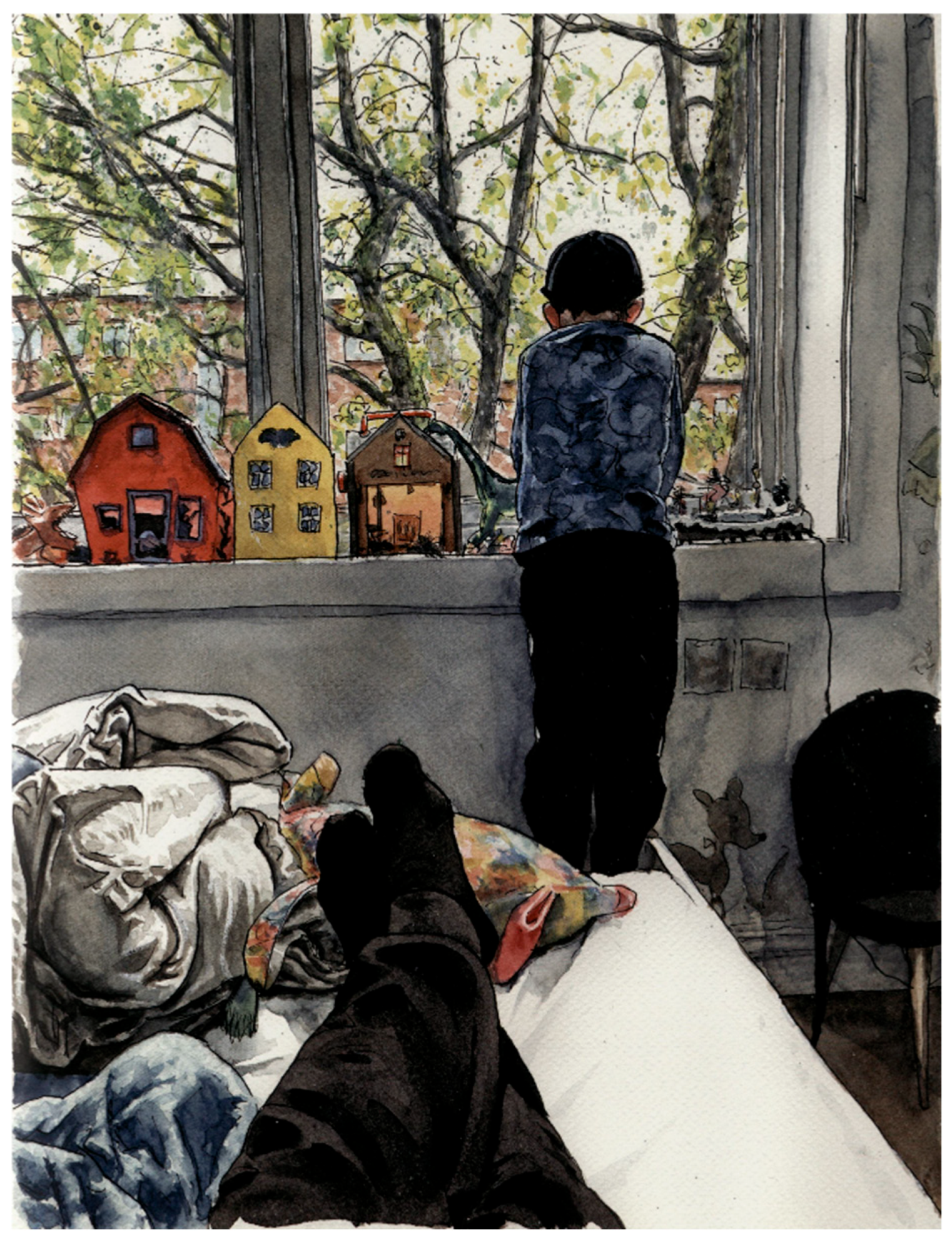
Kverneland 2023, p. 83). When the police break down the door, it becomes clear that the brother has been dead for several days. This narrative in the text is accompanied by images that are fragments of a scene that can be seen in its entirety on the last page of the chapter (see
Figure 6).
It shows Kverneland looking down at his own feet and then at the back of his son, who is about ten years old, as he looks out of the window of his bedroom at the sunlit leaves of a tree.
Jager (
2024, p. 140) has lucidly analysed the fragmentation of the scene as a traumatic breakdown of everyday perception. Among these coloured fragments appears a black and white image that is not part of the everyday scene in the child‘s bedroom but reaches back to the year 2000. It imitates the view through the curtains at the dead brother’s socks (see
Figure 7). So, it is the moment of shock. This drawing is special not only because it does not fit into the pictorial logic of the chapter (not part of the fragments, not coloured), but above all because it is clearly not based on a photograph. It is unthinkable that Kverneland would have his camera at the ready at the moment of shock and the paralysis that follows.
Of course, this drawing is an iconic sign that represents what was experienced, but the iconic potential is reduced to a minimum: two black surfaces, a white gap in between, and the socks. It is not so much the scene that Kverneland saw back in 2000, not the visual side of the event, but the experience itself; the picture mimics the shock: Everything that could potentially be iconic (the pattern and structure of the curtain and the floor in the apartment, the reflection effects on the window through which the viewer is looking, Kverneland’s hand pounding on the window…) is lost in the unrecognisable black and white of the surfaces; all that can be recognised is what was burned into the memory at the moment of shock: the socks. What is shown, then, is actually the trauma in its classical definition in Freud and the theoretical tradition that followed him:
21 the trauma is triggered by an event that overwhelms the subject to such an extent that it cannot be remembered (i.e., brought into an order and thus mastered) but which has been so deeply engraved in the subject’s unconscious that it comes to the surface of consciousness at the slightest provocation, to be finally processed, to be brought into order, to be able to be remembered. In the case at hand, this occasion is provided by the socks. Kverneland, in the peaceful everyday situation in his son’s bedroom, looks at his own socks, and this sight provokes the traumatic impression of his brother’s socks from the depths of his subconscious.
This finding can be translated into the semiotic terminology developed above: the peaceful everyday situation of
Figure 6 is based on a photograph, and thus on an indexical act; in the drawing, all indexical aspects of the photograph have been erased; what remains is an image that can be read entirely iconically. The moment has been (psychologically) mastered; consciousness has appropriated the moment as memory. In this form, however, the image has also lost any causal relationship to the real moment. As a drawing, the moment has been transferred into eternity; it can now be analysed and interpreted, enjoyed or ignored, by anyone: studium. To achieve this eternity, the moment had to die an iconic death. The moment has become an image and has thus become autonomous from the situation in which it arose.
This eternalisation is not possible in the case of the inscription of the traumatic moment in memory. Even after the transformation of the socks in
Figure 7, the iconic could only take the lead to a very small extent; instead, the indexicality of the moment, the traumatising contact with the memory, remains intact and uncontrollable for the subject. The indexical keeps the death of the brother alive! This paradoxical formulation shows that the indexical has the potential to threaten the subject. It provokes a punctum that haunts the subject again and again. It is telling, as
Langås (
2016, p. 98) has pointed out, that the word ‘punctum’ is the Latin equivalent of the Greek ‘trauma’. Ulrich Baer also confirms this connection in his photography theory when he starts with “the constitutive breakdown of context that, in a structural analogy to trauma, is staged by every photograph” (
Baer 2002, p. 11). He recognises the analogy between photography and trauma in their shared indexicality. Both leave traces of themselves in their medium—on light-sensitive photographic paper or in the subconscious of the traumatised person—which is why Baer also calls trauma “a kind of index of a historical reality” (
Baer 2002, p. 11).
The juxtaposition of the two images (
Figure 6 and
Figure 7) in the last chapter of
Skygger thus shows that the emotional charge of the semiotic terms is ambivalent: iconic death can pacify; it guarantees mastery of what is remembered; indexical death, on the other hand, can mean imprisonment in trauma. In other words, the final chapter of
Skygger provides a reason why the indexical should be avoided.
11. Indexical Consolation
By emphasising the indexical as photography, shadow or reflection on each of its pages, but then exposing the indexical as a threatening, potentially traumatising punctum in the final chapter, the comic can be read as a defence against the indexical. This explains why a book about trauma, terror, pandemic and war begins with a chapter about its aesthetic process, which consists of transforming photographs into drawings. This iconisation is intended to prevent the traumatising potential of the index from unfolding. Kverneland makes it clear that he is gaining an ever better understanding of the image in the process of iconification—“I have to study and analyse every little detail”
22 (
Kverneland 2023, p. 12)—a clear indication that the drawing allows for studium. This understanding takes away the potential shock of the punctum. Kverneland calls the result a ‘reimagination’ (gjendiktning). That is, when he looks at the figures in his drawing at the end of the chapter and says, “The hopelessness, the despair, the hollow cheeks, the resignation in their eyes. Death, which may already have them in its sight.”
23 (see
Figure 2), then this death is an element of his (re)imagination. The observers of the drawing—we—are the death that gazes at the figures and selects them. But these figures have lost all connection to the prisoners of war of the Mauthausen concentration camp. They have become figures of art that can even take on new roles—for example, those of prisoners in a camp on Risøy; even there they can play the part of the doomed.
Kverneland narrates another defence against the indexical in the chapter that extends from page 29 to 37. On the first four pages, he shows the aforementioned puddles with their indexical reflection of sky and trees. The remaining five pages show Kverneland’s son Aksel, who, equipped with red rubber boots, jumps into the puddles, thereby dispersing every iconic reflection.
What about the numerous shadows? They, too, seem sinister on most pages, especially in the black-and-white drawings in the chapter on the coronavirus pandemic. The streets are deserted, there are no cars on the road, and if you meet another person, you keep your distance. But there is another shadow image that has a very different character: a serene forest path in colour (see
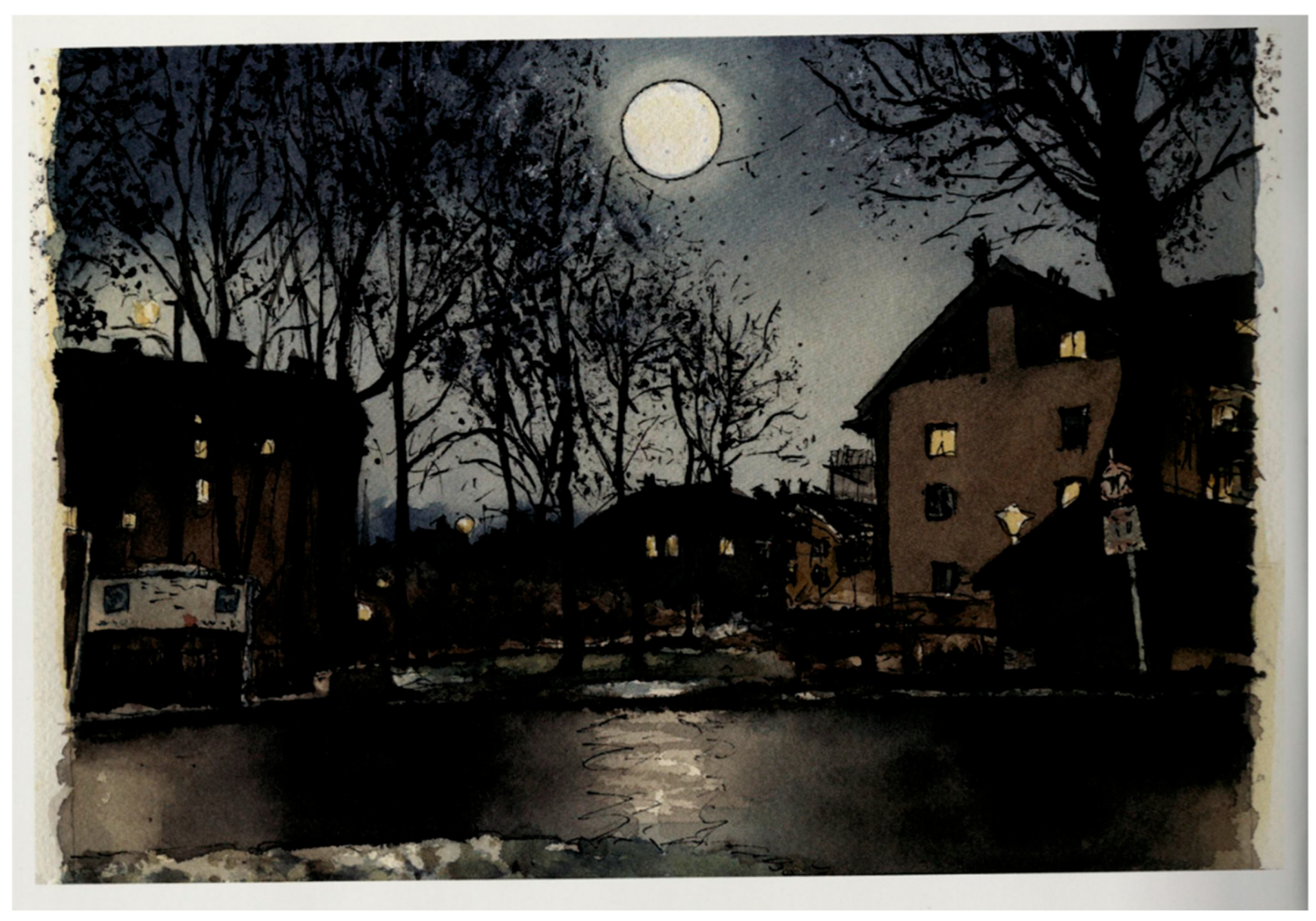
Figure 4). These two pages are surrounded by two black pages, thus forming a chapter of their own, i.e., it forms a hopeful prelude chapter before the chapter about the aesthetic strategies and the then steadily darkening chapters until the traumatising death of the brother. But the back inside cover repeats the hopeful forest scene from the beginning. One could therefore say that the dark episodes are framed by hopeful shadow images. So, does Kverneland’s comic point to another side of the indexical that is not confronted with death? One chapter is particularly revealing in this regard. It consists of only one page, showing a picture of a rain-soaked street with trees and houses with lit windows in the night-like darkness of a Norwegian autumn afternoon. The eye is drawn to the pale full moon (see
Figure 8).
The text accompanying this image reads as follows:
We were on our way home from kindergarten. I pointed up at the sky and said, ‘Look, Aksel! There’s the moon!’/He was very impressed; he hadn’t seen it before. We walked along the little blind alley. Houses and trees flew by, but the moon hung there, unshakeable. ‘Look, Dad! It’s following us!’.
24
The picture is sombre in mood, like so many of the images of catastrophe in
Skygger; but the text does not support this mood. It tells of the amazement of a child perceiving the moon for the first time. The signs of the indexical, which the drawing addresses, are again shadows (the shadows of the night), reflections (the rain-slicked road) and photography (the template for the drawing). But the picture shows another indexical sign: the light of the moon does not radiate from itself but is a reflection of sunlight. The moon is thus depicted as an indexical sign that the sun, its light, its warmth, and its colour-giving power are still there. Yes, even more. The image of the moon becomes a secular hope
25 of an “unshakeable” (“urokkelig”) companion: All the dark indexical signs with their connotation of death, the shadows, the reflections, and the photographs must not necessarily be seen as signs of the anthropological fact of death; they can also be seen as hopeful signs of the much stronger power of light, because they are effects of light. Shadows are only “holes in the light” (
Baxandall 1995, p. 2) and thus signs of their opposite, and puddles on the road allow us to see the sky even when we bow our heads in grief and sorrow. In an ambivalent way, the indexical marks not only death but also life.
The aesthetic strategy that Kverneland develops on the first pages of his graphic essay using a photograph from World War II can be understood as a transformation of indexicality into iconicity, from affect to understanding, from punctum to studium. The fact that Kverneland starts from a picture of Soviet prisoners of war shows that remembering World War II has the function of a litmus test in current artistic discourse. The traumas of the 1940s have become canonical. Precisely for this reason, they can be used as test cases against which the handling of current crises must be measured.
In her review of
Skygger, Una Gjerde describes her reading experience as follows: “In this meaningless existence, I found, to my own surprise, comfort in Steffen Kverneland’s latest release,
Skygger”
26 (
Gjerde 2023). What Gjerde experienced was the ambivalent game of life and death that Kverneland coaxes out of the semiotic potential of his images: iconic eternity and mummification—indexical touch and the burden of mortality. Choosing between an indexical and an iconic reading of one and the same sign can become a question of existential dimensions. Steffen Kverneland’s
Skygger poignantly revolves around this existential dimension of semiotic concepts. In doing so, the comic helps us to widen the semiotic horizon that memory studies have drawn with their examination of photographs of the Holocaust and Second World War.