

Article

Family Income and Student Educational and Cognitive Outcomes in China: Exploring the Material and Psychosocial Mechanisms


1
Department of Sociology, University of Utah, Salt Lake City, UT 84112, USA
2
Department of Sociology, Renmin University of China, Beijing 100872, China
3
Department of Geography, University of Utah, Salt Lake City, UT 84112, USA
4
Department of Health Promotion, Center for Reducing Health Disparities, University of Nebraska Medical Center, Omaha, NE 68198, USA
*
Authors to whom correspondence should be addressed.
Soc. Sci. 2020, 9(12), 225; https://doi.org/10.3390/socsci9120225
Submission received: 2 November 2020 / Revised: 25 November 2020 / Accepted: 1 December 2020 / Published: 7 December 2020
(This article belongs to the Special Issue Social Stratification and Schooling)

Abstract

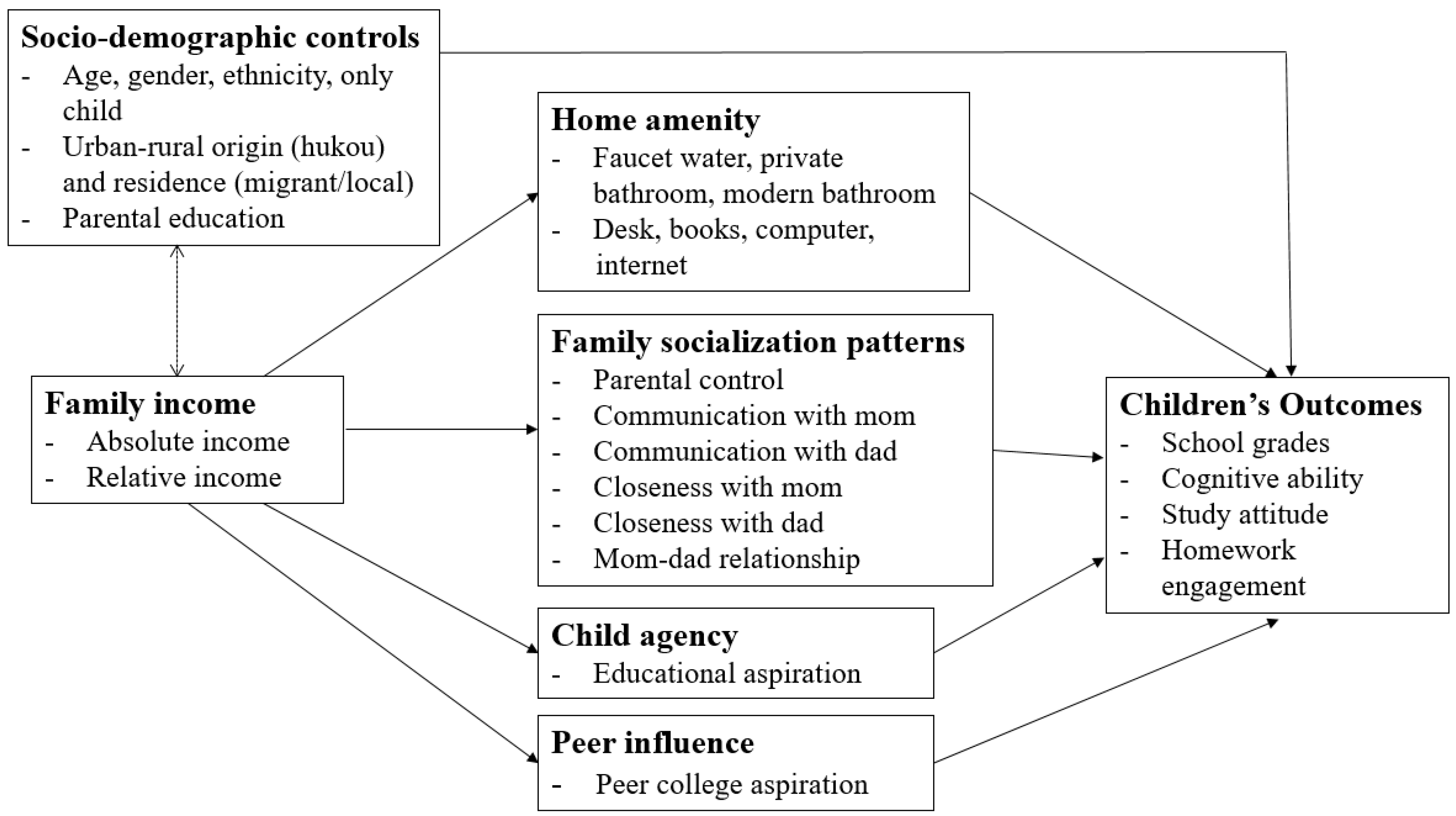
Leveraging data from a nationally representative school-based adolescent survey, the current study aimed to provide a comprehensive assessment of how family income is associated with multiple cognitive and educational outcomes in China and examine the underlying material and psychosocial mechanisms. We found robust associations of family income with school grades, cognitive ability, and study attitude, but not with homework engagement. Moreover, we found that home amenities, i.e., measuring home-based material resources, played the largest mediating role in explaining family income effects on cognitive ability and study attitude. Among the non-monetary or intangible intervening factors, children’s own and peers’ educational aspirations along with mother-child communication were the most important mechanisms. To a lesser extent, family income effects were also attributable to harmonious parent-child and between-parent relationships. The key take-home message is that home environments constitute a prominent setting outside of school exerting powerful influences shaping school outcomes for Chinese adolescents. Our study contributes to a better understanding of how family economic resources are transmitted to children’s cognitive and educational advantages via home material resources, family non-monetary features, children’s agency, and peer influence. Policy implications and future research are discussed.
Keywords: family income; cognitive ability; academic performance; homework engagement; study attitude; China family income; cognitive ability; academic performance; homework engagement; study attitude; China


